Facebook Instagram Youtube Twitter

Thermal insulation materials testing

Learn about the essential tests used to evaluate the performance and safety of thermal insulation materials in various industries.
Thermal insulation materials testing

Introduction to Thermal Insulation Materials Testing

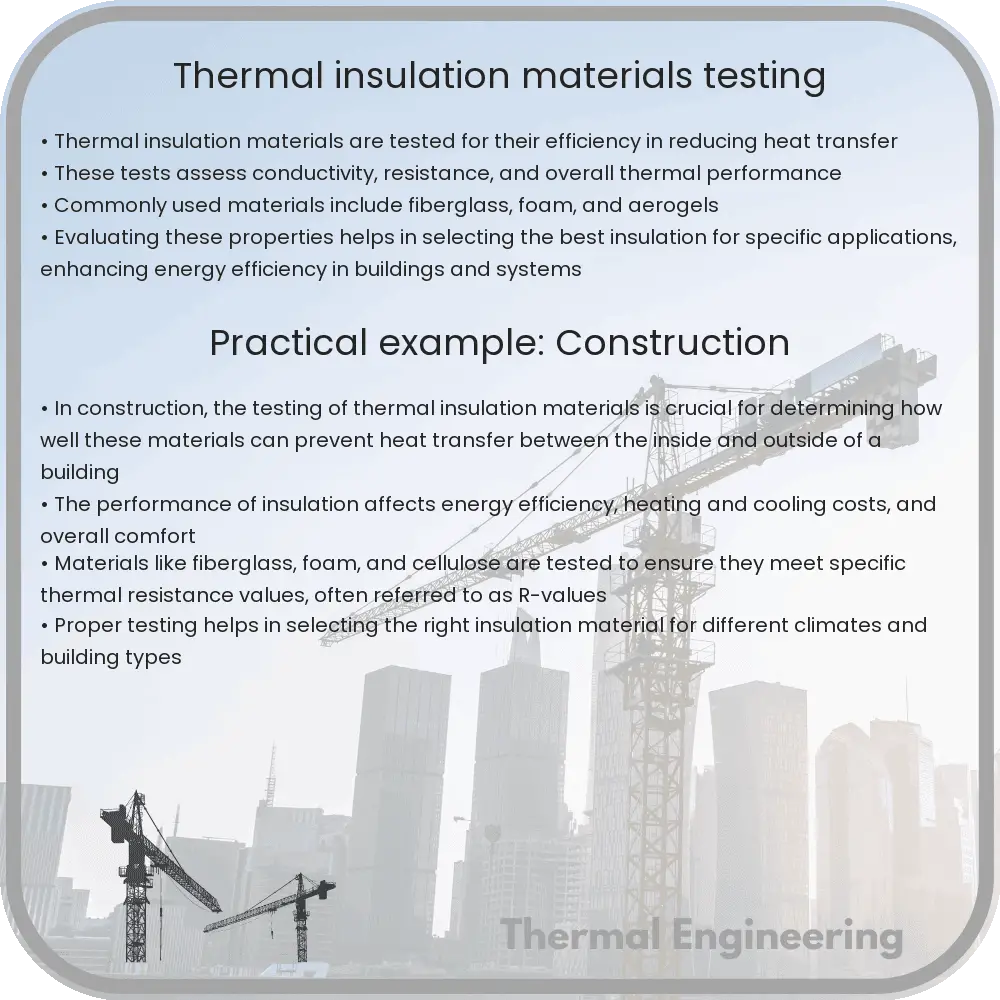
Thermal insulation materials play a crucial role in reducing the exchange of heat between an object and its environment. They are key components in building construction, automotive industries, and various other sectors. By enhancing energy efficiency and optimizing thermal control, these materials significantly contribute to sustainability. Testing these materials is essential to ensure they meet specific standards and requirements for thermal performance and safety.

The Importance of Testing Thermal Insulation Materials

Effective testing of thermal insulation materials ensures that they can maintain comfort in buildings, protect equipment from heat damage, and save on energy costs. It also ensures compliance with international and regional standards. By confirming the material’s thermal resistance, flammability, and durability, industries can guarantee safety, efficiency, and cost-effectiveness in their applications.

Types of Tests for Thermal Insulation Materials

  • Thermal Conductivity Testing: This test measures how well a material conducts heat. It often uses a guarded hot plate or heat flow meter apparatus to measure the rate of heat flow through the insulation material.
  • Thermal Resistance Testing: Also known as R-value testing, it measures the material’s ability to resist heat flow. The higher the R-value, the better the insulation properties.
  • Flammability Testing: This assesses how easily the material can catch fire and how it behaves when it does. Tests include surface flammability, material flammability, and fire resistance testing.
  • Hot Surface Performance Testing: This evaluates how insulation material behaves when applied to hot surfaces, which is particularly relevant in industrial applications.
  • Moisture Vapor Transmission: This test evaluates how much water vapor a material allows to pass through. It is crucial for understanding how insulation will perform in humid conditions.
  • Ageing Test: To understand how the properties of thermal insulation may change over time when exposed to various environmental conditions.

Standards and Regulatory Frameworks

Different standards are used globally to guide the testing and application of thermal insulation materials. These include:

  1. ASTM International Standards: covering a wide range of insulation materials and methods for testing thermal insulation properties.
  2. ISO Standards: such as ISO 8302, which specifies the determination of steady state thermal resistance and related properties of thermal insulation products.
  3. IEC Standards: used primarily for electrical applications, ensuring that thermal insulation also meets electrical safety requirements.

Future Trends in Thermal Insulation Testing

The development of new materials such as aerogels and vacuum insulation panels (VIPs) emphasizes the need for updated testing methodologies. Additionally, the focus on sustainability and reducing carbon footprints is likely to shape future standards and testing protocols for thermal insulation materials.

As we move forward, the dynamic changes in climate and technology will continually redefine what is required of thermal insulation. Updated and rigorous testing will ensure that these materials can meet the evolving demands, providing safer, more efficient, and environmentally friendly insulation solutions.

Heat transfer in underfloor heating

Learn how underfloor heating systems use conduction, convection, and radiation to efficiently heat spaces.

Heat transfer in underfloor heating

Understanding Heat Transfer in Underfloor Heating Systems

Underfloor heating is an efficient and increasingly popular method of heating homes and buildings. Unlike traditional radiators that heat the air around them, underfloor heating provides radiant heat that warms up the room from the floor upwards. This article explores the mechanisms of heat transfer involved in underfloor heating and how these systems use these principles to efficiently heat a space.

Types of Underfloor Heating Systems

There are primarily two types of underfloor heating systems: water-based (hydronic) and electric. Hydronic systems circulate warm water through pipes laid beneath the floor, while electric systems use electrical cables or heating mats. Despite the difference in heat sources, both systems operate on similar principles of heat transfer.

Principles of Heat Transfer

Heat transfer in underfloor heating systems involves three primary mechanisms:

  • Conduction
  • Convection
  • Radiation

Conduction is the process through which heat moves through materials. In underfloor heating, heat is conducted from the warm pipes or heating elements through the floor material, gradually warming up the entire surface area of the floor.

Convection occurs when the warm floor heats the air in contact with it, causing this air to rise and circulate naturally within the room. This helps distribute the heat evenly throughout the space.

Radiation refers to the transfer of heat in the form of infrared radiation which directly heats objects and people in the room, rather than heating the air around them. This form of heat transfer is particularly effective in creating a comfortable environment, as it reduces the temperature swings typically associated with forced air heating systems.

Design Considerations for Effective Heat Transfer

The effectiveness of underfloor heating largely relies on proper system design and installation. Key considerations include:

  • The type and thickness of floor materials, as different materials have different conductive properties.
  • The spacing and layout of the heating pipes or cables, to ensure even heat distribution.
  • The operating temperature of the system, which should be optimized for the specific setup.
  • Insulation beneath the heating elements to prevent heat loss downwards, improving efficiency.

Especially in hydronic systems, the water temperature and flow rate must be carefully calibrated to match the thermal properties of the floor and the heating needs of the space.

Energy Efficiency and Heat Transfer

Underfloor heating systems excel in energy efficiency due to how they heat the space. The even distribution of heat from the floor itself allows these systems to operate effectively at lower temperatures than traditional radiators, reducing energy consumption. Furthermore, the radiant nature of the heat produced minimizes the heat loss typically associated with air drafts, making underfloor heating an efficient choice for keeping a home warm.

Overall, the principles of heat transfer played out within underfloor heating systems form the backbone of their operations, making them not only effective at heating but also a preferred choice in terms of energy consumption and comfort.

Thermal analysis of electric motors

Learn about thermal analysis of electric motors, key to optimizing motor performance, efficiency, and safety.

Thermal analysis of electric motors

Introduction to Thermal Analysis of Electric Motors

Electric motors are fundamental to almost every industry, powering systems from household appliances to industrial equipment. While these motors are generally efficient, they convert a portion of electrical energy into heat due to electrical and mechanical losses. Managing this heat is crucial as excessive temperature rise can lead to reduced efficiency and lifespan or even premature failure of the motor. This is where thermal analysis comes into play. This process assesses the heat generation and dissipation within the motor, ensuring that it operates within safe temperature limits.

Why is Thermal Analysis Important?

Thermal analysis of electric motors is essential for several reasons:

  • Performance Efficiency: High temperatures can decrease the efficiency of the motor. Temperature can affect the resistance of the electrical windings, with higher resistance resulting in higher power losses.
  • Reliability and Durability: Continuous excessive heating can deteriorate insulation materials and other critical components, which compromises the motor’s reliability and lifespan.
  • Safety: Overheating can lead to hazardous situations, including fires. Thus, thermal analysis ensures the motor and its surroundings are safe under various operational conditions.

Thermal Model of Electric Motors

A simplified thermal model of an electric motor typically considers heat generation and heat transfer components. The heat sources in an electric motor include:

  • Joule Heating: Heat generated due to resistance to current flow in motor windings, generally calculated by \(P = I^2 * R\) where \(I\) is the current and \(R\) is the resistance.
  • Iron Losses: Include both hysteresis and eddy current losses in the motor’s magnetic core.
  • Friction Losses: Heat arising from mechanical friction and air resistance.
  • Stray Load Losses: Additional losses due to leakage inductance and irregularities in the magnetic field.

For heat dissipation, electric motors typically rely on mechanisms such as:

  • Conduction: Transfer of heat through motor components.
  • Convection: Cooling via air or liquid around the motor casing.
  • Radiation: Emission of heat in the form of infrared radiation.
  • Use of Heat Exchangers: Additional devices like fans or cooling jackets to enhance heat dissipation.

Methods of Thermal Analysis

Thermal analysis of electric motors can be conducted using several approaches:

  • Computational Fluid Dynamics (CFD): A numerical analysis method that simulates fluid flow (air or cooling fluids) and heat transfer within and around the motor.
  • Finite Element Analysis (FEA): Uses a computational model to predict how the motor components will react to thermal stresses and heat flows.
  • Thermal Cameras and Sensors: Direct measurement methods that use infrared cameras and temperature sensors to monitor operational heat generation and dissipation.
  • Empirical Testing: Running the motor in controlled settings to gather data on how it heats under various conditions and operational stresses.

Challenges in Thermal Analysis

Despite the importance of thermal analysis, there are several challenges that need to be addressed:

  • Complex Geometries: Electric motors often have complex parts and assemblies which can make it difficult to accurately model and analyze them.
  • Varying Load Conditions: The operational conditions and load impact motor temperature differently, and modeling all possible scenarios is computationally intensive.
  • Material Properties: Accurate characterization of material properties under different temperature and operational conditions is necessary, yet challenging.
  • Integration with Electrical and Mechanical Systems: A comprehensive analysis often requires simultaneous consideration of electrical, thermal, and mechanical aspects, adding to the complexity.

Conclusion

Thermal analysis of electric motors is a crucial aspect of design and maintenance which assures performance, reliability, and safety. Advances in computational methods and better sensor technologies are continually improving the effectiveness of thermal management systems. As electric motors continue to play a vital role in technology and industry, optimizing their thermal performance remains a key focus for both engineers and researchers.

Boiling heat transfer enhancement

Guide to enhancing boiling heat transfer efficiency in various engineering applications for improved thermal management systems.

Boiling heat transfer enhancement

Understanding Boiling Heat Transfer Enhancement

Boiling heat transfer is a process where heat is efficiently transferred from a solid surface to a liquid causing the liquid to boil. In engineering applications, enhancing this process is vital, as it can lead to significant improvements in the efficiency of energy systems, including power generation and cooling technologies. This article explores the methods and technologies used to enhance boiling heat transfer and their applications in various engineering fields.

Basic Mechanisms of Boiling Heat Transfer

Boiling heat transfer involves the transfer of heat from a hotter surface to a boiling liquid, leading to the formation and release of vapor bubbles. This process can be categorized into two main types:

  • Nucleate Boiling: This occurs at moderate surface temperatures and is characterized by the vigorous formation of vapor bubbles at discrete points on the heated surface.
  • Film Boiling: At higher surface temperatures, a continuous film of vapor forms between the surface and the liquid, which tends to decrease the rate of heat transfer.

Enhancing boiling heat transfer typically focuses on increasing the efficiency of nucleate boiling since this mode offers higher heat transfer coefficients.

Techniques for Enhancing Boiling Heat Transfer

Several techniques can be employed to enhance the boiling heat transfer, which include:

  1. Surface Modification: Altering the surface characteristics (such as roughness or wettability) can significantly impact bubble dynamics. Techniques such as sandblasting, coating, or etching are used to increase the number of active nucleation sites, thereby enhancing heat transfer.
  2. Additives in Boiling Fluid: Adding particles like nanoparticles (nano-fluids) or surfactants to the boiling fluid can alter the boiling dynamics. These additives can change the thermal conductivity of the fluid and the surface tension, which in turn affects the bubble generation and detachment.
  3. Vibration: Applying mechanical vibrations to the system can enhance heat transfer by promoting the detachment and formation of bubbles.
  4. Electric or Magnetic Fields: Using electric or magnetic fields has been shown to affect the boiling process. Electric fields can influence bubble formation and detachment, whereas magnetic fields can be used with ferrofluids to control heat transfer properties.

Each of these techniques can be tailored to specific applications, depending on the requirements of the system and the properties of the boiling fluid.

Applications of Enhanced Boiling Heat Transfer

Enhanced boiling heat transfer is crucial in several key industries:

  • Electronics Cooling: In high-performance computing and electronics, efficient heat removal is necessary to maintain operational stability and prevent overheating. Enhanced boiling techniques can improve the effectiveness of cooling systems used in these technologies.
  • Power Generation: In power plants, especially in nuclear reactors, efficient heat transfer is crucial for safety and operational efficiency. Enhancing the boiling process helps in achieving higher thermal efficiencies and better cooling processes.
  • Refrigeration: Enhanced boiling processes are also used in refrigeration to increase the efficiency of heat exchangers and cooling units, reducing energy consumption and improving performance.
  • Desalination: In thermal desalination processes, enhanced heat transfer can improve the efficiency and output of freshwater production, which is vital in arid regions.

In conclusion, boiling heat transfer enhancement plays a pivotal role in the advancement of various engineering domains through increased efficiency and performance in thermal management systems. Continuous research and technological improvements are driving this field towards more sustainable and effective solutions, contributing to advancements in energy systems, electronic applications, and environmental management.

Microchannel heat exchanger optimization

Learn about optimizing microchannel heat exchangers for enhanced performance and efficiency in modern thermal systems.

Microchannel heat exchanger optimization

Understanding Microchannel Heat Exchanger Optimization

Microchannel heat exchangers are pivotal in modern heating, cooling, and refrigeration systems, known for their exceptional heat transfer efficiency and compact size. These devices feature small channels through which fluids circulate, allowing for rapid heat exchange with minimal material usage. Optimization of these systems is crucial to achieving higher performance and efficiency while reducing costs and material use.

Fundamentals of Microchannel Heat Exchanger Design

The design of microchannel heat exchangers involves several critical parameters that are optimized to improve performance. These include the hydraulic diameter, flow arrangement, and the material of construction. The hydraulic diameter must be minimized to enhance the heat transfer coefficient but sufficiently sized to keep pressure drops to a manageable level.

  • Hydraulic Diameter: The hydraulic diameter is a critical factor in optimizing heat transfer and fluid flow. It is calculated as four times the cross-sectional area for flow divided by the wetted perimeter.
  • Flow Arrangement: Common arrangements include counterflow, crossflow, and parallel flow, each having different advantages in terms of heat transfer efficiency and pressure drop.
  • Material Selection: Materials such as aluminum or copper are typically used due to their high thermal conductivity, which aids in the efficient transfer of heat.

Thermal and Fluid Dynamic Considerations

The optimization of a microchannel heat exchanger also involves balancing the heat transfer with fluid dynamics to prevent excessive pressure drops, which can negatively affect system performance and increase operating costs.

Key considerations include:

  1. Minimizing Pressure Drop: This involves designing channels that are not too small, which can cause high resistance to flow and result in greater energy consumption in pumps or fans.
  2. Maximizing Heat Transfer: The heat exchanger should be designed to maximize the surface area in contact with the fluid, which can be achieved through various fin and microchannel designs.
  3. Optimizing Channel Geometry: The shape and dimensions of the channels significantly impact both the heat transfer rate and the fluid flow characteristics. Rectangular and triangular channels are common.

Advanced Techniques in Optimization

With advancements in technology, several sophisticated methods have become available to further optimize microchannel heat exchangers:

  • Computational Fluid Dynamics (CFD): CFD simulations are extensively used to predict the flow and heat transfer in microchannels and to experiment with different designs before physical models are built.
  • Machine Learning: Machine learning algorithms can analyze vast amounts of data from simulations and operational use to suggest improvements in design and operation.
  • Multi-objective Optimization: This approach balances various competing objectives, such as minimizing the size and cost while maximizing the heat transfer efficiency.

Conclusion

Optimizing microchannel heat exchangers involves a delicate balance between maximizing heat transfer and minimizing pressure drops, all while considering factors like material choice and channel geometry. With the integration of computational tools and advanced materials, these systems continue to evolve, offering greater efficiency and performance in thermal management systems. By understanding and applying these principles, engineers can design more effective and economical thermal systems.

Heat transfer in welding processes

Learn about the modes of heat transfer in welding and their impact on weld quality and material properties.

Heat transfer in welding processes

Understanding Heat Transfer in Welding Processes

Welding is a critical process in both manufacturing and construction, enabling the joining of materials, usually metals or thermoplastics, by causing coalescence. This is typically done by melting the workpieces and adding a filler material to form a pool of molten material that cools to become a strong joint. The efficiency and quality of a welding join depend significantly on how heat is transferred during the process. Let’s explore the basics of heat transfer in welding and its implications on the welding quality and properties of the material.

Types of Heat Transfer in Welding

There are three primary modes of heat transfer involved in welding:

  • Conduction: Heat moves through the material from the area of higher temperature near the weld to the surrounding metal, which is cooler. The rate of heat conduction depends on the thermal conductivity of the material and the temperature gradient.
  • Convection: In welding, convection can occur in the molten weld pool as the hotter molten metal rises and the cooler metal descends. This mode is influenced by the fluid properties of the molten pool and the welding environment.
  • Radiation: Heat is also transferred via electromagnetic waves and can be significant at high temperatures when welding metals like steel.

Key Equations in Heat Transfer for Welding

Understanding the heat flow during the welding process is crucial for predicting the temperature distribution, cooling rates, and the resulting microstructure of the weld. The basic equation governing conduction of heat in solids is Fourier’s Law:

q = -k * ∇T

where q represents the heat flux, k is the thermal conductivity of the material, and ∇T is the temperature gradient.

In the context of a moving heat source like welding, the distribution of temperature can also be approximated using Rosenthal’s equation for a point source in an infinite medium:

T(x) = (q / (2 * π * k)) * (1 / r) * exp(-v * r / (2 * α))

Here, T(x) is the temperature at a point x, q is the heat input, r is the distance from the heat source, v is the speed of the welding torch, and α represents the thermal diffusivity of the material.

Effects of Heat Transfer on Weld Quality

The way heat is transferred during welding significantly affects the quality and characteristics of the weld. Some key influences include:

  • Weld Penetration: Effective heat transfer determines the depth of the weld penetration, which is critical for the strength of the weld.
  • Cooling Rate: The rate at which the weld cools can affect the microstructure of the welded materials, impacting mechanical properties such as hardness, strength, and toughness.
  • Distortion and Stresses: Uneven or excessive heat can lead to warping, distortion, or residual stresses in the welded structure, potentially leading to structural failures.
  • Heat-Affected Zone (HAZ): The area around the weld undergoes thermal cycles but doesn’t melt. The properties of this zone can be markedly different from both the base material and the weld metal due to microstructural changes.

Conclusion

Heat transfer in welding is a complex yet fascinating subject that plays a significant role in determining the effectiveness and quality of a weld. By understanding and controlling heat transfer, welders can prevent defects such as cracks, unwanted stresses, and ensure the weld is strong and durable. This knowledge is not only crucial for improving welding techniques but also for advancing materials engineering as a whole.

Thermal management in LED lighting

Learn about the importance of thermal management in LED lighting, focusing on heat dissipation methods and design solutions for efficiency.

Thermal management in LED lighting

Understanding Thermal Management in LED Lighting

LED lighting has transformed the way we illuminate our environments. Not only are LEDs more efficient than traditional light bulbs, but they also offer longer operational lifetimes and better environmental performance. However, one of the critical challenges in LED technology is thermal management. Effective heat management is crucial because it significantly impacts the efficiency, performance, and longevity of LED lights.

Why is Thermal Management Important in LEDs?

LEDs convert electricity into light, but not all the electrical energy is converted into visible light; a significant portion is converted into heat. If this heat is not managed properly, it can lead to overheating, which affects the LED’s performance and durability. Specifically, excessive heat can result in:

  • Color shift: Changes in color output of the LED as temperature changes.
  • Reduced life span: Premature aging and failure of LEDs.
  • Decreased efficiency: Lower light output per watt of electricity consumed.

Methods of Heat Dissipation in LED Systems

To combat the negative effects of heat, several methods are employed to dissipate heat effectively from LED systems:

  1. Heat Sinks: Perhaps the most common solution, heat sinks are materials attached to the LED device to absorb and disperse heat. Materials with high thermal conductivity like aluminum are typically used.
  2. Thermal Interface Materials (TIMs): These materials enhance the thermal coupling between heat sources and heat sinks. They include thermal pastes, adhesive tapes, and phase change materials, which fill air gaps and thus reduce thermal resistance.
  3. Fans: In some high-power LED applications, active cooling methods such as fans are used to force air circulation around the LED to enhance heat dissipation.
  4. Heat Pipes: Utilized in high-performance LED lighting systems, heat pipes transfer heat from the LED chip to an external heat exchanger efficiently.

Thermal Management Solutions in Design

Engineering design plays a crucial role in integrating thermal management into LED devices. Here are some strategies used:

  • PCB Design: Designing the printed circuit board (PCB) to spread heat evenly and rapidly away from the LED chip.
  • Component Placement: Strategic placement of thermally-sensitive components away from heat sources to minimize thermal stress.
  • Housing Materials: Using materials for the LED housing that aid in heat dissipation. Metals are commonly employed for their excellent thermal conduction properties.

In conclusively ensuring that an LED system has a robust thermal management solution involves understanding both the material science and the engineering design principles critical to heat dissipation. With advancements in technology and materials, managing heat in LED lighting systems will continue to evolve, leading to even more efficient and longer-lasting LEDs.

Laminar flow heat transfer

Learn about laminar flow heat transfer in engineering, crucial for thermal management in aerospace, automotive, and HVAC sectors.

Laminar flow heat transfer

Understanding Laminar Flow Heat Transfer in Engineering

Laminar flow heat transfer is a critical concept in the field of thermal engineering. It describes the way heat is transferred between a surface and a fluid flowing in layers, without mixing across those layers. This phenomenon is especially important in designing equipment and processes in industries like aerospace, automotive, and HVAC (heating, ventilation, and air conditioning).

What is Laminar Flow?

Laminar flow occurs when a fluid flows in parallel layers, with no disruption between the layers. This type of flow is characterized by smooth streamlines and regular paths, typically occurring at lower velocities and higher viscosities. In terms of heat transfer, laminar flow can greatly influence the rate and efficiency of heat being transferred from one surface to another.

Basic Principles of Heat Transfer in Laminar Flow

Heat transfer in laminar flow is predominantly conducted through the fluid layers. The basic equation for this process is derived from Fourier’s Law of Heat Conduction, which can be expressed as:

Q = -k * A * (dT/dx)

  • Q represents the heat transfer rate in watts (W).
  • k is the thermal conductivity of the fluid (W/m*K).
  • A is the surface area through which heat is being transferred (m2).
  • dT/dx is the temperature gradient in the direction of flow (K/m).

This equation shows that heat transfer increases with higher thermal conductivity, larger surface area, and steeper temperature gradient.

Factors Affecting Laminar Flow Heat Transfer

Several factors impact the effectiveness of heat transfer in a laminar flow regime:

  1. Fluid Viscosity: Higher viscosity impairs the movement of fluid layers, potentially reducing the heat transfer rate.
  2. Fluid Velocity: While higher velocities can disrupt laminar flow, modifying the flow speed thoughtfully can optimize heat transfer rates without transitioning to turbulent flow.
  3. Surface Temperature: Variations in surface temperature can affect the temperature gradient driving the heat transfer.

Applications of Laminar Flow Heat Transfer

The principles of laminar flow heat transfer are utilized in many practical applications:

  • Microchannel Heat Exchangers: These devices feature small channels through which heat transfer fluids flow, taking advantage of laminar flow for high efficiency.
  • Electronic Cooling Systems: Many electronic devices use laminar flow heat transfer principles to manage heat, thus preventing overheating and ensuring performance.
  • Aerospace: In high-altitude environments, controlled laminar flow can be crucial for regulating the temperatures of aerospace vehicles.

Challenges and Future Perspective

While laminar flow allows for stable and efficient heat transfer, it has its limitations. One major challenge is its susceptibility to becoming turbulent with increased flow rates or reduced viscosities. This transition can disrupt heat transfer efficiency. Ongoing research in the field aims to enhance our understanding of laminar flow dynamics and to develop new materials and technologies that stabilize laminar flow and optimize heat transfer rates.

In conclusion, laminar flow heat transfer is a foundational aspect of thermal engineering that impacts a wide range of industries. Understanding and manipulating this phenomenon is crucial for developing efficient, effective, and innovative thermal management systems.

Heat transfer in polymer processing

Explore the crucial role of heat transfer types—conduction, convection, and radiation—in polymer processing to enhance product quality and efficiency.

Heat transfer in polymer processing

Understanding Heat Transfer in Polymer Processing

Heat transfer is a fundamental aspect of polymer processing which significantly influences the quality, efficiency, and cost of manufacturing products. Polymers, such as plastics and resins, undergo various processes like extrusion, molding, and thermoforming, where heat transfer plays a crucial role. This article explores the types of heat transfer involved and how they impact polymer processing.

Types of Heat Transfer

In polymer processing, three main types of heat transfer occur:

  • Conduction: This refers to heat moving through a solid material. When heat is applied to one part of a polymer chain, it gets transferred along the chain through vibrations of molecules.
  • Convection: This happens when heat is carried away by a moving fluid, which can be a liquid or a gas. In the case of polymers, this is commonly air or water used to cool the material post-processing.
  • Radiation: Heat can also be transferred through electromagnetic waves. Infrared heaters are often used in processes like plastic welding where radiation can efficiently transfer heat to the polymer.

The effectiveness of each heat transfer method depends on the properties of the polymer and the specific conditions of the process.

Equations and Concepts of Heat Transfer

Understanding the heat transfer in polymer processing can be approached by examining some key equations and concepts:

  1. Fourier’s Law of Heat Conduction: This law helps in calculating the heat transfer rate through materials and is given by the equation:

    \[ q = -k \cdot A \cdot \frac{dT}{dx} \]

    Here, q is the heat transfer rate, k is the thermal conductivity of the material, A is the area through which heat is being transferred, and \(\frac{dT}{dx}\) is the temperature gradient.

  2. Newton’s Law of Cooling: This law is used to calculate the rate of heat transfer by convection and is expressed as:

    \[ Q = h \cdot A \cdot (T_{surface} – T_{fluid}) \]

    Here, Q is the heat transfer rate, h is the heat transfer coefficient, Tsurface is the surface temperature of the material, and Tfluid is the temperature of the fluid.

  3. Stefan-Boltzmann Law: Relevant in heat transfer by radiation, it is given by:

    \[ Q = \epsilon \cdot \sigma \cdot A \cdot (T^4 – T_{surrounding}^4) \]

    Here, Q indicates the heat transfer rate, \(\epsilon\) is the emissivity of the material, \(\sigma\) is the Stefan-Boltzmann constant, T is the temperature of the material, and Tsurrounding is the surrounding temperature.

Practical Applications in Polymer Processing

Each heat transfer method is applied differently based on the polymer processing technique:

  • Extrusion: Conduction is primarily used to heat the polymer through heated barrels and screws. Convection plays a role during the cooling phase where air or water cools the extruded polymer.
  • Injection Molding: Here, conduction heats the polymer as it passes through heated sections of the mold. Convection cooling occurs as the polymer solidifies in the mold cavity.
  • Blow Molding: Similar to injection molding, both conduction and convection are essential for heating the polymer and cooling the finished product, respectively.
  • Thermoforming: Radiation often proves useful in rapidly heating sheets of plastic, followed by conduction to maintain the shape and convection to cool down the product.

Effective heat management ensures enhanced strength, clarity, and quality of the final polymer products, reducing defects like warping, sink marks, or incomplete curing. Understanding and controlling heat transfer is thus crucial for optimizing polymer processing operations.

Conclusion

Heat transfer in polymer processing involves complex interactions of conduction, convection, and radiation. Being versed with the theoretical aspects and practical implementations of these heat transfer methods allows engineers to design more efficient and higher quality polymer products. As such, mastering this element of polymer processing is indispensable for materials engineers and product designers alike.

Radiative heat transfer in gases

Explore the principles and applications of radiative heat transfer in gases, emphasizing its role in engineering and atmospheric sciences.

Radiative heat transfer in gases

Understanding Radiative Heat Transfer in Gases

Radiative heat transfer is a mode of energy transfer that involves the emission and absorption of electromagnetic waves. In the context of gases, this process plays a critical role in various engineering applications, including combustion systems, atmospheric science, and industrial processes. This article aims to explain the fundamentals of radiative heat transfer in gases and its implications in practical applications.

Basics of Radiative Heat Transfer

Radiative heat transfer differs from conduction and convection as it does not require any medium for energy transfer and can occur in a vacuum. It is governed by the Stefan-Boltzmann law, which states that the energy emitted by a body per unit area is proportional to the fourth power of its absolute temperature. The mathematical representation of this law is:

E = σT4

where E is the emissive power, T is the absolute temperature in Kelvin, and σ (Stefan-Boltzmann constant) is approximately 5.67 × 10⁻⁸ W/m2K4.

Radiative Properties of Gases

Gases have unique radiative properties that depend on their molecular composition and structure. Unlike solids, gases do not emit or absorb radiation uniformly across all wavelengths. Their interaction with radiation is mostly through discrete spectral lines or bands specific to each gas. Key factors influencing these interactions include:

  • Temperature of the gas
  • Gas composition and concentration
  • Path length through which the radiation travels

Role of Absorption and Emission Coefficients

The extent to which a gas absorbs or emits radiation is quantified by its absorption and emission coefficients. These coefficients vary with wavelength and are crucial for calculating the heat transfer in a gaseous medium. The general expression for the spectral radiative heat transfer rate per unit area can be described by the equation:

qλ = Iλe – Iλ

where qλ is the net heat flux at wavelength λ, Iλe is the emission intensity, and Iλ is the intensity of the incident radiation.

Applications of Radiative Heat Transfer in Gases

Radiative heat transfer in gases is significant in numerous engineering fields. Some of the notable applications include:

  • Atmospheric Science: Understanding of greenhouse gases and their impact on climate change.
  • Combustion Systems: Design of efficient combustion chambers in engines and turbines.
  • Industrial Furnaces: Optimization of heat distribution and temperature control.
  • Spacecrafts: Thermal management systems that ensure the spacecraft components operate within safe temperature limits.

Challenges in Modeling Radiative Heat Transfer

Accurately modeling radiative heat transfer in gases poses several challenges due to the complexity of spectral line-based absorption and emission. Advanced computational methods and spectral databases are often required to achieve precise predictions. The major hurdles include:

  • High computational cost of line-by-line radiative transfer calculations
  • Need for accurate spectroscopic data of gases
  • Integration of radiative heat transfer calculations with other modes of heat transfer

In conclusion, radiative heat transfer in gases is a complex but crucial phenomenon in many engineering applications. Understanding and accurately modeling this process is essential for the design and improvement of systems where thermal radiation plays a significant role.