Facebook Instagram Youtube Twitter

Thermal control in spacecraft

Learn about the essentials of thermal control in spacecraft, including passive and active systems to manage extreme temperature variations in space.
Thermal control in spacecraft

Understanding Thermal Control in Spacecraft

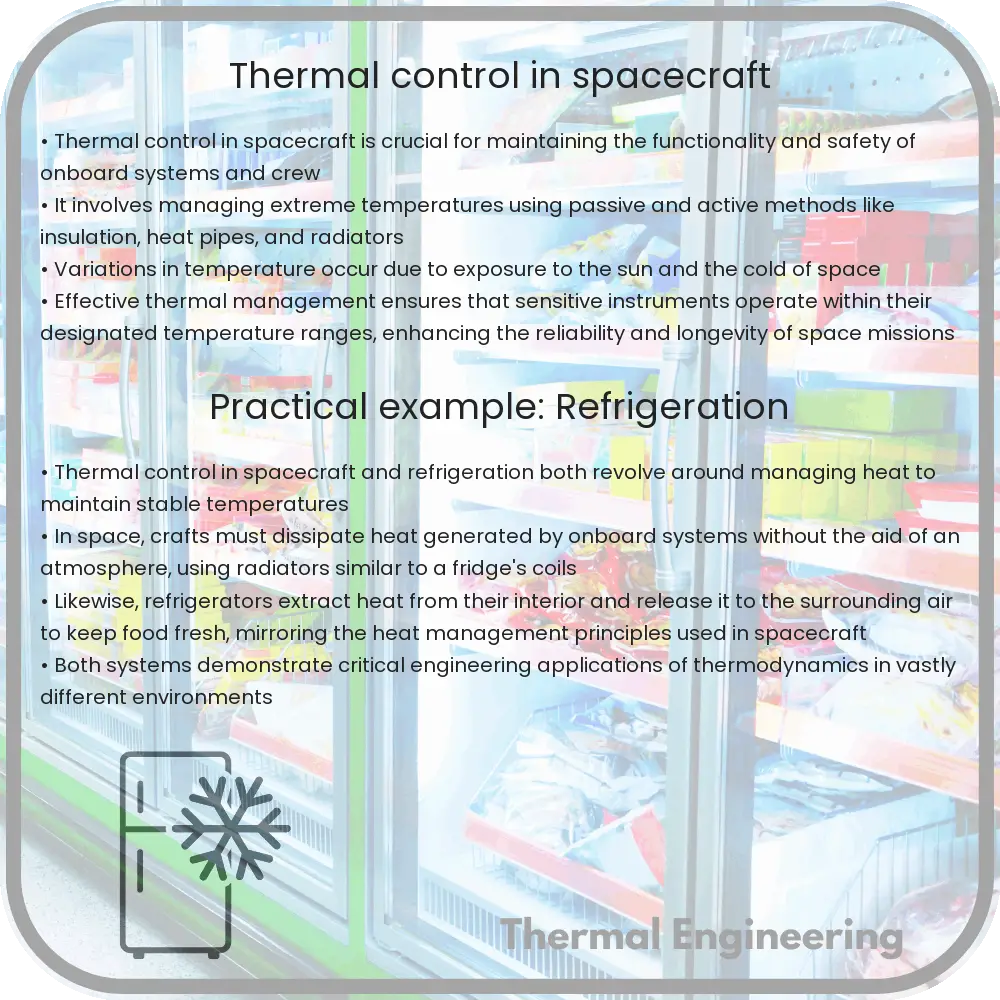
Thermal control is a critical aspect of spacecraft design that ensures all components operate within their acceptable temperature ranges throughout the mission. Space presents an extreme environment where temperatures can vary dramatically, making thermal management essential for the functionality and longevity of a spacecraft.

Why Is Thermal Control Necessary?

In space, there is no atmospheric convection to help regulate temperatures like we have on Earth. The only means of heat transfer available are radiation and conduction. Additionally, various parts of a spacecraft might be exposed to intense sunlight and deep space simultaneously, causing vastly different temperatures within a short distance. This can lead to thermal stress and potential failure of structural materials and electronic components.

Components of Thermal Control Systems (TCS)

  • Passive Thermal Control: This involves no moving parts and includes the design elements that naturally maintain the appropriate thermal balance. Examples include:
    • Thermal coatings and paints: Usually white or gold to reflect solar heat.
    • Multi-layer insulation (MLI): Layers of reflective foil that protect against heat loss in shadowed areas and heat gain in sunlit areas.
    • Thermal blankets: Used to wrap components, maintaining steady temperatures.
  • Active Thermal Control: This approach uses powered systems to transfer and dissipate heat. Components include:
    • Heat pumps: Similar to air conditioners, these devices move heat from one area to another.
    • Fluid loops: Often water or ammonia, which can absorb heat from equipment and radiate it away in radiators.
    • Electric heaters: Used to counteract the deep cold of shadowed spacecraft parts.

Thermal Analysis in Spacecraft Design

Engineers employ thermal modeling and simulation to predict how heat will affect a spacecraft, part of what is known as thermal analysis. This involves calculations based on heat transfer modes (conduction, convection, and radiation), and the specific environmental conditions the spacecraft will face in orbit or interplanetary space. Important equations in thermal analysis include the heat transfer equation:

Q = k * A * (T1 – T2) / d

Where:

  • Q is the heat transfer rate in watts (W),
  • k is the thermal conductivity in watts per meter-Kelvin (W/m·K),
  • A is the cross-sectional area through which heat is being transferred in square meters (m²),
  • T1 and T2 are the temperatures of the bodies at each end of the material in Kelvin (K),
  • d is the thickness of the material in meters (m).

Stefan-Boltzmann’s law helps calculate radiation energy per unit area emitted by an object, vital for understanding thermal radiation in space:

E = σ * T4

Where:

  • E is the emissive power in watts per square meter (W/m2),
  • σ (sigma) is the Stefan-Boltzmann constant approximately equal to 5.67 × 10⁻⁸ W/m2K4,
  • T is the absolute temperature in Kelvin (K).

Challenges and Innovations

Thermal control systems face continuous challenges such as weight limitations, power constraints, and extreme variability in environmental conditions. Innovations in materials such as aerogels, advanced insulators, and enhanced radiative coatings are under development to improve the efficiency and reliability of thermal systems

Maintaining the optimal temperature on spacecraft not only ensures the success of the mission but also secures the safety of any crew. Engineers continue to innovate and develop more sophisticated technologies to address the complex thermal challenges presented by space exploration.

Understanding these principles offers a glimpse into the technical marvels behind human efforts in space exploration and enhances our appreciation for the field of aerospace engineering.
Heat transfer in geothermal systems

Learn about heat transfer in geothermal systems, including conduction, convection, and radiation, and their role in sustainable energy.

Heat transfer in geothermal systems

Understanding Heat Transfer in Geothermal Systems

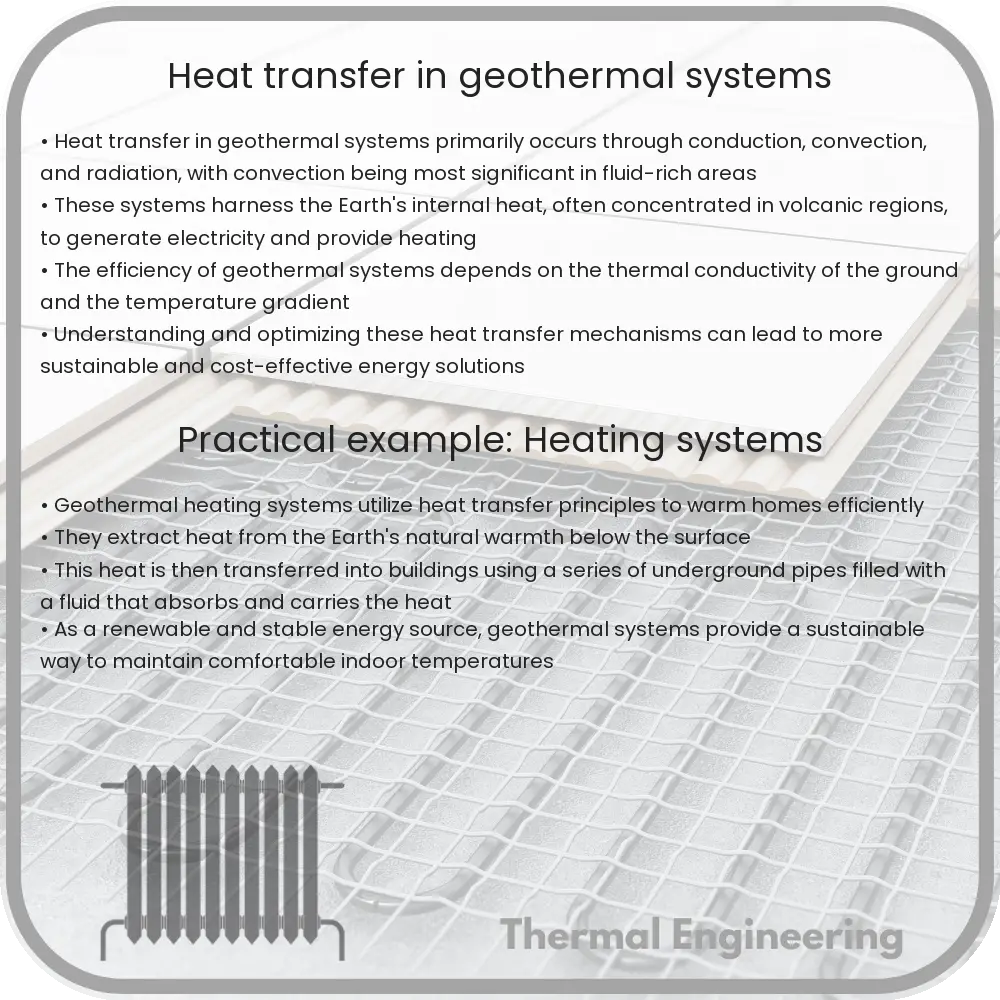
Geothermal systems tap into the Earth’s internal heat as a reliable and eco-friendly energy source. This technology has gained attention for its contribution to sustainable energy solutions. The efficiency of geothermal systems largely depends on the principles of heat transfer, which involves the movement of heat from the Earth’s core to the surface and ultimately into our homes or power plants.

Key Types of Heat Transfer

There are three main mechanisms through which heat transfer occurs in geothermal systems:

  • Conduction: This is the transfer of heat through materials without the movement of the material itself. In geothermal systems, heat conducts through the Earth’s crust, warming the rocks and water in geothermal reservoirs.
  • Convection: Heat is also transferred by the movement of fluids. In a geothermal setup, this typically refers to the movement of water and steam within the Earth, circulating heat through natural or artificially created reservoirs.
  • Radiation: Though less significant in geothermal systems, radiation is the transfer of energy through electromagnetic waves. In deep Earth, heat radiates from molten material to surrounding rock.

Heat Transfer Equation

The basic equation governing conductive heat transfer is Fourier’s law of heat conduction, which is expressed as:

q = -k * A * (dT/dx)

  • q represents the heat transfer rate (in Watts),
  • k is the thermal conductivity of the material (in W/mK),
  • A is the area through which heat is being transferred (in square meters),
  • dT/dx is the temperature gradient (in °C/m).

The negative sign indicates that heat flows from higher to lower temperatures.

Applications of Heat Transfer in Geothermal Systems

Efficient heat transfer is crucial in the design and operation of geothermal systems, which can be categorized primarily into three types:

  1. Direct Use Systems: These systems use geothermal hot water for heating buildings, greenhouses, pools, and industrial processes. The efficiency of these systems depends on the minimization of heat losses during transfer from the source to the end-use.
  2. Geothermal Heat Pumps: Also known as ground-source heat pumps, these systems utilize the stable ground temperature to provide heating, cooling, and hot water. They rely on conduction to transfer heat between the ground and a fluid that is circulated in a loop buried underground.
  3. Geothermal Power Plants: These plants convert geothermal heat into electricity. The plants exploit the heat from natural geothermal reservoirs, often transforming it from thermal to kinetic energy using steam turbines.

Improving Heat Transfer Efficiency

Enhancing heat transfer efficiency in geothermal systems can significantly affect their overall performance and environmental impact. Innovations may include improving materials used in heat exchangers, optimizing the geometry of the system, or enhancing the properties of the transfer fluid. Scientists and engineers continually study geological formations and fluid dynamics to develop more efficient geothermal systems.

Understanding the basics of heat transfer in geothermal systems not only aids in the appreciation of these green technologies but also highlights the intricate relationship between natural resources and human-engineered solutions.

Hybrid solar thermal power plants

Learn about hybrid solar thermal power plants, combining solar energy with traditional power generation for enhanced efficiency and reliability.

Hybrid solar thermal power plants

Understanding Hybrid Solar Thermal Power Plants

Hybrid solar thermal power plants represent a significant advancement in sustainable energy technology, combining the principles of solar energy capture with conventional power generation methods. This hybridization aims to enhance efficiency, reliability, and continuous power supply, particularly beneficial in regions with significant solar potential.

What is a Hybrid Solar Thermal Power Plant?

A hybrid solar thermal power plant integrates a solar thermal component with another power generating technology, typically a fossil fuel-based system. This combination aims to overcome the limitations posed by the variability of solar energy. During sunny periods, the plant primarily uses solar energy to produce power, whereas during cloudy periods or at night, it can switch to or supplement with the other energy source.

Key Components of Hybrid Solar Thermal Power Plants

  • Solar Field: Comprises a series of mirrors or collectors that concentrate solar heat, typically onto a central receiver or through parabolic troughs.
  • Heat Storage: Utilizes materials such as molten salts to store the absorbed heat, which can be used to produce steam and generate electricity even when solar input is low.
  • Supplementary Energy System: Often a natural gas-fired boiler or a biogas processor that can quickly compensate for the intermittent solar output.
  • Power Block: Includes the turbine and generator components for electricity production. Steam generated from both the solar field and the supplementary system is directed here to drive turbines.

Operational Mechanism

The operation of a hybrid solar thermal power plant involves several steps:

  1. Solar collectors capture solar radiation and convert it into heat.
  2. This heat is transferred to a fluid medium, often oil or molten salt, which is then used to generate steam.
  3. The steam drives a turbine connected to a generator, producing electricity.
  4. Excess heat during peak solar times is stored in thermal storage systems.
  5. During lower solar insolation, the supplementary system is activated to ensure continuous power output.

Advantages of Hybrid Solar Thermal Power Plants

  • Enhanced Efficiency: By combining solar energy with a backup source that can quickly ramp up, these plants maintain a steady output regardless of solar variability.
  • Reduced Emissions: Significant reliance on solar power reduces the carbon footprint compared to conventional fossil fuel plants.
  • Energy Security: Hybrid systems reduce dependency on a single energy source, thus enhancing energy security and stability.

Challenges and Future Prospects

Despite their benefits, hybrid solar thermal power plants face some challenges:

  • High Initial Costs: The initial investment for these plants is considerable, primarily due to the cost of solar field installation and thermal storage systems.
  • Technological Complexity: Managing the seamless integration of different energy systems and storage technologies requires sophisticated control systems and operational strategies.

Furthermore, ongoing research and development are focused on improving the efficiency of heat storage materials and reducing costs through technological innovations and economies of scale.

In conclusion, hybrid solar thermal power plants offer a promising path toward sustainable and reliable energy production by leveraging the strengths of both solar power and conventional generation methods. As technology progresses and investment continues, these systems are likely to become a cornerstone of modern energy strategies worldwide.

Thermal energy harvesting

Thermal energy harvesting: a sustainable method to convert waste heat into electrical energy using thermodynamic principles.

Thermal energy harvesting

Understanding Thermal Energy Harvesting

Thermal energy harvesting is a process that captures heat – often waste heat – that would otherwise dissipate into the environment unused, and converts it into electrical energy. This innovative approach is becoming increasingly critical in our energy-conscious world, offering a sustainable way to power devices and systems without relying solely on traditional energy sources.

How Thermal Energy Harvesting Works

At the core of thermal energy harvesting are a few fundamental principles from physics, particularly the science of thermodynamics. The basic idea is to utilize the temperature differences within a system to generate electricity. Here are the predominant mechanisms used in thermal energy harvesting:

  • Thermoelectric Generators (TEGs): These devices utilize the Seebeck effect, where a voltage is generated across two dissimilar metals or semiconductors that are joined at two junctions maintained at different temperatures. The power generated, P, can be described by the equation P = α2 ∙ ΔT2 ∙ RL, where α is the Seebeck coefficient, ΔT is the temperature difference, and RL is the load resistance.
  • Thermo-magnetic devices: These devices work based on the principle of the magnetocaloric effect. When a magnetic material is exposed to a changing magnetic field, its temperature changes. This cycle can be used to produce work or generate heat, contributing to a harvesting system.
  • Pyroelectric cells: Pyroelectric materials generate an electric charge in response to thermal changes. By cyclically heating and cooling, these materials can alternatively accumulate charge and produce an electric current.

Applications of Thermal Energy Harvesting

The practical applications of thermal energy harvesting are broad and impactful. Some key applications include:

  • Industrial waste heat recovery: Large amounts of heat generated in industrial processes can be captured and turned into electricity, significantly improving energy efficiency and reducing operational costs.
  • Remote sensor networks: Thermal energy harvesting can power sensors in remote or inaccessible locations, useful in fields like environmental monitoring, wildlife tracking, and industrial automation.
  • Wearable technology: Body heat can power smart wearables, eliminating the need for traditional battery use and enhancing the convenience and longevity of these devices.

Challenges in Thermal Energy Harvesting

While the benefits of thermal energy harvesting are clear, there are several challenges that need to be addressed to maximize its potential:

  • Material efficiency: The efficiency of materials used in devices like thermoelectric generators is crucial. Ongoing research aims to discover and optimize materials with higher Seebeck coefficients and better heat transfer properties.
  • Cost-effectiveness: The economic viability of implementing thermal energy harvesting systems on a larger scale is a crucial consideration. Reducing the cost of materials and enhancing the lifespan of the systems are essential steps towards widespread adoption.
  • Integration with existing technologies: Developing strategies for integrating harvesting technologies into existing infrastructure poses technical and logistical challenges that must be overcome for successful application.

Future Prospects

The future of thermal energy harvesting looks promising as both the technology and materials science continue to advance. With the ongoing push for sustainable and renewable energy sources, thermal energy harvesting stands as a pivotal technology that may offer substantial contributions to global energy solutions. Innovations in nano-materials, scalability, and integration techniques will likely drive the adoption of this technology, paving the way for its larger role in the green energy landscape.

In conclusion, thermal energy harvesting represents a key development in our approach to energy efficiency and sustainability, harnessing physics and engineering to turn waste into power. As research progresses, we can anticipate more robust and economically viable solutions that can be implemented across various sectors, reducing our overall carbon footprint and contributing to a more sustainable world.

Convective heat transfer in nanofluids

Learn about nanofluids and their role in enhancing convective heat transfer in various engineering applications.

Convective heat transfer in nanofluids

Understanding Convective Heat Transfer in Nanofluids

Heat transfer mechanisms are fundamental to various engineering applications, from automotive engines to HVAC systems in buildings. One of the fascinating advancements in the field of thermal engineering is the use of nanofluids in convective heat transfer processes. Nanofluids are fluids that contain nanoparticles, which are particles sized between 1 and 100 nanometers. These particles are typically made of metals, oxides, carbides, or carbon nanotubes. By dispersing these tiny particles into a base fluid, like water or oil, the thermal properties of the fluid improve dramatically, offering new possibilities in heat transfer applications.

What are Nanofluids?

Nanofluids are engineered colloidal suspensions of nanoparticles in a base fluid. The idea behind nanofluids is to combine the advantageous properties of the nanoparticle material—such as high thermal conductivity—with the fluidity of the base fluid. This results in a fluid with enhanced thermal conductivity, specific heat capacity, and convective heat transfer coefficients, making it superior to traditional heat transfer fluids.

Enhancement of Convective Heat Transfer

In the context of convective heat transfer, the addition of nanoparticles to a fluid affects both its thermal and flow properties. The primary mechanism by which nanofluids enhance convective heat transfer is through the significant increase in thermal conductivity of the fluid. This increase in thermal conductivity helps in more efficient heat absorption and dissipation.

Mathematically, the convective heat transfer coefficient (h) can be thought of as:

    h = (k / δ) * Nu

where:

  • k is the thermal conductivity of the fluid,
  • Nu is the Nusselt number, a dimensionless number representing the ratio of convective to conductive heat transfer across a boundary,
  • δ is the characteristic length, and

Enhanced thermal conductivity (k) in nanofluids increases the heat transfer coefficient (h), thereby improving the efficiency of heat transfer processes.

Impact on Flow Properties

Further, nanoparticles influence the flow properties of the fluid. Their presence can either increase or decrease the viscosity depending on the shape, size, and concentration of nanoparticles, as well as the type of base fluid. Increased viscosity can lead to a higher Reynolds number, which characterizes the flow regime of the fluid. In laminar flows, higher viscosity may reduce performance, whereas in turbulent flows, it may enhance heat transfer due to increased mixing and turbulence.

Mathematically, the impact on flow properties and heat transfer can be represented by modified Reynolds and Prandtl numbers:

    Re = ρ * u * L / μ
    Pr = cp * μ / k

where:

  • ρ is the density of the fluid,
  • u is the flow velocity,
  • L is the characteristic length,
  • μ is the dynamic viscosity,
  • cp is the specific heat capacity.

Practical Applications and Challenges

Nanofluids have potential applications in a wide variety of fields such as cooling of electronic devices, automotive industries, refrigeration, and air conditioning systems, among others. However, the practical implementation of nanofluids faces challenges including the stability of the suspension, cost of nanoparticle production, and potential clogging of flow channels.

Overall, the use of nanofluids in enhancing convective heat transfer presents an exciting frontier in engineering. Continued research and development are needed to overcome existing challenges and fully harness the potential of nanofluids in industrial applications.

By understanding and improving the properties and behaviors of nanofluids, engineers can design more efficient heat transfer systems, contributing to advancements in technology and energy efficiency.

Heat transfer in refrigeration systems

Learn about the role of heat transfer in refrigeration systems, focusing on its mechanisms and impact on efficiency.

Heat transfer in refrigeration systems

Understanding Heat Transfer in Refrigeration Systems

Heat transfer is a fundamental concept in refrigeration systems, which are used to cool and preserve food, medicine, and other perishable items by removing heat from one area and disposing of it in another. This article explores how heat transfer processes are integral to the operation of refrigeration systems.

Basics of Heat Transfer

Heat transfer in refrigeration involves three primary mechanisms: conduction, convection, and radiation. However, in most refrigeration systems, conduction and convection are the most relevant:

  • Conduction is the transfer of heat through a solid material. In refrigerators, this occurs when heat travels through the walls of the refrigeration chamber.
  • Convection is the transfer of heat by the movement of fluids (liquids or gases). In refrigeration systems, convection is used to circulate refrigerant, which absorbs and carries heat away.
  • Radiation involves heat transfer in the form of electromagnetic waves and is generally less significant in the context of conventional refrigeration.

The Refrigeration Cycle

The refrigeration cycle is a technical process where refrigerant absorbs and removes heat from the space to be cooled. Here’s a basic outline of this cycle:

  1. Evaporation: The refrigerant absorbs heat as it converts from a low-pressure liquid into a vapor, effectively removing heat from the refrigerator’s interior.
  2. Compression: The vaporized refrigerant is compressed by a compressor, which increases its pressure and temperature, making it a high-temperature vapor.
  3. Condensation: The high-pressure, high-temperature vapor travels through condenser coils where it releases the absorbed heat to the outside environment and condenses into a high-pressure liquid.
  4. Expansion: The high-pressure liquid passes through an expansion valve, reducing its pressure and temperature before it re-enters the evaporator to repeat the cycle.

This cycle is crucial because each phase in the process focuses on optimizing the transfer of heat, using the properties of the refrigerant effectively.

Importance of Heat Transfer Coefficients

The efficiency of heat transfer in refrigeration systems heavily relies on heat transfer coefficients, which measure how well heat is transferred through materials. Different parts of the refrigerator have different coefficients impacting the system’s overall performance:

  • In the evaporator, a higher heat transfer coefficient means that the refrigerant can absorb more heat from the interior, enhancing cooling efficiency.
  • In the condenser, a higher coefficient facilitates the release of heat into the environment, crucial for maintaining the efficiency of the cycle.

Technological Advances

Recent advancements in refrigeration technology focus on improving the materials used in heat exchangers and developing more effective and environmentally friendly refrigerants. These changes aim to increase the heat transfer coefficients and reduce the overall energy consumption and environmental impact of refrigeration systems.

Conclusion

Understanding the basics of heat transfer within refrigeration systems illuminates how these appliances maintain their cool environments. By improving components and optimizing the refrigeration cycle, engineers can enhance efficiency and sustainability, making these systems integral to modern life.

This overview of heat transfer in refrigeration systems underscores the critical role of physics and engineering in developing practical, efficient technologies that meet everyday needs and contribute to global sustainability efforts. Whether for industrial or domestic purposes, the principles of heat transfer serve as the backbone for refrigeration technology.

Cross-flow heat exchanger design

Learn about cross-flow heat exchanger design, its components, efficiency, and applications in various industries.

Cross-flow heat exchanger design

Understanding Cross-Flow Heat Exchanger Design

Heat exchangers are vital components used in a variety of engineering applications to transfer heat between two or more fluids without them mixing. Among the various types of heat exchangers, the cross-flow heat exchanger is particularly noteworthy due to its efficiency and versatility. This article will explore the basic design principles of cross-flow heat exchangers and their practical applications.

What is a Cross-Flow Heat Exchanger?

In a cross-flow heat exchanger, the two fluids flow perpendicular to each other. One fluid flows through tubes, and the other passes outside these tubes at a 90-degree angle. This configuration can occur in one of two ways: either the fluids are both unmixed, or one fluid is mixed while the other remains unmixed. This arrangement is commonly employed in situations where space constraints exist, as it provides a compact solution for heat exchange.

Key Components and Design Considerations

  • Tubes: The choice of material and size of the tubes is critical. Common materials include aluminum, copper, or stainless steel, chosen based on factors like thermal conductivity, corrosion resistance, and cost.
  • Casing: This encloses the tubes to ensure that the second fluid flows over the tubes effectively. Like tubes, casings must also exhibit good thermal conductivity and durability.
  • Fins: Often used in cross-flow heat exchangers, fins increase the surface area for heat transfer, improving the exchanger’s effectiveness. Fins can be attached to the tubes or the casing.
  • Flow arrangement: The configuration of flows (i.e., whether one or both fluids are mixed) greatly influences the heat transfer efficiency and the exchanger design.

Thermal Design and Efficiency

The effectiveness of a cross-flow heat exchanger is highly dependent on its ability to transfer heat between the two fluids. The heat transfer can be described by the equation:

Q = U * A * ΔTlm

  • Q is the total heat transfer rate,
  • U is the overall heat transfer coefficient,
  • A is the heat transfer surface area, and
  • ΔTlm is the logarithmic mean temperature difference, calculated based on the inlet and outlet temperatures of the fluids.

To maximize efficiency, engineers must optimize each of these factors. For instance, increasing the surface area (A) by adding fins or choosing materials with a higher heat transfer coefficient (U) can enhance the heat transfer rate. Additionally, managing the flow rates and paths of the fluids can help achieve a more favorable ΔTlm, thereby improving the overall performance of the heat exchanger.

Applications of Cross-Flow Heat Exchangers

Cross-flow heat exchangers are used in a myriad of applications, including:

  • Heating, Ventilation, and Air Conditioning (HVAC): Used in systems to effectively manage the temperatures of buildings and vehicles.
  • Power plants: Utilized for cooling the working fluids used in power generation processes.
  • Automotive industry: Employed for cooling internal combustion engines.
  • Chemical processing: Necessary for controlling the temperature of chemical reactions, which can be crucial for reaction efficiency and safety.

In conclusion, the design of cross-flow heat exchangers is a sophisticated discipline combining materials science, fluid mechanics, and thermodynamics. By understanding and optimizing the key components and variables involved, engineers can facilitate more effective and efficient heat transfer in a wide range of industrial and commercial applications.

Thermal conductivity enhancement

Learn about methods to enhance thermal conductivity in materials, crucial for improving efficiency in thermal management systems.

Thermal conductivity enhancement

Understanding Thermal Conductivity Enhancement

Thermal conductivity is a fundamental property of materials that describes their ability to conduct heat. Enhancement of thermal conductivity is crucial in various engineering applications to improve efficiency and performance in thermal management systems such as in electronics cooling, automotive, and aerospace industries. This article delves into the basics of thermal conductivity and explores the methods and materials used to enhance it.

Basics of Thermal Conductivity

Thermal conductivity (\( k \)) is a measure of a material’s ability to conduct heat and it is defined as the rate at which heat passes through a material, typically measured in watts per meter Kelvin (W/mK). The formula used to describe heat transfer through a material is given by Fourier’s law of heat conduction:

\[ q = -k \cdot A \cdot \frac{\Delta T}{\Delta x} \]

  • q is the heat transfer rate (Watts, W)
  • A is the cross-sectional area of the material (m2)
  • \(\Delta T\) is the temperature difference (K),
  • \(\Delta x\) is the thickness of the material (m)

This relationship indicates that the greater the thermal conductivity of a material, the more efficient it is at transferring heat.

Methods of Enhancing Thermal Conductivity

Enhancing thermal conductivity can be achieved through several methods, primarily focusing on material modification and structure design:

  1. Material Substitution: Using materials with inherently higher thermal conductivities, such as copper or aluminum, in place of less conductive materials.
  2. Composite Materials: Creating composite materials that combine materials with high thermal conductivity with those offering other desirable properties (e.g., mechanical strength, lower weight).
  3. Nanostructuring: Incorporating nanoscale structures, such as nanoparticles or nanofibers, which can bridge the gaps between larger particles and increase the effective thermal conductivity.
  4. Phase Change Materials (PCM): Integrating PCMs which absorb or release large amounts of heat when they change states. This method can significantly augment heat absorption and dispersion within a material.

Advancements in Materials for Thermal Conductivity

Recent advancements in material science have led to the development of new materials and composites specifically engineered for enhanced thermal properties:

  • Carbon Nanotubes (CNTs): Known for their exceptional thermal conductivity, CNTs are being used in composites to enhance heat conduction pathways.
  • Graphene: Another form of carbon, graphene, has one of the highest known thermal conductivities and is studied for use in thermal management applications.
  • Metal Matrix Composites (MMCs): These composites usually involve embedding conductive materials like silver or copper in a metal matrix to improve overall thermal conductivity.

Each of these materials offers unique benefits and challenges, and their effectiveness can vary based on the application and operating conditions.

Applications of Enhanced Thermal Conductivity

Enhanced thermal conductivity materials find applications in numerous fields, notably:

  • Electronics: High thermal conductivity materials help dissipate heat in electronic devices, thereby improving performance and longevity.
  • Automotive: Efficient heat exchangers made from materials with enhanced thermal conductivity can lead to more efficient thermal management of engine components.
  • Aerospace: High conductivity materials are essential for managing the extreme temperatures encountered in aerospace applications.

In conclusion, enhancing the thermal conductivity of materials plays a vital role in advancing technology and engineering. With ongoing research into new materials and composites, the potential for further improvements in thermal management systems looks promising.

Heat transfer in multiphase flows

Explore the complexities of heat transfer within multiphase flows, crucial for enhancing system designs across a range of industries.

Heat transfer in multiphase flows

Understanding Heat Transfer in Multiphase Flows

Heat transfer in multiphase flows is a fundamental aspect of many engineering processes in industries ranging from power generation to food processing. A multiphase flow involves the simultaneous flow of materials in different phases (solid, liquid, or gas) or different chemical states. The complexity of these flows makes understanding their heat transfer characteristics critical for designing efficient and safe systems.

Basics of Multiphase Flow

Multiphase flows can be classified based on the phases involved—such as gas-liquid, solid-liquid, gas-solid, or gas-liquid-solid flows. Common examples include boiling water (liquid to gas), sediment transport in rivers (solid in liquid), and pneumatic conveyance systems (solid in gas). Each type of flow presents unique challenges for heat transfer.

Mechanisms of Heat Transfer

Heat transfer in multiphase systems involves several mechanisms:

  • Conduction: This is the heat transfer due to the temperature gradient within a single phase or between different phases in contact. The thermal conductivity of each phase plays a crucial role.
  • Convection: This mechanism involves the heat transfer due to the movement of the fluid. In multiphase systems, convection can occur both due to the bulk motion of the phases and due to the relative motion between phases.
  • Radiation: Heat transfer could also occur through electromagnetic waves, especially in high-temperature environments. Though less common in multiphase flows, it is significant in some specialized applications.
  • Phase Change: Heat transfer during boiling or condensation is particularly important. The latent heat of transformation significantly affects the heat transfer rates.

Key Parameters Influencing Heat Transfer

Several factors influence the efficiency of heat transfer in multiphase flows:

  • Phase Distribution: The spatial arrangement and distribution of different phases affect the heat transfer area and the thermal resistance.
  • Flow Regime: The flow pattern (e.g., bubbly, slug, annular, stratified) impacts how the phases interact and mix, thereby influencing heat transfer rates.
  • Properties of Phases: Properties such as density, viscosity, thermal conductivity, and specific heat capacity dictate how heat is absorbed and transferred within and between the phases.
  • Operating Conditions: Conditions like temperature, pressure, and flow velocities determine the driving force for heat transfer and the resistance to flow.

Mathematical Representation

The fundamental equations governing heat transfer in multiphase flows often start with conservation laws, such as the conservation of mass, momentum, and energy. The general form of the energy equation can be expressed as:

\[
\frac{\partial (\rho E)}{\partial t} + \nabla \cdot (\rho E \mathbf{u}) = -\nabla \cdot \mathbf{q} + \dot{Q}
\]

Where:

  • \(\rho\) is the density,
  • \(E\) is the total energy per unit mass,
  • \(\mathbf{u}\) is the velocity vector,
  • \(\mathbf{q}\) is the heat flux vector,
  • \(\dot{Q}\) represents heat sources or sinks.

Real-World Applications

Understanding and mastering heat transfer in multiphase flows enable engineers to design more efficient heat exchangers, boilers, and cooling systems. It also plays a crucial role in environmental engineering, chemical processing, and the energy sector. For instance, in oil and gas production, effective management of heat during multiphase transport of hydrocarbons significantly impacts process efficiency and safety.

Overall, the study of heat transfer in multiphase flows not only advances our theoretical knowledge but also enhances our capability to innovate in various technical fields, improving energy conservation and process optimization.

Thermal comfort models

Explore the role of thermal comfort models in optimizing indoor environments for human satisfaction and energy efficiency in building design.

Thermal comfort models

Understanding Thermal Comfort Models

Thermal comfort models are essential components in the study of indoor environmental quality, directly affecting human satisfaction and energy efficiency in building design. These models help engineers and architects create environments that optimize occupants’ thermal comfort whilst using resources efficiently.

What is Thermal Comfort?

Thermal comfort is defined as that condition of mind which expresses satisfaction with the thermal environment. Several factors influence it, including air temperature, radiant temperature, air velocity, relative humidity, clothing insulation, and metabolic rate. Achieving thermal comfort for all occupants can be challenging, as individual preferences vary widely.

Key Models of Thermal Comfort

  • Fanger’s Predicted Mean Vote (PMV) Model: Developed by P.O. Fanger in the 1970s, this model predicts the average thermal comfort response of a large group of people. It is based on the heat balance of the human body and environmental variables such as air temperature, mean radiant temperature, humidity, air velocity, clothing insulation, and metabolic rate. The output, the PMV, predicts the average vote of a large group of people on a scale ranging from -3 (cold) to +3 (hot).
  • Adaptive Model: Unlike the PMV model which is steady state, the adaptive model assumes that users can adapt to their environment through natural behavioral changes like adjusting clothing or opening a window. This model is particularly relevant in naturally ventilated buildings where conditions fluctuate more than in mechanically conditioned spaces. The adaptive model depends heavily on outdoor temperatures, presuming that indoor temperatures should naturally float within a range of the outdoor climate.

Calculating PMV

The PMV index is calculated using the following formula:

PMV = (0.303 * e-0.036M + 0.028) * L

Where:

  • M is the metabolic rate (met)
  • L represents the thermal load on the human body, which is the difference between the internal heat production and the heat loss to the actual environment, for an individual at comfort (expressed in W/m2).

Applications and Limitations of Thermal Comfort Models

Thermal comfort models are crucial in the design of HVAC (heating, ventilation, and air conditioning) systems to predict and evaluate environmental conditions within buildings. Moreover, these models inform guidelines and standards like ASHRAE 55 or ISO 7730, which stipulate conditions for acceptable thermal environments.

However, these models do have limitations. They may not fully capture personal comfort variances due to individual differences or may not be applicable in extreme environments like very hot and humid areas. Furthermore, they generally require precise input data which might not always be feasible to obtain in all settings.

The Future of Thermal Comfort Modeling

Advancements in technology and better understanding of human physiology continue to evolve these models. Future developments include more personalized approaches that account for individual differences in thermal comfort perception and adaptive capacities, potentially integrated with smart building technology that actively responds to occupant feedback. The integration of machine learning and AI can also refine predictions, creating smarter and more responsive environments.

Understanding and applying thermal comfort models is critical to ensuring the well-being of building occupants and the sustainability of our built environments. By addressing both human comfort and energy utilization, these models play a key role in environmental design and management.