Learn how propellers use fluid dynamics and pressure principles to generate thrust in various transport modes.
How Do Propellers Generate Thrust? Understanding Fluid Pressure and Its Effects
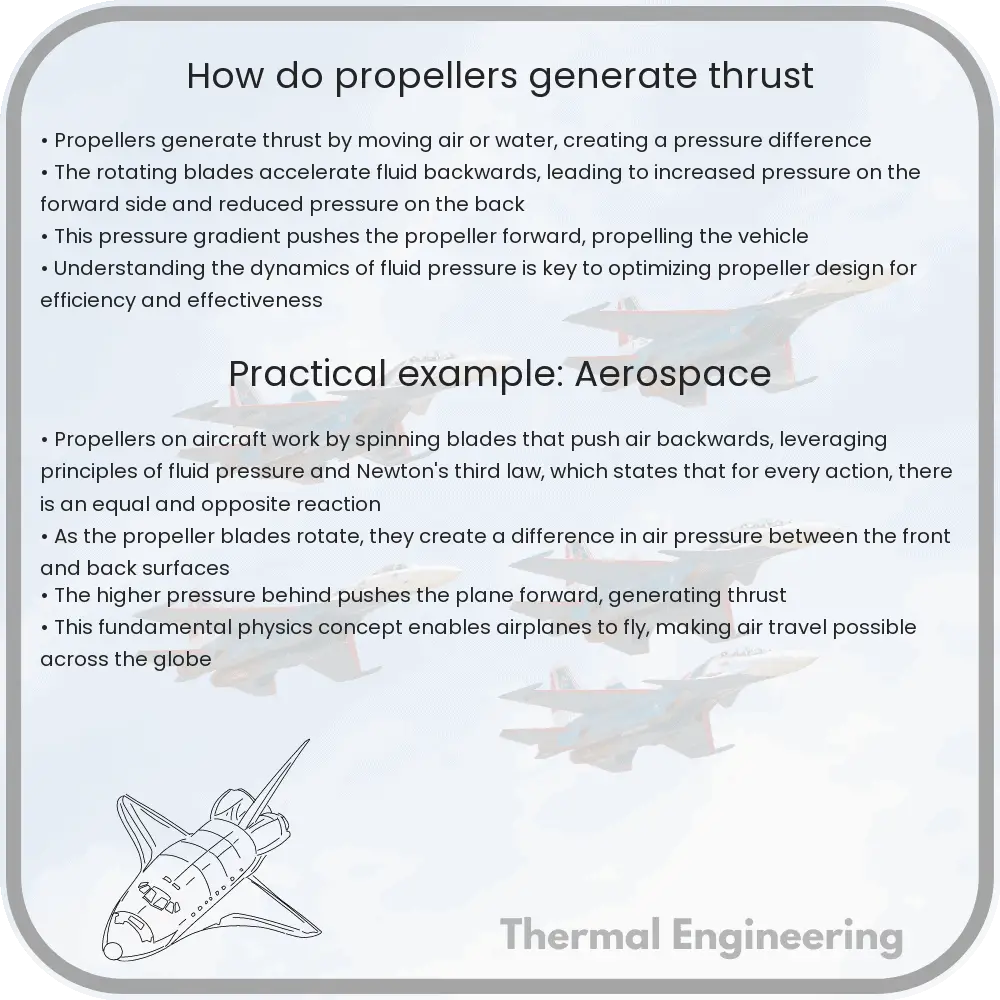
Propellers are a common sight in various modes of transport, from boats to airplanes. These devices play a crucial role in motion by converting rotational power into thrust. But how exactly does this process work? The secret lies in understanding fluid dynamics and the principles of pressure and force.
The Basics of Propeller Design
At its core, a propeller is a type of fan that transmits power by converting rotational motion into thrust. This is done through its blades which are shaped to push air or water backwards. The shape and twist of the blades are critical and are designed to maximize efficiency while minimizing drag.
The Role of Fluid Pressure
The principle behind a propeller’s function involves fluid pressure and the movement of the fluid, whether air or water. When a propeller rotates, its blades push against the fluid, causing the fluid to accelerate backwards. According to Newton’s Third Law, every action has an equal and opposite reaction. As the blades push the fluid backwards, the fluid similarly exerts an equal and opposite force on the propeller blades, propelling the vehicle forward.
Dynamic Lift Created by Propeller Blades
Each blade of a propeller has an airfoil shape, similar to an airplane wing. This design allows each blade to create lift as it moves through the fluid. Lift in the context of propellers is the force that moves the vehicle forward. The lift generated by each blade can be described by Bernoulli’s principle, which states that an increase in the speed of the fluid occurs simultaneously with a decrease in pressure.
As the propeller rotates, the angle (also known as pitch) of the blades and their speed cause the fluid to accelerate over the blade creating a difference in pressure across the surfaces of the blade. The higher pressure on the bottom and lower pressure on the top push the blade upward and forward, thereby generating thrust. The equation for lift (L) can be expressed as:
L = (1/2) * ρ * v² * A * Cl
- ρ (rho): Density of the fluid
- v: Velocity of the fluid relative to the propeller
- A: Area of the propeller blade
- Cl: Lift coefficient, which depends on the blade shape and angle of attack
Thrust Equation in Propellers
The thrust (T) created by a propeller can again be approximated by a variation of Bernoulli’s principle and can be thought of in terms of changes in the momentum of the fluid. The thrust generated by the propeller can be calculated using the following equation:
T = ṁ * (Vout – Vin)
- ṁ (m dot): Mass flow rate of the fluid through the propeller
- Vout: Velocity of the fluid leaving the propeller zone
- Vin: Velocity of the fluid entering the propeller zone
This equation essentially says that the thrust generated is the product of the mass flow rate and the change in velocity of the fluid passing through the propeller. As the propeller imparts more speed to the fluid, more thrust is generated.
Conclusion
Understanding how propellers generate thrust is a classic example of fluid dynamics in action, involving concepts of pressure, fluid velocity, and aerodynamics. Engineers design propellers by carefully considering the shape, size, and pitch of the blades to optimize the interaction with the fluid, maximizing thrust while minimizing energy loss. Learning about these principles not only reveals the mechanics behind everyday technology but also provides insights into sophisticated engineering design strategies.
This fundamental understanding allows engineers and designers to innovate and improve upon existing technologies, crafting more efficient and powerful propelling systems for everything from personal drones to large maritime vessels.