Facebook Instagram Youtube Twitter

Foaming Agents | Culinary, Firefighting & Cleaning

Learn about foaming agents and their role in enhancing culinary, firefighting, and cleaning applications by reducing surface tension to create stable foams.

Foaming Agents | Culinary, Firefighting & Cleaning

Understanding Foaming Agents: Applications in Culinary, Firefighting, and Cleaning

Foaming agents are substances that facilitate the formation of foam or bubbles in various liquids. These agents are critical in numerous fields, including culinary arts, firefighting, and cleaning domains. This article will explore how foaming agents work, their properties, and their applications across these diverse areas.

How Foaming Agents Work

Foaming agents operate by reducing the surface tension of a liquid, allowing air or other gases to become trapped under a layer of the liquid, forming stable bubbles or foam. In technical terms, they consist of surfactants which have two parts: a hydrophilic (water-attracting) head and a hydrophobic (water-repelling) tail. When added to a liquid, these molecules arrange themselves at the surface and around air pockets, stabilizing the interface and facilitating foam formation.

Culinary Uses of Foaming Agents

  • Whipped Cream: In culinary applications, foaming agents like lecithin (found in egg yolks) and saponins (found in quillaja) are used to stabilize whipped creams and foams. These agents help retain the air incorporated by whipping, maintaining the structure and volume of the foam.
  • Molecular Gastronomy: Ingredients such as methyl cellulose and xanthan gum are used in the innovative field of molecular gastronomy to create unique textures and presentations by stabilizing foams and emulsions.

Firefighting Applications of Foaming Agents

  • Class A Foams: Used primarily for wildfires, these foams make water more effective by reducing its surface tension, allowing it to spread and penetrate more effectively over combustible materials.
  • Class B Foams: These are used to combat flammable liquid fires. Foaming agents like aqueous film-forming foams (AFFF) form a barrier between the fuel and the air, effectively cutting off the oxygen supply and suppressing the fire.

Cleaning Applications of Foaming Agents

  • Detergents and Soaps: Foaming agents in soaps and detergents help in trapping dirt and oils within foam bubbles which can then be easily washed away. Sodium lauryl sulfate (SLS) and sodium laureth sulfate (SLES) are common examples used in domestic and industrial cleaning products.
  • Industrial Cleaners: In more rigorous cleaning applications such as in machinery or automotive industries, foaming agents help in breaking down and removing stubborn greases and residue effectively.

Safety and Environmental Considerations

While foaming agents play a critical role in various applications, their impact on health and the environment is also noteworthy. Substances like SLS and SLES, while effective, can pose skin irritation and other health risks with prolonged exposure. Additionally, environmental concerns such as the biodegradability and aquatic toxicity of these chemicals are significant. Alternatives such as naturally derived saponins are being explored for their reduced environmental footprint.

In conclusion, foaming agents are versatile substances that enhance the effectiveness of products across culinary, firefighting, and cleaning applications. Understanding their properties and mechanisms helps industries and consumers utilize them more efficiently and responsibly.


Thermal properties of building joint systems

Learn about the role of thermal properties in building joint systems, including thermal bridging, conductivity, and expansion, and their impact on building efficiency.

Thermal properties of building joint systems

Understanding Thermal Properties of Building Joint Systems

Building joint systems are critical components in the construction and performance of buildings. They play a significant role in determining the thermal comfort, energy efficiency, and long-term sustainability of a structure. This article explores the thermal properties of these systems, including thermal bridging, conductivity, and expansion, and how they impact building performance.

Thermal Bridging in Joints

Thermal bridging occurs when a conductive material provides a pathway for heat flow across a thermal barrier. In building joints, this can happen when materials with high thermal conductivity, such as steel or aluminum, connect the interior and exterior of a building. The result is increased heat loss or gain, which can significantly affect the energy efficiency of a building.

  • Impact: Increased heating and cooling loads, leading to higher energy costs.
  • Prevention: Using low-conductivity materials and incorporating thermal breaks.

Thermal Conductivity of Joint Materials

Thermal conductivity is a material property indicating the ability to conduct heat. In the context of building joints, selecting materials with appropriate thermal conductivity values is crucial for controlling heat transfer.

  • Low Conductivity Materials: Materials such as rubber, fiberglass, and certain plastics are used to reduce undesirable heat transfer.
  • High Conductivity Materials: Metals like aluminum and copper are generally avoided in places where thermal insulation is critical.

Thermal Expansion and Contraction

Materials expand when heated and contract when cooled. This natural behavior can lead to stress on joint systems, potentially causing cracks or distortions, which compromise the building’s thermal envelope.

  • Temperature Variation: Daily and seasonal temperature changes can continuously cycle the expansion and contraction, stressing the joints over time.
  • Accommodation Strategies: Designing joints to accommodate these movements using flexible materials or expansion joints can help maintain the integrity and insulation properties of the building envelope.

Designing for Thermal Efficiency

Effective design and material selection of building joint systems is crucial for minimizing energy loss and enhancing the comfort and sustainability of buildings. Here are some strategies used in the engineering of thermally efficient joints:

  1. Thermal Breaks: Incorporating elements that reduce conductivity, such as insulative strips, at the joints.
  2. Sealants and Gaskets: Using materials that provide a tight seal to prevent air leakage which can undermine thermal insulation.
  3. Continuous Insulation: Designing the building envelope with continuous layers of insulation that bridge across joints to prevent thermal bridges.

In conclusion, understanding and optimizing the thermal properties of building joint systems is fundamental in achieving energy-efficient buildings. By focusing on reducing thermal bridging, selecting materials with appropriate thermal conductivity, and accommodating thermal expansion, engineers and designers can enhance the overall performance and sustainability of modern building structures.

Anti-Foaming Agents | Industrial Processes & Applications

Explore the function, types, and applications of anti-foaming agents in various industries to prevent and control foam formation.

Anti-Foaming Agents | Industrial Processes & Applications

Introduction to Anti-Foaming Agents

Anti-foaming agents, also known as defoamers, are chemicals added to liquids to reduce and hinder the formation of foam. Foam formation is a common issue in various industrial processes, and if not controlled, it can drastically affect process efficiency, product quality, and system stability. Anti-foaming agents work by altering the surface tension of the fluid, hence breaking up the foam bubbles and preventing their formation.

Chemical Composition and Types

Anti-foaming agents are made from a variety of compounds depending on their specific application. The most common types include:

  • Silicone-based defoamers: These are versatile and very effective in controlling foam in non-aqueous and aqueous systems. They tend to have low toxicity and thermal stability.
  • Oil-based defoamers: Comprising white oils, mineral oils, or vegetable oils, these are often used in food processing, paper, and wastewater treatment.
  • Water-based defoamers: These are emulsions of oils and waxes in water and are predominantly used in water treatment processes.
  • Alkyl polyacrylates: Suitable for a wide range of applications, these defoamers are particularly effective in polymer dispersions.

Principle of Operation

The operation of anti-foaming agents involves primarily the disruption of foam stability. Foam is typically a mass of bubbles created when air or gas gets trapped under a liquid surface. Anti-foam agents work by spreading over the surfaces of these bubbles. The agents disrupt the stability of the bubble walls (lamellae), speeding up the drainage of liquid content from the foam, leading to the collapse of the bubbles.

Industrial Applications

Anti-foaming agents find usefulness across a broad range of industries due to their efficacy in controlling unwanted foaming:

  • Food Industry: Used in the processing of beverages, dairy products, and edible oils to prevent overflow and contamination during production.
  • Paper Manufacturing: Helps in pulp production and while operating papermaking machines by reducing surface foam and improving the drainage of the pulp.
  • Pharmaceuticals: Essential during the manufacture of antibiotics and fermentation processes where excess foam can compromise the quality of medicinal products.
  • Wastewater Treatment: Aids in the separation and removal of suspended solids by minimizing foam formation during aeration and sedimentation processes.

Conclusion

Anti-foaming agents are crucial in enhancing the efficiency and stability of industrial operations across various sectors. By effectively controlling foam, these agents help maintain the quality and consistency of products while optimizing the performance of processing equipment. As industries strive to improve production efficiency and product quality, the role of anti-foaming agents is set to grow even more significant.

Gel Fluids | Cosmetics, Food & Pharmaceutical Applications

Learn about gel fluids, viscoelastic materials used in cosmetics, food, and pharmaceuticals, understanding their properties and applications.

Gel Fluids | Cosmetics, Food & Pharmaceutical Applications

Understanding Gel Fluids in Engineering Applications

Gel fluids, also known as viscoelastic fluids, are materials that exhibit both viscous and elastic characteristics when undergoing deformation. These fluids are a crucial component in various industries including cosmetics, food, and pharmaceuticals. Understanding how gel fluids work and their applications can provide insights into their versatility and functionality in everyday products.

The Science Behind Gel Fluids

At the molecular level, gel fluids are typically composed of a network of polymers that are dispersed in a solvent. This structure enables them to behave like both solids and liquids under different conditions. The unique behavior of gel fluids is primarily governed by factors like polymer concentration, molecular weight, and the nature of the cross-linking between polymer chains.

Cosmetic Applications

  • Skincare Products: In the cosmetics industry, gel fluids are used for their excellent spreadability and smooth texture. They are often found in moisturizers, sunscreens, and face masks to provide a hydrating yet non-greasy feel.
  • Hair Care Products: Gel fluids help in formulating hair gels that offer both hold and flexibility. This balancing act allows for effective styling without damaging the hair.
  • Makeup: Gel-based foundations and eyeliners utilize gel fluids to achieve a consistent application that stays intact throughout the day while feeling lightweight on the skin.

Food Industry Applications

  • Thickening Agents: Gel fluids are used to alter the texture and consistency of culinary products. In sauces and soups, they act as thickening agents without altering flavor.
  • Desserts: Many desserts such as puddings and gummy candies rely on gel fluids for their firm yet elastic texture.
  • Dairy Products: Gel-based stabilizers are incorporated in ice cream and yogurt to prevent ice crystal formation and to maintain a creamy consistency throughout shelf-life.

Pharmaceutical Applications

  • Drug Delivery Systems: Gel fluids can be engineered to create controlled-release drug delivery systems. Their viscoelastic nature allows for the gradual release of medication in the body.
  • Topical Medications: Gels are preferred in topical medications for their ease of application and effective absorption through the skin or mucous membranes.
  • Biotechnology: In biotechnological applications, gel fluids are used as a medium for growing tissues or as carriers for cells in culture systems.

Conclusion

The versatile applications of gel fluids across cosmetics, food, and pharmaceutical industries underline their importance in modern science and engineering. Their unique material properties offer solutions that enhance product performance, consumer experience, and therapeutic efficacy. As research continues to evolve, the potential uses and innovations involving gel fluids are likely to expand, opening new possibilities across various fields of application.

Lubricant Additives | Friction Reduction & Engine Health

Learn how lubricant additives improve friction reduction and engine health in modern machinery.

Lubricant Additives | Friction Reduction & Engine Health

Understanding Lubricant Additives: Enhancing Friction Reduction and Engine Health

Lubricants are essential for the proper functioning of many mechanical systems, particularly internal combustion engines. The primary role of a lubricant is to reduce friction between moving parts, thereby preventing wear and increasing efficiency. However, the demands of modern engines and machinery mean that lubricants must offer more than just basic lubrication. This is where lubricant additives come into play.

Additives are chemical compounds that are added to base lubricants to enhance their performance in various ways. These additives are crucial for prolonging the life of an engine and ensuring its efficient operation. Two primary benefits provided by lubricant additives include enhanced friction reduction and improved engine health.

Types of Lubricant Additives

  • Anti-wear Agents: These additives help protect engine surfaces under high pressure and shear conditions, reducing metal-to-metal contact and wear.
  • Friction Modifiers: Specifically designed to reduce friction, these additives can improve fuel efficiency and provide smoother operation.
  • Detergents: These keep the engine clean by preventing the formation of deposits on critical engine parts.
  • Dispersants: Helpful in maintaining cleanliness, dispersants keep particulate matter in suspension thus avoiding sludge formation.
  • Corrosion Inhibitors: They protect metal surfaces from corrosive compounds formed by fuel combustion or from the environment.
  • Antioxidants: These extend the life of the lubricant by preventing its degradation due to oxidation.
  • Viscosity Modifiers: They help the lubricant perform under a wide range of temperatures by controlling its viscosity.

How Lubricant Additives Reduce Friction

At the microscopic level, even surfaces that appear smooth are rough. When two surfaces come into contact, their irregularities can interlock, causing friction. Friction modifiers in lubricants work by forming a slippery layer on the surface of the engine parts, allowing them to glide smoothly over each other. This not only reduces the energy lost to friction (thus improving efficiency) but also minimizes the wear and tear on the components.

Boosting Engine Health with Lubricant Additives

Lubricant additives play a significant role in maintaining engine health in several ways. Anti-wear agents and friction modifiers minimize direct metal-to-metal contact, significantly reducing engine wear. Corrosion inhibitors protect vital engine parts from corrosive processes, which can be accelerated by high temperatures and the presence of water or acids. Detergents and dispersants ensure that the engine remains clean by keeping solids and contaminants dispersed and preventing the buildup of harmful deposits. Finally, antioxidants help maintain the chemical stability of the lubricant, preventing acid formation that can lead to engine damage.

Conclusion

In summary, lubricant additives are vital for reducing friction and enhancing the health and efficiency of engines. By understanding the role and function of these additives, we can appreciate the complex chemistry that goes into maintaining the performance and longevity of modern mechanical systems. Effective use of these additives not only saves energy and reduces operational costs but also contributes to the sustainability of mechanical operations by extending the life of engine components and reducing the need for frequent replacements.

For anyone involved in automotive maintenance, machinery design, or just looking to understand more about how vehicles and other complex machinery operate, understanding lubricant additives is essential.

Surfactants | Detergents, Emulsifiers & Industrial Uses

Learn about surfactants, the key ingredients in detergents, emulsifiers, and more, detailing their functions, types, and diverse applications.

Surfactants | Detergents, Emulsifiers & Industrial Uses

Understanding Surfactants: Roles in Detergents, Emulsifiers, and Beyond

Surfactants, short for surface-active agents, are compounds that lower the surface tension between two liquids, between a gas and a liquid, or between a liquid and a solid. This unique attribute allows surfactants to be crucial ingredients in myriad of applications, notably in detergents, emulsifiers, and various industrial uses. This article delves into how surfactants work, their classification, and their extensive utilization across different sectors.

How Do Surfactants Work?

Surfactants function by concentrating at the interface of two phases, altering the interfacial properties. They consist of a hydrophilic (water-attracting) head and a hydrophobic (water-repelling) tail. When added to a system, surfactants decrease the surface tension of the liquid, allowing otherwise incompatible materials to mix more readily. In washing liquids, for example, surfactants enable oil and water to mix, effectively cleaning surfaces or fabrics by emulsifying grease and enabling it to be washed away with water.

Types of Surfactants

Surfactants are generally categorized into four primary types based on the charge on their hydrophilic head:

  • Anionic surfactants: Possess a negatively charged head. Commonly used in household detergents and shampoos, an example is sodium dodecyl sulfate.
  • Cationic surfactants: Feature a positively charged head and are typically utilized in fabric softeners and conditioners.
  • Nonionic surfactants: These do not carry any charge on their hydrophilic head and are used in applications where foam control is essential, such as in dishwasher detergents.
  • Amphoteric surfactants: Can carry either a positive or negative charge depending on the pH of the solution, used in personal care products like facial washes for sensitive skin.

Applications of Surfactants

Surfactants are integral components in numerous industrial and consumer products:

  1. Detergents: Perhaps their most well-known use, surfactants in detergents help remove soils by reducing water’s surface tension and emulsifying greasy substances.
  2. Emulsifiers: In the food industry and cosmetics, surfactants are employed to stabilize emulsions, preventing the separation of ingredients in products like mayonnaise, creams, and lotions.
  3. Pesticides: Surfactants enhance the effectiveness of pesticides by helping the active ingredients spread and adhere to the targeted surfaces or plants.
  4. Enhanced Oil Recovery (EOR): In the oil industry, surfactants are used to increase the output of oil from reservoirs by reducing the capillary forces within the oil and making it easier to extract.
  5. Medicine: They are used in formulations to improve the delivery and efficacy of certain drugs.
  6. Textile Processing: Surfactants play a role in the dyeing of fabrics, ensuring even dye distribution and enhancing colorfastness.

Given their extensive applications and critical roles in both everyday and specialized products, surfactants are truly indispensable in modern society. Their ability to manipulate interfacial properties makes them a valuable tool in a broad array of scientific and industrial fields, demonstrating the deep intersection between chemistry and engineering.

Conclusion

The widespread use and versatile nature of surfactants highlight their essential function in numerous industries—from household cleaning products to complex pharmaceutical formulations. By understanding the science behind surfactants, industries can continue to innovate and improve the efficacy and sustainability of their products. Whether softening fabrics or extracting oil, surfactants are key to the efficiency and effectiveness of countless products we depend on every day.

Capillary Fluids | Medical Devices & Diagnostic Uses

Learn about capillary action, a key physics principle used in medical devices for fluid manipulation and diagnostic purposes.

Capillary Fluids | Medical Devices & Diagnostic Uses

Understanding Capillary Action in Medical Devices and Diagnostics

Capillary action is a fundamental principle of physics that plays a crucial role in various medical devices and diagnostics. It refers to the ability of a liquid to flow in narrow spaces without the assistance of external forces and even against gravity. This phenomenon is primarily driven by the cohesive and adhesive forces between the liquid and the surrounding material.

Role of Capillary Action in Medical Devices

Capillary action is utilized in a variety of medical devices, particularly in the design and function of certain diagnostic equipment. Here are a few significant applications:

  • Capillary Tubes: These are small, narrow tubes used in medical laboratories to manipulate and measure very small volumes of fluids, such as blood. The capillary action allows the blood to rise in the tube without the need for a pump.
  • Glucometers: People with diabetes use these devices to monitor their blood glucose levels. A small drop of blood drawn from the fingertip is naturally drawn into a narrow strip via capillary action, which provides an accurate reading of blood glucose concentrations.
  • Lateral Flow Tests (LFTs): Widely used for rapid test kits such as pregnancy tests or diagnostic tests for diseases like COVID-19. The test fluid moves through the test strip via capillary action, interacting with reagents that produce a visible signal if the target analyte is present.

Capillary Action in Microfluidics

Microfluidic technology, which integrates capillary action extensively, has revolutionized medical diagnostics, enabling the development of compact, efficient, and highly sensitive devices. Here are the benefits and applications in the medical field:

  1. Lab-on-a-Chip Devices: These devices integrate several laboratory functions on a single chip of only millimeters to a few square centimeters in size. Capillary action moves fluids through microchannels where different tests can be conducted simultaneously.
  2. Point-of-Care Testing: Capillary-driven microfluidic devices allow for diagnostics at the patient’s side, rather than in a conventional laboratory. This is critical for timely clinical decision-making, especially in emergency and rural settings.
  3. Reduced Sample Volume: Capillary action in microfluidic devices requires only microliters of fluid, which is particularly important for testing where sample volumes are limited, such as in neonatal care.

Capillary action operates under the fundamental principles of cohesion and adhesion. The cohesive forces within the fluid and the adhesive forces between the fluid and the wall of the tube work together to propel the fluid. Mathematically, this can be described by the Young-Laplace equation, which is used to determine the capillary pressure difference sustained across the interface of two fluids:

PL – PV = (2 * γ * cos(θ)) / r

Where PL and PV are the pressures in the liquid and vapor phases respectively, γ is the surface tension, θ is the contact angle, and r is the radius of the tube.

Challenges and Future Outlook

While capillary action has facilitated advancements in medical diagnostics, challenges remain in standardizing capillary-based devices for more complex analyses and ensuring consistent results across different bodily fluids with varying properties. Ongoing research and development are expected to overcome these challenges, leading to more sophisticated and reliable devices that continue to harness the simple yet powerful phenomenon of capillary action.

In conclusion, capillary action not only illustrates a fascinating principle of physics but is also a cornerstone in the development of innovative medical devices and diagnostics that offer significant benefits in terms of efficiency, convenience, and effectiveness in patient care.

Heat Pipe Fluids | Thermal Management & Electronics Cooling

Exploring the selection and impact of fluids in heat pipes for effective electronic cooling and thermal management.

Heat Pipe Fluids | Thermal Management & Electronics Cooling

Understanding Heat Pipe Fluids for Efficient Thermal Management in Electronics Cooling

Heat pipes are a critical component in the field of thermal management engineering. They are widely used for the cooling of electronic devices due to their high effective thermal conductivity. The performance of a heat pipe, however, heavily depends on the choice of fluid used within it. In this article, we delve into the world of heat pipe fluids, explaining their role, how they are chosen, and their impact on the efficiency of heat pipes.

Role of Fluids in Heat Pipes

At the core of heat pipe technology is the concept of phase transfer heat transfer. This system utilizes a fluid that undergoes phase changes (from liquid to vapor and back to liquid) within the pipe. This fluid absorbs heat from a heat source (such as an overheating electronic component), vaporizes, and travels to a cooler region of the heat pipe where it condenses, releasing the absorbed heat. The cycle repeats, effectively transferring heat from hot areas to cooler ones.

Criteria for Fluid Selection

Choosing the right fluid is crucial for optimizing a heat pipe’s performance for specific applications, particularly in electronics cooling. The selection depends on several factors:

  • Boiling Point: The fluid’s boiling point must be suitable for the operating temperature range of the application. It should be low enough to vaporize at the heat source’s temperature and high enough to condense back at the cooler end.
  • Thermal Conductivity: Higher thermal conductivity aids in the efficient transfer of heat.
  • Viscosity: Lower viscosity facilitates the easier flow of fluid, ensuring more efficient vapor and liquid movement inside the pipe.
  • Compatibility: The fluid must be chemically inert with the materials of the heat pipe and other components in the environment to avoid any chemical reactions that could degrade the performance.
  • Wetting Characteristics: Good wetting characteristics are essential for efficient heat transfer and effective return of the condensed fluid via capillary action in the wick structure.
  • Safety and Stability: Fluids should be safe to handle and stable under operational temperatures and pressures.

Commonly Used Fluids in Heat Pipes

Different fluids are used based on the operating temperatures they need to handle:

  1. Water: The most commonly used fluid due to its excellent thermal properties and performance in the temperature range of 20°C to 200°C. Because of its chemical properties, water is particularly effective for cooling electronics.
  2. Methanol: Used for applications where lower temperature operation is needed, as it has a boiling point of -64.7°C.
  3. Ammonia: Suitable for applications requiring operation at temperatures between -60°C and 120°C. Ammonia’s high latent heat of vaporization makes it effective for transferring heat over larger distances.
  4. Acetone: Known for its use in applications requiring rapid heat transfer at temperatures ranging from -95°C to 56°C.

For applications beyond the scope of these common fluids, synthetic oils or even more specialized magnetic fluids might be used depending on specific requirements such as higher non-reactivity or operation under magnetic influence.

Enhancing Heat Pipe Efficiency

Optimizing the heat pipe’s design such as the shape and size, the wick structure, and the material of the casing can further enhance efficiency. However, the choice of fluid remains a fundamental element in achieving the desired thermal management performance. By carefully selecting the appropriate fluid, engineers can greatly improve the rate of heat transfer, thermal capacity, and overall reliability of heat pipe cooling systems in electronic applications.

In summary, the efficacy of heat pipes in electronic cooling significantly depends on the fluid used. The characteristics and compatibility of the fluid with the operating environment determine the overall performance, making the process of fluid selection integral to advanced thermal management solutions in engineering.

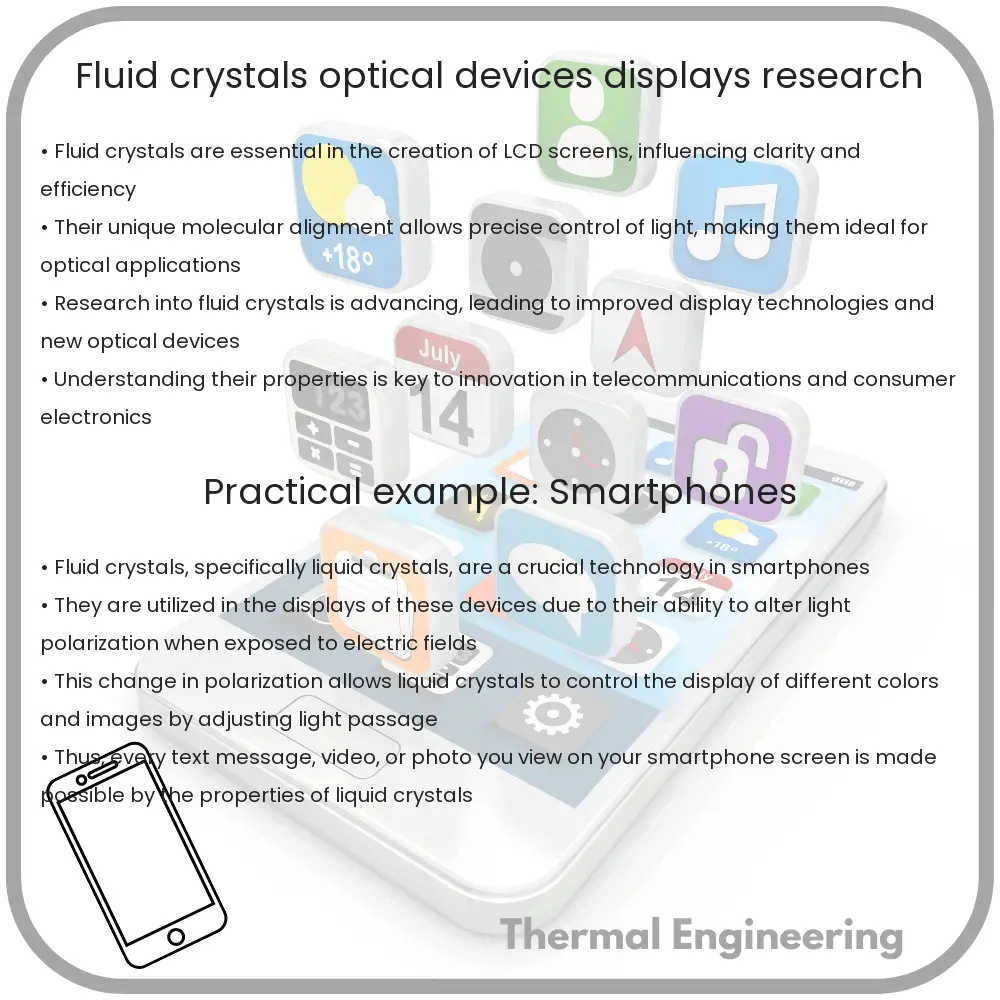
Fluid Crystals | Optical Devices, Displays & Research

Explore the unique properties and applications of liquid crystals in optical devices and research, highlighting their ability to manipulate light.

Fluid Crystals | Optical Devices, Displays & Research

Fluid Crystals and Their Role in Optical Devices and Research

Fluid crystals, often referred to as liquid crystals, are substances that exhibit properties between those of conventional liquids and solid crystals. Perhaps most famously used in display technology, liquid crystals are also crucial in various other optical applications and research areas. This article explores the fundamental nature of liquid crystals, their applications in optical devices and displays, and their role in scientific research.

Understanding Liquid Crystals

Liquid crystals are characterized by their ability to flow like a liquid but maintain some of the ordered structures of a solid. They typically exhibit different phases, including nematic, smectic, and cholesteric, each with unique structural characteristics.

  • Nematic phase: Molecules are oriented in roughly the same direction, but without any positional order.
  • Smectic phase: Molecules are arranged in layers, with each layer behaving like a two-dimensional liquid.
  • Cholesteric phase (or chiral nematic): Molecules are arranged in layers, but each successive layer is slightly rotated, creating a helical structure.

Applications in Optical Devices and Displays

Liquid crystals find extensive use in optical devices due to their unique property of manipulating light based on the alignment of their molecules. This capability is essential for the function of several types of displays and optical equipment.

  1. Liquid Crystal Displays (LCDs): These are the most common application of liquid crystals, used in televisions, computer monitors, and smartphones. LCDs utilize liquid crystals that change orientation in response to electric fields, altering the light’s passage through them. This change in orientation affects the light modulating properties of the device, enabling the display of images.
  2. Optical switches and modulators: Optical devices that require the modulation of light for transmission and reception extensively use liquid crystals. Their ability to control light with high precision makes them suitable for advanced optical communication systems.
  3. Thermotropic sensors: Certain types of liquid crystals can change color based on temperature, which makes them effective as temperature sensors. They are used in devices that require visual temperature monitoring.

Liquid Crystals in Research

In addition to their commercial applications, liquid crystals are a subject of intense research, offering potential breakthroughs in various scientific fields:

  • Advanced Display Technology: Researchers are exploring newer modes of liquid crystal-based displays that promise better energy efficiency and enhanced display characteristics like flexibility and transparency.
  • Biomedical applications: Innovative research involves using liquid crystals for site-specific drug delivery and other therapeutic applications where controlled release of medications is crucial.
  • Photonic structures: The unique light manipulation capabilities of liquid crystals are being used to develop advanced photonic devices and structures for use in telecommunications, computing, and other high-tech industries.

Liquid crystals continue to fascinate scientists and engineers alike, offering a bridge between the flowing properties of liquids and the ordered orientation of crystalline solids. Their continued development and application in optical devices and research not only underline their importance but also hint at the vast potential still to be tapped in this intriguing field of science and engineering.

Dilatant Fluids | Impact Protection & Entertainment

Learn about dilatant fluids, also known as shear-thickening fluids, which increase in viscosity under stress and have diverse applications in safety and entertainment.

Dilatant Fluids | Impact Protection & Entertainment

Introduction to Dilatant Fluids

Dilatant fluids, often known as shear-thickening fluids, are non-Newtonian fluids that behave in a unique and counterintuitive way. Unlike common liquids, dilatant fluids increase in viscosity, or thickness, under the influence of mechanical stress. This peculiar property has made them a subject of interest both in science and in practical applications ranging from impact protection to entertainment.

Understanding Shear-Thickening Behavior

The viscosity of dilatant fluids increases with the rate of applied shear stress. When shear stress is applied – for example, when stirred quickly or struck – the particles within the fluid temporarily form structures that resist flow, hence the fluid behaves more like a solid. The mechanism behind this involves the packing of particles in the fluid, which increases resistance against flow.

Applications in Impact Protection

  • Sports Equipment: Dilatant fluids are used in sports gear like shin guards, helmets, and protective padding. The fluid remains flexible and comfortable during normal use but hardens instantly upon impact, providing superior protection compared to conventional materials.
  • Military and Law Enforcement: Body armor integrating dilatant compounds can be light and flexible, improving mobility while still offering high levels of shock absorption and resistance against projectiles or blunt force.
  • Automotive Safety: Research is ongoing into using dilatant materials in automotive safety systems, such as in bumpers or as part of shock absorbers to enhance protection in the event of a collision.

Entertainment and Consumer Products

  • Slime and Non-Newtonian Toys: One of the most familiar forms of dilatant fluids in entertainment is the popular children’s toy known as “slime”, which exhibits interesting flow characteristics that intrigue and engage young minds.
  • Stress Balls: Dilatant fluids are also used in stress relief toys. These balls offer a satisfying resistance when squeezed, helping to relieve tension and stress.

Scientific and Industrial Applications

Beyond their more visible uses in protective gear and toys, dilatant fluids also hold potential for various industrial applications. These include vibration damping systems where the fluid’s properties help absorb and dissipate energy, and in certain manufacturing processes where adjustable resistance or stiffness is beneficial.

Challenges and Future Research

While dilatant fluids offer promising applications, they also pose challenges. Consistency in behavior under different conditions, long-term stability, and cost-effectiveness in production are areas needing further exploration. Research continues into improving the formulations to maximize both the protective characteristics and the energy-absorbing capabilities of these materials under a broader range of conditions. These advancements could lead to broader applications and even more effective uses in safety and industry.

In conclusion, dilatant fluids exemplify the fascinating intersection of physics and engineering. By understanding and harnessing their unique properties, engineers and scientists are opening up new possibilities in safety technology and beyond, making everyday activities safer and more enjoyable.