Facebook Instagram Youtube Twitter

Fluid Viscosity Enhancers | Industrial, Automotive & Health

Learn about fluid viscosity enhancers, additives that modify fluid viscosity to improve performance and efficiency across various industries.
Fluid Viscosity Enhancers | Industrial, Automotive & Health

Understanding Fluid Viscosity Enhancers

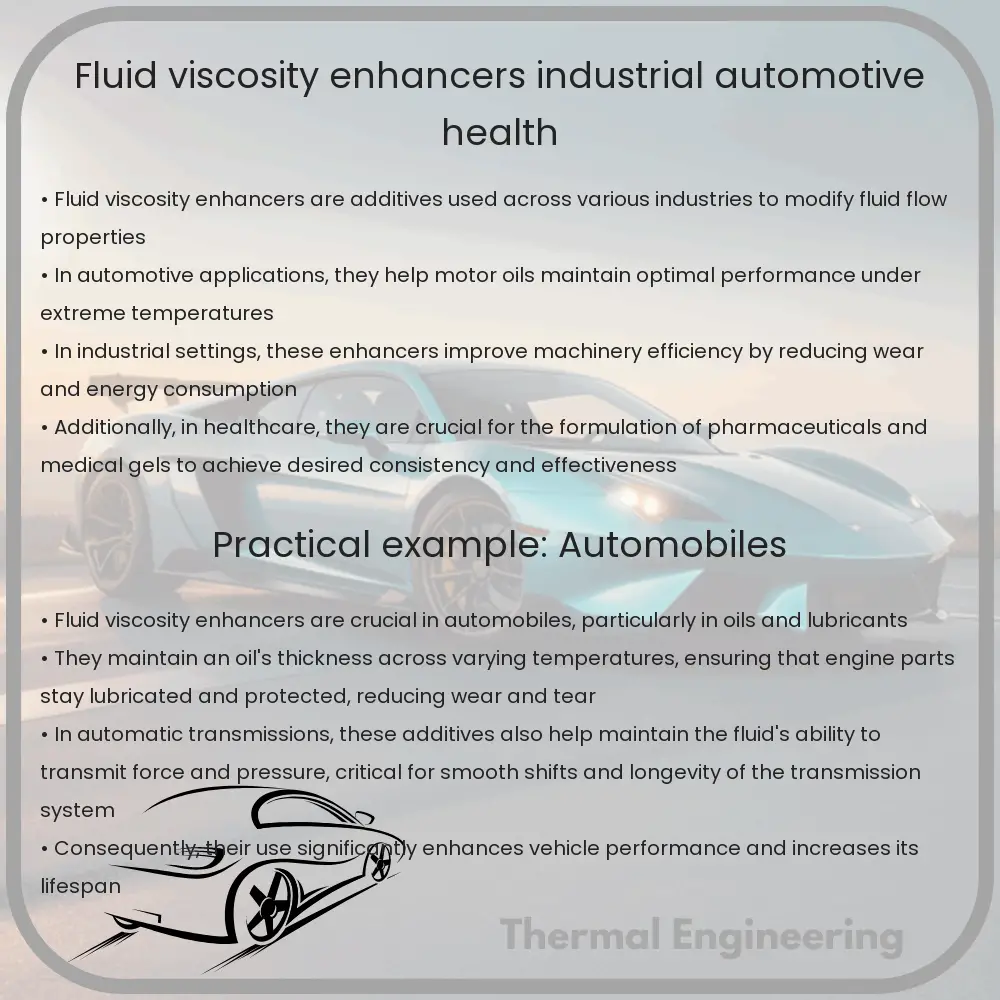
Viscosity, a measure of a fluid’s resistance to flow, plays a crucial role in various industries including industrial, automotive, and health sectors. Fluid viscosity enhancers, or viscosity modifiers, are additives used to alter the viscosity of fluids to optimize performance, efficiency, and durability of systems. This article explores different types of viscosity enhancers and their applications across various fields.

Types of Fluid Viscosity Enhancers

Viscosity enhancers come in several types, each tailored for specific applications:

  • Polymeric Thickeners: Commonly used in lubricants and greases, these large molecules increase the fluid’s viscosity, improving its load-bearing capacity and stability.
  • Viscosity Index Improvers: Used in motor oils, these additives help the oil maintain its optimal viscosity across a range of temperatures.
  • Anti-settling Agents: These are used in suspensions to increase the low-shear viscosity and prevent the settling of suspended particles.
  • Gelling Agents: Widely used in pharmaceuticals and food products, these additives can drastically elevate the viscosity by forming a semi-solid gel.

Applications in Industries

Industrial Applications

In industrial settings, fluid viscosity enhancers are integral to maintaining machinery and production lines. For example, hydraulic fluids benefit from viscosity enhancers that enable consistent performance under varying pressures and temperatures, crucial for maintaining operational accuracy and preventing wear and tear.

Automotive Applications

In the automotive sector, viscosity enhancers are essential in lubricants and engine oils. They ensure that the oils maintain their viscosity under the high temperature and high stress conditions of an engine. This helps in reducing friction and wear, extending the life of the engine parts, and improving fuel efficiency.

Health Sector Applications

In the health sector, viscosity modifiers are used in various pharmaceutical formulations. These enhancers can control the release of medication, improve the stability of suspensions, and influence the absorption of drugs by the body. For instance, eye drops often contain viscosity enhancers to prolong the drug’s contact time with the eye.

Conclusion

Fluid viscosity enhancers play a pivotal role across multiple industries by altering fluid behaviors to meet specific requirements. Their ability to modify viscosity not only enhances the performance and efficiency of products but also significantly impacts product longevity and reliability. As technology progresses, the development of more advanced and environmentally friendly viscosity modifiers is expected, further broadening their applications and effectiveness.

Surface Tension Fluids | Capillary Action & Applications

Learn how surface tension and capillarity drive technological advancements in fields like medicine, agriculture, and engineering.

Surface Tension Fluids | Capillary Action & Applications

Understanding Surface Tension in Fluids

Surface tension is a fundamental concept in both physics and engineering, describing the elastic tendency of a fluid surface that makes it acquire the least surface area possible. This phenomenon occurs because molecules at the surface of a liquid experience a different environment compared to those in the interior, leading to a net inward force, which makes the surface layer contract and resist being stretched or broken.

Equation of Surface Tension

The surface tension, denoted by the Greek letter gamma (γ), is measured in force per unit length. The units are Newtons per meter (N/m). The equation for calculating surface tension is as follows:

γ = F / L

where:

  • F is the force exerted along the line of length L,
  • L is the length along which the force is exerted.

Capillary Action

Capillary action, or capillarity, is a process where a liquid flows in narrow spaces without the assistance of, and frequently in opposition to, external forces like gravity. This movement occurs due to the adhesive force between the liquid and surrounding solid surfaces combined with the cohesive force within the liquid.

The height h to which a liquid will rise or fall in a capillary tube can be predicted by the Jurin’s Law, which is given by:
h = (2γcosθ) / (ρgr)
where:

  • γ is the surface tension of the liquid,
  • θ is the contact angle,
  • ρ is the density of the liquid,
  • g is the acceleration due to gravity,
  • r is the radius of the capillary.

Applications of Surface Tension and Capillary Action

Surface tension and capillary action have numerous applications in various fields of science and engineering. Here are some key examples:

  • Medical Technologies: The design of medical devices such as syringes and blood capillaries relies on capillary action for drawing body fluids.
  • Printing Technologies: In inkjet printers, ink is propelled onto the paper through fine nozzles by exploiting surface tension and capillary effects.
  • Agricultural Engineering: Soil wettability and water absorption involve principles of capillarity, crucial for irrigation techniques and understanding water movements in soils.
  • Coating Processes: Industrial painting and coating processes utilize surface tension to ensure smooth and even distribution of paint on surfaces.
  • Cleaning Operations: Detergents reduce the surface tension of water, allowing it to better penetrate fabrics and surfaces for efficient cleaning.

Understanding these fundamental phenomena is crucial for engineers and scientists to manipulate the properties of liquids in technological applications efficiently. By mastering the concepts of surface tension and capillary action, improvements and innovations in various fields can be achieved, enhancing our everyday tools and systems.

Thixotropic Fluids | Time-dependent Shear & Uses

Learn about thixotropic fluids, non-Newtonian substances with time-dependent shear thinning properties and diverse industrial applications.

Thixotropic Fluids | Time-dependent Shear & Uses

Understanding Thixotropic Fluids: Time-Dependent Shear and Practical Uses

Thixotropic fluids are a type of non-Newtonian fluid that exhibit time-dependent shear thinning properties. Unlike Newtonian fluids, whose viscosity remains constant regardless of the stress applied, thixotropic fluids change their viscosity with variations in shear rate over time. This characteristic makes thixotropic fluids of great interest in various engineering and industrial applications.

What Are Thixotropic Fluids?

Thixotropy is a phenomenon where the viscosity of the fluid decreases over time under constant shear stress. Once the shear stress is removed, the fluid gradually returns to its original viscosity. This reversible and time-dependent change is due to the fluid’s internal structure being broken down when under shear and rebuilt when at rest.

Mechanical Behavior and Properties

The defining feature of thixotropic fluids is their time-dependent shear thinning behavior. When a shear force is applied, the fluid undergoes a decrease in viscosity, which can be described by the following general equation:

η(t) = η0 – k∗tn

Where:

  • η(t) is the viscosity at time t
  • η0 is the initial viscosity
  • k is a constant reflecting the rate of viscosity decrease
  • n is an exponent indicating the dependence on time

This behavior is typically observed in fluids where the internal structure or microstructure can be temporarily broken down by applying a force, such as in gels or suspensions.

Key Applications of Thixotropic Fluids

  • Paints and Coatings: Thixotropy is advantageous in paint formulations, enabling easy application (lower viscosity under shear) while preventing drips and sags once the paint is applied (higher viscosity at rest).
  • Pharmaceuticals: Certain gels and creams used in pharmaceuticals exhibit thixotropic properties to ensure they are easy to spread during application but remain in place thereafter.
  • Food Industry: Some sauces and dressings are designed to be thixotropic so they can be poured easily and then thicken when on the plate.
  • Construction Materials: Concrete and mortars can exhibit thixotropic behavior, essential for ensuring they are workable when being mixed or pumped but stable when applied.
  • Drilling Fluids: Used in the oil and gas industry, drilling fluids must possess thixotropic properties to maintain low viscosity for easy pumping down the drill pipe and increase viscosity to suspend and transport cuttings to the surface.

Advantages and Challenges

Thixotropic fluids offer several advantages in industrial and engineering applications, such as improved handling and application properties, better stability in variable shear conditions, and enhanced performance characteristics aligned with specific use-cases. However, their design and formulation require precise control over their thixotropy which can be sensitive to factors like temperature, pH, and concentration of components.

In conclusion, thixotropic fluids are key in numerous applications across various industries, leveraging their unique property of reversible viscosity to enhance product functionality and user experience. Understanding these fluids’ behavior under different conditions is crucial for optimizing their performance and broadening their application spectrum.

Aerogel insulation for thermal applications

Learn about aerogel insulation, a lightweight, highly effective material for thermal management and how it works across various industries.

Aerogel insulation for thermal applications

Understanding Aerogel Insulation for Thermal Applications

Aerogel is a highly effective insulating material that holds the title for being one of the lightest solids known to science. This remarkable material offers superior thermal insulation properties, making it an ideal choice for various high-performance applications. This article delves into what aerogel is, how it is used in thermal insulation, and the benefits it offers over traditional insulating materials.

What is Aerogel?

Aerogel is made from a gel wherein the liquid component of the gel has been replaced with gas. The result is a material that is composed of up to 99% air, yet has a solid, porous structure. This structure is key to its effectiveness as an insulator. Aerogels can be made from a variety of materials, but silica aerogels are the most common type used for thermal insulation applications.

How Does Aerogel Insulation Work?

The secret to the superior insulating capability of aerogel lies in its composition and structure. The porous material contains a network of interconnected nano-sized pores that block the three methods of heat transfer – conduction, convection, and radiation. Here’s how aerogel performs against each mode of heat transfer:

  • Conduction: Aerogel’s solid structure has very little solid material, which minimizes the points at which heat can be transferred through physical contact.
  • Convection: The pores within aerogels are typically smaller than the mean free path of air molecules, severely restricting air movement and thus reducing heat transfer by convection within its structure.
  • Radiation: Silica aerogel’s structure also reflects infrared radiation, which significantly reduces heat transfer via radiant heat loss.

Applications of Aerogel Insulation

Aerogel’s exceptional insulative properties and lightweight nature make it suitable for a wide range of applications:

  • Building construction: Aerogel can be used in the walls, roofs, and windows of buildings to improve energy efficiency.
  • Industrial usage: It is employed in pipelines and other industrial applications where effective thermal management is critical.
  • Aerospace: Aerogel is used to insulate space suits and spacecraft due to its low density and effective insulation properties.
  • Consumer goods: Applications include high-performance insulating clothing and outdoor gear.

Benefits of Aerogel Insulation

The use of aerogel insulation comes with numerous benefits:

  • Thermal Performance: It offers superior thermal insulation with lower thicknesses than traditional insulators.
  • Lightweight: Its high air content makes it incredibly light, which is especially beneficial in applications where weight is a critical factor.
  • Thickness Reduction: As it provides high insulation value per unit of thickness, it enables slimmer designs in architectural and other applications.
  • Environmental Resistance: Aerogels are hydrophobic and can withstand high temperatures, making them suitable for challenging environments.

Challenges and Future Outlook

Despite its many advantages, aerogel insulation also faces some challenges. Its brittle nature can lead to handling difficulties, and it is currently more expensive than many traditional insulating materials. However, ongoing research and development are likely to overcome these shortcomings. Innovations in manufacturing processes and material blends continue to lower costs and improve the usability of aerogels in various applications.

In conclusion, aerogel insulation represents a cutting-edge solution that addresses both the need for efficient thermal management and energy conservation across multiple industries. As technology progresses, we can anticipate broader adoption and new applications of this fascinating material.

Heat exchanger design for low-temperature environments

Learn about heat exchanger design for low-temperature environments, focusing on material selection, thermal stress, and optimization techniques.

Heat exchanger design for low-temperature environments

Understanding Heat Exchanger Design for Low-Temperature Environments

Heat exchangers are crucial components used in engineering to transfer heat between two or more fluids and are utilized in various applications from heating and cooling in industrial processes to energy generation and refrigeration. Designing heat exchangers for low-temperature environments poses unique challenges that require careful consideration of materials, thermodynamics, and environmental impact. This article provides an overview of these design considerations with a focus on optimizing performance and efficiency.

Key Factors in Designing Heat Exchangers for Cold Climates

When designing heat exchangers for low-temperature environments, such as in polar regions or in high-altitude settings, several factors must be prioritized to ensure efficient operation and durability:

  • Material Selection: The materials used in constructing heat exchangers must be capable of withstanding low temperatures without becoming brittle. Common materials include stainless steel and aluminum due to their durable nature and excellent thermal conductivity.
  • Thermal Stress Management: Low temperatures can induce substantial thermal stresses within the heat exchanger due to differential contraction of materials. Proper design must accommodate these stresses to prevent structural failures.
  • Fouling: In colder environments, the risk of fouling—where impurities accumulate on the heat exchanger surfaces—increases due to the reduced temperatures affecting fluid properties. This can diminish thermal performance and requires regular maintenance or self-cleaning designs.
  • Fluid Selection: The type of fluid used can impact the heat exchanger’s effectiveness and efficiency. For low-temperature operations, fluids like glycol mixtures or synthetic oils, which have lower freezing points, are preferred.

Optimization Techniques in Heat Exchanger Design

Optimization of heat exchangers in low-temperature environments not only focuses on the prevention of operational failures but also aims to enhance energy efficiency and reduce costs. Some common strategies include:

  • Counterflow Configuration: Utilizing a counterflow arrangement where the hot and cold fluids move in opposite directions can maximize the temperature gradient, thus enhancing the heat transfer efficiency.
  • Minimizing Size: Designing compact heat exchangers can help in managing costs and improving the operational feasibility in remote or space-constrained environments.
  • Using Fins: Incorporating fins in the design increases the surface area for heat transfer, effectively improving the heat exchanger’s performance.

Case Study: Application in Renewable Energy

Heat exchangers are integral to the operation of renewable energy systems, such as geothermal power stations or bioenergy plants operating in cold climates. For instance, in geothermal heating systems, heat exchangers play a critical role in transferring geothermal heat to the working fluid. Here, the design must ensure that the heat exchanger can function efficiently at the low ambient temperatures, without losing significant heat to the surroundings.

Conclusion

Designing heat exchangers for low-temperature environments demands a multidisciplinary approach encompassing material science, fluid mechanics, and thermodynamics. By focusing on the proper selection of materials, optimizing design configurations, and regularly assessing operational challenges like fouling, engineers can create effective and efficient systems suitable for the unique demands of cold climates. As technology advances, ongoing research and development are expected to further enhance heat exchanger performance, making them even more viable for a wider range of applications in challenging environmental conditions.

Bingham Plastic Fluids | Yield Stress & Industrial Applications

Understanding Bingham plastic fluids, non-Newtonian materials with a yield stress that must be exceeded to flow.

Bingham Plastic Fluids | Yield Stress & Industrial Applications

Bingham Plastic Fluids: Understanding Yield Stress and Their Industrial Applications

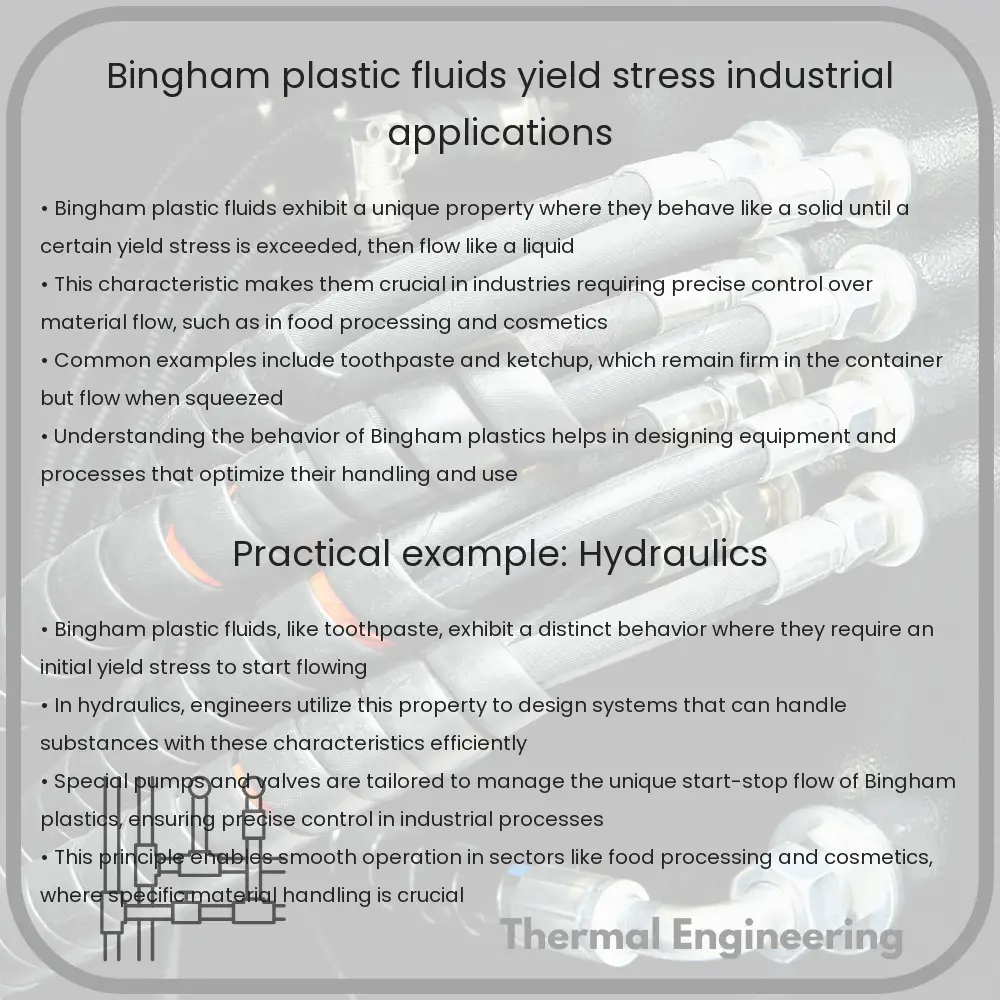
Bingham plastic fluids represent a class of materials that display unique flow properties, distinguishing themselves from the more commonly discussed Newtonian fluids like water or oil. These non-Newtonian fluids have a behavior characterized by a yield stress, which needs to be exceeded before they start to flow like typical fluids. This characteristic makes Bingham plastics crucial in various engineering and industrial applications.

What are Bingham Plastic Fluids?

Bingham plastic fluids are defined by their yield stress threshold, which is the minimum force required to initiate flow. Below this stress, Bingham plastics behave like a solid, maintaining their shape and resisting deformation. Once the yield stress is surpassed, they flow like a viscous liquid. The flow behavior of Bingham plastics can be described by the following equation:

\[
\tau = \tau_y + \mu \cdot \dot{\gamma}
\]

where:

  • \(\tau\) represents the shear stress applied,
  • \(\tau_y\) is the yield stress,
  • \(\mu\) is the plastic viscosity (the constant of proportionality), and
  • \(\dot{\gamma}\) is the shear rate (the rate at which the fluid is deformed under stress).

Thus, Bingham plastics transition from a solid-like to a fluid-like behavior, giving them versatile applications that leverage these properties for efficient performance.

Measurement of Yield Stress

Measuring the yield stress of a Bingham plastic is critical to ascertain its suitability for specific applications. Techniques such as rotational viscometry or rheometry are often employed. These methods allow engineers to emulate the conditions under which the fluid will be used and measure how the fluid behaves under different stress levels, providing insight into its flow characteristics.

Key Industrial Applications of Bingham Plastic Fluids

The unique behavior of Bingham plastics makes them ideal for several industrial uses including:

  1. Mining and Drilling: Bingham plastics are utilized in drilling muds. The yield stress properties help in carrying the drilling cuttings to the surface when the drilling stops and the fluid starts to flow.
  2. Food Industry: Many food products, such as ketchup and mayonnaise, exhibit Bingham plastic behavior. Their resistance to deformation under low stresses helps in maintaining their shape and texture, but they flow easily when sufficient stress is applied (like squeezing a bottle).
  3. Construction and Building Materials: Materials like concrete and plaster can exhibit Bingham plastic behavior. The yield stress helps keep the material stable and in place until deliberate stress (like spreading or smoothing) is applied.
  4. Paints and Coatings: Many paints are engineered to act as Bingham plastics to prevent dripping and running, improving ease of application and uniformity of the coating.

Understanding the yield stress and flow behavior of Bingham plastics not only helps in optimizing these applications but also drives innovation in developing new materials and processes that can leverage these properties. The study and application of Bingham plastics are perfect examples of how material science and fluid mechanics come together in the field of engineering to solve real-world problems.

In summary, Bingham plastic fluids with their unique yield stress property find essential uses across various industries, improving product functionality and processing efficiency. Engineers and scientists continue to explore the potentials of these fascinating materials in even wider contexts.

Hydrodynamic Fluid Film | Lubrication Techniques & Uses

Explore the mechanics and applications of hydrodynamic fluid film lubrication in mechanical engineering to reduce wear and friction.

Hydrodynamic Fluid Film | Lubrication Techniques & Uses

Understanding Hydrodynamic Fluid Film Lubrication

Hydrodynamic fluid film lubrication is a critical technique used in mechanical engineering to minimize wear and friction between sliding surfaces. This type of lubrication primarily relies on the movement of the surfaces to drag the lubricant into the space between them, subsequently creating a separating film. The film formation is vital as it prevents surface contact and reduces the risk of damage and increased friction.

How Hydrodynamic Fluid Film Lubrication Works

In hydrodynamic lubrication, the surfaces moving relative to each other are separated by a thin layer of fluid. This layer forms as the relative motion begins and becomes thick enough to support the normal loads of operation. It is characterized by the fluid’s viscous forces being much larger than the forces due to the fluid’s inertia. As the speed or viscosity increases, the thickness of the lubricating film also increases, thereby enhancing the lubrication effectiveness. The basic principle can be described by the Reynolds equation:

PdV = -d(h3/12μ)(dp/dx)

where P is the pressure in the fluid, V is the velocity, h is the film thickness, μ is the viscosity of the lubricant, and x is the coordinate in the direction of motion.

Types of Lubrication Systems Using Hydrodynamic Fluid Films

Various designs and configurations exist for implementing hydrodynamic fluid film lubrication, depending on the application and machinery design:

  • Journal Bearing: This common type of bearing is used in rotating shafts, and the fluid creates a film as the shaft spins within its housing.
  • Thrust Bearing: Used for axial load support, these bearings form a fluid film that supports loads parallel to the shaft.
  • Kingsbury Bearing: A specialized type of thrust bearing with pivoted shoes that adapt to variations in load and movement, helping maintain a stable fluid film.
  • Lobe Bearings: Often used in gear pumps, lobe bearings support the rotating gears while maintaining a fluid film that separates the gear teeth from the casing.

Applications and Benefits

Hydrodynamic fluid film lubrication is crucial in many industrial applications. Some of the most common applications include:

  • Automotive Engines: The moving parts such as pistons, crankshafts, and camshafts are supported by hydrodynamic lubrication.
  • Power Generators: Hydrodynamic bearings support turbine shafts in hydroelectric, wind, and other power plants.
  • Heavy Machinery: Essential for the smooth operation of equipment in mining, manufacturing, and construction.

The benefits of using hydrodynamic fluid film lubrication include:

  • Reduction in Wear and Tear: By preventing direct contact between moving parts, the lubrication minimizes wear and extends the life of machinery.
  • Decrease in Energy Consumption: Efficient lubrication reduces friction, leading to lower energy use and operational costs.
  • Improved Machine Performance: With reduced friction, machines operate more smoothly and efficiently, enhancing overall performance.
  • Heat Reduction: Lubrication helps in dissipating heat generated by moving parts, thus preventing overheating and potential damage.

In conclusion, hydrodynamic fluid film lubrication plays an indispensable role in a wide range of engineering applications, offering significant benefits in terms of reliability, efficiency, and longevity of equipment. Understanding and implementing effective lubrication systems are essential for optimizing the operation and durability of mechanical systems.

Fluid Couplings | Power Transmission & Machinery

Learn how fluid couplings facilitate power transmission in machinery by using hydraulic principles for smoother and safer operations.

Fluid Couplings | Power Transmission & Machinery

Understanding Fluid Couplings: Essential for Power Transmission in Machinery

Fluid couplings play a pivotal role in the realm of power transmission, particularly in heavy machinery and automotive applications. This device, leveraging the principles of hydraulic power, enables the transfer of rotational power from one shaft to another, using fluid as a medium. Its fundamental operation provides numerous benefits, including smooth start-ups and protection against mechanical overloads.

The Basic Structure and Functioning of Fluid Couplings

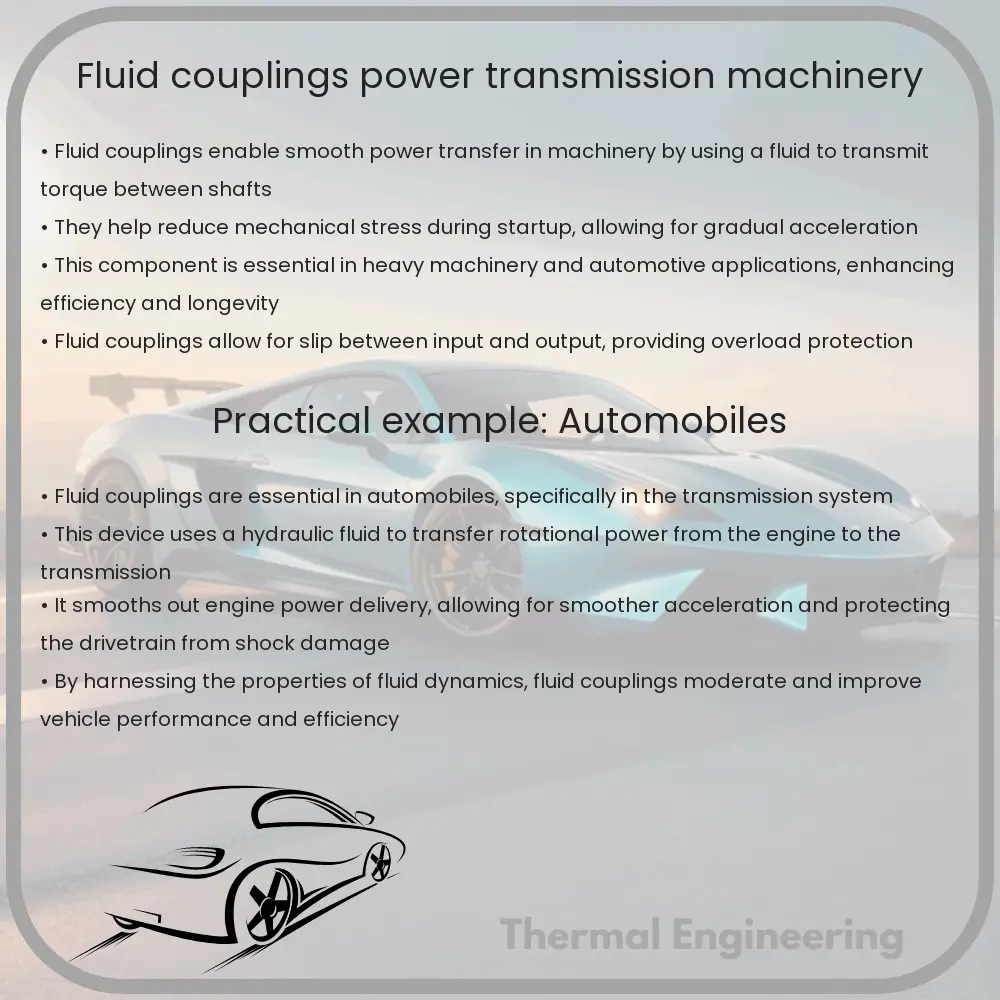
The structure of a fluid coupling typically includes three primary components: an input shaft connected to the driving power source, an output shaft connected to the driven machine, and an enclosed chamber that houses the fluid. Inside the chamber, two main elements exist— the impeller (or pump) fixed to the input shaft and the turbine fixed to the output shaft.

Operation begins when the driving shaft (engine or motor shaft) turns the impeller. This motion imparts kinetic energy to the hydraulic fluid, spirally projecting it outward toward the turbine blades. The fluid’s movement imparts a force on the turbine blades, causing the turbine and the output shaft to rotate, thereby transferring power from the input to the output through the fluid medium.

Advantages of Using Fluid Couplings

  • Torque Conversion: Fluid couplings can modify the torque transmitted between the input and the output, which is beneficial for applications requiring variable torque settings.
  • Controlled Startup: They allow for a gradual increase of load, which provides a smooth and controlled startup, thus reducing stress on the machinery during initial power take-up.
  • Overload Protection: By acting as a mechanical fuse, fluid couplings protect against mechanical overloads by slipping when the load exceeds safe operating limits.
  • Vibration Dampening: They help to damp vibrations and reduce shock loads to the drive system, thus extending the life-span of machinery components.

Applications of Fluid Couplings

Fluid couplings are used extensively across various industries. They are particularly prevalent in automotive applications, like in automatic transmissions where they serve as a replacement for mechanical clutches, providing a smoother ride. In industrial settings, they are employed in conveyors, crushers, fans, pumps, and compressors, where variable speed operation and controlled start-up conditions are required.

Conclusion

The integration of fluid couplings in power transmission systems offers enhanced operational efficiency, protection, and control. As industries continue to demand more flexible and reliable machinery operations, the importance of understanding and implementing fluid couplings will undoubtedly increase. Whether in heavy machinery or automotive applications, the role of fluid couplings is integral to modern mechanical engineering.

Fluid Dampers | Vibration Control & Structural Safety

Learn about fluid dampers, their functionality, types, and the crucial role they play in enhancing structural safety and controlling vibrations.

Fluid Dampers | Vibration Control & Structural Safety

Understanding Fluid Dampers: Essential Tools for Vibration Control and Structural Safety

Fluid dampers, also known as hydraulic dampers, play a crucial role in engineering by providing vibration control which, in turn, enhances structural safety in various applications. From skyscrapers to automotive suspensions and bridges, the application of fluid dampers is wide-ranging and vital. Here, we delve into how fluid dampers work, their types, and the impact they have on controlling vibrations and ensuring safety in structures.

How Do Fluid Dampers Work?

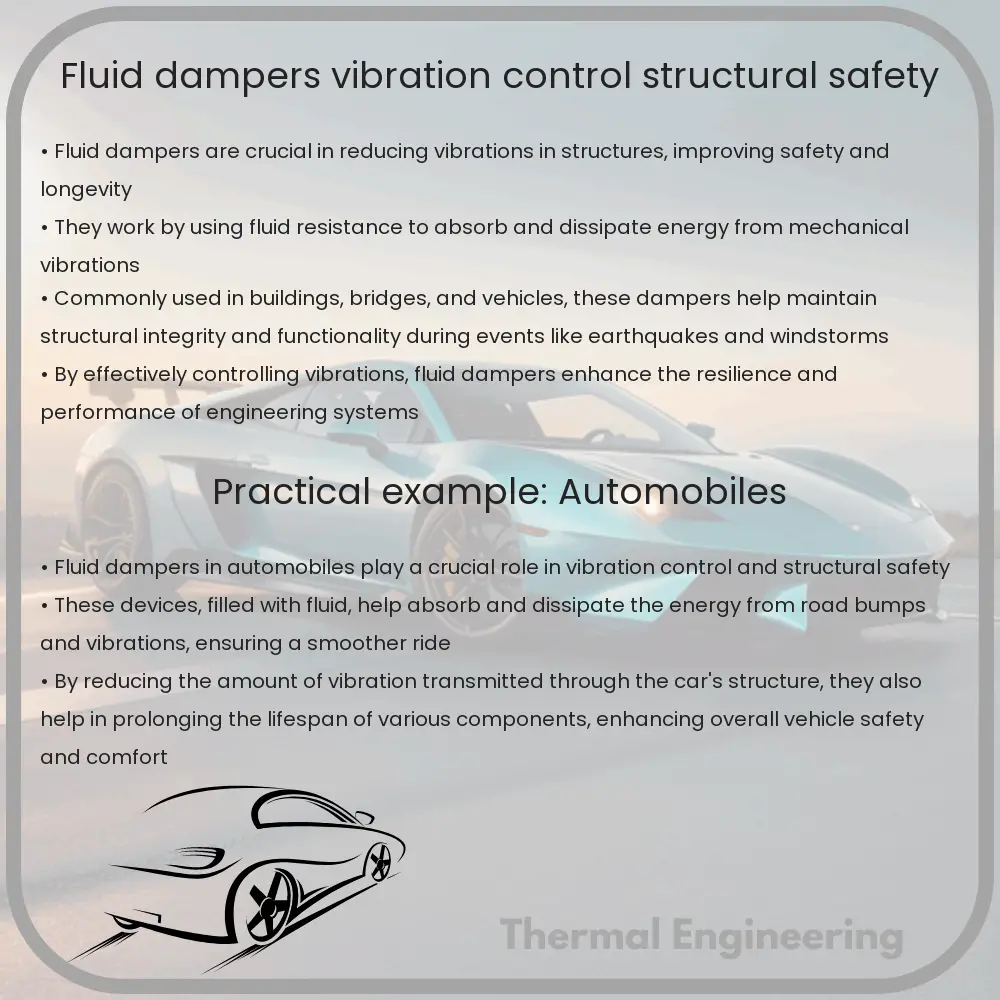
Fluid dampers reduce the amplitude of vibrations using a fluid, typically oil, to absorb and dissipate energy. The basic principle involves a piston moving through a cylinder filled with fluid. As the piston moves, it displaces the fluid, forcing it through orifices or around obstacles, which converts the kinetic energy (movement energy) of the structure into thermal energy (heat), thereby dampening the motion.

  • Viscous Damping: The fluid opposes the piston’s motion, providing a resistance that is proportional to the velocity of the motion. This is described by the equation F = -c*v, where F is the damping force, c is the damping coefficient, and v is the velocity.
  • Compression and Expansion: The compression creates pressure within the damper, and managing this pressure through specially designed valves controls the resistance level and response of the damper.

Types of Fluid Dampers

Fluid dampers are categorized based on their construction and the operational behavior of the fluid within.

  1. Hydraulic Dampers: These are commonly used in automotive applications and heavy machinery. They provide stable damping characteristics and can be adapted for different conditions with adjustable settings.
  2. Magnetorheological (MR) Dampers: These contain a fluid that changes viscosity in the presence of a magnetic field, allowing for rapid adjustment of the damper’s stiffness and damping capacity. This feature is incredibly useful in adaptive suspension systems.
  3. Electrorheological (ER) Dampers: Similar to MR dampers, but the fluid’s viscosity changes in response to an electric field. These are less common due to their higher complexity and cost.

Vibration Control and Structural Safety

The primary purpose of incorporating fluid dampers into structures and machinery is to enhance vibration control, which directly impacts safety and durability. By mitigating the amplitude and frequency of vibrational energy, dampers:

  • Protect Structural Integrity: Reducing stress on materials prevents fatigue and cracks, thereby extending the lifespan of the structure.
  • Ensure Operational Safety and Comfort: In vehicles and buildings, reducing excess vibrations enhances comfort for users and stability during operations.
  • Prevent Resonance Failures: Resonance, which can lead to catastrophic failures in structures like bridges and towers, is effectively controlled by tuning dampers to specific vibration frequencies.

The Future of Fluid Damping Technology

Advancements in material science and control systems are paving the way for the next generation of fluid dampers, which promise even greater control and adaptability to dynamic loads and environmental changes. Smart damping systems, which integrate sensors and adaptive control algorithms, are set to redefine how structures respond to natural forces like earthquakes and high winds.

In conclusion, fluid dampers are essential components in engineering that play a pivotal role in vibration control and structural safety. As technology progresses, their importance and capabilities are only set to increase, offering more sophisticated solutions to engineering challenges in dynamic environments.

Fluids in Space | Microgravity, Research & Life Support

Explore the unique behavior of fluids in microgravity and its crucial role in space-based research and life support systems.

Fluids in Space | Microgravity, Research & Life Support

Understanding Fluid Behavior in Space: Microgravity, Research, and Life Support

Fluid dynamics in the unique conditions of space, particularly under microgravity, offers fascinating insights into physical phenomena that are otherwise masked by Earth’s gravitational pull. This article delves into the behavior of fluids in space, highlighting its importance in research and life support systems aboard spacecraft and space stations.

What is Microgravity and Its Impact on Fluids?

Microgravity is the condition in space where the force of gravity is significantly less than on Earth, often described as “weightlessness. This environment creates unique challenges and opportunities for managing fluids. Unlike on Earth, where gravity ensures that liquids settle and gases rise, microgravity conditions lead to different fluid behavior, strongly influenced by surface tension and cohesive forces.

In microgravity, fluids tend to form spherical shapes and can adhere to surfaces and objects, creating potential problems like obstructing airways or damaging equipment. However, this behavior also allows for novel experiments related to phase changes, fluid dynamics, and heat transfer.

Research Applications of Fluid Dynamics in Space

The peculiarities of fluid behavior in microgravity have prompted extensive research with applications ranging from physics to biotechnology. Key areas of investigation include:

  • Protein Crystal Growth: Microgravity allows the growth of more perfect crystals, benefiting drug design and synthesis back on Earth.
  • Combustion Research: Studying combustion in microgravity leads to a better understanding of the process since the absence of buoyancy-driven convection simplifies the reaction dynamics.
  • Material Science: The behavior of molten materials can be better understood in microgravity, aiding the development of better materials for aerospace and other applications.

Fluids in Life Support Systems in Space

Fluid management is crucial for life support systems in space habitats. These systems must efficiently handle air and water for human survival. Key aspects include:

  • Water Recovery and Recycling: Water used by astronauts is collected, filtered, and reused. Effective fluid management ensures maximum recovery rate and purification for safe drinking water.
  • Waste Management: Fluid waste in space requires careful handling to prevent contamination and ensure the health and safety of the space environment.
  • Air Humidity Control: In microgravity, moisture does not settle as droplets on surfaces but forms a mist. Devices must ensure humidity is controlled to prevent condensation on equipment and maintain comfortable living conditions.

Future of Fluid Research in Space

The ongoing research and discoveries related to fluid dynamics in microgravity continue to enhance our understanding and improve space travel’s viability. NASA and other space agencies invest in such studies to prepare for longer missions, such as those to Mars and beyond, where advanced fluid management systems will be critical. Furthermore, insights gained from space-based fluid research can lead to innovations in technology and manufacturing processes on Earth, demonstrating the broader impacts of this intriguing field of study.

As we continue to explore space, the control and understanding of fluid behavior in microgravity will remain a cornerstone of ensuring astronauts’ safety and well-being while also unraveling new scientific phenomena.