Facebook Instagram Youtube Twitter

7 Types of Exergy Analysis in Thermodynamic Systems

Exergy analysis is a thermodynamic tool used to evaluate and improve the efficiency and performance of energy systems by measuring their useful work potential.

7 Types of Exergy Analysis in Thermodynamic Systems

Introduction to Exergy Analysis in Thermodynamic Systems

Exergy analysis is a powerful tool in thermodynamics that helps engineers and scientists evaluate the performance and efficiency of energy systems. Unlike energy, which is always conserved, exergy measures the useful work potential of a system, indicating how much of the energy can be effectively utilized. This is pivotal for enhancing system designs and reducing wasted resources. In thermodynamic systems, there are several types of exergy analysis that can be applied, each offering unique insights and benefits.

1. Specific Exergy Analysis

This type of analysis focuses on the exergy of specific components within a system at a given state. For instance, it evaluates how much work is needed to bring a subsystem or component from its current state to a reference environment condition. It is especially useful in identifying the potential for performance improvement in individual components of a system.

2. Flow Exergy Analysis

Flow exergy analysis is used primarily for fluid streams within a system. It considers the flow of energy and materials through components such as turbines, compressors, and heat exchangers. This analysis helps in designing and optimizing processes by examining how changes in pressure, temperature, and chemical properties affect the overall exergy.

3. Chemical Exergy Analysis

Chemical exergy analysis assesses the potential work of a system based on the chemical energy stored in fuels and other materials. It is crucial in systems where chemical reactions occur, such as in combustion engines and chemical reactors. This analysis helps in maximizing the conversion of chemical energy into useful work.

4. Thermal Exergy Analysis

Thermal exergy analysis deals with the exergy changes due to temperature differences within a system. The main focus is on how heat transfer affects the exergy and, consequently, the efficiency of thermal systems like boilers and condensers.

5. Exergoeconomic Analysis

Exergoeconomic analysis combines exergy analysis with cost aspects, providing a holistic view of both the thermodynamic and economic performance of a system. It helps in determining the real economic cost of inefficiencies and in pinpointing cost-effective improvements.

6. Exergoenvironmental Analysis

The exergoenvironmental analysis extends the exergy concept to include environmental impacts. By assessing the life cycle exergy consumption of a system, including the exergy destruction associated with environmental emissions, this analysis helps in designing more sustainable and eco-friendly systems.

7. Dynamic Exergy Analysis

Unlike the mostly static nature of other analyses, dynamic exergy analysis takes into account the changes in a system over time. It is particularly useful for systems subject to transient operating conditions, evaluating how system performance varies with time and identifying optimal operation strategies under variable conditions.

Conclusion

Exergy analysis in its various forms provides a valuable framework for analyzing and improving the efficiency, cost effectiveness, and environmental impact of thermodynamic systems. By utilizing these different types of exergy analyses, engineers can design more effective, efficient, and sustainable systems, thus contributing significantly to energy conservation and resource management.

5 Types of Thermal Comfort Models in Architecture

Explore the application of different thermal comfort models in architecture, including Fanger’s Comfort Model and the Adaptive Comfort Model, to enhance occupant well-being.

5 Types of Thermal Comfort Models in Architecture

Understanding Thermal Comfort Models in Architecture

Thermal comfort is a crucial aspect of architectural design, affecting both energy consumption and occupant satisfaction. Architects and engineers use various thermal comfort models to predict and evaluate the comfort levels within built environments. These models help in making informed decisions about HVAC system design, material selection, and other building attributes. Here’s an overview of five prominent types of thermal comfort models used in architecture.

1. Fanger’s Comfort Model

Developed by P.O. Fanger in the 1970s, this model is one of the most widely acknowledged approaches to assessing thermal comfort. It introduces the concept of Predicted Mean Vote (PMV), which predicts the mean value of the votes of a large group of people on a seven-point thermal sensation scale, ranging from -3 (cold) to +3 (hot). The Predicted Percentage of Dissatisfied (PPD) is also a component of this model, estimating the percentage of people likely to feel thermally uncomfortable. The formula for PMV is based on factors like air temperature, mean radiant temperature, air velocity, humidity, clothing insulation, and metabolic rate.

2. Adaptive Comfort Model

The Adaptive Comfort Model takes into account the adaptive behavior of people according to changes in their environment. It suggests that thermal comfort ranges can vary depending on the local climate and the occupants’ ability to adapt through natural ventilation, clothing, or other means. This model is particularly useful for designing spaces without mechanical cooling or heating systems, promoting sustainable practices.

3. ASHRAE Standard 55

A widely used standard in building design, ASHRAE Standard 55 outlines the conditions under which a substantial majority of occupants will find an environment thermally comfortable. This standard applies the principles from both the Fanger model and the adaptive model, offering guidelines that can be implemented in various climates and for different seasonal conditions.

4. Berkeley Comfort Model

Developed at the Center for the Built Environment at the University of California, Berkeley, this model focuses on local thermal comfort conditions. It assesses comfort by considering the impact of six primary factors: air temperature, radiant temperature, humidity, air speed, clothing level, and metabolic rate. This localized approach allows for more detailed thermal comfort analysis within different zones of a building.

5. UTCI – Universal Thermal Climate Index

The UTCI is a comprehensive thermal comfort model that considers the thermal environment from the perspective of human physiology. It evaluates how outdoor environmental conditions, including temperature, humidity, wind speed, and radiation, affect human comfort. The index is used globally and can apply to a wide range of climatic conditions, making it versatile for urban planning and outdoor comfort assessments.

In conclusion, understanding and applying these thermal comfort models enable architects and engineers to create more comfortable, functional, and sustainable living environments. Each model offers unique insights and tools to tailor architectural designs to the nuanced demands of climate and occupant comfort preferences, ultimately enhancing the overall well-being and satisfaction of building occupants.

6 Types of Heat Absorption Techniques for Cooling

Learn about six key heat absorption techniques used in cooling systems, from evaporative cooling to absorption refrigeration.

6 Types of Heat Absorption Techniques for Cooling

Introduction to Heat Absorption Techniques for Cooling

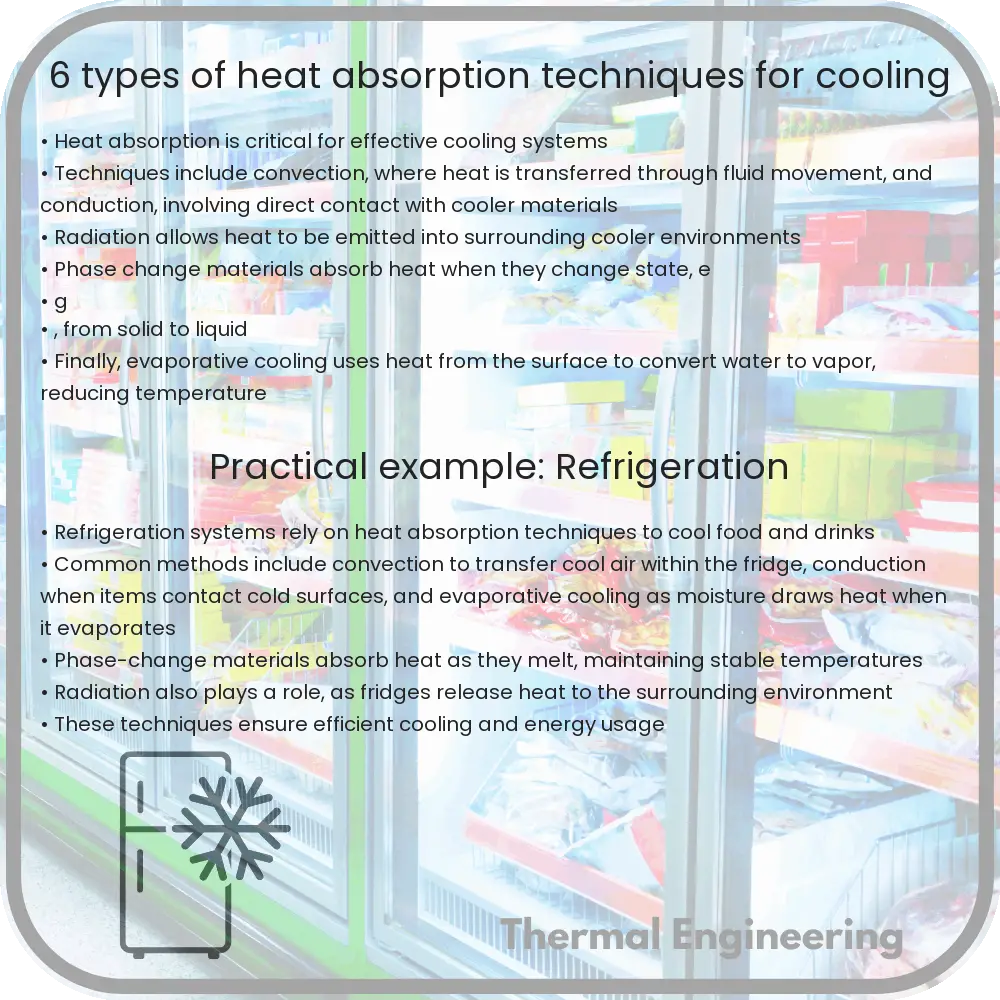
Cooling technologies play a critical role in various applications from industrial processes to consumer electronics and climate control in buildings. The efficiency of these technologies largely depends on how effectively they can absorb and remove heat. Here, we explore six common types of heat absorption techniques used in cooling systems.

1. Evaporation Cooling

Evaporative cooling is a natural and efficient process that absorbs heat through the evaporation of water. When water evaporates, it absorbs significant amounts of heat energy from its surroundings, thereby reducing the temperature. This principle is commonly used in cooling towers, swamp coolers, and in some air conditioning systems.

2. Refrigeration Cycle

The refrigeration cycle is a cornerstone of modern air conditioning and refrigeration. It involves a refrigerant passing through a cycle of evaporation, compression, condensation, and expansion. During the evaporation stage, the refrigerant absorbs heat from the environment, cooling it effectively. This technology is widely used in domestic and commercial refrigerators, air conditioners, and industrial chillers.

3. Heat Pipes

Heat pipes are highly efficient thermal conductors that consist of a sealed tube filled with a liquid coolant that absorbs heat by evaporating and then releases the heat by condensing. They are particularly useful in cooling high-performance electronics, such as CPUs and GPUs, where direct cooling methods can be inadequate.

4. Thermoelectric Cooling (Peltier Effect)

Thermoelectric cooling uses the Peltier effect to create a heat flux between two different types of materials. When a voltage is applied to a thermoelectric module, heat is moved from one side to the other, creating a cold side and a hot side. This method is useful for portable coolers and for cooling small electronic components that require precise temperature control.

5. Phase Change Materials (PCMs)

PCMs absorb and release heat while undergoing phase changes, typically from solid to liquid and back. By integrating PCMs in building materials, electronics, and other products, they can help in stabilizing temperature fluctuations by absorbing excess heat and releasing it when the temperature drops. This technology is increasingly used in data centers, thermal energy storage systems, and passive building cooling.

6. Absorption Refrigeration

Absorption refrigeration is a type of refrigeration that uses a heat source (e.g., solar power, natural gas, or waste heat) and a water-ammonia solution or other combinations to absorb heat, rather than electrically driven compressors. This technique is ideal for industrial applications where waste heat is available, and in low-power applications like RV refrigerators and solar-powered refrigeration systems.

Conclusion

Understanding these six heat absorption techniques provides insight into the diverse strategies engineers and scientists use to manage thermal energy. Whether through evaporation, refrigeration cycles, the innovative use of materials like PCMs, or other methods, effective heat management is fundamental across many aspects of modern technology and industry. By leveraging these various cooling techniques, we can enhance performance, increase efficiency, and drive technological advances in numerous fields.

10 Types of Thermal Efficiency Metrics in Engines

Explore key metrics used to evaluate thermal efficiency in engines, including Brake Thermal Efficiency and Indicated Thermal Efficiency.

10 Types of Thermal Efficiency Metrics in Engines

Understanding Thermal Efficiency Metrics in Engines

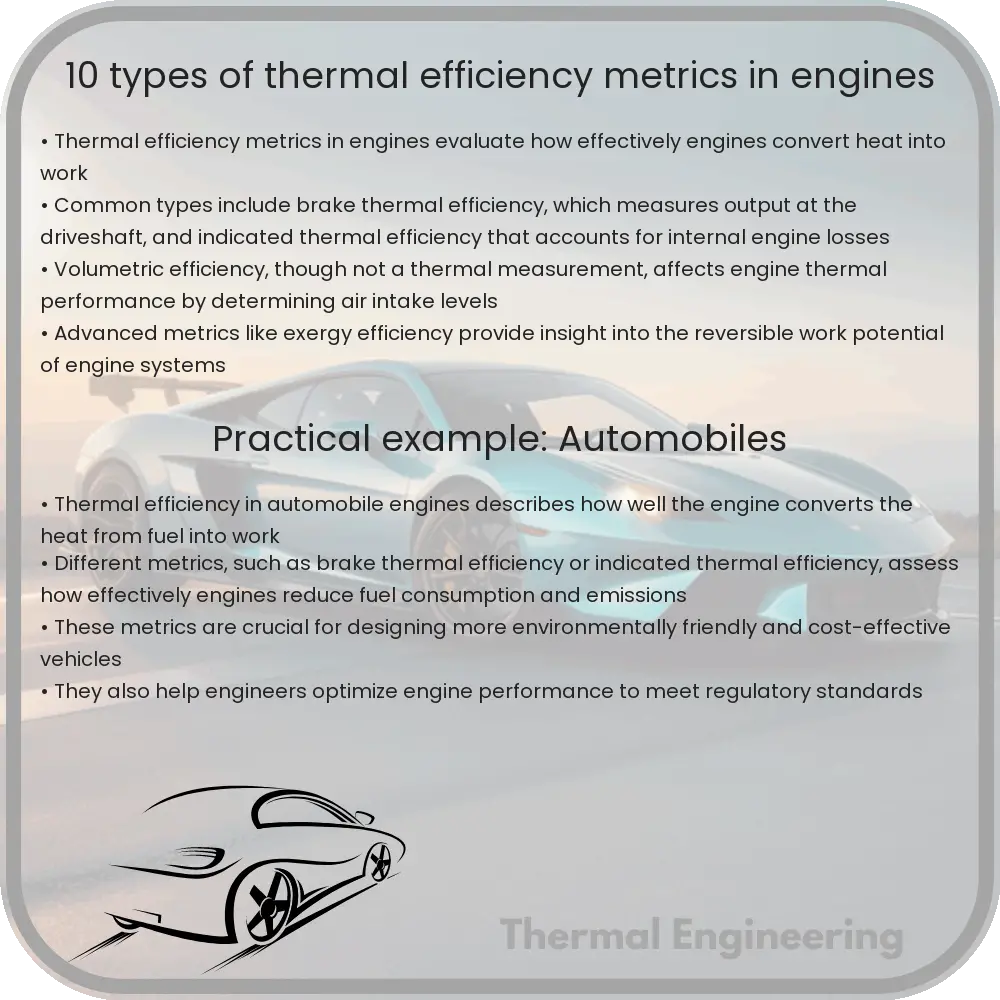
Thermal efficiency is a critical measurement in the engineering and automotive industries, indicating how well an engine converts the heat from fuel into work. There are several metrics used to evaluate thermal efficiency, each with its specific focus and applications. This article will explore ten types of thermal efficiency metrics commonly used in engine evaluation.

1. Brake Thermal Efficiency (BTE)

Brake Thermal Efficiency assesses the proportion of heat converted into useful work by an engine at the output shaft. It is expressed by the equation:

BTE = (Output Power / Input Heat Energy) * 100%

This metric is frequently used for benchmarking engine performance in vehicles.

2. Indicated Thermal Efficiency (ITE)

Indicated Thermal Efficiency measures the efficiency within the engine’s cylinders before mechanical losses are considered. It is calculated as:

ITE = (Indicated Power / Input Heat Energy) * 100%

ITE helps in understanding the efficiency losses occurring due to the engine design and operation before power is transmitted to the drivetrain.

3. Volumetric Efficiency

Volumetric Efficiency is not a measure of thermal efficiency directly but influences it significantly. It measures the effectiveness of the engine in drawing air into the cylinders and is defined as the ratio of the volume of air intake to the theoretical volume of the engine’s cylinders.

4. Mechanical Efficiency

Mechanical Efficiency quantifies the losses primarily due to friction and other mechanical resistances within the engine. It is the ratio of brake power to indicated power:

Mechanical Efficiency = (Brake Power / Indicated Power) * 100%

5. Specific Fuel Consumption (SFC)

Specific Fuel Consumption is an indirect efficiency metric that measures the fuel efficiency of an engine relative to the power output. Lower values indicate better efficiency:

SFC = (Fuel Flow Rate / Power Output)

6. Thermal Efficiency of Rankine Cycle

Often used in context with steam engines, this metric measures the efficiency of converting heat into work in systems using the Rankine cycle. It is defined as:

η = (Work Done / Heat Supplied)

7. Carnot Efficiency

Carnot Efficiency is the theoretical maximum efficiency that a heat engine can achieve operating between two temperatures. It is expressed as:

ηCarnot = 1 – (Tlow / Thigh), where T is in Kelvin

This equation sets a fundamental limit on the maximum efficiency possible for any heat engine due to the second law of thermodynamics.

8. Second Law Efficiency

This metric evaluates the effectiveness of an engine in converting available energy into useful work, considering entropy generation and other irreversibilities. It is a more comprehensive tool for analyzing real-world systems beyond idealized models.

9. Exergy Efficiency

Exergy Efficiency, or the second law efficiency, focuses on the useful work potential of a given process. It contrasts with traditional metrics by evaluating how much useful work is retrieved instead of solely focusing on heat conversion:

Exergy Efficiency = (Useful Exergy Output / Exergy Input)

10. Coefficient of Performance (COP)

While commonly associated with refrigerators and heat pumps, the Coefficient of Performance can also be a metric for thermal management systems in engines:

COP = (Heat Removed or Added / Work Input)

Understanding these thermal efficiency metrics provides insight into the performance, design, and potential improvements of engine systems. Engineers use these values not only to gauge current engine performance but also to set benchmarks and objectives for future advancements in engine technologies.

Thermal resistance of insulating materials

Unlock the secrets of how insulating materials manage heat flow through the understanding of thermal resistance, its measurement, and influential factors.

Thermal resistance of insulating materials

Understanding the Thermal Resistance of Insulating Materials

Insulating materials play a crucial role in managing and controlling heat flow in various applications, from household insulation to industrial processes. The effectiveness of an insulating material in limiting heat transmission is quantified by its thermal resistance, which is a measure of a material’s ability to resist heat flow. Higher thermal resistance indicates better insulating properties. This article explores the basic concept of thermal resistance, how it is measured, and the factors that affect it.

What is Thermal Resistance?

Thermal resistance is a physical property that measures the temperature difference across a material for a given heat flow rate. It is denoted by the symbol R and typically measured in units of Kelvin per Watt (K/W). The formula for calculating thermal resistance is:

\[ R = \frac{\Delta T}{Q} \]

where:

  • \(\Delta T\) is the temperature difference across the material (in Kelvins, K)
  • \(Q\) is the heat flow rate (in Watts, W)

Thermal resistance is intrinsic to the material’s properties, including its thermal conductivity, thickness, and area through which heat is transferred.

Factors Influencing Thermal Resistance

The main factors impacting the thermal resistance of an insulating material can be broadly categorized into three groups:

  1. Material Composition: Different materials have inherent properties that define how well they can insulate against heat. For instance, materials with a lower thermal conductivity, such as aerogels or fiberglass, exhibit higher thermal resistance compared to metals like copper or aluminum.
  2. Thickness of the Material: For a given material, increasing the thickness will proportionally increase the thermal resistance. This relationship can be expressed by the equation \( R = \frac{L}{k} \) where \( L \) is the thickness of the material and \( k \) is the thermal conductivity.
  3. Surface Area: The area through which heat is transferred also affects thermal resistance. Larger areas facilitate more heat transfer, decreasing thermal resistance, while smaller areas increase it.

It’s important to note that in practical scenarios, multiple layers of different materials are often used together to optimize insulating performance, each contributing differently to the overall thermal resistance.

Measurement and Applications

Thermal resistance for a material is typically measured in controlled laboratory settings using devices like heat flow meters or guarded hot plates. These measurements are crucial for engineering applications where precise thermal management is necessary, such as in building construction, refrigeration, aerospace, and other areas where effective insulation affects energy efficiency and safety.

Conclusion

In summary, thermal resistance is a fundamental property of insulating materials that dictates their effectiveness in impeding heat flow. Understanding and measuring this property is essential in the design and selection of materials for thermal insulation in various engineering fields. By considering the composition, thickness, and area of the material, engineers can manipulate and enhance the thermal resistance to meet specific requirements for energy conservation and thermal management.

Exploring thermal resistance not only aids in better material design but also promotes a deeper understanding of heat transfer mechanisms in real-world applications. As materials science advances, the development of materials with higher thermal resistances is likely to continue, playing a key role in enhancing energy efficiency across global industries.

5 Types of Heat Transfer in Food Processing

Learn about the role of heat transfer in food processing, including conduction, convection, radiation, induction, and evaporation methods.

5 Types of Heat Transfer in Food Processing

Understanding Heat Transfer in Food Processing

In the world of food processing, heat transfer plays a critical role in ensuring that foods are safely and efficiently processed for consumption. Heat transfer refers to the movement of thermal energy between physical systems depending on the temperature and properties of the materials involved. Here are five primary types of heat transfer mechanisms utilized in the food processing industry:

1. Conduction

Conduction is the transfer of heat through a solid material from one molecule to another without any movement of the material as a whole. In food processing, conduction occurs when heat moves through food placed directly on a hot surface, such as a grill or pan. An example would be grilling a steak or frying pancakes.

  • Example: Cooking a burger on a griddle involves heat transfer from the hot surface to the burger through conduction.

2. Convection

Convection involves the transfer of heat through a fluid, which can be a liquid or a gas. This occurs when heated particles transfer energy to the surrounding cooler particles, which then heat up and rise, creating a circulating flow. In food processing, convection is used in practices like boiling, deep-frying, and steam cooking.

  • Example: Baking bread in an oven uses convection as hot air circulates around the dough, cooking it evenly.

3. Radiation

Radiation heat transfer occurs through electromagnetic waves, such as infrared radiation. Food does not need to directly contact the heat source for radiation to occur. In food processing, this is commonly seen in processes that involve grills or microwave ovens.

  • Example: Toasting bread in a toaster involves heat transfer through infrared radiation emanating from the toaster’s heating elements.

4. Induction

Induction heating is another method used in food processing. It involves the generation of heat through electromagnetic induction. Under this process, an electrically conducting object (usually a metal pan) is placed in a changing magnetic field, causing electric currents (eddy currents) to flow through the metal and heat it up.

  • Example: Using an induction cooktop to heat a saucepan. The cooktop itself does not get hot; the heat is generated by the electric currents within the pan.

5. Evaporation and Condensation

While often overlooked, the processes of evaporation and condensation are significant in food processing. Evaporation involves the removal of heat through the vaporization of moisture (water or other cooking fluids), which helps in processes like concentration and drying. Condensation is the process where vapor turns back into liquid, releasing heat and is utilized in techniques such as distillation.

  • Example: Concentrating fruit juice by heating it to promote evaporation of water, thus thickening the juice and intensifying flavors.

In conclusion, understanding these types of heat transfer in food processing helps in optimizing manufacturing processes, ensuring energy efficiency, and achieving the desired quality in food products. Integrating the appropriate heat transfer methods can significantly influence the texture, flavor, and shelf-life of processed foods.

8 Types of Thermal Barriers in Engine Design

Learn about the role of thermal barriers in enhancing engine performance and longevity by managing extreme temperatures.

8 Types of Thermal Barriers in Engine Design

Understanding Thermal Barriers in Engine Design

One crucial aspect of engine design is managing the extreme temperatures that internal combustion generates. Thermal barriers are employed to protect engine components, enhance efficiency, and prolong the engine’s life. This article explores eight types of thermal barriers commonly used in engine design.

1. Thermal Barrier Coatings (TBCs)

Thermal Barrier Coatings are advanced materials usually applied to the surfaces of components exposed to high temperatures, such as turbine blades and combustion chambers. These coatings are generally made of ceramic materials such as yttria-stabilized zirconia (YSZ), which help to insulate the component from heat and reduce thermal fatigue.

2. Heat Shields

Heat shields are more straightforward compared to TBCs. They are often made from metal sheets and are used to deflect or absorb heat away from engine components and the vehicle’s interior. Materials such as aluminum or specialized reflective sheets are commonly used due to their excellent thermal reflective properties.

3. Thermal Barrier Pistons

Pistons in high-performance engines may be coated with a thermal barrier coating to reduce the transfer of heat from the combustion process into the piston. This helps in maintaining more consistent operating temperatures and reduces the risk of piston wear and failure.

4. Exhaust Wraps

Exhaust wraps help reduce heat loss from exhaust piping, effectively allowing hotter gases to exit the system faster. This can increase exhaust gas velocity, improving engine scavenging and overall performance. The wraps are typically made from materials like fiberglass or ceramic fibers.

5. Thermal Gaskets

Thermal gaskets are used to provide a heat-resistant seal between two components, preventing heat transfer while also ensuring no leaks of gases or liquids. These gaskets are critical in maintaining performance and reducing engine overheating.

6. Cylinder Head Insulation

The cylinder head can be insulated using special inserts or coatings that help maintain optimal combustion chamber temperatures. This can enhance combustion efficiency, leading to better engine performance and lower emissions.

7. Cooling Jackets

Cooling jackets are an integral part of most engines, designed to allow coolant to circulate around critical components such as the engine block and cylinder heads. The coolant absorbs and dissipates heat away from the engine, helping to regulate its temperature.

8. Piston Skirt Coatings

Piston skirts can be coated with materials that have low thermal conductivity, reducing the heat transfer into the piston and also minimizing friction. This not only helps in reducing wear and tear but also boosts the overall efficiency of the engine.

Each of these thermal barriers plays a vital role in engine performance and durability. By effectively managing heat, they contribute to more efficient, reliable, and longer-lasting engines, which are crucial in both automotive and aerospace industries.

9 Types of Thermodynamic Analysis in Renewable Energy

Learn how thermodynamic analysis enhances renewable energy efficiency, focusing on energy transformations in systems like solar and wind power.

9 Types of Thermodynamic Analysis in Renewable Energy

Understanding Thermodynamic Analysis in Renewable Energy

Thermodynamics plays a crucial role in understanding and improving the efficiency of renewable energy systems. By analyzing the energy transformations within these systems, engineers can optimize their performance and sustainability. This article explores nine types of thermodynamic analysis commonly applied to renewable energy technologies such as solar, wind, hydro, and bioenergy systems.

1. Energy Analysis

Energy analysis assesses the total energy input and output of renewable energy systems. The goal is to calculate the net energy yield and evaluate the system’s efficiency. It typically involves measuring the energy produced compared to the energy consumed during the lifecycle of the system, from production to disposal.

2. Exergy Analysis

Exergy analysis, also known as available energy analysis, focuses on the quality of energy. It is defined as the maximum useful work possible during a process that brings the system into equilibrium with its environment. Unlike energy, exergy is destroyed in real processes due to irreversibilities, helping identify where improvements can be made.

3. Entropy Generation Minimization

This analysis seeks to identify, quantify, and minimize the entropy generated in different processes within renewable energy systems. Entropy generation is associated with energy loss and inefficiencies. By minimizing entropy production, the system’s thermodynamic efficiency can be enhanced.

4. Exergoeconomic Analysis

Exergoeconomic analysis combines exergy analysis with economic principles to assess the cost associated with the exergy consumption of a renewable energy system. It helps in optimizing the design from both a thermodynamic and an economic perspective.

5. Exergoenvironmental Analysis

Exergoenvironmental analysis evaluates the environmental impact in conjunction with exergy destruction. This type of analysis is crucial for understanding and minimizing the environmental burdens associated with the inefficiencies of renewable energy systems.

6. Energy Return on Investment (EROI)

EROI is a measure of the energy yield compared to the energy invested into the system over its operational life. It is particularly useful in comparing the viability and sustainability of different renewable energy technologies.

7. Lifecycle Assessment

Lifecycle assessment (LCA) involves a comprehensive examination of the environmental impacts associated with all the stages of a product’s life from cradle to grave (i.e., from raw material extraction through materials processing, manufacture, distribution, use, repair and maintenance, and disposal or recycling). For renewable energy, LCA helps identify stages where significant energy and exergy losses occur.

8. Thermoeconomic Optimization

Thermoeconomic optimization involves the analysis and optimization of the thermodynamic properties of a system to achieve the best economic output. It integrates the principles of thermodynamics with economic strategy to determine the trade-offs between cost and efficiency.

9. Renewable Energy Integration Analysis

This type of analysis focuses on the integration of various types of renewable energy sources into the existing energy systems. It involves studying the effects of adding renewable sources on the overall system behavior, stability, and efficiency.

Each type of thermodynamic analysis provides unique insights for improving and understanding renewable energy technologies. Engineers and researchers use these analyses not only to enhance the performance of individual technologies but also to contribute to the broader application of renewable energies in a sustainable manner.

10 Types of Radiative Heat Transfer Applications

Radiative heat transfer: a method of heat exchange using electromagnetic waves, essential in engineering and environmental applications.

10 Types of Radiative Heat Transfer Applications

Introduction to Radiative Heat Transfer

Radiative heat transfer is a mechanism of heat transfer in which the energy is emitted by a material as electromagnetic waves. This form of heat transfer does not require any medium and can occur through a vacuum. It is fundamental to numerous applications across different engineering fields. Here, we explore ten applications where radiative heat transfer is crucial.

1. Solar Energy Collection

In solar power systems, radiative heat transfer plays a pivotal role. Solar collectors, such as photovoltaic cells, absorb radiation from the sun and convert it into electricity or heat. This application is vital for sustainable energy solutions.

2. Thermal Insulation

Materials designed to limit heat transfer by radiation are used extensively in building insulations and space suits. These materials reflect radiative heat away from the living spaces or the human body, thereby maintaining controlled temperatures.

3. Infrared Thermography

This technique is used for inspecting electrical equipment, detecting heat leaks in buildings, and medical imaging. It relies on capturing the infrared radiation emitted by objects due to their temperature, providing valuable diagnostic information.

4. Heat Exchangers

Radiative heat exchangers are used in industrial processes and power plants for efficient heat transfer between two fluids or gases without mixing them. They utilize radiation to transfer heat through an intervening medium or vacuum.

5. Climate Control in Vehicles

The design of climate control systems in automobiles and aircraft often includes considerations for radiative heat transfer, particularly the heat entering or leaving through windows. Special coatings on glass can manage radiation absorption and emission.

6. Earth’s Climate System

The Earth’s climate system is significantly influenced by radiative processes. The balance between the solar radiation received and the infrared radiation emitted back to space is crucial in understanding and modeling climate change and energy budgets.

7. Radiative Cooling

Passive radiative cooling is a process where objects naturally emit infrared radiation to lose heat without consuming energy. This principle is used in creating paints and other materials that help cool buildings more efficiently by emitting radiation at a wavelength optimized to pass through the Earth’s atmosphere.

8. Fire Detection Systems

Advanced fire detection systems use sensors that detect the infrared radiation emitted by fires even before visible signs such as smoke develop. This allows for early warning and potentially can save lives and property.

9. Cooking Appliances

Infrared cooking devices, like grills and toasters, use radiative heat transfer to cook food. The infrared radiation directly heats the food’s surface, speeding up the cooking process and resulting in different flavors and textures compared to conventional cooking methods.

10. Satellite Thermal Control

Satellites use radiative heat transfer principles to maintain optimal operating temperatures in the harsh environment of space. They are equipped with surfaces that can radiate excess heat away or prevent too much solar radiation from heating up the satellite.

Conclusion

Understanding radiative heat transfer is crucial in engineering as it applies to a broad range of technologies and processes. From improving energy efficiency to climate modeling, the applications are diverse and impact many aspects of modern life and environmental management.

4 Types of Thermodynamic Properties of Fluids

Learn about the four key thermodynamic properties of fluids: intensive, extensive, specific, and derived, crucial for various engineering applications.

4 Types of Thermodynamic Properties of Fluids

Understanding the 4 Types of Thermodynamic Properties of Fluids

Thermodynamics, a branch of physics that deals with heat and temperature and their relation to energy and work, plays a vital role in understanding the behavior of fluids. Fluids, which include both liquids and gases, exhibit unique characteristics that can be described using specific thermodynamic properties. These properties are crucial for engineers and scientists who deal with HVAC systems, power plants, engines, and various other applications. Here, we discuss four primary types of thermodynamic properties of fluids: intensive, extensive, specific, and derived.

1. Intensive Properties

Intensive properties are those properties of a fluid that do not depend on the mass of the system or the quantity of the fluid. In other words, these properties are not additive and remain unchanged regardless of how much fluid is being considered. Examples of intensive properties include:

  • Temperature
  • Pressure
  • Density
  • Viscosity

These properties are particularly useful in identifying the state of a fluid under specific conditions.

2. Extensive Properties

Extensive properties, in contrast to intensive properties, depend on the amount of fluid present in the system. These are additive properties, meaning their values change proportionally with the mass of the system. Examples of extensive properties include:

  • Volume
  • Mass
  • Total kinetic energy
  • Total potential energy

Extensive properties are important when calculating the overall energy or material balance in engineering systems.

3. Specific Properties

Specific properties are a type of intensive property derived from an extensive property divided by mass. These properties are referred to as “specific” because they are specific to the quantity of the fluid, thereby offering a per-unit-mass perspective. Typical examples include:

  • Specific volume (Volume per unit mass, typically denoted as v = V / m)
  • Specific enthalpy (Enthalpy per unit mass, typically denoted as h)

These properties make it easier to analyze systems where the mass of fluid changes during the process, such as in thermodynamic cycles used in refrigerators and air conditioners.

4. Derived Properties

Derived properties are those that are calculated or derived from other fundamental properties. These properties help in understanding complex interactions and behaviors of fluids under different thermodynamic conditions. Important derived properties include:

  • Entropy
  • Thermal conductivity
  • Specific heat capacity

To calculate these properties, equations of state and correlation formulas that incorporate temperature, pressure, and other relevant thermodynamic data are used.

In conclusion, understanding these four types of thermodynamic properties of fluids—intensive, extensive, specific, and derived—provides a foundational framework for analyzing and designing systems in a range of engineering applications. With these properties, engineers and scientists can predict the behavior of fluids more accurately, leading to better performance and efficiency in technologies dependent on thermodynamics.