Facebook Instagram Youtube Twitter

7 Types of Heat Pumps and Their Working Principles

Learn about the different types of heat pumps and how they work to efficiently heat and cool spaces using natural resources.
7 Types of Heat Pumps and Their Working Principles

Understanding Heat Pumps: 7 Types and Their Working Principles

Heat pumps are devices that transfer heat from one place to another by using a small amount of energy. They are commonly used for both heating and cooling spaces as well as for heating water. Below, we explore seven common types of heat pumps and explain their working principles.

Air Source Heat Pumps (ASHPs)

Air source heat pumps are the most common type. They transfer heat between the air outside a building and the air inside through a refrigerant process. ASHPs absorb heat from the outdoor air in a coil that contains refrigerant. The refrigerant is compressed, which increases its temperature. It then goes through a condenser where the heat is released into the indoor air.

Ground Source Heat Pumps (GSHPs) or Geothermal Heat Pumps

Ground source heat pumps utilize the earth’s stable ground temperature to boost efficiency and reduce the operational costs of heating and cooling systems. These systems circulate a mixture of water and antifreeze through a loop of pipes buried underground. Heat is exchanged between the fluid in the pipes and the surrounding ground before being transferred to or from the indoor environment depending on the needs of space conditioning.

Water Source Heat Pumps (WSHPs)

Similar to GSHPs, water source heat pumps use water instead of the earth as the heat exchange medium. These systems are typically used in areas with a nearby water source such as a lake, pond, or well. The system’s pipes submerge in water, absorbing or dispersing heat through the water body.

Hybrid Heat Pumps

Hybrid heat pumps combine the features of air-source heat pumps with another type of heating system, typically a gas boiler. This allows them to maintain efficiency in colder climates where air-source heat pumps might struggle alone. The system automatically switches between the heat pump and the gas boiler depending on which is the most efficient at the given temperature.

Exhaust Air Heat Pumps

Exhaust air heat pumps extract heat from the exhaust air of a building and use it for heating fresh incoming air or water. These systems are particularly effective in tightly sealed properties where good ventilation is crucial. They help in maintaining energy efficiency by reusing the heat that would otherwise be expelled into the environment.

Absorption Heat Pumps

Absorption heat pumps are a variation of traditional heat pumps that use a heat source for their energy, often natural gas, solar-heated water, or geothermally heated water instead of electricity. Unlike other heat pumps, these use an absorbent fluid and a refrigerant, where the absorbent fluid absorbs and releases the refrigerant, which transports heat.

Solar-Assisted Heat Pumps

A solar-assisted heat pump incorporates solar thermal collectors, which capture and utilize solar energy to increase the efficiency of the heat pump. During sunny conditions, they use the collected solar energy to aid the heat pump, reducing the reliance on external electrical power or reducing the workload on the heat pump system.

Heat pumps are versatile and environmentally-friendly systems that offer both heating and cooling solutions. By leveraging natural sources and the laws of thermodynamics, they provide an energy-efficient alternative to traditional HVAC systems. Whether through air, water, ground, or solar assistance, these systems harness and transfer heat in a way that is not only ingenious but also beneficial for reducing carbon footprints and promoting sustainability.
10 Types of Thermal Analysis Techniques for Materials

Learn essential thermal analysis techniques used in materials science to study thermal properties and behaviors as materials react to temperature changes.

10 Types of Thermal Analysis Techniques for Materials

Introduction to Thermal Analysis Techniques for Materials

Thermal analysis is a branch of materials science where the properties of materials are studied as they change with temperature. Techniques in thermal analysis can provide valuable insights into thermal stability, composition, decomposition, and physical properties, like phase transitions of various materials. These techniques are essential in the research and development of new materials, product improvement, and quality control. Here, we will explore ten of the most common thermal analysis techniques used today.

1. Differential Scanning Calorimetry (DSC)

Differential Scanning Calorimetry (DSC) measures how much heat a sample absorbs or releases as it is heated, cooled, or held at a constant temperature. DSC is widely used to analyze polymeric materials to determine their glass transition temperature, crystallization, and melting points.

2. Thermogravimetric Analysis (TGA)

Thermogravimetric Analysis (TGA) involves measuring the mass of a sample as it is heated or cooled in a controlled atmosphere. This technique is useful for determining decomposition temperatures, moisture content, and the amount of fillers in materials.

3. Dynamic Mechanical Analysis (DMA)

Dynamic Mechanical Analysis (DMA) measures the mechanical properties of materials as a function of temperature, time, and frequency. It is primarily used to examine the viscoelastic behavior of polymers, providing insights into modulus (stiffness) and damping characteristics.

4. Thermomechanical Analysis (TMA)

Thermomechanical Analysis (TMA) tracks dimensional changes in a material as a function of temperature. TMA can be used to determine coefficient of thermal expansion, glass transition temperatures, and softening points.

5. Differential Thermal Analysis (DTA)

Differential Thermal Analysis (DTA) measures the temperature difference between a sample and an inert reference as both are subjected to controlled temperature programming. DTA can detect phase changes, crystallization events, and other thermal properties.

6. Dielectric Thermal Analysis (DETA)

Dielectric Thermal Analysis (DETA) measures the dielectric properties (such as permittivity and dissipation factor) of a material as a function of temperature and frequency. It is sensitive to minute changes in the molecular structure of materials.

7. Thermally Stimulated Current (TSC)

Thermally Stimulated Current (TSC) analysis involves heating a previously electrically polarized material to induce a flow of charge as the temperature increases, revealing information about trap states in electronic materials.

8. Micro-Thermal Analysis (μTA)

Micro-Thermal Analysis combines microscopic examination with localized thermal analysis capabilities. This technique allows for thermal properties to be mapped with high spatial resolution.

9. Laser Flash Analysis (LFA)

Laser Flash Analysis (LFA) is used to measure the thermal diffusivity of materials. The technique involves using a laser pulse to heat the surface of a small disk sample and then measuring the temperature change on the opposite face to calculate thermal properties.

10. Thermoreflectance

Thermoreflectance is a non-contact method used to study thermal properties by measuring the change in the reflectivity of a material as a function of temperature. It is especially useful for investigating thin films and semiconductor materials.

Conclusion

These thermal analysis techniques are fundamental tools in materials science and engineering, providing essential data for the characterization, development, and quality control of materials. Understanding the principles and applications of these methods can significantly contribute to advancements in technology and industrial applications.

6 Types of Heat Sink Designs for Electronic Cooling

Learn about the different types of heat sinks used in electronic cooling, including stamped, extruded, forged, skived fin, bonded fin, and pin fin designs.

6 Types of Heat Sink Designs for Electronic Cooling

Introduction to Heat Sinks

Heat sinks are critical components in electronic systems, designed to dissipate excess heat and maintain optimal operating temperatures of electronic components. By effectively managing heat, heat sinks prevent overheating and enhance the performance and longevity of electronic devices. There are several designs of heat sinks, each tailored for specific cooling needs and physical layouts. This article explores six common types of heat sink designs used for electronic cooling.

1. Stamped Heat Sinks

Stamped heat sinks are made by cutting and shaping thin sheets of metal, typically aluminum or copper, through a stamping process. These are generally used in applications where the heat load is relatively low, such as in power supplies and transistor cooling. Their simple manufacturing process makes them cost-effective, particularly suitable for mass production. However, their cooling performance is generally lower than more elaborately designed heat sinks.

2. Extruded Heat Sinks

Extruded heat sinks are perhaps the most common type used in electronics cooling due to their good balance between performance and cost. These heat sinks are manufactured by extruding metal, usually aluminum, through a die of the desired cross-section. This process allows for complex cross-sectional designs that can be optimally engineered for thermal performance. Extruded heat sinks are particularly effective for applications like CPU and GPU cooling in computers.

3. Forged Heat Sinks

Forging involves shaping metal using localized compressive forces, and forged heat sinks often feature enhanced strength and thermal conductivity. The process results in very fine, uniform microstructures within the metal, providing excellent heat dissipation characteristics. Forged heat sinks are used in environments where robustness and high thermal performance are required, such as in high-power electronics and rugged outdoor applications.

4. Skived Fin Heat Sinks

In skiving, slabs of metal are shaved off in thin slices, creating fins that are then integrated into the main body of the heat sink. This method allows the fins to be extremely close together, increasing the surface area for heat dissipation and making this design highly efficient for its size. Skived fin heat sinks are typically used in high performance computing and servers where space and cooling efficiency are crucial.

5. Bonded Fin Heat Sinks

Bonded fin heat sinks consist of separate base plates and fins, which are bonded together using an epoxy or a soldering process. This design allows for much taller fins and larger fin densities than is possible with extrusion methods. The increased surface area greatly enhances the cooling performance, making bonded fin heat sinks ideal for high heat flux situations in telecom and industrial applications.

6. Pin Fin Heat Sinks

Pin fin heat sinks use an array of pin-like protrusions to increase the heat sink’s surface area and are particularly effective when the flow of coolant is multidirectional. The pins can be cylindrical, elliptical or square, and their arrangement allows air to move more freely through the heat sink, reducing airflow resistance and improving heat dissipation. They are commonly used in applications where space and air resistance are significant considerations, such as in LED cooling and dense PCB (Printed Circuit Board) assemblies.

Conclusion

Choosing the right heat sink design is crucial for effective thermal management in electronic devices. The design selection is influenced by factors such as the thermal load, space constraints, airflow, and manufacturing costs. From stamped to pin fin heat sinks, each type offers unique advantages that can be leveraged in different applications to optimize electronic cooling solutions effectively.

5 Types of Thermodynamic Systems and Their Boundaries

Learn about thermodynamic systems, their types, and boundaries essential for energy and matter exchange in engineering.

5 Types of Thermodynamic Systems and Their Boundaries

Understanding Thermodynamic Systems and Their Boundaries

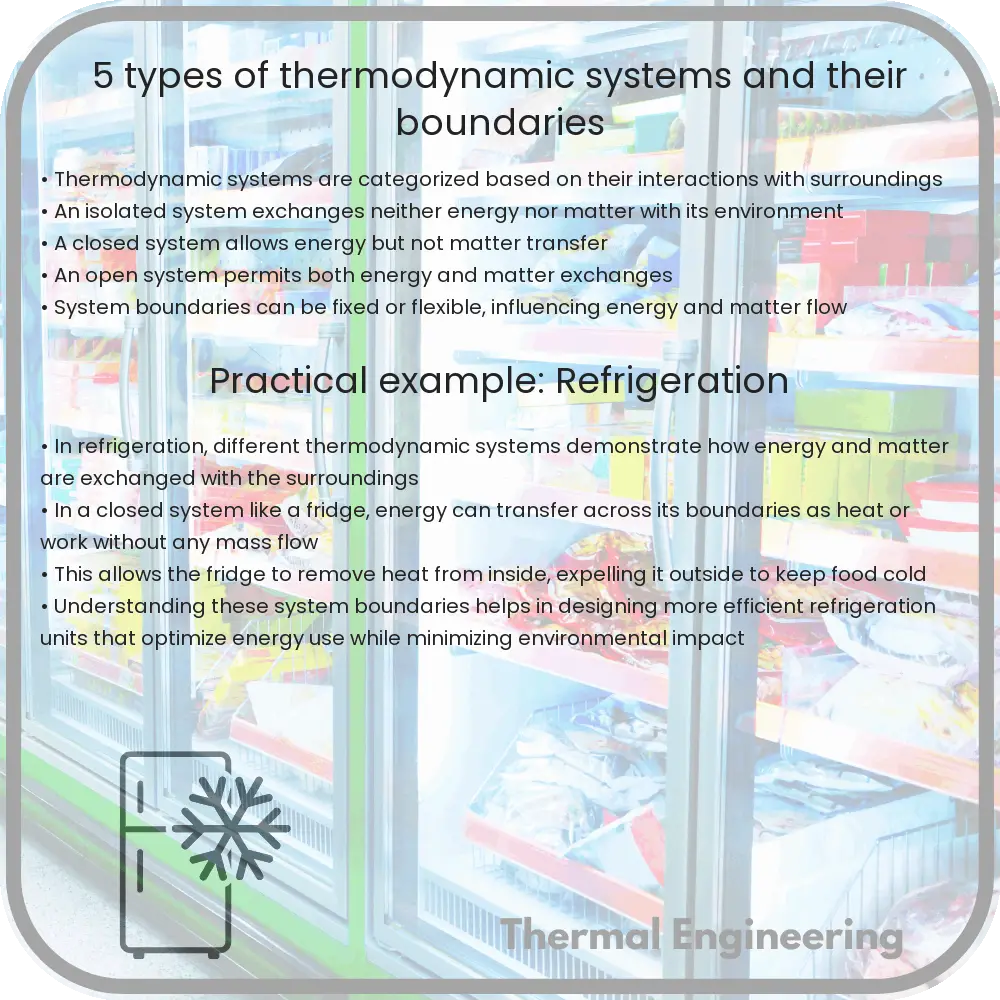
Thermodynamics is a fundamental branch of physics and engineering that deals with the study of energy transfer and transformations. A thermodynamic system is typically defined by its mass or volume, composition, energy, temperature, and pressure. These systems are classified based on how they exchange energy and matter with their surroundings. Understanding the types of thermodynamic systems and their boundaries is crucial for analyzing and designing various engineering processes and devices. Here, we explore five primary types of thermodynamic systems and the nature of their boundaries.

1. Open Systems

An open system can exchange both energy and matter with its surrounding environment. This type of system is commonly observed in engineering applications such as boilers, turbines, and radiators. For example, in an internal combustion engine, fuel and air enter the system, undergo combustion, and then exit in the form of exhaust gases. The boundary of an open system usually includes physical gates or ports that allow the transfer of mass in and out of the system.

2. Closed Systems

Closed systems allow the exchange of energy (such as heat and work) but no exchange of matter with the surroundings. An example of a closed system is a sealed flask of water placed on a heater. Energy in the form of heat can enter the system through the walls of the flask, raising the temperature and possibly changing the state of the water, but no water can enter or leave the flask. The boundaries of a closed system are typically impermeable to matter.

3. Isolated Systems

An isolated system does not exchange either energy or matter with its surroundings, making it the most restrictive type of thermodynamic system. A good theoretical example of an isolated system is a perfect thermos bottle, which neither gains nor loses heat and allows no matter transfer in or out. In reality, perfectly isolated systems do not exist, but they are a useful ideal for theoretical discussions in thermodynamics.

4. Adiabatic Systems

An adiabatic system is a specific type of closed system that does not exchange heat with its surroundings, although it can exchange work. One real-world example is an insulated piston in which gas is compressed or expanded. If the insulation is perfect, no heat will be lost or gained during the process, and any changes in the internal energy of the gas are due to work done by or on the system. The boundary of an adiabatic system is ideally thermally insulating.

5. Control Volumes

The concept of a control volume applies primarily in fluid dynamics and refers to a volume in space through which fluids (liquids or gases) may flow. This type of system boundary can be both real and imaginary and may change shape and size. A typical example is the air passing through the turbine of a jet engine. The boundaries of a control volume are defined by the area through which fluids enter and exit the system, making it similar to an open system but more flexible in terms of shape and size. The analysis of control volumes is crucial in the study of fluid dynamics and related calculations.

Each type of thermodynamic system and its boundaries helps scientists and engineers determine the behavior and efficiency of processes in various fields of technological application. By understanding the fundamental properties and restrictions associated with these systems, it becomes easier to apply engineering principles to optimize performance and solve practical challenges effectively.

Cooling strategies in concentrated solar power

Understanding and optimizing cooling strategies in Concentrated Solar Power systems to boost efficiency and sustainability.

Cooling strategies in concentrated solar power

Cooling Strategies in Concentrated Solar Power Systems

Concentrated Solar Power (CSP) systems generate electricity by harnessing the sun’s energy to produce high-temperature heat. However, managing the heat in these systems is crucial for maintaining efficiency and protecting equipment. In this article, we explore various cooling strategies employed in CSP plants to optimize performance and longevity.

Basics of Heat in CSP Systems

In CSP plants, mirrors or lenses concentrate sunlight to heat a receiver containing a fluid, typically molten salt or oil, which then transfers this heat to produce steam. The steam drives turbines, generating electricity. However, the concentrated heat can damage equipment and reduce efficiency if not properly managed.

Types of Cooling Systems

Cooling in CSP plants is typically achieved through two main systems: air cooling and water cooling. Each has its distinct advantages and challenges.

1. Water Cooling Systems

Water cooling is the traditional method for CSP plants. It involves using water to absorb and transfer heat away from critical components such as the steam turbine. The major steps in water cooling include:

  • Condensation: Steam used in the turbine is cooled in a condenser and returns to the liquid state.
  • Cooling Towers: Warm water from the condenser is cooled through evaporation in cooling towers and reused in the system.
  • Heat Exchangers: These devices transfer heat from the cooling water to the environment.

While effective, water cooling requires significant amounts of water, making it less suitable for arid areas where CSP plants are often located.

2. Air Cooling Systems

Air cooling represents an alternative that significantly reduces water use, making it ideal for dry locations. In air cooled condensers, the steam from the turbine is condensed by passing it over finned tubes through which air is blown.

  • Less Water Usage: Air systems use ambient air to cool the steam, eliminating the need for large-scale water withdrawal.
  • Increased Cost and Complexity: Air cooling systems are generally more expensive and less efficient thermally than water-based systems.

Innovative Cooling Technologies

Advancements in cooling technology continue to emerge, focusing on improving the efficiency and sustainability of CSP systems. Some noteworthy innovations include:

Hybrid Cooling Systems

Hybrid systems combine air and water cooling to balance resource use and efficiency. These systems typically use water cooling during peak efficiency times and switch to air cooling during off-peak times or when water conservation is necessary.

Molten Salt Thermal Storage

Molten salt is an effective medium for heat storage in CSP plants, allowing for electricity generation even when the sun is not shining. Cooling strategies in molten salt systems focus on maintaining the salt in a liquid state to prevent solidification and damage to storage tanks.

Phase Change Materials (PCMs)

PCMs absorb and release heat at specific temperatures, providing an innovative way to manage thermal loads in CSP systems. They help in stabilizing the temperature around the clock, enhancing overall efficiency.

Challenges and Future Directions

While CSP technologies offer great potential for sustainable energy, the efficiency of cooling systems remains a significant challenge. Future research and development are directed towards optimizing these systems to improve reliability and decrease costs. Furthermore, the exploration of alternative coolants and low-water-use technologies continues to be a priority in advancing CSP technology.

Effective cooling strategies in CSP plants not only enhance performance but also extend the lifespan of the equipment and reduce environmental impact, marking an essential component of the overall system design.

9 Types of Energy Conversion in Thermodynamics

Learn about energy conversion in thermodynamics, highlighting nine common types, including chemical, electrical, and mechanical transitions.

9 Types of Energy Conversion in Thermodynamics

Understanding Energy Conversion in Thermodynamics

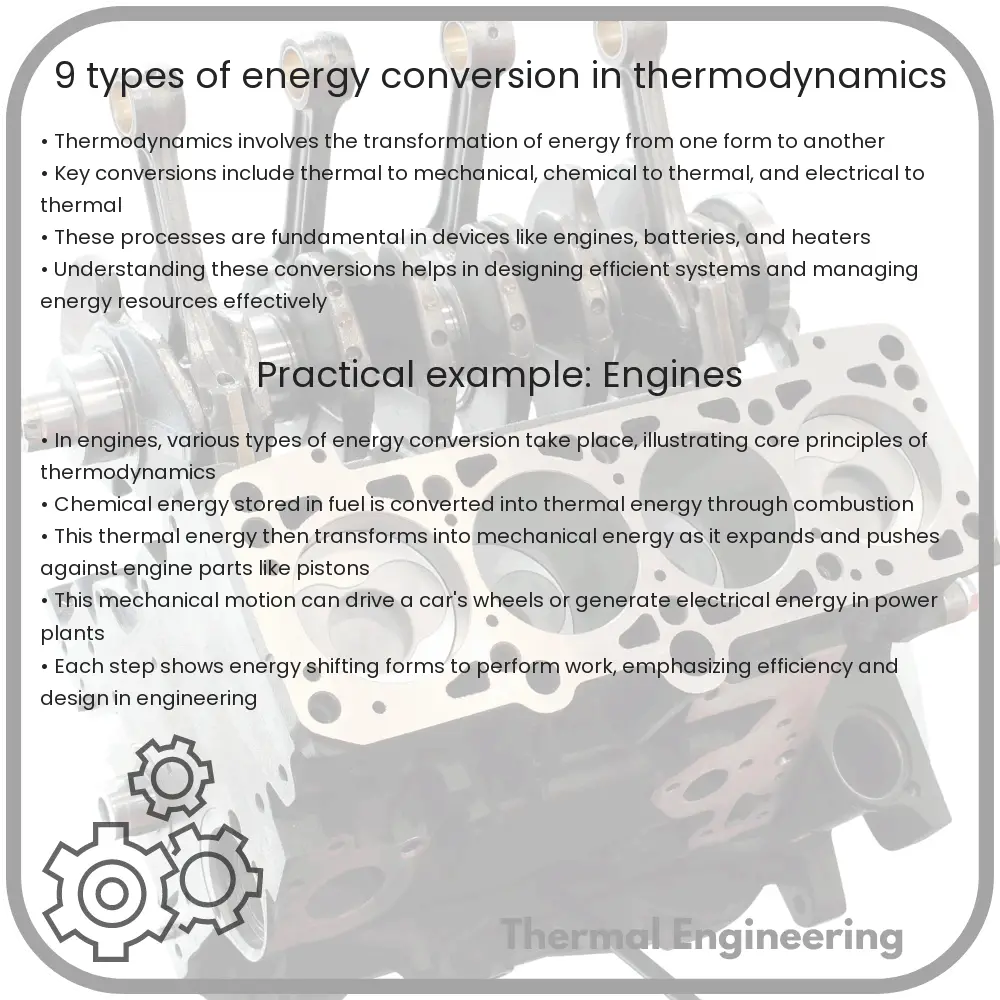
Thermodynamics, a branch of physics involved with heat, work, temperature, and energy, plays a critical role in understanding how different forms of energy are converted from one type to another. Energy conversion is central to all thermodynamic processes and crucial for various engineering applications. Let’s explore nine common types of energy conversions that illustrate the fundamental principles of thermodynamics.

1. Chemical to Thermal Energy

When chemical energy is released from a substance, it often turns into thermal energy. This transformation is evident in processes like combustion, where burning fuels like coal, oil, or gas releases heat.

2. Electrical to Mechanical Energy

Electric motors convert electrical energy into mechanical energy. This process is pervasive in household appliances, manufacturing machinery, and electric vehicles, where electric energy supplied by batteries or power lines is transformed into motion.

3. Thermal to Electrical Energy

In thermoelectric generators, a temperature difference across certain materials can generate an electric voltage, thus converting thermal energy directly into electrical energy. This effect is also utilized in technologies such as radioisotope thermoelectric generators in spacecraft.

4. Radiant to Chemical Energy

Photosynthesis is a natural process where light energy (radiant energy) from the sun is converted into chemical energy within the cells of plants. This energy is stored in the form of glucose and other organic molecules.

5. Mechanical to Electrical Energy

Generators convert mechanical energy into electrical energy. This process is critical in power plants, where mechanical energy provided by steam turbines, water turbines, or wind turbines is transformed into electrical energy distributed across power grids.

6. Electrical to Thermal Energy

Devices like electric heaters and resistors commonly convert electrical energy into thermal energy. When electric current flows through a resistive material, it generates heat through the resistance encountered by the electrons in motion.

7. Nuclear to Thermal Energy

Nuclear reactors perform the conversion of nuclear energy from the fission of atoms into thermal energy. The heat generated is then used to produce steam that drives turbines to generate electricity.

8. Mechanical to Hydraulic Energy

In hydraulic systems, mechanical energy is used to move and compress fluids under pressure. This conversion is fundamental in machines like hydraulic presses, excavators, and some types of energy storage systems.

9. Thermal to Mechanical Energy

Steam engines convert thermal energy into mechanical energy. The high-pressure steam produced from boiling water drives pistons or turbines, converting the high temperature and pressure into mechanical motion.

Each of these conversions involves the transformation of energy from one form to another, guided by the laws of thermodynamics. Ultimately, the study of these energy transformations not only deepens our understanding of physical phenomena but also enhances our ability to engineer systems for more efficient energy use in industrial, domestic, and environmental applications.

6 Types of Cooling Methods in Thermal Engineering

Explore essential cooling methods in thermal engineering, from air and water to phase change techniques.

6 Types of Cooling Methods in Thermal Engineering

Introduction to Cooling Methods in Thermal Engineering

Thermal engineering is a sub-branch of engineering that focuses on the management of heat energy and its transfer among mediums. One of the critical aspects of this field is the development of efficient cooling techniques to protect equipment, improve performance, and ensure safety. Cooling methods vary widely based on their applications, from industrial machines to electronic devices. Here, we discuss six fundamental types of cooling methods commonly used in thermal engineering.

1. Air Cooling

Air cooling is the most common method used for dissipating heat. It involves using air as the medium to remove heat from the surface it cools. The process might be as simple as natural convection where heated air rises and cooler air replaces it, or it may involve forced convection using fans or blowers to increase the rate of air movement. This method is widely used in computers, motor vehicles, and various electronics.

2. Water Cooling

Water has a higher heat capacity than air and can absorb more heat before increasing in temperature. In water cooling systems, water or coolant passes through a system to absorb heat from the hotter parts then moves to a radiator where heat is radiated away. This method is particularly effective for high-performance computing systems like gaming PCs and data centers where large amounts of heat are generated.

3. Oil Cooling

Oil cooling involves using oil as a heat transfer fluid. Oils can operate at higher temperatures than water without evaporating, making them suitable for applications like transformers and some high-performance engines. The oil absorbs heat from the hot surfaces and may pass through a cooler or heat exchanger before being recirculated.

4. Evaporative Cooling

Evaporative cooling is a process whereby water is evaporated to cool air directly. By taking advantage of the latent heat of evaporation, this method can achieve lower air temperatures than are attainable through simple heat transfer to air. Commonly used in cooling towers and swamp coolers, evaporative cooling is an efficient method for climate control in buildings, particularly in dry, hot regions.

5. Thermoelectric Cooling

Thermoelectric cooling uses the Peltier effect to create a heat flux at the junction of two different types of materials. When a voltage is applied across the junction, heat is moved from one side to the other, thus cooling one side while heating the other. This method is useful for applications that require precise temperature control, such as in optical devices and some medical equipment.

6. Phase Change Cooling

Phase change cooling involves a fluid that absorbs heat and transitions from one phase to another, typically from a liquid to a vapor. This transformation absorbs large amounts of heat, effectively reducing temperature. This method is used in high-performance cooling systems, including those for high-end servers where conventional cooling methods may not suffice.

Conclusion

Thermal engineering integrates a variety of cooling methods to address different heat management challenges across many types of industrial and consumer applications. Understanding the fundamentals and applications of these various methods helps engineers design more efficient and sustainable cooling solutions, crucial for the longevity and safety of heat-intensive systems.

3 Types of Heat Transfer in Earth’s Atmosphere

Learn about the three main types of heat transfer—conduction, convection, and radiation—and their impact on Earth’s atmosphere and climate.

3 Types of Heat Transfer in Earth's Atmosphere

Understanding the Three Types of Heat Transfer in Earth’s Atmosphere

Heat transfer plays a crucial role in shaping the weather patterns and climate of Earth. It involves the movement of thermal energy from one place to another and occurs in three fundamental ways: conduction, convection, and radiation. By examining these mechanisms, we can gain a deeper understanding of atmospheric processes and their effects on our environment.

1. Conduction

Conduction is the process of heat transfer through a material without the actual movement of the substance. In the Earth’s atmosphere, this form of heat transfer is less significant compared to the others, as air is a poor conductor of heat. However, conduction is critical near the surface of the Earth where the ground absorbs heat during the day and releases it at night. This transfer of heat affects the immediate layer of air in contact with the ground, primarily influencing temperature variations and microclimates close to the surface.

2. Convection

Convection refers to heat transfer through fluids (liquids or gases) driven by the movement of the fluid itself. In the atmosphere, convection is primarily responsible for the vertical movement of air. Warm air near the Earth’s surface becomes less dense and rises, while cooler air sinks, creating convection currents. This mechanism is a primary driver for various weather phenomena, including the formation of clouds, storms, and the general circulation of the atmosphere. An example of a convection current can be seen when warm air rises from a hot surface, cools as it gains altitude, condenses into clouds, and eventually precipitates as rain.

3. Radiation

Radiation is the transfer of heat in the form of electromagnetic waves. This type of heat transfer does not require a medium (like air or water) and can occur in a vacuum. Solar radiation is the most prominent form of radiative heat transfer affecting Earth’s atmosphere. The sun emits radiation, primarily in the form of visible light and ultraviolet rays, which travel through space and are absorbed, reflected, or transmitted by the Earth’s atmosphere and surface. Infrared radiation, or heat, is then emitted by the Earth’s surface and atmosphere. Greenhouse gases in the atmosphere absorb and re-emit infrared radiation, warming the Earth through the greenhouse effect.

Conclusion

The three types of heat transfer — conduction, convection, and radiation — work simultaneously to regulate the Earth’s atmosphere and influence our daily weather and long-term climate. Each type plays a distinct role, from the ground-level temperature changes driven by conduction, to the formation of major weather systems through convection, and the global energy balance maintained by radiation. Understanding these processes helps scientists predict weather patterns, study climate change, and devise strategies for mitigating adverse environmental effects.

8 Types of Thermal Conductivity Applications

Learn about thermal conductivity, a key property influencing material choice across construction, electronics, aerospace, and more for efficient heat management.

8 Types of Thermal Conductivity Applications

Understanding Thermal Conductivity and Its Applications

Thermal conductivity is a fundamental property that measures a material’s ability to conduct heat. It plays a critical role in various applications across engineering and technology domains. Here are eight important applications of thermal conductivity:

1. Building and Construction Materials

In the construction industry, thermal conductivity is crucial for determining the insulating properties of building materials. Materials with low thermal conductivity, such as fiberglass and foam insulation, are used to reduce heat transfer, enhancing energy efficiency and comfort in buildings.

2. Electronics Cooling

Thermal management is key in electronics to prevent overheating and ensure reliable operation. Materials with high thermal conductivity, such as copper and aluminum, are commonly used in heat sinks and cooling systems to dissipate heat efficiently from electronic components like CPUs and GPUs.

3. Thermoelectric Generators

Thermoelectric materials, which can convert temperature differences into electrical energy, rely on specific thermal conductivity properties to enhance efficiency. A lower thermal conductivity is preferable in these materials to maintain a significant temperature gradient across the device.

4. Aerospace Engineering

Thermal conductivity is important in the aerospace industry, where materials must withstand extreme temperatures. High thermal conductivity materials are employed in areas that require efficient heat dissipation, while materials with low thermal conductivity are used for thermal insulation in spacecraft and high-speed aircraft.

5. Automotive Industry

In automotive engineering, managing heat is essential for performance and safety. Components such as engines and exhaust systems use materials with high thermal conductivity to resist heat and prevent damage to the vehicle.

6. Textiles and Clothing

Thermal conductivity influences the development of fabrics for clothing, especially in regards to thermal comfort and protection. Materials with lower thermal conductivity are chosen for winter clothing to provide better insulation, whereas higher thermal conductivity materials are used in summer apparel for better heat dissipation.

7. Cooking Utensils

The thermal conductivity of materials directly affects cooking performance. Metal cookware like copper and aluminum, known for their high thermal conductivity, allows for quick and even heat distribution, improving cooking efficiency and food quality.

8. Cryogenics

In cryogenics, materials must efficiently handle extremely low temperatures. The thermal conductivity of materials like copper and silver becomes crucial in applications involving the storage and transport of liquid gases, where effective thermal insulation is necessary to maintain low temperatures.

Understanding the applications of thermal conductivity not only enhances our ability to choose appropriate materials for specific tasks but also drives innovation in technology and engineering, leading to more efficient, sustainable, and robust systems.

7 Types of Thermodynamic Cycles in Power Generation

Learn about thermodynamic cycles, the core processes behind power generation and how they convert energy into electricity.

7 Types of Thermodynamic Cycles in Power Generation

Introduction to Thermodynamic Cycles in Power Generation

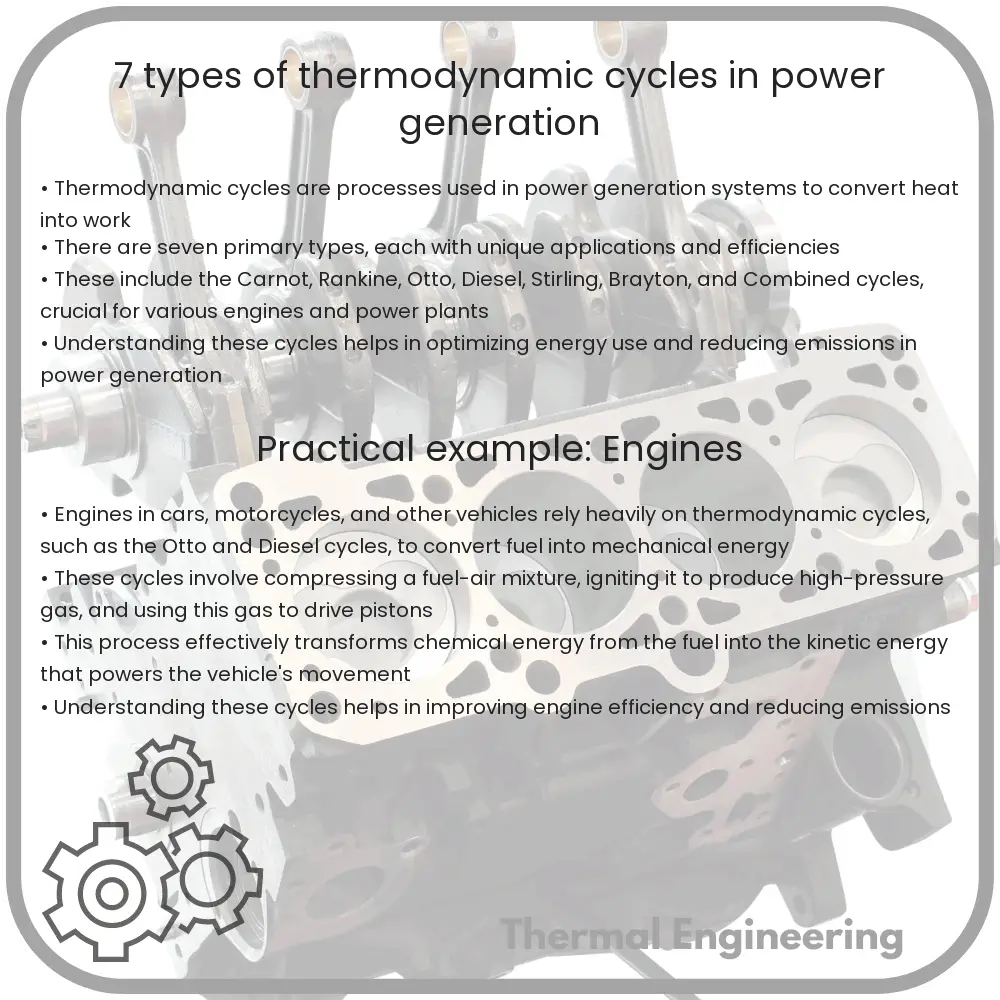
Thermodynamic cycles are the backbone of power generation systems, encompassing a series of processes through which a fluid undergoes changes in pressure, temperature, and state. These cycles are fundamental to understanding how energy is converted into electricity and useful work in various power plants. This article explores seven types of thermodynamic cycles commonly used in power generation.

1. Carnot Cycle

The Carnot cycle is a theoretical model that represents the maximum possible efficiency a heat engine can achieve under certain conditions. The cycle consists of two isothermal processes (heat transfer at constant temperature) and two adiabatic processes (heat transfer in which no energy is lost to the surroundings).

  • Process 1-2: Isothermal expansion at temperature T1.
  • Process 2-3: Adiabatic expansion, temperature drops from T1 to T2.
  • Process 3-4: Isothermal compression at temperature T2.
  • Process 4-1: Adiabatic compression, temperature rises from T2 to T1.

The efficiency of the Carnot cycle is given by $\eta = 1 – \frac{T_2}{T_1}$, where T1 and T2 are the temperatures of the hot and cold reservoirs, respectively.

2. Rankine Cycle

The Rankine cycle is the fundamental operating cycle for steam turbine systems used in power generation. It includes the following four primary processes:

  • Process 1-2: Isentropic (constant entropy) compression of the working fluid in a pump.
  • Process 2-3: Addition of heat at constant pressure in a boiler, which vaporizes water into steam.
  • Process 3-4: Isentropic expansion through a turbine, generating work.
  • Process 4-1: Rejection of heat in a condenser, converting steam back to liquid.

3. Brayton Cycle

Also known as the gas turbine cycle, the Brayton cycle is used in aircraft engines and gas turbine power plants. It consists of three main stages:

  • Process 1-2: Isentropic compression of air in the compressor.
  • Process 2-3: Constant pressure heat addition in the combustion chamber.
  • Process 3-4: Isentropic expansion through a turbine to produce work.

4. Otto Cycle

Typical of spark ignition internal combustion engines, the Otto cycle includes four stages:

  • Process 1-2: Isentropic compression of the air-fuel mixture in the combustion chamber.
  • Process 2-3: Constant volume heat addition (ignition of fuel).
  • Process 3-4: Isentropic expansion (power stroke).
  • Process 4-1: Constant volume heat rejection (exhaust).

5. Diesel Cycle

The Diesel cycle is used in diesel engines and is characterized by its combustion process, which occurs at a constant pressure:

  • Process 1-2: Isentropic compression of air (no fuel involved).
  • Process 2-3: Constant pressure heat addition when the fuel is injected and combusted.
  • Process 3-4: Isentropic expansion.
  • Process 4-1: Constant volume heat rejection.

6. Stirling Cycle

The Stirling cycle is used in Stirling engines, known for their high efficiency and quiet operation. It involves isothermal and isochoric (constant volume) processes:

  • Process 1-2: Isothermal expansion.
  • Process 2-3: Isochoric cooling.
  • Process 3-4: Isothermal compression.
  • Process 4-1: Isochoric heating.

7. Combined Cycle

A combined cycle power plant integrates more than one thermodynamic cycle to achieve higher overall efficiency. Typically, it combines the Brayton cycle (for a gas turbine) and the Rankine cycle (for a steam turbine). Exhaust heat from the gas turbine is used to generate steam for the steam turbine, effectively utilizing the energy from fuel.

Understanding these thermodynamic cycles provides a foundation for exploring how various types of power plants operate and achieve energy conversion. Each cycle has its peculiarities and applications, making it fit for particular purposes in the field of power generation.