Facebook Instagram Youtube Twitter

How Do Cooling Towers Work?

Learn how cooling towers function and their mechanics in industrial heat removal.

How Do Cooling Towers Work?

Understanding Cooling Towers: Function and Mechanics

Cooling towers are a pivotal component in various industrial processes, essentially serving as heat removal devices. Their primary function is to release waste heat into the atmosphere by cooling a stream of water to a lower temperature. This article will explore the principles, design, and operation of cooling towers.

Types of Cooling Towers

Cooling towers vary in size and design, but there are mainly two types: open-circuit (evaporative) cooling towers and closed-circuit (dry) cooling towers.

  • Open-circuit Cooling Towers: Water is cooled directly by evaporation and contact with air. The process water is exposed to the air, causing a small portion of the water to evaporate and cool the remaining water.
  • Closed-circuit Cooling Towers: These utilize a heat exchanger, separating the process cooling water from the water being evaporated, thereby keeping it clean and uncontaminated.

Basic Operation of an Open-Circuit Cooling Tower

The operation of an open-circuit cooling tower is based on the principle of evaporative cooling. The basic steps include:

  1. Hot water from the industrial process is pumped to the top of the cooling tower, and distributed over the fill material (a structure that enhances water-air contact).
  2. As the water descends through the fill, it spreads out, increasing the water-air contact area.
  3. Air is drawn in through the inlets at the base of the tower and moves upward, opposite to the water flow. A fan might be used to facilitate the airflow.
  4. Evaporation occurs when the warm water meets the cooler air. This evaporative process removes heat from the water, cooling it down.
  5. The cooled water collects at the bottom of the tower, from where it is pumped back into the industrial process to absorb more heat.
  6. The warm, moist air naturally rises and exits through the top of the tower.

Efficiency and Design Considerations

Cooling tower efficiency can be affected by several factors:

  • Ambient Wet Bulb Temperature: This is the most critical parameter influencing cooling tower performance. Lower wet bulb temperatures can enhance cooling efficiency.
  • Airflow: Effective airflow is crucial for adequate evaporative cooling. Too little air flow can inhibit evaporation, while too much air can lead to excessive water losses.
  • Fill Material: The type and quality of fill influence the exposure of water to the air, impacting the rate of evaporation and, thus, the cooling effectiveness.

When designing cooling towers, engineers must balance numerous considerations including energy consumption, water conservation, local climate conditions, and environmental impact regulations.

Applications of Cooling Towers

Cooling towers are essential in numerous sectors where heat dissipation is necessary, such as:

  • Power Generation: Cooling towers are crucial in thermal and nuclear power plants where large amounts of heat need to be dissipated.
  • Manufacturing: Various manufacturing processes generate excess heat that often requires efficient cooling systems.
  • HVAC: For large scale industrial and office buildings, cooling towers assist in maintaining air conditioning systems by dissipating heat.

Understanding how cooling towers work helps industries manage waste heat effectively, ensuring that their processes are both efficient and environmentally compliant. With their critical role across various sectors, cooling towers represent a key application of engineering principles in thermal management and environmental protection.

Understanding Combustion in Thermal Systems

Explore the fundamentals and engineering applications of combustion in thermal systems, focusing on efficiency and emissions.

Understanding Combustion in Thermal Systems

Understanding Combustion in Thermal Systems

Combustion is a fundamental chemical process in which fuel reacts with an oxidizer to produce heat and light, typically in the form of flames. In the context of thermal systems, such as engines and furnaces, understanding combustion is critical for enhancing efficiency, reducing emissions, and optimizing performance.

The Basics of Combustion

At its core, combustion involves the oxidation of the combustible components of a fuel. For most practical applications, the fuel is organic, containing carbon and hydrogen, which reacts with oxygen in the air. The primary products of combustion are typically carbon dioxide (CO2), water vapor (H2O), and heat. The generalized chemical equation for the combustion of a hydrocarbon (CxHy) in oxygen is given by:

CxHy + (x + y/4) O2 → x CO2 + (y/2) H2O

Types of Combustion

There are several types of combustion processes, which can be categorized based on the oxidizer, the reaction rate, or the completeness of the reaction:

  • Complete Combustion: Occurs when a fuel burns in plentiful supply of air, yielding CO2 and H2O. This type of combustion is ideal for maximum energy release and minimal harmful emissions.
  • Incomplete Combustion: Happens due to insufficient oxygen supply, producing not only CO2 and H2O but also carbon monoxide (CO) and even soot or carbon (C). Incomplete combustion is less efficient and more polluting.
  • Spontaneous Combustion: Can occur without an external ignition source, due to heat generated internally by reactions within the material, often under specific conditions of heat and pressure.
  • Explosive Combustion: Is rapid and results in a sudden release of energy, such as in internal combustion engines or fireworks.

Key Parameters Influencing Combustion

Several factors influence the rate and efficiency of combustion:

  • Temperature: Higher temperatures generally increase the rate of combustion since they speed up the chemical reactions involved.
  • Pressure: In many systems, higher pressures facilitate faster reaction rates.
  • Oxygen Concentration: Adequate oxygen is crucial for combustion. Variations in oxygen concentration in the air can affect combustion processes significantly.
  • Fuel Composition: Different fuels contain varying amounts of carbon, hydrogen, and other elements, which influence the amount of energy released during combustion.

Applications of Combustion in Engineering

Combustion plays a vital role in many engineering applications:

  • Internal Combustion Engines: Used in automobiles and other vehicles, these engines burn petrol or diesel to convert chemical energy into mechanical power.
  • Power Generation: Combustion of coal, natural gas, or oil in power plants generates heat that is used to produce steam for turbines and generators.
  • Industrial Processes: Many industrial processes require heat, which is often provided by burning fuels. For example, the combustion of natural gas in furnaces.

Challenges and Innovations

Despite its widespread use, combustion-based systems pose environmental challenges, primarily due to emissions of CO2, NOx (nitrogen oxides), and other pollutants. Innovations in combustion technology aim to increase efficiency and reduce these emissions. These include:

  • Advanced Combustion Techniques: Such as staged combustion and flue gas recirculation, which help achieve more complete burning and lower emissions.
  • Alternative Fuels: Using biofuels, hydrogen, or synthetic fuels that may burn cleaner than traditional hydrocarbons.
  • Emission Control Technologies: Like catalytic converters and scrubbers, which reduce the amount of pollutants released into the atmosphere.

Understanding the principles of combustion allows engineers to design better thermal systems that are efficient, environmentally friendly, and capable of meeting the energy demands of today’s technology-driven world.

Basics of Phase Change in Heat Transfer

Learn about phase change in heat transfer, focusing on melting, freezing, vaporization, and condensation processes and their applications in engineering.

Basics of Phase Change in Heat Transfer

Understanding Phase Change in Heat Transfer

Heat transfer is a fundamental concept in engineering and physics that involves the movement of heat or thermal energy from one place to another. One of the most important aspects of heat transfer is the phase change process, where a substance changes from one state of matter to another, such as from solid to liquid or from liquid to gas. This article explores the basics of phase change in heat transfer, focusing on key processes and the principles that govern them.

Types of Phase Changes

Phase changes occur in various forms, the most common being melting, freezing, vaporization (boiling), and condensation. Each of these processes plays a crucial role in various industrial and natural processes.

  • Melting: Transition from solid to liquid when heat is absorbed.
  • Freezing: Transition from liquid to solid when heat is released.
  • Vaporization: Transition from liquid to gas when heat is absorbed. This can occur either at the boiling point (boiling) or below it (evaporation).
  • Condensation: Transition from gas to liquid when heat is released.

Latent Heat

One critical concept in understanding phase changes is latent heat, which is the amount of heat absorbed or released by a substance during a phase change without a change in temperature. Latent heat is vital because it explains why phase changes are effective heat transfer processes.

Latent heat comes in two main forms:

  • Latent Heat of Fusion (Lf): The heat required to change a unit mass of a substance from solid to liquid or vice versa at constant temperature.
  • Latent Heat of Vaporization (Lv): The heat required to change a unit mass of a substance from liquid to gas or vice versa at constant temperature.

Calculating Heat Transfer During Phase Changes

The amount of heat (Q) required to change the phase of a substance can be calculated using the formula:

Q = m * L

Where:

  • m is the mass of the substance,
  • L is the latent heat (either Lf or Lv depending on the phase change).

For example, to find the heat needed to melt ice into water, you would use the latent heat of fusion of water, and to compute the heat required to boil water into steam, you would use the latent heat of vaporization of water.

Applications in Engineering

Understanding and controlling phase changes are crucial in many engineering disciplines:

  • Refrigeration: Uses the principles of phase change to transfer heat out of an area, keeping it cool.
  • Power Generation: Steam turbines involve the boiling of water into steam to drive turbines and generate electricity.
  • Heating Systems: Indoor heating can use the condensation of steam to release heat within a radiator.
  • Material Science: Controlling the cooling and solidification of materials to improve their properties and performance.

By mastering the basics of phase change in heat transfer, engineers can design more efficient systems for a wide range of applications, from industrial manufacturing processes to everyday household appliances.

Conclusion

Phase changes are a cornerstone of heat transfer processes in both natural and engineered systems. Understanding how these transitions occur and their thermal characteristics, such as latent heat, allows us to manipulate thermal energy effectively, enhancing both the functionality and efficiency of numerous applications across various sectors of engineering.

How Do Pumps Circulate Fluids?

Learn about the vital roles and mechanisms of pumps in circulating fluids across numerous systems including residential, industrial, and agricultural uses.

How Do Pumps Circulate Fluids?

Understanding How Pumps Circulate Fluids

Pumps are vital components in various engineering systems, playing a critical role in moving fluids from one location to another. They are essential in activities ranging from providing water to residential homes, to complex industrial operations. This article explores the basic principle behind how pumps circulate fluids, the different types of pumps, and where they are commonly used.

Basic Principle of Pump Operation

At its core, a pump moves fluid by creating a low pressure at its inlet which allows atmospheric or head pressure to force the fluid into the pump. The mechanical action of the pump then pushes the fluid out at a higher pressure from the outlet, enabling the fluid to move through a piping system or into a reservoir.

The operation of a pump can generally be explained through Bernoulli’s Principle, which states that an increase in the speed of a fluid occurs simultaneously with a decrease in pressure or a decrease in the fluid’s potential energy. Pumps increase fluid velocity by converting mechanical energy from a motor to energy in a moving fluid. The motor energy is usually supplied via electrical, hydraulic, or pneumatic power sources.

Types of Pumps

There are two primary types of pumps: positive displacement pumps and dynamic (or centrifugal) pumps. Each type operates slightly differently and serves different purposes.

  • Positive Displacement Pumps: These pumps work by trapping a fixed amount of fluid and then forcing (displacing) that trapped volume into the discharge pipe. Positive displacement pumps can be further categorized into rotary (such as gear and screw pumps) and reciprocating (such as piston and diaphragm pumps) types. They are particularly effective for high viscosity and high pressure applications.
  • Dynamic Pumps: Dynamic pumps, or centrifugal pumps, impart velocity to the fluid by rotating impellers. The velocity is then converted to pressure energy as the fluid leaves the impeller through a diffuser or volute. These pumps are commonly used for low viscosity fluids like water and light oils.

Applications of Pumps

Pumps are utilized in a myriad of applications across various industries. Here are some common uses:

  1. Water Supply: Pumps are used extensively in municipal water supply systems to extract water from sources and deliver it to homes and businesses.
  2. Industrial Applications: In industries, pumps are used for a wide range of purposes including cooling systems, processing chemicals, transferring fuels, and in wastewater treatment.
  3. Agricultural Irrigation: Pumps are crucial for irrigation practices, helping distribute water across large fields.
  4. Petrochemical Industries: In the oil and gas industry, pumps are essential for transporting crude oil, refined products, and for injectivity purposes.

Conclusion

Pumps are indispensable tools in engineering that facilitate the movement of fluids in countless applications. Understanding how they work, the different types available, and their applications can help industry professionals choose the right pump for their needs, ensuring efficiency and effectiveness in fluid management and transport.

By grasping the fundamental principles of pump operation and recognizing the appropriate pump type for your needs, you can optimize operations, whether they involve small-scale water systems or large industrial processes.

Explaining Heat Transfer in Thermal Systems

Learn about heat transfer in thermal systems, covering conduction, convection, and radiation, and their applications in engineering.

Explaining Heat Transfer in Thermal Systems

Understanding Heat Transfer in Thermal Systems

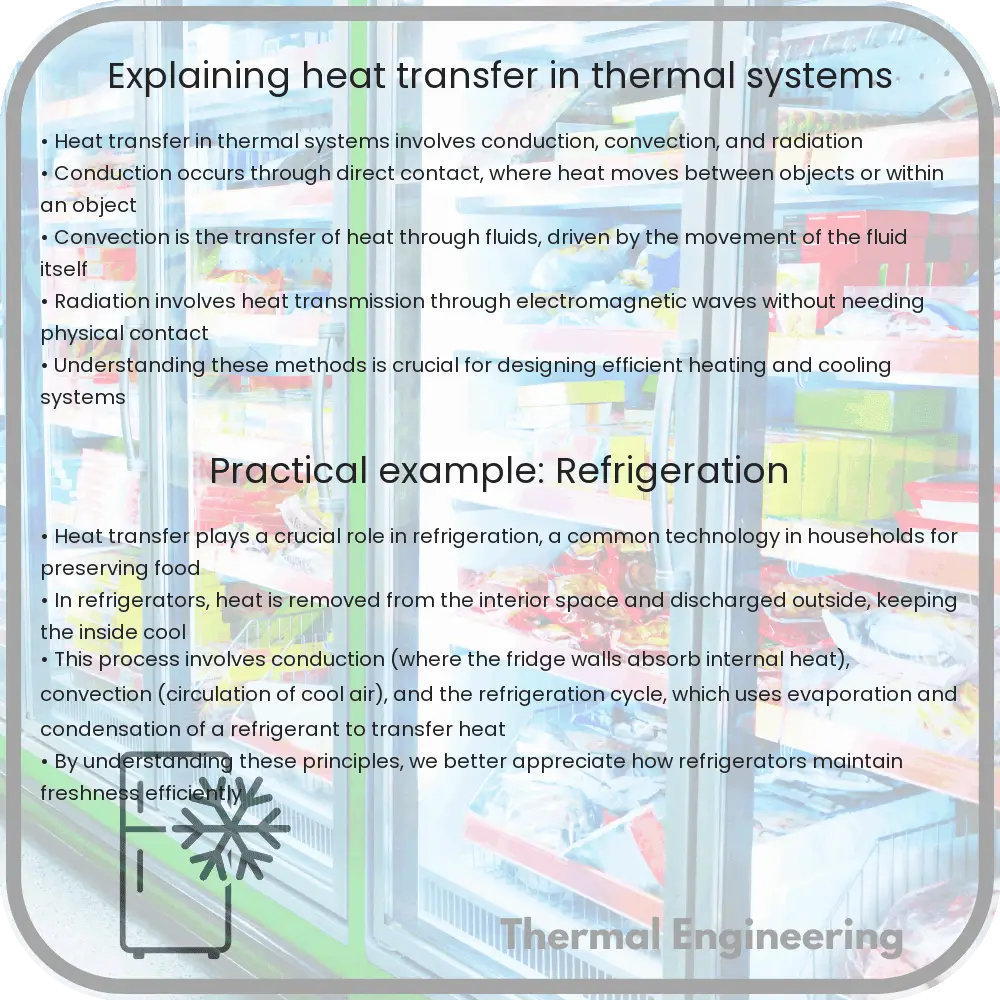
Heat transfer is a fundamental concept in the field of thermal engineering, which involves the movement of thermal energy from one place to another due to temperature differences. In the design and operation of various mechanical systems and devices, from simple household appliances to complex industrial processes, understanding heat transfer is essential. It can be categorized into three main mechanisms: conduction, convection, and radiation.

Conduction

Conduction is the process of heat transfer through a solid material from a region of higher temperature to a region of lower temperature, without any actual movement of the material itself. This type of heat transfer occurs due to the collision and scattering of molecules and electrons within the material. The rate at which heat is conducted depends on the properties of the material, such as its thermal conductivity, which can be described by Fourier’s law of heat conduction:

q = -k * A * (dT/dx)

  • q is the heat transfer rate in watts (W).
  • k is the thermal conductivity of the material in watts per meter-Kelvin (W/m*K).
  • A is the cross-sectional area through which heat is conducted in square meters (m2).
  • dT/dx represents the temperature gradient along the direction of heat transfer in Kelvins per meter (K/m).

Convection

Convection is the heat transfer that occurs between a surface and a fluid (liquid or gas) that is in motion, and it involves both the diffusion and advection (bulk movement) of molecules. Convective heat transfer can be natural (due to density gradients caused by temperature variations in the fluid), or forced (by external sources like fans or pumps). The transfer of heat by convection can be quantified using Newton’s law of cooling:

q = h * A * (Ts – T∞)

  • q is the heat transfer rate in watts (W).
  • h is the heat transfer coefficient in watts per square meter-Kelvin (W/m2*K).
  • A is the contact area between the fluid and the surface in square meters (m2).
  • Ts is the surface temperature in Kelvins (K).
  • T∞ is the fluid temperature far from the surface in Kelvins (K).

Radiation

Radiation is the transfer of heat in the form of electromagnetic waves, without the involvement of a physical medium. This mode of heat transfer can occur between two bodies separated by a medium colder than both bodies. A key principle of thermal radiation is the Stefan-Boltzmann law, which is mathematically expressed as:

E = σ * A * T4

  • E is the rate of radiant energy emitted in watts (W).
  • σ is the Stefan-Boltzmann constant (5.67 x 10⁻⁸ W/m2*K4).
  • A is the emitting surface’s area in square meters (m2).
  • T is the absolute temperature of the surface in Kelvins (K).

Understanding these fundamental principles of heat transfer allows engineers to design more efficient heating, cooling, and ventilation systems, enhance the thermal efficiency of engines, and manage thermal loads in electronic devices, among various other applications.

What Is Thermal Expansion in Materials?

Learn about thermal expansion, the phenomenon where materials change size with temperature, affecting numerous engineering applications.

What Is Thermal Expansion in Materials?

What Is Thermal Expansion in Materials?

Thermal expansion is the tendency of matter to change its shape, area, and volume in response to a change in temperature. This physical phenomenon is observed in solids, liquids, and gases and is typically a reversible process where materials expand or contract depending upon the temperature they are exposed to.

Understanding the Basics

All materials are made up of atoms and molecules that are constantly in motion. When a material is heated, its atoms and molecules move more vigorously and tend to occupy more space due to increased kinetic energy. Conversely, when a material cools, the motion of its atoms and molecules decreases, leading to a decrease in the material’s overall dimensions.

How Is Thermal Expansion Measured?

The change in linear dimensions (length, breadth, and height) of materials due to thermal expansion is generally characterized by the coefficient of linear expansion, denoted as α (alpha). The coefficient of linear expansion is defined by the equation:

\[\alpha = \frac{\Delta L / L_0}{\Delta T}\]

where:

  • \(\Delta L\) is the change in length,
  • \(L_0\) is the original length,
  • \(\Delta T\) is the change in temperature.

The units of α are usually expressed in 1/°C or 1/K (Kelvin).

For volumetric expansion, which considers changes in all three dimensions, the coefficient of volumetric expansion (often denoted as β) is used, which is approximately three times the coefficient of linear expansion for isotropic materials (materials with uniform expansion properties in all directions).

Applications of Thermal Expansion

Understanding thermal expansion is essential in numerous engineering applications. For instance:

  • Construction: Materials used in construction such as steel, concrete, and bricks, expand and contract due to temperature changes. Expansion joints are therefore crucial in structures like bridges and buildings to prevent damage.
  • Railways: Rails can buckle on hot days if continuous welded rails are not accommodated for thermal expansion.
  • Precision Instruments: Devices that require high accuracy, such as clocks and telescopes, must be designed to handle thermal expansion to avoid distortions in their functioning.

Challenges Posed by Thermal Expansion

While thermal expansion can be beneficial and often necessary to consider in engineering design, it also poses some challenges, such as:

  • Thermal Stress: When parts of an object expand at different rates, it may induce stresses that can lead to material fatigue or failure.
  • Sealing Problems: Components that fit together tightly may loosen or leak as materials expand and contract.

In conclusion, thermal expansion is a fundamental concept in the field of material science and engineering. A thorough understanding of how materials behave with temperature changes can significantly influence the reliability, safety, and durability of engineering structures and systems.

Understanding Capillary Action in Fluids

Learn how capillary action enables liquids to move through narrow spaces without external forces, influencing natural processes and technological applications.

Understanding Capillary Action in Fluids

Understanding Capillary Action in Fluids

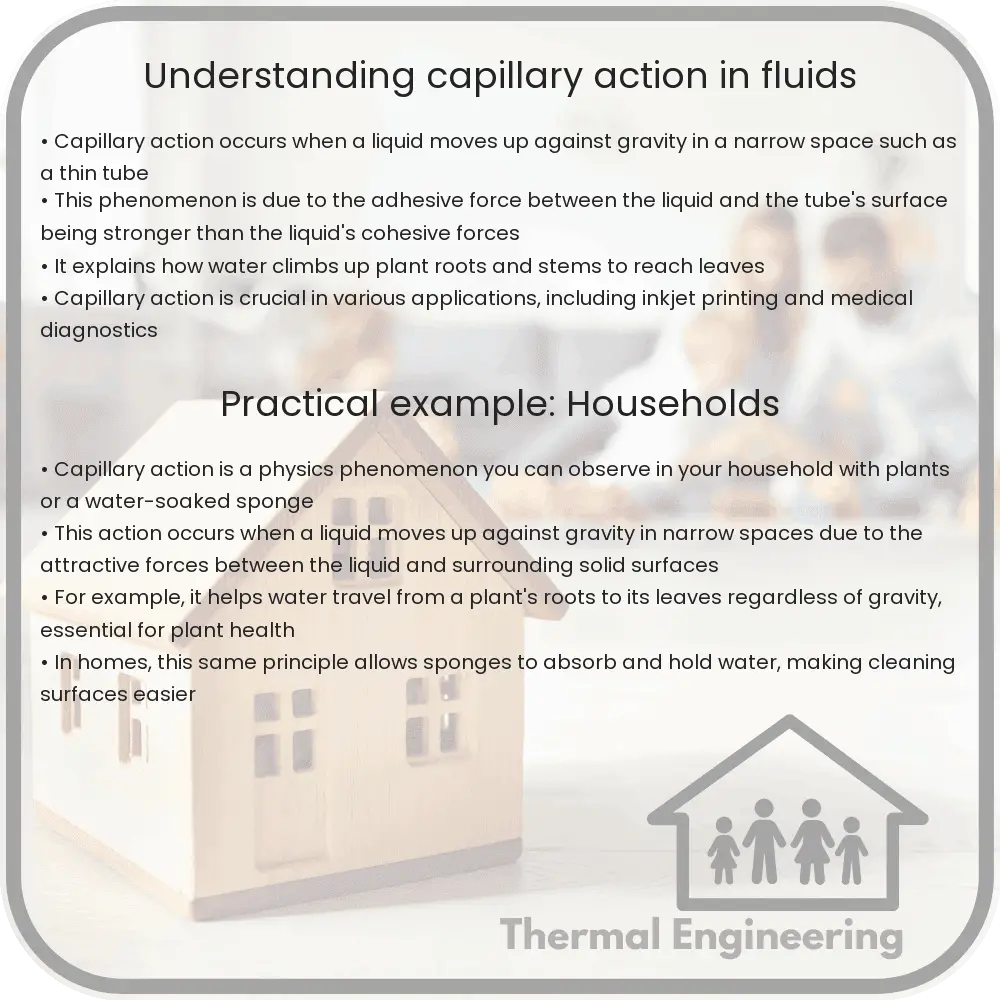
Capillary action is a fascinating physical phenomenon that allows liquids to flow in narrow spaces without the assistance of external forces like gravity. Also known as capillarity, this process plays a crucial role in various natural and technological processes, from the absorption of water in plants to the operation of thin layer chromatography.

What Causes Capillary Action?

The primary forces behind capillary action are cohesion and adhesion. Cohesion refers to the attractive force between molecules of the same substance, while adhesion is the force between molecules of different substances. In capillary action, adhesion causes the liquid to cling to the walls of a narrow tube (such as a capillary), and cohesion pulls the rest of the liquid along after the initial layer adheres.

When a capillary tube is placed in a liquid such as water, adhesion between the water molecules and the tube’s surface causes the water to climb up the walls of the tube. At the same time, cohesive forces attempt to keep the water molecules close together, resulting in a rise of the liquid inside the tube above the surrounding liquid level. The combined effect of these forces can cause the liquid to reach considerable heights, depending on the circumstances.

The Role of Surface Tension

Surface tension also plays a vital role in capillary action. It is the elastic tendency of fluid surfaces to acquire the least surface area possible. Surface tension arises from the greater attraction of liquid molecules to each other (due to cohesion) than to the molecules in the air (adhesion). This creates a surface ‘film’ that makes it more difficult to move an object through the surface than to move it when it is completely submersed. In the context of capillary action, surface tension stabilizes the liquid column inside a tube against gravity.

Capillary Action Equation

The height to which a liquid rises in a capillary tube can be predicted by a straightforward equation:

\[ h = \frac{2 \gamma \cos(\theta)}{r \rho g} \]

Where:

  • h is the height the liquid rises,
  • \(\gamma\) denotes the liquid’s surface tension,
  • \(\theta\) is the contact angle,
  • r is the radius of the tube,
  • \(\rho\) is the density of the liquid, and
  • g is the acceleration due to gravity.

This equation illustrates that the height is inversely proportional to the radius of the tube: the smaller the radius of the tube, the higher the liquid climbs.

Applications of Capillary Action

Capillary action has a variety of applications in both the natural world and human technology. In nature, capillary action is essential for the transport of water from the roots to the leaves of plants. In technology, engineers use capillary action in designing devices that move fluids through small channels, such as in heat pipes and inkjet printers.

Conclusion

Capillary action is more than just a curious scientific phenomenon; it is a fundamental principle that underpins a wide range of biological and technological processes. Understanding capillary action not only enhances our appreciation of nature but also enables us to devise more effective technologies in fluid management and delivery systems. As we continue to explore the capabilities and applications of capillary forces, we open up new frontiers in science and engineering.

Basics of Fluid Flow in Pipes

This article provides a detailed examination of fluid flow in pipes, focusing on concepts like laminar and turbulent flow, Reynolds number, and the Bernoulli Equation.

Basics of Fluid Flow in Pipes

Understanding Fluid Flow in Pipes

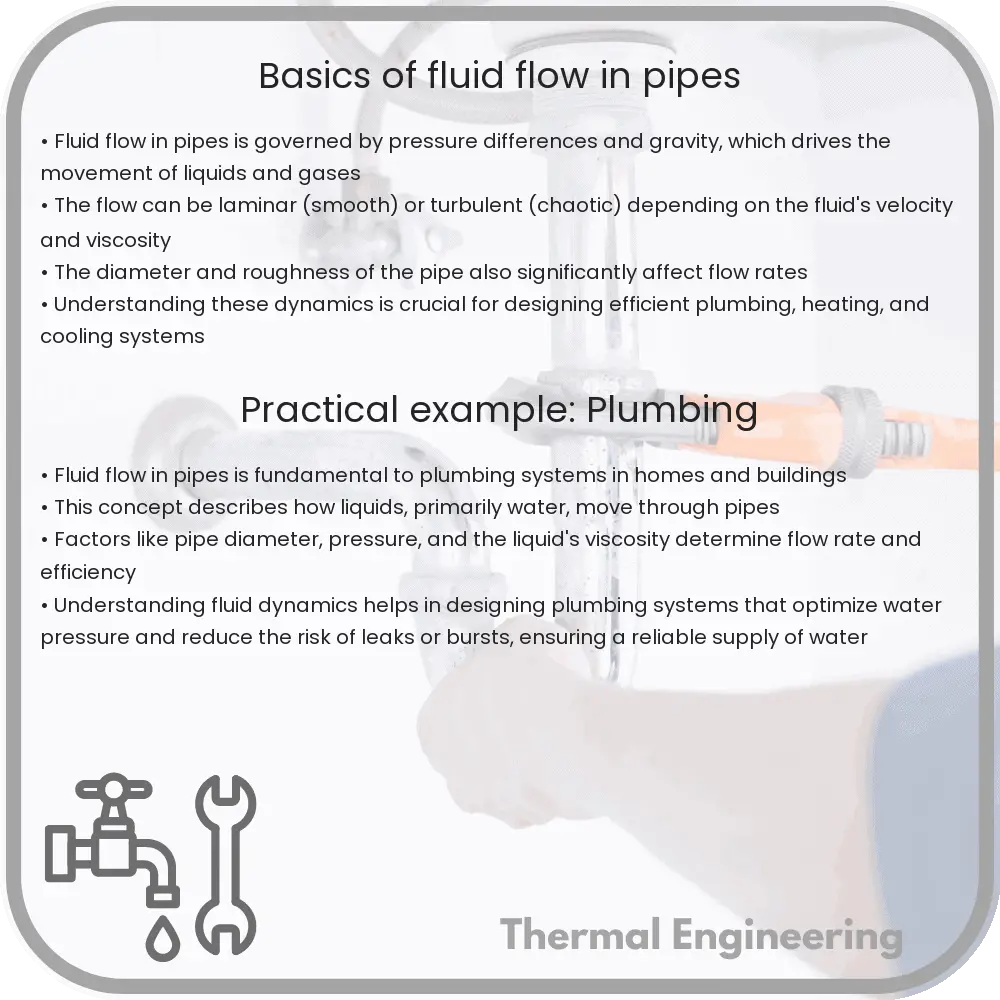
Fluid mechanics is an essential field of physics and engineering that deals with the behavior of fluids in various states. An understanding of how fluids flow through pipes is critical for engineers designing systems involved in water supply, oil transport, and chemical processing. In this article, we’ll explore the fundamental concepts of fluid flow in pipes, including types of flow, equations governing the flow, and pertinent parameters that influence flow behavior.

Types of Fluid Flow

Fluid flow within pipes can occur in different regimes, primarily characterized as either laminar or turbulent flow:

  • Laminar flow: Fluid particles move in smooth, orderly layers. Laminar flow typically occurs at lower velocities and can be modeled by simpler, linear equations. It is generally characterized by a Reynolds number (Re) of less than 2000.
  • Turbulent flow: At higher velocities, the flow becomes chaotic and irregular. Turbulent flow involves mixing across layers and is much harder to model accurately. It occurs when Re > 4000.
  • Transitional flow: Occurs between laminar and turbulent flows, typically in the range of Re = 2000 to 4000.

Reynolds Number

The Reynolds number (Re) is a dimensionless quantity in fluid mechanics used to predict flow patterns in different fluid flow situations. It is defined as:

Re = (ρ * v * D) / μ

  • ρ (rho) – the density of the fluid (kg/m3).
  • v – the velocity of the fluid within the pipe (m/s).
  • D – the diameter of the pipe (m).
  • μ (mu) – the dynamic viscosity of the fluid (Pa*s).

This equation helps determine whether the flow is laminar or turbulent, which in turn affects how the flow can be analyzed and calculated.

The Bernoulli Equation

One of the fundamental equations used in the study of fluid flow is the Bernoulli Equation, which applies to incompressible flows and is derived from the conservation of energy principle. It is expressed as:

P + (1/2)*ρ*v2 + ρ*g*h = Constant

  • P – the pressure within the fluid (Pa).
  • ρ (rho) – the density of the fluid (kg/m3).
  • v – the velocity of the fluid (m/s).
  • g – acceleration due to gravity (9.81 m/s2).
  • h – the height relative to a reference point (m).

The Bernoulli Equation is essential when analyzing fluid flow in systems where the elevation difference and the pressure difference play significant roles, such as in siphons and venturi meters.

Practical Considerations

When applying these principles to real-world engineering problems, several practical aspects need to be considered:

  • Friction: Fluid flow in pipes is generally affected by friction, which can be described by the Darcy-Weisbach equation. This equation relates the frictional head loss due to the flow of the fluid in a pipe.
  • Pipe Roughness: The inner surface of a pipe can vary greatly depending on the material, impacting the flow rate and pressure loss.
  • Changes in Diameter: Changes in pipe diameter along the flow path cause changes in fluid velocity and pressure, according to the continuity equation and Bernoulli’s principle.

Understanding the dynamics of fluid flow in pipes is vital for the design and maintenance of efficient piping systems in various industries such as civil, chemical, and mechanical engineering. By mastering the basics discussed above, engineers can predict and manipulate fluid behavior to meet their requirements effectively.

Thermal properties of bio-based materials

Explore the unique thermal properties of bio-based materials and their applications in sustainable building and manufacturing.

Thermal properties of bio-based materials

Understanding the Thermal Properties of Bio-Based Materials

With the increasing emphasis on sustainability and eco-friendly construction materials, bio-based materials have gained significant attention. These materials, derived from biological sources, are not only renewable but also offer unique thermal properties that make them highly suitable for various applications in building and manufacturing. But what exactly are these thermal properties, and why do they matter?

Thermal Conductivity of Bio-Based Materials

Thermal conductivity is a measure of a material’s ability to conduct heat. It plays a crucial role in how materials behave in environments where temperature regulation is important. Generally, bio-based materials such as wood, bamboo, and natural fibers exhibit lower thermal conductivity compared to conventional building materials like concrete or steel. This property makes bio-based materials excellent insulators, helping in energy conservation within buildings and in thermal management in various engineering applications.

  • Wood: Typically has a thermal conductivity in the range of 0.12 – 0.04 W/(m*K), depending on the type and the direction of heat flow (along or across the grains).
  • Bamboo: Exhibits slightly higher conductivity than wood, averaging around 0.2 W/(m*K), which still falls below many traditional materials.
  • Hemp, Flax, and Other Natural Fibers: These materials are often used in composite forms and generally have low thermal conductivity, similar to or even lower than wood, enhancing their insulating properties.

Specific Heat Capacity

The specific heat capacity is another important thermal property, indicating the amount of heat required to change the temperature of a unit mass of a material by one degree Celsius. Most bio-based materials have a relatively high specific heat capacity, meaning they can absorb a lot of heat before they become significantly hotter. This property is beneficial for thermal comfort in building applications.

  • Wood: Has a specific heat capacity around 1200 – 1600 J/(kg*K).
  • Bamboo: Ranges from 1400 to 2100 J/(kg*K), depending on moisture content and other factors.

Thermal Expansion

Thermal expansion refers to how much a material expands or contracts when the temperature changes. Bio-based materials typically exhibit lower thermal expansion rates compared to metals and plastics, which can be advantageous in applications where dimensional stability is critical under varying temperature conditions.

  • Wood and Bamboo: These materials generally have thermal expansion coefficients in the range of 3 to 5 µm/(m*K), much lower than materials like aluminum or steel.

Applications of Bio-Based Materials’ Thermal Properties

The unique thermal properties of bio-based materials make them suitable for a variety of applications:

  1. Building Insulation: The low thermal conductivity and high specific heat capacity make them excellent for reducing energy consumption in buildings.
  2. Ecological Construction: Their low environmental impact and sustainable nature make them ideal for green building practices.
  3. Manufacturing: Used in manufacturing processes that require heat-sensitive materials.

In conclusion, the thermal properties of bio-based materials not only contribute to their practical applications in engineering and construction but also align with global sustainability goals. By understanding and utilizing these properties, engineers and architects can design solutions that are both effective and environmentally friendly.

Explaining Bernoulli’s Principle

Learn how Bernoulli’s Principle, a cornerstone in fluid dynamics, influences phenomena in aviation, engineering, and our daily technologies.

Explaining Bernoulli's Principle

Understanding Bernoulli’s Principle

Bernoulli’s Principle is a basic concept within the field of fluid dynamics, which is part of physics and engineering. It explains how the speed of a fluid (liquid or gas) affects its pressure. Formulated by Daniel Bernoulli in the 18th century, the principle has wide applications, including in aviation, car design, and the workings of many everyday devices like carburetors and chimneys.

What Is Bernoulli’s Principle?

Bernoulli’s Principle states that for an inviscid flow, an increase in the speed of the fluid occurs simultaneously with a decrease in pressure or a decrease in the fluid’s potential energy. It is derived from the conservation of energy and specifically applies to ideal fluids which are incompressible and have no viscosity.

The Bernoulli Equation

The most common form of Bernoulli’s equation, simplified for understanding, can be written as follows:

P + 1/2 ρv2 + ρgh = constant

  • P represents the fluid’s pressure.
  • ρ (rho) is the density of the fluid.
  • v is the speed of the fluid.
  • g refers to the acceleration due to gravity.
  • h is the height above a reference point.

This equation basically states that as the speed of the fluid increases, the pressure decreases and vice versa. The same principle also means that high-speed fluid streams with low pressure, and slower fluid streams with comparatively higher pressure.

Applications of Bernoulli’s Principle

Bernoulli’s Principle has several fascinating applications in various engineering and physical realms:

  • Aviation: It helps in explaining how aircraft wings generate lift. The wing’s shape (airfoil) speeds up the airflow above it, decreasing pressure and producing lift.
  • Automotives: The principle is used in the design of carburetors and fuel injectors, which mix air and fuel in an internal combustion engine.
  • Sports: It accounts for the behavior of spinning balls, like in tennis or soccer. The spin creates different speeds and pressures on opposite sides of the ball, causing it to curve.
  • Venturi Effect: This is a practical demonstration of Bernoulli’s Principle, observed when fluid flows through a choke or narrow point in a tube, leading to a decrease in pressure and an increase in velocity.

Conclusion

Bernoulli’s Principle is a powerful aspect of fluid dynamics that helps explain and predict the behavior of fluids under various conditions. Despite its simplicity, the principle’s implications are profound, influencing countless engineering designs and contributing to advances in technology and understanding of natural phenomena.

Understanding Bernoulli’s principle opens up a world of applications and provides insights not only into advanced scientific studies but also practical, everyday technologies.