Facebook Instagram Youtube Twitter

How Do Hydraulic Systems Utilize Fluids?

This article elucidates the workings of hydraulic systems, focusing on their components, principles, applications, and benefits.

How Do Hydraulic Systems Utilize Fluids?

Understanding Hydraulic Systems

Hydraulic systems are integral in various applications from construction equipment to vehicle brakes. By understanding how they utilize fluids to transmit power, we can gain insights into their efficient nature and powerful capabilities.

Basic Principle of Hydraulics

At the heart of hydraulic systems lies Pascal’s Law, which states that when pressure is applied to a confined fluid, the pressure change occurs throughout the entire fluid. Simply put, applying pressure to any part of the fluid (often oil or water) will transmit that same pressure throughout the entire system without diminishing.

Components of Hydraulic Systems

  • Hydraulic Fluid: The medium through which power is transmitted. It is typically a mineral-based oil or water.
  • Reservoir: Holds the hydraulic fluid.
  • Pump: Moves the fluid from the reservoir to the hydraulic system. This component is crucial as it converts mechanical power into hydraulic energy.
  • Valves: Direct and control the flow of hydraulic fluid, determining the path it takes and managing the fluid flow rate.
  • Actuators: These can be hydraulic cylinders (which generate linear motion) or hydraulic motors (which produce rotary motion). They are the components that do the actual work, powered by the hydraulic fluid.

How the System Works

  1. The pump draws hydraulic fluid from the reservoir and sends it under high pressure to the actuator via the valves.
  2. The valves determine the direction and amount of fluid that flows into the actuator.
  3. As the hydraulic fluid enters the actuator, it pushes against a piston or gear inside, creating motion (either linear or rotary).
  4. The motion created is then used to perform work, such as lifting heavy loads, crushing material, or turning a system of gears.
  5. Used fluid is then recirculated back to the reservoir, where it is either cooled or allowed to rest before being reused.

Applications of Hydraulic Systems

Hydraulic systems are favored for applications where great force needs to be applied or controlled. Typical examples include:

  • Construction equipment like excavators and bulldozers
  • Automotive applications such as hydraulic brakes and power steering systems
  • Industrial machinery like presses and cranes
  • Aerospace applications, including landing gear and flight control systems

Advantages of Hydraulic Systems

Hydraulic systems provide numerous advantages that make them ideal for various demanding tasks:

  • High Power-to-Weight Ratio: Hydraulics produce large amounts of power using very little physical size or mass relative to the output.
  • Precise Control: With advanced valve designs, it is possible to control movements very precisely, which is crucial in applications such as robotic surgery or fine material handling.
  • Reliability: With fewer moving parts than electromechanical systems, hydraulics are robust and less prone to failure.
  • Scalability: Hydraulic systems can be scaled up or down to meet different force requirements effortlessly.

Understanding hydraulic systems’ operation helps appreciate the sophistication of modern machinery and the engineering that powers it. By leveraging the simple principle of fluid pressure multiplication, they enable a myriad of technologies and machines that form the backbone of contemporary industry and transportation.

What Is Reynolds Number in Fluid Flow?

Learn about the Reynolds number, a crucial dimensionless quantity in fluid mechanics, used to predict flow patterns and determine if the flow will be laminar or turbulent in various engineering applications.

What Is Reynolds Number in Fluid Flow?

Understanding Reynolds Number in Fluid Flow

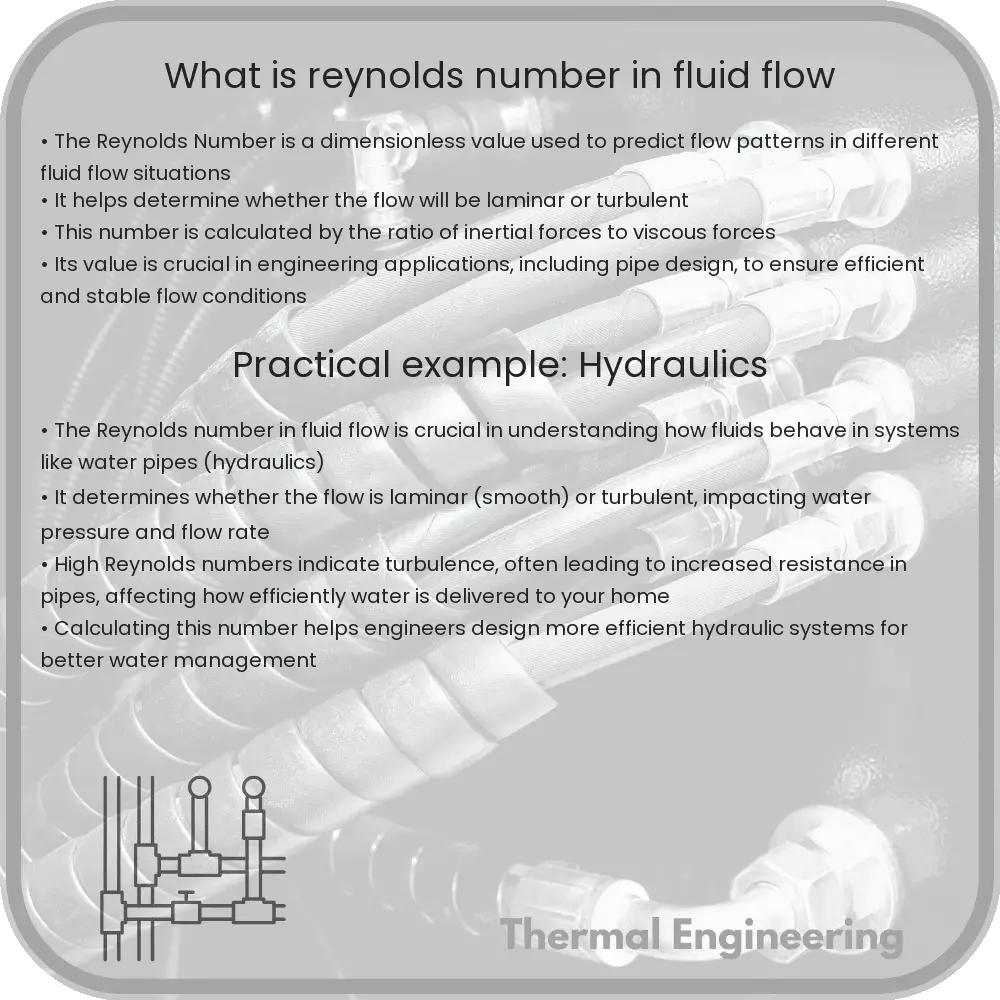
The Reynolds number is a dimensionless quantity in fluid mechanics used to predict flow patterns in different fluid flow situations. This number helps determine whether the flow will be laminar or turbulent. Understanding the Reynolds number is crucial for engineers and physicists as it affects the design and analysis of equipment such as pipes, airfoils, and even environmental studies like river currents.

Definition and Formula

The Reynolds number (Re) is calculated using the formula:

\[
\text{Re} = \frac{{\rho \cdot u \cdot L}}{\mu}
\]

Where:

  • \(\rho\) (rho) is the density of the fluid (in kilograms per cubic meter, kg/m3).
  • \(u\) is the velocity of the fluid with respect to the object (in meters per second, m/s).
  • \(L\) is a characteristic linear dimension (in meters, m) (could be diameter of a pipe).
  • \(\mu\) (mu) is the dynamic viscosity of the fluid (in Pascal seconds, Pa·s).

Alternatively, the Reynolds number can also be expressed using the kinematic viscosity (\(\nu\)), where \(\nu = \frac{\mu}{\rho}\), leading to the simplified equation:

\[
\text{Re} = \frac{{u \cdot L}}{\nu}
\]

Interpretation and Applications

The value of the Reynolds number determines the nature of the flow:

  • Laminar Flow: If Re < 2000, the flow is smooth and regular, often described as streamlined.
  • Transitional Flow: If 2000 < Re < 4000, the flow transitions from laminar to turbulent, featuring both flow types.
  • Turbulent Flow: If Re > 4000, the flow is chaotic and characterized by small swirling regions.

The importance of the Reynolds number extends to its applications in various engineering designs. For instance:

  • In aerospace engineering, understanding the transition from laminar to turbulent flow helps in designing more efficient wing profiles.
  • In civil engineering, it is crucial for the design of sewage systems and water distribution networks.
  • Automotive engineering uses it to enhance the aerodynamic properties of vehicles.

Practical Example

Consider the flow of water through a pipe with a diameter of 0.1 meters. If the velocity of water is 1 m/s, the density 1000 kg/m3, and the dynamic viscosity 0.001 Pa·s, the Reynolds number can be calculated as follows:

\[
\text{Re} = \frac{{1000 \cdot 1 \cdot 0.1}}{0.001} = 100000
\]

This high Reynolds number indicates that the flow inside the pipe is turbulent, which can impact pressure drop and flow rate calculations essential for designing efficient piping systems.

Conclusion

The Reynolds number is a key concept in fluid dynamics that helps predict the type of flow under various conditions. By understanding and using this number, engineers can optimize designs and operations of systems involving fluid flows, enhancing performance and efficiency across multiple disciplines.

How Do Airfoils Generate Lift?

Learn how airfoils, through unique shapes and airflow principles, create lift essential for aircraft flight and other aerodynamic applications.

How Do Airfoils Generate Lift?

How Do Airfoils Generate Lift?

Lift is a fundamental concept in aerodynamics that allows an aircraft to rise and remain aloft. One of the key components responsible for generating lift is the airfoil, a specially shaped wing or blade. This article explores how airfoils generate lift, focusing on the principles of their design and the physics involved.

The Shape of Airfoils

Airfoils are designed with a particular shape that has a rounded leading edge, followed by a sharp trailing edge, and a characteristic asymmetry in the curved surfaces top and bottom. This shape is crucial because it affects how air moves over and under the wing, which in turn impacts the lift produced.

Principle of Airflow and Pressure Distribution

The key to understanding lift lies in the behavior of the airflow around the airfoil and the resultant pressure distribution. According to Bernoulli’s principle, an increase in the speed of a fluid (in this case, air) occurs simultaneously with a decrease in pressure. Here’s how this principle works in the context of an airfoil:

  • Camber and Angle of Attack: Airfoils have a cambered or curved shape, and they are positioned with a certain angle of attack in relation to the incoming air. The angle of attack is the angle between the chord line (a straight line connecting the leading and trailing edges of the airfoil) and the oncoming air.
  • Faster Airflow Over the Top Surface: As air splits at the leading edge of the airfoil, the flow that goes over the top experiences a longer, curved path. To meet up with the air flowing beneath the wing at the trailing edge, the air on top must travel faster.
  • Lift from Pressure Differences: According to Bernoulli’s principle, the faster air on top of the wing creates a lower pressure than the slower air flowing beneath the wing. The higher pressure beneath the wing as compared to the pressure above the wing generates a net upward force — lift.

The Effect of Coefficient of Lift (CL)

The Coefficient of Lift (CL) is a dimensionless number that quantifies the lift produced by an airfoil at a given angle of attack. This coefficient is influenced by factors like airfoil shape, air density, and airspeed. The lift force (L) can be calculated with the equation:

\[ L = C_L \times \frac{1}{2} \rho v^2 S \]

where:

  • \( \rho \) (rho) is the air density
  • \( v \) is the velocity of the air
  • \( S \) is the wing area

Stall and Angle of Attack

While increasing the angle of attack generally increases the lift up to a point, beyond a certain angle, the smooth airflow over the wing breaks down, and the wing stalls, rapidly losing lift. This phenomenon is crucial for understanding the limitations of airfoil performance in various flying conditions.

Real-World Applications

Airfoils not only enable airplanes to fly, but they are also used in other applications such as turbomachinery, where blades in a turbine or compressor function similarly to lift-generating wings. Their principles are also employed in designing efficient sails for boats and aerodynamic components for cars like spoilers, which manage airflow to reduce unwanted lift and increase traction.

Understanding how airfoils generate lift is essential not only for aerospace engineers but also for anyone interested in the principles of flight and aerodynamics. By exploring these concepts, innovations in design and functionality continue to evolve, enhancing the efficiency and capabilities of various flying and aerodynamic devices.

Understanding Turbulence in Fluid Flow

Explore the dynamic and chaotic nature of turbulence in fluid flow, a crucial concept impacting engineering, meteorology, and environmental science.

Understanding Turbulence in Fluid Flow

Understanding Turbulence in Fluid Flow

Turbulence in fluid flow is a complex phenomenon observed in various natural settings and engineering applications. From the flow of rivers and atmospheric weather patterns to the design of aircraft and pipelines, understanding turbulence is crucial for predicting and managing fluid behavior. In this article, we’ll dive into what turbulence is, why it matters, and the basic principles underlying this dynamic state of fluid motion.

What is Turbulence?

Turbulence is a type of fluid motion characterized by chaotic, stochastic property changes. This includes low momentum diffusion, high momentum convection, and rapid variation of pressure and velocity in space and time. Unlike laminar flow, where the fluid flows in smooth layers, turbulent flow is marked by swirling and eddying motions.

Characteristics of Turbulent Flow

  • Irregularity: Turbulent flow is chaotic and unpredictable.
  • Diffusivity: Enhanced mixing and increased mass, momentum, and energy transfer.
  • Rapid Variation: Fluctuations in speed and pressure occur without regular frequency.
  • Viscosity Dominance: In turbulent flow, internal friction forces (viscosity) play a significant role.

Factors Contributing to Turbulence

The onset of turbulence can be influenced by several factors:

  • Velocity of the Fluid: Higher speeds increase the likelihood of turbulence.
  • Viscosity of the Fluid: Lower viscosity fluids are more prone to turbulence.
  • Characteristics of the Flow Path: Obstacles or sharp turns in the flow path can induce turbulence.

Mathematical Description of Turbulence

The mathematical analysis of turbulent flows is principally governed by the Navier-Stokes equations, a set of nonlinear differential equations that describe the motion of viscous fluid substances. These equations are given by:

\[\frac{\partial \mathbf{u}}{\partial t} + (\mathbf{u} \cdot \nabla) \mathbf{u} = -\frac{1}{\rho} \nabla p + \nu \nabla^2 \mathbf{u} + \mathbf{f}\]

where:

  • \(\mathbf{u}\) – velocity field
  • \(t\) – time
  • \(\rho\) – density of the fluid
  • \(p\) – pressure field
  • \(\nu\) – kinematic viscosity
  • \(\mathbf{f}\) – external forces (e.g., gravity)

Due to the complexity of these equations, exact solutions can rarely be found, and numerical methods or simplified models are often used in practical applications.

Practical Implications of Understanding Turbulence

The study of turbulence has profound implications in various fields:

  • Engineering Design: Aircraft and automobiles are designed considering the effects of turbulence to improve performance and safety.
  • Meteorology: The forecasting of weather patterns relies heavily on understanding the turbulent flow of the atmosphere.
  • Medical Applications: In cardiovascular disease research, studying the turbulent flow of blood can provide insights into the causes and treatments of conditions.
  • Environmental Science: Turbulence plays a key role in the dispersion of pollutants in air and water, affecting environmental assessments and mitigation strategies.

Understanding turbulence and its effects allows engineers and scientists to predict and mitigate its impact, leading to advances in technology and improvement in the quality of life.

Conclusion

Turbulence in fluid flow represents one of the most challenging areas in fluid dynamics. While it presents complexities in prediction and management, advancements in computational fluid dynamics and ongoing research continue to peel back the layers of this chaotic yet fascinating phenomenon. With continued study, the hope is to harness and manage turbulence for technological and environmental benefits.

Principles of Viscosity in Liquids

Learn about viscosity, a critical property of fluids defining their resistance to flow, and its importance in engineering and science.

Principles of Viscosity in Liquids

Understanding Viscosity in Liquids

Viscosity is a fundamental property of fluids which describes their resistance to flow. This property is crucial in both natural phenomena and in various engineering applications. Knowing about viscosity helps in designing machines and equipment that handle fluids, such as pumps, pipes, and engines.

What is Viscosity?

Viscosity can be described as the internal friction of a fluid, which makes it resist flowing. It is essentially the measure of a fluid’s resistance to deform under shear stress. It is an essential factor in determining how fluids move through different materials and surfaces.

Types of Viscosity

  • Dynamic Viscosity: Often referred to simply as viscosity, this measures the force that resists the flow under an applied shear stress. It is usually denoted by the Greek letter ‘µ’ (mu) and is measured in Pascal-seconds (Pa·s) or Poise in the CGS (Centimeter-Gram-Second) system.
  • Kinematic Viscosity: It considers the fluid density and is defined as the dynamic viscosity divided by the density. Denoted by the Greek letter ‘ν’ (nu), it is measured in square meters per second (m2/s) or Stokes in the CGS system.

Factors Affecting Viscosity

The viscosity of a fluid is influenced by several factors:

  1. Temperature: Generally, as the temperature increases, the viscosity of a liquid decreases. This is because the increased kinetic energy of the molecules means they can move more freely past each other.
  2. Pressure: Unlike gases, the effect of pressure on the viscosity of liquids is relatively small. Generally, an increase in pressure increases the viscosity of a liquid slightly.
  3. Chemical Composition: The nature of the molecules in a fluid and how they interact affects its viscosity. For example, liquids with large or complex molecules typically have higher viscosities.

Calculating Viscosity

The basic equation used for calculating dynamic viscosity in Newtonian fluids, where the viscosity remains constant irrespective of the flow conditions, is:

\[ \mu = \tau / \left(\frac{\Delta u}{\Delta y}\right) \]

Where:

  • μ = dynamic viscosity
  • τ = shear stress
  • Δu/Δy = velocity gradient perpendicular to the direction of shear

This equation doesn’t apply to non-Newtonian fluids where the viscosity can change under different flow conditions.

Applications of Viscosity

Viscosity has important applications in various industries and natural processes:

  • Engineering: Design of fluid transport systems, machinery lubrication, and cooling systems.
  • Manufacturing: Production processes such as injection molding, painting, and food processing rely heavily on understanding and controlling fluid viscosity.
  • Geology: Viscosity of magma plays a critical role in volcanic activities and the formation of rocks.
  • Medicine: In medical diagnostics and drug delivery, controlling fluid viscosity ensures efficacy and quality of formulations.

Understanding the principles of viscosity enables better design and efficient operation of systems involving the flow of liquids. Its control and manipulation allow for innovation and efficiency improvements across various sectors of technology and industry.

Conclusion

Viscosity is a key concept in fluid dynamics that affects how substances flow and interact. By studying viscosity, engineers and scientists can create more effective and efficient solutions in a wide range of fields from industrial manufacturing to natural earth processes. As we continue to unravel the complexities of fluid behavior, viscosity remains a vital area of research and development.

Thermal performance testing of materials

Learn how thermal performance testing evaluates materials for their heat resistance and application suitability in various industries.

Thermal performance testing of materials

Understanding Thermal Performance Testing of Materials

Thermal performance testing is a critical process in engineering that helps scientists and engineers evaluate how materials respond to changes in temperature. This type of testing is essential for determining the suitability of materials for use in various applications, from construction and insulation to aerospace and electronics. The goal is to ensure that materials will perform well under the expected thermal conditions and have a long service life.

What is Thermal Performance?

Thermal performance refers to a material’s ability to conduct, convect, and radiate heat. It is a measure of a material’s ability to resist heat flow, which is crucial in many applications where temperature regulation and insulation are important. The main aspects of thermal performance include thermal conductivity, thermal resistance, and thermal capacity:

  • Thermal Conductivity: This is a measure of a material’s ability to conduct heat through its mass. Materials with high thermal conductivity, like metals, are good heat conductors, while those with low thermal conductivity, such as foams and fibers, are considered insulators.
  • Thermal Resistance: This is an indication of how well a material can resist the flow of heat. It is generally used to rate insulation materials. A higher thermal resistance means better insulation properties.
  • Thermal Capacity: Also called heat capacity, this measures the amount of heat energy required to raise the temperature of a given mass of material by a given amount. Materials with high thermal capacity can absorb and store more heat energy.

Methods of Thermal Performance Testing

Thermal performance testing can be conducted using various methods depending on the characteristics of the material and the information required. Some of the common testing methods include:

  1. Steady-State Methods: These tests measure the thermal properties while the material is in a steady temperature state. Techniques include guarded hot plate, heat flow meter, and steady-state thermal transmission properties by means of a heat flow meter apparatus.
  2. Transient Methods: These are quick methods useful for measuring the thermal properties of materials when they are exposed to changing temperatures. Techniques include the hot disk method, which uses a transient technique for determining thermal conductivity, diffusivity, and specific heat.
  3. Infrared Thermography: This is a non-contact method that uses infrared cameras to observe the thermal radiation emitted from the material’s surface. It helps in detecting thermal anomalies and understanding heat distribution in materials.

Applications of Thermal Testing

The outcomes of thermal performance testing have vital implications in various fields:

  • Construction: For ensuring materials used in building construction provide adequate insulation and energy efficiency.
  • Electronics: In designing devices, it is crucial to assess how components dissipate heat and manage thermal loads to prevent overheating and failure.
  • Aerospace: Materials used in aerospace need to withstand extreme temperatures, both high and low, and testing helps determine spaceworthiness.
  • Automotive: Thermal testing helps in the development of automotive components that can perform under varying climatic conditions and engine temperatures.

Conclusion

Thermal performance testing is indispensable in the selection and development of materials across industries. It ensures that materials will not only perform as expected but also adhere to safety standards and durability under real-world thermal conditions. Understanding these aspects can significantly aid in the innovation and improvement of products, contributing to better performance and sustainability.

How Does Thermal Energy Storage Work?

Learn about Thermal Energy Storage (TES), a technology that captures and utilizes heat for later use in power generation and climatic control.

How Does Thermal Energy Storage Work?

Understanding Thermal Energy Storage

Thermal energy storage (TES) is a technology that stocks thermal energy by heating or cooling a storage medium so the stored energy can be used later for heating and cooling applications and power generation. This can lead to substantial operational cost savings and provide an efficient way to manage the supply and demand of energy.

Types of Thermal Energy Storage Systems

Thermal energy storage systems can be primarily classified into three types based on how the energy is stored: sensible heat, latent heat, and thermochemical storage.

  • Sensible Heat Storage: This is the most common type of thermal energy storage. It involves storing energy by raising the temperature of a solid or liquid, without a phase change. Common materials used for sensible heat storage include water, sand, and rocks.
  • Latent Heat Storage: This approach utilizes the energy change that occurs when a material changes from one phase to another, typically from solid to liquid or vice versa. The energy is stored and released through the material’s phase change at a constant temperature. Materials used for latent heat storage, called phase change materials (PCMs), include paraffin, salts, and certain metallics.
  • Thermochemical Storage: The most complex form of TES, thermochemical storage involves chemical reactions to store and release heat. This type of storage allows for higher energy densities and virtually no heat loss over time, though it’s usually more expensive and technically challenging to implement.

How Does Thermal Energy Storage Work?

The basic operation of TES systems can vary significantly depending on the type of storage used, but here’s a general overview:

  1. Energy Collection: Thermal energy is captured from a heat source. This heat might come from natural sources like solar heat (captured using solar thermal panels), industrial waste heat, or even off-peak electricity converted to heat via an electric heater.
  2. Energy Storage: The captured heat is transferred to a TES medium. In sensible heat storage, the medium’s temperature increases; in latent heat storage, the medium undergoes a phase change; in thermochemical processes, a chemical reaction occurs to store energy.
  3. Energy Retrieval: When required, the stored energy is extracted either directly for heating/cooling or converted back into electricity. The retrieval process depends on the inverse processes of storage, such as releasing heat by cooling down the medium or reversing the chemical reaction.

Applications and Benefits of Thermal Energy Storage

Thermal energy storage has a range of applications in both residential and industrial sectors:

  • Enhanced Energy Management: TES systems allow for the storage of excess energy during times of low demand and its usage during peak demand periods. This can help in balancing load, thus reducing the need for expensive peak power plants and decreasing energy costs.
  • Increased Renewable Energy Usage: By storing surplus energy from renewable sources like solar or wind, TES helps in overcoming the intermittent nature of these resources, allowing for a more stable and continuous energy supply.
  • Improved System Efficiency: TES systems can improve the overall efficiency of energy systems by capturing and reusing waste heat that would otherwise be lost.
  • Reduced Greenhouse Gas Emissions: By optimizing the energy system and reducing reliance on fossil fuels, TES can significantly lower greenhouse gas emissions.

In conclusion, thermal energy storage is a versatile and powerful tool in the arsenal of energy management and sustainability. Its ability to store excess energy efficiently and to release it on-demand makes it crucial for the future of energy grids worldwide, particularly as we move towards more renewable energy sources and seek greater energy efficiency.

Basics of Fluid Dynamics in Engineering

Learn about fluid dynamics, a pivotal science in engineering that explores how liquids and gases behave during motion, enabling advancements in multiple fields.

Basics of Fluid Dynamics in Engineering

Understanding Fluid Dynamics in Engineering

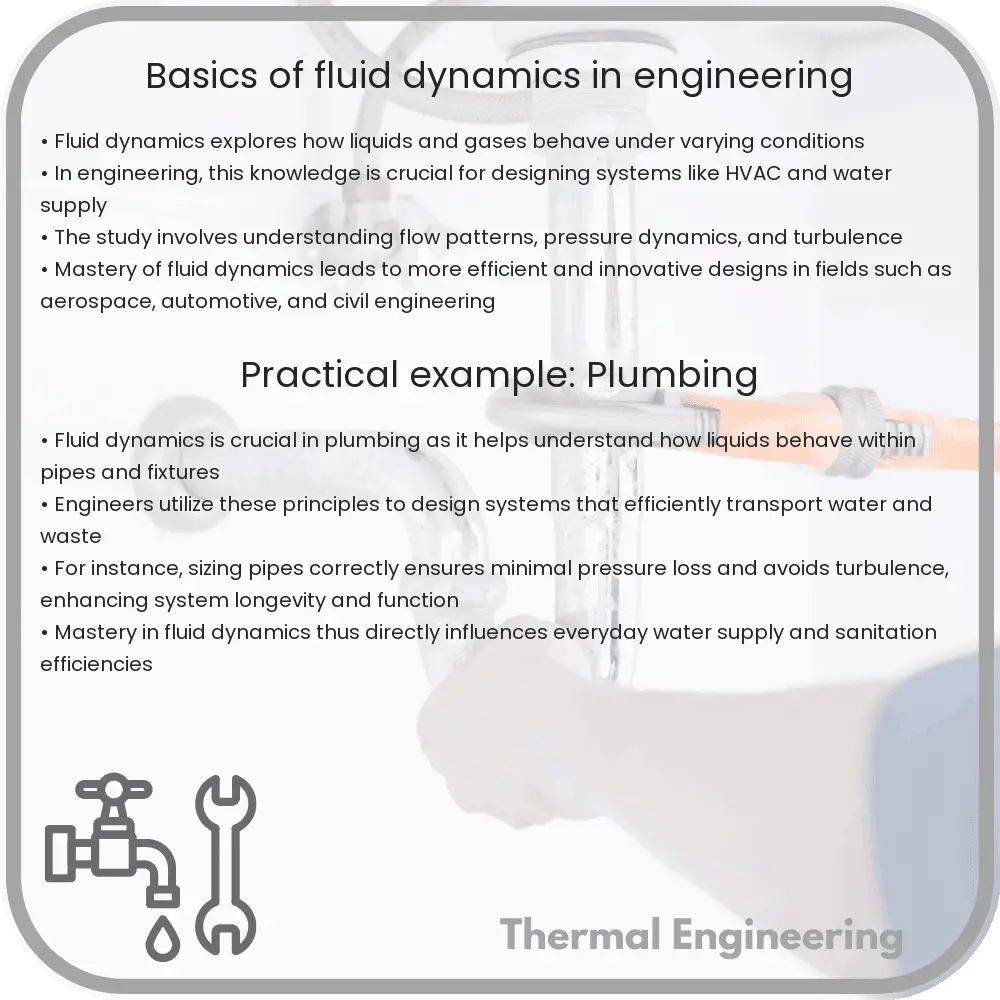
Fluid dynamics is a sub-discipline of fluid mechanics that deals with fluids (liquids and gases) in motion. It plays a critical role in engineering, enabling the design and analysis of systems such as aircraft, automobiles, ships, pipelines, and power plants, among others. This article elucidates the basic principles of fluid dynamics and its practical applications in various engineering fields.

Foundational Concepts of Fluid Dynamics

Fluid dynamics is grounded on several foundational principles derived from physics. Understanding these principles is essential for comprehending how fluids behave under different conditions:

  • Continuity Equation: This principle asserts that the mass of fluid passing through a pipe or conduit is conserved at any point in the system. It is expressed mathematically as:

    A1V1 = A2V2

    where A is the cross-sectional area and V is the fluid velocity. It implies that when a fluid passes through different areas of a pipe, its velocity changes inversely with the cross-sectional area.

  • Bernoulli’s Equation: This equation describes the conservation of energy in a flowing fluid and is a critical tool for solving various fluid dynamics problems. It can be stated as:

    P + 0.5ρV2 + ρgh = constant

    where P is the fluid pressure, ρ (rho) is the fluid density, g is the acceleration due to gravity, h is the height above a reference level, and V is the velocity of the fluid. This equation implies that the total energy (pressure energy, kinetic energy, and potential energy) in a fluid flowing along a streamline is conserved.

  • Navier-Stokes Equations: These equations provide a comprehensive description of the motion of fluid substances. They account for various forces that act on fluid elements, notably viscous forces, and are essential for solving complex flow problems.

Applications of Fluid Dynamics in Engineering

Fluid dynamics has diverse applications across many engineering disciplines:

  1. Aerospace Engineering: Engineers use fluid dynamics to design aircraft shapes that minimize drag and optimize lift, influencing the efficiency and performance of aircraft.
  2. Automotive Engineering: Fluid dynamics helps in designing the aerodynamics of vehicles, improving fuel efficiency and stability at high speeds.
  3. Civil Engineering: It’s used in water supply and sewage systems, determining flow rates and pipe sizing to ensure efficient transport and distribution of fluids.
  4. Chemical Engineering: Fluid dynamics is crucial in the design of reaction vessels and piping systems in chemical plants to achieve optimal mixing and reaction rates.
  5. Mechanical Engineering: It assists in designing heating, ventilation, and air conditioning systems (HVAC), optimizing fluid flow for better thermal comfort and efficiency.

Conclusion

Fluid dynamics is a fundamental aspect of engineering that applies principles of fluid mechanics to solve problems related to fluid flow. The continuity equation, Bernoulli’s equation, and the Navier-Stokes equations are key tools in understanding and applying fluid dynamics. These principles facilitate innovation and efficiency across a wide range of engineering applications, from aircraft design to urban water supply systems. As such, fluid dynamics remains a vital area of study and practice in engineering.

By appreciating these basic principles, students and professionals can better harness fluid dynamics to cultivate more effective and efficient engineering solutions in their respective fields.

Understanding Heat Exchangers: A Guide

Learn how heat exchangers transfer heat between fluids in diverse applications, enhancing efficiency and conservation in engineering systems.

Understanding Heat Exchangers: A Guide

Understanding Heat Exchangers: A Guide

Heat exchangers are devices that facilitate the transfer of heat from one fluid to another without mixing them. Common in many industrial, commercial, and residential applications, these systems play a critical role in energy conservation and efficiency. This article explores the basic principles of heat exchangers, their various types, and real-world applications.

Basic Principles of Heat Exchange

At its core, a heat exchanger transfers heat energy through conductive and convective processes. The effectiveness of a heat exchanger is determined by factors such as the surface area of the heat exchange components, the temperature difference between the fluids, and the thermal conductivity of the materials involved. The general heat transfer equation used is:

Q = U * A * ΔT

  • Q is the rate of heat transfer (in watts or joules per second).
  • U stands for the overall heat transfer coefficient (in watts per square meter per kelvin).
  • A is the heat transfer surface area (in square meters).
  • ΔT is the temperature difference between the fluids (in kelvin).

Efficiency in a heat exchanger is enhanced by increasing the surface area in contact with the fluids or by maximizing turbulence, often by using fins or corrugations in the components’ designs.

Types of Heat Exchangers

Heat exchangers come in various designs, each suited to specific applications and fluid properties:

  1. Shell and Tube Heat Exchangers: These consist of a series of tubes, one set carrying the hot fluid and the other the cold fluid. Typically used in large-scale industrial applications where pressures are high.
  2. Plate Heat Exchangers: Constructed with corrugated plates arranged to form channels through which the fluids flow. They offer high heat transfer efficiency and are compact, making them ideal for use in food, beverage, and pharmaceutical industries.
  3. Air Cooled Heat Exchangers: Used primarily for cooling fluids with air, these are common in vehicle radiators and HVAC systems. They rely on fans to blow air across a network of tubes carrying the hot fluid.

Applications of Heat Exchangers

Heat exchangers are pivotal in numerous sectors:

  • Power Generation: Used extensively in power plants, heat exchangers recover waste heat from exhaust gases to improve overall plant efficiency.
  • Refrigeration and Air Conditioning: Heat exchangers are essential components of refrigerators and air conditioners, where they absorb and dissipate heat to regulate temperature.
  • Chemical Processing: Chemical reactors often use heat exchangers to control the temperature of reactants, affecting the rate and yield of chemical reactions.
  • Automotive: Cars use heat exchangers in the form of radiators and oil coolers to maintain engine temperature and prevent overheating.

Understanding the basic principles and applications of heat exchangers can significantly impact the design and operation of various systems in engineering. This knowledge assists engineers and technicians in selecting the most appropriate heat exchanger type, enhancing system efficiency and energy conservation.

What Is Entropy in Thermal Systems?

Learn about entropy in thermal systems, a key concept in thermodynamics that describes disorder and energy distribution efficiency.

What Is Entropy in Thermal Systems?

Understanding Entropy in Thermal Systems

Entropy is a fundamental concept in thermodynamics, which is crucial for describing the behavior and efficiency of thermal systems. It is often associated with the idea of disorder or randomness in a system. In the context of thermodynamics, entropy measures the number of ways a system can be arranged while maintaining the same energy, which directly influences how energy is distributed within the system.

Basic Definition and Importance

Entropy is a measure of the disorder or randomness in a system. The second law of thermodynamics states that the total entropy of an isolated system can never decrease over time. This means that thermal systems naturally evolve towards a state of maximum entropy, or maximum disorder. This principle helps engineers and scientists predict how energy will flow in a system, and is fundamental in processes like heat transfer, energy generation, and refrigeration.

Mathematical Description of Entropy

In a more formal sense, entropy (S) can be defined through the change in entropy (\(\Delta S\)) for a reversible process, which is given by the equation:

\[ \Delta S = \int \frac{dQ}{T} \]

Here, \(dQ\) represents an infinitesimal amount of heat added to the system and \(T\) is the absolute temperature at which the heat is added. This equation is crucial for calculating entropy changes in thermal processes, helping engineers design more efficient systems.

Entropy in Practical Applications

  • Heat Engines: In heat engines, entropy helps in determining the maximum efficiency that can be achieved. For example, in a Carnot engine, the efficiency depends only on the temperatures of the hot and cold reservoirs, and is given by \((1 – Tcold/Thot)\).
  • Refrigeration: In refrigeration, entropy analysis helps in understanding the energy flows and inefficiencies of the cooling cycle, guiding improvements in performance and energy conservation.
  • Energy Systems: Analysis of entropy changes in power plants helps optimize the process of converting heat into work, minimizing energy wastage.

The Entropic Universe

At a cosmic level, entropy is also a key concept in understanding the evolution of the universe. According to the second law of thermodynamics, the entropy of the universe is constantly increasing, leading towards a state of thermodynamic equilibrium known as the “heat death” of the universe, where no more work can be extracted from thermal energy due to a uniform temperature throughout.

In conclusion, entropy is a powerful concept in thermal systems, providing insight into the direction and efficiency of energy transformations. By understanding and applying the principles of entropy, engineers can design systems that better harness energy, reduce waste, and improve overall system performance.

Key Takeaways

  1. Entropy is a measure of disorder or randomness in a system.
  2. The second law of thermodynamics states that entropy in an isolated system never decreases.
  3. Entropy calculations are vital for optimizing thermal systems in engineering applications such as heat engines, refrigeration, and power plants.
  4. The increasing entropy of the universe may lead to a state where no more useful energy is available.

This fundamental understanding not only helps in engineering efficient systems but also provides a deeper insight into the natural processes governing our universe.