Facebook Instagram Youtube Twitter

Thermal barrier in automotive exhaust systems

Learn about thermal barriers in automotive exhaust systems, their types, benefits, and implications for vehicle performance and durability.

Thermal barrier in automotive exhaust systems

Understanding Thermal Barriers in Automotive Exhaust Systems

Automotive exhaust systems are critical in managing the emissions and noise produced by the engine. One of the key components that enhance the efficiency and safety of these systems is the thermal barrier. This technology plays a significant role in minimizing heat transfer from the exhaust system to other parts of the vehicle, thereby protecting sensitive components and improving overall vehicle performance.

What is a Thermal Barrier?

A thermal barrier in automotive exhaust systems refers to materials or coatings applied to exhaust system components, such as the exhaust manifold, pipes, and sometimes the muffler. These barriers are designed to reflect, absorb, or dissipate heat, keeping it within the exhaust system and away from other parts of the vehicle.

Types of Thermal Barriers

  • Ceramic Coatings: Perhaps the most common type of thermal barrier, ceramic coatings are applied to the surface of exhaust components. These coatings can withstand very high temperatures and effectively reduce the heat transfer to the surrounding areas.
  • Heat Shields: These are physical barriers, often made of metal, which are placed around parts of the exhaust system. They function by reflecting heat back into the exhaust flow or away from sensitive components.
  • Exhaust Wraps: This type involves wrapping the exhaust components with specially designed tapes or fabrics. These wraps contain heat within the pipes by providing an insulating layer around the metal.

Benefits of Thermal Barriers

  1. Improved Vehicle Performance: By keeping the exhaust gases hotter, thermal barriers help in maintaining or increasing the exhaust gas velocity. This can lead to better scavenging of the cylinders, which improves the engine’s efficiency and power output.
  2. Protection of Vehicle Components: By reducing under-hood temperatures, thermal barriers protect sensitive components such as electronics, plastics, and painted surfaces from heat damage.
  3. Enhanced Durability: High temperatures can degrade many of the materials used in the construction of a car. By limiting their exposure to extreme heat, thermal barriers can extend the lifespan of these materials.
  4. Increased Comfort: Reducing the heat that escapes into the passenger compartment can make for a more comfortable ride, particularly in vehicles where the exhaust runs beneath the cabin area.

Challenges and Considerations

While thermal barriers offer many benefits, there are also challenges and considerations that need to be taken into account. The application of ceramic coatings requires specialized equipment and expertise, and once applied, they can be difficult to remove or modify. Heat shields and exhaust wraps, while simpler to install, can sometimes retain moisture, leading to accelerated corrosion of the exhaust components if not properly installed.

Conclusion

Thermal barriers play an essential role in the efficiency and longevity of automotive exhaust systems. By understanding the different types of barriers and their benefits, automotive engineers can make informed decisions about how to best manage heat in exhaust systems, leading to better vehicle performance and durability. With ongoing technological advances, the materials and methods used for thermal barriers continue to evolve, offering even greater potential benefits for future automotive designs.

How does thermal break technology improve windows

Learn how thermal break technology in windows enhances insulation, reduces energy costs, and improves comfort by minimizing heat transfer.

How does thermal break technology improve windows

Understanding Thermal Break Technology in Windows

One of the key advancements in window engineering is the integration of thermal break technology. This technology plays a crucial role in enhancing the insulative properties of windows, which in turn improves a building’s energy efficiency, comfort levels, and even the longevity of window frames. But what exactly is thermal break technology, and how does it contribute to these improvements?

What is a Thermal Break?

A thermal break refers to a material placed within the frame of a window that physically separates the inside part of the frame from the outside. Often made from a less conductive material than the main frame, usually polyamide or reinforced polyurethane, the thermal break acts as a barrier that reduces heat transfer through the window. This is especially important in metal frames, like aluminum, which are highly conductive and can otherwise allow a lot of heat to pass through, diminishing the window’s overall thermal efficiency.

Benefits of Thermal Break Technology in Windows

  • Improved Insulation: By minimizing the amount of heat that passes through the window frames, thermal break technology significantly enhances thermal insulation. During the winter, it keeps the heat inside, and in the summer, it prevents heat from entering, maintaining a more consistent indoor temperature.
  • Reduction in Energy Costs: Improved insulation means heating and cooling systems do not work as hard to maintain desired temperatures, thereby reducing energy consumption and costs.
  • Prevention of Condensation: A thermal break reduces the likelihood of condensation, which occurs when warm, moist indoor air comes in contact with a cold surface, condensating and potentially leading to problems like mold or mildew.
  • Increased Comfort: Thermal breaks can help eliminate cold spots and drafts near windows, which contributes to a more comfortable living environment.
  • Eco-friendly: By reducing the energy needed to heat or cool a space, thermal break windows contribute to lower carbon emissions.

How Does Thermal Break Technology Work?

The effectiveness of thermal break technology in windows can be explained through the fundamental principles of heat transfer. Heat is transferred in three ways: conduction, convection, and radiation. In the context of windows, the frame can conduct heat from the outside to the inside or vice versa. The thermal break acts as a barrier that minimizes this conductive heat transfer.

Say, the thermal conductivity of aluminum is approximately 160 W/mK, which is relatively high. Contrarily, materials used for thermal breaks have much lower thermal conductivities, generally less than 1 W/mK. The presence of a thermal break markedly reduces the overall U-value (the measure of heat transfer through a structural element) of the window, leading to better insulative properties.

Conclusion

Thermal break technology significantly improves the performance of windows, particularly when it comes to their energy efficiency and overall comfort contribution to a building’s environment. By understanding and utilizing this technology, engineers and architects can design buildings that are not only more sustainable but also offer enhanced comfort and efficiency. Whether renovating old structures or constructing new ones, considering thermal break technology in window design is essential for achieving modern energy standards and living conditions.

How does thermal conductivity affect electronic devices

Learn about thermal conductivity’s role in enhancing the performance and lifespan of electronic devices by efficiently managing heat dissipation.

How does thermal conductivity affect electronic devices

Understanding Thermal Conductivity in Electronic Devices

Thermal conductivity is a crucial physical property in the field of electronics engineering, significantly impacting the performance, efficiency, and longevity of electronic devices. It refers to a material’s capacity to conduct heat and plays a pivotal role in the management of heat in electronic circuits and devices.

Why Thermal Conductivity Matters in Electronics

Electronic devices generate heat during operation due to the electrical resistance in their components. Efficient heat management is essential, as excessive heat can lead to electronic failure, reduced performance, and shortened device lifespan. The thermal conductivity of the materials used in electronic devices determines how effectively this heat can be spread away from hot components and dissipated.

Materials and Thermal Conductivity

  • Metals: Metals like copper and aluminum are commonly used in electronics due to their high thermal conductivity. For instance, copper has a thermal conductivity of about 400 W/m*K, making it excellent for heat dissipation.
  • Semiconductors: Silicon, a widely used semiconductor in electronics, has a thermal conductivity of about 150 W/m*K, which is less than that of metals but sufficient for many applications.
  • Insulators: Materials like glass and plastic have low thermal conductivity, typically less than 1 W/m*K, and are used where minimal heat transfer is desired.

Heat Management in Electronic Design

Engineers use materials with appropriate thermal conductivities to design electronic devices that can effectively manage heat. This includes the use of heat sinks, thermal paste, and thermal pads which improve heat dissipation from critical components like CPUs and GPUs to the ambient environment.

  • Heat sinks: Made from high thermal conductivity materials, these components are designed to increase the surface area in contact with the cooler air, thus enhancing heat dissipation.
  • Thermal paste: Also known as thermal grease, it is used to fill in air gaps between the heat sink and the component. Despite its lower thermal conductivity compared to metals, it improves the overall heat transfer between surfaces.
  • Thermal pads: These serve as a heat transfer interface between heat sinks and electronic components with irregular surfaces or components that are heat sensitive.

Advancements and Innovations

Research continuously evolves in the field of materials science to find materials with higher thermal conductivities or to enhance the heat dissipation properties of existing materials. For example, developments in carbon-based materials like graphene and carbon nanotubes, which exhibit exceptional thermal conductivity, offer promising enhancements in thermal management of electronics.

Conclusion

The efficient management of heat through understanding and applying the principles of thermal conductivity is foundational in electronic design. By selecting and using materials based on their thermal conductivity, engineers can significantly affect the performance and reliability of electronic devices. Moving forward, innovations in material science and engineering will continue to push the boundaries of what is possible in thermal management technologies.

How does thermal energy harvesting convert waste heat

Learn about thermal energy harvesting, a technology that converts waste heat into electrical power, enhancing energy efficiency and reducing environmental impact.

How does thermal energy harvesting convert waste heat

Understanding Thermal Energy Harvesting

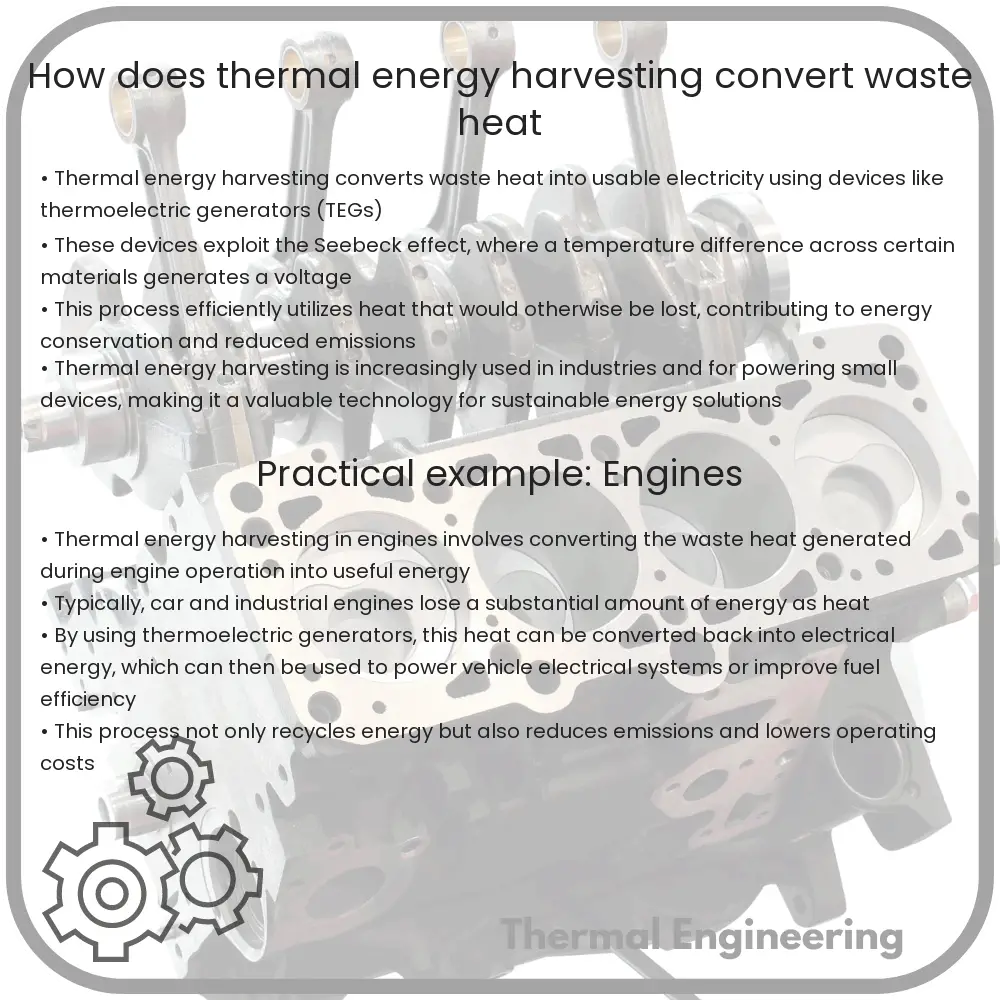
Thermal energy harvesting is a transformative technology that provides a route to convert waste heat generated in various processes into useful electrical power. This approach not only contributes to improving energy efficiency but also helps in reducing the overall environmental impact of energy usage.

How Does Thermal Energy Harvesting Work?

At its core, thermal energy harvesting operates on the principle of capturing and converting the surplus heat that would otherwise dissipate unused into the environment. This conversion process typically exploits the “thermoelectric effect,” which constitutes several phenomena including the Seebeck effect, Peltier effect, and Thomson effect. However, for the purpose of energy harvesting, the Seebeck effect is most pertinent.

The Seebeck effect occurs when a temperature difference is established between two dissimilar electrical conductors or semiconductors. This temperature difference generates a voltage difference between these two materials, which can then be used to drive an electrical current through an external circuit. The process can be summarized by the equation:

V = S * ΔT

  • V refers to the voltage generated.
  • S is the Seebeck coefficient, which varies depending on the materials used.
  • ΔT is the temperature difference between the hot and cold ends of the thermoelectric materials.

Key Components of a Thermoelectric Generator

A typical thermoelectric generator (TEG), which is a device designed for thermal energy harvesting, includes several key components:

  1. Thermoelectric Materials: These are typically made from bismuth telluride (Bi2Te3) or other semiconductor materials that exhibit strong thermoelectric properties.
  2. Heat Source: Provides the necessary temperature gradient required for the Seebeck effect to occur. This could be any waste heat source from industrial processes, automotive exhausts, or natural heat sources.
  3. Heat Sink: Maintains the colder side of the thermoelectric materials, essential for maintaining the temperature gradient.
  4. Electrical Load: The device or resistor where the generated electrical power is utilized or further processed.

Applications of Thermal Energy Harvesting

Thermal energy harvesting finds applications across a wide range of industries. Some notable examples include:

  • Automotive: Harvesting exhaust heat to generate additional power for vehicle systems.
  • Industrial: Recovering heat from furnaces, boilers, and other industrial machinery to improve overall energy efficiency.
  • Consumer Electronics: Using body heat to power wearable devices, reducing dependency on batteries.
  • Aerospace: Managing and reusing heat within spacecraft systems to enhance energy efficiency in extreme environments.

Challenges and Future Prospects

While thermal energy harvesting presents a promising avenue for managing waste heat and improving energy sustainability, there are challenges. These primarily revolve around the efficiency of thermoelectric materials and the cost-effectiveness of deploying such systems at a large scale. Ongoing research focuses on developing materials with higher Seebeck coefficients, better thermal conductivity, and overall greater efficiency at converting heat to electricity.

In conclusion, thermal energy harvesting stands as a critical component in the drive towards more sustainable energy practices. With advancements in materials science and thermoelectric technology, its role is set to expand significantly in the coming years, offering a greener alternative by converting waste heat into a valuable energy resource.

How does a thermal zone control HVAC efficiency

Learn how thermal zone control in HVAC systems enhances efficiency and comfort by managing individual zone temperatures.

How does a thermal zone control HVAC efficiency

Understanding Thermal Zone Control in HVAC Systems

Heating, Ventilation, and Air Conditioning (HVAC) systems are essential in maintaining comfort in buildings. One of the advanced methods to enhance HVAC efficiency is through thermal zone control. But what exactly does this mean, and how does it contribute to HVAC efficiency? Let’s dive into the basics of thermal zone control and its impact on energy utilization and comfort levels.

What is a Thermal Zone?

A thermal zone is an area or a room within a building that has similar heating and cooling needs. These needs are determined based on various factors such as occupancy, space usage, exposure to sunlight, and external weather conditions. Essentially, different parts of a building may require different environmental conditions, and this variation defines the need for distinct thermal zones.

How Does Thermal Zone Control Work?

Thermal zone control involves regulating the temperature of each zone independently, rather than applying a uniform temperature setpoint across a whole building. This is accomplished via a network of thermostats, dampers, and sensors that work together to tailor the heating and cooling delivered to each zone. The controlling elements in a typical thermal zone system include:

  • Zone thermostats that sense and regulate the temperature in their respective areas.
  • Control dampers in the ductwork that can open or close to adjust airflow into the zone.
  • Variable Frequency Drives (VFDs) that modulate fan speeds based on the demand from different zones.

Benefits of Thermal Zone Control

Implementing thermal zone control in HVAC systems offers several advantages which include:

  1. Enhanced Comfort: By managing temperature on a zone-by-zone basis, occupants can enjoy a personalized comfort level, leading to increased satisfaction and productivity, especially in environments like offices and schools.
  2. Improved Energy Efficiency: Heating or cooling only the zones that need it prevents waste of energy in unoccupied or less frequented areas. This targeted approach can lead to significant reductions in energy consumption and utility costs.
  3. Reduced Wear and Tear: By operating HVAC components like fans and compressors only when necessary, thermal zone control can also extend the lifespan of the entire system by reducing its overall operational hours.

Examples of Thermal Zone Control in Action

An excellent example of thermal zone control can be found in modern office buildings where meeting rooms, individual offices, and open areas may have very different occupancy and thus different cooling and heating requirements throughout the day. Advanced HVAC systems can detect the presence of people and adjust the environment accordingly, ensuring that energy is not wasted on empty rooms.

In another example, residential units that employ smart thermostats can automatically adjust the heating or cooling based on learned preferences and timed schedules for different zones in the home, such as bedrooms, living rooms, and kitchens.

Conclusion

Thermal zone control represents a significant step forward in the optimization of HVAC systems. By aligning energy usage with actual demand, it not only conserves resources but also ensures that comfort is consistently maintained throughout the building spaces. As technology advances and more buildings adopt smart systems, the implementation of thermal zone control is likely to become more sophisticated and widespread, offering even greater efficiency gains and user-specific adaptations.

For anyone interested in maximizing HVAC efficiency while maintaining high comfort levels, exploring and investing in thermal zone control systems can be highly beneficial. It is a solid example of how engineering principles can tackle real-world issues in innovative and effective ways.

How does thermal-based power generation work

Explore how thermal-based power generation converts heat into electricity, using processes like steam production and turbine rotation, guided by thermodynamics.

How does thermal-based power generation work

Understanding Thermal-Based Power Generation

Thermal-based power generation is a process that converts heat energy into electrical energy. This is one of the most common methods of producing electricity in the world, utilized in coal, gas, oil, and nuclear power plants. At its core, the process involves converting water into steam, which then powers a turbine connected to a generator. Here’s a detailed look at how this process works.

The Basic Components

  • Boiler: Burns fuel to generate heat.
  • Turbine: Converts steam energy into mechanical energy.
  • Generator: Converts mechanical energy from the turbine into electricity.
  • Condenser: Cools steam back into water.
  • Cooling Tower: Releases or reuses excess heat into the atmosphere.

How it Works

The process of thermal power generation follows several key steps:

  1. Generating Heat: Initially, a fuel source (such as coal, natural gas, oil, or nuclear material) is burned in a large boiler to create heat. In nuclear power plants, heat is generated through nuclear fission reactions rather than by burning fuels.
  2. Producing Steam: The heat produced in the boiler is used to heat water in pipes, turning it into steam. This usually involves passing water through tubes that absorb heat from the combustion gases or the nuclear reactor core.
  3. Rotating the Turbine: The high-pressure, high-temperature steam is directed onto blades of a turbine. As the steam expands and cools, it pushes against the blades, causing the turbine to spin. This converts the thermal energy of the steam into mechanical energy.
  4. Generating Electricity: The turbine is connected to a generator. As the turbine rotates, it drives a generator rotor that contains magnets. The movement of these magnets past stationary coils of wire inside the generator induces an electromagnetic field and generates electricity.
  5. Condensing Steam: The steam exiting the turbine is hot but low in pressure. It moves into a condenser, where it is cooled by cold water pipes or via an air cooling system, turning it back into liquid water. This water is then pumped back to the boiler, repeating the cycle.
  6. Cooling Water Treatment: Water used in the cooling process is typically sent to a cooling tower where excess heat is expelled into the atmosphere, and the water is reused in the system.

Thermodynamics in Power Generation

The efficiency of a thermal power plant is determined by how well it converts the energy from the original fuel source into electrical energy. This efficiency is governed by the laws of thermodynamics, particularly the first and second laws. These laws dictate that while energy cannot be created or destroyed (first law), it can be converted from one form to another with some of it invariably being wasted, typically as heat loss (second law).

The theoretical maximum efficiency of a thermal power plant can be calculated using the Carnot efficiency formula:

\[ \text{Efficiency (η)} = 1 – \frac{T_{\text{cold}}}{T_{\text{hot}}} \]

where:

  • \( T_{\text{hot}} \) is the temperature of the steam entering the turbine (in Kelvin)
  • \( T_{\text{cold}} \) is the temperature of the environment into which the heat is discharged (in Kelvin).

However, real-world efficiencies are much lower than the Carnot efficiency due to additional real-world factors such as friction, energy losses in the fuel combustion process, and limitations in materials that reduce the maximum achievable temperatures and pressures.

Conclusion

Thermal power generation continues to be a major method for electricity generation worldwide. Its principles involve basic thermodynamic interactions and the transformation of energy from heat into mechanical and then into electrical form. Although significant strides have been made in improving the efficiency and environmental impact of these power plants, they still face challenges such as greenhouse gas emissions and finite fuel resources. Understanding these processes is essential for working towards more sustainable and efficient energy production solutions in the future.

How does a thermally activated delay fluorescent light

Learn about Thermally Activated Delayed Fluorescence (TADF), a key technology enhancing OLED efficiency by bridging fluorescence and phosphorescence.

How does a thermally activated delay fluorescent light

Understanding Thermally Activated Delayed Fluorescence (TADF)

Thermally Activated Delayed Fluorescence (TADF) is an innovative technology that has found significant application in the field of light-emitting diodes (LEDs), particularly in creating more efficient Organic Light Emitting Diodes (OLED). But how exactly does this technology work and what makes it different from traditional fluorescence? Let’s explore the intricacies of TADF and its importance in advancing lighting technology.

The Basics of Fluorescence and Phosphorescence

To understand TADF, it is essential first to grasp the concepts of fluorescence and phosphorescence. These phenomena relate to the ways certain materials emit light upon exposure to electromagnetic radiation:

  • Fluorescence: In fluorescence, a material absorbs light at a high energy level and almost instantly (within about 10-8 seconds) re-emits the light at a lower energy level, ceasing once the exciting light is removed.
  • Phosphorescence: This process is similar to fluorescence, but the emission can last longer after the excitation light is removed, ranging from microseconds to several hours due to the involvement of triplet excited states.

What is TADF?

Thermally Activated Delayed Fluorescence bridges the gap between fluorescence and phosphorescence. It involves materials capable of harvesting energy from triplet states to emit light through the singlet state. In simple terms, it utilizes the normally “wasted” triplet energy states (common in phosphorescence) and converts them back to singlet states from which light can be efficiently emitted.

The critical aspect of TADF is that the process is thermally activated. The energy difference between the singlet and triplet states (ΔEST) is very small, which allows thermal energy at room temperature to promote electrons from the triplet state to the singlet state, from which fluorescence can occur. This conversion enhances the efficiency of light emission, making TADF advantageous for OLEDs, where energy conservation is crucial.

Benefits of TADF in OLEDs

The implementation of TADF in OLED technology offers multiple benefits:

  • High Efficiency: By harnessing both singlet and triplet states, TADF can theoretically achieve a 100% internal quantum efficiency. This efficiency is derived from the capability to convert all the electrical energy used into light without significant losses.
  • Lower Energy Consumption: Enhanced efficiency translates into lower energy consumption, which is crucial for extending the battery life of portable devices using OLED displays.
  • Better Color Purity: TADF compounds can be designed to emit light across the visible spectrum, allowing for improved color purity and more vibrant display colors.

Challenges and Future Prospects

Despite its advantages, TADF technology faces challenges such as stability under prolonged operation and managing manufacturing costs. However, ongoing research and development are likely to overcome these hurdles, paving the way for more widespread use of TADF in not only displays but also in general lighting solutions.

In conclusion, Thermally Activated Delayed Fluorescence is a promising technology in the evolution of lighting and display technologies, offering a blend of efficiency and performance that could redefine industry standards.

How does thermal sterilization kill bacteria

Learn how thermal sterilization uses heat to eliminate bacteria and other microorganisms in healthcare, food safety, and more.

How does thermal sterilization kill bacteria

Understanding Thermal Sterilization: How It Kills Bacteria

Thermal sterilization is a critical process used in various industries like healthcare, food processing, and pharmaceuticals to maintain sterility and safety standards. By understanding the science behind thermal sterilization, we can appreciate how it effectively eliminates harmful bacteria and other microorganisms.

What is Thermal Sterilization?

Thermal sterilization refers to the process of using heat to destroy bacteria, viruses, fungi, and spores. It can be achieved through various methods, including moist heat (using steam under pressure) and dry heat (using hot air or an open flame).

Moist Heat Sterilization

  • Autoclaving: The most common method, autoclaving employs steam at high pressures and temperatures (typically 121 degrees Celsius for about 15 to 20 minutes, depending on the load), ensuring rapid heat penetration and sterilization.
  • Pasteurization: Used primarily in food processing, pasteurization involves heating substances like milk below boiling to kill pathogenic microbes and reduce enzymatic activity, prolonging its shelf life.

Dry Heat Sterilization

  • Hot Air Oven: Dry heat sterilization involves using an oven heated to 160-170 degrees Celsius for approximately 2 hours. It is less effective at penetrating materials, so longer times and higher temperatures are required compared to moist heat.
  • Direct Flaming: Used for sterilizing small metal or glass objects by exposing them to a flame until they are red hot, thereby incinerating microorganisms.

How Does Heat Kill Bacteria?

Heat kills bacteria through a combination of denaturing proteins, disrupting membranes, and dehydrating cells. Here’s a deeper look into each mechanism:

  • Denaturing Proteins: Proteins are essential for the survival and functioning of all cells. Heat causes these proteins to denature or lose their structure, rendering them non-functional. Once a protein’s structure is lost, the cell cannot carry out vital life-sustaining functions, leading to its death. Enzymes, which are types of proteins that act as catalysts for biochemical reactions, are also denatured, halting the metabolism of the cell.
  • Disrupting Membranes: Cellular membranes maintain the internal environment of a cell. Heat destabilizes these membranes, causing them to become permeable or even break apart. This disruption not only allows crucial cellular components to leak out but also leads to an uncontrolled flow of harmful substances into the cell, further damaging it.
  • Dehydrating Cells: Heat can also remove water from cells through evaporation. Since water is vital for various cellular processes, its loss can lead to cellular malfunction and death.

Applications and Importance

Thermal sterilization is indispensable in settings where the sterility of instruments, containers, and consumables is crucial:

  • Healthcare: Surgical instruments, syringes, and prosthetics are sterilized to prevent infections and ensure patient safety.
  • Food Industry: Thermal processing helps eliminate potentially harmful bacteria from food products, ensuring they are safe for consumption and extending their shelf life.
  • Scientific Research: Sterile environments are crucial for many types of biological and chemical research to avoid contamination that could skew results.

In conclusion, thermal sterilization is a proven, effective method for controlling microbial contamination. Its ability to destroy harmful organisms by altering protein structures, disrupting cell membranes, and dehydrating cells makes it a cornerstone in maintaining hygiene and safety standards across various industries.

How does thermal tillage benefit soil

Learn about thermal tillage, an innovative agricultural method enhancing soil health and crop production by using heat to control pests and improve soil properties.

How does thermal tillage benefit soil

Understanding the Benefits of Thermal Tillage on Soil

Thermal tillage, sometimes known as soil solarization or thermotherapy for soil, is an innovative agricultural practice designed to improve soil health and crop production. This method utilizes heat as its primary tool, producing significant changes in the soil’s biological, chemical, and physical properties. Here, we’ll explore how thermal tillage benefits soil and contributes to agricultural efficiency.

What is Thermal Tillage?

Thermal tillage involves the application of heat directly to the soil. This can be achieved through various methods, including the use of steam, hot water, or even flame. The primary goal is to increase the soil temperature to levels that are detrimental to soil pathogens and weed seeds, without harming the beneficial properties of the soil.

Benefits of Thermal Tillage

  • Pest and Weed Control: One of the most notable benefits of thermal tillage is its effectiveness in reducing the populations of pests, diseases, and weeds. By heating the soil, harmful organisms such as bacteria, fungi, nematodes, and weed seeds are destroyed. This leads to a healthier environment for crops to grow without the competition or stress from these detrimental elements.
  • Soil Fertility Enhancement: Applying heat to the soil can also help in releasing nutrients that are otherwise locked in organic matter. The decomposition process is accelerated, and essential nutrients like nitrogen, phosphorus, and potassium become more available to plants. This can enhance the overall fertility of the soil, promoting better crop growth.
  • Soil Structure Improvement: Thermal tillage can improve the physical structure of the soil. The heat helps in breaking down heavy clays, reducing compaction, and enhancing soil aeration. Improved soil structure allows for better water infiltration and retention, which is pivotal for crop health and resilience against drought conditions.
  • Reduction in Soil-Borne Diseases: By eliminating many of the pathogens present in the soil, thermal tillage reduces the incidence of soil-borne diseases. Healthy soil fosters the growth of beneficial microorganisms that compete with harmful pathogens, further maintaining soil health and reducing the need for chemical interventions.

How is Thermal Tillage Applied?

The application of thermal tillage varies based on the specific method used. Techniques can include:

  • Steam Injection: Steam is injected into the soil, typically using specialized equipment that delivers steam directly into the soil at controlled depths and temperatures. This method is particularly effective for treating deeper layers of soil.
  • Solarization: This method involves covering the soil with clear plastic sheets to trap solar radiation. The heat from the sun raises the temperature of the soil beneath the plastic, effectively sterilizing it.
  • Flame Weeding: A more surface-level technique, flame weeding involves passing a flame over the soil surface briefly. This bursts the cells of plants and seeds, leading to their destruction without significant heat penetration into deeper soil layers.

Considerations and Challenges

Despite its benefits, thermal tillage requires careful consideration:

  • Environmental Impact: The use of non-renewable fuel sources, especially in flame weeding, can contribute to emissions. However, adopting solarization uses renewable solar energy, mitigating some environmental concerns.
  • Temperature Regulation: It is crucial to closely monitor and control the temperature to avoid damaging the beneficial soil components. Excessive heat can lead to undesirable soil structure changes and loss of organic matter.

In conclusion, thermal tillage offers several advantages in terms of pest control, soil fertility, structure improvement, and disease management. By understanding and implementing this practice effectively, farmers can improve soil health and crop productivity while possibly reducing reliance on chemical treatments.

How does thermal vision technology work

Learn about thermal vision technology, its workings, applications, and future in enhancing human perception and capabilities across various fields.

How does thermal vision technology work

Understanding Thermal Vision Technology

Thermal vision technology, also known as thermography or infrared imaging, is a fascinating engineering breakthrough that allows humans to see the heat emitted by objects. It is widely used in various fields such as security, navigation, surveillance, firefighting, and healthcare. But how exactly does this technology work? Let’s explore the principles and components that enable thermal vision.

The Science Behind Thermal Vision

Every object emits infrared energy as heat, and the amount of this energy is directly associated with its temperature. Thermal vision cameras detect this infrared radiation and convert it into an image that we can see. This process involves several key steps and components:

  • Infrared Sensor: At the heart of any thermal imaging device is an infrared sensor. This sensor is capable of detecting infrared radiation (heat) emitted from various objects.
  • Infrared Detector Elements: The infrared sensor contains thousands of detector elements arranged in a grid. Each element reacts to the infrared radiation striking it and converts it into an electrical signal.
  • Signal Processing: The electrical signals generated by the detector elements are processed using specialized algorithms to form a digital image. This image represents varying heat levels of the scene in different colors.

The images produced by thermal cameras are often color-coded. The common palette used assigns warmer objects with colors like reds and yellows, while cooler objects appear in greens and blues. These colors are not real but are rather symbolic to help humans better visualize variations in temperature.

Applications of Thermal Vision Technology

Thermal imaging technology has a wide array of applications across many sectors:

  • Security and Surveillance: Thermal cameras can capture images in complete darkness and through smoke, fog, or haze, making them ideal for security applications.
  • Firefighting: Firefighters use thermal imaging cameras to see through smoke and monitor the heat of fire scenes, helping them locate hotspots and individuals trapped in fires.
  • Maintenance and Diagnostics: In engineering contexts, thermal cameras can identify hot spots or thermal anomalies in machinery and electrical circuits, aiding in preventive maintenance and troubleshooting.
  • Wildlife Research: Scientists and researchers use thermal cameras to study animals at night or to track them in their natural habitats without disturbance.
  • Medical Diagnostics: In healthcare, thermal imaging is used to detect body heat patterns that may signify circulatory issues, muscle injuries, or other medical conditions.

The Future of Thermal Imaging

With ongoing advancements in sensor technology, data processing, and artificial intelligence, the scope and efficiency of thermal vision technology continue to expand. Future developments are likely to make these devices even more sensitive, affordable, and integrated into everyday technology, expanding their applications across new fields and improving their efficacy in existing ones.

Thermal vision technology epitomizes the intersection of physics and engineering, turning what was once a phenomenon of nature—the emission of infrared radiation—into a powerful tool for enhancing human perception and capability.