Facebook Instagram Youtube Twitter

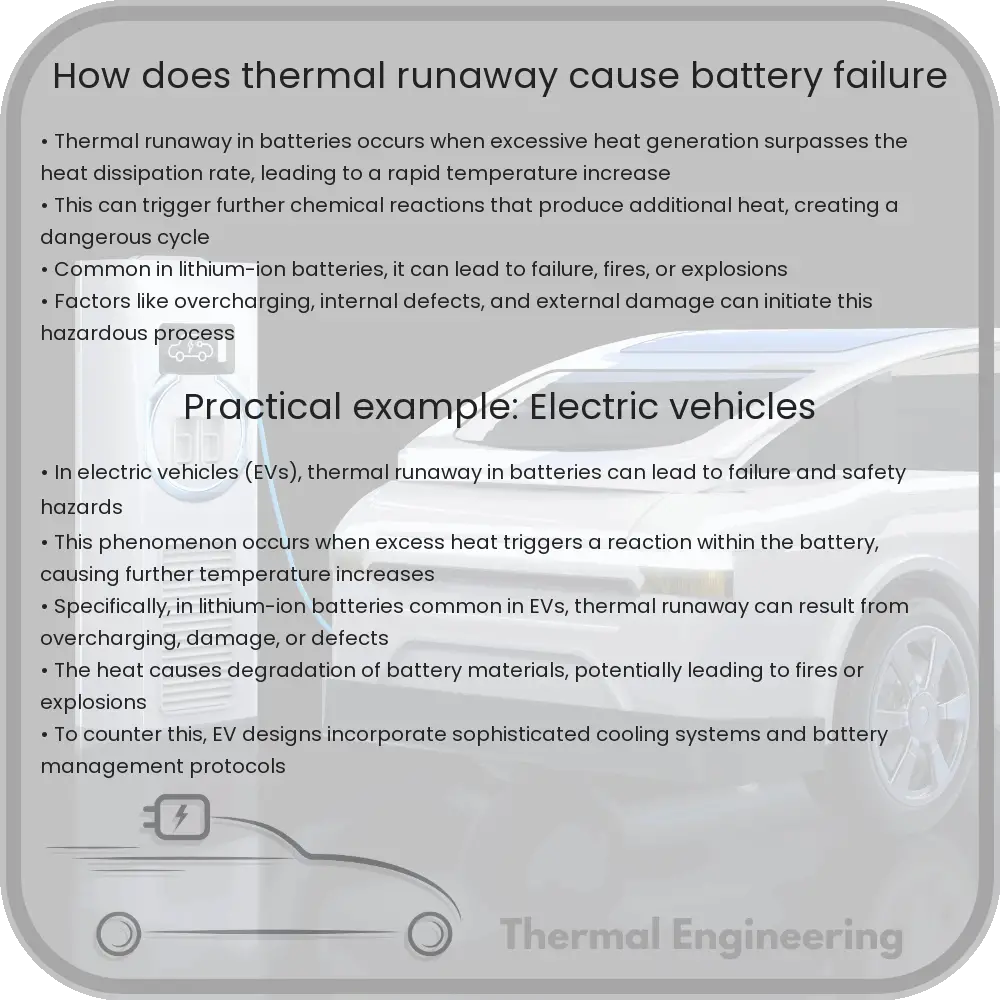
How does thermal runaway cause battery failure

Explore the causes, mechanisms, and prevention of thermal runaway in lithium-ion batteries, a critical safety concern in battery technology.
How does thermal runaway cause battery failure

Understanding Thermal Runaway and Battery Failure

Thermal runaway is a critical issue in the field of battery technology, particularly concerning rechargeable lithium-ion batteries. It is a self-sustaining chemical reaction that occurs within the battery, leading to overheating and often resulting in catastrophic battery failures such as fires or explosions. This phenomenon can jeopardize the safety of electronic devices, electric vehicles, and storage systems that employ these batteries. To understand thermal runaway, it’s essential to explore its causes, mechanisms, and preventive measures.

Causes of Thermal Runaway

Thermal runaway can be initiated by various factors, often related to design flaws, operational errors, or external influences:

  • Overcharging: Charging beyond the recommended voltage causes excessive heat and can lead to thermal runaway.
  • Physical Damage: Impacts, punctures, or crushes can compromise internal structures, creating internal short circuits that generate heat.
  • High Temperatures: External heat sources or operation in high-temperature environments can push the battery beyond its thermal limits.
  • Manufacturing Defects: Imperfections such as metal particles inside the battery can lead to short circuits within the cell.

Mechanism of Thermal Runaway

Thermal runaway in lithium-ion batteries involves three primary stages:

  1. Initiation: The process begins with an initial heat source which may be due to overcharging, mechanical damage, or an internal defect that causes a short circuit.
  2. Heat Generation: Once initiated, the heat causes the internal temperature and pressure of the battery to rise, leading to further degradation of the electrolyte and electrodes. This degradation releases more heat and may cause the release of gases.
  3. Self-propagation: If the heat is not dissipated quickly, the rising temperature leads to further chemical reactions and breakdowns, essentially allowing the reaction to propagate and accelerate, even if the initial source is removed.

The critical concern is that once thermal runaway starts, it is often impossible to stop, leading to the destruction of the battery and potentially causing fire.

Preventing Thermal Runaway

Preventing thermal runaway involves several strategies aimed at both design and operational levels:

  • Battery Management Systems (BMS): These systems monitor the state of charge, temperature, and health of the battery pack to prevent unsafe operations.
  • Temperature Regulation: Using cooling systems to ensure that batteries operate within safe temperature ranges.
  • Safe Battery Design: Developing batteries with robust structures and materials that can withstand physical stresses and thermal pressures.
  • Manufacturing Quality Control: Ensuring that batteries are free from defects such as metal particles or poorly aligned components which can cause short circuits.

Understanding thermal runaway in batteries is essential for engineering safer energy storage systems. With advancements in technology and improved safety standards, the risks associated with these powerful but volatile components can be mitigated.

Conclusion

Thermal runaway represents a significant safety risk in various applications of lithium-ion batteries. Through comprehensive understanding and rigorous safety protocols, engineers and researchers aim to curb the dangers associated with battery technologies. The future of battery safety lies in the continuous improvement of battery chemistries, designs, and protective technologies to prevent such failures effectively.
How does a thermal scope detect targets

Learn how thermal scopes use infrared radiation to detect targets in low-visibility conditions, explained through the basics of their operation and components.

How does a thermal scope detect targets

Understanding How a Thermal Scope Detects Targets

Thermal scopes are advanced devices used primarily in military, hunting, and surveillance applications to see through darkness, smoke, fog, and various other visual impairments. The science behind these innovative tools is rooted in thermography and the properties of infrared radiation. This article delves into the fundamental workings of thermal scopes and explains how they detect targets based on differences in temperature.

The Basics of Infrared Radiation

All objects emit infrared energy as heat, with the amount of radiation increasing with the temperature of the object. This form of energy is part of the electromagnetic spectrum, which lies just beyond the visible range of light detectable by the human eye. The key to a thermal scope’s functionality is its ability to detect and interpret this infrared radiation.

Core Components of a Thermal Scope

  • Infrared Sensor Detector: This is the heart of the thermal scope, responsible for capturing infrared radiation. The detector converts the energy into an electrical signal that creates a video image.
  • Optics: The scope uses special lenses made of materials like germanium, which are transparent to infrared radiation, allowing the IR waves to pass through and focus on the detector.
  • Display: After the IR radiation is converted into an electrical signal, it is processed and shown on the display, typically as different colors representing different temperatures.

How Thermal Scopes Detect Targets

Thermal scopes detect targets by capturing the contrast in infrared radiation (heat) emitted by different objects in the environment. When viewing through a thermal scope, warmer objects like warm-blooded animals or engine-operated vehicles appear distinctly against cooler backgrounds such as trees, water, or buildings. This contrast creates an image known as a thermogram, which is processed by the scope’s software to enhance the visibility of objects.

The process involves several steps:

  1. Infrared Radiation Capture: The thermal scope captures the infrared radiation from all objects in the scope’s field of view.
  2. Signal Conversion: The captured radiation is converted into electrical signals.
  3. Image Processing: Signals are processed to create a detailed image based on temperature differences. This image is mapped in different colors, where common palettes include black, white, and various colors where hotter areas appear brighter.
  4. Display Output: Finally, the processed image is displayed on the scope’s screen, allowing the user to see in conditions where normal vision would be impaired.

Applications and Limitations

Thermal scopes are incredible tools that can see through smoke, fog, and no-light conditions, which makes them invaluable for night-time hunting, security, firefighting, and military operations. However, they do have limitations. For instance, thermal scopes cannot see through glass as glass reflects infrared radiation instead of letting it pass through. Additionally, environmental conditions like rain or strong sunlight can affect the effectiveness and accuracy of thermal imaging.

By leveraging the principles of infrared radiation and modern technological advancements, thermal scopes provide a significant advantage in various fields by enabling visibility in low-visibility conditions. As technology advances, these devices are becoming more sophisticated, with better imaging capabilities and applications extending into areas like environmental monitoring and healthcare diagnostics.

Conclusion

Thermal scopes transform the invisible spectrum of infrared radiation into a visible form, allowing users to detect and monitor objects based on their thermal signatures. As we continue to expand our understanding and application of infrared technology, the potential uses for thermal imaging are vast, promising further advancements in both existing and emerging fields.

Temperature control in precision agriculture

Explore how temperature control in precision agriculture optimizes crop growth and sustainability through advanced technologies and data analytics.

Temperature control in precision agriculture

Understanding Temperature Control in Precision Agriculture

Precision agriculture represents a revolution in the ability to optimize resources such as water, fertilizers, and pesticides, enhancing productivity while reducing costs and environmental impacts. Among the various environmental factors influencing agricultural output, temperature is paramount. Effective temperature control can significantly bolster plant growth, health, and yields. This article delves into the mechanisms and technologies used in precision agriculture to manage and control temperature.

Why is Temperature Control Important in Agriculture?

Temperature affects plant biochemical processes, and thus, influences germination, growth rates, photosynthesis, and also the resistance to pests and diseases. Each species of plant has a specific temperature range that optimizes these processes and any deviation can reduce efficiency, affecting crop yield and quality.

Technologies Used for Temperature Control

  • Automated Environmental Control Systems: These systems use sensors combined with climate control technologies to maintain optimal growth conditions. Commonly found in greenhouses, these systems monitor the internal temperature and adjust heating or cooling accordingly.
  • Thermal Screens: Used in greenhouse operations, thermal screens can reflect sunlight to reduce heat during the day and retain heat during cooler nights. They are effective in creating a stable growing environment that is less influenced by external temperature fluctuations.
  • Soil Temperature Regulation: Techniques such as using mulches can modify soil temperature, encouraging seedling growth and reducing temperature fluctuation that might stress the plant.
  • Drip Irrigation Systems: While primarily used for water delivery, these systems can be adapted to impact soil temperature. For instance, delivering cooler water can help mitigate the overheating of plant roots on hot days.

The Role of Data and Predictive Modeling

In precision agriculture, the collection of data via sensors for temperature, humidity, soil conditions, and other environmental factors is crucial. Advanced algorithms and data analytics are then used to predict and automate adjustments in real time. For example, predictive models can forecast spikes in temperature and adjust greenhouse climate controls preemptively or suggest the optimal time for watering to avoid thermal stress in plants.

Case Studies and Results

  1. Greenhouse Automation: A study showed that implementing an automated climate control system in a commercial greenhouse enhanced tomato yield by up to 20%, primarily due to maintaining ideal temperature and humidity levels.
  2. Soil Temperature Management: Research indicates that the use of organic mulches can increase the average soil temperature, which is beneficial for crops like strawberries, thereby extending their growing season and improving yield quality.

Future Trends in Temperature Control in Agriculture

Advancements in IoT (Internet of Things) technologies and AI (Artificial Intelligence) are expected to drive further innovations in temperature control. Sensors are becoming more sophisticated and less invasive, while AI enables more accurate predictions and efficient resource allocation. The integration of these technologies promises enhanced automation in temperature management, leading to greater productivity and sustainability in agriculture.

In conclusion, precise temperature control is integral to the success of modern agriculture, especially in controlled environments like greenhouses. Through the use of advanced technologies and data-driven approaches, farmers can significantly improve the quality and quantity of their produce, paving the way towards more sustainable and efficient farming practices.

How does thermal neutron capture work in reactors

Thermal neutron capture is a nuclear reaction where a thermal neutron is absorbed by a nucleus, affecting nuclear reactor efficiency and safety.

How does thermal neutron capture work in reactors

Understanding Thermal Neutron Capture in Nuclear Reactors

Thermal neutron capture is a critical process in the operation of nuclear reactors, particularly in those that use thermal neutrons to sustain a chain reaction. This fundamental phenomenon affects both the efficiency and safety of nuclear energy production. In this article, we’ll explore what thermal neutron capture is, how it works, and its role in nuclear reactors.

What are Thermal Neutrons?

Neutrons, a type of subatomic particle, play a crucial role in the process of nuclear fission. Neutrons come in different energy categories: fast, thermal, and cold. Thermal neutrons are those which have been slowed down (or moderated) to reach thermal equilibrium with their environment. This usually occurs at a temperature around room temperature, giving them an average kinetic energy of about 0.025 electron volts (eV).

The Process of Thermal Neutron Capture

Thermal neutron capture is a type of nuclear reaction in which a thermal neutron is absorbed by a nucleus, leading to a compound nucleus that is in an excited state. The general reaction can be expressed as:

N(Z, A) + n → [N(Z, A+1)*]

Here, n represents a neutron, and N(Z, A) represents a nucleus with atomic number Z and mass number A. The product, [N(Z, A+1)*], is the excited compound nucleus.

Once absorbed, the compound nucleus usually de-excites by emitting gamma rays, or in some cases, other particles or radiations. This de-excitation can be represented by:

[N(Z, A+1)*] → N(Z, A+1) + γ

where γ denotes gamma radiation.

Significance in Nuclear Reactors

In thermal reactors, the ability to capture neutrons effectively is essential for maintaining a controlled nuclear chain reaction. Materials capable of moderating neutrons, like water, graphite, or heavy water, slow down fast neutrons to thermal energies, which significantly increases the probability of neutron capture by fissile nuclei such as uranium-235 or plutonium-239.

During operation, it’s crucial that enough neutrons are captured by fissile material to sustain the chain reaction (called achieving criticality). However, certain materials within the reactor core, known as neutron poisons, can absorb these neutrons without fissioning, thus removing them from the chain reaction and decreasing the reactor’s efficiency.

Thermal Neutron Capture Cross Section

The likelihood of neutron capture is quantified by the thermal neutron capture cross section, expressed in units called barns (where 1 barn = 10-28 m2). Different materials have different capture cross sections, influencing their selection in reactor design. For instance, Boron has a high absorption cross section, making it an effective neutron absorber for control rods in reactors.

Applications Beyond Energy Generation

Aside from its vital role in energy generation, thermal neutron capture is also employed in various other applications such as neutron capture therapy for cancer treatment, and in the analysis of materials using neutron activation analysis.

Understanding thermal neutron capture not only provides insights into the functioning of nuclear reactors, but also opens avenues for other beneficial technologies, enhancing both energy sustainability and medical advancements.

In conclusion, thermal neutron capture is a foundational concept in nuclear physics with profound implications for both theoretical research and practical applications in energy production and beyond.

How does thermal pollution affect water bodies

Learn about thermal pollution, its sources, effects on aquatic environments, and strategies to mitigate its impact.

How does thermal pollution affect water bodies

Understanding Thermal Pollution and Its Impact on Water Bodies

Thermal pollution occurs when an industry or other human activities increase the temperature of a water body, which can lead to significant changes in aquatic environments. This change often has detrimental effects on the ecosystems within these water bodies. Exploring the sources, effects, and potential solutions to thermal pollution can help us understand and mitigate its impact.

Sources of Thermal Pollution

Thermal pollution primarily originates from industrial processes that use water as a cooling agent. Major contributors include:

  • Power plants
  • Manufacturing factories
  • Refineries

These facilities often discharge heated water back into rivers, lakes, or oceans, which disrupts the local thermal balance.

Effects of Thermal Pollution

  1. Ecosystem Disruption: Sudden changes in temperature can affect aquatic life drastically. Fish and other organisms adapted to certain thermal conditions may not survive sudden shifts.
  2. Decreased Oxygen Levels: Warmer water holds less dissolved oxygen than cooler water. Consequently, elevated temperatures can lead to hypoxic conditions, endangering aquatic life that depends on oxygen.
  3. Algal Blooms: Increased water temperatures can accelerate the growth of algae. Excessive algal growth, or blooms, can block light to deeper waters and deplete oxygen, harming fish and other aquatic organisms.

Potential Solutions to Mitigate Thermal Pollution

To reduce the effects of thermal pollution, various strategies can be employed:

  • Cooling Ponds and Towers: Industries can use cooling ponds or towers to dissipate heat from their discharge before it enters a natural water body. This gradual cooling helps to minimize the impact on the receiving waters.
  • Heat Exchangers: Implementing advanced heat exchange techniques can significantly reduce the temperature of industrial discharge.
  • Regulatory Measures: Governments and environmental authorities can enforce stricter regulations on thermal emissions, ensuring industries comply with discharge water temperature standards.

Conclusion

Thermal pollution is a significant environmental issue that arises mainly from industrial activities. The increase in temperature can disrupt aquatic ecosystems, leading to reduced oxygen levels and harmful algal blooms. By understanding its sources and implementing effective mitigation strategies, such as the use of cooling technologies and stricter regulatory frameworks, we can help protect our water bodies from the adverse effects of thermal pollution.

Addressing thermal pollution effectively not only supports aquatic life but also helps maintain the overall health of our planet’s diverse ecosystems, contributing to sustainable environmental practices.

How does a thermal profiler optimize soldering

Learn how thermal profilers optimize soldering in electronics by controlling temperature to enhance product quality and efficiency.

How does a thermal profiler optimize soldering

Understanding Thermal Profilers in Soldering Processes

Thermal profiling is a crucial aspect of the soldering process in electronic manufacturing, ensuring that products are consistently of high quality. A thermal profiler is a device used to monitor and control the temperature profiles throughout the soldering process. Its optimization of the soldering process protects delicate components and enhances the integrity of the solder joints.

What is a Thermal Profiler?

A thermal profiler measures temperatures at various points on a printed circuit board (PCB) as it goes through the soldering process. Commonly, this device comes with multiple temperature sensors (thermocouples) that are temporarily attached to critical points on the PCB. The data collected is used to create a temperature profile, which can be visualized, analyzed, and compared against predefined optimal profiles.

Optimal Temperature Profiling

To optimize soldering, the thermal profiler manages the rate of heating, peak temperature, and cooling rate, which are three critical factors:

  • Heating Rate: It is important that the PCB components are not subjected to a rapid thermal rise, which can cause thermal shock and damage. The profiler ensures the heating rate is gradual and controlled.
  • Peak Temperature: Thermal profilers help maintain a peak temperature high enough to effectively melt the solder without overheating the components, which can degrade their performance or lead to failures. This temperature must be maintained uniformly across the PCB.
  • Cooling Rate: Controlled cooling is equally important to prevent the formation of poor-quality solder joints. Rapid cooling can cause brittleness, while too slow can lead to unwanted crystal growth in solder.

Benefits of Using Thermal Profilers

Accuracy and repeatability are the key benefits of using thermal profilers in soldering. By ensuring that the temperature profile stays within specified limits, these devices help achieve the following:

  • Improved Solder Joint Quality: Optimal temperature profiles lead to better wetting and a stronger intermetallic connection, which significantly enhances solder joint integrity.
  • Reduced Defect Rates: By monitoring the temperature accurately, thermal profilers help reduce the occurrence of defects such as cold solder joints and thermal damage to components.
  • Enhanced Manufacturing Efficiency: Consistent application of the ideal temperature profiles increases the throughput and reduces waste, contributing to more efficient production processes.
  • Documentation and Compliance: Thermal profiling generates essential data needed for quality assurance, process troubleshooting, and compliance with industry standards.

How Companies Implement Thermal Profiling

Implementation starts with identifying the critical components and areas on the PCB requiring monitoring. Thermocouples are placed on these locations, and the PCB is sent through the soldering process. From preheating to reflow, and cooling, the thermal profiler records the temperature data. This data is then analyzed, using specialized software, to ensure alignment with the ideal thermal profile or to identify needs for adjustments in the soldering process.

In conclusion, by offering precise control and monitoring of the temperature, thermal profilers play a critical role in optimizing the soldering process, leading to better product quality and increased operational efficiencies in electronic manufacturing. These systems form an integral part of modern electronic production ensuring reliability and compliance in an increasingly complex and demanding industry.

How does thermal efficiency impact power plants

Learn about thermal efficiency in power plants, its calculation, factors affecting it, and its impact on operations and the environment.

How does thermal efficiency impact power plants

Understanding Thermal Efficiency in Power Plants

Thermal efficiency is a critical measure in the assessment and operation of power plants. It essentially determines how well a power plant converts the heat energy from its fuel source into electrical energy. This efficiency impacts not only the operational cost of the power plant but also its environmental footprint and sustainability. Learning about thermal efficiency helps us understand how modern power plants are designed to optimize energy conversion and reduce wastage.

What is Thermal Efficiency?

Thermal efficiency, in the context of a power plant, is defined as the ratio of the output electrical power to the input energy from the fuel. It is expressed as a percentage and calculated using the formula:

Thermal Efficiency (%) = (Output Energy / Input Energy) * 100

The input energy typically comes from the combustion of fossil fuels like coal, natural gas, or oil, although other forms of energy such as nuclear, solar thermal, or geothermal heat can also be used. The output energy is the electrical power generated and delivered to the grid.

Factors Affecting Thermal Efficiency in Power Plants

  • Type of Fuel: Different fuels have varying energy contents per unit mass. For instance, natural gas tends to have a higher thermal efficiency compared to coal.
  • Technology Used: Advanced technologies in turbines, boilers, and heat recovery systems can significantly improve a plant’s thermal efficiency. For example, combined cycle plants where both gas and steam turbines are used can achieve efficiencies above 60%.
  • Temperature and Pressure: Higher temperatures and pressures at which turbines operate generally improve the efficiency of the cycle. This is governed by the thermodynamic principles where higher thermal gradients allow for better heat conversion capabilities.
  • Plant Age and Maintenance: Older plants tend to be less efficient due to wear and tear and outdated technology. Regular maintenance can help sustain efficiency levels but may not be enough to compete with newer, more efficient technologies.

Impact of Thermal Efficiency on Power Plant Operations

The thermal efficiency of a power plant has a direct impact on its operational costs and environmental implications:

  1. Reduced Fuel Consumption: Higher efficiency means that less fuel is required to produce the same amount of electricity, leading to cost savings in fuel procurement.
  2. Lower Emissions: Efficient fuel use also translates to fewer emissions per unit of electricity generated, thus reducing the plant’s environmental impact, particularly concerning greenhouse gases like CO2.
  3. Economic Performance: As fuel costs constitute a significant portion of the operational expenses in power plants, higher efficiency can also mean better competitiveness in the power market with potentially lower electricity prices for consumers.

Conclusion

Thermal efficiency is a vital aspect of power plant design and operation. With the growing emphasis on reducing carbon footprints and operational costs, the drive towards more efficient energy production methods is becoming more prevalent. Power plants with high thermal efficiency not only benefit economically by using their primary fuel more effectively but also play a crucial role in environmental conservation by emitting fewer pollutants per unit of power generated. The ongoing research and development in technologies like supercritical and ultra-supercritical boilers, and improvements in turbine materials and design, continue to push the boundaries of what is achievable in thermal power production.

How does a thermal inkjet printer create images

Learn how thermal inkjet printers use advanced thermodynamics and digital technology to efficiently produce high-quality images and text.

How does a thermal inkjet printer create images

Understanding How Thermal Inkjet Printers Create Images

Thermal inkjet printers represent a marvel of modern engineering, blending the principles of thermodynamics, fluid mechanics, and digital technology to produce images and text. Commonly used both in homes and offices, these printers are lauded for their ability to efficiently and precisely generate high-quality printed materials.

Basic Operation of a Thermal Inkjet Printer

At the core of a thermal inkjet printer’s operation is the inkjet technology, which employs numerous microscopic nozzles to spray ink onto paper. Here’s how it works:

  • Ink Cartridges: The printer uses cartridges filled with liquid ink, commonly composed of colorant, solvent, and other chemicals that ensure smooth flow and quick drying.
  • Thermal Firing Chamber: Each nozzle in the print head is equipped with a tiny heating element. The process begins when a digital image or text is sent to the printer, which translates this digital data into instructions about which nozzles to activate.

The Printing Process

The actual printing process can be described in a series of steps:

  1. Digital Data Reception: The printer receives digital data from the computer, which instructs which colors to print and at which locations on the page.
  2. Ink Ejection: To eject ink, the printer passes current through the miniature heating elements located in the nozzles, causing a rapid vaporization of the ink nearby and forming a bubble.
  3. Bubble Expansion: As the temperature rises to approximately 300-400°C, the ink bubble expands forcefully. This expansion pushes a droplet of ink out of the nozzle.
  4. Ink Placement on Paper: The expelled ink droplet lands on the paper, creating a tiny dot. The precise arrangement of these dots forms images or text.
  5. Bubble Collapse: Almost immediately after the droplet is ejected, the bubble collapses. This collapse draws more ink into the firing chamber from the cartridge to prepare for the next firing cycle.

Each nozzle can fire hundreds of times per second, allowing images and texts to be printed swiftly and efficiently.

Advantages of Thermal Inkjet Printing

  • High Resolution: The ability of the printer to control the size and placement of ink droplets leads to images with high resolution and sharp borders.
  • Speed: Thermal inkjet printers can produce prints faster than many other types of printers because the process of heating and ejecting the ink is incredibly quick.
  • Cost-Effectiveness: These printers generally have lower maintenance costs and use less expensive inks.
  • Quiet Operation: Unlike impact printers that strike the paper, inkjet printers use non-contact methods which make them relatively quiet.
  • Quality: Advanced color mixing technologies allow for excellent color reproduction and image quality.

In conclusion, the thermal inkjet printer exemplifies a successful application of heating technology in microscale to achieve precise and efficient printing. Through a sophisticated integration of heat mechanics and digital control, these printers manage to transform digital visuals into tangible prints, quickly and effectively.

How does thermal inversion layer affect pollution

Learn about thermal inversion, a meteorological event that reverses temperature patterns and exacerbates air pollution in urban areas.

How does thermal inversion layer affect pollution

Understanding Thermal Inversion and Its Impact on Pollution

Thermal inversion is a meteorological phenomenon that plays a significant role in how air pollution is distributed in the atmosphere. Commonly, air temperature decreases with altitude, but during a thermal inversion, this pattern reverses and the temperature increases with altitude over a specific layer. This phenomenon can have a profound impact on air quality and pollution levels, especially in urban areas.

What Causes Thermal Inversion?

Thermal inversions typically occur due to one of the following reasons:

  • Radiational cooling: On clear nights, the earth’s surface cools rapidly by radiating heat away. The air close to the surface cools down more quickly than the air above it, leading to an inversion.
  • Subsidence: Large-scale downward movement of air, especially in high-pressure weather systems, can warm the air by compression as it descends, causing an inversion layer.
  • Frontal inversion: When a cold air mass is undercut by a warm air mass, it can also lead to an inversion.
  • Oralgraphic and coastal effects: Cool air from higher elevations or coastal areas can underlie warmer air, creating an inversion.

These causes lead to a situation where a layer of warmer air sits above cooler air. As cooler air is denser than warmer air, it becomes trapped near the ground.

Effects of Thermal Inversion on Pollution

During a thermal inversion, the layer of warm air above acts like a lid, trapping pollutants near the ground rather than allowing them to disperse upwards. The effects can be compounded in urban environments where industrial activity, vehicles, and other sources generate significant amounts of pollutants. Here’s how it impacts urban air quality:

  • Increased concentration of pollutants: Pollutants such as carbon monoxide, sulfur dioxide, nitrogen oxides, and particulate matter become trapped close to the ground, increasing their concentration and exacerbating their health effects.
  • Reduced visibility: The accumulation of pollutants can lead to smog formation, which severely reduces visibility and can disrupt transportation and daily activities.
  • Health issues: High concentrations of pollutants can lead to respiratory problems, heart disease, and other health issues, particularly in vulnerable populations such as children, the elderly, and those with pre-existing health conditions.

Managing the Effects of Thermal Inversions

Managing and mitigating the effects of thermal inversions requires strategic planning and policies. Some common approaches include:

  • Regulating emissions: Imposing stricter regulations on industrial emissions and vehicle exhausts during inversion periods can help reduce the amount of pollutants released into the atmosphere.
  • Public alerts: Informing the public about inversion periods and advising on reduced outdoor activity can help minimize health impacts.
  • Encouraging public transport: Reducing the number of vehicles on the road can decrease the total emissions during critical periods.
  • Innovative urban planning: Designing cities in a way that enhances air circulation, such as creating green belts or open spaces, can help alleviate the effects of inversions.

In conclusion, thermal inversions are an important meteorological phenomenon that significantly affects pollution levels, particularly in urban areas. Understanding its causes and implementing effective countermeasures is essential for protecting public health and improving air quality.

Thermal management in smart textiles

Explore the innovative integration of thermal management within smart textiles, emphasizing its principles, methods, and diverse applications for enhanced comfort and functionality.

Thermal management in smart textiles

Understanding Thermal Management in Smart Textiles

Smart textiles represent a fascinating fusion of fabric with technology, where textiles gain the ability to interact with their environment. One of the key areas of innovation within smart textiles is thermal management—a critical aspect for enhancing user comfort and functionality. This article explores the principles of thermal management in smart textiles, how it is achieved, and its applications.

Principles of Thermal Management

Thermal management in textiles primarily focuses on regulating the temperature between the human body and the textile environment. This involves either heat retention or heat dissipation to maintain an optimal temperature range. The efficiency of these processes depends critically on the thermal conductivity and thermal resistance of the materials used.

  • Thermal Conductivity: Determines how well a material can conduct heat. Materials with high thermal conductivity are used in applications where heat needs to be drawn away from the body.
  • Thermal Resistance: Opposes the flow of heat. Textiles with high thermal resistance are used to retain warmth and are suitable for colder environments.

Methods of Thermal Management

Smart textiles employ various methods to manage thermal properties. These methods can be broadly classified into two types: active and passive thermal management systems.

  1. Active Thermal Management: Involves the use of external energy sources to control the temperature. This might include integrated heating elements, phase change materials (PCMs), or thermoelectric devices that can either heat or cool the fabric.
  2. Passive Thermal Management: Relies on the material properties themselves to regulate heat. Examples include using breathable fabrics that enhance natural ventilation, moisture management techniques, or special weaves and knits that trap air and provide insulation.

Applications of Thermal Management in Smart Textiles

The applications of thermal management in smart textiles are vast and varied, covering everything from consumer comfort to specialized industrial needs:

  • Sports and Fitness: Wearables that adjust temperature to enhance athletic performance and comfort.
  • Medical Textiles: Patient wear that helps in maintaining the optimal body temperature for recovery or thermal blankets used in emergency services.
  • Military Uniforms: Uniforms equipped with temperature regulation capabilities to maintain performance in diverse climates.
  • Automotive Seating: Seats that can adjust their temperature autonomously, enhancing comfort for passengers during different weather conditions.
  • Smart Home Textiles: Beddings and upholstery that adapt their thermal properties to improve comfort and energy efficiency.

Future Trends and Challenges

While smart textiles continue to advance, there are several challenges and future opportunities in thermal management:

  • Energy Efficiency: Developing more efficient energy sources and storage mechanisms within textiles to sustain thermal adjustments over longer periods.
  • Sustainability: Using more sustainable materials and processes in the manufacture of thermally managed textiles to reduce environmental impacts.
  • Integration of Sensors: Combining thermal management with other smart functions, like health monitoring, for a holistic smart textile solution.

In conclusion, thermal management in smart textiles is a dynamic field that blends material science, textile engineering, and thermodynamics to develop fabrics that not only provide greater comfort and utility but also open up new avenues for health and industry-specific applications. As technology progresses, the potential for innovation in this area expands, making it an exciting frontier in both research and real-world applications.