Facebook Instagram Youtube Twitter

How does thermal acclimatization affect the body

Learn about thermal acclimatization, the body’s adjustments to maintain stability in changing temperatures for survival and comfort.
How does thermal acclimatization affect the body

Understanding Thermal Acclimatization

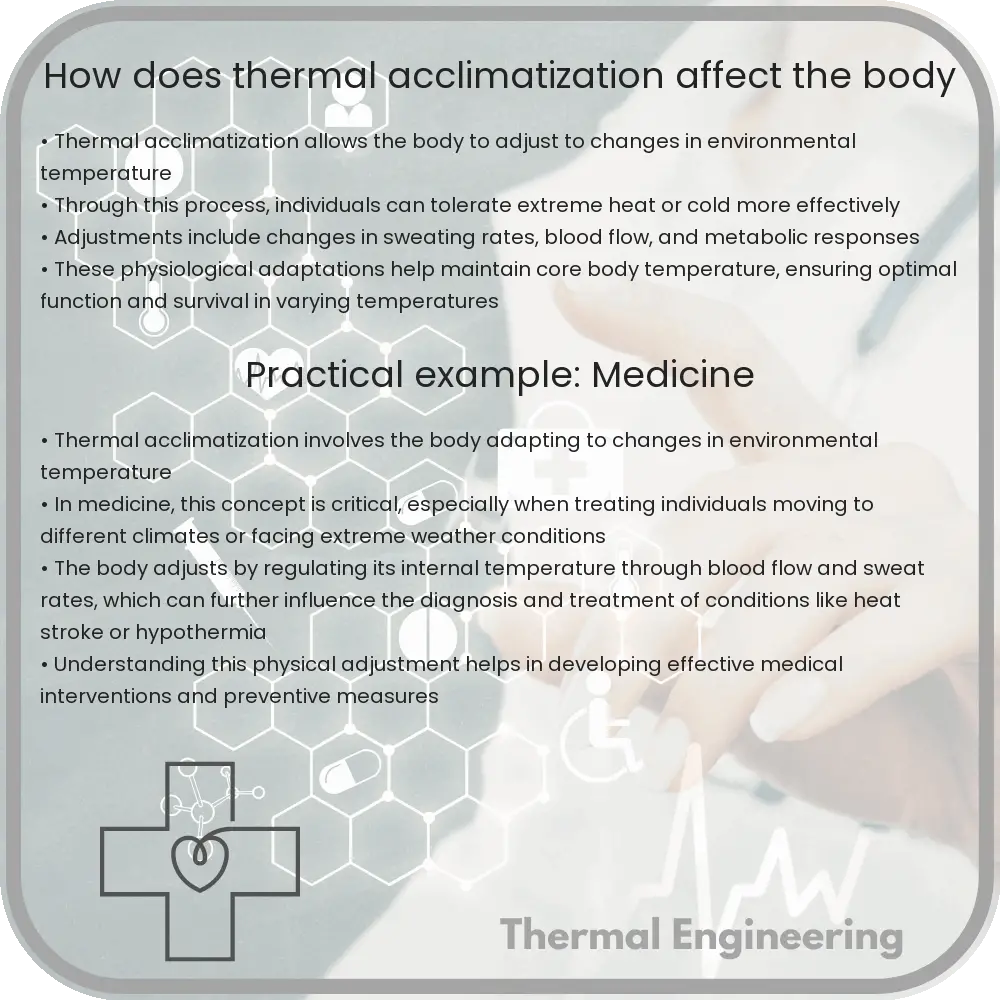
Thermal acclimatization is the physiological and behavioral adjustments our bodies make in response to changes in the surrounding temperature. These adaptations allow humans to maintain homeostasis—steady internal conditions—despite external temperature fluctuations. This capability is crucial for survival and comfort in varying climates and temperatures.

How it Works

Thermal acclimatization can occur in both directions: adapting to colder and warmer environments. The process involves changes in our cardiovascular system, sweating mechanisms, and cellular metabolism which occur over days to weeks.

  • Acclimatization to Heat: When exposed to high temperatures, the body gradually increases its ability to dissipate heat. Changes include increased sweat rate, decreased salt concentration in sweat, increased blood plasma volume, and earlier onset of sweating. These adjustments help in lowering the body’s core temperature despite the heat.
  • Acclimatization to Cold: In cold environments, the body improves its capacity to generate and retain heat. Behavioral adaptations like seeking shelter or wearing warmer clothes are combined with physiological changes such as improved basal metabolic rate, better peripheral vasoconstriction (narrowing of blood vessels on the body surface to reduce heat loss), and sometimes, enhanced capability to shiver.

Physiological Changes During Acclimatization

During the acclimatization process, specific physiological changes are notable:

  1. Vascular Adjustments: Changes in blood flow patterns help regulate body temperature. In heat, blood flow to the skin increases, enhancing heat dissipation. In cold, constriction of surface blood vessels reduces heat loss.
  2. Metabolic Responses: Metabolism may increase in cold conditions, generating more heat. Conversely, metabolism might decrease in hot conditions to reduce internal heat production.
  3. Hormonal Fluctuations: Hormones like thyroid hormones can play roles in adjusting metabolism rates according to the need for more or less heat production.
  4. Adaptations in Muscle Function: Enhancements in muscle efficiency can occur, allowing better endurance in the heat and more intense shivering in the cold.

Benefits of Thermal Acclimatization

The benefits of acclimatizing to different temperature environments are significant:

  • Improved Physical Performance: Acclimatization leads to better endurance and performance, particularly notable in athletes who compete or train under extreme weather conditions.
  • Health Protection: Proper acclimatization reduces the risk of heat strokes, hypothermia, and other temperature-related health issues.
  • Comfort and Work Efficiency: Being acclimatized can make daily activities more comfortable and productive, especially in extreme climates.

Conclusion

Thermal acclimatization is a fascinating example of the human body’s ability to adapt to environmental challenges. By understanding and supporting these natural processes, we can improve our comfort, performance, and safety in diverse temperatures. This adaptation not only highlights the resilience of the human body but also underscores the importance of preparing for and respecting our environmental conditions.
How do thermal cyclers perform PCR

Learn about thermal cyclers, vital devices for automating PCR by precisely controlling temperature changes to amplify DNA, essential in genetics and diagnostics.

How do thermal cyclers perform PCR

Understanding the Role of Thermal Cyclers in Performing PCR

Polymerase Chain Reaction (PCR) is a pivotal technique in molecular biology that amplifies a specific segment of DNA, making millions of copies from a tiny sample. This process is crucial in genetic research, forensics, and medical diagnostics. Central to this method is a device known as a thermal cycler, which automates the temperature changes required during the PCR process.

Components and Functionality of a Thermal Cycler

A thermal cycler, also referred to as a PCR machine, primarily consists of a thermal block that can hold a number of tubes containing PCR mixtures, and a heating and cooling system that changes the temperature of the block according to the needs of the PCR protocol. Here’s how the thermal cycler functions through the main stages of PCR:

  1. Denaturation: During this initial stage, the thermal cycler heats the block to a high temperature (commonly around 94°C – 98°C). This heat causes the double-stranded DNA molecule to denature, or separate into two single strands, which prepares it for the next phase.
  2. Annealing: Following denaturation, the machine cools the block to a lower temperature (usually between 50°C to 65°C), allowing primers—short sequences of nucleotides that provide a starting point for DNA synthesis—to attach to the single-stranded DNA templates.
  3. Extension: The thermal cycler then raises the temperature again (typically to about 72°C) to activate the Taq polymerase enzyme, which starts synthesizing new DNA strands from the primers by adding nucleotides that are complementary to the template strands.

This cycle of temperature changes is repeated typically 25 to 35 times to amplify the target DNA sequence exponentially. Each cycle doubles the amount of DNA starting from the original template, theoretically doubling the DNA at every cycle if the efficiency is perfect.

Key Features of Thermal Cyclers

  • Temperature Uniformity and Accuracy: To ensure the PCR runs effectively, the thermal cycler must maintain a uniform and precise temperature across the thermal block. This is crucial because even slight temperature variations can affect the efficiency and specificity of the PCR.
  • Speed of Temperature Change: Rapid changes in temperature increase the throughput and decrease the total time required to complete PCR cycles. Modern thermal cyclers can change temperatures very quickly, thus reducing the overall duration of the PCR process.
  • Programmable and User-friendly Interface: Thermal cyclers come with digital controls that allow scientists to program temperature profiles and the number of cycles. This automation makes the PCR process highly reproducible and less prone to human error.
  • Heated Lid: To prevent condensation of the samples during high-temperature cycles, most thermal cyclers feature a heated lid. This lid prevents the formation of droplets on the top of the reaction tubes, which could otherwise lead to variations in reaction volumes and concentrations.

The Impact of Thermal Cyclers in Science and Medicine

The development of thermal cyclers has vastly improved the efficiency and accessibility of PCR. By automating the precise temperature changes required during the PCR, these machines have enabled widespread use of this method in various fields. From identifying genetic disorders and paternity testing to detecting pathogens and studying genetic sequences, the thermal cycler’s role in PCR is indispensable.

In conclusion, thermal cyclers have simplified the once time-consuming steps of PCR, bringing precision and reproducibility to molecular biology laboratories around the world. Their continuous evolution promises even greater enhancements in DNA analysis and molecular diagnostics.

How does a thermal airship stay buoyant

Learn how thermal airships utilize thermodynamics and buoyancy principles to float in the air by heating air inside their envelopes.

How does a thermal airship stay buoyant

Understanding the Buoyancy of Thermal Airships

Thermal airships, also known as hot air airships, are lighter-than-air (LTA) aircraft that stay aloft by using heated air. The principle behind their operation is quite intuitive once you understand the basic physics of buoyancy and temperature’s effect on gases. Here, we’ll dissect how these fascinating machines use the principles of thermodynamics and buoyancy to gracefully float through the air.

Principles of Buoyancy

The key to understanding how any airship stays buoyant lies in the principle of buoyancy, which can be described by the Archimedes’ principle. This principle states that any object, wholly or partly immersed in a fluid, is buoyed up by a force equal to the weight of the fluid displaced by the object. For airships, the “fluid” is the air in the atmosphere.

Temperature and Density Relationship

Air density plays a crucial role in the operation of thermal airships. The density of air (or any gas) is inversely proportional to its temperature, which can be expressed through the ideal gas law:

\[ P*V = n*R*T \]

Where:

  • P is the pressure,
  • V is the volume,
  • n is the number of moles of gas,
  • R is the ideal gas constant, and
  • T is the temperature (in Kelvin).

As the air inside the airship is heated, its volume remains constant but its temperature increases, thereby decreasing its density. Since the cooler, denser air surrounds the airship, the heated, less dense air inside creates a buoyant force.

Calculating Buoyancy

The buoyant force (FB) can be calculated with the equation:

\[ F_B = (\rho_{air} – \rho_{heated}) * V * g \]

Where:

  • \(\rho_{air}\) is the density of the surrounding cooler air,
  • \(\rho_{heated}\) is the density of the heated air inside the airship,
  • V is the volume of the displaced air, and
  • g is the acceleration due to gravity.

Essentially, the airship will rise if the buoyant force is greater than the gravitational force acting on the airship, and it will descend if the buoyant force is less.

Real-world Application

Thermal airships typically use a burner to heat the air inside the envelope, the large bag-like structure commonly made of nylon or polyester. By varying the heat output from the burner, pilots can control the ascent or descent of the airship.

Understanding these concepts not only elucidates how thermal airships function but also illustrates a practical application of the laws of thermodynamics and fluid mechanics. This convergence of physics and engineering not only enables the enchanting flights of these airships but also paves the way for advancements in other types of aerial technologies.

Whether used for advertising, aerial surveillance, or recreation, thermal airships provide a clear example of engineering principles brought to life, harnessing the simple yet powerful science of buoyancy.

How do thermal insulating paints reduce heat loss

Learn how thermal insulating paints limit heat loss by reflecting radiative heat and lowering thermal conductivity.

How do thermal insulating paints reduce heat loss

Understanding How Thermal Insulating Paints Reduce Heat Loss

One innovative approach to increasing energy efficiency in buildings is the use of thermal insulating paints. These paints are designed to reduce heat loss from a building’s envelope, contributing to lower heating costs and improved indoor comfort. But how exactly do these paints work? Let’s explore the science behind thermal insulating paints and their effectiveness in insulation.

The Science Behind Thermal Insulating Paints

Thermal insulating paints, also known as insulating or thermal barrier paints, contain tiny insulating materials that reflect and dissipate heat. The primary mechanism they use to prevent heat transfer is by reflecting radiative heat back to its source, thereby reducing the amount of heat that penetrates through the surface of the painted area.

The key ingredients in these paints are hollow ceramic microspheres or microbeads made from materials such as glass or ceramic. These microspheres are small enough (ranging from micrometers to nanometers in diameter) to be mixed into paint without affecting its application or texture. When applied, these microspheres create a layer filled with tiny air pockets throughout the painted surface, enhancing the paint’s insulating properties.

How Thermal Insulating Paints Work

Thermal insulating paints operate through the following mechanisms:

  • Reflection: The microspheres have reflective properties that bounce back infrared radiation (heat), which typically would be absorbed by the building. This reflection reduces the amount of heat entering during warm conditions and retains more heat within during colder conditions.
  • Low Thermal Conductivity: Air is a poor conductor of heat, and because the microspheres are hollow, they trap air inside them. This trapped air significantly reduces the overall thermal conductivity of the paint, hindering heat transfer through the painted surface.

Effectiveness and Applications

While thermal insulating paints can help in reducing heat transfer, it’s important to note that their effectiveness is generally less compared to traditional insulation methods like foam boards or fiber insulation. However, they are particularly useful in situations where conventional insulation is not feasible due to space constraints or in cases where an additional minor reduction in heat transfer is desired without significant renovations.

Common applications of thermal insulating paints include:

  • Exterior walls to reflect sunlight and reduce cooling loads.
  • Roofs to prevent heat from entering the building during hot weather.
  • Pipes and heat exchangers to minimize heat loss in industrial settings.

In conclusion, thermal insulating paints offer a novel and practical way to enhance the thermal efficiency of building envelopes and other structures. By reflecting heat and reducing thermal conductivity, these paints serve as a supplemental solution for energy conservation, especially in scenarios where traditional insulation methods are impractical or insufficient.

How does a thermoelectric wine cooler work

Learn how thermoelectric wine coolers use the Peltier effect for eco-friendly, quiet wine storage.

How does a thermoelectric wine cooler work

Understanding How a Thermoelectric Wine Cooler Works

Thermoelectric wine coolers offer an innovative and efficient way to store wine at optimal temperatures. Unlike traditional refrigeration methods that utilize compressors and refrigerant gases, thermoelectric coolers rely on the Peltier effect to maintain the desired temperature. This article explores the basics of how thermoelectric wine coolers function.

The Peltier Effect

The Peltier effect is the key principle behind thermoelectric cooling. Named after Jean Charles Athanase Peltier, who discovered it in 1834, this phenomenon occurs when electric current is passed through two dissimilar conductors. The junction of these conductors absorbs heat from one side and releases it on the other, thereby creating a cooling effect where heat is absorbed.

Components of a Thermoelectric Wine Cooler

  • Thermoelectric Module: This is the heart of the cooler and consists of many pairs of p-type and n-type semiconductor materials sandwiched between ceramic plates. When DC current flows through this module, one ceramic plate heats up while the other cools down.
  • Heat Sink: Attached to the hot side of the thermoelectric module, the heat sink dissipates the heat absorbed from the cool side into the surrounding environment, maintaining the cool temperature inside the cooler.
  • Fans: Fans help in dispersing the heat away from the heat sink more efficiently, ensuring that the thermoelectric module operates effectively.
  • Temperature Controller: This component allows users to set and maintain the desired temperature inside the cooler. It adjusts the current passing through the thermoelectric module based on the temperature setting.

How It Works

To cool the wine efficiently, the DC current is sent through the thermoelectric module. As the current moves from one conductor to another, it causes a temperature difference due to the Peltier effect. The cold side of the thermoelectric module absorbs the heat from within the wine cooler’s interior, making it cooler. Concurrently, the hot side of the module expels the absorbed heat into the environment, assisted by the heat sink and fans.

Advantages of Thermoelectric Wine Coolers

  • Eco-Friendly: Thermoelectric coolers do not use refrigerants, which are harmful to the environment. This makes them more eco-friendly compared to traditional coolers.
  • Quiet Operation: Since thermoelectric coolers do not have compressors, they operate much quietly, causing minimal vibration. This is essential for preserving the quality of wine by preventing agitation of sediments.
  • Energy Efficiency: These coolers can be more energy-efficient particularly when used for small-scale applications like wine cooling.
  • Maintaining Consistent Temperature: Thermoelectric wine coolers are excellent at maintaining a constant temperature, which is crucial for the proper aging and storage of wine.

In conclusion, thermoelectric wine coolers are an effective solution for anyone looking to store wine at its optimum temperature without the environmental impact of traditional cooling methods. Their simple design and operation, based on the Peltier effect, make them ideal for residential purposes where noise and space are significant considerations.

Thermal comfort in mass transit systems

Exploring the engineering principles behind thermal comfort in mass transit systems such as buses, trains, and subways.

Thermal comfort in mass transit systems

Understanding Thermal Comfort in Mass Transit Systems

Thermal comfort in mass transit systems, such as buses, trains, and subways, is crucial for ensuring that passengers have a pleasant and comfortable journey. This aspect of transit system design involves various engineering principles that take into account temperature, humidity, air quality, and the thermal properties of different materials used in the transit vehicles.

The concept of thermal comfort is essentially about creating an environment that balances the body’s heat production with its heat loss, so that occupants feel neither too hot nor too cold. This balance depends on several factors including air temperature, radiant temperature, air velocity, humidity, clothing insulation, and metabolic heat. Engineers use these factors as a foundation to design climate control systems that can adapt to both the internal and external environmental changes.

Factors Influencing Thermal Comfort

  • Air Temperature: This is the most noticeable factor affecting thermal comfort. In transit systems, maintaining a consistent temperature that caters to diverse preferences is challenging, especially when external temperatures vary widely across seasons.
  • Radiant Temperature: The heat emitted by surrounding surfaces can influence how warm or cool a passenger feels. For example, large windows in a bus or train can elevate radiant temperatures significantly on sunny days.
  • Air Velocity: Increased air movement can enhance comfort in warm conditions but can lead to discomfort in colder conditions. Thus, managing air flow is essential, especially in crowded transit conditions.
  • Humidity: High humidity can enhance heat stress, especially in densely packed environments. Controlling humidity involves careful design of the ventilation and air conditioning systems.
  • Clothing Insulation: The type of clothing passengers wear also affects thermal comfort. This factor is less controllable but can be considered in the design of temperature settings based on seasonal variations.
  • Metabolic Rate: The metabolic rate, or the rate at which passengers generate heat, varies depending on whether they are standing, walking, or sitting. Transit systems need to accommodate these differences, especially during peak and off-peak hours.

Engineering Solutions for Thermal Comfort

Addressing the thermal comfort challenge in mass transit involves a multidisciplinary approach that includes HVAC (heating, ventilation, and air conditioning) design, material selection, and environmental control systems. Below are some common engineering practices used:

  • HVAC Systems: Modern HVAC systems are designed to adjust temperatures, control humidity, and filter air effectively. These systems must be robust enough to handle large fluctuations in passenger load and external weather conditions.
  • Thermal Insulation: Using materials with good insulation properties helps reduce heat exchange between the interior and exterior of transit vehicles, leading to more stable temperatures.
  • Automated Control Systems: Smart controls can monitor and adjust the climate inside transit vehicles automatically by sensing the number of occupants, external temperature, and humidity levels.
  • Ergonomic Design: The design of seats, windows, and overall interior layout can influence the radiant temperatures and air flow distribution, thereby impacting thermal comfort.

Ensuring thermal comfort in mass transit systems not only enhances passenger satisfaction but can also influence the overall energy efficiency of the transit operation. As technology advances, the integration of smarter automation and more efficient materials holds the key to improving thermal comfort in mass transit environments, making every journey a more pleasant experience.

Future Directions

Future research and development in the domain of thermal comfort in mass transit will likely focus on integrating renewable energy sources with HVAC systems, improving the adaptiveness of environmental controls, and possibly personalizing thermal comfort to suit individual needs through advanced technologies such as wearable thermal devices and localized air conditioning systems.

The continuous evolution in this field not only promises better passenger experiences but also contributes to the broader goals of sustainable and energy-efficient public transportation systems.

How do thermal fluid systems transfer heat

Learn about thermal fluid systems, their key components, mechanisms of heat transfer, and applications in various industries.

How do thermal fluid systems transfer heat

Understanding How Thermal Fluid Systems Transfer Heat

Thermal fluid systems, also known as heat transfer systems, play a crucial role in numerous industrial processes where heating and cooling are required. These systems are designed to transfer heat efficiently and safely across different temperatures and phases, often using a fluid as the medium of heat exchange. Here, we’ll delve into the fundamentals of how these systems function and the various mechanisms involved in the heat transfer process.

Key Components of Thermal Fluid Systems

Before diving into the mechanisms of heat transfer, let’s first identify the core components typically found in thermal fluid systems:

  • Heat Source: This includes any equipment that generates heat, such as boilers or heaters.
  • Heat Transfer Fluid (HTF): This fluid carries thermal energy from one part of the system to another. It is usually a liquid, such as oil or water, but can also be a gas.
  • Heat User: The end point where the transferred heat is utilized, which could be a process stream or a heat exchanger.
  • Piping and Pumps: These are used to transport the HTF throughout the system efficiently.
  • Expansion Tank: This component accommodates the HTF’s expansion and contraction as it heats and cools.
  • Control System: This ensures that the system operates within safe and efficient parameters.

Heat Transfer Mechanisms in Thermal Fluid Systems

Heat transfer in these systems generally occurs through three primary mechanisms:

  1. Conduction: Heat transfer through direct contact. The molecular agitation of heated particles transfers energy to adjacent particles in the fluid, increasing their thermal energy.
  2. Convection: Heat is carried away by the movement of the HTF. This can be either natural convection, resulting from density differences within the fluid due to temperature variations, or forced convection, where an external mechanism like a pump enhances the fluid motion.
  3. Radiation: Heat transfer through electromagnetic waves, which can occur even without a medium, such as in space. However, in thermal fluid systems, radiation is often less significant compared to conduction and convection.

The efficiency of each mechanism is influenced by factors such as the thermal conductivity of the fluid, the system’s temperature, the flow rate of the fluid, and the surface area over which the heat transfer occurs.

Equations Governing Heat Transfer

In any heat transfer process, several equations are fundamental. Among the most important is the heat transfer equation:

Q = m * Cp * ΔT

where:

  • Q is the heat transferred (in joules or calories)
  • m is the mass of the heat transfer fluid (in kilograms)
  • Cp is the specific heat capacity of the fluid (in joules per kilogram per degree Celsius)
  • ΔT is the change in temperature of the fluid (in degrees Celsius)

Another essential concept in heat transfer systems is the heat transfer coefficient (h), which quantifies the heat transfer rate per unit area per unit temperature difference:

Q = h * A * ΔT

where:

  • A is the area through which heat is being transferred (in square meters)

Applications of Thermal Fluid Systems

Thermal fluid systems find applications in many industries, including:

  • Chemical Processing: For controlling the temperature during chemical reactions.
  • Plastics Manufacturing: For precise temperature control in plastic molding processes.
  • Food and Beverage: In pasteurization and sterilization processes.
  • Pharmaceuticals: For maintaining critical temperatures in drug manufacturing.

Understanding these principles helps in appreciating how essential thermal fluid systems are to modern industry, impacting productivity, safety, and efficiency. By mastering the basics of how these systems transfer heat, engineers can optimize processes and innovate new solutions across various fields.

How does a thermal relief valve protect systems

Learn how thermal relief valves prevent overpressurization in systems by automatically releasing pressure when it exceeds set limits.

How does a thermal relief valve protect systems

Understanding the Role of Thermal Relief Valves in System Protection

Thermal relief valves are critical safety components in plumbing and fluid transfer systems. They are designed to prevent the system from becoming overpressurized due to thermal expansion, which can cause structural failure, leaks, or other hazardous conditions. In this article, we will explore how thermal relief valves work and why they are essential for maintaining safe operating conditions in various systems.

Temperature and Pressure Relationship

Before diving into the specifics of thermal relief valves, it’s important to understand the relationship between temperature and pressure in a contained fluid. According to the ideal gas law (PV = nRT), the pressure exerted by a gas increases as the temperature increases when the volume of the container does not change. In liquid systems, while liquids are generally considered incompressible, they can also expand when heated, thereby increasing the pressure within a container or system of fixed volume.

How Thermal Relief Valves Work

Thermal relief valves function by automatically releasing pressure from a system once it surpasses a predefined limit. They are typically installed in closed liquid systems where thermal expansion could lead to dangerously high pressures. Here’s a basic step-by-step process detailing their operation:

  • Temperature Increase: As the temperature of the fluid within the system increases, so does its pressure.
  • Pressure Threshold: Each valve is preset to a specific opening pressure, which is carefully chosen based on the system’s maximum allowable working pressure.
  • Valve Activation: When the fluid pressure reaches this threshold, the force exerted by the expanding fluid overcomes a spring mechanism (or another form of resistance) in the valve.
  • Pressure Relief: With the resistance overcome, the valve opens to allow a small volume of fluid to escape. This release of fluid reduces the pressure within the system.
  • Valve Reset: Once the pressure drops back down to a safe level, the valve automatically closes, ensuring that the system is not depleted of too much fluid and continues to operate effectively.

Applications of Thermal Relief Valves

Thermal relief valves are utilized across various sectors for safety and efficiency:

  • Water Heating Systems: Protects water heaters from pressure buildup caused by thermal expansion as the water is heated.
  • Solar Heating: Guards against pressure increases due to the high temperatures achievable with solar collectors.
  • Chemical Processes: Ensures that vats and pipelines carrying heated chemicals do not rupture or leak due to overpressurization.
  • Heat Exchangers: Maintains safe pressure levels in systems where temperature differences are exploited to transfer heat between fluids.

Conclusion

Thermal relief valves are indispensable elements of many engineering systems, providing an automatic response to potentially dangerous thermal expansions. By understanding and utilizing these safety devices, engineers and technicians can ensure the longevity and safe operation of thermal systems in industrial, residential, and commercial environments.

The inclusion of thermal relief valves therefore not only aligns with safety regulations but also represents a foundational practice in risk management and preventive maintenance within many engineering disciplines.

How does a thermal blanket protect spacecraft

Learn about thermal blankets, their design, function, and critical role in protecting spacecraft from extreme temperatures in space.

How does a thermal blanket protect spacecraft

Understanding Thermal Protection for Spacecraft: The Role of Thermal Blankets

Spacecraft operating in the harsh environment of space face extreme temperatures, both hot and cold. Protecting these vital instruments and the astronauts aboard them from these temperature extremes is critical for the success of space missions. One of the main technologies used to manage these temperature extremes is the thermal blanket. This article explores how thermal blankets are designed, how they function, and why they are crucial for spacecraft protection.

What is a Thermal Blanket?

A thermal blanket, also known as a Multi-Layer Insulation (MLI) blanket, is a protective cover made up of multiple layers of thin, reflective materials. These layers are often made from materials such as Mylar or Kapton, which have excellent reflective properties and low emissivity. The primary function of a thermal blanket is to protect the spacecraft from the extreme temperatures of space, which can range from as low as -270 degrees Celsius in the shade to over +120 degrees Celsius in direct solar exposure.

How Does a Thermal Blanket Work?

The effectiveness of a thermal blanket lies in its design and the properties of its materials. Here’s a step-by-step explanation of how it works:

  • Reflection of Solar Radiation: The outer layers of the blanket are designed to reflect solar radiation, thus reducing the amount of heat that penetrates the blanket.
  • Radiation of Heat: The reflective surfaces also help to radiate heat away from the spacecraft when it becomes too warm.
  • Reduction of Heat Transfer: The multiple layers of thin, reflective material create barriers for heat transfer. This design minimizes the conduction and convection processes that typically facilitate heat exchange.
  • Control of Thermal Environment: By controlling the radiative heat transfer, the blanket maintains a more stable thermal environment inside the spacecraft.

The Importance of Thermal Blankets in Space Missions

Thermal blankets are critical components for the survival of spacecraft in space for several reasons:

  1. Protection Against Temperature Extremes: Spacecraft are exposed to intense cold when in the Earth’s shadow and extreme heat when exposed to the sun. Thermal blankets help to mitigate these extremes and protect the sensitive electronics and other materials onboard.
  2. Increased Efficiency: By maintaining a stable internal temperature, thermal blankets reduce the need for onboard heating and cooling systems to work as hard, which can prolong the life of these systems and save energy.
  3. Enhanced Performance: Sensitive instruments and systems onboard the spacecraft perform optimally within specific temperature ranges. Thermal blankets help maintain these conditions, ensuring that equipment operates efficiently and reliably.

Conclusion

Thermal blankets are a testament to the ingenuity of space engineering, providing a simple yet effective solution to one of space exploration’s most pressing challenges – temperature control. As we continue to send missions further into space, the design and functionality of thermal blankets will remain a crucial aspect of spacecraft design. Through ongoing research and development, these systems continue to evolve, enhancing the safety and effectiveness of space missions for the future.

In conclusion, a better understanding of how thermal blankets protect spacecraft not only highlights an important aspect of space travel but also underscores the significance of engineering innovation in overcoming the challenges of the space environment.

How does a thermal barrier coating protect surfaces

Learn about Thermal Barrier Coatings (TBCs), advanced materials protecting machinery parts from extreme heat, enhancing efficiency and durability.

How does a thermal barrier coating protect surfaces

Understanding Thermal Barrier Coatings

Thermal barrier coatings (TBCs) are advanced materials typically used to protect metal parts of machinery, such as turbine blades and engine components, from extreme heat environments. These coatings are crucial for efficiency improvements and durability in various applications, from aerospace to power generation systems. Here’s how they work:

Composition of Thermal Barrier Coatings

Most thermal barrier coatings comprise a ceramic material, such as yttria-stabilized zirconia (YSZ). YSZ is favored due to its low thermal conductivity, high thermal stability, and resistance to thermal expansion mismatch stresses. The typical structure of a TBC system includes a bond coat applied directly to the substrate and a ceramic topcoat that serves as the insulating layer.

  • Bond Coat: Provides adhesion and oxidation resistance. Commonly, it’s made from MCrAlY (M = Ni, Co or a combination, Cr for chromium, Al for aluminum, Y for yttrium).
  • Top Coat: Acts as the main thermal insulator. The topcoat is mainly zirconium dioxide based, doped with 6-8% yttria.

Thermal Protection Mechanism

The primary role of a thermal barrier coating is to protect parts from thermal degradation. This is achieved by reducing the heat flow to the substrate material. The lower thermal conductivity of the ceramic layer results in less heat reaching the underlying metal. The difference in heat resistance can be quantitatively analyzed by calculating the heat flow (q) through the formula:

q = (ΔT * A) / R

  • ΔT = Temperature difference across the coating
  • A = Area through which heat is conducted
  • R = Thermal resistance of coating

The presence of the ceramic layer increases the thermal resistance, thus lowering the rate at which heat is transferred to the metal component.

Benefits of Using Thermal Barrier Coatings

  • Increased Component Lifespan: By reducing temperatures, TBCs decrease the thermal stress and oxidative wear on components.
  • Improved Efficiency: Engines with TBCs can operate at higher temperatures without compromising the integrity of the metal components, thus improving combustion efficiency.
  • Environmental Impact: Enhanced combustion efficiency leads to more complete burning of fuel, thus reducing emissions.

Applications in Various Industries

Thermal barrier coatings are widely used in several critical fields:

  • Aerospace: Protecting turbine blades in jet engines from extreme temperatures generated during flight.
  • Automotive: Used in piston crowns, cylinder heads, and exhaust system components of high-performance motors.
  • Power Generation: Applied in turbine blades and other components in thermal power plants to withstand high temperatures.

Conclusion

Thermal barrier coatings represent a critical technology in modern engineering, enhancing both the performance and longevity of components subject to high thermal stress. As technology progresses and operational conditions become more demanding, the development and application of TBCs will continue to be a key area of research and innovation.