Facebook Instagram Youtube Twitter

How does a thermal protector prevent motor overheating

Learn how thermal protectors prevent electric motor overheating, ensuring safety and extending equipment lifespan.

How does a thermal protector prevent motor overheating

Understanding Thermal Protectors in Motor Applications

Thermal protectors are crucial components in the maintenance and safety of electric motors. They are designed to prevent motors from overheating, which can lead to equipment failure and safety hazards. This article explains how thermal protectors work, their types, and why they are essential in various motor-driven applications.

How Do Thermal Protectors Work?

Thermal protectors function by monitoring the temperature of the motor windings and interrupting the current flow when a preset temperature limit is exceeded. Overheating in motors can occur due to various reasons such as overload, voltage issues, or mechanical failures. When the temperature reaches a critical threshold, the thermal protector triggers a mechanism to either open or close the circuit, effectively stopping the motor from operating and preventing further temperature rise.

The operation of a thermal protector typically involves either a bimetallic strip or a thermistor as the sensing element:

  • Bimetallic Strip: In this type of protector, two metals with different thermal expansion coefficients are bonded together. As the temperature increases, the difference in expansion between the two metals causes the strip to bend. This bending action will eventually break the electrical contact and disrupt the circuit, thus stopping the motor.
  • Thermistor: Thermistors are temperature-sensitive resistors. In thermal protectors, they primarily work by changing their resistance with temperature. A Positive Temperature Coefficient (PTC) thermistor, commonly used in motor protection, increases its resistance when the temperature rises above a certain point and thus reduces the current flow to a level that prevents the motor from further heating.

Types of Thermal Protectors

Thermal protectors are categorized based on their reset features into two main types:

  1. Automatic Reset Thermal Protectors: These protectors automatically reset themselves once the motor cools down to a safe operating temperature. They are suitable for applications where intermittent supervision and manual reset could lead to unnecessary downtime.
  2. Manual Reset Thermal Protectors: These devices require a manual intervention to reset the operating conditions of the motor. They are commonly used in applications where overheating could indicate a severe problem, necessitating an inspection before restarting the motor.

Importance of Thermal Protectors

The inclusion of thermal protectors in motor design is vital for several reasons:

  • Safety: They prevent the potential fire hazards that could arise from excessively high motor temperatures.
  • Equipment Protection: By preventing overheating, thermal protectors help in extending the life of the motors and reducing the frequency of maintenance or replacements.
  • Cost Efficiency: Minimizing downtime and repair costs due to motor failures ensures more reliable and cost-effective operations in industrial or commercial settings.

In conclusion, thermal protectors play a fundamental role in the safe and efficient operation of electric motors. Their ability to detect and respond to temperature anomalies not only safeguards the equipment but also supports uninterrupted service and operational continuity in various applications.

How does thermal depolymerization convert waste to fuel

Learn how thermal depolymerization transforms waste into fuel by mimicking natural geological processes at an accelerated pace.

How does thermal depolymerization convert waste to fuel

Understanding Thermal Depolymerization: Converting Waste into Fuel

Thermal depolymerization (TDP) is an innovative process designed to convert waste material into usable fuels, mimicking the natural geological processes that produce fossil fuels, but at a significantly accelerated pace. This promising technology can transform a variety of waste inputs, such as plastics, agricultural residue, and even rubber tires, into valuable commodities like light crude oil, which can subsequently be refined into gasoline, kerosene, diesel, and other petroleum products. Here’s a closer look at how thermal depolymerization works and its potential impact on waste management and fuel production.

Basic Principles of Thermal Depolymerization

At its core, thermal depolymerization is based on the principle of pressure cooking organic material to break it down into smaller molecules. The process involves several key steps:

  • Feedstock Preparation: The waste material, or feedstock, is prepared by removing any inorganic or unwanted materials. It is then shredded into small pieces to ensure uniform processing.
  • Heat and Pressure Application: The feedstock is subjected to high heat and pressure. Typically, temperatures reach between 250°C and 500°C, and pressure levels are maintained at around 600 psi. These conditions facilitate the breakdown of complex organic molecules into simpler ones.
  • Breakdown of Molecules: Under these extreme conditions, the long-chain polymers of organic material are thermally cracked into smaller hydrocarbons—a process known as depolymerization. Water present in the feedstock or added during the process generates heat and pressure, contributing to the breakdown of materials.
  • Separtion of Outputs: Once the organic material is broken down, the resulting product is cooled and the resultant substances—such as oil, gas, and solid residues—are separated and extracted for further refinement or disposal.

Chemical Mechanisms

The underlying chemical reaction facilitating thermal depolymerization is primarily a thermochemical decomposition process, which involves breaking chemical bonds through the application of heat and pressure. Crucial to this mechanism is the presence of water, which acts not only as a medium to transfer heat but also chemically as a participant in hydrolysis reactions. Hydrolysis reactions aid in breaking down complex organic compounds into simpler molecules, making them a fundamental component of the TDP process.

Potential Applications and Environmental Impact

Thermal depolymerization presents a multifaceted solution to the problems of waste management and sustainable fuel production. The potential applications include:

  • Waste Reduction: By converting waste materials into oil, TDP reduces the volume of waste that would otherwise require disposal in landfills.
  • Resource Recovery: It allows for the extraction of valuable resources from waste materials that are often considered non-recyclable, thus promoting resource efficiency.
  • Energy Production: The oil and other fuels produced can be used to generate energy, offering a renewable energy source that can help reduce reliance on fossil fuels.

Environmental benefits of this technology include the reduction of greenhouse gas emissions associated with conventional waste disposal methods such as incineration and landfilling. Additionally, by converting waste into fuel, TDP can contribute to a circular economy, where materials are reused and recycled continuously, minimizing environmental footprint.

Challenges and Future Prospects

Despite its benefits, thermal depolymerization faces technical and economic challenges. The process requires significant energy input and sophisticated equipment to maintain high temperatures and pressures, making it economically feasible only at a large scale. Furthermore, the quality and composition of the feedstock can significantly affect the efficiency and output of the process, requiring careful selection and pretreatment of the waste materials.

Advancements in technology and process optimizations may address these challenges, making TDP a more viable and widely adopted method for waste management and fuel production. As research continues and interest in sustainable practices grows, thermal depolymerization could play a critical role in shaping a sustainable future.

In conclusion, thermal depolymerization offers an exciting glimpse into the future of energy and waste management, embodying the principles of sustainability and innovation. By effectively converting waste into valuable fuel, this technology not only helps manage waste but also contributes to the creation of renewable energy resources, ushering in a new era of environmental responsibility.

Heat recovery in industrial distillation

Explore heat recovery in industrial distillation, a process that enhances energy efficiency and reduces emissions by reusing waste heat.

Heat recovery in industrial distillation

Understanding Heat Recovery in Industrial Distillation

Industrial distillation is a critical process used in various sectors, including petroleum refining, chemicals, and pharmaceuticals. It is primarily employed to separate components based on differences in their boiling points. While effective, distillation can be energy-intensive. As such, improving energy efficiency has become a critical focus, leading to the implementation of heat recovery systems.

What is Heat Recovery?

Heat recovery in industrial distillation is a process of capturing waste heat that would otherwise escape into the environment and using it to perform useful work, like preheating feedstock or generating power. This not only enhances the energy efficiency of the distillation process but also reduces the overall carbon footprint of manufacturing.

Methods of Heat Recovery in Distillation

  • Direct Heat Exchange: This method involves the integration of a heat exchanger within the distillation system. The hot vapors generated within the distillation column transfer their heat directly to the incoming feed, which needs to be pre-heated before entering the column.
  • Indirect Heat Exchange: Using an intermediate fluid, which absorbs heat from the distillation process and then transfers it to the feed. This method is typically used when the direct contact between the distillation vapors and the feed is not desirable.
  • Use of Heat Pumps: Heat pumps can lift the temperature of waste heat to a higher level, making it reusable for the distillation process. This approach is particularly useful when the temperature differential between the waste heat and utility is small.

Benefits of Heat Recovery

  1. Reduced Energy Consumption: By recycling the heat, the total energy required for heating in the distillation process is decreased, leading to significant energy savings.
  2. Lower Operating Costs: Lower energy consumption translates directly into reduced energy costs, which can improve the economic viability of manufacturing operations.
  3. Environmental Impact: Efficient heat recovery contributes to reduced greenhouse gas emissions by decreasing the dependence on fossil fuels for energy production.
  4. Enhanced Process Efficiency: Reusing heat can lead to more uniform heating and improved control over the distillation process, leading to better product quality and yield.

Challenges in Implementing Heat Recovery

While heat recovery offers considerable benefits, there are challenges in its implementation:

  • Initial Investment: The upfront cost for installing heat recovery systems, such as heat exchangers and pumps, can be significant.
  • Maintenance Requirements: Heat recovery systems require consistent maintenance to prevent efficiency losses and ensure long-term reliability.
  • Complex System Integration: Retrofitting heat recovery into existing distillation units can be complex and requires careful planning and engineering to avoid disruptions in processes.

Conclusion

As industries strive to become more sustainable, heat recovery in industrial distillation presents a promising opportunity. Despite the challenges, the advantages of reduced energy costs and environmental impact make it a worthwhile investment. With ongoing technological advancements, the implementation of heat recovery systems in distillation is set to become more accessible and effective, paving the way for greener and more energy-efficient manufacturing practices.

How does a thermal fluid heater operate

Learn how thermal fluid heaters, also known as hot oil heaters, operate in industrial settings for efficient high-temperature process heating.

How does a thermal fluid heater operate

Understanding How a Thermal Fluid Heater Operates

Thermal fluid heaters, also known as hot oil heaters, are crucial components used in various industrial processes where high temperatures are required. These systems provide a stable and safe means of heating without the need for high pressures as in steam systems. Here, we’ll explore the basic principles and operation of these heaters, highlighting their design and efficiency.

Principles of Operation

Thermal fluid heaters operate on a simple principle: a special heat-transferring fluid is circulated through the heater, absorbing and transporting energy where needed. The system comprises primarily a burner, combustion chamber, coils, expansion tank, and a pumping system. Here’s how each component plays a role:

  • Burner: The heat source, typically fueled by gas, oil, or electricity, which heats the fluid.
  • Combustion Chamber: Where the burner heats the thermic fluid contained in the coils.
  • Coils: Heat-conductive pipes that carry the heat transfer fluid through the heater, absorbing heat from the combustion chamber.
  • Expansion Tank: As the fluid heats, it expands. The expansion tank accommodates this increase in volume without significant pressure buildup.
  • Pumping System: Ensures continuous circulation of the thermal fluid from the heater to the application area and back.

Heating and Circulation Process

The operation of a thermal fluid heater is a continuous loop system:

  1. Heating the Fluid: The thermal fluid is first heated in the heater by the burner. As it flows through the coils in the combustion chamber, it absorbs heat efficiently, elevating its temperature.
  2. Circulation: Once heated, the fluid exits the heater and is pumped through the conducting pipes to the application area (e.g., a reactor vessel, storage tank, exchangers) where the heat energy is used.
  3. Return: After releasing its heat energy, the cooled fluid returns to the heater for re-heating, and the cycle continues.

Advantages of Using Thermal Fluid Heaters

Thermal fluid heating systems offer several advantages over other heating methods such as direct heating or steam systems:

  • High Temperature at Low Pressure: Capable of reaching high temperatures without the high pressures required for steam systems, ensuring safer operations and simpler equipment designs.
  • Versatility: Can be used in a variety of industrial applications and are compatible with numerous heat transfer fluids, facilitating different system requirements.
  • Efficiency: Provides uniform heating and high energy efficiency as the heat loss is minimal during transfer and use.
  • Low Maintenance: The closed-loop system helps minimize oxidation and contamination of the fluid and thereby prolongs system life and reduces maintenance needs.

Conclusion

Thermal fluid heaters are integral in industries requiring precise and high-temperature process heating. By understanding the basic operation and advantages of these systems, industries can better implement and maintain efficient and safe thermal heating systems tailored to their specific needs. Whether operating in chemical processing, oil and gas, or food and beverage industries, thermal fluid heaters offer a reliable solution for high-efficiency industrial heating.

Whether you’re an engineering student, professional, or just curious about industrial processes, grasping the operation of thermal fluid heaters is valuable for understanding how thermal energy is managed and utilized in large-scale applications.

How does a thermal fuse protect appliances

Learn how thermal fuses protect electrical appliances by interrupting power when overheating, ensuring safety from potential fire hazards.

How does a thermal fuse protect appliances

How Does a Thermal Fuse Protect Appliances?

Thermal fuses are a critical safety component in many electrical appliances, serving as a failsafe that prevents potential fire hazards due to overheating. Understanding how a thermal fuse functions and protects appliances can not only shed light on the intricacies of appliance design but also on the broader principles of electrical engineering and safety.

What is a Thermal Fuse?

A thermal fuse is a single-use device that’s designed to protect electrical appliances by interrupting the electrical circuit when heated to a specific temperature. These fuses contain a metallic wire or strip that melts when exposed to a temperature above its threshold, effectively breaking the circuit and ceasing the operation of the appliance. This protects the appliance from catching fire or sustaining damage due to excessive heat.

Key Characteristics

  • Temperature-Sensitive Design: The trigger temperature is a critical specification of a thermal fuse. This is the designated temperature at which the fuse will disrupt the electrical current. It is carefully chosen based on the normal operating temperatures of the appliance.
  • One-Time Use: Once a thermal fuse has operated, it cannot be reset. It must be replaced. This ensures reliable operation and safety, as the integrity of the fuse cannot be guaranteed after it has been triggered.
  • Compact and Inexpensive: Thermal fuses are small and low-cost, making them easy to implement in a wide range of appliances, from hair dryers and coffee makers to more complex machinery like HVAC systems.

Application in Appliances

In practical terms, thermal fuses are installed in any area of an appliance that is susceptible to overheating. Here are a few common examples:

  • Hair Dryers: Often placed near the heating element, a thermal fuse in a hair dryer prevents the device from overheating, which can be caused by a malfunctioning fan or a clogged lint filter.
  • Washing Machines and Dryers: These contain thermal fuses that prevent the high-heat environments within the drums from causing fires, often triggered by excess lint or overloading.
  • Space Heaters: Given their purpose and design, space heaters are particularly prone to overheating, and thermal fuses serve as an essential preventative mechanism.

How It Works

When the temperature in the appliance reaches an unsafe level, the thermal fuse heats up to its pre-defined trigger point. At this temperature, the internal conductor of the fuse—typically made from a metal alloy—melts. This melting breaks the electrical circuit by physically separating the electrical contacts inside the fuse, cutting off power to the appliance and thus stopping the generation of heat. This operation is both simple and effective, requiring no external inputs or complicated triggering mechanisms.

The Importance of Thermal Fuses in Safety

Thermal fuses play a crucial role in preventing fires and ensuring the safe operation of household and industrial appliances. By providing a reliable and inexpensive solution to a potential overheating problem, thermal fuses safeguard not only the appliance itself but also the environment and people around it. Regular inspection and replacement of worn or exposed thermal fuses are important parts of maintaining appliance safety and functionality.

In conclusion, the thermal fuse is a pivotal safety feature in modern appliances. Its ability to detect and respond to excessive temperatures by disrupting electrical continuity helps prevent potential fire hazards, thereby highlighting the seamless integration of engineering ingenuity and safety considerations in everyday technology.

How do thermal desalination plants produce fresh water

Learn about thermal desalination, a process using heat to convert seawater into potable water by leveraging principles of thermodynamics.

How do thermal desalination plants produce fresh water

Understanding Thermal Desalination Plants

Thermal desalination is a process that addresses one of the most critical needs of our time: converting seawater into fresh, potable water. As access to fresh water becomes increasingly scarce in many parts of the world, understanding and utilizing technologies like thermal desalination is more important than ever. This article explains the key principles and processes involved in thermal desalination, highlighting how engineering and physics come together to provide solutions to water scarcity.

What is Thermal Desalination?

Thermal desalination is a method that uses heat to remove dissolved salts and other impurities from seawater, thereby producing water that is fit for human consumption and irrigation. The process relies primarily on the principles of evaporation and condensation—fundamentals of thermodynamics, a subfield of physics.

Key Processes in Thermal Desalination

There are several techniques employed in thermal desalination, with the most common being Multi-Stage Flash Distillation (MSF) and Multiple Effect Distillation (MED).

Multi-Stage Flash Distillation (MSF)

  • Heating: Seawater is first heated in a brine heater to near boiling point using steam from power plants or other sources.
  • Flashing: The hot brine then enters a series of chambers (stages) under progressively lower pressures. In each chamber, some of the brine rapidly “flashes” or evaporates, forming fresh water vapor. This happens because the boiling point of water decreases as pressure decreases.
  • Condensation: The water vapor is then condensed into fresh water by being passed through cooling tubes in each stage, with the resultant heat often recycled to warm incoming seawater, thereby improving energy efficiency.

Multiple Effect Distillation (MED)

  • Sequential Evaporation: In MED, seawater is heated in a series of evaporator stages. Each stage operates at a lower pressure and temperature than the one before, so that the vapor from one stage heats the next stage.
  • Vapor Transport: Steam produced in one stage is used to heat the seawater in the following stage, creating new steam in the process. This cascading effect increases the efficiency of heat usage.
  • Condensation: Similar to MSF, the steam is eventually cooled and condenses to form fresh water.

Energy Considerations and Innovations

Energy consumption is a significant factor in the cost of water production in thermal desalination plants. Innovations aim to optimize energy use through process improvements such as advanced heat exchangers, hybrid systems combining thermal and membrane processes, and the integration of renewable energy sources like solar or wind power.

Environmental Impact and Future Directions

Thermal desalination plants typically have higher energy requirements compared to other desalination technologies such as reverse osmosis. Therefore, minimizing environmental impacts is crucial. Ongoing research focuses on reducing greenhouse gas emissions, managing the discharge of concentrated brine into marine environments, and enhancing overall system sustainability.

The future of thermal desalination is promising, with advancements in material science and engineering continually improving the efficiency and viability of these systems. As demand for fresh water increases worldwide, thermal desalination remains a crucial technology in our toolkit to ensure water availability in arid regions and beyond.

By leveraging the concepts of thermodynamics and innovative engineering practices, thermal desalination plants play a pivotal role in transforming seawater into a lifesaving resource.

How does a thermal bridge breaker improve insulation

Learn about thermal bridge breakers, their function, and benefits in enhancing building insulation and energy efficiency.

How does a thermal bridge breaker improve insulation

Understanding Thermal Bridge Breakers and Their Impact on Insulation

Insulation performance in buildings and other structures is crucial for energy efficiency, comfort, and reducing heating and cooling costs. Nevertheless, even the best-insulated properties can suffer from heat loss due to ‘thermal bridging’. To mitigate this issue, the role of thermal bridge breakers becomes significant. In this article, we will explore what thermal bridges are, how thermal bridge breakers work, and the improvements they bring to insulation systems.

What is a Thermal Bridge?

A thermal bridge, also known as a cold bridge or heat bridge, is a section of a building that has a significantly higher heat transfer compared to surrounding materials that are better insulated. This typically occurs around windows, doors, and where the wall meets the roof or floor. Thermal bridges can result in increased energy costs and uncomfortable temperature variations inside a building.

How Does a Thermal Bridge Breaker Work?

A thermal bridge breaker is designed to reduce heat transfer at points where thermal bridging commonly occurs. It involves inserting a material with low thermal conductivity between the parts of the building that bridge the inside and outside. Common materials used for this purpose include expanded polystyrene (EPS), extruded polystyrene (XPS), polyurethane foam, and phenolic foam. These materials disrupt the path of heat through the bridge, effectively ‘breaking’ the bridge.

Benefits of Using Thermal Bridge Breakers

  • Improved Thermal Insulation: By interrupting the heat flow through thermal bridges, thermal bridge breakers significantly enhance the overall insulation of a building. This results in maintaining a more consistent internal temperature and reducing the workload on heating and ventilation systems.
  • Energy Efficiency: Improved insulation directly correlates with decreased energy consumption. With better controlled heat transfer, heating and cooling systems use less energy to maintain desired temperatures, thus reducing energy costs and environmental impact.
  • Prevention of Condensation: Thermal bridges can lead to areas of lower temperature on the internal surfaces, where condensation may occur. By reducing thermal bridging, thermal bridge breakers help prevent condensation, which can lead to mold growth and structural damage over time.
  • Increased Comfort: Eliminating cold spots and reducing drafts linked to thermal bridges leads to increased comfort for occupants.

Application of Thermal Bridge Breakers

Thermal bridge breakers are applied in several critical areas in construction to enhance building performance:

  1. At junctions: Where the floor meets external walls or where walls meet the roof.
  2. Around openings: Around windows and door frames to disrupt the heat path between the frame and the surrounding walls.
  3. In structural elements: In balconies or external wall insulation systems, incorporated into the structure to reduce heat flow.

Its implementation can vary depending on the type of construction and materials used but maximizing the use of thermal bridge breakers can greatly enhance a building’s thermal efficiency.

Conclusion

Thermal bridge breakers play an essential role in modern building designs, aiming to optimize thermal insulation and energy efficiency. Understanding where and how to implement these can significantly decrease thermal bridging, leading to a more sustainable and cost-effective building solution. As technology and materials advance, the integration of effective thermal break solutions continues to evolve, pushing the boundaries of what is possible in energy-efficient construction.

How does thermal annealing affect metal properties

Learn how thermal annealing modifies metal properties by altering ductility, hardness, and stress through recovery, recrystallization, and grain growth stages.

How does thermal annealing affect metal properties

Understanding the Impact of Thermal Annealing on Metal Properties

Thermal annealing is a widely used heat treatment process in the field of materials science and engineering, specifically with regards to modifying the properties of metals and alloys. This process involves heating a metal to a specific temperature, holding it at that temperature for a certain period of time, and then allowing it to cool slowly. The primary goal of thermal annealing is to alter the physical and sometimes chemical properties of a material to increase its ductility, reduce hardness, improve workability, or restore ductility after a metal has been work-hardened.

Key Processes in Thermal Annealing

Thermal annealing can be broken down into three main stages: recovery, recrystallization, and grain growth. Each of these stages plays a crucial role in influencing the final properties of the metal.

  • Recovery: The first stage where internal stresses within the metal are relieved without any noticeable changes in the overall microstructure. This reduction in dislocation density leads to a decrease in hardness and brittleness while improving ductility.
  • Recrystallization: This is the primary phase of the annealing process where new grains form without prior strain characteristics. The material is typically heated to between 1/3 and 1/2 of its melting point (in Kelvin). This temperature threshold allows atoms to rearrange into a new grain structure, which is typically free of the stresses induced by work-hardening.
  • Grain Growth: Following recrystallization, the new grains may continue to grow if the material is left at the annealing temperature. Larger grains can boost toughness but might reduce the strength of the metal, a phenomenon known as the Hall-Petch relationship.

Effects of Thermal Annealing on Metal Properties

The modifications induced by thermal annealing can significantly alter the mechanical properties of metals:

  1. Increased Ductility: Annealing typically increases the ductility of a metal, enabling it to deform more readily under tensile stress. This makes the metal more workable.
  2. Decreased Hardness: The process often results in a softer metal, which may be beneficial where ease of machining or shaping is required.
  3. Reduced Residual Stresses: By allowing the metal to reform its microstructure naturally, thermal annealing reduces internal stresses. This reduction can enhance the overall performance of the material under operational stresses.
  4. Improved Conductivity: For some metals, like copper, annealing can improve electrical conductivity due to an ordered atomic structure.

In conclusion, thermal annealing is a pivotal process in the manipulation of metal properties for various industrial applications. By understanding and controlling the conditions and stages of annealing, engineers can tailor the characteristics of metals to meet specific needs. Whether it’s improving malleability for metal forming processes or enhancing conductivity for electrical applications, thermal annealing provides a controlled solution for modifying metal properties effectively.

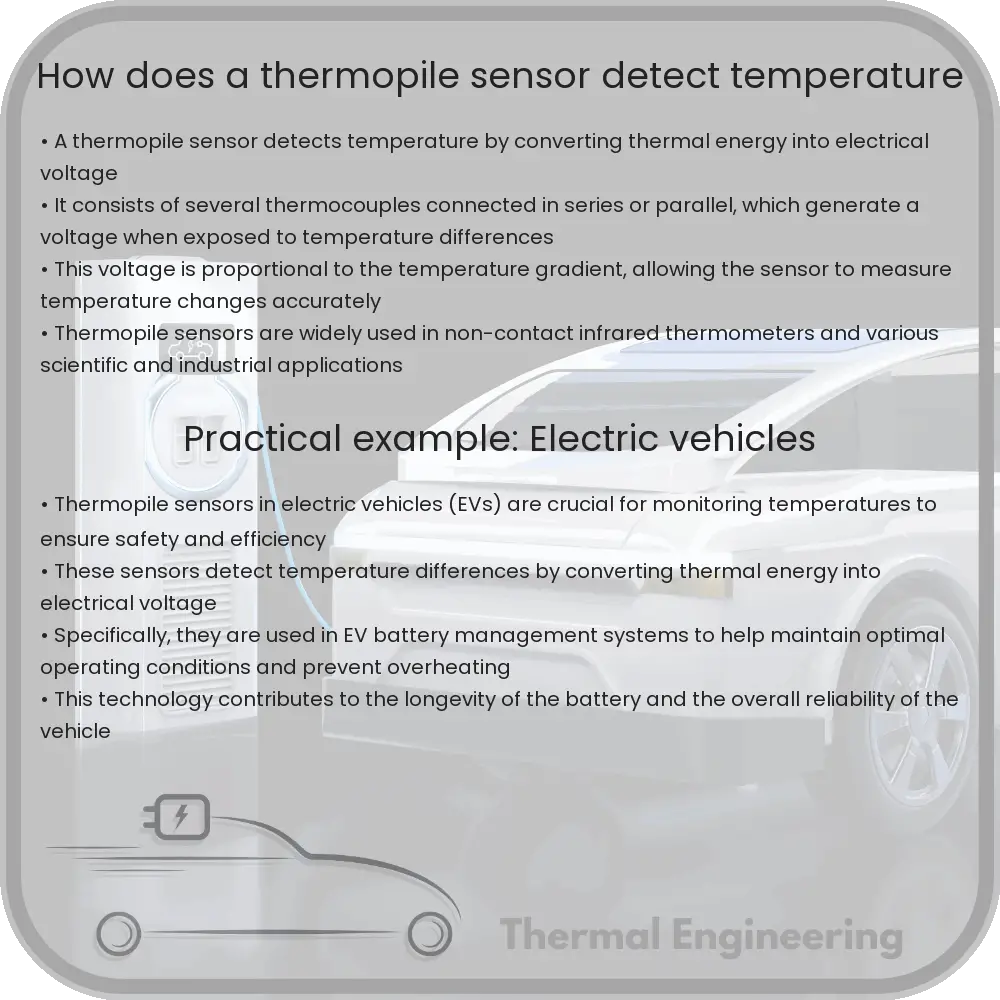
How does a thermopile sensor detect temperature

Learn about thermopile sensors, devices that measure temperature by detecting thermal radiation and converting it into an electrical signal based on the Seebeck effect.

How does a thermopile sensor detect temperature

Understanding Thermopile Sensors

Thermopile sensors are intriguing devices used extensively to measure temperature. These sensors leverage the principles of thermoelectricity to detect thermal radiation and convert it into an electrical signal. Let’s delve into how these sensors operate, their components, and their applications in the real world.

Principles of Operation

A thermopile sensor is essentially an array of several thermocouples connected in series or parallel to enhance the electrical output signal. A thermocouple, as the fundamental unit of a thermopile, operates on the Seebeck effect. This effect states that a voltage is generated when there is a temperature difference between two dissimilar metal junctions. In simple terms, this voltage is given by:

V = S*∆T

where:

  • V is the voltage produced,
  • S is the Seebeck coefficient (material-dependent), and
  • ∆T (Delta T) represents the temperature difference between the hot and cold junctions.

In a thermopile, multiple thermocouples are connected so that their voltages add up. The ‘hot’ junctions are exposed to the object whose temperature is being measured, while the ‘cold’ junctions are maintained at a known reference temperature. The resulting output voltage of the thermopile is thus proportional to the temperature difference between these junctions, allowing for accurate temperature readings.

Components of a Thermopile Sensor

  • Absorber: This component absorbs the infrared radiation from the object whose temperature is being measured. It is typically black to maximize absorption.
  • Thermocouples array: As noted, these are connected in series or parallel to produce a measurable voltage.
  • Reference junction: Held at a known temperature, this helps in establishing the baseline for temperature difference.
  • Signal processing circuit: This component amplifies and converts the thermopile voltage to a usable output, such as digital data.

Applications of Thermopile Sensors

Thermopile sensors find applications in various fields due to their ability to perform non-contact temperature measurements. Key applications include:

  • Medical devices: Used in ear thermometers and other diagnostic equipment to measure body temperature without direct contact.
  • Home appliances: Integrated in devices like microwaves and pyrometers for temperature monitoring.
  • Industrial monitoring: Employed in processes that require the monitoring of high temperatures, such as in furnaces.
  • Environmental systems: Used to monitor ambient temperatures or for fire detection.

The operational simplicity and effectiveness of the thermopile sensor in measuring temperature through electromagnetic radiation make it a valuable tool in both everyday appliances and specialized equipment. Its non-intrusive nature also ensures that measurements can be taken without the need to physically alter or disturb the target, preserving integrity and efficiency.

Conclusion

Thermopile sensors are an elegant application of thermoelectric principles, enabling accurate and reliable temperature measurements across diverse sectors. By understanding how these devices function, we can better appreciate the sophisticated yet straightforward technology that impacts our daily lives and industrial processes alike.

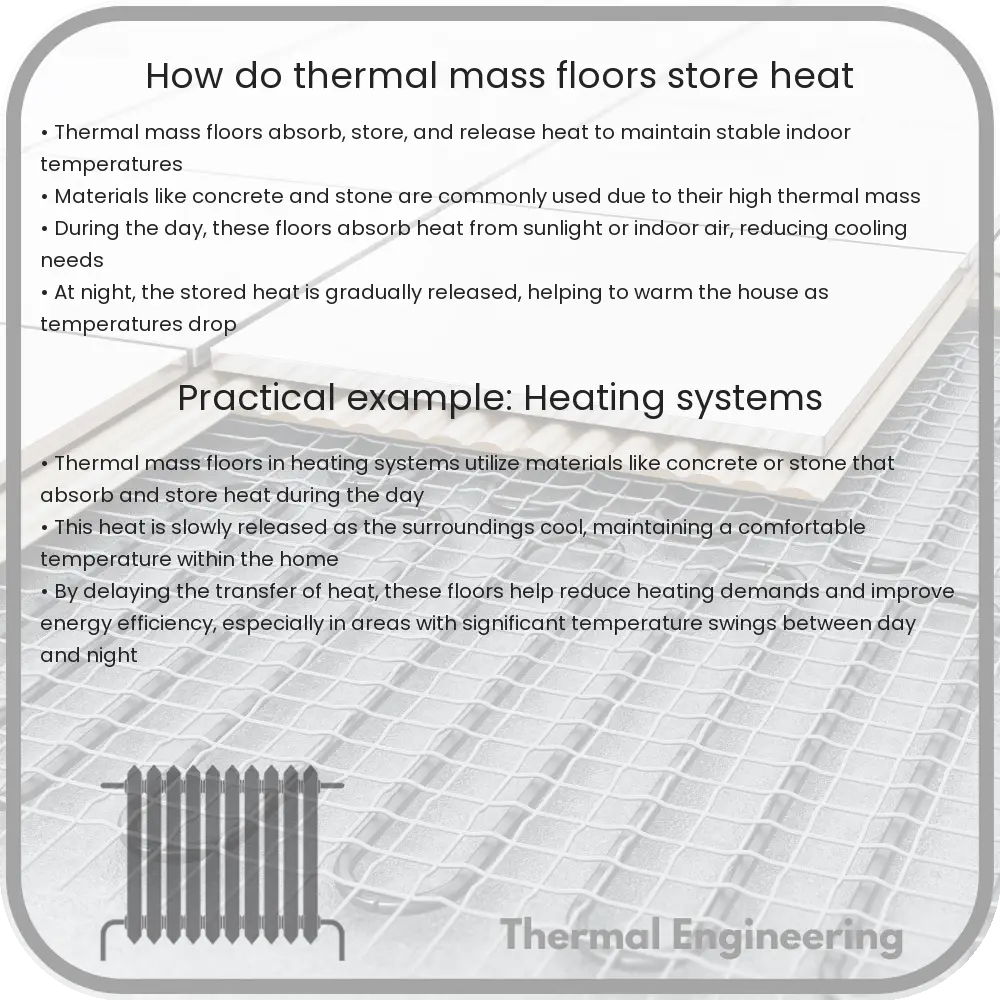
How do thermal mass floors store heat

Learn how thermal mass floors enhance energy efficiency by storing and releasing heat, stabilizing indoor temperatures, and reducing energy costs.

How do thermal mass floors store heat

Understanding Thermal Mass Floors and Heat Storage

Thermal mass floors are a key component in sustainable building design, offering a method to store heat during warmer periods and release it during cooler periods. This natural heating and cooling system contributes to energy efficiency and consistent indoor temperature control. But how exactly does this system work? Let’s break down the concept of thermal mass and explore how it can effectively store heat.

What is Thermal Mass?

Thermal mass refers to the ability of a material to absorb, store, and release heat energy. Materials with high thermal mass, like concrete, brick, stone, and ceramic tiles, are able to absorb a large amount of heat without a significant rise in their own temperature. The efficiency of thermal mass is due to the specific heat capacity of the material, which is the amount of heat energy required to raise the temperature of one kilogram of the substance by one degree Celsius.

How Thermal Mass Floors Store Heat

The process of heat storage in thermal mass floors involves the following steps:

  • Heat Absorption: During the day, especially in sunny conditions, thermal mass floors absorb heat from the sun and/or ambient heat from the indoor environment. This heat is absorbed through direct sunlight (if exposed), convection, and thermal radiation from the surrounding air.
  • Heat Storage: Once absorbed, the heat energy is stored deep within the material of the thermal mass floor. The dense nature of materials utilized in thermal mass floors allows them to contain this heat without a substantial temperature increase, enabling prolonged storage duration.
  • Heat Distribution: The stored heat does not remain localized. Over time, it starts to diffuse through the material of the floor. The slower release rate prevents rapid temperature changes, offering a gradual warming effect to the area above and adjacent to the floor.
  • Delayed Release: As the temperature in the environment drops, particularly at night, the stored heat in the thermal mass floor begins to release. This released heat warms the surrounding air, offering a natural heating mechanism which reduces the reliance on artificial heating systems.

Benefits of Thermal Mass Floors

Thermal mass floors provide multiple benefits:

  1. Energy Efficiency: By storing excess heat during the day and releasing it at night, thermal mass floors can significantly reduce the need for mechanical heating and cooling systems, leading to lower energy consumption and costs.
  2. Consistent Indoor Climate: Thermal mass floors help in stabilizing indoor temperatures, reducing the extremes of hot and cold, thus enhancing occupant comfort.
  3. Environmental Impact: Reduced dependence on fossil fuel-based energy systems decreases the carbon footprint of a building, contributing to a more sustainable environment.

Optimizing Thermal Mass Floor Performance

To maximize the benefits of thermal mass floors, a few considerations should be kept in mind:

  • Material Choice: Selecting the appropriate materials with high density and specific heat capacity is crucial. Commonly used materials include concrete, tiles, and bricks.
  • Exposure to Sunlight: The placement of thermal mass floors in areas receiving ample sunlight can increase their effectiveness in absorbing heat.
  • Insulation Integration: While thermal mass can store and release heat, efficient insulation is necessary to prevent heat loss to the surroundings, ensuring that the stored heat is effectively utilized within the building.

In conclusion, thermal mass floors represent a strategic and efficient approach to natural temperature regulation in buildings. By understanding and leveraging the properties of thermal mass, engineers and architects can design buildings that are not only more energy-efficient but also provide a comfortable living environment.