Facebook Instagram Youtube Twitter

How does a thermal mixer homogenize samples

Learn how a thermal mixer efficiently homogenizes samples in scientific labs by controlling temperature and agitation for consistent results.

How does a thermal mixer homogenize samples

Understanding the Functioning of a Thermal Mixer in Homogenizing Samples

Thermal mixers are essential laboratory equipment used extensively in biochemistry, molecular biology, and related scientific fields to ensure that samples are uniformly mixed and maintained at a precise temperature. The ability of a thermal mixer to homogenize samples efficiently makes it invaluable in experiments where temperature and mixing speed need to be controlled meticulously to achieve consistent results.

Principles of Operation

A thermal mixer operates based on the dual functionality of temperature control and mechanical agitation. It typically integrates a heating block and a motor that drives the mixing motion, which may include shaking, vortexing, or stirring. Here’s how these components work together to homogenize samples:

  • Temperature Control: The device’s heating block can be set to a specific temperature, ensuring that the sample maintains a uniform temperature throughout the process. This is particularly important for biochemical reactions which are temperature-sensitive, such as enzymatic assays and PCR (Polymerase Chain Reaction) preparations.
  • Mechanical Agitation: Through a shaking or spinning action enabled by the motor, the samples are agitated uniformly. This mixing action ensures that the components of the sample are evenly distributed, thus achieving homogenization. Different speeds and motion patterns can be set depending on the sample’s characteristics and the desired result.

Role of Homogenization

Homogenization in the context of a thermal mixer refers to the process of making a mixture uniform in composition throughout. This is crucial for many reasons:

  • Reproducibility of Results: Uniform sample preparation leads to more reliable and reproducible results in experiments, which is paramount in scientific research.
  • Efficiency: Proper mixing can also improve the efficiency of biochemical reactions by ensuring that reactants are evenly distributed and consistently maintained at the optimal temperature.
  • Accuracy: Accurate temperature control and effective mixing improve the precision of experiments, reducing errors and variability in outcomes.

Applications of Thermal Mixers

Thermal mixers are versatile and find applications across various scientific disciplines:

  1. DNA, RNA, and Protein Studies: They are used to prepare samples for PCR, which requires precise temperature cycling and thorough mixing to ensure the DNA amplification is even.
  2. Cell Culture: Thermal mixers facilitate the resuspension of cells or the mixing of cell culture media under controlled conditions.
  3. Enzymatic Reactions: Enzyme kinetics studies often require strict temperature control and effective mixing to maintain enzyme activity and ensure consistent reactions.

In conclusion, the thermal mixer is an indispensable tool in the laboratory that enhances sample homogenization through effective mixing and precise temperature control. By understanding the basic principles behind its operation and the importance of homogenization, scientists and technicians can utilize thermal mixers to their fullest potential, leading to more accurate and consistent experimental outcomes.
How does a thermos flask prevent heat transfer

Learn how a thermos flask uses specialized design elements like double walls, vacuum insulation, and reflective coatings to effectively minimize heat transfer and maintain beverage temperatures.

How does a thermos flask prevent heat transfer

Understanding the Engineering Behind a Thermos Flask

A thermos flask, also known as a vacuum flask, is a common household item used to keep beverages hot or cold over extended periods. But how does this ingenious device manage to maintain the temperature of its contents so effectively? The secret lies in its specialized design that minimizes heat transfer through conduction, convection, and radiation.

Key Components and Their Functions

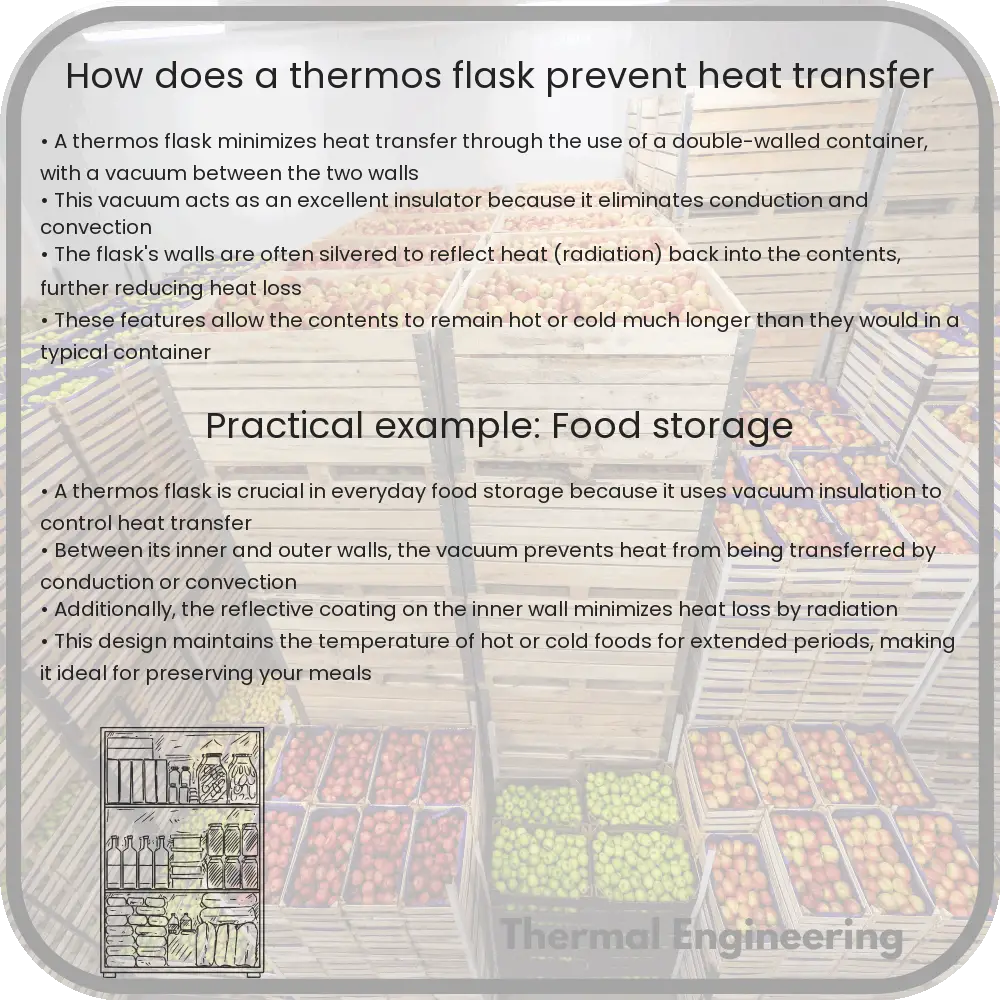
  • Double-Walled Container: At the heart of a thermos is a double-walled container, usually made of glass or metal. These two walls are separated by a vacuum.
  • Vacuum: The vacuum between the two walls plays a crucial role in heat insulation. A vacuum is essentially a space devoid of matter, including air. Without air, the process of conduction (where heat is transferred through the vibration of molecules) and convection (where heat is transferred through fluid motion) is greatly reduced.
  • Reflective Coating: The surfaces of the inner and outer walls are often coated with a reflective material, typically silver. This coating reflects radiant heat energy back towards its source, significantly reducing the amount of heat lost through radiation.
  • Tight Seals: To prevent heat exchange with the outside environment, thermos flasks are equipped with tight, insulating stoppers. These stoppers inhibit air from entering or leaving the flask, further reducing heat loss via convection.
  • Protective Casing: The outer casing of the flask, made from materials like plastic or stainless steel, protects the delicate inner glass or metal container and provides an additional layer of thermal insulation.

How Heat Transfer is Minimized

The design of a thermos flask tackles the three methods of heat transfer:

  1. Conduction: In typical containers, heat is transferred through the walls of the container by conduction. The vacuum in a thermos flask minimizes the molecules available to transfer heat, effectively reducing conduction.
  2. Convection: Convection occurs when heat is transferred by the movement of fluids. The airtight seal of the thermos prevents air from circulating in and out, thus blocking this type of heat transfer.
  3. Radiation: Radiative heat transfer involves the transfer of heat in the form of electromagnetic waves. The reflective surfaces inside the thermos reflect this radiation back towards the contents, reducing the heat lost.

The Science of Everyday Comfort

The thermos flask is a prime example of practical engineering and physics applied to daily life. By understanding and manipulating the principles of heat transfer, engineers have created a device that allows us to enjoy hot or cold beverages hours after they have been prepared. This convenience is particularly appreciated by anyone who needs to keep liquids at a desired temperature for an extended time without external energy sources. Whether it’s keeping coffee hot during a long meeting or ensuring water stays cold during a hike, the thermos flask reveals the profound impact of thermal insulation technologies in our everyday comfort.

How does thermal shock resistance affect materials

Learn about thermal shock resistance, a vital material property for enduring rapid temperature changes in aerospace, cookware, and electronics.

How does thermal shock resistance affect materials

Understanding Thermal Shock Resistance in Materials

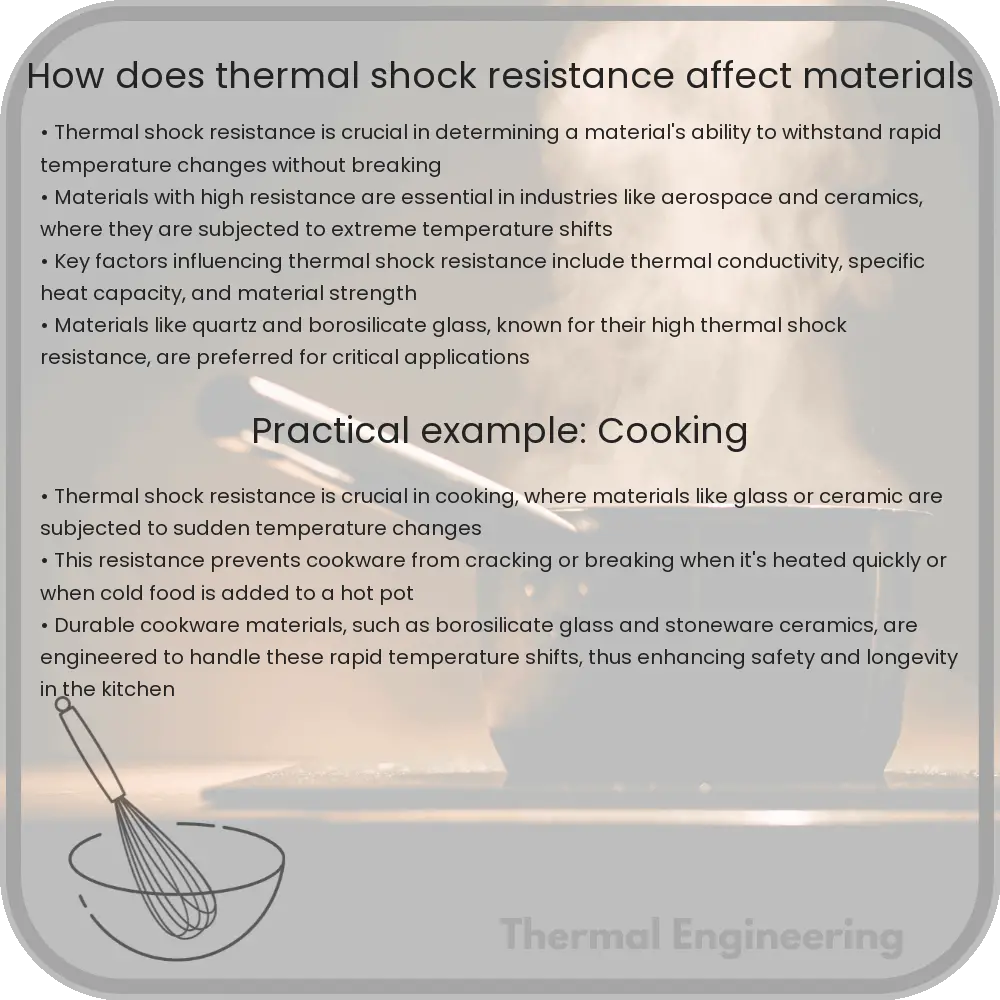
Thermal shock resistance is a critical property of materials that determines their ability to withstand rapid changes in temperature without deteriorating or breaking. This property is particularly important in applications that involve sudden heating or cooling, such as in aerospace components, cookware, and ceramic materials used in electronics and energy systems.

What is Thermal Shock?

Thermal shock refers to the stress experienced by a material when it undergoes a sudden change in temperature. The rapid temperature variation can lead to thermal expansion or contraction, which, in turn, creates stress within the material. If the material cannot withstand this stress, it may crack, fracture, or fail in other ways.

Factors Influencing Thermal Shock Resistance

  • Thermal Expansion Coefficient: Materials with low thermal expansion coefficients are less likely to experience internal stresses due to less expansion or contraction with temperature changes.
  • Thermal Conductivity: High thermal conductivity helps in quickly dissipating the heat across the material, thus minimizing temperature gradients that can lead to stress.
  • Elastic Modulus: Materials with a higher elastic modulus tend to be more brittle, and thus, more susceptible to thermal shock. Conversely, materials with a lower elastic modulus can absorb more stress.
  • Strength and Toughness: High strength and toughness allow a material to resist fractures under stress, contributing positively to thermal shock resistance.

Measurement of Thermal Shock Resistance

Thermal shock resistance is often quantified using a parameter known as the thermal shock parameter (R), which is calculated based on the material’s properties. It can be given by the formula:

R = (K * σt) / (E * α2 * ΔT)

Where:

  • K = Thermal conductivity
  • σt = Tensile strength
  • E = Modulus of elasticity (Young’s modulus)
  • α = Coefficient of thermal expansion
  • ΔT = Temperature change

Practical Applications and Examples

In practical applications, the design of components considers thermal shock resistance to ensure longevity and reliability. For example:

  • In aerospace, materials such as advanced ceramics and composites are chosen for engine components because of their high thermal shock resistance.
  • In cooking, utensils made from materials like borosilicate glass are popular because they resist cracking under rapid temperature changes.
  • Electronic devices often use materials with high thermal shock resistance to prevent damage due to rapid heating and cooling cycles.

Conclusion

Understanding and enhancing thermal shock resistance is crucial for developing materials that can withstand extreme and sudden temperature changes. This property plays a significant role in a wide range of engineering applications, influencing the design and material choice in industries as diverse as cookware, aerospace, and electronics. By selecting materials with optimum thermal shock resistance, engineers can enhance the performance, safety, and durability of the components and systems they design.

How does a thermal cutoff switch prevent fires

Learn how thermal cutoff switches prevent fires by stopping electric current when excessive temperatures are detected in appliances and systems.

How does a thermal cutoff switch prevent fires

Understanding the Role of Thermal Cutoff Switches in Fire Prevention

A thermal cutoff switch, often referred to as a thermal protector, plays a critical role in preventing fires in electrical appliances and systems. This safety device is designed to interrupt electric current flow when excessive temperatures are detected, thereby preventing potential overheating and subsequent fire outbreaks. This article explores how thermal cutoff switches work and their importance in various applications.

How Does a Thermal Cutoff Switch Work?

The basic function of a thermal cutoff switch is quite straightforward. It consists of a thermal-sensitive component that responds to a specific high temperature by breaking an electrical circuit. This component is typically made from a material that can detect temperature changes reliably and quickly. When the temperature threshold is exceeded, the thermal-sensitive material activates a mechanism that opens the circuit, effectively stopping the current flow to the connected device or system.

  • Bimetallic Strip: In some designs, the switch utilizes a bimetallic strip made of two different metals with varying expansion rates. When heated, this strip bends or curves, triggering a mechanical action that opens the switch.
  • Fusible Alloy: Other models use a fusible alloy that melts at a specific temperature, causing a spring-loaded mechanism to break the circuit.

Key Applications of Thermal Cutoff Switches

Thermal cutoff switches are used in a variety of applications where temperature control is crucial for safety. Here are some common examples:

  • Household Appliances: They are commonly found in kitchen appliances such as coffee makers, toasters, and microwaves, where they prevent overheating that could lead to fires.
  • Electrical Motors: Motors in tools and appliances can overheat due to excessive load or failure of other components. Thermal cutoff switches help prevent damage or fires caused by motor overheating.
  • Heating and Cooling Systems: These switches are integral components of HVAC systems (Heating, Ventilation, and Air Conditioning), ensuring that heaters, boilers, and other high-temperature equipment operate safely.

Advantages of Using Thermal Cutoff Switches

The inclusion of thermal cutoff switches in electrical systems offers several benefits:

  • Fire Prevention: By disconnecting the power at the first sign of overheating, these switches significantly reduce the risk of fire.
  • Equipment Protection: They prevent damage to electrical devices and appliances by halting operation before temperatures reach damaging levels.
  • Cost-Effectiveness: Thermal cutoff switches are generally inexpensive and can avoid costly repairs or replacements of equipment by acting as a simple preventive measure.

Conclusion

Thermal cutoff switches are vital components in maintaining safety in electrical appliances and systems. By effectively cutting off power in response to excessive temperature, they play a crucial role in fire prevention and protection of equipment. With their straightforward design and operation, thermal cutoff switches provide a reliable and cost-effective solution for managing the inherent risks associated with electrical device operation.

How does thermal lamination protect documents

Learn about thermal lamination, a technique for safeguarding documents against wear while enhancing their appearance and longevity.

How does thermal lamination protect documents

Understanding Thermal Lamination: Protecting Documents from Time and Elements

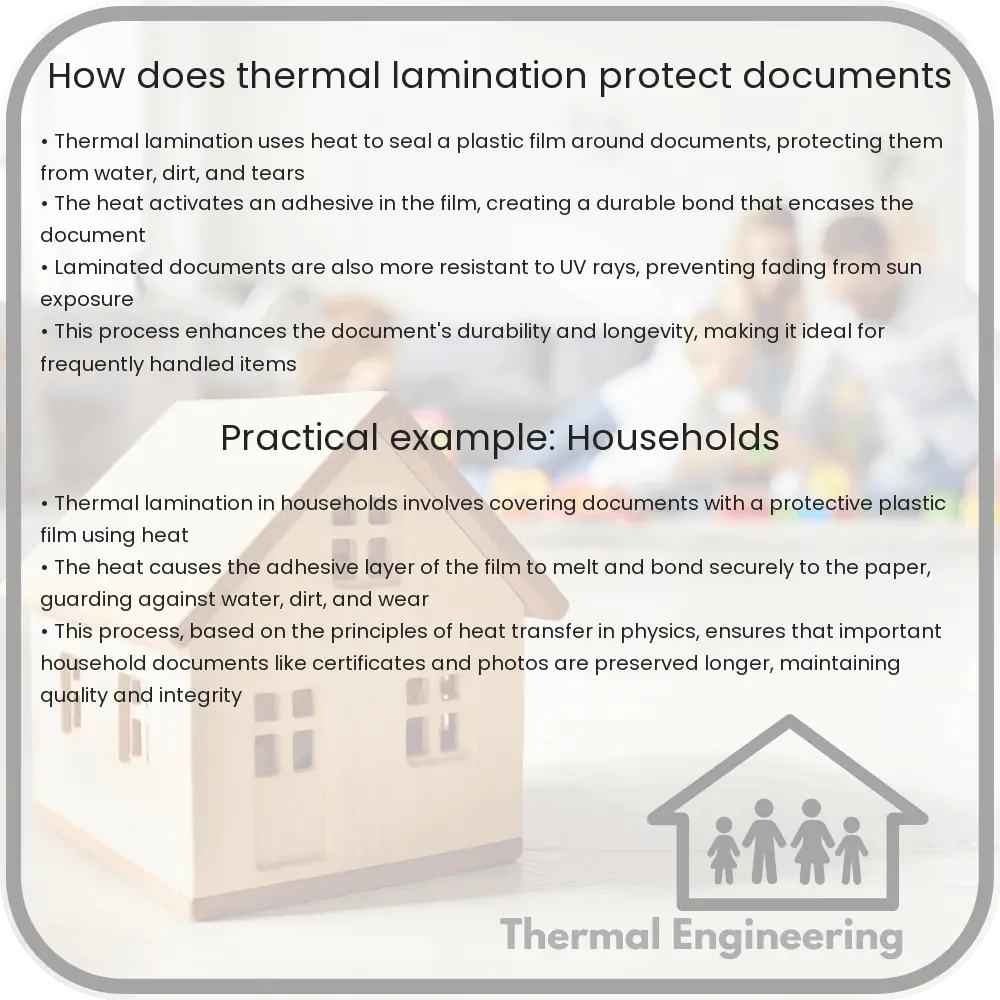
Thermal lamination is a popular and effective method used to protect and enhance the physical quality of paper documents. This technique involves the application of a protective plastic film onto the paper document, which not only safeguards the document from wear and tear but also improves its appearance. The process, widely used in offices, schools, and printing businesses, ensures that documents are preserved for long-term use and handling. Below, we explore how thermal lamination works and its benefits.

How Does Thermal Lamination Work?

Thermal lamination utilizes heat to bond a plastic film to paper documents. The basic process can be broken down into several key steps:

  • Document Preparation: Before lamination, the document is typically placed inside a lamination pouch. This pouch consists of two layers of laminating film, which are sealed on one side.
  • Heating: The lamination machine, which contains heated rollers, preheats to a specific temperature. This temperature is crucial and varies depending on the type of film and document.
  • Laminating Process: The document, placed inside the pouch, is then fed through the lamination machine. The heated rollers apply pressure and heat to the pouch, causing the adhesive layer of the laminating film to melt and bind with the document.
  • Cooling and Bonding: As the laminated document exits the machine, it cools down, solidifying the adhesive and forming a permanent protective seal around the document.

The key to effective lamination lies in the controlled application of heat. Too much heat can damage the document and the film, while insufficient heat may not adequately activate the adhesive, leading to poor adhesion and potential delamination.

Types of Laminating Films

Laminating films come in various types, each suited to different lamination needs:

  • Glossy Film: Adds a shiny finish, enhancing colors, and making documents more visually appealing.
  • Matte Film: Reduces glare, making documents easier to read under strong light, suitable for business presentations and educational materials.
  • UV Protection Film: Contains additives that block ultraviolet light, preventing fading and yellowing of documents exposed to sunlight.

Benefits of Thermal Lamination

Thermal lamination offers several advantages:

  1. Protection: It shields documents from moisture, dirt, fingerprints, smudges, and abrasions. Laminated documents are also more resistant to tearing and bending.
  2. Enhanced Durability: Laminated documents can withstand frequent handling and are ideal for items that require frequent use, such as menus, ID badges, and instructional sheets.
  3. Aesthetic Improvement: Lamination enhances the color and brightness of documents, providing a professional look and feel that is especially important for business and marketing materials.
  4. Versatility: Lamination isn’t limited to paper documents; it can also be applied to photos, signs, and various other materials that need enhanced durability and visual quality.

In conclusion, thermal lamination is a robust method for protecting and preserving documents. It extends the life of paper materials, enhances visual qualities, and improves handling – attributes crucial in both professional and personal settings.

Waste thermal energy conversion

Learn about waste thermal energy conversion, a method that improves energy efficiency by converting lost heat into usable power.

Waste thermal energy conversion

Understanding Waste Thermal Energy Conversion

Waste thermal energy conversion is a process that has garnered significant interest due to its potential to reduce energy waste and improve overall energy efficiency. This method focuses on utilizing the heat that is typically lost in industrial processes, power generation, or everyday activities to generate electricity or useful heat, helping decrease environmental impact and enhance sustainability.

How Does Waste Thermal Energy Conversion Work?

The basic principle behind waste thermal energy conversion is capturing heat that would otherwise be lost to the environment and converting it into electrical power or other forms of usable energy. The processes used can vary greatly depending on the source of the waste heat and the desired output. Key technologies involved in this conversion include:

  • Thermoelectric Generators: These devices generate electricity directly from heat using the Seebeck effect, where a voltage is created between two different materials when there is a temperature difference.
  • Organic Rankine Cycle (ORC): Similar to a traditional steam turbine but using organic fluids with lower boiling points than water. This allows for heat recovery from lower temperature sources, generating electricity without requiring extremely high temperatures.
  • Heat Exchangers: Typically used in combination with other systems, heat exchangers transfer waste heat to a working fluid, often in industrial settings, to recover and repurpose the heat.

Benefits of Waste Thermal Energy Conversion

The conversion of waste thermal energy comes with several key benefits:

  1. Improved Energy Efficiency: By capturing and utilizing heat that would otherwise be lost, this technology significantly enhances energy efficiency across a variety of systems.
  2. Reduction in Greenhouse Gas Emissions: Utilizing waste heat helps decrease the reliance on fossil fuel-powered systems, leading to reduced greenhouse gas emissions.
  3. Cost Savings: While the initial setup can be pricey, the long-term savings achieved through reduced energy costs make waste thermal energy conversion an economically viable option for many industries.
  4. Versatility: This technology can be applied in numerous industries, including manufacturing, power generation, and even in vehicle exhaust systems.

Challenges and Considerations

Despite the benefits, there are several challenges associated with waste thermal energy conversion:

  • High Initial Investment: The cost of deploying technologies like ORC systems or thermoelectric generators can be substantial, possibly deterring smaller enterprises or industries with tight budgets.
  • Technology Fit: Not all waste heat recovery technologies are suitable for every type of waste heat source. Factors like heat quality, fluctuation, and availability must be carefully evaluated to choose the appropriate technology.
  • Maintenance and Durability: Since these systems involve additional components and complexity, they require regular maintenance and are subject to wear and tear.

In conclusion, waste thermal energy conversion represents a promising avenue for making better use of the enormous amounts of heat that are currently being wasted. Although challenges exist, continued advancements in technology and declining costs are likely to enhance the feasibility and attractiveness of this sustainable energy solution.

How do cryogenic treatments improve metal durability

Learn how cryogenic treatments enhance metal durability by improving microstructure and increasing resistance to wear and stress.

How do cryogenic treatments improve metal durability

Understanding Cryogenic Treatments and Metal Durability

Cryogenic treatment is a process that significantly improves the durability and performance of metals, particularly those used in tools, gear components, and automotive parts. This article will explain the fundamentals of cryogenic treatments, how they affect metal properties, and why they are considered beneficial for enhancing the longevity and function of various metallic components.

What are Cryogenic Treatments?

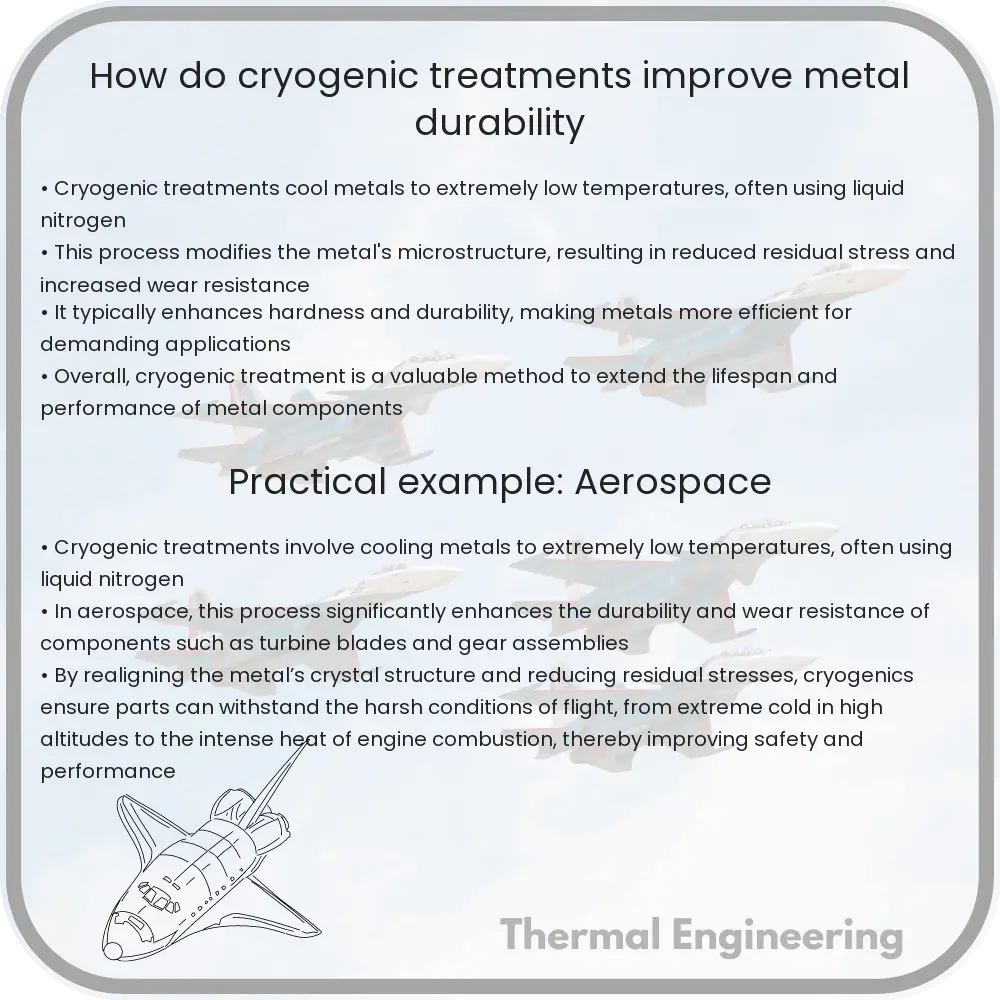
Cryogenic treatments involve cooling a material to extremely low temperatures, often down to -190 degrees Celsius (-310 degrees Fahrenheit) or lower, using liquid nitrogen. The process can be classified into two main types: shallow cryogenic treatment and deep cryogenic treatment. Shallow treatments cool materials to temperatures around -80°C (-112°F), whereas deep cryogenic treatments typically go to -196°C (-320.8°F) or lower.

The cooling process is followed by a gradual warming back to room temperature, and sometimes the application of a tempering heat treatment. This entire procedure can alter the material’s microstructure, leading to improved physical properties.

Effects on Metal Durability

The primary mechanism behind the enhancement of metal durability through cryogenic treatment lies in the transformation and stabilization of the microstructure. Here are key changes that occur during the treatment:

  • Conversion of Austenite to Martensite: Some alloys, particularly steels, contain retained austenite which is a less stable phase. Cryogenic treatment helps convert this retained austenite into martensite, a much harder and more stable phase.
  • Refinement of Microstructure: The process also refines the grain structure of the metal, which increases its hardness and toughness.
  • Reduction of Internal Stresses: Metals treated cryogenically show reduced internal stresses which often result from the manufacturing processes like welding or forging.
  • Precipitation of Fine Carbides: During cryogenic treatment, fine carbide particles precipitate out in the steel matrix. These carbides increase the abrasion resistance and strength of the metal.

Practical Applications and Benefits

The improved hardness, wear resistance, and toughness of cryogenically treated metals have practical implications in various industries:

  1. Increased durability of cutting tools such as drill bits, end mills, and inserts, leading to longer service life and reduced replacement costs.
  2. Better stability in precision components found in aerospace and automotive industries, which require high levels of dimensional stability and resistance to thermal stresses.
  3. Enhanced performance of racing components, where superior strength and durability can significantly impact the performance and safety of high-performance vehicles.

Conclusion

Cryogenic treatments offer a compelling method to enhance the properties of metals, thus boosting their performance and longevity significantly. By understanding and applying this advanced process, industries benefit from the reduction in material failures and down times, alongside the optimized performance of components that are critical to their operations. Given these advantages, the adoption of cryogenic processing continues to grow across various sectors, underlining its importance in modern materials engineering.

How does thermodynamic software simulate systems

Understand the role of thermodynamic software simulation in engineering, involving energy and material processes for diverse industrial applications.

How does thermodynamic software simulate systems

Understanding Thermodynamic Software Simulation

Thermodynamic software is used extensively by engineers to model and simulate processes that involve heat, energy, and material transformations. This technology plays a crucial role in industries including power generation, mechanical engineering, chemical manufacturing, and HVAC systems. But how exactly does such software simulate complex thermodynamic systems?

Core Principles of Thermodynamic Simulation

At the heart of any thermodynamic simulation software is the ability to model both the properties and the behavior of materials under various temperatures, pressures, and compositions. This is achieved through a combination of thermodynamic theories, material property databases, and numerical methods.

  • Thermodynamic Theories: These are the fundamental laws of thermodynamics including conservation of energy (First Law), the increase of entropy (Second Law), and the relationships between heat, work, temperature, and pressure.
  • Equations of State: Software often uses specific equations of state (EOS) like the Ideal Gas Law (PV=nRT), van der Waals equation, and others tailored to particular materials to calculate changes in volume, pressure, and temperature.
  • Material Property Databases: Reliable simulations depend on accurate material properties such as specific heat capacity, thermal conductivity, and viscosity. These properties may change with temperature and pressure, and are sourced from extensive databases integrated into the software.
  • Numerical Methods: Methods like finite difference, finite element, and Monte Carlo simulations are used to solve the mathematical models derived from the thermodynamic theories and equations.

Steps in a Thermodynamic Simulation

  1. Defining the System: Users specify the system configuration, including the type of system (e.g., closed, open), components, and the operational conditions (e.g., initial temperatures, pressures).
  2. Choosing the Model: Based on the application, users select an appropriate thermodynamic model or equation of state that best fits the physical scenario.
  3. Inputting Data: This involves entering data such as material properties, interaction parameters between different materials, and environmental conditions.
  4. Simulation Execution: The software performs calculations, iteratively solving the thermodynamic equations to predict how the system will behave over time.
  5. Analysis and Optimization: Users analyze the simulated results for feasibility, safety, and efficiency, and make necessary adjustments to the design or operation conditions.

Applications of Thermodynamic Software

Thermodynamic simulation software is versatile with a range of applications, such as:

  • Energy Systems: Design and optimization of boilers, turbines, and refrigeration cycles.
  • Chemical Reaction Engineering: Predicting the outcome of chemical reactions, designing chemical reactors, and safety analysis.
  • Environmental Engineering: Studying pollutant behaviors and designing systems for pollution control and waste management.
  • Automotive: Enhancing fuel efficiency and reducing emissions in combustion engines.

In conclusion, thermodynamic software provides a powerful tool for engineers to design, analyze, and optimize systems involving energy transformations and material exchanges. By simulating different scenarios and conditions, engineers can ensure that their systems operate safely, efficiently, and sustainably.

How does a thermal fogger work for pest control

Learn how thermal foggers work in pest control, their components, operation phases, advantages, and safety considerations for efficient use.

How does a thermal fogger work for pest control

Understanding the Mechanics of a Thermal Fogger for Pest Control

Thermal foggers are devices widely used in pest control to distribute insecticides in the form of a dense fog or smoke. This method is especially effective in targeting airborne pests or insects hidden in hard-to-reach areas. The fog, composed of tiny particles of the pesticide solution, ensures that the chemical can penetrate deep into crevices and foliage where pests reside. Here’s how these devices work, broken down into manageable components.

Components of a Thermal Fogger

  • Heating Assembly: This is the core component where the fogging solution is turned into fog. It consists of a coil or a burner, which heats the solution to high temperatures.
  • Solution Tank: This tank holds the chemical solution that is to be fogged. The capacity of this tank can vary depending on the type of model and its intended use.
  • Pump: It pushes the liquid chemical solution from the tank towards the heating assembly.
  • Nozzle: This part of the fogger is where the heated solution is expelled out into the atmosphere, creating a fog or mist.

Operation of a Thermal Fogger

The functionality of a thermal fogger can be explained through the following operational phases:

  1. Initialization: First, the chemical solution is placed into the solution tank while ensuring the fogger is in a safe, outdoor environment.
  2. Heating: When activated, the pump transfers the solution to the heating chamber where it is exposed to high temperatures. This heat vaporizes the solution almost instantly.
  3. Atomization: Upon reaching the nozzle, the vaporized solution is expelled and comes in contact with cooler outside air. The sudden change in temperature causes the chemical to condense into very fine particles, forming a thick cloud of fog.
  4. Dispersion: The fogger blows this cloud into the air, allowing it to disperse across a wide area. The tiny particles of fog penetrate deep into potentially infested areas.
  5. Settling: Eventually, the fog’s particles settle onto surfaces, coating them with the insecticide, which then acts to kill and repel pests.

Advantages of Using Thermal Foggers

Thermal foggers offer several advantages in pest control:

  • Efficient Dispersal: They can cover large areas quickly and ensure that the insecticide permeates deeply into hiding spots that are otherwise difficult to reach.
  • Particle Size Control: The size of the particles can be adjusted by tweaking the temperature and the flow rate, which allows for targeting specific types of pests.
  • Immediate Effect: The fog produced works instantly, making it ideal for large scale and immediate pest control needs like in agricultural fields or public health emergencies involving vector control.

Considerations and Safety Tips

Although thermal foggers are potent tools in pest management, they require appropriate handling to ensure safety and effectiveness:

  • Use Outdoors: Due to the dense fog and chemical nature, it’s recommended to use these devices outdoors or in well-ventilated areas.
  • Protective Gear: Operators should wear protective gear including masks, goggles, and gloves to avoid direct exposure to chemicals.
  • Follow Directions: It is crucial to use the correct chemical concentration and follow the manufacturer’s instructions for operation and maintenance.

Understanding the principle and functionality of thermal foggers can enhance their effective use in pest control, helping to reduce pest-related issues while adhering to safety standards.

How do radiant barriers reduce heat transfer

Learn how radiant barriers work to reflect heat and improve energy efficiency in buildings, particularly in reducing attic heat transfer.

How do radiant barriers reduce heat transfer

Understanding Radiant Barriers and Heat Transfer Reduction

Radiant barriers are materials that help reduce the transfer of heat by reflecting radiant heat instead of absorbing it. These barriers are commonly used in buildings, especially in attics, to improve energy efficiency by lowering cooling costs. The effectivity of radiant barriers depends on their material, placement, and the environment in which they are used.

How Radiant Heat Transfer Works

Heat can be transferred in three ways: conduction, convection, and radiation. Radiant heat transfer involves the transfer of heat from one object to another without needing contact or an intermediary medium. In buildings, radiant heat from the sun can make rooms warmer, particularly those under the roof.

Components of Radiant Barriers

  • Reflective Material: Most radiant barriers are made of a highly reflective material, typically aluminum foil, which has the ability to reflect back radiant heat.
  • Substrate: This material supports the reflective aluminum layer. Common substrates include Kraft paper, plastic films, cardboard, and air infiltration barrier material.

Functional Principle of Radiant Barriers

Radiant barriers reduce the radiant heat transfer from the underside of the roof to other surfaces in the attic. They are usually placed on the attic ceiling, just beneath the roof, to reflect the heat away before it can warm up the space below. When installed correctly, the barriers can reflect up to 97% of the radiant heat, significantly lowering the temperature of the attic and, consequently, the living spaces below.

Effectiveness and Factors Influencing Performance

  • Emissivity: This is the ability of the material to emit absorbed heat. Lower emissivity means less heat is radiated downwards from the barrier itself.
  • Angle of Installation: The effectiveness of a radiant barrier can be influenced by its orientation to the sun. Barriers are most effective when perpendicular to radiant energy striking them.
  • Climatic Conditions: In cooler climates, the benefits of radiant barriers are less significant as opposed to hot climates where radiant heat is a major concern.
  • Placement and Spacing: Proper installation is crucial. There should be a small air gap between the radiant barrier and the roof, as this gap helps in reflecting the heat back towards the roof.

In conclusion, by reflecting radiant energy, radiant barriers help maintain lower temperatures in a building’s attic and living areas during warm weather conditions, resulting in reduced energy costs for cooling. Their effectiveness is contingent upon correct installation and environmental conditions.

Understanding these principles not only offers insights into the benefits of radiant barriers but also emphasizes the importance of thermal management in building design and energy conservation.