Facebook Instagram Youtube Twitter

Principles of Convection Heating Explained

Learn about convection heating, a key method in efficient heat distribution for homes, industries, and cooking applications.

Principles of Convection Heating Explained

Understanding Convection Heating

Convection heating is a fundamental principle used in various heating systems and technologies. It relies on the movement of fluids (liquids or gases) to transfer heat from one place to another. This method is key to designing efficient heating systems in buildings, appliances, and industrial processes. Here, we’ll explore how convection heating works, its types, and its practical applications.

How Convection Heating Works

In convection heating, heat transfer occurs through the movement of molecules within fluids. When a fluid such as air or water is heated, it becomes less dense and rises because the warmer parts have lower density compared to the cooler parts. As the warm fluid rises, cooler fluid takes its place, and this cycle creates a convection current that allows for the distribution of heat.

Types of Convection

  • Natural Convection: This occurs when fluid motion is caused by buoyancy forces that are induced by density differences in the fluid due to temperature variations. For example, natural convection is what causes warm air to rise and cool air to fall, creating a convection current in a room.
  • Forced Convection: In forced convection, external means such as fans or pumps are used to circulate the fluid. This method is commonly used in various heating systems to enhance the rate of heat transfer. Heating systems in buildings often use fans to distribute heated air throughout the space more efficiently.

Convection vs. Other Heating Methods

Convection heating is different from conduction and radiation, the two other main types of heat transfer. Conduction is the heat transfer through direct contact between materials. Radiation, on the other hand, is heat transfer that occurs through electromagnetic waves and does not require a medium. Convection’s advantage is its ability to heat large volumes of space efficiently, as it circulates heat throughout the room or space.

Applications of Convection Heating

  • Home Heating Systems: Many homes use convection heating through central heating systems or portable heaters. These systems heat the air, which then circulates through the house, warming up the environment.
  • Industrial Processes: Convection is also essential in industrial processes where large volumes of air or other gases need to be heated, such as in drying processes or chemical manufacturing.
  • Cooking: Ovens often utilize convection heating. Convection ovens come equipped with a fan that circulates hot air and maintains a consistent temperature. This leads to faster and more uniform cooking compared to traditional ovens.

Benefits of Convection Heating

Convection heating offers several advantages such as:

  1. Efficient distribution of heat, which leads to a more uniformly heated space.
  2. Enhanced comfort as the heating system rapidly adjusts to changes in temperature settings.
  3. Energy efficiency, especially in systems that utilize forced convection, which can be more controlled and directed as needed.

In conclusion, convection heating is an effective and versatile method for achieving comfort and efficiency in heating applications ranging from small-scale home environments to large-scale industrial settings. By understanding the principles behind convection heating, engineers can design systems that maximize heat transfer efficiency while catering to specific environmental needs.

Explaining Steam Turbine Efficiency

Learn about steam turbine efficiency, its calculation, factors influencing it, and ways to enhance its performance for better energy use.

Explaining Steam Turbine Efficiency

Understanding Steam Turbine Efficiency

Steam turbines are a critical component in various industrial applications, ranging from electricity generation to marine propulsion. The efficiency of a steam turbine determines how effectively it converts thermal energy from steam into mechanical energy. This article explores what steam turbine efficiency is, how it is calculated, and the factors that affect it.

What is Steam Turbine Efficiency?

Steam turbine efficiency is a measure of how well a turbine can convert the energy from steam into useful work. This efficiency is typically expressed as a percentage, indicating the ratio of the turbine’s mechanical power output to the thermal energy input from the steam. High efficiency in a steam turbine means that less energy is wasted and more is converted into useful work.

Calculating Steam Turbine Efficiency

The efficiency of a steam turbine (\eta) can be calculated using the formula:

\[
\eta = \left(\frac{{\text{{Output Power}}}}{{\text{{Input Heat Energy}}}}\right) * 100\%
\]

Where:

  • Output Power is the mechanical power generated by the turbine, usually measured in watts (W).
  • Input Heat Energy is the energy content of the steam entering the turbine, typically measured in joules (J).

To obtain these values, specific measurements and calculations related to steam properties (such as temperature, pressure and flow rate) and turbine output (such as torque and rotational speed) are required.

Factors Affecting Steam Turbine Efficiency

Several factors can influence the efficiency of a steam turbine:

  1. Steam Conditions: Higher steam pressures and temperatures generally improve turbine efficiency because the steam contains more energy that can be converted into mechanical work. However, there are practical limits to the conditions that can be achieved and tolerated by the turbine materials.
  2. Turbine Design: The configuration of the turbine (e.g., impulse or reaction turbine) and the precision in the manufacturing of the turbine blades play a significant role in determining efficiency. Optimization of the blade shape and the flow passages can greatly reduce energy losses.
  3. Exhaust Steam Conditions: If the steam leaves the turbine at a high energy state, that energy is wasted. Therefore, improving the condenser pressure and ensuring efficient exhaust steam flow is crucial.
  4. Operational Practices: Proper maintenance and operation of the turbine ensure minimal energy losses due to wearing of parts, leakages, or suboptimal steam flows.

Improving Steam Turbine Efficiency

To enhance the efficiency of a steam turbine, engineers focus on:

  • Using advanced materials that can withstand higher temperatures and pressures.
  • Designing more aerodynamically efficient turbine blades to minimize energy losses caused by friction and turbulence.
  • Implementing better steam cycle designs, like reheat and regeneration, which reuse the steam exhaust for additional work.
  • Regular maintenance to ensure the systems remain in peak operational condition, reducing inefficiencies caused by wear and tear, fouling, and other disturbances.

In conclusion, steam turbine efficiency not only influences operational costs but also impacts environmental sustainability by reducing waste and energy consumption. By understanding and optimizing the factors affecting turbine efficiency, industries can achieve better performance and contribute to more efficient energy use globally.

Basics of Thermodynamics in Engineering

This article explores thermodynamics in engineering, covering its core concepts, laws, and practical applications across various disciplines.

Basics of Thermodynamics in Engineering

Understanding the Basics of Thermodynamics in Engineering

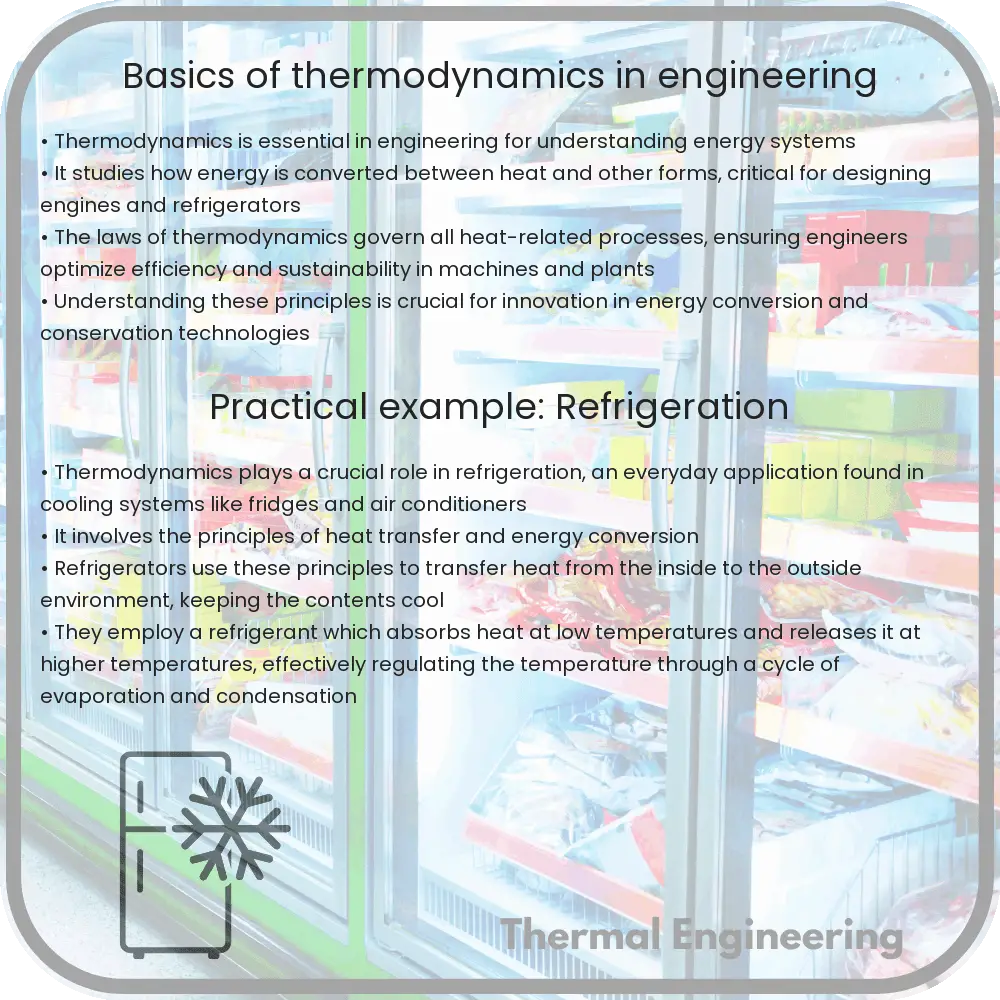
Thermodynamics is a fundamental branch of physics and engineering that describes how heat and energy are transformed and used within systems. This scientific discipline is crucial in developing efficient energy systems, engines, refrigerators, and countless other systems. In this article, we’ll explore the core concepts and laws that underpin thermodynamics in an engineering context.

Core Concepts of Thermodynamics

At its heart, thermodynamics deals with the concepts of heat, work, temperature, and energy. Here are the basics:

  • Heat (Q): Energy that is transferred between systems due to a temperature difference.
  • Work (W): Energy transferred when an external force moves a body.
  • Temperature (T): A measure of the average kinetic energy of the particles in a system.
  • Energy (E): The capacity to do work or produce heat.

These concepts are linked by the first law of thermodynamics or the law of energy conservation, which states that energy cannot be created or destroyed in an isolated system.

The Laws of Thermodynamics

The behavior of these quantities is governed by four fundamental laws:

  1. The Zeroth Law of Thermodynamics: If two systems are in thermal equilibrium with a third system, they are also in equilibrium with each other. This law establishes the concept of temperature.
  2. The First Law of Thermodynamics: The change in internal energy of a system is equal to the heat added to the system minus the work done by the system on its surroundings. Mathematically, it’s expressed as ΔE = Q – W.
  3. The Second Law of Thermodynamics: Heat does not spontaneously transfer from a cooler body to a hotter one and the entropy of a closed system always increases over time. This law explains the direction of thermal processes and the concept of entropy.
  4. The Third Law of Thermodynamics: As the temperature of a system approaches absolute zero, the entropy of the system approaches a minimum value. This law is crucial for understanding cryogenics and absolute zero behavior.

Applications of Thermodynamics in Engineering

Thermodynamics principles are applied extensively in various fields of engineering:

  • Mechanical Engineering: Design and analysis of engines, power plants, heating, ventilation, and air conditioning systems (HVAC).
  • Chemical Engineering: Process design for chemical reactions, energy management in manufacturing, and material synthesis.
  • Civil Engineering: Environmental control in buildings and structures, and energy efficiency in construction processes.
  • Electrical Engineering: Thermodynamic analysis in the generation and transmission of electricity, and in the cooling of electrical components.

Conclusion

Understanding the basics of thermodynamics equips engineers with the necessary tools to analyze energy systems and enhance their efficiency. It provides a framework for solving complex problems in energy management, system optimization, and sustainability, which are central concerns in today’s engineering challenges. Consequently, thermodynamics not only enriches the theoretical foundation of engineering but also has extensive practical applications across various engineering disciplines.

How Do Radiators Heat Rooms Efficiently?

Learn how radiators use convection, material properties, and design features to efficiently heat rooms.

How Do Radiators Heat Rooms Efficiently?

How Do Radiators Heat Rooms Efficiently?

Radiators are a common feature in many homes, particularly in regions that experience cold weather. But how exactly do these relatively simple devices efficiently heat up a room? Understanding the basic concepts of heat transfer and the design of radiators can shed light on how they effectively distribute warmth throughout indoor spaces.

The Basics of Radiator Operation

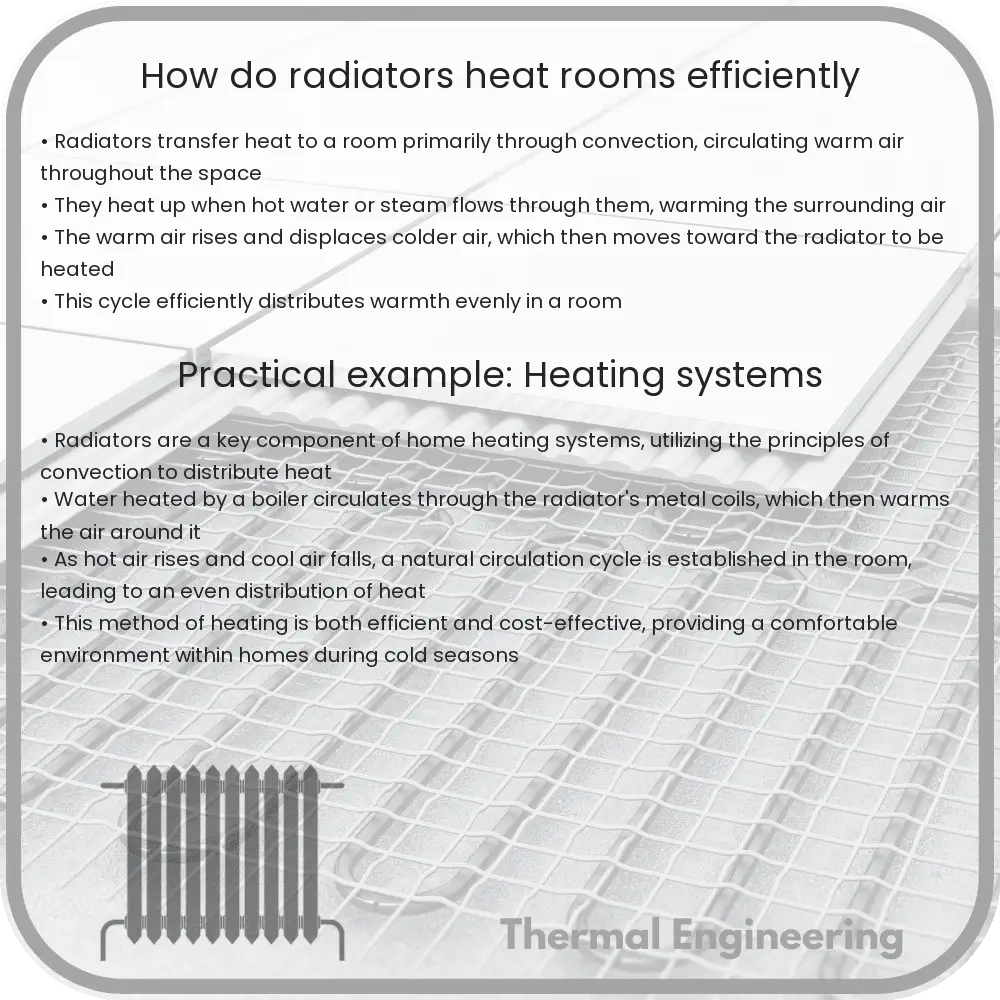
Radiators work primarily through a process called convection heating. Here is the step-by-step process of how a radiator operates:

  1. Heating the water: Radiators are typically connected to a boiler where water is heated. This hot water is then pumped through a closed piping system to the radiators.
  2. Emitting heat: As hot water enters the radiator, the heat from the water is transferred to the metal surface of the radiator through a process called conduction.
  3. Convection currents: Once the radiator itself heats up, it heats the air around it. The warm air rises and cooler air moves in to take its place, creating a natural circulation called convection. This process helps distribute warm air throughout the room.

This cycle continues, with the radiator repeatedly heating the air surrounding it, thereby warming up the room efficiently and steadily.

Design Features That Enhance Efficiency

The design of a radiator can significantly impact its efficiency. Some key features include:

  • Material: Radiators are usually made from metals like steel, aluminum, or cast iron, which are excellent conductors of heat. Aluminum, for instance, heats up quickly and is lightweight, while cast iron retains heat for longer periods.
  • Surface area: The more surface area a radiator has, the more heated air can circulate around it. Manufacturers often design radiators with fins or columns that increase surface area, promoting better heat distribution.
  • Placement: Proper placement of a radiator can also affect its efficiency. Ideally, radiators should be placed under windows or on external walls to counteract the cold air from outside. This positioning helps create a thermal curtain that enhances the convection process.

Advanced Technologies in Radiator Design

In addition to traditional designs, modern radiators incorporate advanced technologies to improve efficiency:

  • Thermostatic Radiator Valves (TRVs): These allow for automatic adjustment of the heat output based on the room’s temperature, reducing energy consumption and enhancing comfort.
  • Low water content radiators: These radiators heat up and cool down faster than traditional designs, providing a quicker response to changes in heating demand and enhancing overall energy efficiency.

Conclusion

Radiators are more than just metal structures standing in the corner of a room. Their design and operation hinge on complex principles of thermodynamics and heat transfer. By optimally transferring heat from hot water to the room via convection and employing materials and designs that maximize heat distribution, radiators can effectively and efficiently warm spaces, creating comfortable living and working environments, especially in cold climates.

Understanding the science behind radiator efficiency not just aids in appreciating the engineering but can also guide better usage and maintenance practices, leading to more sustainable and cost-effective home heating solutions.

How Do Heat Pumps Work in Cold Climates?

Learn how heat pumps function efficiently in cold climates by utilizing advanced technology and design adaptations.

How Do Heat Pumps Work in Cold Climates?

How Do Heat Pumps Work in Cold Climates?

Heat pumps are a popular and efficient option for heating and cooling homes, even in cold climates. But how exactly do they manage to extract heat from chilly outdoor air and use it to warm a home? This article explains the principles behind the operation of heat pumps in cold environments, their components, and the technology that enhances their effectiveness in lower temperatures.

The Basic Operation of Heat Pumps

At its core, a heat pump uses the principles of heat transfer to move heat from one location to another via a refrigerant. The process involves several key steps and components:

  • Evaporator Coil: Here, the refrigerant absorbs heat from the outside air, even when temperatures are low.
  • Compressor: The compressor increases the pressure of the refrigerant, raising its temperature.
  • Condenser Coil: Once the refrigerant is heated and pressurized, it is moved to the condenser coil inside the home, where the heat is released into the home’s heating system.
  • Expansion Valve: This component reduces the pressure of the refrigerant, cooling it down before it returns to the evaporator coil to repeat the cycle.

Challenges in Cold Climates

Colder climates present unique challenges to heat pumps, primarily because the colder the outside air, the less heat there is available for the heat pump to transfer inside. As temperatures drop, most standard heat pumps become less efficient and may struggle to provide sufficient warmth.

Technological Adaptations for Cold Climates

To address these challenges, several technological adaptations have been developed:

  • Dual-Fuel Systems: These systems pair a heat pump with a more traditional heating system, such as a gas furnace. The heat pump operates when temperatures are moderate, and the furnace kicks in only when extremely cold conditions make the heat pump less efficient.
  • Advanced Compressors: Some heat pumps are equipped with variable-speed or two-stage compressors that can adjust their output depending on the demand, improving efficiency and performance in lower temperatures.
  • Enhanced Vapor Injection: This technology allows heat pumps to boost output and efficiency in cold weather by injecting vapor into the compressor at strategic points of the heating cycle.

Moreover, newer models of heat pumps are built specifically for cold climates (often referred to as “cold climate heat pumps”) and can perform effectively at temperatures as low as -15°F or lower. These systems utilize special designs and refrigerants capable of extracting heat from severely cold air.

Conclusion

Heat pumps are not only suitable for moderate climates but, with the right technology and design, can also provide an efficient heating solution in cold climates. Innovations like dual-fuel systems, advanced compressors, and enhanced vapor injection have significantly improved the performance of heat pumps in cold weather, making them a smart choice for energy-conscious homeowners in colder regions.

Understanding the function and capabilities of heat pumps in differing climatic conditions can help homeowners make informed decisions about their heating and cooling needs, ensuring comfort regardless of the temperature outside.

Understanding Refrigeration: Basic Principles

Explore the fundamental principles and processes of refrigeration, including the refrigeration cycle, thermodynamics, and practical applications.

Understanding Refrigeration: Basic Principles

Understanding Refrigeration: Basic Principles

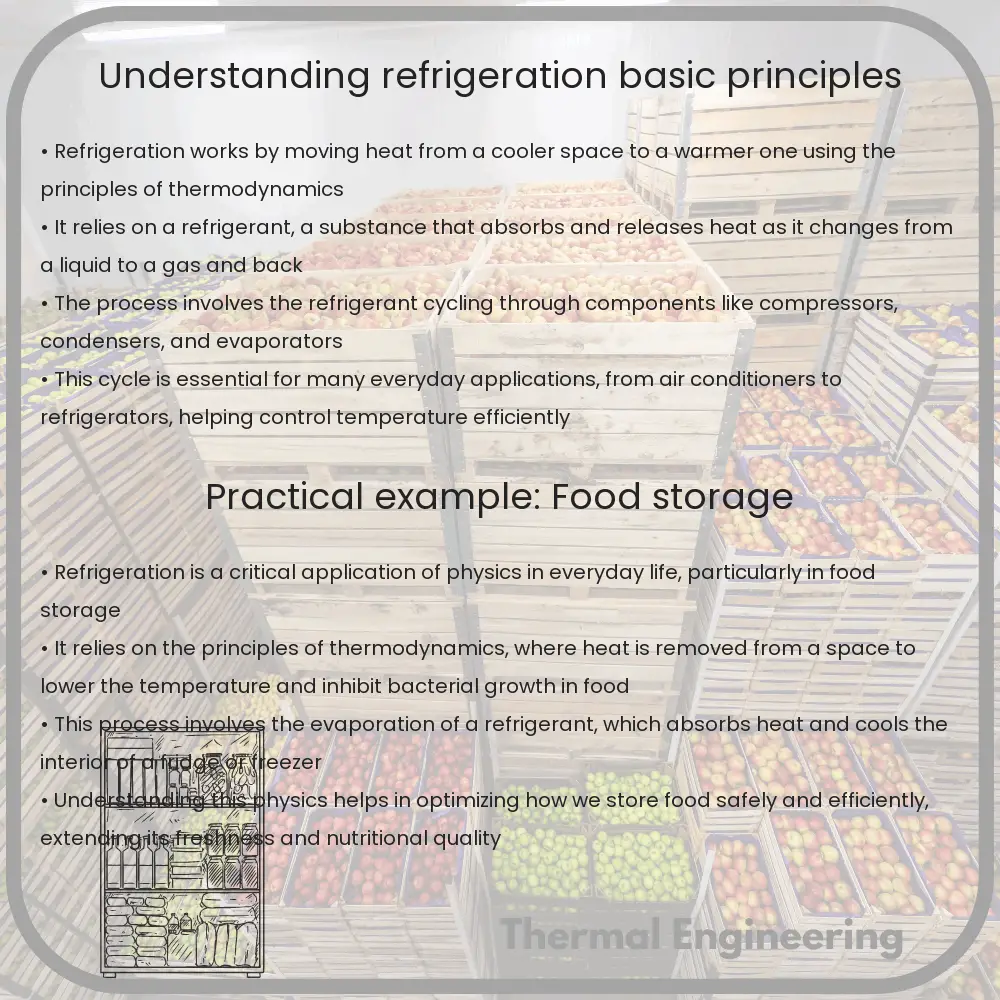
Refrigeration is an essential technology that impacts daily life through applications like food preservation and air conditioning. At its core, refrigeration is about moving heat from one place to another to achieve cooling. Here, we’ll delve into how this process works, covering the basic principles that underlie all refrigeration systems.

The Refrigeration Cycle

The refrigeration cycle is a series of stages that involve the compression, condensation, expansion, and evaporation of a refrigerant. Each component of the cycle plays a crucial role:

  1. Compression: The refrigerant, initially in a low-pressure gas form, is compressed by the compressor. This process increases the pressure and temperature of the refrigerant, turning it into a high-pressure gas.
  2. Condensation: The high-pressure, high-temperature gas flows through the condenser. Here, the gas releases its heat to the surroundings (usually the air or water outside the system), and it cools down and condenses into a high-pressure liquid.
  3. Expansion: The high-pressure liquid passes through an expansion device (like a valve or capillary tube) which reduces its pressure. This sudden reduction in pressure cools the liquid further as it prepares to enter the evaporator.
  4. Evaporation: In the evaporator, the now low-pressure, cold liquid refrigerant absorbs heat from the interior of the refrigerator or the area to be cooled. As it absorbs heat, it evaporates back into a low-pressure gas, and the cycle starts again with the compressor.

The continuous circulation of the refrigerant through these stages results in the removal of heat from one place and its release into another, effectively lowering the temperature in the refrigerated space while expelling heat to the environment.

Thermodynamic Principles

Refrigeration exploits basic principles of thermodynamics, particularly those regarding temperature, heat transfer, and the behavior of gases:

  • First Law of Thermodynamics: This law, also known as the conservation of energy, indicates that energy can neither be created nor destroyed, only transferred or changed in form. In refrigeration, this principle explains transferring heat from a cooler to a warmer area.
  • Second Law of Thermodynamics: This law states that heat does not naturally flow from a colder area to a warmer area without work being done (e.g., by the compressor).

Refrigerants

Refrigerants are substances used in a refrigeration system to absorb and transport heat. They have properties that allow them to change states at convenient temperatures and pressures within the cycle. Historically, substances like ammonia, carbon dioxide, and various halocarbons have been used. Modern refrigerants are often chosen based on their performance, environmental impact, and safety—factors like global warming potential (GWP) and ozone depletion potential (ODP) are considered critical.

Applications of Refrigeration

Refrigeration has diverse applications beyond keeping food cold in homes and supermarkets. Significant usages include:

  • Air Conditioning: Residential and commercial buildings are kept cool in warm climates.
  • Industrial Processes: Certain chemical processes require low temperatures.
  • Medical Storage: Many medications and vaccines need refrigeration to maintain efficacy.

Understanding the basic principles of refrigeration not only informs us about a technology ubiquitous in daily life but also underscores the importance of engineering and thermodynamics in creating sustainable, effective solutions to human needs.

What Is Thermal Conductivity in Materials?

Learn about thermal conductivity, a key property of materials that describes their ability to conduct heat, crucial in many engineering applications.

What Is Thermal Conductivity in Materials?

Understanding Thermal Conductivity in Materials

Thermal conductivity is a fundamental property of materials that describes their ability to conduct heat. It plays a critical role in engineering, materials science, and various applications like building construction, automotive, and electronics cooling. In this article, we will explore what thermal conductivity is, how it is measured, and how it affects the performance of different materials.

Definition and Fundamentals

Thermal conductivity, denoted as k or λ, is a measure of a material’s ability to transfer heat through conduction. Conduction is the process by which heat energy is transmitted through collisions between neighboring molecules or atoms in a substance. The faster this energy transfers, the higher the thermal conductivity.

The thermal conductivity of a material can be expressed using the following equation:

k = (Q * L) / (A * ΔT * t)

  • Q is the amount of heat transferred (in joules or watts per second)
  • L is the thickness of the material (in meters)
  • A is the area through which heat is transferred (in square meters)
  • ΔT is the temperature difference across the material (in degrees Celsius or Kelvin)
  • t is the time over which the heat transfer takes place (in seconds)

Factors Influencing Thermal Conductivity

The thermal conductivity of a material depends on several factors:

  • Material type: Metals generally have higher thermal conductivity than insulators. For example, copper and aluminum are excellent conductors of heat, while materials like rubber and wood are poor conductors.
  • Temperature: The conductivity of materials typically changes with temperature. For many materials, conductivity decreases as temperature increases.
  • Impurities and structure: The presence of impurities, defects, and the overall structure of the material can significantly affect its thermal conductivity. For example, pure crystalline materials usually have higher conductivity than amorphous materials or those with many defects.

Measurement Techniques

Thermal conductivity can be measured using various techniques, such as:

  • Steady-state methods: These involve maintaining a constant temperature difference across a sample and measuring the steady heat flow.
  • Transient methods: These methods, such as the laser flash technique, involve observing how a material responds to a sudden change in temperature.

These methods help determine the suitability of a material for specific applications based on its heat conduction properties.

Applications and Importance

Understanding and controlling thermal conductivity is crucial in various engineering fields:

  • Building and construction: Materials with low thermal conductivity are used for insulation to reduce energy consumption in buildings.
  • Electronics: High thermal conductivity materials, like copper and silver, are used to dissipate heat in devices, preventing overheating and ensuring the longevity and reliability of electronic components.
  • Automotive: Thermal management systems in vehicles also rely on materials with appropriate thermal conductivities to manage heat effectively.

In conclusion, thermal conductivity is a vital material property that significantly impacts both everyday and industrial applications. By selecting materials with the right thermal properties, engineers can create more efficient, durable, and safe products and structures.

Ram Pump | Gravity Principle & Irrigation Use

Learn how the ram pump, a hydraulic device, utilizes gravity and the water hammer effect to transport water without electricity.

Ram Pump | Gravity Principle & Irrigation Use

Understanding the Ram Pump and Its Principles

The ram pump, often known as a hydraulic ram, is a fascinating example of utilizing basic physics to achieve practical engineering tasks, such as transporting water to locations without the use of electricity. This device leverages the power of gravity and the momentum of flowing water to pump a portion of that water to heights greater than its original source without using any external energy sources such as electricity or fuel.

How Does a Ram Pump Work?

At its core, a ram pump operates using the water hammer effect—a phenomenon occurring when a flowing fluid is suddenly forced to stop or change direction, creating a surge or spike in pressure. The pump consists of a few main components:

  • Inlet pipe (drive pipe): This is the long pipe that channels flowing water from a higher elevation down into the pump.
  • Waste valve: This valve, also known as the clack valve, opens and closes under the pressure of moving water, allowing a small amount of water to exit periodically, thereby creating the necessary water hammer effect.
  • Pressure chamber: Captures the high-pressure spike caused by the closing of the waste valve. This pressure is used to gradually force some water upwards.
  • Delivery pipe: This pipe carries the water that is pumped upward to its storage location or area of use.

The cycle begins with water flowing into the ram pump from the inlet pipe. The water’s flow and gravity force the waste valve to close, which momentarily increases pressure in the pump. The increased pressure opens a delivery valve, pushing some water into the delivery pipe and into the pressure chamber. When the pressure decreases, the waste valve reopens to release excess water and the cycle repeats.

Gravity’s Role in the Ram Pump

Gravity is essential for the operation of a ram pump. It affects both the inlet flow and the pumping mechanism. The water source must be situated high enough above the pump to create adequate pressure and flow speed in the inlet pipe. This kinetic energy stemming from gravity helps create the conditions necessary for the water hammer effect to occur.

Irrigation Use of Ram Pumps

Ram pumps are particularly useful in agricultural practices for irrigation purposes, especially in remote areas where electric power is scarce or non-existent. They can transport water from lower to higher ground, distributing it over farmland that would otherwise be dependent on manual watering or rain. This ability to lift water to substantial heights without using electrical power is not only cost-effective but also environmentally friendly, as it uses no fossil fuels and has minimal environmental impact.

Advantages:

  • Energy efficiency: Operates without electricity or fuel.
  • Low maintenance: Few moving parts mean it is relatively low maintenance.
  • Durability: Can operate for years if properly maintained.

Limitations:

  • Initial setup costs: Can be initially expensive to set up, especially if the source of water is quite far from the area of use.
  • Dependence on water source: Requires a consistent source of flowing water to operate effectively.

Despite these limitations, the ram pump remains a valuable tool for sustainable agriculture and a classic example of practical engineering that exploits basic physical laws to solve real-world problems.

High-temperature superconductors

Learn about high-temperature superconductors, materials that conduct electricity without resistance at higher critical temperatures, revolutionizing multiple technologies.

High-temperature superconductors

Understanding High-Temperature Superconductors

Superconductors are materials that can conduct electricity without resistance when they are cooled to certain critical temperatures. Traditionally, these temperatures have been very low, close to absolute zero (-273.15°C). However, high-temperature superconductors (HTS) operate at significantly higher temperatures, making them more practical for a broader range of applications.

Discovery and Types of High-Temperature Superconductors

High-temperature superconductors were first discovered in 1986 by IBM researchers Georg Bednorz and K. Alex Müller, who found that certain ceramic copper-oxide materials exhibited superconductivity at temperatures higher than previously thought possible. This discovery won them the Nobel Prize in Physics in 1987. The main families of high-temperature superconductors include:

  • YBCO (Yttrium Barium Copper Oxide) with a critical temperature of about 92 K (-181.15°C)
  • BSCCO (Bismuth Strontium Calcium Copper Oxide) and
  • TBCCO (Thallium Barium Calcium Copper Oxide) with higher critical temperatures still.

The discovery of these new superconducting materials has significant implications for various fields, from medical technologies to transportation systems.

How High-Temperature Superconductors Work

Superconductors work based on the principle of Cooper pairs, where two electrons interact weakly through lattice vibrations and pair up to flow without energy loss. In high-temperature superconductors, despite ongoing research, the exact mechanism remains complex and somewhat elusive. However, it is primarily attributed to the electron pairing mediated through interactions with magnetic fluctuations in the copper-oxide planes of the material.

Applications of High-Temperature Superconductors

High-temperature superconductors hold the potential for revolutionizing many technologies due to their efficiency and power capabilities. Some of the promising applications include:

  • Magnetic Resonance Imaging (MRI): Superconducting magnets made from HTS materials can produce highly uniform and strong magnetic fields, essential for high-resolution imaging.
  • Power Cables: Superconducting materials can transmit electricity with negligible losses, potentially reducing energy dissipation in power grids.
  • Particle Accelerators: Superior magnetic fields generated by superconductors can be used to steer and accelerate particles more efficiently in research facilities.
  • Maglev Trains: Magnetically levitated trains can use HTS for efficient, high-speed transportation systems.

However, while high-temperature superconductors work at higher temperatures than conventional superconductors, they still require cooling, typically using liquid nitrogen, which has a boiling point of 77 K (-196.15°C). This requirement is a challenge and an area of active research.

The Future of High-Temperature Superconductors

The ongoing research aims to develop superconductors that can operate at even higher temperatures, ideally close to room temperature. Such advancements could further reduce the reliance on complex cooling systems and pave the way for more widespread adoption of superconductor-based technologies. Researchers are also exploring novel materials and compositions that may host superconductivity at higher temperatures, driving forward innovative applications across science and industry.

In conclusion, high-temperature superconductors continue to be a vibrant field of scientific inquiry and engineering application, promising a future where energy-efficient technologies are more readily accessible and effective across multiple domains.

Horizontal Axis Wind Turbine | Aerodynamics & Large Farms

Explore the aerodynamics, design, and efficiency of Horizontal Axis Wind Turbines (HAWTs) used in wind energy generation.

Horizontal Axis Wind Turbine | Aerodynamics & Large Farms

Understanding Horizontal Axis Wind Turbine Aerodynamics

Horizontal Axis Wind Turbines (HAWTs) are the most common type of wind turbine used for generating electricity. These turbines feature the main rotor shaft and electrical generator at the top of a tower, and must be pointed into the wind. The aerodynamics of these turbines are crucial for their efficiency and performance.

Basic Principles

The blades of a HAWT operate much like the wings of an airplane. Air flows over the blades generating lift, which turns the blades around the rotor. The lift generated by the wind on the blades is perpendicular to the direction of the wind. The design of the blade shape and the angle of attack (the angle between the direction of the airflow and the chord of the blade) are critical for maximizing efficiency.

Blade Design

Most HAWT blades are designed using airfoil sections, with the thickness and shape of these sections varying along the length of the blade. At the root of the blade, where loads are highest, the airfoils can be quite thick, while at the tip, they are much thinner. This variation helps manage the mechanical forces acting on the blade and optimizes performance.

Performance and Efficiency

The efficiency of a wind turbine in converting the kinetic energy of the wind into mechanical energy is constrained by the Betz Limit, which caps the maximum achievable efficiency at 59.3%. In practice, most large turbines achieve around 40-50% efficiency due to real-world factors such as air viscosity, turbine design imperfections, and other losses.

The power available from the wind can be expressed with the equation:

P = 0.5 * ρ * A * V3

Where:

  • ρ (rho) is the air density,
  • A is the swept area of the turbine blades,
  • V is the wind speed.

The Role of Large Wind Farms

When evaluating the role of large wind farms composed of many HAWTs, both environmental impact and efficiency of space usage become significant considerations. These farms can be found both onshore and offshore.

Aerodynamic Effects in Wind Farms

In large wind farms, the placement of turbines relative to each other affects individual turbine and overall farm efficiency due to wake effects. When wind passes through a turbine, it creates a wake behind it where the wind speed is reduced and turbulence is increased, potentially affecting the output of turbines situated downstream.

Optimizing Layout for Aerodynamic Efficiency

To mitigate wake effects, substantial planning is required to arrange the turbines. This spacing depends on various factors including the prevailing wind direction and the geographic layout of the installation site. Generally, turbines are spaced about 3-5 times the diameter of the rotor apart in the direction perpendicular to the wind, and 7-10 diameters apart in the direction parallel to the wind.

Environmental and Economic Considerations

Wind farms must also balance energy production with environmental and social impacts. Concerns such as noise pollution, visual impacts, and effects on local wildlife habitats must be managed. Economically, the scale of these projects can benefit from economies of scale in engineering, procurement, and construction, lowering the cost per kilowatt-hour of energy produced as the farm size increases.

Conclusion

Horizontal Axis Wind Turbines play a crucial role in modern renewable energy strategies. Understanding the aerodynamics of these turbines and the interplay between individual turbines in large farms is essential for improving their efficiency and reducing their environmental footprint. As technology and modeling techniques improve, so too will the capability to design optimal wind farm layouts that maximize energy production while minimizing adverse effects.