Facebook Instagram Youtube Twitter

Cryogenic Pump | LNG Transfer & Space Use

Learn about cryogenic pumps, their function, types, and applications in industries like LNG transfer and space technology.

Cryogenic Pump | LNG Transfer & Space Use

Understanding Cryogenic Pumps

Cryogenic pumps are specialized devices designed to handle extremely cold liquids and gases at temperatures typically below -150 degrees Celsius (-238 degrees Fahrenheit). These pumps play a critical role in various industries, particularly in transferring liquefied natural gas (LNG) and in space exploration applications. This article will explore how cryogenic pumps work, their types, and their applications in LNG transfer and space technology.

How Cryogenic Pumps Work

The primary function of a cryogenic pump is to safely and efficiently transport cryogenic fluids. These pumps are designed to tolerate low temperatures by using materials that can withstand severe thermal contraction and expansion. The working principle of cryogenic pumps generally involves the conversion of rotational energy from a motor into fluid energy using the dynamics of rotating impellers. This process increases the pressure of the fluid being pumped, allowing for effective fluid movement and control at low temperatures.

Types of Cryogenic Pumps

  • Submerged Pumps: These pumps are installed inside the cryogenic liquid they are intended to pump. The pump motor is also submerged, and thus, it typically utilizes liquid-cooled mechanisms to handle extreme cold.
  • Externally Mounted Pumps: These pumps are situated outside of the cryogenic reservoir. They are connected through a shaft or other mechanisms to an impeller submerged in the cryogenic fluid. Special designs are used to prevent heat transfer to the cryogenic liquid.

Cryogenic Pumps in LNG Transfer

Liquefied Natural Gas (LNG) is primarily methane gas that has been cooled to about -162 degrees Celsius (-260 degrees Fahrenheit). The liquefaction of natural gas significantly reduces its volume, making it easier and more economical to transport and store. Cryogenic pumps are essential in this sector for the efficient loading and unloading of LNG from storage tanks to ships or trucks.

During the transfer process, submerged cryogenic pumps are commonly used due to their efficiency and safety. They pump LNG directly from the storage tanks to the transfer system, effectively handling the LNG at its boiling point without causing vaporization or pressure spikes which could jeopardize the containment systems.

Applications of Cryogenic Pumps in Space Exploration

Space exploration requires the handling of cryogenic fluids not just for fuel—such as liquid hydrogen and liquid oxygen—but also for life support systems in spacecraft. Cryogenic pumps facilitate the transfer of these essential fluids under controlled conditions to fuel rockets or maintain necessary life-support reserves.

One remarkable challenge in space is minimal gravity, which affects the typical operation of pumps. Cryogenic pumps used in space missions often incorporate sophisticated technology to manage the fluids effectively in these extreme conditions. Designs may include magnetic bearings and special induction motors to reduce the risk of mechanical failure and enhance the reliability of fluid transfer in space.

Conclusion

Cryogenic pumps are pivotal in both LNG industries and space technology. Their ability to efficiently manage the storage, transfer, and handling of extremely cold fluids makes them indispensable in modern engineering applications. Understanding these pumps not only highlights a key area of engineering innovation but also underscores the importance of specialized equipment in achieving economic efficiency and advancing our capabilities in space exploration.
Regenerative Turbine Pump | High Head & Boiler Feed

Learn about regenerative turbine pumps, their unique design, operation, and key applications in industrial systems.

Regenerative Turbine Pump | High Head & Boiler Feed

Understanding the Regenerative Turbine Pump

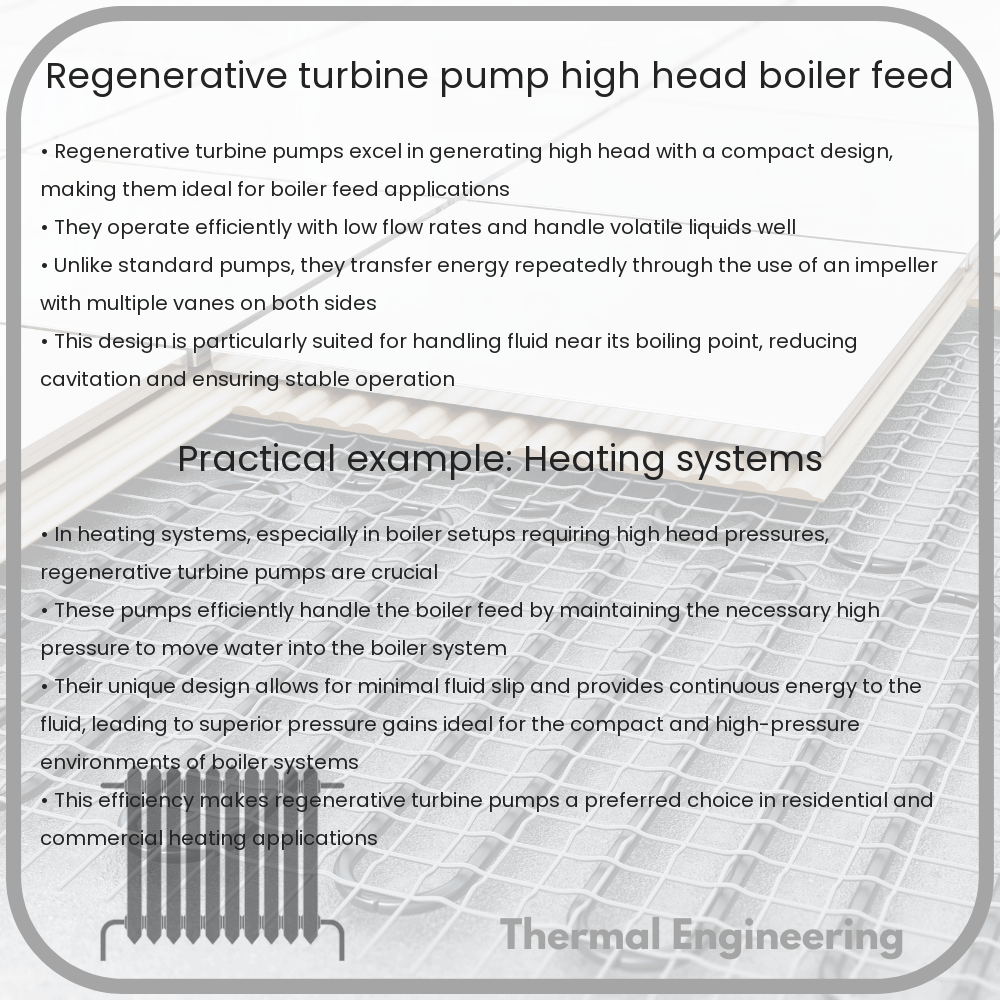
Regenerative turbine pumps are specialized types of centrifugal pumps used primarily for applications requiring high heads at low flow rates. They are distinguishable from other centrifugal pumps by their unique impeller design and the way they utilize fluid mechanics to increase the energy of the pumping fluid. Common applications include boiler feed systems, condensate return, and high-pressure water injections.

How Regenerative Turbine Pumps Work

The key component of a regenerative turbine pump is its impeller, which is equipped with numerous radial blades on its circumference. Unlike conventional impeller designs, the fluid in regenerative turbine pumps flows in a circular path through channels between the blades, gaining energy with each pass through the impeller. As the fluid moves through the impeller multiple times, it gains head each cycle, enabling the delivery of fluid at high pressures while maintaining a compact design.

Advantages of Regenerative Turbine Pumps

  • High Head at Low Flows: These pumps are particularly effective for systems requiring high pressures but at lower flow rates, making them ideal for applications like boiler feed water pumps.
  • Smooth Flow: Regenerative turbine pumps provide a relatively steady flow without the pulsations typical in other types of pumps like piston or diaphragm pumps.
  • Compact Design: Their unique design allows for a more compact and efficient setup compared to other pumps that might require larger geometries to achieve similar pressures.
  • Handling of Vapor: These pumps are capable of handling significant amounts of entrained vapors without losing efficiency, which is particularly important in applications such as condensate return systems.

Application in Boiler Feed Systems

One of the primary applications of regenerative turbine pumps is in boiler feed systems. These pumps are tasked with supplying water to boilers where it is heated to produce steam. The boilers typically operate at high pressures, and thus require the feed water to be delivered at high pressures as well to avoid boiling within the feed line. The ability of regenerative turbine pumps to generate substantial head from a compact form factor makes them highly suitable for this role. Their efficiency in handling vapors also helps prevent cavitation, which can otherwise reduce the lifespan of pump components.

Considerations for Use

While regenerative turbine pumps offer several advantages, there are considerations to keep in mind:

  • Sensitivity to Changes: The performance of regenerative turbine pumps can be sensitive to changes in system conditions such as flow rate and pressure, which may impact their operating efficiency and lifespan.
  • Wear and Tear: The high speeds and pressures involved can lead to increased wear and tear unless carefully maintained and monitored.
  • Cost: Typically, these pumps can be more expensive than other types given their specialized design and materials used for high-pressure applications.

In conclusion, regenerative turbine pumps are pivotal in applications requiring high heads with low to moderate flow rates, such as in boiler feed systems. Their ability to efficiently handle vapor and provide stable, high-pressure outputs in compact installations makes them a preferred choice in many industrial applications. However, potential users should weigh their benefits against considerations such as maintenance and cost.

Ducted Wind Turbine | Urban Efficiency Increase

Ducted wind turbines (DWTs), also known as diffuser-augmented wind turbines, use a shroud to increase urban wind energy efficiency.

Ducted Wind Turbine | Urban Efficiency Increase

Exploring the Potential of Ducted Wind Turbines for Urban Efficiency

Ducted wind turbines (DWTs), also known as diffuser-augmented wind turbines (DAWTs), present an innovative approach to enhance the efficiency and feasibility of wind energy in urban environments. Unlike traditional wind turbines, DWTs utilize a shroud or duct to channel and accelerate wind flow to the turbine blades, potentially offering a more compact and efficient solution suitable for urban settings.

Design and Working Principle

The primary distinction of a Ducted Wind Turbine lies in its design. It includes a traditional wind turbine enclosed within an aerodynamic duct, which acts to funnel and accelerate the wind’s speed as it reaches the turbine blades. This acceleration results from the Venturi effect—a phenomenon where wind speed increases while its dynamic pressure decreases as it passes through a constricted path. The result is a significant boost in wind turbine efficiency, which can generate more electricity than an unducted turbine of the same size.

Benefits of Ducted Wind Turbines in Urban Areas

  • Increased Efficiency: The duct enhances the wind speed at the turbine rotor, which can increase the power output significantly compared to non-ducted turbines. This is particularly useful in urban areas, where wind speeds are generally lower than in rural areas.
  • Reduced Space Requirement: Because the efficiency is increased, DWTs can be smaller in size while providing the same power output. This is essential in densely built-up urban environments where space is at a premium.
  • Noise Reduction: The duct also helps in reducing noise, a crucial advantage in noise-sensitive urban applications.
  • Bird Safety: The enclosed design can reduce bird strikes, which is beneficial for urban settings with dense bird populations.

Challenges and Considerations

Despite their advantages, DWTs face several challenges that must be addressed to maximize their urban efficiency:

  • Design Complexity: The addition of a duct adds to the complexity of design and installation, potentially increasing the cost.
  • Aesthetic Impact: Ensuring that DWTs integrate well into the urban landscape without negatively impacting aesthetics is a significant consideration for urban planners and designers.
  • Maintenance: The enclosed nature of the turbine might complicate maintenance and repair operations, requiring more specialized skills and tools.

Case Studies and Real-World Applications

Several cities around the world have begun to explore and implement DWTs. For instance, a project in Japan has successfully demonstrated that small DWTs can be installed on building rooftops, effectively harnessing urban wind channels without significant noise or visual impact. Similarly, certain European trials have shown the practicality of integrating DWTs into both new and existing buildings to contribute to energy needs.

Conclusion

The integration of ducted wind turbines in urban settings promises enhanced energy efficiency and reduced environmental impact. With ongoing research and development, DWTs have the potential to become a more common sight in cities around the world, contributing to sustainable urban energy solutions. However, overcoming the technical, aesthetic, and financial challenges will be crucial in determining their future viability and success.

By harnessing innovative technologies like DWTs, urban areas can make significant strides towards energy independence and sustainability, making them a key component of future smart city initiatives.

Impulse Turbine | Jet Efficiency in Power Generation

Learn about impulse turbines and their role in enhancing jet efficiency for optimal power generation in hydroelectric systems.

Impulse Turbine | Jet Efficiency in Power Generation

Understanding Impulse Turbines and Jet Efficiency in Power Generation

Impulse turbines are a type of turbine that harness the energy of high-speed jets of fluid to generate electricity. One of the most common examples of an impulse turbine is the Pelton wheel, widely used in hydroelectric power generation. This article explores the fundamental principles of impulse turbines, focusing on how jet efficiency impacts power generation.

What is an Impulse Turbine?

An impulse turbine operates using the principle of impulse, i.e., a change in momentum. In these turbines, a high-speed jet of fluid strikes the turbine blades, transferring its momentum to the turbine, which is converted into mechanical work. Key characteristics of impulse turbines include:

  • Operation at high heads and low flow rates: Impulse turbines are most efficient under conditions where water is available at high head and low flow rate.
  • No pressure change: The fluid undergoes no significant pressure change as it passes through the turbine, unlike reaction turbines where both the pressure and velocity of the fluid change.

Components of an Impulse Turbine

The main components of an impulse turbine include:

  • Nozzle: This component converts the hydrostatic pressure of incoming fluid into kinetic energy, forming a high-speed jet.
  • Runner with buckets: A wheel equipped with specially shaped buckets that capture the jet, changing the direction of the fluid flow to extract maximum energy and generate torque.

The Concept of Jet Efficiency

Jet efficiency is a critical factor in the effectiveness of impulse turbines and reflects the turbine’s ability to convert the kinetic energy of the jet into mechanical energy effectively. The efficiency of a jet in an impulse turbine can be expressed as:

ηjet = (Actual Output Energy / Jet’s Kinetic Energy) * 100%

The efficiency largely depends on factors like the design of the buckets, the speed of the turbine runner, and the alignment of the jet with respect to the buckets. Losses primarily occur due to:

  • Splash losses: Where water splashes out of the buckets rather than contributing to turning the runner.
  • Friction losses: Energy lost due to the friction of the fluid against the surfaces of the buckets and runner.

Maximizing Jet Efficiency in Power Generation

To optimize jet efficiency and thereby maximize power generation, several strategies can be employed:

  • Optimal nozzle design: Designing nozzles that provide a smooth, consistent flow reduces turbulence and increases the fluid jet’s stability impacting the buckets.
  • Bucket shape optimization: Tailoring the shape of the buckets to ensure that they capture and redirect as much of the jet’s energy as possible is crucial.
  • Precise alignment: Ensuring precise alignment of the jet with the buckets minimizes the energy lost from splash and misdirected flows.

By understanding and enhancing jet efficiency, the performance of impulse turbines in power generation can be significantly improved, leading to more efficient energy production. This aspect of turbine technology is particularly important in applications like hydroelectric power, where maximizing the energy extracted from water is essential for economic and environmental sustainability.

In conclusion, impulse turbines represent a sophisticated application of fundamental physics principles in engineering to harness natural energy sources. The efficiency of these systems, particularly the efficiency of the jet striking the turbine, is critical in determining the overall effectiveness and sustainability of power generation systems.

Slurry Pump | Abrasion Resistance in Mining

Learn how slurry pumps transfer abrasive slurries in mining, their design, types, and materials for abrasion resistance.

Slurry Pump | Abrasion Resistance in Mining

Understanding Slurry Pumps and Abrasion Resistance in Mining

Slurry pumps are a type of centrifugal pump, lobe pump or peristaltic hose pump used in the mining industry to transfer thick, often abrasive and corrosive slurries containing solid particles. These particles can include anything from mined material to debris and sediment in a transport fluid. The primary challenge in designing and operating slurry pumps is managing the high levels of abrasion caused by the suspended particles.

Types of Slurry Pumps

Slurry pumps come in various designs, each tailored to meet different operational needs in the mining sector. The most commonly used slurry pumps in mining are:

  • Horizontal slurry pumps – These are the most common type, offering flexibility in hydraulics and adaptability to a variety of applications.
  • Vertical slurry pumps – This type is ideal when space is limited. They are often used for pumping out pits or sumps in underground mining.
  • Submersible slurry pumps – These pumps operate entirely submerged, directly handling abrasive slurries and offering increased wear resistance.

Material Selection for Abrasion Resistance

The choice of material for slurry pumps is critical, as the components must withstand a harsh environment laden with abrasive particles. Materials typically used include:

  • High-chrome alloys – Known for their excellent wear resistance and durability in handling abrasive slurries.
  • Rubber-lined pumps – These are favored for applications where sharp, jagged particles are absent, as rubber can offer superior corrosion resistance and elasticity.
  • Stainless steel – Used primarily for pumping chemical slurries or very fine abrasive particles due to its good corrosion resistance.
  • Ceramic materials – They provide excellent resistance to wear and corrosion and are used in very harsh slurry pump conditions.

Factors Influencing Abrasion in Slurry Pumps

The extent of wear in a slurry pump is influenced by several factors:

  1. Particle size and hardness: Larger and harder particles contribute to greater abrasion.
  2. Velocity of the slurry: Higher velocities increase the rate of abrasion, hence pumps often operate at speeds that minimize particle suspension while avoiding settling.
  3. Concentration of the solids: Higher concentrations mean more particles are likely to cause abrasion.
  4. Pump design: The design of the pump also matters, where smoother flow patterns can reduce wear.

Increasing Pump Lifespan Through Design and Operation

Enhancing the life expectancy of slurry pumps in abrasive conditions involves several strategic decisions:

  • Optimizing pump selection – Choosing a pump whose flow rate and pressure are well-suited to the slurry’s characteristics can reduce wear.
  • Proper material selection – Using materials best suited for the slurry conditions (taking into account particle size, shape, and hardness, as well as chemical properties).
  • Maintenance strategies – Regular maintenance and scheduled part replacement can preempt failures and extend the pump’s lifespan.

In conclusion, slurry pumps are vital to the mining industry for handling abrasive slurry mixtures. The longevity of these pumps is heavily dependent on material selection, pump type, and operational strategies. Understanding these elements ensures efficient management of the abrasion challenges faced in mining operations.

Rooftop Wind Turbine | Residential Solutions & Low Noise

Explore the benefits, challenges, and noise considerations of installing rooftop wind turbines for residential sustainable energy solutions.

Rooftop Wind Turbine | Residential Solutions & Low Noise

Rooftop Wind Turbines: Residential Solutions for Sustainable Energy

Rooftop wind turbines represent a promising solution for homeowners looking to reduce their carbon footprint and harness the power of renewable energy sources. These small-scale wind turbines can be installed on the roof of a residential building and are designed to convert wind energy into electrical energy, contributing to home electricity supply. This article explores the benefits, challenges, and noise considerations associated with rooftop wind turbines.

Understanding Rooftop Wind Turbines

Rooftop wind turbines are typically smaller than traditional wind turbines used in wind farms. They usually have a capacity ranging from a few hundred watts to several kilowatts. The most common types found on residential buildings are vertical-axis wind turbines (VAWTs) and small horizontal-axis wind turbines (HAWTs).

VAWTs are advantageous in residential settings because they can capture wind from all directions and tend to be quieter and more compact. HAWTs, on the other hand, are more similar to traditional farm wind turbines, designed to capture wind from a particular direction, and they generally have higher efficiency.

Benefits of Installing Rooftop Wind Turbines

  • Energy Independence: By generating their own electricity, homeowners can lower their dependency on the power grid, reducing electricity bills.
  • Environmentally Friendly: Wind energy is clean and sustainable, producing no greenhouse gas emissions during operation.
  • Economic Advantages: Besides reducing energy costs, some regions offer incentives like tax breaks or rebates for homes using wind energy.

Challenges of Rooftop Wind Installations

Despite the benefits, there are several challenges faced when installing wind turbines on residential rooftops:

  • Wind Speed Variability: Wind speeds are lower and more turbulent at rooftop levels compared to those at higher altitudes or open plains, potentially leading to less efficient energy production.
  • Structural Integrity: Not all roofs can support the additional load of a wind turbine, and structural modifications might be required.
  • Regulations and Permissions: Homeowners often need to navigate local zoning laws and obtain permits before installation.

Addressing Noise Concerns

One of the significant considerations for residential wind turbines is noise. Advances in technology have led to the development of low-noise turbine models, crucial for maintaining a peaceful domestic environment. Several strategies are employed in designing these turbines:

  • Blade Design: Curved or serrated blades can reduce noise by minimizing the interaction between blade edges and the air.
  • Material Choice: Using materials that dampen sound or reduce vibration can also help in lowering noise levels.
  • Placement and Orientation: Positioning the turbine optimally relative to prevailing wind directions and obstructions can alleviate noise issues.

Conclusion

Rooftop wind turbines offer a viable option for residential areas to partake in renewable energy generation. While they come with certain challenges such as efficiency and noise control, advancements in technology continue to make them more accessible and practical for everyday use. For homeowners considering this option, it is essential to evaluate both the feasibility and the potential benefits such an installation could bring to their energy consumption and sustainability goals.

Hand Pump | Manual Water Access & Rural Use

Learn about hand pumps, essential for manual water access in rural areas, including their types, operation, and role in development.

Hand Pump | Manual Water Access & Rural Use

Understanding Hand Pumps: An Essential Tool for Manual Water Access in Rural Areas

Hand pumps are mechanical devices used to manually lift water from underground sources, commonly found in rural and remote areas where access to centralized water systems is limited. These devices play a pivotal role in ensuring the availability of potable water for millions of people, significantly impacting their health and livelihood.

Types of Hand Pumps

There are several types of hand pumps, each suited for different depths and water yield requirements. The most common types include:

  • Lever Action Hand Pump: Often used for shallow wells, these pumps are simple to operate, with a handle that is moved up and down to draw water.
  • Rotary Hand Pump: Equipped with a rotating handle, this type of pump is effective for slightly deeper sources. The rotary action creates a steady flow of water.
  • Deep Well Hand Pump: Capable of drawing water from significantly deeper sources, sometimes up to several hundred feet. These pumps typically require more effort and are equipped with a cylinder placed below ground level.

How Hand Pumps Work

Hand pumps operate based on the principles of mechanical advantage and hydraulic pressure. The basic components of a hand pump include:

  • Handle: Used to manually drive the pump’s mechanism.
  • Cylinder: Houses a piston that moves up and down as the handle is operated.
  • Piston or Plunger: Seals against the cylinder walls and helps in drawing and pushing water up.
  • Check Valves: Located at the base of the pump, these allow water to enter the cylinder on the upstroke and prevent it from flowing back into the well on the downstroke.

When the handle of a hand pump is moved, it causes the piston inside the cylinder to move. On the upstroke, a vacuum is created within the cylinder, opening the inlet valve and allowing water to flow in. On the downstroke, the inlet valve closes, the outlet valve opens, and the water above the piston is pushed upwards and out of the pump spout.

Importance in Rural Development

Hand pumps are crucial in rural settings for several reasons:

  • Water Accessibility: Provide a reliable source of water in areas lacking infrastructure for water delivery.
  • Cost-Effective: Relatively inexpensive to install and maintain, making them economically viable for many communities.
  • Sustainability: Operate without electricity, using human power to draw up water, thus promoting sustainability and resilience in off-grid areas.

Maintenance and Sustainability

To ensure the longevity and proper functioning of hand pumps, regular maintenance is essential. This includes checking for leaks, ensuring the cleanliness of water sources, and lubricating moving parts. Training local communities in pump maintenance is also a key aspect of sustainable rural water supply programs.

Furthermore, selecting appropriate pumps based on the community’s needs, the local water table, and soil conditions is vital to prevent over-extraction and ensure the sustainable management of groundwater resources.

Conclusion

Hand pumps are indispensable tools that enhance water security in rural areas. By providing an accessible, reliable, and sustainable means of accessing clean water, hand pumps contribute significantly to improving the quality of life for many isolated populations. The simplicity and effectiveness of these devices have made them a cornerstone of rural development in many parts of the world.

Floating Wind Turbine | Deep Water & Offshore Energy

Explore how floating wind turbines enable harnessing offshore wind energy in deep waters, offering higher energy production and new location possibilities.

Floating Wind Turbine | Deep Water & Offshore Energy

Floating Wind Turbines: Harnessing Deep Water and Offshore Energy

As the demand for renewable energy sources intensifies, engineers and scientists around the world are turning to innovative solutions to capture wind energy in environments that were previously inaccessible. One of the most promising developments in this field is the technology of floating wind turbines. These advanced structures enable the harnessing of wind power far offshore in deep waters, where winds are typically stronger and more consistent than land-based alternatives.

Understanding Floating Wind Turbines

Floating wind turbines are not anchored directly into the ocean floor. Instead, they are mounted on floating structures that are securely anchored to the seabed using mooring lines. This approach allows the turbines to be deployed in water depths beyond 60 meters, which is generally the limit for traditional fixed-bottom turbines.

  • Platform Types: There are three main types of floating platforms used for wind turbines: spar-buoy, semi-submersible, and tension leg platform (TLP). Each type has its own advantages and is selected based on specific site conditions such as water depth and sea conditions.
  • Spar-buoy platforms use a large, weighted cylinder that extends deep underwater to stabilize the turbine.
  • Semi-submersible platforms are partially submerged and supported by pontoons, offering quicker deployment and easier access for maintenance.
  • Tension leg platform (TLP) uses taut, vertical mooring lines that minimize vertical movement and are ideal for very deep waters.

Advantages of Floating Wind Turbines

The ability to tap into offshore breezes not reachable by traditional methods provides several advantages:

  • Higher Wind Speeds: Wind speeds increase with distance from the coast and elevation above sea level, resulting in higher energy production.
  • Reduced Visual Impact: Floating turbines can be located far enough offshore to minimize visual concerns from the coast.
  • Access to New Areas: By removing the limitation of water depth, floating wind farms can be located optimally relative to wind resources and without competing for land space.

Engineering Challenges

While floating wind turbines present a host of benefits, they also introduce new engineering challenges:

  • Mooring System Design: Designing robust mooring systems that can withstand harsh marine environments while keeping the turbine stable can be complex.
  • Maintenance: Accessing turbines for maintenance and repairs is more challenging and costly when they are located offshore and subject to oceanic conditions.
  • Cost: The initial cost of deploying floating structures is higher than traditional fixed-bottom turbines, although costs are expected to decrease as the technology matures and scales.

Future Prospects

As floating wind turbine technology continues to evolve, several large-scale projects are underway or in the planning stages around the world. These projects are set to significantly increase the contribution of wind energy to the global energy mix. Advances in engineering and materials science are also expected to drive down costs, making floating wind energy a more accessible option for many countries seeking to expand their renewable energy portfolios.

In conclusion, floating wind turbines represent a significant step forward in our quest for sustainable and reliable energy sources. With continued research and development, these marvels of modern engineering could play a crucial role in powering our future while preserving our planet.

Rotary Gear Pump | Oil Transfer & High Viscosity

Learn how rotary gear pumps function, their role in oil transfer, and effectiveness in handling high-viscosity fluids, offering efficiency and reliability.

Rotary Gear Pump | Oil Transfer & High Viscosity

Understanding Rotary Gear Pumps: Their Role in Oil Transfer & Handling High-Viscosity Fluids

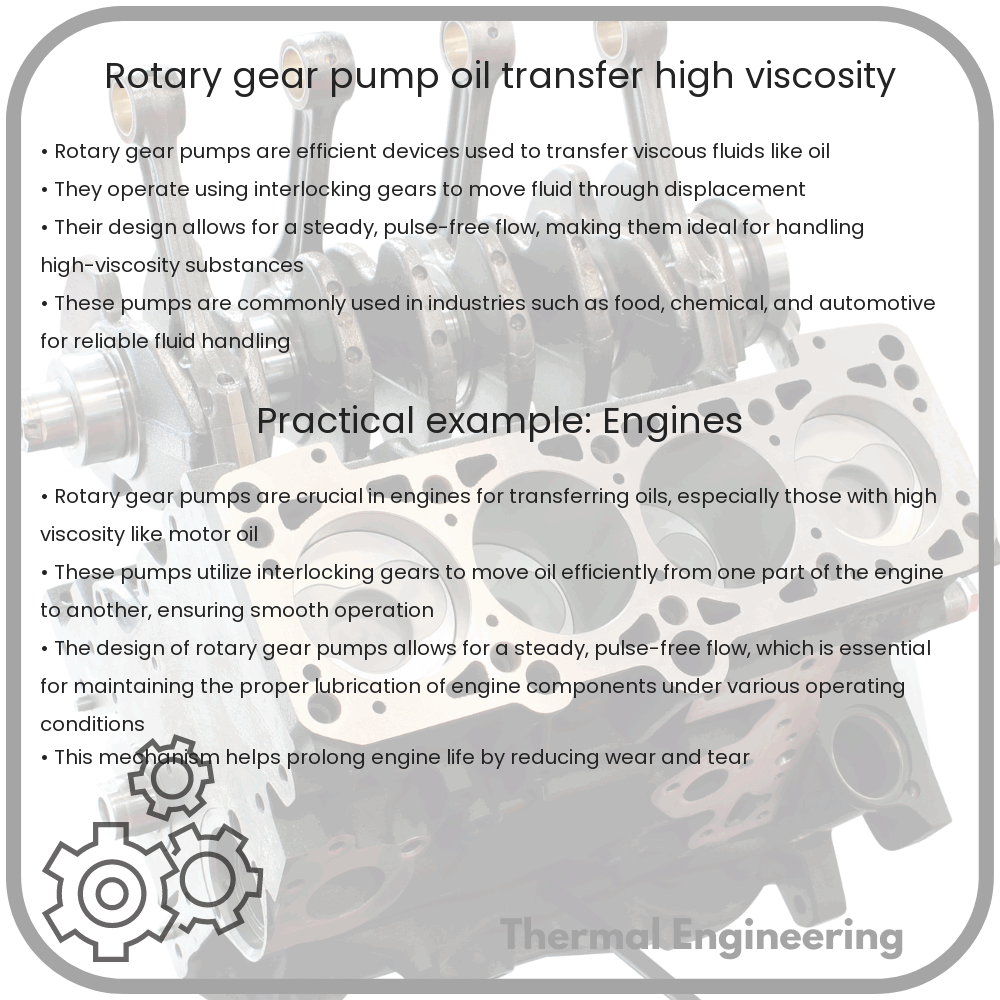
Rotary gear pumps are a vital component in many industrial and mechanical systems, particularly when transferring oil and handling high-viscosity fluids. These pumps are valued for their reliability, efficiency, and ability to handle a range of challenging pumping situations. This article explores how rotary gear pumps work, their applications, and why they are particularly suited for oil transfer and high-viscosity substances.

How Rotary Gear Pumps Work

At its core, a rotary gear pump features two gears which rotate inside a closely fitted casing. One gear is driven by a motor, and this gear drives the other. As the gears rotate, fluid on the inlet side is trapped between the teeth of the gears and the casing walls, then carried around the casing to the outlet side. The mechanism is simple but effective, relying on the continual engagement of the gears to prevent backflow, thus maintaining a steady, pulsation-free flow.

Key Components of Rotary Gear Pumps

  • Gears: These are typically spur or helical gears. Helical gears provide a smoother operation as they engage more gradually than spur gears.
  • Casing: Encloses the gears, maintaining close clearance to improve efficiency by minimizing fluid slip back to the inlet.
  • Drive Shaft: Connects to an external power source to drive the primary gear.

Applications in Oil Transfer

Rotary gear pumps are extensively used in the transfer of oil, including crude oil, lubricating oil, and fuel oil. Their efficiency and capability to handle varying viscosities and temperatures without degradation make them ideal for this role. Whether moving oil from storage tanks to processing areas or from ships to shore facilities, rotary gear pumps provide a continuous, controlled flow essential for effective fluid handling.

Handling High-Viscosity Fluids

Rotary gear pumps excel in dealing with high-viscosity fluids. High viscosity presents challenges like increased resistance which requires more power to move the fluid. Gear pumps tackle this by:

  • Operating at lower speeds, which reduces the shear rates and thus maintains fluid integrity.
  • Having tight clearances between the gears and the casing, effectively sealing the fluid and providing a smooth flow with minimal slippage.

Advantages of Using Rotary Gear Pumps

  1. Consistent Performance: Provides a steady flow necessary for processes requiring precise volumetric flows.
  2. Versatility: Capable of handling a wide range of fluids with different characteristics.
  3. High Efficiency: Tight clearances and continuous engagement of gears minimize fluid slip.
  4. Durability: Simple design with fewer moving parts reduces wear and prolongs pump life.

Conclusion

Rotary gear pumps are integral to industries requiring the efficient, reliable transfer of oils and high-viscosity fluids. Their design principles cater specifically to these needs, ensuring they remain a preferred choice for many applications. Whether in the oil industry or handling complex industrial fluids, understanding the basic operation and strengths of rotary gear pumps can contribute immensely to selecting the right pump for the job.

For industries and applications where fluid integrity and consistent flow are paramount, the rotary gear pump stands out as an essential tool, seamlessly blending simplicity with sophisticated fluid handling technology.

Pumped-Storage Hydroelectricity | Grid & Water Management

Learn about pumped-storage hydroelectricity (PSH), a key method for energy storage and grid stability in hydroelectric power generation.

Pumped-Storage Hydroelectricity | Grid & Water Management

Understanding Pumped-Storage Hydroelectricity

Pumped-storage hydroelectricity (PSH) is a type of hydroelectric power generation method that plays a critical role in grid stability and energy storage. Used predominantly for load balancing, PSH facilities allow energy utilities to manage supply and demand by storing excess electrical energy during low demand periods and releasing energy during peak demand periods.

How Pumped-Storage Works

The basic operation of pumped-storage hydroelectricity involves two water reservoirs at different elevations: one at a higher level and one at a lower level. During periods when electricity demand is low, typically at night, electricity is used to pump water from the lower reservoir to the higher reservoir. This process converts electrical energy into potential energy stored in the form of elevated water.

During periods of high electricity demand, the stored water is released back into the lower reservoir through turbines. As the water descends, it drives turbines that generate electricity by converting the gravitational potential energy back into electrical energy.

Components of a Pumped-Storage Facility

  • Pumping Station: This consists of pumps and motors that move water uphill during the storage phase.
  • Upper Reservoir: Holds the water that has been pumped from the lower reservoir.
  • Turbines and Generators: These convert the potential energy of water into mechanical and subsequently electrical energy during generation.
  • Lower Reservoir: Acts as the source of water during pumping and the receiver of water during generation.
  • Control system: Manages the operation of pumps, turbines, and flow of water to optimize efficiency and response to grid demand.

Benefits of Pumped-Storage Hydroelectricity

  • Energy Storage: PSH provides a large-scale method for storing energy, thereby enhancing the stability and efficiency of the power grid.
  • Load Balancing: Helps in balancing load by generating electricity during peak demand and absorbing excess electricity during low demand.
  • Renewable Integration: Facilitates the integration of variable renewable energy sources like wind and solar, by storing excess energy produced during high generation and low usage times.
  • Grid Reliability: Enhances grid reliability and prevents the grid from overloads by providing quick response to fluctuations in demand.
  • Carbon Emission Reduction: Helps in reducing carbon emissions by making renewable energy sources more viable and decreasing reliance on fossil-fuel-based peak power plants.

Challenges and Considerations

Pumped-storage hydroelectricity, while beneficial, comes with its own set of challenges and environmental impacts. These include the requirement for suitable geography with adequate elevation difference, potential ecological impacts due to construction and operation, and high initial capital costs. Despite these challenges, PSH remains a critical component in modern energy grids, particularly as the world increases its reliance on intermittent renewable energy sources.

In conclusion, the role of pumped-storage hydroelectricity is pivotal in modern energy systems. It not only supports grid management and enhances the reliability of electricity supply but also plays a significant role in the broader context of renewable energy adoption and carbon emission reduction. As energy demands continue to evolve, pumped-storage hydroelectricity will remain a vital element of energy strategy worldwide.