Facebook Instagram Youtube Twitter

What is Validity of Ideal Gas Law – Definition

Validity of Ideal Gas Law. The Ideal Gas Law is accurate only at relatively low pressures (relative to the critical pressure pcr) and high temperatures. Thermal Engineering

Validity of Ideal Gas Law

Since ideal gas is defined as one in which all collisions between atoms or molecules are perfectly elastic and in which there are no intermolecular attractive forces, there is no such thing in nature as a truly ideal gas. On the other hand, all real gases approach the ideal state at low pressures (densities). At low pressures molecules are far enough apart that they do not interact with one another.

In other words, the Ideal Gas Law is accurate only at relatively low pressures (relative to the critical pressure pcr) and high temperatures (relative to the critical temperature Tcr). At these parameters, the compressibility factor, Z = pv / RT, is approximately 1. The compressibility factor is used to account for deviation from the ideal situation. This correction factor is dependent on pressure and temperature for each gas considered.

 
References:
Reactor Physics and Thermal Hydraulics:
  1. J. R. Lamarsh, Introduction to Nuclear Reactor Theory, 2nd ed., Addison-Wesley, Reading, MA (1983).
  2. J. R. Lamarsh, A. J. Baratta, Introduction to Nuclear Engineering, 3d ed., Prentice-Hall, 2001, ISBN: 0-201-82498-1.
  3. W. M. Stacey, Nuclear Reactor Physics, John Wiley & Sons, 2001, ISBN: 0- 471-39127-1.
  4. Glasstone, Sesonske. Nuclear Reactor Engineering: Reactor Systems Engineering, Springer; 4th edition, 1994, ISBN: 978-0412985317
  5. Todreas Neil E., Kazimi Mujid S. Nuclear Systems Volume I: Thermal Hydraulic Fundamentals, Second Edition. CRC Press; 2 edition, 2012, ISBN: 978-0415802871
  6. Zohuri B., McDaniel P. Thermodynamics in Nuclear Power Plant Systems. Springer; 2015, ISBN: 978-3-319-13419-2
  7. Moran Michal J., Shapiro Howard N. Fundamentals of Engineering Thermodynamics, Fifth Edition, John Wiley & Sons, 2006, ISBN: 978-0-470-03037-0
  8. Kleinstreuer C. Modern Fluid Dynamics. Springer, 2010, ISBN 978-1-4020-8670-0.
  9. U.S. Department of Energy, THERMODYNAMICS, HEAT TRANSFER, AND FLUID FLOW. DOE Fundamentals Handbook, Volume 1, 2 and 3. June 1992.

See also:

Ideal Gas Law

We hope, this article, Validity of Ideal Gas Law, helps you. If so, give us a like in the sidebar. Main purpose of this website is to help the public to learn some interesting and important information about thermal engineering.

What is Internal Energy of Ideal Gas – Monatomic Gas, Diatomic Molecule – Definition

The internal energy is the total of all the energy associated with the motion of the atoms or molecules in the system and is various for monatomic gas ans diatomic molecules. Thermal Engineering

Internal Energy of an Ideal Gas

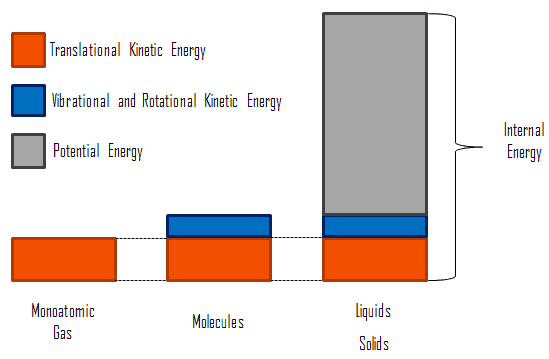
The internal energy is the total of all the energy associated with the motion of the atoms or molecules in the system. Microscopic forms of energy include those due to the rotation, vibration, translation, and interactions among the molecules of a substance.

Monatomic Gas – Internal Energy

For a monatomic ideal gas (such as helium, neon, or argon), the only contribution to the energy comes from translational kinetic energy. The average translational kinetic energy of a single atom depends only on the gas temperature and is given by equation:

Kavg = 3/2 kT.

The internal energy of n moles of an ideal monatomic (one atom per molecule) gas is equal to the average kinetic energy per molecule times the total number of molecules, N:

Eint = 3/2 NkT = 3/2 nRT

where n is the number of moles. Each direction (x, y, and z) contributes (1/2)nRT to the internal energy. This is where the equipartition of energy idea comes in – any other contribution to the energy must also contribute (1/2)nRT. As can be seen, the internal energy of an ideal gas depends only on temperature and the number of moles of gas.

Diatomic Molecule – Internal Energy

If the gas molecules contain more than one atom, there are three translation directions, and rotational kinetic energy also contributes, but only for rotations about two of the three perpendicular axes. The five contributions to the energy (five degrees of freedom) give:

Diatomic ideal gas:

Eint = 5/2 NkT = 5/2 nRT

This is only an approximation and applies at intermediate temperatures. At low temperatures only the translational kinetic energy contributes, and at higher temperatures two additional contributions (kinetic and potential energy) come from vibration. The internal energy will be greater at a given temperature than for a monatomic gas, but it will still be a function only of temperature for an ideal gas.

The internal energy of real gases also depends mainly on temperature, but similarly as the Ideal Gas Law, the internal energy of real gases depends also somewhat on pressure and volume. All real gases approach the ideal state at low pressures (densities). At low pressures molecules are far enough apart that they do not interact with one another. The internal energy of liquids and solids is quite complicated, for it includes electrical potential energy associated with the forces (or chemical bonds) between atoms and molecules.

Specific Heat at Constant Volume and Constant Pressure

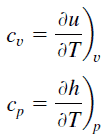
Specific heat is a property related to internal energy that is very important in thermodynamics. The intensive properties cv and cp are defined for pure, simple compressible substances as partial derivatives of the internal energy u(T, v) and enthalpy h(T, p), respectively:

Specific Heat at Constant Volume and Constant Pressure

where the subscripts v and p denote the variables held fixed during differentiation. The properties cv and cp are referred to as specific heats (or heat capacities) because under certain special conditions they relate the temperature change of a system to the amount of energy added by heat transfer. Their SI units are J/kg K or J/mol K. Two specific heats are defined for gases, one for constant volume (cv) and one for constant pressure (cp).

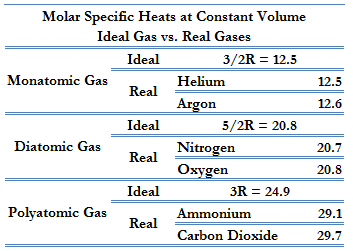
Molar specific heats - ideal gasAccording to the first law of thermodynamics, for constant volume process with a monatomic ideal gas the molar specific heat will be:

Cv = 3/2R = 12.5 J/mol K

because

U = 3/2nRT

It can be derived that the molar specific heat at constant pressure is:

Cp = Cv + R = 5/2R = 20.8 J/mol K

This Cp is greater than the molar specific heat at constant volume Cv, because energy must now be supplied not only to raise the temperature of the gas but also for the gas to do work because in this case volume changes.

 
References:
Reactor Physics and Thermal Hydraulics:
  1. J. R. Lamarsh, Introduction to Nuclear Reactor Theory, 2nd ed., Addison-Wesley, Reading, MA (1983).
  2. J. R. Lamarsh, A. J. Baratta, Introduction to Nuclear Engineering, 3d ed., Prentice-Hall, 2001, ISBN: 0-201-82498-1.
  3. W. M. Stacey, Nuclear Reactor Physics, John Wiley & Sons, 2001, ISBN: 0- 471-39127-1.
  4. Glasstone, Sesonske. Nuclear Reactor Engineering: Reactor Systems Engineering, Springer; 4th edition, 1994, ISBN: 978-0412985317
  5. Todreas Neil E., Kazimi Mujid S. Nuclear Systems Volume I: Thermal Hydraulic Fundamentals, Second Edition. CRC Press; 2 edition, 2012, ISBN: 978-0415802871
  6. Zohuri B., McDaniel P. Thermodynamics in Nuclear Power Plant Systems. Springer; 2015, ISBN: 978-3-319-13419-2
  7. Moran Michal J., Shapiro Howard N. Fundamentals of Engineering Thermodynamics, Fifth Edition, John Wiley & Sons, 2006, ISBN: 978-0-470-03037-0
  8. Kleinstreuer C. Modern Fluid Dynamics. Springer, 2010, ISBN 978-1-4020-8670-0.
  9. U.S. Department of Energy, THERMODYNAMICS, HEAT TRANSFER, AND FLUID FLOW. DOE Fundamentals Handbook, Volume 1, 2 and 3. June 1992.

See also:

Ideal Gas Law

We hope, this article, Internal Energy of Ideal Gas – Monatomic Gas, Diatomic Molecule, helps you. If so, give us a like in the sidebar. Main purpose of this website is to help the public to learn some interesting and important information about thermal engineering.

What is Specific Heat at Constant Volume and Constant Pressure – Definition

Specific heat is a property related to internal energy that is very important in thermodynamics. The intensive properties cv and cp are defined for pure, simple compressible substances. Thermal Engineering

Specific Heat at Constant Volume and Constant Pressure

Specific heat is a property related to internal energy that is very important in thermodynamics. The intensive properties cv and cp are defined for pure, simple compressible substances as partial derivatives of the internal energy u(T, v) and enthalpy h(T, p), respectively:

Specific Heat at Constant Volume and Constant Pressure

where the subscripts v and p denote the variables held fixed during differentiation. The properties cv and cp are referred to as specific heats (or heat capacities) because under certain special conditions they relate the temperature change of a system to the amount of energy added by heat transfer. Their SI units are J/kg K or J/mol K. Two specific heats are defined for gases, one for constant volume (cv) and one for constant pressure (cp).

Molar specific heats - ideal gasAccording to the first law of thermodynamics, for constant volume process with a monatomic ideal gas the molar specific heat will be:

Cv = 3/2R = 12.5 J/mol K

because

U = 3/2nRT

It can be derived that the molar specific heat at constant pressure is:

Cp = Cv + R = 5/2R = 20.8 J/mol K

This Cp is greater than the molar specific heat at constant volume Cv, because energy must now be supplied not only to raise the temperature of the gas but also for the gas to do work because in this case volume changes.

 
References:
Reactor Physics and Thermal Hydraulics:
  1. J. R. Lamarsh, Introduction to Nuclear Reactor Theory, 2nd ed., Addison-Wesley, Reading, MA (1983).
  2. J. R. Lamarsh, A. J. Baratta, Introduction to Nuclear Engineering, 3d ed., Prentice-Hall, 2001, ISBN: 0-201-82498-1.
  3. W. M. Stacey, Nuclear Reactor Physics, John Wiley & Sons, 2001, ISBN: 0- 471-39127-1.
  4. Glasstone, Sesonske. Nuclear Reactor Engineering: Reactor Systems Engineering, Springer; 4th edition, 1994, ISBN: 978-0412985317
  5. Todreas Neil E., Kazimi Mujid S. Nuclear Systems Volume I: Thermal Hydraulic Fundamentals, Second Edition. CRC Press; 2 edition, 2012, ISBN: 978-0415802871
  6. Zohuri B., McDaniel P. Thermodynamics in Nuclear Power Plant Systems. Springer; 2015, ISBN: 978-3-319-13419-2
  7. Moran Michal J., Shapiro Howard N. Fundamentals of Engineering Thermodynamics, Fifth Edition, John Wiley & Sons, 2006, ISBN: 978-0-470-03037-0
  8. Kleinstreuer C. Modern Fluid Dynamics. Springer, 2010, ISBN 978-1-4020-8670-0.
  9. U.S. Department of Energy, THERMODYNAMICS, HEAT TRANSFER, AND FLUID FLOW. DOE Fundamentals Handbook, Volume 1, 2 and 3. June 1992.

See also:

Ideal Gas Law

We hope, this article, Specific Heat at Constant Volume and Constant Pressure, helps you. If so, give us a like in the sidebar. Main purpose of this website is to help the public to learn some interesting and important information about thermal engineering.

What is First Law of Thermodynamics – Definition

dEint = dQ – dW. This is the First Law of Thermodynamics (1st Law) and it is the principle of conservation of energy. One of the most wonderful properties of engineering. Thermal Engineering

First Law of Thermodynamics

The increase in internal energy of a closed system is equal to the heat supplied to the system minus work done by it.

∆Eint = Q – W

This is the First Law of Thermodynamics and it is the principle of conservation of energy, meaning that energy can neither be created nor destroyed, but rather transformed into various forms as the fluid within the control volume is being studied.

It is the most important law for analysis of most systems and the one that quantifies how thermal energy is transformed to other forms of energy. It follows, perpetual motion machines of the first kind are impossible.

Principle of Conservation of Energy

One of the most wonderful properties of the universe is that energy can be transformed from one type to another and transferred from one object to another. Moreover, when transformed from one type to another and transferred from one object to another, the total amount of energy is always the same. It is one of the elementary properties of the universe.

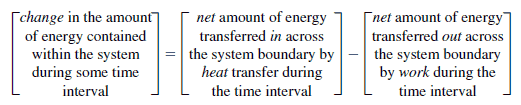
In thermodynamics the concept of energy is broadened to account for other observed changes, and the principle of conservation of energy is extended to include a wide variety of ways in which systems interact with their surroundings. The only ways the energy of a closed system can be changed are through transfer of energy by work or by heat. Further, based on the experiments of Joule and others, a fundamental aspect of the energy concept is that energy is conserved. This principle is known as the first law of thermodynamics. The first law of thermodynamics can be written in various forms:

In words:

first-law-of-thermodynamics-in-words

conservation-of-energy-in-thermodynamics
Physical layout of the four main devices used in the Rankine cycle and basic energy transfers.

Equation form:

∆Eint = Q – W

where Eint represents the internal energy of the material, which depends only on the material’s state (temperature, pressure, and volume). Q is the net heat added to the system and W is the net work done by the system. We must be careful and consistent in following the sign conventions for Q and W. Because W in the equation is the work done by the system, then if work is done on the system, W will be negative and Eint will increase.

Similarly, Q is positive for heat added to the system, so if heat leaves the system, Q is negative. This tells us the following: The internal energy of a system tends to increase if heat is absorbed by the system or if positive work is done on the system. Conversely, the internal energy tends to decrease if heat is lost by the system or if negative work is done on the system. It must be added Q and W are path dependent, while Eint is path independent.

Differential form:

dEint = dQ  – dW

The internal energy Eint of a system tends to increase if energy is added as heat Q and tends to decrease if energy is lost as work W done by the system.

 
Open System - Closed System - Isolated System
Open System – Closed System – Isolated System

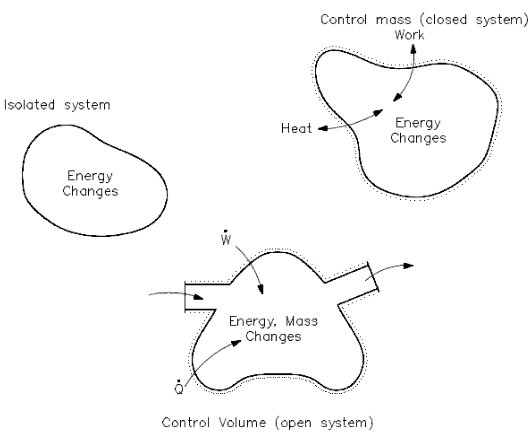
closed-open-isolated-systemHeat and/or work can be directed into or out of the control volume. But, for convenience and as a standard convention, the net energy exchange is presented here with the net heat exchange assumed to be into the system and the net work assumed to be out of the system. If no mass crosses the boundary, but work and/or heat do, then the system is referred to as a “closed” system. If mass, work and heat do not cross the boundary (that is, the only energy exchanges taking place are within the system), then the system is referred to as an isolated system. Isolated and closed systems are nothing more than specialized cases of the open system.

First Law in Terms of Enthalpy dH = dQ + Vdp

The enthalpy is defined to be the sum of the internal energy E plus the product of the pressure p and volume V. In many thermodynamic analyses the sum of the internal energy U and the product of pressure p and volume V appears, therefore it is convenient to give the combination a name, enthalpy, and a distinct symbol, H.

H = U + pV

See also: Enthalpy

The first law of thermodynamics in terms of enthalpy show us, why engineers use the enthalpy in thermodynamic cycles (e.g. Brayton cycle or Rankine cycle).

The classical form of the law is the following equation:

dU = dQ  – dW

In this equation dW is equal to dW = pdV and is known as the boundary work.

 
Boundary Work - pdV Work
Boundary work occurs because the mass of the substance contained within the system boundary causes a force, the pressure times the surface area, to act on the boundary surface and make it move. Boundary work (or pΔV Work) occurs when the volume V of a system changes. It is used for calculating piston displacement work in a closed system. This is what happens when steam, or gas contained in a piston-cylinder device expands against the piston and forces the piston to move.
Since H = U + pV, therefore dH = dU + pdV + Vdp and we substitute dU = dH – pdV – Vdp into the classical form of the law:

dH – pdV – Vdp = dQ – pdV

We obtain the law in terms of enthalpy:

dH = dQ + Vdp

or

dH = TdS + Vdp

In this equation the term Vdp is a flow process work. This work,  Vdp, is used for open flow systems like a turbine or a pump in which there is a “dp”, i.e. change in pressure. There are no changes in control volume. As can be seen, this form of the law simplifies the description of energy transfer. At constant pressure, the enthalpy change equals the energy transferred from the environment through heating:

Isobaric process (Vdp = 0):

dH = dQ     →     Q = H2 – H1

At constant entropy, i.e. in isentropic process, the enthalpy change equals the flow process work done on or by the system:

Isentropic process (dQ = 0):

dH = Vdp     →     W = H2 – H1

It is obvious, it will be very useful in analysis of both thermodynamic cycles used in power engineering, i.e. in Brayton cycle and Rankine cycle.

Example: First Law of Thermodynamics and Brayton Cycle

Let assume the ideal Brayton cycle that describes the workings of a constant pressure heat engine. Modern gas turbine engines and airbreathing jet engines also follow the Brayton cycle. This cycle consist of four thermodynamic processes:

  1. first law - example - brayton cycle
    Ideal Brayton cycle consist of four thermodynamic processes. Two isentropic processes and two isobaric processes.

    isentropic compression – ambient air is drawn into the compressor, where it is pressurized (1 → 2). The work required for the compressor is given by WC = H2 – H1.

  2. isobaric heat addition – the compressed air then runs through a combustion chamber, where fuel is burned and air or another medium is heated (2 → 3). It is a constant-pressure process, since the chamber is open to flow in and out. The net heat added is given by Qadd = H3 – H2
  3. isentropic expansion – the heated, pressurized air then expands on turbine, gives up its energy. The work done by turbine is given by WT = H4 – H3
  4. isobaric heat rejection – the residual heat must be rejected in order to close the cycle. The net heat rejected is given by Qre = H4 – H1

As can be seen, we can describe and calculate (e.g. thermodynamic efficiency) such cycles (similarly for Rankine cycle) using enthalpies.

Internal Energy

In thermodynamics, internal energy (also called the thermal energy) is defined as the energy associated with microscopic forms of energy. It is an extensive quantity, it depends on the size of the system, or on the amount of substance it contains. The SI unit of internal energy is the joule (J). It is the energy contained within the system, excluding the kinetic energy of motion of the system as a whole and the potential energy of the system. Microscopic forms of energy include those due to the rotation, vibration, translation, and interactions among the molecules of a substance. None of these forms of energy can be measured or evaluated directly, but techniques have been developed to evaluate the change in the total sum of all these microscopic forms of energy.

In addition, energy is can be stored in the chemical bonds between the atoms that make up the molecules. This energy storage on the atomic level includes energy associated with electron orbital states, nuclear spin, and binding forces in the nucleus.

Microscopic Energy

Internal energy involves energy on the microscopic scale. It may be divided into microscopic potential energy, Upot, and microscopic kinetic energy, Ukin, components:

U = Upot + Ukin

Microscopic Energy - Internal Energywhere the microscopic kinetic energy, Ukin, involves the motions of all the system’s particles with respect to the center-of-mass frame. For an ideal monatomic gas, this is just the translational kinetic energy of the linear motion of the atoms. Monoatomic particles do not rotate or vibrate. The behavior of the system is well described by kinetic theory of gases. Kinetic theory is based on the fact that during an elastic collision between a molecule with high kinetic energy and one with low kinetic energy, part of energy will transfer to the molecule of lower kinetic energy. However, for polyatomic gases there is rotational and vibrational kinetic energy as well.

The microscopic potential energy, Upot, involves the chemical bonds between the atoms that make up the molecules, binding forces in the nucleus and also the physical force fields within the system (e.g. electric or magnetic fields).

In liquids and solids there is significant component of potential energy associated with the intermolecular attractive forces.

Heat and Work

We’ve seen that the internal energy changes with Q, which is the net heat added to the system and W, which is the net work done by the system. We now examine how the work done by and the heat added to the system during a thermodynamic process depend on the details of how the process takes place.

Heat in Thermodynamics

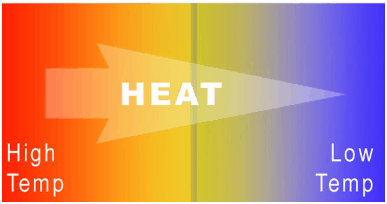
zeroth-law-of-thermodynamics-heatWhile internal energy refers to the total energy of all the molecules within the object, heat is the amount of energy flowing from one body to another spontaneously due to their temperature difference. Heat is a form of energy, but it is energy in transit. Heat is not a property of a system. However, the transfer of energy as heat occurs at the molecular level as a result of a temperature difference.

Consider a block of metal at high temperature, that consists of atoms that are oscillating intensely around their average positions. At low temperatures, the atoms continue to oscillate, but with less intensity. If a hotter block of metal is put in contact with a cooler block, the intensely oscillating atoms at the edge of the hotter block gives off its kinetic energy to the less oscillating atoms at the edge of the cool block. In this case there is energy transfer between these two blocks and heat flows from the hotter to the cooler block by this random vibrations.

In general, when two objects are brought into thermal contact, heat will flow between them until they come into equilibrium with each other.  When a temperature difference does exist heat flows spontaneously from the warmer system to the colder system. Heat transfer occurs by conduction or by thermal radiation. When the flow of heat stops, they are said to be at the same temperature. They are then said to be in thermal equilibrium.

As with work, the amount of heat transferred depends upon the path and not simply on the initial and final conditions of the system. There are actually many ways to take the gas from state i to state f.

Also, as with work, it is important to distinguish between heat added to a system from its surroundings and heat removed from a system to its surroundings. Q is positive for heat added to the system, so if heat leaves the system, Q is negative. Because W in the equation is the work done by the system, then if work is done on the system, W will be negative and Eint will increase.

The symbol q is sometimes used to indicate the heat added to or removed from a system per unit mass. It equals the total heat (Q) added or removed divided by the mass (m).

Heat Capacity

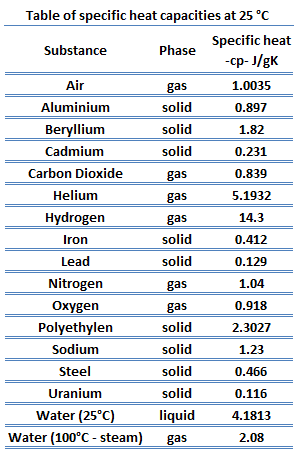
Table of specific heat capacitiesDifferent substances are affected to different magnitudes by the addition of heat. When a given amount of heat is added to different substances, their temperatures increase by different amounts. This proportionality constant between the heat Q that the object absorbs or loses and the resulting temperature change T of the object is known as the heat capacity C of an object.

C = Q / ΔT

Heat capacity is an extensive property of matter, meaning it is proportional to the size of the system. Heat capacity C has the unit of energy per degree or energy per kelvin. When expressing the same phenomenon as an intensive property, the heat capacity is divided by the amount of substance, mass, or volume, thus the quantity is independent of the size or extent of the sample.

Specific Heat Capacity

The heat capacity of a substance per unit mass is called the specific heat capacity (cp) of the substance. The subscript p indicates that the heat capacity and specific heat capacity apply when the heat is added or removed at constant pressure.

cp = Q / mΔT

Specific Heat Capacity of Ideal Gas

In the Ideal Gas Model, the intensive properties cv and cp are defined for pure, simple compressible substances as partial derivatives of the internal energy u(T, v) and enthalpy h(T, p), respectively:

Specific Heat at Constant Volume and Constant Pressure

where the subscripts v and p denote the variables held fixed during differentiation. The properties cv and cp are referred to as specific heats (or heat capacities) because under certain special conditions they relate the temperature change of a system to the amount of energy added by heat transfer. Their SI units are J/kg K or J/mol K. Two specific heats are defined for gases, one for constant volume (cv) and one for constant pressure (cp).

Molar specific heats - ideal gasAccording to the first law of thermodynamics, for constant volume process with a monatomic ideal gas the molar specific heat will be:

Cv = 3/2R = 12.5 J/mol K

because

U = 3/2nRT

It can be derived that the molar specific heat at constant pressure is:

Cp = Cv + R = 5/2R = 20.8 J/mol K

This Cp is greater than the molar specific heat at constant volume Cv, because energy must now be supplied not only to raise the temperature of the gas but also for the gas to do work because in this case volume changes.

Latent Heat of Vaporization

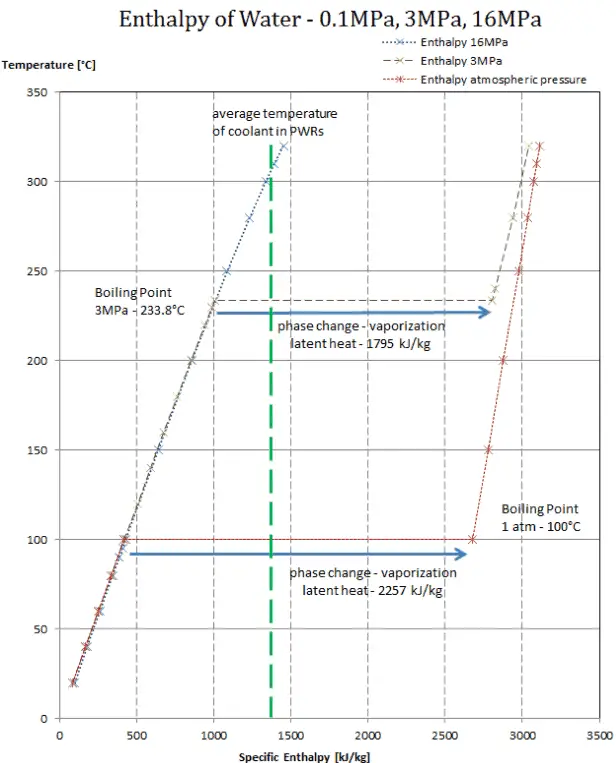
Latent heat of vaporization - water at 0.1 MPa, 3 MPa, 16 MPa
The heat of vaporization diminishes with increasing pressure, while the boiling point increases. It vanishes completely at a certain point called the critical point.

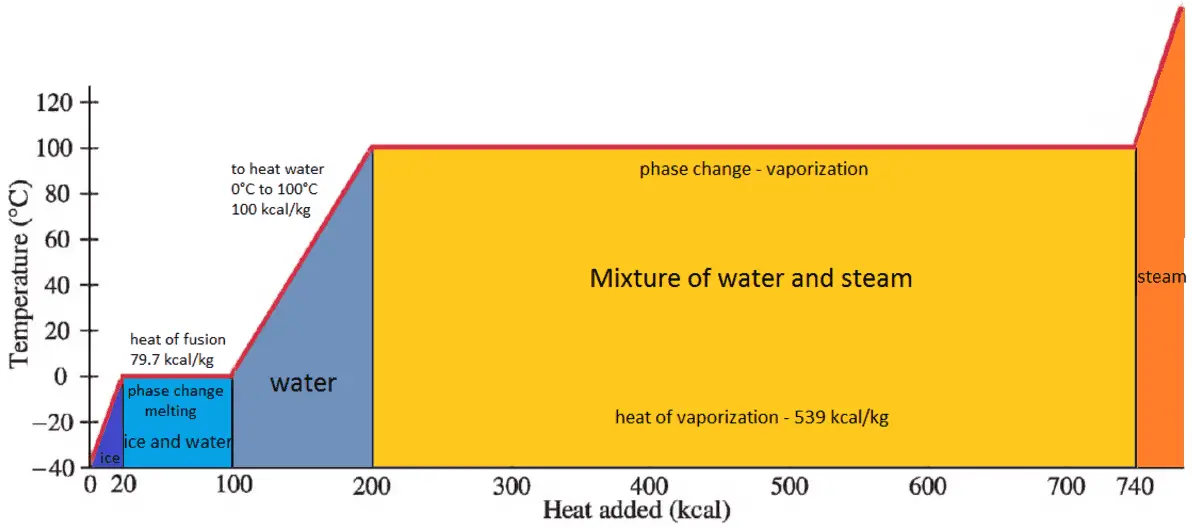
In general, when a material changes phase from solid to liquid, or from liquid to gas a certain amount of energy is involved in this change of phase. In case of liquid to gas phase change, this amount of energy is known as the enthalpy of vaporization, (symbol ∆Hvap; unit: J) also known as the (latent) heat of vaporization or heat of evaporation. Latent heat is the amount of heat added to or removed from a substance to produce a change in phase. This energy breaks down the intermolecular attractive forces, and also must provide the energy necessary to expand the gas (the pΔV work). When latent heat is added, no temperature change occurs. The enthalpy of vaporization is a function of the pressure at which that transformation takes place.

Latent heat of vaporization – water at 0.1 MPa (atmospheric pressure)

hlg = 2257 kJ/kg

Latent heat of vaporization – water at 3 MPa (pressure inside a steam generator)

hlg = 1795 kJ/kg

Latent heat of vaporization – water at 16 MPa (pressure inside a pressurizer)

hlg = 931 kJ/kg

The heat of vaporization diminishes with increasing pressure, while the boiling point increases. It vanishes completely at a certain point called the critical point. Above the critical point, the liquid and vapor phases are indistinguishable, and the substance is called a supercritical fluid.

The heat of vaporization is the heat required to completely vaporize a unit of saturated liquid (or condense a unit mass of saturated vapor) and it equal to hlg = hg − hl.

The heat that is necessary to melt (or freeze) a unit mass at the substance at constant pressure is the heat of fusion and is equal to hsl = hl − hs, where hs is the enthalpy of saturated solid and hl is the enthalpy of saturated liquid.

Phase changes - enthalpy of vaporization
Latent heat of vaporization – water at 0.1 MPa. Dominant part of heat absorbed.

Work in Thermodynamics

In thermodynamics, work performed by a system is the energy transferred by the system to its surroundings. Kinetic energy, potential energy and internal energy are forms of energy that are properties of a system. Work is a form of energy, but it is energy in transit. A system contains no work, work is a process done by or on a system. In general, work is defined for mechanical systems as the action of a force on an object through a distance.

W = F . d

where:

W = work (J)

F = force (N)

d = displacement (m)

pΔV Work

pdV Work - Thermodynamics
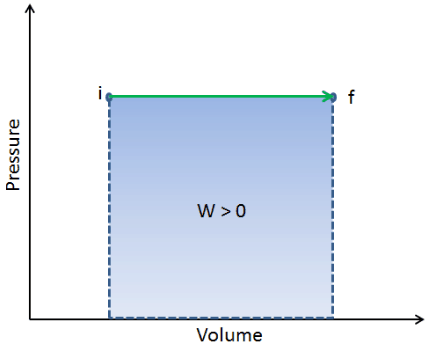
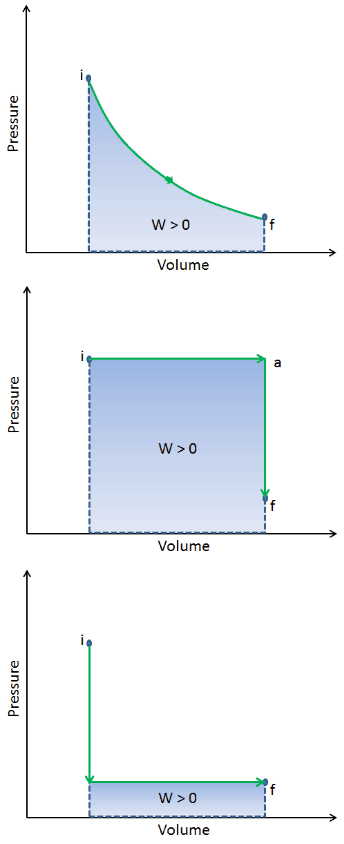
pΔV Work is equal to the area under the process curve plotted on the pressure-volume diagram.

Pressure-volume work (or pΔV Work) occurs when the volume V of a system changes. The pΔV Work is equal to the area under the process curve plotted on the pressure-volume diagram. It is known also as the boundary work.  Boundary work occurs because the mass of the substance contained within the system boundary causes a force, the pressure times the surface area, to act on the boundary surface and make it move. Boundary work (or pΔV Work) occurs when the volume V of a system changes. It is used for calculating piston displacement work in a closed system. This is what happens when steam, or gas contained in a piston-cylinder device expands against the piston and forces the piston to move.

Example:

Consider a frictionless piston that is used to provide a constant pressure of 500 kPa in a cylinder containing steam (superheated steam) of a volume of 2 m3  at 500 K.

Calculate the final temperature, if 3000 kJ of heat is added.

Solution:

Using steam tables we know, that the specific enthalpy of such steam (500 kPa; 500 K) is about 2912 kJ/kg. Since at this condition the steam has density of 2.2 kg/m3, then we know there is about 4.4 kg of steam in the piston at enthalpy of 2912 kJ/kg x 4.4 kg = 12812 kJ.

When we use simply Q = H2 − H1, then the resulting enthalpy of steam will be:

H2 = H1 + Q = 15812 kJ

From steam tables, such superheated steam (15812/4.4 = 3593 kJ/kg) will have a temperature of 828 K (555°C). Since at this enthalpy the steam have density of 1.31 kg/m3, it is obvious that it has expanded by about 2.2/1.31 = 1.67 (+67%). Therefore the resulting volume is 2 m3 x 1.67 = 3.34 m3 and ∆V = 3.34 m3 – 2 m3 = 1.34 m3.

The p∆V part of enthalpy, i.e. the work done is:

W = p∆V = 500 000 Pa x 1.34 m3 = 670 kJ

———–

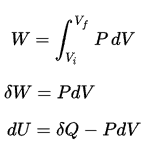
During the volume change, the pressure and temperature may also change. To calculate such processes, we would need to know how pressure varies with volume for the actual process by which the system changes from state i to state f. The first law of thermodynamics and the work can then be expressed as:

Work in Thermodynamics - general formula

Work in Thermodynamics - path dependency
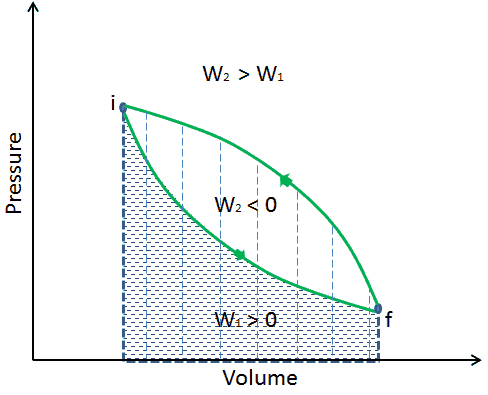
The work done by the system depends not only on the initial and final states, but also on the intermediate states—that is, on the path.

When a thermodynamic system changes from an initial state to a final state, it passes through a series of intermediate states. We call this series of states a path. There are always infinitely many different possibilities for these intermediate states. When they are all equilibrium states, the path can be plotted on a pV-diagram. One of the most important conclusions is that:

The work done by the system depends not only on the initial and final states, but also on the intermediate states—that is, on the path.

Q and W are path dependent, whereas ΔEint is path independent. As can be seen from the picture (p-V diagram), work is path dependent variable. The blue area represents the pΔV Work done by a system as it goes from an initial state i to a final state f. Work W is positive because the system’s volume increases. The second process shows, that work is greater and that depends on path of the process.

Moreover, we can take the system through a series of states forming a closed loop, such i ⇒ f ⇒ i. In this case the final state is the same as the initial state, but the total work done by the system is not zero. A positive value for work indicates that work is done by the system on its surroundings. A negative value indicates that work is done on the system by its surroundings.

 
Cyclic Process
Cyclic process - work
A process that eventually returns a system to its initial state is called a cyclic process.

Example: Turbine Specific Work

engineering thermodynamics
Rankine Cycle – Thermodynamics as Energy Conversion Science

A high-pressure stage of steam turbine operates at steady state with inlet conditions of  6 MPa, t = 275.6°C, x = 1 (point C). Steam leaves this stage of turbine at a pressure of 1.15 MPa, 186°C and x = 0.87 (point D). Calculate the enthalpy difference between these two states. Determine the specific work transfer.

The enthalpy for the state C can be picked directly from steam tables, whereas the enthalpy for the state D must be calculated using vapor quality:

h1, wet = 2785 kJ/kg

h2, wet = h2,s x + (1 – x ) h2,l  = 2782 . 0.87 + (1 – 0.87) . 790 = 2420 + 103 = 2523 kJ/kg

Δh = 262 kJ/kg

Since in adiabatic process dh = dw, Δh = 262 kJ/kg is the turbine specific work.

Four Special Cases of the First Law of Thermodynamics

The first law of thermodynamics finds application in several special cases:

Adiabatic Process:

An adiabatic process is one in which there is no heat transfer into or out of the system. It occurs very rapidly or a system is well insulated that no transfer of energy as heat occurs between the system and its environment. Therefore dQ = 0 in the first law of thermodynamics, which is then:

dQ = 0, dEint = – dW

Isochoric Process:

An isochoric process is one in which there is no change in volume. An isochoric process is a constant-volume process. When the volume of a thermodynamic system is constant, it does no work on its surroundings. Therefore dW = 0 in the first law of thermodynamics, which is then:

dW = 0, dEint = dQ

In an isochoric process, all the energy added as heat (that is, Q is positive) remains in the system as an increase in internal energy (increase in temperature).

Cyclic Process:

A process that eventually returns a system to its initial state is called a cyclic process. At the conclusion of a cycle, all the properties have the same value they had at the beginning.

For such a process, the final state is the same as the initial state, and so the total internal energy change must be zero. Steam (water) that circulates through a closed cooling loop undergoes a cycle. The first law of thermodynamics is then:

dEint = 0, dQ = dW

Thus, the net work done during the process must exactly equal the net amount of energy transferred as heat.

Free Expansion:

This is an adiabatic process in which no transfer of heat occurs between the system and its environment and no work is done on or by the system. These types of adiabatic processes are called free expansion. It is an irreversible process in which a gas expands into an insulated evacuated chamber. It is also called Joule expansion. For an ideal gas, the temperature doesn’t change (see: Joule’s Second Law), however, real gases experience a temperature change during free expansion. In free expansion Q = W = 0, and the first law requires that:

dEint = 0

A free expansion can not be plotted on a P-V diagram, because the process is rapid, not quasistatic. The intermediate states are not equilibrium states, and hence the pressure is not clearly defined.

 
References:
Nuclear and Reactor Physics:
  1. J. R. Lamarsh, Introduction to Nuclear Reactor Theory, 2nd ed., Addison-Wesley, Reading, MA (1983).
  2. J. R. Lamarsh, A. J. Baratta, Introduction to Nuclear Engineering, 3d ed., Prentice-Hall, 2001, ISBN: 0-201-82498-1.
  3. W. M. Stacey, Nuclear Reactor Physics, John Wiley & Sons, 2001, ISBN: 0- 471-39127-1.
  4. Glasstone, Sesonske. Nuclear Reactor Engineering: Reactor Systems Engineering, Springer; 4th edition, 1994, ISBN: 978-0412985317
  5. W.S.C. Williams. Nuclear and Particle Physics. Clarendon Press; 1 edition, 1991, ISBN: 978-0198520467
  6. Kenneth S. Krane. Introductory Nuclear Physics, 3rd Edition, Wiley, 1987, ISBN: 978-0471805533
  7. G.R.Keepin. Physics of Nuclear Kinetics. Addison-Wesley Pub. Co; 1st edition, 1965
  8. Robert Reed Burn, Introduction to Nuclear Reactor Operation, 1988.
  9. U.S. Department of Energy, Nuclear Physics and Reactor Theory. DOE Fundamentals Handbook, Volume 1 and 2. January 1993.

Advanced Reactor Physics:

  1. K. O. Ott, W. A. Bezella, Introductory Nuclear Reactor Statics, American Nuclear Society, Revised edition (1989), 1989, ISBN: 0-894-48033-2.
  2. K. O. Ott, R. J. Neuhold, Introductory Nuclear Reactor Dynamics, American Nuclear Society, 1985, ISBN: 0-894-48029-4.
  3. D. L. Hetrick, Dynamics of Nuclear Reactors, American Nuclear Society, 1993, ISBN: 0-894-48453-2.
  4. E. E. Lewis, W. F. Miller, Computational Methods of Neutron Transport, American Nuclear Society, 1993, ISBN: 0-894-48452-4.

See also:

Thermodynamics

We hope, this article, First Law of Thermodynamics, helps you. If so, give us a like in the sidebar. Main purpose of this website is to help the public to learn some interesting and important information about thermal engineering.

What is About – Definition

Main purpose of this project is to help the public to learn some interesting and important information about the energy and about the nuclear energy. The best way to promote nuclear power is to present the facts. Thermal Engineering

About us

This website was founded as a non-profit project, built entirely by a group of young engineers. Entire website is based on our own personal perspectives, and does not represent any views of any company in the energy industry.

Main purpose of this project is to help the public to learn some interesting and important information about the energy and about the peaceful uses of nuclear energy. We realize that the basics in the nuclear physics do not belong to fundamental human knowledge and the term “nuclear” often evokes a feeling of something negative or even dangerous. We do not claim this or that opinion is the only opinion that is right. But it is noteworthy, that the vast majority of nuclear engineers, people who know what nuclear means, do not connect the term “nuclear” with anything negative or dangerous.

Anyone can be able to come here, learn the basics of nuclear physics, reactor physics and power engineering and should be able to answer basic questions. Feel free to ask a question, leave feedback or take a look at one of our articles. The best way to promote nuclear power is to present the facts.

Disclaimer

The information contained in this website is for general information purposes only. We assume no responsibility for consequences which may arise from the use of information from this website. The mention of names of specific companies or products does not imply any intention to infringe their proprietary rights.

This website does not use any proprietary data. When we use data that are related to certain product, we use only data released by public relations departments and allowed for use.

Copyright Notice

This website and its content is copyright of Nuclear Power for Everybody. All rights reserved.

Any redistribution or reproduction of part or all of the contents in any form is prohibited other than the following:

  • You may copy, create extracts, abstracts from articles, you may print, download to a local hard disk extracts for your personal and non-commercial use only. If you want to give a credit, just cite the page in your Bibliographic Entry according to rules in your country.
  • You may copy the content to individual third parties for their personal or educational use, but only if you acknowledge the website as the source of the material.
  • You may not, except with our express written permission, distribute or commercially exploit the content. Nor may you transmit it or store it in any other website or other form of electronic retrieval system.

In other words, you may almost everything for non-commercial, educational use or training purpose. Feel free to use the content, when you prepare a thesis, a presentation or a guide to anybody, but it would be good to give a credit to us (e.g. cite the page in the Bibliographic Entry). Note that, the main purpose of this project is to help the public or professionals to learn some interesting and important information about the energy, about the nuclear energy and about the reactor safety.

DMCA.com Protection Status

Examples of how to cite Nuclear Power

Similarly as for Wikipedia, you should not cite any particular author or authors for a Nuclear Power article, in general. Nuclear Power articles are written collaboratively by more authors and articles can be updated by another author.

MLA style

Citation in MLA style, as recommended by the Modern Language Association, 8th edition:

“Shutdown Margin – SDM.” Nuclear Power. Web. 10 Aug. 2018, nuclear-power.com/nuclear-power/reactor-physics/reactor-operation/shutdown-margin-sdm/

Chicago style

Citation in Chicago st

Privacy Policy

Our Privacy Policy was last updated and posted on 19 February 2017. It governs the privacy terms of our Website, located at www.nuclear-power.com. Our Website follows all legal requirements to protect your privacy. Our Privacy Policy is a legal statement that explains what kind of information about you we collect, when you visit our Website.

Personally identifiable information (PII), or sensitive personal information (SPI), as used in information security and privacy laws, is information that can be used on its own or with other information to identify, contact, or locate a single person, or to identify an individual in context.

While using our Website, we do not ask you to provide us with any personally identifiable information. Therefore:

We do not collect any personally identifiable information and we do not store any personally identifiable information.

Since we do not store your personal information, we do not share, sell, trade or otherwise transfer to outside your personally identifiable information.

When you contact us by e-mail, the data you provide (your e-mail address, if applicable your name and your telephone number) will be stored by us in order to answer your questions. We delete the data arising in this context after the storage is no longer necessary, or limit the processing if statutory retention obligations exist.

Privacy Policy Updates

We reserve the right to update or change our Privacy Policy at any time and you should check this Privacy Policy periodically. If we make material changes to this policy, we may notify you on our Website, by a blog post, or by any method we determine. The method we chose is at our sole discretion. We will also change the “Last Updated” date at the beginning of this Privacy Policy. Any changes we make to our Privacy Policy are effective as of this Last Updated date and replace any prior Privacy Policies.

Cookies Statement

This Cookie Statement is part of our Privacy Policy. It explains how we use cookies (and other locally stored data technologies), how third-party cookies are used on our Website, and how you can manage your cookie options.

A “cookie” is a tiny data file that we transfer onto your computer, mobile phone, or any other device that you use to access the nuclear-power.com, generally used for authentication and tracking. Every cookie expires after a certain period of time, but that period varies depending on what the cookie is used for and how your browser is configured.

Like many sites, we use “cookies” to collect information by the interaction of your mobile phone or web browser with our Website. Such information is typically considered non-personal information.

We use cookies to understand and save your preferences for future visits and compile aggregate data about site traffic and site interaction so that we can offer better site experiences and tools in the future. This information includes the name of the website from which you entered our Website, if any, as well as the name of the website to which you’re headed when you leave our website. This information also includes the IP address of your computer/proxy server that you use to access the Internet, your Internet Website provider name, web browser type, type of mobile device, and computer operating system. We use all of this information to analyze trends among our Users to help improve our Website. This approach is usual and typical for entire World Wide Web.

You can instruct your browser to refuse all cookies or to indicate when a cookie is being sent.However, please note that if you do this you may not be able to use the full functionality of this website.

Third Party Tracking Tools

We also use third party tracking tools to improve the performance and features of our Website. These third party tracking tools are designed to collect only Non-Personal Information about your use of our Website. However, you understand that such tools are created and managed by parties outside our control. As such, we are not responsible for what information is actually captured by such third parties or how such third parties use and protect that information. This site uses cookies via use of the following features:

Google Analytics

This website uses Google Analytics, a web analytics service provided by Google, Inc. (“Google”). Google Analytics uses “cookies”, which are text files placed on your computer, to help the website analyze how users use the site. The information generated by the cookie about your use of the website (including your IP address) will be transmitted to and stored by Google on servers in the United States . Google will use this information for the purpose of evaluating your use of the website, compiling reports on website activity for website operators and providing other services relating to website activity and internet usage. Google may also transfer this information to third parties where required to do so by law, or where such third parties process the information on Google’s behalf. Google will not associate your IP address with any other data held by Google. You may refuse the use of cookies by selecting the appropriate settings on your browser, however please note that if you do this you may not be able to use the full functionality of this website. By using this website, you consent to the processing of data about you by Google in the manner and for the purposes set out above.

Google AdSense

This website uses Google AdSense, a service for including advertisements from Google Inc. (“Google”). Google AdSense uses “cookies”, text files that are stored on your computer, to allow to analyze the use of the internet. Google AdSense uses also web beacons (invisible images). Through these web beacons information such as the visitor traffic are evaluated on these pages. The information generated by cookies and web beacons about the usage of this website (including your IP address) and the delivery of advertising formats are transmitted to a Google server in the USA and stored there. This information can be given by Google to contractors of Google. Google will not bring your IP address together with other data stored by you. You may refuse the use of cookies by selecting the appropriate settings on your browser, but we point out that in this case you may not be able to use all features of this website. By using this website you agree to the processing of data about you by Google in the manner described and for the aforementioned purpose.

Google +1 Button

The Google +1 button is a way for you to share information publicly with the world. The Google +1 button helps you and others receive personalized content from Google and our partners. The fact that you +1’d something will be recorded by Google, along with information about the page you were viewing when you clicked on the +1 button. Your +1’s may appear to others as an annotation with your profile name and photo in Google services (such as in search results or on your Google Profile) or elsewhere on websites and ads on the Internet. Google is recording information about your +1 activity in order to provide you and other users with a better experience on Google services. In order to use the Google +1 button, you need to have a public Google Profile visible to the world, which at a minimum includes the name you chose for the profile. That name will be used across Google services and in some cases it may replace another name you’ve used when sharing content under your Google Account. Google may display your Google Profile identity to people who have your email address or other identifying information.

In addition to the above-described uses, the information you provide to Google is used subject to Googles main Privacy Policy. Google may share aggregate statistics related to users’ +1 activity with the public, their users, and partners, such as publishers, advertisers, or connected sites.

Facebook Share Button

We implement « Social Plugins » such as the Facebook like button and the Facebook share button which are both operated by Facebook Inc. 1601 S. California Avenue, Palo Alto, CA 94304, USA (“Facebook”). For more information on the Facebook Privacy Policy.

Twitter Inc.

Functions from Twitter services are integrated into our webpages. These functions are offered by Twitter Inc., 795 Folsom St., Suite 600, San Francisco, CA 94107, USA. By using Twitter and the function “Retweet”, the webpages that you visit will be linked with your Twitter account and made public to other users. Information is also transmitted to Twitter in this way. We would like to point out that we, as providers of the website, do not receive information about the contents of the transmitted data or their use by Twitter. For more information, please see Twitter’s privacy statement. You can change your privacy protection settings for Twitter in your account settings.
Third party links

Occasionally, at our discretion, we may include or offer third party products or services on our website. These third party sites have separate and independent privacy policies. We therefore have no responsibility or liability for the content and activities of these linked sites. Nonetheless, we seek to protect the integrity of our site and welcome any feedback about these sites.

Contact Us

If you want to get in touch with us, please do not hesitate to contact us via e-mail:

info@www.nuclear-power.com

We welcome all messages from our readers and will try to respond to any questions for feedback you have. If you use your personal information, e.g. your name, we will not use it for anything except replying to you.

We hope, this article, About, helps you. If so, give us a like in the sidebar. Main purpose of this website is to help the public to learn some interesting and important information about thermal engineering.

What is Disclaimer – Definition

The information contained in this website is for general information purposes only. Thermal Engineering

Disclaimer

The information contained in this website is for general information purposes only. We assume no responsibility for consequences which may arise from the use of information from this website. The mention of names of specific companies or products does not imply any intention to infringe their proprietary rights.

This website does not use any proprietary data. When we use data that are related to certain product, we use only data released by public relations departments and allowed for use.

We hope, this article, Disclaimer, helps you. If so, give us a like in the sidebar. Main purpose of this website is to help the public to learn some interesting and important information about thermal engineering.

What is Copyright Notice – Definition

This website and its content is copyright of Nuclear Power for Everybody. All rights reserved. Thermal Engineering

Copyright Notice

This website and its content is copyright of Nuclear Power for Everybody. All rights reserved.

Any redistribution or reproduction of part or all of the contents in any form is prohibited other than the following:

  • You may copy, create extracts, abstracts from articles, you may print, download to a local hard disk extracts for your personal and non-commercial use only. If you want to give a credit, just cite the page in your Bibliographic Entry according to rules in your country.
  • You may copy the content to individual third parties for their personal or educational use, but only if you acknowledge the website as the source of the material.
  • You may not, except with our express written permission, distribute or commercially exploit the content. Nor may you transmit it or store it in any other website or other form of electronic retrieval system.

In other words, you may almost everything for non-commercial, educational use or training purpose. Feel free to use the content, when you prepare a thesis, a presentation or a guide to anybody, but it would be good to give a credit to us (e.g. cite the page in the Bibliographic Entry). Note that, the main purpose of this project is to help the public or professionals to learn some interesting and important information about the energy, about the nuclear energy and about the reactor safety.

DMCA.com Protection Status

Examples of how to cite Nuclear Power

Similarly as for Wikipedia, you should not cite any particular author or authors for a Nuclear Power article, in general. Nuclear Power articles are written collaboratively by more authors and articles can be updated by another author.

MLA style

Citation in MLA style, as recommended by the Modern Language Association, 8th edition:

“Shutdown Margin – SDM.” Nuclear Power. Web. 10 Aug. 2018, nuclear-power.com/nuclear-power/reactor-physics/reactor-operation/shutdown-margin-sdm/

Chicago style

Citation in Chicago style:

Nuclear Power, s.v. “Shutdown Margin – SDM,” (accessed August 10, 2018), https://www.nuclear-power.com/nuclear-power/reactor-physics/reactor-operation/shutdown-margin-sdm/

MHRA style

Citation in MHRA style, as recommended by the Modern Humanities Research Association:

Nuclear Power contributors, ‘Shutdown Margin – SDM’, Nuclear Power, <https://www.nuclear-power.com/nuclear-power/reactor-physics/reactor-operation/shutdown-margin-sdm/> [accessed 10 August 2018]

We hope, this article, Copyright Notice, helps you. If so, give us a like in the sidebar. Main purpose of this website is to help the public to learn some interesting and important information about thermal engineering.

What is Privacy Policy – Definition

Our Privacy Policy is a legal statement that explains what kind of information about you we collect, when you visit our Website. Thermal Engineering

Privacy Policy

Our Privacy Policy was last updated and posted on 19 February 2017. It governs the privacy terms of our Website, located at www.nuclear-power.com. Our Website follows all legal requirements to protect your privacy. Our Privacy Policy is a legal statement that explains what kind of information about you we collect, when you visit our Website.

Personally identifiable information (PII), or sensitive personal information (SPI), as used in information security and privacy laws, is information that can be used on its own or with other information to identify, contact, or locate a single person, or to identify an individual in context.

While using our Website, we do not ask you to provide us with any personally identifiable information. Therefore:

We do not collect any personally identifiable information and we do not store any personally identifiable information.

Since we do not store your personal information, we do not share, sell, trade or otherwise transfer to outside your personally identifiable information.

When you contact us by e-mail, the data you provide (your e-mail address, if applicable your name and your telephone number) will be stored by us in order to answer your questions. We delete the data arising in this context after the storage is no longer necessary, or limit the processing if statutory retention obligations exist.

Privacy Policy Updates

We reserve the right to update or change our Privacy Policy at any time and you should check this Privacy Policy periodically. If we make material changes to this policy, we may notify you on our Website, by a blog post, or by any method we determine. The method we chose is at our sole discretion. We will also change the “Last Updated” date at the beginning of this Privacy Policy. Any changes we make to our Privacy Policy are effective as of this Last Updated date and replace any prior Privacy Policies.

Cookies Statement

This Cookie Statement is part of our Privacy Policy. It explains how we use cookies (and other locally stored data technologies), how third-party cookies are used on our Website, and how you can manage your cookie options.

A “cookie” is a tiny data file that we transfer onto your computer, mobile phone, or any other device that you use to access the nuclear-power.com, generally used for authentication and tracking. Every cookie expires after a certain period of time, but that period varies depending on what the cookie is used for and how your browser is configured.

Like many sites, we use “cookies” to collect information by the interaction of your mobile phone or web browser with our Website. Such information is typically considered non-personal information.

We use cookies to understand and save your preferences for future visits and compile aggregate data about site traffic and site interaction so that we can offer better site experiences and tools in the future. This information includes the name of the website from which you entered our Website, if any, as well as the name of the website to which you’re headed when you leave our website. This information also includes the IP address of your computer/proxy server that you use to access the Internet, your Internet Website provider name, web browser type, type of mobile device, and computer operating system. We use all of this information to analyze trends among our Users to help improve our Website. This approach is usual and typical for entire World Wide Web.

You can instruct your browser to refuse all cookies or to indicate when a cookie is being sent.However, please note that if you do this you may not be able to use the full functionality of this website.

Third Party Tracking Tools

We also use third party tracking tools to improve the performance and features of our Website. These third party tracking tools are designed to collect only Non-Personal Information about your use of our Website. However, you understand that such tools are created and managed by parties outside our control. As such, we are not responsible for what information is actually captured by such third parties or how such third parties use and protect that information. This site uses cookies via use of the following features:

Google Analytics

This website uses Google Analytics, a web analytics service provided by Google, Inc. (“Google”). Google Analytics uses “cookies”, which are text files placed on your computer, to help the website analyze how users use the site. The information generated by the cookie about your use of the website (including your IP address) will be transmitted to and stored by Google on servers in the United States . Google will use this information for the purpose of evaluating your use of the website, compiling reports on website activity for website operators and providing other services relating to website activity and internet usage. Google may also transfer this information to third parties where required to do so by law, or where such third parties process the information on Google’s behalf. Google will not associate your IP address with any other data held by Google. You may refuse the use of cookies by selecting the appropriate settings on your browser, however please note that if you do this you may not be able to use the full functionality of this website. By using this website, you consent to the processing of data about you by Google in the manner and for the purposes set out above.

Google AdSense

This website uses Google AdSense, a service for including advertisements from Google Inc. (“Google”). Google AdSense uses “cookies”, text files that are stored on your computer, to allow to analyze the use of the internet. Google AdSense uses also web beacons (invisible images). Through these web beacons information such as the visitor traffic are evaluated on these pages. The information generated by cookies and web beacons about the usage of this website (including your IP address) and the delivery of advertising formats are transmitted to a Google server in the USA and stored there. This information can be given by Google to contractors of Google. Google will not bring your IP address together with other data stored by you. You may refuse the use of cookies by selecting the appropriate settings on your browser, but we point out that in this case you may not be able to use all features of this website. By using this website you agree to the processing of data about you by Google in the manner described and for the aforementioned purpose.

Google +1 Button

The Google +1 button is a way for you to share information publicly with the world. The Google +1 button helps you and others receive personalized content from Google and our partners. The fact that you +1’d something will be recorded by Google, along with information about the page you were viewing when you clicked on the +1 button. Your +1’s may appear to others as an annotation with your profile name and photo in Google services (such as in search results or on your Google Profile) or elsewhere on websites and ads on the Internet. Google is recording information about your +1 activity in order to provide you and other users with a better experience on Google services. In order to use the Google +1 button, you need to have a public Google Profile visible to the world, which at a minimum includes the name you chose for the profile. That name will be used across Google services and in some cases it may replace another name you’ve used when sharing content under your Google Account. Google may display your Google Profile identity to people who have your email address or other identifying information.

In addition to the above-described uses, the information you provide to Google is used subject to Googles main Privacy Policy. Google may share aggregate statistics related to users’ +1 activity with the public, their users, and partners, such as publishers, advertisers, or connected sites.

Facebook Share Button

We implement « Social Plugins » such as the Facebook like button and the Facebook share button which are both operated by Facebook Inc. 1601 S. California Avenue, Palo Alto, CA 94304, USA (“Facebook”). For more information on the Facebook Privacy Policy.

Twitter Inc.

Functions from Twitter services are integrated into our webpages. These functions are offered by Twitter Inc., 795 Folsom St., Suite 600, San Francisco, CA 94107, USA. By using Twitter and the function “Retweet”, the webpages that you visit will be linked with your Twitter account and made public to other users. Information is also transmitted to Twitter in this way. We would like to point out that we, as providers of the website, do not receive information about the contents of the transmitted data or their use by Twitter. For more information, please see Twitter’s privacy statement. You can change your privacy protection settings for Twitter in your account settings.
Third party links

Occasionally, at our discretion, we may include or offer third party products or services on our website. These third party sites have separate and independent privacy policies. We therefore have no responsibility or liability for the content and activities of these linked sites. Nonetheless, we seek to protect the integrity of our site and welcome any feedback about these sites.

Contact Us

If you want to get in touch with us, please do not hesitate to contact us via e-mail:

info@www.nuclear-power.com

We welcome all messages from our readers and will try to respond to any questions for feedback you have. If you use your personal information, e.g. your name, we will not use it for anything except replying to you.

We hope, this article, Privacy Policy, helps you. If so, give us a like in the sidebar. Main purpose of this website is to help the public to learn some interesting and important information about thermal engineering.

What is Cookies Statement – Definition

This Cookie Statement is part of our Privacy Policy. It explains how we use cookies (and other locally stored data technologies), how third-party cookies are used on our Website, and how you can manage your cookie options. Thermal Engineering

Cookies Statement

This Cookie Statement is part of our Privacy Policy. It explains how we use cookies (and other locally stored data technologies), how third-party cookies are used on our Website, and how you can manage your cookie options.

A “cookie” is a tiny data file that we transfer onto your computer, mobile phone, or any other device that you use to access the nuclear-power.com, generally used for authentication and tracking. Every cookie expires after a certain period of time, but that period varies depending on what the cookie is used for and how your browser is configured.

Like many sites, we use “cookies” to collect information by the interaction of your mobile phone or web browser with our Website. Such information is typically considered non-personal information.

We use cookies to understand and save your preferences for future visits and compile aggregate data about site traffic and site interaction so that we can offer better site experiences and tools in the future. This information includes the name of the website from which you entered our Website, if any, as well as the name of the website to which you’re headed when you leave our website. This information also includes the IP address of your computer/proxy server that you use to access the Internet, your Internet Website provider name, web browser type, type of mobile device, and computer operating system. We use all of this information to analyze trends among our Users to help improve our Website. This approach is usual and typical for entire World Wide Web.

You can instruct your browser to refuse all cookies or to indicate when a cookie is being sent.However, please note that if you do this you may not be able to use the full functionality of this website.

Third Party Tracking Tools

We also use third party tracking tools to improve the performance and features of our Website. These third party tracking tools are designed to collect only Non-Personal Information about your use of our Website. However, you understand that such tools are created and managed by parties outside our control. As such, we are not responsible for what information is actually captured by such third parties or how such third parties use and protect that information. This site uses cookies via use of the following features:

Google Analytics

This website uses Google Analytics, a web analytics service provided by Google, Inc. (“Google”). Google Analytics uses “cookies”, which are text files placed on your computer, to help the website analyze how users use the site. The information generated by the cookie about your use of the website (including your IP address) will be transmitted to and stored by Google on servers in the United States . Google will use this information for the purpose of evaluating your use of the website, compiling reports on website activity for website operators and providing other services relating to website activity and internet usage. Google may also transfer this information to third parties where required to do so by law, or where such third parties process the information on Google’s behalf. Google will not associate your IP address with any other data held by Google. You may refuse the use of cookies by selecting the appropriate settings on your browser, however please note that if you do this you may not be able to use the full functionality of this website. By using this website, you consent to the processing of data about you by Google in the manner and for the purposes set out above.

Google AdSense

This website uses Google AdSense, a service for including advertisements from Google Inc. (“Google”). Google AdSense uses “cookies”, text files that are stored on your computer, to allow to analyze the use of the internet. Google AdSense uses also web beacons (invisible images). Through these web beacons information such as the visitor traffic are evaluated on these pages. The information generated by cookies and web beacons about the usage of this website (including your IP address) and the delivery of advertising formats are transmitted to a Google server in the USA and stored there. This information can be given by Google to contractors of Google. Google will not bring your IP address together with other data stored by you. You may refuse the use of cookies by selecting the appropriate settings on your browser, but we point out that in this case you may not be able to use all features of this website. By using this website you agree to the processing of data about you by Google in the manner described and for the aforementioned purpose.

Google +1 Button

The Google +1 button is a way for you to share information publicly with the world. The Google +1 button helps you and others receive personalized content from Google and our partners. The fact that you +1’d something will be recorded by Google, along with information about the page you were viewing when you clicked on the +1 button. Your +1’s may appear to others as an annotation with your profile name and photo in Google services (such as in search results or on your Google Profile) or elsewhere on websites and ads on the Internet. Google is recording information about your +1 activity in order to provide you and other users with a better experience on Google services. In order to use the Google +1 button, you need to have a public Google Profile visible to the world, which at a minimum includes the name you chose for the profile. That name will be used across Google services and in some cases it may replace another name you’ve used when sharing content under your Google Account. Google may display your Google Profile identity to people who have your email address or other identifying information.

In addition to the above-described uses, the information you provide to Google is used subject to Googles main Privacy Policy. Google may share aggregate statistics related to users’ +1 activity with the public, their users, and partners, such as publishers, advertisers, or connected sites.

Facebook Share Button

We implement « Social Plugins » such as the Facebook like button and the Facebook share button which are both operated by Facebook Inc. 1601 S. California Avenue, Palo Alto, CA 94304, USA (“Facebook”). For more information on the Facebook Privacy Policy.

Twitter Inc.

Functions from Twitter services are integrated into our webpages. These functions are offered by Twitter Inc., 795 Folsom St., Suite 600, San Francisco, CA 94107, USA. By using Twitter and the function “Retweet”, the webpages that you visit will be linked with your Twitter account and made public to other users. Information is also transmitted to Twitter in this way. We would like to point out that we, as providers of the website, do not receive information about the contents of the transmitted data or their use by Twitter. For more information, please see Twitter’s privacy statement. You can change your privacy protection settings for Twitter in your account settings.

We hope, this article, Cookies Statement, helps you. If so, give us a like in the sidebar. Main purpose of this website is to help the public to learn some interesting and important information about thermal engineering.

What is Contact Us – Definition

If you want to get in touch with us, please do not hesitate to contact us via e-mail or social media links. Thermal Engineering

Contact Us

If you want to get in touch with us, please do not hesitate to contact us via e-mail:

info@www.nuclear-power.com

We welcome all messages from our readers and will try to respond to any questions for feedback you have. If you use your personal information, e.g. your name, we will not use it for anything except replying to you.

We hope, this article, Contact Us, helps you. If so, give us a like in the sidebar. Main purpose of this website is to help the public to learn some interesting and important information about thermal engineering.