Facebook Instagram Youtube Twitter

What is Entropy and the Second Law of Thermodynamics – Definition

Entropy and the Second Law of Thermodynamics. Entropy relates to the second law since the second law predicts that some heat rejection must take place in closed cycle. Thermal Engineering

Various Statements of the Law

The second law of thermodynamics may be expressed in many specific ways. Each statement expresses the same law. Listed below are three that are often encountered.

Before these statements, we have to remind the work of a French engineer and physicist, Nicolas Léonard Sadi Carnot advanced the study of the second law by forming a principle (also called Carnot’s rule) that specifies limits on the maximum efficiency any heat engine can obtain.

 
Carnot's Principle
In 1824, a French engineer and physicist, Nicolas Léonard Sadi Carnot advanced the study of the second law by forming a principle (also called Carnot’s rule) that specifies limits on the maximum efficiency any heat engine can obtain. In short, this principle states that the efficiency of a thermodynamic cycle depends solely on the difference between the hot and cold temperature reservoirs.

Carnot’s principle states:

  1. No engine can be more efficient than a reversible engine (a Carnot heat engine) operating between the same high temperature and low temperature reservoirs.
  2. The efficiencies of all reversible engines (Carnot heat engines) operating between the same constant temperature reservoirs are the same, regardless of the working substance employed or the operation details.

Carnot Efficiency

The formula for this maximum efficiency is:
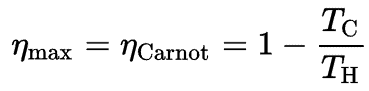
Carnot Efficiency Formula

where:

  • is the efficiency of Carnot cycle, i.e. it is the ratio = W/QH of the work done by the engine to the heat energy entering the system from the hot reservoir.
  • TC is the absolute temperature (Kelvins) of the cold reservoir,
  • TH is the absolute temperature (Kelvins) of the hot reservoir.
Example: Carnot efficiency for coal-fired power plant
In a modern coal-fired power plant, the temperature of high pressure steam (Thot) would be about 400°C (673K) and Tcold, the cooling tower water temperature, would be about 20°C (293K). For this type of power plant the maximum (ideal) efficiency will be:

= 1 – Tcold/Thot = 1 – 293/673 = 56%

It must be added, this is an idealized efficiency. The Carnot efficiency is valid for reversible processes. These processes cannot be achieved in real cycles of power plants. The Carnot efficiency dictates that higher efficiencies can be attained by increasing the temperature of the steam. This feature is valid also for real thermodynamic cycles. But this requires an increase in pressures inside boilers or steam generators. However, metallurgical considerations place an upper limits on such pressures. Sub-critical fossil fuel power plants, that are operated under critical pressure (i.e. lower than 22.1 MPa), can achieve 36–40% efficiency. Supercritical designs, that are operated at supercritical pressure (i.e. greater than 22.1 MPa),  have efficiencies around 43%. Most efficient and also very complex coal-fired power plants that are operated at “ultra critical” pressures (i.e. around 30 MPa) and use multiple stage reheat reach about 48% efficiency.

See also: Supercritical Reactor

Entropy and the Second Law

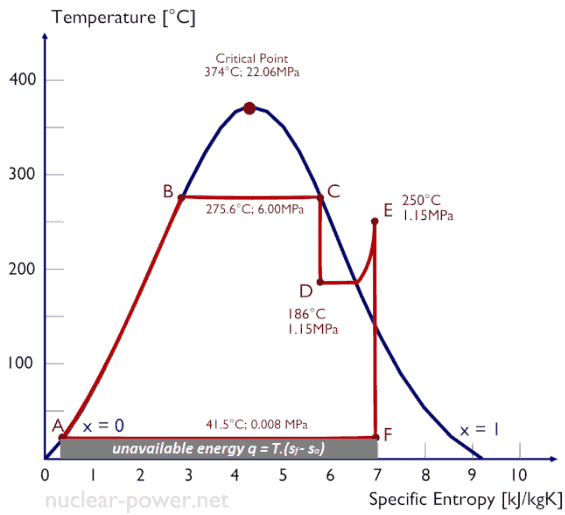
T-s diagram of a thermodynamic cycle
T-s diagram of Rankine Cycle

One consequence of the second law of thermodynamics is the development of the physical property of matter, that is known as the entropy (S). The change in this property is used to determine the direction in which a given process will proceed. Entropy quantifies the energy of a substance that is no longer available to perform useful work. This relates to the second law since the second law predicts that not all heat provided to a cycle can be transformed into an equal amount of work, some heat rejection must take place.

See also: Entropy

According to Clausius, the entropy was defined via the change in entropy S of a system. The change in entropy S, when an amount of heat Q is added to it by a reversible process at constant temperature, is given by:
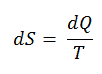
Entropy- Equation

Here Q is the energy transferred as heat to or from the system during the process, and T is the temperature of the system in kelvins during the process. The SI unit for entropy is J/K.

The second law of thermodynamics can also be expressed as ∆S≥0 for a closed cycle.

In words:

The entropy of any isolated system never decreases. In a natural thermodynamic process, the sum of the entropies of the interacting thermodynamic systems increases.

∆S≥0

Because entropy tells so much about the usefulness of an amount of heat transferred in performing work, the steam tables include values of specific entropy (s = S/m) as part of the information tabulated.

 
References:
Nuclear and Reactor Physics:
  1. J. R. Lamarsh, Introduction to Nuclear Reactor Theory, 2nd ed., Addison-Wesley, Reading, MA (1983).
  2. J. R. Lamarsh, A. J. Baratta, Introduction to Nuclear Engineering, 3d ed., Prentice-Hall, 2001, ISBN: 0-201-82498-1.
  3. W. M. Stacey, Nuclear Reactor Physics, John Wiley & Sons, 2001, ISBN: 0- 471-39127-1.
  4. Glasstone, Sesonske. Nuclear Reactor Engineering: Reactor Systems Engineering, Springer; 4th edition, 1994, ISBN: 978-0412985317
  5. W.S.C. Williams. Nuclear and Particle Physics. Clarendon Press; 1 edition, 1991, ISBN: 978-0198520467
  6. Kenneth S. Krane. Introductory Nuclear Physics, 3rd Edition, Wiley, 1987, ISBN: 978-0471805533
  7. G.R.Keepin. Physics of Nuclear Kinetics. Addison-Wesley Pub. Co; 1st edition, 1965
  8. Robert Reed Burn, Introduction to Nuclear Reactor Operation, 1988.
  9. U.S. Department of Energy, Nuclear Physics and Reactor Theory. DOE Fundamentals Handbook, Volume 1 and 2. January 1993.

Advanced Reactor Physics:

  1. K. O. Ott, W. A. Bezella, Introductory Nuclear Reactor Statics, American Nuclear Society, Revised edition (1989), 1989, ISBN: 0-894-48033-2.
  2. K. O. Ott, R. J. Neuhold, Introductory Nuclear Reactor Dynamics, American Nuclear Society, 1985, ISBN: 0-894-48029-4.
  3. D. L. Hetrick, Dynamics of Nuclear Reactors, American Nuclear Society, 1993, ISBN: 0-894-48453-2.
  4. E. E. Lewis, W. F. Miller, Computational Methods of Neutron Transport, American Nuclear Society, 1993, ISBN: 0-894-48452-4.

See also:

Second Law

We hope, this article, Entropy and the Second Law of Thermodynamics, helps you. If so, give us a like in the sidebar. Main purpose of this website is to help the public to learn some interesting and important information about thermal engineering.

What is Energy Source – Definition

Energy sources have always played a very important role in the development of human society. We have to distinguish the primary energy sources and secondary energy sources. Thermal Engineering

Energy Sources

Total Primary Energy Supply
Total Primary Energy Supply by resource 1993, 2011 and prediction for 2020.
Source: World Energy Resources – 2013 Survey
Used by permission of the World Energy Council

Energy sources have always played a very important role in the development of human society. Since the industrial revolution the energy has been a driving force for the modern civilization development. Technological development and consumption of primary energy, along with the increase of the world population are interdependent. In past 20 years, the world around us has changed significantly. Technology has become one of the main drivers of economic and social development. The rapid advancement of Information Technology (IT) all over the world has transformed not only the way we think, but also the way we act. It must be noted that practically all technologies run on electrical energy and therefore the share of electricity is increasing rapidly, faster than Total Primary Energy Supply (TPES –  the sum of production and imports subtracting exports and storage changes.).

At present, fossil fuel is still the world’s predominant energy source and its extraction, production and use are not considered to be efficient regardless of the new technologies available to improve its use and extraction. When studying energy resources, we have to distinguish the primary energy sources and secondary energy sources.

Primary Energy Sources

primary energy sources - table
Key indicators for 1993, 2011 and prediction for 2020.
Source: World Energy Resources – 2013 Survey
Used by permission of the World Energy Council

Primary energy (PE) is an energy resource found in nature that has not been subjected to any conversion or transformation process. It is energy contained in raw fuels, and other forms of energy received as input to a system. Primary energy sources take many forms, including nuclear energy, fossil energy — like oil, coal and natural gas — and renewable sources like wind, solar, geothermal and hydropower. These primary sources can be converted to secondary energy source, so called energy carriers. Primary energy sources can be divided into:

  • Non-renewable sources
    • Fossil fuels
      • Oil
      • Coal
      • Natural gas
    • Mineral fuels
      • Natural Uranium
      • Natural Thorium
  • Renewable sources
    • Solar energy
    • Wind energy
    • Hydro and tidal energy
    • Geothermal energy
    • Biomass energy (if sustainably exploited)

Secondary Energy Sources – Energy Carriers

Secondary energy sources, also called energy carriers, are derived from the transformation of primary energy sources. They are called energy carriers, because they move energy in a useable form from one place to another. The well-known energy carriers are:

  • Electricity
  • Petrol
  • Hydrogen

Electricity and hydrogen made from primary energy sources such as coal, natural gas, nuclear energy, petroleum, and renewable energy sources. Electricity is particularly useful since it has low entropy (is highly ordered) and can be converted into other forms of energy very efficiently. Simply, we cannot say that hydrogen have potential to offset fossil fuels.

Secondary energy sources are used, because its using is easier than using a primary energy source. For example, using electricity for lighting is safer than using petroleum in candles or kerosene lamps.

On the other hand any conversion of primary energy to energy carrier is associated with some inefficiency. Therefore when dealing with secondary energy source, we have to always consider the way, how the carrier was made.

Examples of Energy of 1 Joule

One joule in everyday life and in science corresponds to approximately:

  • The kinetic energy of an object with mass 1 kg moving at √2 ≈ 1.4 m/s.
  • The kinetic energy of a 50 kg object (e.g. human) moving very slowly – approximately 0.72 km/h.
  • The energy required to lift a medium-size apple (100 g) 1 meter vertically from the surface of the Earth.
  • The heat required to raise the temperature of 1 g of water by 0.24 °C.
  • The heat required to evaporate of 0.00044 g of liquid water at 100°C.
  • The amount of electricity required to light a 1 watt LED for 1 s.
  • Is released by approximately 3.1⋅1010 fissions in a nuclear reactor.
 
References:
Reactor Physics and Thermal Hydraulics:
  1. J. R. Lamarsh, Introduction to Nuclear Reactor Theory, 2nd ed., Addison-Wesley, Reading, MA (1983).
  2. J. R. Lamarsh, A. J. Baratta, Introduction to Nuclear Engineering, 3d ed., Prentice-Hall, 2001, ISBN: 0-201-82498-1.
  3. W. M. Stacey, Nuclear Reactor Physics, John Wiley & Sons, 2001, ISBN: 0- 471-39127-1.
  4. Glasstone, Sesonske. Nuclear Reactor Engineering: Reactor Systems Engineering, Springer; 4th edition, 1994, ISBN: 978-0412985317
  5. Todreas Neil E., Kazimi Mujid S. Nuclear Systems Volume I: Thermal Hydraulic Fundamentals, Second Edition. CRC Press; 2 edition, 2012, ISBN: 978-0415802871
  6. Zohuri B., McDaniel P. Thermodynamics in Nuclear Power Plant Systems. Springer; 2015, ISBN: 978-3-319-13419-2
  7. Moran Michal J., Shapiro Howard N. Fundamentals of Engineering Thermodynamics, Fifth Edition, John Wiley & Sons, 2006, ISBN: 978-0-470-03037-0
  8. Kleinstreuer C. Modern Fluid Dynamics. Springer, 2010, ISBN 978-1-4020-8670-0.
  9. U.S. Department of Energy, THERMODYNAMICS, HEAT TRANSFER, AND FLUID FLOW. DOE Fundamentals Handbook, Volume 1, 2 and 3. June 1992.

See also:

Energy

We hope, this article, Energy Source, helps you. If so, give us a like in the sidebar. Main purpose of this website is to help the public to learn some interesting and important information about thermal engineering.

What is Primary Energy Source – Definition

Primary energy source (PE) is an energy resource found in nature that has not been subjected to any conversion or transformation process. Thermal Engineering

Primary Energy Sources

primary energy sources - table
Key indicators for 1993, 2011 and prediction for 2020.
Source: World Energy Resources – 2013 Survey
Used by permission of the World Energy Council

Primary energy (PE) is an energy resource found in nature that has not been subjected to any conversion or transformation process. It is energy contained in raw fuels, and other forms of energy received as input to a system. Primary energy sources take many forms, including nuclear energy, fossil energy — like oil, coal and natural gas — and renewable sources like wind, solar, geothermal and hydropower. These primary sources can be converted to secondary energy source, so called energy carriers. Primary energy sources can be divided into:

  • Non-renewable sources
    • Fossil fuels
      • Oil
      • Coal
      • Natural gas
    • Mineral fuels
      • Natural Uranium
      • Natural Thorium
  • Renewable sources
    • Solar energy
    • Wind energy
    • Hydro and tidal energy
    • Geothermal energy
    • Biomass energy (if sustainably exploited)
Total Primary Energy Supply
Total Primary Energy Supply by resource 1993, 2011 and prediction for 2020.
Source: World Energy Resources – 2013 Survey
Used by permission of the World Energy Council
 
References:
Reactor Physics and Thermal Hydraulics:
  1. J. R. Lamarsh, Introduction to Nuclear Reactor Theory, 2nd ed., Addison-Wesley, Reading, MA (1983).
  2. J. R. Lamarsh, A. J. Baratta, Introduction to Nuclear Engineering, 3d ed., Prentice-Hall, 2001, ISBN: 0-201-82498-1.
  3. W. M. Stacey, Nuclear Reactor Physics, John Wiley & Sons, 2001, ISBN: 0- 471-39127-1.
  4. Glasstone, Sesonske. Nuclear Reactor Engineering: Reactor Systems Engineering, Springer; 4th edition, 1994, ISBN: 978-0412985317
  5. Todreas Neil E., Kazimi Mujid S. Nuclear Systems Volume I: Thermal Hydraulic Fundamentals, Second Edition. CRC Press; 2 edition, 2012, ISBN: 978-0415802871
  6. Zohuri B., McDaniel P. Thermodynamics in Nuclear Power Plant Systems. Springer; 2015, ISBN: 978-3-319-13419-2
  7. Moran Michal J., Shapiro Howard N. Fundamentals of Engineering Thermodynamics, Fifth Edition, John Wiley & Sons, 2006, ISBN: 978-0-470-03037-0
  8. Kleinstreuer C. Modern Fluid Dynamics. Springer, 2010, ISBN 978-1-4020-8670-0.
  9. U.S. Department of Energy, THERMODYNAMICS, HEAT TRANSFER, AND FLUID FLOW. DOE Fundamentals Handbook, Volume 1, 2 and 3. June 1992.

See also:

Energy

We hope, this article, Primary Energy Source, helps you. If so, give us a like in the sidebar. Main purpose of this website is to help the public to learn some interesting and important information about thermal engineering.

What is Secondary Energy Source – Energy Carrier – Definition

Secondary energy sources, also called energy carriers, are derived from the transformation of primary energy sources. They move energy in a useable form from one place to another. Thermal Engineering

Secondary Energy Sources – Energy Carriers

Secondary energy sources, also called energy carriers, are derived from the transformation of primary energy sources. They are called energy carriers, because they move energy in a useable form from one place to another. The well-known energy carriers are:

  • Electricity
  • Petrol
  • Hydrogen

Electricity and hydrogen made from primary energy sources such as coal, natural gas, nuclear energy, petroleum, and renewable energy sources. Electricity is particularly useful since it has low entropy (is highly ordered) and can be converted into other forms of energy very efficiently. Simply, we cannot say that hydrogen have potential to offset fossil fuels.

Secondary energy sources are used, because its using is easier than using a primary energy source. For example, using electricity for lighting is safer than using petroleum in candles or kerosene lamps.

On the other hand any conversion of primary energy to energy carrier is associated with some inefficiency. Therefore when dealing with secondary energy source, we have to always consider the way, how the carrier was made.

 
References:
Reactor Physics and Thermal Hydraulics:
  1. J. R. Lamarsh, Introduction to Nuclear Reactor Theory, 2nd ed., Addison-Wesley, Reading, MA (1983).
  2. J. R. Lamarsh, A. J. Baratta, Introduction to Nuclear Engineering, 3d ed., Prentice-Hall, 2001, ISBN: 0-201-82498-1.
  3. W. M. Stacey, Nuclear Reactor Physics, John Wiley & Sons, 2001, ISBN: 0- 471-39127-1.
  4. Glasstone, Sesonske. Nuclear Reactor Engineering: Reactor Systems Engineering, Springer; 4th edition, 1994, ISBN: 978-0412985317
  5. Todreas Neil E., Kazimi Mujid S. Nuclear Systems Volume I: Thermal Hydraulic Fundamentals, Second Edition. CRC Press; 2 edition, 2012, ISBN: 978-0415802871
  6. Zohuri B., McDaniel P. Thermodynamics in Nuclear Power Plant Systems. Springer; 2015, ISBN: 978-3-319-13419-2
  7. Moran Michal J., Shapiro Howard N. Fundamentals of Engineering Thermodynamics, Fifth Edition, John Wiley & Sons, 2006, ISBN: 978-0-470-03037-0
  8. Kleinstreuer C. Modern Fluid Dynamics. Springer, 2010, ISBN 978-1-4020-8670-0.
  9. U.S. Department of Energy, THERMODYNAMICS, HEAT TRANSFER, AND FLUID FLOW. DOE Fundamentals Handbook, Volume 1, 2 and 3. June 1992.

See also:

Energy

We hope, this article, Secondary Energy Source – Energy Carrier, helps you. If so, give us a like in the sidebar. Main purpose of this website is to help the public to learn some interesting and important information about thermal engineering.

What is Form of Energy – Definition

Forms of Energy. Energy exists in many forms. Common energy forms include mechanical energy that is classically divided into kinetic and potential energy. Thermal Engineering

What is Energy

The Sun
The Sun generates its energy by nuclear fusion of hydrogen nuclei into helium. In its core, the Sun fuses 620 million metric tons of hydrogen each second.
Source: hyperphysics.phy-astr.gsu.edu

The term energy is very very broad and it has many definitions. Technically, energy is a scalar physical quantity that is associated with the state of one or more objects. Energy is generally defined as the potential to do work or produce heat. Sometimes it is like the “currency” for performing work. You must have energy to accomplish work. To do 1 kilojoule of work, you must expend 1 kilojoule of energy. It must be added, this interpretation can be misleading because energy is not necessarily available to do work.

One of the most wonderful properties of the universe is that energy can be transformed from one type to another and transferred from one object to another. Moreover, when transformed from one type to another and transferred from one object to another, the total amount of energy is always the same. It is one of the elementary properties of the universe.

For example, burning gasoline to power cars is an energy conversion process we rely on. The chemical energy in gasoline is converted to thermal energy, which is then converted to mechanical energy that makes the car move. The mechanical energy has been converted to kinetic energy. When we use the brakes to stop a car, that kinetic energy is converted by friction back to heat, or thermal energy.

Forms of Energy

Energy exists in many forms. Common energy forms include mechanical energy that is classically divided into kinetic and potential energy. The kinetic energy is related to the velocity of a moving object. The potential energy is related to an object’s position in a force field (gravitational, electric or magnetic). Tension in a spring or surface film tension are other forms of potential mechanical energy (elastic energy). There are many other forms of energy including electrical, magnetical, chemical, and nuclear energy.

In thermodynamics the concept of energy is broadened to account for other observed changes. Thermodynamics deals with another type of energy called “thermal energy” or “internal energy”. The only ways the energy of a closed system can be changed are through transfer of energy by work or by heat. Further, based on the experiments of Joule and others, a fundamental aspect of the energy concept is that energy is conserved. This principle is known as the first law of thermodynamics. In general energy is a fundamental concept of thermodynamics and one of the most significant aspects of engineering analysis.

 
Mechanical energy
In physics, mechanical energy (Emech) is the energy associated with the motion and position of an object usually in some force field (e.g. gravitational field). Mechanical energy (and also the thermal energy) can be separated into two categories, transient and stored. Transient energy is energy in motion, that is, energy being transferred from one place to another. Stored energy is the energy contained within a substance or object. Transient mechanical energy is commonly referred to as work. Stored mechanical energy exists in one of two forms: kinetic or potential.
Kinetic energy
The kinetic energy, K, is defined as the energy stored in an object because of its motion. An object in motion has the ability to do work and thus can be said to have energy. It is called kinetic energy, from the Greek word kinetikos, meaning “motion.”

The kinetic energy depends on the speed of an object and is the ability of a moving object to do work on other objects when it collides with them. On the other hand, the kinetic energy of an object represents the amount of energy required to increase the velocity of the object from rest (v = 0) to its final velocity. The kinetic energy also depends linearly on the mass, which is a numerical measure of object’s inertia and the measure of an object’s resistance to acceleration when a force is applied.

We define the quantity:

K = ½ mv2

to be the translational kinetic energy of the object. It must be added, it is called the “translational” kinetic energy to distinguish it from rotational kinetic energy

Potential energy
Potential energy, U, is defined as the energy stored in an object subjected to a conservative force. Common types include the gravitational potential energy, the elastic potential energy of an extended spring, and the electric potential energy of an electric charge in an electric field and so on.
Gravitational energy

In classical mechanics, the gravitational potential energy (U) is energy an object possesses because of its position in a gravitational field. Gravitational potential (V; the gravitational energy per unit mass) at a location is equal to the work (energy transferred) per unit mass that would be needed to move the object from a fixed reference location to the location of the object. The most common use of gravitational potential energy is for an object near the surface of the Earth where the gravitational acceleration can be assumed to be constant at about 9.8 m/s2.

U = mgh

Internal energy
In thermodynamics, internal energy (also called the thermal energy) is defined as the energy associated with microscopic forms of energy. It is an extensive quantity, it depends on the size of the system, or on the amount of substance it contains. The SI unit of internal energy is the joule (J). It is the energy contained within the system, excluding the kinetic energy of motion of the system as a whole and the potential energy of the system. Microscopic forms of energy include those due to the rotation, vibration, translation, and interactions among the molecules of a substance. None of these forms of energy can be measured or evaluated directly, but techniques have been developed to evaluate the change in the total sum of all these microscopic forms of energy.

In addition, energy is can be stored in the chemical bonds between the atoms that make up the molecules. This energy storage on the atomic level includes energy associated with electron orbital states, nuclear spin, and binding forces in the nucleus.

Enthalpy
In thermodynamics, the enthalpy is a measurement of energy in a thermodynamic system. It is the thermodynamic quantity equivalent to the total heat content of a system. The enthalpy is defined to be the sum of the internal energy E plus the product of the pressure p and volume V. In many thermodynamic analyses the sum of the internal energy U and the product of pressure p and volume V appears, therefore it is convenient to give the combination a name, enthalpy, and a distinct symbol, H.

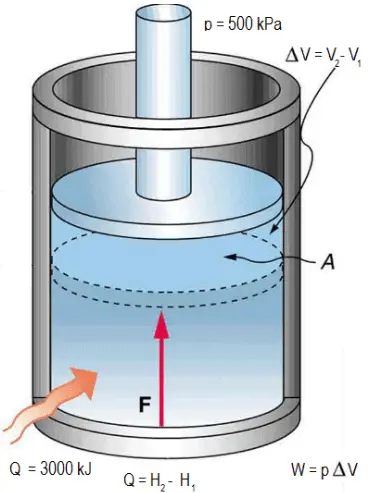
The enthalpy is the preferred expression of system energy changes in many chemical, biological, and physical measurements at constant pressure. It is so useful that it is tabulated in the steam tables along with specific volume and specific internal energy. It is due to the fact, it simplifies the description of energy transfer. At constant pressure, the enthalpy change equals the energy transferred from the environment through heating (Q = H2 – H1) or work other than expansion work. For a variable-pressure process, the difference in enthalpy is not quite as obvious.

Entropy
In thermodynamics and statistical physics, entropy is a quantitative measure of disorder, or of the energy in a system to do work.

In statistical physics, entropy is a measure of the disorder of a system. What disorder refers to is really the number of microscopic configurations, W, that a thermodynamic system can have when in a state as specified by certain macroscopic variables (volume, energy, pressure, and temperature). By “microscopic states”, we mean the exact states of all the molecules making up the system.

Mathematically, the exact definition is:

Entropy = (Boltzmann’s constant k) x logarithm of number of possible states

S = kB logW

This equation, which relates the microscopic details, or microstates, of the system (via W) to its macroscopic state (via the entropy S), is the key idea of statistical mechanics. In a closed system, entropy never decreases, so in the Universe entropy is irreversibly increasing. In an open system (for example, a growing tree), entropy can decrease and order can increase, but only at the expense of an increase in entropy somewhere else (e.g. in the Sun).

Gibbs Free Energy
In thermodynamics, the Gibbs free energy is a thermodynamic potential that is defined as the enthalpy of the system minus the product of the temperature times the entropy of the system. Since the enthalpy is defined to be the sum of the internal energy E plus the product of the pressure p and volume V.
Electrical Energy
Electrical energy is the energy derived from electric potential energy or kinetic energy. A typical nuclear power plant has an electric-generating capacity of 1000 MWe. It produces 1 000 000 000 joules of electrical energy per second. The heat source in the nuclear power plant is a nuclear reactor. As is typical in all conventional thermal power stations the heat is used to generate steam which drives a steam turbine connected to a generator which produces electricity. The turbines are heat engines and are subject to the efficiency limitations imposed by the second law of thermodynamics. In modern nuclear power plants the overall thermodynamic efficiency is about one-third (33%), so 3000 MWth of thermal power from the fission reaction is needed to generate 1000 MWe of electrical power.

Since voltage is electric potential energy per unit charge, the Kirchhoff’s voltage law can be seen to be a consequence of conservation of electrical energy. Kirchhoff’s voltage law states:

The algebraic sum of the voltages (drops or rises) encountered in traversing any loop of a circuit in a specified direction must be zero.

The algebraic sum of the voltages (drops or rises) encountered in traversing any loop of a circuit in a specified direction must be zero.

kirchhoffs-voltage-law-equation1

Simply, the voltage changes around any closed loop must sum to zero. The sum of the voltage rises is equal to the sum of the voltage drops in a loop. No matter what path you take through an electric circuit, if you return to your starting point you must measure the same voltage, constraining the net change around the loop to be zero. This rule is equivalent to saying that each point on a mountain has only one elevation above sea level. If you start from any point and return to it after walking around the mountain, the algebraic sum of the changes in elevation that you encounter must be zero.

Radiant Energy
In physics, radiant energy is the energy of electromagnetic and gravitational radiation. The term “radiant energy” is most commonly used in the fields of radiometry, solar energy, heating and lighting. As energy, its SI unit is the joule (J). The quantity of radiant energy may be calculated by integrating radiant flux with respect to time. Radiant heat transfer is very important in power industry, because it is one of the most important ways , how thermal energy can be transferred. It does not need a medium, such as air or metal, to take place. Any material that has a temperature above absolute zero gives off some radiant energy. Most energy of this type is in the infra-red region of the electromagnetic spectrum although some of it is in the visible region.

Radiant heat transfer rate from a body (e.g. a black body) to its surroundings is proportional to the fourth power of the absolute temperature and can be expressed by the following equation:

q =  εσT4

where σ is a fundamental physical constant called the Stefan–Boltzmann constant, which is equal to 5.6697×10⁻⁸ W/m2K4. This relationship is called the Stefan–Boltzmann law. The emissivity, ε, of the surface of a material is its effectiveness in emitting energy as thermal radiation and varies between 0.0 and 1.0. By definition, a black body in thermal equilibrium has an emissivity of ε = 1.0. It can be seen, radiation heat transfer is important at very high temperatures and in a vacuum.

Two bodies that radiate toward each other have a net heat flux between them. The net flow rate of heat between them is given by:

Q = εσA1-2(T41 −T42)  [J/s]

q =  εσ(T41 −T42) [J/m2s]

The area factor A1-2, is the area viewed by body 2 of body 1, and can become fairly difficult to calculate.

Ionization Energy
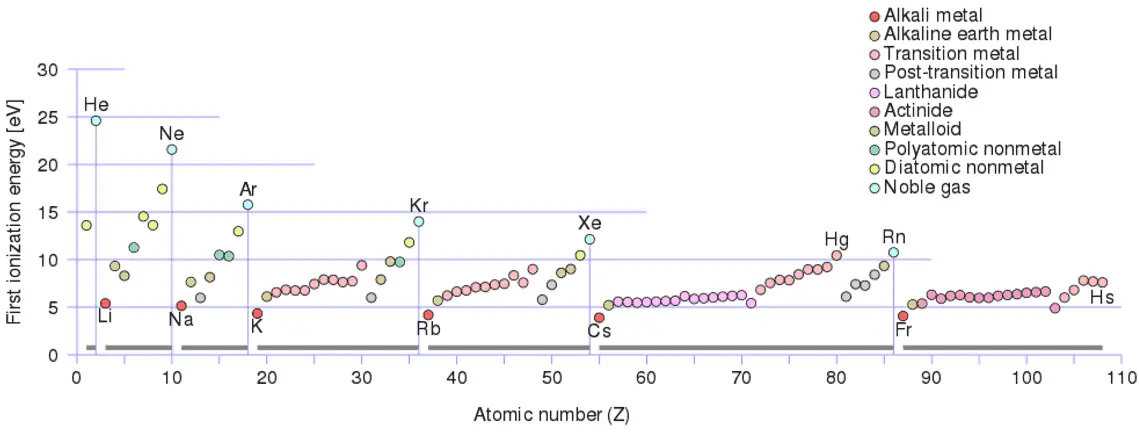
Ionization energy, also called ionization potential, is the energy necessary to remove an electron from the neutral atom.

X + energy → X+ + e−

where X is any atom or molecule capable of being ionized, X+ is that atom or molecule with an electron removed (positive ion), and e− is the removed electron.

There is an ionization energy for each successive electron removed. The electrons that circle the nucleus move in fairly well-defined orbits. Some of these electrons are more tightly bound in the atom than others. For example, only 7.38 eV is required to remove the outermost electron from a lead atom, while 88,000 eV is required to remove the innermost electron.

  • Ionization energy is lowest for the alkali metals which have a single electron outside a closed shell.
  • Ionization energy increases across a row on the periodic maximum for the noble gases which have closed shells.

For example, sodium requires only 496 kJ/mol or 5.14 eV/atom to ionize it. On the other hand neon, the noble gas, immediately preceding it in the periodic table, requires 2081 kJ/mol or 21.56 eV/atom.

The ionization energy associated with removal of the first electron is most commonly used. The nth ionization energy refers to the amount of energy required to remove an electron from the species with a charge of (n-1).

1st ionization energy

X → X+ + e−

2nd ionization energy

X+ → X2+ + e−

3rd ionization energy

X2+ → X3+ + e−

For example, only 7.38 eV is required to remove the outermost electron from a lead atom, while 88,000 eV is required to remove the innermost electron.

Ionization energy
Source: wikipedia.org License: CC BY-SA 3.0
Nuclear Energy
Nuclear energy comes either from spontaneous nuclei conversions or induced nuclei conversions. Among these conversions (nuclear reactions) belong for example nuclear fission, nuclear decay and nuclear fusion. Conversions are associated with mass and energy changes. One of the striking results of Einstein’s theory of relativity is that mass and energy are equivalent and convertible, one into the other. Equivalence of the mass and energy is described by Einstein’s famous formula:

E=MC2

 
References:
Reactor Physics and Thermal Hydraulics:
  1. J. R. Lamarsh, Introduction to Nuclear Reactor Theory, 2nd ed., Addison-Wesley, Reading, MA (1983).
  2. J. R. Lamarsh, A. J. Baratta, Introduction to Nuclear Engineering, 3d ed., Prentice-Hall, 2001, ISBN: 0-201-82498-1.
  3. W. M. Stacey, Nuclear Reactor Physics, John Wiley & Sons, 2001, ISBN: 0- 471-39127-1.
  4. Glasstone, Sesonske. Nuclear Reactor Engineering: Reactor Systems Engineering, Springer; 4th edition, 1994, ISBN: 978-0412985317
  5. Todreas Neil E., Kazimi Mujid S. Nuclear Systems Volume I: Thermal Hydraulic Fundamentals, Second Edition. CRC Press; 2 edition, 2012, ISBN: 978-0415802871
  6. Zohuri B., McDaniel P. Thermodynamics in Nuclear Power Plant Systems. Springer; 2015, ISBN: 978-3-319-13419-2
  7. Moran Michal J., Shapiro Howard N. Fundamentals of Engineering Thermodynamics, Fifth Edition, John Wiley & Sons, 2006, ISBN: 978-0-470-03037-0
  8. Kleinstreuer C. Modern Fluid Dynamics. Springer, 2010, ISBN 978-1-4020-8670-0.
  9. U.S. Department of Energy, THERMODYNAMICS, HEAT TRANSFER, AND FLUID FLOW. DOE Fundamentals Handbook, Volume 1, 2 and 3. June 1992.

See also:

Thermodynamics

We hope, this article, Form of Energy, helps you. If so, give us a like in the sidebar. Main purpose of this website is to help the public to learn some interesting and important information about thermal engineering.
What is Ideal Gas Model – Definition

The ideal gas model is used to predict the behavior of gases and is one of the most useful and commonly used substance models ever developed. Thermal Engineering

Ideal Gas Model

The ideal gas model is used to predict the behavior of gases and is one of the most useful and commonly used substance models ever developed. I was found, that if we confine 1 mol samples of various gases in identical volume and hold the gases at the same temperature, then their measured pressures are almost the same. Moreover when we confine gases at lower densities the differences tend to disappear. It was found, such gases tend to obey the following relation, which is known as the ideal gas law:

Enthalpy - Example - A frictionless piston

pV = nRT

where:

p is the absolute pressure of the gas

n is the amount of substance

T is the absolute temperature

V is the volume

R  is the ideal, or universal, gas constant, equal to the product of the Boltzmann constant and the Avogadro constant. The power of the ideal gas law is in its simplicity. When any two of the thermodynamic variables, p, v, and T are given, the third can easily be found.

The ideal gas model is based on following assumptions:

  1. The pressure, volume, and temperature of an ideal gas obey the ideal gas law.
  2. The specific internal energy is only a function of the temperature: u = u(T)
  3. The molar mass of an ideal gas is identical with the molar mass of the real substance
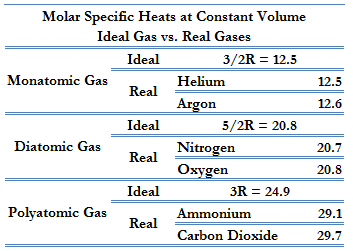
  4. The specific heats — cp and cv — are independent of temperature which means that they are constants.

From microscopic point of view it is based on these assumptions:

  1. The molecules of the gas are small, hard spheres.
  2. The only forces between the gas molecules are those that determine the point-like collisions.
  3. All collisions are elastic and all motion is frictionless.
  4. The average distance between molecules is much larger than the size of the molecules.
  5. The molecules are moving in random directions.
  6. There are no other attractive or repulsive force between these molecules.

Validity of Ideal Gas Law

Since ideal gas is defined as one in which all collisions between atoms or molecules are perfectly elastic and in which there are no intermolecular attractive forces, there is no such thing in nature as a truly ideal gas. On the other hand, all real gases approach the ideal state at low pressures (densities). At low pressures molecules are far enough apart that they do not interact with one another.

In other words, the Ideal Gas Law is accurate only at relatively low pressures (relative to the critical pressure pcr) and high temperatures (relative to the critical temperature Tcr). At these parameters, the compressibility factor, Z = pv / RT, is approximately 1. The compressibility factor is used to account for deviation from the ideal situation. This correction factor is dependent on pressure and temperature for each gas considered.

 
References:
Reactor Physics and Thermal Hydraulics:
  1. J. R. Lamarsh, Introduction to Nuclear Reactor Theory, 2nd ed., Addison-Wesley, Reading, MA (1983).
  2. J. R. Lamarsh, A. J. Baratta, Introduction to Nuclear Engineering, 3d ed., Prentice-Hall, 2001, ISBN: 0-201-82498-1.
  3. W. M. Stacey, Nuclear Reactor Physics, John Wiley & Sons, 2001, ISBN: 0- 471-39127-1.
  4. Glasstone, Sesonske. Nuclear Reactor Engineering: Reactor Systems Engineering, Springer; 4th edition, 1994, ISBN: 978-0412985317
  5. Todreas Neil E., Kazimi Mujid S. Nuclear Systems Volume I: Thermal Hydraulic Fundamentals, Second Edition. CRC Press; 2 edition, 2012, ISBN: 978-0415802871
  6. Zohuri B., McDaniel P. Thermodynamics in Nuclear Power Plant Systems. Springer; 2015, ISBN: 978-3-319-13419-2
  7. Moran Michal J., Shapiro Howard N. Fundamentals of Engineering Thermodynamics, Fifth Edition, John Wiley & Sons, 2006, ISBN: 978-0-470-03037-0
  8. Kleinstreuer C. Modern Fluid Dynamics. Springer, 2010, ISBN 978-1-4020-8670-0.
  9. U.S. Department of Energy, THERMODYNAMICS, HEAT TRANSFER, AND FLUID FLOW. DOE Fundamentals Handbook, Volume 1, 2 and 3. June 1992.

See also:

Ideal Gas Law

We hope, this article, Ideal Gas Model, helps you. If so, give us a like in the sidebar. Main purpose of this website is to help the public to learn some interesting and important information about thermal engineering.

What is Joule’s Second Law – Definition

Joule’s Second Law states: The internal energy of a fixed mass of an ideal gas depends only on its temperature (not pressure or volume). Thermal Engineering

Joule’s Second Law

For any gas whose equation of state is given exactly by pV = nRT (or pv = RT), the specific internal energy depends on temperature only. This rule was originally found in 1843 by an English physicist James Prescott Joule experimentally for real gases and is known as Joule’s second law:

The internal energy of a fixed mass of an ideal gas depends only on its temperature (not pressure or volume).

The specific enthalpy of a gas described by pV = nRT also depends on temperature only. Note that, the enthalpy is the thermodynamic quantity equivalent to the total heat content of a system. It is equal to the internal energy of the system plus the product of pressure and volume. In intensive variables the Joule’s second law is therefore given by h = h(T) = u(T) + pv = u(T) + RT.

These three equations constitute the ideal gas model, summarized as follows:

pv = RT

u = u(T)

h = h(T) = u(T) + RT

 
References:
Reactor Physics and Thermal Hydraulics:
  1. J. R. Lamarsh, Introduction to Nuclear Reactor Theory, 2nd ed., Addison-Wesley, Reading, MA (1983).
  2. J. R. Lamarsh, A. J. Baratta, Introduction to Nuclear Engineering, 3d ed., Prentice-Hall, 2001, ISBN: 0-201-82498-1.
  3. W. M. Stacey, Nuclear Reactor Physics, John Wiley & Sons, 2001, ISBN: 0- 471-39127-1.
  4. Glasstone, Sesonske. Nuclear Reactor Engineering: Reactor Systems Engineering, Springer; 4th edition, 1994, ISBN: 978-0412985317
  5. Todreas Neil E., Kazimi Mujid S. Nuclear Systems Volume I: Thermal Hydraulic Fundamentals, Second Edition. CRC Press; 2 edition, 2012, ISBN: 978-0415802871
  6. Zohuri B., McDaniel P. Thermodynamics in Nuclear Power Plant Systems. Springer; 2015, ISBN: 978-3-319-13419-2
  7. Moran Michal J., Shapiro Howard N. Fundamentals of Engineering Thermodynamics, Fifth Edition, John Wiley & Sons, 2006, ISBN: 978-0-470-03037-0
  8. Kleinstreuer C. Modern Fluid Dynamics. Springer, 2010, ISBN 978-1-4020-8670-0.
  9. U.S. Department of Energy, THERMODYNAMICS, HEAT TRANSFER, AND FLUID FLOW. DOE Fundamentals Handbook, Volume 1, 2 and 3. June 1992.

See also:

Ideal Gas Law

We hope, this article, Joule’s Second Law, helps you. If so, give us a like in the sidebar. Main purpose of this website is to help the public to learn some interesting and important information about thermal engineering.
What is Universal Gas Constant – Definition

pV=nRT. In this equation the symbol R is a constant called the universal gas constant that has the same value for all gases—namely, R = 8.31 J/mol K. Thermal Engineering

Universal Gas Constant

Any equation that relates the pressure, temperature, and specific volume of a substance is called an equation of state. The simplest and best-known equation of state for substances in the gas phase is the Ideal Gas equation of state. It was first stated by Émile Clapeyron in 1834 as a combination of the empirical Boyle’s law, Charles’ law and Avogadro’s Law. This equation predicts the p-v-T behavior of a gas quite accurately for dilute or low-pressure gases. In an ideal gas, molecules have no volume and do not interact. According to the ideal gas law, pressure varies linearly with temperature and quantity, and inversely with volume.

pV = nRT

where:

  • p is the absolute pressure of the gas
  • n is the amount of substance
  • T is the absolute temperature
  • V is the volume
  • R  is the ideal, or universal, gas constant, equal to the product of the Boltzmann constant and the Avogadro constant,

In this equation the symbol R is a constant called the universal gas constant that has the same value for all gases—namely, R =  8.31 J/mol K.

The power of the ideal gas law is in its simplicity. When any two of the thermodynamic variables, p, v, and T are given, the third can easily be found. Many physical conditions of gases calculated by engineers fit the above description. Perhaps the most common use of gas behavior studied by engineers is that of the compression process and expansion process using ideal gas approximations.


Molar specific heats - ideal gas

 
References:
Reactor Physics and Thermal Hydraulics:
  1. J. R. Lamarsh, Introduction to Nuclear Reactor Theory, 2nd ed., Addison-Wesley, Reading, MA (1983).
  2. J. R. Lamarsh, A. J. Baratta, Introduction to Nuclear Engineering, 3d ed., Prentice-Hall, 2001, ISBN: 0-201-82498-1.
  3. W. M. Stacey, Nuclear Reactor Physics, John Wiley & Sons, 2001, ISBN: 0- 471-39127-1.
  4. Glasstone, Sesonske. Nuclear Reactor Engineering: Reactor Systems Engineering, Springer; 4th edition, 1994, ISBN: 978-0412985317
  5. Todreas Neil E., Kazimi Mujid S. Nuclear Systems Volume I: Thermal Hydraulic Fundamentals, Second Edition. CRC Press; 2 edition, 2012, ISBN: 978-0415802871
  6. Zohuri B., McDaniel P. Thermodynamics in Nuclear Power Plant Systems. Springer; 2015, ISBN: 978-3-319-13419-2
  7. Moran Michal J., Shapiro Howard N. Fundamentals of Engineering Thermodynamics, Fifth Edition, John Wiley & Sons, 2006, ISBN: 978-0-470-03037-0
  8. Kleinstreuer C. Modern Fluid Dynamics. Springer, 2010, ISBN 978-1-4020-8670-0.
  9. U.S. Department of Energy, THERMODYNAMICS, HEAT TRANSFER, AND FLUID FLOW. DOE Fundamentals Handbook, Volume 1, 2 and 3. June 1992.

See also:

Ideal Gas Law

We hope, this article, Universal Gas Constant, helps you. If so, give us a like in the sidebar. Main purpose of this website is to help the public to learn some interesting and important information about thermal engineering.
What is Ideal Gas – Definition

An ideal gas is defined as one in which all collisions between atoms or molecules are perfectly elastic and in which there are no intermolecular attractive forces. Thermal Engineering

What is an Ideal Gas

An ideal gas is defined as one in which all collisions between atoms or molecules are perfectly elastic and in which there are no intermolecular attractive forces. An ideal gas can be visualized as a collection of perfectly hard spheres which collide but which otherwise do not interact with each other. In reality, no real gases are like an ideal gas and therefore no real gases follow the ideal gas law or equation completely. At temperatures near a gases boiling point, increases in pressure will cause condensation to take place and drastic decreases in volume. At very high pressures, the intermolecular forces of a gas are significant. However, most gases are in approximate agreement at pressures and temperatures above their boiling point. The ideal gas law is utilized by engineers working with gases because it is simple to use and approximates real gas behavior.

[xyz-ihs snippet=”pressure”]

See also: Elastic Collision

 
References:
Reactor Physics and Thermal Hydraulics:
  1. J. R. Lamarsh, Introduction to Nuclear Reactor Theory, 2nd ed., Addison-Wesley, Reading, MA (1983).
  2. J. R. Lamarsh, A. J. Baratta, Introduction to Nuclear Engineering, 3d ed., Prentice-Hall, 2001, ISBN: 0-201-82498-1.
  3. W. M. Stacey, Nuclear Reactor Physics, John Wiley & Sons, 2001, ISBN: 0- 471-39127-1.
  4. Glasstone, Sesonske. Nuclear Reactor Engineering: Reactor Systems Engineering, Springer; 4th edition, 1994, ISBN: 978-0412985317
  5. Todreas Neil E., Kazimi Mujid S. Nuclear Systems Volume I: Thermal Hydraulic Fundamentals, Second Edition. CRC Press; 2 edition, 2012, ISBN: 978-0415802871
  6. Zohuri B., McDaniel P. Thermodynamics in Nuclear Power Plant Systems. Springer; 2015, ISBN: 978-3-319-13419-2
  7. Moran Michal J., Shapiro Howard N. Fundamentals of Engineering Thermodynamics, Fifth Edition, John Wiley & Sons, 2006, ISBN: 978-0-470-03037-0
  8. Kleinstreuer C. Modern Fluid Dynamics. Springer, 2010, ISBN 978-1-4020-8670-0.
  9. U.S. Department of Energy, THERMODYNAMICS, HEAT TRANSFER, AND FLUID FLOW. DOE Fundamentals Handbook, Volume 1, 2 and 3. June 1992.

See also:

Ideal Gas Law

We hope, this article, Ideal Gas, helps you. If so, give us a like in the sidebar. Main purpose of this website is to help the public to learn some interesting and important information about thermal engineering.
What is Example of Ideal Gas Law – Gas Compression – Definition

Example: Ideal Gas Law – Gas compression inside a pressurize. What is the final pressure of the gas inside the pressurizer? Assume that the gas is ideal. Thermal Engineering

Example: Ideal Gas Law – Gas compression inside a pressurizer

pressurizer
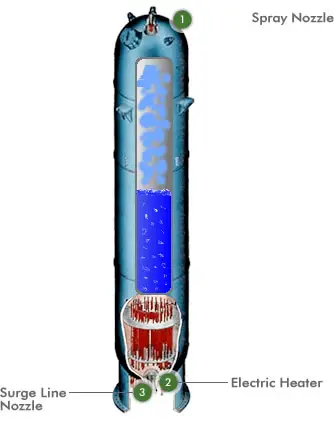
A pressurizer is a key component of PWRs.

Pressure in the primary circuit of PWRs is maintained by a pressurizer, a separate vessel that is connected to the primary circuit (hot leg) and partially filled with water which is heated to the saturation temperature (boiling point) for the desired pressure by submerged electrical heaters. During the plant heatup the pressurizer can be filled by nitrogen instead of saturated steam.

Assume that a pressurizer contains 12 m3 of nitrogen at 20°C and 15 bar. The temperature is raised to 35°C, and the volume is reduced to 8.5 m3. What is the final pressure of the gas inside the pressurizer? Assume that the gas is ideal.

Solution:

Since the gas is ideal,we can use the ideal gas law to relate its parameters, both in the initial state i and in the final state f. Therefore:

pinitVinit = nRTinit

and

pfinalVfinal = nRTfinal

Dividing the second equation by the first equation and solving for pf we obtain:

pfinal = pinitTfinalVinit / TinitVfinal

Note that we cannot convert units of volume and pressure to basic SI units, because they cancel out each other. On the other hand we have to use Kelvins instead of degrees of Celsius. Therefore Tinit = 293 K and Tfinal = 308 K.

It follows, the resulting pressure in the final state will be:

pfinal = (15 bar) x (308 K) x (12 m3) / (293 K) x (8.5 m3) = 22 bar

 
References:
Reactor Physics and Thermal Hydraulics:
  1. J. R. Lamarsh, Introduction to Nuclear Reactor Theory, 2nd ed., Addison-Wesley, Reading, MA (1983).
  2. J. R. Lamarsh, A. J. Baratta, Introduction to Nuclear Engineering, 3d ed., Prentice-Hall, 2001, ISBN: 0-201-82498-1.
  3. W. M. Stacey, Nuclear Reactor Physics, John Wiley & Sons, 2001, ISBN: 0- 471-39127-1.
  4. Glasstone, Sesonske. Nuclear Reactor Engineering: Reactor Systems Engineering, Springer; 4th edition, 1994, ISBN: 978-0412985317
  5. Todreas Neil E., Kazimi Mujid S. Nuclear Systems Volume I: Thermal Hydraulic Fundamentals, Second Edition. CRC Press; 2 edition, 2012, ISBN: 978-0415802871
  6. Zohuri B., McDaniel P. Thermodynamics in Nuclear Power Plant Systems. Springer; 2015, ISBN: 978-3-319-13419-2
  7. Moran Michal J., Shapiro Howard N. Fundamentals of Engineering Thermodynamics, Fifth Edition, John Wiley & Sons, 2006, ISBN: 978-0-470-03037-0
  8. Kleinstreuer C. Modern Fluid Dynamics. Springer, 2010, ISBN 978-1-4020-8670-0.
  9. U.S. Department of Energy, THERMODYNAMICS, HEAT TRANSFER, AND FLUID FLOW. DOE Fundamentals Handbook, Volume 1, 2 and 3. June 1992.

See also:

Ideal Gas Law

We hope, this article, Example of Ideal Gas Law – Gas Compression, helps you. If so, give us a like in the sidebar. Main purpose of this website is to help the public to learn some interesting and important information about thermal engineering.