Facebook Instagram Youtube Twitter

Boiler | Steam Generation & Types

An in-depth look at boilers and their role in steam generation for industrial and residential uses, covering operation, types, and processes.

Boiler | Steam Generation & Types

Introduction to Boilers and Steam Generation

Boilers are integral components used in many industrial and residential applications to generate steam. Steam generation is a key process in various industries, including power generation, manufacturing, and heating. In this article, we will explore how boilers operate, the principles of steam generation, and the different types of boilers used in industry and other applications.

Basics of Steam Generation

At its core, a boiler is a device designed to convert water into steam through the application of heat. Typically, the energy is supplied through the combustion of fuels (like coal, gas, oil) or through electrical heating elements. The generated steam can be used directly in process industries or for producing electricity in turbines.

The basic equation for the energy balance in a boiler can be expressed as:

Energy in = Energy out + Energy Stored

Where “Energy in” is the heat provided to the boiler (via fuel or electricity), “Energy out” is the energy carried away by steam, and “Energy Stored” is the energy retained within the boiler components.

Types of Boilers

There are several types of boilers, each designed to meet specific needs and operate under different conditions:

  • Fire-Tube Boiler: In these boilers, hot gases pass through one or more tubes, which are surrounded by water. The heat from the gases is transferred through the walls of the tubes by thermal conduction, heating the water and ultimately creating steam.
  • Water-Tube Boiler: Water-tube boilers work in the opposite manner of fire-tube boilers. Water flows through tubes that are exposed to hot gases on the outside. This design allows water-tube boilers to generate steam at higher pressures and rates than fire-tube boilers.
  • Electric Boiler: These use electricity to heat the water. They are often used in places where combustion of fuels is not viable or desired. Although they are more environmentally friendly, they tend to be more expensive in areas where electricity is costly.
  • Condensing Boiler: A condensing boiler is designed to recover energy that would otherwise be dispersed out of the stack as waste heat. It does this by condensing water vapor in the exhaust gases and recovering its latent heat, which is used to preheat the incoming cold water. This efficiency can drastically cut fuel costs and is also more environmentally friendly.

Steam Generation Process

The key steps in the steam generation within a typical boiler can be described as follows:

  1. Heating: Heat is generated by burning fuel, which may be solid, liquid, or gas, or through electric coils. This heat raises the temperature of water inside the boiler.
  2. Evaporation: As the water heats up, it reaches the boiling point and starts to convert into steam. Depending on the boiler pressure, the boiling point of water can be higher than the standard 100 degrees Celsius at atmospheric pressure.
  3. Superheating: In some boilers, once the steam is formed it may further pass through a superheater, which raises the temperature of the steam beyond the boiling point. This superheated steam is particularly useful in powering turbines as it holds more energy and can exert greater pressure on turbine blades.
  4. Separation: Finally, steam is separated from water in a steam drum, and the saturated (wet) steam is further superheated before being piped out for industrial use.

Conclusion

Boilers and their capacity to generate steam are crucial to many sectors of modern industry. Understanding different types of boilers and how they generate steam helps engineers and technicians optimize performance for various applications, from large-scale power generation to small manufacturing processes. As technology advances, so too do the designs and efficiencies of boilers, broadening their applications and improving their environmental compatibility.

Thermally responsive smart materials

Learn about thermally responsive smart materials, substances that change properties in reaction to temperature variations.

Thermally responsive smart materials

Thermally Responsive Smart Materials

Thermally responsive smart materials are a category of innovative substances that react to changes in temperature with remarkable transformations in their physical properties. Utilized across various fields such as aerospace, automotive, healthcare, and consumer products, these materials hold the potential to drive significant advancements in technology and product design.

Understanding Thermally Responsive Materials

At their core, thermally responsive materials are designed to respond to a specific trigger, which is a change in temperature. This response can manifest in several ways, including changes in shape, rigidity, and conductivity, among others. The capability of these materials to react to temperature changes is primarily due to their molecular structure, which is engineered to be sensitive to thermal variations.

Types of Thermally Responsive Materials

  • Shape Memory Alloys (SMAs): Perhaps the most well-known type of thermally responsive materials, SMAs can return to their original shape after being deformed. This property is useful in applications requiring self-adjusting components or devices. Nickel-titanium alloys (commonly referred to as Nitinol) are a prominent example of SMAs.
  • Shape Memory Polymers (SMPs): Similar to SMAs, SMPs change their shape in response to a temperature change. However, they can be engineered to operate at lower temperatures and are generally lighter and more cost-effective than metal alloys.
  • Thermally responsive gels: These materials can undergo significant volume changes when exposed to temperature shifts. Hydrogels that expand or contract with temperature are commonly used in biomedical applications, such as drug delivery systems where they release medication upon reaching a specific body temperature.

Applications of Thermally Responsive Materials

  • Aerospace: In aerospace engineering, SMAs are used for developing components that can adapt to environmental changes, improve fuel efficiency, and reduce maintenance costs.
  • Automotive: Thermally responsive polymers find applications in automotive sensors and actuators, providing enhanced control systems that operate based on temperature changes.
  • Healthcare: In the medical field, thermally responsive materials are critical in creating devices that can adapt to the thermal dynamics of the human body for more effective treatments and interventions.
  • Consumer Products: These materials are also integrated into consumer products such as eyeglasses that adjust their tint based on sunlight exposure, or clothing that changes its thermal insulation properties as per the ambient temperature.

Challenges and Future Directions

Despite their potential, the development and integration of thermally responsive smart materials face several challenges. These include the cost of material production, durability under repeated use, and the precision of control in real-world applications. As research continues, the focus remains on overcoming these hurdles through innovative engineering strategies and ongoing advancements in material science.

The future of thermally responsive materials is promising, as they are poised to become integral components of next-generation products and systems, offering responsive and adaptive solutions to complex engineering challenges.

Understanding and exploiting these materials fully could lead to revolutionary applications across a broad spectrum of industries, enhancing functionality, efficiency, and sustainability in the technologies of tomorrow.

Condensing Unit | AC Systems & Refrigeration

Learn about the condensing unit, a crucial component in AC and refrigeration systems, its functions, and components.

Condensing Unit | AC Systems & Refrigeration

Understanding the Condensing Unit in AC Systems and Refrigeration

The condensing unit is a pivotal component in air conditioning (AC) systems and refrigeration cycles. It serves a vital role in the heat transfer process that is essential for cooling environments or preserving perishables. In this article, we will explore how the condensing unit functions, its components, and the role it plays in different types of cooling systems.

What is a Condensing Unit?

A condensing unit is the part of the AC or refrigeration system where the vapor refrigerant is converted back to liquid form. It is usually located outside the home or commercial building, and consists of several key components including the compressor, the condenser coil, and the condenser fan.

Components of a Condensing Unit

  • Compressor: The heart of the condensing unit, the compressor is responsible for compressing the refrigerant, which increases its temperature and pressure. This process prepares the refrigerant for condensation as it enters the condenser coils.
  • Condenser Coil: This component facilitates the heat transfer where the compressed gas releases its internal heat to the surrounding air. It’s typically made of copper or aluminum which efficiently conducts heat.
  • Condenser Fan: The fan blows outside air through the condenser coil to help cool the refrigerant down more efficiently. As the refrigerant loses heat, it starts to condense from a gas back into a liquid form.

How Does a Condensing Unit Work?

The operation of a condensing unit is based on the principles of the refrigeration cycle. The cycle begins in the compressor, where low-pressure gas is compressed to a high-pressure state. The high-pressure, high-temperature vapor then travels to the condenser coil. Here, under the action of the condenser fan, the ambient air absorbs the heat from the refrigerant, causing the temperature of the refrigerant to drop and it transforms back into a liquid state.

Once the refrigerant has liquefied, it moves to the expansion valve where it undergoes a sudden drop in pressure, cooling it further and preparing it for its journey back into the indoor unit. This cycle repeats continuously to maintain a consistent cooling effect inside the desired environment.

Types of Condensing Units

Condensing units can vary based on the type of refrigerant they use, their size, and their efficiency. They are also classified based on their application, such as:

  1. Residential AC Systems: These are typically smaller units designed to cool single rooms or houses.
  2. Commercial AC Systems: Larger and more robust, these units are capable of cooling multiple rooms or entire buildings.
  3. Refrigeration Systems: These are specifically designed for refrigeration applications and can vary significantly in size based on the requirements of the facility.

The Role of the Condensing Unit in Energy Efficiency

The efficiency of a condensing unit greatly affects the overall energy consumption of an AC or refrigeration system. Modern condensing units often include features like energy-efficient compressors and larger condenser coils to improve heat transfer and reduce operational costs. Improvements in fan blade design and the use of variable speed fans also contribute to enhanced efficiency, leading to more sustainable operations and lower environmental impact.

Conclusion

The condensing unit is an essential component of both air conditioning and refrigeration systems. Understanding how it works helps individuals and businesses optimize their use of these cooling systems and potentially reduce energy costs. Whether for residential comfort or commercial necessity, the condensing unit plays a critical role in temperature regulation and operational efficiency.

Chilled Beam System | Energy-Efficient Applications

Learn about chilled beam systems, efficient air conditioning using water for thermal comfort in commercial and institutional buildings.

Chilled Beam System | Energy-Efficient Applications

Understanding Chilled Beam Systems

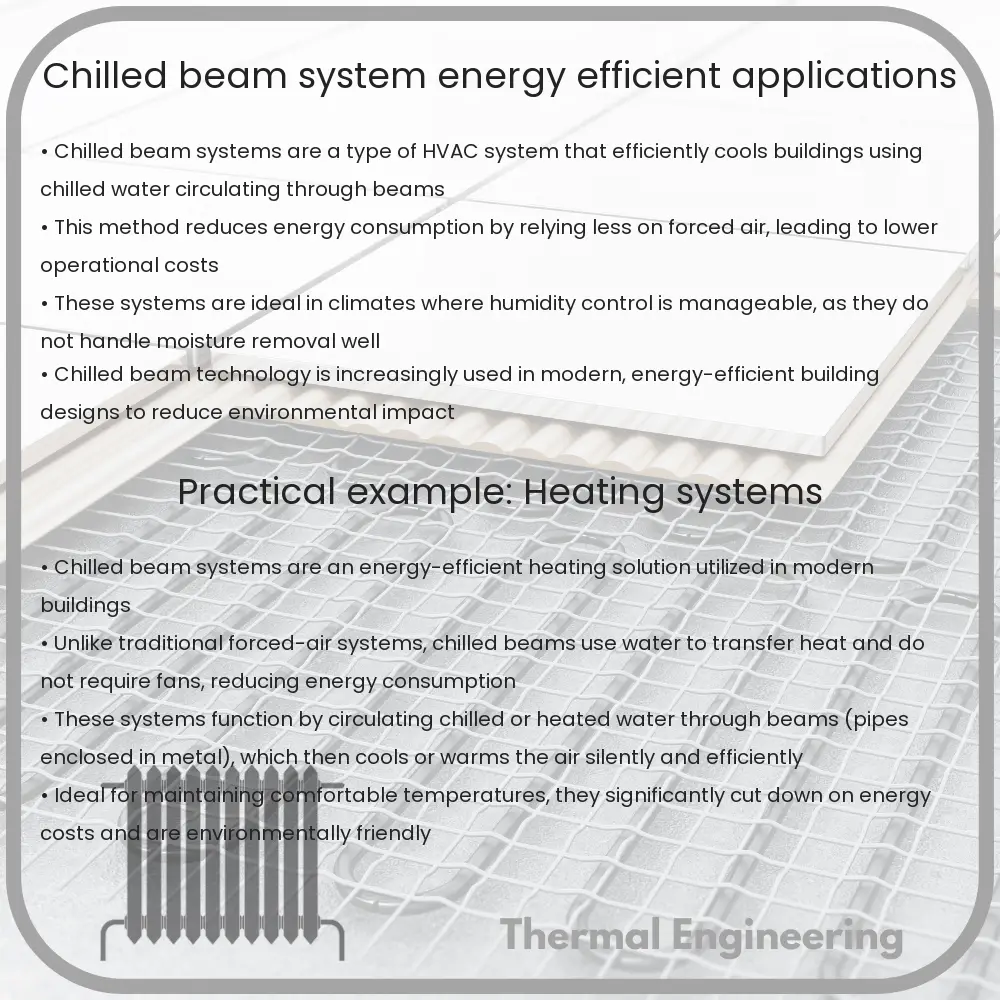
Chilled beam systems are a type of air conditioning system that provides efficient thermal comfort by using water as a heat transfer medium. Predominantly used in commercial and institutional buildings, these systems have gained popularity due to their energy efficiency and ability to reduce operating costs compared to traditional HVAC systems.

How Chilled Beam Systems Work

Chilled beam systems contain pipes through which chilled water circulates. They are installed within or just below the ceiling. There are two types of chilled beam systems:

  • Passive chilled beams: These utilize the natural convection process to cool a space. Warm air rises towards the ceiling, cools upon contacting the chilled beam, and then descends back into the room as cooler air.
  • Active chilled beams: These systems incorporate ducted air supply. Air is supplied to the chilled beam at a slightly higher pressure, inducing room air to circulate through the coil along with the primary air, enhancing the cooling effect.

Energy Efficiency and Applications

Chilled beam systems are particularly noted for their energy efficiency. The key factors contributing to this efficiency include:

  • Reduced Air Volumes: Active chilled beams require less air to be conditioned because they mostly handle latent loads (moisture removal) and make use of the water system for sensible cooling (temperature drops).
  • Lower Fan Energy Use: Since smaller volumes of air are necessary, fan energy consumption is significantly reduced.
  • Enhanced Thermal Comfort: These systems provide a more controlled environment by delivering cooling directly from the ceiling into the occupied space, reducing the risk of drafts.

When considering applications, chilled beam systems are best suited for environments where:

  1. Noise reduction is necessary, as these systems operate quietly compared to forced-air systems.
  2. Space with controlled humidity is critical, such as in hospitals or laboratories.
  3. Energy saving is prioritized. Schools, offices, and hotels are common places where chilled beam systems can frequently be found.

Maintenance and Considerations

While chilled beam systems offer several advantages, they also require careful consideration and maintenance:

  • Condensation Control: It’s vital to maintain correct humidity levels to avoid condensation, which can lead to water damage and mold growth. This typically requires accurate controls and, in some climates, additional dehumidification systems.
  • Installation Cost: The initial installation cost of chilled beam systems can be higher than traditional HVAC systems. However, the reduced operational costs can offset this over time.
  • Architectural Considerations: Since these units are installed in or near the ceiling, the building design must accommodate this integration, which may impact the aesthetic or structural aspects of a project.

Conclusion

Chilled beam systems stand out as a sustainable choice in modern air conditioning technology, particularly for applications where noise levels, space air quality, and energy efficiency are critical. By understanding the principles and considerations involved in their design and operation, facilities can optimize their environments while reducing overall energy consumption.

Thermal Imaging System | Preventive Infrared Uses

Learn how thermal imaging systems convert thermal energy into visible images for analysis and maintenance across industries.

Thermal Imaging System | Preventive Infrared Uses

Understanding Thermal Imaging Systems

Thermal imaging systems are devices that translate thermal energy (heat) into visible light in order to analyze a particular object or scene. The image produced is known as a thermogram and is analyzed through a process called thermography. Thermal imaging cameras are exceptionally powerful tools for monitoring, diagnosing, and managing problems in a variety of applications across many industry sectors.

How Thermal Imaging Systems Work

At the heart of a thermal imaging camera is an infrared detector and an optical system that captures infrared radiation from objects in the scene. The infrared detector elements create a detailed temperature pattern called a thermogram. This thermogram is then converted into electric impulses that are sent to a signal-processing unit, a circuit board with a dedicated chip that translates the data into an image for display. Every pixel in the output represents a temperature of the captured scene.

Components of a Thermal Imaging System

  • Infrared Detector: Essential for capturing infrared radiation.
  • Optical System: Focuses infrared radiation onto the detector.
  • Display: Converts the electric impulses into an image visible to humans.
  • Processing Unit: Analyses the data from the detector to produce the image.

Preventive and Predictive Maintenance

Preventive maintenance using thermal imaging involves regularly checking and monitoring equipment to detect abnormalities that may indicate impending failure. Similarly, predictive maintenance involves foreseeing potential problems before they occur. Both practices are pivotal in prolonging equipment life and preventing costly downtime and repairs in industrial settings.

Preventive Infrared Uses in Various Industries

  1. Electrical Systems: Inspecting electrical panels, connections, and transformers for hot spots that indicate excessive heat build-up which could lead to failures.
  2. Mechanical Systems: Monitoring bearings, motors, pumps, and other mechanical equipment for unusual heat patterns indicating wear or misalignment.
  3. Building Diagnostics: Identifying energy losses, missing insulations, water leaks, and structural integrity.
  4. Medical and Veterinary: Diagnosing and monitoring diseases by observing the thermal variations that indicate abnormalities in humans and animals.
  5. Security and Surveillance: Detecting intrusions in complete darkness or through obstructions such as smoke or fog.

Advancements in Thermal Imaging Technology

Advancements in sensor technology have greatly enhanced the sensitivity and resolution of thermal imagers. Current high-definition sensors offer significantly finer details. Additionally, the integration of AI and machine learning algorithms has allowed for smarter thermal sensing applications, which can perform pattern recognition to automatically identify potential issues in complex industrial environments.

Conclusion

Thermal imaging systems form an essential part of modern diagnostic and maintenance routines across various industries. By allowing users to see the unseen—heat anomalies that signify potential or existent problems—these tools not only ensure safety and efficiency but also save money by preempting equipment failures and minimizing downtime.

Heat Pipe | Electronics & Efficiency Design

Learn how heat pipes improve electronics efficiency by managing heat through thermal conductivity and phase transition.

Heat Pipe | Electronics & Efficiency Design

Understanding Heat Pipes in Electronics and Efficiency Design

Heat pipes are an essential component in modern electronics design, particularly due to their efficiency in heat management. These devices play a critical role in improving the reliability and performance of electronic systems by effectively dissipating heat. Let’s explore how heat pipes work, their design aspects, and their impact on electronics efficiency.

What is a Heat Pipe?

A heat pipe is a heat-transfer device that combines the principles of both thermal conductivity and phase transition to efficiently manage the transfer of heat between two interfaces. At its core, a heat pipe contains a working fluid within a sealed environment. When one end of the pipe, termed as the “evaporator” section, is exposed to a heat source, the fluid inside absorbs this heat and changes from a liquid to a vapor, thus moving to a cooler area of the pipe known as the “condenser” section.

How Heat Pipes Work

  • Evaporation: At the hot interface (evaporator), the working fluid absorbs heat and evaporates, transforming from a liquid to a gas. This phase change absorbs a significant amount of thermal energy, which helps in cooling the heat source.
  • Vapor Transport: The vaporized fluid travels along the pipe to the other end driven by the pressure difference created by the heat.
  • Condensation: At the cooler interface (condenser), the vapor releases its latent heat and condenses back into a liquid form. The released heat is then expelled into the environment or into a secondary cooling mechanism like a heat sink.
  • Liquid Return: The liquid returns to the evaporator section through capillary action, gravity, or a wick structure lining the inner walls of the pipe, repeating the cycle.

Components of a Heat Pipe

  • Container: The physical shell of a heat pipe, which holds the working fluid and is typically made from materials with high thermal conductivity such as copper or aluminum.
  • Working Fluid: The fluid choice depends on the operational temperature range of the device. Common fluids include water, acetone, and ammonia.
  • Wick or Capillary Structure: This structure lines the interior walls of the heat pipe and helps in returning the liquid from the condenser back to the evaporator by capillary action.

Role in Electronics

Heat pipes are found in a variety of electronic devices, from computers and servers to smartphones and high-power electronics. They are particularly valuable in applications where traditional cooling methods, like fans or heat sinks, are insufficient or impractical. Their ability to efficiently transfer heat over relatively long distances with minimal temperature difference makes them ideal for densely packed electronic enclosures.

Benefits of Heat Pipes in Electronics Design

  • High Efficiency: Because they exploit the latent heat of vaporization, heat pipes are significantly more effective at transferring heat than solid conductors like copper rods.
  • Reliability: Heat pipes contain no moving parts, making them highly reliable and maintenance-free with very long service lifetimes.
  • Compactness: Heat pipes can conform to various shapes and sizes, offering flexible integration into electronic hardware designs.
  • Environmental Resistance: Being completely sealed, they are resistant to environmental factors like dust and moisture.

Conclusion

Heat pipes represent a critical innovation in thermal management within the field of electronics. By effectively transporting heat with minimal loss, they enable the design of smaller, faster, and more reliable electronic systems. As electronic devices continue to shrink while increasing in power, the role of heat pipes in efficiency and reliability becomes ever more vital.

Understanding these components helps in appreciating the sophistication and challenges of modern electronics design and highlights the seamless integration of physics in engineering solutions.

HVAC System | Types for Environmental Comfort

Learn about HVAC systems, their types, benefits, and maintenance for optimal indoor comfort and air quality.

HVAC System | Types for Environmental Comfort

Understanding HVAC Systems: Engineering for Environmental Comfort

Heating, Ventilation, and Air Conditioning (HVAC) systems are crucial in maintaining a comfortable and healthy indoor environment in various types of buildings, from residential homes to commercial office spaces and industrial facilities. These systems regulate indoor climate and air quality to ensure comfort and health. This article explores the different types of HVAC systems and their benefits in providing environmental comfort.

Types of HVAC Systems

HVAC systems can be categorized broadly into four types: split systems, hybrid systems, duct-free systems, and packaged heating and air systems. Each has its unique configuration and benefits, tailored for different needs and building types.

  • Split Systems: The most common type of HVAC system; split systems are characterized by two main components: one outdoor unit that houses the compressor and condenser, and one indoor unit that holds the evaporator coil and blower. The split system is most commonly used in residential buildings. It’s efficient and economical for small to medium-sized buildings.
  • Hybrid Systems: Similar to the split system, hybrid systems allow for a fuel-switching capability, generally between gas and electricity. This flexibility can result in significant energy savings and a reduced carbon footprint, as it can be optimized based on energy costs and climate conditions.
  • Duct-Free Systems: Also known as mini-split systems, these units can be installed directly into the zones of the house that require heating and cooling. Each zone has its own unit, and each can be controlled independently. This type of system is ideal for new additions to homes, such as garages, extensions, or retrofit add-ons to houses with non-ducted heating systems, such as hydronic (hot water heat), radiant panels, and space heaters.
  • Packaged Heating and Air Conditioning Systems: These systems contain the evaporator coil, compressor, and condenser all in one location, typically on a roof or near the foundation. This type of system is typically used in small commercial buildings and can be a great solution where there isn’t much indoor space for a system.

Choosing the Right System

Selecting the right HVAC system depends on several factors including climate, building size, initial budget, and energy consumption preferences. For instance, the split system might be more appropriate for smaller residential settings whereas larger commercial or industrial environments could benefit from the robustness of packaged systems.

Moreover, energy efficiency is also a key factor in choosing an HVAC system. Technologies such as variable speed motors in fans and blowers can adjust speeds based on the need, which conserves energy significantly. Additionally, modern HVAC systems incorporate smart thermostatic controls, which adapt heating and cooling parameters based on real-time environmental and occupancy data.

Maintaining Your HVAC System

Regular maintenance is crucial for the longevity and efficiency of HVAC systems. This includes routine checks and cleaning of filters, ducts, and coils, along with scheduled inspections and servicing by professionals. Proper maintenance not only ensures optimal functioning but can also prevent unexpected repairs and breakdowns, thereby extending the life of the system.

In conclusion, HVAC systems are essential for ensuring the comfort and health of building occupants by regulating indoor climate and air quality. There are various types of HVAC systems to choose from depending on specific needs and circumstances. By understanding each type and maintaining it correctly, one can significantly enhance indoor environmental comfort and efficiency.

Radiant Floor Heating | Efficiency & Installation

Learn about radiant floor heating, including how it works, its efficiency, installation types, and benefits for home heating systems.

Radiant Floor Heating | Efficiency & Installation

Understanding Radiant Floor Heating: Efficiency and Installation

Radiant floor heating is a method of heating a home or building that provides warmth directly from the floor. It is a popular alternative to traditional heating systems, like forced-air systems, due to its ability to evenly distribute heat and enhance overall energy efficiency. In this article, we’ll explore how radiant floor heating works, its efficiency benefits, and considerations for installation.

How Radiant Floor Heating Works

Radiant floor heating systems function by circulating warm water through a network of pipes laid under the floor, or by using electrical cables or mats. There are two main types of radiant floor heating systems:

  • Hydronic systems: These use hot water that’s heated by a boiler and pumped through pipes installed beneath the floor. The heat from the water radiates upward, warming the floor and the room.
  • Electric systems: These consist of electric coils or mats placed under the flooring. When electricity passes through these coils, they heat up the floor above.

The heat generated by these systems then radiates upward, warming objects and people in the room directly. This direct method of heating provides a uniform distribution of warmth, which can feel more comfortable than the sometimes uneven heat produced by conventional forced-air systems.

Efficiency of Radiant Floor Heating

Radiant floor heating is known for its high efficiency for several reasons:

  • Reduced Heat Loss: As heat is generated from the floor and rises naturally, there is minimal heat loss, unlike traditional heating systems where much heat can be lost through ducts.
  • Lower Operating Temperatures: Radiant systems often operate effectively at lower temperatures than standard boilers or furnaces, which translates into energy savings over time.
  • Better Heat Distribution: The even distribution of heat means that radiant heating often reaches the desired comfort level at a lower thermostat setting than other systems.

Moreover, because there are no air currents involved in moving heat around, radiant floors do not circulate dust and allergens as much as forced-air systems. This can contribute to a healthier living environment and further increase the system’s appeal.

Installation Considerations

Installation of a radiant floor heating system can vary depending on several factors, such as the type of system (hydronic or electric) and the existing structure of a home. Key considerations include:

  • Type of Flooring: Radiant heat can be installed under various types of flooring including tile, stone, wood, and carpet. However, conductivity of the flooring material can affect performance. Materials like tile and stone typically conduct and hold heat well, making them ideal choices.
  • Installation Costs: Initial installation costs of radiant floor heating systems can be high, particularly for hydronic systems due to the need for a boiler and extensive piping. Electric systems tend to be simpler and less expensive to install, making them popular for smaller scale projects such as heating individual rooms or renovations.
  • Building and Renovation Compatibility: Installing radiant heating in new construction is often easier and less costly than retrofitting in existing homes. Retrofitting may require significant alterations such as raising floor levels to accommodate the heating system beneath.

Conclusion

Radiant floor heating is an efficient, comfortable, and healthy way to heat a space. Its ability to provide even heat distribution and operate at lower temperatures can lead to significant energy savings. While the initial installation cost may be high, particularly for hydronic systems, the long-term benefits and savings often offset this. Finally, considering the type of flooring and the suitability for new construction versus renovation are critical to making an informed decision about installing radiant floor heating.

Thermocouple Sensor | Industrial Temperature Types

Learn about thermocouples, essential sensors in industrial temperature measurement, known for their range and direct temperature-to-electrical output.

Thermocouple Sensor | Industrial Temperature Types

Understanding Thermocouple Sensors: An Essential Tool in Industrial Temperature Measurement

Thermocouples are widely used temperature sensing devices in industrial settings, favored for their simplicity, broad temperature ranges, and direct temperature-to-electrical conversion capabilities. Comprising two different types of metal wires joined at one end, thermocouples produce a voltage that can be correlated directly to temperature. The difference in the electrical potential between the metals is generated due to the thermoelectric effect, also known as the Seebeck effect.

Basic Principle

When heat is applied to the junction point of two distinct metals, a voltage is generated that can be measured and interpreted as temperature. The voltage arises because the heat causes electrons in one metal to become more energetic than those in the other metal. This difference in electron energy level between the two metals generates an electromotive force (EMF), manifested as voltage.

Types of Thermocouples

Different combinations of metals can be used to make thermocouples, classified into various types based on their temperature sensitivity, durability, and suitability for different environments:

  • Type K (Chromel-Alumel): This is the most common general-purpose thermocouple with a temperature range of -200°C to +1350°C. It is suitable for use in oxidizing or inert atmospheres.
  • Type J (Iron-Constantan): With a range of -40°C to +750°C, it is reliable in reducing atmospheres but should not be used in an oxidizing environment at high temperatures.
  • Type T (Copper-Constantan): Excellent for measuring lower temperatures ranging from -200°C to +350°C. It is suitable for use in oxidizing, reducing, and inert atmospheres.
  • Type E (Chromel-Constantan): Has a high output and high sensitivity, covering -200°C to +900°C, it works well in both oxidizing and reducing atmospheres.
  • Type N (Nicrosil-Nisil): Known for its stability and resistance to high-temperature oxidation, this type ranges from -270°C to +1300°C.
  • Type S, R, and B: All three are platinum-based thermocouples suitable for high temperatures (approximately 1480°C for Types S and R, and up to 1700°C for Type B) and are generally used in applications requiring high precision.

Thermocouple Configurations

For industrial applications, thermocouples can be configured in several ways to optimize performance and longevity:

  • Sheathed Thermocouples: Consists of a thermocouple wire housed inside a protective metal sheath filled with insulating powder. The sheath protects the thermocouple from environmental conditions and mechanical damage.
  • Bare Wire Thermocouples: These are the simplest form, best used in controlled environments where there is little risk of contamination or mechanical damage.
  • Grounded Junction: The junction point is electrically bonded to the sheath, offering faster response times but possible interference from electrical noise in the environment.
  • Ungrounded Junction: The junction is isolated from the sheath, which minimizes electrical interference but may result in slower response times.

Applications and Limitations

Thermocouples are incredibly versatile and used across various industries, including metals, power generation, oil refining, and pharmaceuticals. They are especially important in applications where rapid temperature changes are common, such as in furnaces and ovens.

While thermocouples offer many advantages, they have limitations such as susceptibility to corrosion, wear over time at high temperatures, and potential inaccuracy due to the decalibration. Additionally, they require careful calibration to ensure precision in temperature readings.

Conclusion

Thermocouples serve as crucial components in the landscape of industrial temperature measurement. Understanding different types, configurations, applications, and limitations is key to selecting the right thermocouple for a specific application, thereby ensuring reliability, efficiency, and safety in industrial processes.

Evaporative Cooler | Eco Models & Evaporation

Learn about evaporative coolers, their energy-efficient cooling technology that leverages the science of evaporation, suitable for dry climates.

Evaporative Cooler | Eco Models & Evaporation

Understanding Evaporative Coolers: Eco Models and the Science of Evaporation

Evaporative coolers, often referred to as swamp coolers, offer an energy-efficient way to cool indoor spaces, particularly in hot, dry climates. This technology harnesses the principles of evaporation to reduce air temperature, using significantly less energy compared to traditional air conditioning systems. This article explores how evaporative coolers work, the benefits of eco-friendly models, and the fundamental physics of evaporation that make this all possible.

How Evaporative Coolers Work

At its core, an evaporative cooler cools air through the process of evaporation. The device consists of a fan, a water reservoir, and a moistened pad. Air is drawn into the cooler and passes over the wet pad. As hot, dry air moves across the pad, water molecules on the surface of the pad absorb some of the air’s heat and then evaporate. This phase change from liquid to vapor removes heat from the air, cooling it before it is circulated back into the room.

The Role of Climate in Evaporative Cooling

Evaporative cooling is most effective in areas with low humidity levels because dry air has a higher capacity to absorb water vapor. As the relative humidity increases, the efficiency of evaporative cooling decreases. This is because moist air has less room to hold additional moisture, reducing the rate of evaporation and consequently the cooling effect.

Eco-Friendly Models of Evaporative Coolers

Eco models of evaporative coolers are designed to maximize energy efficiency and minimize environmental impact. These models often incorporate features such as:

  • Energy-efficient motors and fans that reduce electricity consumption.
  • Materials that are more durable and/or recyclable to reduce waste.
  • Smart technologies that optimize water and energy usage based on real-time climate conditions.

By choosing an eco model, users not only contribute to environmental conservation but also benefit from lower operating costs in terms of energy and maintenance.

Physics Behind Evaporation

The cooling effect of evaporative coolers can be explained through the laws of thermodynamics, particularly the concept of latent heat of vaporization. The latent heat of vaporization is the amount of heat that needs to be absorbed for a liquid to transform into a gas. For water, this value is approximately 2260 Joules per gram at 100°C

Here is the formula for the amount of heat absorbed during the evaporation:

Q = m * Lv

Where:

  • Q is the heat absorbed (in Joules)
  • m is the mass of water evaporated (in grams)
  • Lv is the latent heat of vaporization of water (about 2260 J/g at 100°C)

Through this process, the air temperature is lowered without the need for chemical refrigerants, making evaporative cooling a natural and environmentally friendly method.

Conclusion

Evaporative coolers represent a compelling option for sustainable cooling, particularly in suitable climates. By understanding the basic principles of evaporation and the design of eco-friendly models, consumers can make informed decisions that benefit both their own comfort and the environment. The adoption of such technology could be a significant step towards more sustainable living, leveraging the natural process of evaporation in lieu of more energy-intensive alternatives.