Facebook Instagram Youtube Twitter

Refrigeration Unit | Food Preservation Types

Learn how refrigeration units utilize the refrigeration cycle and technological enhancements to preserve food and reduce waste.
Refrigeration Unit | Food Preservation Types

Understanding Refrigeration Units and Their Role in Food Preservation

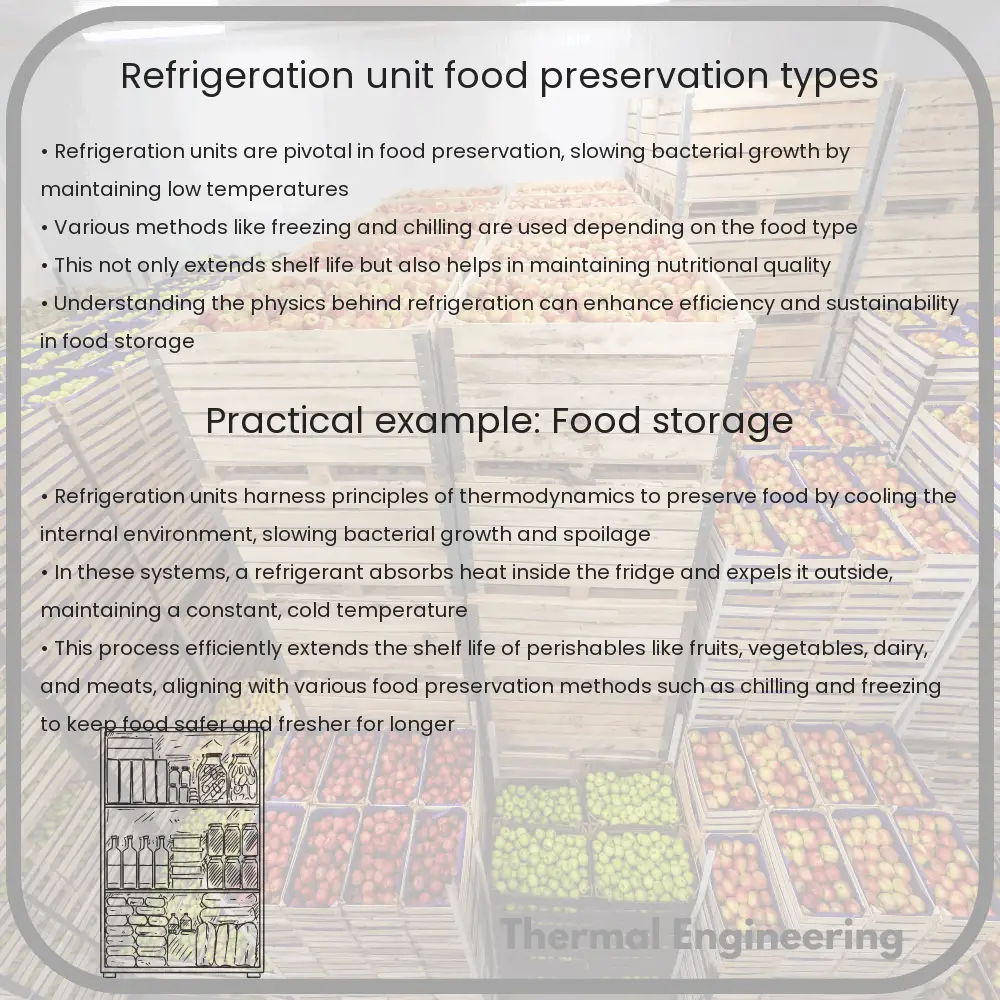
Refrigeration units are essential in modern society, playing a crucial role in preserving food by slowing down the deterioration and growth of harmful bacteria. These units maintain a cold environment where perishables such as fruits, vegetables, dairy products, and meats can be stored safely for extended periods. This article explores the basics of refrigeration technology and the various methods used in food preservation.

The Principles of Refrigeration

At the heart of refrigeration is the basic principle of heat transfer, which involves removing heat from one area and dissipating it to another. This process is achieved through the use of a refrigerant and a cycle of evaporation and condensation, commonly called the refrigeration cycle. Here’s a brief overview:

  • Evaporation: Inside the refrigeration unit, the refrigerant absorbs heat from the interior as it transforms from a liquid to a gas.
  • Compression: The compressor then squeezes the refrigerant gas, raising its temperature and pressure.
  • Condensation: The hot, high-pressure gas then flows through the condenser coils where it loses heat to the environment and returns to a liquid state.
  • Expansion: Lastly, the refrigerant passes through an expansion valve where it experiences a drop in pressure, cools down again, and is ready to absorb heat once more.

This cyclical process is what keeps the interior of the fridge and freezer at the desired low temperatures.

Types of Food Preservation in Refrigeration Units

Refrigeration impacts food preservation in several key ways:

  1. Temperature Control: By maintaining consistently low temperatures, refrigeration slows the growth of bacteria and molds which are prime contributors to food spoilage.
  2. Humidity Regulation: Many refrigeration units can control the level of humidity, which is vital for preserving the crispness and texture of fruits and vegetables.
  3. Atmosphere Control: Some advanced refrigeration units modify the composition of the air (like reducing the oxygen level and increasing carbon dioxide) which can further slow down the ripening process of fresh produce.

Technological Enhancements in Refrigeration

Modern refrigeration units have advanced significantly with technology, offering features that improve efficiency and food preservation quality. Innovations include:

  • Energy-efficient designs: Modern refrigerators use less electricity and are designed to minimize environmental impacts.
  • Smart systems: Some refrigerators can now be controlled via smartphone apps, allowing users to adjust temperatures and settings remotely.
  • Specialized compartments: Many units feature different zones for specific types of food that require distinct storage conditions, enhancing preservation and reducing waste.

Through these engineering advancements, refrigeration units not only help in keeping food fresh longer but also contribute to energy conservation and reduce overall food waste.

Conclusion

Refrigeration is an engineering marvel that combines the principles of thermodynamics with innovative technology to preserve perishable foods. By understanding how refrigeration units work and using them effectively, consumers can significantly extend the freshness and nutritional quality of their food, contributing to better health and less waste. It serves as a reminder of how engineering solutions can directly impact daily life and global sustainability.

Thermal Mass Flow Meter | Gas Measurement Apps

Learn how thermal mass flow meters utilize thermal properties for precise gas measurement in various industrial settings.

Thermal Mass Flow Meter | Gas Measurement Apps

Understanding Thermal Mass Flow Meters for Gas Measurement Applications

Thermal mass flow meters are crucial devices in measuring the mass flow rate of gases in various industrial applications. These meters leverage the thermal properties of gases to accurately measure flow, making them suitable for processes where precise gas measurement is essential. This article explores how thermal mass flow meters work, their applications, and their advantages.

How Thermal Mass Flow Meters Work

Thermal mass flow meters measure the mass flow rate of a gas directly by using the relationship between heat transfer and the gas’s mass flow rate. The operational principle relies on heat dissipation from a heated element and the temperature difference created as gas flows past this element.

There are typically two sensors in a thermal mass flow meter: a heated sensor and a temperature sensor. These sensors are placed in the gas flow path. The heated sensor is maintained at a higher temperature than the gas flow. As the gas passes the heated sensor, it absorbs some of the heat, causing the temperature of the sensor to drop proportionally to the mass flow rate of the gas.

The temperature sensor measures the gas’s actual temperature and acts as a reference to determine the amount of heat loss from the heated sensor. By analyzing the difference in temperature between these two sensors and knowing the specific heat properties of the gas, the mass flow rate can be calculated with high accuracy using the following equation:

m = (P / (h * Cp)) * ΔT

  • m is the mass flow rate.
  • P is the power used to heat the sensor.
  • h is the heat transfer coefficient.
  • Cp is the heat capacity of the gas at constant pressure.
  • ΔT is the temperature difference between the heated and reference sensors.

Applications of Thermal Mass Flow Meters

Thermal mass flow meters are used in a variety of applications where gas measurement is crucial. Some common applications include:

  • Monitoring and controlling industrial gas flows, such as in chemical and pharmaceutical manufacturing.
  • Measuring emissions in environmental monitoring and compliance.
  • Controlling gas flow in semiconductor fabrication.
  • HVAC (Heating, Ventilation, and Air Conditioning) systems to ensure optimal air-to-fuel ratios.

Advantages of Using Thermal Mass Flow Meters

Thermal mass flow meters offer several advantages over other types of flow meters:

  • Direct Measurement: These devices measure mass flow directly, unlike volumetric meters, which may require pressure and temperature corrections.
  • High Accuracy: They provide high accuracy and repeatability in gas measurements.
  • No Moving Parts: The absence of moving parts minimizes maintenance needs and enhances meter durability.
  • Wide Rangeability: Capable of measuring very low flow rates up to very high flow rates effectively.
  • Fast Response Time: Thermal mass flow meters react quickly to changes in gas flow, which is crucial for process control applications.

In conclusion, thermal mass flow meters are essential tools in industries requiring precise measurement and control of gas flows. Their design based on thermal principles enables accurate, reliable, and efficient measurement, catering to a wide array of applications from environmental management to precision manufacturing processes.

Thermal Insulation Blanket | High-Temp Materials

Learn about thermal insulation blankets, their materials like ceramic fibers and aerogels, and uses in industries from aerospace to home appliances.

Thermal Insulation Blanket | High-Temp Materials

Understanding Thermal Insulation Blankets: Composition and Applications

Thermal insulation blankets are critical components used across various industries to manage and control heat in equipment and environmental settings. From aerospace to home appliances, these high-temperature materials function to reduce energy consumption, protect equipment, and enhance safety by controlling the thermal exchanges.

Material Composition of Thermal Insulation Blankets

Thermal insulation blankets are made from materials that can withstand extreme temperatures while preventing heat flow. Common materials used include:

  • Ceramic Fibers: Composed of aluminum silicate, these fibers can endure temperatures up to 2300°F (1260°C) and are commonly used in furnaces and kilns.
  • Fiberglass: Fiberglass is made from fine fibers of glass and is an excellent insulator at lower high-temperature ranges up to 1200°F (649°C).
  • Mineral Wool: Made from molten basalt or slag, mineral wool can handle temperatures up to 1800°F (982°C) and is often used in fire protection.
  • Calcium Silicate: Known for its ability to handle high temperature and mechanical abuse, it’s used extensively in industrial pipe and equipment insulation.
  • High-Temperature Aerogels: Known for their extremely low thermal conductivity, these can be used in applications exceeding 2000°F (1093°C).

These materials are encapsulated in high strength fabrics that can withstand mechanical wear and tear, ultraviolet radiation, and moisture exposure, prolonging the life of the thermal blanket.

Applications of High-Temperature Insulation Blankets

The applications of thermal insulation are diverse, stemming from household to industrial uses:

  1. Industrial Equipment: Insulation blankets are used to cover pipes, boilers, and heat exchangers to improve efficiency and safety.
  2. Aerospace: Thermal blankets are crucial in protecting spacecraft and aircraft from extreme temperatures both generated internally by equipment and encountered in atmospheric re-entry.
  3. Automotive: Used to manage temperatures under the hood, particularly in protecting sensitive components from heat emissions of the engine.
  4. Buildings: Applied in HVAC systems for efficient heating and cooling, or in walls and roofs to prevent heat transfer, thus enhancing energy efficiency.
  5. Electrical appliances: Employed in ovens, grills, and other appliances to both protect the appliance’s components and control energy usage.

Benefits of Using Thermal Insulation Blankets

Utilizing thermal insulation blankets offers several benefits:

  • Energy Efficiency: By reducing the amount of heat lost or gained, they considerably cut down on energy needs and costs.
  • Personnel Protection: They protect workers from burns and other injuries related to exposure to high temperatures.
  • Enhanced Durability of Equipment: By maintaining a controlled temperature, the lifespan of equipment is extended by reducing thermal stress.
  • Environmental Protection: They help in reducing the carbon footprint of industrial processes by improving energy efficiency and using materials that are often environmentally benign.

In conclusion, thermal insulation blankets represent a vital technology in the control and management of heat in various applications. By choosing the right materials and proper implementation, they can deliver significant performance benefits across multiple industries.

Heat Pump | Climate Control Types & Principles

Learn about heat pumps, their working principles, types, and benefits for efficient climate control and sustainability.

Heat Pump | Climate Control Types & Principles

Understanding Heat Pumps: Principles and Types for Climate Control

Heat pumps are a versatile and efficient solution for both heating and cooling buildings. By exploiting the principles of thermodynamics, they transfer heat from one place to another, providing year-round climate control. This article explores how heat pumps work, their different types, and their significance in promoting sustainable energy practices.

The Principles Behind Heat Pumps

Heat pumps operate on the basic principles of heat transfer, which involve absorbing heat from a cooler space and releasing it to a warmer one. This is achieved through a cycle of evaporation and condensation using a refrigerant. The main components of a typical heat pump include a compressor, a condenser, an expansion valve, and an evaporator.

In the heating mode, the heat pump extracts heat from outdoor air, ground, or water sources, and transfers it indoors. In contrast, when cooling is needed, the system reverses, pulling heat from the indoor air and releasing it outdoors. This dual functionality makes heat pumps a highly efficient form of heating and cooling.

Types of Heat Pumps

  • Air-source heat pumps: These are the most common types of heat pumps. They transfer heat between your house and the outside air. Air-source heat pumps are cheaper than other types and are easier to install.
  • Ground-source (or geothermal) heat pumps: These systems use the earth’s constant ground temperature to improve efficiency and comfort. While more expensive and requiring significant installation work, they offer lower operating costs and are more efficient throughout the year.
  • Water-source heat pumps: Similar to ground-source, these heat pumps use nearby water sources, like lakes or wells, to exchange heat. They are ideal in areas with a nearby water source.
  • Hybrid heat pumps: These systems combine the features of gas furnaces and electric heat pumps to optimize energy use and reduce operational costs, especially in colder climates where a single system may not be efficient enough.

How Heat Pumps Promote Energy Efficiency

Heat pumps are considered to be one of the most energy-efficient forms of climate control. Rather than generating heat, they simply move existing heat from one place to another. This process can be three to four times more energy efficient compared to traditional heating systems like furnaces and boilers. The efficiency of a heat pump is often measured by the coefficient of performance (CoP), which is the ratio of heat output to the electrical energy input, expressed as:

CoP = Heat Output (in Joules) / Electrical Energy Input (in Joules)

The higher the CoP, the greater the efficiency of the heat pump. Modern heat pumps typically have CoP values ranging from 3 to 5, indicating that for every unit of electricity they use, they provide three to five units of heat.

Environmental Impact

By utilizing ambient air, ground, or water temperatures to heat and cool buildings, heat pumps can significantly reduce greenhouse gas emissions compared to systems that rely on combustion. As they depend largely on electricity, their environmental friendliness is enhanced when paired with renewable energy sources such as solar or wind power, contributing further to reductions in carbon footprints.

The Future of Heat Pumps

With advancements in technology and growing emphasis on sustainability, the adoption of heat pumps is expected to increase. Innovations aim to improve their efficiency in extremely cold climates and to integrate them with smart energy systems. This positions heat pumps as a crucial component in achieving future energy efficiency targets and reducing global dependence on fossil fuels.

Understanding how heat pumps work and their different types can help consumers and businesses make informed decisions about their heating and cooling needs. By choosing the right type of heat pump, users can enjoy comfortable indoor environments, lower energy bills, and a reduced environmental impact.

Thermal behavior of electric motors

Explore the impact of thermal behavior on electric motors, focusing on heat generation causes, issues from overheating, and effective thermal management strategies.

Thermal behavior of electric motors

Understanding the Thermal Behavior of Electric Motors

Electric motors are instrumental in powering everything from household appliances to industrial machinery. However, one critical aspect that affects their efficiency and longevity is their thermal behavior. Overheating in electric motors can lead to reduced performance, failure, and even hazards. Let’s explore how thermal behavior impacts electric motors and the engineering principles used to manage heat generation.

Heat Generation in Electric Motors

Electric motors convert electrical energy into mechanical energy, but this process is not 100% efficient. Some of the electrical energy is invariably converted into heat. This heat generation is primarily due to three factors:

  • Resistance Heating: As electric current flows through the motor windings, the natural resistance of the wire to the flow of current generates heat, known as I2R losses, where I is the current and R is the resistance.
  • Iron Losses: These include hysteresis and eddy current losses in the motor’s iron core. Both are types of losses that occur from the magnetization and demagnetization of the core and from currents induced within the core by changing magnetic fields.
  • Friction and Windage Losses: These are mechanical losses due to friction in bearings and other moving parts, as well as air resistance (windage) against rotating parts.

Effects of Excess Heat

When electric motors become too hot, several problems can arise:

  • Reduced Efficiency: Increased temperatures lead to higher resistance (since resistance of conductors increases with temperature), which in turn causes more power loss in the form of heat.
  • Insulation Breakdown: The insulation on winding wires can degrade or melt at high temperatures, leading to short circuits or failures.
  • Lubricant Degradation: Excessive heat can cause lubricants in the bearings to degrade faster, which can result in increased friction and even more heat.
  • Thermal Expansion: Different components of motors expand at different rates, which can misalign or deform parts and lead to additional wear or failure.

Thermal Management in Electric Motors

To mitigate these issues, effective thermal management strategies are essential. Here are some of the common methods used:

  • Enhanced Air Flow: Many motors are equipped with fans or ventilated housings designed to improve air circulation, which helps in carrying the heat away from the motor.
  • Heat Sinks and Cooling Fins: Some motors feature external heat sinks or cooling fins that increase the surface area available for heat dissipation.
  • Materials Improvement: Using materials with higher thermal conductivities in motor construction can help spread and dissipate heat more effectively.
  • Use of Temperature Sensors: Incorporating temperature sensors can help in monitoring motor temperatures and can trigger cooling mechanisms or shut the motor down to prevent overheating.

Advanced thermal management also involves thermal analysis during the design phase, using computational methods such as Finite Element Analysis (FEA) to predict hot spots and optimize the thermal properties of components.

Conclusion

Thermal behavior is a critical aspect of electric motor design and operation. Understanding and managing heat generation and dissipation ensures that motors operate efficiently, last longer, and are safer. Advances in materials science, cooling technologies, and predictive analysis continue to enhance the thermal management capabilities of electric motors, aligning with increasing demands for efficiency and durability in various applications.

Whether you are an engineer, a student, or simply a curious learner, appreciating these principles can provide deeper insights into the workings of electric motors and their applications in our daily lives.

Infrared Camera | Building Inspection Tech

Infrared cameras are essential for modern building inspections, detecting heat variations to identify structural defects, moisture, and energy inefficiencies.

Infrared Camera | Building Inspection Tech

Infrared Cameras in Building Inspection

Infrared cameras are a pivotal tool in modern building inspection techniques, facilitating the easy identification of potential problems that are typically invisible to the naked eye. This technology, which relies on detecting infrared energy (heat) emitted from objects, helps inspectors in assessing various building features without any destructive testing.

How Infrared Cameras Work

Infrared cameras, also known as thermal imaging cameras, work by capturing the amount of infrared radiation from surfaces in their field of view. Every object emits some level of infrared radiation based on its temperature. These cameras use a special lens to focus the infrared light emitted by all of the objects in view. The focused light is scanned by an infrared detector element in the camera, which creates a detailed temperature pattern called a thermogram. This thermogram is then converted into electric impulses, which are translated into an image visible on the camera screen. This image varies in color to represent different temperatures, with warmer areas typically illustrated in red and cooler areas in blue.

Applications in Building Inspection

  • Energy Efficiency Audits: One of the main uses of infrared cameras in building inspection is for energy efficiency audits. The camera reveals heat leaks in the insulation and around windows, doors, or other openings. These inspections can help prioritize repairs that improve energy efficiency and reduce heating and cooling expenses.
  • Moisture Detection: Infrared cameras can identify areas with moisture accumulation which are prone to mold growth and structural damage. These areas show up as cooler on the thermal image due to the cooling effect of evaporation.
  • Electrical Inspections: Overloaded and undersized circuits, as well as faulty wiring and worn-out electrical components, can be pinpointed as they commonly exhibit excessive heat. Infrared cameras can capture this heat early before these conditions lead to electrical failures.
  • Structural Defects: Variances in heat in various parts of the building structure can indicate anomalies due to structural defects, inadequate insulation, or shoddy workmanship.

Benefits of Using Infrared Cameras

The use of infrared cameras in building inspections provides numerous benefits including:

  1. Non-contact and Non-destructive: These cameras can inspect and detect issues without needing physical contact or altering any part of the building, unlike traditional inspection methods.
  2. Comprehensive: They provide a complete view of the building’s condition, allowing for a thorough understanding of the situation and aiding in making informed maintenance decisions.
  3. Save Time and Money: Quickly identifying and addressing potential problems helps prevent costly repairs and extensive damage to the building.
  4. Documentation: Thermal images provide a clear, visual record of the inspection, which can be valuable for insurance claims, compliance verification, and maintenance records.

With their ability to uncover hidden issues such as electrical faults, moisture, insulation defects, and structural anomalies, infrared cameras are a crucial tool in today’s building inspection arsenal. They help ensure buildings are safer, more sustainable, and more efficient in their energy use, reflecting the growing emphasis on building technology and preventive maintenance in modern engineering practices.

Thermoelectric Generator | Power & Seebeck Variants

Learn about thermoelectric generators (TEGs), devices that convert thermal energy to electrical energy using the Seebeck effect for various applications.

Thermoelectric Generator | Power & Seebeck Variants

Understanding Thermoelectric Generators

Thermoelectric generators (TEGs) are fascinating devices that convert thermal energy directly into electrical energy based on a phenomenon called the Seebeck effect. This allows them to generate power from temperature gradients, making them useful in a variety of applications, ranging from powering wearable electronics to recovering waste heat from engines.

The Basics of the Seebeck Effect

The operation of a thermoelectric generator revolves primarily around the Seebeck effect, discovered by Thomas Johann Seebeck in the 1820s. Simply put, the Seebeck effect occurs when a circuit made of two different conductors is heated at one junction while the other remains at a lower temperature. This temperature difference creates a voltage difference, which can drive an electric current through the circuit.

The voltage generated by the Seebeck effect is relatively small, typically a few microvolts per degree Celsius of temperature difference (\(\Delta T\)). The magnitude of the voltage can be expressed by the equation:

\[ V = S \times \Delta T \]

where \( V \) is the voltage, \( S \) is the Seebeck coefficient, which depends on the materials used, and \( \Delta T \) is the temperature difference between the two junctions.

Power Generation with TEGs

To generate power, a TEG uses several pairs of thermoelectric materials connected electrically in series and thermally in parallel. When one side of this array is heated and the other is cooled, a direct current flows through the circuit. The amount of power (\( P \)) generated can be calculated by:

\[ P = I \times V \]

where \( I \) is the current. It’s important to note that the efficiency of power generation in TEGs is typically quite low, but ongoing research aims to develop materials and designs that can increase this efficiency.

Applications of Thermoelectric Generators

Due to their unique property of converting heat into electricity, thermoelectric generators are incredibly versatile. Here are some of the key applications:

  • Waste Heat Recovery: TEGs can convert the waste heat generated by industrial processes or automotive engines into useful electrical power, improving overall energy efficiency.
  • Remote Power Supplies: They are ideal for powering sensors and telecommunications equipment in remote locations where conventional power sources are unavailable.
  • Space Applications: NASA has used TEGs in space missions, including the Voyager spacecraft, to convert the heat released by decaying radioactive materials into electrical power.

Challenges and Future Potential

While thermoelectric generators offer promising benefits, they face challenges such as low efficiency and high cost of materials. However, advances in material science, particularly in nanostructured materials, hold the potential to greatly improve the performance and reduce the costs of these devices.

In conclusion, thermoelectric generators represent a compelling technology for sustainable energy solutions, capturing waste heat and converting it into electricity. With continued research and development, TEGs may play a crucial role in the future of energy generation and conservation.

Cooling Tower | Process Industry Designs

Learn how cooling towers function in process industries, their types, and their crucial role in heat removal and industrial efficiency.

Cooling Tower | Process Industry Designs

Understanding Cooling Towers in Process Industries

Cooling towers are a vital component in process industries, such as power plants, petroleum refineries, petrochemical plants, natural gas processing plants, food processing factories, and HVAC systems for cooling buildings. They are engineered to remove heat from a variety of sources such as machinery or heated process material, using water as the medium. This article explores how cooling towers operate, their design types, and their significance in industrial applications.

Basic Principle of Operation

Cooling towers function on the principle of heat rejection. They are designed to transfer heat from water to the air, thus cooling the water that circulates through the tower. This process is accomplished mainly by evaporative cooling, where some of the water is evaporated into a moving air stream which provides significant cooling to the remainder of the water stream.

Types of Cooling Towers

There are several types of cooling towers, each tailored for specific needs and operational criteria:

  • Natural Draft Cooling Towers: Utilize the buoyancy of exhaust air rising in a tall chimney to induce air flow. These towers are typically very large and primarily used in power generation installations.
  • Mechanical Draft Cooling Towers: Employ fans to force or draw air through the tower. This category includes:
    • Forced Draft Cooling Towers: where air is pushed by fans located at the air inlet.
    • Induced Draft Cooling Towers: where air is sucked through the tower by fans located at the discharge (exiting air).
  • Hyperbolic Cooling Towers: Recognizable by their hyperbolic structure, these towers facilitate efficient natural draft cooling through their unique shape, enhancing the performance of the cooling process.

The Cooling Process

In detailed operation, the process within a cooling tower involves the following steps:

  1. Warm water from the heat source is pumped into the cooling tower, where it is distributed evenly to maximize exposure to the air stream.
  2. As the warm water cascades down through fill material, which increases the contact surface area and the contact time between the water and the air, thereby enhancing the heat removal efficiency.
  3. Air is introduced, either naturally or mechanically, moving counter or cross-flow to the water stream. This air absorbs evaporated water and heat from the remainder of the water.
  4. The cooled water collects at the bottom and is re-circulated back to cool the facility’s systems again while the warm, moist air exits the tower.

Performance Metrics

Cooling tower efficiency is generally evaluated using the following formula:

Cooling Efficiency (%) = [(Tin – Tout) / (Tin – Twb)] * 100

where:

  • Tin is the temperature of the water entering the cooling tower,
  • Tout is the temperature of the water exiting the tower,
  • Twb is the wet-bulb temperature of the surrounding air.

This formula highlights the importance of the wet-bulb temperature as a fundamental limit to cooling tower performance.

Conclusion

Cooling towers are an indispensable part of many industrial processes where heat rejection is crucial. Understanding the types, operation, and performance of cooling towers helps in optimizing their use and enhancing the efficiency of industrial operations. By selecting the right type of cooling tower and maintaining it properly, industries can conserve water, energy, and significant costs over time.

This guide should provide a comprehensive understanding of cooling towers for those in industries where cooling is a critical aspect of their operations.

Cryogenic Tank | Materials & Medical Storage

Explore the design, materials, and medical uses of cryogenic tanks, essential for storing substances at ultra-low temperatures.

Cryogenic Tank | Materials & Medical Storage

Understanding Cryogenic Tanks: Materials and Medical Storage Applications

Cryogenic tanks are specialized storage containers designed to hold materials at extremely low temperatures, typically below -150 degrees Celsius (-238 degrees Fahrenheit). These tanks are crucial in various sectors, including medical, industrial, and scientific fields, due to their ability to store perishable liquids like liquid nitrogen, oxygen, argon, and LNG (liquefied natural gas) safely. This article delves into the materials used to construct these tanks and their specific applications in medical storage.

Materials Used in Cryogenic Tanks

The materials used in the construction of cryogenic tanks need to withstand the harsh conditions of cryogenic storage. They must have excellent thermal resistance, low thermal conductivity, and high resistance to fracture at low temperatures. Commonly used materials include:

  • Stainless Steel: It is widely used due to its strength and resistance to cryogenic temperatures. Austenitic stainless steels, like 304 and 316 types, are preferred for their durability and corrosion resistance.
  • Aluminum Alloys: Known for their light weight and good thermal conductivity, aluminum alloys are often used in the construction of smaller cryogenic containers.
  • Composite Materials: Advanced composites such as fiberglass, carbon fiber, and foam insulations are used in cryogenic tanks. These materials help in reducing the weight and improving the thermal insulation properties of the tanks.
  • Nickel Alloys: For extremely low temperatures, nickel alloys that retain strength and toughness at these conditions are used, especially in handling liquefied natural gas.

These materials are typically shaped into two main components of the cryogenic tank: the inner vessel that holds the liquefied gas and the outer vessel that serves as a protective jacket. Between these two layers, insulation materials such as vacuum, perlite, or multilayer insulation are used to help maintain the extremely low temperatures needed to keep the contents in a liquid state without excessive evaporation.

Medical Storage Applications of Cryogenic Tanks

In the medical field, cryogenic storage plays a pivotal role in several applications:

  • Storage of Human Biological Materials: Human biological samples such as blood, stem cells, and reproductive cells (sperm and eggs) are stored in liquid nitrogen tanks. This form of storage preserves their viability over long periods.
  • Cryosurgery: Liquid nitrogen tanks are used in medical procedures that involve the controlled destruction of diseased tissues, such as skin lesions, by freezing.
  • Pharmaceuticals: Certain biopharmaceuticals require storage at cryogenic temperatures to maintain their efficacy until they are ready for use.
  • Transportation of Critical Samples: Cryogenic tanks are also vital in transporting sensitive biological materials across different locations, ensuring they remain uncontaminated and viable.

Conclusion

The effectiveness of cryogenic tanks in preserving the integrity and viability of critical materials at ultra-low temperatures has made them indispensable, particularly in medical storage applications. The continuous improvement in materials and technology employed in the construction of these tanks promises even more reliable and efficient solutions in the future. Understanding these principles and advancements is key to appreciating how critical these technologies are to modern medicine and beyond.

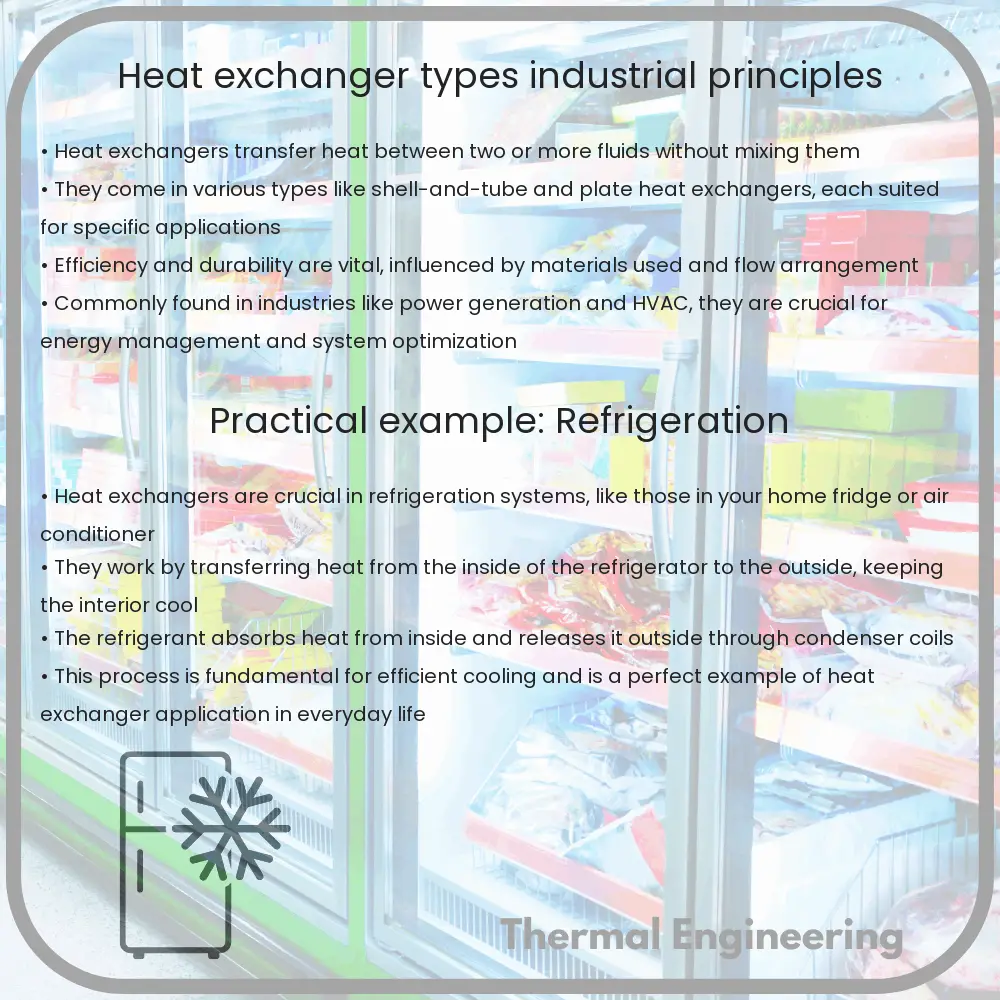
Heat Exchanger | Types & Industrial Principles

Learn about heat exchangers, their types, applications, and operating principles in various industries.

Heat Exchanger | Types & Industrial Principles

Understanding Heat Exchangers: Types and Industrial Applications

Heat exchangers are devices designed to transfer heat between two or more fluids—liquids, vapors, or gases—of different temperatures. Depending on the type of heat exchanger employed, the fluids may be separated by a solid wall to prevent mixing or may be in direct contact. They are widely used in various applications, including power plants, automotive engines, refrigeration, air conditioning systems, chemical plants, petrochemical plants, petroleum refineries, and natural gas processing.

Types of Heat Exchangers

  • Shell and Tube Heat Exchangers: This is the most common type found in many industries. They are constructed of a series of tubes, one set carrying the hot fluid and the other the cold fluid. The tubes are enclosed in a shell, and heat transfer occurs as the fluids move through the tubes. The arrangement allows for high pressures and offers a flexible design to handle a wide range of temperatures.
  • Plate Heat Exchangers: These exchangers use metal plates to transfer heat between two fluids. The major advantage of this type is that the fluids are exposed to a much larger surface area, making the heat transfer more efficient. Plate heat exchangers are typically more compact than shell and tube types.
  • Fin Tube Heat Exchangers: These enhance heat transfer through fins on tubes. The fins increase the exterior surface area of the tube, improving the heat exchange efficiency. These are commonly used where one of the fluids is air or another gas.
  • Condensers, Evaporators, and Boilers: While these are specific types of heat exchangers, each serves a particular purpose in refrigeration, HVAC systems, and power plants. Condensers cool gases into liquids; evaporators turn liquid into gases absorbing heat, and boilers transfer energy to water, turning it into steam.

Industrial Principles of Heat Exchangers

Heat exchangers operate on the principle of heat transfer by conduction or convection. In an industrial setting, these devices are vital in controlling fluid temperatures, thereby ensuring the efficiency and longevity of machines. The effectiveness of a heat exchanger is determined by several factors:

  • Temperature Difference: The greater the temperature difference between the hot and cold fluids, the more effective the heat transfer process. This is quantified by the logarithmic mean temperature difference (LMTD).
  • Heat Transfer Area: The amount of surface area available for heat transfer directly affects the rate at which heat is exchanged. More area can lead to more efficient heat transfer.
  • Flow Arrangement: Fluids can flow in a parallel flow, counterflow, or cross-flow arrangement. Counterflow is typically the most efficient, as it allows the maximum temperature difference between fluids over the longest part of the exchanger.
  • Properties of Fluids: The thermal conductivity, density, and viscosity of the fluids also affect the efficiency of the heat exchanger.

Heat exchangers are critical components in many industrial processes where temperature regulation is necessary. Understanding the different types and how they operate helps in selecting the right heat exchanger for a specific application, ensuring efficiency, safety, and cost-effectiveness in industrial operations.

In summary, heat exchangers are indispensable tools in the engineering industry, playing crucial roles in maintaining energy efficiency and process stability across various sectors. Their design and operational principles adapt to meet the demands of the specific functions they serve, making them a key element in the infrastructure of modern industry.