Facebook Instagram Youtube Twitter

Thermal efficiency of heat pumps

Learn about the thermal efficiency of heat pumps, including how it’s measured using COP and EER, and the factors enhancing HVAC system performance.
Thermal efficiency of heat pumps

Understanding the Thermal Efficiency of Heat Pumps

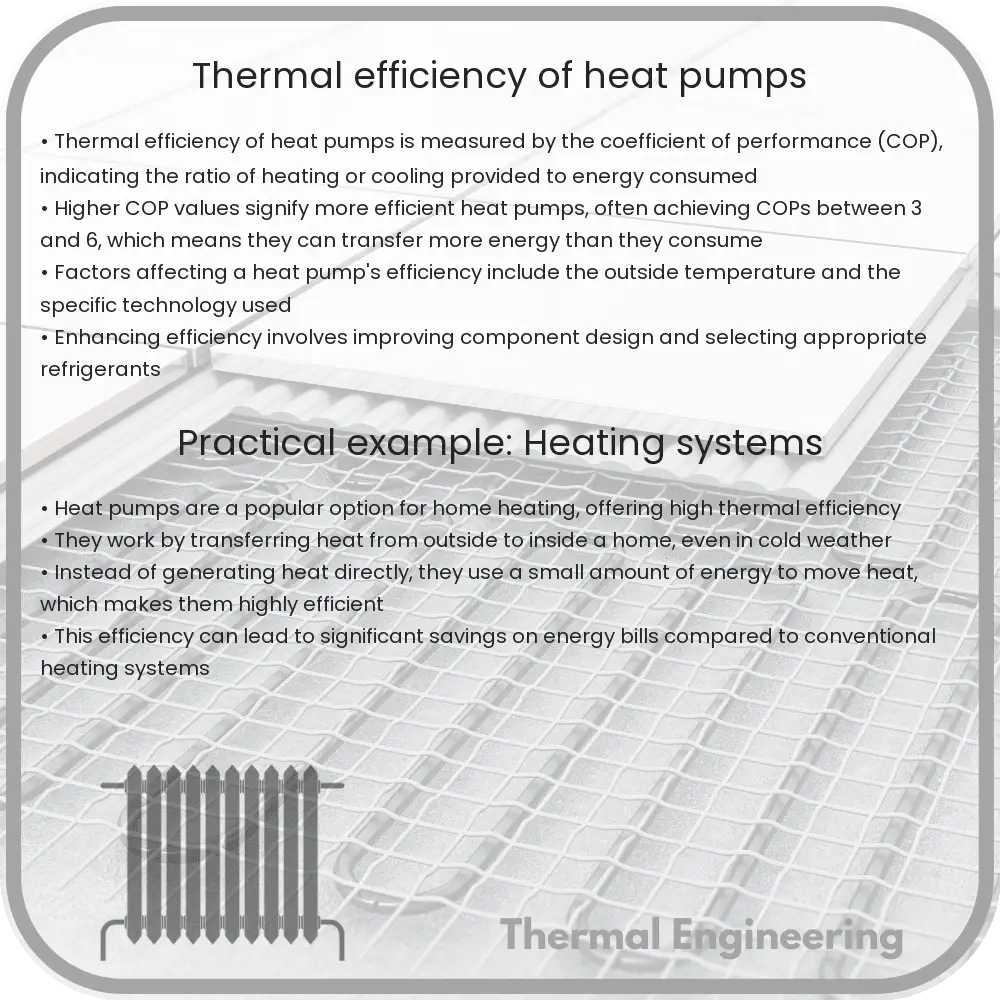
Heat pumps are a pivotal technology in the realm of heating, ventilation, and air conditioning (HVAC) systems. Their ability to transfer heat from one environment to another, rather than generating heat directly, makes them an efficient solution for both heating and cooling buildings. The thermal efficiency of heat pumps is a critical metric that determines their energy efficiency and environmental impact. In this article, we will explore what thermal efficiency is, how it is measured, and the factors that affect the efficiency of heat pumps.

What is Thermal Efficiency?

Thermal efficiency, in the context of heat pumps, refers to the effectiveness of the pump in using energy to transfer heat versus the energy consumed in the process. This is typically expressed through the Coefficient of Performance (COP) for heating and the Energy Efficiency Ratio (EER) for cooling. These metrics help quantify the ratio of heat output or cooling provided to the energy input required to run the pump.

  • Coefficient of Performance (COP): This is the ratio of the heat output in watts to the electrical energy input in watts. The higher the COP, the more efficient the heat pump.

    COP = Heat Output (W) / Electrical Energy Input (W)

  • Energy Efficiency Ratio (EER): Used primarily for cooling processes, this ratio measures the cooling output in British Thermal Units (BTU) per hour divided by the power input in watts.

    EER = Cooling Output (BTU/hr) / Electrical Energy Input (W)

Factors Influencing the Efficiency of Heat Pumps

Several factors can impact the efficiency of heat pumps:

  1. Temperature Differential: The difference between the source and supply temperatures significantly affects COP. Smaller differences generally yield higher COP values.
  2. Type of Heat Pump: There are different types of heat pumps, such as air-source, water-source, and ground-source—each with varying efficiencies. Ground-source pumps, for example, tend to have higher COPs due to the moderate temperatures of the ground.
  3. Quality of Installation: Improper installation can lead to reduced efficiency. Factors such as the location of the heat pump, ductwork leakage, and inadequate insulation all play critical roles.
  4. Maintenance: Regular maintenance is essential for keeping a heat pump running efficiently. This includes cleaning filters, checking fluid levels, and ensuring that components are in good working order.

Improving Heat Pump Efficiency

To maximize the efficiency of a heat pump, consider the following strategies:

  • Using advanced technologies: Inverter-driven compressors, for instance, can adjust their speed to the demand, significantly improving the COP of a heat pump.
  • Optimal sizing and installation: Ensuring that the heat pump is correctly sized and properly installed for the specific building or space is crucial.
  • Regular maintenance: As mentioned earlier, routine inspections and maintenance help sustain high efficiency.

Conclusion

The thermal efficiency of heat pumps plays a vital role in determining their energy consumption and effectiveness in heating or cooling environments. By understanding and optimizing factors such as the type of heat pump, temperature differentials, and regular maintenance, users can significantly enhance the performance and energy efficiency of their heat pump systems. With increasing focus on sustainable energy practices, improving the efficiency of such systems is more crucial than ever.

Whether you’re a homeowner, business owner, or a student of engineering, grasping the basic principles that govern the efficiency of heat pumps can help you make informed decisions about heating and cooling solutions that are not only efficient but also environmentally responsible.
Heat transfer modeling in CFD

Detailed exploration of heat transfer modeling in Computational Fluid Dynamics (CFD) for engineering applications.

Heat transfer modeling in CFD

Understanding Heat Transfer Modeling in Computational Fluid Dynamics (CFD)

Heat transfer is a fundamental phenomenon in various engineering applications, ranging from HVAC systems in buildings to cooling systems in electronic devices. Computational Fluid Dynamics (CFD) provides a sophisticated way to simulate and analyze how heat transfer occurs within and around different objects and fluids. The core idea behind heat transfer modeling in CFD is to predict the temperature distribution and heat flow paths to enhance the efficiency and safety of engineering designs.

Types of Heat Transfer

In the realm of CFD, it is crucial to understand the three basic mechanisms of heat transfer:

  • Conduction: This is the transfer of heat through a solid material or between solid materials in contact without the movement of the material itself. It is generally described by Fourier’s Law:

\[ q = -k \nabla T \]

where \( q \) is the heat flux, \( k \) is the thermal conductivity of the material, and \( \nabla T \) is the temperature gradient.

  • Convection: This involves heat transfer between a solid surface and an adjacent moving fluid. It depends on the fluid velocity and its properties and is governed by Newton’s law of cooling:

\[ q = h (T_s – T_f) \]

where \( h \) is the convective heat transfer coefficient, \( T_s \) is the surface temperature, and \( T_f \) is the fluid temperature.

  • Radiation: Heat transfer through electromagnetic waves, where heat is emitted by a material and absorbed by another. This mechanism is described by the Stefan-Boltzmann law:

\[ q = \epsilon \sigma (T^4 – T_{\text{env}}^4) \]

where \( \epsilon \) is the emissivity of the surface, \( \sigma \) is the Stefan-Boltzmann constant, \( T \) is the absolute temperature of the surface, and \( T_{\text{env}} \) is the temperature of the surrounding environment.

The Role of CFD in Heat Transfer Modeling

CFD simulations offer a virtual modeling environment where complex heat transfer interactions can be simulated, visualized, and optimized. Below are the primary steps involved in setting up a heat transfer model using CFD:

  1. Geometry and Mesh Generation: Create a digital replica of the physical domain where heat transfer analysis is to be carried out. The domain is then discretized into small control volumes (cells/mesh).
  2. Setting Initial and Boundary Conditions: Define initial temperatures and other relevant initial conditions. Boundary conditions can include specified temperature, heat flux, convection heat transfer parameters, or ambient conditions.
  3. Selection of Material Properties: Input accurate material properties like thermal conductivity, heat capacity, and density which affect heat transfer rates.
  4. Choosing the Appropriate Heat Transfer Model: Depending on the complexity of the problem and the types of heat transfer involved, select a suitable model (e.g., conduction, convection, and/or radiation).
  5. Solving the Governing Equations: Numerically solve the heat transfer equations using appropriate numerical methods to obtain the temperature distribution and heat fluxes throughout the domain.
  6. Post-processing: Analyze the results through visualization tools in CFD software to interpret temperature contours, heat flux vectors, and other relevant thermal parameters.

Heat transfer modeling in CFD enables engineers and designers to explore multiple scenarios and designs, optimizing heat transfer characteristics in an efficient and cost-effective manner. Ongoing developments in computational power and simulation techniques continue to enhance the capabilities and accuracy of CFD tools, making them indispensable in modern engineering projects.

Through the appropriate use of CFD, advancements in heat transfer understanding not only improve product performance and safety but also lead to innovations in energy efficiency and material usage, which are crucial in today’s environmentally conscious world.

Heat transfer in permafrost

Explore the mechanisms of heat transfer in permafrost, highlighting conduction, convection, and radiation, and their roles in climate-related changes.

Heat transfer in permafrost

Understanding Heat Transfer in Permafrost

Permafrost refers to the ground, including rock or soil, that remains completely frozen—0 degrees Celsius or colder—for at least two consecutive years. It is predominantly found in high latitude regions of the Earth, such as in Siberia, Canada, Alaska, and Antarctica. The study of heat transfer in permafrost is crucial, as climate change is leading to the thawing of permafrost, which can have significant ecological and structural implications.

Basics of Heat Transfer

Heat transfer in permafrost occurs in three primary ways: conduction, convection, and radiation, with conduction being the most significant in the permafrost context.

  • Conduction: This is the transfer of heat through a solid material from molecule to molecule. In permafrost, heat from the warmer ground above is conducted downwards into the frozen layer.
  • Convection: Typically less relevant in solid permafrost, convection occurs more prominently in areas where permafrost is thawing, allowing for the movement of water which can carry heat.
  • Radiation: Although a minor player, thermal radiation from the sun can cause surface heating, which subsequently affects the permafrost.

Mathematical Modeling of Heat Transfer in Permafrost

To understand how heat moves through permafrost, researchers often rely on the heat conduction equation:

\[ \frac{\partial T}{\partial t} = \alpha \frac{\partial^2 T}{\partial x^2} \]

Where:

  • \( T \) is the temperature,
  • \( t \) represents time,
  • \( x \) is the spatial coordinate,
  • and \( \alpha \) (thermal diffusivity) encapsulates the material’s ability to conduct heat relative to its ability to store heat.

This equation is a form of the diffusion equation and helps predict how temperature changes with time and space within the permafrost layer, assuming a one-dimensional, semi-infinite body.

Factors Affecting Heat Transfer in Permafrost

Several factors can influence how heat is transferred in permafrost areas:

  1. Soil Composition: Soils with high ice content will conduct heat differently than dry soils due to the properties of ice versus soil particles.
  2. Water Content: The presence of water in thawing permafrost leads to convection, further complicating the heat transfer process.
  3. External Temperature: Seasonal and daily temperature variations significantly affect the heat transfer dynamics at the surface, influencing the freeze-thaw cycles.
  4. Solar Radiation: The amount of solar energy absorbed by the surface impacts the surface temperatures and thus the heat conducted into the permafrost.
  5. Vegetation and Snow Cover: These can act as insulators, reducing the rate of heat transfer from the atmosphere to the permafrost.

Importance of Understanding Heat Transfer in Permafrost

Studying how heat transfers through permafrost is essential for several reasons:

  • Climate Change Impacts: As global temperatures rise, understanding the thermal stability of permafrost is vital in predicting methane and carbon releases.
  • Infrastructure: In regions like Siberia and Alaska, buildings, pipelines, and roads can be affected by the thawing of permafrost, leading to potential damages and economic loss.
  • Ecological Considerations: The ecological balance in permafrost regions can be disrupted by changes in the ground’s temperature, affecting local wildlife and plants.

In summary, heat transfer in permafrost is a complex but pivotal topic within environmental and geotechnical engineering, holding significant implications for our understanding of climate change and its effects on the Earth’s frozen regions.

Thermal diffusion in alloys

Explore how thermal diffusion, or thermotransport, influences the properties and performance of alloys by driving element redistribution within material due to temperature gradients.

Thermal diffusion in alloys

Understanding Thermal Diffusion in Alloys

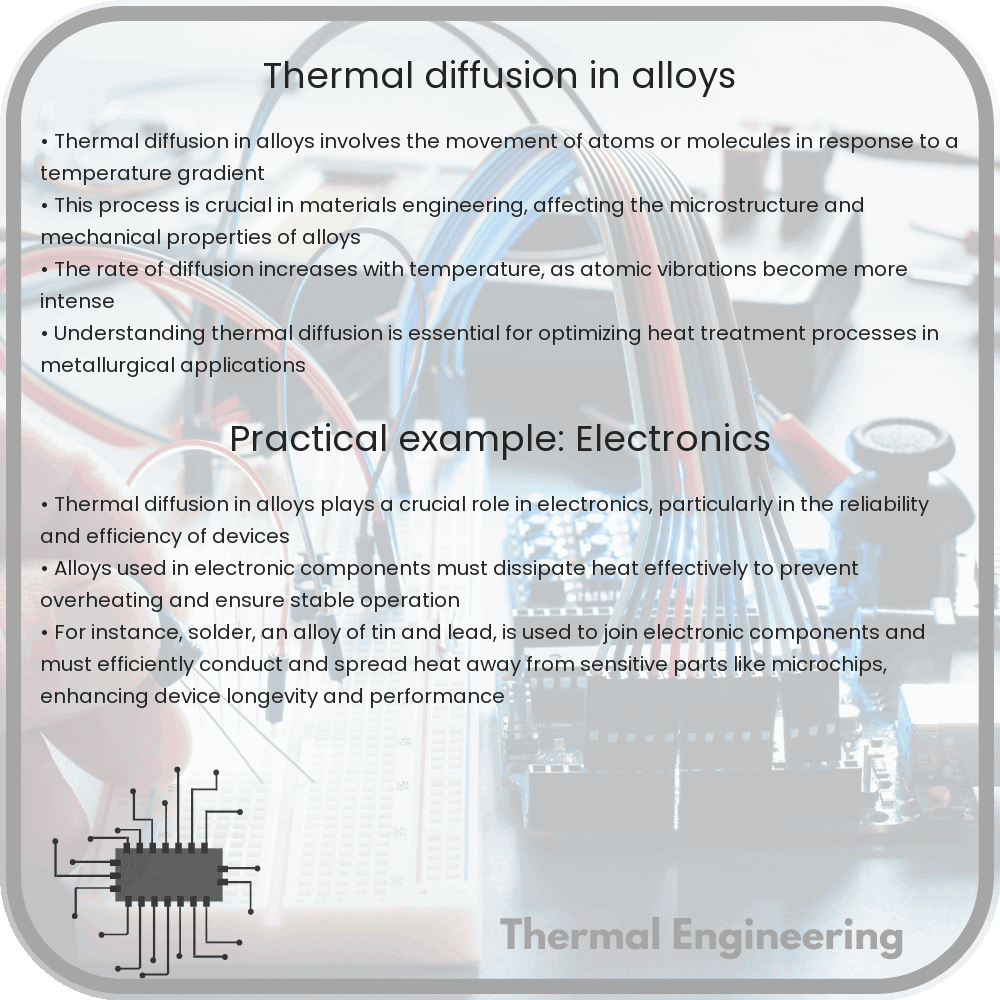
Thermal diffusion, also known as thermotransport, is a critical process in materials engineering, especially in the study of alloys. This phenomenon involves the movement of different species within an alloy due to a temperature gradient. This movement can result in changes in the chemical composition of the material over time, which can significantly affect its properties and performance.

Basics of Thermal Diffusion

Thermal diffusion in alloys occurs because atoms and molecules in a material tend to move from regions of higher temperature to lower temperature. This movement is driven by the thermal energy of the particles, which is higher in warmer regions. When an alloy experiences a temperature gradient, the differing thermal energies of its constituents lead to a mass flux, redistributing the elements within the alloy.

Key Factors Influencing Thermal Diffusion

  • Temperature Gradient: The primary driver for thermal diffusion is the temperature gradient itself. The steeper the gradient, the more pronounced the diffusion process.
  • Composition of the Alloy: Different elements have different diffusion coefficients. The rate at which an element diffuses depends on its atomic size, bond strength with neighboring atoms, and its concentration within the alloy.
  • Microstructure: The structure of the alloy, including grain size, phase boundaries, and dislocations, can affect how easily atoms migrate through the material.

Mathematical Description of Thermal Diffusion

The mathematical treatment of thermal diffusion in materials science is generally described by Fick’s Laws of diffusion combined with the heat transfer equations. The first law of Fick states that the diffusion flux is proportional to the concentration gradient. This can be expressed as:

D * dC/dx

where D is the diffusion coefficient and dC/dx is the concentration gradient. The second law of Fick provides a description over time:

dC/dt = D * d2C/dx2

In addition to these, the Soret Coefficient (ST) is used to quantify thermal diffusion. It is defined as the ratio of the mass flux due to thermal diffusion to the heat flux within the material:

ST = – (Jm / Jq)

where Jm is the mass flux and Jq is the heat flux.

Applications and Implications

Understanding thermal diffusion is crucial for many industrial applications. For example, in the aerospace sector, the integrity of alloy components exposed to high temperature gradients can be compromised due to the redistribution of elements. Similarly, in electronics, thermal diffusion can affect the reliability of solder joints and other interconnects in integrated circuits.

Thermal diffusion is also a significant factor in the field of nuclear engineering. In reactors, where temperature gradients are common, thermal diffusion can lead to significant changes in material composition, affecting the reactor’s longevity and safety.

Conclusion

Thermal diffusion in alloys is a complex but fundamentally important process in materials science and engineering, affecting everything from aerospace components to electronic devices. By understanding and calculating thermal diffusion processes, engineers can better design materials and structures that are more durable and reliable under a variety of thermal conditions.

Heat transfer in hybrid vehicles

Learn about heat transfer challenges and solutions in hybrid vehicles, focusing on maintaining efficiency and component longevity.

Heat transfer in hybrid vehicles

Understanding Heat Transfer in Hybrid Vehicles

Hybrid vehicles, which combine an internal combustion engine with one or more electric motors, face unique challenges when it comes to managing heat. Effective heat transfer is crucial for maintaining the performance, efficiency, and longevity of both the engine and the battery system. In this article, we’ll explore the fundamentals of heat transfer in hybrid vehicles and the innovative solutions engineers apply to control temperature.

Key Concepts of Heat Transfer

Heat transfer in hybrid vehicles involves three basic modes: conduction, convection, and radiation:

  • Conduction is the transfer of heat through materials, such as from the engine block to its surroundings.
  • Convection involves the movement of heat by the flow of fluids, which in vehicles is typically air or coolant fluids.
  • Radiation refers to the transfer of energy through electromagnetic waves, like heat radiating off the car’s surface into the environment.

Challenges in Hybrid Vehicles

Hybrid vehicles need to manage the heat produced by both the engine and electrical components. The main challenges include:

  1. Higher operating temperatures in compact spaces, increasing the demands on heat dissipation.
  2. Varying heat loads as the vehicle shifts between electric motor and internal combustion engine operation.
  3. Battery efficiency and lifespan reduction when exposed to high temperatures.

Engineering Solutions for Efficient Heat Management

To address these challenges, hybrid vehicle designs incorporate several advanced heat transfer technologies:

  • Advanced Cooling Systems: These systems are more sophisticated than those in conventional vehicles, often utilizing dual cooling circuits to separately manage the heat from the engine and the batteries.
  • Heat Exchangers: Hybrid vehicles use specialized heat exchangers to dissipate heat efficiently from the engine and electrical systems. These exchangers must be highly efficient due to the confined space and the need to minimize weight.
  • Thermal Barriers: These materials are used to insulate components, particularly the battery, from excessive engine heat, thereby stabilizing the battery temperature.
  • Thermal Interface Materials (TIMs): TIMs improve the heat conduction between different components, aiding in the rapid transfer and dissipation of heat.

Impact of Heat Transfer Technology on Hybrid Vehicles

Effective heat transfer technologies not only prolong the life of the hybrid vehicle’s components but also enhance overall vehicular performance. They contribute to:

  • Improving the efficiency of the internal combustion engine and electric motors by keeping them at optimal operating temperatures.
  • Enhancing battery performance and lifespan by preventing overheating, which is critical in maintaining battery health and efficiency.
  • Reducing energy consumption by optimizing the thermal management system, thus supporting the vehicle’s environmental friendliness.

As technology advances, the integration of smart thermal management systems using sensors and adaptive controls is expected to further improve the efficiency and performance of hybrid vehicles. These systems dynamically adjust to temperature changes and operational modes, ensuring optimal heat management across different driving conditions.

In conclusion, heat transfer is a critical aspect of hybrid vehicle design, requiring sophisticated engineering solutions to handle the complex interplay of thermal energy within these advanced vehicles. As hybrids become more prevalent, the innovation in thermal management is likely to continue its rapid pace, advancing both the performance and environmental impact of these vehicles.

Heat transfer in evaporative coolers

Learn about heat transfer in evaporative coolers, focusing on convection, conduction, and evaporation processes that aid in cooling.

Heat transfer in evaporative coolers

Understanding Heat Transfer in Evaporative Coolers

Evaporative coolers, also known as swamp coolers, offer an energy-efficient way to cool spaces, particularly in hot, dry climates. This method of cooling is based fundamentally on the principles of heat transfer and the process of evaporation. In this article, we will explore the science behind evaporative cooling, focusing on how heat transfer occurs in these systems.

The Basics of Evaporative Cooling

First, it’s important to understand what evaporative cooling is. It’s a natural process that occurs all around us. For instance, when you step out of a swimming pool on a hot day, you feel cool as the water on your skin evaporates. Evaporative coolers utilize this same principle by combining water evaporation with a simple fan system to lower the temperature of the air.

Key Components

An evaporative cooler primarily consists of:

  • A fan
  • A water pump
  • Water-soaked pads

The cooler draws in the warm external air through these wet pads and by passing this air over them, it cools down through evaporation.

Heat Transfer Mechanisms in Evaporative Coolers

Understanding the heat transfer in evaporative coolers involves examining three key modes:

  1. Convection
  2. Conduction
  3. Evaporation

Convection

In evaporative coolers, the pump circulates water from the reservoir to the pads, keeping them saturated. As the hot air outside the unit is pulled in by the fan, it passes over these cool, damp pads. The heat from the air transfers to the cooler water through convection, the process of heat transfer by the movement of fluids (in this case, air over the water surface).

Conduction

Conduction is the process of heat transfer through direct contact. In an evaporative cooler, when the warmer external air directly touches the cooler surface of the wet pads, the air’s heat is transferred to the water. This causes the water to gain energy and increase in temperature slightly, thereby reducing the temperature of the air.

Evaporation

The most significant part of the cooling process in evaporative coolers is evaporation. When the warm air hits the cooler, wet pads, the water molecules at the surface of the water gain enough energy to change into vapor. The phase change from liquid water to water vapor requires energy, which comes from the heat in the air. This heat transfer from the air to the water vapor lowers the air’s temperature, a process termed evaporative cooling.

Efficiency Factors

The efficiency of evaporative coolers can depend on several factors, including:

  • Humidity levels: Lower humidity allows for more effective evaporation.
  • Airflow rate: Higher airflow rates increase evaporation, enhancing the cooling effect.
  • Pad material and thickness: More absorbent and thicker pads enhance evaporation.

In essence, understanding how heat transfer via convection, conduction, and evaporation is crucial in optimizing the design and function of evaporative coolers. These coolers not only offer a cost-effective cooling solution but also utilize a more natural and environmentally friendly process compared to conventional air-conditioning systems.

For regions that experience high temperatures combined with low humidity, evaporative coolers provide a sustainable option to maintain comfort without relying heavily on energy-intensive technologies.

Thermal runaway in lithium batteries

Thermal runaway in lithium batteries is a dangerous condition causing rapid temperature and pressure increases, potentially leading to fires or explosions.

Thermal runaway in lithium batteries

Understanding Thermal Runaway in Lithium Batteries

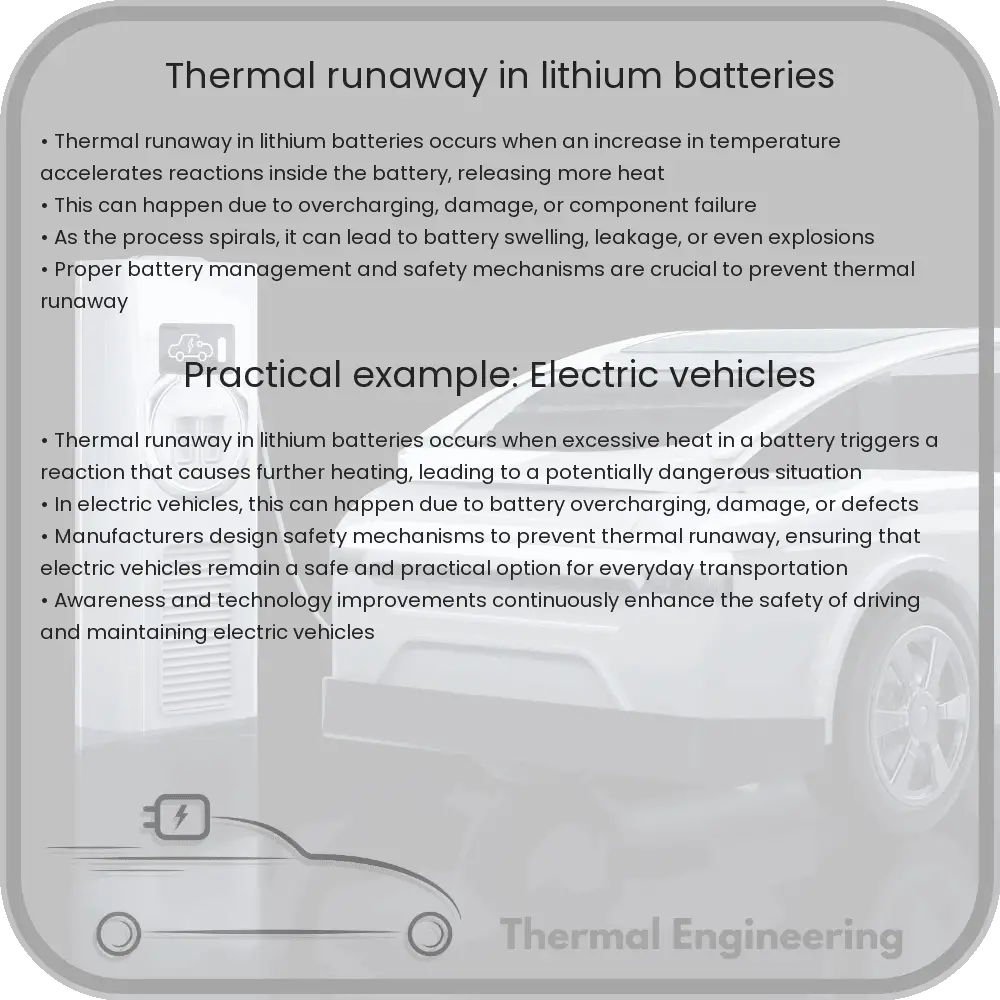
Lithium batteries are ubiquitous in modern devices ranging from smartphones to electric vehicles. While these batteries offer excellent energy density and long lifespan, they are susceptible to a hazardous phenomenon known as thermal runaway. Thermal runaway refers to a self-sustaining chemical reaction within the battery that leads to a rapid increase in temperature and pressure, potentially resulting in a fire or explosion.

Causes of Thermal Runaway

Thermal runaway in lithium batteries can be initiated by several factors, which include:

  • Overcharging: Exceeding the voltage threshold can cause excessive heat generation.
  • Mechanical Damage: Physical impacts can compromise internal structures, leading to short circuits.
  • Internal Short Circuit: This can occur due to the breakdown of the separator between the anode and cathode.
  • External Heat Exposure: External sources of heat can increase the internal temperature of the battery, accelerating degradation processes.

The above conditions disrupt the normal electrochemical processes in a lithium battery. For example, excessive heat can cause the decomposition of the electrolyte and the breakdown of cathode materials, releasing gases and further increasing the pressure inside the battery cell.

Chemical and Physical Changes During Thermal Runaway

During thermal runaway, several interrelated physical and chemical changes occur inside the battery, including:

  1. Heat Generation: Internal chemical reactions produce heat. If this heat accumulates faster than it can dissipate, the temperature rises steeply.
  2. Breakdown of Materials: As temperatures increase, key components of the battery such as the electrolyte and cathode material begin to decompose.
  3. Gas Formation: The breakdown of organic electrolytes and other materials generates flammable and toxic gases, increasing internal pressure.
  4. Increased Conductivity: The rise in temperature can increase the electrical conductivity of the battery, leading to higher currents and further heat generation.

This sequence of events can culminate in physical rupture of the battery case or ignition of the flammable gases, posing serious safety risks.

Preventive Measures and Safety Enhancements

To mitigate the risk of thermal runaway, battery manufacturers and engineers adopt various strategies:

  • Improved Battery Design: Using more stable materials and robust separators can enhance safety.
  • Battery Management Systems (BMS): These systems monitor the state of each battery cell, controlling voltage, and temperature to prevent dangerous conditions.
  • Thermal Barriers: Incorporating thermal insulation or phase change materials can help contain and dissipate heat more effectively.
  • Vent Mechanisms: Vents can release gases and pressure safely in the event of battery failure, preventing more dangerous explosions.

In conclusion, thermal runaway is a critical safety concern in the operation of lithium batteries. Understanding its causes and consequences helps in improved design and safer use of these essential energy sources. Through careful management and innovative engineering, the risks associated with thermal runaway can be significantly reduced, paving the way for safer and more reliable battery technology.

Heat transfer in wind turbines

Learn about heat transfer in wind turbines, focusing on conduction, convection, and radiation, and methods to manage heat for efficiency.

Heat transfer in wind turbines

Understanding Heat Transfer in Wind Turbines

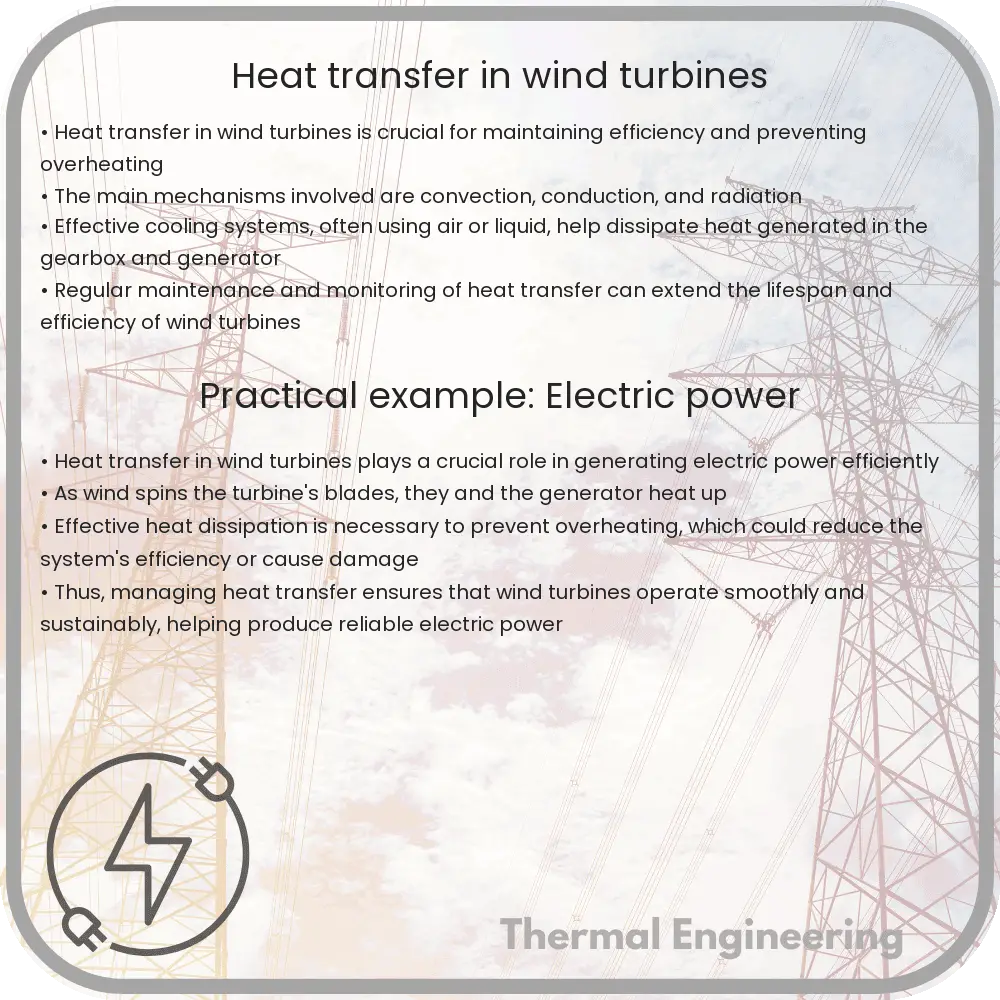
Wind turbines are a cornerstone of renewable energy, converting wind kinetic energy into electrical power. However, like all mechanical systems, they are subject to various physical processes including heat transfer. Managing heat within wind turbines is crucial as excessive heat can lead to reduced efficiency and damage to the turbine’s components. Let’s explore how heat transfer occurs in wind turbines and the methods used to control it.

Types of Heat Transfer in Wind Turbines

Heat transfer in wind turbines primarily occurs through three mechanisms: conduction, convection, and radiation.

  • Conduction: This is the transfer of heat through materials. In wind turbines, conduction occurs in the gearbox, generator, and other components where materials are in direct contact.
  • Convection: Convection occurs when heated fluids, which include air or coolant fluids, move away from the source of heat. In wind turbines, air or hydraulic fluids in cooling systems carry heat away from the generator and gearbox.
  • Radiation: Although less significant compared to conduction and convection, radiation involves the transfer of heat in the form of thermal radiation. This might affect external surfaces of the turbine depending on their material and color.

Key Components Affected by Heat

The primary components that generate heat in wind turbines include the gearbox, generator, and the rotor blades.

  • Gearbox: The gearbox experiences heat due to friction and shearing of the gear oil. Heat buildup can reduce the efficiency of gear oil and increase wear on the gears.
  • Generator: As the generator converts mechanical energy into electrical energy, it inevitably generates heat. This is due to electrical resistance and magnetic hysteresis.
  • Rotor Blades: Friction between the blades and the air generates heat. Although minimal compared to the gearbox or the generator, it can still affect blade performance and material integrity over time.

Heat Dissipation Techniques

Effective heat dissipation mechanisms are crucial for the sustainable operation of wind turbines. Here are the most common methods used:

  • Air Cooling: Utilizes airflow, both natural and fan-assisted, through the nacelle to remove excess heat. This method is straightforward and cost-effective but might not be sufficient alone for high power turbines under heavy load.
  • Liquid Cooling: Employs coolants to absorb and transfer heat away from critical components. It is typically used for high-power applications where air cooling is inadequate.
  • Heat Exchangers: Often used in conjunction with both air and liquid cooling systems. Heat exchangers improve the efficiency of heat transfer from the turbine’s components to the cooling medium.

Monitoring and Maintenance

Regular monitoring and maintenance are required to ensure that heat transfer mechanisms function effectively. Sensors and thermal imaging can detect overheating issues before they lead to system failure. Routine checks and replacing cooling fluids and components such as filters can also prevent overheating and prolong the lifespan of the wind turbine.

Understanding and managing heat transfer in wind turbines is essential for their efficient operation and durability. By leveraging proper cooling techniques and regular maintenance, the operational lifespan of wind turbines can be significantly extended, thereby increasing their cost-effectiveness and reliability in renewable energy production.

Thermal interface materials for electronics

Explore the vital role and types of Thermal Interface Materials (TIMs) in enhancing electronic device performance by effective heat management.

Thermal interface materials for electronics

Understanding Thermal Interface Materials in Electronics

Thermal interface materials (TIMs) are essential components used in electronics to enhance thermal conduction between surfaces. By improving heat transfer from electronic devices, such as processors and power electronics, to heat sinks or other cooling devices, TIMs play a crucial role in maintaining operational reliability and preventing overheating.

Function of Thermal Interface Materials

The primary function of TIMs is to fill microscopic air gaps and irregularities between the heat source (like a CPU) and the heat sink. Since air is a poor conductor of heat, removing air gaps with materials that have higher thermal conductivity results in significantly improved heat transfer.

Types of Thermal Interface Materials

  • Thermal Greases: Also known as thermal paste, it is a common type of TIM that consists of a suspension of thermally conductive fillers in a silicone or synthetic oil. It is easy to apply but can be messy and may require occasional reapplication.
  • Thermal Pads: These are pre-cut pieces of soft material like silicone or foam, infused with conductive fillers. Thermal pads are simpler to deploy as they can be placed directly on the heat source or sink, offering consistent performance without the messiness of greases.
  • Phase Change Materials: These materials remain solid at room temperature but change to liquid once a certain operational temperature is exceeded, filling in gaps more effectively. Upon cooling, they solidify, ensuring the gaps remain filled.
  • Thermal Adhesives: Acting as both an adhesive and a thermal conductor, these epoxies or tapes provide a permanent bond, unlike greases or pads. They are particularly useful for components that do not have robust mechanical fastening approaches.
  • Thermal Films: These are thin, flexible films that can be cut to size and offer decent thermal conductivity with minimal thickness, useful in applications with tight spacing.
  • Metal-Based TIMs: Including soft metals like indium or alloys that can deform to fill in gaps, these materials offer the highest thermal conductivity but at a higher cost.

Properties of an Ideal Thermal Interface Material

An effective TIM should possess several key properties:

  • High Thermal Conductivity: To efficiently transfer heat from the heat source to the heat sink.
  • Low Thermal Resistance: Indicates a material’s ability to allow heat flow, the lower, the better.
  • Stability at Operating Temperatures: It must maintain its characteristics and functionality over the expected range of operating temperatures.
  • Compliance: The material should be able to conform to the surfaces it is applied between, aiding in the minimization of air gaps.
  • Ease of Application: For practical use in assembly processes and maintenance.

Applications in Electronics

TIMs find applications across various branches of electronics, helping manage heat in:

  • Computer CPUs and GPUs where overheating can lead to reduced performance or failure.
  • Power electronic devices such as inverters and converters in renewable energy systems.
  • LED lighting systems, where excess heat can affect the efficiency and lifespan of the LEDs.
  • Telecommunications equipment which often operates 24/7 and needs to dissipate heat efficiently.

Conclusion

The use of appropriate thermal interface materials is critical in the design and maintenance of reliable, efficient, and high-performing electronic devices. By understanding the types and properties of different TIMs, engineers can make informed choices that not only enhance the longevity of electronic components but also their functionality.

As electronic devices continue to evolve towards higher power densities and smaller form factors, the role of sophisticated thermal management solutions like TIMs will become even more vital. Selecting the right TIM is an essential step in the successful design of any heat-sensitive electronic system.

Sustainable thermal energy technologies

Explore the role of sustainable thermal energy technologies in improving energy efficiency and reducing environmental impact.

Sustainable thermal energy technologies

Sustainable Thermal Energy Technologies

In the quest for a cleaner and more sustainable future, thermal energy technologies play a crucial role. These technologies allow the capture, storage, conversion, and usage of thermal energy (heat) in ways that minimize environmental impact and support energy efficiency objectives. This article will explore various sustainable thermal energy technologies that are key in combatting climate change and promoting energy sustainability.

1. Solar Thermal Energy

Solar thermal systems convert sunlight into thermal energy. Unlike photovoltaic cells that convert sunlight directly into electricity, solar thermal devices absorb heat and use it for water heating, space heating, and even cooling through absorption refrigeration cycles. There are three main types of solar thermal systems:

  • Low-temperature collectors: Used mainly for heating swimming pools and domestic hot water.
  • Medium-temperature collectors: Employed for heating water or air for residential and commercial buildings.
  • High-temperature collectors: Concentrate sunlight using mirrors or lenses to achieve temperatures high enough to drive industrial heat processes or generate electricity through thermodynamic cycles.

2. Geothermal Heat Pumps

Geothermal heat pumps (GHPs), also known as ground-source heat pumps, utilize the stable ground temperature to provide highly efficient heating and cooling. By exploiting the constant temperatures several feet below the earth’s surface, GHPs exchange heat with the ground through a loop of pipes buried underground. This system can reduce energy use by 30-60% compared to conventional heating or cooling systems and is notable for its longevity and low maintenance requirements.

3. Heat Recovery Systems

Heat recovery technologies capture and reuse heat that would otherwise be wasted, often from industrial processes, building ventilation, or waste water. There are various forms of heat recovery systems including:

  • Heat recovery ventilators (HRV): Improve air quality and reduce heating and cooling demands by exchanging heat between incoming and outgoing air streams in residential and commercial buildings.
  • Waste heat recovery boilers: Convert excess heat from manufacturing processes into steam or hot water that can be reused for process heating, power generation, or heating buildings.

4. Thermal Energy Storage

Thermal energy storage (TES) systems store excess thermal energy for later use, helping to balance demand and supply and enhance the flexibility of energy systems. TES can be categorized into three main types:

  • Sensible heat storage systems: Use materials (like water, sand, or molten salts) that store energy by increasing their temperature.
  • Latent heat storage systems: Use phase change materials (PCMs) that absorb or release heat at constant temperature while changing phase (e.g., from solid to liquid).
  • Thermochemical storage: Involves chemical reactions that absorb or release heat upon reversing; these systems often promise higher energy density and the ability to store heat for longer periods.

5. Cogeneration (Combined Heat and Power)

Cogeneration, or combined heat and power (CHP), involves simultaneous production of electricity and useful heat from the same energy source, typically at individual sites. Cogeneration increases the overall efficiency of energy use, which can exceed 80%, compared to 50% or less for many conventional systems separately producing electricity and heat.

Conclusion

Sustainable thermal energy technologies are essential in moving towards a lower carbon future. By improving energy efficiency and leveraging renewable heat sources, these technologies not only reduce environmental impact but also offer economic benefits by reducing energy costs. As the global community continues to focus on sustainable development, the role of innovative thermal engineering solutions becomes increasingly important.