Facebook Instagram Youtube Twitter

Heat transfer in catalytic converters

Learn how heat transfer in catalytic converters is essential for reducing vehicle emissions and improving environmental engineering.

Heat transfer in catalytic converters

Understanding Heat Transfer in Catalytic Converters

Catalytic converters are crucial components in the exhaust systems of automobiles, reducing harmful emissions. A key aspect that impacts the efficiency and function of a catalytic converter is heat transfer. This article explores the fundamental concepts of heat transfer within catalytic converters and its significance in environmental engineering.

Basic Principles of Heat Transfer

Heat transfer in catalytic converters primarily involves three modes: conduction, convection, and radiation. Each plays a pivotal role in the converter’s ability to reduce emissions:

  • Conduction: This is the transfer of heat through a solid material. In catalytic converters, this occurs in the solid structure of the catalyst itself.
  • Convection: Heat is transferred via a fluid, which in the case of catalytic converters is the exhaust gas flowing through it.
  • Radiation: The emission of heat in the form of infrared radiation. While less significant in catalytic converters compared to conduction and convection, radiation still contributes, particularly at high temperatures.

Thermal Management in Catalytic Converters

Effective heat management in catalytic converters is pivotal for their performance. The catalyst needs to reach an optimal temperature known as the ‘light-off’ temperature to efficiently convert harmful emissions such as NOx, CO, and hydrocarbons into less harmful substances like N2, CO2, and H2O.

The challenge is dual: the converter must heat up quickly to reach this light-off temperature soon after the engine starts, but it also must not overheat, which could lead to degradation or melting of the catalyst materials. The following aspects are essential in the thermal management of catalytic converters:

  1. Insulation: Proper insulation helps in maintaining the requisite high temperatures within the converter while preventing excessive heating of nearby vehicle components.
  2. Material Selection: Materials with high heat tolerance and good thermal conductivity, like ceramics and certain metals, are crucial for efficient heat transfer and durability of the converter.
  3. Design: The internal design of the converter, including the structure of the catalyst, affects how effectively heat is absorbed and held within the system.

Heat Transfer Efficiency and Catalyst Performance

The efficiency of heat transfer directly influences catalyst performance. The rate at which heat is conducted through the catalyst material and the surface area available for heat exchange with the exhaust gases are critical factors. Materials such as platinum, palladium, and rhodium are often used in the catalyst because they have excellent properties for both catalytic reaction and heat transfer.

Technological advancements are continually being made to improve the efficiency of catalytic converters through better heat management. This includes innovations in catalyst formulation, improved design for quicker light-off, and more robust materials that can withstand the harsh operating conditions while providing effective heat transfer.

Conclusion

Heat transfer in catalytic converters is a complex but fascinating subject that integrates principles of thermodynamics and material science to address environmental concerns. By optimizing the heat transfer processes, engineers can enhance the efficiency of catalytic converters, leading to fewer emissions and a cleaner environment. Understanding these principles allows for ongoing advancements and innovations in automotive design and emissions control technology.

This exploration of heat transfer within catalytic converters not only underscores the importance of engineering applications in environmental protection but also highlights the interdisciplinary nature of tackling real-world problems through scientific principles. As we continue to drive innovations in this field, the role of heat transfer in catalytic converters remains a critical area of research and development.


Heat transfer in supercritical fluids

Learn about heat transfer in supercritical fluids, exploring conduction, convection, radiation, and their applications.

Heat transfer in supercritical fluids

Understanding Heat Transfer in Supercritical Fluids

Supercritical fluids are substances that are subjected to temperatures and pressures above their critical points, where distinct liquid and gas phases do not exist. The unique properties of supercritical fluids—such as increased diffusivity, low viscosity, and high density—make them highly effective in various applications including extraction, power generation, and as reaction media. Understanding heat transfer in such conditions is crucial for optimizing these processes.

Basics of Heat Transfer in Supercritical Fluids

Heat transfer in supercritical fluids is complex due to the dramatic changes in physical properties near the critical point. These fluids exhibit varying behavior in thermal conductivity and specific heat capacity, influenced significantly by pressure and temperature. The mechanisms of heat transfer—conduction, convection, and radiation—each play a role and are influenced by the fluid’s anomalous properties at supercritical conditions.

Conductive Heat Transfer

Conduction in supercritical fluids can be intriguing as the thermal conductivity can either increase or decrease near the critical point. The ability to conduct heat is generally enhanced due to the increased density of the fluid. However, fluctuations near the critical point can lead to non-linear behavior, which requires careful analysis for accurate prediction and control in engineering applications.

Convective Heat Transfer

Convective heat transfer in supercritical fluids is significantly affected by changes in buoyancy forces, which are driven by density variations. Near the critical point, even slight changes in temperature or pressure can lead to large changes in density, dramatically affecting the convective heat transfer coefficient. This phenomenon can result either in enhanced heat transfer rates or in deterioration, depending on the specific conditions and fluid properties.

Radiative Heat Transfer

While conduction and convection are the primary modes of heat transfer in supercritical fluids, radiation can also play a role, particularly at high temperatures. The emissivity of supercritical fluids can change with temperature and pressure, impacting the heat transfer by radiation. This aspect is particularly important in high-temperature applications such as supercritical water oxidation or in nuclear reactors.

Mathematical Modelling of Heat Transfer

To accurately predict heat transfer in supercritical fluids, it’s essential to rely on mathematical models that account for the variable physical properties at different conditions. Typical approaches include:

  • Empirical correlations: Developed from experimental data, these provide approximations that help predict heat transfer coefficients under various conditions.
  • Numerical simulations: Computational Fluid Dynamics (CFD) models offer a more detailed and comprehensive way to simulate heat transfer in supercritical fluids by solving the Navier-Stokes equations alongside energy and mass transfer equations.

Applications and Future Directions

Effective heat transfer using supercritical fluids has significant implications in many fields. In the energy sector, supercritical CO2 is emerging as an efficient working fluid in power cycles due to its excellent thermodynamic properties. Supercritical fluids are also crucial in the pharmaceutical industry, where they are used for precise extraction of bioactive compounds. Understanding and optimizing heat transfer in these fluids is key to advancing these technologies.

As research continues and technology progresses, the use of supercritical fluids is likely to expand into new areas and applications. Continued exploration of heat transfer properties and behaviors in these fluids will be critical for the development of more efficient, sustainable, and cost-effective processes.

In conclusion, supercritical fluids offer a dynamic and challenging area for heat transfer studies. The unique and variable properties of these fluids at supercritical conditions demand a nuanced approach to understanding and managing heat transfer for industrial applications.

Heat transfer in gas turbines

Learn about heat transfer in gas turbines, including conduction, convection, radiation, cooling methods, and their impact on turbine efficiency.

Heat transfer in gas turbines

Understanding Heat Transfer in Gas Turbines

Gas turbines are fundamental components used in a variety of applications including power generation, aircraft propulsion, and large ships. A key factor affecting the efficiency and functionality of a gas turbine is the management of heat transfer within the system. This article explores the basics of heat transfer in gas turbines and its significance in turbine performance.

Basics of Gas Turbines

Gas turbines operate on the basic principles of thermodynamics and fluid dynamics. They convert the energy stored in a fuel (typically natural gas or aviation fuel) into mechanical energy. This conversion occurs through several stages:
1. Air intake and compression
2. Fuel combustion, producing high-temperature, high-pressure gas
3. Expansion of gas through a turbine, generating mechanical power
4. Exhaust.

Heat transfer in each of these steps is a critical factor influencing efficiency and operational limits of the turbine.

Types of Heat Transfer in Gas Turbines

In gas turbines, heat transfer occurs primarily through three modes: conduction, convection, and radiation.

  • Conduction is the transfer of heat through materials without the movement of the material itself. In turbines, this is most relevant in components like the turbine blades and shaft.
  • Convection involves the transfer of heat by the movement of fluids (in this case, the hot gas passing through the turbine). It is the dominant form of heat transfer in the combustion chamber and across the turbine blades.
  • Radiation is the heat transfer through electromagnetic waves. It plays a role in high-temperature sections of the turbine such as the combustor.

Importance of Cooling in Gas Turbines

Overheating is a major limitation in gas turbine operation. The high temperatures generated in the combustion process can deteriorate turbine blades and other components, reducing their lifespan and efficiency. Therefore, efficient cooling methods are integral to turbine design. The primary cooling techniques used include:

  • Air Cooling: Cooler air from the compressor is often redirected to pass over or within turbine components to absorb heat.
  • Steam Cooling: For higher efficiency, steam can be used for cooling parts of the turbine exposed to the highest temperatures.
  • Cooling Coatings: Ceramic or metallic coatings on turbine blades help to reflect heat and reduce thermal strain.

Mathematical Description of Heat Transfer

Heat transfer in engineering can often be described using Newton’s Law of Cooling, which is expressed as:

Q = h*A*ΔT

Where:

  • Q is the rate of heat transfer
  • h is the heat transfer coefficient
  • A is the surface area through which heat is being transferred
  • ΔT is the temperature difference across the surface

This equation highlights the relationship between heat transfer rate and the gradient in temperature, area of exposure, and the efficacy of the heat transfer medium (denoted by h). Understanding and optimizing these parameters is crucial for enhancing turbine efficiency and durability.

Conclusion

Heat transfer in gas turbines is a complex but fascinating subject impacting turbine efficiency, longevity, and performance. Advances in cooling technology and thermal barrier coatings continue to drive the evolution of more robust and efficient gas turbine designs. Understanding these heat transfer processes and technologies is essential for anyone involved in the design, operation, or maintenance of gas turbines.

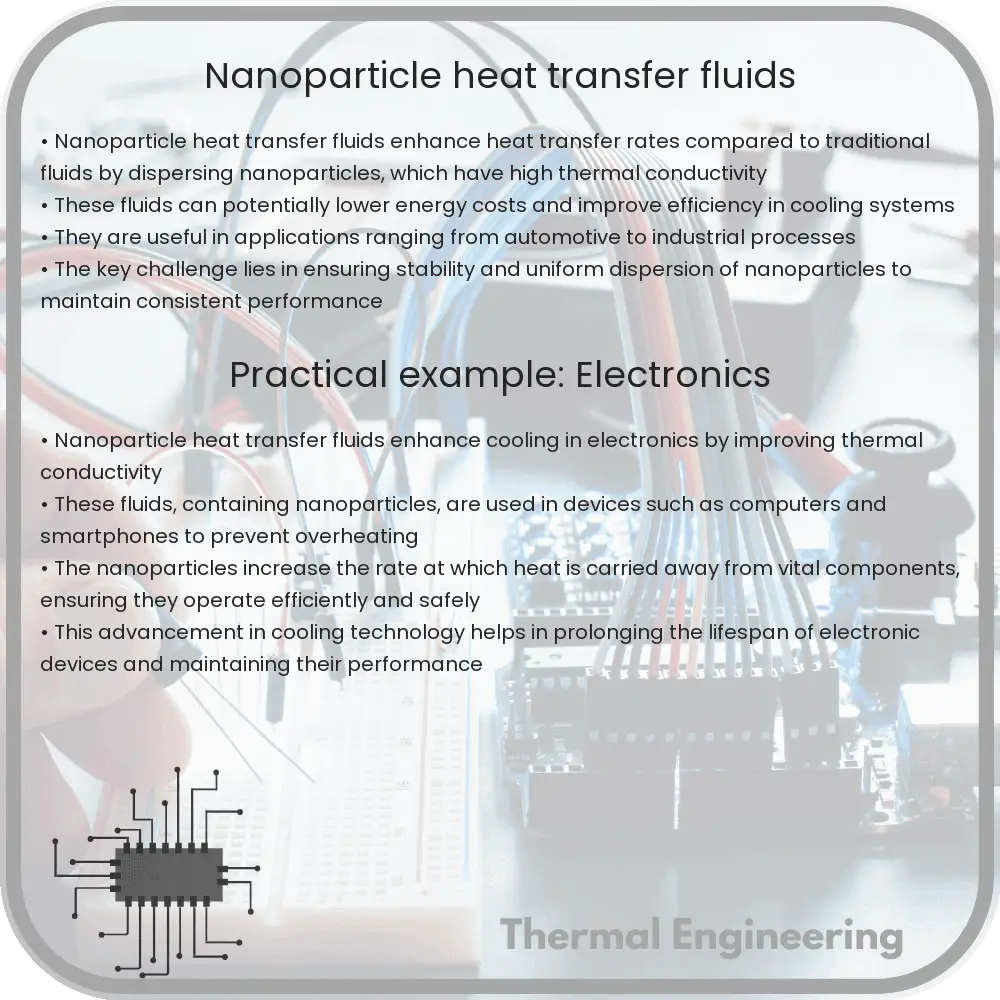
Nanoparticle heat transfer fluids

Learn about nanoparticle heat transfer fluids, a breakthrough in enhancing fluid thermal properties for efficient thermal management across industries.

Nanoparticle heat transfer fluids

Understanding Nanoparticle Heat Transfer Fluids

Heat transfer fluids are vital components in various engineering applications, enabling effective temperature management in systems ranging from automotive engines to power plants. Recently, the development of nanoparticle heat transfer fluids, also known as nanofluids, has emerged as a significant advancement in this area. These are conventional heat transfer fluids interspersed with nano-sized particles, typically metals or metal oxides, which enhance the thermal properties of the fluid.

Composition and Types of Nanofluids

Nanofluids consist of a base fluid and nanoparticles. Common base fluids include water, oil, and ethylene glycol, among others. The nanoparticles used can be metals like copper or silver, metal oxides like alumina (Al2O3) or titanium dioxide (TiO2), or even carbon nanotubes and graphene. The choice of nanoparticle depends on the desired properties and the specific application.

Enhancing Thermal Conductivity

One of the primary reasons for adding nanoparticles to heat transfer fluids is to enhance their thermal conductivity. The particles have a high surface area to volume ratio and exceptional thermal properties, which help in transferring heat more efficiently than the conventional fluids. Experiments and theoretical models suggest that even a small volume fraction of nanoparticles (generally below 5%) can lead to significant improvements in thermal conductivity.

The effective thermal conductivity, \( k_{\text{eff}} \), of a nanofluid can be approximated by models like the Maxwell model among others. According to this model:

\[
k_{\text{eff}} = k_f + \frac{3 \phi k_p (k_f + 2k_p)}{3k_p + \phi (k_f – k_p)}
\]

where \( k_f \) is the thermal conductivity of the base fluid, \( k_p \) is the thermal conductivity of the particles, and \( \phi \) is the volume fraction of the nanoparticles.

Applications of Nanofluids

  • Cooling and Heating Systems: Nanofluids are used in HVAC (Heating, Ventilation, and Air Conditioning) systems to enhance heat absorption and release, improving the efficiency of heating and cooling systems.
  • Automotive: In the automotive industry, nanofluids are used to enhance the performance of radiators and other cooling systems, which helps in maintaining optimal operating temperatures of engines.
  • Electronics Cooling: High-performance electronic devices generate a lot of heat, which can reduce efficiency and lifespan. Nanofluids assist in more effective cooling of these devices.
  • Renewable Energy Systems: Solar collectors and thermal energy storage systems utilize nanofluids to improve energy absorption and storage capacities.

Challenges and Research Directions

Despite the promising enhancements, the application of nanofluids also faces challenges such as nanoparticle agglomeration, sedimentation, and impacts on pressure drop across systems. Addressing these issues necessitates further research into nanoparticle coating, stability solutions, and system-specific compatibility. Additionally, environmental and health-related impacts of these nanoparticles must be thoroughly assessed to ensure safe long-term use.

In conclusion, nanoparticle heat transfer fluids present a significant advancement in thermal management systems across various industries. Their ability to conduct heat more efficiently than traditional fluids can lead to enhanced performance, energy savings, and ultimately, more sustainable engineering solutions. As research continues in this exciting area, expectations are that newer formulations and applications will emerge, broadening the spectrum of possibilities in thermal management technologies.

Heat transfer in microelectronics packaging

Explore the complexities of heat transfer in microelectronics packaging, focusing on conduction, convection, and radiation to optimize electronic device performance and reliability.

Heat transfer in microelectronics packaging

Understanding Heat Transfer in Microelectronics Packaging

Heat transfer in microelectronics packaging is a critical aspect of electronics engineering that deals with managing the undesired accumulation of heat in electronic devices. As electronics devices shrink in size and increase in power, controlling the temperature becomes increasingly challenging, but essential for maintaining performance and reliability.

Basics of Heat Transfer Mechanisms

In the context of microelectronics, there are three primary mechanisms of heat transfer: conduction, convection, and radiation.

  • Conduction is the transfer of heat between substances that are in direct contact with each other. In microelectronics, heat conduction often occurs between the semiconductor chip and the heat sink.
  • Convection involves the transfer of heat between a surface and a moving fluid or gas. In many electronic devices, fans are used to enhance this process by moving air across surfaces, facilitating heat dissipation.
  • Radiation refers to the transfer of energy through electromagnetic waves. Although less significant in microelectronics, radiation can contribute to cooling, especially under vacuum or in high-temperature environments.

Key Components Influencing Thermal Management

In microelectronics packaging, several key components play a crucial role in thermal management:

  1. Thermal Interface Materials (TIMs): These materials improve the thermal contact conductance between different surfaces, such as between the chip and the heat sink. TIMs fill gaps and micro-asperities to reduce thermal resistance.
  2. Heat Sinks: Often made of materials with high thermal conductivity like aluminum or copper, heat sinks dissipate heat through conduction and convection.
  3. Cooling Solutions: This includes fans, heat pipes, and liquid cooling solutions, which help in transferring heat away from the device.
  4. Chip Design and Layout: Optimizing the design and layout of circuits can reduce hotspots and improve overall heat distribution.

Mathematical Background of Heat Transfer

The heat transfer in microelectronics can be described by Fourier’s law of heat conduction, which can be expressed as:

q = -k * A * (dT/dx)

Here:

  • q represents the heat transfer rate (W).
  • k is the thermal conductivity of the material (W/m*K).
  • A is the area through which heat is being transferred (m2).
  • dT/dx is the temperature gradient (K/m).

This equation helps in quantifying the heat flux across materials in the package, providing a basis for analysis and optimization in thermal management.

Challenges in Heat Transfer for Microelectronics

There are several challenges that come with managing heat in microelectronics:

  • Miniaturization: As devices shrink, dissipation of heat becomes more problematic because of the limited surface area available for heat exchange.
  • Material Limits: Materials used in microelectronics typically have upper temperature limits, beyond which their properties may degrade.
  • Power Density: Increases in power density can lead to higher temperatures, necessitating more effective heat management strategies.
  • Reliability and Performance: Inadequate heat management can lead to reduced reliability and performance degradation over time.

Conclusion

The discipline of heat transfer in microelectronics packaging is crucial to the reliability and efficiency of electronic devices. By understanding and applying the principles of conduction, convection, and radiation, along with employing innovative materials and designs, engineers can effectively manage heat. Continued research and development are essential to meet the growing demands of modern electronics, ensuring that devices not only keep cool but also perform optimally under increasingly high power loads.

Heat transfer in porous electrodes

Uncover the dynamics of heat transfer in porous electrodes and its profound impact on the performance and safety of energy devices.

Heat transfer in porous electrodes

Understanding Heat Transfer in Porous Electrodes

Heat transfer in porous electrodes is a critical aspect of the performance and efficiency in various engineering applications, including batteries, fuel cells, and electrolysis systems. This article delves into the mechanisms of heat transfer within these materials and their impact on the operation of energy devices.

Basics of Porous Electrodes

Porous electrodes are composed of a solid matrix with interconnected pores. These structures allow fluids, either liquid or gas, to flow through them while facilitating electrochemical reactions. The porosity and pore size distribution are crucial in determining their effectiveness in specific applications.

Mechanisms of Heat Transfer

Heat in porous electrodes is transferred through three primary mechanisms: conduction, convection, and radiation, although radiation is typically negligible in many of the practical temperatures at which these devices operate. The dominant mechanisms are:

  • Conduction: This is the transfer of heat through the solid matrix of the electrode. The rate of heat conduction is governed by the thermal conductivity of the material and can be described by Fourier’s law of heat conduction:

\[ q = -k \nabla T \]

where \( q \) is the heat flux, \( k \) is the thermal conductivity, and \( \nabla T \) represents the temperature gradient within the electrode.

  • Convection: This mechanism involves the transport of heat by the movement of fluids within the pores. The efficiency of convective heat transfer is influenced by the fluid’s properties, velocity, and the specific heat capacity.

The overall effectiveness of these mechanisms is influenced by the electrode’s morphology, including porosity, pore size, and tortuosity, which is a measure of the complexity of the path through the porous structure.

Mathematical Modeling of Heat Transfer

To analyze heat transfer within porous electrodes, engineers use various mathematical models that typically employ the energy conservation equation, which can be written as:

\[ \rho C_p \frac{\partial T}{\partial t} = \nabla \cdot (k \nabla T) + \dot{Q} \]

Here, \( \rho \) is the density, \( C_p \) is the specific heat capacity at constant pressure, \( T \) is temperature, \( t \) is time, and \( \dot{Q} \) represents the heat generated per unit volume due to electrochemical reactions.

Impact on Device Performance

Effective management of heat within porous electrodes is vital for the reliability and efficiency of energy devices. Excessive heat can lead to thermal runaway, especially in batteries, potentially causing failure or even safety hazards. On the other hand, insufficient heat can lead to suboptimal reaction rates, thereby reducing the device’s performance.

Engineers strive to design porous electrodes with optimal properties to balance the heat generation and dissipation, which can significantly enhance the longevity and functionality of energy devices.

Conclusion

Heat transfer in porous electrodes is a dynamic field that combines aspects of material science, fluid dynamics, and thermodynamics to solve complex problems in energy systems. Understanding and optimizing these processes are key to advancing technologies in the field of energy storage and conversion, contributing to more efficient and safer systems.

By continuing to explore the intricacies of this topic, researchers and engineers can develop innovative solutions that enhance the performance of existing technologies and pave the way for new applications.

Heat transfer fluids in solar systems

Learn about heat transfer fluids used in solar systems, their types, properties, and impact on system efficiency and performance.

Heat transfer fluids in solar systems

Understanding Heat Transfer Fluids in Solar Systems

In the realm of renewable energy, solar thermal systems represent a crucial technology for harnessing the sun’s power to generate heat. A key component of these systems is the heat transfer fluid (HTF). This fluid plays a pivotal role in transferring heat from the solar collectors to the point of use or storage. Here we explore the types of heat transfer fluids used in solar systems, their properties, and their importance in efficient system performance.

Types of Heat Transfer Fluids

There are various types of fluids that can serve as HTFs in solar systems, each selected based on their thermal properties, freezing point, boiling point, and chemical stability. The most commonly used fluids include:

  • Water: Due to its high specific heat capacity and availability, water is often used in areas where freezing is not a concern. However, its use requires careful corrosion control and it can be limited by its high freezing and low boiling points.
  • Antifreeze Solutions: Mixtures like water-glycol (often propylene glycol) are used where temperatures may drop below freezing. Glycol helps in lowering the freezing point of the solution and increases the boiling point, making it ideal for a wider range of climatic conditions.
  • Synthetic Oils: These are used in high-temperature applications. Synthetic oils can withstand higher temperatures than both water and glycol solutions, reducing the risk of system damage due to overheating.
  • Molten Salts: Comprising sodium and potassium nitrate, molten salts can operate at very high temperatures and store heat effectively, making them ideal for concentrated solar power (CSP) systems that require heat storage for electricity generation during non-sunny hours.

Selection Criteria for Heat Transfer Fluids

Selecting an appropriate heat transfer fluid involves considering several key factors:

  • Thermal Capacity: Fluids with higher heat capacities can store and transfer more heat, enhancing the efficiency of the solar system.
  • Viscosity: Lower viscosity fluids are preferable as they flow more easily, reducing the energy required to pump them through the system.
  • Thermal Stability: Fluids must be stable at high temperatures to avoid breakdown and degradation, which could lead to system failure.
  • Freezing and Boiling Points: Fluids should be suited to the environmental conditions, with appropriate freezing and boiling points to avoid solidifying or vaporizing under typical operating conditions.
  • Corrosiveness: Non-corrosive fluids are essential to minimize the wear and tear on solar system components, prolonging their lifespan.

Impact of Heat Transfer Fluids on System Performance

The efficiency of a solar thermal system is significantly influenced by the type of HTF used. The fluid’s ability to absorb heat from the solar collector, transfer it efficiently, and release it at the usage point or in storage without substantial temperature loss is critical. An optimal HTF contributes to the system’s overall thermal efficiency, operational reliability, and longevity.

In summary, heat transfer fluids are integral to the performance of solar thermal systems. By understanding the properties of different HTFs and the demands of specific solar applications, engineers and designers can tailor solar heating systems to maximize efficiency, reduce operational costs, and extend service life, all while contributing to the broader adoption of solar energy technologies.

As advancements in fluid technologies continue, the selection of HTFs will evolve, further enhancing the capabilities and applicability of solar thermal energy systems in both residential and industrial sectors.

Thermal management of photovoltaic panels

Explore the importance of thermal management in enhancing the efficiency and lifespan of photovoltaic panels.

Thermal management of photovoltaic panels

Understanding Thermal Management in Photovoltaic Panels

Photovoltaic (PV) panels are a cornerstone of renewable energy, converting sunlight directly into electricity. However, a critical challenge affects their efficiency: temperature. As the panels absorb solar radiation, they also heat up. Higher temperatures can significantly reduce the output and lifespan of PV panels. This article explores the significance of thermal management in photovoltaic systems and various methods used to maintain optimal panel temperatures.

The Impact of Temperature on PV Efficiency

The performance of photovoltaic panels decreases with temperature increase. This reduction in efficiency is primarily due to the physical properties of the semiconductor materials used in PV cells. As the temperature rises, the semiconductor’s band gap decreases, resulting in lower voltage output. Moreover, an increase in temperature also increases the rate at which electrons and holes recombine, further reducing the electrical output.

Empirically, the efficiency of a typical silicon PV cell declines by about 0.4% for every 1 degree Celsius increase in temperature. This sensitivity is quantified by the temperature coefficient, typically found in the specifications of PV modules.

Methods for Thermal Management

  • Cooling Systems: Active and passive cooling systems are essential for managing the temperature of PV panels. Active cooling may involve using water or air to directly cool the panels. For instance, water can be circulated at the back of the panels to absorb heat, while air cooling could involve forced ventilation systems.
  • Radiative Cooling: This passive cooling technique involves designing the panel surfaces to emit infrared radiation, helping to radiate heat back to the atmosphere during cooler periods of the day or night.
  • Heat Sinks: Adding a heat sink to the back of photovoltaic panels can enhance heat dissipation. Materials with high thermal conductivity like aluminum are typically used for this purpose.
  • Improved Materials: Research continues into developing materials with lower temperature coefficients. Using materials that inherently manage heat better can directly enhance the overall efficiency of the PV system.
  • Mounting Techniques: Certain mounting techniques may mitigate heat build-up. Elevated or rack-mounted panels allow for air circulation around the panels, which can aid in cooling.

Advances in Technology and Materials

Technological innovations continue to improve the thermal management of PV panels. For instance, phase change materials (PCMs) that melt and solidify at certain temperatures can effectively manage excess heat by absorbing and releasing latent heat. Additionally, nano-fluids and advanced geometrics for heat sinks are being explored to enhance the surface area and improve heat dissipation rates.

Conclusion

Efficient thermal management in photovoltaic panels is vital for maximizing their output and durability. By effectively managing the temperature, we can ensure that solar panels operate at optimal conditions, thereby increasing both their efficiency and lifespan. As research continues, it is likely that new materials and technologies will further enhance the capabilities of photovoltaic systems to manage thermal energy, making solar power an even more attractive option for sustainable energy production.

Heat transfer in particulate suspensions

A detailed exploration of heat transfer mechanisms in particulate suspensions, crucial for various engineering applications.

Heat transfer in particulate suspensions

Understanding Heat Transfer in Particulate Suspensions

Heat transfer in particulate suspensions is a fascinating and complex process that plays a crucial role in various engineering and industrial applications. This article will explore the basics of how heat transfer occurs in these systems, the factors that influence it, and why understanding it is essential for the design and optimization of many technologies.

What are Particulate Suspensions?

Particulate suspensions consist of solid particles dispersed in a fluid medium, which can be a liquid or gas. The particles, depending on their material, size, shape, and concentration, can significantly influence the thermal properties of the suspension. Examples of particulate suspensions include slurries, muddy water, blood, and various chemical mixtures used in industrial processes.

Mechanisms of Heat Transfer

Heat transfer in particulate suspensions can occur through three primary mechanisms:

  • Conduction: Heat is transferred through direct contact between particles and between the particles and the surrounding fluid.
  • Convection: This mechanism involves heat transfer due to the movement of the fluid, which can be natural (driven by buoyancy forces due to temperature differences) or induced (caused by external mechanical forces).
  • Radiation: Heat can be transferred through electromagnetic waves, which can occur especially at high temperatures.

The overall heat transfer in particulate suspensions is often a combined effect of these three mechanisms, with the dominant mechanism depending on the specific conditions like temperature, particle concentration, and fluid velocity.

Key Factors Influencing Heat Transfer

Several factors can significantly impact the efficiency of heat transfer in particulate suspensions:

  1. Particle Properties: This includes the size, shape, and material of the particles. Higher thermal conductivity of the particles can enhance heat transfer.
  2. Concentration of Particles: An increased concentration of particles generally increases the system’s thermal conductivity but might hinder fluid flow and reduce convective heat transfer.
  3. Fluid Properties: The type of fluid, its viscosity, and thermal conductivity play a crucial role in determining the rate of heat transfer.
  4. Flow Conditions: The velocity and type of flow (turbulent or laminar) can affect the efficiency of convective heat transfer.
  5. Temperature Gradient: The difference in temperature between the particles and the fluid influences the driving force for heat transfer.

Applications in Engineering

Understanding the behavior of heat transfer in particulate suspensions can significantly impact various engineering fields, such as:

  • Chemical Engineering: Design of reactors and mixers where heat transfer is crucial for reaction kinetics.
  • Environmental Engineering: Management of waste treatments or thermal pollution.
  • Energy Sector: Development of enhanced geothermal systems or cooling systems for nuclear reactors.
  • Manufacturing: Processes requiring precise temperature control to ensure product quality.

Conclusion

Heat transfer in particulate suspensions encompasses a variety of mechanisms and influencing factors, making it a complex yet fascinating study area within thermal science. As industries continue to evolve, the demand for efficient process control and optimization highlights the importance of deeper insights into thermal behaviors in particulate-laden fluids. Integrating experimental studies with theoretical models can enhance our understanding and lead to technological advances across multiple sectors.

By advancing our understanding of heat transfer in these systems, engineers can design more efficient and effective processes, contributing to better energy usage, reduced costs, and improved environmental impact.

Heat transfer in high-temperature reactors

This article explains heat transfer in high-temperature reactors, focusing on conduction, convection, and radiation within nuclear power generation.

Heat transfer in high-temperature reactors

Understanding Heat Transfer in High-Temperature Reactors

High-temperature reactors (HTRs), such as those used in nuclear power plants, are crucial for energy generation. The efficiency and safety of these reactors depend significantly on the effective management of heat transfer. This article will explore the fundamentals of heat transfer in high-temperature reactors, including the mechanisms involved and the engineering principles applied to ensure safety and efficiency.

Mechanisms of Heat Transfer in HTRs

Heat transfer in high-temperature reactors occurs through three primary mechanisms: conduction, convection, and radiation.

  • Conduction: In HTRs, heat conduction happens when thermal energy is transferred directly through materials. For example, heat conduction occurs in the reactor’s fuel elements and structural materials. The equation governing conduction is Fourier’s Law, which can be expressed as:

    q = -k * ∇T

    Where q is the heat flux, k is the thermal conductivity of the material, and ∇T stands for the temperature gradient.

  • Convection: Convection involves the transfer of heat by the physical movement of fluid, which in the case of many high-temperature reactors, is often a gas like helium. The convective heat transfer can be represented by Newton’s Law of Cooling:

    q = h * A * (Ts – T∞)

    Where q is the heat transfer rate, h is the convective heat transfer coefficient, A is the surface area, Ts is the surface temperature, and T∞ is the fluid temperature.

  • Radiation: Heat radiation is emitted by surfaces in the form of electromagnetic waves. In reactors, surfaces at high temperatures emit radiation that can be absorbed, reflected, or transmitted. The Stefan-Boltzmann law describes this radiant heat transfer:

    q = ε * σ * A * (T4 – T04)

    Where ε is the emissivity of the material, σ is the Stefan-Boltzmann constant, and T and T0 are the temperatures of the radiating surface and the surroundings, respectively.

Engineering Solutions to Enhance Heat Transfer Efficiency

To maximize the efficiency and safety of high-temperature reactors, engineers employ various strategies:

  • Material Selection: Choosing materials with high thermal conductivity for reactor components to enhance heat conduction.
  • Coolant Optimization: Using coolants that provide optimal heat capacity and flow characteristics can significantly improve convective heat transfer. Helium, due to its inertness and thermal properties, is commonly used in high-temperature reactors.
  • Design of Heat Exchangers: Effectively designed heat exchangers play a crucial role in transferring heat from the reactor core to the steam generators or secondary coolants.
  • Radiative Heat Shields: Incorporating reflective or absorptive materials to control radiative heat transfer to or from critical components.

Challenges and Future Perspectives

While significant advancements have been made, high-temperature reactors still face challenges related to heat transfer. These include managing the extreme temperatures, improving the lifetime of materials under intense thermal stresses, and optimizing the reactor design for better heat management. Continuous research and development are being conducted to find innovative solutions to these challenges, highlighting the critical role of heat transfer in the sustainability and safety of nuclear power generation.

In conclusion, a deep understanding and careful management of heat transfer mechanisms are indispensable in the design and operation of high-temperature reactors. As the demand for energy grows and safety standards become stricter, enhancing heat transfer methodologies will remain at the forefront of nuclear reactor technology development.