Facebook Instagram Youtube Twitter

Thermodynamics of membrane separation processes

Explore how thermodynamic principles govern the efficiency of membrane separation processes used in various industries.
Thermodynamics of membrane separation processes

Understanding the Thermodynamics of Membrane Separation Processes

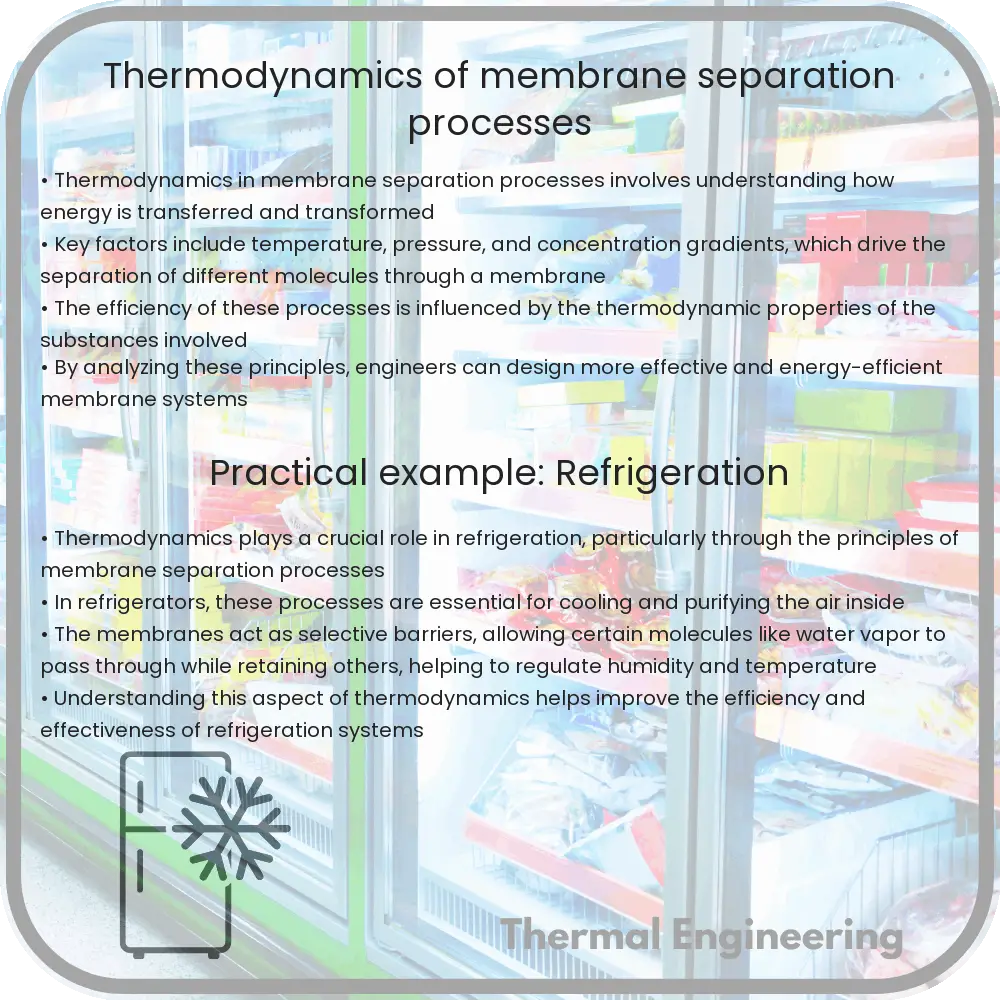
Membrane separation is a crucial engineering technique used across various industries, from water purification to gas separation. The basic principle behind membrane separation is the selective barrier mechanism, where certain molecules are allowed to pass while others are blocked. The efficiency and selectivity of these processes are largely determined by thermodynamic principles, which help us understand and predict the behavior of these separations.

Basic Principles of Membrane Separation

At the core of membrane technology are the concepts of chemical potential and driving forces. In any membrane separation process, a difference in chemical potential between two sides of the membrane drives the transfer of mass. This transfer can be driven by differences in concentration, pressure, or temperature, leading to different types of membrane processes such as reverse osmosis, nanofiltration, and gas separation.

Thermodynamics and Energy Considerations

The Second Law of Thermodynamics plays a key role in membrane separation. It implies that for a spontaneous process to occur, the entropy of the system should increase. In practical terms, this means designing membrane processes that minimize energy consumption while maximizing separation efficiency. The efficiency of a process is often determined by its ability to retain this balance under operational conditions.

Models of Membrane Separation

To describe and optimize membrane separation processes, engineers use various thermodynamic models. These models help in understanding how temperature, pressure, and concentration gradients affect separation efficiency and selectivity:

  • Solution-Diffusion Model: This model assumes that the feed solution dissolves in the membrane material, and the separation is governed by the differences in the diffusion rates of various components through the membrane.
  • Porous Model: In this model, the membrane is considered as a porous medium. The separation is based on the size and shape of the pores relative to the particles being separated.
  • Thermodynamic Models: These models integrate the laws of thermodynamics directly into the analysis, typically by analyzing the entropy generation or the exergy (usable energy) destruction in the membrane process.

Entropy and Membrane Processes

Entropy, a measure of disorder or randomness in a system, is a fundamental concept in thermodynamics that also affects membrane technology. During separation, the aim is often to decrease the entropy associated with mixing different particles or molecules. The generation of entropy associated with mixing can often determine the feasibility and efficiency of a membrane separation process.

Real-World Applications

Understanding the thermodynamics of membrane processes has profound practical implications:

  • Water Desalination: Making freshwater from seawater by removing salts through reverse osmosis.
  • Gas Separation: Such as the extraction of oxygen from air in medical applications or hydrogen purification in petrochemical processes.
  • Pharmaceutical Production: Purification steps in drug synthesis, often requiring precise separation of complex mixtures.

In conclusion, the thermodynamics of membrane separation processes is a key aspect of engineering that allows the design and optimization of systems to carry out critical separations in industry and environmental management. Recognizing the thermodynamic constraints and capabilities of membranes enables engineers to innovate and enhance the sustainability and efficiency of these vital systems.

Exergy analysis in thermal insulation materials

Learn how exergy analysis optimizes the efficiency of thermal insulation materials by minimizing energy waste and improving sustainability.

Exergy analysis in thermal insulation materials

Understanding Exergy Analysis in Thermal Insulation Materials

Exergy analysis is a thermodynamic tool used to quantify the quality of energy flow systems and to improve their efficiency. When applied to thermal insulation materials, exergy analysis provides crucial insights into the effectiveness of these materials in reducing energy waste and enhancing sustainability of buildings and industrial processes.

Basics of Exergy

Exergy is a measure of useful energy that can be extracted when a system interacts with its environment to reach equilibrium. It differs from energy in that while energy is conserved, exergy is not — it is destroyed due to irreversibilities in real processes. The basic formula for exergy is expressed as:

E_x = (U + p_0 * V - T_0 * S) - (U_0 + p_0 * V_0 - T_0 * S_0)

Where:

  • U – Internal energy
  • V – Volume
  • S – Entropy
  • p0 – Ambient pressure
  • T0 – Ambient temperature

Exergy in Thermal Insulation

The primary function of thermal insulation materials is to reduce the thermal energy transfer between objects at different temperatures. The effectiveness of these materials can be enhanced by using exergy analysis to understand and minimize the irreversibilities in heat transfer processes.

Thermal insulation works by minimizing the heat conduction, convection, and radiation. By applying exergy analysis, the amount of destroyed exergy can be measured, providing a metric to assess how well the insulation conserves useful energy.

Application of Exergy Analysis

In practical terms, exergy analysis helps in designing more effective insulation materials and systems. Engineers use it to compare different materials and designs, choosing those that result in lower exergy destruction, thereby improving energy efficiency and reducing environmental impact. Here are the steps typically involved in doing an exergy analysis for a thermal insulation system:

  1. Identifying the system boundaries and state properties (temperature, pressure, etc.) of the system and surroundings.
  2. Calculating the exergy flows entering and exiting the system.
  3. Assessing the exergy destruction within the system and identifying sources of thermodynamic inefficiencies.
  4. Proposing modifications to decrease the exergy destruction and boost the system’s efficiency.

Benefits of Exergy Analysis in Insulation

Exergy analysis of thermal insulation materials provides several benefits:

  • Improved efficiency: By focusing on minimizing exergy destruction, materials can be engineered to optimize heat retention or exclusion as required.
  • Cost-effectiveness: Reducing exergy destruction can lead to lower operational costs by minimizing the need for additional heating or cooling.
  • Environmental Impact: Efficient insulation materials contribute to reduced energy consumption and lower emissions of greenhouse gases.

In conclusion, exergy analysis offers a powerful approach for enhancing the performance and sustainability of thermal insulation materials. By understanding and optimizing the exergy flows, engineers can design more effective insulation solutions that play a crucial role in the global effort towards energy efficiency and environmental conservation.

Thermodynamics of carbon capture and storage

Understanding the role of thermodynamics in carbon capture and storage (CCS) processes and technologies.

Thermodynamics of carbon capture and storage

The Thermodynamics of Carbon Capture and Storage

Carbon capture and storage (CCS) is a technology aimed at reducing carbon dioxide (CO2) emissions from industrial processes and power generation. Understanding the thermodynamics of carbon capture and storage is essential to enhancing its efficiency and integration into our fight against climate change. This article explores the fundamental thermodynamic principles that underpin CCS technologies and their practical applications.

Basic Principles of Thermodynamics in CCS

Thermodynamics, the study of energy and its transformations, is fundamental to the design and operation of CCS systems. The first and second laws of thermodynamics play crucial roles:

  • First Law of Thermodynamics: This law, also known as the Law of Energy Conservation, states that energy cannot be created or destroyed, only transformed from one form to another. In CCS, this principle governs the energy transformations involved in capturing, compressing, transporting, and storing CO2.
  • Second Law of Thermodynamics: This law states that entropy, a measure of system disorder, always increases in a closed system. For CCS, this law affects the efficiency of CO2 separation and compression processes, as each step tends to increase the system’s overall entropy.

Thermodynamics of CO2 Capture

CO2 capture can be achieved through various methods such as post-combustion, pre-combustion, and oxy-fuel combustion, each with different thermodynamic considerations:

  • Post-combustion: CO2 is separated from the flue gases produced after combustion of the fossil fuel. This process often involves the use of solvents like amines which absorb CO2. The main thermodynamic challenge is the energy required to regenerate the solvent, which involves heating it to release the absorbed CO2, a process highly influenced by the heat capacities and phase behavior of the involved compounds.
  • Pre-combustion: Fossil fuels are converted into a gas mixture of hydrogen and CO2 before combustion. CO2 is separated from hydrogen at high pressures. This process is thermodynamically favored due to the high pressure, which affects the solubility and partial pressures of the gases.
  • Oxy-fuel combustion: Combustion in pure oxygen, rather than air, produces a flue gas mainly of CO2 and water steam. Water is then condensed out, leaving nearly pure CO2. The challenge here lies in the production and purification of oxygen, which is energy-intensive.

Compression and Transportation of CO2

Once captured, CO2 must be compressed to a supercritical state for efficient transportation, usually through pipelines. This compression requires significant energy and increases entropy, making the process less efficient thermodynamically. The supercritical state, where CO2 becomes a dense fluid, enhances pipeline flow characteristics but requires that the CO2 be maintained above its critical temperature (31.1°C) and pressure (73.8 bar).

Storage of CO2

Storage involves injecting the CO2 into geological formations. The suitability of a site for storage is largely determined by its thermodynamic properties. For instance, the interaction between CO2 and the reservoir rock, the stability of the mineral phases under different temperatures and pressures, and the buoyancy forces affecting the trapped CO2 all depend on thermodynamic principles.

Future Directions

Advancements in thermodynamic modeling and simulations hold promise for enhancing CCS efficiency and scalability. Researchers are exploring innovative materials and processes that could reduce the energy penalties associated with CO2 capture, compression, and storage, making CCS a more viable solution for mitigating climate change.

In summary, thermodynamics plays a vital role in every step of the CCS process. A better understanding of these principles will not only improve existing technologies but also pave the way for the development of new techniques in carbon management.

Thermodynamics of jet propulsion systems

Learn about the thermodynamics principles that power jet propulsion systems in aircraft and space vehicles.

Thermodynamics of jet propulsion systems

Understanding the Thermodynamics of Jet Propulsion Systems

Jet propulsion systems are a critical component in various types of aircraft, including commercial airliners, military jets, and space vehicles. The fundamental science that enables these systems to work so effectively is thermodynamics, the branch of physics that deals with heat and temperature and their relation to energy and work. In this article, we will explore the basic thermodynamic principles that govern jet propulsion systems and how they are implemented in engineering design.

Basic Principles of Thermodynamics in Jet Engines

The operation of a jet engine involves converting the chemical energy stored in fuel into mechanical energy in the form of thrust. This process is governed by several key principles in thermodynamics:

  • First Law of Thermodynamics: This law, also known as the law of energy conservation, states that energy cannot be created or destroyed, only transferred or changed in form. In jet engines, chemical energy from the fuel is converted into thermal energy by combustion and then into kinetic energy as the gases are expelled at high speed to produce thrust.
  • Second Law of Thermodynamics: This law states that the entropy (degree of disorder) of an isolated system always increases over time. In practical terms, this means that any energy conversion process, including those in a jet engine, is not 100% efficient. Some energy is always lost, usually as waste heat.
  • The concept of cycles: Jet engines operate on the basis of thermodynamic cycles, with the Brayton cycle being the most common. This cycle involves adiabatic compression, isobaric (constant pressure) combustion, and adiabatic expansion.

The Brayton Cycle Explained

The Brayton cycle is the fundamental cycle underlying most modern jet propulsion systems. It consists of the following stages:

  1. Intake and Compression: Ambient air is drawn into the engine and compressed by the compressor, increasing its pressure and temperature and decreasing its volume.
  2. Combustion: Fuel is injected into the compressed air, and the mixture is ignited. The combustion generates a high-temperature, high-pressure gas.
  3. Expansion and Exhaust: The high-pressure gas expands through the turbine, which extracts energy to run the compressor. The gas then exits the engine at high speed through the exhaust, providing thrust.

The efficiency of this cycle is influenced by several factors, including the pressure ratio (the ratio of the pressure at the compressor outlet to that at the inlet) and the turbine inlet temperature. Higher pressure ratios and higher temperatures generally lead to increased efficiency but also pose greater technical challenges in terms of materials and construction.

Engineering Applications and Innovations

In the realm of engineering, applying the principles of thermodynamics to jet propulsion involves continuous innovation and improvement. Advances in materials science allow for higher temperature and pressure conditions within the engine, improving efficiency. Computational fluid dynamics (CFD) and other simulation tools provide engineers with the ability to optimize engine designs before physical prototypes are built.

Moreover, modern engineering efforts also focus on sustainability, aiming to reduce the environmental impact of jet propulsion. This includes developing engines that burn fuel more completely to reduce emissions and researching alternative fuels that are more environmentally friendly.

In conclusion, the thermodynamics of jet propulsion is a vibrant area of engineering that combines principles of physics with sophisticated technological design. Understanding these principles not only helps us appreciate the complexities of modern air travel and space exploration but also drives continuous advancements in the efficiency and sustainability of these crucial systems.

Thermodynamic performance of heat exchangers

Learn about the essential role and thermodynamic evaluation of heat exchangers in various industrial applications.

Thermodynamic performance of heat exchangers

Understanding the Thermodynamic Performance of Heat Exchangers

Heat exchangers are critical components used in various industrial and engineering applications, ranging from power plants to refrigeration systems, where heat transfer between two fluids is necessary. The performance of these devices is paramount to ensuring efficiency and sustainability in energy use. Evaluating the thermodynamic performance of heat exchangers involves understanding key concepts like effectiveness, heat transfer rates, and pressure drops, among other parameters.

Key Concepts in Thermodynamic Analysis

Before delving into the analysis of heat exchangers, it is important to understand several fundamental concepts:

  • Heat Transfer Coefficient (U): This is a measure of a heat exchanger’s ability to transfer heat between fluids. It is influenced by the materials used, the flow arrangement, and the physical properties of the fluids.
  • Log Mean Temperature Difference (LMTD): This value represents the average temperature difference between the hot and cold fluids over the length of the heat exchanger.
  • Effectiveness (ε): The effectiveness of a heat exchanger measures its ability to attain the maximum possible heat transfer. It is defined as the ratio of the actual heat transfer to the maximum possible heat transfer under the same conditions.

The formula for effectiveness depends on the type of heat exchanger, but for a simple counterflow heat exchanger, it can be estimated using:

\[ \epsilon = \frac{T_{h,in} – T_{h,out}}{T_{h,in} – T_{c,in}} \]

where \( T_{h,in} \) and \( T_{h,out} \) are the inlet and outlet temperatures of the hot fluid, and \( T_{c,in} \) is the inlet temperature of the cold fluid.

Evaluating Heat Transfer

The overall heat transfer rate (Q) in a heat exchanger can be calculated by:

\[ Q = U * A * \Delta T_{lm} \]

Here, \( A \) stands for the heat transfer area, and \( \Delta T_{lm} \) is the log mean temperature difference. The higher the value of \( U \), the more efficient the heat exchanger will be.

Pressure Drop and Its Implications

Alongside heat transfer, pressure drop across a heat exchanger is a crucial performance metric. It directly impacts the operating cost and efficiency of the system. A high pressure drop requires more pump or fan power, thus increasing operating costs. The pressure drop (\( \Delta P \)) is influenced by the flow arrangement, fluid velocity, viscosity, and other parameters.

A balance needs to be struck between achieving a high heat transfer rate and maintaining a reasonable pressure drop to ensure that the heat exchanger performs effectively without incurring excessive energy costs.

Solutions and Enhancements

Various methods can be employed to improve the performance of heat exchangers:

  • Using enhanced surfaces: Features like fins or corrugations can increase the heat transfer surface area and the heat transfer coefficient.
  • Optimizing flow arrangements: Adjusting the flow configuration (e.g., counterflow, crossflow) can lead to higher effectiveness and better thermal performance.
  • Maintenance and cleaning: Regular maintenance and cleaning of heat exchanger surfaces can prevent fouling, a common issue that degrades heat transfer efficiency over time.

Evaluating and enhancing the thermodynamic performance of heat exchangers not only contributes to the optimization of energy use but also extends the lifespan of the equipment and reduces environmental impact.

Conclusion

Thorough understanding and regular assessment of the thermodynamic properties of heat exchangers are essential for maintaining and enhancing the efficiency of thermal systems in various applications. Adopting improved design strategies and maintenance practices can significantly influence their thermodynamic performance, ultimately contributing to more sustainable and cost-effective operations.

Carnot cycle efficiency improvements

Learn about the Carnot cycle, a theoretical model that sets the efficiency benchmark for heat engines in thermodynamics.

Carnot cycle efficiency improvements

Understanding and Improving the Efficiency of the Carnot Cycle

The Carnot cycle is a theoretical model that describes the maximum possible efficiency that a heat engine can achieve under certain conditions. This model is fundamental in the field of thermodynamics and helps engineers understand the upper limits of engine efficiency. However, actual machines rarely achieve the Carnot efficiency due to real-world constraints. Nevertheless, there are strategies that can be employed to approach this theoretical efficiency more closely.

Basics of the Carnot Cycle

The Carnot cycle involves four key processes – two isothermal (constant temperature) and two adiabatic (no heat transfer) processes. The four stages are:

  1. Isothermal Expansion: The working fluid (like gas) is thermally connected to a high-temperature heat reservoir, expanding and doing work on the surroundings while absorbing heat.
  2. Adiabatic Expansion: The system is insulated, and the fluid continues to expand, doing work without exchanging heat, which causes it to cool down.
  3. Isothermal Compression: The fluid is now in contact with a lower temperature reservoir. It is compressed, thus giving up heat to the reservoir.
  4. Adiabatic Compression: The system is again insulated; the fluid is compressed further, which causes its temperature to rise back to the initial state, completing the cycle.

The efficiency of the Carnot cycle, denoted as η (eta), is calculated through the ratio of work done by the engine to the heat absorbed from the high-temperature reservoir. Mathematically, it is expressed as:

η = 1 – (T2 / T1)

where T1 is the temperature of the hot reservoir and T2 is the temperature of the cold reservoir. Here, temperatures must be in Kelvin for accuracy.

Strategies for Improving Carnot Cycle Efficiency

To enhance the practical efficiency of heat engines operating close to the Carnot cycle, several strategies can be explored:

  • Temperature Management: Increasing the temperature (T1) of the heat source and decreasing the temperature (T2) of the heat sink can significantly enhance efficiency, as per the Carnot formula.
  • Minimizing Irreversible Losses: In real engines, aspects like friction, turbulence, and non-ideal gas behavior lead to irreversible losses. Reducing these can help approach the theoretical Carnot efficiency.
  • Material Advances: Using materials that can withstand higher temperatures and that have better thermal properties can reduce losses due to heat transfer and component degradation.
  • Improved Design: Enhancing the design of the engine, such as optimizing the shape and size of the cylinders or improving the insulation, can also help in achieving higher efficiencies.

Implementing these improvements in a heat engine not only brings it closer to the theoretical limits of the Carnot cycle but also makes it more practical and efficient for real-world applications.

Conclusion

The Carnot cycle represents an idealized scenario that serves as a benchmark for the efficiency of heat engines. While achieving this ideal in practical applications remains challenging, advances in engineering and technology continually push the boundaries closer to this theoretical maximum. Understanding the principles of the Carnot cycle helps in designing more efficient thermal systems, ultimately contributing to better energy management and conservation in various industrial applications.

Thermodynamics in the semiconductor industry

Understanding the fundamental role of thermodynamics in semiconductor manufacturing, focusing on heat management, material stability, and efficiency.

Thermodynamics in the semiconductor industry

Understanding the Role of Thermodynamics in the Semiconductor Industry

Thermodynamics, the study of energy and its transformations, is fundamental to the design and manufacturing processes in the semiconductor industry. This field of physics helps engineers understand how thermal processes influence material properties and device performance in semiconductor fabrication. This article explores key aspects of thermodynamics in the semiconductor industry, including heat management, material stability, and efficiency enhancement.

Heat Management

Semiconductor devices generate heat during operation, which must be efficiently managed to maintain device performance and reliability. The principles of thermodynamics are critical in designing effective cooling systems that can remove excess heat from the devices and prevent overheating. Engineers use concepts such as heat capacity, heat transfer, and entropy to develop cooling solutions such as heat sinks, fans, and liquid cooling systems.

  • Heat Capacity: This refers to the amount of heat energy required to raise the temperature of the semiconductor material by a specific amount. Understanding the heat capacity helps in selecting materials that can effectively absorb and dissipate heat.
  • Heat Transfer: Heat transfer mechanisms, including conduction, convection, and radiation, are applied to optimize the design of cooling systems. Heat transfer equations, derived from thermodynamic principles, are used to calculate the rate at which heat is transferred away from the device.
  • Entropy: The concept of entropy, which measures the randomness or disorder in a system, provides insights into the efficiency of heat transfer processes. Engineers strive to design systems that minimize entropy increase to achieve maximum energy efficiency.

Material Stability

Thermodynamics also plays a crucial role in understanding and controlling the thermal stability of materials used in semiconductors. High temperatures can lead to undesirable reactions or phase changes in materials, affecting the electronic properties of semiconductor devices.

  • Thermal Expansion: Semiconductor materials can expand or contract when exposed to temperature changes. Thorough knowledge of thermal expansion coefficients is essential for predicting material behavior under thermal stress.
  • Phase Transitions: Materials may undergo phase transitions at certain temperatures, changing their electrical and mechanical properties. Thermodynamic principles help predict these transitions and guide the choice of materials that maintain stability under operational conditions.

Efficiency Enhancement

Improving the energy efficiency of semiconductor devices is another significant application of thermodynamics. Engineers use thermodynamic analysis to optimize processes such as doping, annealing, and deposition to enhance device performance and reduce energy consumption.

  • Doping: The process of adding impurities to semiconductor materials to alter their electrical properties can involve significant thermal processes. Control of these processes is crucial to maintain the purity and performance of the semiconductor.
  • Annealing: This thermal process is used to repair the damage to the semiconductor lattice that occurs during the fabrication process. Thermodynamics guides the annealing temperatures and durations to achieve desired material properties without excessive energy consumption.
  • Deposition: Techniques such as chemical vapor deposition and physical vapor deposition involve thermodynamic consideration to optimize coating uniformity and adhesion, as well as to manage the thermal budget of the semiconductor device.

In conclusion, a deep understanding of thermodynamic principles is indispensable in the semiconductor industry. From managing heat in densely packed electronic circuits to enhancing the efficiency and stability of semiconductor materials, thermodynamics supports the development of more reliable and effective semiconductor devices. The innovative application of these principles continues to drive advancements in technology at the microscopic scale.

Thermal management of photovoltaic cells

Learn how thermal management in photovoltaic cells enhances efficiency and lifespan of solar panels by using cooling techniques and innovative materials.

Thermal management of photovoltaic cells

Understanding Thermal Management in Photovoltaic Cells

Photovoltaic (PV) cells, the building blocks of solar panels, convert sunlight into electricity. While this technology presents a clean energy solution, it faces challenges, particularly related to heat. The efficiency of PV cells decreases as their operating temperature rises, thereby making thermal management a critical aspect of solar energy systems. This article delves into how thermal management in photovoltaic cells is achieved and why it is essential for enhancing both the efficiency and lifespan of solar panels.

The Impact of Temperature on PV Cell Efficiency

The performance of photovoltaic cells is highly temperature-dependent. Generally, as the temperature of a PV cell increases, its efficiency in converting sunlight into electricity decreases. This is because elevated temperatures can reduce the open-circuit voltage and increase the carrier recombination rate within the cell, which negatively affects its electrical output.

Most PV cells are designed to operate at maximum efficiency at around 25°C (77°F). However, under sunlight, the temperature of photovoltaic cells can reach 65°C (149°F) or higher, which significantly impairs their efficiency. The decrease in performance can be quantified by the temperature coefficient, typically around -0.5% per degree Celsius for crystalline silicon PV cells. This means that for every degree increase in temperature from the optimal 25°C, the efficiency of the cell drops by 0.5%.

Strategies for Managing Heat in PV Cells

The key to enhancing the performance and durability of photovoltaic systems is effective thermal management. Here are some of the common strategies employed to manage temperature in PV cells:

  • Passive Cooling: This involves design and material choices that naturally dissipate heat without the need for external energy. Techniques include using heat sinks, reflective coatings, and improved airflow around the panels.
  • Active Cooling: This method utilizes external energy sources to reduce the temperature of PV cells. Common approaches are forced air systems and water cooling arrangements, where a fluid medium is circulated to carry away excess heat.
  • Phase Change Materials (PCMs): PCMs can absorb and release thermal energy during the process of melting and solidifying at certain temperatures, aiding in maintaining optimal operating temperatures for PV cells.

Benefits of Effective Thermal Management

Proper thermal management of photovoltaic cells can lead to numerous benefits:

  1. Increased Efficiency: Keeping the cells at optimal temperatures enhances their photovoltaic conversion efficiency, leading to higher electricity output.
  2. Extended Lifespan: High temperatures can accelerate the aging and degradation of PV cells. Effective cooling can slow down these processes, extending the lifespan of the solar panels.
  3. Improved Performance Stability: Thermal management helps in maintaining consistent performance even on very hot days, ensuring reliability and steady power generation.

Future Perspectives in Thermal Management of PV Cells

As the demand for renewable energy solutions like solar power increases, so does the necessity for efficient solar panel technologies. Innovations in thermal management include the integration of nanotechnology for better heat dissipation and the development of new materials with higher thermal conductivity. Ongoing research and improvement in this area are crucial to making solar energy more viable and efficient on a larger scale.

In summary, effective thermal management is essential for optimizing the performance and longevity of photovoltaic cells. Through a combination of passive and active cooling techniques, along with innovative materials like phase change materials, we can significantly improve the thermal response of solar panels, making solar energy a more robust and reliable power source.

Entropy-based design optimization

Explore the application of entropy-based design optimization in engineering, a method that leverages thermodynamic principles to enhance system efficiency and stability.

Entropy-based design optimization

Understanding Entropy-Based Design Optimization in Engineering

Entropy-based design optimization is a sophisticated method used in engineering to enhance the efficiency and effectiveness of systems, based on principles derived from thermodynamics. This approach uses the concept of entropy, a measure of system disorder or randomness, to guide design decisions towards more optimal, stable, and sustainable solutions.

What is Entropy?

In thermodynamics, entropy is a fundamental concept that quantifies the amount of uncertainty or disorder within a system. Originally formulated in the context of heat engines by the 19th-century physicist Rudolf Clausius, entropy has found applications far beyond its initial scope. In the field of engineering, entropy is not only a measure of energy dispersal but also a tool for analyzing system performance and robustness.

Basics of Entropy-Based Design Optimization

The core idea behind entropy-based design optimization is to minimize or manage the entropy of a system in a way that aligns with the desired outcomes. For instance, lowering the entropy in part of an engineering system can result in more predictable, reliable, and efficient behavior, which is vital in areas such as aerospace, mechanical, and civil engineering.

In practical terms, entropy-based design optimization typically involves the following steps:

  • Identification of the system’s key parameters and their effects on system entropy.
  • Modeling and simulation of the system to understand how changes in these parameters affect overall performance.
  • Application of optimization algorithms to find the best set of parameters that minimize or control entropy.

Application of Entropy in Optimization Algorithms

Entropy-based optimization commonly uses algorithms that are inspired from natural processes, such as genetic algorithms or simulated annealing. For example:

  1. Simulated Annealing: This algorithm is inspired by the process that metals undergo to reach a low-energy crystalline state. By analogy, simulated annealing allows a system to explore various configurations at high entropy (high temperature) and then ‘cools’ it down slowly to stabilize at a minimum entropy state, aiming for an optimal solution.
  2. Genetic Algorithms: These algorithms mimic natural evolution, using concepts like mutation, crossover, and selection. Here, entropy is related to the diversity of the ‘gene pool’ of potential solutions, and the optimization process is akin to biological evolution towards an optimal design.

Advantages and Challenges

Using entropy in design optimization offers several advantages, including improved robustness and adaptability of systems, reduced resource consumption, and enhanced performance. However, this approach also presents challenges such as the complexity of defining and calculating entropy in a specific engineering context, requiring advanced mathematical and computational tools.

Conclusion

Entropy-based design optimization represents a powerful approach in engineering, enabling designers to create more efficient, reliable, and competitive systems. While it requires sophisticated understanding and methods, the benefits of integrating thermodynamic principles into design processes often outweigh the complexities, leading to innovations in engineering practice.

Thermodynamics of magnetic refrigeration

An in-depth exploration of magnetic refrigeration, focusing on its principles, the magnetocaloric effect, and thermodynamic processes for efficient cooling.

Thermodynamics of magnetic refrigeration

Thermodynamics of Magnetic Refrigeration

Magnetic refrigeration is an innovative cooling technology based on the magnetocaloric effect (MCE). Unlike traditional refrigeration methods that rely on gas compression and expansion, magnetic refrigeration uses a magnetic field to manipulate the temperature of magnetocaloric materials. This article explores the fundamental thermodynamics underlying magnetic refrigeration, its efficiency, and potential applications.

Understanding the Magnetocaloric Effect

The MCE occurs when a magnetocaloric material (typically a metal or alloy) changes temperature in response to the application or removal of a magnetic field. The effect is characterized by a change in entropy and temperature of the material due to changes in its magnetic order.

  • Adiabatic Demagnetization: This process involves the initial magnetization of the material at a constant temperature, followed by the adiabatic (without heat exchange with the environment) removal of the magnetic field, leading to a decrease in temperature of the material.
  • Isomagnetic Entropic Change: When the magnetic field is changed at a constant entropy, it results in an isothermal process. The change in the intensity of the magnetic field alters the material’s temperature and entropy.

Key Thermodynamic Equations

The primary thermodynamic relationships that govern magnetic refrigeration include:

  • Entropy Change (ΔS): ΔS = Cm ln[(T2/T1)], where Cm is the magnetic heat capacity, and T1 and T2 are the initial and final temperatures, respectively.
  • Magnetic Heat Capacity (Cm): Cm = (dQ/dT)H, where dQ is the heat added and dT is the change in temperature at a constant magnetic field H.

The effectiveness of the magnetocaloric effect is evaluated by the magnitude of entropy change and the adiabatic temperature change. Greater changes signify a stronger magnetocaloric effect and potentially more efficient refrigeration cycles.

Magnetic Refrigeration Cycle

The basic magnetic refrigeration cycle involves four steps, analogous to the traditional vapor-compression cycle:

  1. Magnetization: The refrigerant is exposed to a magnetic field, which causes it to heat up at a high temperature reservoir.
  2. Hot Side Heat Exchange: The increased temperature of the refrigerant allows heat to be transferred to the external environment.
  3. Demagnetization: The magnetic field is removed, leading the refrigerant to cool as its magnetic domains become more disordered.
  4. Cold Side Heat Exchange: The now cooler refrigerant absorbs heat from the interior of a refrigerator, effectively lowering the internal temperature.

Advantages and Challenges

Magnetic refrigeration offers several advantages over conventional methods, including higher efficiency, reduced noise, and the absence of environmentally harmful refrigerants. However, the widespread adoption faces challenges, such as the cost and availability of magnetocaloric materials, and the need for strong, durable magnets.

Conclusion

Magnetic refrigeration represents a fascinating application of thermodynamics in a modern engineering context. By leveraging the magnetocaloric effect, this technology offers a potentially revolutionary approach to cooling systems, which are more energy-efficient and environmentally friendly. Continued research and development are essential to overcome current limitations and fully realize the technology’s potential in both domestic and industrial applications.