Facebook Instagram Youtube Twitter

Cryogenic heat transfer applications

Explore the essentials of cryogenic heat transfer, focusing on its principles, applications, and challenges in industries like LNG production and space exploration.

Cryogenic heat transfer applications

Introduction to Cryogenic Heat Transfer Applications

Cryogenic heat transfer involves the study and management of thermal energy at very low temperatures, typically below -150°C (-238°F). This field is crucial in the design and optimization of systems where such low temperatures are required, including space applications, medical preservation systems, and liquefied natural gas (LNG) processing.

Key Principles of Cryogenic Heat Transfer

The basic concepts of cryogenic heat transfer are similar to those at higher temperatures but are complicated by the unique behaviors of materials and fluids at low temperatures. The cryogenic regime often involves the consideration of thermal conductivity, specific heat, and convection principles that diverge significantly from those observed at ambient conditions.

Applications of Cryogenic Heat Transfer

  • Liquefied Natural Gas Production: LNG processing involves cooling natural gas to about -162°C (-260°F), turning it into a liquid form for easier storage and transport. Effective heat transfer designs ensure safety and efficiency in cooling and maintaining this low temperature.
  • Superconductivity: Some materials exhibit superconductivity at cryogenic temperatures. Efficient heat transfer systems are essential in maintaining the low temperatures necessary for superconductors used in medical imaging equipment and quantum computers.
  • Space Exploration: The outer space environment has extreme temperatures. Satellites and space vehicles require sophisticated cryogenic heat transfer systems to protect sensitive instruments and maintain operational temperatures.

Challenges in Cryogenic Heat Transfer

Designing heat transfer systems for cryogenic applications presents numerous challenges, including:

  1. Material Selection: Materials can become brittle or change thermal conductivity properties at low temperatures. Engineers must carefully choose materials that maintain structural integrity and desirable thermal properties under these conditions.
  2. Frost Formation: Ice or frost may form on cold surfaces, affecting system performance. Managing or mitigating frosting is critical for maintaining efficiency.
  3. Thermal Insulation: Preventing heat ingress is crucial to maintaining low temperatures. Effective thermal insulation solutions are essential, often involving advanced materials and technologies.

Future Directions

As the demand for advanced cryogenic systems grows, especially in the fields of renewable energy and quantum technologies, the development of more efficient and robust heat transfer methods will be critical. This includes innovations in nano-scale materials science and enhanced computational models for heat transfer simulations.

The field of cryogenic heat transfer is vital for various high-tech industries, reflecting the ongoing need for innovation and adaptation in engineering practices to meet the challenges of extreme environments.

Thermodynamic modeling of distillation processes

Learn how thermodynamic modeling optimizes distillation processes in chemical engineering by predicting mixture behaviors and improving efficiency.

Thermodynamic modeling of distillation processes

Understanding Thermodynamic Modeling in Distillation Processes

Distillation is a widely used process in chemical engineering for separating mixtures based on differences in the volatilities of components. Thermodynamic modeling plays a critical role in designing and optimizing distillation processes. This article will delve into the basics of thermodynamic modeling, focusing on how it is applied to distillation processes to improve efficiency and effectiveness.

Basics of Distillation

Distillation involves the heating of a liquid mixture to form vapor that is richer in one or more of the components; the vapor is then condensed back into a liquid. The key to distillation is the reliance on the differing volatility of the mixture’s components, which dictates the ease or difficulty with which a component will vaporize.

Role of Thermodynamics in Distillation

Thermodynamics provides the necessary framework to understand and predict the behavior of mixtures in both the liquid and vapor phases. It involves the study of energy changes and equilibria between phases. Two main laws are crucial in thermodynamics:

  • The First Law of Thermodynamics, which deals with the conservation of energy.
  • The Second Law of Thermodynamics, which relates to entropy changes and the direction of heat flow.

Thermodynamic Models Used in Distillation

Several models are used to describe the thermodynamics of distillation processes:

  • Equilibrium Stage Models – Assume that each stage of the distillation process reaches a phase equilibrium. The number of stages required for a given separation can be determined using methods like the McCabe-Thiele method.
  • Rate-Based Models – These models do not assume instant equilibrium and take into account the mass transfer rates along with the heat transfer limits. They are more representative of the actual process but are also more complex.

Key Equations in Thermodynamic Modeling of Distillation

Several key equations are fundamental in applying thermodynamic principles to distillation, including:

  • Raoult’s Law: \( P = x_i \cdot P_i^\text{sat} \)

    where \( P \) is the total pressure, \( x_i \) the mole fraction of the component in the liquid phase, and \( P_i^\text{sat} \) the saturation pressure of component \( i \).
  • Antoine Equation: Used to calculate the saturation pressure:

    \( \log P_i^\text{sat} = A – \frac{B}{C+T} \)

    Here, \( A \), \( B \), and \( C \) are component-specific constants, and \( T \) is the temperature.

Importance of Activity Coefficients

In non-ideal mixtures, activity coefficients (\( \gamma \)) are used to account for deviations from Raoult’s Law:

\( P = x_i \cdot \gamma_i \cdot P_i^\text{sat} \).

This equation highlights the impact of interactions between different molecules in the mixture, which are crucial for accurate modeling and design of distillation processes.

Applications and Implications

Thermodynamic modeling is used to design efficient and cost-effective distillation columns, essential in industries ranging from petrochemicals to pharmaceuticals. By understanding and predicting the phase behavior of mixtures, engineers can optimize the number of stages, energy usage, and overall design of distillation units.

Conclusion

Thermodynamic modeling is fundamental to the successful application and optimization of distillation processes in the engineering field. Effective modeling leads to greater process efficiency, reduced energy consumption, and better product purity, which are crucial in achieving the sustainability and profitability of chemical processes.

Exergy destruction in industrial processes

Explore the concept of exergy destruction in industrial processes, a key measure of inefficiency and lost work potential in thermodynamic systems.

Exergy destruction in industrial processes

Understanding Exergy Destruction in Industrial Processes

Exergy destruction represents a critical concept in the field of thermodynamics, especially relevant in engineering and industrial processes. It essentially measures the irreversible loss of work potential during a process due to inefficiencies, and is a key indicator of how well an energy conversion or process system performs.

What is Exergy?

Exergy is the measure of energy that is available to do work. While energy is always conserved according to the first law of thermodynamics, exergy is not, because it is dependent on the state of the environment as well as the system. In simpler terms, exergy is the useful portion of energy that can be converted into work, and any loss of exergy is a loss of potential to perform useful work.

Exergy Destruction: Fundamentals and Causes

Exergy destruction occurs primarily due to irreversibilities in a system. These irreversibilities can include friction, unrestrained expansion, mixing of different substances, chemical reactions, heat transfer through a finite temperature difference, and many other factors commonly encountered in industrial processes.

The following formula represents the mathematical depiction of exergy destruction in a process:

  • Exergy Destruction = Exergy In – Exergy Out – Exergy Work Output

This equation underscores that any energy that does not leave the system as work or flow out with material streams contributes to exergy destruction.

Examples of Exergy Destruction in Industrial Applications

In practical terms, exergy destruction is a pervasive phenomenon in all energy conversion systems. A few examples include:

  • Power Generation: In thermal power plants, significant exergy destruction occurs in boilers, turbines, and condensers. Each of these components experiences irreversibilities due to heat transfer and fluid friction.
  • Chemical Processes: During chemical synthesis, exergy is lost due to the initial energy required to break chemical bonds and the heat released into the surroundings, which is not used for further work.
  • Refrigeration Systems: In these systems, exergy destruction is mainly found in compressors and expansion valves due to non-ideal gas behavior and heat exchange with the environment.

Minimizing Exergy Destruction

Understanding where and how exergy destruction occurs in industrial systems can guide engineers in enhancing the efficiency of these processes. Here are some strategies employed:

  • Process Optimization: Adjusting the operation conditions, such as temperatures and pressures to optimal values, can reduce irreversibilities.
  • Equipment Upgrades: Employing advanced materials and technologies can minimize friction and enhance heat transfer efficiency.
  • Heat Integration: Reusing waste heat from one part of the process in other areas can significantly decrease overall exergy destruction.

Impact of Reducing Exergy Destruction

Reducing exergy destruction is not only beneficial from an energy efficiency standpoint but also has environmental and economic impacts. More efficient processes consume less fuel and produce fewer emissions, leading to lower operational costs and a reduced environmental footprint.

In conclusion, while exergy destruction is an inevitable part of any industrial process, understanding and minimizing it is crucial for developing more sustainable and cost-effective systems. Engineers and scientists continue to develop methodologies and technologies aimed at curtailing exergy losses, demonstrating the ongoing importance of this concept in industrial thermodynamics.

Thermodynamic analysis of cryogenic systems

Understanding the thermodynamics of cryogenic systems, crucial for their design and optimization in engineering.

Thermodynamic analysis of cryogenic systems

Thermodynamic Analysis of Cryogenic Systems

Cryogenic systems are a crucial aspect of modern engineering, particularly in the fields of medicine, space exploration, and liquefied natural gas storage. These systems operate at extremely low temperatures, typically below -150°C (-238°F). Understanding the thermodynamics of these systems is vital for their design and improvement. This article provides an introduction to the thermodynamic principles that govern cryogenic systems, including key concepts and equations.

Basic Principles

Thermodynamics at cryogenic temperatures involves some fundamental concepts from general thermodynamics but often under more extreme conditions. Here are the basics:

  • First Law of Thermodynamics: This law states that energy cannot be created or destroyed in an isolated system. In cryogenic systems, energy in the form of heat and work interactions must be carefully managed to maintain temperature control. The equation is typically given by Q = ΔU + W, where Q is the heat added, ΔU is the change in internal energy, and W is the work done by the system.
  • Second Law of Thermodynamics: This law asserts that entropy in an isolated system always increases, and it defines the direction of thermal interactions. In cryogenics, this is crucial for determining the efficiency of refrigeration cycles and understanding the limitations of cooling processes.

Key Processes in Cryogenic Systems

Cryogenic systems often employ specific thermodynamic cycles to achieve and maintain low temperatures:

  • Liquefaction: The process of converting a gas into a liquid at very low temperatures, which involves compression cooling and expansion. The liquefaction process is critical in many industrial applications, including the storage and transport of natural gas.
  • Refrigeration: Similar to traditional refrigeration but at lower temperatures. Cryogenic refrigeration cycles often use the Joule-Thomson effect and Brayton or Claude cycles, which involve rapid expansion of gases to cool them down.

Efficiency Considerations

Efficiency in cryogenic systems is a measure of how effectively a system can convert input energy into useful cooling. The performance of these systems is often evaluated using the coefficient of performance (COP), defined as:

COP = Qc / W

Where Qc is the heat removed from the cold reservoir and W is the work input. Maximizing the COP is essential for energy-efficient cryogenic systems.

Challenges and Developments

One of the main challenges in cryogenic engineering is the management of heat leaks and insulation. Superior insulation techniques are crucial to prevent heat from the environment warming the system. Advances in materials science, such as the use of aerogels and advanced composites, offer promising improvements in this area.

Additionally, optimizing the exergy (usable energy) destroyed during the cryogenic process can lead to more efficient systems. Researchers continue to explore new methods and materials to minimize this energy loss.

In summary, thermodynamic analysis of cryogenic systems involves understanding the principles of heat, work, and entropy at extremely low temperatures. By optimizing these systems for higher efficiency and better performance, we can broaden their applications and make them more sustainable.

Continued innovation and research in cryogenic thermodynamics are vital for advancements in fields that rely on these technologies, from space travel to superconductivity.

Thermal radiation in energy applications

Learn about thermal radiation, its principles, and its uses in energy applications, from solar power to cooling technologies.

Thermal radiation in energy applications

Understanding Thermal Radiation in Energy Applications

Thermal radiation plays a crucial role in various energy applications, from solar power generation to cooling technologies. This article explores the basics of thermal radiation and its practical applications in the field of engineering.

What is Thermal Radiation?

Thermal radiation is a form of energy emitted by any object which has a temperature above absolute zero. It is one of the fundamental methods of heat transfer and occurs through the emission of electromagnetic waves. These waves can transfer heat through vacuum, requiring no medium. The amount of radiation emitted depends significantly on the surface temperature and properties of the material.

Basic Principles of Thermal Radiation

The behavior of thermal radiation can be described by several foundational principles and laws:

  • Planck’s Law: Indicates that the energy emitted by a blackbody radiation per unit area is a function of the body’s temperature and is distributed across various wavelengths. The formula for spectral radiance can be expressed as:
    \[ B_{\lambda}(T) = \frac{2hc^{2}}{\lambda^{5}[e^{\frac{hc}{\lambda k_{B}T}}-1]} \] where \( h \) is Planck’s constant, \( c \) is the speed of light, \( \lambda \) is the wavelength, \( k_{B} \) is the Boltzmann constant, and \( T \) is the absolute temperature.
  • Stefan-Boltzmann Law: States that the total energy radiated per unit surface area of a black body in unit time \( j^{\star} \) is directly proportional to the fourth power of the black body’s absolute temperature. It is given by:
    \[ j^{\star} = \sigma T^{4} \] where \( \sigma \) is the Stefan-Boltzmann constant and \( T \) is the temperature in Kelvin.
  • Wien’s Displacement Law: Establishes that the wavelength at which the radiation emitted by a black body radiator peaks in intensity is inversely proportional to the temperature:
    \[ \lambda_{\text{max}} = \frac{b}{T} \] where \( b \) is Wien’s displacement constant.

Applications of Thermal Radiation in Energy Engineering

Thermal radiation finds numerous applications in energy systems design and management. Here are a few examples:

  1. Solar Power: Solar thermal panels and photovoltaic systems utilize the radiation from the sun to generate electricity or heat. The efficiency of these systems depends on their ability to capture and convert radiation effectively.
  2. Thermal Insulation and Building Design: Knowledge of thermal radiation is essential for designing buildings that optimize energy consumption for heating or cooling, contributing to energy efficiency and sustainability.
  3. Radiative Cooling: This passive cooling technology employs materials that can radiate heat effectively towards the colder atmosphere, thus cooling down the structure without the need for external energy sources.
  4. Thermography: In preventive maintenance, thermography is used to detect areas in machinery or electrical systems where excessive heat is being emitted, which can indicate a potential failure.

Conclusion

Thermal radiation is a fundamental aspect of heat transfer that impacts many areas of engineering, particularly in energy applications. Understanding the principles governing thermal radiation can lead to more effective designs and innovations in energy technology. Engineers continue to explore new applications and improvements in materials and systems that optimize the use of energy through the management of thermal radiation.

Thermodynamic principles in food processing

Explore how thermodynamic principles enhance food processing, ensuring quality, safety, and efficiency by applying fundamental laws of energy and heat transfer.

Thermodynamic principles in food processing

Understanding Thermodynamic Principles in Food Processing

Thermodynamics, a branch of physics that deals with heat and temperature and their relation to energy and work, plays a critical role in food processing. The application of thermodynamic principles ensures that the quality, safety, and efficiency of food production meet the desired standards. In this article, we will explore how these principles are utilized in various food processing techniques.

Basic Thermodynamic Concepts in Food Processing

Before diving into specific applications, it is crucial to understand some fundamental thermodynamic concepts:

  • First Law of Thermodynamics: This law, also known as the Law of Energy Conservation, states that energy cannot be created or destroyed, only transformed from one form to another. In food processing, this implies that the total energy input (including electrical, thermal, or mechanical) will always be equal to the energy stored in the food plus any energy lost as waste.
  • Second Law of Thermodynamics: This law states that the entropy of an isolated system always increases over time. Entropy, a measure of molecular disorder or randomness, increases with the energy dispersal within a system. In food processing, increasing entropy plays a crucial role, particularly in processes like freezing and heating.
  • Heat Transfer: This is the movement of thermal energy from one object or substance to another. It is fundamental in processes such as cooking, freezing, and drying.

Applications of Thermodynamics in Food Processing

Various food processing techniques apply thermodynamic principles in different ways:

  1. Pasteurization: This process uses heat to kill pathogenic microorganisms in foods and beverages, such as milk and juice. The energy required to raise the temperature of the product (calculated using the specific heat capacity) is a direct application of the first law of thermodynamics.
  2. Freezing: Freezing food slows down enzyme activity that causes food spoilage. The process of freezing involves removing heat from the food, thereby reducing its temperature and increasing its entropy as the molecular motion decreases.
  3. Drying: Removing moisture from food, such as in the production of dried fruits or jerky, involves heat transfer to evaporate water. The drying process often requires careful energy management to optimize efficiency and product quality, showcasing the application of both the first and second laws of thermodynamics.
  4. Refrigeration: Refrigeration slows bacterial growth by reducing the kinetic energy of the molecules within the food. The refrigeration cycle, an essential aspect of this process, involves principles of thermodynamics like the compression and expansion of gases.

The Role of Entropy in Food Processing

Entropy is particularly significant in processes such as freezing and thawing. For instance, during freezing, the order within water molecules increases (as they form a crystalline structure), which paradoxically results in a local decrease in entropy. However, overall system entropy increases because of the heat removed from the system. Understanding this interplay between heat transfer and entropy changes is crucial for optimizing food preservation techniques.

Conclusion

The application of thermodynamic principles in food processing is a testament to how theoretical physics can be applied in practical, everyday scenarios to improve food safety, preservation, and quality. These principles help engineers and scientists design more efficient and effective processes, contributing to advancements in the food industry. By gaining an understanding of these concepts, one can appreciate the scientific craftsmanship behind the everyday foods we consume.

Heat transfer in thermodynamic cycles

Explore the principles of heat transfer within thermodynamic cycles, crucial for engineering systems like engines and refrigerators.

Heat transfer in thermodynamic cycles

Heat Transfer in Thermodynamic Cycles

Understanding how heat transfer operates within thermodynamic cycles is fundamental in engineering, particularly in designing systems like engines, refrigerators, and power plants. This article will break down the concepts of heat transfer within these cycles, illustrating how heat energy is converted into work and vice versa.

The Basics of Thermodynamic Cycles

Thermodynamic cycles consist of a series of processes during which a fluid or gas undergoes various changes in pressure, temperature, and volume. These cycles can be categorized primarily into two types based on their operation: power cycles and refrigeration cycles. Power cycles generally convert heat into work, often found in turbines and engines, whereas refrigeration cycles remove heat from an area, utilized in air conditioning and refrigerators.

Key Processes in Heat Transfer

There are three primary modes of heat transfer relevant to thermodynamic cycles: conduction, convection, and radiation.

  • Conduction: Transfer of heat through a solid material from a higher temperature region to a lower temperature region.
  • Convection: Transfer of heat by the physical movement of a fluid (liquid or gas).
  • Radiation: Transfer of heat in the form of electromagnetic waves, which can occur through a vacuum.

Thermodynamic Principles in Heat Transfer

In any thermodynamic cycle, two principles are particularly crucial in understanding heat transfer:

  1. First Law of Thermodynamics: Also known as the Law of Energy Conservation, which states that energy cannot be created or destroyed, only transformed from one form to another. In the context of a thermodynamic cycle, this law is generally represented as:

\[ \Delta Q = \Delta W + \Delta U \]

Where \(\Delta Q\) is the heat added to the system, \(\Delta W\) is the work done by the system, and \(\Delta U\) is the change in internal energy of the system.

  1. Second Law of Thermodynamics: This law states that entropy, a measure of molecular disorder or randomness, tends to increase over time. This principle dictates that in any cycle, some amount of the energy supplied as heat is always lost and cannot be entirely converted into work.

Heat Transfer in Power Cycles

In a conventional power cycle, such as the Carnot cycle, the working fluid receives heat from a high-temperature source, converts part of this heat to work, and rejects the remaining heat to a low-temperature sink. The efficiency of such a cycle is improved by increasing the temperature difference between the high-temperature heat source and the low-temperature heat sink.

Heat Transfer in Refrigeration Cycles

The fundamental objective of the refrigeration cycle, like the reverse Carnot cycle, is to remove heat from a low-temperature source and discard it at a higher temperature sink. This process is crucial in air conditioning systems and refrigerators, facilitating the cooling by continuous removal and rejection of heat.

Focus on Progressive Enhancements

Improvements in the field of heat transfer within thermodynamic cycles focus not only on enhancing efficiency but also on reducing energy consumption and mitigating environmental impact. Innovations in materials that have higher thermal conductivities and more efficient heat exchange mechanisms are constantly under development, offering promising avenues for more sustainable and powerful systems.

By understanding the fundamentals of heat transfer in thermodynamic cycles, engineers can more effectively design systems that optimize energy usage and provide essential services more efficiently and sustainably.

Thermodynamics of metal casting processes

Learn the role of thermodynamics in metal casting, focusing on heat transfer, phase changes, and thermal properties of metals.

Thermodynamics of metal casting processes

Understanding the Thermodynamics of Metal Casting Processes

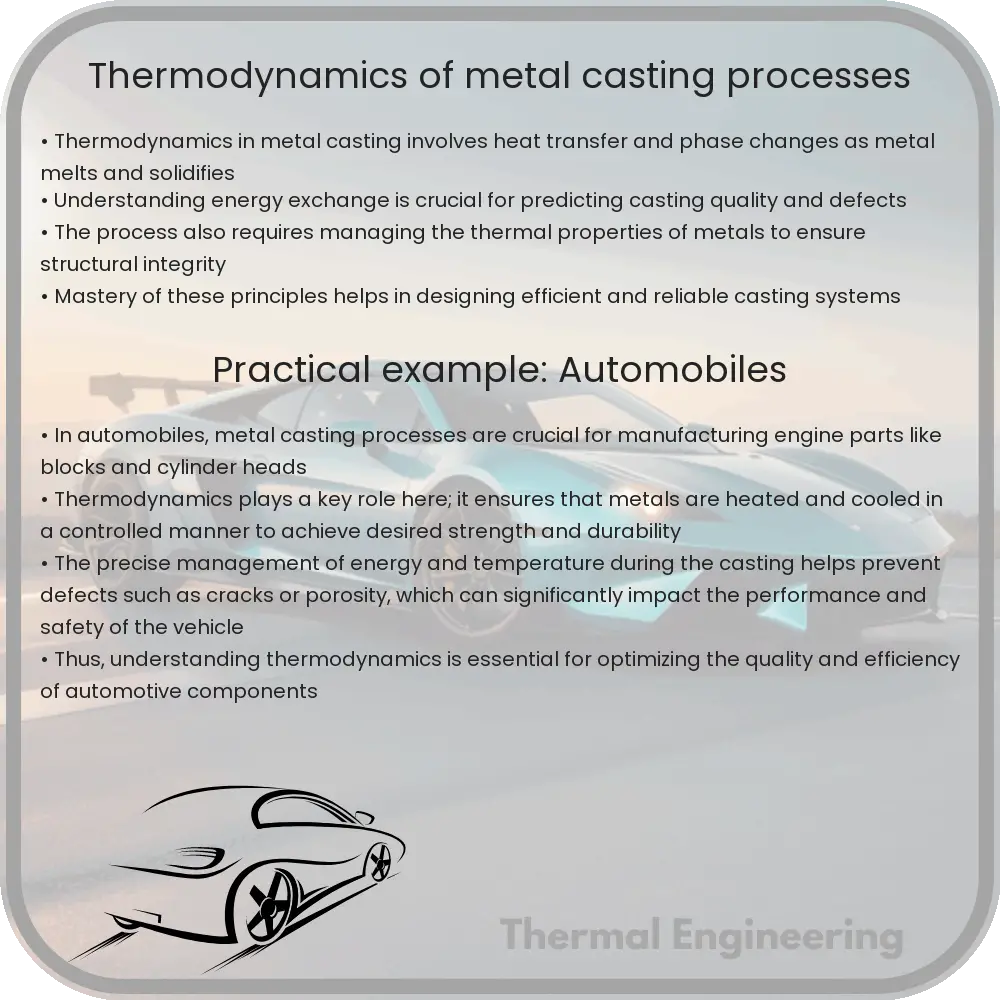
Metal casting is a foundational process in manufacturing and engineering, allowing the production of complex shapes from metals and metal alloys. At its core, the process involves melting a metal, pouring it into a mold where it solidifies into a desired shape, and then removing the cast part. The success and efficiency of casting largely depend on the exact management of heat or thermodynamics throughout the process. Here, we will explore the essential thermodynamic concepts that govern metal casting processes.

The Basics of Thermodynamics in Casting

Thermodynamics in metal casting primarily focuses on two main aspects: heat transfer and phase changes. The metal undergoes a transformation from solid to liquid and back to solid, which involves absorbing and releasing large amounts of heat energy. This cycle is critical to forming a quality casting without defects.

Heat Transfer in Metal Casting

Heat transfer in casting affects how the metal melts, flows, cools, and solidifies. We can break it down into three key mechanisms:

  • Conduction: This is the transfer of heat through a solid material. In casting, conduction is critical as it governs how heat moves from the hotter parts of a metal to its cooler areas during solidification.
  • Convection: Convection occurs in the molten metal as it is poured and as it cools in the mold. The movement of liquid metal can carry heat from one part of the mold to another, affecting the solidification rate.
  • Radiation: As the molten metal and the mold are typically at high temperatures, heat is also transferred via radiation, particularly from metal surfaces exposed to the air.

Effective management of these heat transfer processes is crucial to avoiding defects such as uneven cooling, which can lead to stresses and cracks in the final product.

Phase Changes and Latent Heat

Understanding phase changes—melting and solidification—is crucial in metal casting. These changes are associated with latent heat, which is the heat required to change the state of the metal without changing its temperature. For instance:

  • The latent heat of fusion is absorbed by the metal as it melts.
  • The latent heat of solidification is released by the metal as it solidifies.

The amount of latent heat is significant in casting because it influences the cooling time and the overall integrity of the cast. Calculating the amount of latent heat involved allows engineers to better control the cooling rates, thus minimizing defects.

Thermal Properties of Casting Metals

The specific heat capacity, thermal conductivity, and melting point are critical properties affecting how metals respond to the thermodynamic processes in casting. Metals with high thermal conductivity, such as aluminum, disperse heat quickly, affecting how they should be handled during the casting process to ensure uniform cooling and solidification.

Practical Applications and Continuous Improvement

In industrial applications, engineers use these thermodynamic principles to design efficient casting processes. This includes choosing appropriate casting materials, designing molds that facilitate uniform heat distribution and dissipation, and controlling the environment to stabilize the temperatures involved.

Advancements in computational fluid dynamics (CFD) and thermal analysis software have further enhanced the ability to predict and control the thermodynamics of casting processes. These tools allow for precise simulations of how heat will transfer through the system, enabling better mold designs and higher quality casts with fewer defects.

By mastering the thermodynamics of metal casting, engineers can significantly affect the efficiency, cost, and quality of produced parts, demonstrating just how critical these principles are in the field of manufacturing and materials engineering.

Calorimetry techniques for material characterization

Calorimetry is a precise technique used in material science to measure heat effects in material phase transitions, reactions, and physical changes.

Calorimetry techniques for material characterization

Understanding Calorimetry Techniques for Material Characterization

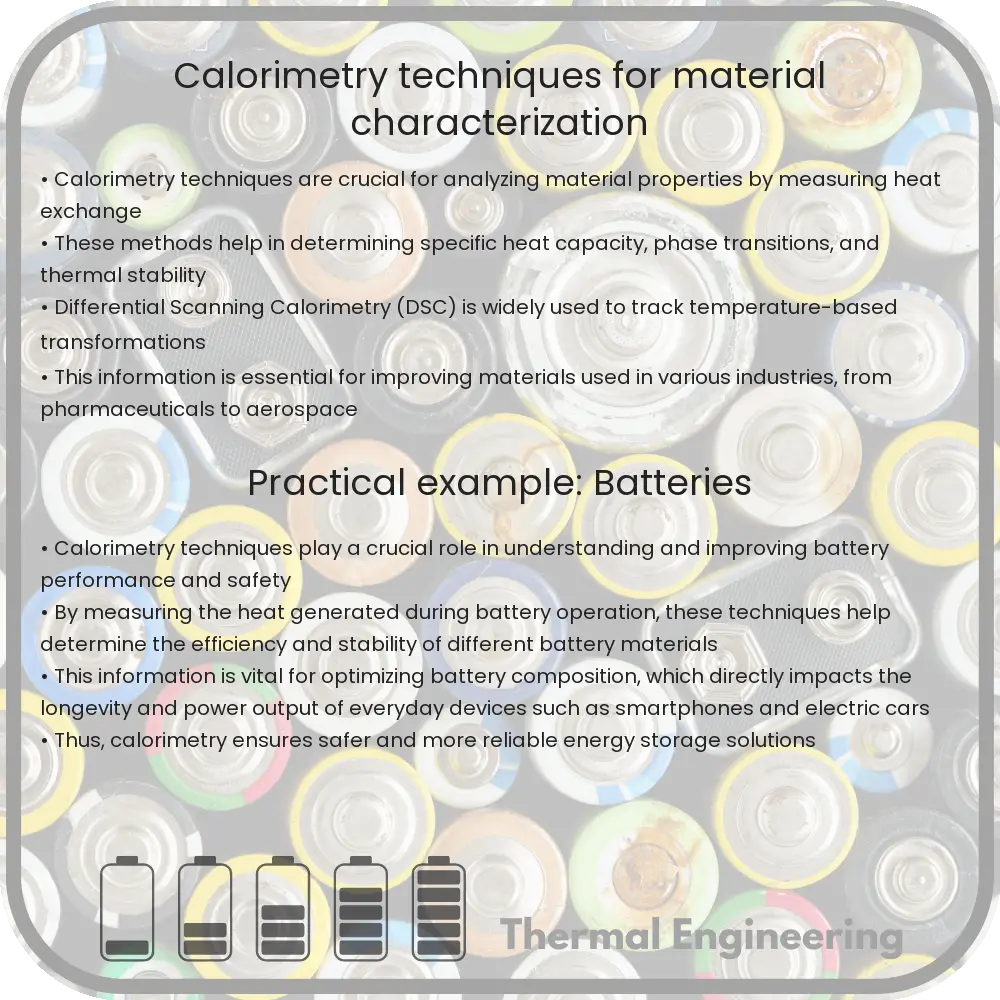
Calorimetry is a fundamental technique used in material science to measure the heat effects associated with material phase transitions, reactions, and physical changes. This method provides critical insights into material properties such as specific heat capacity, enthalpy changes, and kinetic reactions. Understanding these aspects is essential for applications ranging from manufacturing processes to energy storage and pharmaceuticals.

Basic Principles of Calorimetry

At its core, calorimetry involves measuring the amount of heat absorbed or released by a material under a controlled set of conditions. The basic equation used in calorimetry is based on the principle of conservation of energy:

Q = m * c * ΔT

where:

  • Q is the heat absorbed or released,
  • m is the mass of the material,
  • c is the specific heat capacity of the material, and
  • ΔT is the change in temperature.

Types of Calorimeters

There are several types of calorimeters, each suited to different types of analysis:

  1. Differential Scanning Calorimetry (DSC): This technique measures how much heat a sample absorbs or releases as it is heated, cooled, or held at constant temperature. It’s particularly useful for studying melting, crystallization, and other phase transitions.
  2. Isoperibol Calorimetry: Often used in reaction calorimetry, this type maintains the surrounding temperature constant while observing the heat exchange related to chemical reactions.
  3. Adiabatic Calorimetry: Common in safety testing, this type isolates the system thermally from its environment, closely monitoring the temperature changes caused by exothermic reactions without loss or gain of heat to the surroundings.
  4. Microcalorimetry: This is used for measuring very small changes in enthalpy at the microscale, essential in biochemical and pharmacological applications.

Applications of Calorimetry in Material Characterization

Calorimetry serves a broad range of applications in material science, including:

  • Evaluating Thermal Properties: By measuring specific heat and other thermal transitions, calorimetry helps in determining material stability and performance under various temperature conditions.
  • Studying Kinetic Processes: Reaction rate constants and activation energies are derived from calorimetric data, informing chemical reaction kinetics.
  • Quality Control: In industries, calorimetry ensures the consistency and quality of materials by detecting impurities and deviations in compound structure.
  • Energy Storage Materials: Characterization of batteries and supercapacitors to understand and improve energy efficiency and storage capabilities.

Challenges and Innovations in Calorimetry

Despite its wide applications, calorimetry faces challenges such as sensitivity to experimental conditions and limitations in scale. Innovations are continually being developed to enhance the precision, sensitivity, and applicability of calorimetric methods. Advances in microcalorimetry and the integration of computational methods have markedly increased the accuracy and scope of calorimetric analysis, pushing forward the boundaries in material research and development.

Calorimetry remains a pivotal technique in material characterization, providing detailed insights into material properties and behaviors that are critical for both research and industry applications.

Thermodynamics of fluidized bed reactors

Learn about the thermodynamics that drive fluidized bed reactors, key to enhancing industrial chemical processes.

Thermodynamics of fluidized bed reactors

Understanding the Thermodynamics of Fluidized Bed Reactors

Fluidized bed reactors are an essential part of many industrial processes, particularly in chemical engineering. They provide excellent heat transfer, mixing, and reaction rates, which makes them highly efficient for processes like combustion, gasification, and various chemical reactions. In this article, we’ll delve into the basic thermodynamic principles that underpin the operation of fluidized bed reactors.

Basics of Fluidized Beds

A fluidized bed reactor (FBR) is a type of reactor device that can be used to carry out a variety of multiphase chemical reactions. In this reactor, a granular solid material (usually a catalyst) is turned into a fluid-like state through the introduction of a gas or liquid upwards through the solid material. The main feature of FBRs is the presence of solid particles that are suspended in an upward-flowing stream of fluid, typically air or water, which generates a turbulent mixing of the particles and fluids.

Thermodynamic Principles in Fluidized Bed Reactors

The performance of fluidized bed reactors is heavily influenced by their thermodynamic behavior. The key aspects to consider include:

  • Heat Transfer: One of the primary advantages of fluidized beds is their enhanced heat transfer capabilities. The vigorous mixing of particles ensures uniform temperature distribution, minimizing temperature gradients within the reactor. This is crucial in exothermic reactions where hot spots can lead to deactivation of catalysts or even safety hazards.
  • Energy Balance: The energy balance in a fluidized bed reactor must account for the energy provided by the fluidizing medium, the heat released or absorbed by the reaction, heat losses to the environment, and the energy required to maintain the particles in a fluidized state. Generally, the energy balance can be expressed as:

\[ \text{Q}_{\text{in}} + \text{Q}_{\text{reaction}} = \text{Q}_{\text{out}} + \text{Q}_{\text{loss}} \]

where \( Q_{\text{in}} \) is the heat input from the fluidizing medium, \( Q_{\text{reaction}} \) is the heat generated or consumed by the chemical reaction, \( Q_{\text{out}} \) is the heat carried out by the exhaust gases, and \( Q_{\text{loss}} \) is the heat lost to the surroundings.

  • Mass Transfer: The efficiency of reactions within a fluidized bed reactor also depends on the effectiveness of mass transfer. Both mass transfer between the gas and solid phases and between the bulk phase and the surface of the catalyst particles are crucial. Poor mass transfer can lead to lower reaction rates and incomplete reactions.

Applications of Fluidized Bed Reactors

Due to their efficient heat and mass transfer properties, fluidized bed reactors are widely used in various industries. Some common applications include:

  • Chemical production, such as in the manufacture of polymers and pharmaceuticals.
  • Combustion of coal and biomass for power generation.
  • Catalytic cracking in petroleum refining.

Conclusion

Fluidized bed reactors play a pivotal role in modern industrial processes, offering significant advantages in terms of energy efficiency and reaction rates. Understanding the basic thermodynamics and operational principles of fluidized bed reactors is essential for engineers and scientists to design, operate, and optimize these reactors for various industrial applications. With ongoing research and technological advancements, the capabilities and applications of fluidized bed reactors continue to expand, providing broader opportunities for innovation in chemical engineering and related fields.