Facebook Instagram Youtube Twitter

Heat recovery ventilators

Learn about Heat Recovery Ventilators (HRVs), innovative systems enhancing indoor air quality while boosting energy efficiency in buildings.

Heat recovery ventilators

Understanding Heat Recovery Ventilators: Enhancing Energy Efficiency

Heat recovery ventilators (HRVs) are advanced air exchange systems used in modern building designs to ensure fresh air intake while maintaining energy efficiency. These devices are particularly useful in tightly sealed homes, where they play a significant role in reducing energy costs and improving indoor air quality. This article explores the function, benefits, and key considerations associated with HRVs.

How Do Heat Recovery Ventilators Work?

HRVs consist of two separate air streams—stale indoor air and fresh outdoor air—that pass through the unit without mixing. At the core of an HRV is a heat exchanger, which transfers heat from the outgoing, warmer indoor air to the incoming, cooler outdoor air during winter. In the summer, the process reverses; the cooler indoor air cools down the warmer incoming air from outside.

The basic operation of an HRV can be expressed simply as follows:

  • Extraction of indoor air: The HRV pulls warm, stale air from inside the building and passes it through the heat exchanger.
  • Outdoor air intake: Simultaneously, fresh air is drawn into the HRV from outside, absorbing heat from the warm air that is being expelled.
  • Heat exchange: Heat from the outgoing indoor air is transferred to the incoming outdoor air through the walls of the heat exchanger. This process relies on basic principles of heat conduction, where heat moves from a warmer to a cooler surface.
  • Redistribution: The pre-warmed, fresh air is distributed throughout the home, while the cooler, stale air is expelled outside.

Benefits of Using Heat Recovery Ventilators

  • Energy Savings: By recovering heat from exhaust air, HRVs significantly reduce the need for additional heating in the winter and cooling in the summer, leading to lower energy consumption and cost savings.
  • Improved Indoor Air Quality: HRVs continuously replace stale indoor air with fresh outdoor air, which helps to reduce pollutants, allergens, and excess moisture, enhancing the overall indoor air quality.
  • Reduced Condensation: By balancing indoor humidity levels, HRVs help prevent condensation and mold growth, which are common issues in tightly sealed environments.

Key Considerations When Installing HRVs

When planning to install an HRV, several factors need to be considered to maximize its efficiency and effectiveness:

  1. Size and Capacity: The size of the HRV should be appropriate for the space, which depends on the volume of air that needs to be circulated. This is typically calculated based on the size of the building and the specific needs of the inhabitants.
  2. Installation: Proper installation is critical to the performance of HRVs. They must be correctly balanced and commissioned by professionals to ensure efficient operation.
  3. Maintenance: Regular maintenance, including cleaning and replacement of filters, is crucial to keep the HRV running efficiently and to maintain good air quality.
  4. Climate Considerations: The effectiveness of an HRV depends greatly on the local climate. In areas with extreme temperatures, more advanced systems with additional features like humidity control might be required.

Heat recovery ventilators are crucial in modern sustainable building practices, offering a way to enjoy fresh air indoors without incurring high energy costs. Understanding these systems’ operation, benefits, and installation considerations can help homeowners, architects, and builders make informed decisions about integrating HRVs into their projects.

Thermodynamics of osmotic power generation

Learn about osmotic power generation, an innovative energy source that utilizes salinity gradients between seawater and river water to produce electricity through thermodynamic principles.

Thermodynamics of osmotic power generation

Understanding the Thermodynamics of Osmotic Power Generation

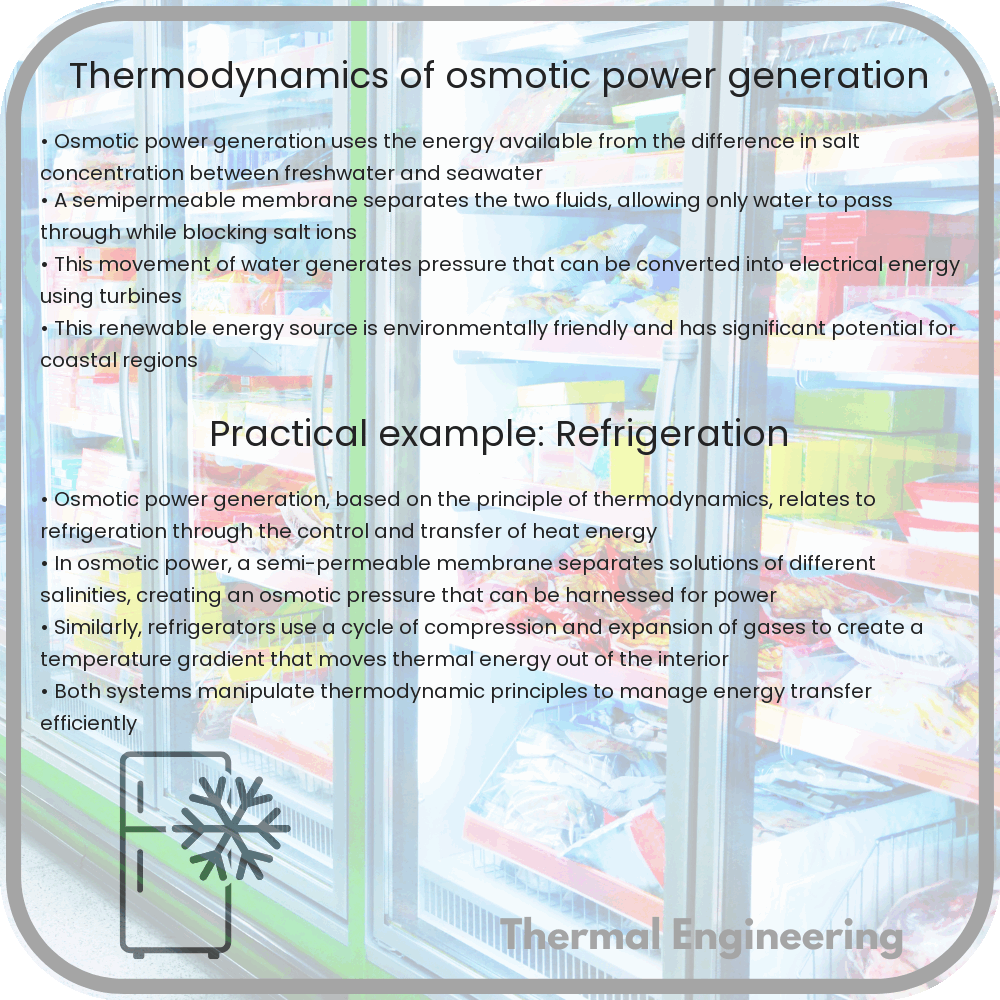
Osmotic power generation, also known as salinity gradient power or blue energy, harnesses the energy available from the difference in the salt concentration between seawater and river water. Let’s delve into the thermodynamic principles that make this innovative energy source possible.

Basic Principle of Osmotic Power

At its core, osmotic power generation revolves around the natural process where water moves from a lower concentration solution through a semipermeable membrane to a higher concentration solution, a process termed ‘osmosis.’ This movement of water generates pressure that can be converted into electrical energy.

Key Thermodynamic Concepts

  • Gibbs Free Energy: In thermodynamics, the potential to generate power from the salinity gradient is explained through Gibbs free energy. This is the energy associated with a chemical reaction that can be used to perform work. The formula for Gibbs free energy (\(\Delta G\)) in the context of mixing river water and seawater can be represented as:

\[
\Delta G = -RT \ln(\frac{K_f}{K_i})
\]

where R is the gas constant, T is the absolute temperature, \(K_f\) is the final equilibrium constant, and \(K_i\) is the initial equilibrium constant.

  • Osmotic Pressure: Osmotic pressure (\(\Pi\)) is crucial in osmotic power systems. It quantifies the pressure needed to stop the osmotic flow and can be calculated using the van’t Hoff equation, which for dilute solutions is:

\[
\Pi = iCRT
\]

where i is the van’t Hoff factor, C is the molar concentration of solute, and T is the absolute temperature.

Thermodynamic Cycle of Osmotic Power Generation

The practical application of osmotic power generation involves the use of PRO (Pressure Retarded Osmosis) or RED (Reverse Electrodialysis) systems to convert osmotic pressure into usable power.

  1. Pressure Retarded Osmosis (PRO): In PRO, sea water and fresh water are put on either side of a selective membrane. Water flows from the fresh to the saltwater side, increasing the pressure on the saltwater side. This pressurized saltwater then drives a turbine, generating electricity.
  2. Reverse Electrodialysis (RED): RED employs a series of ion-selective membranes alternating between permeability to positive ions and negative ions. As ions pass through these membranes from seawater to river water, it creates a voltage through electrochemical potential, which can drive an electric current.

Challenges and Efficiency

While osmotic power is promising, its efficiency and viability are affected by several factors:

  • Membrane Performance: The efficiency of the semipermeable membrane and its ability to withstand high pressures and prevent fouling is crucial.
  • Salt Concentration Gradient: The greater the difference in salinity between the bodies of water, the higher the potential power output.
  • Thermal Considerations: Temperature affects osmotic pressure; warmer temperatures generally increase the rate of osmosis, potentially enhancing efficiency.

In conclusion, the thermodynamics of osmotic power exploits natural salinity gradients to produce a renewable energy source. Although challenges remain in terms of efficiency and technology, ongoing improvements in membrane technology and process optimization continue to enhance its potential as a sustainable power source.

Thermal analysis in forensic engineering

Learn how thermal analysis is used in forensic engineering to investigate material failures and understand thermal histories in engineering accidents.

Thermal analysis in forensic engineering

Understanding Thermal Analysis in Forensic Engineering

Forensic engineering is the field that involves the investigation of materials, products, structures or components that fail or do not operate as intended, often causing personal injury or damage to property. One of the critical techniques used in forensic engineering to determine the causes of failures is thermal analysis. This tool can provide invaluable data about the thermal properties of materials that undergo changes due to temperature variations which could be due to a number of factors including misuse, accidents, or design flaws.

What is Thermal Analysis?

Thermal analysis refers to a branch of materials science where the properties of materials are studied as they change with temperature. Specifically, in forensic engineering, thermal analysis helps investigators understand the thermal history of a component, which can indicate whether the material was subjected to abnormal conditions such as excessive heat or cold, exposure to fire, or electrical malfunctions.

Types of Thermal Analysis Techniques

  • Differential Scanning Calorimetry (DSC): DSC measures how much heat a sample absorbs or releases as it is heated or cooled. This information helps identify specific transitions such as melting, crystallization, or phase changes which can indicate if a material has been exposed to conditions outside its design specifications.
  • Thermogravimetric Analysis (TGA): TGA measures the amount of weight change a material undergoes as it is heated or cooled. This technique can detect decomposition, oxidation, and other reactions that indicate thermal degradation.
  • Dynamic Mechanical Analysis (DMA): DMA measures changes in material properties as a function of temperature, time, and frequency. It is particularly useful for evaluating polymers and can help determine if a failure resulted from material fatigue under cyclic thermal stress.

Application of Thermal Analysis in Forensic Investigations

Thermal analysis can be crucial in determining why a material failed. For instance, if a polymer component in a machine failed leading to an accident, DMA could determine whether the failure was due to inadequate heat resistance of the polymer which might not have been aligned with its specified operational temperature range. Similarly, in the case of a structural fire, DSC can reveal whether the materials used were not compatible with the fire safety requirements, thus contributing to the spread of the fire.

Case Studies

  1. In an investigation of an electronic device fire, TGA was used to determine that the polymer casing had undergone significant thermal degradation at temperatures lower than the specified threshold for the material. This indicated a potential flaw in the material selection or manufacturing process.
  2. A building collapse investigation utilized thermal analysis to reveal that the metallic structure had not been treated for thermal expansion and contraction, which weakened the integrity of the building’s framework over time as it was exposed to seasonal temperature variations.

Thermal analysis provides forensic engineers with a deeper insight into the materials involved in failures, allowing them to piece together the sequence of events leading up to an incident. This crucial analysis supports not only the determination of causality in legal cases but also helps in formulating guidelines for safer material practices and preventive measures in engineering design.

Entropy production in turbulent flows

Learn about entropy production in turbulent flows, a crucial concept in thermodynamics and fluid dynamics, and its impact on engineering systems.

Entropy production in turbulent flows

Understanding Entropy Production in Turbulent Flows

In the realm of thermodynamics and fluid dynamics, entropy is a fundamental concept, often described as the measure of disorder or randomness in a system. The production of entropy in turbulent flows is a critical area of study, particularly because of its implications in energy systems, environmental science, and engineering processes. This article aims to explain the basics of entropy production in turbulent flows, making it accessible and interesting for beginners and those passionate about engineering.

What is Entropy?

Entropy is a thermodynamic quantity that represents the unavailability of a system’s thermal energy for conversion into mechanical work, often interpreted as the degree of disorder or randomness in the system. The second law of thermodynamics states that in an isolated system, entropy tends to increase over time, meaning that systems naturally progress towards a state of maximum disorder.

Basics of Turbulent Flow

Turbulent flow is a type of fluid (gas or liquid) motion characterized by chaotic changes in pressure and flow velocity. It is in contrast to a laminar flow, which occurs when a fluid flows in parallel layers, with no disruption between the layers. One common example of turbulent flow is cigarette smoke in a still environment, which initially rises in a straight line (laminar flow) before dispersing in many directions (turbulence).

Entropy Production in Turbulent Flows

Entropy production in turbulent flows is intricately linked to the disorder and mixing inherent in turbulence. Turbulence enhances the rate of mixing and momentum transfer in fluids, which in turn affects how entropy is generated. The key parameters that influence entropy production in turbulent flows include:

  • Viscosity: In fluid dynamics, viscosity is the measure of a fluid’s resistance to deformation at a given rate. In turbulent flows, the viscous dissipation (the process by which kinetic energy is converted to thermal energy) is a primary contributor to entropy production.
  • Thermal Conductivity: The capability of a material to conduct heat influences the rate of entropy production. In turbulence, the effective thermal conductivity is increased due to the chaotic mixing, leading to enhanced heat transfer and entropy generation.
  • Compressibility: For gases, compressibility (the ability to reduce in volume under pressure) affects the nature of turbulence and subsequently the entropy generation, especially under high-speed flow conditions like those found in jet engines or supersonic flight.

Mathematical Representation of Entropy Production

Entropy production in turbulent flows can be quantitatively described by the following equation:

\(\dot{S} = \int (\frac{\phi}{T}) dV\)

where:

  • \(\dot{S}\) is the rate of entropy production,
  • \(\phi\) represents the dissipation function, which includes effects due to viscosity and thermal conductivity,
  • \(T\) is the absolute temperature,
  • \(dV\) is the differential volume element over which the integration is performed.

The dissipation function, \(\phi\), is notably affected by the turbulence and can be expressed as a function of turbulent velocity fluctuations and gradients in mean flow properties. This function acts as a sink term in the energy equation of a turbulent flow, converting mechanical energy into thermal energy, thereby increasing entropy.

Implications of Entropy Production in Turbulent Flows

Understanding entropy production in turbulent flows has significant implications in various engineering applications. For instance, in the design of efficient combustion systems, minimizing unnecessary entropy production can lead to better energy efficiency and reduced environmental impact. Similarly, in aerodynamics, controlling the turbulence-induced entropy can improve the aerodynamic efficiency and performance of aircraft.

In conclusion, entropy production in turbulent flows is a complex but fundamental aspect of thermodynamics and fluid dynamics, playing a key role in the efficiency and environmental impact of many fluid-related processes and systems. For engineers and scientists, grasping these concepts is essential for optimizing designs and improving the overall effectiveness of technology in our daily lives.

Exergy recovery in power systems

Learn about exergy recovery, a technique in power systems that enhances efficiency by reusing wasted energy, usually as heat.

Exergy recovery in power systems

Understanding Exergy Recovery in Power Systems

Exergy recovery is a critical concept in the engineering of more efficient power systems. It involves capturing and reusing the ‘useful’ portion of energy that would otherwise be wasted, usually as heat. By focusing on the principles of thermodynamics, particularly the second law, this concept plays a pivotal role in enhancing the efficiency and sustainability of various power generation systems.

What is Exergy?

Before delving into exergy recovery, it is essential to understand what exergy means. In thermodynamics, exergy is the measure of the maximum useful work possible during a process that brings the system into equilibrium with a heat reservoir. Unlike total energy, which is conserved, exergy is a value that can be destroyed, particularly through irreversibilities like friction or uncontrolled heat transfer.

Exergy Recovery in Power Systems

In power systems, exergy recovery techniques are employed to capitalize on the energy that is not converted to work and is usually lost to the surroundings. These techniques are often utilized in thermal power plants, heat engines, and refrigeration cycles. Some common methods include:

  • Regenerative cycles
  • Combined heat and power (CHP) systems
  • Heat recovery steam generators (HRSG)

Each method involves redirecting and reusing energy from exhaust gases, waste steam, or even ambient heat to improve overall system efficiency.

Benefits of Exergy Recovery

Implementing exergy recovery in power systems offers multiple advantages:

  1. Increase in overall system efficiency: By capturing and reusing waste heat, power systems can achieve higher thermal efficiency.
  2. Reduction in fuel consumption: Efficient exergy recovery directly translates to less fuel needed to produce the same amount of power, thereby conserving natural resources.
  3. Decrease in greenhouse gas emissions: Improved efficiency leads to lower emissions per unit of power produced, contributing to environmental protection.

Examples of Exergy Recovery Implementations

To contextualize the concept, here are typical applications of exergy recovery:

  • Regenerative Braking in Electric Vehicles: Converts kinetic energy from braking into electrical energy, which is then stored in the vehicle’s battery.
  • Industrial Waste Heat Recovery: Uses heat exchangers to capture excess heat from industrial processes for use in facility heating or additional power generation.
  • Gas Turbine Power Plants: Incorporates HRSGs to utilize the heat from exhaust gases to produce steam, driving additional turbine generators.

Challenges in Exergy Recovery

Despite its benefits, exergy recovery faces several challenges:

  • Technical complexity and initial cost: The design and integration of exergy recovery systems bring additional engineering challenges and upfront investments.
  • System reliability and maintenance: Additional components like heat exchangers and turbines require maintenance, which could affect system reliability.
  • Scale and context-specific applications: Not all power systems can equally benefit from exergy recovery. The effectiveness depends on factors like system size and local environmental conditions.

In conclusion, while exergy recovery introduces certain complexities, its potential to enhance energy efficiency and reduce environmental impact makes it a valuable concept in power system design and operation. As technology progresses, the implementation of more advanced and cost-effective exergy recovery systems is likely to expand, supporting global efforts towards more sustainable energy solutions.

Thermodynamic properties of biodegradable materials

Explore the crucial role of thermodynamic properties in optimizing biodegradable materials for environmental sustainability and various industrial applications.

Thermodynamic properties of biodegradable materials

Understanding the Thermodynamic Properties of Biodegradable Materials

Biodegradable materials are gaining attention due to their potential to reduce waste and minimize environmental impact. To fully leverage these materials, understanding their thermodynamic properties is essential. This knowledge assists in evaluating their stability, degradation kinetics, and energy interactions, crucial for various applications, including packaging, agricultural films, and biomedical devices.

Key Thermodynamic Properties

When examining biodegradable materials, several thermodynamic properties are particularly important:

  • Heat Capacity (Cp): This is the amount of heat required to raise the temperature of a material by one degree Celsius. Heat capacity influences the thermal processing and cooling rates of biodegradable materials.
  • Thermal Conductivity (k): Thermal conductivity indicates how well a material conducts heat. This property is vital for understanding how biodegradable materials respond to temperature changes during processing and use.
  • Gibbs Free Energy (G): Gibbs free energy is crucial for predicting the spontaneity of degradation reactions in biodegradable materials. A negative ΔG indicates that the degradation process is spontaneous under specific conditions.
  • Entropy (S): Entropy measures the disorder or randomness in a system. Changes in entropy during the degradation of biodegradable materials can provide insights into the environmental conditions affecting their stability.
  • Enthalpy (H): Enthalpy changes, represented as ΔH, relate to the heat absorbed or released during the degradation of biodegradable materials. This is critical for understanding their energy profiles during decomposition.

Thermodynamic Analysis Techniques

To measure and analyze these properties, several techniques are commonly used:

  • Differential Scanning Calorimetry (DSC): DSC measures the heat flow associated with transitions in materials as a function of temperature and time. This method is excellent for measuring melting points, crystallization, and thermal stability.
  • Thermogravimetric Analysis (TGA): TGA assesses the weight changes of a material as it is heated. This technique helps in determining the thermal decomposition temperatures and the composition of biodegradable materials.
  • Dynamic Mechanical Analysis (DMA): DMA determines the mechanical properties of materials as they are deformed under stress, temperature, and frequency. For biodegradable materials, DMA provides insights into their viscoelastic properties.

Real-World Applications

The knowledge of thermodynamic properties is not just academic but has practical implications in several fields:

  • Packaging Industry: Optimizing the thermal properties of biodegradable packaging can improve its performance under varying storage and transport conditions.
  • Agriculture: Biodegradable films used in agriculture can be designed to degrade at controlled rates, matching the crop cycle, based on their thermodynamic properties.
  • Medical Sector: In biomedical engineering, understanding the thermal behavior of biodegradable materials can aid in developing more effective biodegradable implants and devices.

As the demand for sustainable materials continues to grow, the role of thermodynamics in understanding and improving biodegradable materials becomes increasingly important. Through careful study and application of these properties, engineers and scientists can better design materials that are not only environmentally friendly but also economically and functionally viable.

Conclusion

The study of thermodynamic properties provides critical insights into the performance and lifecycle of biodegradable materials. By leveraging modern analytical techniques, researchers and engineers can push the boundaries of how these materials are used, paving the way for a more sustainable future.

As the field advances, the integration of thermodynamic data with environmental science and materials engineering promises even greater innovations in the development and application of biodegradable materials.

Efficiency analysis of solar water heaters

This article explores the efficiency of solar water heaters, analyzing components, performance factors, and metrics that influence their effectiveness.

Efficiency analysis of solar water heaters

Efficiency Analysis of Solar Water Heaters

Solar water heaters (SWHs) harness the power of the sun to provide hot water in a clean, effective, and sustainable way. This article examines the efficiency of solar water heaters, including the factors affecting their performance and how they are evaluated.

Understanding the Components and Operation

Solar water heaters typically consist of solar collectors, a fluid system to move the heat from the collector to its point of usage, and a reservoir to store the hot water. The efficiency of a solar water heater is determined by how well these components work together to convert sunlight into usable heat and transfer this heat into the water with minimal losses.

Key Factors Influencing Efficiency

  • Solar Collector Efficiency: This is largely dictated by the design and materials of the collector. Flat-plate collectors and evacuated tube collectors are the most common types, with evacuated tubes generally being more efficient in colder climates.
  • Insulation Quality: Proper insulation of the storage tanks and pipes minimizes heat loss, crucial for maintaining high thermal efficiency, especially during colder months.
  • Ambient Temperature: Solar water heaters tend to perform better in warmer climates due to lower thermal losses.
  • Installation Angle and Orientation: Optimal positioning of the solar collector towards the sun directly affects the amount of solar energy received and, consequently, the system’s efficiency.

Measuring the Efficiency of Solar Water Heaters

The efficiency of solar water heaters is typically evaluated using two primary metrics: the optical efficiency (η₀) and the overall heat loss coefficient (UL). The solar collector efficiency can be modeled by:

\[
\eta = \eta₀ * (1 – U{_L}\frac{(T{_m} – T{_a})}{G})
\]

Where:

  • \( \eta \) – Collector Efficiency
  • \( \eta₀ \) – Optical Efficiency, representing the effectiveness of the collector at intercepting solar radiation
  • \( U{_L} \) – Overall Heat Loss Coefficient, indicative of the rate of heat loss from the collector to the environment
  • \( T{_m} \) – Mean Temperature of the Collector’s Fluid
  • \( T{_a} \) – Ambient Air Temperature
  • \( G \) – Solar Irradiance, the amount of solar energy striking the collector per unit area

The optical efficiency depends on the kind of collector and the cleanliness of its surface, while the heat loss coefficient is influenced by insulation effectiveness and environmental factors.

Improving Efficiency

Improvements in the efficiency of solar water heaters can be achieved through several approaches:

  • Using advanced materials that have better thermophysical properties to enhance the collector’s heat absorption and reduce losses.
  • Improving insulation of tanks and pipelines to reduce thermal losses.
  • Optimizing installation by ensuring the collector faces the sun at an optimal angle, maximizing exposure to solar radiation throughout the year.

By understanding and optimizing these factors, the efficiency of solar water heaters can be significantly enhanced, leading to more sustainable and cost-effective hot water solutions.

Conclusion

Efficiency analysis of solar water heaters helps users and engineers alike to understand the potential and limitations of this sustainable technology. Continual improvements and innovations in system design, materials, and installation practices are crucial for broader adoption and optimal performance of solar water heaters in diverse climates and settings.

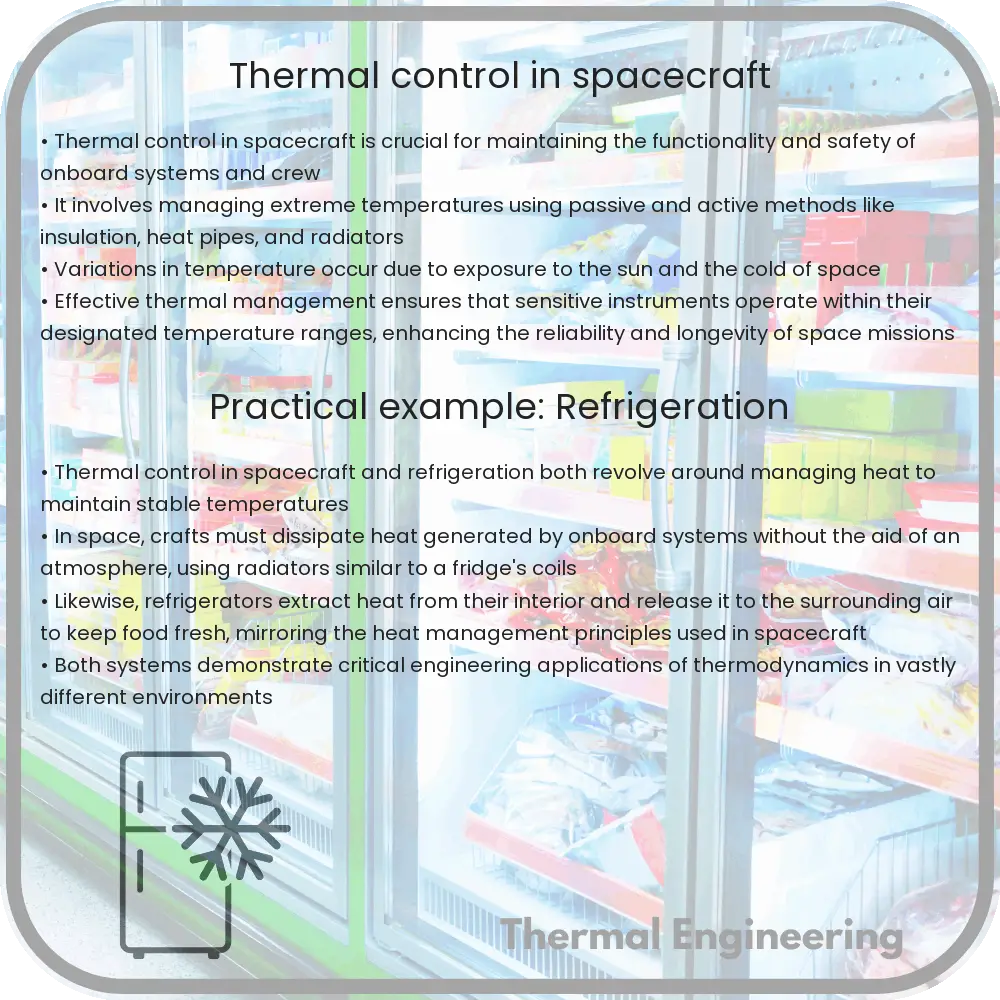
Thermal control in spacecraft

Learn how thermal control systems maintain spacecraft functionality in extreme space conditions, focusing on temperature regulation.

Thermal control in spacecraft

Understanding Thermal Control in Spacecraft

Thermal control is a critical aspect of spacecraft engineering, ensuring that all components operate within their acceptable temperature ranges throughout the mission. The unique environment of space poses significant challenges, primarily due to the extreme temperatures and the vacuum, meaning heat can only be transferred by radiation.

Why is Thermal Control Necessary?

In space, the absence of atmospheric air means that the usual methods of heat transfer—convection and conduction—are mostly ineffective. The only way to regulate temperature is through radiation. Spacecraft components can face intense sunlight, leading to high temperatures, or be in the Earth’s or another celestial body’s shadow, leading to extreme cold. Both conditions can be harmful to the electronics and structural materials used in spacecraft, which typically have specific operating temperature ranges.

Components of a Thermal Control System

  • Insulation: Materials such as Multi-Layer Insulation (MLI) blankets help protect the spacecraft from extreme temperatures. These layers reflect solar radiation away and prevent heat loss when in shadow.
  • Radiators: These are vital for dissipating heat accumulated in the spacecraft. They are designed to radiate heat efficiently into space.
  • Heat Pipes: Used for transferring heat from hotter parts of the spacecraft to the radiators, where it can be expelled.
  • Thermal Coatings: Special reflective or absorptive coatings on the spacecraft’s exterior can help manage the absorption and emission of thermal radiation.
  • Heaters: When the spacecraft is in the shadow of a planet or during other cold conditions, heaters help maintain a minimum operational temperature.

Methods of Heat Transfer in Spacecraft

  1. Passive Thermal Control: This method involves using physical properties of materials (like reflectivity and emissivity), insulations, and coatings to manage temperatures without moving parts or additional energy sources.
  2. Active Thermal Control: This system may include components like pumps, heaters, and thermoelectric coolers that require power to run but offer more precise temperature control.

Calculating Heat Transfer

The basic equation used to estimate the heat transfer by radiation in spacecraft is given by the Stefan-Boltzmann law:

Q = e * σ * A * (T4 – Ts4)

  • Q is the heat transfer rate in watts (W).
  • e represents the emissivity of the material (dimensionless).
  • σ is the Stefan-Boltzmann constant (5.67 x 10⁻⁸ W/m2K4).
  • A is the surface area in square meters (m2).
  • T is the absolute temperature of the spacecraft’s surface in Kelvin (K).
  • Ts is the surroundings’ absolute temperature in Kelvin (K).

Challenges and Solutions

One of the main challenges in spacecraft thermal control is the fluctuating conditions as a spacecraft passes from sunlight to shadow. Addressing these involves not just the placement and materials of thermal control systems, but also careful planning in the spacecraft’s orbit and orientation adjustments.

Advanced computation models and simulations play critical roles in designing and testing thermal control systems before they are implemented. Ensuring these systems work efficiently can lead to longer mission lifetimes and more reliable spacecraft performance, crucial for the success of any space mission.

In conclusion, thermal control systems are indispensable in spacecraft engineering, maintaining the integrity and functionality of spacecraft under the harsh conditions of space. By using a combination of materials science, mechanical engineering, and sophisticated control strategies, engineers can effectively manage the thermal environment of a spacecraft to ensure successful missions.

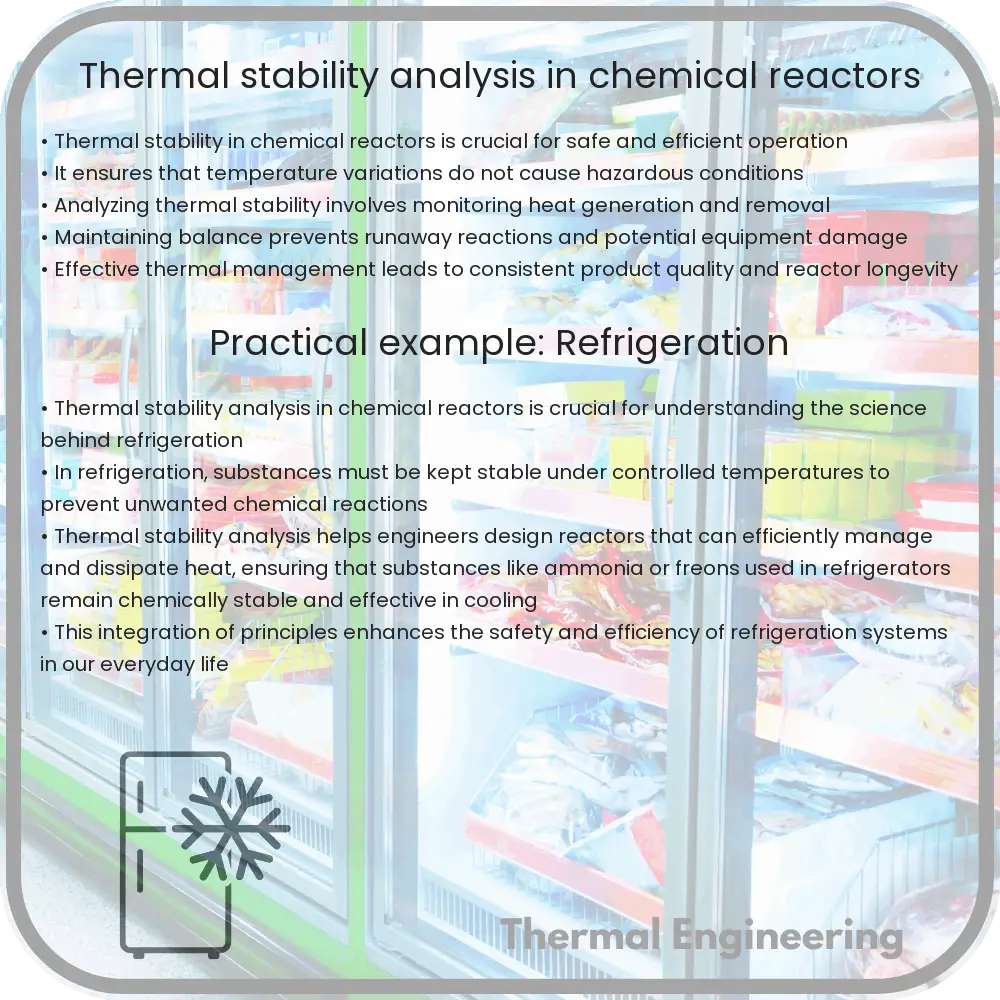
Thermal stability analysis in chemical reactors

Uncover the essentials of thermal stability analysis in chemical reactors, ensuring safe and efficient chemical processing.

Thermal stability analysis in chemical reactors

Understanding Thermal Stability Analysis in Chemical Reactors

Thermal stability analysis in chemical reactors is a critical aspect of the design and operation of chemical processes. This analysis ensures that a chemical reactor operates safely and efficiently under various thermal conditions. Let’s explore what thermal stability means in this context and how it is analyzed.

What is Thermal Stability?

Thermal stability in chemical reactors refers to the ability of the reactor to withstand different operating temperatures without undergoing unsafe conditions such as thermal runaway or unintended reactions. Thermal stability is important for both the safety and the functional efficiency of the reactor.

Importance of Thermal Stability Analysis

Performing thermal stability analysis helps to:

  • Prevent accidents caused by excessive heat generation.
  • Ensure that the reactor can handle the exothermic or endothermic reactions under various conditions.
  • Optimize the reaction conditions to achieve the desired yield.
  • Extend the life of the reactor by avoiding conditions that may cause damage to its structure.

Methods of Thermal Stability Analysis

There are several methods used to analyze thermal stability in reactors, including:

  • Adiabatic Reaction Calorimetry: This method determines how the temperature and pressure in a reactor change when the reaction proceeds without heat loss to the surroundings.
  • Dynamic Scanning Calorimetry: Also known as DSC, this technique measures how much energy is absorbed or released by a sample as it is heated, cooled, or held at constant temperature.
  • Thermal Gravimetric Analysis (TGA): TGA measures changes in the mass of a sample as it is heated, which can help in understanding decomposition or other reactions influenced by temperature.

Mathematical Approaches

In addition to experimental methods, mathematical modeling plays a crucial role in thermal stability analysis. The basic equation used to describe the heat balance in a reactor is expressed as:

Qgenerated = Qremoved + ∆U

Where:

  • Qgenerated is the heat generated by the reaction.
  • Qremoved is the heat removed through reactor walls or cooling systems.
  • ∆U is the change in internal energy of the system.

The stability analysis often involves setting up differential equations based on heat and mass balances and solving them under different scenarios. Tools like MATLAB or ANSYS can be used for simulations that predict the behavior of the reactor under different conditions.

Case Studies and Real-World Applications

Real-world application of thermal stability analysis can be found in industries such as pharmaceuticals, petrochemicals, and polymer manufacturing. For example, in polymerization reactors, thermal stability analysis is crucial as the reaction is highly exothermic and needs precise control to prevent hazardous conditions.

Similarly, in the petroleum industry, the analysis helps in designing reactors that can handle the high temperatures and pressures needed for processes like fluid catalytic cracking.

Conclusion

Thermal stability analysis is essential for the safe and efficient operation of chemical reactors. It combines experimental techniques with mathematical modeling to ensure that reactors operate within safe thermal limits. By understanding and implementing thermal stability analysis, engineers can optimize chemical processes, enhance safety, and prevent costly failures.

Thermodynamics in laser material processing

Explore how thermodynamics is essential to optimizing laser material processing for various industrial applications.

Thermodynamics in laser material processing

Understanding Thermodynamics in Laser Material Processing

Laser material processing is an innovative engineering technique used in various industrial applications such as cutting, welding, engraving, and additive manufacturing. One of the fundamental scientific principles underlying this technology is thermodynamics—the study of heat and energy transformations. Thermodynamics plays a crucial role in optimizing these processes for efficiency and quality.

Basics of Thermodynamics in Lasers

The core concept in thermodynamics relevant to laser material processing is the conversion of laser energy into heat upon interacting with a material. When a laser beam hits a surface, part of its energy is absorbed and converted into heat, causing changes such as melting, vaporization, or chemical transformation in the target material.

There are three primary modes of heat transmission involved:

  • Conduction: Transfer of heat through the material.
  • Convection: Heat transfer through a fluid medium such as air or gas which might be used to eject molten material from the cut path.
  • Radiation: Loss of heat through electromagnetic waves.

Key Thermodynamic Equations

Understanding some basic equations can help in predicting the behavior of materials during laser processing. One essential formula is the heat equation, given by:

Q = mc∆T, where:

  • Q is the heat energy absorbed (joules)
  • m is the mass of the material (kilograms)
  • c is the specific heat capacity (J/kg*K)
  • ∆T is the change in temperature (Kelvin)

Another fundamental principle is the rate of heat conduction, described by Fourier’s law:

Q/t = kA(∆T/d), where:

  • Q/t is the rate of heat transfer (W)
  • k is the thermal conductivity of the material (W/m*K)
  • A is the area through which heat is transferred (m2)
  • ∆T is the temperature difference (K)
  • d is the thickness of the material (m)

Thermal Efficiency in Laser Processing

Thermal efficiency is a significant consideration in laser material processing. It depends largely on the material’s properties and the laser’s parameters such as wavelength, power, and pulse duration. Efficient heat management ensures high-quality processing by reducing thermal damage to the material.

Engineers optimize these parameters to achieve a balance between efficiency and efficacy. In practice, this might mean adjusting the laser’s power and focus or altering the surroundings to manage the heat dissipation effectively.

Applications and Implications

Laser processing is widely used in manufacturing industries for tasks like cutting metal sheets, welding automotive parts, and creating intricate patterns on various materials. With an understanding of thermodynamics, engineers can better manipulate laser parameters to suit specific material characteristics and desired outcomes.

Advancements in thermodynamic models and computational methods continue to enhance the precision and capabilities of laser material processing, pushing the bounds of what can be manufactured while ensuring sustainable and energy-efficient practices.

Conclusion

Thermodynamics provides a fundamental framework that helps in understanding and improving laser material processing. By studying heat and energy transformations, engineers can fine-tune lasers to achieve more precise and efficient results, which is crucial for innovation and improvement in manufacturing technologies.