Facebook Instagram Youtube Twitter

Thermal efficiency of cogeneration systems

Learn about the thermal efficiency of cogeneration systems, which utilize both electricity and heat to enhance energy efficiency and reduce emissions.
Thermal efficiency of cogeneration systems

Understanding the Thermal Efficiency of Cogeneration Systems

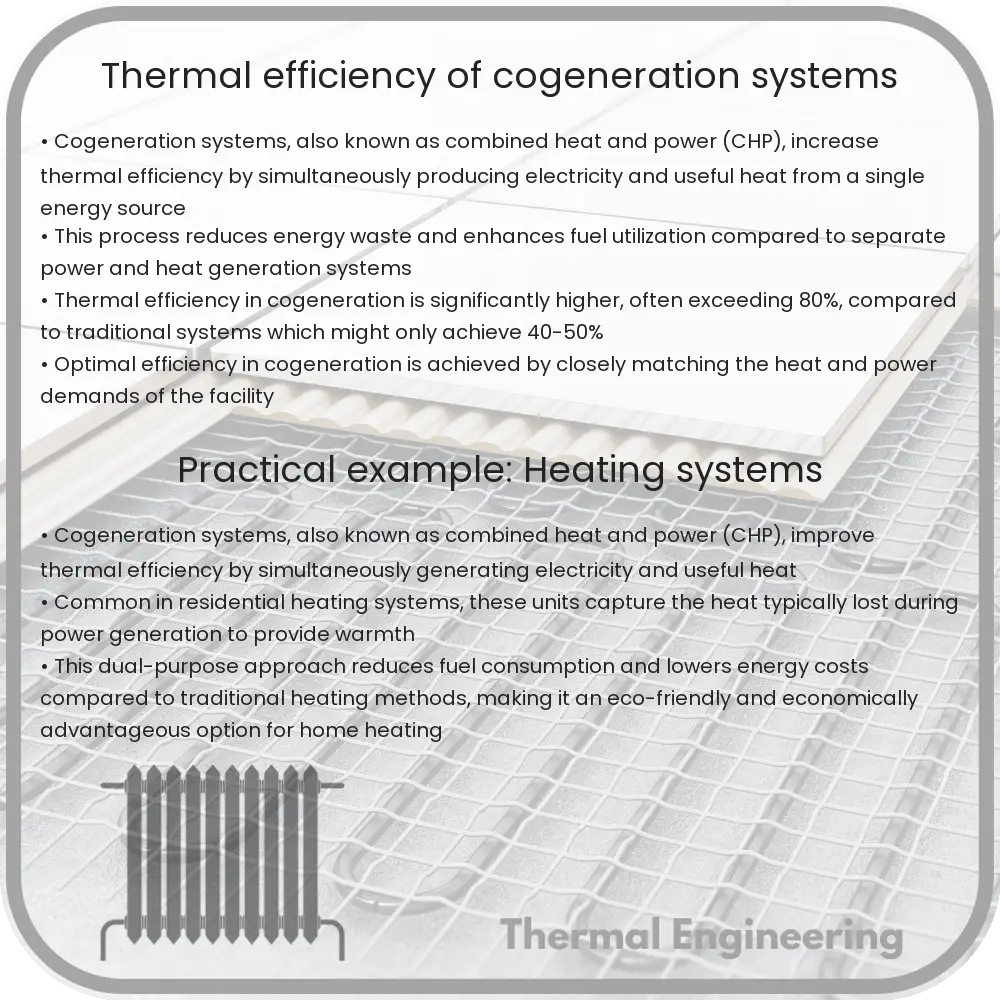
Cogeneration, also known as combined heat and power (CHP), is a highly efficient process that simultaneously generates both electricity and useful heating from the same energy source. This contrasts with traditional methods of electricity generation, where vast amounts of heat are wasted. By capturing and utilizing this heat, cogeneration systems achieve higher thermal efficiencies, significantly reducing energy usage and greenhouse gas emissions.

Basics of Cogeneration

The core of a cogeneration system consists of a prime mover, such as a gas turbine, steam turbine, or internal combustion engine. This prime mover drives an electricity generator and simultaneously produces heat that is collected and used instead of being released into the environment. The synergistic use of electricity and heat boosts the system’s overall efficiency.

Calculating the Thermal Efficiency of Cogeneration Systems

The thermal efficiency of a cogeneration system is calculated by the formula:

\[
\text{Thermal Efficiency} (\%) = \left( \frac{\text{Useful Energy Output}}{\text{Total Energy Input}} \right) \times 100
\]

Where:

  • Useful Energy Output is the sum of the electrical and thermal energy produced.
  • Total Energy Input is the total energy supplied to the system, typically in the form of fuel.

Importantly, the efficiency of cogeneration systems can exceed 80%, significantly higher than the efficiencies of separate heat and power systems, which might only be around 50% efficient when considered individually.

Factors Influencing Thermal Efficiency

Several factors can affect the thermal efficiency of cogeneration systems:

  • Type of Prime Mover: Different technologies, like steam turbines and gas turbines, have varying efficiencies.
  • Quality of Fuel: The type and quality of fuel used can influence the system’s efficiency. Natural gas, for instance, typically results in higher efficiency levels compared to coal.
  • System Configuration: The design and integration of the cogeneration system also play critical roles in determining efficiency.

Applications and Benefits

Cogeneration systems are ideally suited for applications where there is a steady demand for both electricity and heat. Common examples include industrial sites, hospitals, and university campuses. The benefits of these systems, aside from their high efficiency, include reduced energy costs and lower emissions of pollutants and greenhouse gases.

Conclusion

Thermal efficiency is a crucial metric for assessing cogeneration systems, highlighting their advantage over traditional power generation methods. By understanding and improving these systems, industries can make substantial gains in energy efficiency, cost savings, and environmental protection. As the world moves towards more sustainable energy solutions, the role of cogeneration systems is likely to expand, underscoring the importance of optimizing their performance and deployment.
Entropy analysis in environmental systems

Explore the concept of entropy in environmental systems, analyzing its role in sustainability, energy efficiency, and resource management.

Entropy analysis in environmental systems

Understanding Entropy Analysis in Environmental Systems

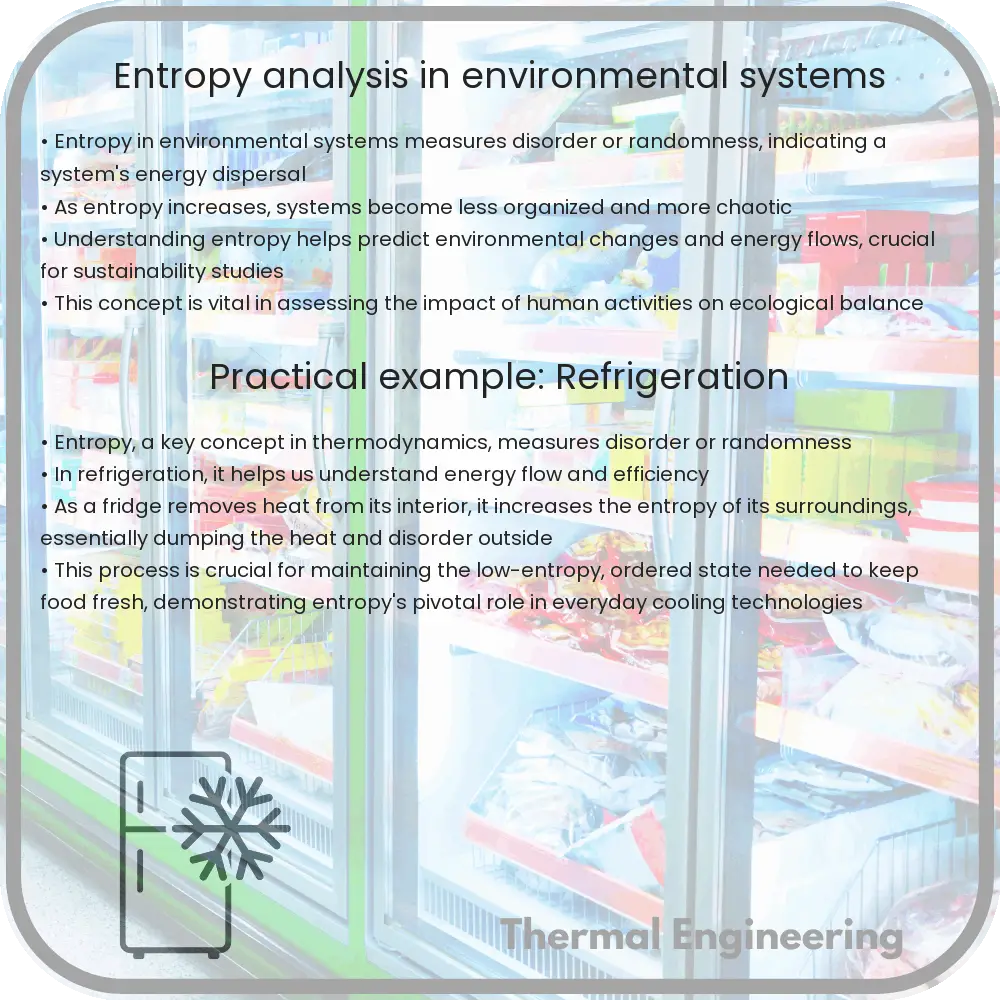
Entropy, a fundamental concept in thermodynamics, is often associated with the measure of disorder, randomness, or uncertainty in a system. The application of entropy analysis to environmental systems provides a powerful lens to understand complex ecological interactions and the impact of human activities on natural order and resource distribution. This article dives into how entropy analysis helps assess the sustainability and efficiency of environmental systems.

What is Entropy?

Entropy is a thermodynamic quantity originally used to conceptualize the inefficiencies within a heat engine. The second law of thermodynamics states that in any closed system, the entropy of the system will either remain constant or increase over time; it never decreases. In simple terms, this law suggests that energy systems tend to move toward a more disordered state if no energy is input to organize the system.

Entropy in Environmental Systems

In environmental science, entropy can be applied to analyze ecological balance, energy flow, and resource depletion. Systems with lower entropy are more ordered and generally more sustainable. Conversely, high entropy in an environmental context often signals overconsumption of resources and a move towards disorder and instability.

  • Energy Analysis: Entropy helps quantify the quality and usability of different forms of energy in an ecosystem. For example, high-quality energy like electricity has low entropy, while heat, often a byproduct of industrial processes, has high entropy and lower utility.
  • Pollution and Waste Management: Entropy analysis helps measure the impact of pollutants and waste on the environment, illustrating how these factors contribute to increasing the overall entropy of the system—indicating degradation and inefficiency.

Entropy and Sustainability

Understanding the entropy changes caused by various economic and industrial activities allows us to gauge their sustainability. Processes that increase entropy (i.e., cause more disorder or waste) are less sustainable over the long term. Conversely, practices that manage to keep entropy low are typically more sustainable, preserving order and energy quality in the environment.

Quantitative Measures of Entropy

Entropy can be quantified using different metrics depending on the specifics of the system. One common approach is through the entropy production in a system, which is indicative of irreversible processes leading to dissipative losses. The equation for entropy change (∆S) is given by:

∆S = Sfinal – Sinitial

where Sfinal is the entropy at the final state, and Sinitial is the entropy at the initial state. More specifically, the entropy of a system increases as the following occurs:

  1. The transfer of heat in an irreversible manner,
  2. Chemical reactions leading to increased randomness,
  3. Physical dispersal of materials, like pollutants or dissolved substances in a water body.

Real-World Applications of Entropy Analysis

From designing more efficient engines that minimize entropy production to creating waste management systems that better organize disposal and recycling, entropy analysis serves a practical purpose in engineering and environmental planning. Additionally, it plays a critical role in the assessment of renewable energy systems where minimizing entropy production is synonymous with maximizing efficiency and sustainability.

Conclusion

Entropy analysis provides a critical framework for understanding and enhancing the efficiency and sustainability of environmental systems. By assessing how activities and technologies influence entropy, we can make informed decisions to preserve natural order and decrease environmental impact. Thus, embracing entropy analysis in environmental strategies is not only about embracing a scientific concept but also about fostering a sustainable future.

Thermodynamics of phase transitions in alloys

Explore the critical role of thermodynamics in understanding phase transitions in alloys, focusing on energy, entropy, and phase stability.

Thermodynamics of phase transitions in alloys

Understanding the Thermodynamics of Phase Transitions in Alloys

The study of phase transitions in alloys is a fundamental aspect of materials science and engineering, offering insights into the behavior of mixtures of different metals or metalloids as they change from one phase to another. Thermodynamics plays a critical role in understanding how these transitions occur, influencing properties such as strength, malleability, conductivity, and durability of the resultant materials.

Basics of Thermodynamics in Phase Transitions

To begin with, an understanding of the basic concepts of thermodynamics is necessary. Thermodynamics in the context of phase transitions often involves the first and second laws of thermodynamics, which describe how energy transfers and transforms within a system, and how entropy, a measure of disorder or randomness, changes during these processes.

Key Thermodynamic Terms and Equations

Several key terms and equations are crucial for understanding phase transitions in alloys:

  • Gibbs free energy (G): This is the most critical parameter in predicting phase stability. It is defined as G = H – TS, where H is the enthalpy, T is the temperature, and S is the entropy of the system. The phase with the lowest Gibbs free energy under any given set of conditions is the most stable.
  • Phase diagrams: These are graphical representations that show the stability of phases at various temperatures and compositions. They are derived using the Gibbs free energy concept.
  • Entropy change (∆S) and Enthalpy change (∆H): These parameters help determine the feasibility and extent of a phase change. The sign and magnitude of ∆S and ∆H provide insights into the nature of the phase transition.

Types of Phase Transitions in Alloys

Alloys can undergo several types of phase transitions, primarily classified into:

  1. Eutectic transitions: These occur when a liquid alloy solidifies into two different solid phases at a specific combination of temperature and composition.
  2. Peritectic transitions: These involve a liquid and one solid phase transforming into a second solid phase upon cooling or heating.
  3. Continuous (second-order) transitions: Marked by a gradual change in the order parameter (like magnetization in ferromagnetic materials) and usually associated with changes in symmetry within the crystal structure without changing the chemical makeup.

Theoretical Approaches to Modeling Phase Transitions

Modeling the thermodynamics of phase transitions in alloys requires the integration of both empirical data and theoretical calculations. Important approaches include:

  • Calphad (Calculation of Phase Diagrams): This computational approach combines thermodynamic data with other properties to calculate stable and metastable equilibria.
  • Molecular dynamics simulations: These simulations allow visualization and analysis of atomic/molecular interactions at small scales, helping predict how changes in conditions might affect alloy behavior.

Applications and Practical Considerations

Understanding the thermodynamics of phase transitions in alloys is not just an academic exercise; it has real-world implications. Improved knowledge leads to better control of alloy properties during manufacturing processes like annealing, tempering, and welding. This control can enhance material characteristics such as corrosion resistance, strength-to-weight ratio, and thermal conductivity in applications ranging from aerospace to consumer electronics.

In conclusion, the thermodynamics of phase transitions in alloys is a broad and essential field that blends theoretical concepts with practical applications. By mastering these principles, engineers and scientists can develop new materials and processes that push the boundaries of what is technologically possible.

Computational thermal modeling

Learn about computational thermal modeling, a vital engineering tool for analyzing heat distribution in systems and objects to optimize design.

Computational thermal modeling

Understanding Computational Thermal Modeling

Computational thermal modeling is an essential engineering tool used to predict the temperature distribution and heat flow within and around various objects and systems. This technique plays a critical role in the design and analysis of everything from electronic components to large-scale industrial machinery. By using computational thermal models, engineers can optimize the performance, safety, and efficiency of their designs before they are built and operated.

Basics of Thermal Modeling

At its core, thermal modeling involves solving the heat transfer equations that describe how heat energy moves in materials. The three modes of heat transfer are conduction, convection, and radiation:

  • Conduction is the transfer of heat through a solid material.
  • Convection involves heat transfer between a surface and a fluid (liquid or gas) that is moving.
  • Radiation describes heat transfer in the form of electromagnetic waves, such as sunlight.

The basic equation used in thermal modeling is the Heat Equation, which for a steady-state condition can be expressed as:

q = -k * ∇T

where:

  • q is the heat flux,
  • k is the thermal conductivity of the material, and
  • ∇T (del T) represents the temperature gradient.

In scenarios involving changes over time, the transient heat equation is used:

ρcp∂T/∂t = ∇(k∇T) + Q

where:

  • ρ is the density of the material,
  • cp is the specific heat capacity,
  • ∂T/∂t represents the change in temperature over time,
  • Q stands for heat generation per unit volume.

Tools and Software for Computational Thermal Modeling

Several sophisticated software tools are available for computational thermal modeling, including:

  • ANSYS Fluent – widely used in industries for simulating fluid flow and heat transfer.
  • SOLIDWORKS Simulation – popular for its integration with SOLIDWORKS CAD software, making it a convenient option for mechanical engineers.
  • COMSOL Multiphysics – known for its flexibility to simulate multiphysics phenomena, including thermal effects combined with other physical effects such as structural stresses or electromagnetic fields.

Applications of Computational Thermal Modeling

Computational thermal modeling has a wide range of applications across different industries:

  • In electronics, engineers use thermal models to ensure that components such as CPUs and GPUs do not overheat, which can lead to failure.
  • In the automotive industry, thermal models help in designing cooling systems for engines and assessing the effectiveness of heating and air conditioning systems in vehicles.
  • In aerospace, modeling helps in managing the extreme temperatures that aircraft and spacecraft encounter during high-speed travel and reentry into Earth’s atmosphere.
  • Building and construction professionals use thermal modeling to assess the energy efficiency of buildings and in the design of HVAC systems.

Computational thermal modeling not only helps in predicting product performance but also aids in troubleshooting and validating experimental results. By continually advancing these models and tools, engineers push the boundaries of what’s possible in technology and design, leading to safer and more efficient products and systems.

Thermodynamics of solar thermal collectors

Learn about the thermodynamics of solar thermal collectors, focusing on energy conversion, heat transfer, and improving efficiency in solar energy systems.

Thermodynamics of solar thermal collectors

Understanding the Thermodynamics of Solar Thermal Collectors

Solar thermal collectors are devices designed to collect heat by absorbing sunlight. They are a key component in solar thermal energy systems used for heating water, air in buildings, and fluids in solar power plants. Understanding the thermodynamics of these systems is crucial for optimizing their efficiency and effectiveness.

Basic Principles

Solar thermal collectors operate on the fundamental principles of thermodynamics, specifically focusing on the conversion of solar radiation into heat and its transfer to a working fluid. The main physical laws governing their function include the laws of thermodynamics and heat transfer mechanisms.

The First Law of Thermodynamics, which is a statement of the conservation of energy, asserts that the energy absorbed by the collector from sunlight must equal the total sum of heat transferred to the fluid and the losses to the surroundings.

The Second Law of Thermodynamics relates to the quality of energy conversion, dictating that not all absorbed energy can be transformed into usable heat due to entropy increase and irreversible processes occurring within the collector.

Key Components

The effectiveness of a solar thermal collector hinges on several key components:

  • Absorber Plate: Typically made from metals like copper or aluminum due to their high thermal conductivity, this component absorbs the solar radiation and transfers the heat to the fluid running through it.
  • Transparent Cover: This top layer allows solar radiation to pass through while reducing heat losses from the absorber plate to the environment by convection and radiation.
  • Insulation: Materials like fiberglass or polyurethane foam are used to minimize heat loss from the back and sides of the collector.
  • Heat Transfer Fluid: The fluid (often water, antifreeze solution, or air) absorbs heat from the absorber plate, transporting it either directly to the hot water or space heating equipment or to a thermal storage system.

Performance Metrics and Efficiency Calculations

The efficiency of solar thermal collectors is primarily gauged by their ability to convert incident solar radiation into usable heat. The efficiency (\(\eta\)) is given by the following equation:

\[ \eta = \frac{Q_{u}}{I \cdot A} \]

where:

  • \(Q_{u}\) is the useful heat gained by the fluid (in watts, W),
  • \(I\) is the solar radiation incident on the collector (in watts per square meter, \(W/m^{2}\)), and
  • \(A\) is the area of the collector (in square meters, \(m^{2}\)).

Two primary types of heat losses affect the efficiency:

  • Convective and conductive losses: These occur due to temperature differences between the collector surface and the surrounding environment.
  • Radiative losses: They occur due to thermal radiation emitted by the collector’s surface.

Reducing these heat losses is crucial for enhancing the collector’s performance and involves optimizing material choices and collector design, including the quality and thickness of insulation and the properties of the absorber surface and transparent cover.

Applications and Future Prospects

Solar thermal collectors are used in a variety of applications, ranging from residential water and space heating to industrial process heat and power generation. Advances in materials science and thermodynamic modeling continue to push the boundaries of collector efficiency, opening new avenues for their application and increasing their role in sustainable energy systems.

Overall, the effective design and optimization of solar thermal collectors heavily rely on a clear understanding of thermodynamic principles to maximize energy capture and minimize losses. This makes them a crucial aspect of the ongoing transition towards renewable energy sources.

Thermal analysis of electronic devices

Learn about thermal analysis of electronic devices, its importance, methods, and applications in device design for optimal performance and safety.

Thermal analysis of electronic devices

Understanding Thermal Analysis of Electronic Devices

Thermal analysis is a crucial aspect of engineering that focuses on understanding how heat affects the performance and longevity of electronic devices. As these devices operate, they generate heat due to electrical resistance and other factors. Managing this heat is essential for ensuring functionality, safety, and efficiency. This article explores the basics of thermal analysis, the methods used, and why it’s vital for the design and operation of electronic devices.

Why is Thermal Analysis Important?

Electronic devices, from simple chips to complex systems like computers and smartphones, must be able to operate effectively within certain temperature ranges. Excessive heat can lead to component failure, reduced reliability, and shortened device lifespan. Thermal analysis helps engineers design systems that can control and dissipate heat effectively, thus enhancing device performance and safety.

Key Concepts in Thermal Analysis

  • Heat Transfer: The three modes of heat transfer are conduction, convection, and radiation. Conduction occurs through materials, convection through fluids (like air or cooling liquids), and radiation emits heat in the form of electromagnetic waves.
  • Thermal Conductivity: A measure of a material’s ability to conduct heat. Higher thermal conductivity materials can transfer heat more effectively.
  • Specific Heat Capacity: This is the amount of heat per unit mass required to raise the temperature of a substance by one degree Celsius. It is crucial in determining how much heat a component can store.
  • Thermal Resistance: An indicator of the difficulty with which heat flows through a material. Devices with high thermal resistance can become hot spots if not properly managed.

Methodologies for Thermal Analysis

There are several techniques used to analyze and manage heat in electronic devices:

  1. Thermal Simulation: Using software to model and predict how heat will behave in a device structure. This can help in designing more efficient heat dissipation systems.
  2. Infrared Thermography: A technique that uses an infrared camera to visualize and measure heat as infrared radiation. This can be crucial for identifying overheating components during testing and operation.
  3. Thermal Mapping: Recording temperature data at various points of a device to create a temperature map. This helps in identifying regions of high thermal concentration.
  4. Material Analysis: Studying materials under different temperatures to find the most effective ones for heat management.

Applications of Thermal Analysis in Device Design

Designers and engineers use the data from thermal analysis in multiple aspects:

  • Component Placement: Strategically placing components within a device to minimize heat concentration and improve thermal dissipation.
  • Heat Sink Design: Designing effective heat sinks that can remove excess heat from sensitive components effectively using conduction, convection, or a combination of both.
  • Cooling Systems: Integrating active cooling solutions such as fans and passive techniques like ventilation to keep device temperatures within safe operational thresholds.
  • Material Choices: Selecting materials with favorable thermal properties can drastically affect a device’s ability to manage heat.

Understanding and managing the thermal behavior of electronic devices is essential to maintaining their functionality and durability. By conducting thorough thermal analysis, engineers can anticipate potential issues and design strategies to mitigate them, ensuring that electronic devices can operate efficiently within their thermal limits. This field of engineering ensures that both emerging and existing technologies can meet the demands of high performance and reliability expected by users.

Thermodynamic studies on gas hydrates

Understanding the thermodynamics of gas hydrates for energy, climate, and safety applications.

Thermodynamic studies on gas hydrates

An Introduction to Thermodynamic Studies on Gas Hydrates

Gas hydrates are fascinating crystalline structures where water molecules form a cage-like arrangement trapping gas molecules inside. Predominantly composed of water and gases such as methane, these hydrates are found in permafrost regions and deep beneath the ocean floor. Understanding the thermodynamics of gas hydrates is crucial for various applications including energy recovery, climate change prediction, and the design of safer energy transport systems.

Formation and Stability of Gas Hydrates

The formation of gas hydrates is highly dependent on specific pressure and temperature conditions. Typically, gas hydrates form under low temperature and high pressure environments. The stability of these hydrates is pivotal, and it is described by the phase equilibrium between water, gas, and hydrates. The stability conditions can be expressed in terms of thermodynamic variables such as the chemical potential or the Gibbs free energy.

The basic condition for hydrate formation can be quantified by the equation:

  • \(\Delta G = \Delta H – T\Delta S = 0\)

where \(\Delta G\) is the change in Gibbs free energy, \(\Delta H\) is the change in enthalpy, \(T\) is the temperature, and \(\Delta S\) is the change in entropy.

Thermodynamic Models

To predict the behavior of gas hydrates under various conditions, scientists use several thermodynamic models. The most prominent include:

  • Van der Waals and Platteeuw model: This model treats the hydrate as a solid solution of gas in water cages. It uses statistical mechanics to predict the occupancy of hydrate cages by guest molecules.

  • Statistical thermodynamic models: These go beyond the Van der Waals and Platteeuw approach by considering the interaction between guest molecules and the hydration water lattice more accurately.

Laboratory Methods and Techniques

To study gas hydrates, researchers employ various laboratory methods to simulate the natural conditions under which hydrates form and decompose. These methods include:

  • Pressure-Temperature experiments: These experiments monitor the formation and dissociation of hydrates under controlled temperature and pressure settings.

  • Microscopic observations: Using high-pressure microscopes to directly observe the crystal growth and structure.

  • Differential Scanning Calorimetry (DSC): A technique used to measure the heat flow associated with material transitions, providing insight into the enthalpy changes during hydrate formation and dissociation.

Applications and Implications

The study of thermodynamics of gas hydrates not only advances our understanding of their formation and stability but also has practical applications:

  • Energy Recovery: Methane hydrates represent a significant potential source of natural gas, providing a substantial energy reserve.

  • Climate Studies: Methane is a potent greenhouse gas, and the study of methane hydrates can help predict changes in atmospheric methane concentrations related to hydrate dissociation.

  • Flow Assurance: In the petroleum industry, managing the formation and decomposition of hydrates is crucial for preventing pipeline blockages.

Understanding the complex thermodynamics of gas hydrates paves the way for leveraging their potential benefits while mitigating associated risks, underscoring the critical role of this area of research in both environmental and engineering contexts.

Thermodynamic modeling of battery systems

Learn about thermodynamic modeling of battery systems, its significance, and its application in optimizing battery efficiency and lifespan.

Thermodynamic modeling of battery systems

Understanding Thermodynamic Modeling of Battery Systems

The performance, efficiency, and lifespan of battery systems are key factors in modern technology, ranging from mobile devices to electric vehicles and grid storage. Thermodynamic modeling plays a vital role in optimizing these systems, providing deeper insight into their operational capabilities and limitations. In this article, we’ll explore the basics of thermodynamic modeling of battery systems, why it’s important, and how it applies to real-world applications.

What is Thermodynamic Modeling?

Thermodynamic modeling involves the application of thermodynamics principles to predict the behavior, efficiency, and life expectancy of battery systems under various operating conditions. This modeling examines the energy transformations within the battery, particularly how energy is converted from chemical to electrical form and the associated losses.

Key Aspects of Thermodynamic Modeling in Batteries

  • State of Charge (SOC): This refers to the current amount of energy stored in the battery compared to its maximum capacity, usually expressed as a percentage. Accurate SOC estimation is crucial for effective battery management and longevity.
  • State of Health (SOH): SOH reflects the overall condition of the battery and its capacity to store charge, which decreases with age and usage. Thermodynamic modeling helps predict battery degradation mechanisms like electrode wear and loss of electrolyte.
  • Temperature Effects: Battery performance is highly sensitive to temperature. Thermodynamic models help understand how heat generation and dissipation affect battery efficiency and lifespan.
  • Energy Efficiency: This is calculated by comparing the energy input to the energy output. Energy losses mainly occur due to internal resistance and heat generation, both of which are studied under thermodynamic modeling.

Thermodynamic Equations Used in Battery Modeling

Several fundamental thermodynamic equations are utilized in battery modeling to describe the energy conversion processes and losses. Here are a few key equations commonly used:

  • First Law of Thermodynamics: This law, also known as the energy conservation law, is crucial for determining the energy balance of a battery system. It can be expressed as:

\[ \Delta U = Q – W \]

Where \( \Delta U \) is the change in internal energy, \( Q \) is the heat added to the system, and \( W \) is the work done by the system.

  • Second Law of Thermodynamics: This law provides insights into the efficiency and feasibility of energy conversions within the battery. The efficiency \( \eta \) can be described by the ratio:

\[ \eta = \frac{W}{Q} \]

where \( W \) is the useful work output, and \( Q \) is the heat input.

Applications of Thermodynamic Modeling in Real-World Battery Systems

Thermodynamic modeling is essential for designing more effective and durable battery systems. Some practical applications include:

  • Electric Vehicles (EVs): Optimizing battery performance and managing thermal effects to extend driving range and battery life.
  • Renewable Energy Storage: Improving the efficiency of energy storage systems that integrate solar or wind power, thereby enhancing overall system reliability.
  • Portable Electronics: Ensuring longer battery life and safety in smartphones, laptops, and other devices through better thermal management and efficiency calculations.

Conclusion

Thermodynamic modeling is an indispensable tool in the field of battery technology. It not only helps in enhancing the performance and efficiency of battery systems but also plays a crucial role in advancing sustainable energy solutions. By understanding and applying the principles of thermodynamics, engineers can design battery systems that meet the increasing demands of modern technology and energy requirements.

This foundational understanding encourages further exploration and innovation in battery technology, thereby supporting the development of more robust and efficient energy storage solutions across various applications.

Advanced thermodynamics for HVAC design

Advanced thermodynamics in HVAC design explores energy conversion to optimize system efficiency and performance.

Advanced thermodynamics for HVAC design

Understanding Advanced Thermodynamics in HVAC Design

Heating, Ventilation, and Air Conditioning (HVAC) systems play a crucial role in maintaining the comfort and air quality in residential and commercial buildings. The design and efficiency of these systems hinge significantly on principles of advanced thermodynamics. This field of engineering explores how energy is converted into heat and work, playing a significant role in optimizing HVAC systems.

Fundamental Concepts in Thermodynamics

At the heart of HVAC design are several key thermodynamic principles:

  • First Law of Thermodynamics: This law, also known as the Law of Energy Conservation, states that energy cannot be created or destroyed in an isolated system. In the context of HVAC, this principle is used to ensure that the energy balance around any system component (like compressors or heat exchangers) remains constant.
  • Second Law of Thermodynamics: This law states that heat cannot pass from a colder to a warmer body without external work being applied, highlighting the direction of heat transfer which is fundamental to HVAC processes.
  • Refrigeration Cycle: Most HVAC systems operate on a refrigeration cycle, which involves the four main stages of compression, condensation, expansion, and evaporation. This cycle is crucial for transferring heat from inside of a building to the outside.

Advanced Applications in HVAC Design

Advanced thermodynamics integrates several complex applications to enhance HVAC efficiency and functionality:

  1. Thermodynamic Properties of Working Fluids: The performance of HVAC systems largely depends on the properties of the fluids being used (often refrigerants). Understanding properties like pressure, temperature, and specific heat capacities is crucial for designing efficient systems.
  2. Psychrometrics: The study of the properties of air-water vapor mixtures is critical for the design of HVAC systems. Psychrometric charts, which illustrate the temperature, humidity, and other properties of air, play an important role in understanding how HVAC systems will perform in different environmental conditions.
  3. Energy Efficiency Measures: Advanced thermodynamics can be used to analyze and improve the energy efficiency of HVAC systems. Techniques such as heat recovery, variable speed drives, and thermal storage are often assessed using thermodynamic principles to determine their effectiveness in reducing energy consumption.

Calculations and Modeling in Thermodynamics

Accurate thermodynamic calculations are vital for the effective design of HVAC systems. These calculations often involve:

  • Heat Load Calculations: Determining the total amount of heat that must be removed from a space to maintain a desired temperature. The basic heat load can be calculated as \( Q = m * c_p * \Delta T \), where:
    • m is the mass flow rate of air,
    • cp is the specific heat capacity of air, and
    • \(\Delta T\) is the temperature difference between the return and supply air.
  • Exergy Analysis: This analyzes the potential work obtainable from a system considering both the system and its environment. It helps in identifying where improvements can be made to increase performance and reduce waste.

Understanding and applying the advanced principles of thermodynamics in HVAC design not only enhances the efficiency and effectiveness of the systems but also leads to better environmental sustainability. With ongoing developments in HVAC technologies, the application of these advanced thermodynamic concepts is increasingly becoming essential.

As we continue to strive for more sustainable and efficient energy solutions, the role of thermodynamics in the engineering of HVAC systems will only become more pivotal. By leveraging the principles described, engineers can design systems that not only meet the thermal comfort needs of building occupants but also contribute positively towards energy conservation and climate control goals.

Thermodynamics in sustainable building design

Learn how thermodynamics principles enhance sustainable building design for better energy efficiency and environmental friendliness.

Thermodynamics in sustainable building design

Thermodynamics in Sustainable Building Design

Thermodynamics, the study of heat and energy transfer, plays a crucial role in sustainable building design. Understanding how energy moves and transforms within a building helps architects and engineers design structures that are more energy-efficient, comfortable, and environmentally friendly. This article explores fundamental thermodynamic principles and how they can be applied to ensure sustainability in building design.

Key Principles of Thermodynamics

To grasp how thermodynamics impacts building design, it’s important to understand several core concepts:

  • First Law of Thermodynamics – Energy cannot be created or destroyed; it only changes forms. In buildings, this helps in balancing energy inputs with outputs to strive for energy neutrality.
  • Second Law of Thermodynamics – The quality of energy degrades over time as it is transformed from higher to lower quality forms. This principle drives the need for efficient systems that minimize energy degradation.
  • Thermal Conductivity – This property of a material describes how well it can conduct heat. Sustainable buildings rely on materials with the appropriate thermal conductivity to enhance heat retention or repulsion, optimizing energy use.

Application in Building Design

Incorporating the principles of thermodynamics into building design involves various strategies aimed at reducing energy consumption while ensuring optimal indoor environmental quality. Some of these strategies include:

  • Thermal Insulation – Adequate insulation reduces unwanted heat gain or loss through a building’s envelope, thus limiting the need for mechanical heating or cooling. This directly stems from the first law of thermodynamics which emphasizes conserving energy.
  • Thermal Mass – Utilizing materials that have high thermal mass can absorb and store significant amounts of heat energy. This helps in moderating indoor temperatures and reduces reliance on active heating and cooling systems, a practical application of both the first and second laws of thermodynamics.
  • Building Orientation and Design – Properly orienting a building can maximize natural heating, cooling, and lighting, optimizing the energy provided by the sun and reducing the need for artificial energy consumption. The strategic placement of windows and selection of glazing types are critical in this aspect.

Advanced Techniques and Technologies

Advanced technologies further leverage thermodynamics to enhance sustainability in buildings:

  • Energy Recovery Ventilation Systems – These systems use the energy content of the outgoing stale air to condition incoming fresh air, significantly reducing the energy required to bring outside air up to ambient indoor conditions.
  • Phase Change Materials (PCMs) – PCMs absorb or release heat as they change between solid and liquid states. Integrating PCMs within building materials can help in maintaining comfortable indoor temperatures more efficiently, by utilizing latent heat storage capabilities.
  • Solar Thermal Systems – These systems convert sunlight into thermal energy, which is then used directly for heating water or air, showing the direct use of energy transformations in a sustainable approach.

Impact of Thermodynamics on Sustainability

By applying the principles of thermodynamics in the design and operation of buildings, architects and engineers can significantly boost energy efficiency, reducing both the environmental impact and operational costs of buildings. This not only meets increasing regulatory requirements but also provides a more sustainable, comfortable, and cost-effective living and working environment. In conclusion, thermodynamics is not merely a subject confined to theoretical physics; it is a vital tool in the design and construction of sustainable buildings.