Facebook Instagram Youtube Twitter

Heat transfer in microfluidic devices

Explore the complexities and applications of heat transfer in microfluidic devices within mechanical and chemical engineering.
Heat transfer in microfluidic devices

Understanding Heat Transfer in Microfluidic Devices

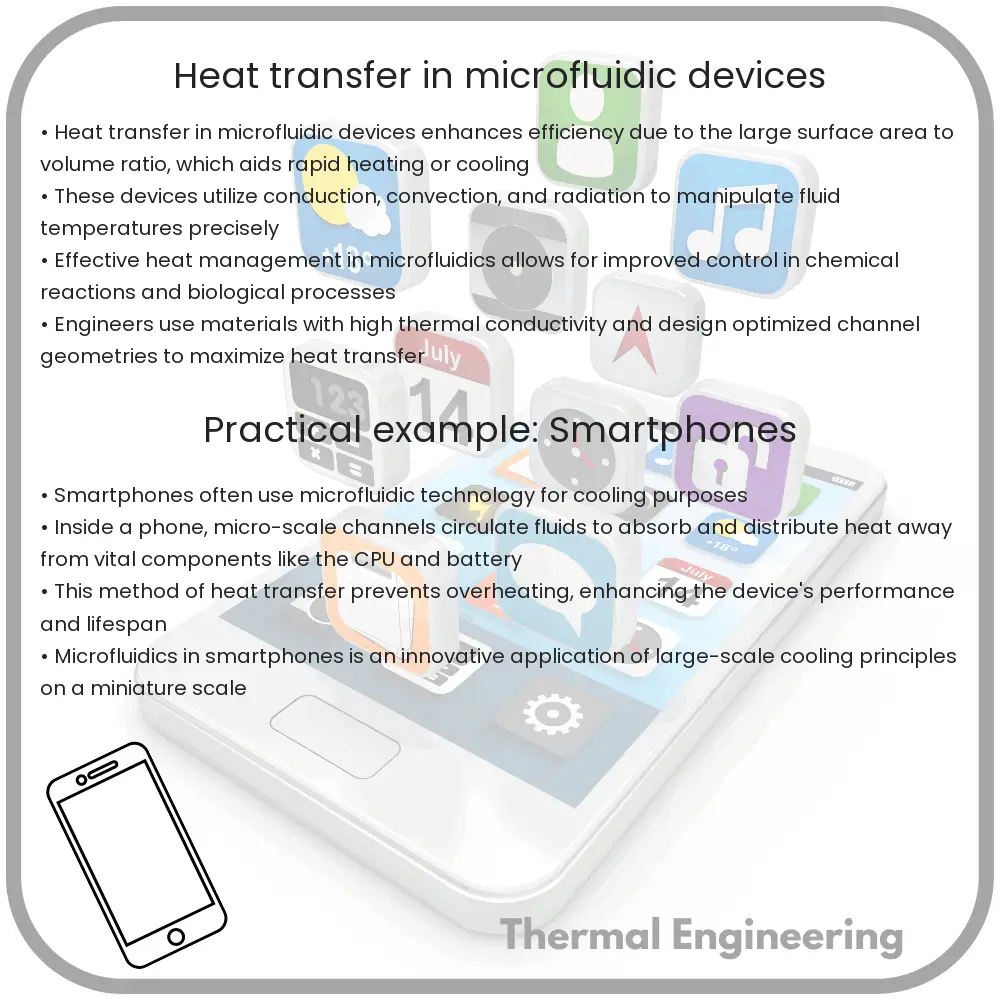
Heat transfer in microfluidic devices is a critical area of study in the field of mechanical and chemical engineering. These devices, often no larger than a few millimeters, utilize small fluid volumes to achieve tasks ranging from chemical synthesis to biological analysis. Due to their small size, heat transfer in microfluidic devices is predominantly influenced by surface area-to-volume ratios, making conventional heat transfer concepts both interesting and challenging to apply.

Types of Heat Transfer in Microfluidics

There are three primary modes of heat transfer: conduction, convection, and radiation. In microfluidic devices, the dominant modes are typically conduction and convection, with radiation playing a negligible role due to the small size of the devices.

  • Conduction: This occurs through materials in the device, such as the substrate and walls of the channels. Heat is transferred via molecular interactions, crucial in devices with solid structures close to heat sources or sinks.
  • Convection: Convection occurs due to fluid motion within the channels. This can be either natural, driven by density differences due to temperature gradients, or forced, caused by external mechanisms like pumps. In microscales, forced convection is often more significant due to the low Reynolds number flow, which limits natural convection.

Mathematical Modeling of Heat Transfer

The heat transfer in microfluidic systems can be modeled using the heat conduction equation for solids and the energy balance for fluids. For a solid, the heat conduction equation is given by:

\[ \nabla \cdot (k \nabla T) = \rho c_p \frac{\partial T}{\partial t} \]

where \( \nabla \cdot \) represents the divergence, \( k \) is the thermal conductivity, \( T \) is the temperature, \( \rho \) is the density, and \( c_p \) is the specific heat at constant pressure.

In fluids, the convective heat transfer can be described by:

\[ \rho c_p \left( \frac{\partial T}{\partial t} + v \cdot \nabla T \right) = \nabla \cdot (k \nabla T) + Q \]

Here, \( v \) represents the flow velocity vector, and \( Q \) is the internal heat generation per unit volume, if any.

Applications of Heat Transfer in Microfluidic Devices

The efficient management of heat is essential for the performance and reliability of microfluidic devices. Some key applications include:

  • DNA amplification: Precise temperature control can significantly influence the efficiency of polymerase chain reactions (PCR) used for DNA amplification.
  • Lab-on-a-chip systems: Thermal management in these systems can affect the speed and outcome of biochemical reactions and analyses.
  • Cooling of electronic components: Microfluidics can also be employed in microscale cooling applications in electronics, where effective heat removal is crucial for device performance and longevity.

Challenges and Innovations

The study of heat transfer in microfluidic devices brings numerous challenges, primarily due to scale, material properties, and the need for precise temperature control. Innovations often focus on materials with higher thermal conductivities, optimized flow patterns, and integration of temperature sensors and actuators to better manage and monitor temperature at the microscale.

Understanding and improving heat transfer in microfluidic devices not only enhances the performance of specific applications but also contributes to the broader fields of miniaturized technology and systems engineering.

Thermodynamics in geothermal energy extraction

Learn how thermodynamics principles guide geothermal energy extraction, converting Earth’s heat to electricity efficiently.

Thermodynamics in geothermal energy extraction

Understanding Thermodynamics in Geothermal Energy Extraction

Geothermal energy extraction is a fascinating application of thermodynamic principles to harvest the Earth’s natural heat. This process involves converting heat from beneath the Earth’s surface into useable energy, typically in the form of electricity. To fully appreciate how this energy conversion occurs, an understanding of the basic principles of thermodynamics is essential.

The Basics of Thermodynamics

Thermodynamics is the branch of physics that studies the relationships between heat, work, temperature, and energy. The laws of thermodynamics are crucial for designing systems that convert heat energy from the Earth into electrical energy efficiently and sustainably.

  • First Law of Thermodynamics: This law, also known as the Law of Energy Conservation, states that energy cannot be created or destroyed, only transferred or changed from one form to another. In geothermal energy, this principle governs the conversion of thermal energy (heat) to mechanical energy (work) and then to electrical energy.
  • Second Law of Thermodynamics: This law states that heat energy naturally flows from an area of high temperature to an area of low temperature. This principle is used in geothermal power plants where heat from the Earth’s core is transferred to a cooler fluid, typically water or an organic compound, which then vaporizes and drives a turbine to generate electricity.

Heat Transfer and Geothermal Energy

In the context of geothermal energy, heat transfer plays a pivotal role. The Earth’s internal heat sources, primarily the decay of radioactive isotopes and residual heat from the planet’s formation, provide a consistent flow of thermal energy. Here are the key steps in which this energy is harnessed:

  1. Heat Extraction: Heat is extracted from underground rocks and fluids at high temperatures. Wells are drilled into geothermal reservoirs to bring hot water and steam to the surface.
  2. Heat to Work Conversion: The high-pressure steam from the geothermal reservoir then drives turbines. The steam expands and cools as it moves through the turbine, causing the turbine blades to spin, which in turn drives a generator to produce electricity.
  3. Cooling and Re-injection: After the steam has passed through the turbine, it is often condensed back into water and re-injected into the Earth. This step helps sustain the pressure in the reservoir and prolongs the lifecycle of the geothermal plant.

The Role of the Carnot Cycle

The Carnot cycle, an idealized thermodynamic cycle proposed by Nicolas Léonard Sadi Carnot in 1824, is a theoretical concept that helps engineers understand the maximum potential efficiency of heat engines, including geothermal power plants. The cycle stipulates that no engine operating between two heat reservoirs can be more efficient than a Carnot engine operating between the same reservoirs. In its simplest form, it is described by the equation:

\[ \text{Efficiency} = 1 – \frac{T_c}{T_h} \]

where \( T_c \) and \( T_h \) are the temperatures of the cold and hot reservoirs, respectively (measured in Kelvin). The efficiency equation emphasizes the importance of high temperature differences between the hot source (geothermal reservoir) and the cold sink (the ambient environment or re-injection fluid).

Conclusion

Thermodynamic principles are integral to understanding and improving the processes involved in geothermal energy extraction. By analyzing systems through the lens of the first and second laws of thermodynamics, and considering the theoretical limits of efficiency as suggested by the Carnot cycle, engineers can design more effective and sustainable geothermal energy systems. As technology progresses and our understanding of thermodynamic systems deepens, the potential for geothermal energy as a major component of sustainable energy portfolios becomes increasingly promising.

This field not only showcases a practical application of thermodynamic principles but also highlights how essential understanding foundational physics is in tackling modern engineering challenges and striving towards energy sustainability.

Thermal barriers in high-temperature applications

Exploring the role and components of Thermal Barrier Coatings (TBCs) in high-temperature industrial applications.

Thermal barriers in high-temperature applications

Understanding Thermal Barriers in High-Temperature Applications

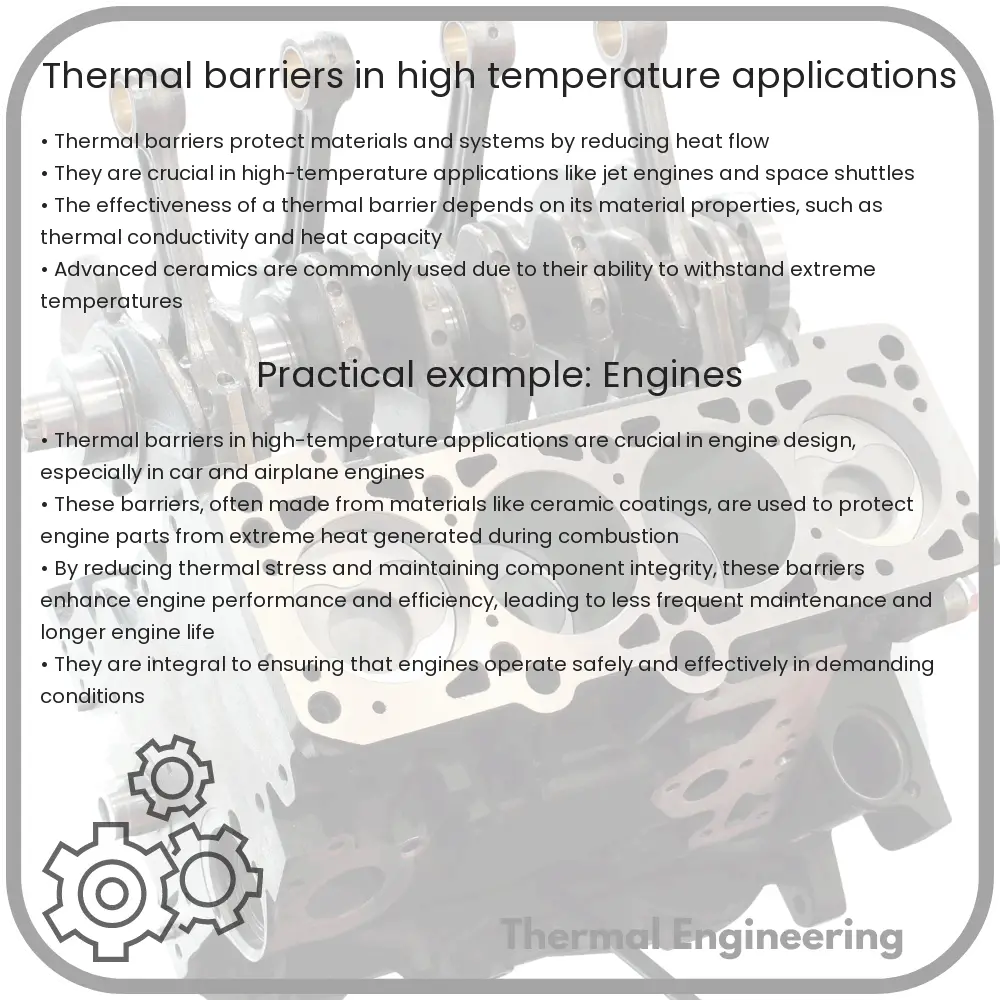
In various engineering and industrial processes, controlling and managing heat is crucial. This is particularly important in high-temperature applications such as jet engines, power plants, or spacecraft re-entry systems. Thermal barrier coatings (TBCs) play a fundamental role in protecting underlying components from temperatures that could lead to failure due to melting, oxidation, or other forms of degradation.

What are Thermal Barrier Coatings?

Thermal barrier coatings are advanced materials applied to metallic surfaces operating in high-temperature environments. These coatings are designed to insulate and protect the underlying base materials from extreme heat exposures while maintaining structural integrity and functionality.

The primary material used in TBCs is typically a ceramic, owing to ceramics’ low thermal conductivity, high melting point, and stability under thermal cycling conditions. The most commonly used ceramic material is yttria-stabilized zirconia (YSZ). YSZ is preferred for its stability at high temperatures and its thermal expansion characteristics, which are somewhat similar to those of the metals commonly used in high-temperature applications.

Components of a Thermal Barrier Coating System

  • Bond Coat: This is a metallic layer applied directly to the substrate. The bond coat helps to protect the base material from oxidation and corrosion, and improves the adhesion of the ceramic topcoat.
  • Ceramic Topcoat: This is the outermost layer and is typically made of YSZ. The topcoat is the primary insulation layer that diffuses and reflects heat, thereby protecting the integrity of the structure beneath.
  • Thermally Grown Oxide (TGO): This oxide layer forms at the interface between the bond coat and the ceramic layer during operation. It is primarily an alumina layer that grows as a result of the oxidation of the bond coat.

Application Methods

The application of TBCs involves high-technology processes that ensure the coat delivers its purpose effectively. The most common methods are:

  • Electron Beam Physical Vapor Deposition (EB-PVD): This method is primarily used for producing TBCs that have a columnar grain structure. It provides excellent strain tolerance against thermal expansion and contraction.
  • Air Plasma Spraying (APS): APS is a more cost-effective process compared to EB-PVD and is commonly used for applying the ceramic topcoat. It creates coatings with a non-directional grain structure which is beneficial for some applications.

Importance of Thermal Barrier Coatings

TBCs significantly enhance the efficiency and longevity of high-temperature systems. By allowing components to operate at higher temperatures without sustaining heat damage, these coatings enable improvements in efficiency, particularly in power generation and aerospace engines. Increased thermal efficiency directly correlates with reduced greenhouse gas emissions, aligning with global efforts towards more sustainable energy practices.

Moreover, the extension of component life due to reduced degradation from heat exposure decreases maintenance frequency and cost, which is vitally important in industries where high downtime costs are incurred, such as in aviation and energy production.

Challenges and Future Directions

Despite their advantages, TBCs face challenges such as thermal shock, sintering, and degradation due to CMAS (Calcium-Magnesium-Alumino-Silicate) infiltration. Emerging research in the development of new materials like gadolinium zirconate and innovations in application techniques aim to overcome these challenges, increasing the resilience and effectiveness of TBCs.

The continuous evolution of TBC technology promises not only to enhance the operational capabilities of high-temperature industrial applications but also to drive forward the efficiency and longevity of critical components across various sectors.

Thermodynamics of supercritical fluids

Learn about supercritical fluids, states of matter at high temperature and pressure with unique properties bridging gases and liquids.

Thermodynamics of supercritical fluids

Understanding the Thermodynamics of Supercritical Fluids

Supercritical fluids (SCFs) are substances at conditions above their critical temperature and critical pressure, where gases and liquids can coexist. This state results in unique properties that are intermediate between gases and liquids, making SCFs highly valuable in various engineering and scientific applications.

What Defines a Supercritical Fluid?

A substance becomes supercritical when it is heated above its critical temperature (Tc) and compressed above its critical pressure (Pc). At the critical point, the distinction between liquid and gas phases disappears. This is due to the drastic decrease in the density difference between the phases.

Properties of Supercritical Fluids

  • Enhanced Diffusivity: Compared to liquids, SCFs have higher diffusion coefficients, closer to those of gases, which helps in faster mixing and mass transfer.
  • Variable Viscosity: SCFs have lower viscosities than liquids, easing the processing of materials, and can be adjusted by changing the temperature or pressure.
  • Variable Density: The density of SCFs is higher than that of gases but lower than liquids. Density can be tuned sensitively by adjusting temperature and pressure, affecting the solvent power.

Thermodynamic Principles of Supercritical Fluids

The behavior of supercritical fluids is typically described by equations of state (EOS), which relate pressure, temperature, and volume. The most commonly used EOS is the van der Waals equation, modified to fit better the behavior at supercritical conditions:

\[ P = \frac{RT}{V_m – b} – \frac{a}{V_m^2 + 2bV_m – b^2} \]

where P is the pressure, T is the temperature, Vm is the molar volume, R is the gas constant, and a and b are substance-specific parameters.

Applications of Supercritical Fluids

  1. Supercritical Fluid Extraction (SFE): Utilizing the solvent properties of SCFs, SFE is a key technique for extracting desired components with high efficiency and without the use of harmful solvents.
  2. Chemical Reaction Engineering: The unique properties of SCFs can be harnessed to improve reaction rates and yields in chemical processes.
  3. Pharmaceuticals: SCFs are used in the pharmaceutical industry for the precise processing of drugs, enhancing the bioavailability of medications.

Thermodynamic Challenges in Working with Supercritical Fluids

Despite their advantages, supercritical fluids pose certain challenges:

  • Control of State: Maintaining precise temperature and pressure to keep a substance in the supercritical state requires sophisticated equipment and control systems.
  • Equipment Material Requirements: The high pressures and temperatures involved demand materials that can withstand extreme conditions without degrading.

In conclusion, supercritical fluids offer a fascinating area of study within thermodynamics and engineering. Their unique properties enable revolutionary applications across various industries, but they also require careful handling and understanding of their complex behavior.

As research and technology advance, the potential for new and innovative uses of supercritical fluids is vast, highlighting the importance of ongoing studies in this dynamic field.

Thermodynamic analysis of combustion engines

Explore the role of thermodynamic principles in optimizing combustion engine efficiency and performance.

Thermodynamic analysis of combustion engines

Thermodynamic Analysis of Combustion Engines

In the world of mechanical engineering, understanding the operation of combustion engines is crucial. These engines power everything from automobiles to large industrial machinery. Thermodynamic analysis, which focuses on the principles of heat and energy transformations, plays a fundamental role in optimizing engine performance and efficiency. Let us delve deeper into this fascinating topic.

Basic Principles of Thermodynamics in Combustion Engines

Combustion engines convert chemical energy from fuel into mechanical energy through a process of combustion—typically burning gasoline, diesel, or another fuel type. The operation can be studied through the laws of thermodynamics.

  • The First Law of Thermodynamics states that energy cannot be created or destroyed, only converted from one form to another. In the context of a combustion engine, the chemical energy of the fuel is converted into heat energy by combustion and subsequently transformed into mechanical work.
  • The Second Law of Thermodynamics emphasizes that every energy transfer or transformation increases the entropy of the universe. For combustion engines, this law explains why not all heat generated from fuel combustion can be converted into work; some energy is always lost as waste heat.

The Four Strokes of a Combustion Engine

The typical four-stroke combustion engine operates through the following phases:

  1. Intake Stroke: The intake valve opens, allowing the air-fuel mixture to fill the combustion chamber as the piston moves downward.
  2. Compression Stroke: The intake valve closes, and the piston compresses the air-fuel mix, heating it by virtue of compression.
  3. Power Stroke (Combustion Stroke): As the piston reaches its highest point, the spark plug ignites the compressed air-fuel mixture, causing combustion. The expanding gases from this combustion push the piston downward, generating work.
  4. Exhaust Stroke: The exhaust valve opens, and the piston moves upwards again, expelling the spent combustion gases from the cylinder.

Thermal Efficiency and Performance Parameters

One of the primary metrics used to gauge the efficiency of a combustion engine is thermal efficiency, which is defined as the ratio of work output to heat input. The formula for thermal efficiency (η) can be represented as:

η = (W / Qin) * 100%

Where W is the work done by the engine, and Qin is the heat added to the engine. Despite advances in technology, most combustion engines have a thermal efficiency of about 20-30%, largely due to the losses in heat and friction.

Thermodynamic Cycles in Combustion Engines

Two common theoretical models for analyzing engine cycles are the Otto cycle and Diesel cycle:

  • Otto Cycle: Used primarily in gasoline engines, this cycle assumes constant volume heat addition.
  • Diesel Cycle: Used in diesel engines, it assumes constant pressure heat addition.

Both cycles help engineers and scientists predict the efficiency and work output of an engine using idealized assumptions about the processes involved.

Conclusion

The thermodynamic analysis of combustion engines offers invaluable insights into their operation and efficiency. By understanding the heat and work interactions within these engines, engineers can continue to make advancements in reducing energy losses and improving the overall environmental impact of engine technology. As our understanding and technologies evolve, further enhancements in thermodynamic efficiency are likely, leading to more sustainable and powerful engines for the future.

Equilibrium thermodynamics in material synthesis

Understand how equilibrium thermodynamics shapes material synthesis, impacting phase stability and properties during engineering processes.

Equilibrium thermodynamics in material synthesis

Understanding Equilibrium Thermodynamics in Material Synthesis

Equilibrium thermodynamics plays a critical role in the field of material synthesis, defining how different materials are formed under various conditions. This branch of physics helps engineers and scientists predict and optimize the properties of materials by understanding the transformations that occur at the atomic or molecular level during synthesis processes.

Basics of Equilibrium Thermodynamics

At its core, equilibrium thermodynamics deals with the energy and entropy of a system at equilibrium. It rests on four fundamental laws:

  • The Zeroth Law: If two systems are each in thermal equilibrium with a third system, then they are in thermal equilibrium with each other.
  • The First Law: Energy cannot be created or destroyed but only transferred or changed from one form to another. Mathematically, ΔU = Q – W, where ΔU is the change in internal energy, Q is the heat added to the system, and W is the work done by the system.
  • The Second Law: The total entropy of an isolated system can never decrease over time, and is constant if and only if all processes are reversible.
  • The Third Law: The entropy of a perfect crystal approaches zero as the temperature approaches absolute zero.

These principles are crucial in predicting how substances behave under different thermal conditions during synthesis.

Role of Thermodynamics in Material Synthesis

In material synthesis, engineers are often concerned with phase diagrams, reaction kinetics, and thermodynamic stability. Each concept relies on understanding how thermodynamic variables such as temperature, pressure, and composition affect the synthesis and ultimately the properties of the material.

  • Phase Diagrams: A phase diagram shows the preferable states of a material under different conditions of temperature and pressure. It is extensively used to determine the conditions under which material synthesis can be performed to achieve desired phase purity and stability.
  • Reaction Kinetics: Although strictly a discipline bridging thermodynamics and chemical kinetics, reaction kinetics in material synthesis can be influenced by thermodynamic data. Understanding the energy barriers (activation energies) and the thermodynamically favored products helps in predicting the reaction paths and the rate at which they occur.
  • Thermodynamic Stability: Thermodynamic stability refers to the energy states of different phases of materials. A thermodynamically stable material minimizes the system’s free energy. Predicting such stability can guide the synthesis of materials that are more durable, efficient, or have specific desired properties.

By understanding the fundamental thermodynamic limits and efficiencies, engineers can design processes that optimize material performance under various service conditions.

Applications of Equilibrium Thermodynamics in Material Synthesis

Material synthesis includes the development of metals, ceramics, polymers, and composites. Applications range from developing new battery materials with better performance and longevity to creating novel pharmaceutical compounds with targeted properties.

  • Metallurgy: The synthesis of alloys, understanding melting points, and predicting alloy stability are guided by thermodynamic principles.
  • Ceramics: Ceramics’ heat resistance and durability are often tested against thermodynamic models to predict their behavior in extreme environments.
  • Polymers: Polymerization reactions and the physical properties of polymers like glass transition temperature, melting temperature, etc., are influenced by thermodynamic insights.

Equilibrium thermodynamics therefore is not just a theoretical framework but a practical guide in the synthesis and development of advanced materials, making it a cornerstone of material engineering.

Thermodynamics of biological systems

Learn how thermodynamics applies to biological systems, emphasizing energy transformations and metabolic processes governed by its laws.

Thermodynamics of biological systems

Understanding the Thermodynamics of Biological Systems

Thermodynamics, traditionally associated with physics and engineering, plays a crucial role in understanding how biological systems operate. This branch of science helps us discover how organisms manage energy transformations and maintain order amidst the chaos of the surrounding environment.

Basic Principles of Thermodynamics in Biology

In biological systems, thermodynamics is primarily concerned with two main processes: energy transfer and the transformation of energy within living organisms. The laws of thermodynamics govern these processes just as they do in physical systems. Here are the core concepts:

  • The First Law of Thermodynamics – Also known as the Law of Energy Conservation, states that energy cannot be created or destroyed in an isolated system. In biological terms, this means that the total amount of energy in an organism remains constant, though it can change forms, such as from chemical energy in food to kinetic energy in movement.
  • The Second Law of Thermodynamics – This law states that the entropy of an isolated system always increases over time. Entropy can be thought of as the measure of disorder or randomness. Biological systems, however, maintain low entropy (high order) by constant energy input, which is typically harnessed from the environment or from consumed nutrients.

Energy and Metabolism

At the heart of thermodynamics in biology is metabolism, the set of life-sustaining chemical reactions in organisms. These reactions primarily involve the conversion of energy from nutrients into usable chemical energy (ATP), along with the elimination of waste products.

Metabolism can be split into two categories:

  • Catabolism – The breakdown of molecules to generate energy.
  • Anabolism – The synthesis of all compounds needed by the cells using energy.

Both processes are driven by the energy transformations governed by the laws of thermodynamics. The efficiency of these transformations is critical for the survival of the organism.

Role of Enzymes in Thermodynamics

Enzymes play a pivotal role in the thermodynamics of biological systems by lowering the activation energy required to initiate a chemical reaction, thus making it easier for a reaction to occur and enhancing the rate at which it happens. This catalytic action helps manage the balance between energy release and energy storage necessary for cell function and overall organism health.

Thermodynamic Systems in Organisms

Biological systems can be thought of as open systems since they exchange both energy and matter with their environment. This differs from closed systems that exchange only energy with their surroundings, or isolated systems, which do not exchange energy or matter.

Examples of open systems in biology include:

  • The human respiratory system, which takes in oxygen and expels carbon dioxide.
  • Plant photosynthesis, where light energy is converted into chemical energy while exchanging gases with the environment.

Conclusion

The principles of thermodynamics are fundamental to understanding how biological systems function. They provide insights into how organisms efficiently use energy, maintain order, and interact with their environments. Whether in humans, animals, or plants, the laws of thermodynamics impact all aspects of life, showcasing the elegant complexity of nature’s engineering.

Cryogenic thermodynamics for space applications

Understanding cryogenic thermodynamics, focusing on low-temperature material and system behaviors, essential for space applications like propellant storage and spacecraft cooling.

Cryogenic thermodynamics for space applications

Cryogenic Thermodynamics for Space Applications

Cryogenic thermodynamics is a field of engineering that focuses on the behavior of materials and systems at very low temperatures, typically below -150 degrees Celsius (-238 degrees Fahrenheit). In the realm of space applications, this branch of engineering is crucial due to the extreme temperature environments encountered in outer space.

Basics of Cryogenics

The term “cryogenics” comes from the Greek word “kryos,” meaning frost. In the context of space, engineers and scientists utilize cryogenic technology primarily for the storage and handling of propellants, cooling of spacecraft components, and the conduct of scientific experiments in space environments.

Key Applications in Space

  • Propellant Storage: Rockets use cryogenic fuels, such as liquid hydrogen and liquid oxygen, due to their high efficiency. These substances must be stored at extremely low temperatures to remain in their liquid state.
  • Sensor and Instrument Cooling: Some space-based sensors and instruments need to be kept at low temperatures to function correctly or improve their accuracy. Examples include infrared sensors and scientific measurement devices.
  • Superconducting Components: Some experimental technologies for space applications involve superconductivity, which typically requires cooling to cryogenic temperatures to maintain superconducting properties.

Thermodynamic Challenges

In space, the absence of an atmosphere presents unique challenges for cryogenic systems, primarily in heat transfer. In Earth conditions, heat can be dissipated by convection through the air, but in space, heat dissipation primarily occurs through radiation, which requires different engineering designs and materials.

Cryogenic Fluid Management Techniques

Managing fluids at cryogenic temperatures in microgravity poses additional challenges. Techniques such as magnetic positioning and surface tension-based devices are employed to control the movement and storage of these fluids.

Equations in Cryogenic Thermodynamics

Understanding the behavior of gases at low temperatures often involves equations from thermodynamics. One key equation is the ideal gas law, modified for real gases:

PV = nZRT

Where:

  • P is the pressure,
  • V is the volume,
  • n is the amount of gas in moles,
  • Z is the compressibility factor,
  • R is the ideal gas constant, and
  • T is the temperature in Kelvin.

At cryogenic temperatures, Z diverges from 1, indicating non-ideal behavior, which is crucial for accurate predictions and designs.

Future Prospects

The future of cryogenic thermodynamics in space exploration is linked to advances in material science, fluid management in microgravity, and sustainability of long-duration space missions. Innovations in cryogenic storage and transfer systems are critical for the next generation of space exploration missions, including manned missions to Mars and beyond.

By understanding and harnessing cryogenic thermodynamics, engineers and scientists can significantly improve the feasibility and safety of space travel, contributing to our capacity to explore, and perhaps settle, the final frontier.

Thermodynamic cycles for waste heat recovery

Explore thermodynamic cycles like Rankine, Brayton, and Kalina for effective waste heat recovery in various industries.

Thermodynamic cycles for waste heat recovery

Understanding Thermodynamic Cycles for Waste Heat Recovery

Thermodynamic cycles play a crucial role in engineering, particularly in the optimization of systems for energy efficiency and sustainability. Waste heat recovery involves capturing heat that would otherwise be lost in processes such as industrial procedures, electricity generation, or transportation, and converting it into useful work or energy. This not only helps in reducing the overall energy consumption but also mitigates environmental impact. Here we will discuss some common thermodynamic cycles used in waste heat recovery systems.

Rankine Cycle

The Rankine cycle is a traditional method used in power generation stations, but it has found its place in waste heat recovery scenarios as well. It involves the conversion of heat into work by using a fluid undergoing phase changes (typically water/steam). The basic components of the Rankine cycle include a boiler, turbine, condenser, and pump. In waste heat recovery applications, the ‘boiler’ receives heat from the waste source, which then vaporizes the working fluid, driving a turbine for electricity generation or mechanical work. This cycle can be particularly effective with high temperature waste heat sources.

  • Efficiency can be enhanced by utilizing variants such as the Organic Rankine Cycle (ORC), which uses organic, high molecular mass fluids with a boiling point lower than water, suitable for capturing lower-temperature waste heat.
  • Superheating the steam can also increase the efficiency of the Rankine cycle.

Brayton Cycle

The Brayton cycle, typically used in jet engines and gas turbines, is another effective thermodynamic cycle for waste heat recovery. It operates with a continuous flow of air or gas as the working fluid, which gets compressed, heated through energy addition in a combustion chamber (or with waste heat in recovery applications), and then expanded to produce work. In waste heat recovery, the Brayton cycle can be adapted to recover heat from various sources by heating the compressed air or gas, thus turning a turbine to generate power.

  • The cycle can process heat from gas streams at both high and low pressures and is well-suited for recovery at medium to high temperatures.
  • It offers flexibility in terms of the type of heat sources and the scale of operations.

Kalina Cycle

Another exciting development in thermodynamic cycles for waste heat recovery is the Kalina cycle. This cycle uses a binary mixture of water and ammonia as the working fluid, allowing for varied boiling points during the heat addition phase. This leads to more efficient heat exchange and energy conversion processes in scenarios where waste heat is available at varying temperatures.

  • The Kalina cycle is particularly effective in capturing low-grade heat from geothermal sources or industrial waste heat.
  • Its ability to adjust to the source’s temperature helps in maximizing the efficiency compared to traditional cycles.

Applications and Benefits

Implementing these thermodynamic cycles in waste heat recovery systems can be transformative for industries looking to enhance their energy efficiencies and reduce carbon footprints. Some areas where these cycles are applicable include:

  1. Power plants: Recovering heat from exhaust gases.
  2. Manufacturing industries: Utilizing heat from furnaces or combustion processes.
  3. Transport sector: Recuperation from vehicle exhaust.

Adopting such technologies not only contributes to significant energy savings but also fosters a move towards more sustainable industrial practices. As industries continue to focus on innovative solutions to waste management and energy conservation, understanding and utilizing these thermodynamic cycles will be paramount.

In summary, thermodynamic cycles for waste heat recovery provide a pathway to not just economic benefits through enhanced energy efficiency but also help in environmental conservation. The choice of cycle—Rankine, Brayton, Kalina, or others—depends largely on the characteristics of the waste heat source and the specific requirements of the recovery system.

Thermal control in aerospace engineering

Learn how thermal control in aerospace engineering manages extreme temperatures in space to ensure spacecraft reliability and performance.

Thermal control in aerospace engineering

Understanding Thermal Control in Aerospace Engineering

In the challenging environment of space, managing the temperature and thermal properties of spacecraft and satellites is crucial. Thermal control in aerospace engineering ensures that the equipment can withstand the extreme temperatures of space, which can range from very cold (-270°C in the shade) to very hot (up to 120°C when exposed to the sun). This article explores the mechanisms of thermal control used in aerospace engineering.

Why Is Thermal Control Important?

Aerospace vehicles, whether orbiting Earth or traveling to other planets, encounter unique thermal environments that can include exposure to intense solar radiation, deep space cold, and reflected heat from planets. Components and materials must operate within specific temperature ranges to function correctly and ensure the reliability and longevity of the mission. Without proper thermal control, electronic equipment could overheat, structural materials could degrade, and instruments could fail to operate within their designed parameters.

Methods of Thermal Control

  • Passive Thermal Control: This involves the use of materials and structural elements to manage heat without moving parts or significant energy consumption. Examples include:
    • Thermal insulation: Materials that minimize heat transfer.
    • Reflective coatings: Surfaces designed to reflect solar radiation away from the spacecraft.
    • Surface finishes: Specific colors and finishes that emit or absorb heat as necessary.
  • Active Thermal Control: This method uses mechanical systems and powered devices to regulate temperature. Examples include:
    • Heaters: Used to warm components when the ambient temperature drops too low.
    • Heat pipes: Efficiently transfer heat from hot to cooler areas of the spacecraft.
    • Thermal louvers: Adjustable vents that can open to radiate heat away or close to retain heat.
    • Fluid loops: Circulate a heat-transfer fluid to move heat from warm components to radiators that expel it into space.

Challenges in Aerospace Thermal Control

Designing thermal control systems (TCS) for spacecraft poses several challenges. These systems must be lightweight yet robust enough to survive launch and space conditions. They must also be reliable over long periods in the extreme and varying conditions of space. Additionally, designers must carefully balance power consumption (for active systems) against the available energy budget and ensure that the TCS interfaces seamlessly with other spacecraft systems, all while keeping redundancy and fail-safe mechanisms in place.

Example of Thermal Control Application

The Mars Rover, a popular example of an aerospace application that faces extreme temperature variations, employs a combination of passive and active thermal control techniques. Its passive thermal control includes special insulation and thermal blankets. Its active systems incorporate heaters and fluid-based thermal loops that maintain operational temperatures for both the rover’s electronic brains and its mechanical components.

Conclusion & Future Directions

As aerospace engineering continues to develop and the boundaries of space exploration expand, thermal management will remain a critical area of research and development. Innovations may include more sophisticated passive materials, more efficient heat transfer systems, and smarter integration with spacecraft power and management systems. Success in thermal control technology will continue to underpin the safety and success of future missions, paving the way for longer, potentially manned missions into deep space.

Understanding the basics of thermal control in aerospace engineering not only highlights the complexity of space missions but also emphasizes the ingenuity and detailed engineering required to overcome environmental challenges. Thus, it remains a vital area of study and innovation in aerospace engineering.