Facebook Instagram Youtube Twitter

Thermodynamics in additive manufacturing processes

Understanding thermodynamics in additive manufacturing enhances process optimization and material properties.

Thermodynamics in additive manufacturing processes

The Role of Thermodynamics in Additive Manufacturing Processes

Additive manufacturing, commonly known as 3D printing, is a transformative approach to industrial production that enables the creation of lighter, stronger parts and systems. It is a process of joining materials to make objects from 3D model data, usually layer upon layer, as opposed to subtractive manufacturing methodologies. Understanding the thermodynamics involved in additive manufacturing is critical for optimizing these processes, enhancing material properties, and ensuring the structural integrity of manufactured parts.

Basic Concepts of Thermodynamics in Additive Manufacturing

Thermodynamics in the context of additive manufacturing primarily involves the study of energy transformations and heat transfer mechanisms that occur during the printing process. These transformations can significantly affect the microstructure, mechanical properties, and dimensional accuracy of the finished product.

  • Heat Transfer: The most predominant aspect of thermodynamics in additive manufacturing is heat transfer. Methods such as laser sintering or electron beam melting involve melting and solidification of materials, which requires precise control of heat sources.
  • Phase Changes: The materials used, typically metal or polymer powders, undergo phase changes during the manufacturing process. Understanding the melting and solidification behaviors, which are dictated by the thermodynamic properties of the material, is essential for predicting the final product’s quality.
  • Thermal Stresses: Rapid heating and cooling cycles can introduce thermal stresses in the manufactured parts. These stresses might lead to warping, distortions, or even failures, which are critical to evaluate from a thermodynamics perspective.

Thermodynamic Analysis in Additive Manufacturing

To mitigate issues associated with thermal behaviors, thermodynamic analysis is employed. This analysis helps in understanding energy absorption, heat distribution, and the evolution of temperature gradients within the material. Such computational analyses often involve a few fundamental equations:

  • Conservation of Energy: Generally expressed as Q = ΔU + W, where Q is the heat added to the system, ΔU is the change in internal energy, and W is the work done by the system.
  • Heat Conduction Equation: Also known as Fourier’s law, it is described by q = -k∇T, where q represents the heat flux, k the thermal conductivity, and ∇T the temperature gradient.
  • Convective Heat Transfer: Convective cooling rates can also influence the solidification process, given by Q = hA(Tsurface - Tfluid), where h is the convective heat transfer coefficient, A is the surface area, and T are the temperatures of the surface and fluid respectively.

Applications and Implications

Understanding the thermodynamic principles in additive manufacturing allows for the refinement of process parameters such as energy input, layer thickness, and scanning speed. It aids in reducing defects, improving surface finish, and achieving dimensional accuracy. Moreover, advanced thermodynamic models contribute to the development of new materials specifically tailored for additive manufacturing that exhibit desirable thermal and mechanical properties.

In conclusion, the interplay of thermodynamics in additive manufacturing is an essential area of study for advancing this technology. As new materials and more complex builds are explored, the role of thermodynamic analysis will only grow, ensuring the efficient and reliable production of high-quality parts.
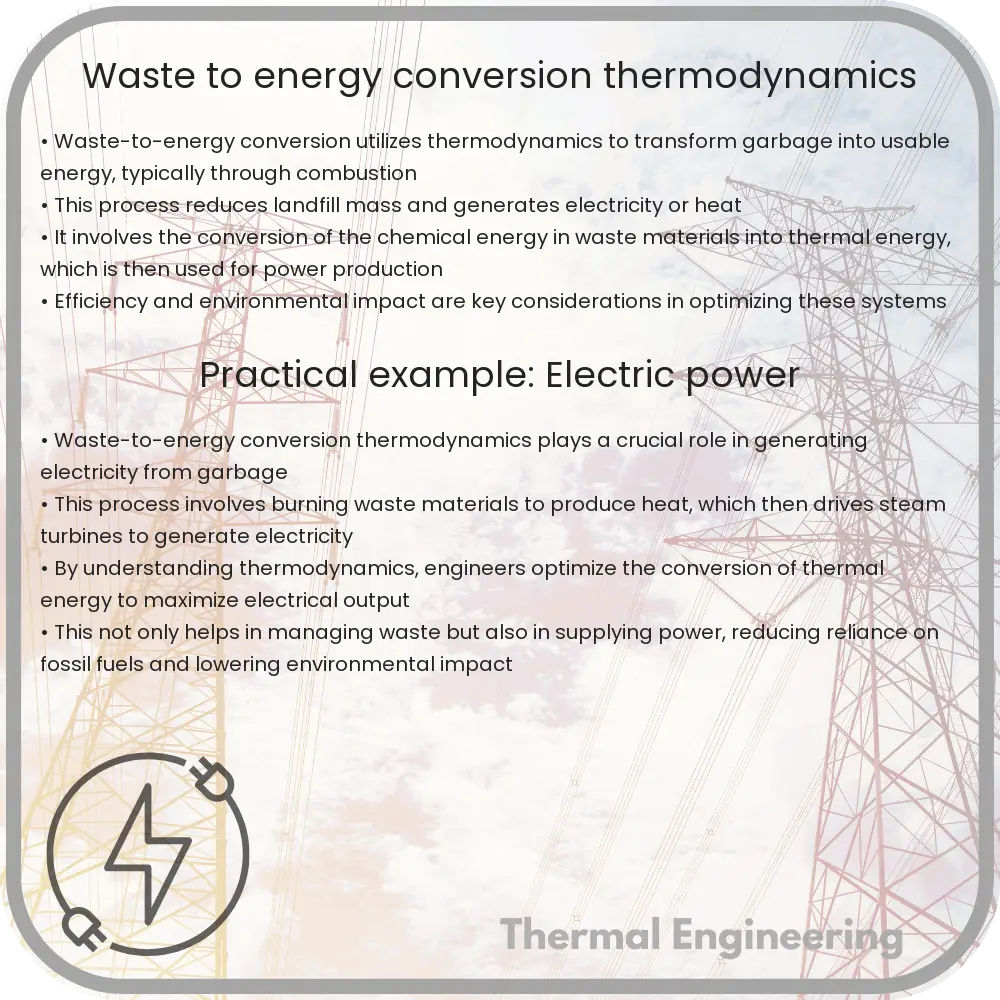

Waste-to-energy conversion thermodynamics

Learn how thermodynamics governs waste-to-energy technology, converting municipal waste into energy while addressing efficiency and sustainability challenges.

Waste-to-energy conversion thermodynamics

Understanding Waste-to-Energy Conversion Thermodynamics

Waste-to-energy (WTE) technology is an innovative way to deal with municipal solid waste by converting it into usable forms of energy, typically electricity and heat. As landfills grow and the environmental impact of waste disposal becomes an increasingly pressing issue, understanding the thermodynamic principles that govern waste-to-energy processes is crucial. This article explores the basic thermodynamic concepts involved in waste-to-energy conversion and how they are applied in practical scenarios.

The Basics of Thermodynamics in Waste-to-Energy Systems

Thermodynamics is a branch of physics that deals with heat, work, temperature, and their relation to energy, radiation, and physical properties of matter. The most relevant laws of thermodynamics for waste-to-energy conversion are:

  • The First Law of Thermodynamics: This law, also known as the Law of Energy Conservation, states that energy can neither be created nor destroyed; it can only be transformed from one form to another. In WTE, the chemical energy stored in waste is converted into thermal energy (heat), and then usually into mechanical energy (to turn a turbine) and finally electrical energy.
  • The Second Law of Thermodynamics: This law states that the entropy of an isolated system always tends to increase over time. Entropy can be thought of as a measure of disorder or randomness. In the context of WTE, this law influences the efficiency of energy conversion systems and sheds light on why all the energy in the waste cannot be completely converted into useful work.

The efficiency of a waste-to-energy plant is fundamentally limited by these thermodynamic principles. The practical implementation of these concepts determines how effectively a WTE plant operates.

Energy Conversion Process in WTE

The typical process in a WTE facility involves several key steps:

  1. Waste Collection and Management: Municipal solid waste is collected and often sorted to remove recyclables and non-burnable materials.
  2. Combustion: The burnable waste is incinerated, releasing heat. The high temperatures convert water into steam in a boiler.
  3. Steam Turbine: The high-pressure steam produced in the boiler is used to drive a turbine, which generates electricity.
  4. Energy Conversion: The mechanical energy from the turbine is converted into electrical energy using a generator.
  5. Waste Treatment: The remaining ash is treated and disposed of, with metals often being recycled.

The conversion efficiency from waste to energy depends on the heating value of the waste and the technology used. Cutting-edge technologies like plasma arc gasification can potentially exceed the efficiencies of traditional incineration methods.

Calculating Efficiency

The efficiency of a WTE power plant can be estimated using the following formula:

\[ Efficiency (\%) = \left(\frac{Output\ Energy}{Input\ Energy}\right) * 100 \]

Here, Output Energy is the electrical energy produced by the generator, and Input Energy is the heat energy released by the combustion of waste. Advanced systems incorporate energy recovery techniques to utilize the heat produced during combustion for district heating, further enhancing overall efficiency.

In summary, waste-to-energy conversion is a sophisticated application of thermodynamics principles aimed at reducing waste and producing energy. While there are limitations and challenges, including emissions and the initial high cost of setting up a WTE plant, ongoing advancements in technology continue to improve the efficiency and environmental impact of this alternative energy source.

Understanding the thermodynamics of waste-to-energy processes not only provides insights into how we can manage waste more effectively but also highlights the potential for renewable energy generation from what is often considered a problematic source. As technology progresses, the role of WTE could become increasingly significant in achieving sustainable waste management and energy production goals.

Efficiency improvements in thermal power plants

Learn about the critical role and impact of enhancing efficiency in thermal power plants to reduce emissions and operational costs.

Efficiency improvements in thermal power plants

Efficiency Improvements in Thermal Power Plants

Thermal power plants are critical to the global energy landscape, providing a significant portion of the world’s electricity. However, the efficiency of these plants has a substantial impact on their environmental footprint and operational costs. Understanding and implementing efficiency improvements can help reduce emissions, conserve fuel resources, and lower electricity generation costs.

Understanding Plant Efficiency

Efficiency in thermal power plants is primarily measured by how effectively they convert heat energy from fuel into electrical energy. This is generally referred to as the ‘thermal efficiency,’ which is given by the formula:

Thermal Efficiency (%) = (Energy Output / Energy Input) * 100

The higher the percentage, the more efficient the power plant. Most conventional fossil-fuel thermal power plants operate with thermal efficiencies in the range of 33% to 48%. This means a significant portion of the energy from the fuel is lost during the energy conversion process, often as waste heat.

Key Techniques for Enhancing Efficiency

1. Improving Turbine Efficiency

  • Blade Design: Advances in turbine blade design, such as using materials that can withstand higher temperatures and pressures, can significantly enhance the efficiency of steam turbines.
  • Reheating and Regenerative Feedwater Heating: By reheating the steam that exits from the high-pressure turbine and sending it back into a medium-pressure turbine, and by using regenerative heaters to preheat the water before it enters the boiler using steam extracted from different stages of the turbine, overall efficiency can be boosted.

2. Reducing Heat Losses

  • Better Insulation: Improving the insulation of pipes and boilers can reduce energy loss from escaping heat.
  • Utilizing Waste Heat: Deploying technologies like Combined Heat and Power (CHP) systems can repurpose waste heat for district heating or additional power generation, further improving the overall efficiency of the plant.

3. Optimizing Plant Operation

  • Load Following: Modifying operations to better match load demands with supply prevents the plant from operating inefficiently under low load conditions.
  • Use of Automation: Integrating advanced control systems that optimize fuel combustion rates and operational parameters based on real-time data can lead to significant efficiency gains.

Advanced Technologies to Consider

Integration of Renewable Energies

Combining solar, wind, or geothermal power with traditional thermal power processes can reduce the dependency on fossil fuels and improve plant efficiency by leveraging consistent, zero-emission energy sources when they are available.

Supercritical and Ultra-Supercritical Boilers

These boilers operate at temperatures and pressures above the critical point of water, creating a supercritical steam condition that results in better fuel-to-steam efficiency due to higher temperatures and reduced vapor water content.

Carbon Capture and Storage (CCS)

Although not directly increasing the operational efficiency, CCS can significantly reduce the carbon footprint of thermal power plants by capturing CO2 emissions from combustion and storing it underground, hence improving the environmental efficiency of these plants.

Conclusion

Improving the efficiency of thermal power plants is a multifaceted endeavor that includes technological innovations, operational strategies, and integration of renewable energy sources. As we continue to rely heavily on these power plants for energy production, prioritizing efficiency improvements not only makes economic sense but is also imperative from an environmental perspective. Upgrading existing plants and designing new ones to be as efficient as possible will play a crucial role in the global transition towards sustainable energy.

Thermal management of lithium-ion batteries

Explore the critical role and techniques of thermal management in lithium-ion batteries, essential for performance and safety.

Thermal management of lithium-ion batteries

Understanding Thermal Management in Lithium-Ion Batteries

Lithium-ion batteries are a popular energy storage choice across various sectors, including consumer electronics, electric vehicles, and renewable energy systems. However, managing their thermal environment is crucial, as it significantly affects battery performance, safety, and longevity. This article will explore the significance and methods of thermal management in lithium-ion batteries.

Why is Thermal Management Important?

Temperature plays a pivotal role in lithium-ion battery operation. These batteries operate efficiently within a specific temperature range, typically between 20°C and 40°C. Temperatures beyond this range can lead to several issues:

  • Reduced Efficiency: At low temperatures, the internal resistance of the battery increases, reducing its efficiency and power output.
  • Capacity Fade: High temperatures accelerate the degradation of battery materials, resulting in reduced storage capacity over time.
  • Safety Risks: Excessive heat can trigger thermal runaway, a dangerous condition where an increase in temperature initiates a reaction that further increases temperature, potentially leading to explosions or fires.

Methods of Thermal Management

Effective thermal management systems (TMS) ensure that lithium-ion batteries operate within their optimal temperature range. There are several strategies used to manage battery temperature:

  1. Air Cooling: This is the simplest form of cooling, relying on air circulation around the battery to dissipate heat. While cost-effective and easy to implement, air cooling may not be sufficient for high-power or densely packed battery configurations.
  2. Liquid Cooling: More efficient than air cooling, liquid cooling systems circulate a coolant through channels adjacent to the batteries. This method is particularly effective in rapidly removing heat and is commonly used in electric vehicles and high-performance applications.
  3. Phase Change Materials (PCMs): PCMs absorb and release thermal energy during phase transitions (e.g., from solid to liquid). Incorporating PCMs around battery cells can help stabilize temperature fluctuations during charge-discharge cycles.
  4. Heat Pipes: These are passive heat transfer devices that exploit the evaporation and condensation of a fluid to transfer heat efficiently. Heat pipes can be used to spread the heat from hot spots to cooler areas of the battery pack.
  5. Thermal Insulation: In colder environments, insulating materials may be used to maintain battery temperature by reducing heat loss to the surroundings.

Advanced Considerations in Thermal Management

As technology advances, so does the complexity of thermal management systems. Hybrid systems combining active and passive technologies are being developed to optimize performance and safety. Furthermore, the integration of smart thermal management using sensors and artificial intelligence allows for real-time adjustments based on temperature data, usage patterns, and environmental conditions.

Future Outlook

The demand for efficient and safe lithium-ion batteries continues to grow, particularly for applications in electric vehicles and renewable energy storage. As such, innovations in thermal management technology are critical. Ongoing research aims to develop materials and designs that enhance thermal performance while reducing costs and environmental impact. With better thermal management solutions, lithium-ion batteries will continue to play a pivotal role in the transition to sustainable energy.

In conclusion, effective thermal management in lithium-ion batteries is not just about enhancing performance but is also crucial for safety and longevity. By understanding and implementing various thermal management techniques, engineers can ensure that these batteries meet the needs of today’s energy demands and tomorrow’s technological advancements.

Thermodynamics of electrolyte solutions

Explore how thermodynamics applies to electrolyte solutions, focusing on energy conversion, solubility, conductivity, and temperature effects.

Thermodynamics of electrolyte solutions

Understanding the Thermodynamics of Electrolyte Solutions

Thermodynamics, a fundamental branch of physics and engineering, explores how energy is converted between heat and other forms of energy. In the context of electrolyte solutions—solutions containing salts, acids, or bases that dissociate into ions when dissolved—thermodynamics helps us understand important properties such as solubility, conductivity, and temperature dependence. Here, we dive into the core concepts that govern these characteristics in electrolyte solutions.

Basic Concepts

At the heart of our exploration are a few key thermodynamic parameters:

  • Gibbs Free Energy (G): Indicates the spontaneity of a process. In electrolyte solutions, it helps predict solubility and the extent of ion dissociation.
  • Entropy (S): A measure of disorder or randomness within a system, which increases as ions disperse in a solution.
  • Enthalpy (H): The total heat content of a system, important for understanding heat effects such as the endothermic or exothermic nature of dissolving processes.

Each of these parameters can be measured or calculated to understand and predict the behavior of electrolyte solutions under various conditions.

Colligative Properties

Colligative properties are those properties of solutions that depend on the ratio of the number of solute particles to the number of solvent molecules in a solution, and not on the type of chemical species present. In electrolyte solutions, these include:

  • Boiling Point Elevation: Solvent’s boiling point increases when a solute is added. Its magnitude for electrolytes is greater due to ion dissociation.
  • Freezing Point Depression: Similarly, the addition of an electrolyte lowers the freezing point of the solvent. This effect is amplified compared to nonelectrolytes.
  • Osmotic Pressure: Differences in solvent concentration across a semipermeable membrane generate osmotic pressure, which is influenced by the ionic nature of the solute.

Equations and Relations

The following fundamental equations are essential to quantify these observations in thermodynamics:

  • The Gibbs-Helmholtz Equation: ∆G = ∆H – T∆S
  • Van ‘t Hoff Factor: i = actual number of particles in solution / number of formula units initially dissolved

This Van ‘t Hoff factor, denoted as i, becomes particularly crucial in calculations involving colligative properties because it accounts for the additional particles formed upon dissociation of electrolytes.

Activity Coefficients

In real solutions, interactions between ions often lead to deviations from ideal behaviour, described by Raoult’s law. This interaction effect is quantified using activity coefficients. These are a measure of how the activity (effective concentration) of an ion deviates from its concentration due to interactions with other ions in solution:

  • Activity: a = γ × c
  • Activity Coefficient (γ): a unitless number representing the ratio of the measured activity to the ideal predicted activity.

The use of activity coefficients is crucial when dealing with high concentrations of ions in solution, as it significantly affects the accuracy of thermodynamic predictions.

Applications and Implications

Understanding the thermodynamics of electrolyte solutions has practical implications in various industries and technologies. For instance, it aids in enhancing the design of batteries and fuel cells, controlling drug delivery systems in medical engineering, and developing more efficient methods of desalination and water treatment.

In conclusion, the study of the thermodynamics of electrolyte solutions not only enriches our theoretical knowledge but also opens the door to innovations in practical applications, making it a vital area of study in both physics and engineering.

Statistical thermodynamics of polymer solutions

Delve into how statistical thermodynamics elucidates the interactions in polymer solutions, impacting material sciences and engineering applications.

Statistical thermodynamics of polymer solutions

Understanding Statistical Thermodynamics of Polymer Solutions

Statistical thermodynamics provides a framework for understanding how the microscopic properties of molecules influence the macroscopic properties of materials. In the case of polymer solutions, this branch of physics is vital in explaining how polymers (long, repeating chains of molecules) interact with solvents (substances in which polymers are dissolved) at the molecular level. This understanding is crucial for a variety of applications from drug delivery systems to the manufacturing of everyday products like plastics and textiles.

Basic Concepts

At its core, statistical thermodynamics of polymer solutions deals with the distribution and arrangements of polymer chains within a solvent. The main considerations involve the polymer’s configuration, the interaction between the polymer and solvent molecules, and the thermodynamic properties that result from these interactions.

Key Parameters

  • Chain Conformation: Describes the shape adopted by the polymer chain in solution. This can range from a tightly coiled state to an extended configuration, depending on the interaction with the solvent.
  • Theta Condition: Refers to the state where a polymer solution behaves like an ideal solution. This occurs when the solvent quality exactly cancels out the volume exclusion caused by the polymer, discussed in terms of theta temperature or Flory temperature.
  • Free Energy of Mixing: Includes contributions from both enthalpy (heat exchange due to interactions) and entropy (change in disorder). It is crucial for predicting the solution behavior such as phase separation.

Mathematical Model

One of the foundational models used in describing the behavior of polymer solutions is based on the Flory-Huggins theory. It considers the solution as a mixture of polymer and solvent and provides a tool to predict how changes in temperature, concentration, and molecular weight will affect the system.

The Flory-Huggins equation for free energy of mixing (ΔGmix) is given by:

ΔGmix = RT [n1ln(φ1) + n2ln(φ2) + χn1φ2]

Where:

  • R is the gas constant
  • T is the temperature
  • n1 and n2 are the number of moles of solvent and polymer, respectively
  • φ1 and φ2 are the volume fractions of solvent and polymer
  • χ is the polymer-solvent interaction parameter

Applications and Importance

Understanding the statistical thermodynamics of polymer solutions not only deepens our theoretical knowledge but also enhances the practical applications involving polymers. Innovations in biomedical engineering, environmental science, and the synthesis of new materials often hinge on manipulating polymer-solvent interactions to achieve desired properties.

For instance, the ability to predict how a polymer behaves in different solvents can lead to more effective drug delivery systems where the drug release rate can be precisely controlled by changing the polymer composition or its environment.

Conclusion

Statistical thermodynamics of polymer solutions bridges the gap between molecular interactions and real-world applications, offering insights that are crucial for both theoretical studies and practical applications in material science and engineering. With continuing research, our understanding and ability to manipulate these complex systems will only grow, leading to advanced materials and technologies.

Advanced cycles for power generation

Overview of advanced power cycles, focusing on their efficiency and environmental benefits in modern power generation systems.

Advanced cycles for power generation

Advanced Cycles for Power Generation

In the quest for efficient, sustainable power generation, scientists and engineers continually adapt and innovate energy systems. Advanced power cycles represent significant progress in optimizing the generation of electricity using various sources like fossil fuels, nuclear energy, and renewable resources. This article explores some of the most prominent and innovative cycles used in power generation today.

Combined Cycle Gas Turbine (CCGT)

The Combined Cycle Gas Turbine utilizes both gas and steam turbines to produce electricity in two phases, enhancing the overall efficiency of the power plant. Initially, natural gas is combusted to drive a gas turbine, generating electricity. The exhaust heat from this process, which would otherwise be wasted, is then used to produce steam that drives a separate steam turbine, creating additional power. CCGT plants can achieve thermal efficiencies up to about 60%, significantly higher than the efficiency of traditional simple-cycle gas turbines, which average around 35%.

Integrated Gasification Combined Cycle (IGCC)

Integrated Gasification Combined Cycle (IGCC) systems offer an advanced technology in which coal or other carbon-based materials are gasified to produce syngas (synthesis gas). The syngas is then cleaned of impurities before being utilized as fuel in a combined cycle power plant. This approach not only increases the efficiency of coal-based power generation but also reduces environmental impacts by capturing and repurposing emissions such as carbon dioxide. IGCC plants boast efficiencies between 45% and 50%.

Pressurized Water Reactor (PWR)

In the realm of nuclear power, the Pressurized Water Reactor (PWR) is a type of light-water reactor that uses water as both a coolant and a moderator. The primary water in the reactor is kept under high pressure, preventing it from boiling even at high temperatures. Heat generated in the nuclear reactor core is transferred to a secondary circuit where it converts water into steam, which then drives the steam turbines to produce electricity. PWRs are known for their robust safety features and are one of the most common types of nuclear reactors around the world.

Organic Rankine Cycle (ORC)

Organic Rankine Cycle (ORC) systems are used for generating power from low-temperature heat sources, such as geothermal heat, industrial waste heat, or concentrated solar power. Unlike traditional steam turbines that operate with water, ORCs use organic fluids with a lower boiling point than water, enabling them to convert even low-grade heat into useful energy. This makes ORC systems particularly valuable for applications where conventional Rankine cycles would be less efficient or entirely unfeasible.

Future Trends and Sustainable Alternatives

Looking ahead, advances in power cycle technology continue to focus on increasing efficiency, reducing environmental impacts, and harnessing renewable energy sources. For instance, Supercritical CO2 (sCO2) power cycles, which utilize carbon dioxide at supercritical pressure and temperature conditions, promise enhancements in efficiency and reductions in equipment size and costs. Supercritical CO2 cycles operate with much higher thermal efficiencies and could set new standards for power generation technology, especially in solar thermal and nuclear power applications.

As we advance, the integration of these technologies along with continuous improvements in cycle efficiency, environmental performance, and cost-effectiveness holds the potential to profoundly reshape the landscape of global energy production.

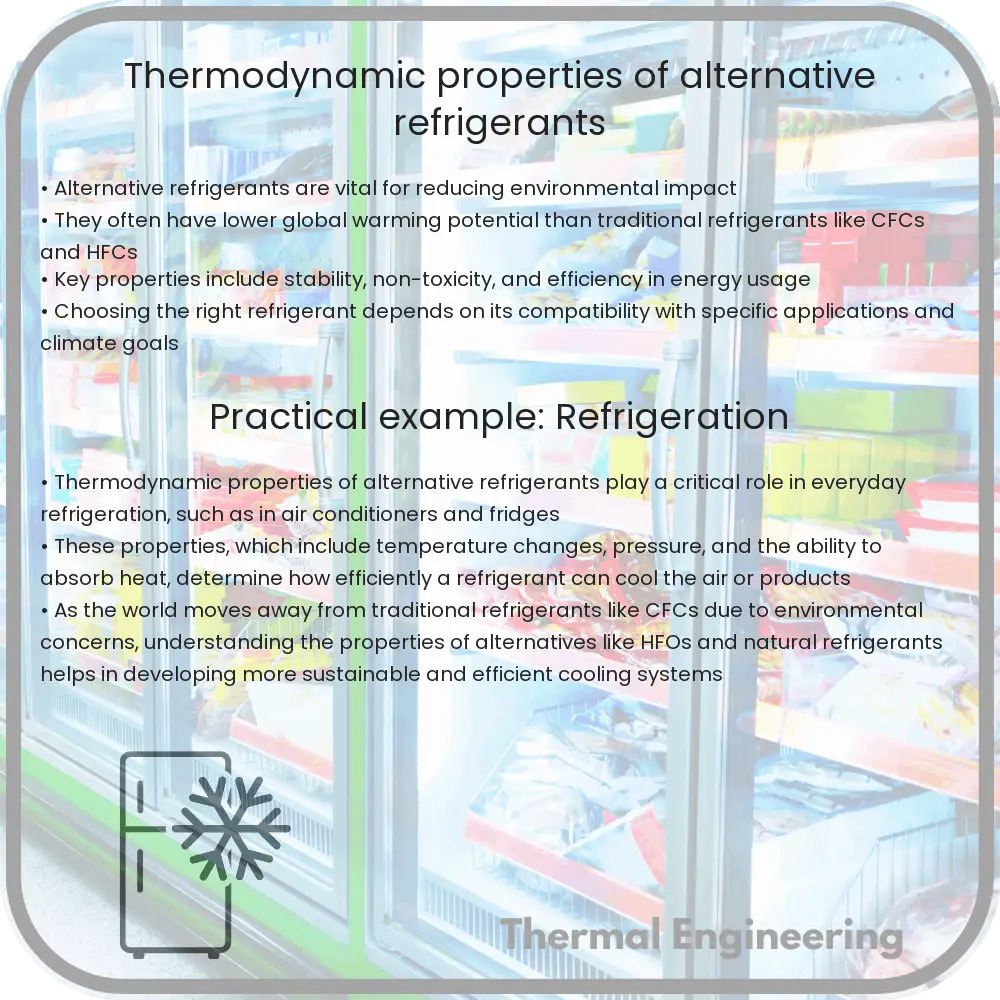
Thermodynamic properties of alternative refrigerants

This article examines the thermodynamic properties and environmental impacts of alternative refrigerants to traditional CFCs and HCFCs in cooling systems.

Thermodynamic properties of alternative refrigerants

Understanding Thermodynamic Properties of Alternative Refrigerants

In the world of refrigeration and air conditioning, the quest for efficient and environmentally friendly refrigerants is ongoing. Traditionally, compounds like chlorofluorocarbons (CFCs) and hydrochlorofluorocarbons (HCFCs) have been used. However, due to their high Global Warming Potential (GWP) and Ozone Depleting Potential (ODP), there has been a shift towards alternative refrigerants. This article explores the thermodynamic properties of these alternatives, focusing on their efficiency and environmental impact.

Why Look for Alternative Refrigerants?

The primary reason for the shift to alternative refrigerants is environmental protection. CFCs and HCFCs contribute significantly to ozone layer depletion. Furthermore, these substances, when released into the atmosphere, have a potent greenhouse effect, exacerbating global warming. In response, the Montreal Protocol, an international treaty, was established to phase out the production of ozone-depleting substances.

Types of Alternative Refrigerants

  • Hydrofluorocarbons (HFCs): HFCs, such as R-134a, R-404A, and R-410A, do not deplete the ozone layer as they do not contain chlorine. However, they do have a high GWP, prompting the search for other alternatives.
  • Hydrofluoroolefins (HFOs): HFOs, like R-1234yf and R-1234ze, are considered promising due to their significantly lower GWP compared to HFCs, making them more environmentally friendly.
  • Natural refrigerants: This category includes substances like ammonia (NH3), carbon dioxide (CO2), and hydrocarbons like propane (R-290) and isobutane (R-600a). These refrigerants have low GWP and ODP values.

Thermodynamic Properties of Alternative Refrigerants

The efficiency of a refrigerant is largely determined by its thermodynamic properties, including:

  • Boiling Point: The boiling point affects the operating pressure of refrigeration systems. Refrigerants with a lower boiling point generally operate at higher pressures.
  • Specific Heat Capacity: This property indicates the amount of heat a refrigerant can absorb while undergoing a temperature change. Higher values are preferable for efficient heat absorption.
  • Thermal Conductivity: Higher thermal conductivity assists in the efficient transfer of heat, enhancing the performance of the refrigeration cycle.
  • Viscosity: Lower viscosity refrigerants reduce the energy required for pumping the refrigerant through the system.

For example, ammonia, a natural refrigerant, presents excellent thermodynamic properties such as high thermal conductivity and latent heat of vaporization which are beneficial for refrigeration cycles. Similarly, CO2 operates under higher pressures but offers significant environmental benefits due to its very low GWP.

Environmental Impact and Performance

HFOs and natural refrigerants are gaining attention due to their low environmental impact. For instance, R-1234yf has a GWP of less than 1, compared to 1430 for R-134a. Alongside environmental benefits, the performance parameters of these refrigerants, including energy efficiency and safety properties such as flammability and toxicity, are critical considerations in their selection and application in refrigeration systems.

Conclusion

The shift towards alternative refrigerants is driven by the need for environmentally sustainable refrigeration and air conditioning systems. Understanding the thermodynamic properties of these alternatives helps in evaluating their performance and suitability for specific applications. As the industry continues to evolve, the adoption of refrigerants with favorable thermodynamic and environmental properties becomes crucial in mitigating impacts on climate change while meeting cooling needs effectively.

This transition not only supports global environmental initiatives like the Montreal Protocol but also pushes forward technological advancements in creating more efficient and greener systems for future generations.

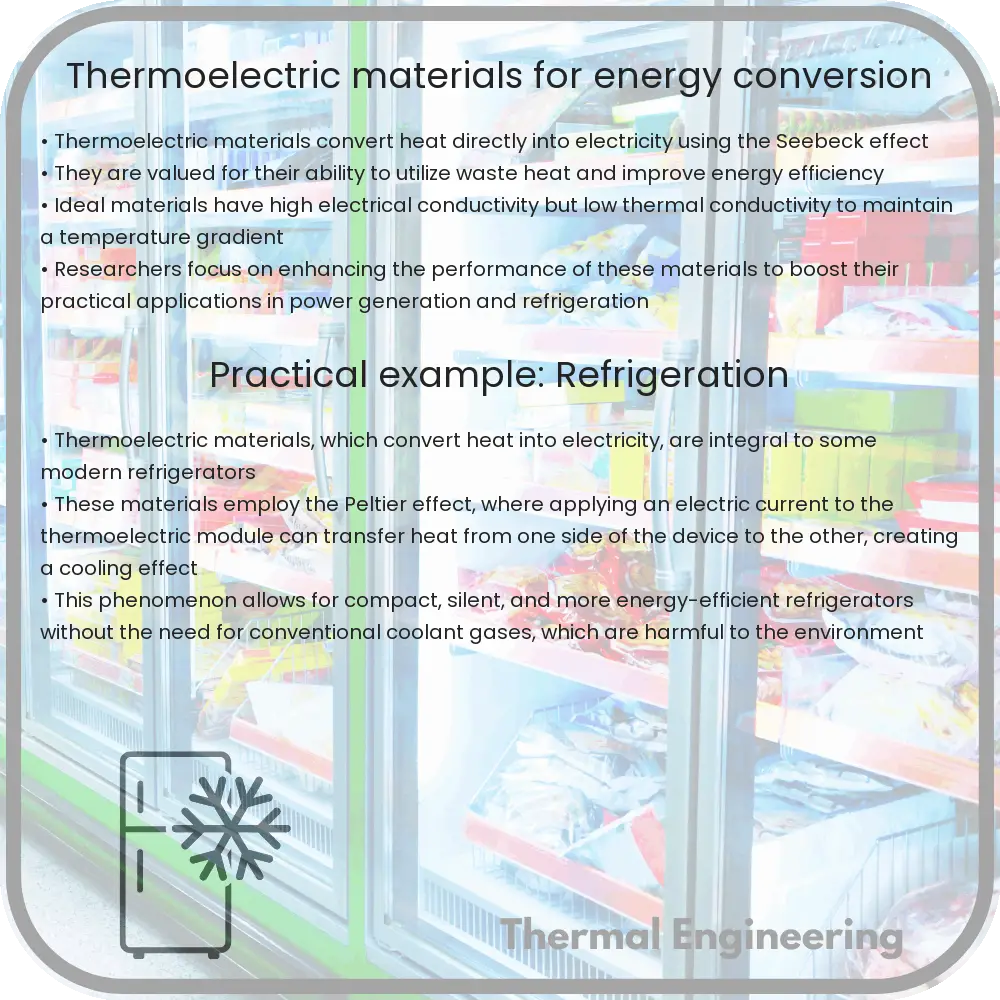
Thermoelectric materials for energy conversion

Learn about thermoelectric materials, their ability to convert temperature differences into electrical voltage, and their applications in energy conversion.

Thermoelectric materials for energy conversion

Understanding Thermoelectric Materials for Energy Conversion

Thermoelectric materials have the distinctive ability to convert temperature differences into electrical voltage and vice versa. This property opens the door to a variety of applications, including power generation from waste heat, energy harvesting, and environmentally friendly refrigeration. In this article, we’ll explore the fundamentals of thermoelectric materials and their role in energy conversion technologies.

How Thermoelectric Materials Work

Thermoelectric materials function based on the Seebeck and Peltier effects—a set of phenomena discovered in the early 19th century. The Seebeck effect describes the generation of an electric current when there is a temperature difference across a material. Conversely, the Peltier effect refers to the creation or absorption of heat when an electric current flows through a material.

A practical thermoelectric device typically consists of pairs of n-type and p-type semiconductor materials that form a thermocouple. These materials are connected electrically in series and thermally in parallel. When a temperature gradient is applied across the device, it induces a voltage difference between the hot and cold junctions, resulting in electric power generation.

Key Parameters of Thermoelectric Materials

  • Seebeck Coefficient (S): This is the measure of the induced voltage in response to a temperature difference across a material. The higher the Seebeck coefficient, the more effective the material is at converting thermal energy to electrical energy.
  • Electrical Conductivity (σ): Efficient thermoelectric materials should have high electrical conductivity to reduce Joule heating and thereby increase efficiency.
  • Thermal Conductivity (κ): Ideally, thermoelectric materials should have low thermal conductivity to maintain a temperature gradient.

The overall efficiency of a thermoelectric material can be evaluated using a dimensionless figure of merit, ZT, given by:

ZT = (S2 * σ * T) / κ

where T is the absolute temperature in Kelvin (K). Materials with higher ZT values are considered better for thermoelectric applications.

Advancements in Thermoelectric Materials

Research in thermoelectric materials has evolved substantially, identifying several promising materials with high ZT values. Bismuth telluride (Bi2Te3), lead telluride (PbTe), and skutterudites are among the most effective thermoelectric materials for mid-range temperature applications. Additionally, recent advancements in nanostructuring and alloying have paved the way for enhanced thermoelectric properties by reducing thermal conductivity while maintaining or improving electrical properties and Seebeck coefficient.

Applications of Thermoelectric Materials

  1. Waste Heat Recovery: Utilizing thermoelectric generators to capture and convert waste heat from industrial processes or vehicle exhaust into usable electricity.
  2. Energy Harvesting: Thermoelectric devices can be used to harness energy from the environment, such as body heat, to power small electronic devices.
  3. Solid-State Cooling: By reversing the process, thermoelectric materials can be used for cooling purposes, offering a compact and environmentally friendly alternative to traditional refrigeration technologies.

Challenges and Future Outlook

Despite their potential, widespread adoption of thermoelectric materials is hindered by challenges such as high production cost, material scarcity, and lower efficiency at room temperature. Ongoing research is aimed at overcoming these hurdles by developing materials with higher ZT values, optimizing material structures, and exploring new, more abundant materials.

As we continue to seek sustainable and efficient energy solutions, thermoelectric materials stand out as a fascinating field of study, promising a future where converting waste heat into electrical power could become commonplace in everyday applications.

Thermodynamic analysis of fuel cells

Unlock the principles of thermodynamics in fuel cells to boost their efficiency and environmental sustainability.

Thermodynamic analysis of fuel cells

Thermodynamic Analysis of Fuel Cells

Fuel cells are fascinating devices that convert chemical energy directly into electrical energy through electrochemical reactions. This process bypasses the conventional combustion process seen in traditional power generators, making fuel cells potentially more efficient and environmentally friendly. A fundamental understanding of the thermodynamic principles at work in fuel cells is key to enhancing their efficiency and effectiveness.

Basic Thermodynamic Concepts in Fuel Cells

At the core of a fuel cell’s operation are the laws of thermodynamics which govern energy conversions and efficiency. To understand a fuel cell’s functionality, one must first grasp how these laws apply:

  • First Law of Thermodynamics (Conservation of Energy): This law asserts that energy cannot be created or destroyed, only converted from one form to another. In fuel cells, chemical energy from the fuel (usually hydrogen) is converted into electrical energy, heat, and water.
  • Second Law of Thermodynamics: This law deals with entropy, stating that the entropy of the universe tends to increase over time. In the context of fuel cells, it explains the direction of energy transfers and the efficiency limitations of energy conversions.

The ideal efficiency of a fuel cell can be determined by calculating the maximum work obtainable from the electrochemical reaction and comparing it with the energy contained in the reactants, primarily hydrogen and oxygen.

The Gibbs Free Energy and Fuel Cells

A key concept in the thermodynamic analysis of fuel cells is the Gibbs free energy (\(\Delta G\)), which represents the maximum amount of useful work obtainable from a chemical reaction at constant temperature and pressure. The relation is given by:

\[\Delta G = \Delta H – T\Delta S\]

where \(\Delta H\) is the change in enthalpy, \(T\) is the absolute temperature, and \(\Delta S\) is the change in entropy. For fuel cells:

  • Enthalpy (\(\Delta H\)) measures the total heat content of the reactants, which helps determine the amount of energy available for conversion to electricity.
  • Entropy (\(\Delta S\)) reflects the irreversible losses in the system, primarily due to heat loss.

The efficiency \(\eta\) of a fuel cell can then be estimated using the Gibbs free energy equation:

\[\eta = \frac{-\Delta G}{\Delta H}\]

This equation underscores that maximizing the output work (\(-\Delta G\)) and minimizing the heat loss (\(\Delta H\)) are crucial for enhancing the efficiency of fuel cells.

Energy and Exergy Analysis

Another critical aspect of the thermodynamic analysis of fuel cells is energy and exergy analysis. Energy analysis involves quantifying the energy conversions and overall efficiency, while exergy analysis helps identify the locations, types, and magnitudes of losses (energy destruction) within the fuel cell system.

  • Energy Analysis: This analysis looks at the balance of energy within the fuel cell, categorizing energy inputs and outputs, and assessing the efficiency of each step of the conversion process.
  • Exergy Analysis: Exergy is the measure of the maximum useful work possible during a process that brings the system into equilibrium with a heat reservoir. By analyzing the exergy losses, engineers can pinpoint inefficiencies and design improvements.

Conclusion

The thermodynamic analysis of fuel cells provides insights into the efficiency and performance of these promising energy systems. By understanding and applying principles like Gibbs free energy, the laws of thermodynamics, and exergy analysis, researchers and engineers can optimize fuel cell designs to better harness the chemical energy of fuels and convert it into useful electrical power, thereby offering more sustainable energy solutions.

This foundational knowledge not only aids in improving existing technologies but also paves the way for innovative advancements in the field of renewable energy.