Facebook Instagram Youtube Twitter

Gibbs free energy applications in chemistry

Gibbs free energy, denoted as G, is a thermodynamic function used to predict the spontaneity of chemical reactions under constant temperature and pressure.

Gibbs free energy applications in chemistry

Understanding Gibbs Free Energy in Chemistry

Gibbs free energy, often symbolized as \( G \), is a thermodynamic quantity that is tremendously useful in chemical thermodynamics for predicting the feasibility of chemical reactions. It helps chemists understand whether a process or reaction will occur spontaneously under constant pressure and temperature.

What is Gibbs Free Energy?

The Gibbs free energy is named after Josiah Willard Gibbs, who introduced it in the 1870s. It combines the concepts of enthalpy (H), temperature (T), and entropy (S) into a single value and is given by the following equation:

\[ G = H – T*S \]

Where:

  • H stands for enthalpy,
  • T is the temperature in Kelvin,
  • S represents entropy.

The significance of \( G \) lies in its ability to predict the spontaneity of a reaction. A negative change in Gibbs free energy (\( \Delta G < 0 \)) indicates a spontaneous reaction, whereas a positive change (\( \Delta G > 0 \)) suggests a non-spontaneous reaction.

Applications of Gibbs Free Energy in Chemistry

The concept of Gibbs free energy finds numerous applications in the field of chemistry:

  1. Predicting Reaction Spontaneity: As mentioned, the sign of \( \Delta G \) allows chemists to understand if a chemical reaction will occur spontaneously. This is crucial not only in academic research but also in industrial applications where predictability of reactions is necessary.
  2. Chemical Equilibrium: Gibbs free energy is directly related to the equilibrium constant of a reaction, given by the relationship:

    \[ \Delta G = -RT \ln K \]

    Where \( R \) is the universal gas constant, \( T \) is the temperature, and \( K \) is the equilibrium constant. This relationship helps in calculating the position of equilibrium in a chemical reaction.

  3. Thermodynamic Efficiency: In processes such as electrochemistry and metabolic pathways, the understanding of Gibbs free energy helps in assessing the energy efficiency. Changes in Gibbs energy indicate how much of the energy released in chemical reactions is available for doing useful work versus lost as heat.
  4. Phase Transitions: Gibbs free energy plays a crucial role in understanding phase transitions such as melting, vaporization, and sublimation. The conditions under which these transitions occur can be predicted by analyzing Gibbs energy changes.
  5. Environmental Chemistry: Calculations of Gibbs free energy assist in assessing the spontaneity and equilibrium of reactions involved in environmental processes. This can include interactions like the dissolution of pollutants in water or the decomposition of organic materials.

Conclusion

Gibbs free energy is a fundamental concept in chemistry that helps scientists and engineers understand and predict the behavior of chemical systems under various conditions. By relating enthalpy, entropy, and temperature, Gibbs free energy provides a valuable tool for exploring the spontaneity and dynamics of chemical reactions and processes. Whether it’s designing a new battery, synthesizing a novel compound, or managing an environmental cleanup, mastery of Gibbs free energy calculations opens up a wealth of strategic approaches in both theoretical and applied chemistry.

Thermodynamics of nanoscale systems

Understanding thermodynamics at the nanoscale, focusing on how heat and energy relationships differ in systems ranging from 1 to 100 nanometers.

Thermodynamics of nanoscale systems

Thermodynamics of Nanoscale Systems

Thermodynamics, the branch of physics that deals with the relationships between heat and other forms of energy, plays a crucial role in understanding the behavior of systems at the nanoscale. At these diminutive scales, typically ranging from 1 to 100 nanometers, the classical laws of thermodynamics encounter unique challenges and interesting phenomena that are crucial for designing nanoscale devices and materials.

Classical vs. Statistical Thermodynamics

At the macroscopic scale, thermodynamics can often be understood through its four classical laws. However, as we move to the nanoscale, the assumptions underlying these laws—such as continuity of matter and energy—no longer hold strictly. This shift necessitates a greater reliance on statistical thermodynamics, which examines the probabilities of various states to predict the overall behavior of a system.

Surface Effects and Nanoscale Thermodynamics

One of the key differences at the nanoscale is the increased importance of surface effects. As the size of a material decreases, the proportion of atoms on the surface compared to those in the bulk increases dramatically. These surface atoms often exhibit different properties due to reduced coordination numbers and altered electronic environments, profoundly affecting the thermodynamic behavior:

  • Increased surface energy, which can lead to different melting points and chemical reactivity.
  • Size-dependent phase transitions, where the transition temperature can depend on the size of the system.

Quantum Effects

Another significant factor in nanoscale thermodynamics is the manifestation of quantum effects. Quantum mechanics begins to dominate the behavior of particles at this scale, leading to phenomena such as quantization of energy levels, quantum tunneling, and zero-point energy. These effects can significantly alter the thermal properties of materials. For example, the specific heat capacity at the nanoscale can deviate from bulk behavior due to quantum confinement effects.

Challenges in Measuring Nanoscale Thermodynamic Properties

Measuring thermodynamic properties like temperature, heat capacity, and entropy at the nanoscale also poses significant challenges:

  • Temperature: At the nanoscale, defining and measuring temperature can become problematic. Temperature, a measure of the average kinetic energy of particles, might not have a clear meaning when only a handful of atoms are involved.
  • Heat Capacity: Measuring the heat capacity, or the amount of heat needed to change the temperature of a system by a certain amount, becomes difficult when the sample size is incredibly small.
  • Entropy: Fluctuations and uncertainty at the nanoscale also affect entropy measurements, which is a measure of disorder or randomness in a system.

Applications and Future Directions

The understanding of thermodynamics at the nanoscale is crucial for numerous applications in fields such as nanotechnology, materials science, and electronics. It enables the development of more efficient thermoelectric materials that convert heat to electricity, better catalysts for chemical reactions, and novel electronic devices that operate on quantum mechanical principles.

As research in this area continues, advancements in techniques such as scanning thermal microscopy and molecular dynamics simulations help overcome experimental challenges, broadening our understanding of nanoscale thermal phenomena. Through such efforts, nanoscale thermodynamics will remain a vibrant area of study, continually reshaping our technological landscape.

Biothermodynamics in metabolic engineering

Learn how biothermodynamics applies thermodynamic principles to biological systems to enhance metabolic engineering.

Biothermodynamics in metabolic engineering

Understanding Biothermodynamics in Metabolic Engineering

Metabolic engineering is a branch of engineering that focuses on modifying the metabolic pathways within organisms to increase production of specific substances, create new substances, or render certain biological processes more efficient. A key aspect of this field is biothermodynamics, which applies the principles of thermodynamics to biological systems to understand and predict the energy balances and transformations within cells.

Basic Principles of Thermodynamics in Biology

At the heart of biothermodynamics are the laws of thermodynamics, which describe how energy is transferred in physical and chemical processes. The first law, also known as the law of energy conservation, states that energy cannot be created or destroyed, only transformed from one form to another. In biological systems, this principle helps us understand how energy obtained from nutrients transforms into other forms of energy to power cellular activities.

The second law of thermodynamics introduces the concept of entropy, a measure of system disorder. In biological terms, it implies that every energy transfer or transformation increases the entropy of the universe, thereby making some energy unavailable for work. This notion is crucial for metabolic engineering to maximize the efficiency of biological processes and minimize energy waste.

Role in Metabolic Engineering

In metabolic engineering, biothermodynamics helps engineers design more efficient metabolic pathways. By analyzing the thermodynamic feasibility of biochemical reactions, engineers can predict which metabolic modifications are viable and optimize them to improve yield and productivity of desired products.

  • Energy Coupling: Biothermodynamics is used to understand and design coupling reactions where an energetically unfavorable process is driven by a favorable one, thereby ensuring the overall thermodynamic feasibility.
  • Bioreactor Design: Thermodynamic analysis is crucial in designing bioreactors, which maintain optimal temperature, pressure, and other conditions for maximum efficiency in industrial biosynthesis.

Mathematical Foundations of Biothermodynamics

The mathematical analysis in biothermodynamics often involves calculations of Gibbs free energy, enthalpy, and entropy changes. Gibbs free energy (\(\Delta G\)), in particular, is a critical parameter. It is defined by the equation:

\[\Delta G = \Delta H – T\Delta S\]

Where:

  • \(\Delta H\) is the change in enthalpy,
  • \(T\) is the temperature (in Kelvin), and
  • \(\Delta S\) is the change in entropy.

If \(\Delta G\) for a reaction is negative, the reaction is exergonic and can occur spontaneously under given conditions. This is a crucial criterion for designing metabolic pathways that are both effective and efficient.

Applications in Industry

The principles of biothermodynamics in metabolic engineering have wide-ranging applications, especially in pharmaceuticals, agriculture, and environmental engineering. For example:

  • Production of antibiotics, where specific metabolic pathways are modified to increase the yield of antibiotic compounds.
  • Development of biofuels, where the metabolic pathways of microorganisms are altered to produce more efficient and higher yields of biofuels.
  • Bioremediation processes, where bacteria are engineered to metabolize pollutants, thereby cleaning up environmental contaminants.

The integration of thermodynamic principles with biological engineering not only enhances the design and efficiency of industrial processes but also contributes significantly to our understanding of the natural metabolic adaptations and evolution of organisms.

Conclusion

Biothermodynamics serves as a foundational pillar in metabolic engineering, bridging the gap between physical energy principles and biological processes. By harnessing the power of these principles, engineers and scientists can design innovative solutions that improve industrial productivity and address various global challenges. As research progresses, the application of biothermodynamics will continue to expand, promising exciting developments in both theory and practice.

Environmental impact of thermodynamic processes

Explore the environmental effects of energy transformations in thermodynamics, focusing on impacts in power generation, manufacturing, and transportation.

Environmental impact of thermodynamic processes

Understanding the Environmental Impact of Thermodynamic Processes

Thermodynamics, a fundamental branch of physics and engineering, focuses on how energy is converted from one form to another and how these transformations impact the surrounding environment. The environmental implications of these processes are notable, especially in industries such as power generation, manufacturing, and transportation, which are essential but also responsible for a significant share of global emissions.

Basics of Thermodynamic Processes

To contextualize the environmental impacts, it is crucial to understand the basics of thermodynamic processes. Thermodynamics deals primarily with the laws of energy transformations:

  • First Law of Thermodynamics: Energy cannot be created or destroyed; it can only be transformed from one form to another.
  • Second Law of Thermodynamics: Energy transformations increase the entropy, or disorder, of the universe, often leading to some energy being wasted, typically as heat.

These principles are applied in various engineering systems, from internal combustion engines to refrigerators and power plants.

Impacts of Energy Conversion Systems

Energy systems, guided by thermodynamic principles, have direct and indirect environmental impacts:

  • Resource Extraction: The extraction of fossil fuels like coal, oil, and natural gas, necessary for many thermodynamic processes, causes significant environmental disruption.
  • Emission of Greenhouse Gases: Combustion of fossil fuels releases large amounts of carbon dioxide (CO2), a major greenhouse gas, contributing to global warming and climate change.
  • Heat Waste: Nearly all thermodynamic systems release some of their energy input as waste heat, which can lead to thermal pollution affecting local ecosystems.
  • Efficiency Losses: While energy efficiency has improved, no process is 100% efficient due to the second law of thermodynamics, resulting in ongoing environmental strain.

Case Studies: Thermodynamic Applications and Environmental Impact

Here are a few common applications of thermodynamic processes and their environmental ramifications:

  1. Internal Combustion Engines: These are used in most vehicles. They burn petrol or diesel to create motion but also produce CO2, NOx, and other pollutants that contribute to air pollution and acid rain.
  2. Electric Power Plants: Whether fossil-fueled or nuclear, these facilities convert chemical or nuclear energy into electricity, with varying levels of emissions and nuclear waste, potentially impacting land and water ecosystems.
  3. Industrial Refrigeration: These systems are essential for food storage and manufacturing processes but can leak refrigerants, potent greenhouse gases that contribute to ozone depletion and climate change.

Technological Advancements and Reducing Impact

Thankfully, advances in technology and increasing awareness of sustainable practices are helping mitigate the environmental impact of thermodynamic processes. Innovations include:

  • Improved Energy Efficiency: Developing more efficient systems reduces the amount of energy wasted as heat and decreases overall fuel consumption.
  • Alternative Energy Sources: Renewable energy sources, such as solar, wind, and hydroelectric power, involve processes with lower direct emissions during operation.
  • Carbon Capture and Storage (CCS): This technological approach aims to capture CO2 emissions from power plants and industrial processes before they enter the atmosphere and store them underground.

Understanding and mitigating the environmental effects of thermodynamic processes is crucial for advancing toward a more sustainable future. Through education, innovation, and conscientious application of these principles, we can substantially reduce the ecological footprint of our energy-dependent activities.

Thermodynamic modeling of phase change materials

Learn about thermodynamic modeling of Phase Change Materials (PCMs) and their application in energy efficiency and thermal management systems.

Thermodynamic modeling of phase change materials

Understanding Thermodynamic Modeling of Phase Change Materials

Phase Change Materials (PCMs) are substances that absorb and release substantial amounts of energy during their phase transition between solid and liquid. This unique property makes them highly useful in various applications from thermal energy storage systems to HVAC systems, improving energy efficiency. Thermodynamic modeling of these materials is crucial for optimizing their application in real-world scenarios. This article dives into the basics of this process, helping us understand how PCMs are modeled to maximize their potential.

Basic Principle Behind Phase Change Materials

PCMs work on the principle of latent heat, which is the energy absorbed or released during a phase change process, without a change in temperature. For instance, when a PCM like paraffin wax melts, it absorbs a large amount of heat from its environment. This property is exploited to absorb excess heat and thus maintain a constant environment temperature. When the temperature drops, the PCM solidifies, releasing the stored heat and warming the environment.

Thermodynamic Models Used

To effectively use PCMs, engineers must understand their thermal storage and release patterns. This is where thermodynamic modeling comes in. Two primary models are commonly used in the analysis of PCMs:

  • Heat Transfer Model: This model focuses on analyzing the heat transfer characteristics of the PCM during the melting and solidification processes. The basic form of the heat transfer equation used is:

    q = m * c * ΔT

    where q is the heat transfer, m is the mass, c is the specific heat, and ΔT is the change in temperature.

  • Phase Change Model: This more complex model breaks down the phase change process into smaller segments and considers various factors like convection and conduction during the phase change. The phase change process is often depicted using the enthalpy-porosity technique, which tracks the enthalpy changes as the PCM transitions between phases.

Mathematical Representation of PCM Behavior

Mathematically, the behavior of PCMs can be modeled using the enthalpy method where the enthalpy H is a function of temperature T:

H(T) = H(solid) + Q + m * c * (T – Tm)

where H(solid) is the enthalpy of the solid phase at the melting point, Q is the latent heat of fusion, and Tm is the melting temperature.

Software and Simulation in Thermodynamic Modeling

Advances in computational methods have greatly enhanced the thermodynamic modeling of PCMs. Software packages like ANSYS and COMSOL Multiphysics are often used for simulation based studies. These tools can simulate complex scenarios involving multiple phase changes and varying environmental conditions.

Challenges and Current Research

Despite the progress in modeling techniques, challenges such as accurately predicting phase change under dynamic conditions, and dealing with the natural convection during the melting process, remain. Current research is focused on enhancing model accuracy and efficiency, particularly through the integration of real-world experimental data and machine learning techniques.

Thermodynamic modeling of PCMs is a crucial step towards their efficient and effective application in thermal management systems. Understanding and simulating the behavior of these materials under different conditions opens the door for innovations in energy efficiency and storage solutions.

Chemical thermodynamics for process engineering

Explore the fundamental role of chemical thermodynamics in optimizing and designing chemical processes in process engineering.

Chemical thermodynamics for process engineering

Understanding Chemical Thermodynamics in Process Engineering

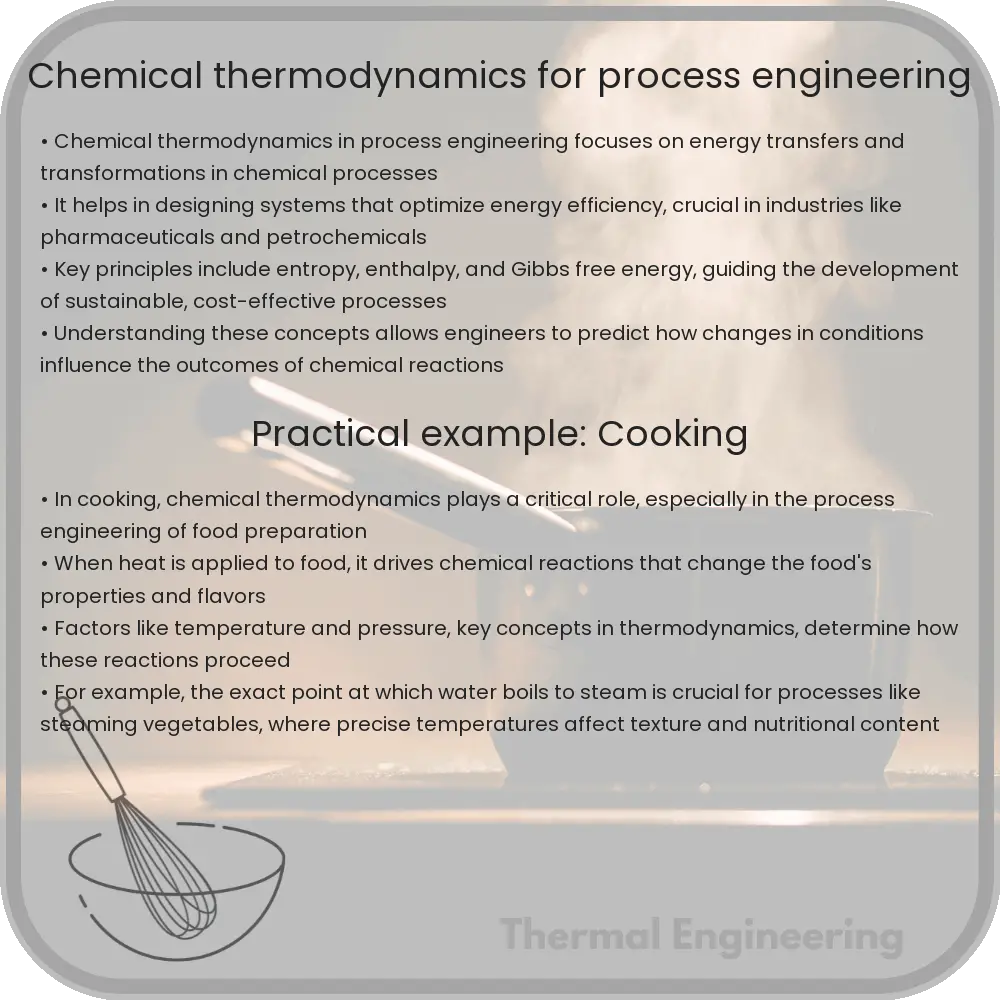
Chemical thermodynamics is a fundamental branch of chemical engineering that deals with the study of energy exchanges that occur during chemical reactions and phase transitions. This knowledge is crucial for designing and optimizing chemical processes in industries ranging from pharmaceuticals to petrochemicals. The principles of thermodynamics help engineers understand how to convert raw materials into desired products efficiently and sustainably.

Key Concepts in Chemical Thermodynamics

Several key concepts form the foundation of understanding chemical thermodynamics in process engineering:

  • First Law of Thermodynamics: Also known as the law of energy conservation, it states that energy cannot be created or destroyed in an isolated system. In engineering terms, this principle is crucial for determining the energy balance around a process. The first law is often expressed as ΔU = Q – W, where ΔU is the change in internal energy, Q is the heat added to the system, and W is the work done by the system.
  • Second Law of Thermodynamics: This law introduces the concept of entropy, a measure of the disorder or randomness of a system. It states that the entropy of an isolated system always increases over time. This principle helps engineers determine the feasibility of a process and the maximum efficiency that can be achieved.
  • Gibbs Free Energy: A vital tool in chemical thermodynamics, Gibbs free energy (G) combines enthalpy, entropy, and temperature to predict the direction of chemical reactions. A negative ΔG indicates a spontaneous process under constant temperature and pressure.
  • Phase Equilibria: Understanding how different phases (solid, liquid, gas) coexist at equilibrium is vital for separation processes like distillation and extraction. The phase behavior can be predicted using equations such as the Clausius-Clapeyron equation for phase transitions.
  • Chemical Equilibrium: The state where the concentrations of reactants and products remain constant over time. The equilibrium constant (K) provides a quantitative measure of the composition of the system at equilibrium. It is related to Gibbs free energy by the equation ΔG = -RT ln(K), where R is the gas constant and T is the temperature in Kelvin.

Applications in Process Engineering

Chemical thermodynamics is integral to the design, analysis, and optimization of various chemical processes. Some common applications include:

  • Energy Efficiency: By analyzing thermodynamic cycles such as the Heat Engine cycle or the Refrigeration cycle, engineers can improve the efficiency of power plants and refrigeration systems.
  • Reaction Engineering: Thermodynamics allows for the design of reactors where optimal conditions for desired reactions are maintained. This includes manipulating temperature, pressure, and concentration to maximize yield and minimize energy consumption.
  • Environmental Engineering: Thermodynamics helps in the design of processes that minimize energy consumption and waste production, contributing to more environmentally friendly manufacturing processes.
  • Material Synthesis: It aids in predicting and optimizing the conditions under which new materials and compounds can be synthesized.

Challenges and Future Directions

Despite its extensive applications, there are challenges in chemical thermodynamics that continue to drive research and innovation. These include the development of more accurate predictive models for complex mixtures, enhancing the integration of thermodynamics with molecular chemistry for nanoscale processes, and improving the scalability of thermodynamic models in industrial applications.

As process engineering evolves, the role of chemical thermodynamics will expand, especially with advancements in computational methods and techniques. Continued research and development in this field are essential for creating more efficient, cost-effective, and environmentally sustainable processes.

Understanding the basics of chemical thermodynamics can profoundly impact the development and improvement of industrial processes. By mastering these principles, process engineers can ensure more efficient, innovative, and sustainable industrial practices, ensuring their operations are not only profitable but also responsible.

Innovative cooling techniques for data centers

Explore innovative cooling techniques for data centers, including liquid immersion, direct-to-chip, and AI-optimized airflow management.

Innovative cooling techniques for data centers

Innovative Cooling Techniques for Data Centers

Data centers are critical hubs for processing, storing, and distributing vast amounts of digital information. As these facilities handle increasingly large data loads, the heat generated by their numerous servers also rises. Effective cooling solutions are essential not only for maintaining optimal operational conditions but also for ensuring energy efficiency and sustainability. This article explores some of the most innovative cooling techniques being implemented in modern data centers.

1. Liquid Immersion Cooling

Liquid immersion cooling is a technique where data center hardware is submerged in a non-conductive liquid. Heat generated by the server components is directly transferred to the liquid, which is then cooled using external heat exchangers. Unlike traditional air cooling, liquid immersion can significantly reduce cooling energy consumption and eliminate the need for space-consuming fans and air conditioning units.

  • Single-phase Immersion Cooling: In this approach, the coolant remains in a liquid state and circulates around the components, absorbing heat without changing its phase.
  • Two-phase Immersion Cooling: This technique involves a coolant that transitions between liquid and gas phases. The phase change helps absorb heat more efficiently, leading to further reductions in cooling energy requirements.

2. Direct-to-Chip Cooling

Direct-to-chip cooling targets the primary source of heat by routing cooling elements directly to the CPUs and other heat-generating components. Special coolants circulate through microchannels in a cold plate situated directly on the chip. This method is particularly effective at removing heat and maintains the components at a lower temperature compared to ambient air cooling.

3. Using Rear Door Heat Exchangers

Rear door heat exchanger units, also known as passive cooling doors, are attached to the backs of server racks. These units contain coils that cool the hot air exiting the servers, effectively recycling the cool air back into the data center. This approach is beneficial in managing the microenvironments within the data center without the need for extensive HVAC systems.

4. Geothermal Cooling

Geothermal cooling utilizes the earth’s stable underground temperature to cool data centers. By circulating a fluid through pipes buried deep underground, the heat from the data center is absorbed by the cooler earth, and the temperature-regulated fluid is recirculated back. This technique is highly efficient and sustainable, significantly reducing the reliance on mechanical cooling and lowering energy costs.

5. AI-Optimized Airflow Management

Advanced software algorithms can dynamically manage data center cooling systems. By continuously analyzing data on heat output and cooling metrics, artificial intelligence (AI) can adjust fans and cooling units in real-time to optimize airflow patterns and reduce cooling-related energy consumption. This smart application of AI not only enhances cooling efficiency but also prolongs hardware lifespan and decreases operational costs.

Benefits of Innovative Cooling Techniques

Implementing these innovative cooling techniques provides several benefits to data centers, including:

  • Reduced energy consumption and operational costs.
  • Enhanced performance of cooling systems and data center equipment.
  • Lower environmental impact through sustainable practices.
  • Increased scalability and flexibility in data center design.

As data centers continue to evolve, these advanced cooling technologies play a crucial role in addressing the challenges of heat management and energy efficiency. By integrating these innovative solutions, data centers can achieve optimal performance while contributing to environmental sustainability.

Thermodynamics in microscale heat transfer

Explore how thermodynamics and heat transfer principles apply at the microscale, crucial for advancing technology in miniaturized systems.

Thermodynamics in microscale heat transfer

Understanding Thermodynamics in Microscale Heat Transfer

Thermodynamics, a foundational pillar of physics and engineering, explores how energy is converted between heat and other forms of energy. When we zoom into the microscale — dimensions at the microscopic level generally in the micrometer range — understanding heat transfer becomes crucial for the development of efficient thermal management systems in electronics, micro-electromechanical systems (MEMS), and nanotechnology.

Basics of Heat Transfer at the Microscale

Heat transfer at the microscale isn’t vastly different from the macroscopic scale in terms of the basic principles—conduction, convection, and radiation still apply. However, the relative significance of these modes can drastically change due to the high surface-area-to-volume ratios at the microscale. Additionally, at such small scales, other effects such as electron tunneling and ballistic transport of heat can become significant.

Key Concepts in Microscale Thermodynamics

  • Fourier’s Law: At the microscale, Fourier’s law of heat conduction still holds, but the thermal conductivity can significantly vary depending on the material and its structure at the microscopic level.
  • Size Effects: As the characteristic length approaches the mean free path of the heat carriers (phonons, electrons), classical theories become less accurate. This is often characterized by a reduction in thermal conductivity.
  • Microscale Convection: Fluid flow at the microscale can deviate from traditional behavior due to effects like electroviscous effects and surface roughness, impacting heat transfer coefficients.
  • Quantum Effects: At very small scales, quantum mechanics can influence heat transfer, particularly when the dimensions are close to or smaller than the wavelength of the heat carriers.

Mathematical Modeling of Microscale Heat Transfer

To analyze heat transfer at the microscale, engineers and scientists use various mathematical models:

  • Classical Differential Equation Models: These are continuity equations modified to incorporate scale effects, such as the Boltzmann transport equation for phonons.
  • Molecular Dynamics (MD) Simulations: MD simulations provide a method to computationally visualize and analyze the movement of atoms and molecules in a substance, helping predict heat transfer behaviors at scales where traditional theories do not hold.
  • Monte Carlo Simulations: These statistical methods are used to understand probabilistic models of heat carrier transport and interaction processes.

For example, Fourier’s law in its one-dimensional form can be expressed as:

q = -k * (dT/dx)

where q is the heat flux, k is the thermal conductivity, and dT/dx represents the temperature gradient along the direction of heat transfer.

Applications of Microscale Thermodynamics

Effective thermal management is critical in various applications including:

  • Electronic Devices: As electronic devices scale down, managing heat becomes crucial. Microscale thermodynamics helps in designing more effective cooling strategies.
  • Energy Systems: In microscale energy systems like microreactors, understanding heat transfer can optimize performance and efficiency.
  • Bioengineering: In medical implants and lab-on-a-chip devices, heat transfer understanding at the microscale can enhance device reliability and function.

Ultimately, the exploration of thermodynamics at the microscale offers profound insights into heat transfer processes that are critical for advancing technology in miniaturized systems. It opens new avenues for innovation in material science, energy, and electronics, ensuring devices not only meet the spatial constraints but also operate efficiently and reliably.

Conclusion

Microscale thermodynamics and heat transfer involve complex interactions influenced by geometric, quantum, and material characteristics. These interactions necessitate sophisticated models and experimental methods for better understanding and application in cutting-edge technology fields.

Non-equilibrium thermodynamics in materials science

Explore how non-equilibrium thermodynamics influences materials science, focusing on systems outside of thermodynamic balance and their applications in developing advanced materials.

Non-equilibrium thermodynamics in materials science

Understanding Non-Equilibrium Thermodynamics in Materials Science

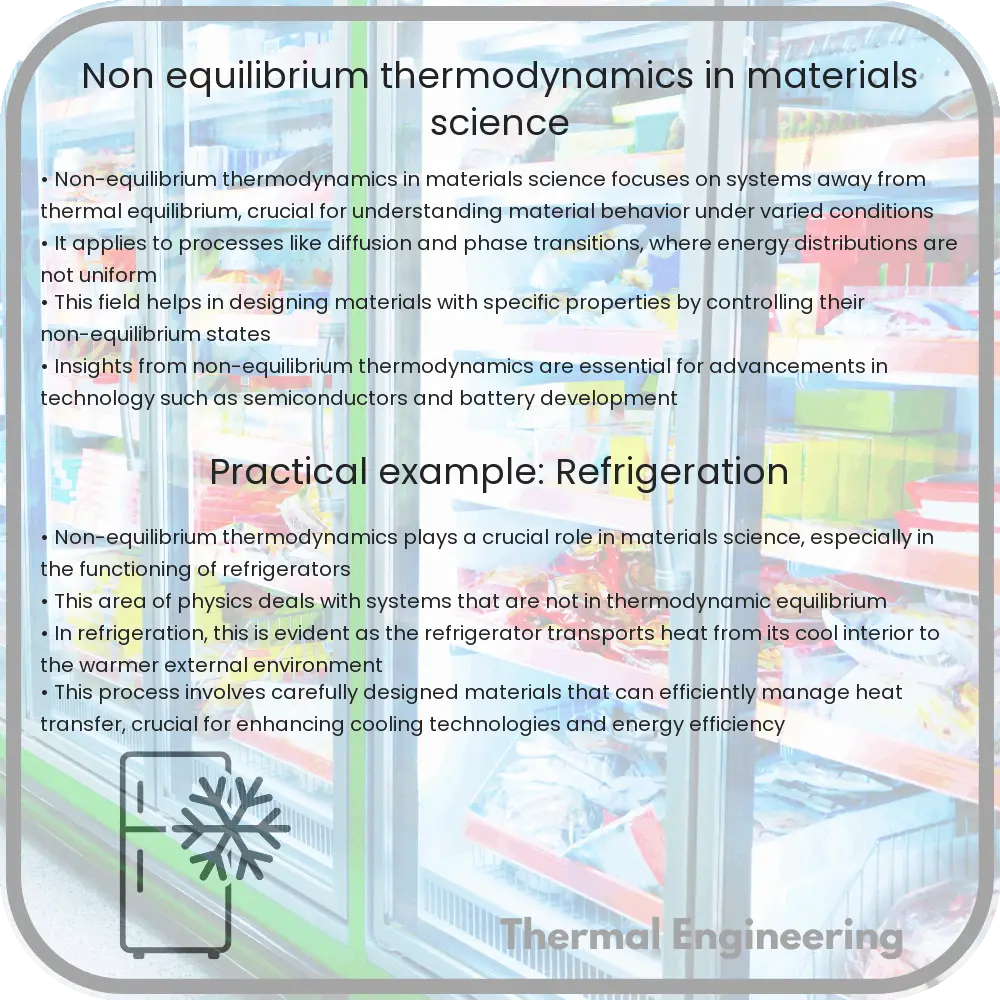
Non-equilibrium thermodynamics is a branch of physics that deals with systems that are not in thermodynamic equilibrium. Most natural processes occur far from equilibrium, and understanding these systems is crucial in materials science. This discipline plays a key role in developing new materials and improving existing ones, by controlling the processes that depend on thermal history such as phase transformations, diffusion, and reaction kinetics.

Basics of Non-Equilibrium Thermodynamics

In classical thermodynamics, the focus is on systems in equilibrium where macroscopic properties like temperature and pressure are uniform and do not change over time. Non-equilibrium thermodynamics, however, deals with conditions where these variables may vary within the system, leading to flows of energy and matter.

This approach involves extending the laws of thermodynamics to situations where irreversible processes occur, such as in the presence of temperature gradients, chemical reactions, or other external forces. The second law of thermodynamics, which in equilibrium states that entropy never decreases, is reformulated to account for the continuous production and flow of entropy in non-equilibrium systems.

Key Concepts in Non-Equilibrium Thermodynamics

  • Entropy Production: In non-equilibrium conditions, entropy production is crucial. It quantifies the irreversibility of a process and is always a non-negative quantity.
  • Fluxes and Forces: Non-equilibrium thermodynamics often involves various fluxes (like heat flux or particle flux) and thermodynamic forces (gradients of temperature, chemical potential, etc.) that drive these fluxes.
  • Onsager’s Reciprocal Relations: These are fundamental relations that provide a framework to relate fluxes and forces in linear non-equilibrium systems. They imply that the matrix of coefficients linking these quantities is symmetric.

Applications in Materials Science

Understanding non-equilibrium thermodynamics is essential in materials science, especially in areas such as:

  1. Diffusion: Describing how atoms and molecules move in materials, which affects the properties of alloys and ceramic materials.
  2. Phase Transformations: Non-equilibrium conditions influence the kinetics of phase changes in materials, critical for processing techniques like quenching in metallurgy.
  3. Thermal Treatments: Procedures like annealing, tempering, and hardening are governed by principles of non-equilibrium thermodynamics, affecting the microstructure and mechanical properties of materials.

Challenges and Future Directions

The study of non-equilibrium systems in materials science presents numerous challenges, primarily due to the complexity of these systems and the mathematical models involved. Researchers continue to develop more accurate and computationally efficient methods to better understand and predict the behavior of materials under non-equilibrium conditions.

Moreover, advances in experimental techniques, such as ultra-fast spectroscopy and high-resolution electron microscopy, allow scientists to observe the microscopic processes in real-time, providing deeper insights and validations for theoretical models.

As we improve our understanding and computational capabilities, non-equilibrium thermodynamics will enable more precise control over material properties, leading to innovative applications and more efficient materials processing technologies.

Conclusion

Non-equilibrium thermodynamics in materials science offers extensive opportunities for innovation and improvement in material properties and processing techniques. By bridging the gaps between theoretical understanding and practical application, this field continues to be a fundamental part of advancements in materials science and engineering.

Entropy generation minimization techniques

Learn about entropy generation minimization in engineering systems to enhance energy efficiency and system performance.

Entropy generation minimization techniques

Understanding Entropy Generation Minimization Techniques

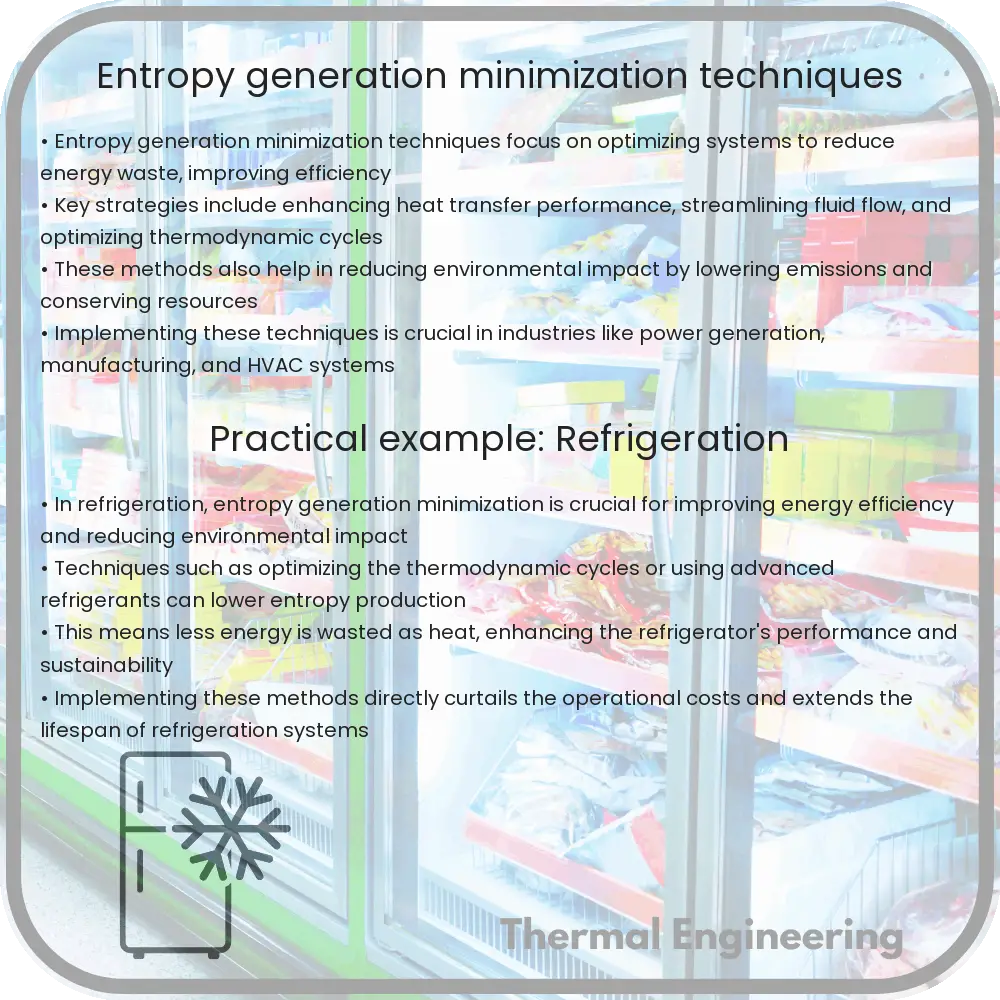
Entropy generation in engineering systems is a key concept that stems from the second law of thermodynamics. This law implies that during any process, the entropy (or disorder) of a system and its surroundings tends to increase. In engineering terms, minimizing entropy generation is crucial for enhancing the efficiency of energy systems. This article explores several techniques used to minimize entropy generation, thereby improving system performance and reducing energy waste.

Basic Concepts of Entropy

Entropy is a measure of the randomness or disorder in a system. The second law of thermodynamics states that the total entropy of an isolated system can never decrease over time. In practical applications, entropy generation refers to the loss of useful energy during a process, which results in less efficiency and more wastage of resources. Therefore, minimizing entropy generation is synonymous with optimizing energy use and enhancing system efficiency.

Techniques for Minimizing Entropy Generation

  • Better Design and Optimization: One of the primary methods to reduce entropy generation is through the careful design and optimization of components and processes. This includes optimizing shapes and sizes of components, streamlining flow paths, and improving thermal insulation, all of which reduce irreversible losses.
  • Utilization of Advanced Materials: The selection of materials with superior thermal properties can significantly cut down entropy production. Materials that can withstand higher temperatures and have lower rates of thermal conductivity help in preserving the energy levels in a system.
  • Waste Heat Recovery: Implementing processes that capture and reuse waste heat can effectively decrease entropy generation. Techniques like regenerative heat exchangers or using waste heat for cogeneration can leverage energy that would otherwise be lost to the surroundings.
  • Increasing Process Integration: Process integration involves redesigning adjacent or connected processes so that they operate more synergistically. For instance, using the output or waste from one process as the input for another reduces the total entropy generation across the system.
  • Control Systems: Sophisticated control systems can significantly influence entropy generation. By precisely controlling the operational conditions such as temperature, pressure, and flow rates, systems can be maintained close to their optimum performance states, minimizing entropy production.

Mathematical Representation of Entropy Generation

The generation of entropy \( S_{gen} \) in a process can be quantified using the following general relationship:

\[ S_{gen} = \frac{Q}{T} \]

where \( Q \) is the heat transfer involved in the process and \( T \) is the absolute temperature at which the heat transfer occurs. This mathematical framework helps in quantifying the inefficiencies and identifying areas for improvement in any engineering system.

Case Studies and Real-world Applications

In real-world applications, minimizing entropy generation has led to significant advancements in power generation, automotive engines, refrigeration systems, and air conditioning units. By applying the above techniques, engineers have successfully designed systems that operate closer to thermodynamic ideal conditions, reducing energy costs and environmental impacts.

For example, modern gas turbines now incorporate advanced aerodynamic designs and cooling technologies to minimize entropy generation, thus improving their efficiency and operational lifespan. Similarly, in the automotive industry, improving engine design and employing waste heat recovery systems have resulted in more fuel-efficient vehicles with lower emissions.

Conclusion

Minimizing entropy generation is a vital consideration in the design and operation of any energy system. By understanding and implementing techniques to reduce entropy production, engineers can significantly enhance the efficiency, sustainability, and cost-effectiveness of these systems. This not only fulfills engineering goals but also contributes towards a greener and more sustainable environment. As technology progresses, entropy minimization will continue to play a crucial role in the development of innovative and efficient engineering solutions.