Facebook Instagram Youtube Twitter

10 Types of Flow Instabilities in Fluid Dynamics

Learn about the 10 fundamental types of flow instabilities in fluid dynamics, crucial for various engineering applications.

10 Types of Flow Instabilities in Fluid Dynamics

10 Types of Flow Instabilities in Fluid Dynamics

Fluid dynamics, a sub-discipline of fluid mechanics, involves the study of how fluids (liquids and gases) behave under various conditions. One of the key challenges in fluid dynamics is understanding and managing flow instabilities. These instabilities can lead to phenomena like turbulence, which can impact engineering processes in industries ranging from aeronautics to civil engineering. Here are ten fundamental types of flow instabilities you should know about:

1. Kelvin-Helmholtz Instability

This type of instability occurs when there is a velocity difference across the interface between two fluids. For example, wind blowing over water can create waves due to the velocity shear in the adjacent layers of the air and the water.

2. Rayleigh-Taylor Instability

The Rayleigh-Taylor instability happens when a denser fluid is on top of a lighter fluid under the influence of gravity. This unstable arrangement leads to the heavier fluid sinking into the lighter fluid, forming intricate patterns such as those seen in certain cloud formations or supernovae explosions.

3. Saffman-Taylor or Viscous Fingering Instability

Viscous fingering occurs when a less viscous fluid pushes a more viscous fluid. This instability is often observed in porous media where water displaces oil, leading to patterns resembling fingers at the interface.

4. Rayleigh-Bénard Convection

When a fluid layer is heated from below, cooler, denser fluid from the top descends while warmer, lighter fluid rises, setting up a convective motion. This can become unstable, leading to a characteristic cell-like pattern known as Bénard cells.

5. Kármán Vortex Street

A von Kármán Vortex Street forms behind a bluff body in a flowing fluid. It is characterized by alternating vortices shed periodically from opposite sides of the body and plays a significant role in engineering scenarios like bridge and building design to prevent oscillatory instabilities.

6. Taylor-Couette Flow

This type of instability occurs between two rotating cylinders with fluid in between. Depending on the speed and direction of the rotations, the fluid can exhibit complex flow patterns including toroidal vortices.

7. Görtler Vortices

Görtler vortices are streamwise vortices that appear along concave walls, due to the centrifugal force acting on the boundary layer. These are significant in aerospace engineering, influencing skin friction drag on aircraft surfaces.

8. Tollmien-Schlichting Waves

These waves grow in amplitude within the boundary layer of laminar flows and can lead to the transition from laminar to turbulent flow if they become sufficiently large. Understanding these instabilities is key in maintaining laminar flow to reduce drag in applications like aviation.

9. Plateau-Rayleigh Instability

This instability occurs in slender jets or threads of liquid surrounded by another fluid. Due to surface tension effects, the cylinder of liquid can break up into droplets – an important phenomenon in inkjet printing and microfluidic applications.

10. Shock Wave Instability

Shock waves can become unstable, particularly in supersonic flow conditions. This can lead to complex wave patterns that are crucial to understand in high-speed aerodynamics and scramjet design.

Understanding these flow instabilities not only provides insights into the underlying physics but also aids in designing more effective engineering systems, ensuring stability and efficiency across various applications. Each type of instability presents unique challenges and opportunities for innovation in fluid dynamics.

7 Types of Cooling Techniques for Data Centers

An overview of effective cooling techniques like air conditioning, in-row cooling, and liquid cooling used in modern data centers.

7 Types of Cooling Techniques for Data Centers

Introduction to Cooling Techniques in Data Centers

Data centers are critical facilities that house computer systems, servers, and associated components. As these devices operate, they generate significant amounts of heat, which can reduce system performance and longevity if not adequately managed. Effective cooling solutions are paramount to ensure operational efficiency and maintain system reliability. This article explores seven common cooling techniques utilized in data centers.

1. Air Conditioning

Air conditioning units are one of the most traditional methods for cooling data centers. These systems use refrigerants and compressor technology to lower the temperature of the air. Cold air is then circulated throughout the facility to absorb the heat generated by the servers before being cycled back to the air conditioning unit for re-cooling.

2. In-Row Cooling

In-row cooling involves placing cooling units directly adjacent to server racks. This setup minimizes the distance that cold air travels before reaching the servers, which enhances cooling efficiency and effectiveness. The cooled air is directly targeted at the heat source, providing localized cooling for high-density configurations.

3. Liquid Cooling

Liquid cooling systems use a liquid coolant to absorb heat directly from the servers. This method typically utilizes water or a glycol mix, circulated through pipes and directly cooling components either via direct contact or through heat exchangers installed within the server racks. Liquid cooling is particularly effective at managing the high heat loads of modern data centers.

4. Free Cooling

Free cooling leverages external environmental conditions to assist in the cooling process. This technique can be employed in cooler climates where the outside air temperature is sufficiently lower than the desired data center temperature. By using economizers, outside air is brought in to cool the facility, significantly reducing the reliance on mechanical cooling.

5. Hot Aisle/Cold Aisle Configuration

This configuration involves the physical layout of server racks in alternating rows with hot aisle and cold aisle. The cold aisles face the AC output ducts, while the hot aisles face the AC return ducts. This arrangement helps keep the hot exhaust air from the servers separate from the cooled intake air, improving overall cooling efficiency.

6. Rear Door Heat Exchangers

Rear door heat exchangers (RDHx) are attached to the back of server racks, acting as a radiator that cools the air as it exits the server. The heat exchanger uses a coolant to absorb heat from the warm air ejected from the servers. This system allows for immediate cooling of exhaust without mixing it with the surrounding air, enhancing the cooling efficiency.

7. Immersive Cooling

In immersive cooling, server components are completely immersed in a non-conductive liquid. Heat from the servers is transferred directly to the liquid, thereby reducing the need for active cooling components like fans within the servers, which also leads to significant energy savings. This method is an emerging technology that is becoming more viable as heat loads continue to increase.

Conclusion

Choosing the right cooling strategy for a data center depends on several factors including geographic location, energy costs, environmental considerations, and the specific hardware used. As data centers continue to evolve, these cooling technologies are also being refined to provide more energy-efficient and cost-effective solutions to meet growing cooling demands.

5 Types of Phase Transition in Fluid Dynamics

Exploring phase transitions in fluid dynamics and their implications in natural and engineered systems.

5 Types of Phase Transition in Fluid Dynamics

Understanding Phase Transitions in Fluid Dynamics

Phase transitions in fluid dynamics are fascinating phenomena that involve the change of a fluid from one state or phase to another. These transitions play a critical role in various natural processes and engineering applications. Understanding these transitions is key to innovations in areas such as aerospace, automotive engineering, and climate science. Here, we explore five fundamental types of phase transitions commonly observed in fluid dynamics.

1. Vaporization

Vaporization is the phase transition from liquid to gas. This process can occur in two forms: boiling or evaporation. Boiling happens when a liquid’s temperature reaches its boiling point at a given pressure, leading to the formation of vapor bubbles within the liquid. Evaporation, on the other hand, occurs at temperatures below the boiling point, where molecules at the surface gain enough energy to transition into a gaseous state.

2. Condensation

Condensation is the transition from a gas phase to a liquid phase. This change occurs when a vapor is cooled below its saturation temperature at a fixed pressure, often leading to the formation of droplets. Condensation is crucial in processes involving heat transfer devices like condensers in power plants or in the water cycle in nature.

3. Freezing

Freezing or solidification refers to the transformation of a liquid into a solid. This transition occurs when the temperature of a liquid drops below its freezing point, causing the molecules to arrange into a crystalline lattice. Freezing is vital in fields such as cryogenics, food preservation, and in the study of polar ice dynamics.

4. Melting

Melting, the opposite process to freezing, is the transition from solid to liquid. When the temperature of a solid rises above its melting point, the crystalline lattice breaks down, and the solid becomes a liquid. Melting is significant in metallurgy, glaciology, and in the manufacturing of substances like glass and plastic.

5. Sublimation and Deposition

Sublimation and deposition are two additional phase transitions involving the direct interconversion between solid and gas phases, bypassing the liquid state. Sublimation occurs when a solid turns directly into a gas, which can be observed in dry ice (solid CO2) and the way snow and ice vanish in cold, dry conditions. Deposition is the reverse process, where a gas turns directly into a solid, such as frost forming from water vapor in the air.

Each of these phase transitions involves unique behaviors and principles that are essential to the understanding of fluid dynamics in both natural environments and engineered systems. By studying these changes, scientists and engineers can design better equipment and systems to manage these transitions, improving efficiency and performance in various applications.

Conclusion

Phase transitions in fluid dynamics are more than just theoretical concepts; they are integral to many of the processes and technologies that shape our world. From weather patterns and global warming to industrial processes and everyday products, the ability to understand and manipulate these transitions can lead to significant advancements and efficiencies.

9 Types of Thermal Insulation for Roofs

Learn about the nine common types of thermal insulation for roofs, their properties, and applications for energy efficiency.

9 Types of Thermal Insulation for Roofs

Understanding Thermal Insulation for Roofs

Thermal insulation is a critical component in building design, contributing to the overall energy efficiency and comfort of buildings. Proper insulation reduces the heat transfer between the outside environment and the interior spaces, helping maintain a stable indoor temperature and reducing energy costs. Here we explore nine common types of thermal insulation materials used in roofing applications, each with its unique properties and applications.

Types of Roof Insulation Materials

  • Fiberglass Insulation: Made from fine glass fibers, fiberglass is one of the most common forms of insulation in residential and commercial buildings. It’s available in batts or rolls and is effective due to its low heat transfer characteristics.
  • Rigid Foam Insulation: This type of insulation comes in large panels of varying thicknesses and can be cut to fit any space. Polystyrene, polyisocyanurate (polyiso), and polyurethane are common types of rigid foam, each with different thermal resistance properties.
  • Spray Foam Insulation: Applied using a spray device, spray foam expands upon application, filling in gaps and offering high R-values (a measure of thermal resistance). It is available in open-cell and closed-cell forms, each providing different moisture and air infiltration characteristics.
  • Reflective Insulation: Also known as radiant barriers, reflective insulation uses materials like aluminum foil to reflect radiant heat away from the building, reducing cooling costs particularly in hot climates.
  • Mineral Wool: Also referred to as rock wool or slag wool, mineral wool is made from molten glass, stone, or industrial waste. It is highly fire resistant and effective at soundproofing in addition to its insulation properties.
  • Cellulose: Comprising of recycled paper products, primarily newspaper, and treated with fire retardant, cellulose is an eco-friendly option. It is usually blown into place and can adapt to odd-shaped enclosures and obstacles.
  • Wood Fiber: Produced from wood product waste, wood fiber panels are treated with natural binders and fillers. Besides providing thermal insulation, they also offer sound insulation properties and are breathable, helping control humidity.
  • Foam Glass: Composed of crushed glass that is heated until it puffs and binds together, foam glass is lightweight, highly durable, and resistant to water and fire. It is particularly useful in flat roof and floor insulation.
  • Aerogel: Known for its exceptional thermal resistance, aerogel is a synthetic porous ultralight material derived from a gel, in which the liquid component of the gel has been replaced with a gas. It is often used in specialized environments, such as industrial applications or in aerospace, due to its high cost.

Choosing the Right Insulation Type

Selecting the appropriate insulation material for a roof depends on various factors including climate, budget, roof design, and specific building codes. Higher R-value materials tend to offer better thermal resistance but may come at a higher cost or with other considerations such as weight or installation requirements. Assessing the long-term energy savings is also crucial in making the most cost-effective decision for roof insulation.

In conclusion, the wide range of insulation types available allows for flexibility in meeting the insulation needs of different roofing systems under varying environmental and budgetary conditions. Consulting with an insulation professional can provide further guidance tailored to specific project needs, ensuring optimal energy efficiency and comfort.

3 Types of Temperature Gradients and Their Significance

Explore the crucial role and types of temperature gradients in thermal physics and engineering for efficient system design.

3 Types of Temperature Gradients and Their Significance

Understanding Temperature Gradients: Types and Their Significance

Temperature gradients are crucial in the study of thermal physics and engineering, where the rate of temperature change spatially (distance-wise) plays a pivotal role in various physical processes and applications. A temperature gradient is essentially the difference in temperature per unit distance within a substance, which drives heat transfer by conduction or affects fluid movement in natural convection. In engineering, understanding and managing temperature gradients is essential for designing efficient systems in aerospace, civil, and mechanical domains, among others.

There are several types of temperature gradients that can occur in different scenarios, each having its own significance in scientific research and engineering applications. Here, we discuss three main types: linear, radial, and spherical temperature gradients.

1. Linear Temperature Gradient

A linear temperature gradient occurs when the temperature changes at a constant rate over a linear distance. This is often seen in thin, flat materials where heat is conducted from one side to the other in a uniform manner. The linear temperature gradient can be expressed mathematically as:

\[ \frac{dT}{dx} \]

Where \( dT \) is the change in temperature, and \( dx \) is the change in distance. Linear gradients are significantly important in understanding heat transfer rate through materials like metal bars or building walls.

2. Radial Temperature Gradient

In cylindrical or spherical objects, such as pipes or storage tanks, the temperature changes radially from one surface to another. This type of gradient is termed a radial temperature gradient and is crucial in the study of heat flow in cylindrical and spherical coordinates. The gradient here is expressed as:

\[ \frac{dT}{dr} \]

Where \( dr \) is the radial distance. Radial gradients are especially significant in applications like geothermal engineering, chemical reactors, and thermal insulation systems.

3. Spherical Temperature Gradient

Spherical temperature gradients are observed in spherical bodies, where the temperature changes from the center of the sphere outward. This situation is common in astrophysics (e.g., stars, including our Sun) and in applications involving spherical reactors or storage spheres. The temperature gradient in a sphere is given by:

\[ \frac{dT}{dr} \]

Here, the distinction from the radial gradient in a cylinder is largely due to the symmetry and boundary conditions specific to spheres, which influence heat transfer and fluid flow differently.

Significance of Understanding Temperature Gradients

Temperature gradients are fundamental to the design and analysis of heating, ventilation, and air conditioning (HVAC) systems, thermal engines, and electronic devices. Engineers rely on understanding these gradients to predict how heat will move through materials, which is essential for material design, thermal insulation, and safeguarding structural integrity against thermal stresses that could lead to material failure.

Moreover, in the natural world, temperature gradients drive weather phenomena and ocean currents, which are critical for meteorological studies and environmental engineering. By studying these gradients, scientists and engineers can develop more effective strategies for energy conservation, environmental protection, and enhanced safety in technology applications.

Thus, understanding the types, contexts, and implications of temperature gradients not only enriches the field of thermal engineering but also supports advancements in technology and environmental management on a broader scale.

8 Types of Fluid Dynamic Bearings for Machinery

Learn about fluid dynamic bearings, their types, applications, and how they enhance machinery performance and lifespan.

8 Types of Fluid Dynamic Bearings for Machinery

Understanding Fluid Dynamic Bearings: Types and Applications

Fluid dynamic bearings are a pivotal component in many machines, providing low friction, long life, and excellent load-carrying capabilities. These bearings utilize a thin layer of fluid—either liquid or gas—as a lubricant in the space between the bearing surfaces. This layer can conform during operation, significantly reducing wear and avoiding direct metal-to-metal contact. Here, we explore eight common types of fluid dynamic bearings utilized in various machinery and their distinct characteristics.

1. Journal Bearings

Journal bearings are widely used in rotating machinery, like turbines, pumps, and compressors. They support the rotating shafts by forming a fluid film between the shaft and the bearing. The classic design includes a cylindrical shaft and a corresponding sleeve that allows the shaft to rotate smoothly within the bearing.

2. Thrust Bearings

Thrust bearings are designed to accommodate axial loads on rotating parts. Common in automotive and aerospace industries, these bearings consist of several pads arranged in a circle; these pads support axial forces on the rotating shaft, allowing smooth rotation.

3. Spherical Roller Bearings

Spherical roller bearings are used where there is significant misalignment between the shaft and the bearing housing. This type features an inner ring with two raceways and a spherical outer raceway, with the rollers shaped accordingly. They support radial and axial loads in both directions and are highly suited for applications involving misaligned or shaft deflection.

4. Cone Bearings

Cone bearings are a variant of journal bearings but with a conical geometry. These bearings can adjust to support both radial and axial loads simultaneously. They are particularly useful in applications where precision is required and load directions can vary.

5. Flexure Bearings

Flexure bearings rely on elastic deformation for movement and load support. They often consist of a fluid film formed by both forced and natural flow, resulting in minimal friction and wear. These bearings are commonly applied in high-precision machinery such as optical and measuring instruments.

6. Tilt Pad Bearings

Tilt pad bearings include several movable elements or pads, which tilt to adapt to the movement and alignment of a shaft. This capacity makes them ideal for high-speed applications where dynamic stability is crucial, such as in turbines.

7. Kingsbury Bearings

A specific type of thrust bearing, Kingsbury bearings consist of a series of sector-shaped pads that can pivot around their own axes. This feature allows the bearing to accommodate both radial and thrust loads, making them suitable for large, heavy-duty turbomachinery.

8. Magnetic Bearings

Magnetic bearings use magnetic forces to levitate and stabilize the rotating shaft, eliminating direct contact and thus wear and friction traditionally associated with mechanical bearings. These are used in applications requiring very high speeds, uncompromised precision, or where lubrication is problematic.

Fluid dynamic bearings play a critical role in the performance and longevity of various machines. By understanding the different types of bearings and their specific advantages, engineers can select the most appropriate bearing for their application, leading to increased efficiency, reduced wear, and extended machinery lifespans.

4 Types of Heat Recovery Steam Generators (HRSG)

Learn about Heat Recovery Steam Generators (HRSG), key in enhancing energy efficiency in power plants and industries.

4 Types of Heat Recovery Steam Generators (HRSG)

Introduction to Heat Recovery Steam Generators (HRSG)

Heat Recovery Steam Generators (HRSGs) are crucial components in the energy sector, particularly within cogeneration and combined cycle power plants. These systems capture exhaust heat from gas turbines and convert it into steam. This steam can then be used for additional power generation or industrial processes, effectively improving the overall energy efficiency of the operation. HRSGs come in different configurations, each tailored to meet specific operational demands and thermal efficiencies. Below, we explore four common types of HRSGs used in various applications.

1. Horizontal Drum HRSG

The Horizontal Drum HRSG features a drum positioned horizontally, facilitating the natural separation of water and steam during the phase transition. This design is well suited for applications with limited vertical space or specific architectural constraints.

  • Advantages: Simplified construction, easier maintenance access, and lower capital cost.
  • Common Applications: Small to medium-sized power plants and industries requiring steam for both power and processing applications.

2. Vertical Drum HRSG

Unlike the horizontal type, the Vertical Drum HRSG features a vertically oriented drum. This arrangement aids in accommodating higher pressures and facilitates more effective steam-water separation due to gravity.

  • Advantages: Better water quality control, which is crucial for high-pressure operations.
  • Common Applications: High-pressure turbine installations, particularly in larger power plant configurations where efficiency and high-quality steam are imperative.

3. Once-Through HRSG

The Once-Through HRSG does not use a drum for steam-water separation. Instead, it allows water to convert directly into steam as it passes through the boiler tubes, which are designed to handle the full range of steam pressures and temperatures.

  • Advantages: Higher efficiency, capable of reaching supercritical levels of operation, and a smaller footprint.
  • Common Applications: High-efficiency combined cycle plants where space and efficiency are at a premium.

4. Modular HRSG

Modular HRSGs are designed for rapid construction and flexibility. These systems consist of pre-fabricated modules that can be quickly assembled on site. Each module is designed to be independently functional, which allows for a tailored arrangement that meets specific site requirements.

  • Advantages: Reduced installation time, flexibility in design, and scalability.
  • Common Applications: Power plants and industries that require custom solutions and may need to scale operations up or down with minimal disruption.

Conclusion

Heat Recovery Steam Generators play a pivotal role in enhancing the efficiency of energy production systems. The choice among the four types of HRSGs—horizontal drum, vertical drum, once-through, and modular—depends on specific project needs, including space constraints, operational pressures, steam quality requirements, and the need for scalability. By choosing the appropriate HRSG type, facilities can optimize their energy output and reduce their environmental footprint, making these systems a cornerstone of sustainable industrial practices.

4 Types of Thermal Efficiency Improvement Strategies

Explore strategies to increase thermal efficiency in engineering systems, enhancing performance and sustainability.

4 Types of Thermal Efficiency Improvement Strategies

Understanding Thermal Efficiency in Engineering

Thermal efficiency plays a critical role in determining the performance and sustainability of various engineered systems, from power plants to internal combustion engines. Improving thermal efficiency means more energy is converted into useful work or output, reducing waste, costs, and environmental impact. Here, we explore four prevalent strategies used in engineering to enhance thermal efficiency.

1. Enhancing Heat Recovery Processes

In many industrial systems, a significant amount of energy is lost through waste heat. Strategies that focus on recovering this heat can significantly boost the system’s overall thermal efficiency. Heat recovery systems like regenerative heat exchangers, or the use of waste heat boilers in power plants, can capture and reuse the energy from exhaust gases or other waste heat sources.

2. Utilizing Higher Efficiency Equipment

Advancements in material science and engineering design have led to the development of more efficient mechanical and electrical components. For instance, gas turbines with advanced coatings that can withstand higher temperatures enable the turbine to operate more efficiently by reducing energy losses. Similarly, upgrading to more efficient boilers, compressors, and other machinery can minimize thermal losses and improve the overall energy efficiency of the system.

3. Optimizing Operational Procedures

Thermal efficiency can also be improved by optimizing how a system operates. In power plants, for example, fine-tuning the operation to manage load demands more accurately can reduce wastage and improve the load factor. Implementing predictive maintenance and real-time monitoring to ensure all equipment operates at peak efficiency can also lead to significant enhancements in thermal efficiency.

4. Integration of Renewable Energy Sources

Incorporating renewable energy sources like solar thermal, geothermal, or biomass can reduce reliance on less efficient and more polluting conventional energy sources. For example, solar thermal power plants convert sunlight into heat, achieving high thermal efficiency levels during the conversion process. Combining these renewable technologies with traditional systems can increase the overall efficiency and sustainability of energy production.

Conclusion

Improving thermal efficiency is crucial for developing more sustainable and cost-effective engineering solutions. By implementing heat recovery systems, utilizing advanced equipment, optimizing operational procedures, and incorporating renewable energy, engineers can significantly enhance the thermal efficiency of various systems. These strategies not only aid in conserving energy but also contribute to the global effort in reducing environmental impacts.

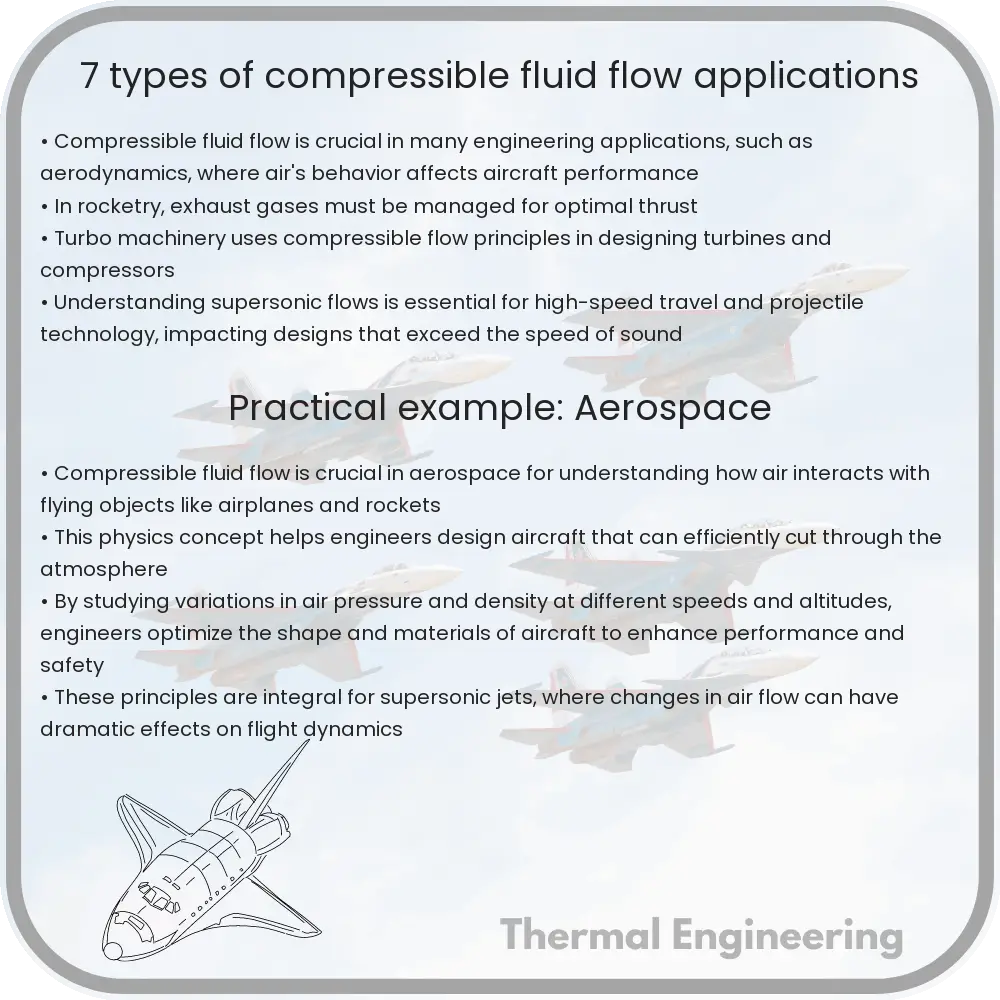
7 Types of Compressible Fluid Flow Applications

Uncover the dynamics of compressible fluid flow, emphasizing its variability in density due to changes in pressure and temperature, and its pivotal role in diverse engineering applications.

7 Types of Compressible Fluid Flow Applications

Understanding Compressible Fluid Flow: Its Importance and Applications

Compressible fluid flow refers to the movement of fluids (most often gases) in which the fluid density can vary significantly due to changes in pressure and temperature. This variability distinguishes it from incompressible flow, where density remains nearly constant. The study of compressible flow is crucial in numerous engineering applications, particularly where high velocities or significant pressure variations occur.

This article explores seven key applications of compressible fluid flow that illustrate its importance in both everyday and specialized engineering contexts.

1. Aerospace Engineering

  • Aircraft Design: High-speed aircraft, such as commercial jets and fighter planes, experience significant changes in air density at high altitudes and speeds. Compressible flow principles are essential for understanding shock waves, boundary layers, and overall aerodynamics critical in aircraft performance and safety.
  • Space Vehicles: Rockets and space shuttles moving through the atmosphere and into space experience variable atmospheric density. Compressible fluid dynamics help in designing these vehicles for optimal thrust and fuel efficiency.

2. Automotive Engineering

  • Engine Intakes: The design of air intake systems in combustion engines involves compressible flow to optimize air-fuel mixtures, improving efficiency and power output.
  • Turbochargers and Superchargers: These components use compressible flow dynamics to increase the engine intake air pressure, boosting the engine’s power without increasing its size.

3. Power Generation

  • Steam Turbines: In power plants, steam often undergoes dramatic pressure and temperature changes, hence understanding compressible flow is vital for the design and operation of turbines and other related equipment.

4. HVAC Systems

  • High-speed Duct Flow: For HVAC systems in large buildings or in vehicles, effectively designing ductwork requires understanding how gases behave under different pressures and temperatures to maintain comfort and system efficiency.

5. Environmental Engineering

  • Wind Engineering: The study of wind effects on landscapes, buildings, and other structures often deals with varying air densities and velocities, requiring knowledge of compressible flow.

6. Chemical and Process Engineering

  • Pipe Transport of Gaseous Substances: Transporting gases in industrial processes often involves varying pressures that can only be effectively managed by applying compressible flow principles to prevent accidents and ensure efficiency.

7. Defense and Military Applications

  • Ballistics: The behavior of gases in gun barrels and propulsion systems of projectiles involves rapidly changing pressures and temperatures, critical for the design and effectiveness of weaponry.
  • Explosive Ordinance Disposal: Understanding shock waves and their propagation through air, essential for assessing risks and effects of explosions, is a key application of compressible flow in military contexts.

The applications mentioned provide just a glance at how wide and critical compressible fluid flow is in various fields of engineering. Each application leverages the unique properties of gases at varying pressures and temperatures to enhance system performance, safety, and efficiency, underscoring the importance of this area of fluid mechanics.

5 Types of Heat Transfer Fluids in Solar Energy

Learn about heat transfer fluids key to enhancing solar thermal systems’ efficiency, exploring types like water, synthetic oils, and more.

5 Types of Heat Transfer Fluids in Solar Energy

Understanding Heat Transfer Fluids in Solar Energy Systems

Heat transfer fluids (HTFs) play a pivotal role in the efficiency and functionality of solar thermal systems. These fluids are responsible for absorbing, transporting, and storing solar heat. Their properties affect the system’s performance, including its efficiency, operational temperature range, and maintenance requirements. Below, we’ll explore five common types of heat transfer fluids used in solar energy systems and discuss their characteristics and applications.

1. Water

Water is one of the most commonly used heat transfer fluids due to its excellent heat transfer properties, affordability, and availability. It has a high specific heat capacity, which allows it to absorb and transport significant amounts of heat. Water is typically used in low to medium-temperature solar thermal systems. However, it can be prone to freezing in cold climates and may cause corrosion in certain types of metal pipes or storage systems.

2. Synthetic Oils

Synthetic oils, also known as thermal oils, are engineered to have high boiling points and remain stable at high temperatures. They are primarily used in high-temperature solar thermal applications, such as in concentrating solar power (CSP) systems. Synthetic oils can typically operate up to 400°C without degrading, making them suitable for systems that require a wide range of operating temperatures. However, these oils are more expensive than water and can be a fire hazard at elevated temperatures.

3. Glycol Mixtures

Ethylene glycol or propylene glycol mixed with water serves as an effective heat transfer fluid, especially in climates prone to freezing conditions. Glycol mixtures prevent the fluid from freezing, allowing the solar thermal system to operate in colder environments. These mixtures also have inherent anti-corrosive properties, which can protect the system’s components. However, glycol has a lower heat capacity than water, which can slightly reduce the system’s overall efficiency.

4. Molten Salts

Molten salts are commonly used in CSP systems and can operate at temperatures of 600°C or higher. The most commonly used molten salts are mixtures of sodium nitrate and potassium nitrate, which have good thermal storage properties and can retain heat for extended periods. This ability makes them ideal for 24-hour solar power generation. The main challenges with molten salts include their corrosiveness and the need for high maintenance to manage this issue.

5. Phase Change Materials (PCMs)

Phase Change Materials are substances that absorb and release thermal energy during the process of melting and freezing. PCMs can be integrated into solar thermal systems to enhance heat storage capacity. When incorporated correctly, they help maintain a consistent supply of thermal energy, even when solar radiation varies. Common PCMs include paraffin wax and salt hydrates. The choice of PCM typically depends on its melting point, which should match the operational temperature range of the specific solar system.

Conclusion

Choosing the right heat transfer fluid is crucial for the optimal performance of solar thermal systems. Each type of HTF has its specific advantages and limitations based on factors such as operating temperature, heat capacity, and geographical climate conditions. By understanding these characteristics, engineers can design more efficient, durable, and cost-effective solar energy systems.