Facebook Instagram Youtube Twitter

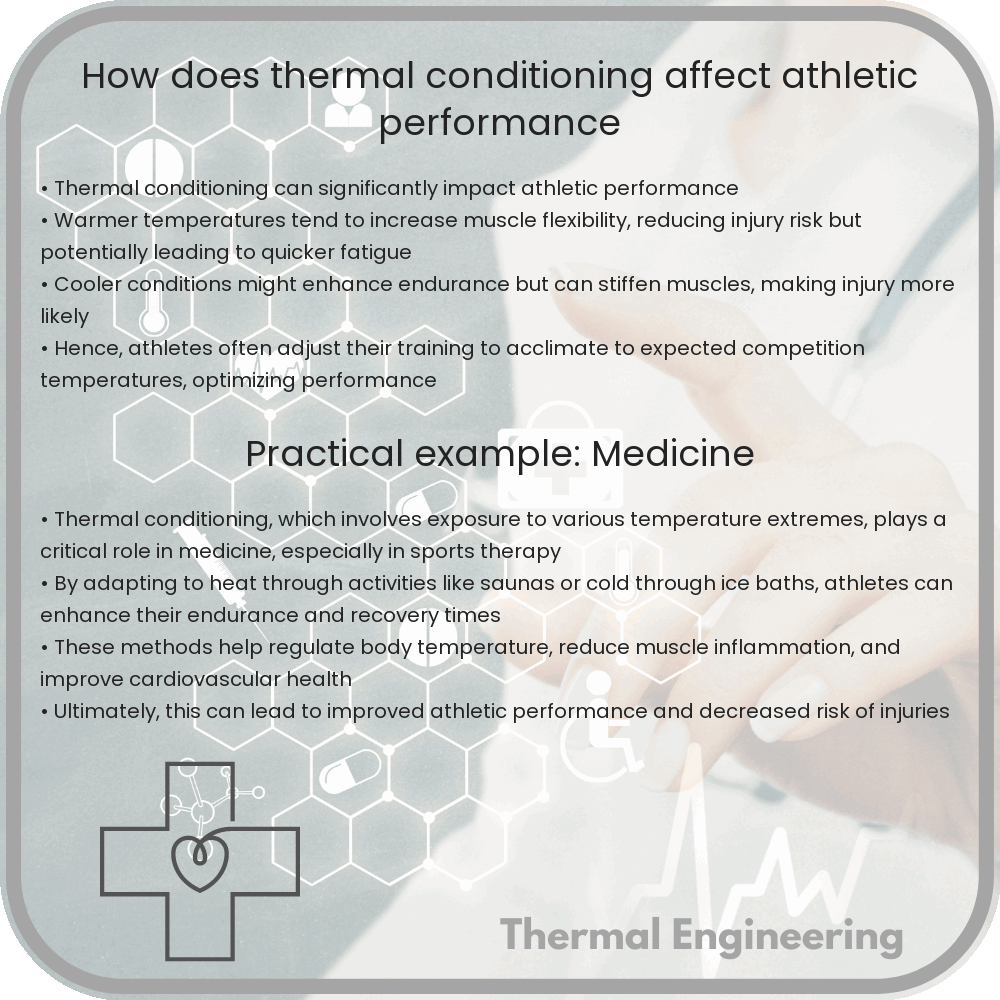
How does thermal conditioning affect athletic performance

Explore how thermal conditioning influences athletic performance by adapting to hot and cold environments, enhancing safety and efficiency.
How does thermal conditioning affect athletic performance

The Impact of Thermal Conditioning on Athletic Performance

Thermal conditioning—referring to the regulation or acclimatization of an athlete to different thermal environments (hot or cold)—is a significant factor affecting sports performance and safety. Whether preparing for competition in adverse weather conditions or optimizing comfort, understanding thermal effects is crucial for peak athletic output.

Understanding the Basics of Thermal Conditioning

Thermal conditioning typically involves exposing athletes to hot or cold environments as part of their training regimen. This exposure aims to trigger physiological adaptations that enhance the body’s ability to perform under similar environmental stressors during actual competitions.

  • Heat Acclimatization: This prepares athletes for performance in hot conditions. Techniques include training in heated environments or using extra clothing to increase body temperature.
  • Cold Acclimatization: This involves training in cold environments, which can help athletes perform better in low-temperature situations by improving the body’s thermal retention and reducing the risk of hypothermia.

Physiological Responses and Adaptations

Several key physiological adaptations occur with thermal conditioning:

  • Cardiovascular Adjustments: Acclimatization helps in improving blood plasma volume, cardiac output, and sweat rate, leading to better temperature regulation.
  • Metabolic Changes: In colder environments, metabolism may increase to produce more heat and maintain body temperature, whereas in hotter conditions, enhanced efficiency in heat dissipation is observed.
  • Enhanced Cooling: Heat acclimatization increases total body water, sweat rate, and skin blood flow, enhancing the heat loss mechanisms through evaporation and convection.

Impact on Performance

The effectiveness of thermal conditioning can directly influence athletic performance:

  • Endurance: Training in hot climates improves an athlete’s endurance by optimizing cardiovascular functions and thermal balance.
  • Strength and Power: Cold environments can enhance strength and power outputs in some athletes by improving neuromuscular reactions and reducing the risk of overheating.
  • Recovery: Proper thermal management post-exercise can greatly influence recovery times, reducing muscle soreness and improving subsequent performance readiness.

Applications in Sports

Sports teams across various disciplines use thermal conditioning to prepare athletes. For instance:

  1. Marathon runners may train in heat for races anticipated to be held in warm climates to improve their heat tolerance and fluid balance.
  2. Skiing and snowboarding athletes frequently engage in cold air training to acclimate their bodies to harsh, frigid conditions they might face during competitions.
  3. Football and soccer teams may use climatic chambers that simulate different environmental conditions to prepare players for the varying weather conditions they may encounter in away games.

Conclusion

Thermal conditioning is a vital aspect of athletics that can dramatically affect performance and safety. By optimizing the body’s physiological responses to extreme temperatures, athletes can greatly enhance their overall efficiency and capability in their sports. Incorporating targeted thermal training into regular athletic preparation is proven to provide strategic advantages, making it an essential practice in modern sports science.

What are the thermal management techniques in spacecraft design

Explore the critical role and techniques of thermal management in spacecraft design to ensure operational safety and equipment longevity in space.

What are the thermal management techniques in spacecraft design

Understanding Thermal Management in Spacecraft Design

Thermal management is a critical aspect of spacecraft engineering, ensuring that the onboard temperatures remain within safe operational limits despite the harsh conditions of space. Effective thermal control systems protect sensitive electronic equipment from extreme temperatures, both from the intense heat of the Sun and the cold vacuum of space.

Key Challenges in Spacecraft Thermal Management

Spacecraft encounter unique thermal environments. The lack of atmospheric molecules means that traditional conductive and convective heat transfer as experienced on Earth does not occur in space. Instead, thermal management systems must primarily rely on radiation to manage heat loads. Additionally, various components on the spacecraft generate heat during operation, which must be effectively dissipated to prevent overheating and ensure functionality.

Techniques of Thermal Management in Spacecraft

  • Passive Thermal Control Systems (PTCS): These systems rely on the design and materials of the spacecraft itself without moving parts. Examples include:
    • Thermal Coatings: Reflective materials and paints that protect against solar and heat radiation.
    • Multi-Layer Insulation (MLI): Layers of reflective sheets separated by insulating material, used extensively on the exterior surfaces of spacecraft.
    • Thermal Blankets: Specially designed blankets that cover sensitive components, providing insulation from both heat and cold.
  • Active Thermal Control Systems (ATCS): These involve mechanically pumped fluids and other devices that require external power to function. They include:
    • Fluid Loop Systems: Utilize a looped pathway carrying a heat-transfer fluid which absorbs heat from equipment and transfers it to radiators.
    • Thermoelectric Coolers: These use the Peltier effect to create a temperature difference and transfer heat from one side of the device to the other.

Heat Pipes and Radiators

Heat pipes are a vital part of both passive and active thermal management systems. They use capillary action to transport heat from hotter areas to cooler areas. Radiators, often used in conjunction with heat pipes, are surfaces that radiate excess heat away into space, thus managing the thermal balance of the spacecraft.

Thermal Modeling and Simulation

Accurate thermal models are essential for the development and testing of spacecraft thermal management systems. These computational models simulate the thermal behaviors and interactions between different spacecraft components and the space environment. They help engineers anticipate potential overheating issues and design more efficient thermal control systems.

Conclusion

Effective thermal management in spacecraft design is crucial for the success and longevity of space missions. Engineers use a combination of passive and active thermal control strategies to maintain temperature levels that protect sensitive equipment and ensure continuous operation. As space exploration advances, developing innovative thermal management technologies continues to be a significant focus for aerospace engineering.

Can thermal analysis predict volcanic eruptions

Learn how thermal analysis helps in monitoring and predicting volcanic eruptions by measuring temperature changes on a volcano’s surface.

Can thermal analysis predict volcanic eruptions

Understanding the Role of Thermal Analysis in Predicting Volcanic Eruptions

Volcano monitoring and predicting volcanic eruptions are critical for reducing the risks associated with volcanic activity. Thermal analysis is one of the key techniques used by volcanologists to study and forecast volcanic behavior. This method involves measuring temperature changes in a volcano, which can indicate a change in activity level, potentially leading to an eruption.

What is Thermal Analysis?

Thermal analysis in the context of volcanic monitoring involves using various technologies to detect and analyze temperature variations on a volcano’s surface. The most common methods include infrared thermography, satellite thermal sensing, and ground-based thermal cameras. These tools allow scientists to monitor temperature anomalies that may precede volcanic eruptions.

How Thermal Analysis Predicts Volcanic Activity

Thermal anomalies, such as hotspots or significant changes in the thermal gradient, can be indicative of increased underground activity. Here’s how thermal analysis contributes to prediction efforts:

  • Tracking Heat Flux: Changes in heat emissions can suggest movements of magma beneath the surface. An increase in heat flux can indicate that magma is rising, which may result in an eruption.
  • Analyzing Thermal Patterns: Consistent monitoring of thermal patterns helps scientists establish a baseline of normal thermal behavior for a volcano. Deviations from this baseline can signal a potential eruption.
  • Correlating Thermal Data with Other Monitoring Techniques: Thermal analysis is often used in conjunction with other geological and geophysical methods, such as seismic monitoring and gas measurements, to validate findings and improve the accuracy of predictions.

Case Studies

The utility of thermal analysis in predicting volcanic eruptions can be illustrated through various case studies:

  1. Mt. Etna, Italy: Thermal imaging techniques have routinely been used to monitor Mt. Etna. Increases in thermal activity detected by satellite technology have been successfully correlated with subsequent eruptions.
  2. Mt. St. Helens, USA: Preceding the 1980 eruption, thermal imaging detected significant increases in surface temperatures, which were among the precursors leading to the explosive event.

Limitations of Thermal Analysis

While thermal analysis is a powerful tool for monitoring volcanic activity, it does have limitations:

  • Weather and Environmental Conditions: Cloud cover, atmospheric temperature, and other environmental factors can interfere with the accuracy of remote thermal sensing.
  • Spatial Resolution: Some thermal imaging systems may not have sufficient resolution to detect subtle changes in heat patterns, particularly over large volcanic regions.
  • Temporal Resolution: The frequency of data collection can also affect the tool’s effectiveness, as infrequent measurements may miss critical changes.

Conclusion

Thermal analysis is undoubtedly a valuable component of the multifaceted approach used to monitor and predict volcanic eruptions. By providing real-time data on changes in surface temperature, it plays a crucial role in the early warning systems that help mitigate the impacts of volcanic hazards. However, it is most effective when used alongside other monitoring techniques, allowing for a comprehensive understanding of volcanic behavior and activity.

This holistic approach to volcano monitoring continues to evolve as advancements in technology and methodology enhance our capacity to predict and respond to volcanic eruptions, saving lives and protecting property in the process.

How does heat affect the degradation of polymers

Learn how heat impacts polymer degradation, affecting their mechanical properties and application reliability.

How does heat affect the degradation of polymers

Understanding How Heat Affects the Degradation of Polymers

Polymers are a crucial part of everyday materials—from plastics in kitchenware to components in electronic devices. However, their properties can degrade over time and under various conditions, particularly heat. This degradation not only affects their performance but can also lead to failure in applications where reliability is critical. Understanding how heat impacts polymers can help in making better materials for heat-intensive environments.

Thermal Degradation of Polymers

Thermal degradation of polymers is a chemical process where high temperatures cause the polymer chains to break down. This breakdown can result in reduced mechanical strength, discoloration, and ultimately, the failure of the material to perform its intended function. The degradation process is influenced by several factors, including the type of polymer, the presence of any additives, and environmental conditions.

Mechanisms of Heat-Induced Degradation

Two primary mechanisms through which heat affects the integrity of polymers are:

  • Thermal Oxidation: When polymers are exposed to high temperatures in the presence of oxygen, oxidation reactions occur. These reactions lead to the formation of free radicals, which then propagate chain reactions that break down the polymer. This mechanism is significantly accelerated by increased temperatures.
  • Chain Scission: High heat can cause the bonds within the polymer backbones to break, leading to chain scission. This process results in a decrease in molecular weight and deterioration of physical properties such as tensile strength and elasticity.

Factors Influencing Heat Degradation

Several factors determine the sensitivity of polymers to heat degradation:

  1. Structural Stability: Polymers with more stable structures, such as those with aromatic rings or cross-linking, generally have higher resistance to heat.
  2. Additives: Certain additives, like antioxidants and UV stabilizers, are used to enhance the thermal stability of polymers and slow down the degradation process.
  3. Environmental Conditions: The temperature, duration of exposure, and presence of oxygen play critical roles in the rate and extent of thermal degradation.

Measuring Thermal Degradation

The impact of heat on polymer degradation is typically assessed using techniques such as:

  • Thermogravimetric Analysis (TGA): Measures changes in the mass of a polymer sample as it is heated, providing information on thermal stability and composition.
  • Differential Scanning Calorimetry (DSC): Examines heat flows associated with thermal transitions in polymers to characterize events such as melting, crystallization, and oxidative stability.

Implications for Material Design and Engineering

The understanding of how heat affects polymer degradation is essential for the design of materials, particularly for those used in high-temperature environments like automotive or aerospace industries. Engineers can use this knowledge to select appropriate polymers, design components to mitigate thermal risks, and develop innovative materials with enhanced heat resistance.

In conclusion, while polymers are indispensable in numerous applications, their performance limitations under high heat are a significant challenge. Detailed knowledge of thermal degradation mechanisms, coupled with advanced analytical techniques, allows engineers and scientists to push the boundaries of polymer technology, creating materials that meet the demands of the future.

Can thermal imaging track wildlife populations

Exploring the role of thermal imaging in wildlife tracking, focusing on its applications, advantages, and challenges in conservation efforts.

Can thermal imaging track wildlife populations

Thermal Imaging in Wildlife Tracking

Thermal imaging technology has become a crucial tool in the conservation and management of wildlife. This non-invasive method uses infrared cameras to detect the heat emitted by animals, allowing researchers to observe and monitor wildlife populations without disturbing their natural behaviors.

How Does Thermal Imaging Work?

Thermal imaging cameras detect infrared radiation, which is a type of light invisible to the human eye that is emitted by all objects based on their temperatures. The hotter an object is, the more infrared radiation it emits. This technology records this radiation in the form of a picture, where different temperatures are assigned different colors, creating a “thermal image. This image helps in identifying animals in their natural habitat, particularly in low visibility conditions such as night time or dense foliage.

Advantages of Using Thermal Imaging in Wildlife Research

  • Non-invasive monitoring: Unlike traditional methods that might require physical trapping of animals, thermal imaging can track animals without any direct contact. This minimizes stress and potential harm to the wildlife.
  • Night-time observation: Many animal species are nocturnal and are active during the night. Thermal cameras are extremely advantageous for studying these species as they can record images in complete darkness.
  • Locating elusive species: Thermal imaging can be invaluable for locating and studying species that are elusive and difficult to spot with traditional methods due to their camouflaging abilities.
  • Data accuracy: By providing precise images of animals within their ecosystems, thermal cameras help in collecting accurate data regarding population numbers, behaviors, and movement patterns.

Challenges and Limitations

While thermal imaging is a powerful tool for wildlife monitoring, it is not without its challenges. These include:

  • Environmental interference: Rain, humidity, and other environmental factors can affect the accuracy of thermal images.
  • High initial costs: The cost of high-quality thermal imaging equipment can be prohibitive, limiting its accessibility for some conservation projects.
  • Identification difficulties: Distinguishing between species, or even individual animals, can sometimes be difficult with thermal images alone, as these cameras capture heat patterns rather than detailed physical features.

Applications in Wildlife Conservation

Thermal imaging has been successfully applied in various conservation projects around the world:

  • Population estimates: By gathering data on animal numbers during breeding seasons or migration, scientists can make more informed decisions regarding the management of wildlife reserves and protected areas.
  • Behavioral studies: Understanding the nocturnal activities of animals helps in comprehending their feeding behaviors, social structures, and territorial actions.
  • Poaching prevention: Rangers and conservationists use thermal imaging cameras to detect poachers during night time, thus protecting endangered species.

Despite the challenges associated with thermal imaging, its benefits in wildlife conservation are immense. As technology continues to advance, it is likely that these cameras will become more refined, increasing both their accessibility and utility in the field of wildlife research and protection.

How does thermal effusion measure material properties

Learn about thermal effusion, a key material science concept analyzing heat transfer through materials, critical in engineering and technology applications.

How does thermal effusion measure material properties

Understanding Thermal Effusion in Material Science

Thermal effusion, often referred to as effusion in the context of material properties, is a method used to study the thermal properties of materials. This technique revolves around understanding how heat transfers through substances, which is crucial for various applications in engineering, such as in the design of materials for thermal insulation or high-temperature environments.

What is Thermal Effusion?

Thermal effusion is a physical process wherein heat is transmitted through a material by the movement of its molecules. It is closely related to the concepts of thermal conductivity and thermal diffusivity, both of which describe the ability of a material to conduct and dissipate heat. Specifically, thermal effusion can be seen as a measure of how quickly a material can reach thermal equilibrium with its surroundings due to molecular collisions and motion.

Measuring Material Properties Using Thermal Effusion

The measurement of thermal effusion is typically achieved through several experimental setups, one of the common methods being the hot-wire method. In this method, a thin wire is embedded into the material, heated electrically, and the rate at which the material surrounding the wire absorbs heat is measured. This rate is directly related to the thermal effusivity of the material, which is a measure of its ability to exchange heat with its environment.

Thermal effusivity (e) is defined by the equation:

\[ e = \sqrt{k \cdot \rho \cdot c} \]

where:

  • \(k\) is the thermal conductivity of the material,
  • \(\rho\) is the density of the material, and
  • \(c\) is the specific heat capacity of the material.

This equation underscores that thermal effusivity is influenced by a combination of material properties, thus providing a comprehensive view of how a material behaves thermally.

Applications of Thermal Effusion

Understanding and measuring the thermal effusion of materials has important implications in various fields of engineering and technology. Some of the key applications are:

  • Building materials: In the construction industry, knowledge of the thermal effusion of materials helps in choosing or designing materials that efficiently manage heat, thereby enhancing energy efficiency and comfort.
  • Electronics: In electronics, especially in device manufacturing, materials with optimal thermal effusion properties are crucial to dissipate heat and maintain operational integrity.
  • Textiles: For clothing, especially outfits designed for extreme weather conditions, the thermal effusion of fabrics determines their comfort and usability.

Conclusion

Thermal effusion is a critical concept in material science and engineering, helping professionals understand and optimize the thermal behavior of materials across diverse applications. By measuring thermal effusivity, engineers and scientists can predict how materials will perform in various thermal environments, ensuring reliability and efficiency in real-world applications.

Understanding these properties not only aids in the selection of materials for specific applications but also drives innovation in developing materials tailored for unique and challenging environments.

Thermal adaptation in urban planning

Urban planning incorporates thermal adaptation strategies to enhance thermal comfort and energy efficiency in response to climate change and urban heat islands.

Thermal adaptation in urban planning

Thermal Adaptation in Urban Planning

As urban areas continue to expand, the incorporation of thermal adaptation strategies in urban planning has become crucial to address the increasing challenges posed by climate change and urban heat islands. This article explores the concept of thermal adaptation in urban environments and highlights some effective strategies that can be implemented in urban planning to enhance thermal comfort and energy efficiency.

Understanding Urban Heat Islands (UHI)

The phenomenon of Urban Heat Islands (UHI) occurs when urban regions experience significantly higher temperatures than their rural surroundings. This is primarily due to the extensive use of materials like concrete and asphalt, which absorb and retain heat, fewer green spaces, and high energy consumption leading to heat generation.

Strategies for Thermal Adaptation

  • Increasing Albedo: Albedo refers to the reflectivity of surfaces. Urban planners can increase the albedo of a city by selecting materials for roads, rooftops, and buildings that are highly reflective. This can significantly reduce the absorption of solar radiation, thereby lowering ambient temperatures.
  • Enhancing Green Infrastructure: Integrating green spaces such as parks, green roofs, and green walls helps mitigate UHI effects. Vegetation not only provides shade but also cools the air through the process of evapotranspiration.
  • Urban Morphology Optimization: The layout of the city, including the width of the streets and the orientation and height of buildings, can influence air flow and solar access. Optimizing these factors can maximize natural ventilation and reduce heat retention.
  • Water Bodies: Incorporating water features like ponds, fountains, and canals can cool the surrounding areas, leveraging the cooling effects of water through evaporation.

Role of New Technologies and Innovations

Innovative technologies also play a significant role in supporting thermal adaptation in urban planning. For instance, smart urban furniture and adaptive building materials that change properties based on temperature are being explored. Moreover, advanced cooling pavements that reflect more sunlight and absorb less heat are being developed to replace traditional materials.

Case Studies: Successful Implementations

  1. Singapore’s Green Plan: Singapore has integrated extensive green roofs and vertical gardens in its urban fabric, significantly lowering urban temperatures and enhancing the city’s sustainability profile.
  2. Stuttgart’s Airflow Guidance: Known for its strategic urban planning, Stuttgart, Germany, has implemented regulations to ensure that air cooling paths, which channel fresh air from the city’s surroundings, remain unobstructed by new construction.

Challenges and Future Directions

While numerous strategies for thermal adaptation are known, their implementation often faces challenges such as budget constraints, political hurdles, and resistance from public or private stakeholders. However, the increasing need to create sustainable and livable urban environments is driving innovation and adoption of thermal adaptation measures. Future urban planning must seamlessly integrate multidisciplinary approaches that involve architects, engineers, and environmentalists to develop solutions that are both effective and culturally apt.

In conclusion, thermal adaptation plays a key role in the sustainable development of urban areas. Through thoughtful planning and the integration of innovative technologies and natural elements, cities can not only tackle the challenges posed by increased urban temperatures but also improve the overall quality of life and sustainability of urban environments.

Can thermal cycling tests predict electronic component failure

Learn how thermal cycling tests evaluate the reliability and predict failures in electronic components by simulating temperature fluctuations.

Can thermal cycling tests predict electronic component failure

Understanding the Role of Thermal Cycling Tests in Predicting Electronic Component Failure

Electronic components are integral to countless devices, systems, and applications in modern technology. From consumer electronics to critical aerospace systems, the reliability of these components is paramount. To ensure long-term functionality, one vital evaluation method employed is thermal cycling tests. This discussion explores the efficacy of such tests in predicting electronic component failure, delving into the mechanisms at play and the insights they offer into material behavior under fluctuating temperatures.

What is Thermal Cycling?

Thermal cycling refers to the process where electronic components are repeatedly subjected to alternating temperatures. This simulation is intended to replicate the natural conditions that components might experience during their operational life. The test involves cycling between high and low temperatures over numerous cycles to assess the reliability and identify potential failure mechanisms of the components.

Mechanics of Thermal Cycling

The primary challenge that thermal cycling addresses stems from the different expansion and contraction rates of the materials used in electronic components. Common materials such as metals, ceramics, and polymers have varying coefficients of thermal expansion (CTE). When an electronic device heats up (during operation) and cools down (when turned off), its materials expand and contract at these differing rates. This discrepancy can induce mechanical stresses within the component, leading to potential failures such as:

  • Crack formation
  • Delamination between different layers
  • Joint failures in solder or other interconnects

Predictive Value of Thermal Cycling Tests

Thermal cycling tests are crucial because they help identify the durability of electronic components under thermal stresses. By accelerating the “real-world” conditions through repetitive heating and cooling cycles, engineers can predict the following:

  1. Component Lifespan: Testing provides an estimate of how long an electronic component is likely to function before failure due to thermal stress.
  2. Failure Modes: It helps in understanding specific failure mechanisms that are likely to occur in the electronic components due to thermal fatigue.
  3. Reliability under Extreme Conditions: These tests can evaluate a component’s behavior under unusual or extreme environmental temperature variations, which is particularly crucial for military and aerospace applications.

Limits of Thermal Cycling Tests

While thermal cycling is indispensable for assessing component reliability, there are certain limitations:

  • They cannot replicate all operating environments; variations like humidity, pressure, and simultaneous mechanical loads are hard to incorporate effectively.
  • The accelerated nature of the test might not always correspond perfectly to real-life application rates, potentially skewing life expectancy estimates.

Conclusion

Thermal cycling tests are a fundamental aspect of quality assurance for electronic components, offering valuable insights into thermal fatigue and component resilience. Although these tests are powerful predictive tools, they should be one part of a comprehensive testing strategy. By combining thermal cycling with other tests that mimic different environmental stresses and operating conditions, manufacturers can thoroughly ensure the reliability and performance of their electronic products.

In conclusion, understanding thermal cycling tests and their implications on electronic components allows engineers to design more durable and reliable electronics. This knowledge is crucial especially in fields where precision and dependability are paramount, thus broadening the limits of current technological applications.

How does thermal inertia affect the climate of Mars

Thermal inertia is a property reflecting a material’s ability to store and conduct heat, influencing temperature changes on planetary surfaces like Mars.

How does thermal inertia affect the climate of Mars

Understanding Thermal Inertia and Its Impact on the Climate of Mars

Thermal inertia is a crucial concept in understanding how the temperatures of planetary surfaces change in response to solar radiation. It reflects how quickly a material can adjust its temperature when exposed to heating or cooling. On Mars, this characteristic significantly influences the planetary climate and weather patterns.

What is Thermal Inertia?

Thermal inertia is a physical property that reflects the ability of a material to conduct and store heat. In a planetary context, it involves a combination of the heat capacity of the surface material (how much heat it can store) and its thermal conductivity (how easily heat can pass through it). This property determines how much the temperature of the planet’s surface will fluctuate between day and night.

  • High thermal inertia: Surfaces with high thermal inertia (such as rock or wet soil) can store a lot of heat and conduct it slowly. As a result, these surfaces warm up and cool down more gradually.
  • Low thermal inertia: Surfaces with low thermal inertia (like dry sand or dust) cannot store much heat and conduct it rapidly. Therefore, they experience quick temperature changes.

Mars’ Surface and Thermal Inertia

The surface of Mars is diverse, containing rocky areas, vast dust-covered plains, and polar ice caps. Each of these features has different thermal inertia properties. For Mars, thermal inertia plays a fundamental role in its climate:

  • The regions around the Martian equator have medium to high thermal inertia, leading to more moderate temperature fluctuations.
  • The lightweight dust and sand found in the mid-latitudes have low thermal inertia, contributing to dramatic temperature changes from day to night.
  • The polar regions, covered by carbon dioxide and water ice, possess varied thermal inertia values that influence seasonal atmospheric changes and ice stability.

Thermal Inertia’s Role in Climate Dynamics

Thermal inertia is vital for understanding Martian meteorology for several reasons:

  1. Temperature Regulation: Regions with higher thermal inertia experience slower heating and cooling, leading to more stable temperatures compared to areas with low thermal inertia.
  2. Atmospheric Circulation: Variations in surface temperature influence atmospheric movements. For instance, the significant temperature difference between the equator and the poles on Mars drives the planet’s wind patterns and dust storms.
  3. Subsurface Ice Stability: The polar regions’ thermal properties affect the sublimation rates of the ice, determining whether it turns into vapor directly or melts into water first. This process is crucial for predicting long-term climate changes and potential habitable conditions.

Conclusion

Thermal inertia not only contributes to the day-to-day weather conditions on Mars but also impacts long-term climatic stability and potential habitability. Understanding this property in conjunction with other environmental factors is essential for future Mars missions and studies focused on the possibility of life on Mars.

It highlights the interplay between surface properties and atmospheric conditions, underlining the complex and dynamic nature of Martian climate.

What are the applications of thermal sensors in smart homes

Explore the critical role of thermal sensors in smart homes, focusing on climate control, appliance efficiency, safety, and health monitoring.

What are the applications of thermal sensors in smart homes

Applications of Thermal Sensors in Smart Homes

Thermal sensors, integral components in the domain of smart home technology, have increasingly significant roles due to their ability to monitor and manage heat environments effectively. These sensors enable smart home systems to maintain comfort, enhance energy efficiency, and ensure safety. Below are key applications of thermal sensors in smart homes.

1. Climate Control and Energy Efficiency

One of the primary applications of thermal sensors is in the area of climate control. These sensors can detect the temperature in different parts of a house and automatically adjust heating, ventilation, and air conditioning (HVAC) systems to maintain a desired comfort level. For instance, a thermal sensor can signal the smart home system to lower the heat when the room reaches the set temperature, thereby conserving energy and reducing utility bills.

  • Optimizing HVAC operations based on the specific heating and cooling needs of each room.
  • Scheduling HVAC activities during off-peak hours to save on energy costs.

2. Improved Appliance Functionality

Thermal sensors also find applications in managing the functionality of household appliances. For example, in smart refrigerators, these sensors help in monitoring and adjusting internal temperatures to keep food fresh. Similarly, in water heaters, thermal sensors ensure the water is heated to the right temperature for use, optimizing energy consumption.

  • Regulation of refrigeration systems to extend the freshness of food and reduce spoilage.
  • Automatic adjustment of water heating based on usage patterns and external temperatures.

3. Enhanced Safety and Security

In the domain of safety and security, thermal sensors play a crucial role by detecting abnormal temperature changes that could indicate potential fire hazards. Integrated within fire detection systems, they can provide early warnings about overheating equipment or electrical fires, thus providing homeowners with timely alerts to avert disasters.

  • Integration with smoke detectors to improve the sensitivity and reliability of fire detection.
  • Monitoring areas typically prone to overheating, such as kitchens and garages.

4. Health Monitoring

Thermal sensors are instrumental in health monitoring systems within smart homes, especially for elderly care. These sensors can detect sudden drops in room temperature that may be harmful to health or indicate a malfunctioning HVAC system. Moreover, advanced thermal sensors can also monitor body temperature to provide insights into a resident’s health state, which can be particularly useful in detecting fever or preventing hypothermia.

  • Continuous monitoring of room and body temperatures to provide a comfortable and safe environment for vulnerable populations like the elderly or ill.
  • Alert generation for caregivers in case of detected health risks associated with abnormal temperatures.

Conclusion

Thermal sensors serve as the cornerstone of many smart home functionalities, contributing significantly to climate control, appliance efficiency, safety, and health monitoring. As technology evolves, the role of these sensors in enhancing home automation and intelligent systems is set to become even more pivotal, offering greater comfort, safety, and efficiency in our living environments.