Facebook Instagram Youtube Twitter

What is Volume – Physics – Definition

What is Volume – Physics. Volume is a basic physical quantity. Volume is a derived quantity and it expresses the three dimensional extent of an object. Thermal Engineering

What is Volume

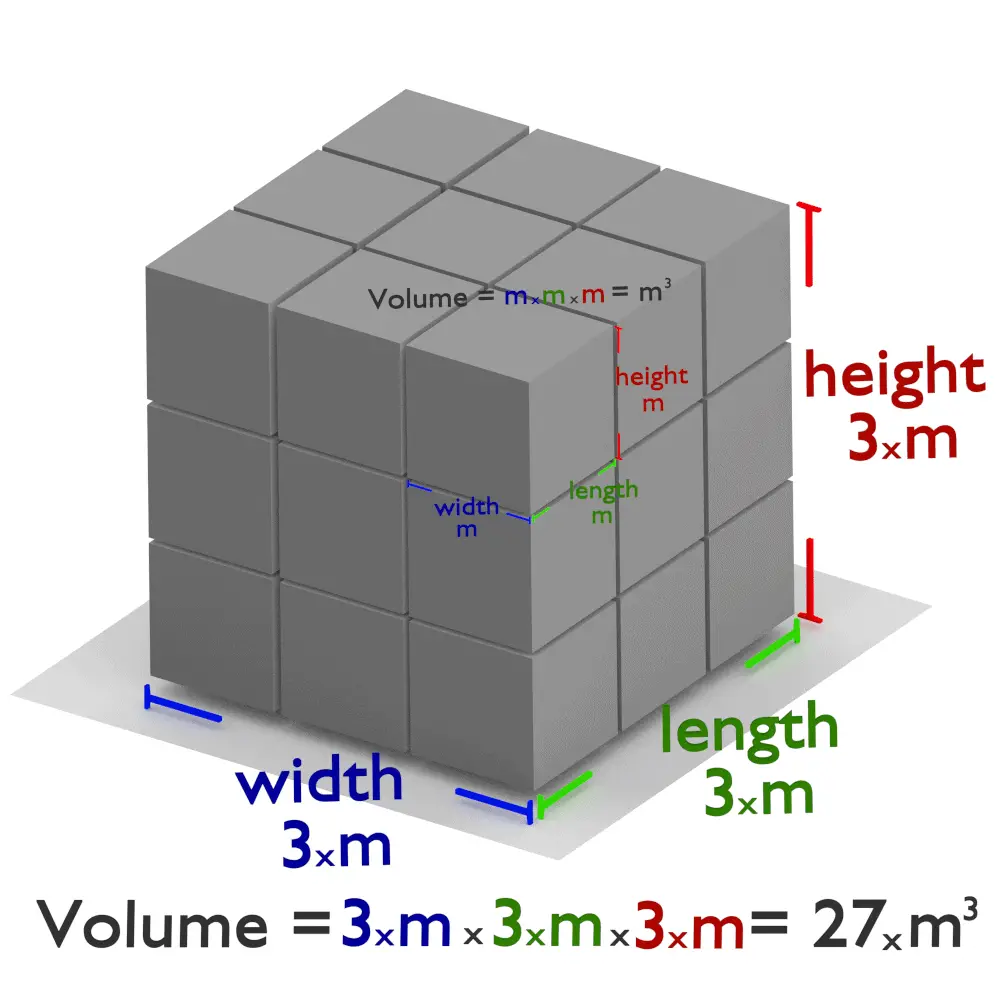
what is volume - physicsVolume is a basic physical quantity. Volume is a derived quantity and it expresses the three dimensional extent of an object. Volume is often quantified numerically using the SI derived unit, the cubic metre. For example, the volume inside a sphere (that is the volume of a ball) is derived to be V = 4/3πr3, where r is the radius of the sphere. As another example, volume of a cube is equal to side times side times side. Since each side of a square is the same, it can simply be the length of one side cubed.

If a square has one side of 3 metres, the volume would be 3 metres times 3 metres times 3 metres, or 27 cubic metres.
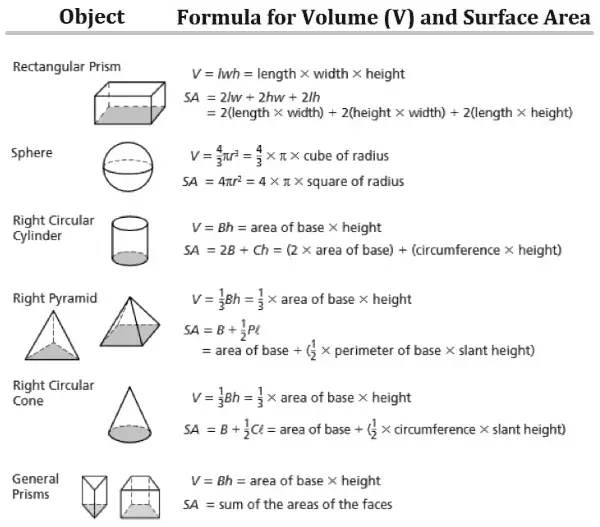
 
Formulas for Calculation of Different Volumes
Volume formulas for some common three-dimensional objects:

formulas-for-volume-calculations-min

What is Specific Volume

Density - Gas - Liquid - Solid
Typical densities of various substances at atmospheric pressure.

Specific volume is an intensive variable, whereas volume is an extensive variable. The standard unit for specific volume in the SI system is cubic meters per kilogram (m3/kg). The standard unit in the English system is cubic feet per pound mass (ft3/lbm).

The density (ρ) of a substance is the reciprocal of its specific volume (ν).

ρ = m/V = 1/ρ

Density is defined as the mass per unit volume. It is also an intensive property, which is mathematically defined as mass divided by volume:

ρ = m/V

 
Materials with Lowest Specific Volume - Densest Materials on the Earth
Since nucleons (protons and neutrons) make up most of the mass of ordinary atoms, the density of normal matter tends to be limited by how closely we can pack these nucleons and depends on the internal atomic structure of a substance. The densest material found on earth is the metal osmium, but its density pales by comparison to the densities of exotic astronomical objects such as white dwarf stars and neutron stars.

List of densest materials:

  1. Osmium – 22.6 x 10³ kg/m3
  2. Iridium – 22.4 x 10³ kg/m3
  3. Platinum – 21.5 x 10³ kg/m3
  4. Rhenium – 21.0 x 10³ kg/m3
  5. Plutonium – 19.8 x 10³ kg/m3
  6. Gold – 19.3 x 10³ kg/m3
  7. Tungsten – 19.3 x 10³ kg/m3
  8. Uranium – 18.8 x 10³ kg/m3
  9. Tantalum – 16.6 x 10³ kg/m3
  10. Mercury – 13.6 x 10³ kg/m3
  11. Rhodium – 12.4 x 10³ kg/m3
  12. Thorium – 11.7 x 10³ kg/m3
  13. Lead – 11.3 x 10³ kg/m3
  14. Silver – 10.5 x 10³ kg/m3

It must be noted, plutonium is a man-made isotope and is created from uranium in nuclear reactors. But, In fact, scientists have found trace amounts of naturally-occurring plutonium.

If we include man made elements, the densest so far is Hassium. Hassium is a chemical element with symbol Hs and atomic number 108.  It is a synthetic element (first synthesised at Hasse in Germany) and radioactive. The most stable known isotope, 269Hs, has a half-life of approximately 9.7 seconds. It has an estimated density of 40.7 x 10³ kg/m3.  The density of Hassium results from its high atomic weight and from the significant decrease in ionic radii of the elements in the lanthanide series, known as lanthanide and actinide contraction.

The density of Hassium is followed by Meitnerium (element 109, named after the physicist Lise Meitner), which has an estimated density of 37.4 x 10³ kg/m3.

Changes in Specific Volume
In general, density and thus the specific volume can be changed by changing either the pressure or the temperature. Increasing the pressure always increases the density of a material. The effect of pressure on the densities of liquids and solids is very very small. On the other hand, the density of gases is strongly affected by pressure. This is expressed by compressibility. Compressibility is a measure of the relative volume change of a fluid or solid as a response to a pressure change.

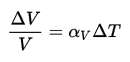
The effect of temperature on the densities of liquids and solids is also very important. Most substances expand when heated and contract when cooled. However, the amount of expansion or contraction varies, depending on the material. This phenomenon is known as thermal expansion. The change in volume of a material which undergoes a temperature change is given by following relation:
thermal-expansion

where ∆T is the change in temperature, V is the original volume, ∆V is the change in volume, and αV is the coefficient of volume expansion.

It must be noted, there are exceptions from this rule. For example, water differs from most liquids in that it becomes less dense as it freezes. It has a maximum of density at 3.98 °C (1000 kg/m3), whereas the density of ice is 917 kg/m3. It differs by about 9% and therefore ice floats on liquid water

Volume of an Atom and Nucleus

Structure of Matter.

The atom consist of a small but massive nucleus surrounded by a cloud of rapidly moving electrons. The nucleus is composed of protons and neutrons. Typical nuclear radii are of the order 10−14 m. Assuming spherical shape, nuclear radii can be calculated according to following formula:

r = r0 . A1/3

where r0 = 1.2 x 10⁻¹⁵ m = 1.2 fm

If we use this approximation, we therefore expect the volume of the nucleus to be of the order of 4/3πr3 or 7,23 ×10−45 m3 for hydrogen nuclei or 1721×10−45 m3 for 238U nuclei. These are volumes of nuclei and atomic nuclei (protons and neutrons) contains of about 99.95% of mass of atom.

Is an atom an empty space?

atomic-nucleus-volume-min
A figurative depiction of the helium-4 atom with the electron cloud in shades of gray. Protons and neutrons are most likely found in exactly the same space, at the central point. Source wikipedia.org License CC BY-SA 3.0

The volume of an atom is about 15 orders of magnitude larger than the volume of a nucleus. For uranium atom, the Van der Waals radius is about 186 pm = 1.86 ×10⁻¹⁰ m. The Van der Waals radius, rw, of an atom is the radius of an imaginary hard sphere representing the distance of closest approach for another atom.  Assuming spherical shape, the uranium atom have volume of about  26.9 ×10⁻³⁰ m3. But this “huge” space is occupied primarily by electrons, because the nucleus occupies only about 1721×10−45 m3 of space. These electrons together weigh only a fraction (let say 0.05%) of entire atom.

It may seem, that the space and in fact the matter is empty, but it is not. Due to the quantum nature of electrons, the electrons are not point particles, they are smeared out over the whole atom. The classical description cannot be used to describe things on the atomic scale. On the atomic scale, physicists have found that quantum mechanics describes things very well on that scale. Particle locations in quantum mechanics are not at an exact position, they are described by a probability density function. Therefore the space in an atom (between electrons and an atomic nucleus) is not empty, but it is filled by a probability density function of electrons (usually known as  “electron cloud“).

Volume of Coolant in Reactor Coolant System

Nuclear reactor - WWER 1200
Nuclear reactor and primary coolant system of WWER-1200.
Source: gidropress.podolsk.ru
used with permission of АО ОКБ “ГИДРОПРЕСС”

In typical modern pressurized water reactors (PWRs), the Reactor Coolant System (RCS), shown in the figure, consists of:

All RCS components are located inside the containment building.

At normal operation, there is a compressed liquid water inside the reactor vessel, loops and steam generators.  The pressure is maintained at approximately 16MPa. At this pressure water boils at approximately 350°C (662°F).  Inlet temperature of the water is about 290°C (554°F). The water (coolant) is heated in the reactor core to approximately 325°C (617°F) as the water flows through the core. As it can be seen, the reactor contains approximately 25°C subcooled coolant (distance from the saturation).volume-of-reactor-coolant-systemThis high pressure is maintained by the pressurizer, a separate vessel that is connected to the primary circuit (hot leg) and partially filled with water (partially with saturated steam) which is heated to the saturation temperature (boiling point) for the desired pressure by submerged electrical heaters. Temperature in the pressurizer can be maintained at 350 °C. At normal conditions, about 60% of volume of pressurizer occupies the compressed water and about 40% of volume occupies the saturated steam.
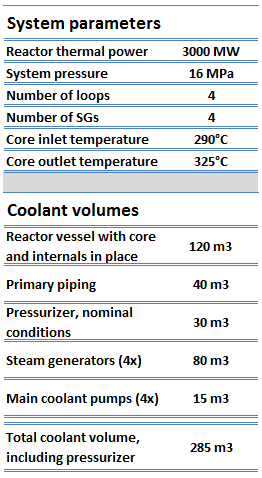
Volumes of typical PWR are in the following table.

It is an illustrative example, following data do not correspond to any reactor design.

It must be noted the volume of coolant significantly changes with the temperature of the coolant. The total mass of the coolant remains always the same, a change in water volume is not a change in water inventory. The reactor coolant volume changes with temperature because of changes in density. Most substances expand when heated and contract when cooled. However, the amount of expansion or contraction varies, depending on the material. This phenomenon is known as thermal expansion. The change in volume of a material which undergoes a temperature change is given by following relation:

thermal-expansion

where ∆T is the change in temperature, V is the original volume, ∆V is the change in volume, and αV is the coefficient of volume expansion.
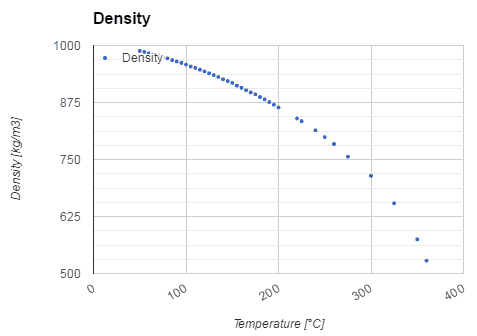
Chart - density - water - temperature
Density of liquid (compressed) water as a function of temperature of water

The volumetric thermal expansion coefficient for water is not constant over the temperature range and increases with the temperature (especially at 300°C), therefore the change in density is not linear with temperature (as indicated in the figure).

See also: Steam Tables

At normal conditions the total volume of coolant in the reactor coolant system is almost constant. On the other hand, during transient load conditions the volume can significantly change. These changes are naturally reflected in a change in pressurizer water level. When the average temperature of reactor coolant goes gradually down, the total water volume is also decreasing, which lowers the pressurizer level. On a gradual load pick-up, the increase in reactor coolant average temperature causes the total water volume to expand, which raises the pressurizer level. These effects must be controlled by pressurizer level control system.

Control Volume – Control Volume Analysis
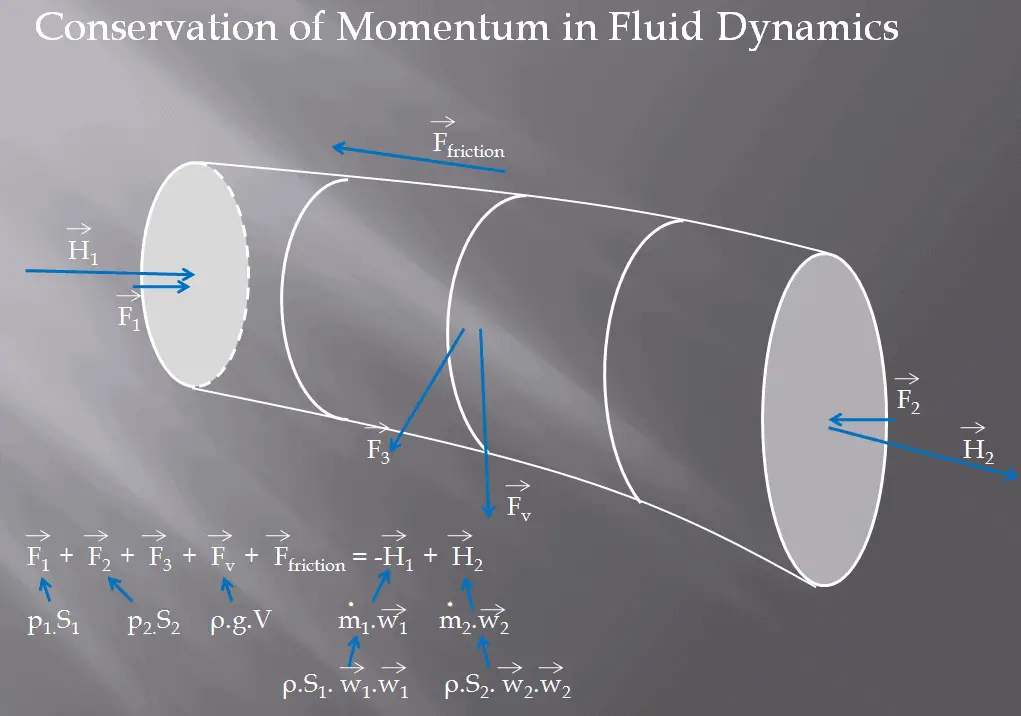
Conservation of Momentum - FluidsA control volume is a fixed region in space chosen for the thermodynamic study of mass and energy balances for flowing systems. The boundary of the control volume may be a real or imaginary envelope. The control surface is the boundary of the control volume.

A control volume analysis can be used for example to determine the rate of change of momentum for a fluid. In this analysis, we will consider a streamtube (control volume) as we did for the Bernoulli equation. In this control volume any change in momentum of the fluid within a control volume is due to the action of external forces on the fluid within the volume.

See also: Momentum Formula

As can be seen from the picture the control volume method can be used to analyze the law of conservation of momentum in fluid. Control volume is an imaginary surface enclosing a volume of interest. The control volume can be fixed or moving, and it can be rigid or deformable. In order to determine all forces acting on the surfaces of the control volume we have to solve the conservation laws in this control volume.

Choosing a Control Volume

A control volume can be selected as any arbitrary volume through which fluid flows. This volume can be static, moving, and even deforming during flow. In order to solve any problem we have to solve basic conservation laws in this volume. It is very important to know all relative flow velocities to the control surface and therefore it is very important to define exactly the boundaries of the control volume during an analysis.

Example: Water Jet Striking a Stationary Plate
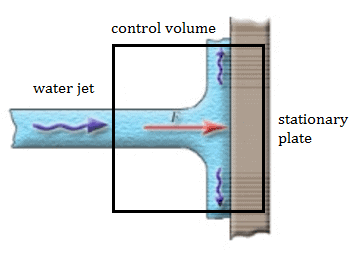
Momentum Equation - Water JetA stationary plate (e.g. blade of a watermill) is used to deflect water flow at a velocity of 1 m/s and at an angle of 90°. It occurs at atmospheric pressure and the mass flow rate is equal to Q =1 m3/s.

  1. Calculate the pressure force.
  2. Calculate the body force.
  3. Calculate the total force.
  4. Calculate the resultant force.

Solution

  1. The pressure force is zero as the pressure at both the inlet and the outlets to the control volume are atmospheric.
  2. As the control volume is small we can ignore the body force due to the weight of gravity.
  3. Fx = ρ.Q.(w1x – w2x) = 1000 . 1 . (1 – 0) = 1000 N
    Fy = 0
    F = (1000, 0)
  4. The resultant force on the plane is the same magnitude but in the opposite direction as the total force F (friction and weight are neglected).

The water jet exerts on the plate the force of 1000 N in the x-direction.

 
References:
Reactor Physics and Thermal Hydraulics:
  1. J. R. Lamarsh, Introduction to Nuclear Reactor Theory, 2nd ed., Addison-Wesley, Reading, MA (1983).
  2. J. R. Lamarsh, A. J. Baratta, Introduction to Nuclear Engineering, 3d ed., Prentice-Hall, 2001, ISBN: 0-201-82498-1.
  3. W. M. Stacey, Nuclear Reactor Physics, John Wiley & Sons, 2001, ISBN: 0- 471-39127-1.
  4. Glasstone, Sesonske. Nuclear Reactor Engineering: Reactor Systems Engineering, Springer; 4th edition, 1994, ISBN: 978-0412985317
  5. Todreas Neil E., Kazimi Mujid S. Nuclear Systems Volume I: Thermal Hydraulic Fundamentals, Second Edition. CRC Press; 2 edition, 2012, ISBN: 978-0415802871
  6. Zohuri B., McDaniel P. Thermodynamics in Nuclear Power Plant Systems. Springer; 2015, ISBN: 978-3-319-13419-2
  7. Moran Michal J., Shapiro Howard N. Fundamentals of Engineering Thermodynamics, Fifth Edition, John Wiley & Sons, 2006, ISBN: 978-0-470-03037-0
  8. Kleinstreuer C. Modern Fluid Dynamics. Springer, 2010, ISBN 978-1-4020-8670-0.
  9. U.S. Department of Energy, THERMODYNAMICS, HEAT TRANSFER, AND FLUID FLOW. DOE Fundamentals Handbook, Volume 1, 2 and 3. June 1992.

See also:

Thermodynamic Properties

We hope, this article, Volume – Physics, helps you. If so, give us a like in the sidebar. Main purpose of this website is to help the public to learn some interesting and important information about thermal engineering.


What is Density of Zirconium – Definition

The density of typical zirconium alloy is about 6.6 x 10³ kg/m3. One of the main uses of zirconium alloys is in nuclear technology, as cladding of fuel rods in nuclear reactors

Density of Zirconium

In general, zirconium has very low absorption cross-section of thermal neutrons, high hardness, ductility and corrosion resistance. One of the main uses of zirconium alloys is in nuclear technology, as cladding of fuel rods in nuclear reactors, due to its very low absorption cross-section (unlike the stainless steel). The density of typical zirconium alloy is about 6.6 x 10³ kg/m3.

 
References:
Reactor Physics and Thermal Hydraulics:
  1. J. R. Lamarsh, Introduction to Nuclear Reactor Theory, 2nd ed., Addison-Wesley, Reading, MA (1983).
  2. J. R. Lamarsh, A. J. Baratta, Introduction to Nuclear Engineering, 3d ed., Prentice-Hall, 2001, ISBN: 0-201-82498-1.
  3. W. M. Stacey, Nuclear Reactor Physics, John Wiley & Sons, 2001, ISBN: 0- 471-39127-1.
  4. Glasstone, Sesonske. Nuclear Reactor Engineering: Reactor Systems Engineering, Springer; 4th edition, 1994, ISBN: 978-0412985317
  5. Todreas Neil E., Kazimi Mujid S. Nuclear Systems Volume I: Thermal Hydraulic Fundamentals, Second Edition. CRC Press; 2 edition, 2012, ISBN: 978-0415802871
  6. Zohuri B., McDaniel P. Thermodynamics in Nuclear Power Plant Systems. Springer; 2015, ISBN: 978-3-319-13419-2
  7. Moran Michal J., Shapiro Howard N. Fundamentals of Engineering Thermodynamics, Fifth Edition, John Wiley & Sons, 2006, ISBN: 978-0-470-03037-0
  8. Kleinstreuer C. Modern Fluid Dynamics. Springer, 2010, ISBN 978-1-4020-8670-0.
  9. U.S. Department of Energy, THERMODYNAMICS, HEAT TRANSFER, AND FLUID FLOW. DOE Fundamentals Handbook, Volume 1, 2 and 3. June 1992.

See also:

Density

We hope, this article, Density of Zirconium, helps you. If so, give us a like in the sidebar. Main purpose of this website is to help the public to learn some interesting and important information about thermal engineering.
What is Density of Uranium – Definition

Uranium metal has a very high density of 19.1 g/cm3. Uranium dioxide used in nuclear reactors has a density of 10.97 g/cm3, but this value may vary with fuel burnup. Thermal Engineering

Density of Uranium

Uranium is a naturally-occurring chemical element with atomic number 92 which means there are 92 protons and 92 electrons in the atomic structure. Natural uranium consists primarily of isotope 238U (99.28%), therefore the atomic mass of uranium element is close to the atomic mass of 238U isotope (238.03u).  Natural uranium also consists of two other isotopes: 235U (0.71%) and 234U (0.0054%). Uranium has the highest atomic weight of the primordially occurring elements. Uranium metal has a very high density of 19.1 g/cm3, denser than lead (11.3 g/cm3), but slightly less dense than tungsten and gold (19.3 g/cm3).

Uranium metal is one of the densest materials found on earth:

  1. Osmium – 22.6 x 10³ kg/m3
  2. Iridium – 22.4 x 10³ kg/m3
  3. Platinum – 21.5 x 10³ kg/m3
  4. Rhenium – 21.0 x 10³ kg/m3
  5. Plutonium – 19.8 x 10³ kg/m3
  6. Gold – 19.3 x 10³ kg/m3
  7. Tungsten – 19.3 x 10³ kg/m3
  8. Uranium – 18.8 x 10³ kg/m3
  9. Tantalum – 16.6 x 10³ kg/m3
  10. Mercury – 13.6 x 10³ kg/m3
  11. Rhodium – 12.4 x 10³ kg/m3
  12. Thorium – 11.7 x 10³ kg/m3
  13. Lead – 11.3 x 10³ kg/m3
  14. Silver – 10.5 x 10³ kg/m3

But most of LWRs use the uranium fuel, which is in the form of uranium dioxide. Uranium dioxide is a black semiconducting solid with very low thermal conductivity. On the other hand the uranium dioxide has very high melting point and has well known behavior.

Uranium dioxide has significantly lower density than uranium in the metal form. Uranium dioxide has a density of 10.97 g/cm3, but this value may vary with fuel burnup, because at low burnup densification of pellets can occurs and at higher burnup swelling occurs.

 
References:
Reactor Physics and Thermal Hydraulics:
  1. J. R. Lamarsh, Introduction to Nuclear Reactor Theory, 2nd ed., Addison-Wesley, Reading, MA (1983).
  2. J. R. Lamarsh, A. J. Baratta, Introduction to Nuclear Engineering, 3d ed., Prentice-Hall, 2001, ISBN: 0-201-82498-1.
  3. W. M. Stacey, Nuclear Reactor Physics, John Wiley & Sons, 2001, ISBN: 0- 471-39127-1.
  4. Glasstone, Sesonske. Nuclear Reactor Engineering: Reactor Systems Engineering, Springer; 4th edition, 1994, ISBN: 978-0412985317
  5. Todreas Neil E., Kazimi Mujid S. Nuclear Systems Volume I: Thermal Hydraulic Fundamentals, Second Edition. CRC Press; 2 edition, 2012, ISBN: 978-0415802871
  6. Zohuri B., McDaniel P. Thermodynamics in Nuclear Power Plant Systems. Springer; 2015, ISBN: 978-3-319-13419-2
  7. Moran Michal J., Shapiro Howard N. Fundamentals of Engineering Thermodynamics, Fifth Edition, John Wiley & Sons, 2006, ISBN: 978-0-470-03037-0
  8. Kleinstreuer C. Modern Fluid Dynamics. Springer, 2010, ISBN 978-1-4020-8670-0.
  9. U.S. Department of Energy, THERMODYNAMICS, HEAT TRANSFER, AND FLUID FLOW. DOE Fundamentals Handbook, Volume 1, 2 and 3. June 1992.

See also:

Uranium

We hope, this article, Density of Uranium, helps you. If so, give us a like in the sidebar. Main purpose of this website is to help the public to learn some interesting and important information about thermal engineering.
What is Density of Nuclear Matter – Nuclear Density – Definition

The nuclear density for a typical nucleus can be approximately calculated from the size of the nucleus and from its mass. It is about 2.3 x 10^17 kg/m3. Thermal Engineering

Density of Nuclear Matter

Nuclear density is the density of the nucleus of an atom. It is the ratio of mass per unit volume inside the nucleus. Since atomic nucleus carries most of atom’s mass and atomic nucleus is very small in comparison to entire atom, the nuclear density is very high.

The nuclear density for a typical nucleus can be approximately calculated from the size of the nucleus and from its mass. Typical nuclear radii are of the order 10−14 m. Assuming spherical shape, nuclear radii can be calculated according to following formula:

r = r0 . A1/3

where r0 = 1.2 x 10⁻¹⁵ m = 1.2 fm

For example, natural uranium consists primarily of isotope 238U (99.28%), therefore the atomic mass of uranium element is close to the atomic mass of 238U isotope (238.03u). Its radius of this nucleus will be:

r = r0 . A1/3 = 7.44 fm.

Assuming it is spherical, its volume will be:

V = 4πr3/3 = 1.73 x 10-42 m3.

The usual definition of nuclear density gives for its density:

ρnucleus = m / V = 238 x 1.66 x 10-27 / (1.73 x 10-42) = 2.3 x 10¹⁷ kg/m3.

Thus, the density of nuclear material is more than 2.1014 times greater than that of water. It is an immense density. The descriptive term nuclear density is also applied to situations where similarly high densities occur, such as within neutron stars. Such immense densities are also found in neutron stars.

 
Density of Neutron Star
The densest material found on earth is the metal osmium, but its density pales by comparison to the densities of exotic astronomical objects such as white dwarf stars and neutron stars.

A neutron star is the collapsed core of a large star (usually of a red giant). Neutron stars are the smallest and densest stars known to exist and they are rotating extremely rapidly. A neutron star is basically a giant atomic nucleus about 11 km in diameter made especially of neutrons. It is believed that under the immense pressures of a collapsing massive stars going supernova it is possible for the electrons and protons  to combine to form neutrons via electron capture, releasing a huge amount of neutrinos.

They are so dense that one teaspoon of its material would have a mass over 5.5×10¹² kg. It is assumed they have densities of 3.7 × 10¹⁷ to 6 × 10¹⁷ kg/m3, which is comparable to the approximate density of an atomic nucleus of 2.3 × 10¹⁷ kg/m3.

 
References:
Reactor Physics and Thermal Hydraulics:
  1. J. R. Lamarsh, Introduction to Nuclear Reactor Theory, 2nd ed., Addison-Wesley, Reading, MA (1983).
  2. J. R. Lamarsh, A. J. Baratta, Introduction to Nuclear Engineering, 3d ed., Prentice-Hall, 2001, ISBN: 0-201-82498-1.
  3. W. M. Stacey, Nuclear Reactor Physics, John Wiley & Sons, 2001, ISBN: 0- 471-39127-1.
  4. Glasstone, Sesonske. Nuclear Reactor Engineering: Reactor Systems Engineering, Springer; 4th edition, 1994, ISBN: 978-0412985317
  5. Todreas Neil E., Kazimi Mujid S. Nuclear Systems Volume I: Thermal Hydraulic Fundamentals, Second Edition. CRC Press; 2 edition, 2012, ISBN: 978-0415802871
  6. Zohuri B., McDaniel P. Thermodynamics in Nuclear Power Plant Systems. Springer; 2015, ISBN: 978-3-319-13419-2
  7. Moran Michal J., Shapiro Howard N. Fundamentals of Engineering Thermodynamics, Fifth Edition, John Wiley & Sons, 2006, ISBN: 978-0-470-03037-0
  8. Kleinstreuer C. Modern Fluid Dynamics. Springer, 2010, ISBN 978-1-4020-8670-0.
  9. U.S. Department of Energy, THERMODYNAMICS, HEAT TRANSFER, AND FLUID FLOW. DOE Fundamentals Handbook, Volume 1, 2 and 3. June 1992.

See also:

Density

We hope, this article, Density of Nuclear Matter – Nuclear Density, helps you. If so, give us a like in the sidebar. Main purpose of this website is to help the public to learn some interesting and important information about thermal engineering.
What is Density of Neutron Star – Definition

Density of Neutron Star. It is assumed neutron stars have densities of 3.7 × 10^17 to 6 × 10^17 kg/m3, which is comparable to the approximate density of an atomic nucleus. Thermal Engineering

Density of Neutron Star

The densest material found on earth is the metal osmium, but its density pales by comparison to the densities of exotic astronomical objects such as white dwarf stars and neutron stars.

A neutron star is the collapsed core of a large star (usually of a red giant). Neutron stars are the smallest and densest stars known to exist and they are rotating extremely rapidly. A neutron star is basically a giant atomic nucleus about 11 km in diameter made especially of neutrons. It is believed that under the immense pressures of a collapsing massive stars going supernova it is possible for the electrons and protons  to combine to form neutrons via electron capture, releasing a huge amount of neutrinos. Since they have some similar properties as atomic nuclei, neutron stars are sometimes described as giant nuclei. But be careful, neutron stars and atomic nuclei are held together by different forces.  A nucleus is held together by the strong force, while a neutron star is held together by gravitational force.

Density of neutron star is enormous. They are so dense that one teaspoon of its material would have a mass over 5.5×10¹² kg. It is assumed they have densities of 3.7 × 10¹⁷ to 6 × 10¹⁷ kg/m3, which is comparable to the approximate density of an atomic nucleus of 2.3 × 10¹⁷ kg/m3.

Density of Nuclear Matter

Nuclear density is the density of the nucleus of an atom. It is the ratio of mass per unit volume inside the nucleus. Since atomic nucleus carries most of atom’s mass and atomic nucleus is very small in comparison to entire atom, the nuclear density is very high.

The nuclear density for a typical nucleus can be approximately calculated from the size of the nucleus and from its mass. Typical nuclear radii are of the order 10−14 m. Assuming spherical shape, nuclear radii can be calculated according to following formula:

r = r0 . A1/3

where r0 = 1.2 x 10⁻¹⁵ m = 1.2 fm

For example, natural uranium consists primarily of isotope 238U (99.28%), therefore the atomic mass of uranium element is close to the atomic mass of 238U isotope (238.03u). Its radius of this nucleus will be:

r = r0 . A1/3 = 7.44 fm.

Assuming it is spherical, its volume will be:

V = 4πr3/3 = 1.73 x 10-42 m3.

The usual definition of nuclear density gives for its density:

ρnucleus = m / V = 238 x 1.66 x 10-27 / (1.73 x 10-42) = 2.3 x 10¹⁷ kg/m3.

Thus, the density of nuclear material is more than 2.1014 times greater than that of water. It is an immense density. The descriptive term nuclear density is also applied to situations where similarly high densities occur, such as within neutron stars. Such immense densities are also found in neutron stars.

 
References:
Reactor Physics and Thermal Hydraulics:
  1. J. R. Lamarsh, Introduction to Nuclear Reactor Theory, 2nd ed., Addison-Wesley, Reading, MA (1983).
  2. J. R. Lamarsh, A. J. Baratta, Introduction to Nuclear Engineering, 3d ed., Prentice-Hall, 2001, ISBN: 0-201-82498-1.
  3. W. M. Stacey, Nuclear Reactor Physics, John Wiley & Sons, 2001, ISBN: 0- 471-39127-1.
  4. Glasstone, Sesonske. Nuclear Reactor Engineering: Reactor Systems Engineering, Springer; 4th edition, 1994, ISBN: 978-0412985317
  5. Todreas Neil E., Kazimi Mujid S. Nuclear Systems Volume I: Thermal Hydraulic Fundamentals, Second Edition. CRC Press; 2 edition, 2012, ISBN: 978-0415802871
  6. Zohuri B., McDaniel P. Thermodynamics in Nuclear Power Plant Systems. Springer; 2015, ISBN: 978-3-319-13419-2
  7. Moran Michal J., Shapiro Howard N. Fundamentals of Engineering Thermodynamics, Fifth Edition, John Wiley & Sons, 2006, ISBN: 978-0-470-03037-0
  8. Kleinstreuer C. Modern Fluid Dynamics. Springer, 2010, ISBN 978-1-4020-8670-0.
  9. U.S. Department of Energy, THERMODYNAMICS, HEAT TRANSFER, AND FLUID FLOW. DOE Fundamentals Handbook, Volume 1, 2 and 3. June 1992.

See also:

Density

We hope, this article, Density of Neutron Star, helps you. If so, give us a like in the sidebar. Main purpose of this website is to help the public to learn some interesting and important information about thermal engineering.

What is Density Formula – Density Equation – Definition

Density Formula – Density Equation. The density (ρ) of a substance is the total mass (m) of that substance divided by the total volume (V). Thermal Engineering

What is Density

Density - Gas - Liquid - Solid
Typical densities of various substances at atmospheric pressure.

Density is defined as the mass per unit volume. It is an intensive property, which is mathematically defined as mass divided by volume:

Density Formula

ρ = m/V

In words, the density (ρ) of a substance is the total mass (m) of that substance divided by the total volume (V) occupied by that substance. The standard SI unit is kilograms per cubic meter (kg/m3). The Standard English unit is pounds mass per cubic foot (lbm/ft3). The density (ρ) of a substance is the reciprocal of its specific volume (ν).

ρ = m/V = 1/ρ

Specific volume is an intensive variable, whereas volume is an extensive variable. The standard unit for specific volume in the SI system is cubic meters per kilogram (m3/kg). The standard unit in the English system is cubic feet per pound mass (ft3/lbm).

 
Changes of Density
In general, density can be changed by changing either the pressure or the temperature. Increasing the pressure always increases the density of a material. The effect of pressure on the densities of liquids and solids is very very small. On the other hand, the density of gases is strongly affected by pressure. This is expressed by compressibility. Compressibility is a measure of the relative volume change of a fluid or solid as a response to a pressure change.

The effect of temperature on the densities of liquids and solids is also very important. Most substances expand when heated and contract when cooled. However, the amount of expansion or contraction varies, depending on the material. This phenomenon is known as thermal expansion. The change in volume of a material which undergoes a temperature change is given by following relation:

thermal-expansion

where ∆T is the change in temperature, V is the original volume, ∆V is the change in volume, and αV is the coefficient of volume expansion.

It must be noted, there are exceptions from this rule. For example, water differs from most liquids in that it becomes less dense as it freezes. It has a maximum of density at 3.98 °C (1000 kg/m3), whereas the density of ice is 917 kg/m3. It differs by about 9% and therefore ice floats on liquid water

 
References:
Reactor Physics and Thermal Hydraulics:
  1. J. R. Lamarsh, Introduction to Nuclear Reactor Theory, 2nd ed., Addison-Wesley, Reading, MA (1983).
  2. J. R. Lamarsh, A. J. Baratta, Introduction to Nuclear Engineering, 3d ed., Prentice-Hall, 2001, ISBN: 0-201-82498-1.
  3. W. M. Stacey, Nuclear Reactor Physics, John Wiley & Sons, 2001, ISBN: 0- 471-39127-1.
  4. Glasstone, Sesonske. Nuclear Reactor Engineering: Reactor Systems Engineering, Springer; 4th edition, 1994, ISBN: 978-0412985317
  5. Todreas Neil E., Kazimi Mujid S. Nuclear Systems Volume I: Thermal Hydraulic Fundamentals, Second Edition. CRC Press; 2 edition, 2012, ISBN: 978-0415802871
  6. Zohuri B., McDaniel P. Thermodynamics in Nuclear Power Plant Systems. Springer; 2015, ISBN: 978-3-319-13419-2
  7. Moran Michal J., Shapiro Howard N. Fundamentals of Engineering Thermodynamics, Fifth Edition, John Wiley & Sons, 2006, ISBN: 978-0-470-03037-0
  8. Kleinstreuer C. Modern Fluid Dynamics. Springer, 2010, ISBN 978-1-4020-8670-0.
  9. U.S. Department of Energy, THERMODYNAMICS, HEAT TRANSFER, AND FLUID FLOW. DOE Fundamentals Handbook, Volume 1, 2 and 3. June 1992.

See also:

Density

We hope, this article, Density Formula – Density Equation, helps you. If so, give us a like in the sidebar. Main purpose of this website is to help the public to learn some interesting and important information about thermal engineering.
What is Unit of Density – Units of Specific Volume – Definition

The standard SI unit of density is kilograms per cubic meter (kg/m3). The Standard English unit of density is pounds mass per cubic foot (lbm/ft3). Thermal Engineering

What is Density

Density - Gas - Liquid - Solid
Typical densities of various substances at atmospheric pressure.

Density is defined as the mass per unit volume. It is an intensive property, which is mathematically defined as mass divided by volume:

ρ = m/V

In words, the density (ρ) of a substance is the total mass (m) of that substance divided by the total volume (V) occupied by that substance. The standard SI unit is kilograms per cubic meter (kg/m3). The Standard English unit is pounds mass per cubic foot (lbm/ft3). The density (ρ) of a substance is the reciprocal of its specific volume (ν).

ρ = m/V = 1/ρ

Specific volume is an intensive variable, whereas volume is an extensive variable. The standard unit for specific volume in the SI system is cubic meters per kilogram (m3/kg). The standard unit in the English system is cubic feet per pound mass (ft3/lbm).

 
References:
Reactor Physics and Thermal Hydraulics:
  1. J. R. Lamarsh, Introduction to Nuclear Reactor Theory, 2nd ed., Addison-Wesley, Reading, MA (1983).
  2. J. R. Lamarsh, A. J. Baratta, Introduction to Nuclear Engineering, 3d ed., Prentice-Hall, 2001, ISBN: 0-201-82498-1.
  3. W. M. Stacey, Nuclear Reactor Physics, John Wiley & Sons, 2001, ISBN: 0- 471-39127-1.
  4. Glasstone, Sesonske. Nuclear Reactor Engineering: Reactor Systems Engineering, Springer; 4th edition, 1994, ISBN: 978-0412985317
  5. Todreas Neil E., Kazimi Mujid S. Nuclear Systems Volume I: Thermal Hydraulic Fundamentals, Second Edition. CRC Press; 2 edition, 2012, ISBN: 978-0415802871
  6. Zohuri B., McDaniel P. Thermodynamics in Nuclear Power Plant Systems. Springer; 2015, ISBN: 978-3-319-13419-2
  7. Moran Michal J., Shapiro Howard N. Fundamentals of Engineering Thermodynamics, Fifth Edition, John Wiley & Sons, 2006, ISBN: 978-0-470-03037-0
  8. Kleinstreuer C. Modern Fluid Dynamics. Springer, 2010, ISBN 978-1-4020-8670-0.
  9. U.S. Department of Energy, THERMODYNAMICS, HEAT TRANSFER, AND FLUID FLOW. DOE Fundamentals Handbook, Volume 1, 2 and 3. June 1992.

See also:

Density

We hope, this article, Unit of Density – Units of Specific Volume, helps you. If so, give us a like in the sidebar. Main purpose of this website is to help the public to learn some interesting and important information about thermal engineering.
What is Density Mass Volume – Definition

The mass and volume of an object are fundamental extensive properties of the object. Density is an intensive property that can be derived from the mass given volume. Thermal Engineering

What is Mass and Weight

The mass of an object is a fundamental property of the object. It is a numerical measure of its inertia and the measure of an object’s resistance to acceleration when a force is applied. It is also a fundamental measure of the amount of matter in the object. The greater the mass, the greater the force needed to cause a given acceleration. This is reflected in Newton’s second law (F=ma).

The mass of a certain body will remain constant even if the gravitational acceleration acting upon that body changes. For example, on earth an object has a certain mass and a certain weight. When the same object is placed in outer space, away from the earth’s gravitational field, its mass remains the same, but it is now in a “weightless” condition. This means in this condition it will weight zero, because gravitational acceleration and, thus, force will equal to zero.

Mass and weight are related: Bodies having large mass also have large weight. A large stone is hard to throw because of its large mass, and hard to lift off the ground because of its large weight. To understand the relationship between mass and weight, consider a freely falling stone, that has an acceleration of magnitude g (g = 9.81 m/s2 is the acceleration due to Earth’s gravitational field). Newton’s second law tells us that a force must act to produce this acceleration. If a 1 kilogram stone falls with an acceleration of the required force has magnitude:

F = ma = 1 [kg] x 9.81 [m/s2] = 9.8 [kg m/s2] = 9.8 N

What is Density

Density - Gas - Liquid - Solid
Typical densities of various substances at atmospheric pressure.

Density is defined as the mass per unit volume. It is an intensive property, which is mathematically defined as mass divided by volume:

ρ = m/V

In words, the density (ρ) of a substance is the total mass (m) of that substance divided by the total volume (V) occupied by that substance. The standard SI unit is kilograms per cubic meter (kg/m3). The Standard English unit is pounds mass per cubic foot (lbm/ft3). The density (ρ) of a substance is the reciprocal of its specific volume (ν).

ρ = m/V = 1/ρ

Specific volume is an intensive variable, whereas volume is an extensive variable. The standard unit for specific volume in the SI system is cubic meters per kilogram (m3/kg). The standard unit in the English system is cubic feet per pound mass (ft3/lbm).

 
References:
Reactor Physics and Thermal Hydraulics:
  1. J. R. Lamarsh, Introduction to Nuclear Reactor Theory, 2nd ed., Addison-Wesley, Reading, MA (1983).
  2. J. R. Lamarsh, A. J. Baratta, Introduction to Nuclear Engineering, 3d ed., Prentice-Hall, 2001, ISBN: 0-201-82498-1.
  3. W. M. Stacey, Nuclear Reactor Physics, John Wiley & Sons, 2001, ISBN: 0- 471-39127-1.
  4. Glasstone, Sesonske. Nuclear Reactor Engineering: Reactor Systems Engineering, Springer; 4th edition, 1994, ISBN: 978-0412985317
  5. Todreas Neil E., Kazimi Mujid S. Nuclear Systems Volume I: Thermal Hydraulic Fundamentals, Second Edition. CRC Press; 2 edition, 2012, ISBN: 978-0415802871
  6. Zohuri B., McDaniel P. Thermodynamics in Nuclear Power Plant Systems. Springer; 2015, ISBN: 978-3-319-13419-2
  7. Moran Michal J., Shapiro Howard N. Fundamentals of Engineering Thermodynamics, Fifth Edition, John Wiley & Sons, 2006, ISBN: 978-0-470-03037-0
  8. Kleinstreuer C. Modern Fluid Dynamics. Springer, 2010, ISBN 978-1-4020-8670-0.
  9. U.S. Department of Energy, THERMODYNAMICS, HEAT TRANSFER, AND FLUID FLOW. DOE Fundamentals Handbook, Volume 1, 2 and 3. June 1992.

See also:

Density

We hope, this article, Density Mass Volume, helps you. If so, give us a like in the sidebar. Main purpose of this website is to help the public to learn some interesting and important information about thermal engineering.
What is Density in Science – Definition

What is Density in Science. In words, the density (ρ) of a substance is the total mass (m) of that substance divided by the total volume (V) occupied by that substance. Thermal Engineering

What is Density in Science

Density - Gas - Liquid - Solid
Typical densities of various substances at atmospheric pressure.

Density is defined as the mass per unit volume. It is an intensive property, which is mathematically defined as mass divided by volume:

ρ = m/V

In words, the density (ρ) of a substance is the total mass (m) of that substance divided by the total volume (V) occupied by that substance. The standard SI unit is kilograms per cubic meter (kg/m3). The Standard English unit is pounds mass per cubic foot (lbm/ft3). The density (ρ) of a substance is the reciprocal of its specific volume (ν).

ρ = m/V = 1/ρ

Specific volume is an intensive variable, whereas volume is an extensive variable. The standard unit for specific volume in the SI system is cubic meters per kilogram (m3/kg). The standard unit in the English system is cubic feet per pound mass (ft3/lbm).

See also: How density influences reactor reactivity

 
Density - Important property in gamma rays shielding
See also: Shielding of Gamma Radiation

In short, effective shielding of gamma radiation is in most cases based on use of materials with two following material properties:

  • high-density of material. 
  • high atomic number of material  (high Z materials)

However, low-density materials and low Z materials can be compensated with increased thickness, which is as significant as density and atomic number in shielding applications.

A lead is widely used as a gamma shield.  Major advantage of lead shield is in its compactness due to its higher density. On the other hand depleted uranium is much more effective due to its higher Z.  Depleted uranium is used for shielding in portable gamma ray sources.

In nuclear power plants shielding of a reactor core can be provided by materials of reactor pressure vessel, reactor internals (neutron reflector). Also heavy concrete is usually used to shield both neutrons and gamma radiation.

Density of Nuclear Matter

Nuclear density is the density of the nucleus of an atom. It is the ratio of mass per unit volume inside the nucleus. Since atomic nucleus carries most of atom’s mass and atomic nucleus is very small in comparison to entire atom, the nuclear density is very high.

The nuclear density for a typical nucleus can be approximately calculated from the size of the nucleus and from its mass. Typical nuclear radii are of the order 10−14 m. Assuming spherical shape, nuclear radii can be calculated according to following formula:

r = r0 . A1/3

where r0 = 1.2 x 10⁻¹⁵ m = 1.2 fm

For example, natural uranium consists primarily of isotope 238U (99.28%), therefore the atomic mass of uranium element is close to the atomic mass of 238U isotope (238.03u). Its radius of this nucleus will be:

r = r0 . A1/3 = 7.44 fm.

Assuming it is spherical, its volume will be:

V = 4πr3/3 = 1.73 x 10-42 m3.

The usual definition of nuclear density gives for its density:

ρnucleus = m / V = 238 x 1.66 x 10-27 / (1.73 x 10-42) = 2.3 x 10¹⁷ kg/m3.

Thus, the density of nuclear material is more than 2.1014 times greater than that of water. It is an immense density. The descriptive term nuclear density is also applied to situations where similarly high densities occur, such as within neutron stars. Such immense densities are also found in neutron stars.

 
Density of Neutron Star
The densest material found on earth is the metal osmium, but its density pales by comparison to the densities of exotic astronomical objects such as white dwarf stars and neutron stars.

A neutron star is the collapsed core of a large star (usually of a red giant). Neutron stars are the smallest and densest stars known to exist and they are rotating extremely rapidly. A neutron star is basically a giant atomic nucleus about 11 km in diameter made especially of neutrons. It is believed that under the immense pressures of a collapsing massive stars going supernova it is possible for the electrons and protons  to combine to form neutrons via electron capture, releasing a huge amount of neutrinos.

They are so dense that one teaspoon of its material would have a mass over 5.5×10¹² kg. It is assumed they have densities of 3.7 × 10¹⁷ to 6 × 10¹⁷ kg/m3, which is comparable to the approximate density of an atomic nucleus of 2.3 × 10¹⁷ kg/m3.

 
References:
Reactor Physics and Thermal Hydraulics:
  1. J. R. Lamarsh, Introduction to Nuclear Reactor Theory, 2nd ed., Addison-Wesley, Reading, MA (1983).
  2. J. R. Lamarsh, A. J. Baratta, Introduction to Nuclear Engineering, 3d ed., Prentice-Hall, 2001, ISBN: 0-201-82498-1.
  3. W. M. Stacey, Nuclear Reactor Physics, John Wiley & Sons, 2001, ISBN: 0- 471-39127-1.
  4. Glasstone, Sesonske. Nuclear Reactor Engineering: Reactor Systems Engineering, Springer; 4th edition, 1994, ISBN: 978-0412985317
  5. Todreas Neil E., Kazimi Mujid S. Nuclear Systems Volume I: Thermal Hydraulic Fundamentals, Second Edition. CRC Press; 2 edition, 2012, ISBN: 978-0415802871
  6. Zohuri B., McDaniel P. Thermodynamics in Nuclear Power Plant Systems. Springer; 2015, ISBN: 978-3-319-13419-2
  7. Moran Michal J., Shapiro Howard N. Fundamentals of Engineering Thermodynamics, Fifth Edition, John Wiley & Sons, 2006, ISBN: 978-0-470-03037-0
  8. Kleinstreuer C. Modern Fluid Dynamics. Springer, 2010, ISBN 978-1-4020-8670-0.
  9. U.S. Department of Energy, THERMODYNAMICS, HEAT TRANSFER, AND FLUID FLOW. DOE Fundamentals Handbook, Volume 1, 2 and 3. June 1992.

See also:

Density

We hope, this article, Density in Science, helps you. If so, give us a like in the sidebar. Main purpose of this website is to help the public to learn some interesting and important information about thermal engineering.

What is Pressure – Physics – Definition

What is Pressure. Pressure is an intensive property of matter. The standard unit for pressure in the SI system is the Newton per square meter or pascal (Pa). Thermal Engineering

What is Pressure

manometer-pressure-measurementPressure is a measure of the force exerted per unit area on the boundaries of a substance. The standard unit for pressure in the SI system is the Newton per square meter or pascal (Pa). Mathematically:

p = F/A

where

  • p is the pressure
  • F is the normal force
  • A is the area of the boundary

Pascal is defined as force of 1N that is exerted on unit area.

  • 1 Pascal = 1 N/m2
However, for most engineering problems it is fairly small unit, so it is convenient to work with multiples of the pascal: the kPa, the bar, and the MPa.
  • 1 MPa  106 N/m2
  • 1 bar    105 N/m2
  • 1 kPa   103 N/m2

In general, pressure or the force exerted per unit area on the boundaries of a substance is caused by the collisions of the molecules of the substance with the boundaries of the system. As molecules hit the walls, they exert forces that try to push the walls outward. The forces resulting from all of these collisions cause the pressure exerted by a system on its surroundings. Pressure as an intensive variable is constant in a closed system. It really is only relevant in liquid or gaseous systems.

Static Pressure
In general, pressure is a measure of the force exerted per unit area on the boundaries of a substance. In fluid dynamics, many authors use the term static pressure in preference to just pressure to avoid ambiguity. The term static pressure is identical to the term pressure, and can be identified for every point in a fluid flow field.

Static pressure is one of the terms of Bernoulli’s equation:

Bernoulli Theorem - Equation

The Bernoulli’s effect causes the lowering of fluid pressure (static pressure – p) in regions where the flow velocity is increased. This lowering of pressure in a constriction of a flow path may seem counterintuitive, but seems less so when you consider pressure to be energy density. In the high velocity flow through the constriction, kinetic energy (dynamic pressure – ½.ρ.v2) must increase at the expense of pressure energy (static pressure – p).

The simplified form of Bernoulli’s equation can be summarized in the following memorable word equation:

static pressure + dynamic pressure = total pressure (stagnation pressure)

Total and dynamic pressure are not pressures in the usual sense – they cannot be measured using an aneroid, Bourdon tube or mercury column.

Dynamic Pressure
In general, pressure is a measure of the force exerted per unit area on the boundaries of a substance. The term dynamic pressure (sometimes called velocity pressure)  is associated with fluid flow and with the Bernoulli’s effect, which is described by the Bernoulli’s equation:

Bernoulli Theorem - Equation

This effect causes the lowering of fluid pressure (static pressure) in regions where the flow velocity is increased. This lowering of pressure in a constriction of a flow path may seem counterintuitive, but seems less so when you consider pressure to be energy density. In the high velocity flow through the constriction, kinetic energy (dynamic pressure – ½.ρ.v2) must increase at the expense of pressure energy (static pressure – p).

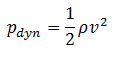
As can be seen, dynamic pressure is dynamic pressure is one of the terms of Bernoulli’s equation. In incompressible fluid dynamics, dynamic pressure is the quantity defined by:

dynamic pressure - formula

The simplified form of Bernoulli’s equation can be summarized in the following memorable word equation:

static pressure + dynamic pressure = total pressure (stagnation pressure)

Total and dynamic pressure are not pressures in the usual sense – they cannot be measured using an aneroid, Bourdon tube or mercury column.

To avoid potential ambiguity when referring to pressure in fluid dynamics, many authors use the term static pressure to distinguish it from total pressure and dynamic pressure. The term static pressure is identical to the term pressure, and can be identified for every point in a fluid flow field. Dynamic pressure is the difference between stagnation pressure and static pressure.

Stagnation Pressure
In general, pressure is a measure of the force exerted per unit area on the boundaries of a substance. In fluid dynamics and aerodynamics, stagnation pressure (or pitot pressure or total pressure) is the static pressure at a stagnation point in a fluid flow. At a stagnation point the fluid velocity is zero and all kinetic energy has been converted into pressure energy (isentropically). This effect is widely used in aerodynamics (velocity measurement or ram-air intake).

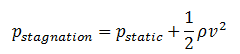
Stagnation pressure is equal to the sum of the free-stream dynamic pressure and free-stream static pressure.

stagnation pressure - total pressure

Static pressure and dynamic pressure are terms of Bernoulli’s equation:

Bernoulli Theorem - Equation

The Bernoulli’s effect causes the lowering of fluid pressure (static pressure – p) in regions where the flow velocity is increased. This lowering of pressure in a constriction of a flow path may seem counterintuitive, but seems less so when you consider pressure to be energy density. In the high velocity flow through the constriction, kinetic energy (dynamic pressure – ½.ρ.v2) must increase at the expense of pressure energy (static pressure – p).

The simplified form of Bernoulli’s equation can be summarized in the following memorable word equation:

static pressure + dynamic pressure = total pressure (stagnation pressure)

Total and dynamic pressure are not pressures in the usual sense – they cannot be measured using an aneroid, Bourdon tube or mercury column.

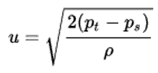
Stagnation pressure is sometimes referred to as pitot pressure because it is measured using a pitot tube. A Pitot tube is a pressure measurement instrument used to measure fluid flow velocity. Velocity can be determined using the following formula:

pitot tube - formula - velocity

where:

  • u is flow velocity to be measured in m/s,
  • ps is stagnation or total pressure in Pa,
  • pt is static pressure in Pa,
  • ρ is fluid density in kg/m3.
What is Pressure [xyz-ihs snippet=”pressure”]

Pressure Scales – Pressure Units

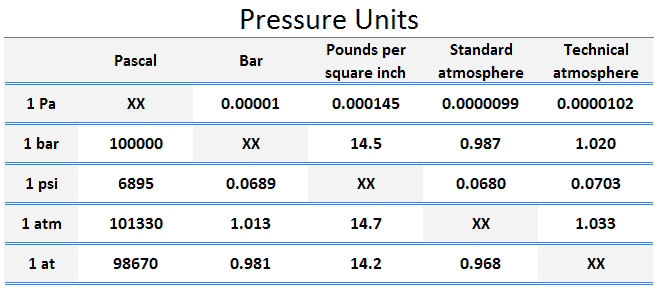
Pascal – Unit of Pressure

As was discussed, the SI unit of pressure and stress is the pascal.

  • 1 pascal  1 N/m2 = 1 kg / (m.s2)

Pascal is defined as one newton per square metre. However, for most engineering problems it is fairly small unit, so it is convenient to work with multiples of the pascal: the kPa, the bar, and the MPa.

  • 1 MPa  106 N/m2
  • 1 bar    105 N/m2
  • 1 kPa   103 N/m2

The unit of measurement called standard atmosphere (atm) is defined as:

  • 1 atm = 101.33 kPa

The standard atmosphere approximates to the average pressure at sea-level at the latitude 45° N. Note that, there is a difference between the standard atmosphere (atm) and the technical atmosphere (at).

A technical atmosphere is a non-SI unit of pressure equal to one kilogram-force per square centimeter.

  • 1 at = 98.67 kPa

Table - Conversion between pressure units - pascal, bar, psi, atmosphere

Pounds per square inch – psi

The standard unit in the English system is the pound-force per square inch (psi). It is the pressure resulting from a force of one pound-force applied to an area of one square inch.

  • 1 psi  1 lbf/in2 = 4.45 N / (0.0254 m)2 ≈ 6895 kg/m2

Therefore, one pound per square inch is approximately 6895 Pa.

The unit of measurement called standard atmosphere (atm) is defined as:

  • 1 atm = 14.7 psi

The standard atmosphere approximates to the average pressure at sea-level at the latitude 45° N. Note that, there is a difference between the standard atmosphere (atm) and the technical atmosphere (at).

A technical atmosphere is a non-SI unit of pressure equal to one kilogram-force per square centimeter.

  • 1 at = 14.2 psi

Bar – Unit of Pressure

The bar is a metric unit of pressure. It is not part of the International System of Units (SI). The bar is commonly used in the industry and in the meteorology, and an instrument used in meteorology to measure atmospheric pressure is called barometer.

One bar is exactly equal to 100 000 Pa, and is slightly less than the average atmospheric pressure on Earth at sea level (1 bar = 0.9869 atm). Atmospheric pressure is often given in millibars where standard sea level pressure is defined as 1013 mbar, 1.013 bar, or 101.3 (kPa).

Sometimes, “Bar(a)” and “bara” are used to indicate absolute pressures and “bar(g)” and “barg” for gauge pressures.

Absolute vs. Gauge Pressure

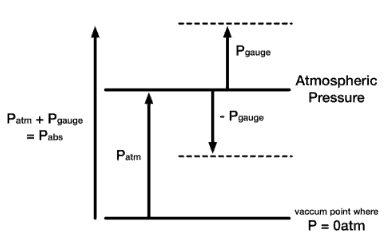
absolute-vs-gauge-pressurePressure as discussed above is called absolute pressure. Often it will be important to distinguish between absolute pressure and gauge pressure. In this article the term pressure refers to absolute pressure unless explicitly stated otherwise. But in engineering we often deal with pressures, that are measured by some devices. Although absolute pressures must be used in thermodynamic relations, pressure-measuring devices often indicate the difference between the absolute pressure in a system and the absolute pressure of the atmosphere existing outside the measuring device. They measure the gauge pressure.

  • Absolute Pressure. When pressure is measured relative to a perfect vacuum, it is called absolute pressure (psia). Pounds per square inch absolute (psia) is used to make it clear that the pressure is relative to a vacuum rather than the ambient atmospheric pressure. Since atmospheric pressure at sea level is around 101.3 kPa (14.7 psi), this will be added to any pressure reading made in air at sea level.
  • Gauge Pressure. When pressure is measured relative to atmospheric pressure (14.7 psi), it is called gauge pressure (psig). The term gauge pressure is applied when the pressure in the system is greater than the local atmospheric pressure, patm. The latter pressure scale was developed because almost all pressure gauges register zero when open to the atmosphere. Gauge pressures are positive if they are above atmospheric pressure and negative if they are below atmospheric pressure.

pgauge = pabsolute – pabsolute; atm

  • Atmospheric Pressure. Atmospheric pressure is the pressure in the surrounding air at – or “close” to – the surface of the earth. The atmospheric pressure varies with temperature and altitude above sea level. The Standard Atmospheric Pressure approximates to the average pressure at sea-level at the latitude 45° N.  The Standard Atmospheric Pressure is defined at sea-level at 273oK (0oC) and is:
    • 101325 Pa
    • 1.01325 bar
    • 14.696 psi
    • 760 mmHg
    • 760 torr
  • Negative Gauge Pressure – Vacuum Pressure. When the local atmospheric pressure is greater than the pressure in the system, the term vacuum pressure is used. A perfect vacuum would correspond to absolute zero pressure. It is certainly possible to have a negative gauge pressure, but not possible to have a negative absolute pressure. For instance, an absolute pressure of 80 kPa may be described as a gauge pressure of −21 kPa (i.e., 21 kPa below an atmospheric pressure of 101 kPa).

pvacuum = pabsolute; atm – pabsolute

For example, a car tire pumped up to 2.5 atm (36.75 psig) above local atmospheric pressure (let say 1 atm or 14.7 psia locally), will have an absolute pressure of 2.5 + 1 = 3.5 atm (36.75 + 14.7 = 51.45 psia or 36.75 psig).

On the other hand condensing steam turbines (at nuclear power plants) exhaust steam at a pressure well below atmospheric (e.g. at 0.08 bar or 8 kPa or 1.16 psia) and in a partially condensed state. In relative units it is a negative gauge pressure of about – 0.92 bar, – 92 kPa, or – 13.54 psig.

Ideal Gas Law

Any equation that relates the pressure, temperature, and specific volume of a substance is called an equation of state. The simplest and best-known equation of state for substances in the gas phase is the Ideal Gas equation of state. It was first stated by Émile Clapeyron in 1834 as a combination of the empirical Boyle’s law, Charles’ law and Avogadro’s Law. This equation predicts the p-v-T behavior of a gas quite accurately for dilute or low-pressure gases. In an ideal gas, molecules have no volume and do not interact. According to the ideal gas law, pressure varies linearly with temperature and quantity, and inversely with volume.

pV = nRT

where:

  • p is the absolute pressure of the gas
  • n is the amount of substance
  • T is the absolute temperature
  • V is the volume
  • R  is the ideal, or universal, gas constant, equal to the product of the Boltzmann constant and the Avogadro constant,

In this equation the symbol R is a constant called the universal gas constant that has the same value for all gases—namely, R =  8.31 J/mol K.

The power of the ideal gas law is in its simplicity. When any two of the thermodynamic variables, p, v, and T are given, the third can easily be found. An ideal gas is defined as one in which all collisions between atoms or molecules are perfectly elastic and in which there are no intermolecular attractive forces. An ideal gas can be visualized as a collection of perfectly hard spheres which collide but which otherwise do not interact with each other. In reality, no real gases are like an ideal gas and therefore no real gases follow the ideal gas law or equation completely. At temperatures near a gases boiling point, increases in pressure will cause condensation to take place and drastic decreases in volume. At very high pressures, the intermolecular forces of a gas are significant. However, most gases are in approximate agreement at pressures and temperatures above their boiling point. The ideal gas law is utilized by engineers working with gases because it is simple to use and approximates real gas behavior.

Typical Pressures in Engineering – Examples

The pascal (Pa) as a unit of pressure measurement is widely used throughout the world and has largely replaced the pounds per square inch (psi) unit, except in some countries that still use the Imperial measurement system, including the United States. For most engineering problems pascal (Pa) is fairly small unit, so it is convenient to work with multiples of the pascal: the kPa, the MPa, or the bar. Following list summarizes a few examples:

  • Typically most of nuclear power plants operates multi-stage condensing steam turbines. These turbines exhaust steam at a pressure well below atmospheric (e.g. at 0.08 bar or 8 kPa or 1.16 psia) and in a partially condensed state. In relative units it is a negative gauge pressure of about – 0.92 bar, – 92 kPa, or – 13.54 psig.
  • The Standard Atmospheric Pressure approximates to the average pressure at sea-level at the latitude 45° N.  The Standard Atmospheric Pressure is defined at sea-level at 273oK (0oC) and is:
    • 101325 Pa
    • 1.01325 bar
    • 14.696 psi
    • 760 mmHg
    • 760 torr
  • Car tire overpressure is about 2.5 bar, 0.25 MPa, or 36 psig.
  • Steam locomotive fire tube boiler: 150–250 psig
  • A high-pressure stage of condensing steam turbine at nuclear power plant operates at steady state with inlet conditions of  6 MPa (60 bar, or 870 psig), t = 275.6°C, x = 1
  • A boiling water reactor is cooled and moderated by water like a PWR, but at a lower pressure (e.g. 7MPa, 70 bar, or 1015 psig), which allows the water to boil inside the pressure vessel producing the steam that runs the turbines.
  • Pressurized water reactors are cooled and moderated by high-pressure liquid water (e.g. 16MPa, 160 bar, or 2320 psig). At this pressure water boils at approximately 350°C (662°F), which provides subcooling margin of about 25°C.
  • The supercritical water reactor (SCWR) is operated at supercritical pressure. The term supercritical in this context refers to the thermodynamic critical point of water (TCR = 374 °C;  pCR = 22.1 MPa)
  • Common rail direct fuel injection: On diesel engines, it features a high-pressure (over 1 000 bar or 100 MPa or 14500 psi) fuel rail.
 
Pressure in Pressurized Water Reactor
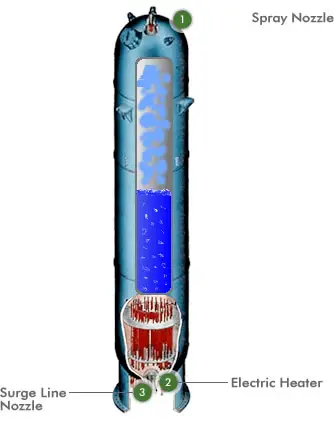
pressurizer
A pressurizer is a key component of PWRs.

Pressurized water reactors use a reactor pressure vessel (RPV) to contain the nuclear fuel, moderator, control rods and coolant. They are cooled and moderated by high-pressure liquid water (e.g. 16MPa). At this pressure water boils at approximately 350°C (662°F).  This high pressure is maintained by pressurizer. Inlet temperature of the water is about 290°C (554°F). The water (coolant) is heated in the reactor core to approximately 325°C (617°F) as the water flows through the core. As it can be seen, the reactor has approximately 25°C subcooled coolant (distance from the saturation).

A pressurizer is a component of a pressurized water reactor. Pressure in the primary circuit of PWRs is maintained by a pressurizer, a separate vessel that is connected to the primary circuit (hot leg) and partially filled with water which is heated to the saturation temperature (boiling point) for the desired pressure by submerged electrical heaters.

On the other hand there are spray lines to decrease pressure inside the pressurizer, which in turn causes decrease in pressure in reactor coolant system. These spray lines sprays reactor coolant from the cold leg of a loop into the steam space and condenses a portion of the steam. The quenching action reduces pressure and limits the pressure increases.

Pressures in Condensing Steam Turbines
engineering thermodynamics
Rankine Cycle – Thermodynamics as Energy Conversion Science

Typically most of nuclear power plants operates multi-stage condensing steam turbines. In these turbines the high-pressure stage receives steam (this steam is nearly saturated steam – x = 0.995 – point C at the figure; 6 MPa; 275.6°C) from a steam generator and exhaust it to moisture separator-reheater (point D). The steam must be reheated in order to avoid damages that could be caused to blades of steam turbine by low quality steam. The reheater heats the steam (point D) and then the steam is directed to the low-pressure stage of steam turbine, where expands (point E to F). The exhausted steam is at a pressure well below atmospheric (absolute pressure of 0.008 MPa), and is in a partially condensed state (point F), typically of a quality near 90%.

See also: Wet Steam

See also: Steam Tables

Pressure coefficient - How pressure influences reactivity
The pressure coefficient (or the moderator density coefficient) is defined as the change in reactivity per unit change in pressure.

αP = dρ⁄dP

It is expressed in units of pcm/MPa. The magnitude and sign (+ or -) of the pressure coefficient is primarily a function of the moderator-to-fuel ratio. That means it primarily depends on certain reactor design.

Although water is considered to be incompressible, in reality, it is slightly compressible (especially at 325°C (617°F)). It is obvious, the effect of pressure in the primary circuit have similar consequences as the moderator temperature. In comparison with effects of moderator temperature changes, changes in pressure have of lower order impact on reactivity and the causes are only in the density of moderator, not in the change of microscopic cross-sections.

Pressure Loss – Fluids

Summary of: Head Loss – Pressure Loss

  • Head loss or pressure loss are the reduction in the total head (sum of potential head, velocity head, and pressure head) of a fluid caused by the friction present in the fluid’s motion.
  • Head loss and pressure loss represent the same phenomenon – frictional losses in pipe and losses in hydraulic components, but they are expressed in different units.
  • Head loss of hydraulic system is divided into two main categories:
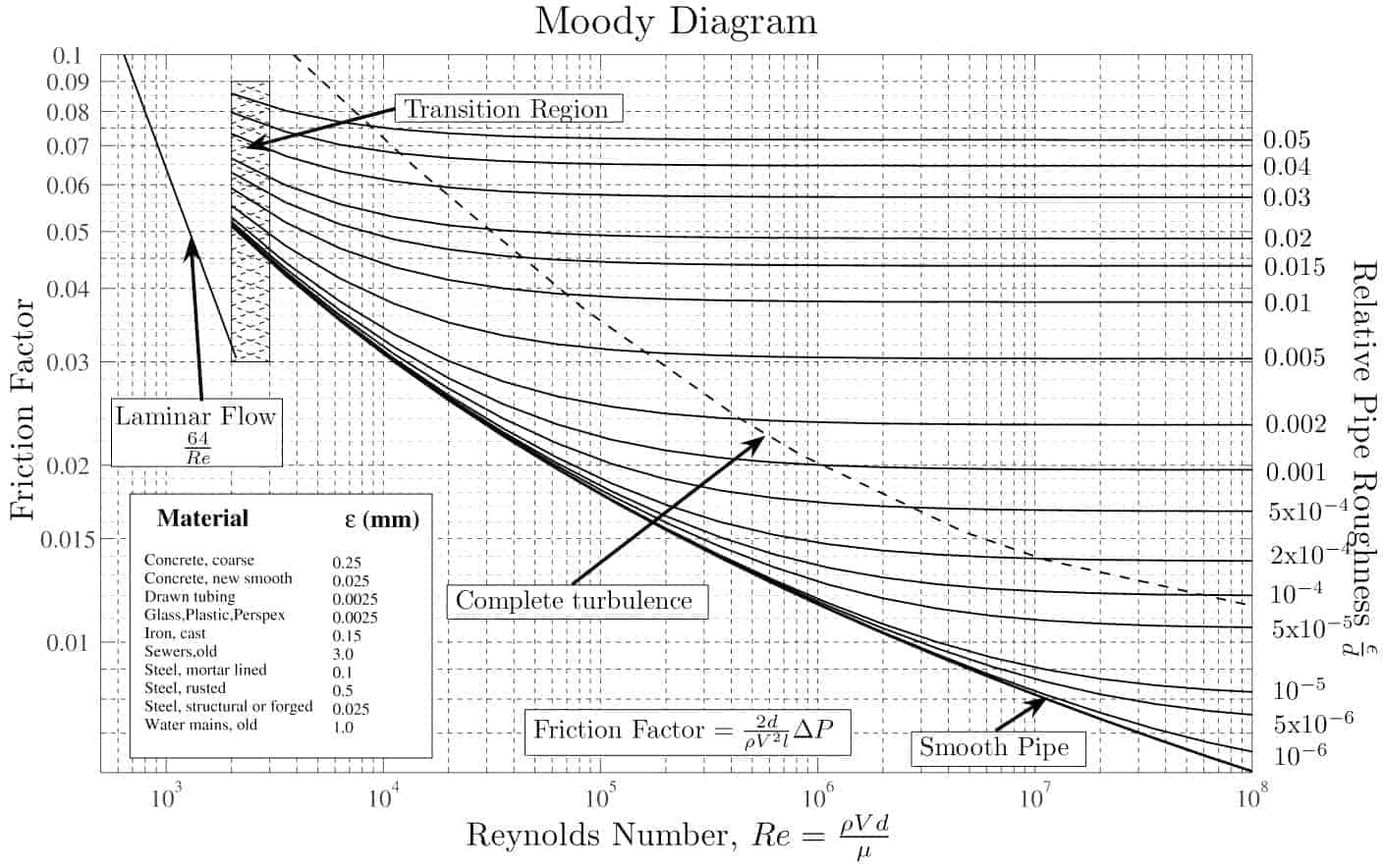
  • Moody Diagram
    Source: Donebythesecondlaw at the English language Wikipedia, CC BY-SA 3.0,
    https://commons.wikimedia.org/w/index.php?curid=4681366

    Darcy’s equation can be used to calculate major losses.

  • A special form of Darcy’s equation can be used to calculate minor losses.
  • The friction factor for fluid flow can be determined using a Moody chart.
  • The friction factor for laminar flow is independent of roughness of the pipe’s inner surface. f = 64/Re
  • The friction factor for turbulent flow depends strongly on the relative roughness. It is determined by the Colebrook equation. It must be noted, at very large Reynolds numbers, the friction factor is independent of the Reynolds number.

Critical Pressure of Water

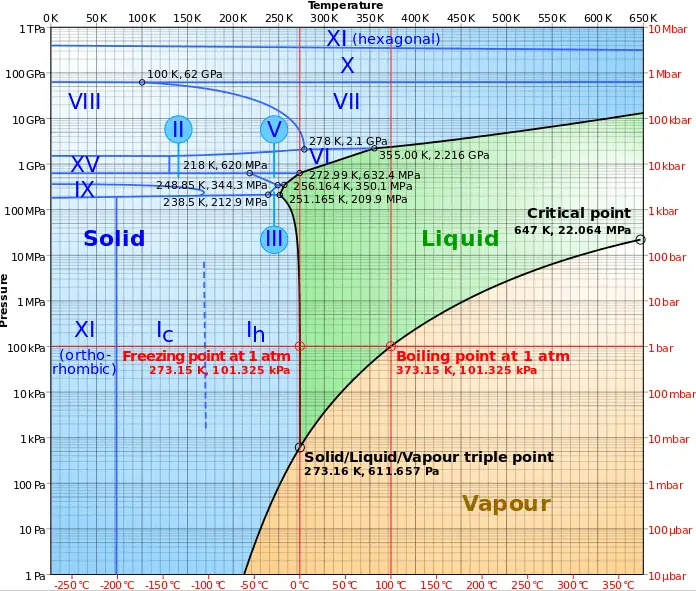
Phase diagram of water
Phase diagram of water.
Source: wikipedia.org CC BY-SA

At pressure, that is higher than the critical pressure,  water is in special state, that is known as supercritical fluid state. A supercritical fluid is a fluid that is at pressures higher than its thermodynamic critical values. At the critical and supercritical pressures a fluid is considered as a single-phase substance in spite of the fact that all thermophysical properties undergo significant changes within the critical and pseudocritical regions.

For water, the critical  parameters are the following:

  • Pcr = 22.09 MPa
  • Tcr = 374.14 °C (or 647.3 K)
  • vcr = 0.003155 m3/kg
  • uf = ug = 2014 kJ/kg
  • hf = hg = 2084 kJ/kg
  • sf = sg =4.406 kJ/kg K

See also: Critical Point of Water

See also: Supercritical Fluid

 
References:
Reactor Physics and Thermal Hydraulics:
  1. J. R. Lamarsh, Introduction to Nuclear Reactor Theory, 2nd ed., Addison-Wesley, Reading, MA (1983).
  2. J. R. Lamarsh, A. J. Baratta, Introduction to Nuclear Engineering, 3d ed., Prentice-Hall, 2001, ISBN: 0-201-82498-1.
  3. W. M. Stacey, Nuclear Reactor Physics, John Wiley & Sons, 2001, ISBN: 0- 471-39127-1.
  4. Glasstone, Sesonske. Nuclear Reactor Engineering: Reactor Systems Engineering, Springer; 4th edition, 1994, ISBN: 978-0412985317
  5. Todreas Neil E., Kazimi Mujid S. Nuclear Systems Volume I: Thermal Hydraulic Fundamentals, Second Edition. CRC Press; 2 edition, 2012, ISBN: 978-0415802871
  6. Zohuri B., McDaniel P. Thermodynamics in Nuclear Power Plant Systems. Springer; 2015, ISBN: 978-3-319-13419-2
  7. Moran Michal J., Shapiro Howard N. Fundamentals of Engineering Thermodynamics, Fifth Edition, John Wiley & Sons, 2006, ISBN: 978-0-470-03037-0
  8. Kleinstreuer C. Modern Fluid Dynamics. Springer, 2010, ISBN 978-1-4020-8670-0.
  9. U.S. Department of Energy, THERMODYNAMICS, HEAT TRANSFER, AND FLUID FLOW. DOE Fundamentals Handbook, Volume 1, 2 and 3. June 1992.

See also:

Thermodynamic Properties

We hope, this article, Pressure – Physics, helps you. If so, give us a like in the sidebar. Main purpose of this website is to help the public to learn some interesting and important information about thermal engineering.