Facebook Instagram Youtube Twitter

What is Pressure Scale – Pressure Unit – Definition

There are several pressure scales and units of pressure. The SI unit of pressure and stress is the pascal. The standard unit in the English system is the pound-force per square inch (psi). Thermal Engineering

Pressure Scales – Pressure Units

Pascal – Unit of Pressure

As was discussed, the SI unit of pressure and stress is the pascal.

  • 1 pascal  1 N/m2 = 1 kg / (m.s2)

Pascal is defined as one newton per square metre. However, for most engineering problems it is fairly small unit, so it is convenient to work with multiples of the pascal: the kPa, the bar, and the MPa.

  • 1 MPa  106 N/m2
  • 1 bar    105 N/m2
  • 1 kPa   103 N/m2

The unit of measurement called standard atmosphere (atm) is defined as:

  • 1 atm = 101.33 kPa

The standard atmosphere approximates to the average pressure at sea-level at the latitude 45° N. Note that, there is a difference between the standard atmosphere (atm) and the technical atmosphere (at).

A technical atmosphere is a non-SI unit of pressure equal to one kilogram-force per square centimeter.

  • 1 at = 98.67 kPa

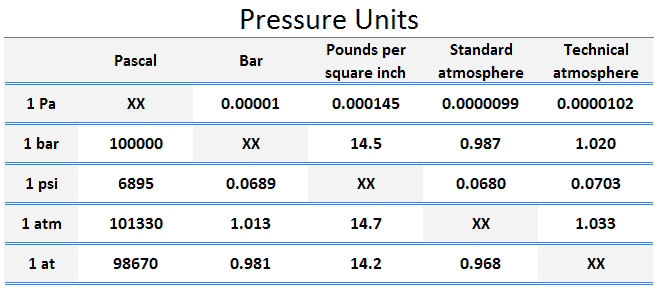
Table - Conversion between pressure units - pascal, bar, psi, atmosphere

Pounds per square inch – psi

The standard unit in the English system is the pound-force per square inch (psi). It is the pressure resulting from a force of one pound-force applied to an area of one square inch.

  • 1 psi  1 lbf/in2 = 4.45 N / (0.0254 m)2 ≈ 6895 kg/m2

Therefore, one pound per square inch is approximately 6895 Pa.

The unit of measurement called standard atmosphere (atm) is defined as:

  • 1 atm = 14.7 psi

The standard atmosphere approximates to the average pressure at sea-level at the latitude 45° N. Note that, there is a difference between the standard atmosphere (atm) and the technical atmosphere (at).

A technical atmosphere is a non-SI unit of pressure equal to one kilogram-force per square centimeter.

  • 1 at = 14.2 psi

Bar – Unit of Pressure

The bar is a metric unit of pressure. It is not part of the International System of Units (SI). The bar is commonly used in the industry and in the meteorology, and an instrument used in meteorology to measure atmospheric pressure is called barometer.

One bar is exactly equal to 100 000 Pa, and is slightly less than the average atmospheric pressure on Earth at sea level (1 bar = 0.9869 atm). Atmospheric pressure is often given in millibars where standard sea level pressure is defined as 1013 mbar, 1.013 bar, or 101.3 (kPa).

Sometimes, “Bar(a)” and “bara” are used to indicate absolute pressures and “bar(g)” and “barg” for gauge pressures.

Typical Pressures in Engineering – Examples

The pascal (Pa) as a unit of pressure measurement is widely used throughout the world and has largely replaced the pounds per square inch (psi) unit, except in some countries that still use the Imperial measurement system, including the United States. For most engineering problems pascal (Pa) is fairly small unit, so it is convenient to work with multiples of the pascal: the kPa, the MPa, or the bar. Following list summarizes a few examples:

  • Typically most of nuclear power plants operates multi-stage condensing steam turbines. These turbines exhaust steam at a pressure well below atmospheric (e.g. at 0.08 bar or 8 kPa or 1.16 psia) and in a partially condensed state. In relative units it is a negative gauge pressure of about – 0.92 bar, – 92 kPa, or – 13.54 psig.
  • The Standard Atmospheric Pressure approximates to the average pressure at sea-level at the latitude 45° N.  The Standard Atmospheric Pressure is defined at sea-level at 273oK (0oC) and is:
    • 101325 Pa
    • 1.01325 bar
    • 14.696 psi
    • 760 mmHg
    • 760 torr
  • Car tire overpressure is about 2.5 bar, 0.25 MPa, or 36 psig.
  • Steam locomotive fire tube boiler: 150–250 psig
  • A high-pressure stage of condensing steam turbine at nuclear power plant operates at steady state with inlet conditions of  6 MPa (60 bar, or 870 psig), t = 275.6°C, x = 1
  • A boiling water reactor is cooled and moderated by water like a PWR, but at a lower pressure (e.g. 7MPa, 70 bar, or 1015 psig), which allows the water to boil inside the pressure vessel producing the steam that runs the turbines.
  • Pressurized water reactors are cooled and moderated by high-pressure liquid water (e.g. 16MPa, 160 bar, or 2320 psig). At this pressure water boils at approximately 350°C (662°F), which provides subcooling margin of about 25°C.
  • The supercritical water reactor (SCWR) is operated at supercritical pressure. The term supercritical in this context refers to the thermodynamic critical point of water (TCR = 374 °C;  pCR = 22.1 MPa)
  • Common rail direct fuel injection: On diesel engines, it features a high-pressure (over 1 000 bar or 100 MPa or 14500 psi) fuel rail.
 
References:
Reactor Physics and Thermal Hydraulics:
  1. J. R. Lamarsh, Introduction to Nuclear Reactor Theory, 2nd ed., Addison-Wesley, Reading, MA (1983).
  2. J. R. Lamarsh, A. J. Baratta, Introduction to Nuclear Engineering, 3d ed., Prentice-Hall, 2001, ISBN: 0-201-82498-1.
  3. W. M. Stacey, Nuclear Reactor Physics, John Wiley & Sons, 2001, ISBN: 0- 471-39127-1.
  4. Glasstone, Sesonske. Nuclear Reactor Engineering: Reactor Systems Engineering, Springer; 4th edition, 1994, ISBN: 978-0412985317
  5. Todreas Neil E., Kazimi Mujid S. Nuclear Systems Volume I: Thermal Hydraulic Fundamentals, Second Edition. CRC Press; 2 edition, 2012, ISBN: 978-0415802871
  6. Zohuri B., McDaniel P. Thermodynamics in Nuclear Power Plant Systems. Springer; 2015, ISBN: 978-3-319-13419-2
  7. Moran Michal J., Shapiro Howard N. Fundamentals of Engineering Thermodynamics, Fifth Edition, John Wiley & Sons, 2006, ISBN: 978-0-470-03037-0
  8. Kleinstreuer C. Modern Fluid Dynamics. Springer, 2010, ISBN 978-1-4020-8670-0.
  9. U.S. Department of Energy, THERMODYNAMICS, HEAT TRANSFER, AND FLUID FLOW. DOE Fundamentals Handbook, Volume 1, 2 and 3. June 1992.

See also:

Pressure

We hope, this article, Pressure Scale – Pressure Unit, helps you. If so, give us a like in the sidebar. Main purpose of this website is to help the public to learn some interesting and important information about thermal engineering.

What is Pascal – Unit of Pressure – Definition

Pascal – Unit of Pressure. Pascal is defined as one newton per square metre. However, it is convenient to work with multiples of the pascal: the kPa, the bar, and the MPa. Thermal Engineering

What is Pressure

manometer-pressure-measurementPressure is a measure of the force exerted per unit area on the boundaries of a substance. The standard unit for pressure in the SI system is the Newton per square meter or pascal (Pa). Mathematically:

p = F/A

where

  • p is the pressure
  • F is the normal force
  • A is the area of the boundary

Pascal is defined as force of 1N that is exerted on unit area.

  • 1 Pascal = 1 N/m2
However, for most engineering problems it is fairly small unit, so it is convenient to work with multiples of the pascal: the kPa, the bar, and the MPa.
  • 1 MPa  106 N/m2
  • 1 bar    105 N/m2
  • 1 kPa   103 N/m2

In general, pressure or the force exerted per unit area on the boundaries of a substance is caused by the collisions of the molecules of the substance with the boundaries of the system. As molecules hit the walls, they exert forces that try to push the walls outward. The forces resulting from all of these collisions cause the pressure exerted by a system on its surroundings. Pressure as an intensive variable is constant in a closed system. It really is only relevant in liquid or gaseous systems.

What is Pressure [xyz-ihs snippet=”pressure”]

Pressure Scales – Pressure Units

Pascal – Unit of Pressure

As was discussed, the SI unit of pressure and stress is the pascal.

  • 1 pascal  1 N/m2 = 1 kg / (m.s2)

Pascal is defined as one newton per square metre. However, for most engineering problems it is fairly small unit, so it is convenient to work with multiples of the pascal: the kPa, the bar, and the MPa.

  • 1 MPa  106 N/m2
  • 1 bar    105 N/m2
  • 1 kPa   103 N/m2

The unit of measurement called standard atmosphere (atm) is defined as:

  • 1 atm = 101.33 kPa

The standard atmosphere approximates to the average pressure at sea-level at the latitude 45° N. Note that, there is a difference between the standard atmosphere (atm) and the technical atmosphere (at).

A technical atmosphere is a non-SI unit of pressure equal to one kilogram-force per square centimeter.

  • 1 at = 98.67 kPa

Table - Conversion between pressure units - pascal, bar, psi, atmosphere

See also: Pound per square inch – psi

See also: Bar – Unit of Pressure

See also: Typical Pressures in Engineering

Absolute vs. Gauge Pressure

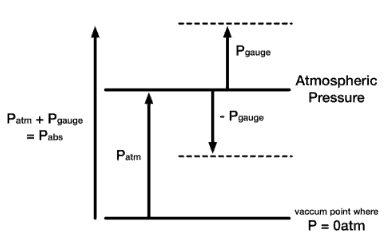
absolute-vs-gauge-pressurePressure as discussed above is called absolute pressure. Often it will be important to distinguish between absolute pressure and gauge pressure. In this article the term pressure refers to absolute pressure unless explicitly stated otherwise. But in engineering we often deal with pressures, that are measured by some devices. Although absolute pressures must be used in thermodynamic relations, pressure-measuring devices often indicate the difference between the absolute pressure in a system and the absolute pressure of the atmosphere existing outside the measuring device. They measure the gauge pressure.

  • Absolute Pressure. When pressure is measured relative to a perfect vacuum, it is called absolute pressure (psia). Pounds per square inch absolute (psia) is used to make it clear that the pressure is relative to a vacuum rather than the ambient atmospheric pressure. Since atmospheric pressure at sea level is around 101.3 kPa (14.7 psi), this will be added to any pressure reading made in air at sea level.
  • Gauge Pressure. When pressure is measured relative to atmospheric pressure (14.7 psi), it is called gauge pressure (psig). The term gauge pressure is applied when the pressure in the system is greater than the local atmospheric pressure, patm. The latter pressure scale was developed because almost all pressure gauges register zero when open to the atmosphere. Gauge pressures are positive if they are above atmospheric pressure and negative if they are below atmospheric pressure.

pgauge = pabsolute – pabsolute; atm

  • Atmospheric Pressure. Atmospheric pressure is the pressure in the surrounding air at – or “close” to – the surface of the earth. The atmospheric pressure varies with temperature and altitude above sea level. The Standard Atmospheric Pressure approximates to the average pressure at sea-level at the latitude 45° N.  The Standard Atmospheric Pressure is defined at sea-level at 273oK (0oC) and is:
    • 101325 Pa
    • 1.01325 bar
    • 14.696 psi
    • 760 mmHg
    • 760 torr
  • Negative Gauge Pressure – Vacuum Pressure. When the local atmospheric pressure is greater than the pressure in the system, the term vacuum pressure is used. A perfect vacuum would correspond to absolute zero pressure. It is certainly possible to have a negative gauge pressure, but not possible to have a negative absolute pressure. For instance, an absolute pressure of 80 kPa may be described as a gauge pressure of −21 kPa (i.e., 21 kPa below an atmospheric pressure of 101 kPa).

pvacuum = pabsolute; atm – pabsolute

For example, a car tire pumped up to 2.5 atm (36.75 psig) above local atmospheric pressure (let say 1 atm or 14.7 psia locally), will have an absolute pressure of 2.5 + 1 = 3.5 atm (36.75 + 14.7 = 51.45 psia or 36.75 psig).

On the other hand condensing steam turbines (at nuclear power plants) exhaust steam at a pressure well below atmospheric (e.g. at 0.08 bar or 8 kPa or 1.16 psia) and in a partially condensed state. In relative units it is a negative gauge pressure of about – 0.92 bar, – 92 kPa, or – 13.54 psig.

 
References:
Reactor Physics and Thermal Hydraulics:
  1. J. R. Lamarsh, Introduction to Nuclear Reactor Theory, 2nd ed., Addison-Wesley, Reading, MA (1983).
  2. J. R. Lamarsh, A. J. Baratta, Introduction to Nuclear Engineering, 3d ed., Prentice-Hall, 2001, ISBN: 0-201-82498-1.
  3. W. M. Stacey, Nuclear Reactor Physics, John Wiley & Sons, 2001, ISBN: 0- 471-39127-1.
  4. Glasstone, Sesonske. Nuclear Reactor Engineering: Reactor Systems Engineering, Springer; 4th edition, 1994, ISBN: 978-0412985317
  5. Todreas Neil E., Kazimi Mujid S. Nuclear Systems Volume I: Thermal Hydraulic Fundamentals, Second Edition. CRC Press; 2 edition, 2012, ISBN: 978-0415802871
  6. Zohuri B., McDaniel P. Thermodynamics in Nuclear Power Plant Systems. Springer; 2015, ISBN: 978-3-319-13419-2
  7. Moran Michal J., Shapiro Howard N. Fundamentals of Engineering Thermodynamics, Fifth Edition, John Wiley & Sons, 2006, ISBN: 978-0-470-03037-0
  8. Kleinstreuer C. Modern Fluid Dynamics. Springer, 2010, ISBN 978-1-4020-8670-0.
  9. U.S. Department of Energy, THERMODYNAMICS, HEAT TRANSFER, AND FLUID FLOW. DOE Fundamentals Handbook, Volume 1, 2 and 3. June 1992.

See also:

Pressure

We hope, this article, Pascal – Unit of Pressure, helps you. If so, give us a like in the sidebar. Main purpose of this website is to help the public to learn some interesting and important information about thermal engineering.
What is Pound per square inch – psi – Definition

Pounds per square inch – psi – psig – psia. The standard unit in the English system is the pound-force per square inch (psi). 1 psi is approximately 6895 Pa. Thermal Engineering

What is Pressure

manometer-pressure-measurementPressure is a measure of the force exerted per unit area on the boundaries of a substance. The standard unit for pressure in the SI system is the Newton per square meter or pascal (Pa). Mathematically:

p = F/A

where

  • p is the pressure
  • F is the normal force
  • A is the area of the boundary

Pascal is defined as force of 1N that is exerted on unit area.

  • 1 Pascal = 1 N/m2
However, for most engineering problems it is fairly small unit, so it is convenient to work with multiples of the pascal: the kPa, the bar, and the MPa.
  • 1 MPa  106 N/m2
  • 1 bar    105 N/m2
  • 1 kPa   103 N/m2

In general, pressure or the force exerted per unit area on the boundaries of a substance is caused by the collisions of the molecules of the substance with the boundaries of the system. As molecules hit the walls, they exert forces that try to push the walls outward. The forces resulting from all of these collisions cause the pressure exerted by a system on its surroundings. Pressure as an intensive variable is constant in a closed system. It really is only relevant in liquid or gaseous systems.

What is Pressure [xyz-ihs snippet=”pressure”]

Pounds per square inch – psi

The standard unit in the English system is the pound-force per square inch (psi). It is the pressure resulting from a force of one pound-force applied to an area of one square inch.

  • 1 psi  1 lbf/in2 = 4.45 N / (0.0254 m)2 ≈ 6895 kg/m2

Therefore, one pound per square inch is approximately 6895 Pa.

The unit of measurement called standard atmosphere (atm) is defined as:

  • 1 atm = 14.7 psi

The standard atmosphere approximates to the average pressure at sea-level at the latitude 45° N. Note that, there is a difference between the standard atmosphere (atm) and the technical atmosphere (at).

A technical atmosphere is a non-SI unit of pressure equal to one kilogram-force per square centimeter.

  • 1 at = 14.2 psi

Table - Conversion between pressure units - pascal, bar, psi, atmosphere

See also: Pascal – Unit of Pressure

See also: Bar – Unit of Pressure

See also: Typical Pressures in Engineering

Absolute vs. Gauge Pressure

absolute-vs-gauge-pressurePressure as discussed above is called absolute pressure. Often it will be important to distinguish between absolute pressure and gauge pressure. In this article the term pressure refers to absolute pressure unless explicitly stated otherwise. But in engineering we often deal with pressures, that are measured by some devices. Although absolute pressures must be used in thermodynamic relations, pressure-measuring devices often indicate the difference between the absolute pressure in a system and the absolute pressure of the atmosphere existing outside the measuring device. They measure the gauge pressure.

  • Absolute Pressure. When pressure is measured relative to a perfect vacuum, it is called absolute pressure (psia). Pounds per square inch absolute (psia) is used to make it clear that the pressure is relative to a vacuum rather than the ambient atmospheric pressure. Since atmospheric pressure at sea level is around 101.3 kPa (14.7 psi), this will be added to any pressure reading made in air at sea level.
  • Gauge Pressure. When pressure is measured relative to atmospheric pressure (14.7 psi), it is called gauge pressure (psig). The term gauge pressure is applied when the pressure in the system is greater than the local atmospheric pressure, patm. The latter pressure scale was developed because almost all pressure gauges register zero when open to the atmosphere. Gauge pressures are positive if they are above atmospheric pressure and negative if they are below atmospheric pressure.

pgauge = pabsolute – pabsolute; atm

  • Atmospheric Pressure. Atmospheric pressure is the pressure in the surrounding air at – or “close” to – the surface of the earth. The atmospheric pressure varies with temperature and altitude above sea level. The Standard Atmospheric Pressure approximates to the average pressure at sea-level at the latitude 45° N.  The Standard Atmospheric Pressure is defined at sea-level at 273oK (0oC) and is:
    • 101325 Pa
    • 1.01325 bar
    • 14.696 psi
    • 760 mmHg
    • 760 torr
  • Negative Gauge Pressure – Vacuum Pressure. When the local atmospheric pressure is greater than the pressure in the system, the term vacuum pressure is used. A perfect vacuum would correspond to absolute zero pressure. It is certainly possible to have a negative gauge pressure, but not possible to have a negative absolute pressure. For instance, an absolute pressure of 80 kPa may be described as a gauge pressure of −21 kPa (i.e., 21 kPa below an atmospheric pressure of 101 kPa).

pvacuum = pabsolute; atm – pabsolute

For example, a car tire pumped up to 2.5 atm (36.75 psig) above local atmospheric pressure (let say 1 atm or 14.7 psia locally), will have an absolute pressure of 2.5 + 1 = 3.5 atm (36.75 + 14.7 = 51.45 psia or 36.75 psig).

On the other hand condensing steam turbines (at nuclear power plants) exhaust steam at a pressure well below atmospheric (e.g. at 0.08 bar or 8 kPa or 1.16 psia) and in a partially condensed state. In relative units it is a negative gauge pressure of about – 0.92 bar, – 92 kPa, or – 13.54 psig.

 
References:
Reactor Physics and Thermal Hydraulics:
  1. J. R. Lamarsh, Introduction to Nuclear Reactor Theory, 2nd ed., Addison-Wesley, Reading, MA (1983).
  2. J. R. Lamarsh, A. J. Baratta, Introduction to Nuclear Engineering, 3d ed., Prentice-Hall, 2001, ISBN: 0-201-82498-1.
  3. W. M. Stacey, Nuclear Reactor Physics, John Wiley & Sons, 2001, ISBN: 0- 471-39127-1.
  4. Glasstone, Sesonske. Nuclear Reactor Engineering: Reactor Systems Engineering, Springer; 4th edition, 1994, ISBN: 978-0412985317
  5. Todreas Neil E., Kazimi Mujid S. Nuclear Systems Volume I: Thermal Hydraulic Fundamentals, Second Edition. CRC Press; 2 edition, 2012, ISBN: 978-0415802871
  6. Zohuri B., McDaniel P. Thermodynamics in Nuclear Power Plant Systems. Springer; 2015, ISBN: 978-3-319-13419-2
  7. Moran Michal J., Shapiro Howard N. Fundamentals of Engineering Thermodynamics, Fifth Edition, John Wiley & Sons, 2006, ISBN: 978-0-470-03037-0
  8. Kleinstreuer C. Modern Fluid Dynamics. Springer, 2010, ISBN 978-1-4020-8670-0.
  9. U.S. Department of Energy, THERMODYNAMICS, HEAT TRANSFER, AND FLUID FLOW. DOE Fundamentals Handbook, Volume 1, 2 and 3. June 1992.

See also:

Pressure

We hope, this article, Pound per square inch – psi, helps you. If so, give us a like in the sidebar. Main purpose of this website is to help the public to learn some interesting and important information about thermal engineering.
What is Bar – Unit of Pressure – Definition

The bar is a metric unit of pressure. The bar is commonly used in the industry and in the meteorology. One bar is exactly equal to 100 000 Pa. Thermal Engineering

What is Pressure

manometer-pressure-measurementPressure is a measure of the force exerted per unit area on the boundaries of a substance. The standard unit for pressure in the SI system is the Newton per square meter or pascal (Pa). Mathematically:

p = F/A

where

  • p is the pressure
  • F is the normal force
  • A is the area of the boundary

Pascal is defined as force of 1N that is exerted on unit area.

  • 1 Pascal = 1 N/m2
However, for most engineering problems it is fairly small unit, so it is convenient to work with multiples of the pascal: the kPa, the bar, and the MPa.
  • 1 MPa  106 N/m2
  • 1 bar    105 N/m2
  • 1 kPa   103 N/m2

In general, pressure or the force exerted per unit area on the boundaries of a substance is caused by the collisions of the molecules of the substance with the boundaries of the system. As molecules hit the walls, they exert forces that try to push the walls outward. The forces resulting from all of these collisions cause the pressure exerted by a system on its surroundings. Pressure as an intensive variable is constant in a closed system. It really is only relevant in liquid or gaseous systems.

What is Pressure [xyz-ihs snippet=”pressure”]

Bar – Unit of Pressure

The bar is a metric unit of pressure. It is not part of the International System of Units (SI). The bar is commonly used in the industry and in the meteorology, and an instrument used in meteorology to measure atmospheric pressure is called barometer.

One bar is exactly equal to 100 000 Pa, and is slightly less than the average atmospheric pressure on Earth at sea level (1 bar = 0.9869 atm). Atmospheric pressure is often given in millibars where standard sea level pressure is defined as 1013 mbar, 1.013 bar, or 101.3 (kPa).

Sometimes, “Bar(a)” and “bara” are used to indicate absolute pressures and “bar(g)” and “barg” for gauge pressures.

Table - Conversion between pressure units - pascal, bar, psi, atmosphere


See also: Pascal – Unit of Pressure

See also: Pound per square inch – psi

See also: Typical Pressures in Engineering

Absolute vs. Gauge Pressure

absolute-vs-gauge-pressurePressure as discussed above is called absolute pressure. Often it will be important to distinguish between absolute pressure and gauge pressure. In this article the term pressure refers to absolute pressure unless explicitly stated otherwise. But in engineering we often deal with pressures, that are measured by some devices. Although absolute pressures must be used in thermodynamic relations, pressure-measuring devices often indicate the difference between the absolute pressure in a system and the absolute pressure of the atmosphere existing outside the measuring device. They measure the gauge pressure.

  • Absolute Pressure. When pressure is measured relative to a perfect vacuum, it is called absolute pressure (psia). Pounds per square inch absolute (psia) is used to make it clear that the pressure is relative to a vacuum rather than the ambient atmospheric pressure. Since atmospheric pressure at sea level is around 101.3 kPa (14.7 psi), this will be added to any pressure reading made in air at sea level.
  • Gauge Pressure. When pressure is measured relative to atmospheric pressure (14.7 psi), it is called gauge pressure (psig). The term gauge pressure is applied when the pressure in the system is greater than the local atmospheric pressure, patm. The latter pressure scale was developed because almost all pressure gauges register zero when open to the atmosphere. Gauge pressures are positive if they are above atmospheric pressure and negative if they are below atmospheric pressure.

pgauge = pabsolute – pabsolute; atm

  • Atmospheric Pressure. Atmospheric pressure is the pressure in the surrounding air at – or “close” to – the surface of the earth. The atmospheric pressure varies with temperature and altitude above sea level. The Standard Atmospheric Pressure approximates to the average pressure at sea-level at the latitude 45° N.  The Standard Atmospheric Pressure is defined at sea-level at 273oK (0oC) and is:
    • 101325 Pa
    • 1.01325 bar
    • 14.696 psi
    • 760 mmHg
    • 760 torr
  • Negative Gauge Pressure – Vacuum Pressure. When the local atmospheric pressure is greater than the pressure in the system, the term vacuum pressure is used. A perfect vacuum would correspond to absolute zero pressure. It is certainly possible to have a negative gauge pressure, but not possible to have a negative absolute pressure. For instance, an absolute pressure of 80 kPa may be described as a gauge pressure of −21 kPa (i.e., 21 kPa below an atmospheric pressure of 101 kPa).

pvacuum = pabsolute; atm – pabsolute

For example, a car tire pumped up to 2.5 atm (36.75 psig) above local atmospheric pressure (let say 1 atm or 14.7 psia locally), will have an absolute pressure of 2.5 + 1 = 3.5 atm (36.75 + 14.7 = 51.45 psia or 36.75 psig).

On the other hand condensing steam turbines (at nuclear power plants) exhaust steam at a pressure well below atmospheric (e.g. at 0.08 bar or 8 kPa or 1.16 psia) and in a partially condensed state. In relative units it is a negative gauge pressure of about – 0.92 bar, – 92 kPa, or – 13.54 psig.

 
References:
Reactor Physics and Thermal Hydraulics:
  1. J. R. Lamarsh, Introduction to Nuclear Reactor Theory, 2nd ed., Addison-Wesley, Reading, MA (1983).
  2. J. R. Lamarsh, A. J. Baratta, Introduction to Nuclear Engineering, 3d ed., Prentice-Hall, 2001, ISBN: 0-201-82498-1.
  3. W. M. Stacey, Nuclear Reactor Physics, John Wiley & Sons, 2001, ISBN: 0- 471-39127-1.
  4. Glasstone, Sesonske. Nuclear Reactor Engineering: Reactor Systems Engineering, Springer; 4th edition, 1994, ISBN: 978-0412985317
  5. Todreas Neil E., Kazimi Mujid S. Nuclear Systems Volume I: Thermal Hydraulic Fundamentals, Second Edition. CRC Press; 2 edition, 2012, ISBN: 978-0415802871
  6. Zohuri B., McDaniel P. Thermodynamics in Nuclear Power Plant Systems. Springer; 2015, ISBN: 978-3-319-13419-2
  7. Moran Michal J., Shapiro Howard N. Fundamentals of Engineering Thermodynamics, Fifth Edition, John Wiley & Sons, 2006, ISBN: 978-0-470-03037-0
  8. Kleinstreuer C. Modern Fluid Dynamics. Springer, 2010, ISBN 978-1-4020-8670-0.
  9. U.S. Department of Energy, THERMODYNAMICS, HEAT TRANSFER, AND FLUID FLOW. DOE Fundamentals Handbook, Volume 1, 2 and 3. June 1992.

See also:

Pressure

We hope, this article, Bar – Unit of Pressure, helps you. If so, give us a like in the sidebar. Main purpose of this website is to help the public to learn some interesting and important information about thermal engineering.
What is Absolute vs. Gauge Pressure – Definition

Absolute Pressure vs. Gauge Pressure. Often it is important to distinguish between absolute pressure and gauge pressure, especially in power engineering. Thermal Engineering

What is Pressure

manometer-pressure-measurementPressure is a measure of the force exerted per unit area on the boundaries of a substance. The standard unit for pressure in the SI system is the Newton per square meter or pascal (Pa). Mathematically:

p = F/A

where

  • p is the pressure
  • F is the normal force
  • A is the area of the boundary

Pascal is defined as force of 1N that is exerted on unit area.

  • 1 Pascal = 1 N/m2
However, for most engineering problems it is fairly small unit, so it is convenient to work with multiples of the pascal: the kPa, the bar, and the MPa.
  • 1 MPa  106 N/m2
  • 1 bar    105 N/m2
  • 1 kPa   103 N/m2

In general, pressure or the force exerted per unit area on the boundaries of a substance is caused by the collisions of the molecules of the substance with the boundaries of the system. As molecules hit the walls, they exert forces that try to push the walls outward. The forces resulting from all of these collisions cause the pressure exerted by a system on its surroundings. Pressure as an intensive variable is constant in a closed system. It really is only relevant in liquid or gaseous systems.

What is Pressure [xyz-ihs snippet=”pressure”]

Absolute vs. Gauge Pressure

absolute-vs-gauge-pressurePressure as discussed above is called absolute pressure. Often it will be important to distinguish between absolute pressure and gauge pressure. In this article the term pressure refers to absolute pressure unless explicitly stated otherwise. But in engineering we often deal with pressures, that are measured by some devices. Although absolute pressures must be used in thermodynamic relations, pressure-measuring devices often indicate the difference between the absolute pressure in a system and the absolute pressure of the atmosphere existing outside the measuring device. They measure the gauge pressure.

  • Absolute Pressure. When pressure is measured relative to a perfect vacuum, it is called absolute pressure (psia). Pounds per square inch absolute (psia) is used to make it clear that the pressure is relative to a vacuum rather than the ambient atmospheric pressure. Since atmospheric pressure at sea level is around 101.3 kPa (14.7 psi), this will be added to any pressure reading made in air at sea level.
  • Gauge Pressure. When pressure is measured relative to atmospheric pressure (14.7 psi), it is called gauge pressure (psig). The term gauge pressure is applied when the pressure in the system is greater than the local atmospheric pressure, patm. The latter pressure scale was developed because almost all pressure gauges register zero when open to the atmosphere. Gauge pressures are positive if they are above atmospheric pressure and negative if they are below atmospheric pressure.

pgauge = pabsolute – pabsolute; atm

  • Atmospheric Pressure. Atmospheric pressure is the pressure in the surrounding air at – or “close” to – the surface of the earth. The atmospheric pressure varies with temperature and altitude above sea level. The Standard Atmospheric Pressure approximates to the average pressure at sea-level at the latitude 45° N.  The Standard Atmospheric Pressure is defined at sea-level at 273oK (0oC) and is:
    • 101325 Pa
    • 1.01325 bar
    • 14.696 psi
    • 760 mmHg
    • 760 torr
  • Negative Gauge Pressure – Vacuum Pressure. When the local atmospheric pressure is greater than the pressure in the system, the term vacuum pressure is used. A perfect vacuum would correspond to absolute zero pressure. It is certainly possible to have a negative gauge pressure, but not possible to have a negative absolute pressure. For instance, an absolute pressure of 80 kPa may be described as a gauge pressure of −21 kPa (i.e., 21 kPa below an atmospheric pressure of 101 kPa).

pvacuum = pabsolute; atm – pabsolute

For example, a car tire pumped up to 2.5 atm (36.75 psig) above local atmospheric pressure (let say 1 atm or 14.7 psia locally), will have an absolute pressure of 2.5 + 1 = 3.5 atm (36.75 + 14.7 = 51.45 psia or 36.75 psig).

On the other hand condensing steam turbines (at nuclear power plants) exhaust steam at a pressure well below atmospheric (e.g. at 0.08 bar or 8 kPa or 1.16 psia) and in a partially condensed state. In relative units it is a negative gauge pressure of about – 0.92 bar, – 92 kPa, or – 13.54 psig.

See also: Typical Pressures in Engineering

 
References:
Reactor Physics and Thermal Hydraulics:
  1. J. R. Lamarsh, Introduction to Nuclear Reactor Theory, 2nd ed., Addison-Wesley, Reading, MA (1983).
  2. J. R. Lamarsh, A. J. Baratta, Introduction to Nuclear Engineering, 3d ed., Prentice-Hall, 2001, ISBN: 0-201-82498-1.
  3. W. M. Stacey, Nuclear Reactor Physics, John Wiley & Sons, 2001, ISBN: 0- 471-39127-1.
  4. Glasstone, Sesonske. Nuclear Reactor Engineering: Reactor Systems Engineering, Springer; 4th edition, 1994, ISBN: 978-0412985317
  5. Todreas Neil E., Kazimi Mujid S. Nuclear Systems Volume I: Thermal Hydraulic Fundamentals, Second Edition. CRC Press; 2 edition, 2012, ISBN: 978-0415802871
  6. Zohuri B., McDaniel P. Thermodynamics in Nuclear Power Plant Systems. Springer; 2015, ISBN: 978-3-319-13419-2
  7. Moran Michal J., Shapiro Howard N. Fundamentals of Engineering Thermodynamics, Fifth Edition, John Wiley & Sons, 2006, ISBN: 978-0-470-03037-0
  8. Kleinstreuer C. Modern Fluid Dynamics. Springer, 2010, ISBN 978-1-4020-8670-0.
  9. U.S. Department of Energy, THERMODYNAMICS, HEAT TRANSFER, AND FLUID FLOW. DOE Fundamentals Handbook, Volume 1, 2 and 3. June 1992.

See also:

Pressure

We hope, this article, Absolute vs. Gauge Pressure, helps you. If so, give us a like in the sidebar. Main purpose of this website is to help the public to learn some interesting and important information about thermal engineering.
What is Absolute Pressure – Definition

Absolute Pressure. When pressure is measured relative to a perfect vacuum, it is called absolute pressure (psia). In engineering, it is important to distinguish between absolute pressure and gauge pressure. Thermal Engineering

What is Pressure

manometer-pressure-measurementPressure is a measure of the force exerted per unit area on the boundaries of a substance. The standard unit for pressure in the SI system is the Newton per square meter or pascal (Pa). Mathematically:

p = F/A

where

  • p is the pressure
  • F is the normal force
  • A is the area of the boundary

Pascal is defined as force of 1N that is exerted on unit area.

  • 1 Pascal = 1 N/m2
However, for most engineering problems it is fairly small unit, so it is convenient to work with multiples of the pascal: the kPa, the bar, and the MPa.
  • 1 MPa  106 N/m2
  • 1 bar    105 N/m2
  • 1 kPa   103 N/m2

In general, pressure or the force exerted per unit area on the boundaries of a substance is caused by the collisions of the molecules of the substance with the boundaries of the system. As molecules hit the walls, they exert forces that try to push the walls outward. The forces resulting from all of these collisions cause the pressure exerted by a system on its surroundings. Pressure as an intensive variable is constant in a closed system. It really is only relevant in liquid or gaseous systems.

What is Pressure [xyz-ihs snippet=”pressure”]

Absolute Pressure

absolute-vs-gauge-pressurePressure as discussed above is called absolute pressure. Often it will be important to distinguish between absolute pressure and gauge pressure. In this article the term pressure refers to absolute pressure unless explicitly stated otherwise. But in engineering we often deal with pressures, that are measured by some devices. Although absolute pressures must be used in thermodynamic relations, pressure-measuring devices often indicate the difference between the absolute pressure in a system and the absolute pressure of the atmosphere existing outside the measuring device. They measure the gauge pressure.

  • Absolute Pressure. When pressure is measured relative to a perfect vacuum, it is called absolute pressure (psia). Pounds per square inch absolute (psia) is used to make it clear that the pressure is relative to a vacuum rather than the ambient atmospheric pressure. Since atmospheric pressure at sea level is around 101.3 kPa (14.7 psi), this will be added to any pressure reading made in air at sea level.
  • Gauge Pressure. When pressure is measured relative to atmospheric pressure (14.7 psi), it is called gauge pressure (psig). The term gauge pressure is applied when the pressure in the system is greater than the local atmospheric pressure, patm. The latter pressure scale was developed because almost all pressure gauges register zero when open to the atmosphere. Gauge pressures are positive if they are above atmospheric pressure and negative if they are below atmospheric pressure.

pgauge = pabsolute – pabsolute; atm

  • Atmospheric Pressure. Atmospheric pressure is the pressure in the surrounding air at – or “close” to – the surface of the earth. The atmospheric pressure varies with temperature and altitude above sea level. The Standard Atmospheric Pressure approximates to the average pressure at sea-level at the latitude 45° N.  The Standard Atmospheric Pressure is defined at sea-level at 273oK (0oC) and is:
    • 101325 Pa
    • 1.01325 bar
    • 14.696 psi
    • 760 mmHg
    • 760 torr
  • Negative Gauge Pressure – Vacuum Pressure. When the local atmospheric pressure is greater than the pressure in the system, the term vacuum pressure is used. A perfect vacuum would correspond to absolute zero pressure. It is certainly possible to have a negative gauge pressure, but not possible to have a negative absolute pressure. For instance, an absolute pressure of 80 kPa may be described as a gauge pressure of −21 kPa (i.e., 21 kPa below an atmospheric pressure of 101 kPa).

pvacuum = pabsolute; atm – pabsolute

For example, a car tire pumped up to 2.5 atm (36.75 psig) above local atmospheric pressure (let say 1 atm or 14.7 psia locally), will have an absolute pressure of 2.5 + 1 = 3.5 atm (36.75 + 14.7 = 51.45 psia or 36.75 psig).

On the other hand condensing steam turbines (at nuclear power plants) exhaust steam at a pressure well below atmospheric (e.g. at 0.08 bar or 8 kPa or 1.16 psia) and in a partially condensed state. In relative units it is a negative gauge pressure of about – 0.92 bar, – 92 kPa, or – 13.54 psig.

 
References:
Reactor Physics and Thermal Hydraulics:
  1. J. R. Lamarsh, Introduction to Nuclear Reactor Theory, 2nd ed., Addison-Wesley, Reading, MA (1983).
  2. J. R. Lamarsh, A. J. Baratta, Introduction to Nuclear Engineering, 3d ed., Prentice-Hall, 2001, ISBN: 0-201-82498-1.
  3. W. M. Stacey, Nuclear Reactor Physics, John Wiley & Sons, 2001, ISBN: 0- 471-39127-1.
  4. Glasstone, Sesonske. Nuclear Reactor Engineering: Reactor Systems Engineering, Springer; 4th edition, 1994, ISBN: 978-0412985317
  5. Todreas Neil E., Kazimi Mujid S. Nuclear Systems Volume I: Thermal Hydraulic Fundamentals, Second Edition. CRC Press; 2 edition, 2012, ISBN: 978-0415802871
  6. Zohuri B., McDaniel P. Thermodynamics in Nuclear Power Plant Systems. Springer; 2015, ISBN: 978-3-319-13419-2
  7. Moran Michal J., Shapiro Howard N. Fundamentals of Engineering Thermodynamics, Fifth Edition, John Wiley & Sons, 2006, ISBN: 978-0-470-03037-0
  8. Kleinstreuer C. Modern Fluid Dynamics. Springer, 2010, ISBN 978-1-4020-8670-0.
  9. U.S. Department of Energy, THERMODYNAMICS, HEAT TRANSFER, AND FLUID FLOW. DOE Fundamentals Handbook, Volume 1, 2 and 3. June 1992.

See also:

Pressure

We hope, this article, Absolute Pressure, helps you. If so, give us a like in the sidebar. Main purpose of this website is to help the public to learn some interesting and important information about thermal engineering.
What is Gauge Pressure – Definition

When pressure is measured relative to atmospheric pressure (14.7 psi), it is called gauge pressure (psig). The term gauge pressure is applied when the pressure is greater than the atmospheric pressure, patm. Thermal Engineering

What is Pressure

manometer-pressure-measurementPressure is a measure of the force exerted per unit area on the boundaries of a substance. The standard unit for pressure in the SI system is the Newton per square meter or pascal (Pa). Mathematically:

p = F/A

where

  • p is the pressure
  • F is the normal force
  • A is the area of the boundary

Pascal is defined as force of 1N that is exerted on unit area.

  • 1 Pascal = 1 N/m2
However, for most engineering problems it is fairly small unit, so it is convenient to work with multiples of the pascal: the kPa, the bar, and the MPa.
  • 1 MPa  106 N/m2
  • 1 bar    105 N/m2
  • 1 kPa   103 N/m2

In general, pressure or the force exerted per unit area on the boundaries of a substance is caused by the collisions of the molecules of the substance with the boundaries of the system. As molecules hit the walls, they exert forces that try to push the walls outward. The forces resulting from all of these collisions cause the pressure exerted by a system on its surroundings. Pressure as an intensive variable is constant in a closed system. It really is only relevant in liquid or gaseous systems.

What is Pressure [xyz-ihs snippet=”pressure”]

Gauge Pressure

absolute-vs-gauge-pressurePressure as discussed above is called absolute pressure. Often it will be important to distinguish between absolute pressure and gauge pressure. In this article the term pressure refers to absolute pressure unless explicitly stated otherwise. But in engineering we often deal with pressures, that are measured by some devices. Although absolute pressures must be used in thermodynamic relations, pressure-measuring devices often indicate the difference between the absolute pressure in a system and the absolute pressure of the atmosphere existing outside the measuring device. They measure the gauge pressure.

  • Absolute Pressure. When pressure is measured relative to a perfect vacuum, it is called absolute pressure (psia). Pounds per square inch absolute (psia) is used to make it clear that the pressure is relative to a vacuum rather than the ambient atmospheric pressure. Since atmospheric pressure at sea level is around 101.3 kPa (14.7 psi), this will be added to any pressure reading made in air at sea level.
  • Gauge Pressure. When pressure is measured relative to atmospheric pressure (14.7 psi), it is called gauge pressure (psig). The term gauge pressure is applied when the pressure in the system is greater than the local atmospheric pressure, patm. The latter pressure scale was developed because almost all pressure gauges register zero when open to the atmosphere. Gauge pressures are positive if they are above atmospheric pressure and negative if they are below atmospheric pressure.

pgauge = pabsolute – pabsolute; atm

  • Atmospheric Pressure. Atmospheric pressure is the pressure in the surrounding air at – or “close” to – the surface of the earth. The atmospheric pressure varies with temperature and altitude above sea level. The Standard Atmospheric Pressure approximates to the average pressure at sea-level at the latitude 45° N.  The Standard Atmospheric Pressure is defined at sea-level at 273oK (0oC) and is:
    • 101325 Pa
    • 1.01325 bar
    • 14.696 psi
    • 760 mmHg
    • 760 torr
  • Negative Gauge Pressure – Vacuum Pressure. When the local atmospheric pressure is greater than the pressure in the system, the term vacuum pressure is used. A perfect vacuum would correspond to absolute zero pressure. It is certainly possible to have a negative gauge pressure, but not possible to have a negative absolute pressure. For instance, an absolute pressure of 80 kPa may be described as a gauge pressure of −21 kPa (i.e., 21 kPa below an atmospheric pressure of 101 kPa).

pvacuum = pabsolute; atm – pabsolute

For example, a car tire pumped up to 2.5 atm (36.75 psig) above local atmospheric pressure (let say 1 atm or 14.7 psia locally), will have an absolute pressure of 2.5 + 1 = 3.5 atm (36.75 + 14.7 = 51.45 psia or 36.75 psig).

On the other hand condensing steam turbines (at nuclear power plants) exhaust steam at a pressure well below atmospheric (e.g. at 0.08 bar or 8 kPa or 1.16 psia) and in a partially condensed state. In relative units it is a negative gauge pressure of about – 0.92 bar, – 92 kPa, or – 13.54 psig.

 
References:
Reactor Physics and Thermal Hydraulics:
  1. J. R. Lamarsh, Introduction to Nuclear Reactor Theory, 2nd ed., Addison-Wesley, Reading, MA (1983).
  2. J. R. Lamarsh, A. J. Baratta, Introduction to Nuclear Engineering, 3d ed., Prentice-Hall, 2001, ISBN: 0-201-82498-1.
  3. W. M. Stacey, Nuclear Reactor Physics, John Wiley & Sons, 2001, ISBN: 0- 471-39127-1.
  4. Glasstone, Sesonske. Nuclear Reactor Engineering: Reactor Systems Engineering, Springer; 4th edition, 1994, ISBN: 978-0412985317
  5. Todreas Neil E., Kazimi Mujid S. Nuclear Systems Volume I: Thermal Hydraulic Fundamentals, Second Edition. CRC Press; 2 edition, 2012, ISBN: 978-0415802871
  6. Zohuri B., McDaniel P. Thermodynamics in Nuclear Power Plant Systems. Springer; 2015, ISBN: 978-3-319-13419-2
  7. Moran Michal J., Shapiro Howard N. Fundamentals of Engineering Thermodynamics, Fifth Edition, John Wiley & Sons, 2006, ISBN: 978-0-470-03037-0
  8. Kleinstreuer C. Modern Fluid Dynamics. Springer, 2010, ISBN 978-1-4020-8670-0.
  9. U.S. Department of Energy, THERMODYNAMICS, HEAT TRANSFER, AND FLUID FLOW. DOE Fundamentals Handbook, Volume 1, 2 and 3. June 1992.

See also:

Pressure

We hope, this article, Gauge Pressure, helps you. If so, give us a like in the sidebar. Main purpose of this website is to help the public to learn some interesting and important information about thermal engineering.

What is Atmospheric Pressure – Definition

The Standard Atmospheric Pressure is defined at sea-level at 273K and is: 101325 Pa; 1.01325 bar; 14.696 psi; 760 mmHg; 760 torr

The Standard Atmospheric Pressure

absolute-vs-gauge-pressure

Atmospheric Pressure. Atmospheric pressure is the pressure in the surrounding air at – or “close” to – the surface of the earth. The atmospheric pressure varies with temperature and altitude above sea level. The Standard Atmospheric Pressure approximates to the average pressure at sea-level at the latitude 45° N.  The Standard Atmospheric Pressure is defined at sea-level at 273oK (0oC) and is:

  • 101325 Pa
  • 1.01325 bar
  • 14.696 psi
  • 760 mmHg
  • 760 torr
 
References:
Reactor Physics and Thermal Hydraulics:
  1. J. R. Lamarsh, Introduction to Nuclear Reactor Theory, 2nd ed., Addison-Wesley, Reading, MA (1983).
  2. J. R. Lamarsh, A. J. Baratta, Introduction to Nuclear Engineering, 3d ed., Prentice-Hall, 2001, ISBN: 0-201-82498-1.
  3. W. M. Stacey, Nuclear Reactor Physics, John Wiley & Sons, 2001, ISBN: 0- 471-39127-1.
  4. Glasstone, Sesonske. Nuclear Reactor Engineering: Reactor Systems Engineering, Springer; 4th edition, 1994, ISBN: 978-0412985317
  5. Todreas Neil E., Kazimi Mujid S. Nuclear Systems Volume I: Thermal Hydraulic Fundamentals, Second Edition. CRC Press; 2 edition, 2012, ISBN: 978-0415802871
  6. Zohuri B., McDaniel P. Thermodynamics in Nuclear Power Plant Systems. Springer; 2015, ISBN: 978-3-319-13419-2
  7. Moran Michal J., Shapiro Howard N. Fundamentals of Engineering Thermodynamics, Fifth Edition, John Wiley & Sons, 2006, ISBN: 978-0-470-03037-0
  8. Kleinstreuer C. Modern Fluid Dynamics. Springer, 2010, ISBN 978-1-4020-8670-0.
  9. U.S. Department of Energy, THERMODYNAMICS, HEAT TRANSFER, AND FLUID FLOW. DOE Fundamentals Handbook, Volume 1, 2 and 3. June 1992.

See also:

Pressure

We hope, this article, Atmospheric Pressure, helps you. If so, give us a like in the sidebar. Main purpose of this website is to help the public to learn some interesting and important information about thermal engineering.

What is Negative Gauge Pressure – Vacuum Pressure – Definition

Negative Gauge Pressure – Vacuum Pressure. When the local atmospheric pressure is greater than the pressure in the system, the term vacuum pressure is used. Thermal Engineering

What is Pressure

manometer-pressure-measurementPressure is a measure of the force exerted per unit area on the boundaries of a substance. The standard unit for pressure in the SI system is the Newton per square meter or pascal (Pa). Mathematically:

p = F/A

where

  • p is the pressure
  • F is the normal force
  • A is the area of the boundary

Pascal is defined as force of 1N that is exerted on unit area.

  • 1 Pascal = 1 N/m2
However, for most engineering problems it is fairly small unit, so it is convenient to work with multiples of the pascal: the kPa, the bar, and the MPa.
  • 1 MPa  106 N/m2
  • 1 bar    105 N/m2
  • 1 kPa   103 N/m2

In general, pressure or the force exerted per unit area on the boundaries of a substance is caused by the collisions of the molecules of the substance with the boundaries of the system. As molecules hit the walls, they exert forces that try to push the walls outward. The forces resulting from all of these collisions cause the pressure exerted by a system on its surroundings. Pressure as an intensive variable is constant in a closed system. It really is only relevant in liquid or gaseous systems.

What is Pressure [xyz-ihs snippet=”pressure”]

Negative Gauge Pressure – Vacuum Pressure

absolute-vs-gauge-pressureNegative Gauge Pressure – Vacuum Pressure. When the local atmospheric pressure is greater than the pressure in the system, the term vacuum pressure is used. A perfect vacuum would correspond to absolute zero pressure. It is certainly possible to have a negative gauge pressure, but not possible to have a negative absolute pressure. For instance, an absolute pressure of 80 kPa may be described as a gauge pressure of −21 kPa (i.e., 21 kPa below an atmospheric pressure of 101 kPa).

pvacuum = pabsolute; atm – pabsolute

For example,  condensing steam turbines (at nuclear power plants) exhaust steam at a pressure well below atmospheric (e.g. at 0.08 bar or 8 kPa or 1.16 psia) and in a partially condensed state. In relative units it is a negative gauge pressure of about – 0.92 bar, – 92 kPa, or – 13.54 psig.

 
References:
Reactor Physics and Thermal Hydraulics:
  1. J. R. Lamarsh, Introduction to Nuclear Reactor Theory, 2nd ed., Addison-Wesley, Reading, MA (1983).
  2. J. R. Lamarsh, A. J. Baratta, Introduction to Nuclear Engineering, 3d ed., Prentice-Hall, 2001, ISBN: 0-201-82498-1.
  3. W. M. Stacey, Nuclear Reactor Physics, John Wiley & Sons, 2001, ISBN: 0- 471-39127-1.
  4. Glasstone, Sesonske. Nuclear Reactor Engineering: Reactor Systems Engineering, Springer; 4th edition, 1994, ISBN: 978-0412985317
  5. Todreas Neil E., Kazimi Mujid S. Nuclear Systems Volume I: Thermal Hydraulic Fundamentals, Second Edition. CRC Press; 2 edition, 2012, ISBN: 978-0415802871
  6. Zohuri B., McDaniel P. Thermodynamics in Nuclear Power Plant Systems. Springer; 2015, ISBN: 978-3-319-13419-2
  7. Moran Michal J., Shapiro Howard N. Fundamentals of Engineering Thermodynamics, Fifth Edition, John Wiley & Sons, 2006, ISBN: 978-0-470-03037-0
  8. Kleinstreuer C. Modern Fluid Dynamics. Springer, 2010, ISBN 978-1-4020-8670-0.
  9. U.S. Department of Energy, THERMODYNAMICS, HEAT TRANSFER, AND FLUID FLOW. DOE Fundamentals Handbook, Volume 1, 2 and 3. June 1992.

See also:

Pressure

We hope, this article, Negative Gauge Pressure – Vacuum Pressure, helps you. If so, give us a like in the sidebar. Main purpose of this website is to help the public to learn some interesting and important information about thermal engineering.

What is Ideal Gas Law – Definition

Ideal Gas Law (pV=nRT – Ideal Gas Equation). According to the ideal gas law, pressure varies linearly with temperature and quantity, and inversely with volume. Thermal Engineering

Ideal Gas Model

The ideal gas model is used to predict the behavior of gases and is one of the most useful and commonly used substance models ever developed. I was found, that if we confine 1 mol samples of various gases in identical volume and hold the gases at the same temperature, then their measured pressures are almost the same. Moreover when we confine gases at lower densities the differences tend to disappear. It was found, such gases tend to obey the following relation, which is known as the ideal gas law:

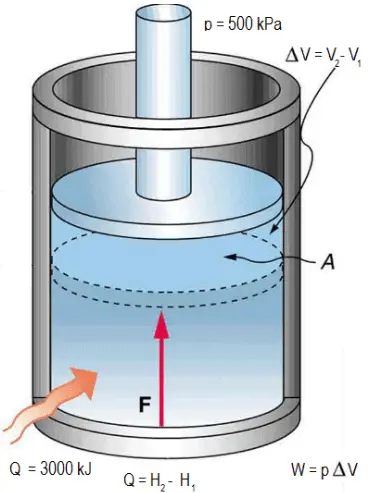
Enthalpy - Example - A frictionless piston

pV = nRT

where:

p is the absolute pressure of the gas

n is the amount of substance

T is the absolute temperature

V is the volume

R  is the ideal, or universal, gas constant, equal to the product of the Boltzmann constant and the Avogadro constant. The power of the ideal gas law is in its simplicity. When any two of the thermodynamic variables, p, v, and T are given, the third can easily be found.

The ideal gas model is based on following assumptions:

  1. The pressure, volume, and temperature of an ideal gas obey the ideal gas law.
  2. The specific internal energy is only a function of the temperature: u = u(T)
  3. The molar mass of an ideal gas is identical with the molar mass of the real substance
  4. The specific heats — cp and cv — are independent of temperature which means that they are constants.

From microscopic point of view it is based on these assumptions:

  1. The molecules of the gas are small, hard spheres.
  2. The only forces between the gas molecules are those that determine the point-like collisions.
  3. All collisions are elastic and all motion is frictionless.
  4. The average distance between molecules is much larger than the size of the molecules.
  5. The molecules are moving in random directions.
  6. There are no other attractive or repulsive force between these molecules.

What is an Ideal Gas

An ideal gas is defined as one in which all collisions between atoms or molecules are perfectly elastic and in which there are no intermolecular attractive forces. An ideal gas can be visualized as a collection of perfectly hard spheres which collide but which otherwise do not interact with each other. In reality, no real gases are like an ideal gas and therefore no real gases follow the ideal gas law or equation completely. At temperatures near a gases boiling point, increases in pressure will cause condensation to take place and drastic decreases in volume. At very high pressures, the intermolecular forces of a gas are significant. However, most gases are in approximate agreement at pressures and temperatures above their boiling point. The ideal gas law is utilized by engineers working with gases because it is simple to use and approximates real gas behavior.

[xyz-ihs snippet=”pressure”]

See also: Elastic Collision

Joule’s Second Law

For any gas whose equation of state is given exactly by pV = nRT (or pv = RT), the specific internal energy depends on temperature only. This rule was originally found in 1843 by an English physicist James Prescott Joule experimentally for real gases and is known as Joule’s second law:

The internal energy of a fixed mass of an ideal gas depends only on its temperature (not pressure or volume).

The specific enthalpy of a gas described by pV = nRT also depends on temperature only. Note that, the enthalpy is the thermodynamic quantity equivalent to the total heat content of a system. It is equal to the internal energy of the system plus the product of pressure and volume. In intensive variables the Joule’s second law is therefore given by h = h(T) = u(T) + pv = u(T) + RT.

These three equations constitute the ideal gas model, summarized as follows:

pv = RT

u = u(T)

h = h(T) = u(T) + RT

Ideal Gas Law

Any equation that relates the pressure, temperature, and specific volume of a substance is called an equation of state. The simplest and best-known equation of state for substances in the gas phase is the Ideal Gas equation of state. It was first stated by Émile Clapeyron in 1834 as a combination of the empirical Boyle’s law, Charles’ law and Avogadro’s Law. This equation predicts the p-v-T behavior of a gas quite accurately for dilute or low-pressure gases. In an ideal gas, molecules have no volume and do not interact. According to the ideal gas law, pressure varies linearly with temperature and quantity, and inversely with volume.

pV = nRT

where:

  • p is the absolute pressure of the gas
  • n is the amount of substance
  • T is the absolute temperature
  • V is the volume
  • R  is the ideal, or universal, gas constant, equal to the product of the Boltzmann constant and the Avogadro constant,

In this equation the symbol R is a constant called the universal gas constant that has the same value for all gases—namely, R =  8.31 J/mol K.

The power of the ideal gas law is in its simplicity. When any two of the thermodynamic variables, p, v, and T are given, the third can easily be found. Many physical conditions of gases calculated by engineers fit the above description. Perhaps the most common use of gas behavior studied by engineers is that of the compression process and expansion process using ideal gas approximations.

Gas Laws

In general, the gas laws are first equations of state, that correlate densities of gases and liquids to temperatures and pressures. The gas laws were completely developed at the end of the 18th century. These laws or statements preceded the ideal gas law, since individually these laws are considered as special cases of the ideal gas equation, with one or more of the variables held constant. Since they have been almost completely replaced by the ideal gas equation, it is not usual for students to learn these laws in detail. The ideal gas equation was first stated by Émile Clapeyron in 1834 as a combination of these laws:

Example: Ideal Gas Law – Gas compression inside a pressurizer

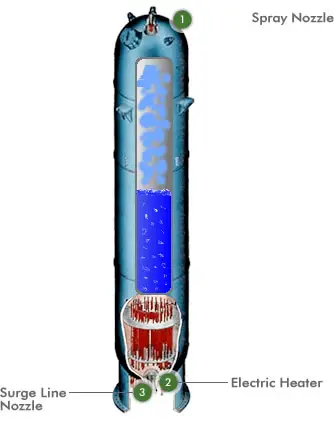
pressurizer
A pressurizer is a key component of PWRs.

Pressure in the primary circuit of PWRs is maintained by a pressurizer, a separate vessel that is connected to the primary circuit (hot leg) and partially filled with water which is heated to the saturation temperature (boiling point) for the desired pressure by submerged electrical heaters. During the plant heatup the pressurizer can be filled by nitrogen instead of saturated steam.

Assume that a pressurizer contains 12 m3 of nitrogen at 20°C and 15 bar. The temperature is raised to 35°C, and the volume is reduced to 8.5 m3. What is the final pressure of the gas inside the pressurizer? Assume that the gas is ideal.

Solution:

Since the gas is ideal,we can use the ideal gas law to relate its parameters, both in the initial state i and in the final state f. Therefore:

pinitVinit = nRTinit

and

pfinalVfinal = nRTfinal

Dividing the second equation by the first equation and solving for pf we obtain:

pfinal = pinitTfinalVinit / TinitVfinal

Note that we cannot convert units of volume and pressure to basic SI units, because they cancel out each other. On the other hand we have to use Kelvins instead of degrees of Celsius. Therefore Tinit = 293 K and Tfinal = 308 K.

It follows, the resulting pressure in the final state will be:

pfinal = (15 bar) x (308 K) x (12 m3) / (293 K) x (8.5 m3) = 22 bar

Validity of Ideal Gas Law

Since ideal gas is defined as one in which all collisions between atoms or molecules are perfectly elastic and in which there are no intermolecular attractive forces, there is no such thing in nature as a truly ideal gas. On the other hand, all real gases approach the ideal state at low pressures (densities). At low pressures molecules are far enough apart that they do not interact with one another.

In other words, the Ideal Gas Law is accurate only at relatively low pressures (relative to the critical pressure pcr) and high temperatures (relative to the critical temperature Tcr). At these parameters, the compressibility factor, Z = pv / RT, is approximately 1. The compressibility factor is used to account for deviation from the ideal situation. This correction factor is dependent on pressure and temperature for each gas considered.

Internal Energy of an Ideal Gas

The internal energy is the total of all the energy associated with the motion of the atoms or molecules in the system. Microscopic forms of energy include those due to the rotation, vibration, translation, and interactions among the molecules of a substance.

Monatomic Gas – Internal Energy

For a monatomic ideal gas (such as helium, neon, or argon), the only contribution to the energy comes from translational kinetic energy. The average translational kinetic energy of a single atom depends only on the gas temperature and is given by equation:

Kavg = 3/2 kT.

The internal energy of n moles of an ideal monatomic (one atom per molecule) gas is equal to the average kinetic energy per molecule times the total number of molecules, N:

Eint = 3/2 NkT = 3/2 nRT

where n is the number of moles. Each direction (x, y, and z) contributes (1/2)nRT to the internal energy. This is where the equipartition of energy idea comes in – any other contribution to the energy must also contribute (1/2)nRT. As can be seen, the internal energy of an ideal gas depends only on temperature and the number of moles of gas.

Diatomic Molecule – Internal Energy

If the gas molecules contain more than one atom, there are three translation directions, and rotational kinetic energy also contributes, but only for rotations about two of the three perpendicular axes. The five contributions to the energy (five degrees of freedom) give:

Diatomic ideal gas:

Eint = 5/2 NkT = 5/2 nRT

This is only an approximation and applies at intermediate temperatures. At low temperatures only the translational kinetic energy contributes, and at higher temperatures two additional contributions (kinetic and potential energy) come from vibration. The internal energy will be greater at a given temperature than for a monatomic gas, but it will still be a function only of temperature for an ideal gas.

The internal energy of real gases also depends mainly on temperature, but similarly as the Ideal Gas Law, the internal energy of real gases depends also somewhat on pressure and volume. All real gases approach the ideal state at low pressures (densities). At low pressures molecules are far enough apart that they do not interact with one another. The internal energy of liquids and solids is quite complicated, for it includes electrical potential energy associated with the forces (or chemical bonds) between atoms and molecules.

Specific Heat at Constant Volume and Constant Pressure

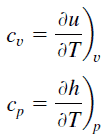
Specific heat is a property related to internal energy that is very important in thermodynamics. The intensive properties cv and cp are defined for pure, simple compressible substances as partial derivatives of the internal energy u(T, v) and enthalpy h(T, p), respectively:

Specific Heat at Constant Volume and Constant Pressure

where the subscripts v and p denote the variables held fixed during differentiation. The properties cv and cp are referred to as specific heats (or heat capacities) because under certain special conditions they relate the temperature change of a system to the amount of energy added by heat transfer. Their SI units are J/kg K or J/mol K. Two specific heats are defined for gases, one for constant volume (cv) and one for constant pressure (cp).

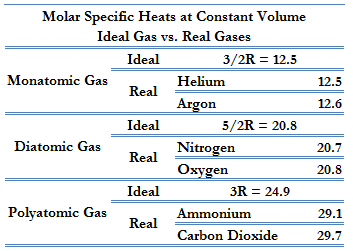
Molar specific heats - ideal gasAccording to the first law of thermodynamics, for constant volume process with a monatomic ideal gas the molar specific heat will be:

Cv = 3/2R = 12.5 J/mol K

because

U = 3/2nRT

It can be derived that the molar specific heat at constant pressure is:

Cp = Cv + R = 5/2R = 20.8 J/mol K

This Cp is greater than the molar specific heat at constant volume Cv, because energy must now be supplied not only to raise the temperature of the gas but also for the gas to do work because in this case volume changes.

Mayer’s relation – Mayer’s formula

Julius Robert Mayer, a German chemist and physicist, derived a relation between specific heat at constant pressure and the specific heat at constant volume for an ideal gas. He studied the fact that the specific heat capacity of a gas at constant pressure (Cp) is slightly greater than at constant volume (Cv). He reasoned that this Cp is greater than the molar specific heat at constant volume Cv, because energy must now be supplied not only to raise the temperature of the gas but also for the gas to do work because in this case volume changes. According to the Mayer’s relation or the Mayer’s formula the difference between these two heat capacities is equal to the universal gas constant, thus the molar specific heat at constant pressure is equal:

Cp = Cv + R

 
References:
Reactor Physics and Thermal Hydraulics:
  1. J. R. Lamarsh, Introduction to Nuclear Reactor Theory, 2nd ed., Addison-Wesley, Reading, MA (1983).
  2. J. R. Lamarsh, A. J. Baratta, Introduction to Nuclear Engineering, 3d ed., Prentice-Hall, 2001, ISBN: 0-201-82498-1.
  3. W. M. Stacey, Nuclear Reactor Physics, John Wiley & Sons, 2001, ISBN: 0- 471-39127-1.
  4. Glasstone, Sesonske. Nuclear Reactor Engineering: Reactor Systems Engineering, Springer; 4th edition, 1994, ISBN: 978-0412985317
  5. Todreas Neil E., Kazimi Mujid S. Nuclear Systems Volume I: Thermal Hydraulic Fundamentals, Second Edition. CRC Press; 2 edition, 2012, ISBN: 978-0415802871
  6. Zohuri B., McDaniel P. Thermodynamics in Nuclear Power Plant Systems. Springer; 2015, ISBN: 978-3-319-13419-2
  7. Moran Michal J., Shapiro Howard N. Fundamentals of Engineering Thermodynamics, Fifth Edition, John Wiley & Sons, 2006, ISBN: 978-0-470-03037-0
  8. Kleinstreuer C. Modern Fluid Dynamics. Springer, 2010, ISBN 978-1-4020-8670-0.
  9. U.S. Department of Energy, THERMODYNAMICS, HEAT TRANSFER, AND FLUID FLOW. DOE Fundamentals Handbook, Volume 1, 2 and 3. June 1992.

See also:

Thermodynamics

We hope, this article, Ideal Gas Law, helps you. If so, give us a like in the sidebar. Main purpose of this website is to help the public to learn some interesting and important information about thermal engineering.