Facebook Instagram Youtube Twitter

What is Density of Steam – Specific Volume of Steam – Definition

Density of Steam – Specific Volume of Steam. Density of steam significantly changes with pressure and temperature. These parameters are tabulated in so called “Steam Tables”. Thermal Engineering

Density of Steam

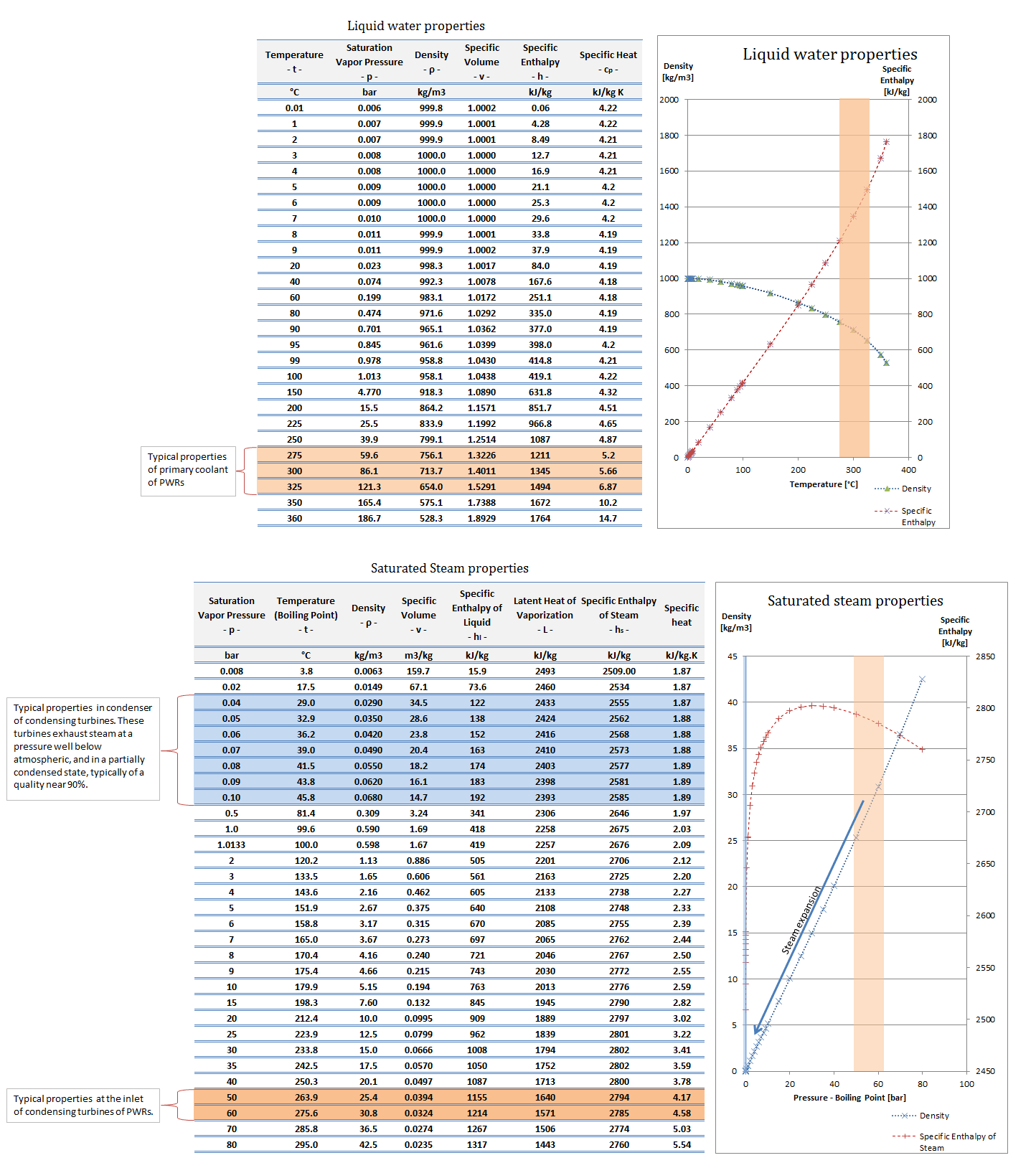
dry-steam-saturated-vapor-minWater and steam are a common medium because their properties are very well known. Their properties are tabulated in so called “Steam Tables”. In these tables the basic and key properties, such as pressure, temperature, enthalpy, density and specific heat, are tabulated along the vapor-liquid saturation curve as a function of both temperature and pressure.

The density (⍴) of any substance is the reciprocal of its specific volume (ν).

ρ = m/V = 1/ν

The specific volume (ν) of a substance is the total volume (V) of that substance divided by the total mass (m) of that substance (volume per unit mass). It has units of cubic meter per kilogram (m3/kg).

steam properties - steam tables

Density of Supercritical Fluid

Properties of Supercritical WaterA supercritical fluid is a fluid that is at pressures higher than its thermodynamic critical values. At the critical and supercritical pressures a fluid is considered as a single-phase substance in spite of the fact that all thermophysical properties undergo significant changes within the critical and pseudocritical regions.

At pressures above the critical pressure,  properties of water in the reactor change gradually and continuously from those we ordinarily associate with a liquid (high density, small compressibility) to those of a gas (low density, large compressibility) without a phase change. There is no change in the phase of water in the core. On the other hand, physical properties such as density, specific heat, specific enthalpy undergo significant changes, especially in the temperature range of the pseudocritical region (for 25 MPa between 372°C and 392°C).

 
References:
Reactor Physics and Thermal Hydraulics:
  1. J. R. Lamarsh, Introduction to Nuclear Reactor Theory, 2nd ed., Addison-Wesley, Reading, MA (1983).
  2. J. R. Lamarsh, A. J. Baratta, Introduction to Nuclear Engineering, 3d ed., Prentice-Hall, 2001, ISBN: 0-201-82498-1.
  3. W. M. Stacey, Nuclear Reactor Physics, John Wiley & Sons, 2001, ISBN: 0- 471-39127-1.
  4. Glasstone, Sesonske. Nuclear Reactor Engineering: Reactor Systems Engineering, Springer; 4th edition, 1994, ISBN: 978-0412985317
  5. Todreas Neil E., Kazimi Mujid S. Nuclear Systems Volume I: Thermal Hydraulic Fundamentals, Second Edition. CRC Press; 2 edition, 2012, ISBN: 978-0415802871
  6. Zohuri B., McDaniel P. Thermodynamics in Nuclear Power Plant Systems. Springer; 2015, ISBN: 978-3-319-13419-2
  7. Moran Michal J., Shapiro Howard N. Fundamentals of Engineering Thermodynamics, Fifth Edition, John Wiley & Sons, 2006, ISBN: 978-0-470-03037-0
  8. Kleinstreuer C. Modern Fluid Dynamics. Springer, 2010, ISBN 978-1-4020-8670-0.
  9. U.S. Department of Energy, THERMODYNAMICS, HEAT TRANSFER, AND FLUID FLOW. DOE Fundamentals Handbook, Volume 1, 2 and 3. June 1992.

See also:

Thermodynamic Properties

We hope, this article, Density of Steam – Specific Volume of Steam, helps you. If so, give us a like in the sidebar. Main purpose of this website is to help the public to learn some interesting and important information about thermal engineering.

What is Saturation – Boiling Point – Definition

In thermodynamics, the term saturation defines a condition in which a mixture of vapor and liquid can exist together. Saturation temperature or boiling point. Thermal Engineering

Saturation

dry-steam-saturated-vapor-minIn thermodynamics, the term saturation defines a condition in which a mixture of vapor and liquid can exist together at a given temperature and pressure. The temperature at which vaporization (boiling) starts to occur for a given pressure is called the saturation temperature or boiling point. The pressure at which vaporization (boiling) starts to occur for a given temperature is called the saturation pressure.

When the vapor quality is equal to 0, it is referred to as the saturated liquid state (single-phase). On the other hand, when the vapor quality is equal to 1, it is referred to as the saturated vapor state or dry steam (single-phase). Between these two states, we talk about vapor-liquid mixture or wet steam (two-phase mixture). At constant pressure, an addition of energy does not changes the temperature of the mixture, but the vapor quality and specific volume changes.

 
Table: Saturated Liquid Properties
liquid water properties
Table: Saturated Vapor Properties
steam properties - steam tables
 
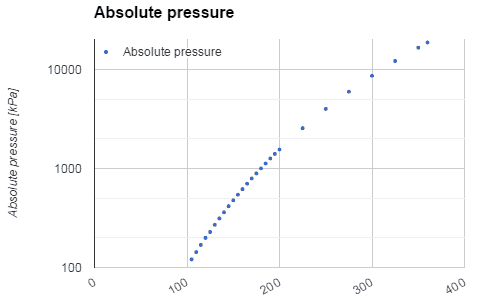
Chart: Absolute pressure as a function of temperature of water
Water: Absolute pressure as a function of temperature
Parameters at which saturation of water occurs are tabulated in so called “Steam Tables”. In these tables the basic and key properties, such as pressure, temperature, enthalpy, density and specific heat, are tabulated along the vapor-liquid saturation curve as a function of both temperature and pressure.

See also: Steam Tables

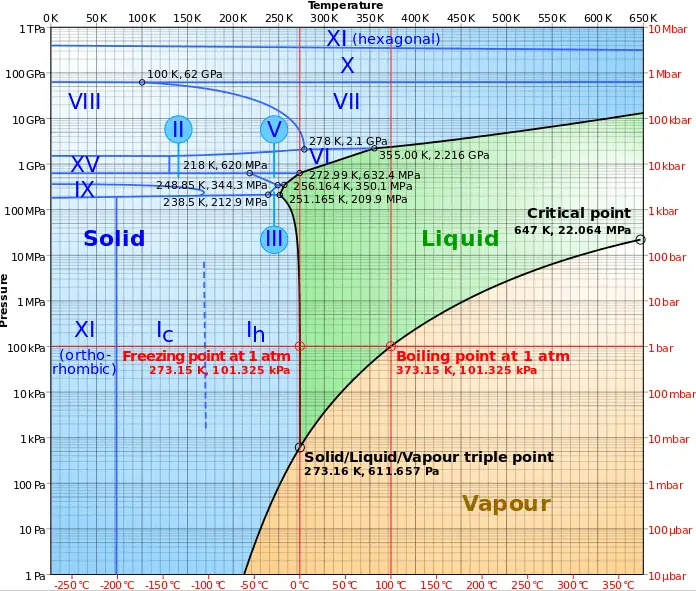
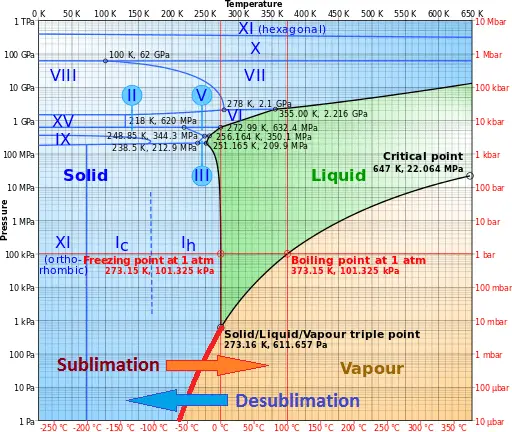
For example:  In pressurizer of pressurized water reactors the saturation temperature is about 350°C, but this corresponds to the pressure of 16,4 MPa, which have to be maintained in the primary circuit. For a pure substance there is a definite relationship between saturation pressure and saturation temperature. The higher the pressure, the higher the saturation temperature. The graphical representation of this relationship between temperature and pressure at saturated conditions is called the vapor pressure curve and it can be seen at the phase diagram of water. This diagram is shown in the figure.

Phase diagram of water
Phase diagram of water.
Source: wikipedia.org CC BY-SA

As can be seen from the phase diagram of water, in the two-phase regions (e.g. on the border of vapor/liquid phases), specifying temperature alone will set the pressure and specifying pressure will set the temperature.

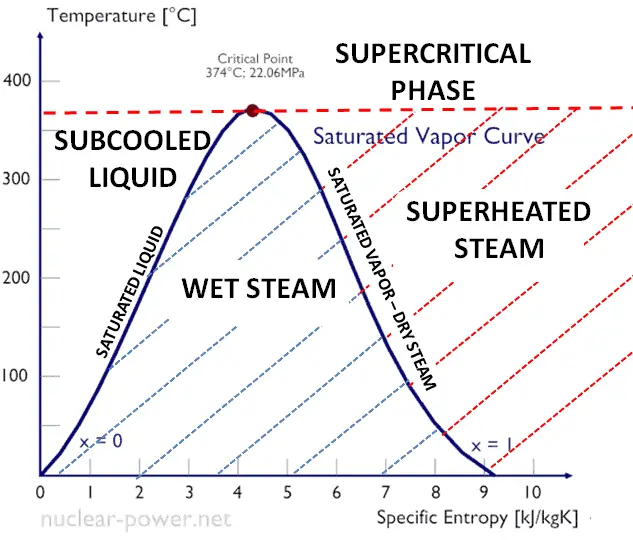
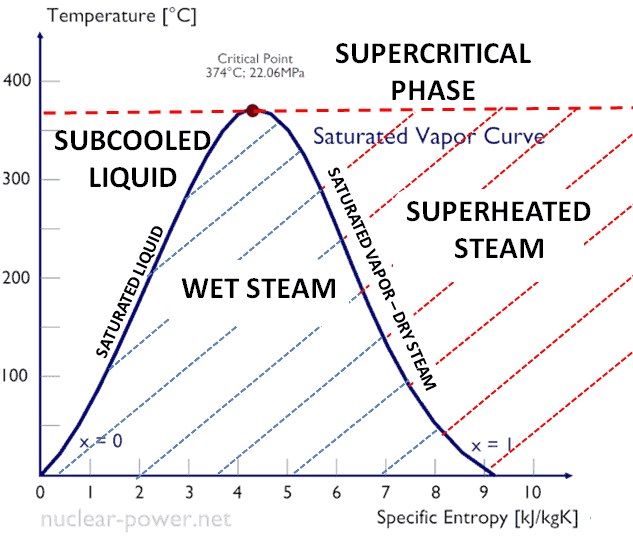
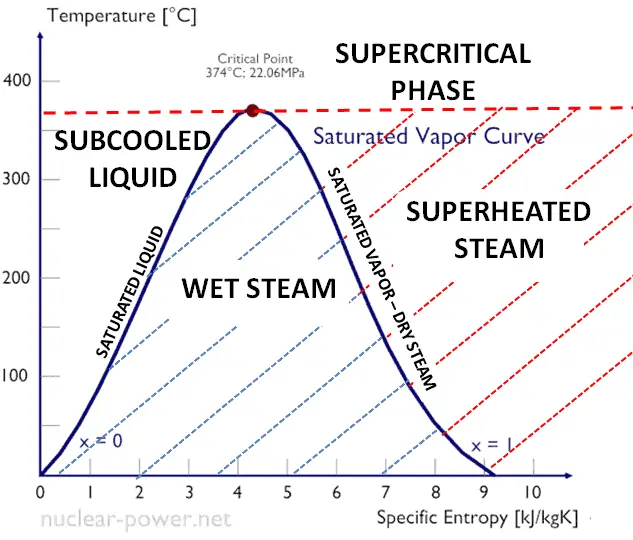
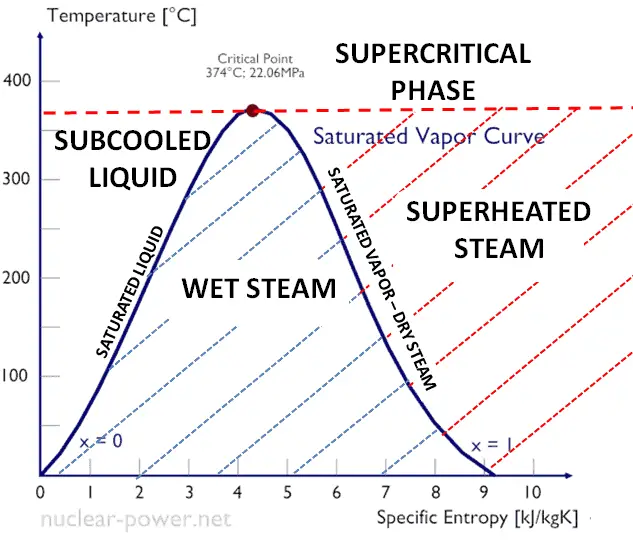
  • The saturation vapor curve is the curve separating the two-phase state and the superheated vapor state in the T-s diagram.
  • The saturated liquid curve is the curve separating the subcooled liquid state and the two-phase state in the T-s diagram.
 
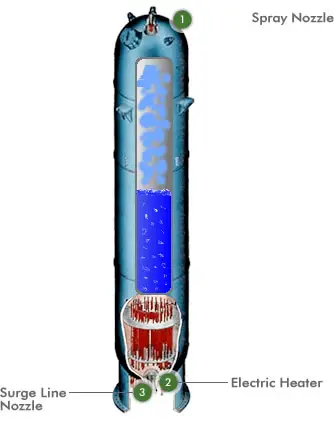
Pressurizer: steam-liquid equilibrium
pressurizer
A pressurizer is a key component of PWRs.

A pressurizer is a component of a pressurized water reactor. Pressure in the primary circuit of PWRs is maintained by a pressurizer, a separate vessel that is connected to the primary circuit (hot leg) and partially filled with water which is heated to the saturation temperature (boiling point) for the desired pressure by submerged electrical heaters. Temperature in the pressurizer can be maintained at 350 °C (662 °F), which gives a subcooling margin (the difference between the pressurizer temperature and the highest temperature in the reactor core) of 30 °C. Subcooling margin is very important safety parameter of PWRs, since the boiling in the reactor core must be excluded. The basic design of the pressurized water reactor includes such requirement that the coolant (water) in the reactor coolant system must not boil. To achieve this, the coolant in the reactor coolant system is maintained at a pressure sufficiently high that boiling does not occur at the coolant temperatures experienced while the plant is operating or in an analyzed transient.

Functions

Pressure in the pressurizer is controlled by varying the temperature of the coolant in the pressurizer. For these purposes two systems are installed. Water spray system and electrical heaters system. Volume of the pressurizer (tens of cubic meters) is filled with water on saturation parameters and steam. The water spray system (relatively cool water – from cold leg) can decrease the pressure in the vessel by condensing the steam on water droplets sprayed in the vessel. On the other hand the submerged electrical heaters are designed to increase the pressure by evaporation the water in the vessel. Water pressure in a closed system tracks water temperature directly; as the temperature goes up, pressure goes up.

Steam Generator - operating conditions
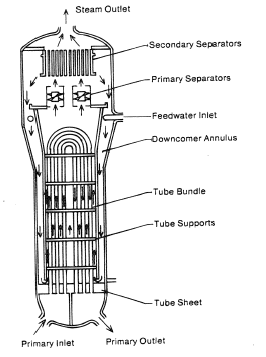
Steam Generator - vertical
Steam Generator – vertical

Steam generators are heat exchangers used to convert feedwater into steam from heat produced in a nuclear reactor core. The steam produced drives the turbine. They are used in the most nuclear power plants, but there are many types according to the reactor type.

The hot primary coolant (water 330°C; 626°F; 16MPa) is pumped into the steam generator through primary inlet. High pressure of primary coolant is used to keep the water in the liquid state. Boiling of the primary coolant shall not occur. The liquid water flows through hundreds or thousands of tubes (usually 1.9 cm in diameter) inside the steam generator. The feedwater (secondary circuit) is heated from ~260°C 500°F to the boiling point of that fluid (280°C; 536°F; 6,5MPa). Heat is transferred through the walls of these tubes to the lower pressure secondary coolant located on the secondary side of the exchanger where the coolant evaporates to pressurized steam (saturated steam 280°C; 536°F; 6,5 MPa). The pressurized steam leaves the steam generator through a steam outlet and continues to the steam turbine. The transfer of heat is accomplished without mixing the two fluids to prevent the secondary coolant from becoming radioactive. The primary coolant leaves (water 295°C; 563°F; 16MPa) the steam generator through primary outlet and continues through a cold leg to a reactor coolant pump and then into the reactor.

Specific Enthalpy of Wet Steam

The specific enthalpy of saturated liquid water (x=0) and dry steam (x=1) can be picked from steam tables. In case of wet steam, the actual enthalpy can be calculated with the vapor quality, x, and the specific enthalpies of saturated liquid water and dry steam:

hwet = hs x + (1 – x ) hl              

where

hwet = enthalpy of wet steam (J/kg)

hs = enthalpy of “dry” steam (J/kg)

hl = enthalpy of saturated liquid water (J/kg)

As can be seen, wet steam will always have lower enthalpy than dry steam.

 
References:
Reactor Physics and Thermal Hydraulics:
  1. J. R. Lamarsh, Introduction to Nuclear Reactor Theory, 2nd ed., Addison-Wesley, Reading, MA (1983).
  2. J. R. Lamarsh, A. J. Baratta, Introduction to Nuclear Engineering, 3d ed., Prentice-Hall, 2001, ISBN: 0-201-82498-1.
  3. W. M. Stacey, Nuclear Reactor Physics, John Wiley & Sons, 2001, ISBN: 0- 471-39127-1.
  4. Glasstone, Sesonske. Nuclear Reactor Engineering: Reactor Systems Engineering, Springer; 4th edition, 1994, ISBN: 978-0412985317
  5. Todreas Neil E., Kazimi Mujid S. Nuclear Systems Volume I: Thermal Hydraulic Fundamentals, Second Edition. CRC Press; 2 edition, 2012, ISBN: 978-0415802871
  6. Zohuri B., McDaniel P. Thermodynamics in Nuclear Power Plant Systems. Springer; 2015, ISBN: 978-3-319-13419-2
  7. Moran Michal J., Shapiro Howard N. Fundamentals of Engineering Thermodynamics, Fifth Edition, John Wiley & Sons, 2006, ISBN: 978-0-470-03037-0
  8. Kleinstreuer C. Modern Fluid Dynamics. Springer, 2010, ISBN 978-1-4020-8670-0.
  9. U.S. Department of Energy, THERMODYNAMICS, HEAT TRANSFER, AND FLUID FLOW. DOE Fundamentals Handbook, Volume 1, 2 and 3. June 1992.

See also:

Steam

We hope, this article, Saturation – Boiling Point, helps you. If so, give us a like in the sidebar. Main purpose of this website is to help the public to learn some interesting and important information about thermal engineering.
What is Sublimation – Definition

In general, sublimation is a phase change of a substance directly from the solid to the gas phase without passing through the intermediate liquid phase. Thermal Engineering

Sublimation

sublimation
Source: wikipedia.org CC BY-SA

In general, sublimation is a phase change of a substance directly from the solid to the gas phase without passing through the intermediate liquid phase. Sublimation is an endothermic phase change that occurs at temperatures and pressures below a substance’s triple point in its phase diagram.

Consider the ice at -10°C  and at the pressure of 500 Pa. In this case, heat transfer to the ice first results in an increase in temperature to -8°C. At this point, however, the ice passes directly from the solid phase to the vapor phase in the process known as sublimation. The corresponding heat is called the heat of sublimation, Ls. Further heat transfer would result in superheating the vapor.

Since sublimation is an endothermic phase change, it requires additional energy. This additional energy required can be calculated by adding the enthalpy of fusion and the enthalpy of vaporization and is known as the enthalpy of sublimation (also called heat of sublimation).

For some substances, sublimation is much easier than evaporation from the melt. It depends on their triple point. When the pressure of its triple point is too high,  it is difficult to obtain them as liquids.

The reverse process of sublimation is desublimation, in which a substance passes directly from a gas to a solid phase.

 
References:
Reactor Physics and Thermal Hydraulics:
  1. J. R. Lamarsh, Introduction to Nuclear Reactor Theory, 2nd ed., Addison-Wesley, Reading, MA (1983).
  2. J. R. Lamarsh, A. J. Baratta, Introduction to Nuclear Engineering, 3d ed., Prentice-Hall, 2001, ISBN: 0-201-82498-1.
  3. W. M. Stacey, Nuclear Reactor Physics, John Wiley & Sons, 2001, ISBN: 0- 471-39127-1.
  4. Glasstone, Sesonske. Nuclear Reactor Engineering: Reactor Systems Engineering, Springer; 4th edition, 1994, ISBN: 978-0412985317
  5. Todreas Neil E., Kazimi Mujid S. Nuclear Systems Volume I: Thermal Hydraulic Fundamentals, Second Edition. CRC Press; 2 edition, 2012, ISBN: 978-0415802871
  6. Zohuri B., McDaniel P. Thermodynamics in Nuclear Power Plant Systems. Springer; 2015, ISBN: 978-3-319-13419-2
  7. Moran Michal J., Shapiro Howard N. Fundamentals of Engineering Thermodynamics, Fifth Edition, John Wiley & Sons, 2006, ISBN: 978-0-470-03037-0
  8. Kleinstreuer C. Modern Fluid Dynamics. Springer, 2010, ISBN 978-1-4020-8670-0.
  9. U.S. Department of Energy, THERMODYNAMICS, HEAT TRANSFER, AND FLUID FLOW. DOE Fundamentals Handbook, Volume 1, 2 and 3. June 1992.

See also:

Phase Changes

We hope, this article, Sublimation, helps you. If so, give us a like in the sidebar. Main purpose of this website is to help the public to learn some interesting and important information about thermal engineering.
What is Desublimation – Deposition – Definition

In general, desublimation (or deposition) is a phase transition of a substance directly from the gas phase to the solid phase without passing through the intermediate liquid phase. Thermal Engineering

Desublimation – Deposition

sublimation
Source: wikipedia.org CC BY-SA

In general, desublimation (or deposition)  is a phase transition of a substance directly from the gas phase to the solid phase without passing through the intermediate liquid phase. Desublimation is an exothermic phase change that occurs at temperatures and pressures below a substance’s triple point in its phase diagram.

Consider the water vapor at -5°C  and at the pressure of 500 Pa. In this case, when heat is taken from the water vapor, the vapor results in an decrease in temperature to -8°C. At this point, however, the vapor passes directly from the gas phase to the solid phase in the process known as desublimation. The corresponding heat is called the heat of sublimation, Ls.

Since desublimation is an exothermic phase change, it releases energy. This energy released can be calculated by adding the enthalpy of fusion and the enthalpy of vaporization and is known as the enthalpy of sublimation (also called heat of sublimation).

For some substances, desublimation is much easier than passing through liquid phase. It depends on their triple point. When the pressure of its triple point is too high,  it is difficult to obtain them as liquids.

The reverse process of desublimation is sublimation, in which a substance passes directly from a solid to a gas phase.

One example of desublimation is when frost forms on a leaf in winter. For desublimation to occur, thermal energy must be removed from a gas. Therefore, when the leaf becomes cold enough, water vapor in the air surrounding the leaf can lose enough thermal energy to change directly into a solid.

 
References:
Reactor Physics and Thermal Hydraulics:
  1. J. R. Lamarsh, Introduction to Nuclear Reactor Theory, 2nd ed., Addison-Wesley, Reading, MA (1983).
  2. J. R. Lamarsh, A. J. Baratta, Introduction to Nuclear Engineering, 3d ed., Prentice-Hall, 2001, ISBN: 0-201-82498-1.
  3. W. M. Stacey, Nuclear Reactor Physics, John Wiley & Sons, 2001, ISBN: 0- 471-39127-1.
  4. Glasstone, Sesonske. Nuclear Reactor Engineering: Reactor Systems Engineering, Springer; 4th edition, 1994, ISBN: 978-0412985317
  5. Todreas Neil E., Kazimi Mujid S. Nuclear Systems Volume I: Thermal Hydraulic Fundamentals, Second Edition. CRC Press; 2 edition, 2012, ISBN: 978-0415802871
  6. Zohuri B., McDaniel P. Thermodynamics in Nuclear Power Plant Systems. Springer; 2015, ISBN: 978-3-319-13419-2
  7. Moran Michal J., Shapiro Howard N. Fundamentals of Engineering Thermodynamics, Fifth Edition, John Wiley & Sons, 2006, ISBN: 978-0-470-03037-0
  8. Kleinstreuer C. Modern Fluid Dynamics. Springer, 2010, ISBN 978-1-4020-8670-0.
  9. U.S. Department of Energy, THERMODYNAMICS, HEAT TRANSFER, AND FLUID FLOW. DOE Fundamentals Handbook, Volume 1, 2 and 3. June 1992.

See also:

Steam

We hope, this article, Desublimation – Deposition, helps you. If so, give us a like in the sidebar. Main purpose of this website is to help the public to learn some interesting and important information about thermal engineering.
What is Phase Change – Phase Transition – Definition

In thermodynamics a phase change or also phase transition is a transition between solid, liquid and gaseous states of matter, and, in rare cases, plasma. Thermal Engineering

Examples

 
Evaporation of water at atmospheric pressure
Calculate heat required to evaporate 1 kg of water at the atmospheric pressure (p = 1.0133 bar) and at the temperature of 100°C.

Solution:

Since these parameters corresponds to the saturated liquid state, only latent heat of vaporization of 1 kg of water is required. From steam tables, the latent heat of vaporization is L = 2257 kJ/kg. Therefore the heat required is equal to:

ΔH = 2257 kJ

Note that the initial specific enthalpy h1 = 419 kJ/kg, whereas the final specific enthalpy will be h2 = 2676 kJ/kg. The specific enthalpy of low-pressure dry steam is very similar to the specific enthalpy of high-pressure dry steam, despite the fact they have different temperatures.

Evaporation of water at high pressure
Calculate heat required to evaporate 1 kg of feedwater at the pressure of 6 MPa (p = 60 bar) and at the temperature of 275.6°C (saturation temperature).

Solution:

Since these parameters corresponds to the saturated liquid state, only latent heat of vaporization of 1 kg of water is required. From steam tables, the latent heat of vaporization is L = 1571 kJ/kg. Therefore the heat required is equal to:

ΔH = 1571 kJ

Note that the initial specific enthalpy h1 = 1214 kJ/kg, whereas the final specific enthalpy will be h2 = 2785 kJ/kg. The specific enthalpy of low-pressure dry steam is very similar to the specific enthalpy of high-pressure dry steam, despite the fact they have different temperatures.

Evaporation of water at high pressure - Energy balance in a steam generator
Steam Generator - vertical
Steam Generator – vertical

Calculate the amount of primary coolant, which is required to evaporate 1 kg of feedwater in a typical steam generator. Assume that there are no energy losses, this is only idealized example.

Balance of the primary circuit

The hot primary coolant (water 330°C; 626°F; 16MPa) is pumped into the steam generator through primary inlet. The primary coolant leaves (water 295°C; 563°F; 16MPa) the steam generator through primary outlet.

hI, inlet = 1516 kJ/kg

=> ΔhI = -206 kJ/kg

hI, outlet = 1310 kJ/kg

Balance of the feedwater

The feedwater (water 230°C; 446°F; 6,5MPa) is pumped into the steam generator through the feedwater inlet. The feedwater (secondary circuit) is heated from ~230°C 446°F to the boiling point of that fluid (280°C; 536°F; 6,5MPa). Feedwater is then evaporated and the pressurized steam (saturated steam 280°C; 536°F; 6,5 MPa) leaves the steam generator through steam outlet and continues to the steam turbine.

hII, inlet = 991 kJ/kg

=> ΔhII = 1789 kJ/kg

hII, outlet = 2780 kJ/kg

Balance of the steam generator

Since the difference in specific enthalpies is less for primary coolant than for feedwater, it is obvious that the amount of primary coolant will be higher than 1kg. To produce of 1 kg of saturated steam from feedwater, about 1789/206 x 1 kg =  8.68 kg of primary coolant is required.

Sublimation

sublimation
Source: wikipedia.org CC BY-SA

In general, sublimation is a phase change of a substance directly from the solid to the gas phase without passing through the intermediate liquid phase. Sublimation is an endothermic phase change that occurs at temperatures and pressures below a substance’s triple point in its phase diagram.

Consider the ice at -10°C  and at the pressure of 500 Pa. In this case, heat transfer to the ice first results in an increase in temperature to -8°C. At this point, however, the ice passes directly from the solid phase to the vapor phase in the process known as sublimation. The corresponding heat is called the heat of sublimation, Ls. Further heat transfer would result in superheating the vapor.

Since sublimation is an endothermic phase change, it requires additional energy. This additional energy required can be calculated by adding the enthalpy of fusion and the enthalpy of vaporization and is known as the enthalpy of sublimation (also called heat of sublimation).

For some substances, sublimation is much easier than evaporation from the melt. It depends on their triple point. When the pressure of its triple point is too high,  it is difficult to obtain them as liquids.

The reverse process of sublimation is desublimation, in which a substance passes directly from a gas to a solid phase.

Desublimation

sublimation
Source: wikipedia.org CC BY-SA

In general, desublimation (or deposition)  is a phase transition of a substance directly from the gas phase to the solid phase without passing through the intermediate liquid phase. Desublimation is an exothermic phase change that occurs at temperatures and pressures below a substance’s triple point in its phase diagram.

Consider the water vapor at -5°C  and at the pressure of 500 Pa. In this case, when heat is taken from the water vapor, the vapor results in an decrease in temperature to -8°C. At this point, however, the vapor passes directly from the gas phase to the solid phase in the process known as desublimation. The corresponding heat is called the heat of sublimation, Ls.

Since desublimation is an exothermic phase change, it releases energy. This energy released can be calculated by adding the enthalpy of fusion and the enthalpy of vaporization and is known as the enthalpy of sublimation (also called heat of sublimation).

For some substances, desublimation is much easier than passing through liquid phase. It depends on their triple point. When the pressure of its triple point is too high,  it is difficult to obtain them as liquids.

The reverse process of desublimation is sublimation, in which a substance passes directly from a solid to a gas phase.

One example of desublimation is when frost forms on a leaf in winter. For desublimation to occur, thermal energy must be removed from a gas. Therefore, when the leaf becomes cold enough, water vapor in the air surrounding the leaf can lose enough thermal energy to change directly into a solid.

 
References:
Reactor Physics and Thermal Hydraulics:
  1. J. R. Lamarsh, Introduction to Nuclear Reactor Theory, 2nd ed., Addison-Wesley, Reading, MA (1983).
  2. J. R. Lamarsh, A. J. Baratta, Introduction to Nuclear Engineering, 3d ed., Prentice-Hall, 2001, ISBN: 0-201-82498-1.
  3. W. M. Stacey, Nuclear Reactor Physics, John Wiley & Sons, 2001, ISBN: 0- 471-39127-1.
  4. Glasstone, Sesonske. Nuclear Reactor Engineering: Reactor Systems Engineering, Springer; 4th edition, 1994, ISBN: 978-0412985317
  5. Todreas Neil E., Kazimi Mujid S. Nuclear Systems Volume I: Thermal Hydraulic Fundamentals, Second Edition. CRC Press; 2 edition, 2012, ISBN: 978-0415802871
  6. Zohuri B., McDaniel P. Thermodynamics in Nuclear Power Plant Systems. Springer; 2015, ISBN: 978-3-319-13419-2
  7. Moran Michal J., Shapiro Howard N. Fundamentals of Engineering Thermodynamics, Fifth Edition, John Wiley & Sons, 2006, ISBN: 978-0-470-03037-0
  8. Kleinstreuer C. Modern Fluid Dynamics. Springer, 2010, ISBN 978-1-4020-8670-0.
  9. U.S. Department of Energy, THERMODYNAMICS, HEAT TRANSFER, AND FLUID FLOW. DOE Fundamentals Handbook, Volume 1, 2 and 3. June 1992.

See also:

Thermodynamics

We hope, this article, Phase Change – Phase Transition, helps you. If so, give us a like in the sidebar. Main purpose of this website is to help the public to learn some interesting and important information about thermal engineering.
What is Vapor Quality – Dryness Fraction – Definition

The mass fraction of the vapor in a two-phase liquid-vapor region is called the vapor quality (or dryness fraction), x, and it is given by simple formula. Thermal Engineering

Vapor Quality – Dryness Fraction

wet-steam-vapor-liquid-mixture-min

See also: Properties of Steam

As can be seen from the phase diagram of water, in the two-phase regions (e.g. on the border of vapor/liquid phases), specifying temperature alone will set the pressure and specifying pressure will set the temperature. But these parameters will not define the volume and enthalpy because we will need to know the relative proportion of the two phases present.

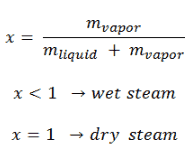
The mass fraction of the vapor in a two-phase liquid-vapor region is called the vapor quality (or dryness fraction), x, and it is given by following formula:

vapor quality

The value of the quality ranges from zero to unity. Although defined as a ratio, the quality is frequently given as a percentage. From this point of view, we distinguish between three basic types of  steam. It must be added, at x=0, we are talking about saturated liquid state (single-phase).

This classification of steam has its limitation. Consider the behavior of the system which is heated at the pressure, that is higher than the critical pressure. In this case, there would be no change in phase from liquid to steam. At all states there would be only one phase. Vaporization and condensation can occur only when the pressure is less than the critical pressure. The terms liquid and vapor tend to lose their significance.

See also: Saturation

See also: Throttling of Steam

 
Saturated and Subcooled Liquid
Phase diagram of water
Phase diagram of water.
Source: wikipedia.org CC BY-SA

As can be seen from the phase diagram of water, in the two-phase regions (e.g. on the border of vapor/liquid phases), specifying temperature alone will set the pressure and specifying pressure will set the temperature.

  • The saturation vapor curve is the curve separating the two-phase state and the superheated vapor state in the T-s diagram.
  • The saturated liquid curve is the curve separating the subcooled liquid state and the two-phase state in the T-s diagram.

If a water exists as a liquid at the saturation temperature and pressure with quality of x = 0, it is called a saturated liquid state (single-phase). If the temperature of the liquid is lower than the saturation temperature for the existing pressure, it is called either a subcooled liquid or a compressed liquid . The term subcooling refers to a liquid existing at a temperature below its normal boiling point.  For example, water normally boils at 100°C (at atmospheric pressure); at room temperature 20°C the water is termed “subcooled”. Analogically the subcooling is defined also in nuclear engineering but for another purpose.

For example, the temperature in the pressurizer can be maintained at 350 °C (662 °F), which gives a subcooling margin (the difference between the pressurizer temperature and the highest temperature in the reactor core) of 30 °C. Subcooling margin is very important safety parameter of PWRs, since the boiling in the reactor core must be excluded.

subcooled-liquid-min

Wet Steam - Vapor-liquid Mixture
wet-steam-vapor-liquid-mixture-minWet steam is characterized by the vapor quality, which ranges from zero to unity – open interval (0,1). When the vapor quality is equal to 0, it is referred to as the saturated liquid state (single-phase). On the other hand, when the vapor quality is equal to 1, it is referred to as the saturated vapor state or dry steam (single-phase). Between these two states, we talk about vapor-liquid mixture or wet steam (two-phase mixture). At constant pressure, an addition of energy does not changes the temperature of the mixture, but the vapor quality and specific volume changes. In the case of dry steam (100% quality), it contains 100% of the latent heat available at that pressure. Saturated liquid water, which has no latent heat and therefore 0% quality, will therefore only contain sensible heat.
engineering thermodynamics
Rankine Cycle – Thermodynamics as Energy Conversion Science

Typically most of nuclear power plants operates multi-stage condensing steam turbines. In these turbines the high-pressure stage receives steam (this steam is nearly saturated steam – x = 0.995 – point C at the figure) from a steam generator and exhaust it to moisture separator-reheater (point D). The steam must be reheated in order to avoid damages that could be caused to blades of steam turbine by low quality steam. The reheater heats the steam (point D) and then the steam is directed to the low-pressure stage of steam turbine, where expands (point E to F). The exhausted steam is at a pressure well below atmospheric, and is in a partially condensed state (point F), typically of a quality near 90%.

Specific Enthalpy of Wet Steam

The specific enthalpy of saturated liquid water (x=0) and dry steam (x=1) can be picked from steam tables. In case of wet steam, the actual enthalpy can be calculated with the vapor quality, x, and the specific enthalpies of saturated liquid water and dry steam:

hwet = hs x + (1 – x ) hl              

where

hwet = enthalpy of wet steam (J/kg)

hs = enthalpy of “dry” steam (J/kg)

hl = enthalpy of saturated liquid water (J/kg)

As can be seen, wet steam will always have lower enthalpy than dry steam.

Specific Entropy of Wet Steam

Similarly, the specific entropy of saturated liquid water (x=0) and dry steam (x=1) can be picked from steam tables. In case of wet steam, the actual entropy can be calculated with the vapor quality, x, and the specific entropies of saturated liquid water and dry steam:

swet = ss x + (1 – x ) sl              

where

swet = entropy of wet steam (J/kg K)

ss = entropy of “dry” steam (J/kg K)

sl = entropy of saturated liquid water (J/kg K)

Specific Volume of Wet Steam

Similarly, the specific volume of saturated liquid water (x=0) and dry steam (x=1) can be picked from steam tables. In case of wet steam, the actual specific volume can be calculated with the vapor quality, x, and the specific volumes of saturated liquid water and dry steam:

vwet = vs x + (1 – x ) vl              

where

vwet = specific volume of wet steam (m3/kg)

vs = specific volume of “dry” steam (m3/kg)

vl = specific volume of saturated liquid water (m3/kg)

Example:

A high-pressure stage of steam turbine operates at steady state with inlet conditions of  6 MPa, t = 275.6°C, x = 1 (point C). Steam leaves this stage of turbine at a pressure of 1.15 MPa, 186°C and x = 0.87 (point D). Calculate the enthalpy difference between these two states.

The enthalpy for the state C can be picked directly from steam tables, whereas the enthalpy for the state D must be calculated using vapor quality:

h1, wet = 2785 kJ/kg

h2, wet = h2,s x + (1 – x ) h2,l  = 2782 . 0.87 + (1 – 0.87) . 790 = 2420 + 103 = 2523 kJ/kg

Δh = 262 kJ/kg

Dry Steam - Saturated Vapor
Phase diagram of water
Phase diagram of water.
Source: wikipedia.org CC BY-SA

Dry steam, or saturated steam,  is characterized by the vapor quality, which is equal to unity. When the vapor quality is equal to 0, it is referred to as the saturated liquid state (single-phase). On the other hand, when the vapor quality is equal to 1, it is referred to as the saturated vapor state or dry steam (single-phase). Between these two states, we talk about vapor-liquid mixture or wet steam (two-phase mixture). At constant pressure, an addition of energy does not changes the temperature of the mixture, but the vapor quality and specific volume changes. In the case of dry steam (100% quality), it contains 100% of the latent heat available at that pressure. Saturated liquid water, which has no latent heat and therefore 0% quality, will therefore only contain sensible heat.

Typically most of nuclear power plants operates multi-stage condensing steam turbines. In these turbines the high-pressure stage receives steam (this steam is nearly saturated steam – x = 0.995 – point C at the figure) from a steam generator and exhaust it to moisture separator-reheater (point D). The steam must be reheated in order to avoid damages that could be caused to blades of steam turbine by low quality steam. The reheater heats the steam (point D) and then the steam is directed to the low-pressure stage of steam turbine, where expands (point E to F). The exhausted steam is at a pressure well below atmospheric, and is in a partially condensed state (point F), typically of a quality near 90%.

dry-steam-saturated-vapor-min

Superheated Steam
superheated-steam-minThe only way to increase the peak temperature of the Rankine cycle (and to increase efficiency) without increasing the boiler pressure is to heat the steam itself to a higher temperature. This requires the addition of another type of heat exchanger called a superheater, which produces the superheated steam. Superheated steam is a steam at a temperature higher than its boiling point at the absolute pressure where the temperature is measured.

In the superheater, further heating at fixed pressure results in increases in both temperature and specific volume. A state such as s is often referred to as a superheated vapor state. The process of superheating in the T-s diagram is provided in the figure between state E and saturation vapor curve. As can be seen also wet steam turbines use superheated steam especially at the inlet of low-pressure stages. In order to evaluate the cycle thermal efficiency the enthalpy must be obtained from the superheated steam tables.

engineering thermodynamics
Rankine Cycle – Thermodynamics as Energy Conversion Science

Typically most of nuclear power plants operates multi-stage condensing steam turbines. In these turbines the high-pressure stage receives steam (this steam is nearly saturated steam – x = 0.995 – point C at the figure) from a steam generator and exhaust it to moisture separator-reheater (point D). The steam must be reheated or superheated in order to avoid damages that could be caused to blades of steam turbine by low quality steam. High content of water droplets can cause the rapid impingement and erosion of the blades which occurs when condensed water is blasted onto the blades. To prevent this, condensate drains are installed in the steam piping leading to the turbine. The reheater heats the steam (point D) and then the steam is directed to the low-pressure stage of steam turbine, where expands (point E to F). The exhausted steam is at a pressure well below atmospheric, and is in a partially condensed state (point F), typically of a quality near 90%.

Static Quality vs. Flow Quality

See also: Two-phase Fluid Flow

In this section we will consider the simultaneous flow of gas (or vapor) and liquid water (as encountered in steam generators and condensers) in concurrent flow through a duct with cross-sectional area A. The subscripts “v” and “ℓ” indicate the vapor and liquid phase, respectively. Fundamental parameters that characterize this flow are:

Static Quality

In general, vapour quality is the mass fraction of vapour in a saturated mixture. Saturated vapour has a quality of 100%, and saturated liquid has a quality of 0%.

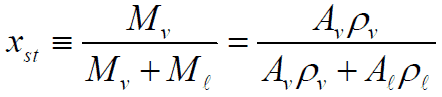
The static quality in a two-phase fluid flow is defined as:
static quality - definition

Flow Quality

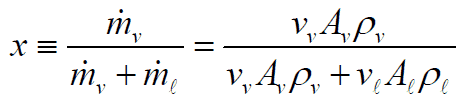
In two-phase fluid flow in is convenient to use the flow quality instead of the static quality. The flow quality in a two-phase fluid flow is defined as:
flow quality - definition

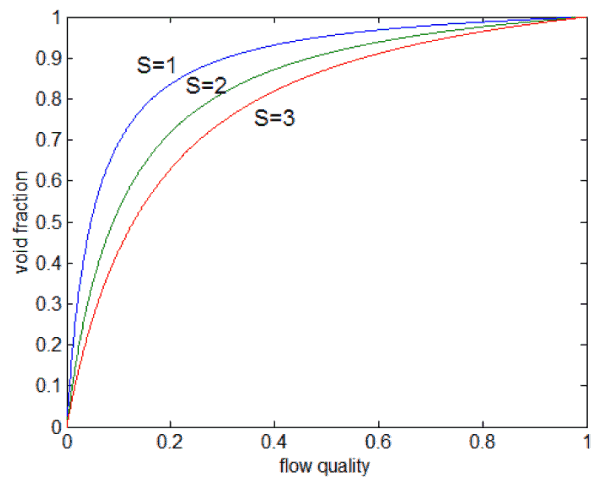
The relations between x, α, and S can be deducted and the result is:

relations between quality, void fraction and slip

Effect of S on α vs x for water at 7 MPa. Source: Buongiorno Jacopo, MIT Department of Nuclear Science and Engineering, NOTES ON TWO-PHASE FLOW
 
References:
Reactor Physics and Thermal Hydraulics:
  1. J. R. Lamarsh, Introduction to Nuclear Reactor Theory, 2nd ed., Addison-Wesley, Reading, MA (1983).
  2. J. R. Lamarsh, A. J. Baratta, Introduction to Nuclear Engineering, 3d ed., Prentice-Hall, 2001, ISBN: 0-201-82498-1.
  3. W. M. Stacey, Nuclear Reactor Physics, John Wiley & Sons, 2001, ISBN: 0- 471-39127-1.
  4. Glasstone, Sesonske. Nuclear Reactor Engineering: Reactor Systems Engineering, Springer; 4th edition, 1994, ISBN: 978-0412985317
  5. Todreas Neil E., Kazimi Mujid S. Nuclear Systems Volume I: Thermal Hydraulic Fundamentals, Second Edition. CRC Press; 2 edition, 2012, ISBN: 978-0415802871
  6. Zohuri B., McDaniel P. Thermodynamics in Nuclear Power Plant Systems. Springer; 2015, ISBN: 978-3-319-13419-2
  7. Moran Michal J., Shapiro Howard N. Fundamentals of Engineering Thermodynamics, Fifth Edition, John Wiley & Sons, 2006, ISBN: 978-0-470-03037-0
  8. Kleinstreuer C. Modern Fluid Dynamics. Springer, 2010, ISBN 978-1-4020-8670-0.
  9. U.S. Department of Energy, THERMODYNAMICS, HEAT TRANSFER, AND FLUID FLOW. DOE Fundamentals Handbook, Volume 1, 2 and 3. June 1992.

See also:

Steam

We hope, this article, Vapor Quality – Dryness Fraction, helps you. If so, give us a like in the sidebar. Main purpose of this website is to help the public to learn some interesting and important information about thermal engineering.
What is Wet Steam – Definition

Wet steam is characterized by the vapor quality, which ranges from zero to unity. Properties of wet steam are tabulated in so called steam tables. Thermal Engineering

Wet Steam

wet-steam-vapor-liquid-mixture-minWet steam is characterized by the vapor quality, which ranges from zero to unity – open interval (0,1). When the vapor quality is equal to 0, it is referred to as the saturated liquid state (single-phase). On the other hand, when the vapor quality is equal to 1, it is referred to as the saturated vapor state or dry steam (single-phase). Between these two states, we talk about vapor-liquid mixture or wet steam (two-phase mixture). At constant pressure, an addition of energy does not changes the temperature of the mixture, but the vapor quality and specific volume changes. In the case of dry steam (100% quality), it contains 100% of the latent heat available at that pressure. Saturated liquid water, which has no latent heat and therefore 0% quality, will therefore only contain sensible heat.

engineering thermodynamics
Rankine Cycle – Thermodynamics as Energy Conversion Science

Typically most of nuclear power plants operates multi-stage condensing steam turbines. In these turbines the high-pressure stage receives steam (this steam is nearly saturated steam – x = 0.995 – point C at the figure) from a steam generator and exhaust it to moisture separator-reheater (point D). The steam must be reheated in order to avoid damages that could be caused to blades of steam turbine by low quality steam. The reheater heats the steam (point D) and then the steam is directed to the low-pressure stage of steam turbine, where expands (point E to F). The exhausted steam is at a pressure well below atmospheric, and is in a partially condensed state (point F), typically of a quality near 90%.

Specific Enthalpy of Wet Steam

The specific enthalpy of saturated liquid water (x=0) and dry steam (x=1) can be picked from steam tables. In case of wet steam, the actual enthalpy can be calculated with the vapor quality, x, and the specific enthalpies of saturated liquid water and dry steam:

hwet = hs x + (1 – x ) hl              

where

hwet = enthalpy of wet steam (J/kg)

hs = enthalpy of “dry” steam (J/kg)

hl = enthalpy of saturated liquid water (J/kg)

As can be seen, wet steam will always have lower enthalpy than dry steam.

Specific Entropy of Wet Steam

Similarly, the specific entropy of saturated liquid water (x=0) and dry steam (x=1) can be picked from steam tables. In case of wet steam, the actual entropy can be calculated with the vapor quality, x, and the specific entropies of saturated liquid water and dry steam:

swet = ss x + (1 – x ) sl              

where

swet = entropy of wet steam (J/kg K)

ss = entropy of “dry” steam (J/kg K)

sl = entropy of saturated liquid water (J/kg K)

Specific Volume of Wet Steam

Similarly, the specific volume of saturated liquid water (x=0) and dry steam (x=1) can be picked from steam tables. In case of wet steam, the actual specific volume can be calculated with the vapor quality, x, and the specific volumes of saturated liquid water and dry steam:

vwet = vs x + (1 – x ) vl              

where

vwet = specific volume of wet steam (m3/kg)

vs = specific volume of “dry” steam (m3/kg)

vl = specific volume of saturated liquid water (m3/kg)

Example:

A high-pressure stage of steam turbine operates at steady state with inlet conditions of  6 MPa, t = 275.6°C, x = 1 (point C). Steam leaves this stage of turbine at a pressure of 1.15 MPa, 186°C and x = 0.87 (point D). Calculate the enthalpy difference between these two states.

The enthalpy for the state C can be picked directly from steam tables, whereas the enthalpy for the state D must be calculated using vapor quality:

h1, wet = 2785 kJ/kg

h2, wet = h2,s x + (1 – x ) h2,l  = 2782 . 0.87 + (1 – 0.87) . 790 = 2420 + 103 = 2523 kJ/kg

Δh = 262 kJ/kg

 
Pressurizer: steam-liquid equilibrium
pressurizer
A pressurizer is a key component of PWRs.

A pressurizer is a component of a pressurized water reactor. Pressure in the primary circuit of PWRs is maintained by a pressurizer, a separate vessel that is connected to the primary circuit (hot leg) and partially filled with water which is heated to the saturation temperature (boiling point) for the desired pressure by submerged electrical heaters. Temperature in the pressurizer can be maintained at 350 °C (662 °F), which gives a subcooling margin (the difference between the pressurizer temperature and the highest temperature in the reactor core) of 30 °C. Subcooling margin is very important safety parameter of PWRs, since the boiling in the reactor core must be excluded. The basic design of the pressurized water reactor includes such requirement that the coolant (water) in the reactor coolant system must not boil. To achieve this, the coolant in the reactor coolant system is maintained at a pressure sufficiently high that boiling does not occur at the coolant temperatures experienced while the plant is operating or in an analyzed transient.

Functions

Pressure in the pressurizer is controlled by varying the temperature of the coolant in the pressurizer. For these purposes two systems are installed. Water spray system and electrical heaters system. Volume of the pressurizer (tens of cubic meters) is filled with water on saturation parameters and steam. The water spray system (relatively cool water – from cold leg) can decrease the pressure in the vessel by condensing the steam on water droplets sprayed in the vessel. On the other hand the submerged electrical heaters are designed to increase the pressure by evaporation the water in the vessel. Water pressure in a closed system tracks water temperature directly; as the temperature goes up, pressure goes up.

Steam Generator - operating conditions
Steam Generator - vertical
Steam Generator – vertical

Steam generators are heat exchangers used to convert feedwater into steam from heat produced in a nuclear reactor core. The steam produced drives the turbine. They are used in the most nuclear power plants, but there are many types according to the reactor type.

The hot primary coolant (water 330°C; 626°F; 16MPa) is pumped into the steam generator through primary inlet. High pressure of primary coolant is used to keep the water in the liquid state. Boiling of the primary coolant shall not occur. The liquid water flows through hundreds or thousands of tubes (usually 1.9 cm in diameter) inside the steam generator. The feedwater (secondary circuit) is heated from ~260°C 500°F to the boiling point of that fluid (280°C; 536°F; 6,5MPa). Heat is transferred through the walls of these tubes to the lower pressure secondary coolant located on the secondary side of the exchanger where the coolant evaporates to pressurized steam (saturated steam 280°C; 536°F; 6,5 MPa). The pressurized steam leaves the steam generator through a steam outlet and continues to the steam turbine. The transfer of heat is accomplished without mixing the two fluids to prevent the secondary coolant from becoming radioactive. The primary coolant leaves (water 295°C; 563°F; 16MPa) the steam generator through primary outlet and continues through a cold leg to a reactor coolant pumpand then into the reactor.

Vapor Quality – Dryness Fraction

wet-steam-vapor-liquid-mixture-minAs can be seen from the phase diagram of water, in the two-phase regions (e.g. on the border of vapor/liquid phases), specifying temperature alone will set the pressure and specifying pressure will set the temperature. But these parameters will not define the volume and enthalpy because we will need to know the relative proportion of the two phases present.

The mass fraction of the vapor in a two-phase liquid-vapor region is called the vapor quality (or dryness fraction), x, and it is given by following formula:

vapor quality

The value of the quality ranges from zero to unity. Although defined as a ratio, the quality is frequently given as a percentage. From this point of view, we distinguish between three basic types of  steam. It must be added, at x=0, we are talking about saturated liquid state (single-phase).

This classification of steam has its limitation. Consider the behavior of the system which is heated at the pressure, that is higher than the critical pressure. In this case, there would be no change in phase from liquid to steam. At all states there would be only one phase. Vaporization and condensation can occur only when the pressure is less than the critical pressure. The terms liquid and vapor tend to lose their significance.

See also: Saturation

See also: Throttling of Steam

Properties of Steam – Steam Tables

Water and steam are a common fluid used for heat exchange in the primary circuit (from surface of fuel rods to the coolant flow) and in the secondary circuit. It used due to its availability and high heat capacity, both for cooling and heating. It is especially effective to transport heat through vaporization and condensation of water because of its very large latent heat of vaporization.

A disadvantage is that water moderated reactors have to use high pressure primary circuit in order to keep water in liquid state and in order to achieve sufficient thermodynamic efficiency. Water and steam also reacts with metals commonly found in industries such as steel and copper that are oxidized faster by untreated water and steam. In almost all thermal power stations (coal, gas, nuclear), water is used as the working fluid (used in a closed loop between boiler, steam turbine and condenser), and the coolant (used to exchange the waste heat to a water body or carry it away by evaporation in a cooling tower).

Properties of water - steam tables
Steam Tables – common parameters in energy systems

Water and steam are a common medium because their properties are very well known. Their properties are tabulated in so called “Steam Tables”. In these tables the basic and key properties, such as pressure, temperature, enthalpy, density and specific heat, are tabulated along the vapor-liquid saturation curve as a function of both temperature and pressure. The properties are also tabulated for single-phase states (compressed water or superheated steam) on a grid of temperatures and pressures extending to 2000 ºC and 1000 MPa.

Further comprehensive authoritative data can be found at the NIST Webbook page on thermophysical properties of fluids.

See also: Steam Tables

Special Reference: Allan H. Harvey. Thermodynamic Properties of Water, NISTIR 5078. Retrieved from https://www.nist.gov/sites/default/files/documents/srd/NISTIR5078.htm

 
Chart: Absolute pressure as a function of temperature of water
Water: Absolute pressure as a function of temperature
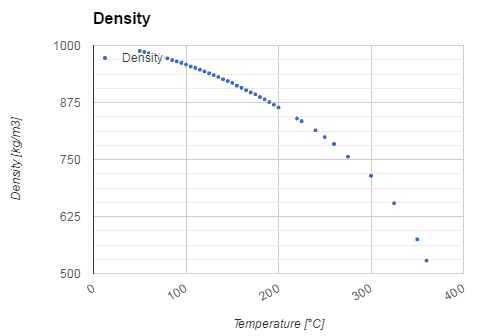
Chart: Density as a function of temperature of water
Chart - density - water - temperature
Density as a function of temperature of water
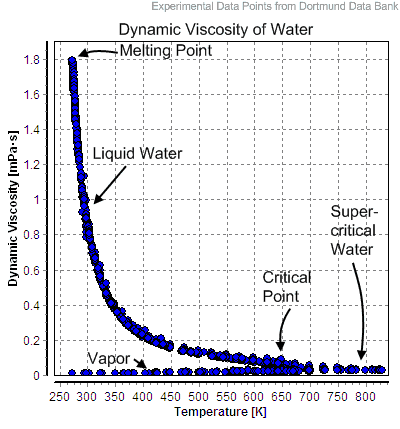
Chart: Dynamic viscosity as a function of temperature of water
Dynamic viscosity as a function of temperature of water
Chart: Dynamic viscosity as a function of temperature of water
Source: wikipedia.org CC BY-SA
 
References:
Reactor Physics and Thermal Hydraulics:
  1. J. R. Lamarsh, Introduction to Nuclear Reactor Theory, 2nd ed., Addison-Wesley, Reading, MA (1983).
  2. J. R. Lamarsh, A. J. Baratta, Introduction to Nuclear Engineering, 3d ed., Prentice-Hall, 2001, ISBN: 0-201-82498-1.
  3. W. M. Stacey, Nuclear Reactor Physics, John Wiley & Sons, 2001, ISBN: 0- 471-39127-1.
  4. Glasstone, Sesonske. Nuclear Reactor Engineering: Reactor Systems Engineering, Springer; 4th edition, 1994, ISBN: 978-0412985317
  5. Todreas Neil E., Kazimi Mujid S. Nuclear Systems Volume I: Thermal Hydraulic Fundamentals, Second Edition. CRC Press; 2 edition, 2012, ISBN: 978-0415802871
  6. Zohuri B., McDaniel P. Thermodynamics in Nuclear Power Plant Systems. Springer; 2015, ISBN: 978-3-319-13419-2
  7. Moran Michal J., Shapiro Howard N. Fundamentals of Engineering Thermodynamics, Fifth Edition, John Wiley & Sons, 2006, ISBN: 978-0-470-03037-0
  8. Kleinstreuer C. Modern Fluid Dynamics. Springer, 2010, ISBN 978-1-4020-8670-0.
  9. U.S. Department of Energy, THERMODYNAMICS, HEAT TRANSFER, AND FLUID FLOW. DOE Fundamentals Handbook, Volume 1, 2 and 3. June 1992.

See also:

Steam

We hope, this article, Wet Steam, helps you. If so, give us a like in the sidebar. Main purpose of this website is to help the public to learn some interesting and important information about thermal engineering.
What is Specific Enthalpy of Wet Steam – Definition

In case of wet steam, the actual enthalpy can be calculated with the vapor quality, x, and the specific enthalpies of saturated liquid water and dry steam. Thermal Engineering

Specific Enthalpy of Wet Steam

wet-steam-vapor-liquid-mixture-min

Specific Enthalpy of Wet Steam

The specific enthalpy of saturated liquid water (x=0) and dry steam (x=1) can be picked from steam tables. In case of wet steam, the actual enthalpy can be calculated with the vapor quality, x, and the specific enthalpies of saturated liquid water and dry steam:

hwet = hs x + (1 – x ) hl              

where

hwet = enthalpy of wet steam (J/kg)

hs = enthalpy of “dry” steam (J/kg)

hl = enthalpy of saturated liquid water (J/kg)

As can be seen, wet steam will always have lower enthalpy than dry steam.

Example:

A high-pressure stage of steam turbine operates at steady state with inlet conditions of  6 MPa, t = 275.6°C, x = 1 (point C). Steam leaves this stage of turbine at a pressure of 1.15 MPa, 186°C and x = 0.87 (point D). Calculate the enthalpy difference between these two states.

The enthalpy for the state C can be picked directly from steam tables, whereas the enthalpy for the state D must be calculated using vapor quality:

h1, wet = 2785 kJ/kg

h2, wet = h2,s x + (1 – x ) h2,l  = 2782 . 0.87 + (1 – 0.87) . 790 = 2420 + 103 = 2523 kJ/kg

Δh = 262 kJ/kg

 
References:
Reactor Physics and Thermal Hydraulics:
  1. J. R. Lamarsh, Introduction to Nuclear Reactor Theory, 2nd ed., Addison-Wesley, Reading, MA (1983).
  2. J. R. Lamarsh, A. J. Baratta, Introduction to Nuclear Engineering, 3d ed., Prentice-Hall, 2001, ISBN: 0-201-82498-1.
  3. W. M. Stacey, Nuclear Reactor Physics, John Wiley & Sons, 2001, ISBN: 0- 471-39127-1.
  4. Glasstone, Sesonske. Nuclear Reactor Engineering: Reactor Systems Engineering, Springer; 4th edition, 1994, ISBN: 978-0412985317
  5. Todreas Neil E., Kazimi Mujid S. Nuclear Systems Volume I: Thermal Hydraulic Fundamentals, Second Edition. CRC Press; 2 edition, 2012, ISBN: 978-0415802871
  6. Zohuri B., McDaniel P. Thermodynamics in Nuclear Power Plant Systems. Springer; 2015, ISBN: 978-3-319-13419-2
  7. Moran Michal J., Shapiro Howard N. Fundamentals of Engineering Thermodynamics, Fifth Edition, John Wiley & Sons, 2006, ISBN: 978-0-470-03037-0
  8. Kleinstreuer C. Modern Fluid Dynamics. Springer, 2010, ISBN 978-1-4020-8670-0.
  9. U.S. Department of Energy, THERMODYNAMICS, HEAT TRANSFER, AND FLUID FLOW. DOE Fundamentals Handbook, Volume 1, 2 and 3. June 1992.

See also:

Steam

We hope, this article, Specific Enthalpy of Wet Steam, helps you. If so, give us a like in the sidebar. Main purpose of this website is to help the public to learn some interesting and important information about thermal engineering.
What is Specific Entropy of Wet Steam – Definition

In case of wet steam, the actual entropy can be calculated with the vapor quality, x, and the specific entropies of saturated liquid water and dry steam. Thermal Engineering

Specific Entropy of Wet Steam

wet-steam-vapor-liquid-mixture-min

Specific Entropy of Wet Steam

Similarly, the specific entropy of saturated liquid water (x=0) and dry steam (x=1) can be picked from steam tables. In case of wet steam, the actual entropy can be calculated with the vapor quality, x, and the specific entropies of saturated liquid water and dry steam:

swet = ss x + (1 – x ) sl              

where

swet = entropy of wet steam (J/kg K)

ss = entropy of “dry” steam (J/kg K)

sl = entropy of saturated liquid water (J/kg K)

 
References:
Reactor Physics and Thermal Hydraulics:
  1. J. R. Lamarsh, Introduction to Nuclear Reactor Theory, 2nd ed., Addison-Wesley, Reading, MA (1983).
  2. J. R. Lamarsh, A. J. Baratta, Introduction to Nuclear Engineering, 3d ed., Prentice-Hall, 2001, ISBN: 0-201-82498-1.
  3. W. M. Stacey, Nuclear Reactor Physics, John Wiley & Sons, 2001, ISBN: 0- 471-39127-1.
  4. Glasstone, Sesonske. Nuclear Reactor Engineering: Reactor Systems Engineering, Springer; 4th edition, 1994, ISBN: 978-0412985317
  5. Todreas Neil E., Kazimi Mujid S. Nuclear Systems Volume I: Thermal Hydraulic Fundamentals, Second Edition. CRC Press; 2 edition, 2012, ISBN: 978-0415802871
  6. Zohuri B., McDaniel P. Thermodynamics in Nuclear Power Plant Systems. Springer; 2015, ISBN: 978-3-319-13419-2
  7. Moran Michal J., Shapiro Howard N. Fundamentals of Engineering Thermodynamics, Fifth Edition, John Wiley & Sons, 2006, ISBN: 978-0-470-03037-0
  8. Kleinstreuer C. Modern Fluid Dynamics. Springer, 2010, ISBN 978-1-4020-8670-0.
  9. U.S. Department of Energy, THERMODYNAMICS, HEAT TRANSFER, AND FLUID FLOW. DOE Fundamentals Handbook, Volume 1, 2 and 3. June 1992.

See also:

Steam

We hope, this article, Specific Entropy of Wet Steam, helps you. If so, give us a like in the sidebar. Main purpose of this website is to help the public to learn some interesting and important information about thermal engineering.
What is Specific Volume of Wet Steam – Definition

In case of wet steam, the actual specific volume can be calculated with the vapor quality, x, and the specific volumes of saturated liquid water and dry steam. Thermal Engineering

Specific Volume of Wet Steam

wet-steam-vapor-liquid-mixture-min

Specific Volume of Wet Steam

Similarly, the specific volume of saturated liquid water (x=0) and dry steam (x=1) can be picked from steam tables. In case of wet steam, the actual specific volume can be calculated with the vapor quality, x, and the specific volumes of saturated liquid water and dry steam:

vwet = vs x + (1 – x ) vl              

where

vwet = specific volume of wet steam (m3/kg)

vs = specific volume of “dry” steam (m3/kg)

vl = specific volume of saturated liquid water (m3/kg)


References:
Reactor Physics and Thermal Hydraulics:
  1. J. R. Lamarsh, Introduction to Nuclear Reactor Theory, 2nd ed., Addison-Wesley, Reading, MA (1983).
  2. J. R. Lamarsh, A. J. Baratta, Introduction to Nuclear Engineering, 3d ed., Prentice-Hall, 2001, ISBN: 0-201-82498-1.
  3. W. M. Stacey, Nuclear Reactor Physics, John Wiley & Sons, 2001, ISBN: 0- 471-39127-1.
  4. Glasstone, Sesonske. Nuclear Reactor Engineering: Reactor Systems Engineering, Springer; 4th edition, 1994, ISBN: 978-0412985317
  5. Todreas Neil E., Kazimi Mujid S. Nuclear Systems Volume I: Thermal Hydraulic Fundamentals, Second Edition. CRC Press; 2 edition, 2012, ISBN: 978-0415802871
  6. Zohuri B., McDaniel P. Thermodynamics in Nuclear Power Plant Systems. Springer; 2015, ISBN: 978-3-319-13419-2
  7. Moran Michal J., Shapiro Howard N. Fundamentals of Engineering Thermodynamics, Fifth Edition, John Wiley & Sons, 2006, ISBN: 978-0-470-03037-0
  8. Kleinstreuer C. Modern Fluid Dynamics. Springer, 2010, ISBN 978-1-4020-8670-0.
  9. U.S. Department of Energy, THERMODYNAMICS, HEAT TRANSFER, AND FLUID FLOW. DOE Fundamentals Handbook, Volume 1, 2 and 3. June 1992.

See also:

Steam

We hope, this article, Specific Volume of Wet Steam, helps you. If so, give us a like in the sidebar. Main purpose of this website is to help the public to learn some interesting and important information about thermal engineering.