Facebook Instagram Youtube Twitter

What is Dry Steam – Definition

Dry steam, or saturated steam, is characterized by the vapor quality, which is equal to unity. Properties of dry steam are tabulated in so called steam tables. Thermal Engineering

Dry Steam – Saturated Vapor
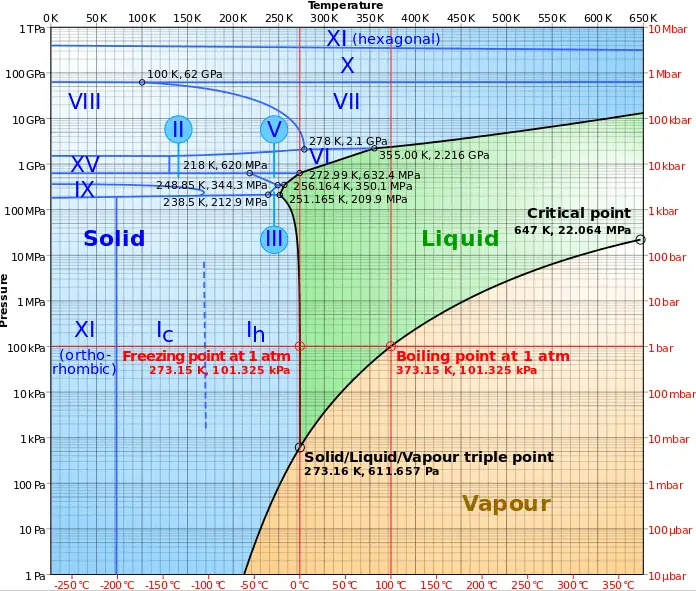
Phase diagram of water
Phase diagram of water.
Source: wikipedia.org CC BY-SA

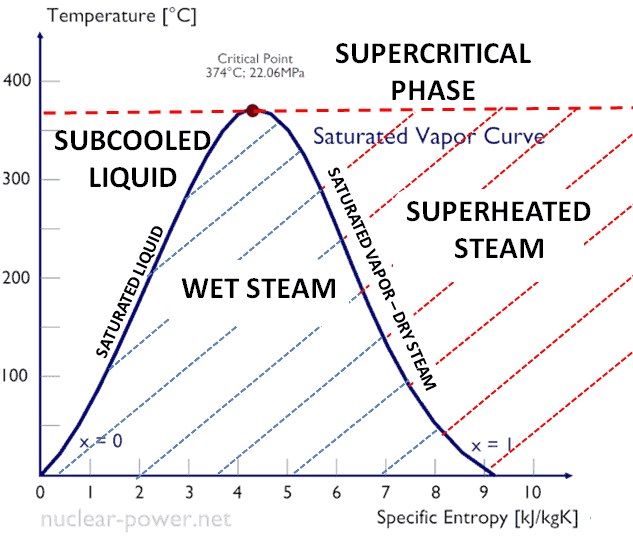
Dry steam, or saturated steam,  is characterized by the vapor quality, which is equal to unity. When the vapor quality is equal to 0, it is referred to as the saturated liquid state (single-phase). On the other hand, when the vapor quality is equal to 1, it is referred to as the saturated vapor state or dry steam (single-phase). Between these two states, we talk about vapor-liquid mixture or wet steam (two-phase mixture). At constant pressure, an addition of energy does not changes the temperature of the mixture, but the vapor quality and specific volume changes. In the case of dry steam (100% quality), it contains 100% of the latent heat available at that pressure. Saturated liquid water, which has no latent heat and therefore 0% quality, will therefore only contain sensible heat.

Typically most of nuclear power plants operates multi-stage condensing steam turbines. In these turbines the high-pressure stage receives steam (this steam is nearly saturated steam – x = 0.995 – point C at the figure) from a steam generator and exhaust it to moisture separator-reheater (point D). The steam must be reheated in order to avoid damages that could be caused to blades of steam turbine by low quality steam. The reheater heats the steam (point D) and then the steam is directed to the low-pressure stage of steam turbine, where expands (point E to F). The exhausted steam is at a pressure well below atmospheric, and is in a partially condensed state (point F), typically of a quality near 90%.
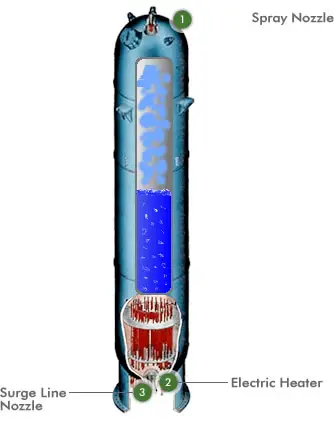
 
Pressurizer: steam-liquid equilibrium
pressurizer
A pressurizer is a key component of PWRs.

A pressurizer is a component of a pressurized water reactor. Pressure in the primary circuit of PWRs is maintained by a pressurizer, a separate vessel that is connected to the primary circuit (hot leg) and partially filled with water which is heated to the saturation temperature (boiling point) for the desired pressure by submerged electrical heaters. Temperature in the pressurizer can be maintained at 350 °C (662 °F), which gives a subcooling margin (the difference between the pressurizer temperature and the highest temperature in the reactor core) of 30 °C. Subcooling margin is very important safety parameter of PWRs, since the boiling in the reactor core must be excluded. The basic design of the pressurized water reactor includes such requirement that the coolant (water) in the reactor coolant system must not boil. To achieve this, the coolant in the reactor coolant system is maintained at a pressure sufficiently high that boiling does not occur at the coolant temperatures experienced while the plant is operating or in an analyzed transient.

Functions

Pressure in the pressurizer is controlled by varying the temperature of the coolant in the pressurizer. For these purposes two systems are installed. Water spray system and electrical heaters system. Volume of the pressurizer (tens of cubic meters) is filled with water on saturation parameters and steam. The water spray system (relatively cool water – from cold leg) can decrease the pressure in the vessel by condensing the steam on water droplets sprayed in the vessel. On the other hand the submerged electrical heaters are designed to increase the pressure by evaporation the water in the vessel. Water pressure in a closed system tracks water temperature directly; as the temperature goes up, pressure goes up.
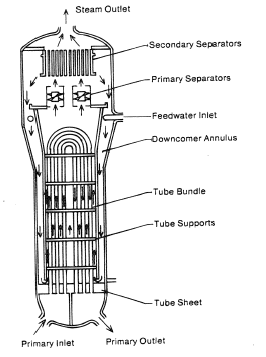
Steam Generator - operating conditions
Steam Generator - vertical
Steam Generator – vertical

Steam generators are heat exchangers used to convert feedwater into steam from heat produced in a nuclear reactor core. The steam produced drives the turbine. They are used in the most nuclear power plants, but there are many types according to the reactor type.

The hot primary coolant (water 330°C; 626°F; 16MPa) is pumped into the steam generator through primary inlet. High pressure of primary coolant is used to keep the water in the liquid state. Boiling of the primary coolant shall not occur. The liquid water flows through hundreds or thousands of tubes (usually 1.9 cm in diameter) inside the steam generator. The feedwater (secondary circuit) is heated from ~260°C 500°F to the boiling point of that fluid (280°C; 536°F; 6,5MPa). Heat is transferred through the walls of these tubes to the lower pressure secondary coolant located on the secondary side of the exchanger where the coolant evaporates to pressurized steam (saturated steam 280°C; 536°F; 6,5 MPa). The pressurized steam leaves the steam generator through a steam outlet and continues to the steam turbine. The transfer of heat is accomplished without mixing the two fluids to prevent the secondary coolant from becoming radioactive. The primary coolant leaves (water 295°C; 563°F; 16MPa) the steam generator through primary outlet and continues through a cold leg to a reactor coolant pumpand then into the reactor.

Vapor Quality – Dryness Fraction
dry-steam-saturated-vapor-minAs can be seen from the phase diagram of water, in the two-phase regions (e.g. on the border of vapor/liquid phases), specifying temperature alone will set the pressure and specifying pressure will set the temperature. But these parameters will not define the volume and enthalpy because we will need to know the relative proportion of the two phases present.

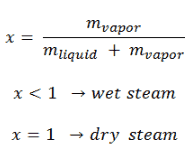
The mass fraction of the vapor in a two-phase liquid-vapor region is called the vapor quality (or dryness fraction), x, and it is given by following formula:
vapor quality

The value of the quality ranges from zero to unity. Although defined as a ratio, the quality is frequently given as a percentage. From this point of view, we distinguish between three basic types of  steam. It must be added, at x=0, we are talking about saturated liquid state (single-phase).

This classification of steam has its limitation. Consider the behavior of the system which is heated at the pressure, that is higher than the critical pressure. In this case, there would be no change in phase from liquid to steam. At all states there would be only one phase. Vaporization and condensation can occur only when the pressure is less than the critical pressure. The terms liquid and vapor tend to lose their significance.

See also: Saturation

Properties of Steam – Steam Tables

Water and steam are a common fluid used for heat exchange in the primary circuit (from surface of fuel rods to the coolant flow) and in the secondary circuit. It used due to its availability and high heat capacity, both for cooling and heating. It is especially effective to transport heat through vaporization and condensation of water because of its very large latent heat of vaporization.

A disadvantage is that water moderated reactors have to use high pressure primary circuit in order to keep water in liquid state and in order to achieve sufficient thermodynamic efficiency. Water and steam also reacts with metals commonly found in industries such as steel and copper that are oxidized faster by untreated water and steam. In almost all thermal power stations (coal, gas, nuclear), water is used as the working fluid (used in a closed loop between boiler, steam turbine and condenser), and the coolant (used to exchange the waste heat to a water body or carry it away by evaporation in a cooling tower).
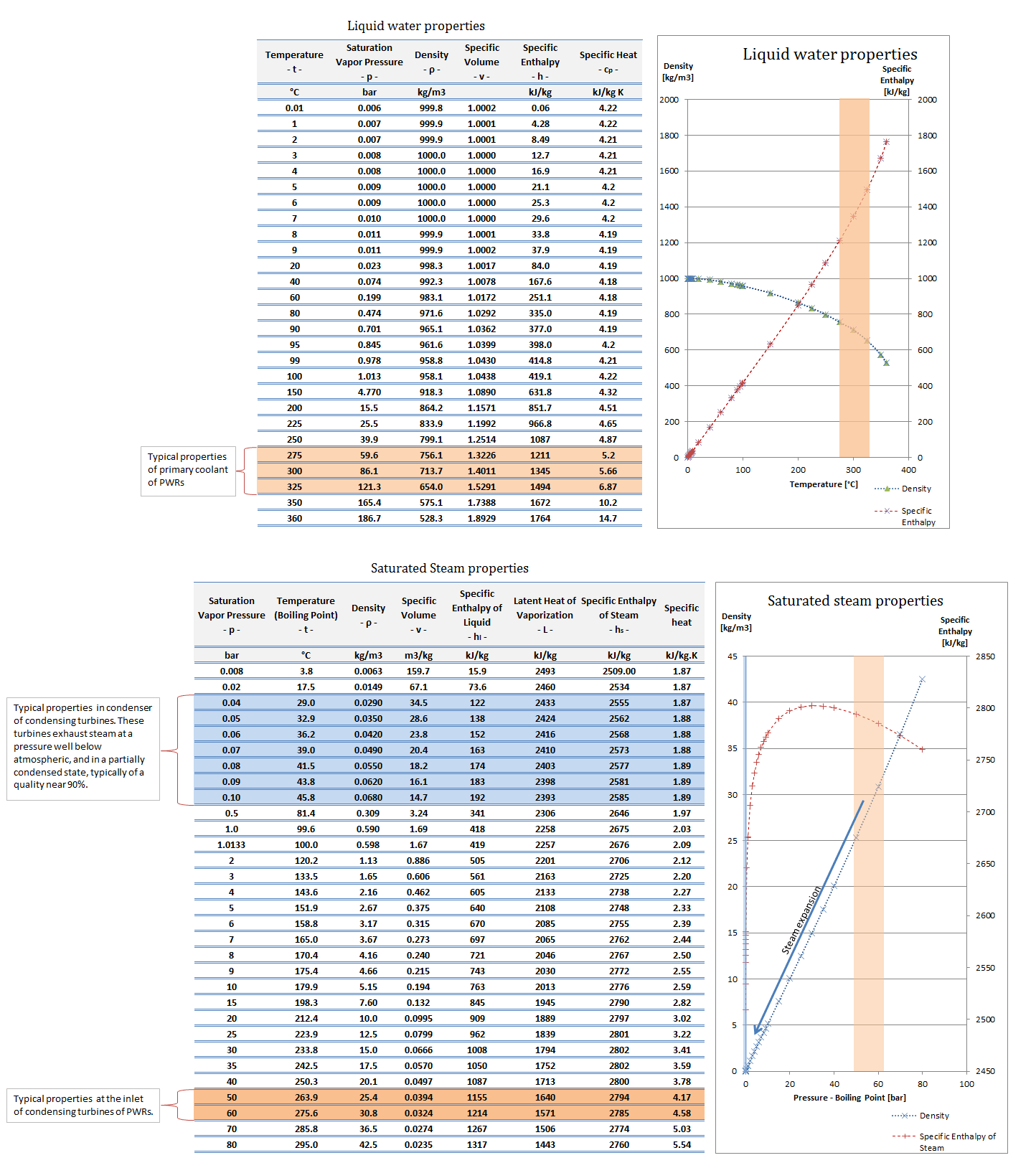
Properties of water - steam tables
Steam Tables – common parameters in energy systems

Water and steam are a common medium because their properties are very well known. Their properties are tabulated in so called “Steam Tables”. In these tables the basic and key properties, such as pressure, temperature, enthalpy, density and specific heat, are tabulated along the vapor-liquid saturation curve as a function of both temperature and pressure. The properties are also tabulated for single-phase states (compressed water or superheated steam) on a grid of temperatures and pressures extending to 2000 ºC and 1000 MPa.

Further comprehensive authoritative data can be found at the NIST Webbook page on thermophysical properties of fluids.

See also: Steam Tables

Special Reference: Allan H. Harvey. Thermodynamic Properties of Water, NISTIR 5078. Retrieved from https://www.nist.gov/sites/default/files/documents/srd/NISTIR5078.htm
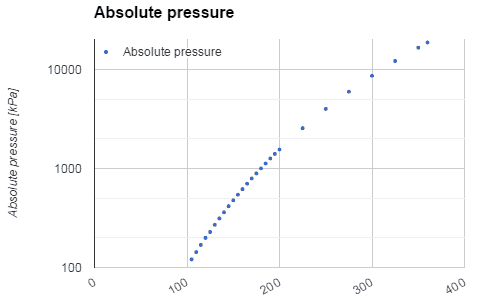
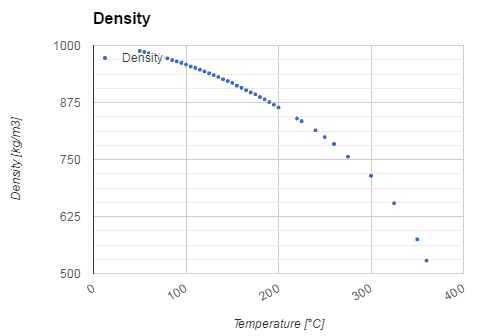
 
Chart: Absolute pressure as a function of temperature of water
Water: Absolute pressure as a function of temperature
Chart: Density as a function of temperature of water
Chart - density - water - temperature
Density as a function of temperature of water
Chart: Dynamic viscosity as a function of temperature of water
Dynamic viscosity as a function of temperature of water
Chart: Dynamic viscosity as a function of temperature of water
Source: wikipedia.org CC BY-SA
 
References:
Reactor Physics and Thermal Hydraulics:
  1. J. R. Lamarsh, Introduction to Nuclear Reactor Theory, 2nd ed., Addison-Wesley, Reading, MA (1983).
  2. J. R. Lamarsh, A. J. Baratta, Introduction to Nuclear Engineering, 3d ed., Prentice-Hall, 2001, ISBN: 0-201-82498-1.
  3. W. M. Stacey, Nuclear Reactor Physics, John Wiley & Sons, 2001, ISBN: 0- 471-39127-1.
  4. Glasstone, Sesonske. Nuclear Reactor Engineering: Reactor Systems Engineering, Springer; 4th edition, 1994, ISBN: 978-0412985317
  5. Todreas Neil E., Kazimi Mujid S. Nuclear Systems Volume I: Thermal Hydraulic Fundamentals, Second Edition. CRC Press; 2 edition, 2012, ISBN: 978-0415802871
  6. Zohuri B., McDaniel P. Thermodynamics in Nuclear Power Plant Systems. Springer; 2015, ISBN: 978-3-319-13419-2
  7. Moran Michal J., Shapiro Howard N. Fundamentals of Engineering Thermodynamics, Fifth Edition, John Wiley & Sons, 2006, ISBN: 978-0-470-03037-0
  8. Kleinstreuer C. Modern Fluid Dynamics. Springer, 2010, ISBN 978-1-4020-8670-0.
  9. U.S. Department of Energy, THERMODYNAMICS, HEAT TRANSFER, AND FLUID FLOW. DOE Fundamentals Handbook, Volume 1, 2 and 3. June 1992.

See also:

Steam

We hope, this article, Dry Steam, helps you. If so, give us a like in the sidebar. Main purpose of this website is to help the public to learn some interesting and important information about thermal engineering.

What is Superheated Steam – Definition

Superheated steam is a steam at a temperature higher than its boiling point at the absolute pressure. Properties of dry steam are tabulated in steam tables. Thermal Engineering

Superheated Steam

Phase diagram of water
Phase diagram of water.
Source: wikipedia.org CC BY-SA

As can be seen from the phase diagram of water, in the two-phase regions (e.g. on the border of vapor/liquid phases), specifying temperature alone will set the pressure and specifying pressure will set the temperature.

  • The saturation vapor curve is the curve separating the two-phase state and the superheated vapor state in the T-s diagram.
  • The saturated liquid curve is the curve separating the subcooled liquid state and the two-phase state in the T-s diagram.

If a steam exists entirely as vapor at saturation temperature, it is called saturated vapor or saturated steam or dry steam. The dry saturated vapor  is characterized by the vapor quality, which is equal to unity. Superheated vapor or superheated steam is a vapor at a temperature higher than its boiling point at the absolute pressure where the temperature is measured. The pressure and temperature of superheated vapor are independent properties, since the temperature may increase while the pressure remains constant. Actually, the substances we call gases are highly superheated vapors.

engineering thermodynamics
Rankine Cycle – Thermodynamics as Energy Conversion Science

The process of superheating of water vapor in the T-s diagram is provided in the figure between state E and saturation vapor curve. As can be seen also wet steam turbines use superheated steam especially at the inlet of low-pressure stages. In order to evaluate the cycle thermal efficiency the enthalpy must be obtained from the superheated steam tables.

The process of superheating is the only way to increase the peak temperature of the Rankine cycle (and to increase efficiency) without increasing the boiler pressure. This requires the addition of another type of heat exchanger called a superheater, which produces the superheated steam.

In the superheater, further heating at fixed pressure results in increases in both temperature and specific volume. The process of superheating in the T-s diagram is provided in the figure between state E and saturation vapor curve.

Typically most of nuclear power plants operates multi-stage condensing steam turbines. In these turbines the high-pressure stage receives steam (this steam is nearly saturated steam – x = 0.995 – point C at the figure) from a steam generator and exhaust it to moisture separator-reheater (point D). The steam must be reheated or superheated in order to avoid damages that could be caused to blades of steam turbine by low quality steam. High content of water droplets can cause the rapid impingement and erosion of the blades which occurs when condensed water is blasted onto the blades. To prevent this, condensate drains are installed in the steam piping leading to the turbine. The reheater heats the steam (point D) and then the steam is directed to the low-pressure stage of steam turbine, where expands (point E to F). The exhausted steam is at a pressure well below atmospheric, and is in a partially condensed state (point F), typically of a quality near 90%.

 
Pressurizer: steam-liquid equilibrium
pressurizer
A pressurizer is a key component of PWRs.

A pressurizer is a component of a pressurized water reactor. Pressure in the primary circuit of PWRs is maintained by a pressurizer, a separate vessel that is connected to the primary circuit (hot leg) and partially filled with water which is heated to the saturation temperature (boiling point) for the desired pressure by submerged electrical heaters. Temperature in the pressurizer can be maintained at 350 °C (662 °F), which gives a subcooling margin (the difference between the pressurizer temperature and the highest temperature in the reactor core) of 30 °C. Subcooling margin is very important safety parameter of PWRs, since the boiling in the reactor core must be excluded. The basic design of the pressurized water reactor includes such requirement that the coolant (water) in the reactor coolant system must not boil. To achieve this, the coolant in the reactor coolant system is maintained at a pressure sufficiently high that boiling does not occur at the coolant temperatures experienced while the plant is operating or in an analyzed transient.

Functions

Pressure in the pressurizer is controlled by varying the temperature of the coolant in the pressurizer. For these purposes two systems are installed. Water spray system and electrical heaters system. Volume of the pressurizer (tens of cubic meters) is filled with water on saturation parameters and steam. The water spray system (relatively cool water – from cold leg) can decrease the pressure in the vessel by condensing the steam on water droplets sprayed in the vessel. On the other hand the submerged electrical heaters are designed to increase the pressure by evaporation the water in the vessel. Water pressure in a closed system tracks water temperature directly; as the temperature goes up, pressure goes up.

Steam Generator - operating conditions
Steam Generator - vertical
Steam Generator – vertical

Steam generators are heat exchangers used to convert feedwater into steam from heat produced in a nuclear reactor core. The steam produced drives the turbine. They are used in the most nuclear power plants, but there are many types according to the reactor type.

The hot primary coolant (water 330°C; 626°F; 16MPa) is pumped into the steam generator through primary inlet. High pressure of primary coolant is used to keep the water in the liquid state. Boiling of the primary coolant shall not occur. The liquid water flows through hundreds or thousands of tubes (usually 1.9 cm in diameter) inside the steam generator. The feedwater (secondary circuit) is heated from ~260°C 500°F to the boiling point of that fluid (280°C; 536°F; 6,5MPa). Heat is transferred through the walls of these tubes to the lower pressure secondary coolant located on the secondary side of the exchanger where the coolant evaporates to pressurized steam (saturated steam 280°C; 536°F; 6,5 MPa). The pressurized steam leaves the steam generator through a steam outlet and continues to the steam turbine. The transfer of heat is accomplished without mixing the two fluids to prevent the secondary coolant from becoming radioactive. The primary coolant leaves (water 295°C; 563°F; 16MPa) the steam generator through primary outlet and continues through a cold leg to a reactor coolant pumpand then into the reactor.

Vapor Quality – Dryness Fraction

superheated-steam-minAs can be seen from the phase diagram of water, in the two-phase regions (e.g. on the border of vapor/liquid phases), specifying temperature alone will set the pressure and specifying pressure will set the temperature. But these parameters will not define the volume and enthalpy because we will need to know the relative proportion of the two phases present.

The mass fraction of the vapor in a two-phase liquid-vapor region is called the vapor quality (or dryness fraction), x, and it is given by following formula:

vapor quality

The value of the quality ranges from zero to unity. Although defined as a ratio, the quality is frequently given as a percentage. From this point of view, we distinguish between three basic types of  steam. It must be added, at x=0, we are talking about saturated liquid state (single-phase).

This classification of steam has its limitation. Consider the behavior of the system which is heated at the pressure, that is higher than the critical pressure. In this case, there would be no change in phase from liquid to steam. At all states there would be only one phase. Vaporization and condensation can occur only when the pressure is less than the critical pressure. The terms liquid and vapor tend to lose their significance.

See also: Saturation

Properties of Steam – Steam Tables

Water and steam are a common fluid used for heat exchange in the primary circuit (from surface of fuel rods to the coolant flow) and in the secondary circuit. It used due to its availability and high heat capacity, both for cooling and heating. It is especially effective to transport heat through vaporization and condensation of water because of its very large latent heat of vaporization.

A disadvantage is that water moderated reactors have to use high pressure primary circuit in order to keep water in liquid state and in order to achieve sufficient thermodynamic efficiency. Water and steam also reacts with metals commonly found in industries such as steel and copper that are oxidized faster by untreated water and steam. In almost all thermal power stations (coal, gas, nuclear), water is used as the working fluid (used in a closed loop between boiler, steam turbine and condenser), and the coolant (used to exchange the waste heat to a water body or carry it away by evaporation in a cooling tower).

Properties of water - steam tables
Steam Tables – common parameters in energy systems

Water and steam are a common medium because their properties are very well known. Their properties are tabulated in so called “Steam Tables”. In these tables the basic and key properties, such as pressure, temperature, enthalpy, density and specific heat, are tabulated along the vapor-liquid saturation curve as a function of both temperature and pressure. The properties are also tabulated for single-phase states (compressed water or superheated steam) on a grid of temperatures and pressures extending to 2000 ºC and 1000 MPa.

Further comprehensive authoritative data can be found at the NIST Webbook page on thermophysical properties of fluids.

See also: Steam Tables

Special Reference: Allan H. Harvey. Thermodynamic Properties of Water, NISTIR 5078. Retrieved from https://www.nist.gov/sites/default/files/documents/srd/NISTIR5078.htm
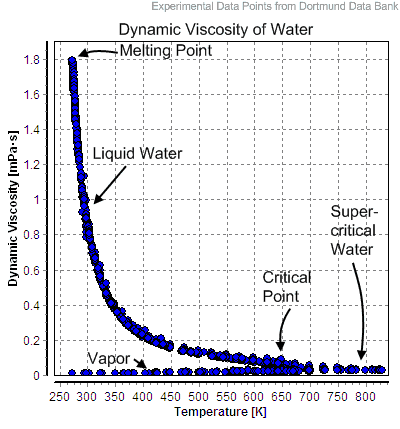
 
Chart: Absolute pressure as a function of temperature of water
Water: Absolute pressure as a function of temperature
Chart: Density as a function of temperature of water
Chart - density - water - temperature
Density as a function of temperature of water
Chart: Dynamic viscosity as a function of temperature of water
Dynamic viscosity as a function of temperature of water
Chart: Dynamic viscosity as a function of temperature of water
Source: wikipedia.org CC BY-SA
 
References:
Reactor Physics and Thermal Hydraulics:
  1. J. R. Lamarsh, Introduction to Nuclear Reactor Theory, 2nd ed., Addison-Wesley, Reading, MA (1983).
  2. J. R. Lamarsh, A. J. Baratta, Introduction to Nuclear Engineering, 3d ed., Prentice-Hall, 2001, ISBN: 0-201-82498-1.
  3. W. M. Stacey, Nuclear Reactor Physics, John Wiley & Sons, 2001, ISBN: 0- 471-39127-1.
  4. Glasstone, Sesonske. Nuclear Reactor Engineering: Reactor Systems Engineering, Springer; 4th edition, 1994, ISBN: 978-0412985317
  5. Todreas Neil E., Kazimi Mujid S. Nuclear Systems Volume I: Thermal Hydraulic Fundamentals, Second Edition. CRC Press; 2 edition, 2012, ISBN: 978-0415802871
  6. Zohuri B., McDaniel P. Thermodynamics in Nuclear Power Plant Systems. Springer; 2015, ISBN: 978-3-319-13419-2
  7. Moran Michal J., Shapiro Howard N. Fundamentals of Engineering Thermodynamics, Fifth Edition, John Wiley & Sons, 2006, ISBN: 978-0-470-03037-0
  8. Kleinstreuer C. Modern Fluid Dynamics. Springer, 2010, ISBN 978-1-4020-8670-0.
  9. U.S. Department of Energy, THERMODYNAMICS, HEAT TRANSFER, AND FLUID FLOW. DOE Fundamentals Handbook, Volume 1, 2 and 3. June 1992.

See also:

Steam

We hope, this article, Superheated Steam, helps you. If so, give us a like in the sidebar. Main purpose of this website is to help the public to learn some interesting and important information about thermal engineering.

What is Saturated and Subcooled Liquid – Definition

Water at saturation temperature and pressure with x=0 is a saturated liquid. At lower temperatures it is called either a subcooled liquid or a compressed liquid. Thermal Engineering

Saturated and Subcooled Liquid

Phase diagram of water
Phase diagram of water.
Source: wikipedia.org CC BY-SA

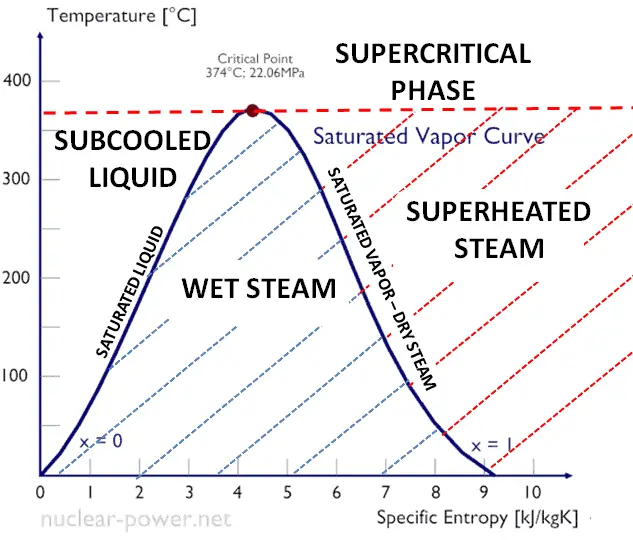
As can be seen from the phase diagram of water, in the two-phase regions (e.g. on the border of vapor/liquid phases), specifying temperature alone will set the pressure and specifying pressure will set the temperature.

  • The saturation vapor curve is the curve separating the two-phase state and the superheated vapor state in the T-s diagram.
  • The saturated liquid curve is the curve separating the subcooled liquid state and the two-phase state in the T-s diagram.

If a water exists as a liquid at the saturation temperature and pressure with quality of x = 0, it is called a saturated liquid state (single-phase). If the temperature of the liquid is lower than the saturation temperature for the existing pressure, it is called either a subcooled liquid or a compressed liquid . The term subcooling refers to a liquid existing at a temperature below its normal boiling point.  For example, water normally boils at 100°C (at atmospheric pressure); at room temperature 20°C the water is termed “subcooled”. Analogically the subcooling is defined also in nuclear engineering but for another purpose.

For example, the temperature in the pressurizer can be maintained at 350 °C (662 °F), which gives a subcooling margin (the difference between the pressurizer temperature and the highest temperature in the reactor core) of 30 °C. Subcooling margin is very important safety parameter of PWRs, since the boiling in the reactor core must be excluded.

 
Pressurizer: steam-liquid equilibrium
pressurizer
A pressurizer is a key component of PWRs.

A pressurizer is a component of a pressurized water reactor. Pressure in the primary circuit of PWRs is maintained by a pressurizer, a separate vessel that is connected to the primary circuit (hot leg) and partially filled with water which is heated to the saturation temperature (boiling point) for the desired pressure by submerged electrical heaters. Temperature in the pressurizer can be maintained at 350 °C (662 °F), which gives a subcooling margin (the difference between the pressurizer temperature and the highest temperature in the reactor core) of 30 °C. Subcooling margin is very important safety parameter of PWRs, since the boiling in the reactor core must be excluded. The basic design of the pressurized water reactor includes such requirement that the coolant (water) in the reactor coolant system must not boil. To achieve this, the coolant in the reactor coolant system is maintained at a pressure sufficiently high that boiling does not occur at the coolant temperatures experienced while the plant is operating or in an analyzed transient.

Functions

Pressure in the pressurizer is controlled by varying the temperature of the coolant in the pressurizer. For these purposes two systems are installed. Water spray system and electrical heaters system. Volume of the pressurizer (tens of cubic meters) is filled with water on saturation parameters and steam. The water spray system (relatively cool water – from cold leg) can decrease the pressure in the vessel by condensing the steam on water droplets sprayed in the vessel. On the other hand the submerged electrical heaters are designed to increase the pressure by evaporation the water in the vessel. Water pressure in a closed system tracks water temperature directly; as the temperature goes up, pressure goes up.

Steam Generator - operating conditions
Steam Generator - vertical
Steam Generator – vertical

Steam generators are heat exchangers used to convert feedwater into steam from heat produced in a nuclear reactor core. The steam produced drives the turbine. They are used in the most nuclear power plants, but there are many types according to the reactor type.

The hot primary coolant (water 330°C; 626°F; 16MPa) is pumped into the steam generator through primary inlet. High pressure of primary coolant is used to keep the water in the liquid state. Boiling of the primary coolant shall not occur. The liquid water flows through hundreds or thousands of tubes (usually 1.9 cm in diameter) inside the steam generator. The feedwater (secondary circuit) is heated from ~260°C 500°F to the boiling point of that fluid (280°C; 536°F; 6,5MPa). Heat is transferred through the walls of these tubes to the lower pressure secondary coolant located on the secondary side of the exchanger where the coolant evaporates to pressurized steam (saturated steam 280°C; 536°F; 6,5 MPa). The pressurized steam leaves the steam generator through a steam outlet and continues to the steam turbine. The transfer of heat is accomplished without mixing the two fluids to prevent the secondary coolant from becoming radioactive. The primary coolant leaves (water 295°C; 563°F; 16MPa) the steam generator through primary outlet and continues through a cold leg to a reactor coolant pumpand then into the reactor.

Vapor Quality – Dryness Fraction

subcooled-liquid-minAs can be seen from the phase diagram of water, in the two-phase regions (e.g. on the border of vapor/liquid phases), specifying temperature alone will set the pressure and specifying pressure will set the temperature. But these parameters will not define the volume and enthalpy because we will need to know the relative proportion of the two phases present.

The mass fraction of the vapor in a two-phase liquid-vapor region is called the vapor quality (or dryness fraction), x, and it is given by following formula:

vapor quality

The value of the quality ranges from zero to unity. Although defined as a ratio, the quality is frequently given as a percentage. From this point of view, we distinguish between three basic types of  steam. It must be added, at x=0, we are talking about saturated liquid state (single-phase).

  • Wet Steam
  • Dry Steam
  • Superheated Steam

This classification of steam has its limitation. Consider the behavior of the system which is heated at the pressure, that is higher than the critical pressure. In this case, there would be no change in phase from liquid to steam. At all states there would be only one phase. Vaporization and condensation can occur only when the pressure is less than the critical pressure. The terms liquid and vapor tend to lose their significance.

See also: Saturation

Properties of Steam – Steam Tables

Water and steam are a common fluid used for heat exchange in the primary circuit (from surface of fuel rods to the coolant flow) and in the secondary circuit. It used due to its availability and high heat capacity, both for cooling and heating. It is especially effective to transport heat through vaporization and condensation of water because of its very large latent heat of vaporization.

A disadvantage is that water moderated reactors have to use high pressure primary circuit in order to keep water in liquid state and in order to achieve sufficient thermodynamic efficiency. Water and steam also reacts with metals commonly found in industries such as steel and copper that are oxidized faster by untreated water and steam. In almost all thermal power stations (coal, gas, nuclear), water is used as the working fluid (used in a closed loop between boiler, steam turbine and condenser), and the coolant (used to exchange the waste heat to a water body or carry it away by evaporation in a cooling tower).

Properties of water - steam tables
Steam Tables – common parameters in energy systems

Water and steam are a common medium because their properties are very well known. Their properties are tabulated in so called “Steam Tables”. In these tables the basic and key properties, such as pressure, temperature, enthalpy, density and specific heat, are tabulated along the vapor-liquid saturation curve as a function of both temperature and pressure. The properties are also tabulated for single-phase states (compressed water or superheated steam) on a grid of temperatures and pressures extending to 2000 ºC and 1000 MPa.

Further comprehensive authoritative data can be found at the NIST Webbook page on thermophysical properties of fluids.

See also: Steam Tables

Special Reference: Allan H. Harvey. Thermodynamic Properties of Water, NISTIR 5078. Retrieved from https://www.nist.gov/sites/default/files/documents/srd/NISTIR5078.htm

 
Chart: Absolute pressure as a function of temperature of water
Water: Absolute pressure as a function of temperature
Chart: Density as a function of temperature of water
Chart - density - water - temperature
Density as a function of temperature of water
Chart: Dynamic viscosity as a function of temperature of water
Dynamic viscosity as a function of temperature of water
Chart: Dynamic viscosity as a function of temperature of water
Source: wikipedia.org CC BY-SA
 
References:
Reactor Physics and Thermal Hydraulics:
  1. J. R. Lamarsh, Introduction to Nuclear Reactor Theory, 2nd ed., Addison-Wesley, Reading, MA (1983).
  2. J. R. Lamarsh, A. J. Baratta, Introduction to Nuclear Engineering, 3d ed., Prentice-Hall, 2001, ISBN: 0-201-82498-1.
  3. W. M. Stacey, Nuclear Reactor Physics, John Wiley & Sons, 2001, ISBN: 0- 471-39127-1.
  4. Glasstone, Sesonske. Nuclear Reactor Engineering: Reactor Systems Engineering, Springer; 4th edition, 1994, ISBN: 978-0412985317
  5. Todreas Neil E., Kazimi Mujid S. Nuclear Systems Volume I: Thermal Hydraulic Fundamentals, Second Edition. CRC Press; 2 edition, 2012, ISBN: 978-0415802871
  6. Zohuri B., McDaniel P. Thermodynamics in Nuclear Power Plant Systems. Springer; 2015, ISBN: 978-3-319-13419-2
  7. Moran Michal J., Shapiro Howard N. Fundamentals of Engineering Thermodynamics, Fifth Edition, John Wiley & Sons, 2006, ISBN: 978-0-470-03037-0
  8. Kleinstreuer C. Modern Fluid Dynamics. Springer, 2010, ISBN 978-1-4020-8670-0.
  9. U.S. Department of Energy, THERMODYNAMICS, HEAT TRANSFER, AND FLUID FLOW. DOE Fundamentals Handbook, Volume 1, 2 and 3. June 1992.

See also:

Steam

We hope, this article, Saturated and Subcooled Liquid, helps you. If so, give us a like in the sidebar. Main purpose of this website is to help the public to learn some interesting and important information about thermal engineering.

What is Triple Point of Water – Definition

The triple point of a water is the unique combination of temperature and pressure at which solid phase, liquid phase, and gaseous phase can all coexist in thermodynamic equilibrium. Thermal Engineering

Triple Point of Water

Phase diagram of water
Phase diagram of water.
Source: wikipedia.org CC BY-SA

In thermodynamics, the triple point of a substance is the unique combination of temperature and pressure at which solid phase, liquid phase, and gaseous phase can all coexist in thermodynamic equilibrium.

By international agreement, the triple point of water has been assigned a value of 273.16 K (0.01 °C; 32.02 °F) and a partial vapor pressure of 611.66 pascals (6.1166 mbar; 0.0060366 atm). At that point, it is possible to change all of the substance to vapor, water, or ice by making arbitrarily small changes in pressure and temperature. Even if the total pressure is well above the triple point of water, provided that the partial pressure of the water vapor is 611.657 pascals, then the system can still be brought to the triple point of water.

The triple point of water, T3 = 273.16 K, is the standard fixed-point temperature for the calibration of thermometers. This agreement also sets the size of the kelvin as 1/273.16 of the difference between the triple-point temperature of water and absolute zero.

The phase diagram of water is a pressure-temperature diagram for water that shows how all three phases (solid, liquid, and vapor) may coexist together in thermal equilibrium. Along the vaporization line, the liquid and vapor phases are in equilibrium, along the fusion line, the solid and liquid phases are in equilibrium and along the sublimation line, the solid and vapor phases are in equilibrium. The only point at which all three phases may exist in equilibrium is the triple point.

The triple point of water corresponds to the minimum pressure at which water in the liquid state can exist. At pressures below the triple point (as in outer space), solid ice when heated at constant pressure is converted directly into water vapor in a process known as sublimation. In general, sublimation is a phase change of a substance directly from the solid to the gas phase without passing through the intermediate liquid phase. Above the triple point, solid ice when heated at constant pressure first melts to form liquid water, and then evaporates to form water vapor.

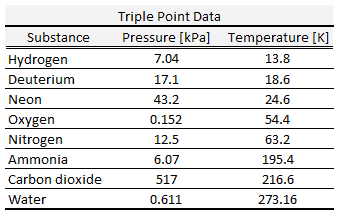
Table of triple point of various substances
Table: Triple points of various substances
 
References:
Reactor Physics and Thermal Hydraulics:
  1. J. R. Lamarsh, Introduction to Nuclear Reactor Theory, 2nd ed., Addison-Wesley, Reading, MA (1983).
  2. J. R. Lamarsh, A. J. Baratta, Introduction to Nuclear Engineering, 3d ed., Prentice-Hall, 2001, ISBN: 0-201-82498-1.
  3. W. M. Stacey, Nuclear Reactor Physics, John Wiley & Sons, 2001, ISBN: 0- 471-39127-1.
  4. Glasstone, Sesonske. Nuclear Reactor Engineering: Reactor Systems Engineering, Springer; 4th edition, 1994, ISBN: 978-0412985317
  5. Todreas Neil E., Kazimi Mujid S. Nuclear Systems Volume I: Thermal Hydraulic Fundamentals, Second Edition. CRC Press; 2 edition, 2012, ISBN: 978-0415802871
  6. Zohuri B., McDaniel P. Thermodynamics in Nuclear Power Plant Systems. Springer; 2015, ISBN: 978-3-319-13419-2
  7. Moran Michal J., Shapiro Howard N. Fundamentals of Engineering Thermodynamics, Fifth Edition, John Wiley & Sons, 2006, ISBN: 978-0-470-03037-0
  8. Kleinstreuer C. Modern Fluid Dynamics. Springer, 2010, ISBN 978-1-4020-8670-0.
  9. U.S. Department of Energy, THERMODYNAMICS, HEAT TRANSFER, AND FLUID FLOW. DOE Fundamentals Handbook, Volume 1, 2 and 3. June 1992.

See also:

Water

We hope, this article, Triple Point of Water, helps you. If so, give us a like in the sidebar. Main purpose of this website is to help the public to learn some interesting and important information about thermal engineering.
What is Law of Thermodynamics – Definition

There are four laws of thermodynamics that define fundamental physical quantities (temperature, energy, and entropy) and that characterize thermodynamic systems. Thermal Engineering

Laws of Thermodynamics

There are four laws of thermodynamics that define fundamental physical quantities (temperature, energy, and entropy) and that characterize thermodynamic systems at thermal equilibrium. These are considered as one of the most important laws in all of physics. The laws are as follows:

Zeroth law of thermodynamics:

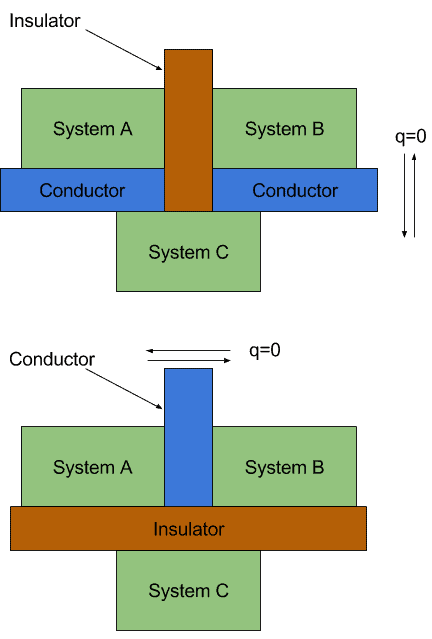
If two systems are both in thermal equilibrium with a third then they are in thermal equilibrium with each other.  

This law provides a definition and method of defining temperatures, perhaps the most important intensive property of a system when dealing with thermal energy conversion problems.

First law of thermodynamics:

The increase in internal energy of a closed system is equal to the heat supplied to the system minus work done by it.  

This law is the principle of conservation of energy. It is the most important law for analysis of most systems and the one that quantifies how thermal energy is transformed to other forms of energy. It follows, perpetual motion machines of the first kind are impossible.

Second law of thermodynamics:

The entropy of any isolated system never decreases. In a natural thermodynamic process, the sum of the entropies of the interacting thermodynamic systems increases.  

This law indicates the irreversibility of natural processes. Reversible processes are a useful and convenient theoretical fiction, but do not occur in nature. From this law follows that it is impossible to construct a device that operates on a cycle and whose sole effect is the transfer of heat from a cooler body to a hotter body. It follows, perpetual motion machines of the second kind are impossible.

Third law of thermodynamics:

The entropy of a system approaches a constant value as the temperature approaches absolute zero.

Based on empirical evidence, this law states that the entropy of a pure crystalline substance is zero at the absolute zero of temperature, 0 K and that it is impossible by means of any process, no matter how idealized, to reduce the temperature of a system to absolute zero in a finite number of steps. This allows us to define a zero point for the thermal energy of a body.

Popular Version of the Laws of Thermodynamics

0. You must play the game.

1. You can’t win; you can only break even.

2. You can only break even at absolute zero.

3. You can’t reach absolute zero.

 
Popular version of the laws
Popular version of the consequences of the first, second, and third laws of thermodynamics:

0. You must play the game.

1. You can’t win. (consequence of first law of thermodynamics)

2. You can’t break even. (consequence of second law of thermodynamics)

3. You can’t even get out of the game. (consequence of third law of thermodynamics)

It is sometimes stated as a general adage without specific reference to the laws of thermodynamics.

Another variant:

1. You can’t win; you can only break even.

2. You can only break even at absolute zero.

3. You can’t reach absolute zero.

Work and Heat in Thermodynamics

Heat in Thermodynamics

zeroth-law-of-thermodynamics-heat

See also: Heat in Thermodynamics

See also: Work in Thermodynamics

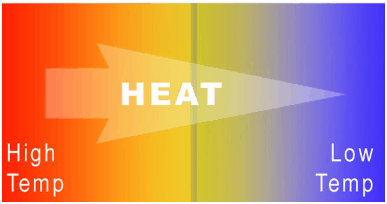
While internal energy refers to the total energy of all the molecules within the object, heat is the amount of energy flowing from one body to another spontaneously due to their temperature difference. Heat is a form of energy, but it is energy in transit. Heat is not a property of a system. However, the transfer of energy as heat occurs at the molecular level as a result of a temperature difference.

Consider a block of metal at high temperature, that consists of atoms that are oscillating intensely around their average positions. At low temperatures, the atoms continue to oscillate, but with less intensity. If a hotter block of metal is put in contact with a cooler block, the intensely oscillating atoms at the edge of the hotter block gives off its kinetic energy to the less oscillating atoms at the edge of the cool block. In this case there is energy transfer between these two blocks and heat flows from the hotter to the cooler block by this random vibrations.

In general, when two objects are brought into thermal contact, heat will flow between them until they come into equilibrium with each other.  When a temperature difference does exist heat flows spontaneously from the warmer system to the colder system. Heat transfer occurs by conduction or by thermal radiation. When the flow of heat stops, they are said to be at the same temperature. They are then said to be in thermal equilibrium.

As with work, the amount of heat transferred depends upon the path and not simply on the initial and final conditions of the system. There are actually many ways to take the gas from state i to state f.

Also, as with work, it is important to distinguish between heat added to a system from its surroundings and heat removed from a system to its surroundings. Q is positive for heat added to the system, so if heat leaves the system, Q is negative. Because W in the equation is the work done by the system, then if work is done on the system, W will be negative and Eint will increase.

The symbol q is sometimes used to indicate the heat added to or removed from a system per unit mass. It equals the total heat (Q) added or removed divided by the mass (m).

Work in Thermodynamics

pdV Work - Thermodynamics
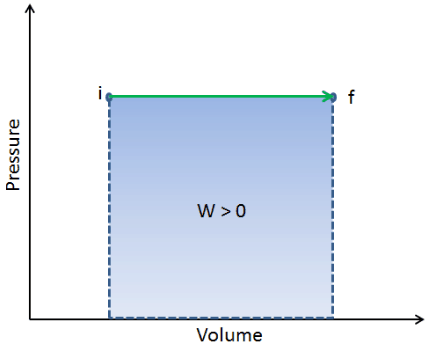
pΔV Work is equal to the area under the process curve plotted on the pressure-volume diagram.

In thermodynamics, work performed by a system is the energy transferred by the system to its surroundings. Kinetic energy, potential energy and internal energy are forms of energy that are properties of a system. Work is a form of energy, but it is energy in transit. A system contains no work, work is a process done by or on a system. In general, work is defined for mechanical systems as the action of a force on an object through a distance.

W = F . d

where:

W = work (J)

F = force (N)

d = displacement (m)

Heat Engines and Thermal Efficiency

Example of Heat Engine
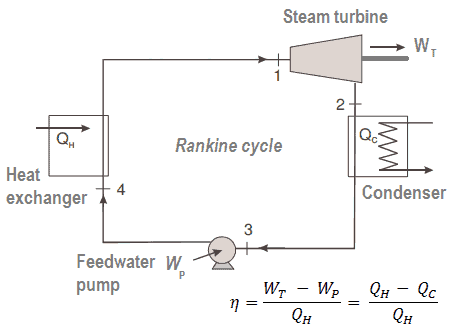
The Rankine cycle closely describes the processes in steam-operated heat engines commonly found in most of thermal power plants.

Energy sources have always played a very important role in the development of human society. Energy is generally defined as the potential to do work or produce heat. Sometimes it is like the “currency” for performing work. One of the most wonderful properties of the universe is that energy can be transformed from one type to another and transferred from one object to another.

In general, it is easy to produce thermal energy by doing work, for example by any frictional process. But to get work from thermal energy is more difficult. It is closely associated with the concept of entropy. For example, electricity is particularly useful since it has very low entropy (is highly ordered) and can be converted into other forms of energy very efficiently.

Sometimes, mechanical energy is directly available, for example wind power and hydro power. But most of our energy comes from the burning of fossil fuels (coal, oil, and gas) and from nuclear reactions. At present, fossil fuel is still the world’s predominant energy source. But the burning of fossil fuels generates only thermal energy, therefore these energy sources are so called “primary energy sources”, that must be converted to secondary energy source, so called energy carriers (electrical energy etc.). To convert thermal energy into another form of energy a heat engine must be used.

In general, a heat engine is a device that converts chemical energy to heat or thermal energy and then to mechanical energy or to electrical energy. Many heat engines operate in a cyclic manner, adding energy in the form of heat in one part of the cycle and using that energy to do useful work in another part of the cycle.

For example, as is typical in all conventional thermal power plants the heat is used to generate steam which drives a steam turbine connected to a generator which produces electricity. Steam generators, steam turbines, condensers and feedwater pumps constitute a heat engine, that is subject to the efficiency limitations imposed by the second law of thermodynamics. In modern nuclear power plants the overall thermodynamic efficiency is about one-third (33%), so 3000 MWth of thermal power from the fission reaction is needed to generate 1000 MWe of electrical power.

See also: Heat Engines

Thermal Efficiency

We define the thermal efficiency, ηth, of any heat engine as the ratio of the work it does, W, to the heat input at the high temperature, QH.

thermal efficiency formula - 1

The thermal efficiency, ηth, represents the fraction of heat, QH, that is converted to work. It  is a dimensionless performance measure of a heat engine that uses thermal energy, such as a steam turbine, an internal combustion engine, or a refrigerator. For a refrigeration or heat pumps, thermal efficiency indicates the extent to which the energy added by work is converted to net heat output. Since it is dimensionless number, we must always express W, QH, and QC in the same units.

Since energy is conserved according to the first law of thermodynamics and energy cannot be be converted to work completely, the heat input, QH, must equal the work done, W, plus the heat that must be dissipated as waste heat QC into the environment. Therefore we can rewrite the formula for thermal efficiency as:

thermal efficiency formula - 2

To give the efficiency as a percent, we multiply the previous formula by 100. Note that, ηth could be 100% only if the waste heat QC will be zero.

In general, the efficiency of even the best heat engines is quite low. In short, it is very difficult to convert thermal energy to mechanical energy. The thermal efficiencies are usually below 50% and often far below. Be careful when you compare it with efficiencies of wind or hydro power (wind turbines are not heat engines), there is no energy conversion between the thermal and mechanical energy.

See also: Carnot’s Principle

See also: Thermal Efficiency

 
References:
Nuclear and Reactor Physics:
  1. J. R. Lamarsh, Introduction to Nuclear Reactor Theory, 2nd ed., Addison-Wesley, Reading, MA (1983).
  2. J. R. Lamarsh, A. J. Baratta, Introduction to Nuclear Engineering, 3d ed., Prentice-Hall, 2001, ISBN: 0-201-82498-1.
  3. W. M. Stacey, Nuclear Reactor Physics, John Wiley & Sons, 2001, ISBN: 0- 471-39127-1.
  4. Glasstone, Sesonske. Nuclear Reactor Engineering: Reactor Systems Engineering, Springer; 4th edition, 1994, ISBN: 978-0412985317
  5. W.S.C. Williams. Nuclear and Particle Physics. Clarendon Press; 1 edition, 1991, ISBN: 978-0198520467
  6. Kenneth S. Krane. Introductory Nuclear Physics, 3rd Edition, Wiley, 1987, ISBN: 978-0471805533
  7. G.R.Keepin. Physics of Nuclear Kinetics. Addison-Wesley Pub. Co; 1st edition, 1965
  8. Robert Reed Burn, Introduction to Nuclear Reactor Operation, 1988.
  9. U.S. Department of Energy, Nuclear Physics and Reactor Theory. DOE Fundamentals Handbook, Volume 1 and 2. January 1993.

Advanced Reactor Physics:

  1. K. O. Ott, W. A. Bezella, Introductory Nuclear Reactor Statics, American Nuclear Society, Revised edition (1989), 1989, ISBN: 0-894-48033-2.
  2. K. O. Ott, R. J. Neuhold, Introductory Nuclear Reactor Dynamics, American Nuclear Society, 1985, ISBN: 0-894-48029-4.
  3. D. L. Hetrick, Dynamics of Nuclear Reactors, American Nuclear Society, 1993, ISBN: 0-894-48453-2.
  4. E. E. Lewis, W. F. Miller, Computational Methods of Neutron Transport, American Nuclear Society, 1993, ISBN: 0-894-48452-4.

See also:

Thermodynamics

We hope, this article, Law of Thermodynamics, helps you. If so, give us a like in the sidebar. Main purpose of this website is to help the public to learn some interesting and important information about thermal engineering.
What is Extensive and Intensive Property – Definition

In thermodynamics, an extensive property is dependent upon the amount of mass or upon the size or extent of a system, while an intensive property does not. Thermal Engineering

Extensive Properties – Intesive Properties

Thermodynamic properties can be divided into two general classes:

  • Extensive properties: An extensive property is dependent upon the amount of mass present or upon the size or extent of a system. Mass, total volume and energy are examples of extensive properties. The value of an extensive property varies directly with the mass. Thus, if a quantity of matter in a given state is divided into two equal parts, each part will have the same value of intensive property as the original and half the value of the extensive property. Extensive properties are additive for subsystems. The system could be divided into any number of subsystems and the value of the property for the system would be the sum of the property for each subsystem.
  • Intensive property: An intensive property is independent of the amount of mass and may vary from place to place within the system at any moment.  For example, the temperature of a system in thermal equilibrium is the same as the temperature of any part of it. If the system is divided the temperature of each subsystem is identical. Temperature, pressure, specific volume, and density are examples of intensive properties. Specific quantities are also referred to as intensive variables, though there are some intensive variables that have no extensive counterpart, such as pressure or temperature. Intensive properties may be functions of both position and time, whereas extensive properties vary at most with time.

Specific Properties

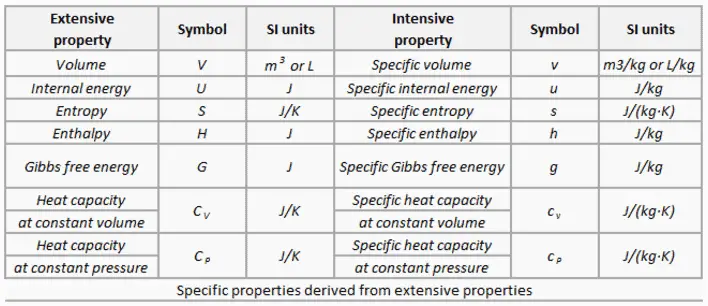
Specific properties of material are derived from other intensive and extensive properties of that material. For example, the density of water  is an intensive property and can be derived from measurements of the mass of a water volume (an extensive property) divided by the volume (another extensive property). Also heat capacity, which is an extensive property of a system can be derived from heat capacity, Cp, and the mass of the system. Dividing these extensive properties gives the specific heat capacity, cp, which is an intensive property.

Specific properties are often used in reference tables as a means of recording material data in a manner that is independent of size or mass. They are very useful for making comparisons about one attribute while cancelling out the effect of variations in another attribute.

Specific properties - thermodynamics
Table of some specific properties
 
References:
Reactor Physics and Thermal Hydraulics:
  1. J. R. Lamarsh, Introduction to Nuclear Reactor Theory, 2nd ed., Addison-Wesley, Reading, MA (1983).
  2. J. R. Lamarsh, A. J. Baratta, Introduction to Nuclear Engineering, 3d ed., Prentice-Hall, 2001, ISBN: 0-201-82498-1.
  3. W. M. Stacey, Nuclear Reactor Physics, John Wiley & Sons, 2001, ISBN: 0- 471-39127-1.
  4. Glasstone, Sesonske. Nuclear Reactor Engineering: Reactor Systems Engineering, Springer; 4th edition, 1994, ISBN: 978-0412985317
  5. Todreas Neil E., Kazimi Mujid S. Nuclear Systems Volume I: Thermal Hydraulic Fundamentals, Second Edition. CRC Press; 2 edition, 2012, ISBN: 978-0415802871
  6. Zohuri B., McDaniel P. Thermodynamics in Nuclear Power Plant Systems. Springer; 2015, ISBN: 978-3-319-13419-2
  7. Moran Michal J., Shapiro Howard N. Fundamentals of Engineering Thermodynamics, Fifth Edition, John Wiley & Sons, 2006, ISBN: 978-0-470-03037-0
  8. Kleinstreuer C. Modern Fluid Dynamics. Springer, 2010, ISBN 978-1-4020-8670-0.
  9. U.S. Department of Energy, THERMODYNAMICS, HEAT TRANSFER, AND FLUID FLOW. DOE Fundamentals Handbook, Volume 1, 2 and 3. June 1992.

See also:

Thermodynamics

We hope, this article, Extensive and Intensive Property, helps you. If so, give us a like in the sidebar. Main purpose of this website is to help the public to learn some interesting and important information about thermal engineering.
What is Specific Property – Definition

Specific properties of material are derived from other intensive and extensive properties of that material. Specific properties are often used in reference tables. Thermal Engineering

Specific Properties

Specific properties of material are derived from other intensive and extensive properties of that material. For example, the density of water  is an intensive property and can be derived from measurements of the mass of a water volume (an extensive property) divided by the volume (another extensive property). Also heat capacity, which is an extensive property of a system can be derived from heat capacity, Cp, and the mass of the system. Dividing these extensive properties gives the specific heat capacity, cp, which is an intensive property.

Specific properties are often used in reference tables as a means of recording material data in a manner that is independent of size or mass. They are very useful for making comparisons about one attribute while cancelling out the effect of variations in another attribute.

Specific properties - thermodynamics
Table of some specific properties
 
References:
Reactor Physics and Thermal Hydraulics:
  1. J. R. Lamarsh, Introduction to Nuclear Reactor Theory, 2nd ed., Addison-Wesley, Reading, MA (1983).
  2. J. R. Lamarsh, A. J. Baratta, Introduction to Nuclear Engineering, 3d ed., Prentice-Hall, 2001, ISBN: 0-201-82498-1.
  3. W. M. Stacey, Nuclear Reactor Physics, John Wiley & Sons, 2001, ISBN: 0- 471-39127-1.
  4. Glasstone, Sesonske. Nuclear Reactor Engineering: Reactor Systems Engineering, Springer; 4th edition, 1994, ISBN: 978-0412985317
  5. Todreas Neil E., Kazimi Mujid S. Nuclear Systems Volume I: Thermal Hydraulic Fundamentals, Second Edition. CRC Press; 2 edition, 2012, ISBN: 978-0415802871
  6. Zohuri B., McDaniel P. Thermodynamics in Nuclear Power Plant Systems. Springer; 2015, ISBN: 978-3-319-13419-2
  7. Moran Michal J., Shapiro Howard N. Fundamentals of Engineering Thermodynamics, Fifth Edition, John Wiley & Sons, 2006, ISBN: 978-0-470-03037-0
  8. Kleinstreuer C. Modern Fluid Dynamics. Springer, 2010, ISBN 978-1-4020-8670-0.
  9. U.S. Department of Energy, THERMODYNAMICS, HEAT TRANSFER, AND FLUID FLOW. DOE Fundamentals Handbook, Volume 1, 2 and 3. June 1992.

See also:

Thermodynamics

We hope, this article, Specific Property, helps you. If so, give us a like in the sidebar. Main purpose of this website is to help the public to learn some interesting and important information about thermal engineering.
What is Thermodynamic Property – Definition

Thermodynamic Properties. In thermodynamics, engineering and in everyday life – knowledge of thermodynamic properties is elementary to understand thermodynamic problems. Thermal Engineering

Thermodynamic Properties

Within thermodynamics, a physical property is any property that is measurable, and whose value describes a state of a physical system. Our goal here will be to introduce thermodynamic properties, that are used in engineering thermodynamics. These properties will be further applied to energy systems and finally to thermal or nuclear power plants.

Extensive vs. intensive thermodynamic properties
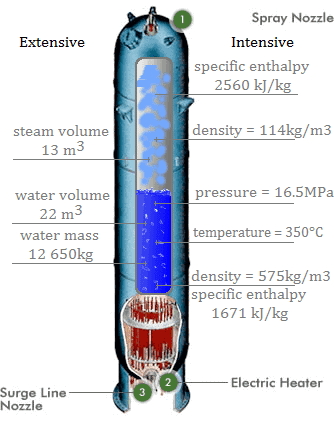
Extensive and intensive properties of medium in the pressurizer.

In general, thermodynamic properties can be divided into two general classes:

Specific Properties

Specific properties of material are derived from other intensive and extensive properties of that material. For example, the density of water  is an intensive property and can be derived from measurements of the mass of a water volume (an extensive property) divided by the volume (another extensive property). Also heat capacity, which is an extensive property of a system can be derived from heat capacity, Cp, and the mass of the system. Dividing these extensive properties gives the specific heat capacity, cp, which is an intensive property.

Specific properties are often used in reference tables as a means of recording material data in a manner that is independent of size or mass. They are very useful for making comparisons about one attribute while cancelling out the effect of variations in another attribute.

Specific properties - thermodynamics
Table of some specific properties

Mass vs. Weight

One of the most familiar forces is the weight of a body, which is the gravitational force that the earth exerts on the body. In general, gravitation is a natural phenomenon by which all things with mass are brought toward one another. The terms mass and weight are often confused with one another, but it is important to distinguish between them. It is absolutely essential to understand clearly the distinctions between these two physical quantities.

 
What is Mass
The mass of an object is a fundamental property of the object. It is a numerical measure of its inertia and the measure of an object’s resistance to acceleration when a force is applied. It is also a fundamental measure of the amount of matter in the object. The greater the mass, the greater the force needed to cause a given acceleration. This is reflected in Newton’s second law (F=ma).

The mass of a certain body will remain constant even if the gravitational acceleration acting upon that body changes. For example, on earth an object has a certain mass and a certain weight. When the same object is placed in outer space, away from the earth’s gravitational field, its mass remains the same, but it is now in a “weightless” condition. This means in this condition it will weight zero, because gravitational acceleration and, thus, force will equal to zero.

Mass and weight are related: Bodies having large mass also have large weight. A large stone is hard to throw because of its large mass, and hard to lift off the ground because of its large weight. To understand the relationship between mass and weight, consider a freely falling stone, that has an acceleration of magnitude g (g = 9.81 m/s2 is the acceleration due to Earth’s gravitational field). Newton’s second law tells us that a force must act to produce this acceleration. If a 1 kilogram stone falls with an acceleration of the required force has magnitude:

F = ma = 1 [kg] x 9.81 [m/s2] = 9.8 [kg m/s2] = 9.8 N

The force that makes the body accelerate downward is its weight. Any body near the surface of the earth that has a mass of 1 kg must have a weight of 9.8 N to give it the acceleration we observe when it is in free fall.

Example: The weight of a stone on the Earth, on the Mars and on the Moon

Weight of a stone on the Earth

gravitational-field-earth-mars-moonThe acceleration due to Earth’s gravitational field is gEarth = 9.81 m/s2.The weight of a stone with mass 1 kg on the Earth can be calculated as:

FEarth = 1 [kg] x 9.81 [m/s2] = 9.8 [kg m/s2] = 9.8 N

Weight of a stone on the Mars

The acceleration of gravity on the Mars is approximately 38% of the acceleration of gravity on the earth. The acceleration due to Moon’s gravitational field is gMars = 3.71 m/s2.

Therefore the weight of the same stone with mass 1 kg on the Mars is:

FMoon = 1 [kg] x 3.71 [m/s2] = 3.71 [kg m/s2] = 3.71 N

Weight of a stone on the Moon

The acceleration of gravity on the Moon is approximately 1/6 of the acceleration of gravity on the earth. The acceleration due to Moon’s gravitational field is gMoon = 1.62 m/s2.

Therefore the weight of the same stone with mass 1 kg on the Moon is:

FMoon = 1 [kg] x 1.62 [m/s2] = 1.62 [kg m/s2] = 1.62 N

The Standard Kilogram

The usual symbol for mass is m and its SI unit is the kilogram. The SI standard of mass is a cylinder of platinum and iridium that is kept at the International Bureau of Weights and Measures near Paris and assigned, by international agreement, a mass of 1 kilogram.

Standard Kilogram
A computer-generated image of the International Prototype kilogram (IPK), which is made from an alloy of 90% platinum and 10% iridium (by weight) and machined into a right-circular cylinder (height = diameter) of 39.17 mm. Source: wikipedia.org; License: CC BY-SA

Toggle: Relativistic Mass

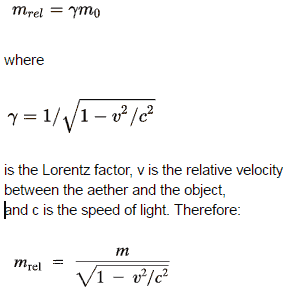
While the mass is normally considered to be an unchanging property of an object, at speeds approaching the speed of light one must consider the increase in the relativistic mass. The relativistic definition of momentum is sometimes interpreted as an increase in the mass of an object. In this interpretation, a particle can have a relativistic mass, mrel. The increase in effective mass with speed is given by the expression:

relativistic-mass-min

In this “mass-increase” formula, m is referred to as the rest mass of the object. It follows from this formula, that an object with nonzero rest mass cannot travel at the speed of light. As the object approaches the speed of light, the object’s momentum increase without bound. On the other hand, when the relative velocity is zero, the Lorentz factor is simply equal to 1, and the relativistic mass is reduced to the rest mass. With this interpretation, the mass of an object appears to increase as its speed increases. In must be added, many physicists believe an object has only one mass (its rest mass), and that it is only the momentum that increases with speed.

What is Mass Defect
See also: Mass Defect

In special theory of relativity certain types of matter may be created or destroyed, but in all of these processes, the mass and energy associated with such matter remains unchanged in quantity. It was found the rest mass of an atomic nucleus is measurably smaller than the sum of the rest masses of its constituent protons, neutrons and electrons. Mass was no longer considered unchangeable in the closed system. The difference is a measure of the nuclear binding energy which holds the nucleus together. According to the Einstein relationship (E=mc2), this binding energy is proportional to this mass difference and it is known as the mass defect.

 
What is Weight
The terms  are often confused with one another, but it is important to distinguish between them. In science and engineering, the weight of an object is usually taken to be the force on the object due to gravity. In general, gravitation is a natural phenomenon by which all things with mass are brought toward one another.

The mass of an object is a fundamental property of the object. It is a numerical measure of its inertia and the measure of an object’s resistance to acceleration when a force is applied. It is also a fundamental measure of the amount of matter in the object. The greater the mass, the greater the force needed to cause a given acceleration. This is reflected in Newton’s second law (F=ma).

The mass of a certain body will remain constant even if the gravitational acceleration acting upon that body changes. For example, on earth an object has a certain mass and a certain weight. When the same object is placed in outer space, away from the earth’s gravitational field, its mass remains the same, but it is now in a “weightless” condition. This means in this condition it will weight zero, because gravitational acceleration and, thus, force will equal to zero.

Mass and weight are related:

Bodies having large mass also have large weight. A large stone is hard to throw because of its large mass, and hard to lift off the ground because of its large weight. To understand the relationship between mass and weight, consider a freely falling stone, that has an acceleration of magnitude g (g = 9.81 m/s2 is the acceleration due to Earth’s gravitational field). Newton’s second law tells us that a force must act to produce this acceleration. If a 1 kilogram stone falls with an acceleration of the required force has magnitude:

F = ma = 1 [kg] x 9.81 [m/s2] = 9.8 [kg m/s2] = 9.8 N

The force that makes the body accelerate downward is its weight. Any body near the surface of the earth that has a mass of 1 kg must have a weight of 9.8 N to give it the acceleration we observe when it is in free fall.

Example: The weight of a stone on the Earth, on the Mars and on the Moon

Weight of a stone on the Earth

gravitational-field-earth-mars-moonThe acceleration due to Earth’s gravitational field is gEarth = 9.81 m/s2.The weight of a stone with mass 1 kg on the Earth can be calculated as:

FEarth = 1 [kg] x 9.81 [m/s2] = 9.8 [kg m/s2] = 9.8 N

Weight of a stone on the Mars

The acceleration of gravity on the Mars is approximately 38% of the acceleration of gravity on the earth. The acceleration due to Moon’s gravitational field is gMars = 3.71 m/s2.

Therefore the weight of the same stone with mass 1 kg on the Mars is:

FMoon = 1 [kg] x 3.71 [m/s2] = 3.71 [kg m/s2] = 3.71 N

Weight of a stone on the Moon

The acceleration of gravity on the Moon is approximately 1/6 of the acceleration of gravity on the earth. The acceleration due to Moon’s gravitational field is gMoon = 1.62 m/s2.

Therefore the weight of the same stone with mass 1 kg on the Moon is:

FMoon = 1 [kg] x 1.62 [m/s2] = 1.62 [kg m/s2] = 1.62 N

Artificial Gravity
In the 20th century, Einstein’s principle of equivalence put all observers, moving or accelerating, on the same footing. Einstein summarised this notion in a postulate:

Principle of Equivalence:

An observer cannot determine, in any way whatsoever, whether the laboratory he occupies is in a uniform gravitational field or is in a reference frame that is accelerating relative to an inertial frame.

This led to an ambiguity as to what exactly is meant by the force of gravity and weight. A scale in an accelerating elevator cannot be distinguished from a scale in a gravitational field.  Gravitational force and weight thereby became essentially frame-dependent quantities. According to the general theory of relativity, gravitational and inertial mass are not different properties of matter but two aspects of a fundamental and single property of matter.

Artificial Gravity
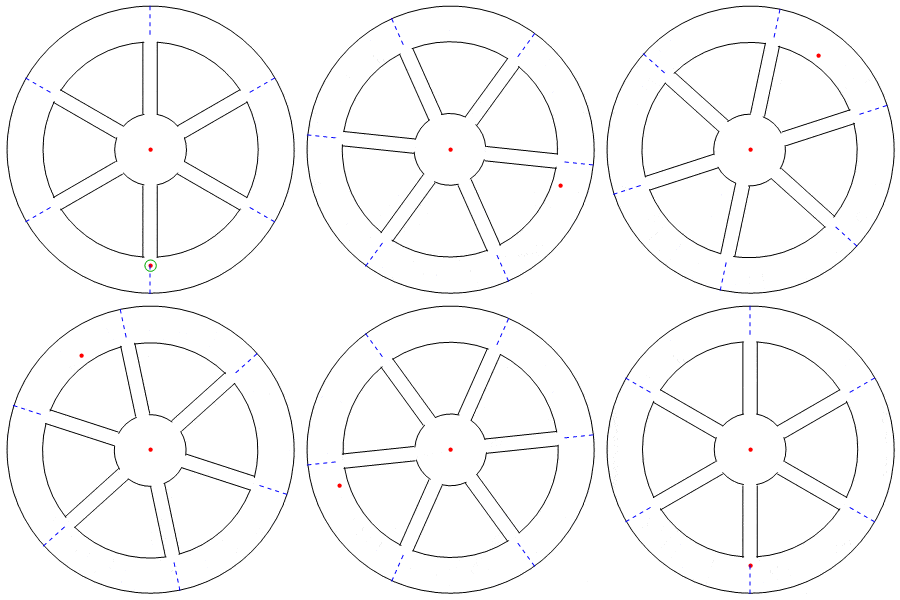
An animation of a 50-meter diameter rotating space-station. Source: wikipedia.org (P.Fraundorf) License: CC BY-SA 4.0

In situations in which gravitation is absent but the chosen coordinate system is not inertial, but is accelerated with the observer, then g-forces and corresponding proper accelerations felt by observers in these coordinate systems are caused by the mechanical forces which resist their weight in such systems. The most realistic method of producing artificial gravity, for example aboard a space station, can be imitated in a rotating spaceship. Objects inside would be pushed toward the hull and they will have some weight. This weight is produced by fictitious forces or “inertial forces” which appear in all such accelerated coordinate systems. Unlike real gravity, which pulls towards a center of the planet, the centripetal force pushes towards the axis of rotation.

What is Volume

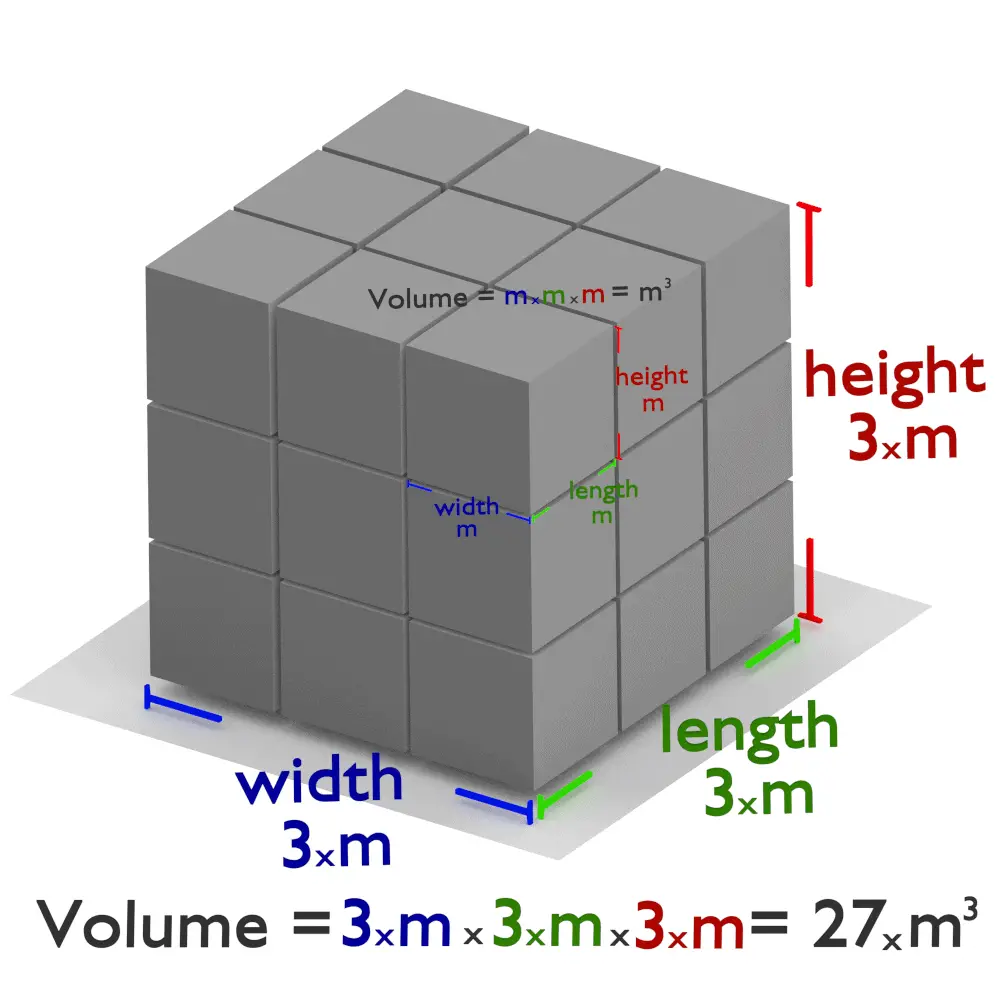
what is volume - physicsVolume is a basic physical quantity. Volume is a derived quantity and it expresses the three dimensional extent of an object. Volume is often quantified numerically using the SI derived unit, the cubic metre. For example, the volume inside a sphere (that is the volume of a ball) is derived to be V = 4/3πr3, where r is the radius of the sphere. As another example, volume of a cube is equal to side times side times side. Since each side of a square is the same, it can simply be the length of one side cubed.

If a square has one side of 3 metres, the volume would be 3 metres times 3 metres times 3 metres, or 27 cubic metres.

See also: Volume of Coolant in Reactor Coolant System

 
Volume of an Atom and Nucleus
Structure of Matter.

The atom consist of a small but massive nucleus surrounded by a cloud of rapidly moving electrons. The nucleus is composed of protons and neutrons. Typical nuclear radii are of the order 10−14 m. Assuming spherical shape, nuclear radii can be calculated according to following formula:

r = r0 . A1/3

where r0 = 1.2 x 10⁻¹⁵ m = 1.2 fm

If we use this approximation, we therefore expect the volume of the nucleus to be of the order of 4/3πr3 or 7,23 ×10−45 m3 for hydrogen nuclei or 1721×10−45 m3 for 238U nuclei. These are volumes of nuclei and atomic nuclei (protons and neutrons) contains of about 99.95% of mass of atom.

See also: Is an atom an empty space?

What is Density

Density - Gas - Liquid - Solid
Typical densities of various substances at atmospheric pressure.

Density is defined as the mass per unit volume. It is an intensive property, which is mathematically defined as mass divided by volume:

ρ = m/V

In words, the density (ρ) of a substance is the total mass (m) of that substance divided by the total volume (V) occupied by that substance. The standard SI unit is kilograms per cubic meter (kg/m3). The Standard English unit is pounds mass per cubic foot (lbm/ft3). The density (ρ) of a substance is the reciprocal of its specific volume (ν).

ρ = m/V = 1/ρ

Specific volume is an intensive variable, whereas volume is an extensive variable. The standard unit for specific volume in the SI system is cubic meters per kilogram (m3/kg). The standard unit in the English system is cubic feet per pound mass (ft3/lbm).

 
Changes of Density
In general, density can be changed by changing either the pressure or the temperature. Increasing the pressure always increases the density of a material. The effect of pressure on the densities of liquids and solids is very very small. On the other hand, the density of gases is strongly affected by pressure. This is expressed by compressibility. Compressibility is a measure of the relative volume change of a fluid or solid as a response to a pressure change.

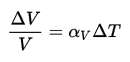
The effect of temperature on the densities of liquids and solids is also very important. Most substances expand when heated and contract when cooled. However, the amount of expansion or contraction varies, depending on the material. This phenomenon is known as thermal expansion. The change in volume of a material which undergoes a temperature change is given by following relation:

thermal-expansion

where ∆T is the change in temperature, V is the original volume, ∆V is the change in volume, and αV is the coefficient of volume expansion.

It must be noted, there are exceptions from this rule. For example, water differs from most liquids in that it becomes less dense as it freezes. It has a maximum of density at 3.98 °C (1000 kg/m3), whereas the density of ice is 917 kg/m3. It differs by about 9% and therefore ice floats on liquid water

See also: How density influences reactor reactivity
 
Densest Materials on the Earth
Since nucleons (protons and neutrons) make up most of the mass of ordinary atoms, the density of normal matter tends to be limited by how closely we can pack these nucleons and depends on the internal atomic structure of a substance. The densest material found on earth is the metal osmium, but its density pales by comparison to the densities of exotic astronomical objects such as white dwarf stars and neutron stars.

List of densest materials:

  1. Osmium – 22.6 x 10³ kg/m3
  2. Iridium – 22.4 x 10³ kg/m3
  3. Platinum – 21.5 x 10³ kg/m3
  4. Rhenium – 21.0 x 10³ kg/m3
  5. Plutonium – 19.8 x 10³ kg/m3
  6. Gold – 19.3 x 10³ kg/m3
  7. Tungsten – 19.3 x 10³ kg/m3
  8. Uranium – 18.8 x 10³ kg/m3
  9. Tantalum – 16.6 x 10³ kg/m3
  10. Mercury – 13.6 x 10³ kg/m3
  11. Rhodium – 12.4 x 10³ kg/m3
  12. Thorium – 11.7 x 10³ kg/m3
  13. Lead – 11.3 x 10³ kg/m3
  14. Silver – 10.5 x 10³ kg/m3

It must be noted, plutonium is a man-made isotope and is created from uranium in nuclear reactors. But, In fact, scientists have found trace amounts of naturally-occurring plutonium.

If we include man made elements, the densest so far is Hassium. Hassium is a chemical element with symbol Hs and atomic number 108.  It is a synthetic element (first synthesised at Hasse in Germany) and radioactive. The most stable known isotope, 269Hs, has a half-life of approximately 9.7 seconds. It has an estimated density of 40.7 x 10³ kg/m3.  The density of Hassium results from its high atomic weight and from the significant decrease in ionic radii of the elements in the lanthanide series, known as lanthanide and actinide contraction.

The density of Hassium is followed by Meitnerium (element 109, named after the physicist Lise Meitner), which has an estimated density of 37.4 x 10³ kg/m3.

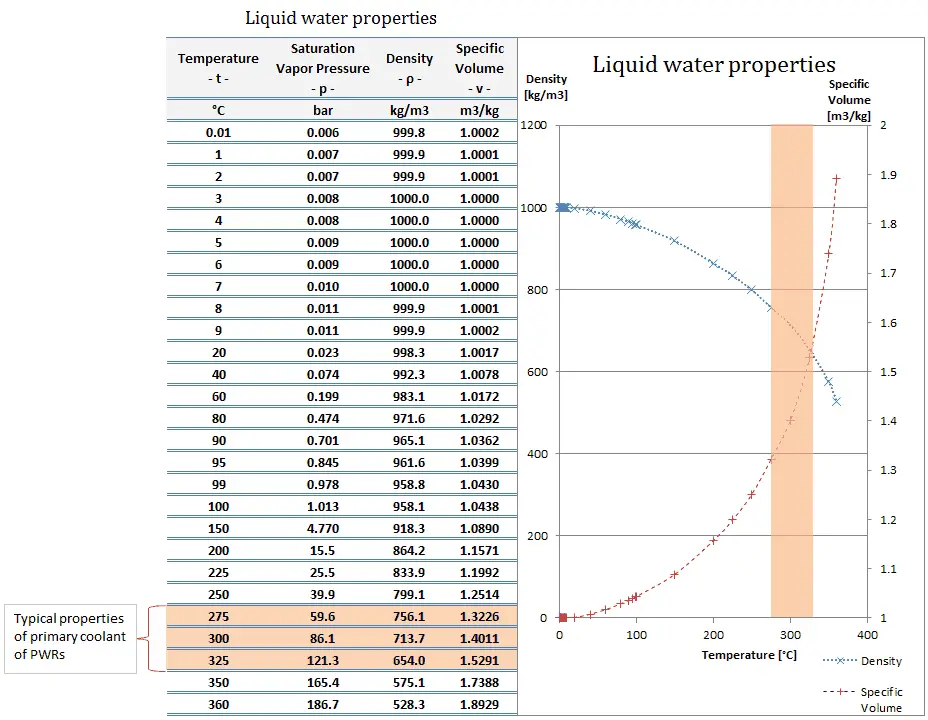
Density of Water - Specific Volume
Density of Water - Specific VolumePure water has its highest density 1000 kg/m3 at temperature 3.98oC (39.2oF). Water differs from most liquids in that it becomes less dense as it freezes. It has a maximum of density at 3.98 °C (1000 kg/m3), whereas the density of ice is 917 kg/m3. It differs by about 9% and therefore ice floats on liquid water. It must be noted, the change in density is not linear with temperature, because the volumetric thermal expansion coefficient for water is not constant over the temperature range. The density of water (1 gram per cubic centimetre) was originally used to define the gram. The density (⍴) of a substance is the reciprocal of its specific volume ().

ρ = m/V = 1/

The specific volume () of a substance is the total volume (V) of that substance divided by the total mass (m) of that substance (volume per unit mass). It has units of cubic meter per kilogram (m3/kg).

Density of Heavy Water
Pure heavy water (D2O) has a density about 11% greater than water, but is otherwise physically and chemically similar.

This difference is caused by the fact, the deuterium nucleus is twice as heavy as hydrogen nucleus. Since about 89% of the molecular weight of water comes from the single oxygen atom rather than the two hydrogen atoms, the weight of a heavy water molecule, is not substantially different from that of a normal water molecule. The molar mass of water is M(H2O) = 18.02 and the molar mass of heavy water is M(D2O) = 20.03 (each deuterium nucleus contains one neutron in contrast to hydrogen nucleus), therefore heavy water (D2O) has a density about 11% greater (20.03/18.03 = 1.112).

Pure heavy water (D2O) has its highest density 1110 kg/m3 at temperature 3.98oC (39.2oF). Also heavy water differs from most liquids in that it becomes less dense as it freezes. It has a maximum of density at 3.98 °C (1110 kg/m3), whereas the density of its solid form ice is 1017 kg/m3. It must be noted, the change in density is not linear with temperature, because the volumetric thermal expansion coefficient for water is not constant over the temperature range.

Density of Steam
steam properties - steam tablesWater and steam are a common medium because their properties are very well known. Their properties are tabulated in so called “Steam Tables”. In these tables the basic and key properties, such as pressure, temperature, enthalpy, density and specific heat, are tabulated along the vapor-liquid saturation curve as a function of both temperature and pressure.

The density (⍴) of any substance is the reciprocal of its specific volume ().

ρ = m/V = 1/

The specific volume () of a substance is the total volume (V) of that substance divided by the total mass (m) of that substance (volume per unit mass). It has units of cubic meter per kilogram (m3/kg).

Density of Steel
The density of steel varies based on the alloying constituents but usually ranges between 7.5 x 10³ kg/m3 and 8 x 10³ kg/m3.
Density of Zirconium
In general, zirconium has very low absorption cross-section of thermal neutrons, high hardness, ductility and corrosion resistance. One of the main uses of zirconium alloys is in nuclear technology, as cladding of fuel rods in nuclear reactors, due to its very low absorption cross-section (unlike the stainless steel). The density of typical zirconium alloy is about 6.6 x 10³ kg/m3.
Density of Uranium
Uranium is a naturally-occurring chemical element with atomic number 92 which means there are 92 protons and 92 electrons in the atomic structure. Natural uranium consists primarily of isotope 238U (99.28%), therefore the atomic mass of uranium element is close to the atomic mass of 238U isotope (238.03u).  Natural uranium also consists of two other isotopes: 235U (0.71%) and 234U (0.0054%). Uranium has the highest atomic weight of the primordially occurring elements. Uranium metal has a very high density of 19.1 g/cm3, denser than lead (11.3 g/cm3), but slightly less dense than tungsten and gold (19.3 g/cm3).

Uranium metal is one of the densest materials found on earth:

  1. Osmium – 22.6 x 10³ kg/m3
  2. Iridium – 22.4 x 10³ kg/m3
  3. Platinum – 21.5 x 10³ kg/m3
  4. Rhenium – 21.0 x 10³ kg/m3
  5. Plutonium – 19.8 x 10³ kg/m3
  6. Gold – 19.3 x 10³ kg/m3
  7. Tungsten – 19.3 x 10³ kg/m3
  8. Uranium – 18.8 x 10³ kg/m3
  9. Tantalum – 16.6 x 10³ kg/m3
  10. Mercury – 13.6 x 10³ kg/m3
  11. Rhodium – 12.4 x 10³ kg/m3
  12. Thorium – 11.7 x 10³ kg/m3
  13. Lead – 11.3 x 10³ kg/m3
  14. Silver – 10.5 x 10³ kg/m3

But most of LWRs use the uranium fuel, which is in the form of uranium dioxide. Uranium dioxide is a black semiconducting solid with very low thermal conductivity. On the other hand the uranium dioxide has very high melting point and has well known behavior.

Uranium dioxide has significantly lower density than uranium in the metal form. Uranium dioxide has a density of 10.97 g/cm3, but this value may vary with fuel burnup, because at low burnup densification of pellets can occurs and at higher burnup swelling occurs.

Density of Nuclear Matter

Nuclear density is the density of the nucleus of an atom. It is the ratio of mass per unit volume inside the nucleus. Since atomic nucleus carries most of atom’s mass and atomic nucleus is very small in comparison to entire atom, the nuclear density is very high.

The nuclear density for a typical nucleus can be approximately calculated from the size of the nucleus and from its mass. Typical nuclear radii are of the order 10−14 m. Assuming spherical shape, nuclear radii can be calculated according to following formula:

r = r0 . A1/3

where r0 = 1.2 x 10⁻¹⁵ m = 1.2 fm

For example, natural uranium consists primarily of isotope 238U (99.28%), therefore the atomic mass of uranium element is close to the atomic mass of 238U isotope (238.03u). Its radius of this nucleus will be:

r = r0 . A1/3 = 7.44 fm.

Assuming it is spherical, its volume will be:

V = 4πr3/3 = 1.73 x 10-42 m3.

The usual definition of nuclear density gives for its density:

ρnucleus = m / V = 238 x 1.66 x 10-27 / (1.73 x 10-42) = 2.3 x 10¹⁷ kg/m3.

Thus, the density of nuclear material is more than 2.1014 times greater than that of water. It is an immense density. The descriptive term nuclear density is also applied to situations where similarly high densities occur, such as within neutron stars. Such immense densities are also found in neutron stars.

 
Density of Neutron Star
The densest material found on earth is the metal osmium, but its density pales by comparison to the densities of exotic astronomical objects such as white dwarf stars and neutron stars.

A neutron star is the collapsed core of a large star (usually of a red giant). Neutron stars are the smallest and densest stars known to exist and they are rotating extremely rapidly. A neutron star is basically a giant atomic nucleus about 11 km in diameter made especially of neutrons. It is believed that under the immense pressures of a collapsing massive stars going supernova it is possible for the electrons and protons  to combine to form neutrons via electron capture, releasing a huge amount of neutrinos.

They are so dense that one teaspoon of its material would have a mass over 5.5×10¹² kg. It is assumed they have densities of 3.7 × 10¹⁷ to 6 × 10¹⁷ kg/m3, which is comparable to the approximate density of an atomic nucleus of 2.3 × 10¹⁷ kg/m3.

What is Pressure

manometer-pressure-measurementPressure is a measure of the force exerted per unit area on the boundaries of a substance. The standard unit for pressure in the SI system is the Newton per square meter or pascal (Pa). Mathematically:

p = F/A

where

  • p is the pressure
  • F is the normal force
  • A is the area of the boundary

Pascal is defined as force of 1N that is exerted on unit area.

  • 1 Pascal = 1 N/m2
However, for most engineering problems it is fairly small unit, so it is convenient to work with multiples of the pascal: the kPa, the bar, and the MPa.
  • 1 MPa  106 N/m2
  • 1 bar    105 N/m2
  • 1 kPa   103 N/m2

In general, pressure or the force exerted per unit area on the boundaries of a substance is caused by the collisions of the molecules of the substance with the boundaries of the system. As molecules hit the walls, they exert forces that try to push the walls outward. The forces resulting from all of these collisions cause the pressure exerted by a system on its surroundings. Pressure as an intensive variable is constant in a closed system. It really is only relevant in liquid or gaseous systems.

What is Pressure [xyz-ihs snippet=”pressure”]

Pressure Scales – Pressure Units

Pascal – Unit of Pressure

As was discussed, the SI unit of pressure and stress is the pascal.

  • 1 pascal  1 N/m2 = 1 kg / (m.s2)

Pascal is defined as one newton per square metre. However, for most engineering problems it is fairly small unit, so it is convenient to work with multiples of the pascal: the kPa, the bar, and the MPa.

  • 1 MPa  106 N/m2
  • 1 bar    105 N/m2
  • 1 kPa   103 N/m2

The unit of measurement called standard atmosphere (atm) is defined as:

  • 1 atm = 101.33 kPa

The standard atmosphere approximates to the average pressure at sea-level at the latitude 45° N. Note that, there is a difference between the standard atmosphere (atm) and the technical atmosphere (at).

A technical atmosphere is a non-SI unit of pressure equal to one kilogram-force per square centimeter.

  • 1 at = 98.67 kPa

Table - Conversion between pressure units - pascal, bar, psi, atmosphere

See also: Pound per square inch – psi

See also: Bar – Unit of Pressure

See also: Typical Pressures in Engineering

Absolute vs. Gauge Pressure

absolute-vs-gauge-pressurePressure as discussed above is called absolute pressure. Often it will be important to distinguish between absolute pressure and gauge pressure. In this article the term pressure refers to absolute pressure unless explicitly stated otherwise. But in engineering we often deal with pressures, that are measured by some devices. Although absolute pressures must be used in thermodynamic relations, pressure-measuring devices often indicate the difference between the absolute pressure in a system and the absolute pressure of the atmosphere existing outside the measuring device. They measure the gauge pressure.

  • Absolute Pressure. When pressure is measured relative to a perfect vacuum, it is called absolute pressure (psia). Pounds per square inch absolute (psia) is used to make it clear that the pressure is relative to a vacuum rather than the ambient atmospheric pressure. Since atmospheric pressure at sea level is around 101.3 kPa (14.7 psi), this will be added to any pressure reading made in air at sea level.
  • Gauge Pressure. When pressure is measured relative to atmospheric pressure (14.7 psi), it is called gauge pressure (psig). The term gauge pressure is applied when the pressure in the system is greater than the local atmospheric pressure, patm. The latter pressure scale was developed because almost all pressure gauges register zero when open to the atmosphere. Gauge pressures are positive if they are above atmospheric pressure and negative if they are below atmospheric pressure.

pgauge = pabsolute – pabsolute; atm

  • Atmospheric Pressure. Atmospheric pressure is the pressure in the surrounding air at – or “close” to – the surface of the earth. The atmospheric pressure varies with temperature and altitude above sea level. The Standard Atmospheric Pressure approximates to the average pressure at sea-level at the latitude 45° N.  The Standard Atmospheric Pressure is defined at sea-level at 273oK (0oC) and is:
    • 101325 Pa
    • 1.01325 bar
    • 14.696 psi
    • 760 mmHg
    • 760 torr
  • Negative Gauge Pressure – Vacuum Pressure. When the local atmospheric pressure is greater than the pressure in the system, the term vacuum pressure is used. A perfect vacuum would correspond to absolute zero pressure. It is certainly possible to have a negative gauge pressure, but not possible to have a negative absolute pressure. For instance, an absolute pressure of 80 kPa may be described as a gauge pressure of −21 kPa (i.e., 21 kPa below an atmospheric pressure of 101 kPa).

pvacuum = pabsolute; atm – pabsolute

For example, a car tire pumped up to 2.5 atm (36.75 psig) above local atmospheric pressure (let say 1 atm or 14.7 psia locally), will have an absolute pressure of 2.5 + 1 = 3.5 atm (36.75 + 14.7 = 51.45 psia or 36.75 psig).

On the other hand condensing steam turbines (at nuclear power plants) exhaust steam at a pressure well below atmospheric (e.g. at 0.08 bar or 8 kPa or 1.16 psia) and in a partially condensed state. In relative units it is a negative gauge pressure of about – 0.92 bar, – 92 kPa, or – 13.54 psig.

Typical Pressures in Engineering – Examples

The pascal (Pa) as a unit of pressure measurement is widely used throughout the world and has largely replaced the pounds per square inch (psi) unit, except in some countries that still use the Imperial measurement system, including the United States. For most engineering problems pascal (Pa) is fairly small unit, so it is convenient to work with multiples of the pascal: the kPa, the MPa, or the bar. Following list summarizes a few examples:

  • Typically most of nuclear power plants operates multi-stage condensing steam turbines. These turbines exhaust steam at a pressure well below atmospheric (e.g. at 0.08 bar or 8 kPa or 1.16 psia) and in a partially condensed state. In relative units it is a negative gauge pressure of about – 0.92 bar, – 92 kPa, or – 13.54 psig.
  • The Standard Atmospheric Pressure approximates to the average pressure at sea-level at the latitude 45° N.  The Standard Atmospheric Pressure is defined at sea-level at 273oK (0oC) and is:
    • 101325 Pa
    • 1.01325 bar
    • 14.696 psi
    • 760 mmHg
    • 760 torr
  • Car tire overpressure is about 2.5 bar, 0.25 MPa, or 36 psig.
  • Steam locomotive fire tube boiler: 150–250 psig
  • A high-pressure stage of condensing steam turbine at nuclear power plant operates at steady state with inlet conditions of  6 MPa (60 bar, or 870 psig), t = 275.6°C, x = 1
  • A boiling water reactor is cooled and moderated by water like a PWR, but at a lower pressure (e.g. 7MPa, 70 bar, or 1015 psig), which allows the water to boil inside the pressure vessel producing the steam that runs the turbines.
  • Pressurized water reactors are cooled and moderated by high-pressure liquid water (e.g. 16MPa, 160 bar, or 2320 psig). At this pressure water boils at approximately 350°C (662°F), which provides subcooling margin of about 25°C.
  • The supercritical water reactor (SCWR) is operated at supercritical pressure. The term supercritical in this context refers to the thermodynamic critical point of water (TCR = 374 °C;  pCR = 22.1 MPa)
  • Common rail direct fuel injection: On diesel engines, it features a high-pressure (over 1 000 bar or 100 MPa or 14500 psi) fuel rail.

What is Temperature

In physics and in everyday life a temperature is an objective comparative measurement of hot or cold based on our sense of touch.  A body that feels hot usually has a higher temperature than a similar body that feels cold. But this definition is not a simple matter. For example, a metal rod feels colder than a plastic rod at room temperature simply because metals are generally better at conducting heat away from the skin as are plastics. Simply hotness may be represented abstractly and therefore it is necessary to have an objective way of measuring temperature. It is one of basic thermodynamic properties.

Thermal Equilibrium

Zeroth law of thermodynamics
Zeroth law of thermodynamics: If two systems are both in thermal equilibrium with a third then they are in thermal equilibrium with each other.

A particularly important concept is thermodynamic equilibrium. In general, when two objects are brought into thermal contact, heat will flow between them until they come into equilibrium with each other.  When a temperature difference does exist heat flows spontaneously from the warmer system to the colder system. Heat transfer occurs by conduction or by thermal radiation. When the flow of heat stops, they are said to be at the same temperature. They are then said to be in thermal equilibrium.

For example, you leave a thermometer in a cup of coffee. As the two objects interact, the thermometer becomes hotter and the coffee cools off a little until they come into thermal equilibrium. Two objects are defined to be in thermal equilibrium if, when placed in thermal contact, no net energy flows from one to the other, and their temperatures don’t change. We may postulate:

When the two objects are in thermal equilibrium, their temperatures are equal.

This is a subject of a law that is called the “zeroth law of thermodynamics”.

 
Zeroth Law of Thermodynamics
Zeroth law of thermodynamics
Zeroth law of thermodynamics: If two systems are both in thermal equilibrium with a third then they are in thermal equilibrium with each other.

We can discover an important property of thermal equilibrium by considering three systems. A, B, and C, that initially are not in thermal equilibrium. We separate systems A and B with an adiabatic wall (ideal insulating material), but we let system C interact with both systems A and B. We wait until thermal equilibrium is reached; then A and B are each in thermal equilibrium with C. But are they in thermal equilibrium with each other?

According to many experiments, there will be no net energy flow between A and B. This is an experimental evidence of the following statement:

If two systems are both in thermal equilibrium with a third then they are in thermal equilibrium with each other.  

This statement is known as the zeroth law of thermodynamics. It has this unusual name because it was not until after the great first and second laws of thermodynamics were worked out that scientists realized that this apparently obvious postulate needed to be stated first.

This law provides a definition and method of defining temperatures, perhaps the most important intensive property of a system when dealing with thermal energy conversion problems. Temperature is a property of a system that determines whether the system will be in thermal equilibrium with other systems. When two systems are in thermal equilibrium, their temperatures are, by definition, equal, and no net thermal energy will be exchanged between them. Thus the importance of the zeroth law is that it allows a useful definition of temperature.

Temperature is a very important characteristics of matter. Many properties of matter change with temperature. The length of a metal rod, steam pressure in a boiler, the ability of a wire to conduct an electric current, and the color of a very hot glowing object. All these depend on temperature.

For example, most materials expand when their temperature is increased. This property is very important in all of the science and engineering, even in nuclear engineering. The thermodynamic efficiency of power plants changes with temperature of inlet steam or even with outside temperature. At higher temperatures, solids such as steel glow orange or even white depending on temperature. The white light from an ordinary incandescent lightbulb comes from an extremely hot tungsten wire. It can be seen temperature is one of the fundamental characteristics that describes matter and influences matter behaviour.

 
Kinetic Temperature
Kinetic theory of gases provides a microscopic explanation of temperature. It is based on the fact that during an elastic collision between a molecule with high kinetic energy and one with low kinetic energy, part of energy will transfer to the molecule of lower kinetic energy. Temperature is therefore related to the kinetic energies of the molecules of a material. Since this relationship is fairly complex, it will be discussed later.
 
How temperature influences the reactivity of the core
In an operating power reactors the neutron population is always large enough to generated heat. In fact, it is the main purpose of power reactors to generate large amount of heat. This causes the temperature of the system changes and material densities change as well (due to the thermal expansion).

Because macroscopic cross sections are proportional to densities and temperatures, neutron flux spectrum depends also on the density of moderator, these changes in turn will produce some changes in reactivity. These changes in reactivity are usually called the reactivity feedbacks and are characterized by reactivity coefficients. This is very important area of reactor design, because the reactivity feedbacks influence the stability of the reactor. For example, reactor design must assure that under all operating conditions the temperature feedback will be negative.

See also: Moderator Temperature Coefficient

See also: Doppler Coefficient

Temperature Scales

Temperature Conversion - Fahrenheit - CelsiusWhen using a thermometer, we need to mark a scale on the tube wall with numbers on it. We have to define a temperature scale. A temperature scale is a way to measure temperature relative to a starting point (0 or zero) and a unit of measurement.

These numbers are arbitrary, and historically many different schemes have been used. For example, this was done by defining some physical occurrences at given temperatures—such as the freezing and boiling points of water — and defining them as 0 and 100 respectively.

There are several scales and units exist for measuring temperature. The most common are:

  • Celsius (denoted °C),
  • Fahrenheit (denoted °F),
  • Kelvin (denoted K; especially in science).
 
Fahrenheit Scale
Fahrenheit temperature scale
Fahrenheit temperature scale is based on two points: the temperature of a solution of brine as 0°F and the average human body temperature as 100°F.

The Celsius scale and the Fahrenheit scale are based on a specification of the number of increments between the freezing point and boiling point of water at standard atmospheric pressure. The Celsius scale has 100 units between these points, and the Fahrenheit scale has 180 units, where each units represents 1°C or 1 °F respectively. The zero points on the scales are arbitrary.

Fahrenheit scale is based on two points:

  • The lower defining point, 0 °F, was established as the temperature of a solution of brine made from equal parts of ice and salt.
  • The upper defining point, 96 °F, was established as the average human body temperature (96 °F, about 2.6 °F less than the modern value due to a later redefinition of the scale)

The difference in height between the two points would then be marked off in 180 divisions with each division representing 1 °F. The scale is today usually defined by two fixed points: the temperature at which water freezes into ice is defined as 32 °F, and the boiling point of water is defined to be 212 °F.

Temperature Conversion – Fahrenheit – Celsius

To convert from a Fahrenheit temperature to a Celsius temperature we have to subtract 32 degrees from the Fahrenheit reading to get to the zero point on the Celsius scale and then adjust for the different size degrees. The ratio of the size of the degrees is 5/9 so that the relationship between the scales is represented by the following equations:

°F = 32.0 + (9/5)°C

°C = (°F – 32.0)(5/9)

Celsius Scale
Celsius temperature scale
Celsius temperature scale is based on two points: the boiling point of water as 100° C and the freezing point of water as 0° C.

About 20 years after Fahrenheit proposed its temperature scale for thermometer, Swedish professor Anders Celsius defined a better scale for measuring temperature. He proposed using the boiling point of water as 100° C and the freezing point of water as 0° C. Water was chosen as the reference material because it was always available in most laboratories around the world.

Celsius temperature scale is also called centigrade temperature scale  because of the 100-degree interval between the defined points. The Celsius temperature for a state colder than freezing water is a negative number. The Celsius scale is used, both in everyday life and in science and industry, almost everywhere in the world.

Absolute zero, the lowest temperature possible, is defined as being precisely 0 K and −273.15 °C. The temperature of the triple point of water is defined as precisely 273.16 K and 0.01 °C. This definition fixes the magnitude of both the degree Celsius and the kelvin as precisely 1 part in 273.16 of the difference between absolute zero and the triple point of water.

It must be added, by international agreement the unit “degree Celsius” and the Celsius scale are currently defined by two different points: absolute zero, and the triple point of water (instead of boiling and freezing points). This definition also precisely relates the Celsius scale to the Kelvin scale, which defines the SI base unit of thermodynamic temperature.

Temperature Conversion – Fahrenheit – Celsius

To convert from a Fahrenheit temperature to a Celsius temperature we have to subtract 32 degrees from the Fahrenheit reading to get to the zero point on the Celsius scale and then adjust for the different size degrees. The ratio of the size of the degrees is 5/9 so that the relationship between the scales is represented by the following equations:

°F = 32.0 + (9/5)°C
°C = (°F – 32.0)(5/9)

Kelvin Scale
Kelvin temperature scale
The Kelvin temperature scale was determined based on the Celsius scale, but with a starting point at absolute zero.

Kelvin temperature scale is the base unit of thermodynamic temperature measurement in the International System (SI) of measurement. The Kelvin scale was determined based on the Celsius scale, but with a starting point at absolute zero. Temperatures in the Kelvin scale are 273 degrees less than in the Celsius scale. The kelvin is defined as the fraction  1⁄273.16 of the thermodynamic temperature of the triple point of water. By international agreement, the triple point of water has been assigned a value of 273.16 K (0.01 °C; 32.02 °F) and a partial vapor pressure of 611.66 pascals (6.1166 mbar; 0.0060366 atm). In other words, it is defined such that the triple point of water is exactly 273.16 K.

Note that the unit on the absolute scale is Kelvins, not degrees Kelvin. It was named in honor of Lord Kelvin who had a great deal to do with the development of temperature measurement and thermodynamics.

The absolute temperature scale that corresponds to the Celsius scale is called the Kelvin (K) scale, and the absolute scale that corresponds to the Fahrenheit scale is called the Rankine (R) scale. The zero points on both absolute scales represent the same physical state. The relationships between the absolute and relative temperature scales are shown in the following equations.

Kelvin – Celsius

K = °C + 273.15

°C = K – 273.15

Rankine – Fahrenheit

R = °F + 460

°F = R – 460

Absolute Zero

Such a scale has as its zero point. The coldest theoretical temperature is called absolute zero, at which the thermal motion of atoms and molecules reaches its minimum.  This is a state at which the enthalpy and entropy of a cooled ideal gas reaches its minimum value, taken as 0. Classically, this would be a state of motionlessness, but quantum uncertainty dictates that the particles still possess a finite zero-point energy. Absolute zero is denoted as 0 K on the Kelvin scale, −273.15 °C on the Celsius scale, and −459.67 °F on the Fahrenheit scale.

Absolute Zero and Third Law of Thermodynamics

Third law of thermodynamics states:

The entropy of a system approaches a constant value as the temperature approaches absolute zero.
Based on empirical evidence, this law states that the entropy of a pure crystalline substance is zero at the absolute zero of temperature, 0 K and that it is impossible by means of any process, no matter how idealized, to reduce the temperature of a system to absolute zero in a finite number of steps. This allows us to define a zero point for the thermal energy of a body.

 
References:
Reactor Physics and Thermal Hydraulics:
  1. J. R. Lamarsh, Introduction to Nuclear Reactor Theory, 2nd ed., Addison-Wesley, Reading, MA (1983).
  2. J. R. Lamarsh, A. J. Baratta, Introduction to Nuclear Engineering, 3d ed., Prentice-Hall, 2001, ISBN: 0-201-82498-1.
  3. W. M. Stacey, Nuclear Reactor Physics, John Wiley & Sons, 2001, ISBN: 0- 471-39127-1.
  4. Glasstone, Sesonske. Nuclear Reactor Engineering: Reactor Systems Engineering, Springer; 4th edition, 1994, ISBN: 978-0412985317
  5. Todreas Neil E., Kazimi Mujid S. Nuclear Systems Volume I: Thermal Hydraulic Fundamentals, Second Edition. CRC Press; 2 edition, 2012, ISBN: 978-0415802871
  6. Zohuri B., McDaniel P. Thermodynamics in Nuclear Power Plant Systems. Springer; 2015, ISBN: 978-3-319-13419-2
  7. Moran Michal J., Shapiro Howard N. Fundamentals of Engineering Thermodynamics, Fifth Edition, John Wiley & Sons, 2006, ISBN: 978-0-470-03037-0
  8. Kleinstreuer C. Modern Fluid Dynamics. Springer, 2010, ISBN 978-1-4020-8670-0.
  9. U.S. Department of Energy, THERMODYNAMICS, HEAT TRANSFER, AND FLUID FLOW. DOE Fundamentals Handbook, Volume 1, 2 and 3. June 1992.

See also:

Thermodynamics

We hope, this article, Thermodynamic Property, helps you. If so, give us a like in the sidebar. Main purpose of this website is to help the public to learn some interesting and important information about thermal engineering.
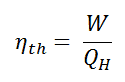
What is Critical Point of Water – Definition

At the critical point the saturated-liquid and saturated-vapor states are identical. In thermodynamics, a critical point (or critical state) is the end point of a phase equilibrium curve. Thermal Engineering

Critical Point of Water

In thermodynamics, a critical point (or critical state) is the end point of a phase equilibrium curve. The phase diagram of water is a pressure-temperature diagram for water that shows how all three phases (solid, liquid, and vapor) may coexist together in thermal equilibrium. Along the vaporization line, the liquid and vapor phases are in equilibrium, along the fusion line, the solid and liquid phases are in equilibrium and along the sublimation line, the solid and vapor phases are in equilibrium. The only point at which all three phases may exist in equilibrium is the triple point. The vaporization line ends at the critical point because there is no distinct change from the liquid phase to the vapor phase above the critical point.

Above the critical point, there is no constant-temperature vaporization process. At the critical point the saturated-liquid and saturated-vapor states are identical. The temperature, pressure, and specific volume at the critical point are called the critical temperature, critical pressure, and critical volume. For water, these parameters are the following:

Parameters of Critical Point

  • Pcr = 22.09 MPa
  • Tcr = 374.14 °C (or 647.3 K)
  • vcr = 0.003155 m3/kg
  • uf = ug = 2014 kJ/kg
  • hf = hg = 2084 kJ/kg
  • sf = sg =4.406 kJ/kg K
Phase diagram of water
Phase diagram of water.
Source: wikipedia.org CC BY-SA
  • Pcr = 22.09 MPa
  • Tcr = 374.14 °C (or 647.3 K)
  • vcr = 0.003155 m3/kg
  • uf = ug = 2014 kJ/kg
  • hf = hg = 2084 kJ/kg
  • sf = sg =4.406 kJ/kg K

A supercritical phase (e.g. water at a pressure above the critical pressure) does not separate into two phases when it is cooled at constant pressure (along a horizontal line above the critical point in phase diagram). Instead, its properties change gradually and continuously from those we ordinarily associate with a gas (low density, large compressibility) to those of a liquid (high density, small compressibility) without a phase change.

As can be seen from steam tables, as we approach the critical point, the differences in physical properties (such as density and enthalpy) between the liquid and vapor phases become smaller. For example, just below the critical point at the pressure of 21.8 MPa and the temperature of 373°C the specific enthalpy of saturated liquid is 1970 kJ/kg, while the specific enthalpy of saturated vapor is 2230 kJ/kg. The specific heat of vaporization is only 260 kJ/kg. Exactly at the critical point these differences become zero, and at this point the distinction between liquid and vapor disappears. The heat of vaporization also becomes zero at the critical point.

Near the critical point, the physical properties of the liquid and the vapor change dramatically. For example, liquid water under normal conditions has a low thermal expansion coefficient, is nearly incompressible, is an excellent solvent for electrolytes, and has a high dielectric constant. But near the critical point, all these properties change into the exact opposite: water becomes compressible, has a significant thermal expansion coefficient, has a low dielectric constant, is a bad solvent for electrolytes. At pressures greater than the critical pressure the physical properties also undergo a fast transition, but without singularities. With further increase in pressure the transition becomes smoother. This transition region is called pseudocritical region, at a given pressure the temperature where the specific heat has its maximum is called pseudocritical point.

Critical Point
For nearly all familiar materials the critical pressures are much greater than atmospheric pressure, therefore we don’t observe this behavior in everyday life.

For nearly all familiar materials the critical pressures are much greater than atmospheric pressure, therefore we don’t observe this behavior in everyday life. But in energy engineering, there are many applications for supercritical water. One of ways to increase thermal efficiency of thermodynamic cycles (e.g. Rankine cycle) is to increase the peak temperature and pressure in the boiler. High-pressure steam boilers in thermal power plants regularly run at pressures and temperatures well above the critical point.

Concept of the SCWR
Concept of the SCWR.
Author (Public domain): U.S. Department of Energy

In nuclear engineering, the supercritical water reactor is considered a promising advancement for nuclear power plants because of its high thermal efficiency (~45 % vs. ~33 % for current LWRs). This concept of reactor operates at supercritical pressure (i.e. greater than 22.1 MPa) and belongs to Generation IV reactor designs.

See also: Supercritical Water Reactor

 
References:
Reactor Physics and Thermal Hydraulics:
  1. J. R. Lamarsh, Introduction to Nuclear Reactor Theory, 2nd ed., Addison-Wesley, Reading, MA (1983).
  2. J. R. Lamarsh, A. J. Baratta, Introduction to Nuclear Engineering, 3d ed., Prentice-Hall, 2001, ISBN: 0-201-82498-1.
  3. W. M. Stacey, Nuclear Reactor Physics, John Wiley & Sons, 2001, ISBN: 0- 471-39127-1.
  4. Glasstone, Sesonske. Nuclear Reactor Engineering: Reactor Systems Engineering, Springer; 4th edition, 1994, ISBN: 978-0412985317
  5. Todreas Neil E., Kazimi Mujid S. Nuclear Systems Volume I: Thermal Hydraulic Fundamentals, Second Edition. CRC Press; 2 edition, 2012, ISBN: 978-0415802871
  6. Zohuri B., McDaniel P. Thermodynamics in Nuclear Power Plant Systems. Springer; 2015, ISBN: 978-3-319-13419-2
  7. Moran Michal J., Shapiro Howard N. Fundamentals of Engineering Thermodynamics, Fifth Edition, John Wiley & Sons, 2006, ISBN: 978-0-470-03037-0
  8. Kleinstreuer C. Modern Fluid Dynamics. Springer, 2010, ISBN 978-1-4020-8670-0.
  9. U.S. Department of Energy, THERMODYNAMICS, HEAT TRANSFER, AND FLUID FLOW. DOE Fundamentals Handbook, Volume 1, 2 and 3. June 1992.

See also:

Water

We hope, this article, Critical Point of Water, helps you. If so, give us a like in the sidebar. Main purpose of this website is to help the public to learn some interesting and important information about thermal engineering.
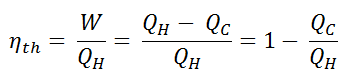
What is Supercritical Water Reactor – SCWR – Definition

The supercritical water reactor is a reactor that is cooled with supercritical water. It is considered a promising reactor desing because of its high efficiency. Thermal Engineering

Supercritical Water Reactor – SCWR

Concept of the SCWR
Concept of the SCWR.
Author (Public domain): U.S. Department of Energy

The supercritical water reactor (SCWR) is a concept of Generation IV reactor, that is operated at supercritical pressure (i.e. greater than 22.1 MPa). The term supercritical in this context refers to the thermodynamic critical point of water (TCR = 374 °C;  pCR = 22.1 MPa), and must not be confused with the criticality of the reactor core, that describes changes in the neutron population in the reactor core.

The supercritical water reactor may be operated as a thermal reactor or as a fast-neutron reactor, depending on the core design. The concept of the supercritical water reactor may be based on classical pressure vessel as in commercial PWRs or on pressure tubes as in CANDU reactors. The pressure-vessel design of supercritical water reactors is developed largely in the EU, US, Japan, Korea, and China, while the pressure-channel design is developed largely in Canada and in Russia. The pressure-vessel design allows using a traditional high-pressure circuit layout. The pressure-channel design allows the key features of passive accident and decay heat removal by radiation and convection from the distributed channels even with no active cooling and fuel melting and use of multi-pass reactor flows making reheating and superheating possible.

For both pressure vessel and pressure-tube designs, a once through steam cycle has been envisaged, omitting any coolant recirculation inside the reactor. It is similar as in boiling water reactors, steam will be supplied directly to the steam turbine and the feed water from the steam cycle will be supplied back to the core.

As well as the supercritical water reactor may use light water or heavy water as neutron moderator. As can be seen, there are many SCWR designs, but all SCWRs have a key feature, that is the use of water beyond the thermodynamic critical point as primary coolant. Since this feature allows to increase the peak temperature, the supercritical water reactors are considered a promising advancement for nuclear power plants because of its high thermal efficiency (~45 % vs. ~33 % for current LWRs).

 
Critical Point of Water
Phase diagram of water
Phase diagram of water.
Source: wikipedia.org CC BY-SA

In thermodynamics, a critical point (or critical state) is the end point of a phase equilibrium curve. The phase diagram of water is a pressure-temperature diagram for water that shows how all three phases (solid, liquid, and vapor) may coexist together in thermal equilibrium. Along the vaporization line, the liquid and vapor phases are in equilibrium, along the fusion line, the solid and liquid phases are in equilibrium and along the sublimation line, the solid and vapor phases are in equilibrium. The only point at which all three phases may exist in equilibrium is the triple point. The vaporization line ends at the critical point because there is no distinct change from the liquid phase to the vapor phase above the critical point.

Above the critical point, there is no constant-temperature vaporization process. At the critical point the saturated-liquid and saturated-vapor states are identical. The temperature, pressure, and specific volume at the critical point are called the critical temperature, critical pressure, and critical volume. For water, these parameters are the following:

  • Pcr = 22.09 MPa
  • Tcr = 374.14 °C (or 647.3 K)
  • vcr = 0.003155 m3/kg
  • uf = ug = 2014 kJ/kg
  • hf = hg = 2084 kJ/kg
  • sf = sg =4.406 kJ/kg K

A supercritical phase (e.g. water at a pressure above the critical pressure) does not separate into two phases when it is cooled at constant pressure (along a horizontal line above the critical point in phase diagram). Instead, its properties change gradually and continuously from those we ordinarily associate with a gas (low density, large compressibility) to those of a liquid (high density, small compressibility) without a phase change.

As can be seen from steam tables, as we approach the critical point, the differences in physical properties (such as density and enthalpy) between the liquid and vapor phases become smaller. For example, just below the critical point at the pressure of 21.8 MPa and the temperature of 373°C the specific enthalpy of saturated liquid is 1970 kJ/kg, while the specific enthalpy of saturated vapor is 2230 kJ/kg. The specific heat of vaporization is only 260 kJ/kg. Exactly at the critical point these differences become zero, and at this point the distinction between liquid and vapor disappears. The heat of vaporization also becomes zero at the critical point.

Near the critical point, the physical properties of the liquid and the vapor change dramatically. For example, liquid water under normal conditions has a low thermal expansion coefficient, is nearly incompressible, is an excellent solvent for electrolytes, and has a high dielectric constant. But near the critical point, all these properties change into the exact opposite: water becomes compressible, has a significant thermal expansion coefficient, has a low dielectric constant, is a bad solvent for electrolytes. At pressures greater than the critical pressure the physical properties also undergo a fast transition, but without singularities. With further increase in pressure the transition becomes smoother. This transition region is called pseudocritical region, at a given pressure the temperature where the specific heat has its maximum is called pseudocritical point.

For nearly all familiar materials the critical pressures are much greater than atmospheric pressure, therefore we don’t observe this behavior in everyday life. But in energy engineering, there are many applications for supercritical water. One of ways to increase thermal efficiency of thermodynamic cycles (e.g. Rankine cycle) is to increase the peak temperature and pressure in the boiler. High-pressure steam boilers in thermal power plants regularly run at pressures and temperatures well above the critical point.

In nuclear engineering, the supercritical water reactor is considered a promising advancement for nuclear power plants because of its high thermal efficiency (~45 % vs. ~33 % for current LWRs). This concept of reactor operates at supercritical pressure (i.e. greater than 22.1 MPa) and belongs to Generation IV reactor designs.

Properties of Supercritical Water
Properties of Supercritical WaterA supercritical fluid is a fluid that is at pressures higher than its thermodynamic critical values. At the critical and supercritical pressures a fluid is considered as a single-phase substance in spite of the fact that all thermophysical properties undergo significant changes within the critical and pseudocritical regions.

____________________

Pseudocritical line – pseudocritical points. Pseudocritical line consist of pseudocritical points, which are points at a pressure above the critical pressure and at a temperature (Tpc > Tcr) corresponding to the maximum value of the specific heat at this particular pressure.

____________________

Pseudocritical line - Pseudocritical pointsAt pressures above the critical pressure,  properties of water in the reactor change gradually and continuously from those we ordinarily associate with a liquid (high density, small compressibility) to those of a gas (low density, large compressibility) without a phase change. There is no change in the phase of water in the core. On the other hand, physical properties such as density, specific heat, specific enthalpy undergo significant changes, especially in the temperature range of the pseudocritical region (for 25 MPa between 372°C and 392°C). For example,

  • the density of supercritical water at the inlet and at the outlet is about 777 kg/m3  (for 25MPa and 280°C) and 90 kg/m3 (for 25MPa and 500°C),
  • the specific enthalpy of supercritical water at the inlet and at the outlet is about 1230 kJ/kg (for 25MPa and 280°C) and 3165 kJ/kg (for 25MPa and 500°C)

supercritical-fluid-specific-heat-conductivityFollowing figures shows the behaviour of thermophysical properties of water near the critical (22.1MPa) and pseudocritical (25MPa) points. Near the critical point these property changes are dramatic. In the vicinity of the pseudocritical point at 25 MPa, these property changes become less significant. At 25 MPa the most significant property changes occur within ±25◦C around pseudocritical point (389.4◦C), this region is known as the pseudocritical region. For convenience, below the pseudocritical point fluid properties are considered to show liquid-like behaviour and above the pseudocritical point they are considered to show gas-like behaviour.

Advantages and Challenges of SCWRs

Characteristics of SCWRsAs can be inferred from its name, the SCWR’s key feature is the use of water beyond the thermodynamic critical point (TCR = 374 °C;  pCR = 22.1 MPa) as primary coolant. SCWR designs have unique features that offer many advantages compared to current light water reactors (LWRs).

  • High thermal efficiency. Since SCWRs supply supercritical steam at pressures and temperatures, that are much higher than in conventional LWRs, they will reach higher thermodynamic efficiency of the power plant (~45 % vs. ~33 % for current LWRs).
  • Lower coolant mass flow rate.  The reactor coolant flow rate of SCWR is much smaller than that of BWR and PWR because the enthalpy rise in the core is much larger, which results in low capacity components of the primary system. Thus, the coolant pumps, pipes and other supporting equipment become smaller. Moreover, the only pumps driving the coolant under normal operating conditions are the feed water pumps and the condensate extraction pumps.
  • The higher steam enthalpy allows to decrease the size of the turbine system and thus to lower the capital costs of the conventional island.
  • Smaller coolant inventory. The coolant inventory is smaller which reduces the size of the containment with pressure suppression pools.
  • Since supercritical water does not undergo a phase change and it exists in a single thermodynamic phase, the boiling crisis (i.e. departure from nucleate boiling – DNB or dry out) cannot occur.
  • With a direct cycle of supercritical coolant, components like steam dryers, separators and steam generators are omitted entirely, reducing the number of major components and eliminating their associated costs.
  • Many of the components (e.g. turbine) are readily developed and available from supercritical fossil fired power plants.

The combination of advanced water-cooled reactor technology and advanced supercritical fossil technology is expected to result in a reactor concept that can be used to generate base-load electricity very economically and efficiently. This feature also makes the SCWR a very attractive concept for utilities, especially those that have experience with both water-cooled reactors and supercritical fossil plants.

On the other hand numerous challenges must be solved before the first power plants of this type can be built:

  • The cladding materials have to withstand higher temperatures (600-650°C in normal operating conditions) than in today’s LWRs.
  • The heat transfer phenomena from cladding surface into supercritical fluid must be understood thoroughly.  Especially in case of within transients with depressurization from supercritical to subcritical conditions.
  • Due to the smaller coolant inventory, the dry out of the core progresses faster in case of a loss of coolant accident (LOCA).

Characteristics of SCWRs

Properties of Supercritical WaterSCWRs operate at pressures above the critical pressure,  properties of water in the reactor change gradually and continuously from those we ordinarily associate with a liquid (high density, small compressibility) to those of a gas (low density, large compressibility) without a phase change. There is no change in the phase of water in the core. On the other hand, physical properties such as density, specific heat, specific enthalpy undergo significant changes, especially in the temperature range of the pseudocritical region (for 25 MPa between 372°C and 392°C). For example,

  • the density of supercritical water at the inlet and at the outlet is about 777 kg/m3  (for 25MPa and 280°C) and 90 kg/m3 (for 25MPa and 500°C),
  • the specific enthalpy of supercritical water at the inlet and at the outlet is about 1230 kJ/kg (for 25MPa and 280°C) and 3165 kJ/kg (for 25MPa and 500°C)

From a neutronics point of view, the density of water is the most important factor. There is a significant change of neutron spectrum, which changes with the axial coordinate of the core. It is caused by the greater moderation in places with greater density. For this reason, a coupled neutronics – thermal hydraulics calculation is inevitable to obtain neutron flux distribution within the core. In each nuclear reactor, there is a direct proportionality between the neutron flux and the reactor thermal power.

Since the coolant (moderator) undergo significant change in density, the SCWR can also be designed as a fast neutron reactor. This property depends on certain reactor design.

 
References:
Reactor Physics and Thermal Hydraulics:
  1. J. R. Lamarsh, Introduction to Nuclear Reactor Theory, 2nd ed., Addison-Wesley, Reading, MA (1983).
  2. J. R. Lamarsh, A. J. Baratta, Introduction to Nuclear Engineering, 3d ed., Prentice-Hall, 2001, ISBN: 0-201-82498-1.
  3. W. M. Stacey, Nuclear Reactor Physics, John Wiley & Sons, 2001, ISBN: 0- 471-39127-1.
  4. Glasstone, Sesonske. Nuclear Reactor Engineering: Reactor Systems Engineering, Springer; 4th edition, 1994, ISBN: 978-0412985317
  5. Todreas Neil E., Kazimi Mujid S. Nuclear Systems Volume I: Thermal Hydraulic Fundamentals, Second Edition. CRC Press; 2 edition, 2012, ISBN: 978-0415802871
  6. Zohuri B., McDaniel P. Thermodynamics in Nuclear Power Plant Systems. Springer; 2015, ISBN: 978-3-319-13419-2
  7. Moran Michal J., Shapiro Howard N. Fundamentals of Engineering Thermodynamics, Fifth Edition, John Wiley & Sons, 2006, ISBN: 978-0-470-03037-0
  8. Kleinstreuer C. Modern Fluid Dynamics. Springer, 2010, ISBN 978-1-4020-8670-0.
  9. U.S. Department of Energy, THERMODYNAMICS, HEAT TRANSFER, AND FLUID FLOW. DOE Fundamentals Handbook, Volume 1, 2 and 3. June 1992.

See also:

Types of Reactors

We hope, this article, Supercritical Water Reactor – SCWR, helps you. If so, give us a like in the sidebar. Main purpose of this website is to help the public to learn some interesting and important information about thermal engineering.