Facebook Instagram Youtube Twitter

Electric Radiator | Room Heating Efficiency

Learn how electric radiators enhance room heating efficiency, their working mechanism, and tips to optimize their performance.
Electric Radiator | Room Heating Efficiency

Understanding Electric Radiators and Room Heating Efficiency

As winter approaches, the need to keep our homes warm and comfortable becomes a priority. Electric radiators are popular for their efficiency and ease of use in heating residential spaces. In this article, we will explore how electric radiators work, factors that affect their efficiency, and tips to optimize their performance in heating a room.

How Do Electric Radiators Work?

Electric radiators operate by converting electrical energy into heat through resistive heating. When electric current flows through the resistor inside the radiator, it encounters resistance which generates heat. This heat is then emitted into the room. There are primarily two types of electric radiators:

  1. Convection Radiators: These radiators heat cold air that passes over the heated element, causing the warm air to rise and disperse through the room.
  2. Radiant Radiators: Rather than heating the air, these radiators emit infrared radiation that warms objects and surfaces directly in their path.

Factors Influencing the Efficiency of Electric Radiators

The efficiency of electric radiators can be influenced by several factors, which include:

  • Room Insulation: Proper insulation reduces heat loss, allowing the radiator to maintain the desired temperature using less energy.
  • Thermostat Accuracy: A precise thermostat can better regulate the temperature and reduce energy consumption by minimizing overheating.
  • Size and Layout of the Room: Large or poorly laid out rooms may require more energy to heat. Strategic placement of the radiator can influence the heating efficiency.
  • Window Type: Double-glazed windows trap air between layers, acting as a barrier to heat loss, unlike single-glazed windows.

Calculating the Efficiency of Electric Radiators

The efficiency of electric radiators is often measured by their ability to convert energy input into useful heat. In ideal conditions, electric radiators can be nearly 100% efficient at the point of use because almost all the electricity used is converted into heat. However, the overall efficiency depends on the source of electricity and how well the heat is distributed and retained within the room.

The efficiency \(\eta\) can be approximately calculated using the formula:

\[
\eta = \left(\frac{Output\, Heat\, Energy}{Input\, Electrical\, Energy}\right) * 100
\]

Tips for Enhancing Heating Efficiency

To maximize the efficiency of electric radiators and reduce energy consumption, consider the following tips:

  • Regular Maintenance: Keeping the radiator dust-free ensures optimal heat transfer.
  • Upgrade to a Programmable Thermostat: This can help adjust the heating schedule based on your routine, reducing wasteful heating when not needed.
  • Reflect Heat: Reflector panels behind radiators can prevent heat from escaping through the walls, directing it back into the room instead.
  • Use Curtains Strategically: Opening curtains during the day can let in sunlight, naturally warming the room, while closing them at night can add an extra layer of insulation.

By understanding the functionality and factors affecting the efficiency of electric radiators, users can optimize their use, leading to a more comfortably heated environment and potential savings in energy costs. Staying informed and making small adjustments can significantly enhance the effectiveness of your room heating solution.

Thermal insulation coatings

Learn about thermal insulation coatings, key materials, and their application in various industries to manage heat effectively.

Thermal insulation coatings

Understanding Thermal Insulation Coatings

Thermal insulation coatings are specialized materials designed to limit heat transfer between objects in thermal contact or in the range of radiative influence. These coatings are essentially integral in improving energy efficiency, protecting equipment, and enhancing safety across various industries, including construction, automotive, aerospace, and industrial processing.

How Do Thermal Insulation Coatings Work?

Thermal insulation coatings operate based on the principle of thermal resistance. They work by reducing the rate at which heat flows from a warmer object to a cooler object. The coatings achieve this through three main mechanisms:

  • Reflective Properties: Many insulation coatings contain pigments that reflect ultraviolet (UV) and infrared (IR) radiation, reducing heat absorption.
  • Low Thermal Conductivity: The materials used in these coatings are often poor conductors of heat, thereby slowing down the transfer of heat through conduction.
  • Microscopic Air Pockets: Coatings frequently encapsulate air in microscopic bubbles which significantly impede heat flow, as air is a poor conductor of heat.

Key Materials Used in Thermal Insulation Coatings

Several innovative materials contribute to the effectiveness of thermal insulation coatings:

  • Ceramic Microspheres: These tiny hollow spheres improve insulative properties by trapping air, one of the most effective insulators.
  • Epoxy Resins: Known for their chemical resistance and durability, these resins form the backbone of many coatings providing a robust barrier against heat.
  • Polyurethane Foams: Used either as part or all of a coating system, these foams expand and create a thick layer with very low thermal conductivity.
  • Silicate: Compounds like calcium silicate provide exceptional insulative properties at high temperatures and are often used in industrial settings.

Applications of Thermal Insulation Coatings

Thermal insulation coatings have a wide range of applications across different sectors:

  1. Building and Construction: Used to coat roofs, walls, and floors to enhance the energy efficiency of buildings by keeping interiors warm in winter and cool in summer.
  2. Automotive Industry: Applied to engine components and exhaust systems to manage heat and protect sensitive components.
  3. Aerospace: Used on spacecraft and aircraft to control the thermal environment in extreme conditions.
  4. Industrial: Applied on pipelines, boilers, storage tanks, and reactors to maintain process temperatures and prevent heat loss or gain which can be critical to safety and efficiency.

Benefits of Using Thermal Insulation Coatings

The use of thermal insulation coatings brings numerous benefits:

  • Energy Efficiency: Reducing the need for additional heating or cooling leads to lower energy consumption and costs.
  • Enhanced Safety: By protecting against extreme heat or cold, these coatings help to prevent accidents and improve overall safety in industrial environments.
  • Increased Equipment Lifespan: Protecting surfaces from extreme temperatures and environmental conditions helps prolong the life of the equipment.
  • Environmental Impact: By decreasing the usage of heating and cooling resources, these coatings contribute to reduced greenhouse gas emissions.

In conclusion, thermal insulation coatings are critical in managing heat across various industries. By understanding the underlying principles and materials involved in their design, users can effectively select and apply these coatings to meet specific thermal management needs.

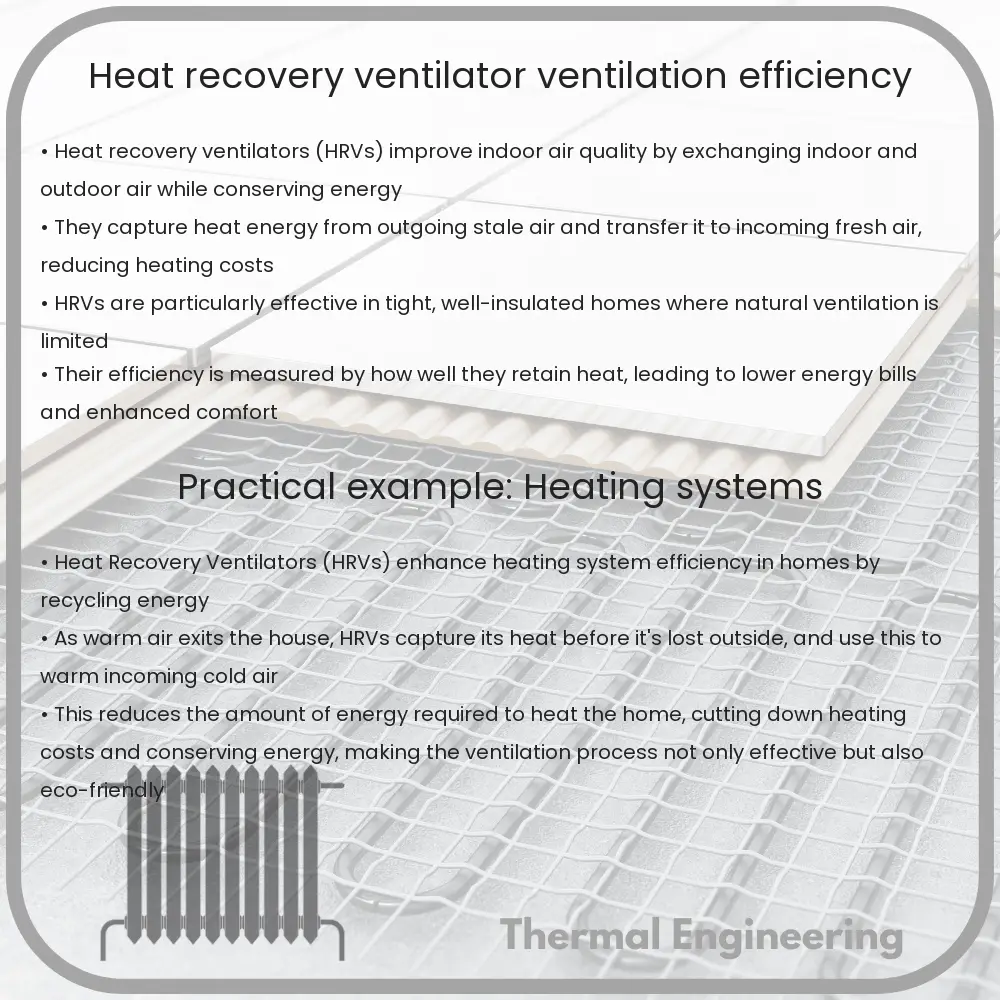
Heat Recovery Ventilator | Ventilation Efficiency

Learn about Heat Recovery Ventilators (HRVs), their importance in energy-efficient building designs, and how they enhance indoor air quality and comfort.

Heat Recovery Ventilator | Ventilation Efficiency

Understanding Heat Recovery Ventilators and Their Efficiency in Ventilation

Heat recovery ventilators (HRVs) are key components in modern building designs, especially with the increasing focus on energy efficiency. An HRV system helps in maintaining a healthy and comfortable indoor environment by effectively managing the air quality and energy used in heating and ventilation processes.

What is a Heat Recovery Ventilator?

A heat recovery ventilator is an eco-friendly system designed to provide fresh air into a building while minimizing energy loss. The HRV system works by extracting stale indoor air and simultaneously bringing in fresh outdoor air. This exchange of air occurs within the HRV unit where the heat from the outgoing air is transferred to the incoming cold air during the winter. Conversely, in the summer, the cooler indoor air can precool the warmer incoming air. This process significantly reduces the energy demands on heating and cooling systems.

Components of HRVs

  • Heat Exchanger: The core component where the heat transfer between outgoing and incoming air takes place without mixing the airstreams.
  • Fans: One fan draws fresh air into the building, while another expels the stale air.
  • Filters: These clean incoming and outgoing air, ensuring that dust, pollen, and other pollutants are removed.
  • Controls: System controls allow users to adjust settings such as fan speeds and operation modes to optimize performance and comfort.

How HRVs Enhance Ventilation Efficiency

HRVs improve the overall efficiency of building ventilation systems by recovering approximately 70% to 95% of the heat that would otherwise be lost in conventional exhaust ventilation systems. This high level of heat recovery is made possible by the heat exchanger within the HRV. The efficiency of an HRV system is often measured by its heat recovery efficiency, which can be calculated with the following formula:

Heat Recovery Efficiency (%) = (Heat Transferred / Heat in Exhaust Air) * 100

Furthermore, HRVs ensure that the indoor air quality is maintained as the system provides a constant supply of fresh air. This reduces pollutants and moisture, which can lead to mold growth and other issues associated with poor air quality.

Benefits of Installing an HRV

  1. Energy Savings: By recovering heat from exhaust air, HRVs reduce the energy needed for heating new incoming air, leading to lower heating costs.
  2. Improved Air Quality: Continuous exchange of air helps in removing pollutants and allergens from indoor air, enhancing the health and comfort of occupants.
  3. Moisture Control: Reduces the likelihood of mold growth and structural damage by managing the humidity levels within the building.
  4. Environmentally Friendly: Lower energy consumption results in reduced greenhouse gas emissions, contributing to environmentally sustainable building practices.

Choosing the Right HRV for Your Needs

Selecting an HRV system requires consideration of various factors such as climate, size of the building, insulation levels, and specific air quality needs. It is often advisable to consult with HVAC professionals to ensure that the system is properly sized and optimized for efficiency and performance in your specific environment.

In conclusion, heat recovery ventilators play a crucial role in modern building ventilation systems, offering an effective way to improve indoor air quality while reducing energy consumption and environmental impact. Whether retrofitting an older building or integrating into new construction, HRVs represent a smart investment towards achieving a more sustainable and comfortable indoor environment.

Geothermal Heat Pump | Sustainable System Types

Learn how geothermal heat pumps use the earth’s stable temperatures for efficient heating and cooling in buildings.

Geothermal Heat Pump | Sustainable System Types

Understanding Geothermal Heat Pumps

Geothermal heat pumps (GHPs), sometimes referred to as ground-source heat pumps, are advanced and efficient heating and cooling systems that utilize the earth’s sub-surface stable temperature to provide thermal comfort in buildings. By exploiting the constant temperatures beneath the Earth’s surface, these systems offer a sustainable alternative to conventional HVAC systems.

How Geothermal Heat Pumps Work

GHP systems consist of three main components: a heat pump unit, a heat exchange fluid (water or an antifreeze solution), and a heat exchange system buried in the ground near the building. In winter, the heat pump removes heat from the heat exchange fluid in the underground pipes and transfers it to the air in the interior space. In summer, the process is reversed, and the heat pump moves heat from the indoor air into the ground. This action cools the building while using minimal electrical energy compared to traditional systems.

Types of Geothermal Heat Pump Systems

  • Horizontal Systems: These are often used in residential applications where adequate land is available. Pipes are laid out horizontally in trenches dug about four to six feet below the surface.
  • Vertical Systems: In places where land surface is limited, vertical systems are used. Holes are drilled about 100 to 400 feet deep, and the heat exchange pipes are inserted vertically.
  • Pond/Lake Systems: If a water body is available, a pond or lake system can be an effective option. Coils of pipe are laid out underwater to take advantage of the thermal properties of the water.
  • Open Loop Systems: These systems use groundwater from a well as a direct energy source. After passing through the heat pump, the water is returned to the ground through a recharge well or drainage ditch.

Advantages of Geothermal Heat Pumps

Geothermal heat pumps offer numerous advantages over traditional heating and cooling systems:

  • Efficiency: GHPs can be up to four times more efficient than traditional HVAC systems due to their use of stable underground temperatures.
  • Cost-effective: Although the initial installation cost of GHPs can be higher, reduced operational costs result in long-term savings.
  • Environmentally friendly: GHPs reduce greenhouse gas emissions and minimize ecological disruption.
  • Durability: With fewer mechanical components exposed to the elements, GHPs typically have long lifespans and low maintenance needs.
  • Quiet operation: Unlike air-source heat pumps, GHPs do not require noisy fans that can be disruptive.

Challenges and Considerations

Despite their advantages, there are some considerations to bear in mind when opting for a geothermal heat pump:

  • Initial Cost: The installation of GHPs involves significant upfront costs, primarily due to the excavation required for the ground loop.
  • Site Suitability: The efficiency and feasibility of installation can vary dramatically depending on geological, hydrological, and spatial characteristics of the site.
  • Installation Disruption: Installing a GHP system can be disruptive to the existing landscape and requires careful planning and management.

In conclusion, geothermal heat pumps represent a powerful and sustainable solution for heating and cooling needs. With the ability to drastically reduce energy use and carbon footprints, they provide an excellent long-term investment for environmentally conscious consumers and businesses. However, thorough site evaluation and professional installation are critical to capitalize on the benefits GHPs offer.

Thermal Conductivity Analyzer | Material Testing

Learn about thermal conductivity analyzers, critical tools for measuring a material’s heat conduction properties in various industries.

Thermal Conductivity Analyzer | Material Testing

Understanding Thermal Conductivity Analyzers in Material Testing

Thermal conductivity is a critical physical property in materials science, determining how well a material can conduct heat. This characteristic is essential for a wide range of applications, from thermal insulation in the building sector to heat dissipation in electronic components. A thermal conductivity analyzer is an instrument used to measure the rate at which heat passes through a material, providing vital data for engineering and scientific research.

The Basics of Thermal Conductivity

Thermal conductivity, often denoted as ‘k’, quantifies the ability of a material to conduct thermal energy. It is defined by Fourier’s law of heat conduction, which can be expressed as:

q = -k * A * (dT/dx)

where:

  • q is the heat flux (the amount of heat transferred per unit area per unit time),
  • k is the thermal conductivity of the material,
  • A is the cross-sectional area through which heat is flowing,
  • dT/dx is the temperature gradient in the direction of the flow.

The negative sign indicates that heat flows from higher to lower temperatures. The SI unit for thermal conductivity is watts per meter-kelvin (W/m*K).

How a Thermal Conductivity Analyzer Works

Thermal conductivity analyzers can be based on several different methodologies, including steady-state techniques, transient techniques, and others. Among the most commonly used techniques are:

  1. Steady-State Method: This technique involves applying a constant heat source to one side of a sample and measuring the temperature difference after a steady state (no change in temperature with time) is reached. This method is suitable for materials with low and medium thermal conductivity.
  2. Transient Hot-Wire Method: In this approach, a thin wire is embedded in the material, and an electrical current is passed through it. The increase in temperature of the wire over time is monitored, and thermal conductivity is calculated based on this data. This method is quick and suitable for fluids and gases.
  3. Laser Flash Analysis: A laser pulse heats the surface of a small specimen, and an infrared detector or thermocouple measures the temperature on the opposite surface. The time it takes for the heat to travel through the specimen is used to calculate thermal conductivity.

Applications of Thermal Conductivity Testing

Thermal conductivity testing is crucial in several sectors:

  • Construction and Building Materials: Determining the thermal insulation properties of materials such as foam, fiberglass, and brick.
  • Electronics: Analyzing how well heat is dissipated in electronic components to prevent overheating and failure.
  • Automotive: Testing materials used in engines and exhaust systems to ensure they can handle high temperatures efficiently.
  • Energy: Evaluating materials for use in solar panels and other energy-conversion devices.

The data obtained from a thermal conductivity analyzer helps engineers and scientists choose the right materials for specific applications, enhancing performance and safety. Understanding thermal properties is fundamental in the development of new materials and for improving existing ones.

Conclusion

A thermal conductivity analyzer is a vital tool in materials science, crucial for assessing a material’s ability to conduct heat. This testing not only contributes to better material design and application in various industries but also leads to advancements in technology and improved energy efficiency. By analyzing thermal properties, engineers can ensure that materials will perform safely and effectively in their intended applications.

Thermal Break Window | Energy Benefits & Build

Learn about thermal break windows, their components, and the energy benefits they offer for efficient heating and cooling.

Thermal Break Window | Energy Benefits & Build

Understanding Thermal Break Windows

Thermal break windows are an innovative type of energy-efficient window that incorporates a separator between the interior and exterior window frames made from a less conductive material. This design is crucial for minimizing the transfer of heat and cold across the window frame, offering improved insulation and significant energy benefits.

Components of a Thermal Break Window

A thermal break window typically consists of an internal and external metal frame, which are separated by a non-metallic polymer or resin. This separator is the “thermal break” and is vital in reducing thermal conductivity. The most common materials used for the frames include aluminum, which is preferred for its strength, lightness, and durability, though it is highly conductive. The thermal break disrupts this conductivity.

  • Frames: Often made of aluminum, reinforced with a polyamide or polyurethane barrier.
  • Glazing: Usually double or triple-glazed units are used, containing inert gas between the panes, like argon or krypton, to further reduce heat transfer.
  • Seals: High-quality seals are essential to prevent air leaks and ensure effective insulation.

Energy Benefits of Thermal Break Windows

Thermal break windows provide several energy-related benefits that contribute to both environmental sustainability and cost efficiency:

  1. Improved Insulation: By interrupting the path for heat transfer, thermal break windows maintain a more consistent indoor temperature, which is crucial for reducing the reliance on heating and cooling systems.
  2. Reduced Energy Consumption: With a more stable indoor climate, less energy is required to heat or cool the space, leading to lower energy bills and conservation of resources.
  3. Decreased Condensation: The improved insulation also means that the inner window surface is less likely to reach dew point temperatures that cause condensation, thereby reducing the potential for moisture-related issues.

Building Considerations for Thermal Break Windows

While thermal break windows are advantageous, there are several key considerations during the building or retrofitting process:

  • Cost: The initial investment for thermal break windows can be higher than standard windows. However, the reduction in energy costs can offset this over time.
  • Installation: Proper installation is crucial to ensure that the full benefits are realized. Poor installation can lead to air leaks and diminished performance.
  • Maintenance: Although minimal, regular maintenance such as checking seals and the integrity of the glazing is critical to maintain performance over time.
  • Adaptation to Climates: Thermal break windows are especially beneficial in extreme climates where the difference between indoor and outdoor temperatures is significant.

Conclusion

Thermal break windows offer a compelling solution for enhancing energy efficiency in buildings. By effectively reducing thermal bridging and enhancing the overall insulative properties of the window, they contribute to a sustainable future while providing cost savings in the long term. As technology in materials and design continues to advance, the adoption of thermal break windows is likely to grow, marking a significant step towards more energy-efficient building practices.

Absorption Chiller | Industrial Cooling Process

Learn about absorption chillers, eco-friendly industrial cooling systems utilizing waste heat for energy efficiency.

Absorption Chiller | Industrial Cooling Process

Understanding Absorption Chillers: The Basics of Industrial Cooling

Absorption chillers are a type of refrigeration system that uses a heat source to provide the energy needed to drive the cooling process. This system is distinct from more conventional refrigeration systems, which typically use mechanical compression. Absorption chillers are commonly used in industrial settings as well as in large commercial buildings, such as hotels and hospitals, where waste heat from processes or solar heat is readily available.

How Absorption Chillers Work

The basic operation of an absorption chiller involves three primary components: the evaporator, the absorber, and the generator. Here’s how these parts work together in a cycle:

  • Evaporator: In the evaporator, a refrigerant (often water) absorbs heat from the surroundings, causing it to evaporate. This phase change pulls heat from the environment, thus creating a cooling effect.
  • Absorber: The vaporized refrigerant is then absorbed by a hygroscopic fluid, typically lithium bromide solution, which is drawn into the absorber. This process of absorption generates heat, which is then removed by a cooling tower.
  • Generator: To regenerate the refrigerant and continue the cycle, the solution containing the absorbed refrigerant is heated in the generator. This heating process causes the refrigerant to vaporize out of the absorbent solution. The refrigerant vapor then cycles back to the evaporator, and the absorbent solution returns to the absorber to repeat the process.

The heat required for the generator can come from various sources, including solar energy, geothermal energy, or waste heat from industrial processes. Because of its ability to utilize waste heat, the absorption chiller is particularly esteemed for its energy efficiency and its contribution to reducing environmental impact.

The Role of Absorption Chillers in Industrial Cooling

Absorption chillers are integral in industries where there is an ample amount of waste heat. Instead of disposing of this heat into the environment, it is repurposed into a productive tool for cooling. Here are some of the advantages of using absorption chillers in an industrial context:

  • Energy Efficiency: By using waste heat as the primary energy source for cooling, these chillers significantly reduce the amount of primary energy required, leading to energy conservation and cost savings.
  • Environmental Impact: Utilizing absorption chillers helps decrease overall greenhouse gas emissions, as they largely rely on heat sources that might otherwise contribute to environmental heating.
  • Cost-Effectiveness: Reducing the electricity consumption for cooling not only saves costs but also reduces dependency on electrical infrastructure, which can be particularly advantageous in areas with limited energy resources.

Conclusion

Absorption chillers represent a compelling solution in the panorama of industrial cooling systems, especially in scenarios where harnessing waste heat is feasible. By transforming waste into a resource, these systems do not just contribute to more sustainable business operations but also align with global energy efficiency and environmental protection goals. As technology advances, the scope for absorption chillers’ efficiency and applications is expected to widen, further enhancing their role in sustainable industrial practices.

Whether you are a student, an engineer, or simply someone interested in efficient cooling systems, absorption chillers offer a fascinating glimpse into the practical application of thermodynamic principles.

Desiccant Dehumidifier | Humidity Control Types

Learn about how desiccant dehumidifiers control humidity through adsorption, their types, and applications across industries.

Desiccant Dehumidifier | Humidity Control Types

Understanding Desiccant Dehumidifiers and Humidity Control

Desiccant dehumidifiers, a vital tool for managing humidity in various environments, operate differently from the more common refrigerative dehumidifiers. Instead of using condensation (typical in refrigerative systems) to remove moisture from the air, desiccant dehumidifiers use a chemical process to adsorb moisture. This makes them particularly useful in environments where maintaining a low humidity is crucial, such as in industrial processes and preservation.

How Desiccant Dehumidifiers Work

The core component of a desiccant dehumidifier is a desiccant material which is a substance that naturally attracts and holds water vapor. Common desiccants include silica gel, activated alumina, and molecular sieves. The process involves air passing through the desiccant material. As the air passes through, moisture adheres to the desiccant, effectively drying the air.

Once the desiccant material becomes saturated with water, it must be “regenerated” or dried. This is typically done by heating the desiccant to release the accumulated water, which is then vented outside. The regeneration process is essential for continuous operation and efficiency of the dehumidifier.

Types of Desiccant Dehumidifiers

  • Solid Desiccant Dehumidifiers: These systems use a solid wheel infused with desiccant material. Air passes through the wheel and moisture is absorbed. The wheel rotates, and a separate air stream heated specifically for regeneration dries the desiccant.
  • Liquid Desiccant Dehumidifiers: These dehumidifiers use a liquid desiccant solution, typically made of glycol or brine, which absorbs moisture from the air. The solution is then regenerated by heating it to release the moisture before re-cooling it for re-use.

Advantages of Desiccant Dehumidification

  • Effectiveness in Cold Environments: Unlike refrigerative dehumidifiers, which become less efficient at lower temperatures, desiccant dehumidifiers maintain effectiveness regardless of the ambient temperature.
  • Energy Efficiency: Modern desiccant dehumidifiers can be integrated with other heating and cooling systems to utilize waste heat for regeneration, reducing overall energy consumption.
  • Improved Air Quality: Desiccant dehumidifiers can remove pollutants and odors along with moisture, contributing to better indoor air quality.
  • Versatility: These systems can be designed for use in various scales, from portable units for domestic use to large industrial systems.

Applications of Desiccant Dehumidifiers

  1. Industrial Manufacturing: Sensitive manufacturing processes, like in the pharmaceutical or food industries, often require precise humidity control to maintain product quality.
  2. Water Damage Restoration: Desiccant dehumidifiers can speed up the drying process after water damage, preventing the growth of mold and mildew.
  3. HVAC Systems: Integration into Heating, Ventilation, and Air Conditioning (HVAC) systems helps to control humidity in large buildings, improving comfort and structural integrity.
  4. Storage and Preservation: These dehumidifiers are also used to protect goods in storage from moisture damage, particularly in museums and libraries where humidity control is critical.

Understanding the working principle and types of desiccant dehumidifiers provides valuable insight into their importance in many commercial and industrial applications. They play a crucial role in optimizing conditions for processes, preservation, and improving overall air quality, highlighting their significance in effective humidity control strategies.

Cooling strategies for high-performance computing

Effective cooling strategies for high-performance computing (HPC) systems, exploring air, liquid, phase change, and hybrid solutions.

Cooling strategies for high-performance computing

Cooling Strategies for High-Performance Computing

High-performance computing (HPC) systems, often comprised of densely packed servers and powerful graphics processing units (GPUs), generate significant amounts of heat during operation. Effective cooling is essential not only for maintaining system stability and reliability but also for achieving optimal performance and energy efficiency. This article explores the various cooling strategies used in modern HPC environments.

1. Air Cooling

Air cooling remains the most common method due to its simplicity and cost-effectiveness. It involves the use of fans to circulate air through heatsinks placed on critical components like CPUs and GPUs. The airflow increases heat transfer by moving warm air away from these components and replacing it with cooler air.

  • Pros: Simple to implement; no need for additional plumbing or complex setups.
  • Cons: Limited cooling capacity; not sufficient for extremely high-density configurations.

2. Liquid Cooling

Liquid cooling is a more efficient method that uses a liquid coolant to absorb and dissipate heat. It comes in several forms:

  1. Direct Liquid Cooling (DLC): Coolant is circulated directly through microchannels or heatsinks that are in direct contact with the heat-generating components.
  2. Indirect Liquid Cooling: Heat is first transferred from the components to a liquid circuit via a conduction plate.
  3. Immersion Cooling: Entire servers or components are submerged in a non-conductive liquid, which absorbs the heat more uniformly.

Liquid cooling is particularly effective in high-density setups and is growing in popularity in modern data centers.

  • Pros: Higher heat absorption capacity; can more efficiently manage the heat from densely packed components.
  • Cons: Higher initial setup cost and maintenance requirements compared to air cooling.

3. Phase Change Cooling

In phase change cooling, heat from the components causes a liquid coolant to evaporate into a gaseous state. The gas is then condensed back to a liquid in a heat exchanger, releasing the absorbed heat. This cycle can effectively manage even higher thermal loads.

  • Pros: Extremely effective at removing large amounts of heat.
  • Cons: Complex setup; generally more suitable for specialized applications in HPC.

4. Hybrid Solutions

Hybrid cooling solutions combine elements of air, liquid, and phase change cooling to optimize the thermal management based on specific needs and constraints of the computing environment.

  • Application: Hybrid solutions are particularly useful in environments where different zones have varying cooling needs.

Conclusion

The choice of cooling strategy in HPC systems depends on a variety of factors including the density of the computing resources, energy efficiency goals, budget, and the physical environment. As computing technology progresses and thermal loads continue to increase, the importance of innovative and effective cooling solutions becomes increasingly critical. Exploring and investing in the appropriate cooling strategy is essential for maintaining the longevity and performance of high-performance computing systems.

Solar Water Heater | Domestic Circulation Types

Learn about the types and functionalities of passive and active solar water heaters for efficient home use.

Solar Water Heater | Domestic Circulation Types

Understanding Solar Water Heaters: Domestic Circulation Types

Solar water heaters are a sustainable and cost-effective way to generate hot water for your home using the energy from the sun. A key component of their efficiency lies in the type of circulation system they employ to move water (or other fluids) through the system. In domestic settings, there are primarily two types of circulation systems used in solar water heating devices: passive systems and active systems. Each type has its unique benefits and configurations.

Passive Solar Water Heating Systems

Passive solar water heating systems are so named because they do not require mechanical pumps to circulate water or the heat-transfer fluid. These systems rely on the natural convection currents that occur when water heats up, becoming lighter and rising through the system. There are two common types of passive systems:

  • Thermosyphon Systems: This is the most commonly used type of passive solar water heating system. In a thermosyphon system, the water tank is mounted above the solar collector panels so that as water in the collector heats, it becomes lighter and rises naturally into the tank while cooler water in the tank flows down to the collector, creating a natural circulation loop.
  • Integral Collector-Storage Systems: Often referred to as batch systems, these systems integrate the solar collector and the storage tank into a single unit. Water is heated directly within the collector that also serves as the storage tank. This system is very simple and efficient but is better suited to warmer climates since the stored water can lose heat overnight.

Active Solar Water Heating Systems

Unlike passive systems, active solar water heating systems employ pumps to circulate water or a heat-transfer fluid through the collector and into the home. These systems are more adaptable to different types of buildings and climates. Active systems can be divided into two main types:

  • Direct Circulation Systems: In this setup, pumps circulate water directly through the solar collectors, where it gets heated by the sun, and then flow back into the home for use. This type of system is best where the temperatures remain above freezing since water in the collector can freeze and damage the system.
  • Indirect Circulation Systems: These systems use a non-freezing heat-transfer fluid that circulates through the collectors and a heat exchanger. The heat exchanger then heats the water that flows into the home. This setup is ideal for regions experiencing freezing temperatures as it prevents potential freeze damage to the collector.

Choosing the Right Solar Water Heater

The choice between passive and active solar water heater systems largely depends on the climate, installation costs, maintenance requirements, and efficiency needs of the homeowner. Passive systems are generally simpler and potentially more reliable due to their lack of moving parts, making them ideal for areas with ample sunlight and mild climates. On the other hand, active systems, with their better adaptability and efficiency, are suitable for a broader range of climates and can be optimized for energy use with variable speed pumps and smart controllers.

Understanding the different types of solar water heating systems and how they operate not only informs a homeowner’s choice but also contributes to more effective and efficient use of solar energy for domestic hot water production, highlighting the merge of engineering innovation and sustainability efforts.

Whether you choose a passive or an active system, solar water heaters represent a step forward in utilizing renewable energy sources for everyday needs, reducing dependency on fossil fuels, and minimizing environmental impact.