Facebook Instagram Youtube Twitter

Heat transfer in organic rankine cycles

Learn about the role of heat transfer in improving Organic Rankine Cycle efficiency for converting low-temperature thermal energy to power.
Heat transfer in organic rankine cycles

Understanding Heat Transfer in Organic Rankine Cycles

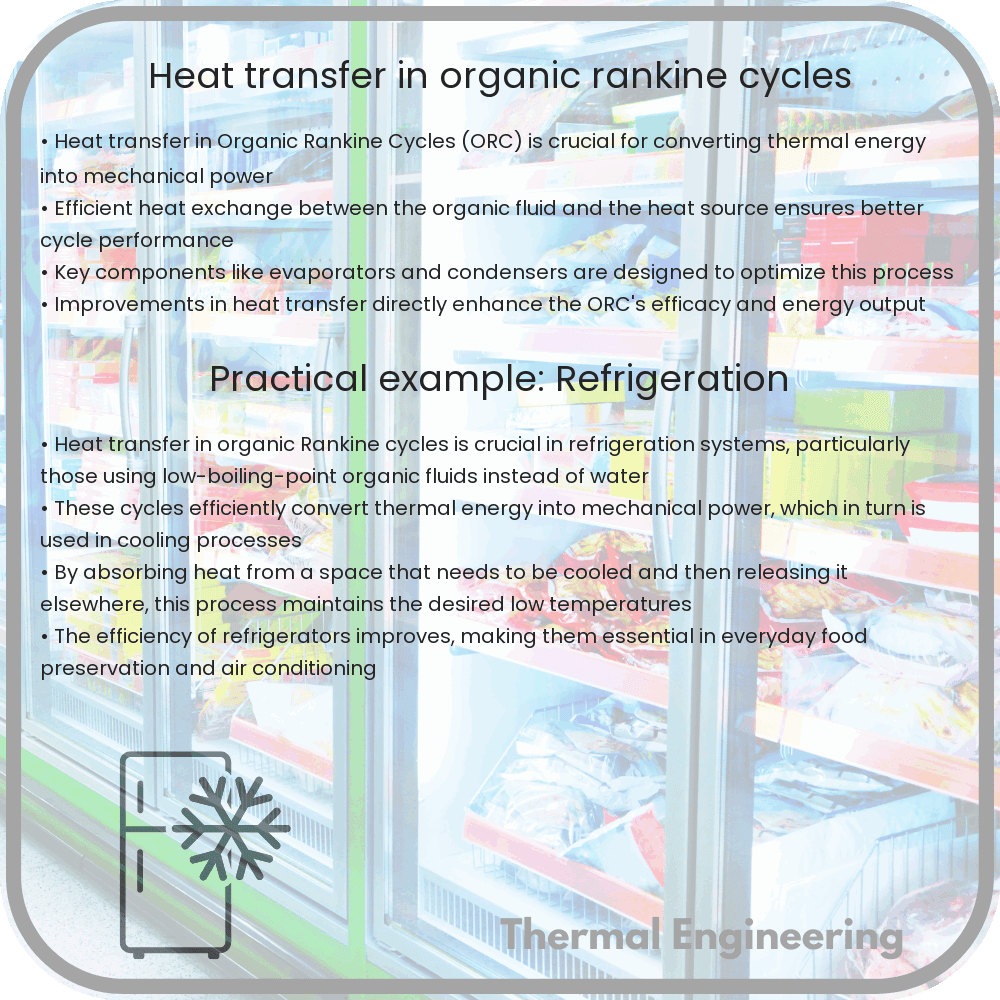
The Organic Rankine Cycle (ORC) is a widely used system in the field of energy engineering, especially for converting low-temperature thermal energy into electrical power. The fundamental principle behind the ORC is similar to a traditional Rankine cycle, with the major difference lying in the use of organic fluids instead of water. This adaptation allows the ORC to efficiently operate at lower heat source temperatures, making it ideal for renewable energy applications such as biomass, geothermal, and waste heat recovery.

Basics of Heat Transfer in ORC

Heat transfer in an Organic Rankine Cycle is a critical aspect that determines the efficiency and effectiveness of the cycle. It occurs in three main components: the evaporator, the condenser, and sometimes the regenerator.

Evaporator

In the evaporator, heat from an external source is transferred to the organic working fluid, causing it to vaporize. The efficiency of this process depends on the thermal characteristics of the fluid used, including its boiling point, thermal conductivity, and heat capacity. Effective heat transfer within the evaporator is crucial as it directly affects the turbine’s input steam quality and, consequently, the overall efficiency of the cycle.

Condenser

Following the expansion in the turbine, the vaporized working fluid must be condensed back into a liquid to complete the cycle. This occurs in the condenser, where heat is removed from the working fluid and transferred to another medium, typically air or cooling water. The design of the condenser plays a significant role in the cycle’s efficiency, influencing how quickly and effectively the fluid can be condensed at the lowest possible temperature.

Regenerator

Some advanced ORC systems include a regenerator (or recuperator) to enhance thermal efficiency. By recovering residual heat from the turbine-exhausted vapor before it enters the condenser, the regenerator preheats the fluid entering the evaporator. This process reduces the thermal energy required from the heat source, thereby increasing the system’s overall efficiency.

Factors Influencing Heat Transfer

Several factors impact the heat transfer rates and thermal efficiency in an ORC. These include:

  • Choice of Working Fluid: The physical and chemical properties of the working fluid such as boiling point, specific heat, and thermal conductivity, determine its heat transfer capabilities.
  • Temperature Gradients: Larger temperature differences between the heat source and the working fluid typically result in more efficient heat transfer.
  • Heat Exchanger Design: The effectiveness of heat exchangers, including their size, shape, and construction material, also influences the rate of heat transfer.
  • Operational Pressure: Higher pressures generally increase the thermal efficiency of the cycle but require stronger, more expensive materials and components.

Mathematical Representation of Heat Transfer

The basic equation governing the heat transfer within components of the ORC can be represented as:

Q = ṁ * cp * ΔT

where:

  • Q is the rate of heat transfer,
  • ṁ (dot over m) is the mass flow rate of the working fluid,
  • cp is the specific heat capacity of the fluid,
  • ΔT is the temperature change of the fluid.

The effectiveness of these heat transfer processes determines the overall thermal efficiency of the Organic Rankine Cycle, affecting both its economic feasibility and environmental impact. Advances in materials science, thermodynamic research, and fluid dynamics continue to push the boundaries of ORC technology, making it a key component of sustainable energy systems.

Conclusion

Understanding and optimizing heat transfer in Organic Rankine Cycles is essential for maximizing the efficiency of converting low-grade heat sources into usable power. With continued research and technological advancements, ORCs have the potential to play a significant role in global efforts towards cleaner, more sustainable energy systems.
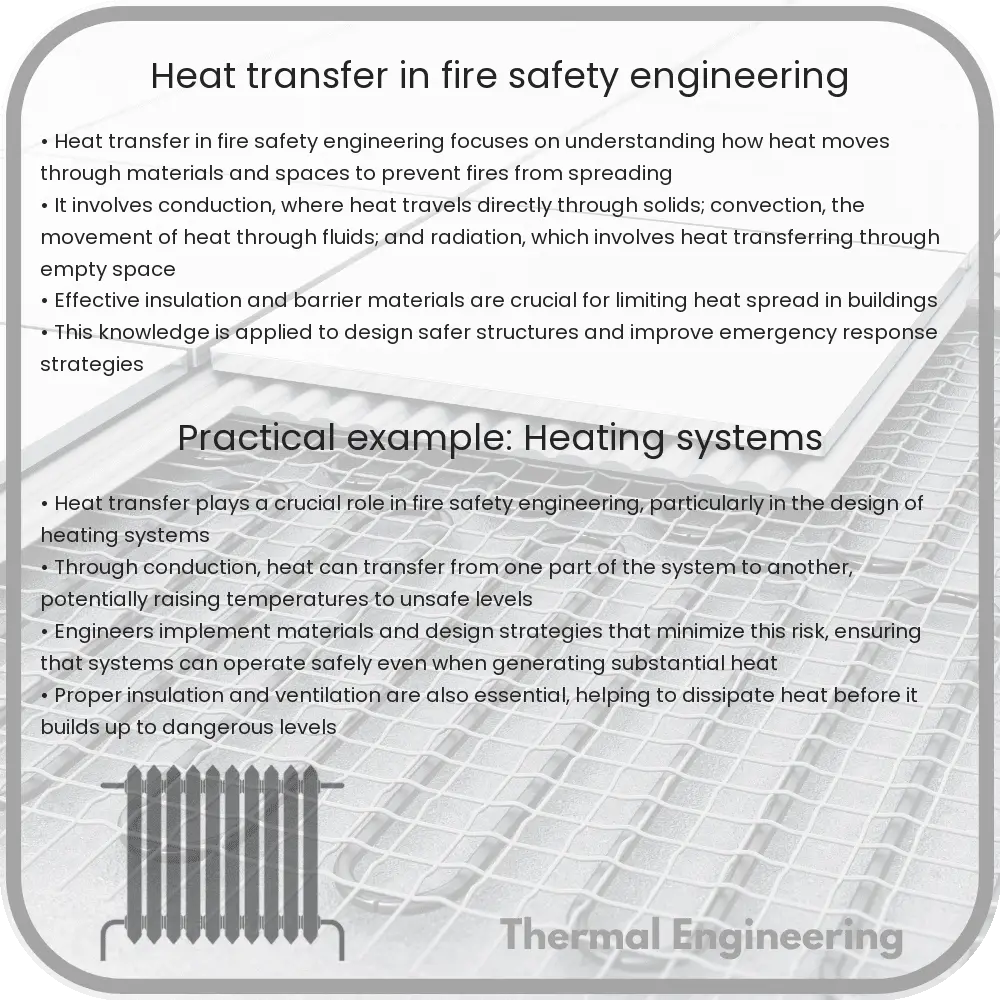
Heat transfer in fire safety engineering

Learn how heat transfer impacts fire safety engineering through conduction, convection, and radiation, influencing building design and fire protection systems.

Heat transfer in fire safety engineering

Understanding Heat Transfer in Fire Safety Engineering

Heat transfer plays a crucial role in the field of fire safety engineering. It involves the movement of heat from one area to another, which can greatly influence the spread of fire within structures and affect the safety measures in place. Understanding the principles of heat transfer helps engineers design safer buildings and develop better fire protection systems.

Types of Heat Transfer

There are three primary modes of heat transfer relevant to fire safety: conduction, convection, and radiation. Each of these plays a different role during a fire event.

  • Conduction is the transfer of heat through materials. In buildings, heat can be conducted through walls, floors, and ceilings, spreading the fire to different parts of the structure. The rate of heat transfer by conduction can be described by Fourier’s law:

    \( q = -k \frac{dT}{dx} \)

    where \( q \) represents the heat flux, \( k \) is the thermal conductivity of the material, \( dT \) is the temperature difference, and \( dx \) is the thickness of the material.

  • Convection involves heat transfer through fluids (liquids and gases), which is particularly important in the spread of fire as hot gases rise and cool gases descend. Convective heat transfer can enhance the spread of fire by moving hot smoke and flames to new areas.

    The convective heat transfer rate can be estimated using Newton’s law of cooling:

    \( q = hA(T_s – T_{\infty}) \)

    where \( h \) is the convective heat transfer coefficient, \( A \) is the area through which heat is being transferred, \( T_s \) is the surface temperature, and \( T_{\infty} \) is the fluid temperature far from the surface.

  • Radiation is the emission and transmission of energy in the form of rays or waves. Heat from a fire radiates in all directions and can ignite combustible materials even without direct contact.

    The radiant heat flux can be calculated by the Stefan-Boltzmann law:

    \( q = \epsilon \sigma A (T^4 – T_{\infty}^4) \)

    where \( \epsilon \) is the emissivity of the material, \( \sigma \) is the Stefan-Boltzmann constant, and \( T \) and \( T_{\infty} \) are the temperatures of the surface and the surroundings respectively.

Applications in Fire Safety Engineering

The understanding of heat transfer mechanisms is applied in various ways in fire safety engineering:

  • Fire Resistance Material Design: Engineers select materials with lower thermal conductivity and higher heat capacity to delay the spread of heat through conduction.
  • Structural Fire Protection: Fire-resistant coatings and compounds are used to enhance the thermal resistance of structural elements, limiting the effects of heat and preventing structural collapse.
  • Smoke Management Systems: Effective design of ventilation systems can manage the convective flow of hot gases and smoke, enhancing evacuation and firefighting efforts.
  • Alarms and Detection: Radiation sensors, such as infrared detectors, can identify unusual heat fluxes indicative of a developing fire, triggering alarms and initiating response measures.

Comprehending these fundamental concepts of heat transfer allows fire safety engineers to create safer environments and protect both lives and properties from the devastating effects of fires. With advances in technology and continuous research, the application of this knowledge continually evolves, leading to more effective fire safety strategies.

Heat transfer in thermal plasmas

Explore the mechanisms of heat transfer in thermal plasmas, crucial for optimizing industrial processes like welding and cutting.

Heat transfer in thermal plasmas

Understanding Heat Transfer in Thermal Plasmas

Thermal plasmas are ionized gases with extremely high temperatures, used extensively in various industrial processes such as welding, cutting, and material processing. Understanding heat transfer within these plasmas is crucial for optimizing these processes and achieving desired outcomes in a controlled and efficient manner. Heat transfer in thermal plasmas primarily occurs through three mechanisms: conduction, convection, and radiation.

Conduction

Heat conduction in thermal plasmas is the transfer of thermal energy through collisions between particles. In the plasma state, both electrons and heavier ions contribute to this process. However, due to their much higher mobility and energy, electrons are predominantly responsible for conduction. The thermal conductivity of a plasma can be described by the equation:

k = (ne * kB * λe * ve) / 3

  • ne: Electron number density
  • kB: Boltzmann constant
  • λe: Mean free path of electrons
  • ve: Electron thermal velocity

This equation highlights that as the plasma temperature increases, so does the thermal conductivity, primarily due to the increased velocity of the electrons.

Convection

In thermal plasmas, convective heat transfer is the physical transport of hot plasma by macroscopic motion of the plasma itself. This mechanism becomes dominant when the plasma is confined in a vessel or flows through a medium, such as in arc furnaces or plasma torches, where the hot plasma is moved from one region to another. The effectiveness of convective heat transfer is influenced by factors such as plasma fluid velocity, viscosity, and the specific heat capacity of the plasma.

Radiation

Radiative heat transfer in plasmas occurs due to the emission of electromagnetic radiation by excited particles within the plasma. At high temperatures, the plasma becomes a strong emitter of radiation, including visible light, ultraviolet, and infrared. The Stefan-Boltzmann law, given by:

P = σ * A * T4

  • P: Radiative power emitted
  • σ: Stefan-Boltzmann constant
  • A: Surface area of the emitting body
  • T: Absolute temperature of the plasma

illustrates the dependence of radiative power on the fourth power of the temperature, indicating that radiation becomes significantly more important at higher temperatures.

Applications and Practical Considerations

Understanding and controlling the different modes of heat transfer in thermal plasmas is essential for enhancing the efficiency and outcome of plasma-based processes. In welding, for instance, optimizing the heat input and its distribution through conduction and convection can reduce material distortion and improve joint quality. Similarly, in plasma cutting, controlling the heat transfer can result in smoother cuts and faster processing times. Moreover, in waste treatment and energy generation, maximizing radiative heat transfer can lead to more complete and efficient processes.

Engineers must consider all three modes of heat transfer to tailor thermal plasma processes according to specific industrial applications. This requires not only a solid understanding of the fundamental principles but also practical experience with the behavior of different materials and operational conditions.

In summary, heat transfer in thermal plasmas involves complex interactions of conduction, convection, and radiation, each playing a crucial role depending on the temperature, composition, and practical application of the plasma. Effective management of these heat transfer modes leads to improved performance and efficiency in plasma-based technologies.

Thermal efficiency improvements in HVAC systems

Learn about thermal efficiency in HVAC systems, focusing on its impact on energy consumption and sustainability, and ways to enhance it.

Thermal efficiency improvements in HVAC systems

Understanding Thermal Efficiency in HVAC Systems

Heating, Ventilation, and Air Conditioning (HVAC) systems play a crucial role in maintaining the comfort and air quality in residential and commercial buildings. A key factor influencing the cost and environmental impact of HVAC systems is their thermal efficiency. This article explores various strategies to improve the thermal efficiency of HVAC systems, thereby reducing energy consumption and promoting sustainability.

What is Thermal Efficiency?

Thermal efficiency in the context of HVAC systems refers to the ratio of useful heating or cooling provided to the energy consumed by the system. It is a measure of the unit’s ability to convert input energy (electricity, gas, etc.) into a desired output (cooling or heating) effectively and economically.

Improvement Strategies for HVAC Thermal Efficiency

  • High-Efficiency HVAC Equipment: Upgrading to high-efficiency HVAC systems can lead to significant energy savings. Modern air conditioners, for instance, often feature advanced compressors and heat exchangers that operate more effectively than older models.
  • Proper Sizing and Installation: Incorrect sizing of HVAC equipment can lead to inefficiencies. Oversized units frequently cycle on and off, reducing their efficiency. Conversely, undersized systems may run continuously, struggling to meet the heating or cooling demand. Proper installation is also critical to ensure optimal performance.
  • Use of Variable Speed Drives: Variable speed drives (VSDs) adjust the motor speed of compressors, fans, and pumps based on system demand. This dynamic adaptation leads to reduced energy consumption and wear, thereby improving the overall system efficiency.
  • Maintenance and Upkeep: Regular maintenance of HVAC systems prevents the deterioration of performance over time. Cleaning or replacing filters, inspecting ductwork, and ensuring that the system components are in good condition are essential maintenance tasks that sustain efficiency.
  • Smart Thermostats and Controls: Integrating smart thermostats and advanced control systems can optimize HVAC operations based on real-time data and usage patterns. These systems can make adjustments automatically, improving comfort while minimizing energy use.
  • Heat Recovery: Heat recovery systems capture waste heat that would otherwise be expelled from the system and reuse it either for heating or in pre-heating fresh air entering the system. Such recycling of energy significantly enhances the system’s thermal efficiency.
  • Sealing and Insulation: Improving the insulation of ducts and sealing leaks where air may enter or escape ensures minimal heat loss, maintaining the efficiency of the HVAC system.

Calculating Thermal Efficiency

The thermal efficiency, η, of an HVAC system is typically calculated using the following formula:

η = (Useful Energy Output / Total Energy Input) * 100%

In this equation, ‘Useful Energy Output’ is the energy actually used for heating or cooling the space, while ‘Total Energy Input’ is the energy consumed by the HVAC system. Higher values of η signify better efficiency.

Conclusion

Improving the thermal efficiency of HVAC systems not only reduces operating costs but also decreases environmental impact by utilizing less energy. Current advancements and technologies provide several avenues through which efficiency can be enhanced. Homeowners and facility managers are encouraged to consider these options not only for economic benefits but also as part of the global effort towards sustainable energy use.

Thermal management in semiconductors

Learn about the importance and methods of thermal management in semiconductors to enhance device performance and longevity.

Thermal management in semiconductors

Understanding Thermal Management in Semiconductors

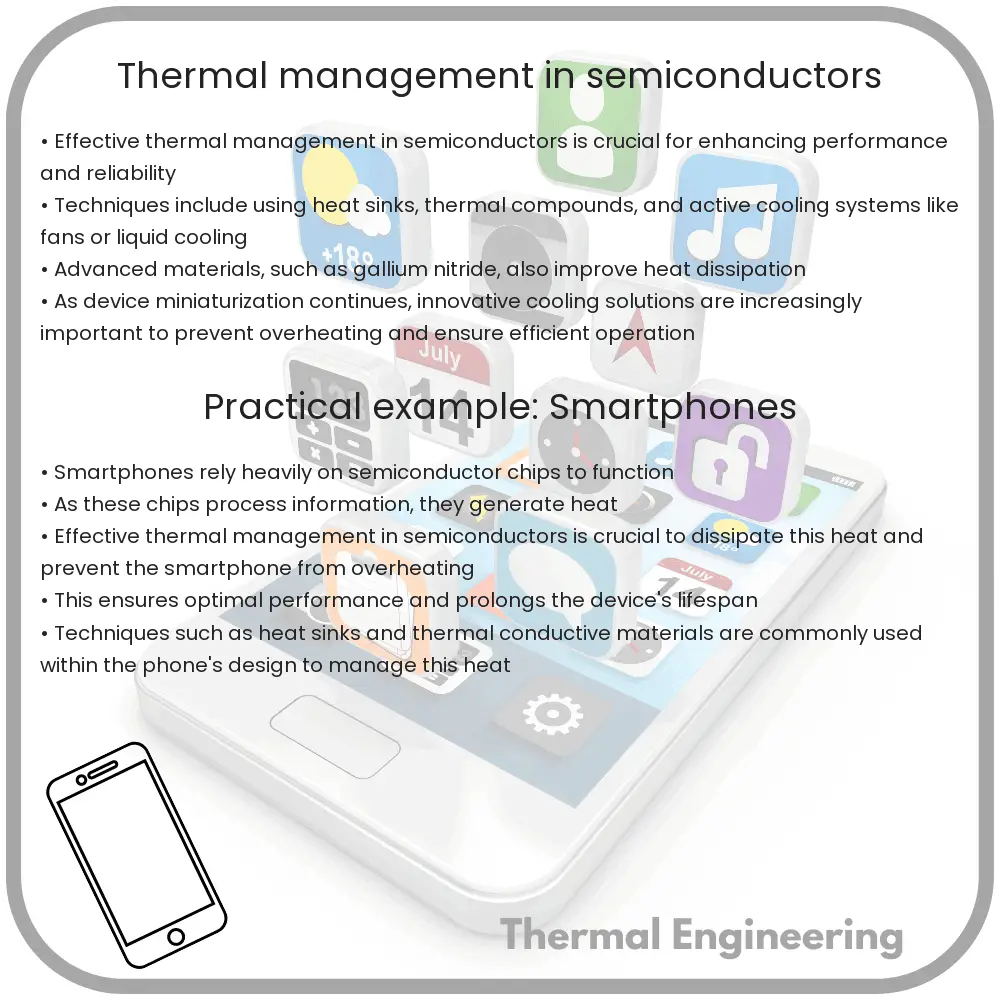
Thermal management is a critical aspect of semiconductor design and operation. As electronic devices get smaller and more powerful, the heat generated by semiconductor components increases, which can lead to overheating and potentially damage the device. Managing this heat is vital for maintaining performance, reliability, and longevity of semiconductor devices.

Why is Thermal Management Important in Semiconductors?

Semiconductors are materials that have electrical conductivity between that of conductors and insulators. They are the backbone of all modern electronics like computers, smartphones, and even electric vehicles. However, semiconductors generate heat when current flows through them, especially at higher powers or when miniaturized in dense configurations, such as in microprocessors and power electronics.

Excessive heat can affect a semiconductor device in several ways:

  • Reduced Performance: High temperatures can cause electronic devices to operate more slowly and less effectively.
  • Physical Damage: Prolonged exposure to high temperatures can lead to physical damage, such as warping or meltdown of semiconductor materials.
  • Shortened Lifespan: Consistently high temperatures can accelerate aging of semiconductor components, thereby reducing their lifespan.

Basics of Heat Transfer in Semiconductors

Heat transfer in semiconductors occurs through three fundamental mechanisms:

  1. Conduction: Heat is transferred directly through materials. This is the most common heat transfer mechanism in semiconductors, flowing from hotter regions to cooler ones.
  2. Convection: Heat transfer occurs through a fluid (air or liquid) moving past the surface of the component, carrying heat away.
  3. Radiation: Heat is emitted from the surface in the form of infrared radiation and does not require any medium to transfer.

Effective thermal management systems leverage these principles to dissipate heat efficiently.

Techniques for Thermal Management

To manage heat in semiconductor devices, engineers employ several techniques:

  • Heat Sinks: These are typically made of metals like aluminum or copper, which have high thermal conductivity. They are attached to the semiconductor device to draw heat away and dissipate it into the surrounding environment.
  • Fans and Cooling Systems: Active cooling solutions use fans to force air circulation around the hot components, significantly enhancing heat dissipation through convection.
  • Thermal Interface Materials (TIMs): These materials improve the heat conduction between the heat source (semiconductor) and the heat sink. Common TIMs include thermal pastes, pads, and adhesive tapes.
  • Heat Pipes: These are vacuum-sealed tubes containing a liquid that vaporizes at high temperatures. The vapor travels along the pipe to a cooler area, where it condenses back into a liquid and returns to the heat source through capillary action.
  • Spreaders: These are used to distribute heat over a larger surface area, effectively reducing the heat density and improving the efficiency of other cooling mechanisms.

Advanced techniques might also involve liquid cooling systems, where a coolant fluid directly absorbs heat from hot components before being cycled away to a radiator. This method is more effective but also more complex and expensive than traditional air cooling systems.

Conclusion

Thermal management in semiconductors is a field that blends principles of physics and engineering to solve practical heat dissipation challenges in electronic devices. As technology continues to evolve, the development of innovative thermal management solutions becomes increasingly important to maintain and enhance the performance, reliability, and lifespan of semiconductor devices.

This insight into how heat is managed in semiconductors not only highlights the importance of this aspect in engineering but also encourages further exploration into more efficient and innovative cooling technologies.

Heat transfer in magnetic cooling

Learn about magnetic cooling, an eco-friendly refrigeration method leveraging the magnetocaloric effect for enhanced efficiency.

Heat transfer in magnetic cooling

Understanding Heat Transfer in Magnetic Cooling

Magnetic cooling, also known as magnetocaloric cooling, is an innovative refrigeration technology that has captured the interest of engineers and scientists worldwide. This cooling method takes advantage of the magnetocaloric effect (MCE), where a magnetic field is used to alter the temperature of a material. It’s seen as a potent alternative to conventional gas-compression refrigeration, promising higher efficiency and being more environmentally friendly. To fully grasp magnetic cooling, it’s essential to understand how heat transfer plays a crucial role in the process.

Basics of the Magnetocaloric Effect

The fundamental principle behind magnetic cooling is the magnetocaloric effect. When a magnetic material is placed in a magnetic field, its temperature increases as its magnetic domains align with the field. Conversely, as the magnetic field is removed, the material cools as the magnetic domains return to a disordered state. This change in temperature during the application and removal of a magnetic field is at the heart of magnetic cooling technology.

Heat Transfer in Magnetic Refrigeration

Heat transfer in magnetic refrigeration involves three primary stages: magnetization, heat rejection, and demagnetization.

  • Magnetization: A magnetocaloric material (MCM) is exposed to a magnetic field, causing it to heat up. This stage exploits the direct MCE.
  • Heat Rejection: While the MCM is still under the influence of the magnetic field, it is brought into thermal contact with a heat sink. The excess heat is transferred to the heat sink, typically via conduction.
  • Demagnetization: The magnetic field is removed, and the MCM cools down due to the inverse MCE. This lowered temperature can now be used for cooling purposes.

Key Components of Magnetic Refrigeration Systems

The efficiency of magnetic cooling systems significantly depends on the effectiveness of the heat transfer mechanisms employed. Key components influencing this include:

  • Magnetocaloric Materials: These are materials that exhibit a significant temperature change under the influence of a magnetic field. Gadolinium and its alloys are commonly used due to their large magnetocaloric effect near room temperature.
  • Heat Exchange Mechanism: Efficient heat exchangers are crucial for optimal transfer of heat to and from the MCM. This can be achieved using fluids like water or air that flow over the MCM to either absorb or dissipate heat.
  • Magnetic Field Source: The strength and variability of the magnetic field are critical. Permanent magnets or electromagnets can be used, each with its own set of advantages and challenges.

The Role of Thermodynamics

The operation of magnetic refrigeration systems also relies heavily on thermodynamic principles. The primary laws of thermodynamics apply, particularly the first law (conservation of energy) and the second law (increased entropy). The cyclic process of magnetization, heat rejection, and demagnetization is designed to sustain a refrigeration cycle, akin to traditional methods but without involving gases or chemical refrigerants. This represents a significant step forward in creating more sustainable technologies.

Challenges in Heat Transfer

While magnetic cooling offers many advantages, it also faces challenges, particularly in the area of heat transfer:

  • Material Efficiency: The magnetocaloric materials must efficiently absorb and release heat. They should also exhibit a substantial magnetocaloric effect over a broad range of temperatures.
  • Heat Exchanger Design: Designing a heat exchanger that can quickly and efficiently manage the heat transfer between the MCM and the environment is crucial. This involves considerations of heat exchanger geometry and the properties of the heat transfer fluid.
  • Scaling: Scaling the technology from small prototypes to systems capable of providing practical amounts of cooling for residential or commercial use remains a significant engineering challenge.

In wrapping up, the potential of magnetic cooling is immense, offering a greener alternative to traditional refrigeration. By improving the mechanisms of heat transfer within these systems, magnetic cooling could soon become a staple in energy-efficient and environmentally friendly cooling technologies.

Heat transfer in external combustion engines

Explore the principles of heat transfer in external combustion engines, focusing on conduction, convection, and radiation processes.

Heat transfer in external combustion engines

Understanding Heat Transfer in External Combustion Engines

External combustion engines (ECEs) are a class of engines in which the combustion of fuel occurs outside the engine itself. Unlike internal combustion engines where the fuel is burned inside the engine, external combustion engines heat a separate working fluid that, in turn, helps in producing mechanical energy. The most famous example of an external combustion engine is the steam engine. Understanding how heat transfer works in these engines is crucial to enhancing their efficiency and effectiveness.

Types of Heat Transfer

Heat transfer in external combustion engines primarily involves three mechanisms: conduction, convection, and radiation.

  • Conduction: This is the transfer of heat through a solid material. In ECEs, heat conduction occurs in the walls of the boiler where heat from the fuel source is transferred to the water to convert it into steam.
  • Convection: This method involves the transfer of heat through a fluid (liquid or gas) that is moving. In the case of external combustion engines, the heated water turns into steam and rises due to convection currents generated in the boiler.
  • Radiation: Heat transfer through electromagnetic waves that directly heat up surfaces. In ECEs, radiation can occur from the heat source to the boiler’s surface.

The Role of the Boiler in Heat Transfer

The boiler is a critical component of external combustion engines where most of the heat transfer processes occur. It is designed to efficiently transfer heat from the combustion process to the water or working fluid. The steps involved include:

  1. Burning of fuel (such as coal, wood, or oil) to generate heat.
  2. The heat produced is transferred to the boiler’s walls through radiation and conduction.
  3. Heat from the walls of the boiler heats the water inside through conduction. As water gets heated, it absorbs heat energy, turning it into steam.
  4. The steam rises and is collected at the top of the boiler, from where it is directed to perform mechanical work, such as turning a turbine or moving a piston.

Efficiency Considerations in Heat Transfer

Maximizing efficiency in heat transfer in external combustion engines involves minimizing heat loss and improving the thermal conductivity of materials used. Some strategies include:

  • Using insulating materials around the boiler to reduce heat loss through dissipation to the surroundings.
  • Employing materials with high thermal conductivity for the boiler’s construction to facilitate faster and more efficient heat transfer.
  • Optimizing the surface area of the boiler exposed to the burning fuel to maximize heat absorption.

Challenges and Innovations

External combustion engines face challenges such as bulkiness, lower efficiency compared to internal combustion engines, and longer start-up times. However, advancements are continuously being made to overcome these issues, such as:

  • Developing new materials with better heat-resisting and conducting properties.
  • Improving engine designs to shorten start-up times and enhance heat transfer efficiencies.
  • Integrating modern control systems to optimize the combustion process and temperature control.

Understanding the basics of heat transfer in external combustion engines not only aids in appreciating a significant part of engineering history but also enhances the potential improvements in modern applications including green energy solutions, where efficiency in heat transfer plays a vital role.

Thermal shock resistance of ceramics

Learn about the ability of ceramics to withstand rapid temperature changes, a key factor in their use in demanding applications.

Thermal shock resistance of ceramics

Understanding Thermal Shock Resistance in Ceramics

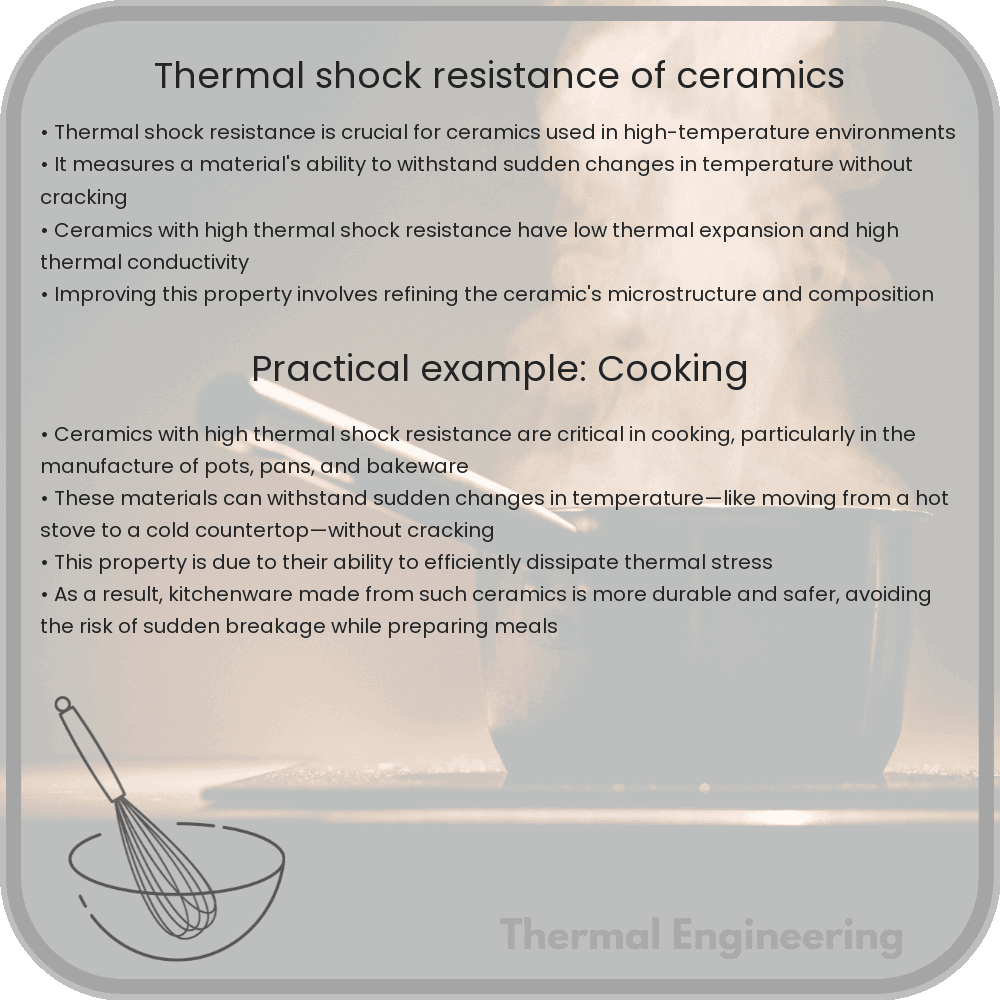
Thermal shock resistance is a critical property of ceramics, pivotal in various applications from spacecraft coatings to kitchenware. It is the ability of a material to withstand rapid temperature changes without damage. This characteristic is especially important for ceramics because, unlike metals, they tend to have low toughness and high brittleness, making them more susceptible to cracking under thermal stress.

What Causes Thermal Shock in Ceramics?

Thermal shock in ceramics occurs when a rapid temperature change induces differential thermal expansion within a material. Different parts of the ceramic expand or contract at different rates due to variations in temperature across its body. This uneven expansion creates stress within the material, potentially leading to cracks and, ultimately, failure.

Factors Influencing Thermal Shock Resistance

  • Thermal Expansion Coefficient: Materials with lower coefficients of thermal expansion are less prone to stress under temperature changes.
  • Elastic Modulus: A lower modulus of elasticity often indicates that the material can absorb more strain before failing.
  • Thermal Conductivity: High thermal conductivity helps in rapidly distributing the thermal stresses over a larger area, reducing localized stresses.
  • Strength and Toughness: Higher mechanical strength and toughness generally enhance the resistance to thermal shock.

Quantifying Thermal Shock Resistance

Thermal shock resistance can be quantified using various methods, one of which is the calculation of a thermal shock parameter, \( R \), defined as:

\[
R = \frac{\sigma \sqrt{a}}{E \alpha \Delta T}
\]

Where:

  • \(\sigma\) is the strength of the material (in tension)
  • \(a\) is the thermal diffusivity
  • \(E\) is the Young’s modulus
  • \(\alpha\) is the coefficient of thermal expansion
  • \(\Delta T\) is the temperature change

This parameter helps in comparing the thermal shock resistance of different materials under similar conditions.

Applications of Ceramics with High Thermal Shock Resistance

Ceramics that exhibit high thermal shock resistance are essential in many high-stress environments:

  • Aerospace: Components like space shuttle tiles and turbine blades require materials that can withstand extreme and rapid temperature fluctuations.
  • Cookware: Ceramic cookware can go from refrigerator to oven without cracking, owing to good thermal shock properties.
  • Electronics: Certain ceramic substrates are used in electronics for their ability to handle rapid thermal cycling during power cycling.

Improving Thermal Shock Resistance

Enhancing the thermal shock resistance of ceramics is often a key research area. Techniques include:

  • Material Modification: Adding zirconia to alumina can improve both toughness and thermal shock resistance.
  • Material Processing: Controlled cooling and heating rates during the manufacturing process can reduce residual stresses.
  • Composite Materials: Developing composite ceramics with materials having different thermal properties to manage and distribute thermal stresses effectively.

In summary, thermal shock resistance is a vital property for ceramics in various engineering applications. Understanding and enhancing this characteristic allows the development of better, more resilient materials compatible with extreme working environments.

Heat transfer in ultrasonic processing

Learn how heat transfer occurs during ultrasonic processing through conduction and convection, influenced by material properties and wave characteristics.

Heat transfer in ultrasonic processing

Understanding Heat Transfer in Ultrasonic Processing

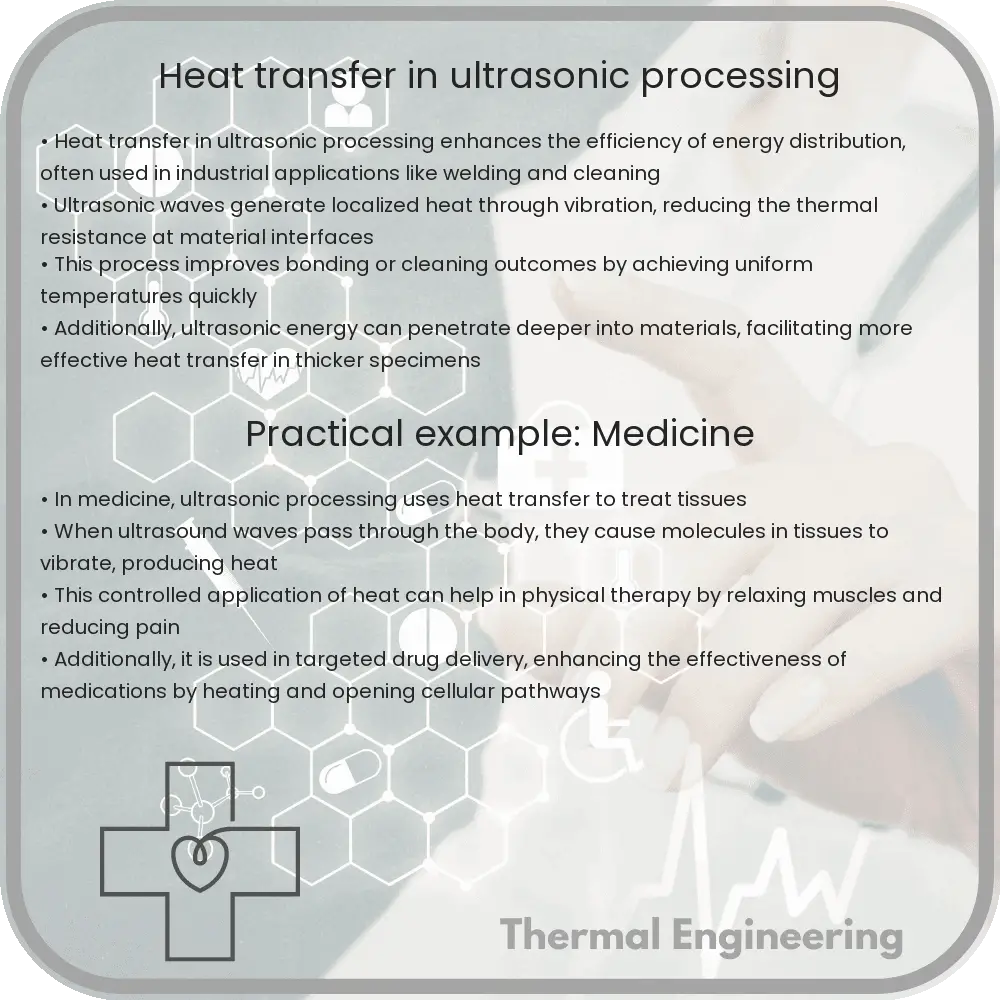
Ultrasonic processing is a fascinating field within engineering where high-frequency sound waves (ultrasound) are used to manipulate materials. Often employed in applications ranging from welding and cutting to homogenization and sonochemistry, this technique also involves significant aspects of heat transfer. Understanding how heat is transferred during ultrasonic processing is crucial for optimizing these processes and ensuring material integrity.

Basics of Heat Transfer in Ultrasonic Processing

Heat transfer in ultrasonic processing primarily occurs through conduction and convection, influenced significantly by the intense vibrations produced by ultrasonic waves. These vibrations can cause local temperature rises, changes in material properties, and even phase changes. Here’s a deeper look into the process:

  • Conduction: When ultrasonic waves pass through a material, they increase the kinetic energy of the molecules within the material due to intensive vibration. This increase manifests as heat due to friction among closely packed molecules, transferring heat through the material.
  • Convection: In fluids, the intense agitation caused by ultrasonic waves can lead to enhanced convection. This process helps in dissipating heat more efficiently across the material, potentially avoiding unwanted hotspots which can degrade the properties of the material.

Key Factors Influencing Heat Transfer

  • Frequency of Ultrasound: The frequency of the ultrasonic waves affects the intensity and depth of penetration into the material. Higher frequencies typically lead to more superficial heat effects, while lower frequencies may result in deeper but less intense heating.
  • Material Properties: Thermal conductivity, capacity, density, and viscosity of the material being processed determine how heat is generated and dissipated. Materials with high thermal conductivity tend to heat up and cool down quickly, influencing the efficiency of the ultrasonic process.
  • Amplitude of Ultrasonic Waves: Higher amplitudes mean more intense vibrations and consequently more significant heat generation. Controlling amplitude is crucial for managing temperature rise within the material.
  • Environment: Surrounding temperature and the medium (e.g., air, water) in which ultrasonic processing takes place also affect heat transfer. For instance, using a liquid medium can enhance cooling effects through convection.

Mathematical Consideration of Heat Generation

The rate of heat generation (Q) can be modeled by considering the intensity of the ultrasonic wave and the properties of the material. The equation below represents a simplified version of heat generation during ultrasonic processing:

Q = β * I2 / ρ * Cp

Where:

  • β is the attenuation coefficient of the material,
  • I is the intensity of the ultrasonic wave,
  • ρ is the density of the material, and
  • Cp is the specific heat capacity of the material.

This formula helps in quantifying the thermal handling needed to prevent overheating or degrading the material’s properties during ultrasonic processing.

Conclusion

Heat transfer in ultrasonic processing is a complex interplay of material properties, wave characteristics, and external conditions. Understanding and controlling these factors ensure optimum results in applications requiring ultrasonic processing. Continued research in this area is essential to unveil newer potentials and enhance the efficiency of this sophisticated engineering, thereby broadening its application spectrum in the industrial sector.

The principles explained here serve as a foundation for those involved in the engineering and scientific exploration of ultrasonic technologies, aiming to maximize the benefits while mitigating the risks associated with heat generation and transfer.

Thermal regulation in wearable technology

Learn about the strategies and challenges of thermal regulation in wearable technology to enhance device performance and user comfort.

Thermal regulation in wearable technology

Thermal Regulation in Wearable Technology

Wearable technology has become an integral part of our daily lives, from fitness trackers and smartwatches to advanced healthcare monitoring devices. As these devices become more sophisticated and multi-functional, ensuring proper thermal management becomes crucial. Effective thermal regulation in wearable technology helps prevent overheating, enhances the comfort and safety of the user, and extends the lifespan and reliability of the device.

Challenges in Thermal Management

The primary challenge in thermal management of wearable technology is the limited space for incorporating cooling systems. Unlike larger electronic devices, wearables must be compact and lightweight, which significantly restricts the options for heat dissipation. Moreover, these devices are worn close to the skin, necessitating that any heat generated must be managed effectively to avoid discomfort or burns.

Strategies for Thermal Regulation

  • Material Selection: Manufacturers often utilize materials with high thermal conductivity, such as copper and aluminum, in the design of wearable devices. These materials help spread heat more uniformly, reducing hotspots that could cause discomfort.
  • Thermal Interface Materials (TIMs): TIMs are used to enhance the thermal coupling between heat sources and heat sinks. These substances improve heat transfer efficiency and are especially useful in compact spaces within wearable technology.
  • Heat Spreaders: In some devices, heat spreaders are employed to distribute the heat generated by electronic components over a larger surface area, thus reducing the peak temperatures to which the skin is exposed.
  • Active Cooling Systems: Although less common due to their size and power requirements, some high-performance wearables might incorporate miniature fans or thermoelectric coolers to actively control device temperature.

Examples of Thermal Regulation in Wearables

One notable example of effective thermal management in wearable technology is in VR (Virtual Reality) headsets. These devices often include built-in fans and heat spreaders to manage heat generated by their high-performance processors and to prevent lens fogging and user discomfort. Similarly, in fitness trackers and smartwatches, the use of lightweight, breathable materials combined with passive cooling mechanisms helps maintain thermal comfort for users.

Future Trends

As technology progresses, the trend is toward even smaller, more powerful wearable devices. Future methodologies in thermal management may include innovations in micro-scale cooling technologies and the development of new materials with higher thermal conductivity or phase change materials that absorb heat when changing state. Moreover, the integration of sensor technology to dynamically monitor and adjust the temperature of wearables in real-time could provide an adaptive solution to thermal regulation.

Effective thermal regulation in wearable technology is essential not only for user comfort and safety but also for the optimal performance and durability of the device. Continuing advances in materials science and cooling technology are likely to play a crucial role in the future development of wearables.

Conclusion

In summary, managing the heat produced by wearable technology is a complex challenge that requires innovative solutions. Through intelligent material choice, sophisticated design, and potentially active cooling solutions, manufacturers can improve the thermal performance of wearables, enhancing their usability and comfort for all users.