Facebook Instagram Youtube Twitter

Xenon Difluoride | Energetic Materials, Thermal Stability

Learn about xenon difluoride (XeF2), its composition, stability, and applications in energetic materials and microelectronics.

Xenon Difluoride | Energetic Materials, Thermal Stability

Understanding Xenon Difluoride: Composition, Properties, and Applications in Energetic Materials

Xenon difluoride (XeF2) is a chemical compound that deserves attention, especially within the field of engineering regarding energetic materials. Known for its potent oxidizing properties and stability under certain conditions, XeF2 is used in various niche applications, ranging from the etching of semiconductor materials to being a potential component in energetic material formulations.

Composition and Chemical Structure

Xenon difluoride is a simple binary compound consisting of two fluorine atoms bonded to a single xenon atom. Xenon, a noble gas, typically does not form compounds easily due to its full valence shell of electrons which makes it chemically inert. However, under the right conditions, it can react with highly electronegative elements like fluorine. The reaction to form XeF2 involves direct interaction under conditions of high pressure and high temperature:

Xe(g) + F2(g) → XeF2(s)

This process results in a crystalline solid, which at room temperature appears as a white powder.

Thermal Stability and Reactivity

XeF2 is notable for its remarkable stability at room temperature, remaining solid and non-reactive under normal conditions. It is a strong fluorinating agent, able to donate fluorine to various substrates. Its stability comes from the strength of the xenon-fluorine bond and the overall linear molecular geometry, which minimizes electronic repulsion between the lone pairs on the xenon atom.

However, when heated or subjected to impact, xenon difluoride decomposes, releasing xenon and fluorine gases. The decomposition can be represented as follows:

XeF2(s) → Xe(g) + F2(g)

Applications as an Energetic Material

  • Microelectronic Fabrication: One of the most common applications of XeF2 is in the field of microfabrication, where it is used for isotropic etching of silicon. Its ability to selectively etch silicon while not affecting other materials like photoresist makes it particularly valuable.
  • Energetic Material Component: In more specialized areas, XeF2 is explored as a component in energetic materials. Energetic materials are those which release energy rapidly through reactions, such as explosives, propellants, and pyrotechnics. Its high oxidation potential and ability to release a significant amount of energy upon decomposition make it a candidate for these applications, although handling and sensitivity issues must be carefully managed.

Handling and Safety

Despite its stability under normal conditions, the handling of xenon difluoride must be approached with caution. It should be stored in closed containers to avoid contact with moisture and organic materials, with which it can react violently. Safety gear such as gloves and eye protection is mandatory when working with this compound due to its corrosive nature and the potential release of toxic fluorine gas upon decomposition.

In conclusion, xenon difluoride serves as an intriguing substance in both academic research and industrial applications. Its unique properties offer benefits in specialized fields, particularly where the strong fluorinating capabilities and thermal stability are necessary. However, careful consideration of the handling and storage conditions is imperative to ensure safety and efficacy in its use.
Krypton Fluoride | Excimer Lasers, High Energy Photons

Learn about Krypton Fluoride Excimer Lasers, key UV light sources in industrial and medical applications, explained through their operation and physics.

Krypton Fluoride | Excimer Lasers, High Energy Photons

Understanding Krypton Fluoride Excimer Lasers

Excimer lasers, a critical class in the family of ultraviolet lasers, have found extensive applications in various scientific, medical, and industrial fields. One of the most potent among them is the Krypton Fluoride (KrF) laser. This article aims to demystify how KrF lasers operate, their mechanism, and the nature of the high-energy photons they emit.

Basics of Excimer Lasers

The term ‘excimer’ is derived from ‘excited dimer’, although in practice most excimer lasers, including the KrF laser, use a combination of noble gases and halogens. These lasers are distinct because they operate using a pseudomolecule formed by a noble gas and a halogen which only exists in an excited electronic state; it dissociates back to its constituent atoms upon returning to the ground state, releasing ultraviolet light.

The Composition and Operation of KrF Lasers

Krypton Fluoride lasers produce light typically at 248 nm wavelength, falling in the ultraviolet (UV) spectrum. Let’s look deeper into its operation:

  • Krypton Gas and Fluorine Mixture: The laser medium consists of a mixture of krypton gas and fluorine. Under typical operation, this mixture is excited electrically or through other energy sources.
  • Formation of Excited Dimers: When energy is supplied, a krypton atom and a fluorine atom bond briefly to form an excited dimer (KrF*). This state is highly energetic and unstable.
  • Emission of UV Light: As the excited KrF* molecules return to their ground state (dissociating into Kr and F), they emit photons in the ultraviolet range, particularly at a wavelength of 248 nm.

Production of High-Energy Photons

The photons emitted by KrF lasers are of high energy primarily due to their short wavelength (UV light). The energy \( E \) of a photon can be calculated using the equation:

\[ E = h \cdot \nu \]

where \( h \) is Planck’s constant (approximately \( 6.626 \times 10^{-34} \) Joule·seconds) and \( \nu \) (nu) is the frequency of the light. Since frequency and wavelength (\( \lambda \)) are related through the speed of light \( c \) (\( \nu = c / \lambda \)), UV photons are more energetic compared to visible light due to shorter wavelengths.

Applications of KrF Lasers

Krypton Fluoride lasers are particularly valuable due to their ability to produce these high-energy photons efficiently. Applications of KrF lasers include:

  • Photolithography: Used extensively in semiconductor manufacturing to etch microcircuits on silicon wafers.
  • Medicine: In procedures like LASIK eye surgery for precise and minimally invasive corneal modification.
  • Spectroscopy: Utilized in research to study materials at molecular and atomic levels.

In conclusion, the Krypton Fluoride excimer laser is a pivotal technology in modern manufacturing and medical treatments, thanks in large part to its production of high-energy UV photons. Understanding the basic physics and engineering principles behind such laser systems not only broadens our scientific knowledge but also enables continued innovation in applications impacting daily life and health.

Oxygen-18 | Isotope Separation, Thermal Gradient Uses

An in-depth exploration of Oxygen-18, a stable isotope used in climatology, medical diagnostics, and research, focusing on its separation methods and applications.

Oxygen-18 | Isotope Separation, Thermal Gradient Uses

Oxygen-18 and Its Isotopic Separation

Oxygen-18 (O18 or 18O) is a stable isotope of oxygen that differs from the more common oxygen-16 due to the presence of two additional neutrons in its nucleus. Naturally occurring in the Earth’s atmosphere and hydrosphere, Oxygen-18 is a vital tracer used in many scientific applications, particularly in paleoclimatology to understand past climate conditions by analyzing ice cores and ocean sediments. Its separation from the more abundant oxygen-16 is crucial for these studies as well as for various medical and scientific applications.

Methods of Isotope Separation

The separation of isotopes, particularly for stable isotopes like oxygen-18, is a technically demanding process. Several methods exist to achieve the high degrees of purity required:

  • Distillation: Fractional distillation of water exploits the slight difference in boiling points between water molecules containing different oxygen isotopes.
  • Chemical Exchange: This method involves the equilibration of oxygen-bearing substances in different oxidation states. One common system used is water (H2O) and hydrogen peroxide (H2O2), where oxygen-18 is enriched in one of the substances.
  • Gas Centrifugation: Utilizing centrifugal forces, this method separates gases with different molecular weights. Oxygen gas containing O18 is slightly heavier and segregates differently under high-speed rotation.

Use of Thermal Gradient for Oxygen-18 Enrichment

Another innovative approach to isotope separation leverages thermal diffusion. Thermal diffusion separates isotopes along a temperature gradient:

  1. A gas mixture containing different oxygen isotopes is subjected to a temperature gradient.
  2. Lighter isotopes tend to cluster at the warmer end, while heavier isotopes (like O18) move to the cooler end.
  3. Separated isotopes are collected at different temperature zones.

This method can be adapted to continuous separation processes, making it suitable for large-scale applications. Although typically less efficient than other methods, improvements in technology could enhance its viability.

Applications of Oxygen-18

Oxygen-18’s unique properties make it indispensable in both science and medicine:

  • Climatic Studies: Ratios of oxygen-18 to oxygen-16 in ice cores and marine sediments help scientists reconstruct past temperature profiles and water cycles.
  • Medical Diagnostics: Water enriched with O18 is used in positron emission tomography (PET) scans, aiding in detailed imaging of metabolic processes and diagnosing diseases.
  • Research: In hydrology, O18-enriched water traces the movement and mixing of water bodies, offering insights into water resources and environmental studies.

The versatility and high demand for oxygen-18 underline the need for efficient and cost-effective separation technologies. As such, both engineering innovation and scientific research continue to focus heavily on improving isotope separation methods, ultimately fostering advancements in many diverse fields.

Helium-3 Gas | Low Temperature Research & Cryogenics

Helium-3 is a non-radioactive isotope crucial in low temperature research and cryogenics, used primarily to achieve temperatures near absolute zero.

Helium-3 Gas | Low Temperature Research & Cryogenics

The Role of Helium-3 in Low Temperature Research and Cryogenics

Helium-3 (He-3) is a light, non-radioactive isotope of helium with two protons and one neutron. Its unique physical properties make it extremely valuable in the fields of low temperature research and cryogenics. This article explores how Helium-3 is used, particularly in its liquid form, to achieve and maintain temperatures near absolute zero, and why it is preferred for certain advanced applications.

Understanding Cryogenics

Cryogenics involves the production and behavior of materials at very low temperatures. In scientific terms, this typically refers to temperatures below approximately -150°C (-238°F or 123 K). Achieving and sustaining such low temperatures requires specialized techniques and materials, among which Helium-3 plays a critical role.

Key Properties of Helium-3

Helium-3 becomes a superfluid when cooled to temperatures below 2.17 K (-270.98°C or -455.76°F). As a superfluid, it has zero viscosity and exhibits strange quantum mechanical effects, such as the ability to flow without friction. This state provides an exceptional environment for studying quantum mechanics on a macroscopic scale. Additionally, the low boiling point of Helium-3 (just 3.2 K at standard atmospheric pressure) makes it particularly useful in cryogenic applications where extremely low temperatures are required.

Uses of Helium-3 in Research and Practical Applications

  • Dilution Refrigerators: One of the most important applications of Helium-3 is in dilution refrigerators. These systems use a mixture of Helium-3 and Helium-4 to achieve continuous cooling to temperatures as low as a few millikelvin (thousandths of a kelvin). The process involves the Helium-3 atoms being diluted by the Helium-4, absorbing heat in the process and thus producing cooling.
  • Quantum Computing: The extremely low operational temperatures needed for quantum computing to prevent decoherence are achievable using Helium-3 based cryogenic systems. These systems help maintain the stability of quantum states within quantum bits (qubits), a fundamental requirement for quantum computation.
  • Low-Temperature Physics Experiments: Experiments that explore the properties of other materials at low temperatures also rely heavily on Helium-3. Researchers study phenomena such as superconductivity and the effects of nearly absolute zero temperatures on physical properties.

Supply and Demand Challenges

The rarity of Helium-3 presents significant sourcing challenges. It is primarily derived from the decay of tritium, a radioactive isotope of hydrogen, and is also found in extremely small quantities in the Earth’s atmosphere. The limited supply of Helium-3 makes it expensive and difficult to obtain, thus adding complexity to research and technological applications that depend on it.

Conclusion

Helium-3’s role in low temperature research and cryogenics is undeniably crucial despite its rarity and the challenges associated with its supply. Its unique properties enable researchers to explore the realms of quantum mechanics, superconductivity, and other phenomena that occur at near absolute zero temperatures. As research advances in these fields, the demand for Helium-3 will continue to grow, underlining the need for efficient usage and perhaps alternative solutions in the future.

Deuterium Gas | Nuclear Fusion, Thermal Neutron Scattering

Learn about deuterium gas, a key element in nuclear fusion and neutron scattering, and its significant role in advancing energy and scientific research.

Deuterium Gas | Nuclear Fusion, Thermal Neutron Scattering

Understanding Deuterium Gas and Its Role in Nuclear Fusion and Neutron Scattering

Deuterium, often known as heavy hydrogen, is a stable isotope of hydrogen with a natural abundance of approximately 0.015% of all hydrogen found on Earth. It is denoted by the chemical symbol 2H or D. Deuterium differs from the most common hydrogen isotope, protium (1H), because it contains one neutron and one proton in its nucleus, whereas protium has no neutrons. This additional neutron imparts unique nuclear properties to deuterium, making it instrumental in nuclear fusion and neutron scattering applications.

Nuclear Fusion with Deuterium

Nuclear fusion is a process that powers the sun and other stars, where nuclear reactions combine lighter atomic nuclei to form a heavier nucleus, releasing energy in the process. Deuterium is a key fuel in many fusion research reactors because of its potential to create energy efficiently. The most common and promising type of fusion reaction on Earth involves the nuclei of deuterium and tritium (another hydrogen isotope with two neutrons).

The reaction can be summarized by the equation:

2H + 3H → 4He (Helium) + n (neutron) + 17.6 MeV of energy

This reaction releases a significant amount of energy (17.6 MeV), mainly because the mass of the resulting helium nucleus is less than the sum of the masses of the original hydrogen isotopes. The difference in mass is converted into energy according to Einstein’s mass-energy equivalence principle, E = mc2.

Thermal Neutron Scattering in Deuterium

Neutron scattering is a critical technique used in material science to understand the properties of materials at the atomic or molecular level. Thermal neutrons, which are neutrons at thermal equilibrium at about room temperature, are particularly effective for this analysis. They have energies in the range of about 0.025 eV, corresponding to speeds of approximately 2200 m/s.

Deuterium is particularly useful in neutron scattering experiments because it has a lower neutron absorption cross-section compared to hydrogen, reducing the background noise in measurements. This makes deuterium-labeled compounds ideal for neutron scattering studies. In addition, the presence of the neutron in the deuterium nucleus allows for coherent scattering, providing more accurate data about the positions and dynamics within the studied materials.

Applications and Future Potential

  • Energy Production: The promise of deuterium-tritium fusion is significant, holding the potential for providing a nearly limitless, clean energy source if controlled effectively.
  • Scientific Research: Deuterium’s properties make it valuable in various forms of spectroscopy and quantum mechanics studies, aiding researchers in unraveling complex molecular behaviors.
  • Medical Applications: Neutron scattering involving deuterium is important in biomedical research, helping to detail the structures of proteins and other macromolecules critical to medicine.

In conclusion, deuterium gas plays a crucial role in the advancement of nuclear fusion technology and enhances the efficiency of neutron scattering techniques. With ongoing research and development, its applications across various fields, including energy, scientific research, and medicine, are likely to expand even further, contributing to significant technological and scientific advancements.

Tritium Gas | Self-Luminous, Thermal Properties & Uses

Tritium gas, a radioactive hydrogen isotope, is used in self-luminous applications, thermal energy sources, and nuclear fusion.

Tritium Gas | Self-Luminous, Thermal Properties & Uses

Understanding Tritium Gas: Self-Luminous Characteristics, Thermal Properties, and Uses

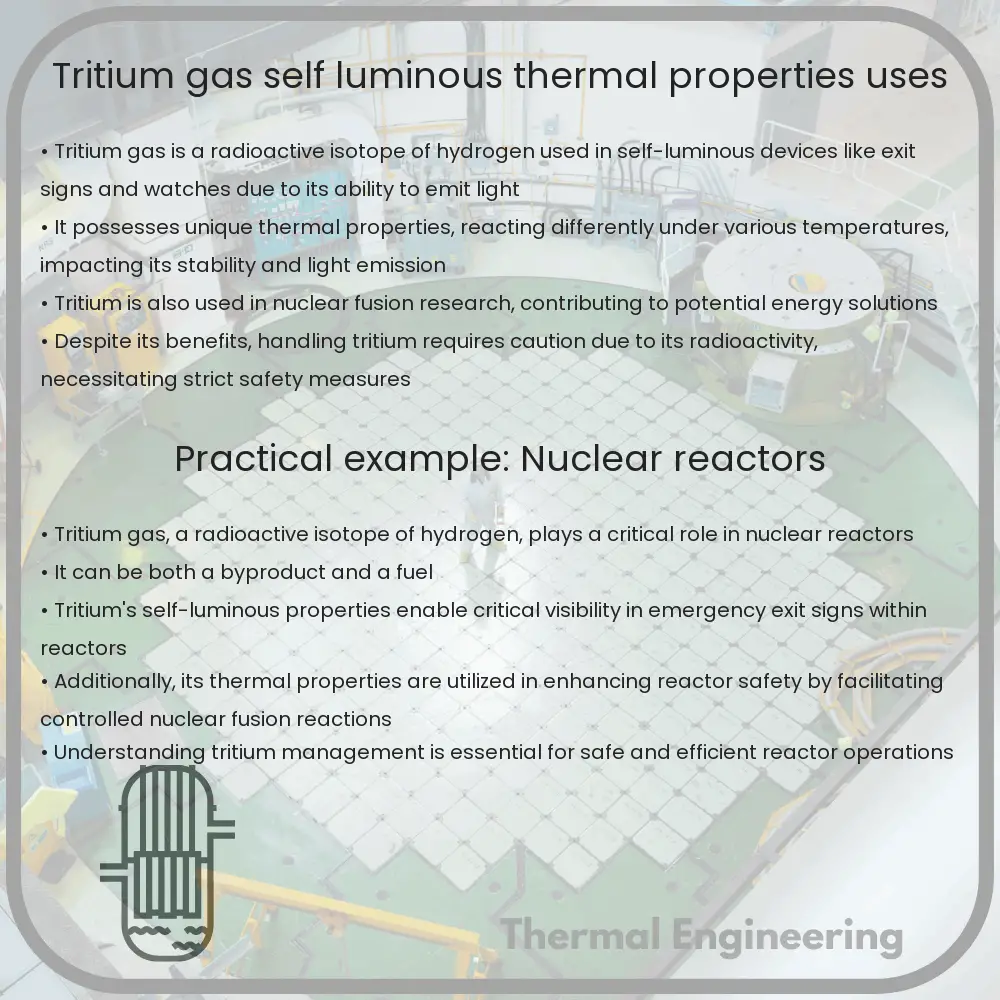
Tritium gas, denoted as 3H or T2, is a radioactive isotope of hydrogen. Comprising one proton and two neutrons, tritium is unique among the hydrogen isotopes for its radioactivity and has several distinctive physical and chemical properties that are exploited in various technological applications.

Self-Luminous Characteristics

Tritium is renowned for its ability to emit light through a process called radioluminescence. When tritium gas is sealed in phosphor-coated tubes, the beta particles (electrons) it emits interact with the phosphor material, causing the phosphor to glow. This luminescence does not require external energy sources, making tritium an ideal candidate for self-luminous applications:

  • Exit signs: Tritium is used in self-illuminated exit signs in buildings, which are reliable because they do not depend on external power sources.
  • Watches and instruments: The dials and displays of certain watches and aircraft instruments are coated with tritium to enable visibility in the dark.
  • Emergency lighting: Tritium provides low-level lighting for pathway marking in military and commercial aircraft, submarines, and in other areas where reliability is critical under all conditions.

Thermal Properties

The thermal characteristics of tritium are intriguing due to its radioactive nature. It undergoes beta decay to helium-3 with a half-life of approximately 12.32 years, releasing 18.6 keV of energy per decay. This decay process leads to a release of heat, a property that can be utilized in various ways:

  • Radioisotope Thermoelectric Generators (RTGs): Some proposed designs for RTGs suggest using tritium as a heat source to generate electricity in space missions, leveraging its decay heat.
  • Research: Understanding tritium’s decay and associated thermal output is crucial for nuclear fusion research, especially in experiments involving heavy water reactors where tritium is a byproduct.

Uses of Tritium

Beyond its self-luminosity and thermal properties, tritium has several other applications across diverse industries:

  • Nuclear Fusion: Tritium is a key fuel in nuclear fusion research due to its ability to release a significant amount of energy when fused with deuterium. Projects like the International Thermonuclear Experimental Reactor (ITER) focus heavily on utilizing the D-T (deuterium-tritium) fusion reaction.
  • Hydrology: As a tracer, tritium can help determine the age of recent groundwater, providing valuable information about water resources and hydrological cycles.
  • Scientific Research: Its radioactive properties make tritium useful in biological and chemical research, for tracing and labeling studies.

Tritium, despite its radioactive nature, poses minimal health risks in contained applications due to its weak penetration ability and low radiation energy. However, safety protocols and regulatory guidelines are strictly adhered to when handling and disposing of tritium to avoid environmental contamination and ensure public safety.

In conclusion, tritium’s unique properties make it invaluable across several fields, from emergency lighting to advancing our understanding and application of nuclear fusion technology. As research continues, the contributions of this small but mighty hydrogen isotope are expected to expand, illuminating both practical applications and fundamental scientific inquiries.

Nitric Oxide | Combustion Control, Thermal Properties

Understanding the role and properties of nitric oxide in combustion control and environmental impact, focusing on its formation, emission control techniques, and thermal characteristics.

Nitric Oxide | Combustion Control, Thermal Properties

The Role of Nitric Oxide in Combustion Control and Its Thermal Properties

Nitric oxide (NO) is a colorless, non-flammable gas at room temperature, notable primarily for its roles in various industrial processes and environmental phenomena. It forms a critical component of the nitrogen cycle in biology and also appears as a byproduct in combustion processes, such as those occurring in car engines and power plants. In engineering contexts, particularly concerning combustion control, nitric oxide plays a significant role in influencing flame characteristics and emissions.

Formation and Impact of Nitric Oxide in Combustion Processes

Nitric oxide is primarily formed during high-temperature combustion processes when nitrogen and oxygen atoms in the air combine. This occurs in two primary ways:

  1. Thermal NOx formation, which happens at very high temperatures (above 1300°C) when atmospheric nitrogen (N2) and oxygen (O2) react.
  2. Prompt NOx, which forms at relatively lower temperatures from the reaction between atmospheric nitrogen and radical hydrocarbons in the combustion zone.

The presence of nitric oxide in engine exhaust gases has led to significant environmental and health concerns, as NO can react with other molecules in the atmosphere to form smog and acid rain. Furthermore, nitric oxide is a precursor to nitrogen dioxide (NO2), a toxic and irritating gas.

Control of Nitric Oxide Emissions

Given the environmental impact of NO emissions, considerable efforts in engineering focus on minimizing the formation of nitric oxide during combustion and effectively managing it post-combustion:

  • Combustion Temperature Control: Maintaining lower combustion temperatures can significantly reduce NOx formation. Techniques such as exhaust gas recirculation (EGR) are used to cool the combustion chamber, thereby limiting nitric oxide formation.
  • Catalytic Reduction: Selective catalytic reduction (SCR) is a technique that uses a catalyst system and a reductant such as ammonia or urea to convert NOx into nitrogen and water, which are harmless.

Thermal Properties of Nitric Oxide

The thermal properties of nitric oxide are crucial for understanding its behavior under different conditions:

  • Melting Point: -164°C
  • Boiling Point: -152°C
  • Specific Heat Capacity: 0.995 kJ/kg·K at 15°C (at constant pressure)

These properties are essential for handling and storing nitric oxide, particularly in industrial applications where it is used or produced in large quantities.

Conclusion

Nitric oxide’s role in engineering, especially in the context of combustion and environmental control, is critical. Its formation during combustion can be detrimental to environmental health, propelling innovations and control measures to manage its production and mitigate impacts post-production. Understanding both the formation mechanisms and thermal properties of NO helps engineers to design more efficient and less polluting combustion systems.

Sulfur Trioxide | Acid Rain, Thermal Stability & Uses

Learn about sulfur trioxide (SO3), its industrial uses, formation processes, and environmental impacts including its role in acid rain.

Sulfur Trioxide | Acid Rain, Thermal Stability & Uses

Introduction to Sulfur Trioxide

Sulfur trioxide (SO3) is a chemical compound that plays a significant role in both the industrial sphere and environmental science. This colorless to white crystalline solid is primarily used in the production of sulfuric acid, one of the most important industrial chemicals in the world.

Formation and Thermal Stability

Sulfur trioxide can be formed through various methods, including the oxidation of sulfur dioxide (SO2) in the presence of a catalyst like vanadium pentoxide (V2O5) at 450°C. This reaction is represented by the equation:

2 SO2 + O2 → 2 SO3

This exothermic reaction is crucial in industrial processes, especially in the contact process for sulfuric acid production. The thermal stability of SO3 is significant, as it does not decompose easily at high temperatures, making it an efficient agent in high-temperature industrial applications.

Uses of Sulfur Trioxide

Sulfur trioxide’s primary use is in the synthesis of sulfuric acid. This is achieved by introducing SO3 into water, a reaction that is highly exothermic and needs to be controlled to prevent explosions:

SO3 + H2O → H2SO4

Beyond the manufacture of sulfuric acid, SO3 is also used in other chemical processes including the manufacture of detergents, explosives, and pharmaceuticals. Its ability to act as a sulfonating agent makes it valuable in organic synthesis, where it is used to introduce sulfonyl groups into organic molecules.

Impact on the Environment: Acid Rain

While sulfur trioxide is very useful, it also has negative impacts on the environment. One of the most notorious of these is the contribution to acid rain. Acid rain occurs when sulfur dioxide and sulfur trioxide are released into the atmosphere, usually from industrial processes or the burning of fossil fuels. They react with water vapor and other chemicals in the atmosphere to form sulfuric acid, which then falls as acid rain. This can have devastating effects on aquatic environments, forests, and even architectural structures made from limestone and marble, as illustrated by the following reactions:

SO3 + H2O → H2SO4 (in the atmosphere)

Acid rain affects plant life by releasing aluminum from the soil, which can be toxic to many plants and reduce soil nutrients essential for plant growth.

Conclusion

Sulfur trioxide, while immensely beneficial to the chemical industry, presents challenges and requires careful handling due to its role in acid rain and its highly reactive nature. Understanding its properties, safe handling measures, and environmental impact is crucial in managing its use in industry while minimizing environmental consequences.

Ethylene Glycol | Antifreeze, Thermal Conductivity & Uses

Learn about Ethylene Glycol, a petrochemical used in antifreeze and heat transfer fluids, and its applications, properties, and safety measures.

Ethylene Glycol | Antifreeze, Thermal Conductivity & Uses

Understanding Ethylene Glycol: Composition, Properties, and Uses

Ethylene glycol (C2H6O2) is a simple petrochemical compound that is widely utilized in various applications due to its unique properties. A colorless, odorless, slightly viscous liquid, ethylene glycol is primarily known for its use in antifreeze formulations and as a key component in heat transfer fluids.

Ethylene Glycol as Antifreeze

Ethylene glycol is perhaps most famous for its role in antifreeze. Antifreeze is crucial in preventing water-based liquids from freezing under cold conditions and from boiling off at higher temperatures. Ethylene glycol helps lower the freezing point of water, which makes it an excellent choice for use in automotive cooling systems and other systems that risk freezing or overheating.

  • Freezing Point Depression: When mixed with water, ethylene glycol disrupts the formation of ice crystals, which effectively lowers the freezing point of the mixture. This is essential for keeping car engines and other machinery operational in cold climates.
  • Boiling Point Elevation: As well as lowering the freezing point, ethylene glycol increases the boiling point of the mixture. This helps prevent the coolant from overheating and evaporating within the engine’s cooling system.

Thermal Conductivity of Ethylene Glycol

The thermal conductivity of a material is a measure of its ability to conduct heat. Ethylene glycol has a relatively low thermal conductivity compared to other fluids like water. However, its capability to function over a wide temperature range and its thermo-physical properties make it an effective medium for heat transfer applications.

  • Thermo-physical Properties: In addition to freezing and boiling point modifications, ethylene glycol has a high specific heat capacity and thermal expansion coefficient, which contribute to its effectiveness in heat transfer applications.

Additional Uses of Ethylene Glycol

Beyond its primary use in cooling systems, ethylene glycol finds application in several other areas:

  • Deicing Fluid: Ethylene glycol is used in the formulation of deicing solutions for aircraft, runways, and windshields to prevent ice formation during cold weather conditions.
  • Hydraulic and Brake Fluids: Its low freezing point also makes ethylene glycol suitable for use in hydraulic and brake fluids used in various transportation vehicles.
  • Solvent and Industrial Humectant: It is used as a solvent in the paint and plastics industries and as a humectant in the textile and cosmetic industries, where moisture retention is critical.

Health and Environmental Considerations

While ethylene glycol is invaluable in industrial applications, it is important to handle it with care due to its toxic nature. Ingestion of ethylene glycol can be harmful and potentially fatal. Moreover, spills and improper disposal can lead to environmental pollution affecting aquatic life and water quality. Regulations and safety guidelines are crucial for managing its use, disposal, and recycling effectively.

In conclusion, etheylenne glycol’s versatility in lowering freezing points and elevating boiling points, coupled with its use in heat transfer and as an industrial solvent, make it a widely used chemical in many sectors. However, its toxic nature and environmental impact call for careful handling and adherence to safety standards.

Synthetic Air | Calibration, Thermal Properties & Uses

Learn about synthetic air, its precise composition, key roles in calibration and industrial applications, and vital thermal properties.

Synthetic Air | Calibration, Thermal Properties & Uses

Understanding Synthetic Air: Composition, Calibration, and Thermal Properties

Synthetic air is a meticulously engineered blend of gases used primarily for scientific research, calibration of air monitoring equipment, and various industrial applications. Essentially, it simulates the composition of Earth’s atmosphere and offers a controlled baseline for experiments and equipment testing. Understanding its properties and uses is essential for professionals in numerous fields of science and engineering.

Composition of Synthetic Air

Synthetic air is primarily composed of nitrogen (N2) and oxygen (O2), the two most abundant gases in Earth’s atmosphere. The typical ratio closely mimics that of natural air, with about 78% nitrogen and 21% oxygen. The remaining 1% consists of argon and other trace gases. However, unlike natural air, synthetic air is often devoid of variable components like water vapor, carbon dioxide, and other pollutants, unless specifically added for a particular application.

Calibration of Instruments Using Synthetic Air

The primary use of synthetic air is in the calibration of air monitoring and analytical instruments. Calibration is crucial for ensuring that devices provide accurate readings. For example, gas detection instruments used in environmental monitoring, safety systems in industrial settings, and medical applications often require regular calibration with synthetic air to maintain accuracy.

  • The consistency and purity of synthetic air allow for high-reliability calibration.
  • It helps in establishing a reference point for measuring concentrations of pollutants and other gases.
  • Synthetic air can be enriched with specific gases like carbon monoxide or methane to create calibration standards for various scenarios.

Thermal Properties of Synthetic Air

Synthetic air has thermal properties close to those of natural air since its major components are the same. These properties are crucial in applications involving heat exchange, combustion processes, and thermal energy studies among others. A key aspect of its thermal behavior is characterized by specific heat capacity, thermal conductivity, and density:

  • Specific Heat Capacity: The ability to absorb heat with changes in temperature. For synthetic air, typical values are around 1005 J/(kg*K) at constant pressure and 718 J/(kg*K) at constant volume.
  • Thermal Conductivity: The rate at which heat passes through a specified material, generally falling within the range of 0.024 to 0.026 W/(m*K) at room temperature.
  • Density: This varies with temperature and pressure, following the ideal gas law PV = nRT (where P is pressure, V is volume, n is the amount of substance, R is the gas constant, and T is temperature in Kelvin).

Applications of Synthetic Air

Beyond its use in calibration, synthetic air supports a wide array of applications. Its production and delivery in controlled, contaminant-free conditions make it ideal for sectors where purity is paramount.

  1. Laboratory Research: Provides a stable atmosphere for experiments, particularly in chemical reactions, where introducing variables can lead to unwanted results.
  2. Healthcare: Used in respiratory apparatus for patients, ensuring that they breathe clean and controlled air compositions.
  3. Aerospace and Automotive Testing: Utilized in engine testing facilities to simulate real-world atmospheric conditions under controlled lab environments.
  4. Electronics Manufacturing: Prevents contamination during the production of sensitive electronic components.

Through its versatile applications and fundamental role in science and technology, synthetic air greatly assists in enhancing environmental sustainability, supporting medical advancements, and promoting manufacturing precision. Grasping its properties and functionality can enable engineers and scientists to optimize its use and explore further potential applications.