Example of Carnot Efficiency – Problem with Solution. Calculate the carnot efficiency of coal-fired power plant. Compare it with real cycles of power plants. Thermal Engineering
Carnot Cycle – Processes
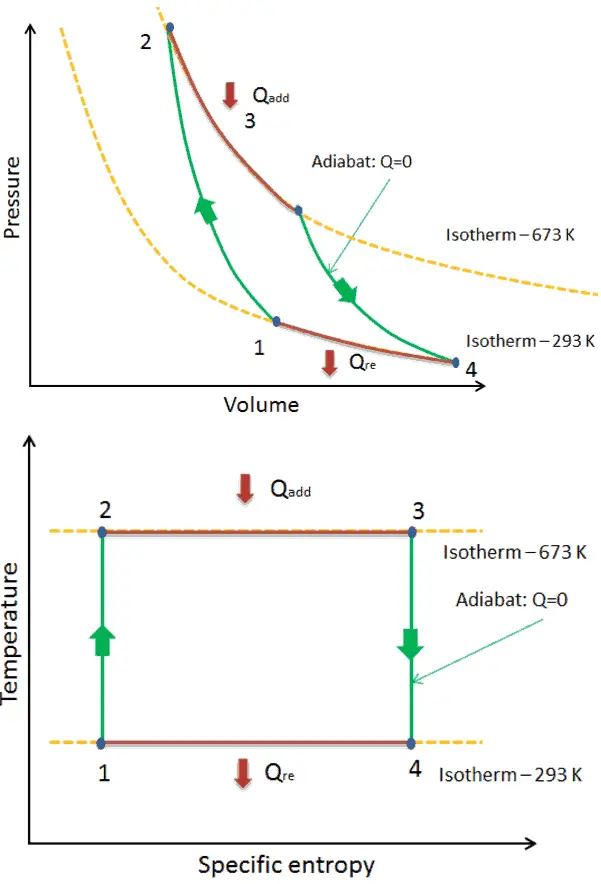
In a Carnot cycle, the system executing the cycle undergoes a series of four internally reversible processes: two isentropic processes (reversible adiabatic) alternated with twoisothermal processes:
isentropic compression – The gas is compressed adiabatically from state 1 to state 2, where the temperature is TH. The surroundings do work on the gas, increasing its internal energy and compressing it. On the other hand the entropy remains unchanged.
Isothermal expansion – The system is placed in contact with the reservoir at TH. The gas expands isothermally while receiving energy QH from the hot reservoir by heat transfer. The temperature of the gas does not change during the process. The gas does work on the surroundings. The total entropy change is given by: ∆S = S1 – S4 = QH/TH
isentropic expansion – The gas expands adiabatically from state 3 to state 4, where the temperature is TC. The gas does work on the surroundings and loses an amount of internal energy equal to the work that leaves the system. Again the entropy remains unchanged.
isothermal compression – The system is placed in contact with the reservoir at TC. The gas compresses isothermally to its initial state while it discharges energy QC to the cold reservoir by heat transfer. In this process the surroundings do work on the gas. The total entropy change is given by: ∆S = S3 – S2 = QC/TC
Carnot Cycle Efficiency
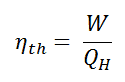
In general, the thermal efficiency, ηth, of any heat engine is defined as the ratio of the net work it does, W, to the heat input at the high temperature, QH.
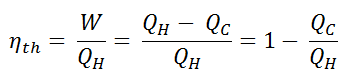
Since energy is conserved according to the first law of thermodynamicsand energy cannot be be converted to work completely, the heat input, QH, must equal the work done, W, plus the heat that must be dissipated as waste heat QC into the environment. Therefore we can rewrite the formula for thermal efficiency as:
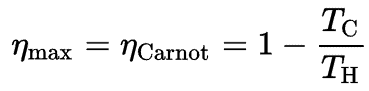
Since QC = ∆S.TCand QH = ∆S.TH, the formula for this maximum efficiency is:
where:
is the efficiency of Carnot cycle, i.e. it is the ratio = W/QH of the work done by the engine to the heat energy entering the system from the hot reservoir.
TC is the absolute temperature (Kelvins) of the cold reservoir,
TH is the absolute temperature (Kelvins) of the hot reservoir.
Example: Carnot efficiency for coal-fired power plant
In a modern coal-fired power plant, the temperature of high pressure steam (Thot) would be about 400°C (673K) and Tcold, the cooling tower water temperature, would be about 20°C (293K). For this type of power plant the maximum (ideal) efficiency will be:
ηth= 1 – Tcold/Thot = 1 – 293/673 = 56%
It must be added, this is an idealized efficiency. The Carnot efficiency is valid for reversible processes. These processes cannot be achieved in real cycles of power plants. The Carnot efficiency dictates that higher efficiencies can be attained by increasing the temperature of the steam. This feature is valid also for real thermodynamic cycles. But this requires an increase in pressures inside boilers or steam generators. However, metallurgical considerations place an upper limits on such pressures. Sub-critical fossil fuel power plants, that are operated under critical pressure (i.e. lower than 22.1 MPa), can achieve 36–40% efficiency. Supercritical designs, that are operated at supercritical pressure (i.e. greater than 22.1 MPa), have efficiencies around 43%. Most efficient and also very complex coal-fired power plants that are operated at “ultra critical” pressures (i.e. around 30 MPa) and use multiple stage reheat reach about 48% efficiency.
Robert Reed Burn, Introduction to Nuclear Reactor Operation, 1988.
U.S. Department of Energy, Nuclear Physics and Reactor Theory. DOE Fundamentals Handbook, Volume 1 and 2. January 1993.
Advanced Reactor Physics:
K. O. Ott, W. A. Bezella, Introductory Nuclear Reactor Statics, American Nuclear Society, Revised edition (1989), 1989, ISBN: 0-894-48033-2.
K. O. Ott, R. J. Neuhold, Introductory Nuclear Reactor Dynamics, American Nuclear Society, 1985, ISBN: 0-894-48029-4.
D. L. Hetrick, Dynamics of Nuclear Reactors, American Nuclear Society, 1993, ISBN: 0-894-48453-2.
E. E. Lewis, W. F. Miller, Computational Methods of Neutron Transport, American Nuclear Society, 1993, ISBN: 0-894-48452-4.
See also:
Carnot Cycle
We hope, this article, Example of Carnot Efficiency – Problem with Solution, helps you. If so, give us a like in the sidebar. Main purpose of this website is to help the public to learn some interesting and important information about thermal engineering.
According to the Mayer’s relation or the Mayer’s formula the difference between these two heat capacities is equal to the universal gas constant. Cp = Cv + R
Mayer’s relation – Mayer’s formula
Julius Robert Mayer, a German chemist and physicist, derived a relation between specific heat at constant pressure and the specific heat at constant volume for an ideal gas. He studied the fact that the specific heat capacity of a gas at constant pressure (Cp) is slightly greater than at constant volume (Cv). He reasoned that this Cp is greater than the molar specific heat at constant volume Cv, because energy must now be supplied not only to raise the temperature of the gas but also for the gas to do work because in this case volume changes. According to the Mayer’s relation or the Mayer’s formula the difference between these two heat capacities is equal to the universal gas constant, thus the molar specific heat at constant pressure is equal:
Cp = Cv + R
References:
Reactor Physics and Thermal Hydraulics:
J. R. Lamarsh, Introduction to Nuclear Reactor Theory, 2nd ed., Addison-Wesley, Reading, MA (1983).
J. R. Lamarsh, A. J. Baratta, Introduction to Nuclear Engineering, 3d ed., Prentice-Hall, 2001, ISBN: 0-201-82498-1.
W. M. Stacey, Nuclear Reactor Physics, John Wiley & Sons, 2001, ISBN: 0- 471-39127-1.
Todreas Neil E., Kazimi Mujid S. Nuclear Systems Volume I: Thermal Hydraulic Fundamentals, Second Edition. CRC Press; 2 edition, 2012, ISBN: 978-0415802871
Zohuri B., McDaniel P. Thermodynamics in Nuclear Power Plant Systems. Springer; 2015, ISBN: 978-3-319-13419-2
Moran Michal J., Shapiro Howard N. Fundamentals of Engineering Thermodynamics, Fifth Edition, John Wiley & Sons, 2006, ISBN: 978-0-470-03037-0
Kleinstreuer C. Modern Fluid Dynamics. Springer, 2010, ISBN 978-1-4020-8670-0.
U.S. Department of Energy, THERMODYNAMICS, HEAT TRANSFER, AND FLUID FLOW. DOE Fundamentals Handbook, Volume 1, 2 and 3. June 1992.
See also:
Ideal Gas Law
We hope, this article, Mayer’s relation – Mayer’s formula, helps you. If so, give us a like in the sidebar. Main purpose of this website is to help the public to learn some interesting and important information about thermal engineering.
In general, the gas laws are first equations of state, that correlate densities of gases and liquids to temperatures and pressures. The gas laws were completely developed at the end of the 18th century. Thermal Engineering
Gas Laws
In general, the gas laws are first equations of state, that correlate densities of gases and liquids to temperatures and pressures. The gas laws were completely developed at the end of the 18th century. These laws or statements preceded the ideal gas law, since individually these laws are considered as special cases of the ideal gas equation, with one or more of the variables held constant. Since they have been almost completely replaced by the ideal gas equation, it is not usual for students to learn these laws in detail. The ideal gas equation was first stated by Émile Clapeyron in 1834 as a combination of these laws:
Boyle-Mariotte Law
Boyle-Mariotte Law is one of the gas laws. At the end of the 17th century, Robert William Boyle and Edme Mariotte independently studied the relationship between the volume and pressure of a gas at constant temperature. The results of certain experiments with gases at relatively low pressure led Robert Boyle to formulate a well-known law. It states that:
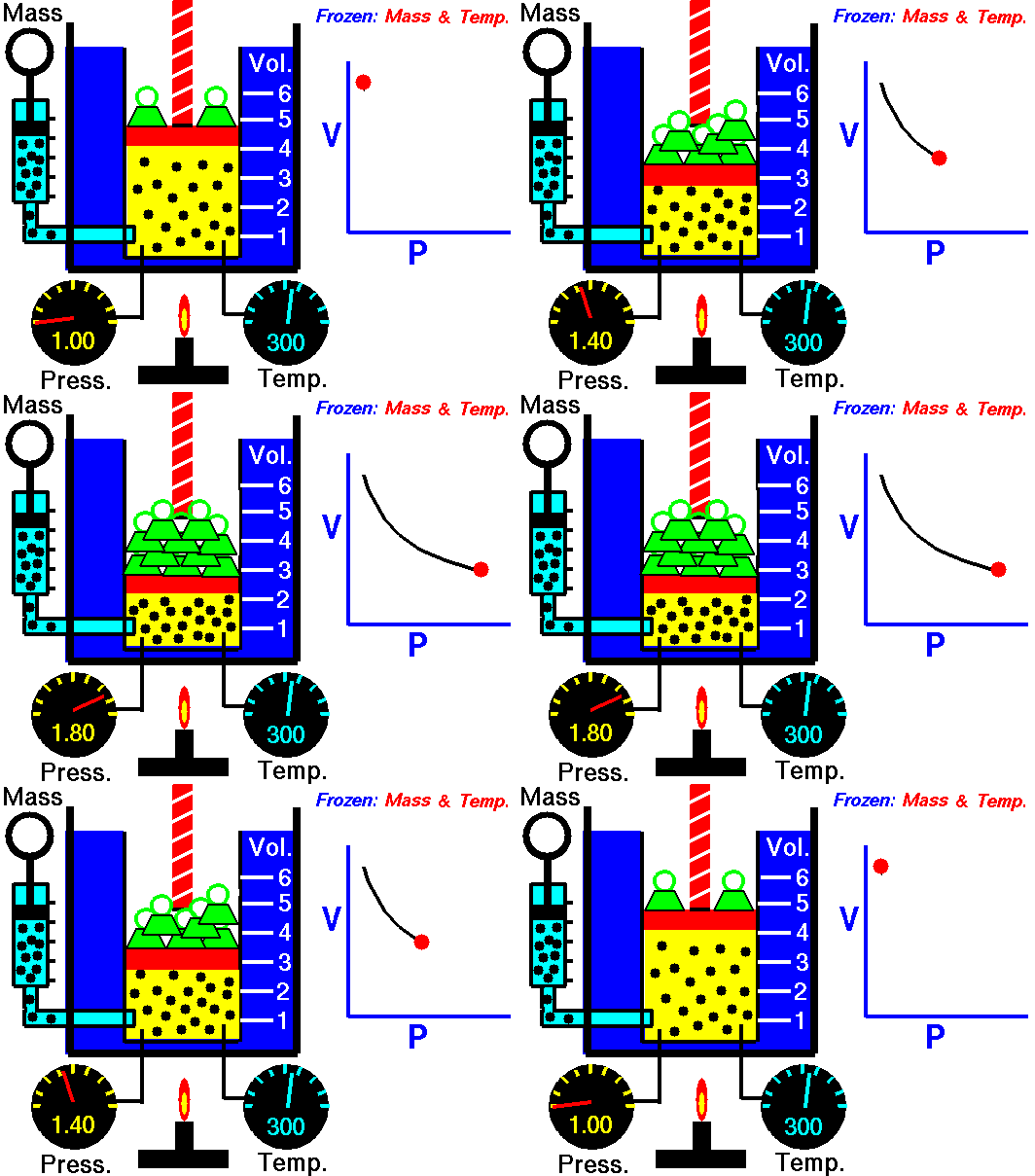
For a fixed mass of gas at constant temperature, the volume is inversely proportional to the pressure.
That means that, for example, if you increase the volume 10 times, the pressure will decrease 10 times. If you halve the volume, you will double the pressure.
You can express this mathematically as:
pV = constant
or
p1V1 = p2V2
Yes, it seems to be identical as isothermal process of ideal gas. In fact, during their experiments the temperature remain constant as was assumed by Mariotte. These results are fully consistent with ideal gas law, which determinates, that the constant is equal to nRT.
pV = nRT
where:
p is the absolute pressure of the gas
n is the amount of substance
T is the absolute temperature
V is the volume
R is the ideal, or universal, gas constant, equal to the product of the Boltzmann constant and the Avogadro constant,
In this equation the symbol R is a constant called the universal gas constant that has the same value for all gases—namely, R = 8.31 J/mol K.
For a fixed mass of gas at constant temperature, the volume is inversely proportional to the pressure. Source: grc.nasa.gov NASA copyright policy states that “NASA material is not protected by copyright unless noted”.
Charles’s Law
Charles’s Law is one of the gas laws. At the end of the 18th century, a French inventor and scientist Jacques Alexandre César Charles studied the relationship between the volume and the temperature of a gas at constant pressure. The results of certain experiments with gases at relatively low pressure led Jacques Alexandre César Charles to formulate a well-known law. It states that:
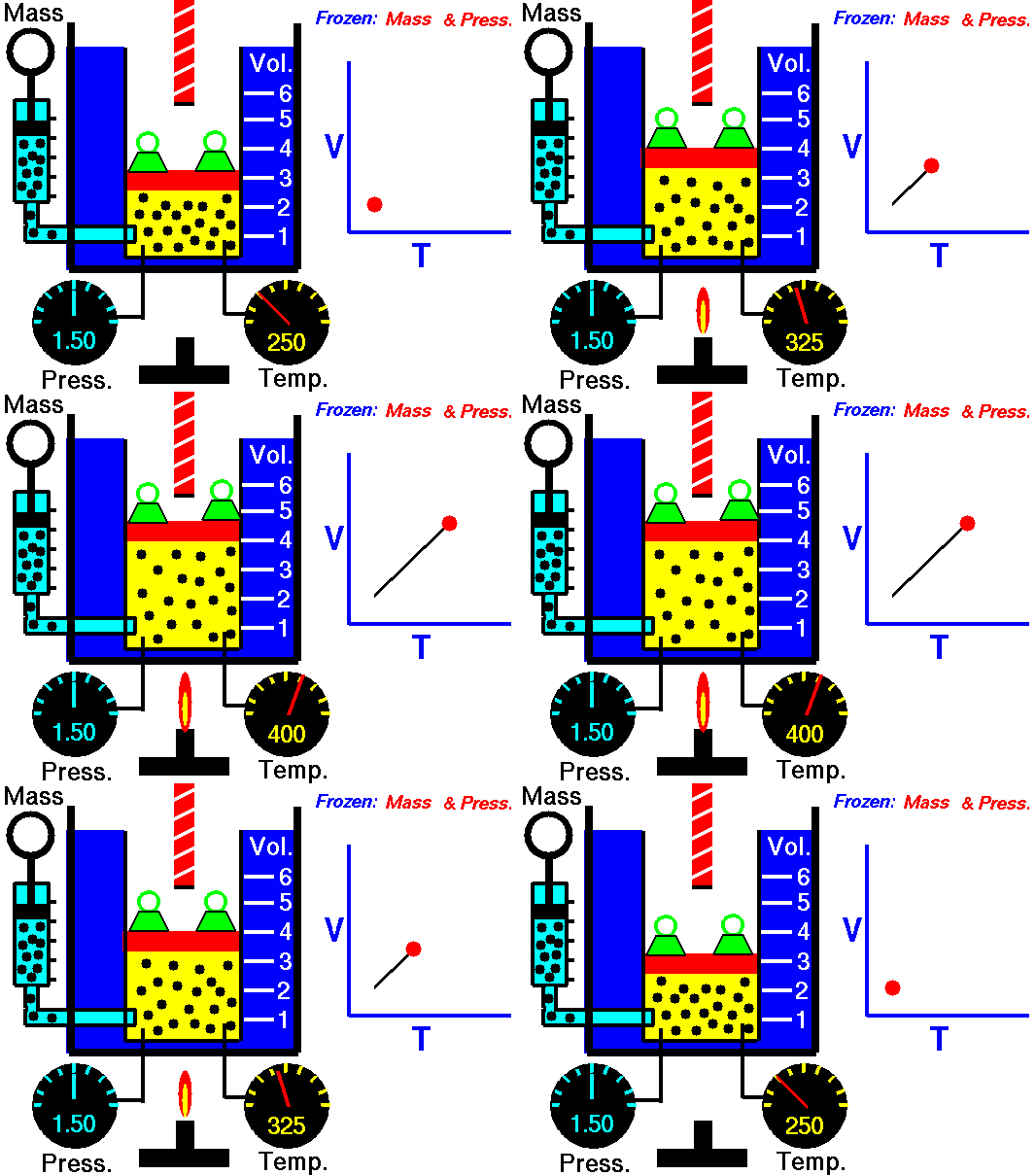
For a fixed mass of gas at constant pressure, the volume is directly proportional to the Kelvin temperature.
That means that, for example, if you double the temperature, you will double the volume. If you halve the temperature, you will halve the volume.
You can express this mathematically as:
V = constant . T
Yes, it seems to be identical as isobaric process of ideal gas. These results are fully consistent with ideal gas law, which determinates, that the constant is equal to nR/p. If you rearrange the pV = nRT equation by dividing both sides by p, you will obtain:
V = nR/p . T
where nR/p is constant and:
p is the absolute pressure of the gas
n is the amount of substance
T is the absolute temperature
V is the volume
R is the ideal, or universal, gas constant, equal to the product of the Boltzmann constant and the Avogadro constant,
In this equation the symbol R is a constant called the universal gas constant that has the same value for all gases—namely, R = 8.31 J/mol K.
For a fixed mass of gas at constant pressure, the volume is directly proportional to the Kelvin temperature. Source: grc.nasa.gov NASA copyright policy states that “NASA material is not protected by copyright unless noted”.
Guy-Lussac’s Law
Guy-Lussac’s Law or the Pressure Law is one of the gas laws. In the late 18th and early 19th centuries, it was discovered by French chemist Joseph Louis Gay-Lussac. He studied the relationship between the pressure and the temperature of a gas at constant volume. The results of certain experiments with gases at relatively low pressure led Joseph Louis Gay-Lussac to formulate a well-known “Pressure Law”. It states that:
For a fixed mass of gas at constant volume, the pressure is directly proportional to the Kelvin temperature.
That means that, for example, if you double the temperature, you will double the pressure. If you halve the temperature, you will halve the pressure.
You can express this mathematically as:
p = constant . T
Yes, it seems to be identical as isochoric process of ideal gas. These results are fully consistent with ideal gas law, which determinates, that the constant is equal to nR/V. If you rearrange the pV = nRT equation by dividing both sides by V, you will obtain:
p = nR/V . T
where nR/V is constant and:
p is the absolute pressure of the gas
n is the amount of substance
T is the absolute temperature
V is the volume
R is the ideal, or universal, gas constant, equal to the product of the Boltzmann constant and the Avogadro constant,
In this equation the symbol R is a constant called the universal gas constant that has the same value for all gases—namely, R = 8.31 J/mol K.
For a fixed mass of gas at constant volume, the pressure is directly proportional to the Kelvin temperature. Source: grc.nasa.gov NASA copyright policy states that “NASA material is not protected by copyright unless noted”.
Avogadro’s Law
Avogadro’s Law is one of the gas laws. At the beginning of the 19th century, an Italian scientist Lorenzo Romano Amedeo Carlo Avogadro studied the relationship between the volume and the amount of substance of gas present. The results of certain experiments with gases led him to formulate a well-known Avogadro’s Law. It states that, under the same conditions of temperature and pressure, equal volumes of different gases contain an equal number of molecules, or:
For a fixed mass of an ideal gas at constant pressure and temperature, the volume and amount of the gas are directly proportional.
You can express this mathematically as:
V ∝ n
or
V = constant . n
where nR/V is constant and:
n is the amount of substance measured in moles
V is the volume of the gas
the constant is equal is to RT/p, where p is the absolute pressure of the gas, T is the absolute temperature and R is the ideal, or universal, gas constant, equal to the product of the Boltzmann constant and the Avogadro constant.
Avogadro’s Number
In tribute to Avogadro, also the number of particles (atoms, molecules, ions or other particles) in 1 mole of a substance, 6.022×10²³, was named after Avogadro as the Avogadro constant or Avogadro number. The Avogadro constant is one of the seven SI base units and represented by NA.
The Avogadro’s Law can be used for comparing the same substance under two different sets of conditions:
V1 / n1 = V2 / n2
Molar Volume of Gases
One of the most practical results of this law is the molar volume of a gases, Vm, which is about:
Vm = 22.4 dm3 / mol
It means, at standard temperature (273.15 K, 0°C) and standard atmospheric pressure (101.325 kPa) the molar volume is the same for all ideal gases. Note that, it is under the ideal gas assumption. This value is strongly dependent on the pressure and the temperature. For example:
for 273.15 K (0°C) and 100.00 kPa, the molar volume of an ideal gas is 22.71 dm3.mol−1.
for 298.15 K (25°C) and 100.00 kPa, the molar volume of an ideal gas is 24.79 dm3.mol−1.
References:
Reactor Physics and Thermal Hydraulics:
J. R. Lamarsh, Introduction to Nuclear Reactor Theory, 2nd ed., Addison-Wesley, Reading, MA (1983).
J. R. Lamarsh, A. J. Baratta, Introduction to Nuclear Engineering, 3d ed., Prentice-Hall, 2001, ISBN: 0-201-82498-1.
W. M. Stacey, Nuclear Reactor Physics, John Wiley & Sons, 2001, ISBN: 0- 471-39127-1.
Todreas Neil E., Kazimi Mujid S. Nuclear Systems Volume I: Thermal Hydraulic Fundamentals, Second Edition. CRC Press; 2 edition, 2012, ISBN: 978-0415802871
Zohuri B., McDaniel P. Thermodynamics in Nuclear Power Plant Systems. Springer; 2015, ISBN: 978-3-319-13419-2
Moran Michal J., Shapiro Howard N. Fundamentals of Engineering Thermodynamics, Fifth Edition, John Wiley & Sons, 2006, ISBN: 978-0-470-03037-0
Kleinstreuer C. Modern Fluid Dynamics. Springer, 2010, ISBN 978-1-4020-8670-0.
U.S. Department of Energy, THERMODYNAMICS, HEAT TRANSFER, AND FLUID FLOW. DOE Fundamentals Handbook, Volume 1, 2 and 3. June 1992.
See also:
Ideal Gas Law
We hope, this article, Gas Law, helps you. If so, give us a like in the sidebar. Main purpose of this website is to help the public to learn some interesting and important information about thermal engineering.
Boyle-Mariotte Law is one of the gas laws. Boyle and Mariotte independently studied the relationship between the volume and pressure of a gas at constant temperature. Thermal Engineering
Boyle-Mariotte Law
Boyle-Mariotte Law is one of the gas laws. At the end of the 17th century, Robert William Boyle and Edme Mariotte independently studied the relationship between the volume and pressure of a gas at constant temperature. The results of certain experiments with gases at relatively low pressure led Robert Boyle to formulate a well-known law. It states that:
For a fixed mass of gas at constant temperature, the volume is inversely proportional to the pressure.
That means that, for example, if you increase the volume 10 times, the pressure will decrease 10 times. If you halve the volume, you will double the pressure.
You can express this mathematically as:
pV = constant
or
p1V1 = p2V2
Yes, it seems to be identical as isothermal process of ideal gas. In fact, during their experiments the temperature remain constant as was assumed by Mariotte. These results are fully consistent with ideal gas law, which determinates, that the constant is equal to nRT.
pV = nRT
where:
p is the absolute pressure of the gas
n is the amount of substance
T is the absolute temperature
V is the volume
R is the ideal, or universal, gas constant, equal to the product of the Boltzmann constant and the Avogadro constant,
In this equation the symbol R is a constant called the universal gas constant that has the same value for all gases—namely, R = 8.31 J/mol K.
For a fixed mass of gas at constant temperature, the volume is inversely proportional to the pressure. Source: grc.nasa.gov NASA copyright policy states that “NASA material is not protected by copyright unless noted”.
References:
Reactor Physics and Thermal Hydraulics:
J. R. Lamarsh, Introduction to Nuclear Reactor Theory, 2nd ed., Addison-Wesley, Reading, MA (1983).
J. R. Lamarsh, A. J. Baratta, Introduction to Nuclear Engineering, 3d ed., Prentice-Hall, 2001, ISBN: 0-201-82498-1.
W. M. Stacey, Nuclear Reactor Physics, John Wiley & Sons, 2001, ISBN: 0- 471-39127-1.
Todreas Neil E., Kazimi Mujid S. Nuclear Systems Volume I: Thermal Hydraulic Fundamentals, Second Edition. CRC Press; 2 edition, 2012, ISBN: 978-0415802871
Zohuri B., McDaniel P. Thermodynamics in Nuclear Power Plant Systems. Springer; 2015, ISBN: 978-3-319-13419-2
Moran Michal J., Shapiro Howard N. Fundamentals of Engineering Thermodynamics, Fifth Edition, John Wiley & Sons, 2006, ISBN: 978-0-470-03037-0
Kleinstreuer C. Modern Fluid Dynamics. Springer, 2010, ISBN 978-1-4020-8670-0.
U.S. Department of Energy, THERMODYNAMICS, HEAT TRANSFER, AND FLUID FLOW. DOE Fundamentals Handbook, Volume 1, 2 and 3. June 1992.
See also:
Gas Laws
We hope, this article, Boyle-Mariotte Law, helps you. If so, give us a like in the sidebar. Main purpose of this website is to help the public to learn some interesting and important information about thermal engineering.
Charles’s Law is one of the gas laws. Jacques Alexandre César Charles studied the relationship between the volume and the temperature of a gas at constant pressure. Thermal Engineering
Charles’s Law
Charles’s Law is one of the gas laws. At the end of the 18th century, a French inventor and scientist Jacques Alexandre César Charles studied the relationship between the volume and the temperature of a gas at constant pressure. The results of certain experiments with gases at relatively low pressure led Jacques Alexandre César Charles to formulate a well-known law. It states that:
For a fixed mass of gas at constant pressure, the volume is directly proportional to the Kelvin temperature.
That means that, for example, if you double the temperature, you will double the volume. If you halve the temperature, you will halve the volume.
You can express this mathematically as:
V = constant . T
Yes, it seems to be identical as isobaric process of ideal gas. These results are fully consistent with ideal gas law, which determinates, that the constant is equal to nR/p. If you rearrange the pV = nRT equation by dividing both sides by p, you will obtain:
V = nR/p . T
where nR/p is constant and:
p is the absolute pressure of the gas
n is the amount of substance
T is the absolute temperature
V is the volume
R is the ideal, or universal, gas constant, equal to the product of the Boltzmann constant and the Avogadro constant,
In this equation the symbol R is a constant called the universal gas constant that has the same value for all gases—namely, R = 8.31 J/mol K.
For a fixed mass of gas at constant pressure, the volume is directly proportional to the Kelvin temperature. Source: grc.nasa.gov NASA copyright policy states that “NASA material is not protected by copyright unless noted”.
References:
Reactor Physics and Thermal Hydraulics:
J. R. Lamarsh, Introduction to Nuclear Reactor Theory, 2nd ed., Addison-Wesley, Reading, MA (1983).
J. R. Lamarsh, A. J. Baratta, Introduction to Nuclear Engineering, 3d ed., Prentice-Hall, 2001, ISBN: 0-201-82498-1.
W. M. Stacey, Nuclear Reactor Physics, John Wiley & Sons, 2001, ISBN: 0- 471-39127-1.
Todreas Neil E., Kazimi Mujid S. Nuclear Systems Volume I: Thermal Hydraulic Fundamentals, Second Edition. CRC Press; 2 edition, 2012, ISBN: 978-0415802871
Zohuri B., McDaniel P. Thermodynamics in Nuclear Power Plant Systems. Springer; 2015, ISBN: 978-3-319-13419-2
Moran Michal J., Shapiro Howard N. Fundamentals of Engineering Thermodynamics, Fifth Edition, John Wiley & Sons, 2006, ISBN: 978-0-470-03037-0
Kleinstreuer C. Modern Fluid Dynamics. Springer, 2010, ISBN 978-1-4020-8670-0.
U.S. Department of Energy, THERMODYNAMICS, HEAT TRANSFER, AND FLUID FLOW. DOE Fundamentals Handbook, Volume 1, 2 and 3. June 1992.
See also:
Gas Laws
We hope, this article, Charles’s Law, helps you. If so, give us a like in the sidebar. Main purpose of this website is to help the public to learn some interesting and important information about thermal engineering.
Guy-Lussac’s Law or the Pressure Law is one of the gas laws. Gay-Lussac studied the relationship between the pressure and the temperature of a gas at constant volume. Thermal Engineering
Guy-Lussac’s Law
Guy-Lussac’s Law or the Pressure Law is one of the gas laws. In the late 18th and early 19th centuries, it was discovered by French chemist Joseph Louis Gay-Lussac. He studied the relationship between the pressure and the temperature of a gas at constant volume. The results of certain experiments with gases at relatively low pressure led Joseph Louis Gay-Lussac to formulate a well-known “Pressure Law”. It states that:
For a fixed mass of gas at constant volume, the pressure is directly proportional to the Kelvin temperature.
That means that, for example, if you double the temperature, you will double the pressure. If you halve the temperature, you will halve the pressure.
You can express this mathematically as:
p = constant . T
Yes, it seems to be identical as isochoric process of ideal gas. These results are fully consistent with ideal gas law, which determinates, that the constant is equal to nR/V. If you rearrange the pV = nRT equation by dividing both sides by V, you will obtain:
p = nR/V . T
where nR/V is constant and:
p is the absolute pressure of the gas
n is the amount of substance
T is the absolute temperature
V is the volume
R is the ideal, or universal, gas constant, equal to the product of the Boltzmann constant and the Avogadro constant,
In this equation the symbol R is a constant called the universal gas constant that has the same value for all gases—namely, R = 8.31 J/mol K.
For a fixed mass of gas at constant volume, the pressure is directly proportional to the Kelvin temperature. Source: grc.nasa.gov NASA copyright policy states that “NASA material is not protected by copyright unless noted”.
References:
Reactor Physics and Thermal Hydraulics:
J. R. Lamarsh, Introduction to Nuclear Reactor Theory, 2nd ed., Addison-Wesley, Reading, MA (1983).
J. R. Lamarsh, A. J. Baratta, Introduction to Nuclear Engineering, 3d ed., Prentice-Hall, 2001, ISBN: 0-201-82498-1.
W. M. Stacey, Nuclear Reactor Physics, John Wiley & Sons, 2001, ISBN: 0- 471-39127-1.
Todreas Neil E., Kazimi Mujid S. Nuclear Systems Volume I: Thermal Hydraulic Fundamentals, Second Edition. CRC Press; 2 edition, 2012, ISBN: 978-0415802871
Zohuri B., McDaniel P. Thermodynamics in Nuclear Power Plant Systems. Springer; 2015, ISBN: 978-3-319-13419-2
Moran Michal J., Shapiro Howard N. Fundamentals of Engineering Thermodynamics, Fifth Edition, John Wiley & Sons, 2006, ISBN: 978-0-470-03037-0
Kleinstreuer C. Modern Fluid Dynamics. Springer, 2010, ISBN 978-1-4020-8670-0.
U.S. Department of Energy, THERMODYNAMICS, HEAT TRANSFER, AND FLUID FLOW. DOE Fundamentals Handbook, Volume 1, 2 and 3. June 1992.
See also:
Gas Laws
We hope, this article, Guy-Lussac’s Law, helps you. If so, give us a like in the sidebar. Main purpose of this website is to help the public to learn some interesting and important information about thermal engineering.
Avogadro’s Law is one of the gas laws. Avogadro studied the relationship between the volume and the amount of substance of gas present.
Avogadro’s Law
Avogadro’s Law is one of the gas laws. At the beginning of the 19th century, an Italian scientist Lorenzo Romano Amedeo Carlo Avogadro studied the relationship between the volume and the amount of substance of gas present. The results of certain experiments with gases led him to formulate a well-known Avogadro’s Law. It states that, under the same conditions of temperature and pressure, equal volumes of different gases contain an equal number of molecules, or:
For a fixed mass of an ideal gas at constant pressure and temperature, the volume and amount of the gas are directly proportional.
You can express this mathematically as:
V ∝ n
or
V = constant . n
where nR/V is constant and:
n is the amount of substance measured in moles
V is the volume of the gas
the constant is equal is to RT/p, where p is the absolute pressure of the gas, T is the absolute temperature and R is the ideal, or universal, gas constant, equal to the product of the Boltzmann constant and the Avogadro constant.
Avogadro’s Number
In tribute to Avogadro, also the number of particles (atoms, molecules, ions or other particles) in 1 mole of a substance, 6.022×10²³, was named after Avogadro as the Avogadro constant or Avogadro number. The Avogadro constant is one of the seven SI base units and represented by NA.
The Avogadro’s Law can be used for comparing the same substance under two different sets of conditions:
V1 / n1 = V2 / n2
Molar Volume of Gases
One of the most practical results of this law is the molar volume of a gases, Vm, which is about:
Vm = 22.4 dm3 / mol
It means, at standard temperature (273.15 K, 0°C) and standard atmospheric pressure (101.325 kPa) the molar volume is the same for all ideal gases. Note that, it is under the ideal gas assumption. This value is strongly dependent on the pressure and the temperature. For example:
for 273.15 K (0°C) and 100.00 kPa, the molar volume of an ideal gas is 22.71 dm3.mol−1.
for 298.15 K (25°C) and 100.00 kPa, the molar volume of an ideal gas is 24.79 dm3.mol−1.
References:
Reactor Physics and Thermal Hydraulics:
J. R. Lamarsh, Introduction to Nuclear Reactor Theory, 2nd ed., Addison-Wesley, Reading, MA (1983).
J. R. Lamarsh, A. J. Baratta, Introduction to Nuclear Engineering, 3d ed., Prentice-Hall, 2001, ISBN: 0-201-82498-1.
W. M. Stacey, Nuclear Reactor Physics, John Wiley & Sons, 2001, ISBN: 0- 471-39127-1.
Todreas Neil E., Kazimi Mujid S. Nuclear Systems Volume I: Thermal Hydraulic Fundamentals, Second Edition. CRC Press; 2 edition, 2012, ISBN: 978-0415802871
Zohuri B., McDaniel P. Thermodynamics in Nuclear Power Plant Systems. Springer; 2015, ISBN: 978-3-319-13419-2
Moran Michal J., Shapiro Howard N. Fundamentals of Engineering Thermodynamics, Fifth Edition, John Wiley & Sons, 2006, ISBN: 978-0-470-03037-0
Kleinstreuer C. Modern Fluid Dynamics. Springer, 2010, ISBN 978-1-4020-8670-0.
U.S. Department of Energy, THERMODYNAMICS, HEAT TRANSFER, AND FLUID FLOW. DOE Fundamentals Handbook, Volume 1, 2 and 3. June 1992.
See also:
Gas Laws
We hope, this article, Avogadro’s Law, helps you. If so, give us a like in the sidebar. Main purpose of this website is to help the public to learn some interesting and important information about thermal engineering.
6.022×10^23 was named after Avogadro as the Avogadro constant or Avogadro number. The Avogadro constant is one of the seven SI base units and represented by NA. Thermal Engineering
Avogadro’s Number
In tribute to Avogadro, also the number of particles (atoms, molecules, ions or other particles) in 1 mole of a substance:
6.022×10²³
It was named after Avogadro as the Avogadro constant or Avogadro number. The Avogadro constant is one of the seven SI base units and represented by NA.
The Avogadro’s Law can be used for comparing the same substance under two different sets of conditions:
V1 / n1 = V2 / n2
Molar Volume of Gases
One of the most practical results of this law is the molar volume of a gases, Vm, which is about:
Vm = 22.4 dm3 / mol
It means, at standard temperature (273.15 K, 0°C) and standard atmospheric pressure (101.325 kPa) the molar volume is the same for all ideal gases. Note that, it is under the ideal gas assumption. This value is strongly dependent on the pressure and the temperature. For example:
for 273.15 K (0°C) and 100.00 kPa, the molar volume of an ideal gas is 22.71 dm3.mol−1.
for 298.15 K (25°C) and 100.00 kPa, the molar volume of an ideal gas is 24.79 dm3.mol−1.
References:
Reactor Physics and Thermal Hydraulics:
J. R. Lamarsh, Introduction to Nuclear Reactor Theory, 2nd ed., Addison-Wesley, Reading, MA (1983).
J. R. Lamarsh, A. J. Baratta, Introduction to Nuclear Engineering, 3d ed., Prentice-Hall, 2001, ISBN: 0-201-82498-1.
W. M. Stacey, Nuclear Reactor Physics, John Wiley & Sons, 2001, ISBN: 0- 471-39127-1.
Todreas Neil E., Kazimi Mujid S. Nuclear Systems Volume I: Thermal Hydraulic Fundamentals, Second Edition. CRC Press; 2 edition, 2012, ISBN: 978-0415802871
Zohuri B., McDaniel P. Thermodynamics in Nuclear Power Plant Systems. Springer; 2015, ISBN: 978-3-319-13419-2
Moran Michal J., Shapiro Howard N. Fundamentals of Engineering Thermodynamics, Fifth Edition, John Wiley & Sons, 2006, ISBN: 978-0-470-03037-0
Kleinstreuer C. Modern Fluid Dynamics. Springer, 2010, ISBN 978-1-4020-8670-0.
U.S. Department of Energy, THERMODYNAMICS, HEAT TRANSFER, AND FLUID FLOW. DOE Fundamentals Handbook, Volume 1, 2 and 3. June 1992.
See also:
Gas Laws
We hope, this article, Avogadro’s Constant – Avogadro’s Number, helps you. If so, give us a like in the sidebar. Main purpose of this website is to help the public to learn some interesting and important information about thermal engineering.
One of the most practical results of the Avogadro’s law is the molar volume of gases, Vm, which is about: Vm = 22.4 dm3 / mol. Thermal Engineering
Avogadro’s Law
Avogadro’s Law is one of the gas laws. At the beginning of the 19th century, an Italian scientist Lorenzo Romano Amedeo Carlo Avogadro studied the relationship between the volume and the amount of substance of gas present. The results of certain experiments with gases led him to formulate a well-known Avogadro’s Law. It states that, under the same conditions of temperature and pressure, equal volumes of different gases contain an equal number of molecules, or:
For a fixed mass of an ideal gas at constant pressure and temperature, the volume and amount of the gas are directly proportional.
You can express this mathematically as:
V ∝ n
or
V = constant . n
where nR/V is constant and:
n is the amount of substance measured in moles
V is the volume of the gas
the constant is equal is to RT/p, where p is the absolute pressure of the gas, T is the absolute temperature and R is the ideal, or universal, gas constant, equal to the product of the Boltzmann constant and the Avogadro constant.
Molar Volume of Gases
One of the most practical results of this law is the molar volume of a gases, Vm, which is about:
Vm = 22.4 dm3 / mol
It means, at standard temperature (273.15 K, 0°C) and standard atmospheric pressure (101.325 kPa) the molar volume is the same for all ideal gases. Note that, it is under the ideal gas assumption. This value is strongly dependent on the pressure and the temperature. For example:
for 273.15 K (0°C) and 100.00 kPa, the molar volume of an ideal gas is 22.71 dm3.mol−1.
for 298.15 K (25°C) and 100.00 kPa, the molar volume of an ideal gas is 24.79 dm3.mol−1.
References:
Reactor Physics and Thermal Hydraulics:
J. R. Lamarsh, Introduction to Nuclear Reactor Theory, 2nd ed., Addison-Wesley, Reading, MA (1983).
J. R. Lamarsh, A. J. Baratta, Introduction to Nuclear Engineering, 3d ed., Prentice-Hall, 2001, ISBN: 0-201-82498-1.
W. M. Stacey, Nuclear Reactor Physics, John Wiley & Sons, 2001, ISBN: 0- 471-39127-1.
Todreas Neil E., Kazimi Mujid S. Nuclear Systems Volume I: Thermal Hydraulic Fundamentals, Second Edition. CRC Press; 2 edition, 2012, ISBN: 978-0415802871
Zohuri B., McDaniel P. Thermodynamics in Nuclear Power Plant Systems. Springer; 2015, ISBN: 978-3-319-13419-2
Moran Michal J., Shapiro Howard N. Fundamentals of Engineering Thermodynamics, Fifth Edition, John Wiley & Sons, 2006, ISBN: 978-0-470-03037-0
Kleinstreuer C. Modern Fluid Dynamics. Springer, 2010, ISBN 978-1-4020-8670-0.
U.S. Department of Energy, THERMODYNAMICS, HEAT TRANSFER, AND FLUID FLOW. DOE Fundamentals Handbook, Volume 1, 2 and 3. June 1992.
See also:
Gas Laws
We hope, this article, Molar Volume of Gases – 22.4 L / mol, helps you. If so, give us a like in the sidebar. Main purpose of this website is to help the public to learn some interesting and important information about thermal engineering.
Isentropic Expansion – Isentropic Compression. Study isentropic processes is of importance in thermodynamics of thermal power plants. Especially in Gas Turbines. Thermal Engineering
Isentropic Expansion – Isentropic Compression for Ideal Gases
An isentropic process is a thermodynamic process, in which the entropyof the fluid or gas remains constant. It means the isentropic process is a special case of an adiabatic process in which there is no transfer of heat or matter. It is a reversible adiabatic process.
R is the ideal, or universal, gas constant, equal to the product of the Boltzmann constant and the Avogadro constant,
In this equation the symbol R is a constant called the universal gas constant that has the same value for all gases—namely, R = 8.31 J/mol K.
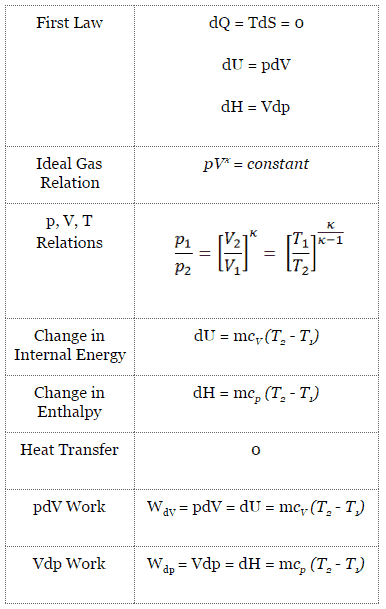
The isentropic process (a special case of adiabatic process) can be expressed with the ideal gas law as:
pVκ = constant
or
p1V1κ = p2V2κ
in which κ = cp/cv is the ratio of thespecific heats (or heat capacities) for the gas. One for constant pressure (cp) and one for constant volume (cv). Note that, this ratio κ = cp/cv is a factor in determining the speed of sound in a gas and other adiabatic processes.
Other p, V, T Relation
On a p-V diagram, the process occurs along a line (called an adiabat) that has the equation p = constant / Vκ. For an ideal gas and a polytropic process, the case n = κcorresponds to an isentropic process.
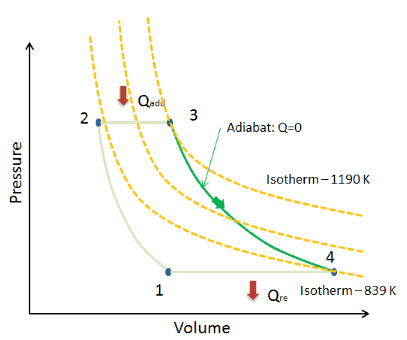
P-V diagram of an isentropic expansion of helium (3 → 4) in a gas turbine.
Assume an isentropic expansion of helium (3 → 4) in a gas turbine. Since helium behaves almost as an ideal gas, use the ideal gas law to calculate outlet temperature of the gas (T4,is). In this turbines the high-pressure stage receives gas (point 3 at the figure; p3 = 6.7 MPa; T3 = 1190 K (917°C)) from a heat exchanger and exhaust it to another heat exchanger, where the outlet pressure is p4 = 2.78 MPa (point 4).
Solution:
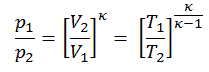
The outlet temperature of the gas, T4,is, can be calculated using p, V, T Relation for isentropic process (reversible adiabatic process):
In this equation the factor for helium is equal to κ=cp/cv=1.66. From the previous equation follows that the outlet temperature of the gas, T4,is, is:
Example: Isentropic Expansion in Gas Turbine
Ideal Brayton cycle consist of four thermodynamic processes. Two isentropic processes and two isobaric processes.
Let assume the ideal Brayton cycle that describes the workings of a constant pressureheat engine. Modern gas turbine engines and airbreathing jet engines also follow the Brayton cycle.
Ideal Brayton cycle consist of four thermodynamic processes. Two isentropic processes and two isobaric processes.
isentropic compression – ambient air is drawn into the compressor, where it is pressurized (1 → 2). The work required for the compressor is given by WC = H2 – H1.
isobaric heat addition – the compressed air then runs through a combustion chamber, where fuel is burned and air or another medium is heated (2 → 3). It is a constant-pressure process, since the chamber is open to flow in and out. The net heat added is given by Qadd = H3 – H2
isentropic expansion – the heated, pressurized air then expands on turbine, gives up its energy. The work done by turbine is given by WT = H4 – H3
isobaric heat rejection – the residual heat must be rejected in order to close the cycle. The net heat rejected is given by Qre = H4 – H1
As can be seen, we can describe and calculate (e.g. thermal efficiency) such cycles (similarly for Rankine cycle) using enthalpies.
Robert Reed Burn, Introduction to Nuclear Reactor Operation, 1988.
U.S. Department of Energy, Nuclear Physics and Reactor Theory. DOE Fundamentals Handbook, Volume 1 and 2. January 1993.
Advanced Reactor Physics:
K. O. Ott, W. A. Bezella, Introductory Nuclear Reactor Statics, American Nuclear Society, Revised edition (1989), 1989, ISBN: 0-894-48033-2.
K. O. Ott, R. J. Neuhold, Introductory Nuclear Reactor Dynamics, American Nuclear Society, 1985, ISBN: 0-894-48029-4.
D. L. Hetrick, Dynamics of Nuclear Reactors, American Nuclear Society, 1993, ISBN: 0-894-48453-2.
E. E. Lewis, W. F. Miller, Computational Methods of Neutron Transport, American Nuclear Society, 1993, ISBN: 0-894-48452-4.
See also:
Isentropic Process
We hope, this article, Isentropic Expansion – Isentropic Compression, helps you. If so, give us a like in the sidebar. Main purpose of this website is to help the public to learn some interesting and important information about thermal engineering.