Facebook Instagram Youtube Twitter

What is Thermal Efficiency of Brayton Cycle – Definition

Modern gas turbine engines and airbreathing jet engines also follow the Brayton cycle. The thermal efficiency of Brayton cycle can be expressed in terms of the temperatures. Thermal Engineering

Thermal Efficiency of Brayton Cycle

Let assume the ideal Brayton cycle that describes the workings of a constant pressure heat engine. Modern gas turbine engines and airbreathing jet engines also follow the Brayton cycle. This cycle consist of four thermodynamic processes:

  1. first law - example - brayton cycle
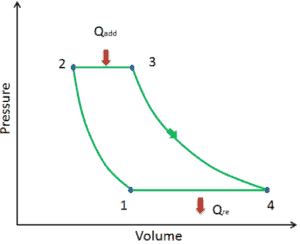
    Ideal Brayton cycle consist of four thermodynamic processes. Two isentropic processes and two isobaric processes.

    isentropic compression – ambient air is drawn into the compressor, where it is pressurized (1 → 2). The work required for the compressor is given by WC = H2 – H1.

  2. isobaric heat addition – the compressed air then runs through a combustion chamber, where fuel is burned and air or another medium is heated (2 → 3). It is a constant-pressure process, since the chamber is open to flow in and out. The net heat added is given by Qadd = H3 – H2
  3. isentropic expansion – the heated, pressurized air then expands on turbine, gives up its energy. The work done by turbine is given by WT = H4 – H3
  4. isobaric heat rejection – the residual heat must be rejected in order to close the cycle. The net heat rejected is given by Qre = H4 – H1

As can be seen, we can describe and calculate (e.g. thermodynamic efficiency) such cycles (similarly for Rankine cycle) using enthalpies.

To calculate the thermal efficiency of the Brayton cycle (single compressor and single turbine) engineers use the first law of thermodynamics in terms of enthalpy rather than in terms of internal energy.

The first law in terms of enthalpy is:

dH = dQ + Vdp

In this equation the term Vdp is a flow process work. This work,  Vdp, is used for open flow systems like a turbine or a pump in which there is a “dp”, i.e. change in pressure. There are no changes in control volume. As can be seen, this form of the law simplifies the description of energy transfer.

There are expressions in terms of more familiar variables such as temperature and pressure:

dH = CpdT + V(1-αT)dp

Where Cp is the heat capacity at constant pressure and α is the coefficient of (cubic) thermal expansion. For ideal gas αT = 1 and therefore:

dH = CpdT

At constant pressure, the enthalpy change equals the energy transferred from the environment through heating:

Isobaric process (Vdp = 0):

dH = dQ     →     Q = H2 – H1   →   H2 – H1 = Cp (T2 – T1)

At constant entropy, i.e. in isentropic process, the enthalpy change equals the flow process work done on or by the system:

Isentropic process (dQ = 0):

dH = Vdp     →     W = H2 – H1     →     H2 – H1 = Cp (T2 – T1)

first law - example - brayton cycle
Ideal Brayton cycle consist of four thermodynamic processes. Two isentropic processes and two isobaric processes.

The enthalpy can be made into an intensive, or specific, variable by dividing by the mass. Engineers use the specific enthalpy in thermodynamic analysis more than the enthalpy itself. The thermal efficiency of such simple Brayton cycle, for ideal gas and in terms of specific enthalpies can now be expressed in terms of the temperatures:

thermal efficiency of Brayton cycle

 
References:
Nuclear and Reactor Physics:
  1. J. R. Lamarsh, Introduction to Nuclear Reactor Theory, 2nd ed., Addison-Wesley, Reading, MA (1983).
  2. J. R. Lamarsh, A. J. Baratta, Introduction to Nuclear Engineering, 3d ed., Prentice-Hall, 2001, ISBN: 0-201-82498-1.
  3. W. M. Stacey, Nuclear Reactor Physics, John Wiley & Sons, 2001, ISBN: 0- 471-39127-1.
  4. Glasstone, Sesonske. Nuclear Reactor Engineering: Reactor Systems Engineering, Springer; 4th edition, 1994, ISBN: 978-0412985317
  5. W.S.C. Williams. Nuclear and Particle Physics. Clarendon Press; 1 edition, 1991, ISBN: 978-0198520467
  6. Kenneth S. Krane. Introductory Nuclear Physics, 3rd Edition, Wiley, 1987, ISBN: 978-0471805533
  7. G.R.Keepin. Physics of Nuclear Kinetics. Addison-Wesley Pub. Co; 1st edition, 1965
  8. Robert Reed Burn, Introduction to Nuclear Reactor Operation, 1988.
  9. U.S. Department of Energy, Nuclear Physics and Reactor Theory. DOE Fundamentals Handbook, Volume 1 and 2. January 1993.

Advanced Reactor Physics:

  1. K. O. Ott, W. A. Bezella, Introductory Nuclear Reactor Statics, American Nuclear Society, Revised edition (1989), 1989, ISBN: 0-894-48033-2.
  2. K. O. Ott, R. J. Neuhold, Introductory Nuclear Reactor Dynamics, American Nuclear Society, 1985, ISBN: 0-894-48029-4.
  3. D. L. Hetrick, Dynamics of Nuclear Reactors, American Nuclear Society, 1993, ISBN: 0-894-48453-2.
  4. E. E. Lewis, W. F. Miller, Computational Methods of Neutron Transport, American Nuclear Society, 1993, ISBN: 0-894-48452-4.

See also:

Thermal Efficiency

We hope, this article, Thermal Efficiency of Brayton Cycle, helps you. If so, give us a like in the sidebar. Main purpose of this website is to help the public to learn some interesting and important information about thermal engineering.


What is Thermal Efficiency of Rankine Cycle – Definition

Thermal Efficiency of Rankine Cycle. To calculate the thermal efficiency of the Rankine cycle (without reheating) engineers use the first law of thermodynamics in terms of enthalpy. Thermal Engineering

Thermal Efficiency of Rankine Cycle

engineering thermodynamics
Rankine Cycle – Thermodynamics as Energy Conversion Science

The Rankine cycle closely describes the processes in steam-operated heat engines commonly found in most of thermal power plants. The heat sources used in these power plants are usually the combustion of fossil fuels such as coal, natural gas, or also the nuclear fission.

A nuclear power plant (nuclear power station) looks like a standard thermal power station with one exception. The heat source in the nuclear power plant is a nuclear reactor. As is typical in all conventional thermal power stations the heat is used to generate steam which drives a steam turbine connected to a generator which produces electricity.

Typically most of nuclear power plants operates multi-stage condensing steam turbines. In these turbines the high-pressure stage receives steam (this steam is nearly saturated steam – x = 0.995 – point C at the figure; 6 MPa; 275.6°C) from a steam generator and exhaust it to moisture separator-reheater (point D). The steam must be reheated in order to avoid damages that could be caused to blades of steam turbine by low quality steam. The reheater heats the steam (point D) and then the steam is directed to the low-pressure stage of steam turbine, where expands (point E to F). The exhausted steam then condenses in the condenser and it is at a pressure well below atmospheric (absolute pressure of 0.008 MPa), and is in a partially condensed state (point F), typically of a quality near 90%.

In this case, steam generators, steam turbine, condensers and feedwater pumps constitute a heat engine, that is subject to the efficiency limitations imposed by the second law of thermodynamics. In ideal case (no friction, reversible processes, perfect design), this heat engine would have a Carnot efficiency of

= 1 – Tcold/Thot = 1 – 315/549 = 42.6%

where the temperature of the hot reservoir is 275.6°C (548.7K), the temperature of the cold reservoir is 41.5°C (314.7K). But the nuclear power plant is the real heat engine, in which thermodynamic processes are somehow irreversible. They are not done infinitely slowly. In real devices (such as turbines, pumps, and compressors) a mechanical friction and heat losses cause further efficiency losses.

To calculate the thermal efficiency of the simplest Rankine cycle (without reheating) engineers use the first law of thermodynamics in terms of enthalpy rather than in terms of internal energy.

The first law in terms of enthalpy is:

dH = dQ + Vdp

In this equation the term Vdp is a flow process work. This work,  Vdp, is used for open flow systems like a turbine or a pump in which there is a “dp”, i.e. change in pressure. There are no changes in control volume. As can be seen, this form of the law simplifies the description of energy transfer. At constant pressure, the enthalpy change equals the energy transferred from the environment through heating:

Isobaric process (Vdp = 0):

dH = dQ     →     Q = H2 – H1

At constant entropy, i.e. in isentropic process, the enthalpy change equals the flow process work done on or by the system:

Isentropic process (dQ = 0):

dH = Vdp     →     W = H2 – H1

It is obvious, it will be very useful in analysis of both thermodynamic cycles used in power engineering, i.e. in Brayton cycle and Rankine cycle.

The enthalpy can be made into an intensive, or specific, variable by dividing by the mass. Engineers use the specific enthalpy in thermodynamic analysis more than the enthalpy itself. It is tabulated in the steam tables along with specific volume and specific internal energy. The thermal efficiency of such simple Rankine cycle and in terms of specific enthalpies would be:

thermal efficiency of Rankine cycle

It is very simple equation and for determination of the thermal efficiency you can use data from steam tables.

In modern nuclear power plants the overall thermal efficiency is about one-third (33%), so 3000 MWth of thermal power from the fission reaction is needed to generate 1000 MWe of electrical power. The reason lies in relatively low steam temperature (6 MPa; 275.6°C). Higher efficiencies can be attained by increasing the temperature of the steam. But this requires an increase in pressures inside boilers or steam generators. However, metallurgical considerations place an upper limits on such pressures. In comparison to other energy sources the thermal efficiency of 33% is not much. But it must be noted that nuclear power plants are much more complex than fossil fuel power plants and it is much easier to burn fossil fuel ,than to generate energy from nuclear fuel. Sub-critical fossil fuel power plants, that are operated under critical pressure (i.e. lower than 22.1 MPa), can achieve 36–40% efficiency.

 
References:
Nuclear and Reactor Physics:
  1. J. R. Lamarsh, Introduction to Nuclear Reactor Theory, 2nd ed., Addison-Wesley, Reading, MA (1983).
  2. J. R. Lamarsh, A. J. Baratta, Introduction to Nuclear Engineering, 3d ed., Prentice-Hall, 2001, ISBN: 0-201-82498-1.
  3. W. M. Stacey, Nuclear Reactor Physics, John Wiley & Sons, 2001, ISBN: 0- 471-39127-1.
  4. Glasstone, Sesonske. Nuclear Reactor Engineering: Reactor Systems Engineering, Springer; 4th edition, 1994, ISBN: 978-0412985317
  5. W.S.C. Williams. Nuclear and Particle Physics. Clarendon Press; 1 edition, 1991, ISBN: 978-0198520467
  6. Kenneth S. Krane. Introductory Nuclear Physics, 3rd Edition, Wiley, 1987, ISBN: 978-0471805533
  7. G.R.Keepin. Physics of Nuclear Kinetics. Addison-Wesley Pub. Co; 1st edition, 1965
  8. Robert Reed Burn, Introduction to Nuclear Reactor Operation, 1988.
  9. U.S. Department of Energy, Nuclear Physics and Reactor Theory. DOE Fundamentals Handbook, Volume 1 and 2. January 1993.

Advanced Reactor Physics:

  1. K. O. Ott, W. A. Bezella, Introductory Nuclear Reactor Statics, American Nuclear Society, Revised edition (1989), 1989, ISBN: 0-894-48033-2.
  2. K. O. Ott, R. J. Neuhold, Introductory Nuclear Reactor Dynamics, American Nuclear Society, 1985, ISBN: 0-894-48029-4.
  3. D. L. Hetrick, Dynamics of Nuclear Reactors, American Nuclear Society, 1993, ISBN: 0-894-48453-2.
  4. E. E. Lewis, W. F. Miller, Computational Methods of Neutron Transport, American Nuclear Society, 1993, ISBN: 0-894-48452-4.

See also:

Thermal Efficiency

We hope, this article, Thermal Efficiency of Rankine Cycle, helps you. If so, give us a like in the sidebar. Main purpose of this website is to help the public to learn some interesting and important information about thermal engineering.
What is Third Law of Thermodynamics – 3rd Law – Definition

The third law of thermodynamics was developed by the German chemist Walther Nernst during the years 1906–12. This law also defines absolute zero temperature. Thermal Engineering

Third Law of Thermodynamics – 3rd Law

The entropy of a system approaches a constant value as the temperature approaches absolute zero.

Based on empirical evidence, this law states that the entropy of a pure crystalline substance is zero at the absolute zero of temperature, 0 K and that it is impossible by means of any process, no matter how idealized, to reduce the temperature of a system to absolute zero in a finite number of steps. This allows us to define a zero point for the thermal energy of a body.

______

The third law of thermodynamics was developed by the German chemist Walther Nernst during the years 1906–12. For this research Walther Nernst won the 1920 Nobel Prize in chemistry. Therefore the third law of thermodynamics is often referred to as Nernst’s theorem or Nernst’s postulate. As can be seen, the third law of thermodynamics states that the entropy of a system in thermodynamic equilibrium approaches zero as the temperature approaches zero. Or conversely the absolute temperature of any pure crystalline substance in thermodynamic equilibrium approaches zero when the entropy approaches zero.

Nernst Heat Theorem (a consequence of the Third Law) is:

It is impossible for any process, no matter how idealized, to reduce the entropy of a system to its absolute-zero value in a finite number of operations.

Mathematically:

nernst theorem

The Nernst heat theorem was later used by a German physicist Max Planck to define the third law of thermodynamics in terms of entropy and absolute zero.

Some materials (e.g. any amorphous solid) do not have a well-defined order at absolute zero. In these materials (e.g. glass) some finite entropy remains also at absolute zero, because the system’s microscopic structure (atom by atom) can be arranged in a different ways (W ≠ 1). This constant entropy is known as the residual entropy, which is the difference between a non-equilibrium state and crystal state of a substance close to absolute zero.

Note that the exact definition of entropy is:

Entropy = (Boltzmann’s constant k) x logarithm of number of possible states

S = kB logW

This equation, which relates the microscopic details, or microstates, of the system (via W) to its macroscopic state (via the entropy S), is the key idea of statistical mechanics.

Absolute Zero

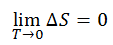
Absolute zero is the coldest theoretical temperature, at which the thermal motion of atoms and molecules reaches its minimum.  This is a state at which the enthalpy and entropy of a cooled ideal gas reaches its minimum value, taken as 0.

Mathematically:

lim ST→0 = 0  

where

S = entropy (J/K)

T = absolute temperature (K)

Classically, this would be a state of motionlessness, but quantum uncertainty dictates that the particles still possess a finite zero-point energy. Absolute zero is denoted as 0 K on the Kelvin scale, −273.15 °C on the Celsius scale, and −459.67 °F on the Fahrenheit scale.

Relation to Heat Engines

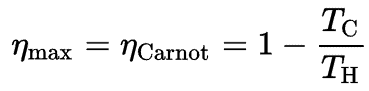
According to the Carnot’s principle, that specifies limits on the maximum efficiency any heat engine can have is the Carnot efficiency.This principle also states that the efficiency of a Carnot cycle depends solely on the difference between the hot and cold temperature reservoirs.

Carnot Efficiency Formula

where:

  • is the efficiency of Carnot cycle, i.e. it is the ratio = W/QH of the work done by the engine to the heat energy entering the system from the hot reservoir.
  • TC is the absolute temperature (Kelvins) of the cold reservoir,
  • TH is the absolute temperature (Kelvins) of the hot reservoir,

The third law dictates that TC can never be zero, therefore we see that a 100% efficient heat engine is not possible.

 
References:
Nuclear and Reactor Physics:
  1. J. R. Lamarsh, Introduction to Nuclear Reactor Theory, 2nd ed., Addison-Wesley, Reading, MA (1983).
  2. J. R. Lamarsh, A. J. Baratta, Introduction to Nuclear Engineering, 3d ed., Prentice-Hall, 2001, ISBN: 0-201-82498-1.
  3. W. M. Stacey, Nuclear Reactor Physics, John Wiley & Sons, 2001, ISBN: 0- 471-39127-1.
  4. Glasstone, Sesonske. Nuclear Reactor Engineering: Reactor Systems Engineering, Springer; 4th edition, 1994, ISBN: 978-0412985317
  5. W.S.C. Williams. Nuclear and Particle Physics. Clarendon Press; 1 edition, 1991, ISBN: 978-0198520467
  6. Kenneth S. Krane. Introductory Nuclear Physics, 3rd Edition, Wiley, 1987, ISBN: 978-0471805533
  7. G.R.Keepin. Physics of Nuclear Kinetics. Addison-Wesley Pub. Co; 1st edition, 1965
  8. Robert Reed Burn, Introduction to Nuclear Reactor Operation, 1988.
  9. U.S. Department of Energy, Nuclear Physics and Reactor Theory. DOE Fundamentals Handbook, Volume 1 and 2. January 1993.

Advanced Reactor Physics:

  1. K. O. Ott, W. A. Bezella, Introductory Nuclear Reactor Statics, American Nuclear Society, Revised edition (1989), 1989, ISBN: 0-894-48033-2.
  2. K. O. Ott, R. J. Neuhold, Introductory Nuclear Reactor Dynamics, American Nuclear Society, 1985, ISBN: 0-894-48029-4.
  3. D. L. Hetrick, Dynamics of Nuclear Reactors, American Nuclear Society, 1993, ISBN: 0-894-48453-2.
  4. E. E. Lewis, W. F. Miller, Computational Methods of Neutron Transport, American Nuclear Society, 1993, ISBN: 0-894-48452-4.

See also:

Laws of Thermodynamics

We hope, this article, Third Law of Thermodynamics – 3rd Law, helps you. If so, give us a like in the sidebar. Main purpose of this website is to help the public to learn some interesting and important information about thermal engineering.
What is Nernst’s Theorem – Nernst’s postulate – Definition

The Nernst’s theorem or Nernst’s postulate states that it is impossible to reduce the entropy of a system to its absolute-zero value in a finite number of operations.

Third Law of Thermodynamics – 3rd Law

The third law of thermodynamics was developed by the German chemist Walther Nernst during the years 1906–12. For this research Walther Nernst won the 1920 Nobel Prize in chemistry. Therefore the third law of thermodynamics is often referred to as Nernst’s theorem or Nernst’s postulate. As can be seen, the third law of thermodynamics states that the entropy of a system in thermodynamic equilibrium approaches zero as the temperature approaches zero. Or conversely the absolute temperature of any pure crystalline substance in thermodynamic equilibrium approaches zero when the entropy approaches zero.

Nernst Heat Theorem (a consequence of the Third Law) is:

It is impossible for any process, no matter how idealized, to reduce the entropy of a system to its absolute-zero value in a finite number of operations.

Mathematically:

nernst theorem

The Nernst heat theorem was later used by a German physicist Max Planck to define the third law of thermodynamics in terms of entropy and absolute zero.

Some materials (e.g. any amorphous solid) do not have a well-defined order at absolute zero. In these materials (e.g. glass) some finite entropy remains also at absolute zero, because the system’s microscopic structure (atom by atom) can be arranged in a different ways (W ≠ 1). This constant entropy is known as the residual entropy, which is the difference between a non-equilibrium state and crystal state of a substance close to absolute zero.

Note that the exact definition of entropy is:

Entropy = (Boltzmann’s constant k) x logarithm of number of possible states

S = kB logW

This equation, which relates the microscopic details, or microstates, of the system (via W) to its macroscopic state (via the entropy S), is the key idea of statistical mechanics.

Absolute Zero

Absolute zero is the coldest theoretical temperature, at which the thermal motion of atoms and molecules reaches its minimum.  This is a state at which the enthalpy and entropy of a cooled ideal gas reaches its minimum value, taken as 0.

Mathematically:

lim ST→0 = 0  

where

S = entropy (J/K)

T = absolute temperature (K)

Classically, this would be a state of motionlessness, but quantum uncertainty dictates that the particles still possess a finite zero-point energy. Absolute zero is denoted as 0 K on the Kelvin scale, −273.15 °C on the Celsius scale, and −459.67 °F on the Fahrenheit scale.

 
References:
Nuclear and Reactor Physics:
  1. J. R. Lamarsh, Introduction to Nuclear Reactor Theory, 2nd ed., Addison-Wesley, Reading, MA (1983).
  2. J. R. Lamarsh, A. J. Baratta, Introduction to Nuclear Engineering, 3d ed., Prentice-Hall, 2001, ISBN: 0-201-82498-1.
  3. W. M. Stacey, Nuclear Reactor Physics, John Wiley & Sons, 2001, ISBN: 0- 471-39127-1.
  4. Glasstone, Sesonske. Nuclear Reactor Engineering: Reactor Systems Engineering, Springer; 4th edition, 1994, ISBN: 978-0412985317
  5. W.S.C. Williams. Nuclear and Particle Physics. Clarendon Press; 1 edition, 1991, ISBN: 978-0198520467
  6. Kenneth S. Krane. Introductory Nuclear Physics, 3rd Edition, Wiley, 1987, ISBN: 978-0471805533
  7. G.R.Keepin. Physics of Nuclear Kinetics. Addison-Wesley Pub. Co; 1st edition, 1965
  8. Robert Reed Burn, Introduction to Nuclear Reactor Operation, 1988.
  9. U.S. Department of Energy, Nuclear Physics and Reactor Theory. DOE Fundamentals Handbook, Volume 1 and 2. January 1993.

Advanced Reactor Physics:

  1. K. O. Ott, W. A. Bezella, Introductory Nuclear Reactor Statics, American Nuclear Society, Revised edition (1989), 1989, ISBN: 0-894-48033-2.
  2. K. O. Ott, R. J. Neuhold, Introductory Nuclear Reactor Dynamics, American Nuclear Society, 1985, ISBN: 0-894-48029-4.
  3. D. L. Hetrick, Dynamics of Nuclear Reactors, American Nuclear Society, 1993, ISBN: 0-894-48453-2.
  4. E. E. Lewis, W. F. Miller, Computational Methods of Neutron Transport, American Nuclear Society, 1993, ISBN: 0-894-48452-4.

See also:

Laws of Thermodynamics

We hope, this article, Nernst’s Theorem – Nernst’s postulate, helps you. If so, give us a like in the sidebar. Main purpose of this website is to help the public to learn some interesting and important information about thermal engineering.

What is Thermodynamic Process – Definition

A thermodynamic process is defined as a change from one equilibrium macrostate to another macrostate. Knowledge of thermodynamic processes is of the highest importance fo engineers. Thermal Engineering

Thermodynamic Processes

Thermodynamic processesA thermodynamic process is defined as a change from one equilibrium macrostate to another macrostate. The initial and final states are the defining elements of the process. During such a process,  a system starts from an initial state i, described by a pressure pi, a volume Vi and a temperature Ti , passes through various quasistatic states to a final state f, described by a pressure pf, a volume Vf , and a temperature Tf. In this process energy may be transferred form or into the system and  also work can be done by or on the system. One example of a thermodynamic process is increasing the pressure of a gas while maintaining a constant temperature. In following section, there are examples of thermodynamic processes that are of highest importance in engineering of heat engines.

Types of Thermodynamic Processes

Reversible Process

In thermodynamics, a reversible process is defined as a process that can be reversed by inducing infinitesimal changes to some property of the system, and in so doing leaves no change in either the system or surroundings. During reversible process the entropy of the system does not increase and the system is in thermodynamic equilibrium with its surroundings.

Irreversible Process

In thermodynamics, an irreversible process is defined as a process that cannot be reversed, process, that cannot return both the system and the surroundings to their original conditions.

During irreversible process the entropy of the system increases.

Cyclic Process

A process that eventually returns a system to its initial state is called a cyclic process. At the conclusion of a cycle, all the properties have the same value they had at the beginning. For such a process, the final state is the same as the initial state, and so the total internal energy change must be zero.

It must be noted, according to the second law of thermodynamics, not all heat provided to a cycle can be transformed into an equal amount of work, some heat rejection must take place. The thermal efficiency, ηth, of any heat engine as the ratio of the work it does, W, to the heat input at the high temperature, QH.  ηth = W/QH.

See also: Reversible Process

See also: Irreversible Process

See also: Cyclic Process

Isentropic vs. adiabatic expansion
Isentropic process is a special case of adiabatic processes. It is a reversible adiabatic process. An isentropic process can also be called a constant entropy process.
Cyclic process - work
A process that eventually returns a system to its initial state is called a cyclic process.

Isentropic Process

An isentropic process is a thermodynamic process, in which the entropy of the fluid or gas remains constant. It means the isentropic process is a special case of an adiabatic process in which there is no transfer of heat or matter. It is a reversible adiabatic process. An isentropic process can also be called a constant entropy process. In engineering such an idealized process is very useful for comparison with real processes.

See also: Isentropic Process 

Main characteristics of isentropic process
Isentropic Process - characteristics
Table of main characteristics

P-V diagram - isentropic process
P-V diagram of an isentropic expansion of helium (3 → 4) in a gas turbine.

Adiabatic Process

An adiabatic process is a thermodynamic process, in which there is no heat transfer into or out of the system (Q = 0). The system can be considered to be perfectly insulated. In an adiabatic process, energy is transferred only as work. The assumption of no heat transfer is very important, since we can use the adiabatic approximation only in very rapid processes. In these rapid processes, there is not enough time for the transfer of energy as heat to take place to or from the system.

In real devices (such as turbines, pumps, and compressors) heat losses and losses in the combustion process occur, but these losses are usually low in comparison to overall energy flow and we can approximate some thermodynamic processes by the adiabatic process.

See also: Adiabatic Process 

Main characteristics of adiabatic process

Isentropic vs. adiabatic expansion
Isentropic vs. adiabatic expansion.

Isothermal Process

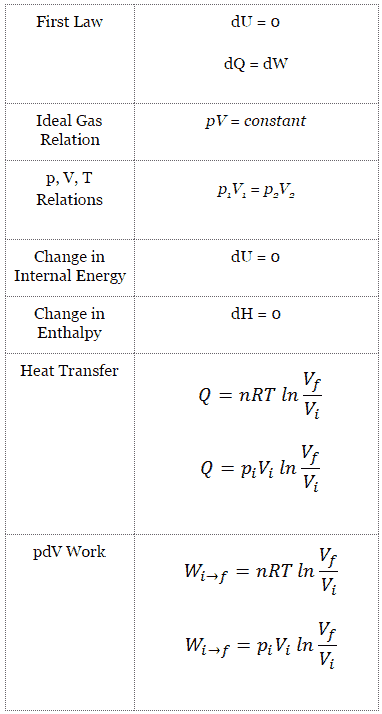
An isothermal process is a thermodynamic process, in which the temperature of the system remains constant (T = const). The heat transfer into or out of the system typically must happen at such a slow rate in order to continually adjust to the temperature of the reservoir through heat exchange. In each of these states the thermal equilibrium is maintained.

For an ideal gas and a polytropic process, the case n = 1 corresponds to an isothermal (constant-temperature) process. In contrast to adiabatic process , in which n = κ  and a system exchanges no heat with its surroundings (Q = 0; ∆T≠0), in an isothermal process there is no change in the internal energy (due to ∆T=0) and therefore ΔU = 0 (for ideal gases) and Q ≠ 0. An adiabatic process is not necessarily an isothermal process, nor is an isothermal process necessarily adiabatic.

See also: Isothermal Process 

Main characteristics of Isothermal process
Isothermal process - main characteristics
Isothermal process – main characteristics

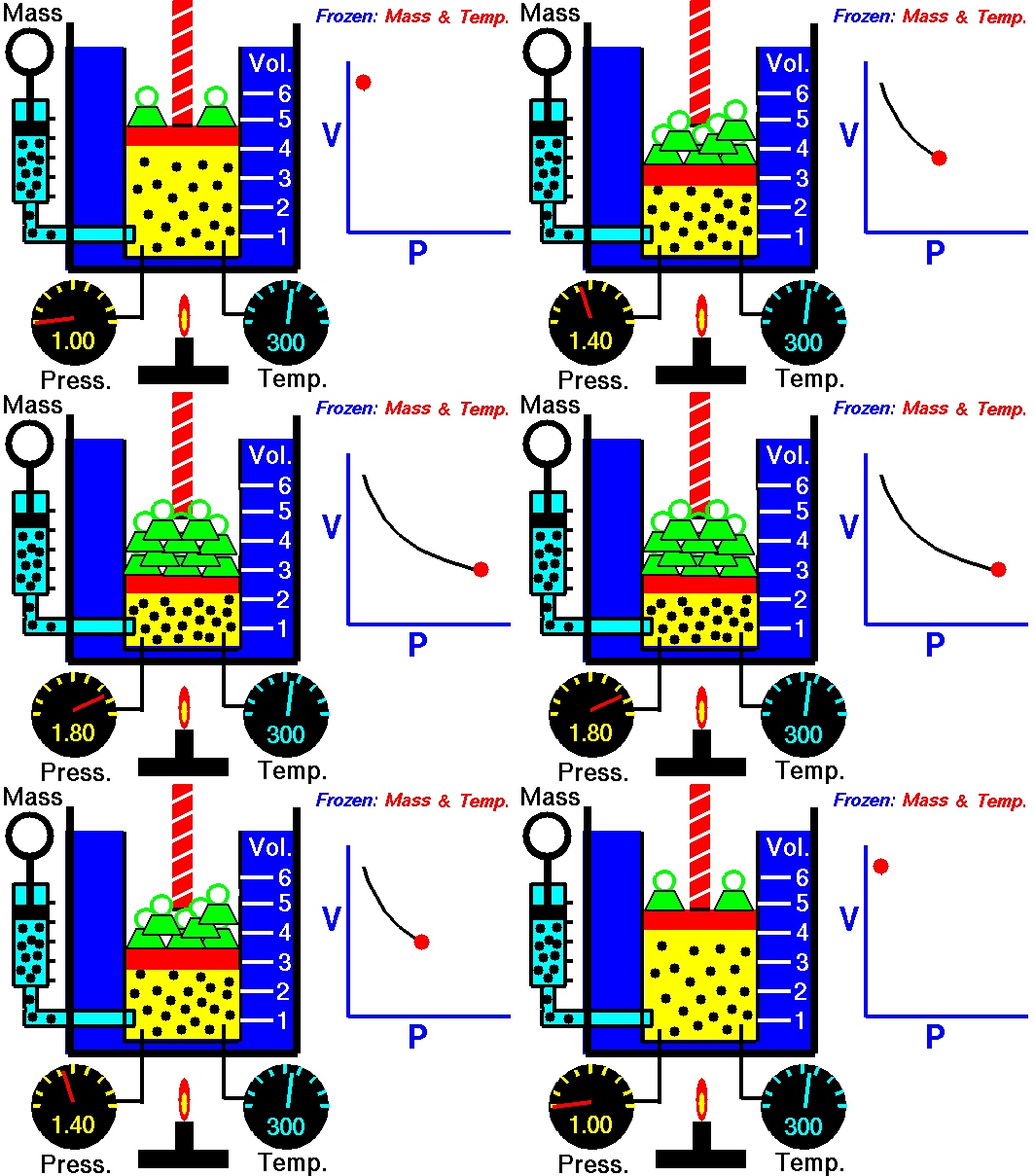
Boyle-Mariotte Law
Boyle-Mariotte Law. For a fixed mass of gas at constant temperature, the volume is inversely proportional to the pressure. Source: grc.nasa.gov NASA copyright policy states that “NASA material is not protected by copyright unless noted”.

Isobaric Process

An isobaric process is a thermodynamic process, in which the pressure of the system remains constant (p = const). The heat transfer into or out of the system does work, but also changes the internal energy of the system.

Since there are changes in internal energy (dU) and changes in system volume (∆V), engineers often use the enthalpy of the system, which is defined as:

H = U + pV

In many thermodynamic analyses it is convenient to use the enthalpy instead of the internal energy. Especially in case of the first law of thermodynamics.

In engineering, both very important thermodynamic cycles (Brayton and Rankine cycle) are based on two isobaric processes, therefore the study of this process is crucial for power plants.

See also: Isobaric Process 

Main characteristics of Isobaric Process
Isothermal process - main characteristics
Isothermal process – main characteristics

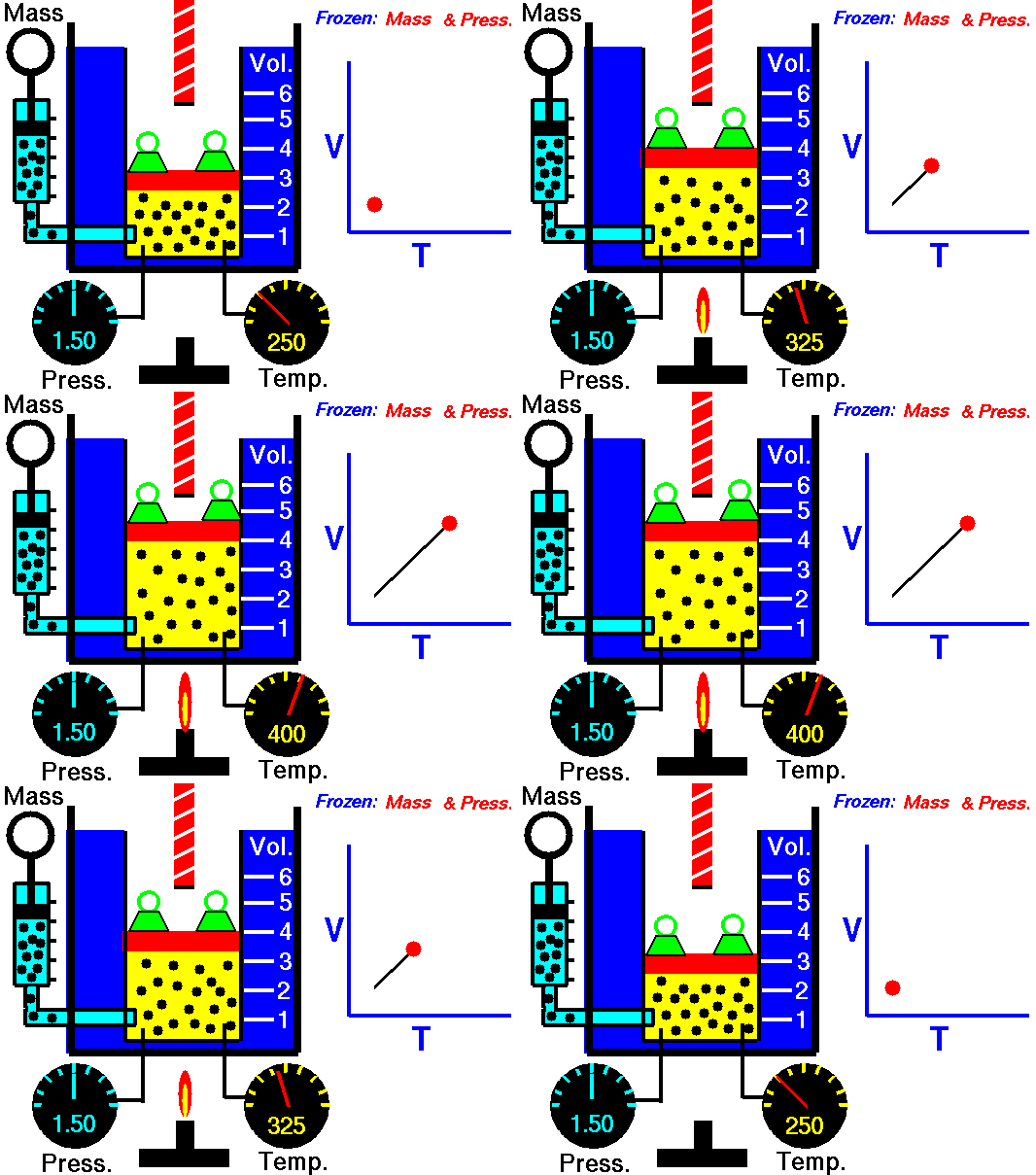
Charles's Law is one of the gas laws.
For a fixed mass of gas at constant pressure, the volume is directly proportional to the Kelvin temperature. Source: grc.nasa.gov NASA copyright policy states that “NASA material is not protected by copyright unless noted”.

Isochoric Process

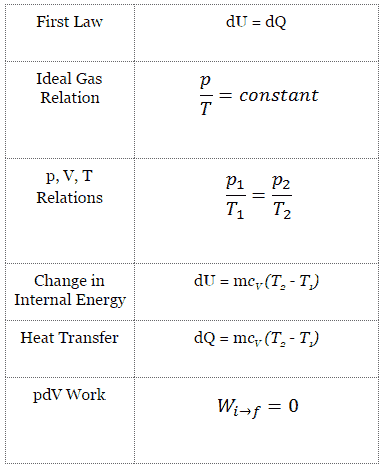
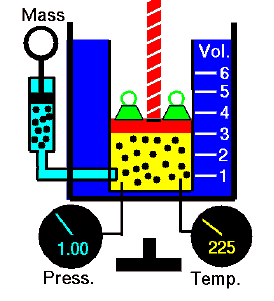
An isochoric process is a thermodynamic process, in which the volume of the closed system remains constant (V = const). It describes the behavior of gas inside the container, that cannot be deformed. Since the volume remains constant, the heat transfer into or out of the system does not the p∆V work, but only changes the internal energy (the temperature) of the system.

In engineering of internal combustion engines, isochoric processes are very important for their thermodynamic cycles (Otto and Diesel cycle), therefore the study of this process is crucial for automotive engineering.

See also: Isochoric Process 

Main characteristics of Isochoric Process
Isochoric process - main characteristics
Isochoric process – main characteristics

Guy-Lussac's Law
For a fixed mass of gas at constant volume, the pressure is directly proportional to the Kelvin temperature.

Polytropic Process

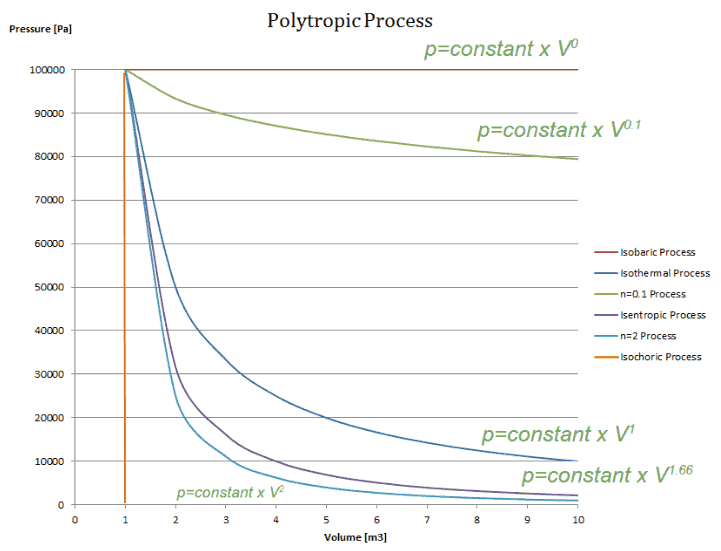
A polytropic process is any thermodynamic process that can be expressed by the following equation:

pVn = constant

The polytropic process can describe gas expansion and compression which include heat transfer. The exponent n is known as the polytropic index and it may take on any value from 0 to ∞, depending on the particular process.

See also: Polytropic Process 

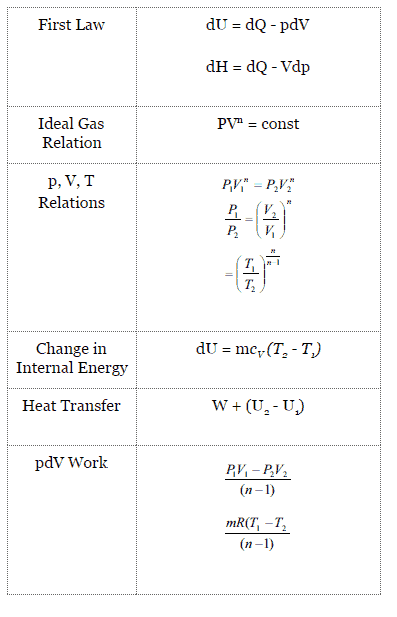
Main characteristics of Polytropic Process
Polytropic process - main characteristics
Polytropic process – main characteristics

polytropic process - pv diagram
Polytropic processes with various polytropic indexes.

Throttling Process – Isenthalpic Process

A throttling process is a thermodynamic process, in which the enthalpy of the gas or medium remains constant (h = const). In fact, the throttling process is one of isenthalpic processes. During the throttling process no work is done by or on the system (dW = 0), and usually there is no heat tranfer (adiabatic) from or into the system (dQ = 0). On the other the throttling process cannot be isentropic, it is a fundamentally irreversible process. Characteristics of throttling process:

  1. No Work Transfer
  2. No Heat Transfer
  3. Irreversible Process
  4. Isenthalpic Process

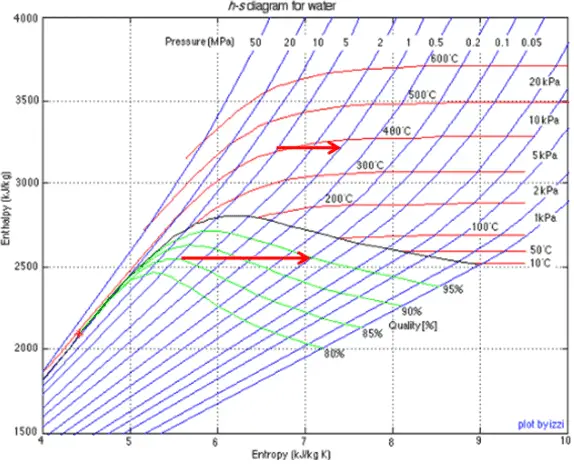
Throttling of the wet steam is also associated with conservation of enthalpy. But in this case a reduction in pressure causes an increase in vapor quality.

See also: Throttling Process

throttling process - hs diagram - steam
 
References:
Nuclear and Reactor Physics:
  1. J. R. Lamarsh, Introduction to Nuclear Reactor Theory, 2nd ed., Addison-Wesley, Reading, MA (1983).
  2. J. R. Lamarsh, A. J. Baratta, Introduction to Nuclear Engineering, 3d ed., Prentice-Hall, 2001, ISBN: 0-201-82498-1.
  3. W. M. Stacey, Nuclear Reactor Physics, John Wiley & Sons, 2001, ISBN: 0- 471-39127-1.
  4. Glasstone, Sesonske. Nuclear Reactor Engineering: Reactor Systems Engineering, Springer; 4th edition, 1994, ISBN: 978-0412985317
  5. W.S.C. Williams. Nuclear and Particle Physics. Clarendon Press; 1 edition, 1991, ISBN: 978-0198520467
  6. Kenneth S. Krane. Introductory Nuclear Physics, 3rd Edition, Wiley, 1987, ISBN: 978-0471805533
  7. G.R.Keepin. Physics of Nuclear Kinetics. Addison-Wesley Pub. Co; 1st edition, 1965
  8. Robert Reed Burn, Introduction to Nuclear Reactor Operation, 1988.
  9. U.S. Department of Energy, Nuclear Physics and Reactor Theory. DOE Fundamentals Handbook, Volume 1 and 2. January 1993.

Advanced Reactor Physics:

  1. K. O. Ott, W. A. Bezella, Introductory Nuclear Reactor Statics, American Nuclear Society, Revised edition (1989), 1989, ISBN: 0-894-48033-2.
  2. K. O. Ott, R. J. Neuhold, Introductory Nuclear Reactor Dynamics, American Nuclear Society, 1985, ISBN: 0-894-48029-4.
  3. D. L. Hetrick, Dynamics of Nuclear Reactors, American Nuclear Society, 1993, ISBN: 0-894-48453-2.
  4. E. E. Lewis, W. F. Miller, Computational Methods of Neutron Transport, American Nuclear Society, 1993, ISBN: 0-894-48452-4.

See also:

Thermodynamics

We hope, this article, Thermodynamic Process, helps you. If so, give us a like in the sidebar. Main purpose of this website is to help the public to learn some interesting and important information about thermal engineering.
What is Reversible Process – Definition

In thermodynamics, a reversible process is defined as a process that can be reversed by inducing infinitesimal changes to some property of the system. Reversible Process

Reversible Process

In thermodynamics, a reversible process is defined as a process that can be reversed by inducing infinitesimal changes to some property of the system, and in so doing leaves no change in either the system or surroundings. During reversible process the entropy of the system does not increase and the system is in thermodynamic equilibrium with its surroundings.

In reality, there are no truly reversible processes. All real thermodynamic processes are somehow irreversible. They are not done infinitely slowly. Therefore, heat engines must have lower efficiencies than limits on their efficiency due to the inherent irreversibility of the heat engine cycle they use. However, for analysis purposes, one uses reversible processes to make the analysis simpler, and to determine maximum thermal efficiencies.

For example the Carnot cycle is considered as a cycle that consist of reversible processes:

  • Reversible isothermal expansion of the gas
  • Isentropic (reversible adiabatic) expansion of the gas
  • Reversible isothermal compression of the gas
  • Isentropic (reversible adiabatic) compression of the gas

Since the cycle is reversible, there is no increase in entropy during the cycle and entropy is conserved. During the cycle, an arbitrary amount of entropy ΔS is extracted from the hot reservoir, and deposited in the cold reservoir.

One way to make real processes approximate reversible process is to carry out the process in a series of small or infinitesimal steps or infinitely slowly, so that the process can be considered as a series of equilibrium states. For example, heat transfer may be considered reversible if it occurs due to a small temperature difference between the system and its surroundings.

A perfectly reversible process is not possible in reality because it would require an infinite time and infinitesamally small steps. Although not practical for real processes, this method is beneficial for thermodynamic studies since the rate at which processes occur is not important.

What Carnot’s principle states about reversible processes:

  1. No engine can be more efficient than a reversible engine (a Carnot heat engine) operating between the same high temperature and low temperature reservoirs.
  2. The efficiencies of all reversible engines (Carnot heat engines) operating between the same constant temperature reservoirs are the same, regardless of the working substance employed or the operation details.
 
References:
Nuclear and Reactor Physics:
  1. J. R. Lamarsh, Introduction to Nuclear Reactor Theory, 2nd ed., Addison-Wesley, Reading, MA (1983).
  2. J. R. Lamarsh, A. J. Baratta, Introduction to Nuclear Engineering, 3d ed., Prentice-Hall, 2001, ISBN: 0-201-82498-1.
  3. W. M. Stacey, Nuclear Reactor Physics, John Wiley & Sons, 2001, ISBN: 0- 471-39127-1.
  4. Glasstone, Sesonske. Nuclear Reactor Engineering: Reactor Systems Engineering, Springer; 4th edition, 1994, ISBN: 978-0412985317
  5. W.S.C. Williams. Nuclear and Particle Physics. Clarendon Press; 1 edition, 1991, ISBN: 978-0198520467
  6. Kenneth S. Krane. Introductory Nuclear Physics, 3rd Edition, Wiley, 1987, ISBN: 978-0471805533
  7. G.R.Keepin. Physics of Nuclear Kinetics. Addison-Wesley Pub. Co; 1st edition, 1965
  8. Robert Reed Burn, Introduction to Nuclear Reactor Operation, 1988.
  9. U.S. Department of Energy, Nuclear Physics and Reactor Theory. DOE Fundamentals Handbook, Volume 1 and 2. January 1993.

Advanced Reactor Physics:

  1. K. O. Ott, W. A. Bezella, Introductory Nuclear Reactor Statics, American Nuclear Society, Revised edition (1989), 1989, ISBN: 0-894-48033-2.
  2. K. O. Ott, R. J. Neuhold, Introductory Nuclear Reactor Dynamics, American Nuclear Society, 1985, ISBN: 0-894-48029-4.
  3. D. L. Hetrick, Dynamics of Nuclear Reactors, American Nuclear Society, 1993, ISBN: 0-894-48453-2.
  4. E. E. Lewis, W. F. Miller, Computational Methods of Neutron Transport, American Nuclear Society, 1993, ISBN: 0-894-48452-4.

See also:

Thermodynamic Processes

We hope, this article, Reversible Process, helps you. If so, give us a like in the sidebar. Main purpose of this website is to help the public to learn some interesting and important information about thermal engineering.

What is Irreversible Process – Definition

In thermodynamics, an irreversible process is defined as a process that cannot be reversed, . During irreversible process the entropy of the system increases. Thermal Engineering

Irreversible Process

In thermodynamics, an irreversible process is defined as a process that cannot be reversed, process, that cannot return both the system and the surroundings to their original conditions.

During irreversible process the entropy of the system increases. There are many factors that make a process irreversible:

  • Presence of friction and heat losses. In real thermodynamic systems or in real heat processes, we cannot exclude the presence of mechanical friction or heat losses.
  • Finite temperature difference. Processes are not done infinitely slowly. For example, there could be turbulence in the gas.Therefore, heat engines must have lower efficiencies than limits on their efficiency due to the inherent irreversibility of the heat engine cycle they use.
  • Mixing of two different substances

These factors are present in real, irreversible processes and prevent these processes from being reversible.

Irreversibility of Natural Processes

According to the second law of thermodynamics:

The entropy of any isolated system never decreases. In a natural thermodynamic process, the sum of the entropies of the interacting thermodynamic systems increases.  

This law indicates the irreversibility of natural processes. Reversible processes are a useful and convenient theoretical fiction, but do not occur in nature. From this law follows that it is impossible to construct a device that operates on a cycle and whose sole effect is the transfer of heat from a cooler body to a hotter body. It follows, perpetual motion machines of the second kind are impossible.

Isentropic vs. Adiabatic Process

Isentropic vs. adiabatic expansion
Isentropic process is a special case of adiabatic processes. It is a reversible adiabatic process. An isentropic process can also be called a constant entropy process.

An isentropic process is a thermodynamic process, in which the entropy of the fluid or gas remains constant. It means the isentropic process is a special case of an adiabatic process in which there is no transfer of heat or matter. It is a reversible adiabatic process. An isentropic process can also be called a constant entropy process. In engineering such an idealized process is very useful for comparison with real processes.

One way to make real processes approximate reversible process is to carry out the process in a series of small or infinitesimal steps or infinitely slowly, so that the process can be considered as a series of equilibrium states. For example, heat transfer may be considered reversible if it occurs due to a small temperature difference between the system and its surroundings. But real processes are not done infinitely slowly. Reversible processes are a useful and convenient theoretical fiction, but do not occur in nature. For example, there could be turbulence in the gas. Therefore, heat engines must have lower efficiencies than limits on their efficiency due to the inherent irreversibility of the heat engine cycle they use.

 
References:
Nuclear and Reactor Physics:
  1. J. R. Lamarsh, Introduction to Nuclear Reactor Theory, 2nd ed., Addison-Wesley, Reading, MA (1983).
  2. J. R. Lamarsh, A. J. Baratta, Introduction to Nuclear Engineering, 3d ed., Prentice-Hall, 2001, ISBN: 0-201-82498-1.
  3. W. M. Stacey, Nuclear Reactor Physics, John Wiley & Sons, 2001, ISBN: 0- 471-39127-1.
  4. Glasstone, Sesonske. Nuclear Reactor Engineering: Reactor Systems Engineering, Springer; 4th edition, 1994, ISBN: 978-0412985317
  5. W.S.C. Williams. Nuclear and Particle Physics. Clarendon Press; 1 edition, 1991, ISBN: 978-0198520467
  6. Kenneth S. Krane. Introductory Nuclear Physics, 3rd Edition, Wiley, 1987, ISBN: 978-0471805533
  7. G.R.Keepin. Physics of Nuclear Kinetics. Addison-Wesley Pub. Co; 1st edition, 1965
  8. Robert Reed Burn, Introduction to Nuclear Reactor Operation, 1988.
  9. U.S. Department of Energy, Nuclear Physics and Reactor Theory. DOE Fundamentals Handbook, Volume 1 and 2. January 1993.

Advanced Reactor Physics:

  1. K. O. Ott, W. A. Bezella, Introductory Nuclear Reactor Statics, American Nuclear Society, Revised edition (1989), 1989, ISBN: 0-894-48033-2.
  2. K. O. Ott, R. J. Neuhold, Introductory Nuclear Reactor Dynamics, American Nuclear Society, 1985, ISBN: 0-894-48029-4.
  3. D. L. Hetrick, Dynamics of Nuclear Reactors, American Nuclear Society, 1993, ISBN: 0-894-48453-2.
  4. E. E. Lewis, W. F. Miller, Computational Methods of Neutron Transport, American Nuclear Society, 1993, ISBN: 0-894-48452-4.

See also:

Thermodynamic Processes

We hope, this article, Irreversible Process, helps you. If so, give us a like in the sidebar. Main purpose of this website is to help the public to learn some interesting and important information about thermal engineering.
What is Cyclic Process – Definition

A process that eventually returns a system to its initial state is called a cyclic process. Cyclic processes are often used in power engineering in heat engines. Thermal Engineering

Cyclic Process

Cyclic process - work
A process that eventually returns a system to its initial state is called a cyclic process.

A process that eventually returns a system to its initial state is called a cyclic process. At the conclusion of a cycle, all the properties have the same value they had at the beginning. For such a process, the final state is the same as the initial state, and so the total internal energy change must be zero. Steam (water) that circulates through a closed cooling loop undergoes a cycle. The first law of thermodynamics is then:

dEint = 0, dQ = dW

Thus, the net work done during the process must exactly equal the net amount of energy transferred as heat. It must be noted, according to the second law of thermodynamics, not all heat provided to a cycle can be transformed into an equal amount of work, some heat rejection must take place.

Example of Cyclic Process – Brayton Cycle

first law - example - brayton cycle
Ideal Brayton cycle consist of four thermodynamic processes. Two isentropic processes and two isobaric processes.

Let assume the ideal Brayton cycle that describes the workings of a constant pressure heat engine. Modern gas turbine engines and airbreathing jet engines also follow the Brayton cycle. This cycle consist of four thermodynamic processes:

Ideal Brayton cycle consist of four thermodynamic processes. Two isentropic processes and two isobaric processes.

  1. isentropic compression – ambient air is drawn into the compressor, where it is pressurized (1 → 2). The work required for the compressor is given by WC = H2 – H1.
  2. isobaric heat addition – the compressed air then runs through a combustion chamber, where fuel is burned and air or another medium is heated (2 → 3). It is a constant-pressure process, since the chamber is open to flow in and out. The net heat added is given by Qadd = H3 – H2
  3. isentropic expansion – the heated, pressurized air then expands on turbine, gives up its energy. The work done by turbine is given by WT = H4 – H3
  4. isobaric heat rejection – the residual heat must be rejected in order to close the cycle. The net heat rejected is given by Qre = H4 – H1

As can be seen, we can describe and calculate (e.g. thermal efficiency) such cycles (similarly for Rankine cycle) using enthalpies.

See also: Thermal Efficiency of Brayton Cycle

 
References:
Nuclear and Reactor Physics:
  1. J. R. Lamarsh, Introduction to Nuclear Reactor Theory, 2nd ed., Addison-Wesley, Reading, MA (1983).
  2. J. R. Lamarsh, A. J. Baratta, Introduction to Nuclear Engineering, 3d ed., Prentice-Hall, 2001, ISBN: 0-201-82498-1.
  3. W. M. Stacey, Nuclear Reactor Physics, John Wiley & Sons, 2001, ISBN: 0- 471-39127-1.
  4. Glasstone, Sesonske. Nuclear Reactor Engineering: Reactor Systems Engineering, Springer; 4th edition, 1994, ISBN: 978-0412985317
  5. W.S.C. Williams. Nuclear and Particle Physics. Clarendon Press; 1 edition, 1991, ISBN: 978-0198520467
  6. Kenneth S. Krane. Introductory Nuclear Physics, 3rd Edition, Wiley, 1987, ISBN: 978-0471805533
  7. G.R.Keepin. Physics of Nuclear Kinetics. Addison-Wesley Pub. Co; 1st edition, 1965
  8. Robert Reed Burn, Introduction to Nuclear Reactor Operation, 1988.
  9. U.S. Department of Energy, Nuclear Physics and Reactor Theory. DOE Fundamentals Handbook, Volume 1 and 2. January 1993.

Advanced Reactor Physics:

  1. K. O. Ott, W. A. Bezella, Introductory Nuclear Reactor Statics, American Nuclear Society, Revised edition (1989), 1989, ISBN: 0-894-48033-2.
  2. K. O. Ott, R. J. Neuhold, Introductory Nuclear Reactor Dynamics, American Nuclear Society, 1985, ISBN: 0-894-48029-4.
  3. D. L. Hetrick, Dynamics of Nuclear Reactors, American Nuclear Society, 1993, ISBN: 0-894-48453-2.
  4. E. E. Lewis, W. F. Miller, Computational Methods of Neutron Transport, American Nuclear Society, 1993, ISBN: 0-894-48452-4.

Another References:

  1. Car Recycling

See also:

Thermodynamic Processes

We hope, this article, Cyclic Process, helps you. If so, give us a like in the sidebar. Main purpose of this website is to help the public to learn some interesting and important information about thermal engineering.
What is Isentropic Process – Definition

An isentropic process is a thermodynamic process, in which the entropy of the fluid or gas remains constant. It is also called a constant-entropy process. Thermal Engineering

Isentropic Process

An isentropic process is a thermodynamic process, in which the entropy of the fluid or gas remains constant. It means the isentropic process is a special case of an adiabatic process in which there is no transfer of heat or matter. It is a reversible adiabatic process. An isentropic process can also be called a constant entropy process. In engineering such an idealized process is very useful for comparison with real processes.

Since there are changes in internal energy (dU) and changes in system volume (∆V), engineers often use the enthalpy of the system, which is defined as:

H = U + pV

In many thermodynamic analyses it is convenient to use the enthalpy instead of the internal energy. Especially in case of the first law of thermodynamics.

Isentropic Process and the First Law

The first law of thermodynamics in terms of enthalpy:

dH = dQ + Vdp

or

dH = TdS + Vdp

Isentropic Process - characteristics
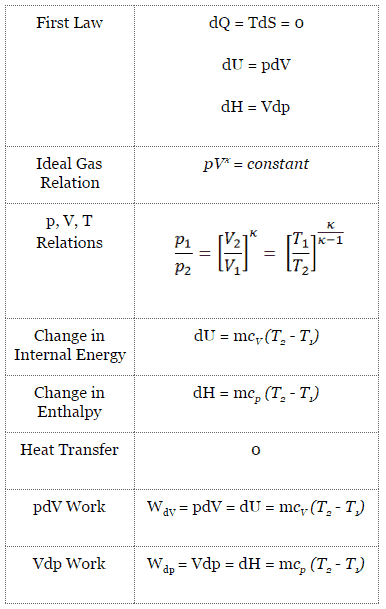
Table of main characteristics

See also: First Law of Thermodynamics

See also: Ideal Gas Law

See also: What is Enthalpy

In this equation the term Vdp is a flow process work. This work,  Vdp, is used for open flow systems like a turbine or a pump in which there is a “dp”, i.e. change in pressure. As can be seen, this form of the law simplifies the description of energy transfer. At constant entropy, i.e. in isentropic process, the enthalpy change equals the flow process work done on or by the system:

Isentropic process (dQ = 0):

dH = Vdp     →     W = H2 – H1     →     H2 – H1 = Cp (T2 – T1)    (for ideal gas)

Isentropic Expansion – Isentropic Compression

See also: What is an Ideal Gas

In an ideal gas, molecules have no volume and do not interact. According to the ideal gas law, pressure varies linearly with temperature and quantity, and inversely with volume.

pV = nRT

where:

  • p is the absolute pressure of the gas
  • n is the amount of substance
  • T is the absolute temperature
  • V is the volume
  • R  is the ideal, or universal, gas constant, equal to the product of the Boltzmann constant and the Avogadro constant,

In this equation the symbol R is a constant called the universal gas constant that has the same value for all gases—namely, R =  8.31 J/mol K.

The isentropic process (a special case of adiabatic process) can be expressed with the ideal gas law as:

pVκ = constant

or

p1V1κ = p2V2κ

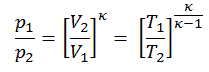
in which κ = cp/cv is the ratio of the specific heats (or heat capacities) for the gas. One for constant pressure (cp) and one for constant volume (cv). Note that, this ratio κ  = cp/cv is a factor in determining the speed of sound in a gas and other adiabatic processes.

Other p, V, T Relation

p,V,T relation - isentropic process

On a p-V diagram, the process occurs along a line (called an adiabat) that has the equation p = constant / Vκ. For an ideal gas and a polytropic process, the case n = κ  corresponds to an isentropic process.

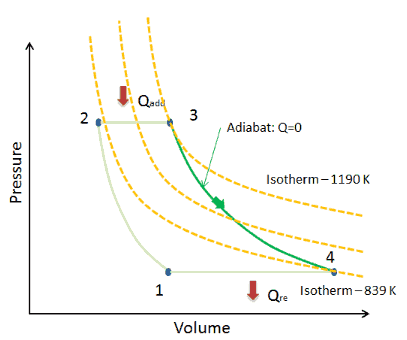
Example: Isentropic Expansion in Gas Turbine

P-V diagram - isentropic process
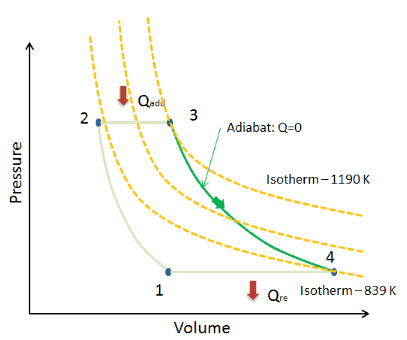
P-V diagram of an isentropic expansion of helium (3 → 4) in a gas turbine.

Assume an isentropic expansion of helium (3 → 4) in a gas turbine. Since helium behaves almost as an ideal gas, use the ideal gas law to calculate outlet temperature of the gas (T4,is). In this turbines the high-pressure stage receives gas (point 3 at the figure; p3 = 6.7 MPa; T3 = 1190 K (917°C)) from a heat exchanger and exhaust it to another heat exchanger, where the outlet pressure is p4 = 2.78 MPa (point 4).

Solution:

The outlet temperature of the gas, T4,is, can be calculated using p, V, T Relation for isentropic process (reversible adiabatic process):

p,V,T relation - isentropic process

In this equation the factor for helium is equal to κ=cp/cv=1.66. From the previous equation follows that the outlet temperature of the gas, T4,is, is:

isentropic process - example

Example: Isentropic Expansion in Gas Turbine

first law - example - brayton cycle
Ideal Brayton cycle consist of four thermodynamic processes. Two isentropic processes and two isobaric processes.

Let assume the ideal Brayton cycle that describes the workings of a constant pressure heat engine. Modern gas turbine engines and airbreathing jet engines also follow the Brayton cycle.

Ideal Brayton cycle consist of four thermodynamic processes. Two isentropic processes and two isobaric processes.

  1. isentropic compression – ambient air is drawn into the compressor, where it is pressurized (1 → 2). The work required for the compressor is given by WC = H2 – H1.
  2. isobaric heat addition – the compressed air then runs through a combustion chamber, where fuel is burned and air or another medium is heated (2 → 3). It is a constant-pressure process, since the chamber is open to flow in and out. The net heat added is given by Qadd = H3 – H2
  3. isentropic expansion – the heated, pressurized air then expands on turbine, gives up its energy. The work done by turbine is given by WT = H4 – H3
  4. isobaric heat rejection – the residual heat must be rejected in order to close the cycle. The net heat rejected is given by Qre = H4 – H1

As can be seen, we can describe and calculate (e.g. thermal efficiency) such cycles (similarly for Rankine cycle) using enthalpies.

See also: Thermal Efficiency of Brayton Cycle

Isentropic Processes in Thermodynamic Cycles

Ideal Carnot Cycle

  • Isentropic compression
  • Isentropic expansion

Ideal Rankine Cycle

  • Isentropic compression in a pump
  • Isentropic expansion in a turbine

Ideal Brayton Cycle

  • Isentropic compression in a compressor
  • Isentropic expansion in a turbine

Ideal Otto Cycle

  • Isentropic compression
  • Isentropic expansion

Ideal Diesel Cycle

  • Isentropic compression
  • Isentropic expansion

Isentropic Efficiency – Turbine, Compressor, Nozzle

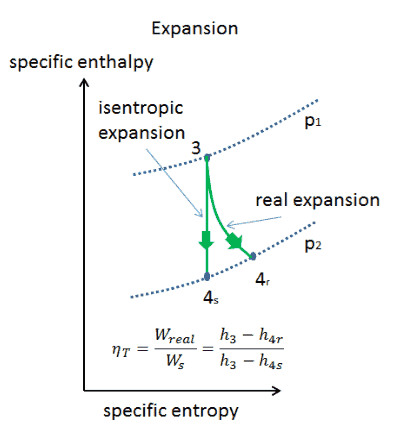
In previous chapters we assumed that the gas expansion is isentropic and therefore we used T4,is  as the outlet temperature of the gas. These assumptions are only applicable with ideal cycles.

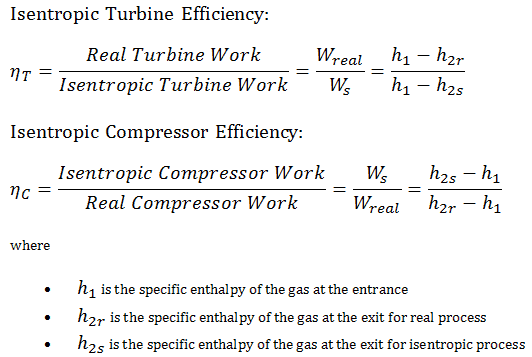
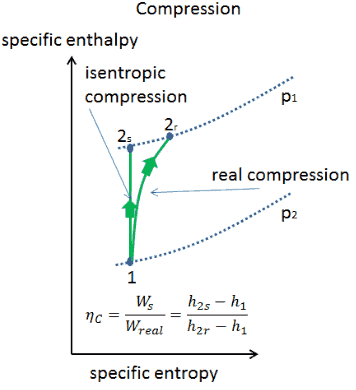
Most steady-flow devices (turbines, compressors, nozzles) operate under adiabatic conditions, but they are not truly isentropic but are rather idealized as isentropic for calculation purposes. We define parameters ηT,  ηC, ηN, as a ratio of real work done by device to work by device when operated under isentropic conditions (in case of turbine). This ratio is known as the Isentropic Turbine/Compressor/Nozzle Efficiency.

These parameters describe how efficiently a turbine, compressor or nozzle approximates a corresponding isentropic device. This parameter reduces the overall efficiency and work output. For turbines, the value of ηT is typically 0.7 to 0.9 (70–90%).

Isentropic Efficiency - equations

Isentropic vs. adiabatic compression
Isentropic vs. adiabatic expansion
Isentropic process is a special case of adiabatic processes. It is a reversible adiabatic process. An isentropic process can also be called a constant entropy process.

Example: Isentropic Turbine Efficiency

Isentropic vs. adiabatic expansion
Isentropic process is a special case of adiabatic processes. It is a reversible adiabatic process. An isentropic process can also be called a constant entropy process.

Assume an isentropic expansion of helium (3 → 4) in a gas turbine. In this turbines the high-pressure stage receives gas (point 3 at the figure; p3 = 6.7 MPa; T3 = 1190 K (917°C)) from a heat exchanger and exhaust it to another heat exchanger, where the outlet pressure is p4 = 2.78 MPa (point 4). The temperature (for isentropic process) of the gas at the exit of the turbine is T4s = 839 K (566°C).

Calculate the work done by this turbine and calculate the real temperature at the exit of the turbine, when the isentropic turbine efficiency is ηT = 0.91 (91%).

Solution:

From the first law of thermodynamics, the work done by turbine in an isentropic process can be calculated from:

WT = h3 – h4s     →     WTs = cp (T3 – T4s)

From Ideal Gas Law we know, that the molar specific heat of a monatomic ideal gas is:

Cv = 3/2R = 12.5 J/mol K and Cp = Cv + R = 5/2R = 20.8 J/mol K

We transfer the specific heat capacities into units of J/kg K via:

cp = Cp . 1/M (molar weight of helium) = 20.8 x 4.10-3 = 5200 J/kg K

The work done by gas turbine in isentropic process is then:

WT,s = cp (T3 – T4s) = 5200 x (1190 – 839) = 1.825 MJ/kg

The real work done by gas turbine in adiabatic process is then:
WT,real = cp (T3 – T4s) . ηT = 5200 x (1190 – 839) x 0.91 = 1.661 MJ/kg

 
References:
Nuclear and Reactor Physics:
  1. J. R. Lamarsh, Introduction to Nuclear Reactor Theory, 2nd ed., Addison-Wesley, Reading, MA (1983).
  2. J. R. Lamarsh, A. J. Baratta, Introduction to Nuclear Engineering, 3d ed., Prentice-Hall, 2001, ISBN: 0-201-82498-1.
  3. W. M. Stacey, Nuclear Reactor Physics, John Wiley & Sons, 2001, ISBN: 0- 471-39127-1.
  4. Glasstone, Sesonske. Nuclear Reactor Engineering: Reactor Systems Engineering, Springer; 4th edition, 1994, ISBN: 978-0412985317
  5. W.S.C. Williams. Nuclear and Particle Physics. Clarendon Press; 1 edition, 1991, ISBN: 978-0198520467
  6. Kenneth S. Krane. Introductory Nuclear Physics, 3rd Edition, Wiley, 1987, ISBN: 978-0471805533
  7. G.R.Keepin. Physics of Nuclear Kinetics. Addison-Wesley Pub. Co; 1st edition, 1965
  8. Robert Reed Burn, Introduction to Nuclear Reactor Operation, 1988.
  9. U.S. Department of Energy, Nuclear Physics and Reactor Theory. DOE Fundamentals Handbook, Volume 1 and 2. January 1993.

Advanced Reactor Physics:

  1. K. O. Ott, W. A. Bezella, Introductory Nuclear Reactor Statics, American Nuclear Society, Revised edition (1989), 1989, ISBN: 0-894-48033-2.
  2. K. O. Ott, R. J. Neuhold, Introductory Nuclear Reactor Dynamics, American Nuclear Society, 1985, ISBN: 0-894-48029-4.
  3. D. L. Hetrick, Dynamics of Nuclear Reactors, American Nuclear Society, 1993, ISBN: 0-894-48453-2.
  4. E. E. Lewis, W. F. Miller, Computational Methods of Neutron Transport, American Nuclear Society, 1993, ISBN: 0-894-48452-4.

See also:

Thermodynamic Processes

We hope, this article, Isentropic Process, helps you. If so, give us a like in the sidebar. Main purpose of this website is to help the public to learn some interesting and important information about thermal engineering.
What is Adiabatic Process – Definition

An adiabatic process is a thermodynamic process, in which there is no heat transfer into or out of the system (Q = 0). The system can be considered to be perfectly insulated. Thermal Engineering

Adiabatic Process

An adiabatic process is a thermodynamic process, in which there is no heat transfer into or out of the system (Q = 0). The system can be considered to be perfectly insulated. In an adiabatic process, energy is transferred only as work. The assumption of no heat transfer is very important, since we can use the adiabatic approximation only in very rapid processes. In these rapid processes, there is not enough time for the transfer of energy as heat to take place to or from the system.

In real devices (such as turbines, pumps, and compressors) heat losses and losses in the combustion process occur, but these losses are usually low in comparison to overall energy flow and we can approximate some thermodynamic processes by the adiabatic process. 

Adiabitic vs Isentropic Process

In comparison to the isentropic process in which the entropy of the fluid or gas remains constant, in the adiabatic process the entropy changes. Therefore the adiabatic process is considered to be irreversible process. The isentropic process is a special case of an adiabatic process. The isentropic process is a reversible adiabatic process. An isentropic process can also be called a constant entropy process. In engineering such an idealized process is very useful for comparison with real processes.

One way to make real processes approximate reversible process is to carry out the process in a series of small or infinitesimal steps or infinitely slowly, so that the process can be considered as a series of equilibrium states. For example, heat transfer may be considered reversible if it occurs due to a small temperature difference between the system and its surroundings. But real processes are not done infinitely slowly. Reversible processes are a useful and convenient theoretical fiction, but do not occur in nature. For example, there could be turbulence in the gas. Therefore, heat engines must have lower efficiencies than limits on their efficiency due to the inherent irreversibility of the heat engine cycle they use.

Adiabatic Process and the First Law

For a closed system, we can write the first law of thermodynamics in terms of enthalpy:

dH = dQ + Vdp

In this equation the term Vdp is a flow process work. This work,  Vdp, is used for open flow systems like a turbine or a pump in which there is a “dp”, i.e. change in pressure. As can be seen, this form of the law simplifies the description of energy transfer. In adiabatic process, the enthalpy change equals the flow process work done on or by the system:

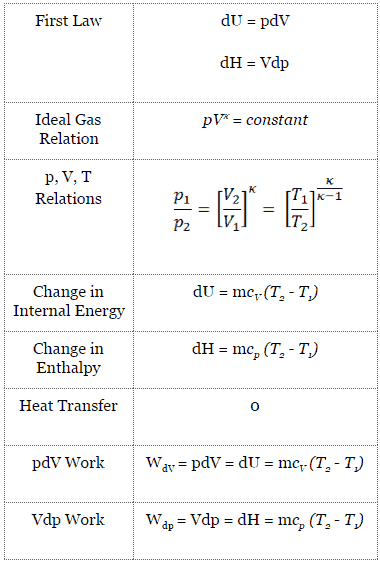
Main characteristics of adiabatic process

See also: First Law of Thermodynamics

See also: Ideal Gas Law

See also: What is Enthalpy

Adiabatic process (dQ = 0):

dH = Vdp     →     W = H2 – H1     →     H2 – H1 = Cp (T2 – T1)    (for an ideal gas)

Adiabatic Expansion – Adiabatic Compression

See also: What is an Ideal Gas

In an ideal gas, molecules have no volume and do not interact. According to the ideal gas law, pressure varies linearly with temperature and quantity, and inversely with volume.

pV = nRT

where:

  • p is the absolute pressure of the gas
  • n is the amount of substance
  • T is the absolute temperature
  • V is the volume
  • R  is the ideal, or universal, gas constant, equal to the product of the Boltzmann constant and the Avogadro constant,

In this equation the symbol R is a constant called the universal gas constant that has the same value for all gases—namely, R =  8.31 J/mol K.

The adiabatic process can be expressed with the ideal gas law as:

pVκ = constant

or

p1V1κ = p2V2κ

in which κ = cp/cv is the ratio of the specific heats (or heat capacities) for the gas. One for constant pressure (cp) and one for constant volume (cv). Note that, this ratio κ  = cp/cv is a factor in determining the speed of sound in a gas and other adiabatic processes.

Other p, V, T Relation

p,V,T relation - isentropic process

On a p-V diagram, the process occurs along a line (called an adiabat) that has the equation p = constant / Vκ. For an ideal gas and a polytropic process, the case n = κ  corresponds to an adiabatic process.

Example of Adiabatic Expansion

P-V diagram - adiabatic process
Assume an adiabatic expansion of helium (3 → 4) in a gas turbine (Brayton cycle).

Assume an adiabatic expansion of helium (3 → 4) in a gas turbine. Since helium behaves almost as an ideal gas, use the ideal gas law to calculate outlet temperature of the gas (T4,real). In this turbines the high-pressure stage receives gas (point 3 at the figure; p3 = 6.7 MPa; T3 = 1190 K (917°C)) from a heat exchanger and exhaust it to another heat exchanger, where the outlet pressure is p4 = 2.78 MPa (point 4).

Solution:

The outlet temperature of the gas, T4,real, can be calculated using p, V, T Relation for adiabatic process. Note that, it is the same relation as for the isentropic process, therefore results must be identical. It this case, we calculate the expansion for different gas turbine (less efficient) as in case of Isentropic Expansion in Gas Turbine.

p,V,T relation - isentropic process

In this equation the factor for helium is equal to κ=cp/cv=1.66. From the previous equation follows that the outlet temperature of the gas, T4,real, is:

adiabatic process - example

See also: Mayer’s relation

Adiabatic Process in Gas Turbine

first law - example - brayton cycle
Ideal Brayton cycle consist of four thermodynamic processes. Two isentropic processes and two isobaric processes.

Let assume the Brayton cycle that describes the workings of a constant pressure heat engine. Modern gas turbine engines and airbreathing jet engines also follow the Brayton cycle.

The Brayton cycle consist of four thermodynamic processes. Two adiabatic processes and two isobaric processes.

  1. adiabatic compression – ambient air is drawn into the compressor, where it is pressurized (1 → 2). The work required for the compressor is given by WC = H2 – H1.
  2. isobaric heat addition – the compressed air then runs through a combustion chamber, where fuel is burned and air or another medium is heated (2 → 3). It is a constant-pressure process, since the chamber is open to flow in and out. The net heat added is given by Qadd = H3 – H2
  3. adiabatic expansion – the heated, pressurized air then expands on turbine, gives up its energy. The work done by turbine is given by WT = H4 – H3
  4. isobaric heat rejection – the residual heat must be rejected in order to close the cycle. The net heat rejected is given by Qre = H4 – H1

As can be seen, we can describe and calculate (e.g. thermal efficiency) such cycles (similarly for Rankine cycle) using enthalpies.

See also: Thermal Efficiency of Brayton Cycle

Isentropic Efficiency – Turbine, Compressor, Nozzle

In previous chapters we assumed that the gas expansion is isentropic and therefore we used T4,is  as the outlet temperature of the gas. These assumptions are only applicable with ideal cycles.

Most steady-flow devices (turbines, compressors, nozzles) operate under adiabatic conditions, but they are not truly isentropic but are rather idealized as isentropic for calculation purposes. We define parameters ηT,  ηC, ηN, as a ratio of real work done by device to work by device when operated under isentropic conditions (in case of turbine). This ratio is known as the Isentropic Turbine/Compressor/Nozzle Efficiency.

These parameters describe how efficiently a turbine, compressor or nozzle approximates a corresponding isentropic device. This parameter reduces the overall efficiency and work output. For turbines, the value of ηT is typically 0.7 to 0.9 (70–90%).

Isentropic Efficiency - equations

Isentropic vs. adiabatic compression
Isentropic vs. adiabatic expansion
Isentropic process is a special case of adiabatic processes. It is a reversible adiabatic process. An isentropic process can also be called a constant entropy process.

Example: Isentropic Turbine Efficiency

Isentropic vs. adiabatic expansion
Isentropic process is a special case of adiabatic processes. It is a reversible adiabatic process. An isentropic process can also be called a constant entropy process.

Assume an isentropic expansion of helium (3 → 4) in a gas turbine. In this turbines the high-pressure stage receives gas (point 3 at the figure; p3 = 6.7 MPa; T3 = 1190 K (917°C)) from a heat exchanger and exhaust it to another heat exchanger, where the outlet pressure is p4 = 2.78 MPa (point 4). The temperature (for isentropic process) of the gas at the exit of the turbine is T4s = 839 K (566°C).

Calculate the work done by this turbine and calculate the real temperature at the exit of the turbine, when the isentropic turbine efficiency is ηT = 0.91 (91%).

Solution:

From the first law of thermodynamics, the work done by turbine in an isentropic process can be calculated from:

WT = h3 – h4s     →     WTs = cp (T3 – T4s)

From Ideal Gas Law we know, that the molar specific heat of a monatomic ideal gas is:

Cv = 3/2R = 12.5 J/mol K and Cp = Cv + R = 5/2R = 20.8 J/mol K

We transfer the specific heat capacities into units of J/kg K via:

cp = Cp . 1/M (molar weight of helium) = 20.8 x 4.10-3 = 5200 J/kg K

The work done by gas turbine in isentropic process is then:

WT,s = cp (T3 – T4s) = 5200 x (1190 – 839) = 1.825 MJ/kg

The real work done by gas turbine in adiabatic process is then:
WT,real = cp (T3 – T4s) . ηT = 5200 x (1190 – 839) x 0.91 = 1.661 MJ/kg

Free Expansion – Joule Expansion

These are adiabatic processes in which no transfer of heat occurs between the system and its environment and no work is done on or by the system. These types of adiabatic processes are called free expansion. It is an irreversible process in which a gas expands into an insulated evacuated chamber. It is also called Joule expansion. For an ideal gas, the temperature doesn’t change (see: Joule’s Second Law), however, real gases experience a temperature change during free expansion. In free expansion Q = W = 0, and the first law requires that:

dEint = 0

A free expansion can not be plotted on a P-V diagram, because the process is rapid, not quasistatic. The intermediate states are not equilibrium states, and hence the pressure is not clearly defined.

 
References:
Nuclear and Reactor Physics:
  1. J. R. Lamarsh, Introduction to Nuclear Reactor Theory, 2nd ed., Addison-Wesley, Reading, MA (1983).
  2. J. R. Lamarsh, A. J. Baratta, Introduction to Nuclear Engineering, 3d ed., Prentice-Hall, 2001, ISBN: 0-201-82498-1.
  3. W. M. Stacey, Nuclear Reactor Physics, John Wiley & Sons, 2001, ISBN: 0- 471-39127-1.
  4. Glasstone, Sesonske. Nuclear Reactor Engineering: Reactor Systems Engineering, Springer; 4th edition, 1994, ISBN: 978-0412985317
  5. W.S.C. Williams. Nuclear and Particle Physics. Clarendon Press; 1 edition, 1991, ISBN: 978-0198520467
  6. Kenneth S. Krane. Introductory Nuclear Physics, 3rd Edition, Wiley, 1987, ISBN: 978-0471805533
  7. G.R.Keepin. Physics of Nuclear Kinetics. Addison-Wesley Pub. Co; 1st edition, 1965
  8. Robert Reed Burn, Introduction to Nuclear Reactor Operation, 1988.
  9. U.S. Department of Energy, Nuclear Physics and Reactor Theory. DOE Fundamentals Handbook, Volume 1 and 2. January 1993.

Advanced Reactor Physics:

  1. K. O. Ott, W. A. Bezella, Introductory Nuclear Reactor Statics, American Nuclear Society, Revised edition (1989), 1989, ISBN: 0-894-48033-2.
  2. K. O. Ott, R. J. Neuhold, Introductory Nuclear Reactor Dynamics, American Nuclear Society, 1985, ISBN: 0-894-48029-4.
  3. D. L. Hetrick, Dynamics of Nuclear Reactors, American Nuclear Society, 1993, ISBN: 0-894-48453-2.
  4. E. E. Lewis, W. F. Miller, Computational Methods of Neutron Transport, American Nuclear Society, 1993, ISBN: 0-894-48452-4.

See also:

Thermodynamic Processes

We hope, this article, Adiabatic Process, helps you. If so, give us a like in the sidebar. Main purpose of this website is to help the public to learn some interesting and important information about thermal engineering.