Facebook Instagram Youtube Twitter

What is Advantage and Challenge of SCWRs – Definition

Advantages and Challenges of SCWRs. SCWR designs have unique features that offer many advantages compared to current light water reactors (LWRs). Thermal Engineering

Advantages and Challenges of SCWRs
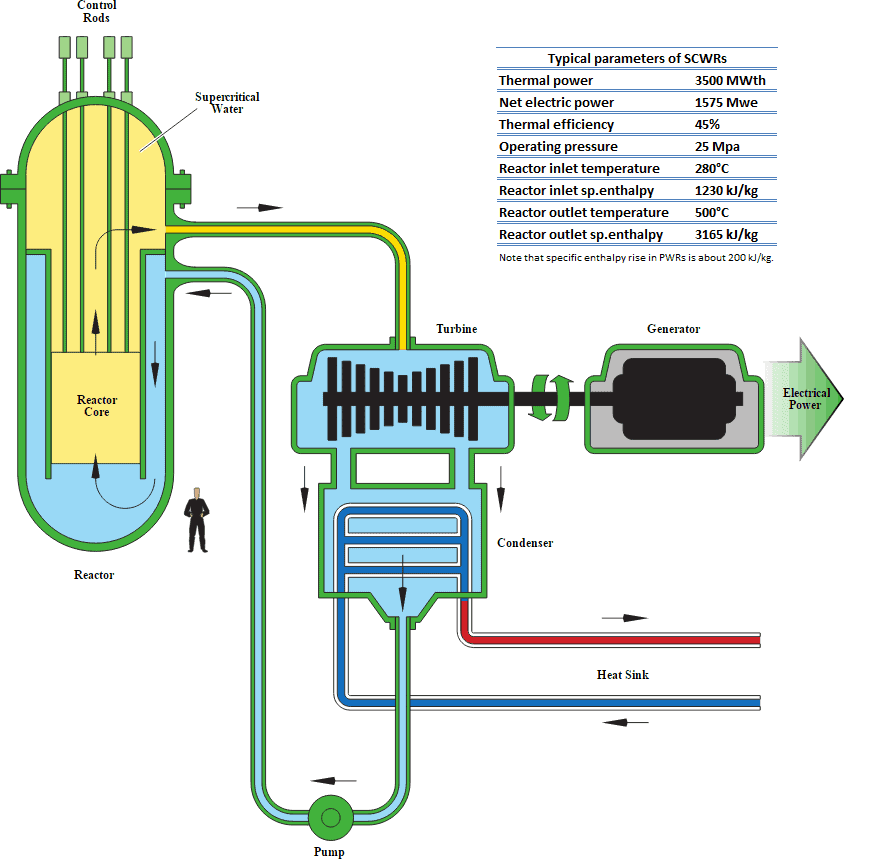
Characteristics of SCWRsAs can be inferred from its name, the SCWR’s key feature is the use of water beyond the thermodynamic critical point (TCR = 374 °C;  pCR = 22.1 MPa) as primary coolant. SCWR designs have unique features that offer many advantages compared to current light water reactors (LWRs).

  • High thermal efficiency. Since SCWRs supply supercritical steam at pressures and temperatures, that are much higher than in conventional LWRs, they will reach higher thermodynamic efficiency of the power plant (~45 % vs. ~33 % for current LWRs).
  • Lower coolant mass flow rate.  The reactor coolant flow rate of SCWR is much smaller than that of BWR and PWR because the enthalpy rise in the core is much larger, which results in low capacity components of the primary system. Thus, the coolant pumps, pipes and other supporting equipment become smaller. Moreover, the only pumps driving the coolant under normal operating conditions are the feed water pumps and the condensate extraction pumps.
  • The higher steam enthalpy allows to decrease the size of the turbine system and thus to lower the capital costs of the conventional island.
  • Smaller coolant inventory. The coolant inventory is smaller which reduces the size of the containment with pressure suppression pools.
  • Since supercritical water does not undergo a phase change and it exists in a single thermodynamic phase, the boiling crisis (i.e. departure from nucleate boiling – DNB or dry out) cannot occur.
  • With a direct cycle of supercritical coolant, components like steam dryers, separators and steam generators are omitted entirely, reducing the number of major components and eliminating their associated costs.
  • Many of the components (e.g. turbine) are readily developed and available from supercritical fossil fired power plants.

The combination of advanced water-cooled reactor technology and advanced supercritical fossil technology is expected to result in a reactor concept that can be used to generate base-load electricity very economically and efficiently. This feature also makes the SCWR a very attractive concept for utilities, especially those that have experience with both water-cooled reactors and supercritical fossil plants.

On the other hand numerous challenges must be solved before the first power plants of this type can be built:

  • The cladding materials have to withstand higher temperatures (600-650°C in normal operating conditions) than in today’s LWRs.
  • The heat transfer phenomena from cladding surface into supercritical fluid must be understood thoroughly.  Especially in case of within transients with depressurization from supercritical to subcritical conditions.
  • Due to the smaller coolant inventory, the dry out of the core progresses faster in case of a loss of coolant accident (LOCA).
 
References:
Reactor Physics and Thermal Hydraulics:
  1. J. R. Lamarsh, Introduction to Nuclear Reactor Theory, 2nd ed., Addison-Wesley, Reading, MA (1983).
  2. J. R. Lamarsh, A. J. Baratta, Introduction to Nuclear Engineering, 3d ed., Prentice-Hall, 2001, ISBN: 0-201-82498-1.
  3. W. M. Stacey, Nuclear Reactor Physics, John Wiley & Sons, 2001, ISBN: 0- 471-39127-1.
  4. Glasstone, Sesonske. Nuclear Reactor Engineering: Reactor Systems Engineering, Springer; 4th edition, 1994, ISBN: 978-0412985317
  5. Todreas Neil E., Kazimi Mujid S. Nuclear Systems Volume I: Thermal Hydraulic Fundamentals, Second Edition. CRC Press; 2 edition, 2012, ISBN: 978-0415802871
  6. Zohuri B., McDaniel P. Thermodynamics in Nuclear Power Plant Systems. Springer; 2015, ISBN: 978-3-319-13419-2
  7. Moran Michal J., Shapiro Howard N. Fundamentals of Engineering Thermodynamics, Fifth Edition, John Wiley & Sons, 2006, ISBN: 978-0-470-03037-0
  8. Kleinstreuer C. Modern Fluid Dynamics. Springer, 2010, ISBN 978-1-4020-8670-0.
  9. U.S. Department of Energy, THERMODYNAMICS, HEAT TRANSFER, AND FLUID FLOW. DOE Fundamentals Handbook, Volume 1, 2 and 3. June 1992.

See also:

SCWR

We hope, this article, Advantage and Challenge of SCWRs, helps you. If so, give us a like in the sidebar. Main purpose of this website is to help the public to learn some interesting and important information about thermal engineering.

What is Thermodynamics – Definition

Thermodynamics is the science that deals with energy production, storage, transfer and conversion. Thermodynamics studies the effects of work, heat and energy on a system. Thermal Engineering

Thermodynamics

thermodynamics - Boltzman equationA knowledge of thermodynamics is essential to nuclear engineers, who deal with nuclear power reactors. A nuclear power plant (nuclear power station) looks like a standard thermal power station with one exception. The heat source in the nuclear power plant is a nuclear reactor. As is typical in many conventional thermal power stations the heat is used to generate steam which drives a steam turbine connected to a generator which produces electricity.

Thermodynamics is the science that deals with energy production, storage, transfer and conversion. It studies the effects of work, heat and energy on a system. Despite the fact it is a very broad subject that affects most fields of science including biology and microelectronics, we will concern mostly with large scale observations. Small scale interactions will be described in the kinetic theory of gases.

Historically, thermodynamics was born in the 19th century as scientists were first discovering how to build and operate steam engines. Particularly through the work of French physicist Nicolas Léonard Sadi Carnot who introduced the concept of the heat-engine cycle and the principle of reversibility in 1824. Scottish physicist Lord Kelvin was the first to formulate a concise definition of thermodynamics in 1854. Carnot’s work concerned the limitations on the maximum amount of work that can be obtained from a steam engine operating with a high-temperature heat transfer as its driving force. In later years the laws of thermodynamics were developed. Thermodynamics is principally based on a set of four laws which are universally valid when applied to systems that fall within the constraints implied by each.

engineering thermodynamics
Rankine Cycle – Thermodynamics as Energy Conversion Science

Thermodynamics is both a branch of physics and an engineering science. The physicist is normally interested in gaining a fundamental understanding of the physical and chemical behavior of fixed quantities of matter at rest and uses the laws of thermodynamics to relate the properties of matter. Engineers are generally interested in studying energy systems and how they interact with their surroundings. To facilitate this, engineers extend the subject of thermodynamics to the study of open systems, in which heat, work and mass can be directed into or out of the control volume.

Our goal here will be to introduce thermodynamics as the energy conversion science, to introduce some of the fundamental concepts and definitions that are used in the study of engineering thermodynamics. These fundamental concepts and definitions will be further applied to energy systems and finally to thermal or nuclear power plants.

Nuclear power plant description
Main features of nuclear power plants with PWR-type (Pressurized Water Reactor) reactor.

A typical nuclear power plant has an electric-generating capacity of 1000 MWe. The heat source in the nuclear power plant is a nuclear reactor. As is typical in all conventional thermal power stations the heat is used to generate steam which drives a steam turbine connected to a generator which produces electricity. The turbines are heat engines and are subject to the efficiency limitations imposed by the second law of thermodynamics. In modern nuclear power plants the overall thermodynamic efficiency is about one-third (33%), so 3000 MWth of thermal power from the fission reaction is needed to generate 1000 MWe of electrical power.

In the following sections we will deal with the problem, how to transform the thermal energy generated inside the reactor into the electrical energy in a most effective way.

Laws of Thermodynamics

There are four laws of thermodynamics that define fundamental physical quantities (temperature, energy, and entropy) and that characterize thermodynamic systems at thermal equilibrium. These are considered as one of the most important laws in all of physics. The laws are as follows:

Zeroth law of thermodynamics:

If two systems are both in thermal equilibrium with a third then they are in thermal equilibrium with each other.  

This law provides a definition and method of defining temperatures, perhaps the most important intensive property of a system when dealing with thermal energy conversion problems.

First law of thermodynamics:

The increase in internal energy of a closed system is equal to the heat supplied to the system minus work done by it.  

This law is the principle of conservation of energy. It is the most important law for analysis of most systems and the one that quantifies how thermal energy is transformed to other forms of energy. It follows, perpetual motion machines of the first kind are impossible.

Second law of thermodynamics:

The entropy of any isolated system never decreases. In a natural thermodynamic process, the sum of the entropies of the interacting thermodynamic systems increases.  

This law indicates the irreversibility of natural processes. Reversible processes are a useful and convenient theoretical fiction, but do not occur in nature. From this law follows that it is impossible to construct a device that operates on a cycle and whose sole effect is the transfer of heat from a cooler body to a hotter body. It follows, perpetual motion machines of the second kind are impossible.

Third law of thermodynamics:

The entropy of a system approaches a constant value as the temperature approaches absolute zero.

Based on empirical evidence, this law states that the entropy of a pure crystalline substance is zero at the absolute zero of temperature, 0 K and that it is impossible by means of any process, no matter how idealized, to reduce the temperature of a system to absolute zero in a finite number of steps. This allows us to define a zero point for the thermal energy of a body.

Popular Version of the Laws of Thermodynamics

0. You must play the game.

1. You can’t win; you can only break even.

2. You can only break even at absolute zero.

3. You can’t reach absolute zero.

 
Popular version of the laws
Popular version of the consequences of the first, second, and third laws of thermodynamics:

0. You must play the game.

1. You can’t win. (consequence of first law of thermodynamics)

2. You can’t break even. (consequence of second law of thermodynamics)

3. You can’t even get out of the game. (consequence of third law of thermodynamics)

It is sometimes stated as a general adage without specific reference to the laws of thermodynamics.

Another variant:

1. You can’t win; you can only break even.

2. You can only break even at absolute zero.

3. You can’t reach absolute zero.

Extensive Properties – Intesive Properties

 
Extensive Properties - Intesive Properties
Thermodynamic properties can be divided into two general classes:
  • Extensive properties: An extensive property is dependent upon the amount of mass present or upon the size or extent of a system. Mass, total volume and energy are examples of extensive properties. The value of an extensive property varies directly with the mass. Thus, if a quantity of matter in a given state is divided into two equal parts, each part will have the same value of intensive property as the original and half the value of the extensive property. Extensive properties are additive for subsystems. The system could be divided into any number of subsystems and the value of the property for the system would be the sum of the property for each subsystem.
  • Intensive property: An intensive property is independent of the amount of mass and may vary from place to place within the system at any moment.  For example, the temperature of a system in thermal equilibrium is the same as the temperature of any part of it. If the system is divided the temperature of each subsystem is identical. Temperature, pressure, specific volume, and density are examples of intensive properties. Specific quantities are also referred to as intensive variables, though there are some intensive variables that have no extensive counterpart, such as pressure or temperature. Intensive properties may be functions of both position and time, whereas extensive properties vary at most with time.
Specific Properties
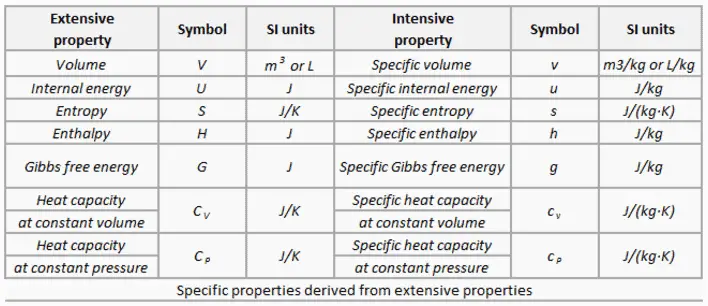
Specific properties of material are derived from other intensive and extensive properties of that material. For example, the density of water  is an intensive property and can be derived from measurements of the mass of a water volume (an extensive property) divided by the volume (another extensive property). Also heat capacity, which is an extensive property of a system can be derived from heat capacity, Cp, and the mass of the system. Dividing these extensive properties gives the specific heat capacity, cp, which is an intensive property.

Specific properties are often used in reference tables as a means of recording material data in a manner that is independent of size or mass. They are very useful for making comparisons about one attribute while cancelling out the effect of variations in another attribute.

Specific properties - thermodynamics
Table of some specific properties

What is Energy

The Sun
The Sun generates its energy by nuclear fusion of hydrogen nuclei into helium. In its core, the Sun fuses 620 million metric tons of hydrogen each second.
Source: hyperphysics.phy-astr.gsu.edu

The term energy is very very broad and it has many definitions. Technically, energy is a scalar physical quantity that is associated with the state of one or more objects. Energy is generally defined as the potential to do work or produce heat. Sometimes it is like the “currency” for performing work. You must have energy to accomplish work. To do 1 kilojoule of work, you must expend 1 kilojoule of energy. It must be added, this interpretation can be misleading because energy is not necessarily available to do work.

One of the most wonderful properties of the universe is that energy can be transformed from one type to another and transferred from one object to another. Moreover, when transformed from one type to another and transferred from one object to another, the total amount of energy is always the same. It is one of the elementary properties of the universe.

For example, burning gasoline to power cars is an energy conversion process we rely on. The chemical energy in gasoline is converted to thermal energy, which is then converted to mechanical energy that makes the car move. The mechanical energy has been converted to kinetic energy. When we use the brakes to stop a car, that kinetic energy is converted by friction back to heat, or thermal energy.

Heat Engines

Example of Heat Engine
The Rankine cycle closely describes the processes in steam-operated heat engines commonly found in most of thermal power plants.

Energy sources have always played a very important role in the development of human society. Energy is generally defined as the potential to do work or produce heat. Sometimes it is like the “currency” for performing work. One of the most wonderful properties of the universe is that energy can be transformed from one type to another and transferred from one object to another.

In general, it is easy to produce thermal energy by doing work, for example by any frictional process. But to get work from thermal energy is more difficult. It is closely associated with the concept of entropy. For example, electricity is particularly useful since it has very low entropy (is highly ordered) and can be converted into other forms of energy very efficiently.

Sometimes, mechanical energy is directly available, for example wind power and hydro power. But most of our energy comes from the burning of fossil fuels (coal, oil, and gas) and from nuclear reactions. At present, fossil fuel is still the world’s predominant energy source. But the burning of fossil fuels generates only thermal energy, therefore these energy sources are so called “primary energy sources”, that must be converted to secondary energy source, so called energy carriers (electrical energy etc.). To convert thermal energy into another form of energy a heat engine must be used.

In general, a heat engine is a device that converts chemical energy to heat or thermal energy and then to mechanical energy or to electrical energy.

The Rankine cycle closely describes the processes in steam-operated heat engines commonly found in most of thermal power plants.

Many heat engines operate in a cyclic manner, adding energy in the form of heat in one part of the cycle and using that energy to do useful work in another part of the cycle.
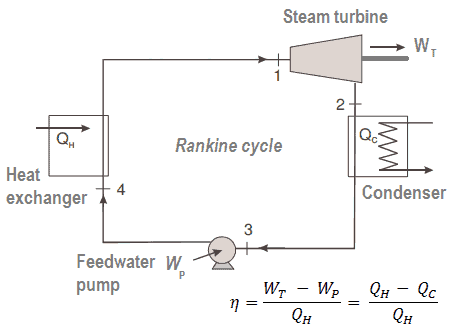
For example, as is typical in all conventional thermal power plants the heat is used to generate steam which drives a steam turbine connected to a generator which produces electricity. Steam generators, steam turbines, condensers and feedwater pumps constitute a heat engine, that is subject to the efficiency limitations imposed by the second law of thermodynamics. In modern nuclear power plants the overall thermodynamic efficiency is about one-third (33%), so 3000 MWth of thermal power from the fission reaction is needed to generate 1000 MWe of electrical power.

 
References:
Nuclear and Reactor Physics:
  1. J. R. Lamarsh, Introduction to Nuclear Reactor Theory, 2nd ed., Addison-Wesley, Reading, MA (1983).
  2. J. R. Lamarsh, A. J. Baratta, Introduction to Nuclear Engineering, 3d ed., Prentice-Hall, 2001, ISBN: 0-201-82498-1.
  3. W. M. Stacey, Nuclear Reactor Physics, John Wiley & Sons, 2001, ISBN: 0- 471-39127-1.
  4. Glasstone, Sesonske. Nuclear Reactor Engineering: Reactor Systems Engineering, Springer; 4th edition, 1994, ISBN: 978-0412985317
  5. W.S.C. Williams. Nuclear and Particle Physics. Clarendon Press; 1 edition, 1991, ISBN: 978-0198520467
  6. Kenneth S. Krane. Introductory Nuclear Physics, 3rd Edition, Wiley, 1987, ISBN: 978-0471805533
  7. G.R.Keepin. Physics of Nuclear Kinetics. Addison-Wesley Pub. Co; 1st edition, 1965
  8. Robert Reed Burn, Introduction to Nuclear Reactor Operation, 1988.
  9. U.S. Department of Energy, Nuclear Physics and Reactor Theory. DOE Fundamentals Handbook, Volume 1 and 2. January 1993.

Advanced Reactor Physics:

  1. K. O. Ott, W. A. Bezella, Introductory Nuclear Reactor Statics, American Nuclear Society, Revised edition (1989), 1989, ISBN: 0-894-48033-2.
  2. K. O. Ott, R. J. Neuhold, Introductory Nuclear Reactor Dynamics, American Nuclear Society, 1985, ISBN: 0-894-48029-4.
  3. D. L. Hetrick, Dynamics of Nuclear Reactors, American Nuclear Society, 1993, ISBN: 0-894-48453-2.
  4. E. E. Lewis, W. F. Miller, Computational Methods of Neutron Transport, American Nuclear Society, 1993, ISBN: 0-894-48452-4.

See also:

Nuclear Engineering

We hope, this article, Thermodynamics, helps you. If so, give us a like in the sidebar. Main purpose of this website is to help the public to learn some interesting and important information about thermal engineering.

What is Key Property of Water – Definition

water is a remarkable substance with many surprising properties. Water is a common medium also in nuclear engineering because properties of water are very well known. Thermal Engineering

Water


properties of waterWater
is a transparent and nearly colorless substance composed of the chemical elements hydrogen and oxygen, that are connected by covalent bonds. On Earth, water exists in gaseous (steam or water vapor), liquid, and solid states (ice). It is one of the most plentiful and essential of compounds and it is the main constituent of Earth’s streams, lakes, and oceans, and the fluids of most living organisms.  It is vital for all known forms of life.

Besides being essential to life, water is a remarkable substance with many surprising properties.

  • It is the only chemical compound that occurs naturally in all three physical states – gaseous (steam or water vapor), liquid, and solid states (ice).
  • It is the only inorganic liquid that occurs naturally on the Earth.
  • Water also differs from most liquids in that it becomes less dense as it freezes. It has a maximum of density at 3.98 °C (1000 kg/m3), whereas the density of ice is 917 kg/m3. It differs by about 9% and therefore ice floats on liquid water
  • Water has the highest specific heat of any common substance –  4.19 kJ/kg K.
  • It has very high heat of vaporization, which makes it an effective coolant and medium in thermal power plants and other energy industry.

Uses of Water in Nuclear Engineering

Water as a reactor coolant


Water and steam
are a common fluid used for heat exchange in the primary circuit (from surface of fuel rods to the coolant flow) and in the secondary circuit. It used due to its availability and high heat capacity, both for cooling and heating. It is especially effective to transport heat through vaporization and condensation of water because of its very large latent heat of vaporization.

A disadvantage is that water moderated reactors have to use high pressure primary circuit in order to keep water in liquid state and in order to achieve sufficient thermodynamic efficiency. Water and steam also reacts with metals commonly found in industries such as steel and copper that are oxidized faster by untreated water and steam. In almost all thermal power stations (coal, gas, nuclear), water is used as the working fluid (used in a closed loop between boiler, steam turbine and condenser), and the coolant (used to exchange the waste heat to a water body or carry it away by evaporation in a cooling tower).

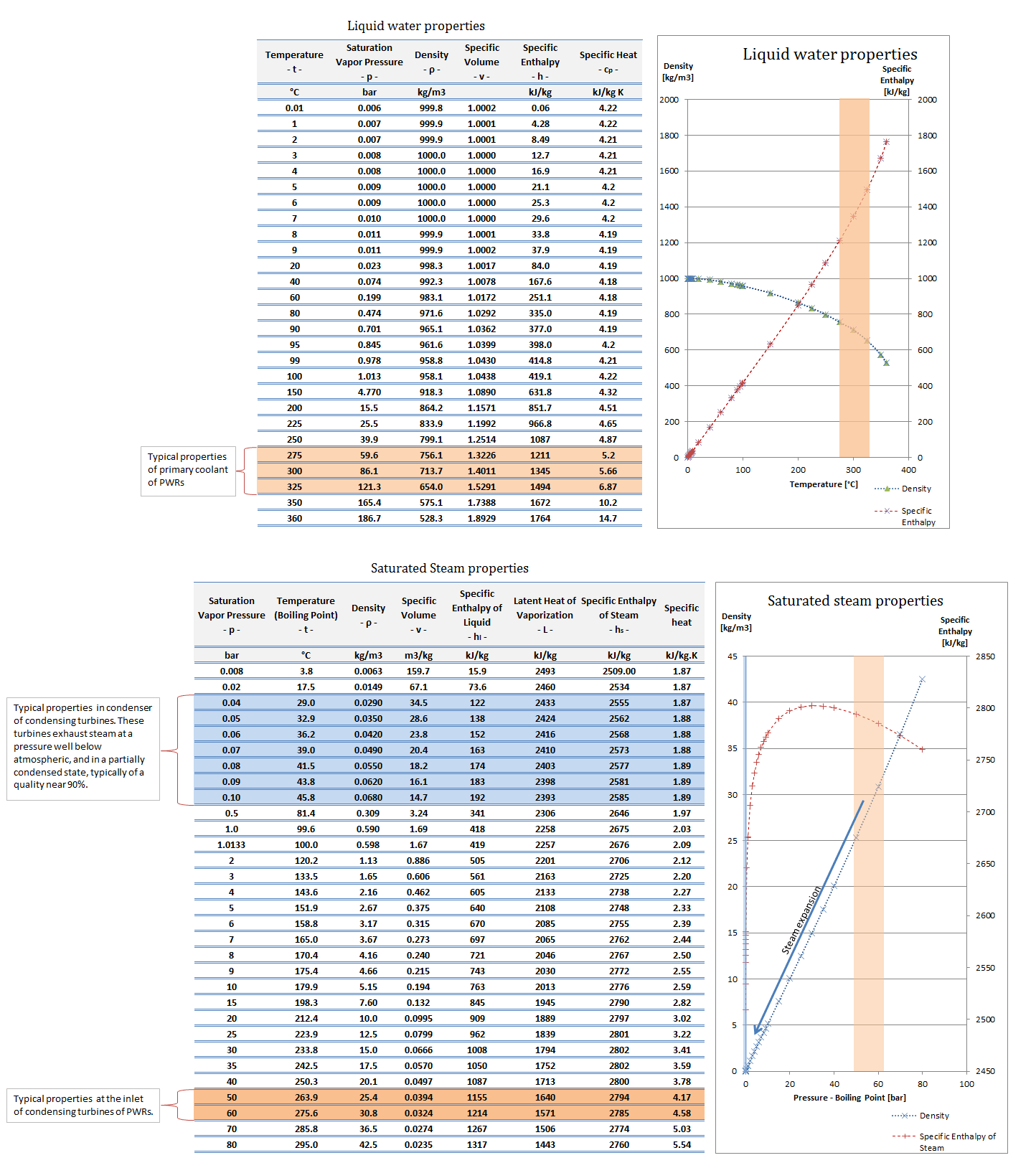
Properties of water - steam tables
Steam Tables – common parameters in energy systems

Water and steam are a common medium because their properties are very well known. Their properties are tabulated in so called “Steam Tables”. In these tables the basic and key properties, such as pressure, temperature, enthalpy, density and specific heat, are tabulated along the vapor-liquid saturation curve as a function of both temperature and pressure. The properties are also tabulated for single-phase states (compressed water or superheated steam) on a grid of temperatures and pressures extending to 2000 ºC and 1000 MPa.

Further comprehensive authoritative data can be found at the NIST Webbook page on thermophysical properties of fluids.

See also: Steam Tables

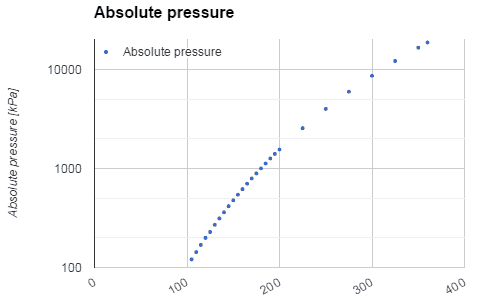
Chart: Absolute pressure as a function of temperature of water
Water: Absolute pressure as a function of temperature
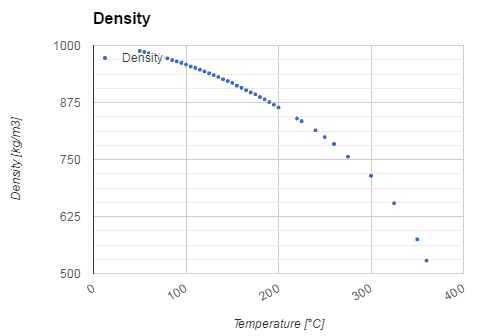
Chart: Density as a function of temperature of water
Chart - density - water - temperature
Density as a function of temperature of water
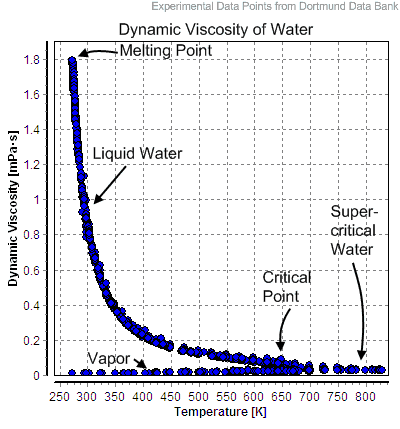
Chart: Dynamic viscosity as a function of temperature of water
Dynamic viscosity as a function of temperature of water
Chart: Dynamic viscosity as a function of temperature of water
Source: wikipedia.org CC BY-SA

Water as a moderator

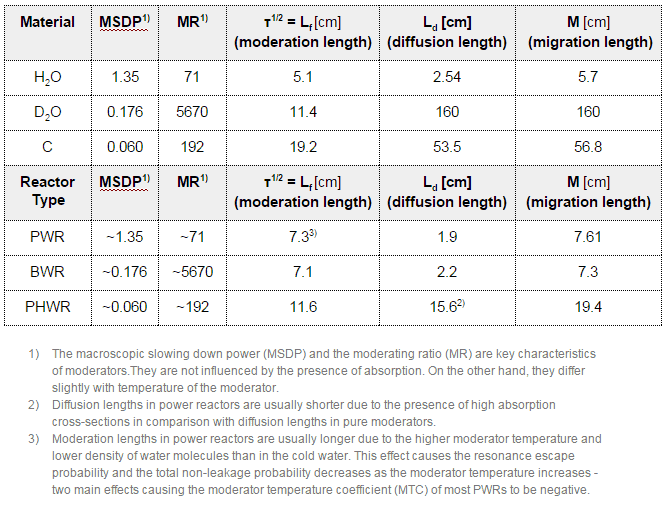
The neutron moderator, which is of importance in thermal reactors, is used to moderate, that is to slow down neutrons from fission to thermal energies. Nuclei with low mass numbers are most effective for this purpose, so the moderator is always a low-mass-number material. Commonly used moderators include regular (light) water (roughly 75% of the world’s reactors), solid graphite (20% of reactors) and heavy water (5% of reactors).

In most nuclear reactors, water is both a coolant and a moderator. The moderation occurs especially on hydrogen nuclei. In case of the hydrogen (A = 1) as the target nucleus, the incident neutron can be completely stopped – it has the highest average logarithmic energy decrement of all nuclei. On the other hand hydrogen nuclei have relatively higher absorption cross section, therefore water is not the best moderator according to the moderating ratio.

Neutron Moderators - Parameters

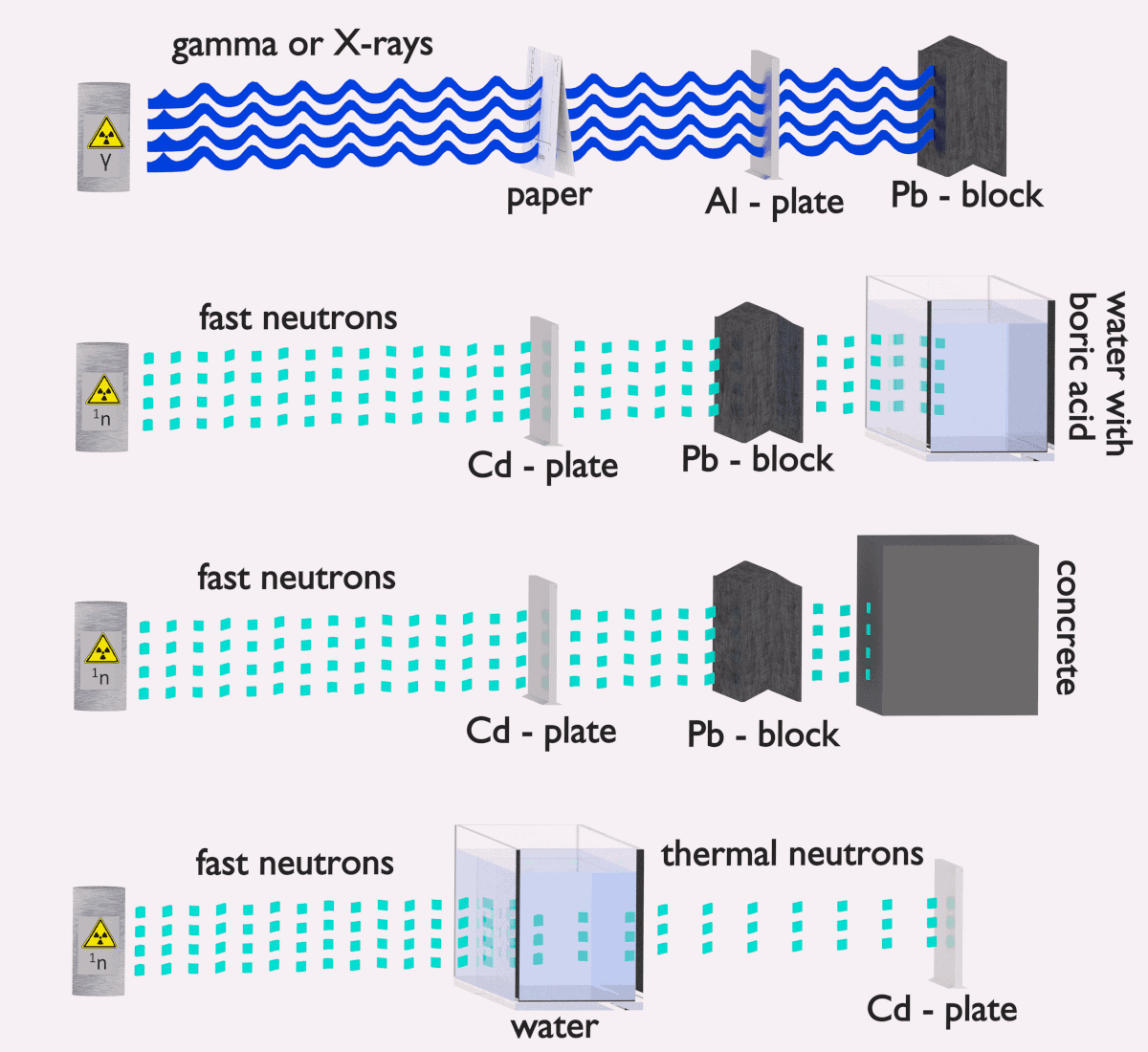
Water as a neutron shielding

Shielding of Neutron Radiation
Water as a neutron shield

Water due to the high hydrogen content and the availability is efective and common neutron shielding. However, due to the low atomic number of hydrogen and oxygen, water is not acceptable shield against the gamma rays. On the other hand in some cases this disadvantage (low density) can be compensated by high thickness of the water shield.  In case of neutrons, water perfectly moderates neutrons, but with absorption of neutrons by hydrogen nucleus secondary gamma rays with the high energy are produced. These gamma rays highly penetrates matter and therefore it can increase requirements on the thickness of the water shield. Adding a boric acid can help with this problem (neutron absorbtion on boron nuclei without strong gamma emission), but results in another problems with corrosion of construction materials.

See also: Shielding of Neutrons

Water as a gamma radiation shielding

In short, effective shielding of gamma radiation is in most cases based on use of materials with two following material properties:

  • high-density of material.
  • high atomic number of material  (high Z materials)
Table of Half Value Layers (in cm)
Table of Half Value Layers (in cm) for a different materials at gamma ray energies of 100, 200 and 500 keV.

Although water is neither high density nor high Z material, it is commonly used as gamma shields. Water provides a radiation shielding of fuel assemblies in a spent fuel pool during storage or during transports from and into the reactor core. Although water is a low-density material and low Z material, it is commonly used in nuclear power plants, because these disadvantages can be compensated with increased thickness.

Half Value Layer of Water

The half value layer expresses the thickness of absorbing material needed for reduction of the incident radiation intensity by a factor of two.

Table of Half Value Layers (in cm) for a different materials at gamma ray energies of 100, 200 and 500 keV.

References:
Reactor Physics and Thermal Hydraulics:
  1. J. R. Lamarsh, Introduction to Nuclear Reactor Theory, 2nd ed., Addison-Wesley, Reading, MA (1983).
  2. J. R. Lamarsh, A. J. Baratta, Introduction to Nuclear Engineering, 3d ed., Prentice-Hall, 2001, ISBN: 0-201-82498-1.
  3. W. M. Stacey, Nuclear Reactor Physics, John Wiley & Sons, 2001, ISBN: 0- 471-39127-1.
  4. Glasstone, Sesonske. Nuclear Reactor Engineering: Reactor Systems Engineering, Springer; 4th edition, 1994, ISBN: 978-0412985317
  5. Todreas Neil E., Kazimi Mujid S. Nuclear Systems Volume I: Thermal Hydraulic Fundamentals, Second Edition. CRC Press; 2 edition, 2012, ISBN: 978-0415802871
  6. Zohuri B., McDaniel P. Thermodynamics in Nuclear Power Plant Systems. Springer; 2015, ISBN: 978-3-319-13419-2
  7. Moran Michal J., Shapiro Howard N. Fundamentals of Engineering Thermodynamics, Fifth Edition, John Wiley & Sons, 2006, ISBN: 978-0-470-03037-0
  8. Kleinstreuer C. Modern Fluid Dynamics. Springer, 2010, ISBN 978-1-4020-8670-0.
  9. U.S. Department of Energy, THERMODYNAMICS, HEAT TRANSFER, AND FLUID FLOW. DOE Fundamentals Handbook, Volume 1, 2 and 3. June 1992.

See also:

Materials

We hope, this article, Key Property of Water, helps you. If so, give us a like in the sidebar. Main purpose of this website is to help the public to learn some interesting and important information about thermal engineering.
What is Water in Nuclear Engineering – Definition

Uses of Water in Nuclear Engineering. In nuclear engineering water has various uses. Water is a remarkable substance and it has many remarkable physical properties. Thermal Engineering

Uses of Water in Nuclear Engineering

Water as a reactor coolant


Water and steam
are a common fluid used for heat exchange in the primary circuit (from surface of fuel rods to the coolant flow) and in the secondary circuit. It used due to its availability and high heat capacity, both for cooling and heating. It is especially effective to transport heat through vaporization and condensation of water because of its very large latent heat of vaporization.

A disadvantage is that water moderated reactors have to use high pressure primary circuit in order to keep water in liquid state and in order to achieve sufficient thermodynamic efficiency. Water and steam also reacts with metals commonly found in industries such as steel and copper that are oxidized faster by untreated water and steam. In almost all thermal power stations (coal, gas, nuclear), water is used as the working fluid (used in a closed loop between boiler, steam turbine and condenser), and the coolant (used to exchange the waste heat to a water body or carry it away by evaporation in a cooling tower).

Properties of water - steam tables
Steam Tables – common parameters in energy systems

Water and steam are a common medium because their properties are very well known. Their properties are tabulated in so called “Steam Tables”. In these tables the basic and key properties, such as pressure, temperature, enthalpy, density and specific heat, are tabulated along the vapor-liquid saturation curve as a function of both temperature and pressure. The properties are also tabulated for single-phase states (compressed water or superheated steam) on a grid of temperatures and pressures extending to 2000 ºC and 1000 MPa.

Further comprehensive authoritative data can be found at the NIST Webbook page on thermophysical properties of fluids.

See also: Steam Tables

 
Chart: Absolute pressure as a function of temperature of water
Water: Absolute pressure as a function of temperature
Chart: Density as a function of temperature of water
Chart - density - water - temperature
Density as a function of temperature of water
Chart: Dynamic viscosity as a function of temperature of water
Dynamic viscosity as a function of temperature of water
Chart: Dynamic viscosity as a function of temperature of water
Source: wikipedia.org CC BY-SA

Water as a moderator

The neutron moderator, which is of importance in thermal reactors, is used to moderate, that is to slow down neutrons from fission to thermal energies. Nuclei with low mass numbers are most effective for this purpose, so the moderator is always a low-mass-number material. Commonly used moderators include regular (light) water (roughly 75% of the world’s reactors), solid graphite (20% of reactors) and heavy water (5% of reactors).

In most nuclear reactors, water is both a coolant and a moderator. The moderation occurs especially on hydrogen nuclei. In case of the hydrogen (A = 1) as the target nucleus, the incident neutron can be completely stopped – it has the highest average logarithmic energy decrement of all nuclei. On the other hand hydrogen nuclei have relatively higher absorption cross section, therefore water is not the best moderator according to the moderating ratio.

Neutron Moderators - Parameters

Water as a neutron shielding

Shielding of Neutron Radiation
Water as a neutron shield

Water due to the high hydrogen content and the availability is efective and common neutron shielding. However, due to the low atomic number of hydrogen and oxygen, water is not acceptable shield against the gamma rays. On the other hand in some cases this disadvantage (low density) can be compensated by high thickness of the water shield.  In case of neutrons, water perfectly moderates neutrons, but with absorption of neutrons by hydrogen nucleus secondary gamma rays with the high energy are produced. These gamma rays highly penetrates matter and therefore it can increase requirements on the thickness of the water shield. Adding a boric acid can help with this problem (neutron absorbtion on boron nuclei without strong gamma emission), but results in another problems with corrosion of construction materials.

See also: Shielding of Neutrons

Water as a gamma radiation shielding

In short, effective shielding of gamma radiation is in most cases based on use of materials with two following material properties:

  • high-density of material.
  • high atomic number of material  (high Z materials)
Table of Half Value Layers (in cm)
Table of Half Value Layers (in cm) for a different materials at gamma ray energies of 100, 200 and 500 keV.

Although water is neither high density nor high Z material, it is commonly used as gamma shields. Water provides a radiation shielding of fuel assemblies in a spent fuel pool during storage or during transports from and into the reactor core. Although water is a low-density material and low Z material, it is commonly used in nuclear power plants, because these disadvantages can be compensated with increased thickness.

Half Value Layer of Water

The half value layer expresses the thickness of absorbing material needed for reduction of the incident radiation intensity by a factor of two.

Table of Half Value Layers (in cm) for a different materials at gamma ray energies of 100, 200 and 500 keV.

 
References:
Reactor Physics and Thermal Hydraulics:
  1. J. R. Lamarsh, Introduction to Nuclear Reactor Theory, 2nd ed., Addison-Wesley, Reading, MA (1983).
  2. J. R. Lamarsh, A. J. Baratta, Introduction to Nuclear Engineering, 3d ed., Prentice-Hall, 2001, ISBN: 0-201-82498-1.
  3. W. M. Stacey, Nuclear Reactor Physics, John Wiley & Sons, 2001, ISBN: 0- 471-39127-1.
  4. Glasstone, Sesonske. Nuclear Reactor Engineering: Reactor Systems Engineering, Springer; 4th edition, 1994, ISBN: 978-0412985317
  5. Todreas Neil E., Kazimi Mujid S. Nuclear Systems Volume I: Thermal Hydraulic Fundamentals, Second Edition. CRC Press; 2 edition, 2012, ISBN: 978-0415802871
  6. Zohuri B., McDaniel P. Thermodynamics in Nuclear Power Plant Systems. Springer; 2015, ISBN: 978-3-319-13419-2
  7. Moran Michal J., Shapiro Howard N. Fundamentals of Engineering Thermodynamics, Fifth Edition, John Wiley & Sons, 2006, ISBN: 978-0-470-03037-0
  8. Kleinstreuer C. Modern Fluid Dynamics. Springer, 2010, ISBN 978-1-4020-8670-0.
  9. U.S. Department of Energy, THERMODYNAMICS, HEAT TRANSFER, AND FLUID FLOW. DOE Fundamentals Handbook, Volume 1, 2 and 3. June 1992.

See also:

Water

We hope, this article, Water in Nuclear Engineering, helps you. If so, give us a like in the sidebar. Main purpose of this website is to help the public to learn some interesting and important information about thermal engineering.

What is Water as a Reactor Coolant – Definition

Water and steam are a common fluid used for heat exchange in the primary circuit – as a reactor coolant. It used due to its availability and high heat capacity, both for cooling and heating. Thermal Engineering

Water as a reactor coolant


Water and steam
are a common fluid used for heat exchange in the primary circuit (from surface of fuel rods to the coolant flow) and in the secondary circuit. It used due to its availability and high heat capacity, both for cooling and heating. It is especially effective to transport heat through vaporization and condensation of water because of its very large latent heat of vaporization.

A disadvantage is that water moderated reactors have to use high pressure primary circuit in order to keep water in liquid state and in order to achieve sufficient thermodynamic efficiency. Water and steam also reacts with metals commonly found in industries such as steel and copper that are oxidized faster by untreated water and steam. In almost all thermal power stations (coal, gas, nuclear), water is used as the working fluid (used in a closed loop between boiler, steam turbine and condenser), and the coolant (used to exchange the waste heat to a water body or carry it away by evaporation in a cooling tower).

Properties of water - steam tables
Steam Tables – common parameters in energy systems

Water and steam are a common medium because their properties are very well known. Their properties are tabulated in so called “Steam Tables”. In these tables the basic and key properties, such as pressure, temperature, enthalpy, density and specific heat, are tabulated along the vapor-liquid saturation curve as a function of both temperature and pressure. The properties are also tabulated for single-phase states (compressed water or superheated steam) on a grid of temperatures and pressures extending to 2000 ºC and 1000 MPa.

Further comprehensive authoritative data can be found at the NIST Webbook page on thermophysical properties of fluids.

See also: Steam Tables

 
Chart: Absolute pressure as a function of temperature of water
Water: Absolute pressure as a function of temperature
Chart: Density as a function of temperature of water
Chart - density - water - temperature
Density as a function of temperature of water
Chart: Dynamic viscosity as a function of temperature of water
Dynamic viscosity as a function of temperature of water
Chart: Dynamic viscosity as a function of temperature of water
Source: wikipedia.org CC BY-SA
 
References:
Reactor Physics and Thermal Hydraulics:
  1. J. R. Lamarsh, Introduction to Nuclear Reactor Theory, 2nd ed., Addison-Wesley, Reading, MA (1983).
  2. J. R. Lamarsh, A. J. Baratta, Introduction to Nuclear Engineering, 3d ed., Prentice-Hall, 2001, ISBN: 0-201-82498-1.
  3. W. M. Stacey, Nuclear Reactor Physics, John Wiley & Sons, 2001, ISBN: 0- 471-39127-1.
  4. Glasstone, Sesonske. Nuclear Reactor Engineering: Reactor Systems Engineering, Springer; 4th edition, 1994, ISBN: 978-0412985317
  5. Todreas Neil E., Kazimi Mujid S. Nuclear Systems Volume I: Thermal Hydraulic Fundamentals, Second Edition. CRC Press; 2 edition, 2012, ISBN: 978-0415802871
  6. Zohuri B., McDaniel P. Thermodynamics in Nuclear Power Plant Systems. Springer; 2015, ISBN: 978-3-319-13419-2
  7. Moran Michal J., Shapiro Howard N. Fundamentals of Engineering Thermodynamics, Fifth Edition, John Wiley & Sons, 2006, ISBN: 978-0-470-03037-0
  8. Kleinstreuer C. Modern Fluid Dynamics. Springer, 2010, ISBN 978-1-4020-8670-0.
  9. U.S. Department of Energy, THERMODYNAMICS, HEAT TRANSFER, AND FLUID FLOW. DOE Fundamentals Handbook, Volume 1, 2 and 3. June 1992.

See also:

Water

We hope, this article, Water as a Reactor Coolant, helps you. If so, give us a like in the sidebar. Main purpose of this website is to help the public to learn some interesting and important information about thermal engineering.
What is Steam – Properties of Steam – Definition

What is Steam – Properties of Steam. Steam is an invisible gas consisting of vaporized water. Properties of steam are tabulated in so called “Steam Tables”. Thermal Engineering

What is steam

Steam is an invisible gas consisting of vaporized water, which is formed when water boils. When steam is visible, it contains the visible mist of water droplets. Such steam is referred to as “wet steam“, but “dry steam” is always invisible. At lower pressures, such as in the upper atmosphere or in the condenser of thermal power plants, steam can exist at a lower temperature than the nominal 100 °C at standard temperature and pressure.

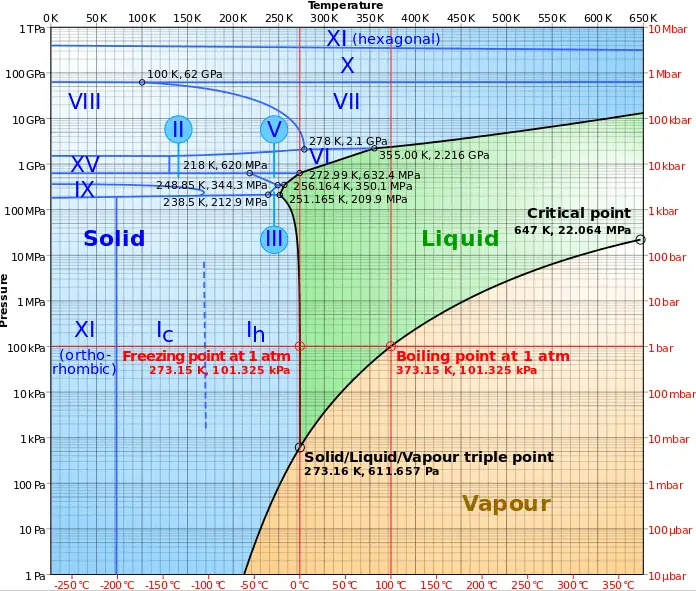
Phase diagram of water
Phase diagram of water.
Source: wikipedia.org CC BY-SA

Since water and steam are a common media used for heat exchange and for conversion of energy, steam is generated on a large scale by energy systems, as, for example, in thermal power plants.  As is typical in all conventional thermal power plants the heat is used to generate steam which drives a steam turbine connected to a generator which produces electricity. Note that, modern steam turbines are used to generate more than 80% of the world’s electricity.

Steam is generally categorized according to the vapor/(liquid + vapor) fraction. This fraction is very important parameter of steam and it is known as the vapor quality.

See also: Properties of Water

 
Pressurizer: steam-liquid equilibrium
pressurizer
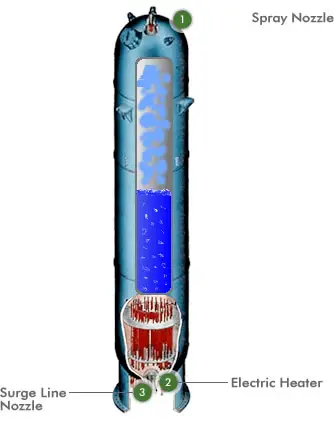
A pressurizer is a key component of PWRs.

A pressurizer is a component of a pressurized water reactor. Pressure in the primary circuit of PWRs is maintained by a pressurizer, a separate vessel that is connected to the primary circuit (hot leg) and partially filled with water which is heated to the saturation temperature (boiling point) for the desired pressure by submerged electrical heaters. Temperature in the pressurizer can be maintained at 350 °C (662 °F), which gives a subcooling margin (the difference between the pressurizer temperature and the highest temperature in the reactor core) of 30 °C. Subcooling margin is very important safety parameter of PWRs, since the boiling in the reactor core must be excluded. The basic design of the pressurized water reactor includes such requirement that the coolant (water) in the reactor coolant system must not boil. To achieve this, the coolant in the reactor coolant system is maintained at a pressure sufficiently high that boiling does not occur at the coolant temperatures experienced while the plant is operating or in an analyzed transient.

Functions

Pressure in the pressurizer is controlled by varying the temperature of the coolant in the pressurizer. For these purposes two systems are installed. Water spray system and electrical heaters system. Volume of the pressurizer (tens of cubic meters) is filled with water on saturation parameters and steam. The water spray system (relatively cool water – from cold leg) can decrease the pressure in the vessel by condensing the steam on water droplets sprayed in the vessel. On the other hand the submerged electrical heaters are designed to increase the pressure by evaporation the water in the vessel. Water pressure in a closed system tracks water temperature directly; as the temperature goes up, pressure goes up.

Steam Generator - operating conditions
Steam Generator - vertical
Steam Generator – vertical

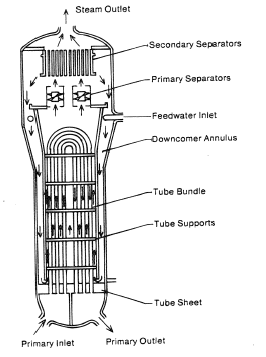
Steam generators are heat exchangers used to convert feedwater into steam from heat produced in a nuclear reactor core. The steam produced drives the turbine. They are used in the most nuclear power plants, but there are many types according to the reactor type.

The hot primary coolant (water 330°C; 626°F; 16MPa) is pumped into the steam generator through primary inlet. High pressure of primary coolant is used to keep the water in the liquid state. Boiling of the primary coolant shall not occur. The liquid water flows through hundreds or thousands of tubes (usually 1.9 cm in diameter) inside the steam generator. The feedwater (secondary circuit) is heated from ~260°C 500°F to the boiling point of that fluid (280°C; 536°F; 6,5MPa). Heat is transferred through the walls of these tubes to the lower pressure secondary coolant located on the secondary side of the exchanger where the coolant evaporates to pressurized steam (saturated steam 280°C; 536°F; 6,5 MPa). The pressurized steam leaves the steam generator through a steam outlet and continues to the steam turbine. The transfer of heat is accomplished without mixing the two fluids to prevent the secondary coolant from becoming radioactive. The primary coolant leaves (water 295°C; 563°F; 16MPa) the steam generator through primary outlet and continues through a cold leg to a reactor coolant pumpand then into the reactor.

Vapor Quality – Dryness Fraction

wet-steam-vapor-liquid-mixture-minAs can be seen from the phase diagram of water, in the two-phase regions (e.g. on the border of vapor/liquid phases), specifying temperature alone will set the pressure and specifying pressure will set the temperature. But these parameters will not define the volume and enthalpy because we will need to know the relative proportion of the two phases present.

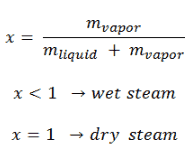
The mass fraction of the vapor in a two-phase liquid-vapor region is called the vapor quality (or dryness fraction), x, and it is given by following formula:

vapor quality

The value of the quality ranges from zero to unity. Although defined as a ratio, the quality is frequently given as a percentage. From this point of view, we distinguish between three basic types of  steam. It must be added, at x=0, we are talking about saturated liquid state (single-phase).

This classification of steam has its limitation. Consider the behavior of the system which is heated at the pressure, that is higher than the critical pressure. In this case, there would be no change in phase from liquid to steam. At all states there would be only one phase. Vaporization and condensation can occur only when the pressure is less than the critical pressure. The terms liquid and vapor tend to lose their significance. At pressure, that is higher than the critical pressure,  water is in special state, that is known as supercritical fluid state.

See also: Saturation

See also: Supercritical Fluid

See also: Throttling of Steam

 
Saturated and Subcooled Liquid
Phase diagram of water
Phase diagram of water.
Source: wikipedia.org CC BY-SA

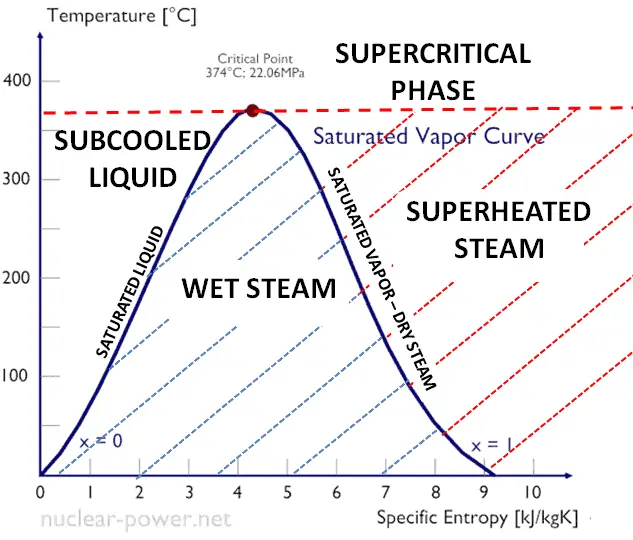
As can be seen from the phase diagram of water, in the two-phase regions (e.g. on the border of vapor/liquid phases), specifying temperature alone will set the pressure and specifying pressure will set the temperature.

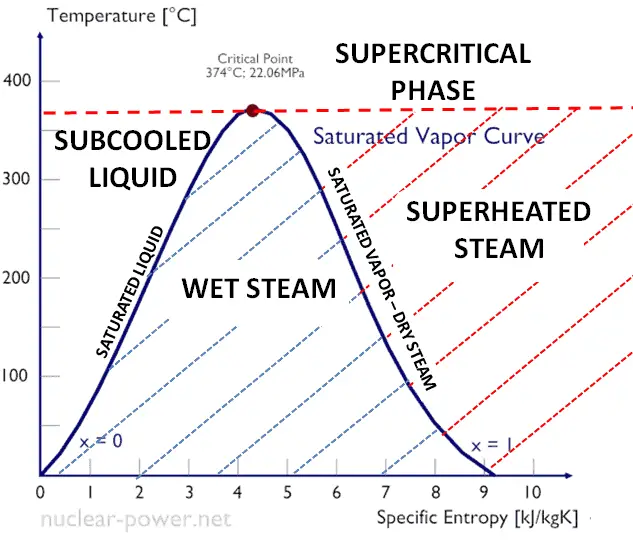
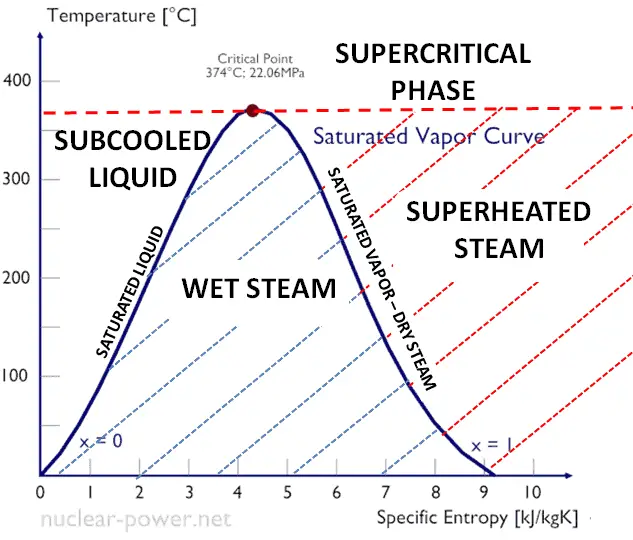
  • The saturation vapor curve is the curve separating the two-phase state and the superheated vapor state in the T-s diagram.
  • The saturated liquid curve is the curve separating the subcooled liquid state and the two-phase state in the T-s diagram.

If a water exists as a liquid at the saturation temperature and pressure with quality of x = 0, it is called a saturated liquid state (single-phase). If the temperature of the liquid is lower than the saturation temperature for the existing pressure, it is called either a subcooled liquid or a compressed liquid . The term subcooling refers to a liquid existing at a temperature below its normal boiling point.  For example, water normally boils at 100°C (at atmospheric pressure); at room temperature 20°C the water is termed “subcooled”. Analogically the subcooling is defined also in nuclear engineering but for another purpose.

For example, the temperature in the pressurizer can be maintained at 350 °C (662 °F), which gives a subcooling margin (the difference between the pressurizer temperature and the highest temperature in the reactor core) of 30 °C. Subcooling margin is very important safety parameter of PWRs, since the boiling in the reactor core must be excluded.

subcooled-liquid-min

Wet Steam - Vapor-liquid Mixture
wet-steam-vapor-liquid-mixture-minWet steam is characterized by the vapor quality, which ranges from zero to unity – open interval (0,1). When the vapor quality is equal to 0, it is referred to as the saturated liquid state (single-phase). On the other hand, when the vapor quality is equal to 1, it is referred to as the saturated vapor state or dry steam (single-phase). Between these two states, we talk about vapor-liquid mixture or wet steam (two-phase mixture). At constant pressure, an addition of energy does not changes the temperature of the mixture, but the vapor quality and specific volume changes. In the case of dry steam (100% quality), it contains 100% of the latent heat available at that pressure. Saturated liquid water, which has no latent heat and therefore 0% quality, will therefore only contain sensible heat.
engineering thermodynamics
Rankine Cycle – Thermodynamics as Energy Conversion Science

Typically most of nuclear power plants operates multi-stage condensing steam turbines. In these turbines the high-pressure stage receives steam (this steam is nearly saturated steam – x = 0.995 – point C at the figure) from a steam generator and exhaust it to moisture separator-reheater (point D). The steam must be reheated in order to avoid damages that could be caused to blades of steam turbine by low quality steam. The reheater heats the steam (point D) and then the steam is directed to the low-pressure stage of steam turbine, where expands (point E to F). The exhausted steam is at a pressure well below atmospheric, and is in a partially condensed state (point F), typically of a quality near 90%.

Specific Enthalpy of Wet Steam

The specific enthalpy of saturated liquid water (x=0) and dry steam (x=1) can be picked from steam tables. In case of wet steam, the actual enthalpy can be calculated with the vapor quality, x, and the specific enthalpies of saturated liquid water and dry steam:

hwet = hs x + (1 – x ) hl              

where

hwet = enthalpy of wet steam (J/kg)

hs = enthalpy of “dry” steam (J/kg)

hl = enthalpy of saturated liquid water (J/kg)

As can be seen, wet steam will always have lower enthalpy than dry steam.

Specific Entropy of Wet Steam

Similarly, the specific entropy of saturated liquid water (x=0) and dry steam (x=1) can be picked from steam tables. In case of wet steam, the actual entropy can be calculated with the vapor quality, x, and the specific entropies of saturated liquid water and dry steam:

swet = ss x + (1 – x ) sl              

where

swet = entropy of wet steam (J/kg K)

ss = entropy of “dry” steam (J/kg K)

sl = entropy of saturated liquid water (J/kg K)

Specific Volume of Wet Steam

Similarly, the specific volume of saturated liquid water (x=0) and dry steam (x=1) can be picked from steam tables. In case of wet steam, the actual specific volume can be calculated with the vapor quality, x, and the specific volumes of saturated liquid water and dry steam:

vwet = vs x + (1 – x ) vl              

where

vwet = specific volume of wet steam (m3/kg)

vs = specific volume of “dry” steam (m3/kg)

vl = specific volume of saturated liquid water (m3/kg)

Example:

A high-pressure stage of steam turbine operates at steady state with inlet conditions of  6 MPa, t = 275.6°C, x = 1 (point C). Steam leaves this stage of turbine at a pressure of 1.15 MPa, 186°C and x = 0.87 (point D). Calculate the enthalpy difference between these two states.

The enthalpy for the state C can be picked directly from steam tables, whereas the enthalpy for the state D must be calculated using vapor quality:

h1, wet = 2785 kJ/kg

h2, wet = h2,s x + (1 – x ) h2,l  = 2782 . 0.87 + (1 – 0.87) . 790 = 2420 + 103 = 2523 kJ/kg

Δh = 262 kJ/kg

Dry Steam - Saturated Vapor
Phase diagram of water
Phase diagram of water.
Source: wikipedia.org CC BY-SA

Dry steam, or saturated steam,  is characterized by the vapor quality, which is equal to unity. When the vapor quality is equal to 0, it is referred to as the saturated liquid state (single-phase). On the other hand, when the vapor quality is equal to 1, it is referred to as the saturated vapor state or dry steam (single-phase). Between these two states, we talk about vapor-liquid mixture or wet steam (two-phase mixture). At constant pressure, an addition of energy does not changes the temperature of the mixture, but the vapor quality and specific volume changes. In the case of dry steam (100% quality), it contains 100% of the latent heat available at that pressure. Saturated liquid water, which has no latent heat and therefore 0% quality, will therefore only contain sensible heat.

Typically most of nuclear power plants operates multi-stage condensing steam turbines. In these turbines the high-pressure stage receives steam (this steam is nearly saturated steam – x = 0.995 – point C at the figure) from a steam generator and exhaust it to moisture separator-reheater (point D). The steam must be reheated in order to avoid damages that could be caused to blades of steam turbine by low quality steam. The reheater heats the steam (point D) and then the steam is directed to the low-pressure stage of steam turbine, where expands (point E to F). The exhausted steam is at a pressure well below atmospheric, and is in a partially condensed state (point F), typically of a quality near 90%.

dry-steam-saturated-vapor-min

Superheated Steam
Phase diagram of water
Phase diagram of water.
Source: wikipedia.org CC BY-SA

As can be seen from the phase diagram of water, in the two-phase regions (e.g. on the border of vapor/liquid phases), specifying temperature alone will set the pressure and specifying pressure will set the temperature.

  • The saturation vapor curve is the curve separating the two-phase state and the superheated vapor state in the T-s diagram.
  • The saturated liquid curve is the curve separating the subcooled liquid state and the two-phase state in the T-s diagram.

If a steam exists entirely as vapor at saturation temperature, it is called saturated vapor or saturated steam or dry steam. The dry saturated vapor  is characterized by the vapor quality, which is equal to unity. Superheated vapor or superheated steam is a vapor at a temperature higher than its boiling point at the absolute pressure where the temperature is measured. The pressure and temperature of superheated vapor are independent properties, since the temperature may increase while the pressure remains constant. Actually, the substances we call gases are highly superheated vapors.

engineering thermodynamics
Rankine Cycle – Thermodynamics as Energy Conversion Science

The process of superheating of water vapor in the T-s diagram is provided in the figure between state E and saturation vapor curve. As can be seen also wet steam turbines use superheated steam especially at the inlet of low-pressure stages. In order to evaluate the cycle thermal efficiency the enthalpy must be obtained from the superheated steam tables.

The process of superheating is the only way to increase the peak temperature of the Rankine cycle (and to increase efficiency) without increasing the boiler pressure. This requires the addition of another type of heat exchanger called a superheater, which produces the superheated steam.

In the superheater, further heating at fixed pressure results in increases in both temperature and specific volume. The process of superheating in the T-s diagram is provided in the figure between state E and saturation vapor curve.

Typically most of nuclear power plants operates multi-stage condensing steam turbines. In these turbines the high-pressure stage receives steam (this steam is nearly saturated steam – x = 0.995 – point C at the figure) from a steam generator and exhaust it to moisture separator-reheater (point D). The steam must be reheated or superheated in order to avoid damages that could be caused to blades of steam turbine by low quality steam. High content of water droplets can cause the rapid impingement and erosion of the blades which occurs when condensed water is blasted onto the blades. To prevent this, condensate drains are installed in the steam piping leading to the turbine. The reheater heats the steam (point D) and then the steam is directed to the low-pressure stage of steam turbine, where expands (point E to F). The exhausted steam is at a pressure well below atmospheric, and is in a partially condensed state (point F), typically of a quality near 90%.

Properties of Steam – Steam Tables

Water and steam are a common fluid used for heat exchange in the primary circuit (from surface of fuel rods to the coolant flow) and in the secondary circuit. It used due to its availability and high heat capacity, both for cooling and heating. It is especially effective to transport heat through vaporization and condensation of water because of its very large latent heat of vaporization.

A disadvantage is that water moderated reactors have to use high pressure primary circuit in order to keep water in liquid state and in order to achieve sufficient thermodynamic efficiency. Water and steam also reacts with metals commonly found in industries such as steel and copper that are oxidized faster by untreated water and steam. In almost all thermal power stations (coal, gas, nuclear), water is used as the working fluid (used in a closed loop between boiler, steam turbine and condenser), and the coolant (used to exchange the waste heat to a water body or carry it away by evaporation in a cooling tower).

Properties of water - steam tables
Steam Tables – common parameters in energy systems

Water and steam are a common medium because their properties are very well known. Their properties are tabulated in so called “Steam Tables”. In these tables the basic and key properties, such as pressure, temperature, enthalpy, density and specific heat, are tabulated along the vapor-liquid saturation curve as a function of both temperature and pressure. The properties are also tabulated for single-phase states (compressed water or superheated steam) on a grid of temperatures and pressures extending to 2000 ºC and 1000 MPa.

Further comprehensive authoritative data can be found at the NIST Webbook page on thermophysical properties of fluids.

See also: Steam Tables

Special Reference: Allan H. Harvey. Thermodynamic Properties of Water, NISTIR 5078. Retrieved from https://www.nist.gov/sites/default/files/documents/srd/NISTIR5078.htm

 
Chart: Absolute pressure as a function of temperature of water
Water: Absolute pressure as a function of temperature
Chart: Density as a function of temperature of water
Chart - density - water - temperature
Density as a function of temperature of water
Chart: Dynamic viscosity as a function of temperature of water
Dynamic viscosity as a function of temperature of water
Chart: Dynamic viscosity as a function of temperature of water
Source: wikipedia.org CC BY-SA

Examples

 
Evaporation of water at atmospheric pressure
Calculate heat required to evaporate 1 kg of water at the atmospheric pressure (p = 1.0133 bar) and at the temperature of 100°C.

Solution:

Since these parameters corresponds to the saturated liquid state, only latent heat of vaporization of 1 kg of water is required. From steam tables, the latent heat of vaporization is L = 2257 kJ/kg. Therefore the heat required is equal to:

ΔH = 2257 kJ

Note that the initial specific enthalpy h1 = 419 kJ/kg, whereas the final specific enthalpy will be h2 = 2676 kJ/kg. The specific enthalpy of low-pressure dry steam is very similar to the specific enthalpy of high-pressure dry steam, despite the fact they have different temperatures.

Evaporation of water at high pressure
Calculate heat required to evaporate 1 kg of feedwater at the pressure of 6 MPa (p = 60 bar) and at the temperature of 275.6°C (saturation temperature).

Solution:

Since these parameters corresponds to the saturated liquid state, only latent heat of vaporization of 1 kg of water is required. From steam tables, the latent heat of vaporization is L = 1571 kJ/kg. Therefore the heat required is equal to:

ΔH = 1571 kJ

Note that the initial specific enthalpy h1 = 1214 kJ/kg, whereas the final specific enthalpy will be h2 = 2785 kJ/kg. The specific enthalpy of low-pressure dry steam is very similar to the specific enthalpy of high-pressure dry steam, despite the fact they have different temperatures.

Evaporation of water at high pressure - Energy balance in a steam generator
Steam Generator - vertical
Steam Generator – vertical

Calculate the amount of primary coolant, which is required to evaporate 1 kg of feedwater in a typical steam generator. Assume that there are no energy losses, this is only idealized example.

Balance of the primary circuit

The hot primary coolant (water 330°C; 626°F; 16MPa) is pumped into the steam generator through primary inlet. The primary coolant leaves (water 295°C; 563°F; 16MPa) the steam generator through primary outlet.

hI, inlet = 1516 kJ/kg

=> ΔhI = -206 kJ/kg

hI, outlet = 1310 kJ/kg

Balance of the feedwater

The feedwater (water 230°C; 446°F; 6,5MPa) is pumped into the steam generator through the feedwater inlet. The feedwater (secondary circuit) is heated from ~230°C 446°F to the boiling point of that fluid (280°C; 536°F; 6,5MPa). Feedwater is then evaporated and the pressurized steam (saturated steam 280°C; 536°F; 6,5 MPa) leaves the steam generator through steam outlet and continues to the steam turbine.

hII, inlet = 991 kJ/kg

=> ΔhII = 1789 kJ/kg

hII, outlet = 2780 kJ/kg

Balance of the steam generator

Since the difference in specific enthalpies is less for primary coolant than for feedwater, it is obvious that the amount of primary coolant will be higher than 1kg. To produce of 1 kg of saturated steam from feedwater, about 1789/206 x 1 kg =  8.68 kg of primary coolant is required.

 
References:
Reactor Physics and Thermal Hydraulics:
  1. J. R. Lamarsh, Introduction to Nuclear Reactor Theory, 2nd ed., Addison-Wesley, Reading, MA (1983).
  2. J. R. Lamarsh, A. J. Baratta, Introduction to Nuclear Engineering, 3d ed., Prentice-Hall, 2001, ISBN: 0-201-82498-1.
  3. W. M. Stacey, Nuclear Reactor Physics, John Wiley & Sons, 2001, ISBN: 0- 471-39127-1.
  4. Glasstone, Sesonske. Nuclear Reactor Engineering: Reactor Systems Engineering, Springer; 4th edition, 1994, ISBN: 978-0412985317
  5. Todreas Neil E., Kazimi Mujid S. Nuclear Systems Volume I: Thermal Hydraulic Fundamentals, Second Edition. CRC Press; 2 edition, 2012, ISBN: 978-0415802871
  6. Zohuri B., McDaniel P. Thermodynamics in Nuclear Power Plant Systems. Springer; 2015, ISBN: 978-3-319-13419-2
  7. Moran Michal J., Shapiro Howard N. Fundamentals of Engineering Thermodynamics, Fifth Edition, John Wiley & Sons, 2006, ISBN: 978-0-470-03037-0
  8. Kleinstreuer C. Modern Fluid Dynamics. Springer, 2010, ISBN 978-1-4020-8670-0.
  9. U.S. Department of Energy, THERMODYNAMICS, HEAT TRANSFER, AND FLUID FLOW. DOE Fundamentals Handbook, Volume 1, 2 and 3. June 1992.

See also:

Materials

We hope, this article, Steam – Properties of Steam, helps you. If so, give us a like in the sidebar. Main purpose of this website is to help the public to learn some interesting and important information about thermal engineering.

What is Specific Properties of Water and Steam – Steam Tables – Definition

Steam Tables. Water and steam are a common medium because their properties are very well known. Their properties are tabulated in so called “Steam Tables”. Thermal Engineering

Steam Tables


Water and steam
are a common fluid used for heat exchange in the primary circuit (from surface of fuel rods to the coolant flow) and in the secondary circuit. It used due to its availability and high heat capacity, both for cooling and heating. It is especially effective to transport heat through vaporization and condensation of water because of its very large latent heat of vaporization.

See also: Properties of Steam

A disadvantage is that water moderated reactors have to use high pressure primary circuit in order to keep water in liquid state and in order to achieve sufficient thermodynamic efficiency. Water and steam also reacts with metals commonly found in industries such as steel and copper that are oxidized faster by untreated water and steam. In almost all thermal power stations (coal, gas, nuclear), water is used as the working fluid (used in a closed loop between boiler, steam turbine and condenser), and the coolant (used to exchange the waste heat to a water body or carry it away by evaporation in a cooling tower).

Properties of water - steam tables
Steam Tables – common parameters in energy systems

Water and steam are a common medium because their properties are very well known. Their properties are tabulated in so called “Steam Tables”. In these tables the basic and key properties, such as pressure, temperature, enthalpy, density and specific heat, are tabulated along the vapor-liquid saturation curve as a function of both temperature and pressure. The properties are also tabulated for single-phase states (compressed water or superheated steam) on a grid of temperatures and pressures extending to 2000 ºC and 1000 MPa.

Further comprehensive authoritative data can be found at the NIST Webbook page on thermophysical properties of fluids.

Special Reference: Allan H. Harvey. Thermodynamic Properties of Water, NISTIR 5078. Retrieved from https://www.nist.gov/sites/default/files/documents/srd/NISTIR5078.htm

 
Chart: Absolute pressure as a function of temperature of water
Water: Absolute pressure as a function of temperature
Chart: Density as a function of temperature of water
Chart - density - water - temperature
Density as a function of temperature of water
Chart: Dynamic viscosity as a function of temperature of water
Dynamic viscosity as a function of temperature of water
Chart: Dynamic viscosity as a function of temperature of water
Source: wikipedia.org CC BY-SA

Examples

 
Evaporation of water at atmospheric pressure
Calculate heat required to evaporate 1 kg of water at the atmospheric pressure (p = 1.0133 bar) and at the temperature of 100°C.

Solution:

Since these parameters corresponds to the saturated liquid state, only latent heat of vaporization of 1 kg of water is required. From steam tables, the latent heat of vaporization is L = 2257 kJ/kg. Therefore the heat required is equal to:

ΔH = 2257 kJ

Note that the initial specific enthalpy h1 = 419 kJ/kg, whereas the final specific enthalpy will be h2 = 2676 kJ/kg. The specific enthalpy of low-pressure dry steam is very similar to the specific enthalpy of high-pressure dry steam, despite the fact they have different temperatures.

Evaporation of water at high pressure
Calculate heat required to evaporate 1 kg of feedwater at the pressure of 6 MPa (p = 60 bar) and at the temperature of 275.6°C (saturation temperature).

Solution:

Since these parameters corresponds to the saturated liquid state, only latent heat of vaporization of 1 kg of water is required. From steam tables, the latent heat of vaporization is L = 1571 kJ/kg. Therefore the heat required is equal to:

ΔH = 1571 kJ

Note that the initial specific enthalpy h1 = 1214 kJ/kg, whereas the final specific enthalpy will be h2 = 2785 kJ/kg. The specific enthalpy of low-pressure dry steam is very similar to the specific enthalpy of high-pressure dry steam, despite the fact they have different temperatures.

Evaporation of water at high pressure - Energy balance in a steam generator
Steam Generator - vertical
Steam Generator – vertical

Calculate the amount of primary coolant, which is required to evaporate 1 kg of feedwater in a typical steam generator. Assume that there are no energy losses, this is only idealized example.

Balance of the primary circuit

The hot primary coolant (water 330°C; 626°F; 16MPa) is pumped into the steam generator through primary inlet. The primary coolant leaves (water 295°C; 563°F; 16MPa) the steam generator through primary outlet.

hI, inlet = 1516 kJ/kg

=> ΔhI = -206 kJ/kg

hI, outlet = 1310 kJ/kg

Balance of the feedwater

The feedwater (water 230°C; 446°F; 6,5MPa) is pumped into the steam generator through the feedwater inlet. The feedwater (secondary circuit) is heated from ~230°C 446°F to the boiling point of that fluid (280°C; 536°F; 6,5MPa). Feedwater is then evaporated and the pressurized steam (saturated steam 280°C; 536°F; 6,5 MPa) leaves the steam generator through steam outlet and continues to the steam turbine.

hII, inlet = 991 kJ/kg

=> ΔhII = 1789 kJ/kg

hII, outlet = 2780 kJ/kg

Balance of the steam generator

Since the difference in specific enthalpies is less for primary coolant than for feedwater, it is obvious that the amount of primary coolant will be higher than 1kg. To produce of 1 kg of saturated steam from feedwater, about 1789/206 x 1 kg =  8.68 kg of primary coolant is required.

 
References:
Reactor Physics and Thermal Hydraulics:
  1. J. R. Lamarsh, Introduction to Nuclear Reactor Theory, 2nd ed., Addison-Wesley, Reading, MA (1983).
  2. J. R. Lamarsh, A. J. Baratta, Introduction to Nuclear Engineering, 3d ed., Prentice-Hall, 2001, ISBN: 0-201-82498-1.
  3. W. M. Stacey, Nuclear Reactor Physics, John Wiley & Sons, 2001, ISBN: 0- 471-39127-1.
  4. Glasstone, Sesonske. Nuclear Reactor Engineering: Reactor Systems Engineering, Springer; 4th edition, 1994, ISBN: 978-0412985317
  5. Todreas Neil E., Kazimi Mujid S. Nuclear Systems Volume I: Thermal Hydraulic Fundamentals, Second Edition. CRC Press; 2 edition, 2012, ISBN: 978-0415802871
  6. Zohuri B., McDaniel P. Thermodynamics in Nuclear Power Plant Systems. Springer; 2015, ISBN: 978-3-319-13419-2
  7. Moran Michal J., Shapiro Howard N. Fundamentals of Engineering Thermodynamics, Fifth Edition, John Wiley & Sons, 2006, ISBN: 978-0-470-03037-0
  8. Kleinstreuer C. Modern Fluid Dynamics. Springer, 2010, ISBN 978-1-4020-8670-0.
  9. U.S. Department of Energy, THERMODYNAMICS, HEAT TRANSFER, AND FLUID FLOW. DOE Fundamentals Handbook, Volume 1, 2 and 3. June 1992.

See also:

Thermodynamics

We hope, this article, Specific Properties of Water and Steam – Steam Tables, helps you. If so, give us a like in the sidebar. Main purpose of this website is to help the public to learn some interesting and important information about thermal engineering.
What is Saturation Vapor Curve – Definition

Saturation Vapor Curve. The saturation vapor curve is the curve separating the two-phase state and the superheated vapor state in the T-s diagram. Thermal Engineering

Saturation Vapor Curve

Phase diagram of water
Phase diagram of water.
Source: wikipedia.org CC BY-SA

See also: Steam

As can be seen from the phase diagram of water, in the two-phase regions (e.g. on the border of vapor/liquid phases), specifying temperature alone will set the pressure and specifying pressure will set the temperature.

  • The saturation vapor curve is the curve separating the two-phase state and the superheated vapor state in the T-s diagram.
  • The saturated liquid curve is the curve separating the subcooled liquid state and the two-phase state in the T-s diagram.

Typically most of nuclear power plants operates multi-stage condensing steam turbines. In these turbines the high-pressure stage receives steam (this steam is nearly saturated steam – x = 0.995 – point C at the figure) from a steam generator and exhaust it to moisture separator-reheater (point D). The steam must be reheated or superheated in order to avoid damages that could be caused to blades of steam turbine by low quality steam. High content of water droplets can cause the rapid impingement and erosion of the blades which occurs when condensed water is blasted onto the blades. To prevent this, condensate drains are installed in the steam piping leading to the turbine. The reheater heats the steam (point D) and then the steam is directed to the low-pressure stage of steam turbine, where expands (point E to F). The exhausted steam is at a pressure well below atmospheric, and is in a partially condensed state (point F), typically of a quality near 90%.

dry-steam-saturated-vapor-min

 
Pressurizer: steam-liquid equilibrium
pressurizer
A pressurizer is a key component of PWRs.

A pressurizer is a component of a pressurized water reactor. Pressure in the primary circuit of PWRs is maintained by a pressurizer, a separate vessel that is connected to the primary circuit (hot leg) and partially filled with water which is heated to the saturation temperature (boiling point) for the desired pressure by submerged electrical heaters. Temperature in the pressurizer can be maintained at 350 °C (662 °F), which gives a subcooling margin (the difference between the pressurizer temperature and the highest temperature in the reactor core) of 30 °C. Subcooling margin is very important safety parameter of PWRs, since the boiling in the reactor core must be excluded. The basic design of the pressurized water reactor includes such requirement that the coolant (water) in the reactor coolant system must not boil. To achieve this, the coolant in the reactor coolant system is maintained at a pressure sufficiently high that boiling does not occur at the coolant temperatures experienced while the plant is operating or in an analyzed transient.

Functions

Pressure in the pressurizer is controlled by varying the temperature of the coolant in the pressurizer. For these purposes two systems are installed. Water spray system and electrical heaters system. Volume of the pressurizer (tens of cubic meters) is filled with water on saturation parameters and steam. The water spray system (relatively cool water – from cold leg) can decrease the pressure in the vessel by condensing the steam on water droplets sprayed in the vessel. On the other hand the submerged electrical heaters are designed to increase the pressure by evaporation the water in the vessel. Water pressure in a closed system tracks water temperature directly; as the temperature goes up, pressure goes up.

 
References:
Reactor Physics and Thermal Hydraulics:
  1. J. R. Lamarsh, Introduction to Nuclear Reactor Theory, 2nd ed., Addison-Wesley, Reading, MA (1983).
  2. J. R. Lamarsh, A. J. Baratta, Introduction to Nuclear Engineering, 3d ed., Prentice-Hall, 2001, ISBN: 0-201-82498-1.
  3. W. M. Stacey, Nuclear Reactor Physics, John Wiley & Sons, 2001, ISBN: 0- 471-39127-1.
  4. Glasstone, Sesonske. Nuclear Reactor Engineering: Reactor Systems Engineering, Springer; 4th edition, 1994, ISBN: 978-0412985317
  5. Todreas Neil E., Kazimi Mujid S. Nuclear Systems Volume I: Thermal Hydraulic Fundamentals, Second Edition. CRC Press; 2 edition, 2012, ISBN: 978-0415802871
  6. Zohuri B., McDaniel P. Thermodynamics in Nuclear Power Plant Systems. Springer; 2015, ISBN: 978-3-319-13419-2
  7. Moran Michal J., Shapiro Howard N. Fundamentals of Engineering Thermodynamics, Fifth Edition, John Wiley & Sons, 2006, ISBN: 978-0-470-03037-0
  8. Kleinstreuer C. Modern Fluid Dynamics. Springer, 2010, ISBN 978-1-4020-8670-0.
  9. U.S. Department of Energy, THERMODYNAMICS, HEAT TRANSFER, AND FLUID FLOW. DOE Fundamentals Handbook, Volume 1, 2 and 3. June 1992.

See also:

Steam

We hope, this article, Saturation Vapor Curve, helps you. If so, give us a like in the sidebar. Main purpose of this website is to help the public to learn some interesting and important information about thermal engineering.
What is Open System – Closed System – Isolated System – Definition

Whether the system is open system or closed system or isolated system, it is dependent on work and heat which may cross the boundary of the system. Thermal Engineering

Open System – Closed System – Isolated System

Open System – Closed System – Isolated System

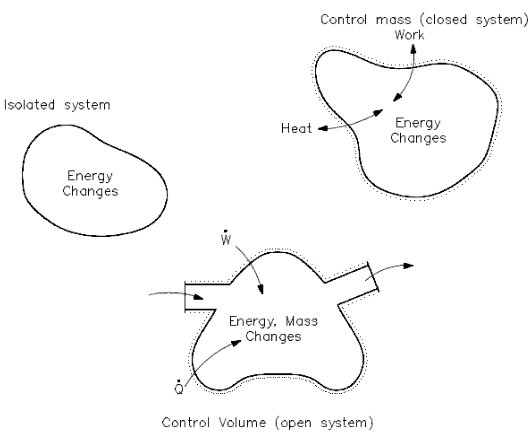
closed-open-isolated-systemHeat and/or work can be directed into or out of the control volume. But, for convenience and as a standard convention, the net energy exchange is presented here with the net heat exchange assumed to be into the system and the net work assumed to be out of the system. If no mass crosses the boundary, but work and/or heat do, then the system is referred to as a “closed” system. If mass, work and heat do not cross the boundary (that is, the only energy exchanges taking place are within the system), then the system is referred to as an isolated system. Isolated and closed systems are nothing more than specialized cases of the open system.

 
References:
Nuclear and Reactor Physics:
  1. J. R. Lamarsh, Introduction to Nuclear Reactor Theory, 2nd ed., Addison-Wesley, Reading, MA (1983).
  2. J. R. Lamarsh, A. J. Baratta, Introduction to Nuclear Engineering, 3d ed., Prentice-Hall, 2001, ISBN: 0-201-82498-1.
  3. W. M. Stacey, Nuclear Reactor Physics, John Wiley & Sons, 2001, ISBN: 0- 471-39127-1.
  4. Glasstone, Sesonske. Nuclear Reactor Engineering: Reactor Systems Engineering, Springer; 4th edition, 1994, ISBN: 978-0412985317
  5. W.S.C. Williams. Nuclear and Particle Physics. Clarendon Press; 1 edition, 1991, ISBN: 978-0198520467
  6. Kenneth S. Krane. Introductory Nuclear Physics, 3rd Edition, Wiley, 1987, ISBN: 978-0471805533
  7. G.R.Keepin. Physics of Nuclear Kinetics. Addison-Wesley Pub. Co; 1st edition, 1965
  8. Robert Reed Burn, Introduction to Nuclear Reactor Operation, 1988.
  9. U.S. Department of Energy, Nuclear Physics and Reactor Theory. DOE Fundamentals Handbook, Volume 1 and 2. January 1993.

Advanced Reactor Physics:

  1. K. O. Ott, W. A. Bezella, Introductory Nuclear Reactor Statics, American Nuclear Society, Revised edition (1989), 1989, ISBN: 0-894-48033-2.
  2. K. O. Ott, R. J. Neuhold, Introductory Nuclear Reactor Dynamics, American Nuclear Society, 1985, ISBN: 0-894-48029-4.
  3. D. L. Hetrick, Dynamics of Nuclear Reactors, American Nuclear Society, 1993, ISBN: 0-894-48453-2.
  4. E. E. Lewis, W. F. Miller, Computational Methods of Neutron Transport, American Nuclear Society, 1993, ISBN: 0-894-48452-4.

See also:

Conservation of Energy

We hope, this article, Open System – Closed System – Isolated System, helps you. If so, give us a like in the sidebar. Main purpose of this website is to help the public to learn some interesting and important information about thermal engineering.
What is Casing – Volute – Definition

The casing contains the liquid and acts as a pressure containment vessel. The volute of a centrifugal pump is the casing that receives the fluid being pumped by the impeller. Thermal Engineering

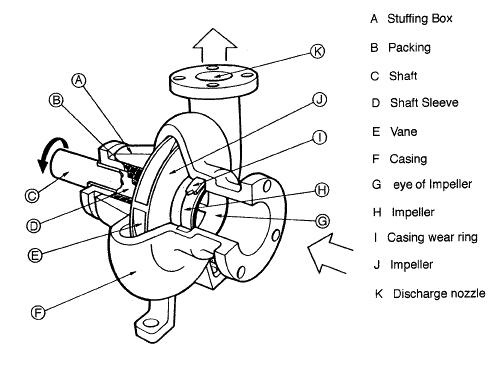
Casing – Volute

Centrifugal Pump-minEach centrifugal pump is made of hundreds of parts. There are a few components that virtually every centrifugal pump has in common. These components can be subdivided into the wet end and the mechanical end.

The wet end of the pump includes those parts that determine the hydraulic performance of pump. The two primary wet ends are the impeller and casing. In some cases the first radial bearing can be water lubricated. In this case also bearing can belongs to wet ends.

The mechanical end includes those parts that support the impeller within the casing. The mechanical end of the pump includes the pump shaft, sealing, bearings and shaft sleeve.

Casing

impeller and diffuserThe casing contains the liquid and acts as a pressure containment vessel that directs the flow of liquid in and out of the centrifugal pump. The volute is a curved funnel that increases in area as it approaches the discharge port. The volute of a centrifugal pump is the casing that receives the fluid being pumped by the impeller, slowing down the fluid’s rate of flow. Therefore, according to Bernoulli’s principle, the volute converts kinetic energy into pressure by reducing speed while increasing pressure. Some centrifugal pumps contain diffusers. A diffuser is a set of stationary vanes that surround the impeller. The diffuser directs the flow, allows a more gradual expansion and therefore increases the efficiency of the centrifugal pump.

 
References:
Reactor Physics and Thermal Hydraulics:
  1. J. R. Lamarsh, Introduction to Nuclear Reactor Theory, 2nd ed., Addison-Wesley, Reading, MA (1983).
  2. J. R. Lamarsh, A. J. Baratta, Introduction to Nuclear Engineering, 3d ed., Prentice-Hall, 2001, ISBN: 0-201-82498-1.
  3. W. M. Stacey, Nuclear Reactor Physics, John Wiley & Sons, 2001, ISBN: 0- 471-39127-1.
  4. Glasstone, Sesonske. Nuclear Reactor Engineering: Reactor Systems Engineering, Springer; 4th edition, 1994, ISBN: 978-0412985317
  5. Todreas Neil E., Kazimi Mujid S. Nuclear Systems Volume I: Thermal Hydraulic Fundamentals, Second Edition. CRC Press; 2 edition, 2012, ISBN: 978-0415802871
  6. Zohuri B., McDaniel P. Thermodynamics in Nuclear Power Plant Systems. Springer; 2015, ISBN: 978-3-319-13419-2
  7. Moran Michal J., Shapiro Howard N. Fundamentals of Engineering Thermodynamics, Fifth Edition, John Wiley & Sons, 2006, ISBN: 978-0-470-03037-0
  8. Kleinstreuer C. Modern Fluid Dynamics. Springer, 2010, ISBN 978-1-4020-8670-0.
  9. U.S. Department of Energy, THERMODYNAMICS, HEAT TRANSFER, AND FLUID FLOW. DOE Fundamentals Handbook, Volume 1, 2 and 3. June 1992.
  10. White Frank M., Fluid Mechanics, McGraw-Hill Education, 7th edition, February, 2010, ISBN: 978-0077422417

See also:

Centrifugal Pumps

We hope, this article, Casing – Volute, helps you. If so, give us a like in the sidebar. Main purpose of this website is to help the public to learn some interesting and important information about thermal engineering.