Facebook Instagram Youtube Twitter

What is Grashof Number – Definition

The Grashof number is a dimensionless number, named after Franz Grashof. The Grashof number is defined as the ratio of the buoyant to viscous force acting on a fluid in the velocity boundary layer. Thermal Engineering

What is Grashof Number

The Grashof number is a dimensionless number, named after  Franz Grashof. The Grashof number is defined as the ratio of the buoyant to viscous force acting on a fluid in the velocity boundary layer. Its role in natural convection is much the same as that of the Reynolds number in forced convection.

Natural convection is used if this motion and mixing is caused by density variations resulting from temperature differences within the fluid. Usually the density decreases due to an increase in temperature and causes the fluid to rise. This motion is caused by the buoyant force. The major force that resists the motion is the viscous force. The Grashof number is a way to quantify the opposing forces.

The Grashof number is defined as:

grashof number - definition - formula

where:

g is acceleration due to Earth’s gravity

β is the coefficient of thermal expansion

Twall is the wall temperature

T∞ is the bulk temperature

L is the vertical length

ν is the kinematic viscosity.

For gases β = 1/T where the temperature is in K. For liquids β can be calculated if variation of density with temperature at constant pressure is known. For a vertical flat plate, the flow turns turbulent for value of Gr.Pr > 109. As in forced convection the microspic nature of flow and convection correlations are distinctly different in the laminar and turbulent regions.

The Grashof number is closely related to Rayleigh number, which is defined as the product of the Grashof number, which describes the relationship between buoyancy and viscosity within a fluid, and the Prandtl number, which describes the relationship between momentum diffusivity and thermal diffusivity.

Example: Grashof Number

Rayleigh Number and Grashof NumberA vertical plate is maintained at 50°C in 20°C air. Determine the height at which the boundary layer will turn turbulent if turbulence sets in at Gr.Pr = 109.

Solution:

The property values required for this example are:

ν = 1.48 x 10⁻⁵ m2/s

ρ = 1.17 kg/m3

Pr = 0.700

β = 1/ (273 + 20) = 1/293

We know the natural circulation becomes turbulent at Gr.Pr > 109, which is fulfilled at the following height:

grashof number - example

 
References:
Heat Transfer:
  1. Fundamentals of Heat and Mass Transfer, 7th Edition. Theodore L. Bergman, Adrienne S. Lavine, Frank P. Incropera. John Wiley & Sons, Incorporated, 2011. ISBN: 9781118137253.
  2. Heat and Mass Transfer. Yunus A. Cengel. McGraw-Hill Education, 2011. ISBN: 9780071077866.
  3. Fundamentals of Heat and Mass Transfer. C. P. Kothandaraman. New Age International, 2006, ISBN: 9788122417722.
  4. U.S. Department of Energy, Thermodynamics, Heat Transfer and Fluid Flow. DOE Fundamentals Handbook, Volume 2 of 3. May 2016.

Nuclear and Reactor Physics:

  1. J. R. Lamarsh, Introduction to Nuclear Reactor Theory, 2nd ed., Addison-Wesley, Reading, MA (1983).
  2. J. R. Lamarsh, A. J. Baratta, Introduction to Nuclear Engineering, 3d ed., Prentice-Hall, 2001, ISBN: 0-201-82498-1.
  3. W. M. Stacey, Nuclear Reactor Physics, John Wiley & Sons, 2001, ISBN: 0- 471-39127-1.
  4. Glasstone, Sesonske. Nuclear Reactor Engineering: Reactor Systems Engineering, Springer; 4th edition, 1994, ISBN: 978-0412985317
  5. W.S.C. Williams. Nuclear and Particle Physics. Clarendon Press; 1 edition, 1991, ISBN: 978-0198520467
  6. G.R.Keepin. Physics of Nuclear Kinetics. Addison-Wesley Pub. Co; 1st edition, 1965
  7. Robert Reed Burn, Introduction to Nuclear Reactor Operation, 1988.
  8. U.S. Department of Energy, Nuclear Physics and Reactor Theory. DOE Fundamentals Handbook, Volume 1 and 2. January 1993.
  9. Paul Reuss, Neutron Physics. EDP Sciences, 2008. ISBN: 978-2759800414.

Advanced Reactor Physics:

  1. K. O. Ott, W. A. Bezella, Introductory Nuclear Reactor Statics, American Nuclear Society, Revised edition (1989), 1989, ISBN: 0-894-48033-2.
  2. K. O. Ott, R. J. Neuhold, Introductory Nuclear Reactor Dynamics, American Nuclear Society, 1985, ISBN: 0-894-48029-4.
  3. D. L. Hetrick, Dynamics of Nuclear Reactors, American Nuclear Society, 1993, ISBN: 0-894-48453-2.
  4. E. E. Lewis, W. F. Miller, Computational Methods of Neutron Transport, American Nuclear Society, 1993, ISBN: 0-894-48452-4.

See also:

Characteristic Numbers

We hope, this article, Grashof Number, helps you. If so, give us a like in the sidebar. Main purpose of this website is to help the public to learn some interesting and important information about thermal engineering.

What is Rayleigh Number – Definition

The Rayleigh number is a dimensionless number, named after Lord Rayleigh. The Rayleigh number is used to express heat transfer in natural convection. Thermal Engineering

What is Rayleigh Number

The Rayleigh number is a dimensionless number, named after  Lord Rayleigh. The Rayleigh number is closely related to Grashof number and both numbers are used to decribe natural convection (Gr) and heat transfer by natural convection (Ra). The Rayleigh number is simply defined as the product of the Grashof number, which describes the relationship between buoyancy and viscosity within a fluid, and the Prandtl number, which describes the relationship between momentum diffusivity and thermal diffusivity.

Rax = Grx . Pr

The Grashof number is defined as the ratio of the buoyant to viscous force acting on a fluid in the velocity boundary layer. Its role in natural convection is much the same as that of the Reynolds number in forced convection. Natural convection occurs if this motion and mixing is caused by density variations resulting from temperature differences within the fluid. Usually the density decreases due to an increase in temperature and causes the fluid to rise. This motion is caused by the buoyant force. The major force that resists the motion is the viscous force. The Grashof number is a way to quantify the opposing forces.

The Rayleigh number is used to express heat transfer in natural convection. The magnitude of the Rayleigh number is a good indication as to whether the natural convection boundary layer is laminar or turbulent. The simple empirical correlations for the average Nusselt number, Nu, in natural convection are of the form:

Nux = C. Raxn

The values of the constants C and n depend on the geometry of the surface and the flow regime, which is characterized by the range of the Rayleigh number. The value of n is usually n = 1/4 for laminar flow and n = 1/3 for turbulent flow.

The Rayleigh number is defined as:

rayleigh number - definition - formula

where:

g is acceleration due to Earth’s gravity

β is the coefficient of thermal expansion

Twall is the wall temperature

T∞ is the bulk temperature

L is the vertical length

α is thermal diffusivity

ν is the kinematic viscosity.

For gases β = 1/T where the temperature is in K. For liquids β can be calculated if variation of density with temperature at constant pressure is known. For a vertical flat plate, the flow turns turbulent for value of:

Rax = Grx . Pr > 109 

As in forced convection the microspic nature of flow and convection correlations are distinctly different in the laminar and turbulent regions.

Example: Rayleigh Number

Rayleigh Number and Grashof NumberA vertical plate is maintained at 50°C in 20°C air. Determine the height at which the boundary layer will turn turbulent if turbulence sets in at Ra = Gr.Pr = 109.

Solution:

The property values required for this example are:

ν = 1.48 x 10⁻⁵ m2/s

ρ = 1.17 kg/m3

Pr = 0.700

β = 1/ (273 + 20) = 1/293

We know the natural circulation becomes turbulent at approximately Ra = Gr.Pr > 109, which is fulfilled at the following height:

grashof number - example

 
References:
Heat Transfer:
  1. Fundamentals of Heat and Mass Transfer, 7th Edition. Theodore L. Bergman, Adrienne S. Lavine, Frank P. Incropera. John Wiley & Sons, Incorporated, 2011. ISBN: 9781118137253.
  2. Heat and Mass Transfer. Yunus A. Cengel. McGraw-Hill Education, 2011. ISBN: 9780071077866.
  3. Fundamentals of Heat and Mass Transfer. C. P. Kothandaraman. New Age International, 2006, ISBN: 9788122417722.
  4. U.S. Department of Energy, Thermodynamics, Heat Transfer and Fluid Flow. DOE Fundamentals Handbook, Volume 2 of 3. May 2016.

Nuclear and Reactor Physics:

  1. J. R. Lamarsh, Introduction to Nuclear Reactor Theory, 2nd ed., Addison-Wesley, Reading, MA (1983).
  2. J. R. Lamarsh, A. J. Baratta, Introduction to Nuclear Engineering, 3d ed., Prentice-Hall, 2001, ISBN: 0-201-82498-1.
  3. W. M. Stacey, Nuclear Reactor Physics, John Wiley & Sons, 2001, ISBN: 0- 471-39127-1.
  4. Glasstone, Sesonske. Nuclear Reactor Engineering: Reactor Systems Engineering, Springer; 4th edition, 1994, ISBN: 978-0412985317
  5. W.S.C. Williams. Nuclear and Particle Physics. Clarendon Press; 1 edition, 1991, ISBN: 978-0198520467
  6. G.R.Keepin. Physics of Nuclear Kinetics. Addison-Wesley Pub. Co; 1st edition, 1965
  7. Robert Reed Burn, Introduction to Nuclear Reactor Operation, 1988.
  8. U.S. Department of Energy, Nuclear Physics and Reactor Theory. DOE Fundamentals Handbook, Volume 1 and 2. January 1993.
  9. Paul Reuss, Neutron Physics. EDP Sciences, 2008. ISBN: 978-2759800414.

Advanced Reactor Physics:

  1. K. O. Ott, W. A. Bezella, Introductory Nuclear Reactor Statics, American Nuclear Society, Revised edition (1989), 1989, ISBN: 0-894-48033-2.
  2. K. O. Ott, R. J. Neuhold, Introductory Nuclear Reactor Dynamics, American Nuclear Society, 1985, ISBN: 0-894-48029-4.
  3. D. L. Hetrick, Dynamics of Nuclear Reactors, American Nuclear Society, 1993, ISBN: 0-894-48453-2.
  4. E. E. Lewis, W. F. Miller, Computational Methods of Neutron Transport, American Nuclear Society, 1993, ISBN: 0-894-48452-4.

See also:

Characteristic Numbers

We hope, this article, Rayleigh Number, helps you. If so, give us a like in the sidebar. Main purpose of this website is to help the public to learn some interesting and important information about thermal engineering.

What is Péclet Number – Definition

The Péclet number is a dimensionless number, named after the Jean C. E. Péclet. The Péclet number is defined as the ratio of the rate of advection to the rate of diffusion. Thermal Engineering

What is Péclet Number

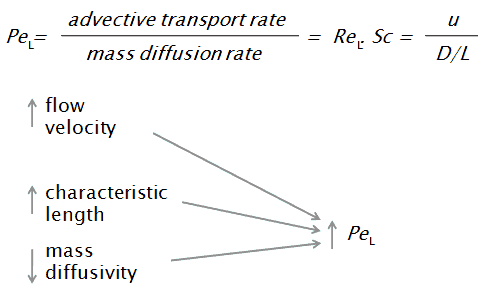
The Péclet number is a dimensionless number, named after the French physicist Jean Claude Eugène Péclet. The Péclet number is defined as the ratio of the rate of advection of a physical quantity by the flow to the rate of diffusion (matter or heat) of the same quantity driven by an appropriate gradient. Therefore we must distinguish between Peclet number for mass transfer and heat transfer.

Peclet Number in Mass Transfer

In mass transfer problems, the Péclet number is the product of the Reynolds number, which describes the flow regime, and the Schmidt number, which is used to characterize fluid flows in which there are simultaneous momentum and mass diffusion convection processes.

peclet number - definition - formula - mass

where:

  • u is the flow velocity,
  • L is a characteristic linear dimension, (travelled length of the fluid; hydraulic diameter etc.)
  • D is the mass diffusivity [m2/s]

Peclet Number in Heat Transfer

In heat transfer problems, the Péclet number is the ratio of the thermal energy convected to the fluid to the thermal energy conducted within the fluid.  The Péclet number is simply defined as the product of the Reynolds number, which describes the flow regime, and the Prandtl number, which describes the relationship between momentum diffusivity and thermal diffusivity. If Pe is small, conduction is important.

peclet number - definition - formula - heat

where:

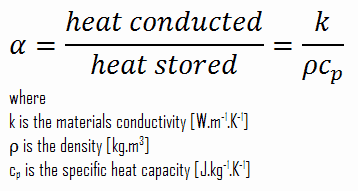
Thermal diffusivity represents how fast heat diffuses through a material and has units m2/s. In other words, it is the measure of thermal inertia of given material. Thermal diffusivity is usually denoted α and is given by:

thermal diffusivity

As can be seen it measures the ability of a material to conduct thermal energy(represented by factor k) relative to its ability to store thermal energy (represented by factor ρ.cp). Materials of large α will respond quickly to changes in their thermal environment, whereas materials of small α will respond more slowly (heat is mostly absorbed), taking longer to reach a new equilibrium condition.

Mass Diffusivity and Fick’s law

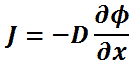
Diffusivity is encountered in Fick’s law, which states:

If the concentration of a solute in one region is greater than in another of a solution, the solute diffuses from the region of higher concentration to the region of lower concentration, with a magnitude that is proportional to the concentration gradient.

In one (spatial) dimension, the law is:

Ficks Law - equation

where:

  • J is the diffusion flux,
  • D is the diffusion coefficient,
  • φ (for ideal mixtures) is the concentration.

The use of this law in nuclear reactor theory leads to the diffusion approximation.

 
References:
Heat Transfer:
  1. Fundamentals of Heat and Mass Transfer, 7th Edition. Theodore L. Bergman, Adrienne S. Lavine, Frank P. Incropera. John Wiley & Sons, Incorporated, 2011. ISBN: 9781118137253.
  2. Heat and Mass Transfer. Yunus A. Cengel. McGraw-Hill Education, 2011. ISBN: 9780071077866.
  3. Fundamentals of Heat and Mass Transfer. C. P. Kothandaraman. New Age International, 2006, ISBN: 9788122417722.
  4. U.S. Department of Energy, Thermodynamics, Heat Transfer and Fluid Flow. DOE Fundamentals Handbook, Volume 2 of 3. May 2016.

Nuclear and Reactor Physics:

  1. J. R. Lamarsh, Introduction to Nuclear Reactor Theory, 2nd ed., Addison-Wesley, Reading, MA (1983).
  2. J. R. Lamarsh, A. J. Baratta, Introduction to Nuclear Engineering, 3d ed., Prentice-Hall, 2001, ISBN: 0-201-82498-1.
  3. W. M. Stacey, Nuclear Reactor Physics, John Wiley & Sons, 2001, ISBN: 0- 471-39127-1.
  4. Glasstone, Sesonske. Nuclear Reactor Engineering: Reactor Systems Engineering, Springer; 4th edition, 1994, ISBN: 978-0412985317
  5. W.S.C. Williams. Nuclear and Particle Physics. Clarendon Press; 1 edition, 1991, ISBN: 978-0198520467
  6. G.R.Keepin. Physics of Nuclear Kinetics. Addison-Wesley Pub. Co; 1st edition, 1965
  7. Robert Reed Burn, Introduction to Nuclear Reactor Operation, 1988.
  8. U.S. Department of Energy, Nuclear Physics and Reactor Theory. DOE Fundamentals Handbook, Volume 1 and 2. January 1993.
  9. Paul Reuss, Neutron Physics. EDP Sciences, 2008. ISBN: 978-2759800414.

Advanced Reactor Physics:

  1. K. O. Ott, W. A. Bezella, Introductory Nuclear Reactor Statics, American Nuclear Society, Revised edition (1989), 1989, ISBN: 0-894-48033-2.
  2. K. O. Ott, R. J. Neuhold, Introductory Nuclear Reactor Dynamics, American Nuclear Society, 1985, ISBN: 0-894-48029-4.
  3. D. L. Hetrick, Dynamics of Nuclear Reactors, American Nuclear Society, 1993, ISBN: 0-894-48453-2.
  4. E. E. Lewis, W. F. Miller, Computational Methods of Neutron Transport, American Nuclear Society, 1993, ISBN: 0-894-48452-4.

See also:

Characteristic Numbers

We hope, this article, Péclet Number, helps you. If so, give us a like in the sidebar. Main purpose of this website is to help the public to learn some interesting and important information about thermal engineering.
What is Critical Reynolds Number – Definition

The critical Reynolds number is associated with the laminar-turbulent transition, in which a laminar flow becomes turbulent. Critical Reynolds Number

Critical Reynolds Number

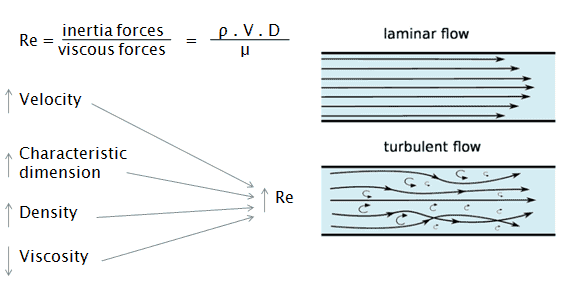
reynolds numberThe Reynolds number is the ratio of inertial forces to viscous forces and is a convenient parameter for predicting if a flow condition will be laminar or turbulent.

The critical Reynolds number is associated with the laminar-turbulent transition, in which a laminar flow becomes turbulent. This is an extraordinarily complicated process, which at present is not fully understood.

Critical Reynolds Number for Flow in a Pipe

For flow in a pipe of diameter D, experimental observations show that for “fully developed” flow, the critical Reynolds number is about Red,crit = 2300.

  • Laminar flow. For practical purposes, if the Reynolds number is less than 2000, the flow is laminar. The accepted transition Reynolds number for flow in a circular pipe is Red,crit = 2300.
  • Transitional flow. At Reynolds numbers between about 2000 and 4000 the flow is unstable as a result of the onset of turbulence. These flows are sometimes referred to as transitional flows.
  • Turbulent flow. If the Reynolds number is greater than 3500, the flow is turbulent.

Note that, the critical Reynolds number is different for every geometry.

Critical Reynolds Number in boundary layer flow over a flat plate.

In determining whether the boundary layer is laminar or turbulent, it is frequently reasonable to assume that transition begins at some location xcrit, as shown in figure. This location is determined by the critical Reynolds number, Rex,crit. For flow over a flat plate,
transition from laminar to turbulent boundary layer occurs when Reynolds number at x exceeds Rex,crit ~ 500,000. Transition may occur earlier, but it is dependent especially on the surface roughness. The turbulent boundary layer thickens more rapidly than the laminar boundary layer as a result of increased shear stress at the body surface.
Boundary layer on flat plate

Example: Critical Reynolds Number

A long thin flat plate is placed parallel to a 1 m/s stream of water at 20°C. Assume that kinematic viscosity of water at 20°C is equal to 1×10⁻⁶ m2/s.

At what distance x from the leading edge will be the transition from laminar to turbulent boundary layer (i.e. find Rex ~ 500,000).

Solution:

In order to locate the transition from laminar to turbulent boundary layer, we have to find x at which Rex ~ 500,000.

x = 500 000 x 1×10-6 [m2/s] / 1 [m/s] = 0.5 m

 
References:
Heat Transfer:
  1. Fundamentals of Heat and Mass Transfer, 7th Edition. Theodore L. Bergman, Adrienne S. Lavine, Frank P. Incropera. John Wiley & Sons, Incorporated, 2011. ISBN: 9781118137253.
  2. Heat and Mass Transfer. Yunus A. Cengel. McGraw-Hill Education, 2011. ISBN: 9780071077866.
  3. Fundamentals of Heat and Mass Transfer. C. P. Kothandaraman. New Age International, 2006, ISBN: 9788122417722.
  4. U.S. Department of Energy, Thermodynamics, Heat Transfer and Fluid Flow. DOE Fundamentals Handbook, Volume 2 of 3. May 2016.

Nuclear and Reactor Physics:

  1. J. R. Lamarsh, Introduction to Nuclear Reactor Theory, 2nd ed., Addison-Wesley, Reading, MA (1983).
  2. J. R. Lamarsh, A. J. Baratta, Introduction to Nuclear Engineering, 3d ed., Prentice-Hall, 2001, ISBN: 0-201-82498-1.
  3. W. M. Stacey, Nuclear Reactor Physics, John Wiley & Sons, 2001, ISBN: 0- 471-39127-1.
  4. Glasstone, Sesonske. Nuclear Reactor Engineering: Reactor Systems Engineering, Springer; 4th edition, 1994, ISBN: 978-0412985317
  5. W.S.C. Williams. Nuclear and Particle Physics. Clarendon Press; 1 edition, 1991, ISBN: 978-0198520467
  6. G.R.Keepin. Physics of Nuclear Kinetics. Addison-Wesley Pub. Co; 1st edition, 1965
  7. Robert Reed Burn, Introduction to Nuclear Reactor Operation, 1988.
  8. U.S. Department of Energy, Nuclear Physics and Reactor Theory. DOE Fundamentals Handbook, Volume 1 and 2. January 1993.
  9. Paul Reuss, Neutron Physics. EDP Sciences, 2008. ISBN: 978-2759800414.

Advanced Reactor Physics:

  1. K. O. Ott, W. A. Bezella, Introductory Nuclear Reactor Statics, American Nuclear Society, Revised edition (1989), 1989, ISBN: 0-894-48033-2.
  2. K. O. Ott, R. J. Neuhold, Introductory Nuclear Reactor Dynamics, American Nuclear Society, 1985, ISBN: 0-894-48029-4.
  3. D. L. Hetrick, Dynamics of Nuclear Reactors, American Nuclear Society, 1993, ISBN: 0-894-48453-2.
  4. E. E. Lewis, W. F. Miller, Computational Methods of Neutron Transport, American Nuclear Society, 1993, ISBN: 0-894-48452-4.

See also:

Reynolds Number

We hope, this article, Critical Reynolds Number, helps you. If so, give us a like in the sidebar. Main purpose of this website is to help the public to learn some interesting and important information about thermal engineering.
What is Convection – Convective Heat Transfer – Definition

Convection is either the mass transfer or the heat transfer due to bulk movement. The process of heat transfer between a surface and a fluid flowing in contact with it is called convective heat transfer. Thermal Engineering

What is Convection

Convection - Convective Heat TransferIn general, convection is either the mass transfer or the heat transfer due to bulk movement of molecules within fluids such as gases and liquids. Although liquids and gases are generally not very good conductors of heat, they can transfer heat quite rapidly by convection.

Convection takes place through advection, diffusion or both. Convection cannot take place in most solids because neither significant diffusion of matter nor bulk current flows can take place. Diffusion of heat takes place in rigid solids, but that is called thermal conduction.

The process of heat transfer between a surface and a fluid flowing in contact with it is called convective heat transfer. In engineering, convective heat transfer is one of the major mechanisms of heat transfer. When heat is to be transferred from one fluid to another through a barrier, convection is involved on both sides of the barrier. In most cases the main resistance to heat flow is by convection. Convective heat transfer take place both by thermal diffusion (the random motion of fluid molecules) and by advection, in which matter or heat is transported by the larger-scale motion of currents in the fluid.

Mechanism on Convection

In thermal conduction, energy is transferred as heat either due to the migration of free electrons or lattice vibrational waves (phonons). There is no movement of mass in the direction of energy flow. Heat transfer by conduction is dependent upon the driving “force” of temperature difference. Conduction and convection are similar in that both mechanisms require the presence of a material medium (in comparison to thermal radiation). On the other hand they are different in that convection requires the presence of fluid motion.

It must be emphasized, at the surface, energy flow occurs purely by conduction, even in conduction. It is due to the fact, there is always a thin stagnant fluid film layer on the heat transfer surface. But in the next layers both conduction and diffusion-mass movement in the molecular level or macroscopic level occurs. Due to the mass movement the rate of energy transfer is higher. Higher the rate of mass movement, thinner the stagnant fluid film layer will be and higher will be the heat flow rate.

It must be noted, nucleate boiling at the surface effectively disrupts this stagnant layer and therefore nucleate boiling significantly increases the ability of a surface to transfer thermal energy to bulk fluid.

As was written, heat transfer through a fluid is by convection in the presence of mass movement and by conduction in the absence of it. Therefore, thermal conduction in a fluid can be viewed as the limiting case of convection, corresponding to the case of quiescent fluid.

Convection as a Conduction with Fluid Motion

Some experts do not consider convection to be a fundamental mechanism of heat transfer since it is essentially heat conduction in the presence of fluid motion. They consider it to be a special case of thermal conduction, known as “conduction with fluid motion”. On the other hand, it is practical to recognize convection as a separate heat transfer mechanism despite the valid arguments to the contrary.

 
Velocity Boundary Layer
In general, when a fluid flows over a stationary surface, e.g. the flat plate, the bed of a river, or the wall of a pipe, the fluid touching the surface is brought to rest by the shear stress to at the wall. The region in which flow adjusts from zero velocity at the wall to a maximum in the main stream of the flow is termed the boundary layer. The concept of boundary layers is of importance in all of viscous fluid dynamics and also in the theory of heat transfer.

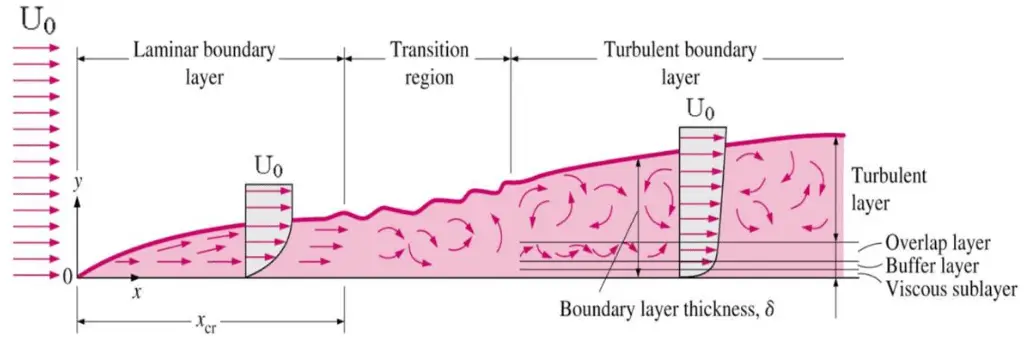
Basic characteristics of all laminar and turbulent boundary layers are shown in the developing flow over a flat plate. The stages of the formation of the boundary layer are shown in the figure below:

Boundary layer on flat plate

Boundary layers may be either laminar, or turbulent depending on the value of the Reynolds number.

See also: Boundary Layer

Thermal Boundary Layer
thermal boundary layer - convectionSimilarly as a velocity boundary layer develops when there is fluid flow over a surface, a thermal boundary layer must develop if the bulk temperature and surface temperature differ. Consider flow over an isothermal flat plate at a constant temperature of Twall. At the leading edge the temperature profile is uniform with Tbulk. Fluid particles that come into contact with the plate achieve thermal equilibrium at the plate’s surface temperature. At this point, energy flow occurs at the surface purely by conduction. These particles exchange energy with those in the adjoining fluid layer (by conduction and diffusion), and temperature gradients develop in the fluid. The region of the fluid in which these temperature gradients exist is the thermal boundary layer. Its thickness, δt, is typically defined as the distance from the body at which the temperature is 99% of the temperature found from an inviscid solution. With increasing distance from the leading edge, the effects of heat transfer penetrate farther into the stream and the thermal boundary layer grows.

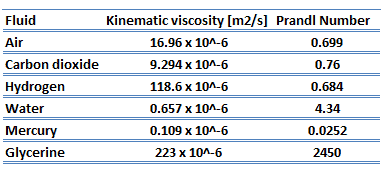
Prandtl Number - materialsThe ratio of these two thicknesses (velocity and thermal boundary layers) is governed by the Prandtl number, which is defined as the ratio of momentum diffusivity to thermal diffusivity. A Prandtl number of unity indicates that momentum and thermal diffusivity are comparable, and velocity and thermal boundary layers almost coincide with each other. If the Prandtl number is less than 1, which is the case for air at standard conditions, the thermal boundary layer is thicker than the velocity boundary layer. If the Prandtl number is greater than 1, the thermal boundary layer is thinner than the velocity boundary layer. Air at room temperature has a Prandtl number of 0.71 and for water at 18°C it is around 7.56, which means that the thermal diffusivity is more dominant for air than for water.

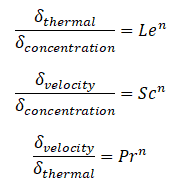
Similarly as for Prandtl Number, the Lewis number physically relates the relative thickness of the thermal layer and mass-transfer (concentration) boundary layer. The Schmidt number physically relates the relative thickness of the velocity boundary layer and mass-transfer (concentration) boundary layer.

Lewis Number - Prandtl Number - Schmidt Number

where n = 1/3  for most applications in all three relations. These relations, in general, are applicable only for laminar flow and are not applicable to turbulent boundary layers since turbulent mixing in this case may dominate the diffusion processes.

laminar sublayer - convectionHeat transfer by convection is more difficult to analyze than heat transfer by conduction because no single property of the heat transfer medium, such as thermal conductivity, can be defined to describe the mechanism. Convective heat transfer is complicated by the fact that it involves fluid motion as well as heat conduction. Heat transfer by convection varies from situation to situation (upon the fluid flow conditions), and it is frequently coupled with the mode of fluid flow. In forced convection, the rate of heat transfer through a fluid is much higher by convection than it is by conduction.

In practice, analysis of heat transfer by convection is treated empirically (by direct experimental observation). Most of problems can be solved using so called characteristic numbers (e.g. Nusselt number). Characteristic numbers are dimensionless numbers used to describe a character of heat transfer and can be used to compare a real situation (e.g. heat transfer in a pipe) with a small-scale model. Experience shows that convection heat transfer strongly depends on the fluid properties dynamic viscosity, thermal conductivity, density, and specific heat, as well as the fluid velocity. It also depends on the geometry and the roughness of the solid surface, in addition to the type of fluid flow. All these conditions affect especially the stagnant film thickness.

Convection involves the transfer of heat between a surface at a given temperature (Twall) and fluid at a bulk temperature (Tb). The exact definition of the bulk temperature (Tb) varies depending on the details of the situation.

  • For flow adjacent to a hot or cold surface, Tb is the temperature of the fluid “far” from the surface.
  • For boiling or condensation, Tb is the saturation temperature of the fluid.
  • For flow in a pipe, Tb is the average temperature measured at a particular cross-section of the pipe.

Newton’s Law of Cooling

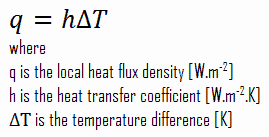
Despite the complexity of convection, the rate of convection heat transfer is observed to be proportional to the temperature difference and is conveniently expressed by Newton’s law of cooling, which states that:

The rate of heat loss of a body is directly proportional to the difference in the temperatures between the body and its surroundings provided the temperature difference is small and the nature of radiating surface remains same.

newton's law of cooling - convection equation

Note that, ΔT is given by the surface or wall temperature, Twall and the bulk temperature, T∞, which is the temperature of the fluid sufficiently far from the surface.

Convective Heat Transfer Coefficient

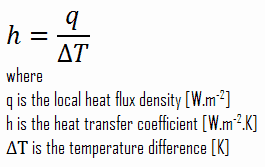
As can be seen, the constant of proportionality will be crucial in calculations and it is known as the convective heat transfer coefficient, h. The convective heat transfer coefficient, h, can be defined as:

The rate of heat transfer between a solid surface and a fluid per unit surface area per unit temperature difference.

convective heat transfer coefficient - equation

convective heat transfer coefficient - examplesThe convective heat transfer coefficient is dependent upon the physical properties of the fluid and the physical situation. The convective heat transfer coefficient is not a property of the fluid. It is an experimentally determined parameter whose value depends on all the variables influencing convection such as the surface geometry, the nature of fluid motion, the properties of the fluid, and the bulk fluid velocity.

Typically, the convective heat transfer coefficient for laminar flow is relatively low compared to the convective heat transfer coefficient for turbulent flow. This is due to turbulent flow having a thinner stagnant fluid film layer on the heat transfer surface.

It must be noted, this stagnant fluid film layer plays crucial role for the convective heat transfer coefficient. It is observed, that the fluid comes to a complete stop at the surface and assumes a zero velocity relative to the surface. This phenomenon is known as the no-slip condition and therefore, at the surface, energy flow occurs purely by conduction. But in the next layers both conduction and diffusion-mass movement in the molecular level or macroscopic level occurs. Due to the mass movement the rate of energy transfer is higher. As was written, nucleate boiling at the surface effectively disrupts this stagnant layer and therefore nucleate boiling significantly increases the ability of a surface to transfer thermal energy to bulk fluid.

A similar phenomenon occurs for the temperature. It is observed, that the fluid’s temperature at the surface and the surface will have the same temperature at the point of contact. This phenomenon is known as the no-temperature-jump condition and it is very important for theory of nucleate boiling.

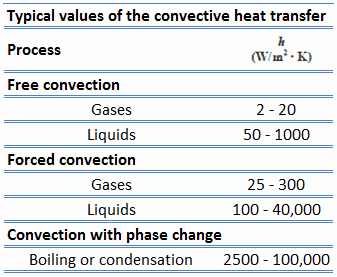
Values of the heat transfer coefficient, h, have been measured and tabulated for the commonly encountered fluids and flow situations occurring during heat transfer by convection.

 
Thermal Resistance - Analogy to Electric Resistance
See also: Thermal Resistance

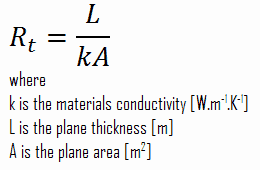
Thermal resistance is a heat property and a measurement of a temperature difference by which an object or material resists a heat flow. The thermal resistance for conduction in a plane wall is defined as:

thermal resistance - definition

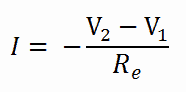
The equation above can be derived also for convective heat trasfer. For heat flow is analogous to the relation for electric current flow I, expressed as:

analogy to electric resistance

where Re = L/σeA is the electric resistance and V1 – V2 is the voltage difference across the resistance (σe is the electrical conductivity). The analogy between both equations is obvious. The rate of heat transfer through a layer corresponds to the electric current, the thermal resistance corresponds to electrical resistance, and the temperature difference corresponds to voltage difference across the layer. The temperature difference is the potential or driving function for the heat flow, resulting in the Fourier equation being written in a form similar to Ohm’s Law of Electrical Circuit Theory.

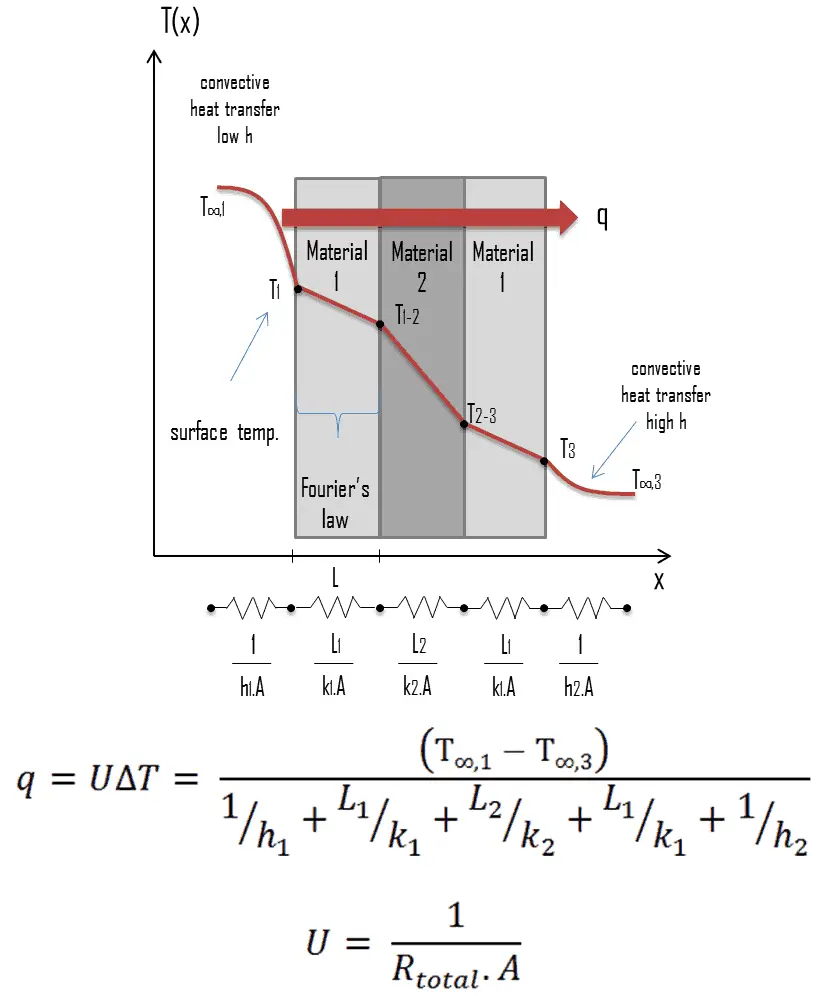
thermal resistance - composite wallsCircuit representations provide a useful tool for both conceptualizing and quantifying heat transfer problems. This analogy can be used also for the thermal resistance of the surface against heat convection. Note that when the convection heat transfer coefficient is very large (h → infinity), the convection resistance becomes zero and the surface temperature approaches the bulk temperature. This situation is approached in practice at surfaces where intensive boiling and condensation occur.

The heat transfer through the composite wall can be calculated from these resistances. The rate of steady heat transfer between two surfaces is equal to the temperature difference divided by the total thermal resistance between those two surfaces.

thermal resistance - equation

The equivalent thermal circuit for the plane wall with convection surface conditions is shown in the figure.

See also: Wiedemann–Franz Law

U-factor - Overall Heat Transfer Coefficient
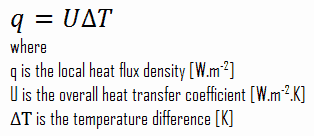
Many of the heat transfer processes encountered in industry involve composite systems and even involve a combination of both conduction and convection. With these composite systems, it is often convenient to work with an overall heat transfer coefficient, known as a U-factor. The U-factor is defined by an expression analogous to Newton’s law of cooling:

u-factor - overall heat transfer coefficient

The overall heat transfer coefficient is related to the total thermal resistance and depends on the geometry of the problem. For example, heat transfer in a steam generator involves convection from the bulk of the reactor coolant to the steam generator inner tube surface, conduction through the tube wall, and convection (boiling) from the outer tube surface to the secondary side fluid.

In cases of combined heat transfer for a heat exchanger, there are two values for h. There is the convective heat transfer coefficient (h) for the fluid film inside the tubes and a convective heat transfer coefficient for the fluid film outside the tubes. The thermal conductivity (k) and thickness (Δx) of the tube wall must also be accounted for.

Overall Heat Transfer Coefficient – Plane Wall

U-factor - Overall Heat Transfer Coefficient

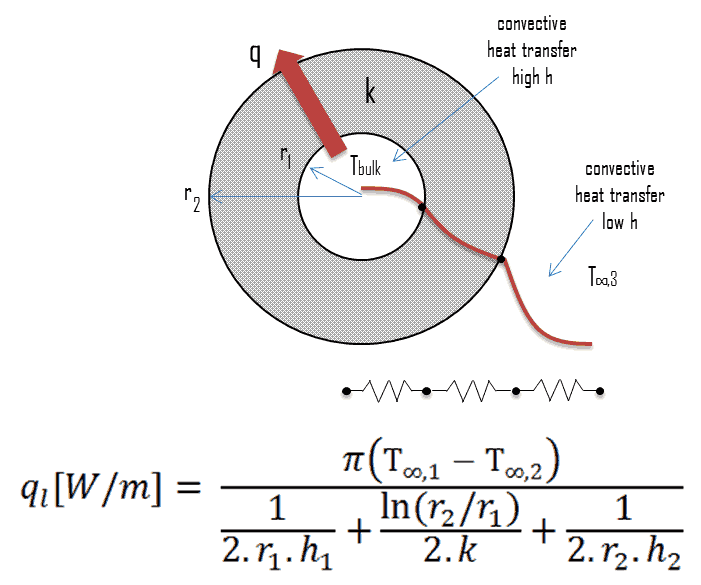
Overall Heat Transfer Coefficient – Cylindrical Tubes

Steady heat transfer through multilayered cylindrical or spherical shells can be handled just like multilayered plane walls.

Overall Heat Transfer Coefficient - Cylindrical Tubes

Nusselt Number

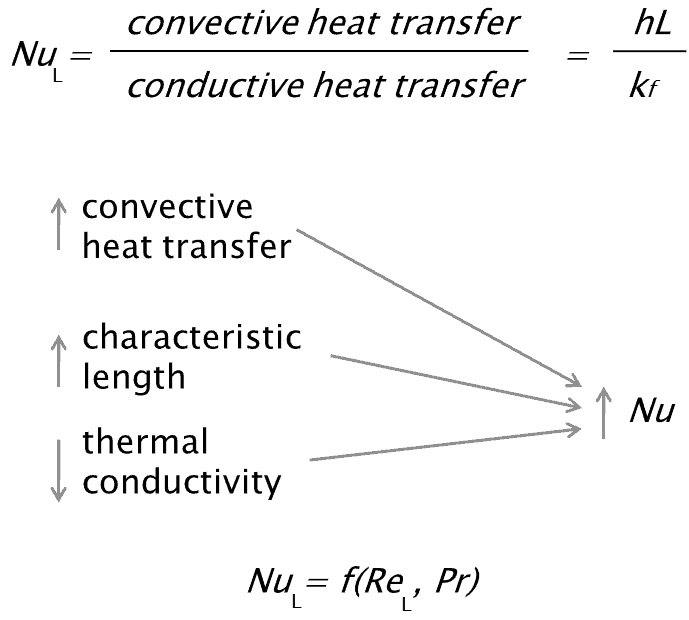
The Nusselt number is a dimensionless number, named after a German engineer Wilhelm Nusselt. The Nusselt number is closely related to Péclet number and both numbers are used to describe the ratio of the thermal energy convected to the fluid to the thermal energy conducted within the fluid. Nusselt number is equal to the dimensionless temperature gradient at the surface, and it provides a measure of the convection heat transfer occurring at the surface. The conductive component is measured under the same conditions as the heat convection but with a stagnant fluid. The Nusselt number is to the thermal boundary layer what the friction coefficient is to the velocity boundary layer. Thus, the Nusselt number is defined as:

Nusselt Number - definition

where:

kf is thermal conductivity of the fluid [W/m.K]

L is the characteristic length

h is the convective heat transfer coefficient [W/m2.K]

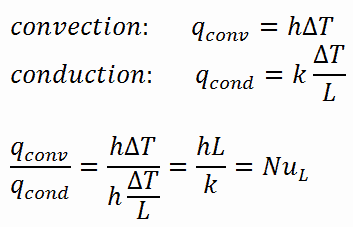
For illustration, consider a fluid layer of thickness L and temperature difference ΔT. Heat transfer through the fluid layer will be by convection when the fluid involves some motion and by conduction when the fluid layer is motionless.

In case of conduction, the heat flux can be calculated using Fourier’s law of conduction. In case of convection, the heat flux can be calculated using Newton’s law of cooling. Taking their ratio gives:

nusselt number - convection to conduction

The preceding equation defines the Nusselt number. Therefore, the Nusselt number represents the enhancement of heat transfer through a fluid layer as a result of convection relative to conduction across the same fluid layer.  A Nusselt number of Nu=1 for a fluid layer represents heat transfer across the layer by pure conduction. The larger the Nusselt number, the more effective the convection. A larger Nusselt number corresponds to more effective convection, with turbulent flow typically in the 100–1000 range. For turbulent flow, the Nusselt number is usually a function of the Reynolds number and the Prandtl number.

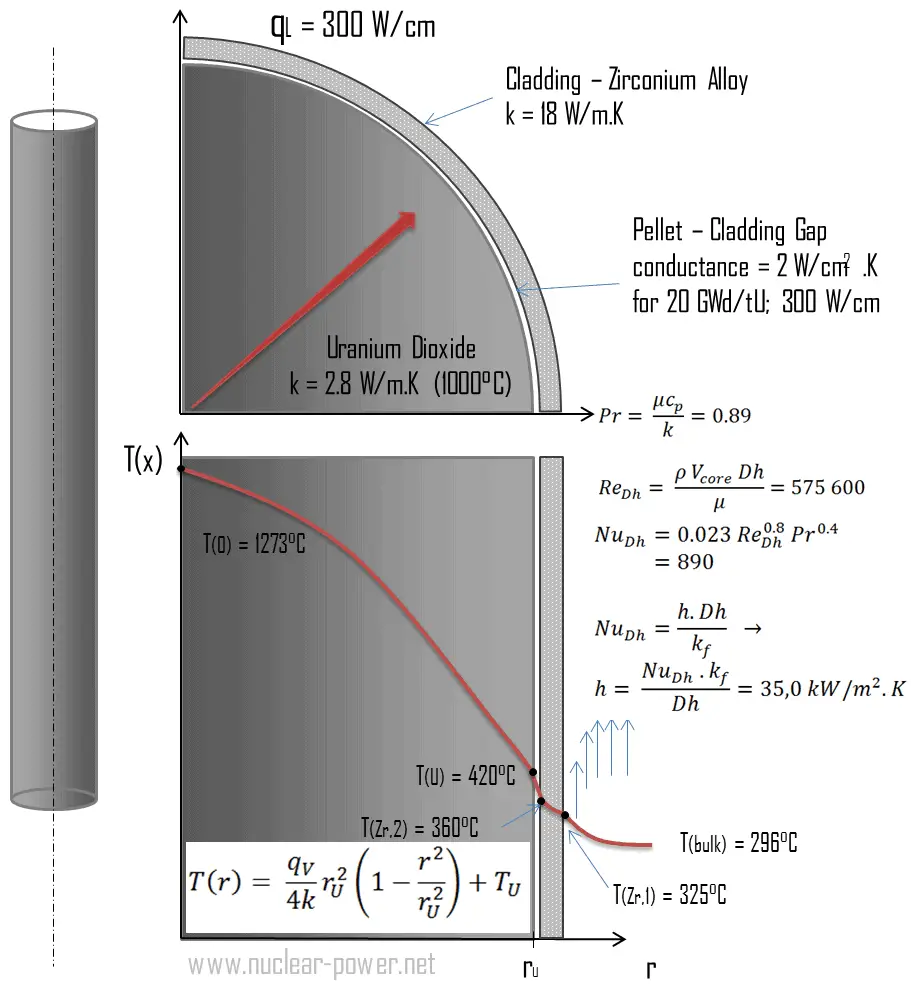
Example – Convective Heat Transfer – Cladding Surface Temperature

Convection - Convective Heat TransferCladding is the outer layer of the fuel rods, standing between the reactor coolant and the nuclear fuel (i.e. fuel pellets). It is made of a corrosion-resistant material with low absorption cross section for thermal neutrons, usually zirconium alloy. Cladding prevents radioactive fission products from escaping the fuel matrix into the reactor coolant and contaminating it. Cladding constitute one of barriers in ‘defence-in-depth‘ approach, therefore its coolability is one of key safety aspects.

Consider the fuel cladding of inner radius rZr,2 = 0.408 cm and outer radius rZr,1 = 0.465 cm. In comparison to fuel pellet, there is almost no heat generation in the fuel cladding (cladding is slightly heated by radiation). All heat generated in the fuel must be transferred via conduction through the cladding and therefore the inner surface is hotter than the outer surface.

Assume that:

  • the outer diameter of the cladding is: d = 2 x rZr,1 = 9,3 mm
  • the pitch of fuel pins is: p = 13 mm
  • the thermal conductivity of saturated water at 300°C is: kH2O = 0.545 W/m.K
  • the dynamic viscosity of saturated water at 300°C is: μ = 0.0000859 N.s/m2
  • the fluid density is: ρ = 714 kg/m3
  • the specific heat is: cp = 5.65 kJ/kg.K
  • the core flow velocity is constant and equal to Vcore = 5 m/s
  • the temperature of reactor coolant at this axial coordinate is: Tbulk = 296°C
  • the linear heat rate of the fuel is qL = 300 W/cm (FQ ≈ 2.0) and thus the volumetric heat rate is qV = 597 x 106 W/m3

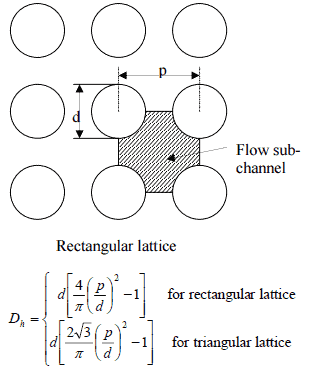
Hydraulic Diameter - Fuel ChannelCalculate the Prandtl, Reynolds and Nusselt number for this flow regime (internal forced turbulent flow) inside the rectangular fuel lattice (fuel channel), then calculate the heat transfer coefficient and finally the cladding surface temperature, TZr,1.

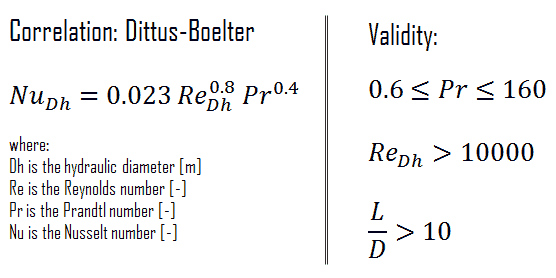
To calculate the cladding surface temperature, we have to calculate the Prandtl, Reynolds and Nusselt number, because the heat transfer for this flow regime can be described by the Dittus-Boelter equation, which is:

Dittus-Boelter Equation - Formula

Calculation of the Prandtl number

To calculate the Prandtl number, we have to know:

  • the thermal conductivity of saturated water at 300°C is: kH2O = 0.545 W/m.K
  • the dynamic viscosity of saturated water at 300°C is: μ = 0.0000859 N.s/m2
  • the specific heat is: cp = 5.65 kJ/kg.K

Note that, all these parameters significantly differs for water at 300°C from those at 20°C.  Prandtl number for water at 20°C is around 6.91. Prandtl number for reactor coolant at 300°C is then:

prandtl number - example

Calculation of the Reynolds number

To calculate the Reynolds number, we have to know:

  • the outer diameter of the cladding is: d = 2 x rZr,1 = 9,3 mm (to calculate the hydraulic diameter)
  • the pitch of fuel pins is: p = 13 mm  (to calculate the hydraulic diameter)
  • the dynamic viscosity of saturated water at 300°C is: μ = 0.0000859 N.s/m2
  • the fluid density is: ρ = 714 kg/m3

The hydraulic diameter, Dh, is a commonly used term when handling flow in non-circular tubes and channels. The hydraulic diameter of the fuel channel, Dh, is equal to 13,85 mm.

See also: Hydraulic Diameter

The Reynolds number inside the fuel channel is then equal to:

reynolds number - example

This fully satisfies the turbulent conditions.

Calculation of the Nusselt number using Dittus-Boelter equation

For fully developed (hydrodynamically and thermally) turbulent flow in a smooth circular tube, the local Nusselt number may be obtained from the well-known Dittus–Boelter equation.

To calculate the Nusselt number, we have to know:

The Nusselt number for the forced convection inside the fuel channel is then equal to:

nusselt number - example

Calculation of the heat transfer coefficient and the cladding surface temperature, TZr,1

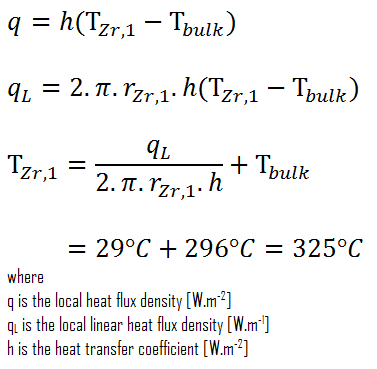
Detailed knowledge of geometry, fluid parameters, outer radius of cladding, linear heat rate, convective heat transfer coefficient allows us to calculate the temperature difference ∆T between the coolant (Tbulk) and the cladding surface (TZr,1).

To calculate the the cladding surface temperature, we have to know:

  • the outer diameter of the cladding is: d = 2 x rZr,1 = 9,3 mm
  • the Nusselt number, which is NuDh = 890
  • the hydraulic diameter of the fuel channel is: Dh = 13,85 mm
  • the thermal conductivity of reactor coolant (300°C) is: kH2O = 0.545 W/m.K
  • the bulk temperature of reactor coolant at this axial coordinate is: Tbulk = 296°C
  • the linear heat rate of the fuel is: qL = 300 W/cm (FQ ≈ 2.0)

The convective heat transfer coefficient, h, is given directly by the definition of Nusselt number:

convective heat transfer coefficient - example

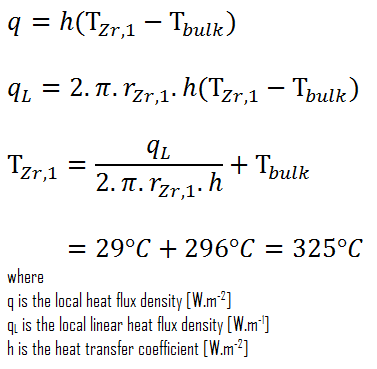
Finally, we can calculate the cladding surface temperature (TZr,1) simply using the Newton’s Law of Cooling:

Newton law of cooling - example

For PWRs at normal operation, there is a compressed liquid water inside the reactor core, loops and steam generators.  The pressure is maintained at approximately 16MPa. At this pressure water boils at approximately 350°C(662°F). As can be seen, the surface temperature TZr,1 = 325°C ensures, that even subcooled boiling does not occur. Note that, subcooled boiling requires TZr,1 = Tsat. Since the inlet temperatures of the water are usually about 290°C (554°F), it is obvious this example corresponds to the lower part of the core. At higher elevations of the core the bulk temperature may reach up to 330°C. The temperature difference of 29°C causes the subcooled boiling may occur (330°C + 29°C > 350°C). On the other hand, nucleate boiling at the surface effectively disrupts the stagnant layer and therefore nucleate boiling significantly increases the ability of a surface to transfer thermal energy to bulk fluid. As a result, the convective heat transfer coefficient significantly increases and therefore at higher elevations, the temperature difference (TZr,1 – Tbulk) significantly decreases.

 
References:
Heat Transfer:
  1. Fundamentals of Heat and Mass Transfer, 7th Edition. Theodore L. Bergman, Adrienne S. Lavine, Frank P. Incropera. John Wiley & Sons, Incorporated, 2011. ISBN: 9781118137253.
  2. Heat and Mass Transfer. Yunus A. Cengel. McGraw-Hill Education, 2011. ISBN: 9780071077866.
  3. Fundamentals of Heat and Mass Transfer. C. P. Kothandaraman. New Age International, 2006, ISBN: 9788122417722.
  4. U.S. Department of Energy, Thermodynamics, Heat Transfer and Fluid Flow. DOE Fundamentals Handbook, Volume 2 of 3. May 2016.

Nuclear and Reactor Physics:

  1. J. R. Lamarsh, Introduction to Nuclear Reactor Theory, 2nd ed., Addison-Wesley, Reading, MA (1983).
  2. J. R. Lamarsh, A. J. Baratta, Introduction to Nuclear Engineering, 3d ed., Prentice-Hall, 2001, ISBN: 0-201-82498-1.
  3. W. M. Stacey, Nuclear Reactor Physics, John Wiley & Sons, 2001, ISBN: 0- 471-39127-1.
  4. Glasstone, Sesonske. Nuclear Reactor Engineering: Reactor Systems Engineering, Springer; 4th edition, 1994, ISBN: 978-0412985317
  5. W.S.C. Williams. Nuclear and Particle Physics. Clarendon Press; 1 edition, 1991, ISBN: 978-0198520467
  6. G.R.Keepin. Physics of Nuclear Kinetics. Addison-Wesley Pub. Co; 1st edition, 1965
  7. Robert Reed Burn, Introduction to Nuclear Reactor Operation, 1988.
  8. U.S. Department of Energy, Nuclear Physics and Reactor Theory. DOE Fundamentals Handbook, Volume 1 and 2. January 1993.
  9. Paul Reuss, Neutron Physics. EDP Sciences, 2008. ISBN: 978-2759800414.

Advanced Reactor Physics:

  1. K. O. Ott, W. A. Bezella, Introductory Nuclear Reactor Statics, American Nuclear Society, Revised edition (1989), 1989, ISBN: 0-894-48033-2.
  2. K. O. Ott, R. J. Neuhold, Introductory Nuclear Reactor Dynamics, American Nuclear Society, 1985, ISBN: 0-894-48029-4.
  3. D. L. Hetrick, Dynamics of Nuclear Reactors, American Nuclear Society, 1993, ISBN: 0-894-48453-2.
  4. E. E. Lewis, W. F. Miller, Computational Methods of Neutron Transport, American Nuclear Society, 1993, ISBN: 0-894-48452-4.

See also:

Heat Transfer

We hope, this article, Convection – Convective Heat Transfer, helps you. If so, give us a like in the sidebar. Main purpose of this website is to help the public to learn some interesting and important information about thermal engineering.
What is Convection – Definition

What is Convection – Definition of Convection. Convection takes place through advection, diffusion or both. Convection cannot take place in most solids

What is Convection

Convection - Convective Heat Transfer

What is Convection

In general, convection is either the mass transfer or the heat transfer due to bulk movement of molecules within fluids such as gases and liquids. Although liquids and gases are generally not very good conductors of heat, they can transfer heat quite rapidly by convection.

Convection takes place through advection, diffusion or both. Convection cannot take place in most solids because neither significant diffusion of matter nor bulk current flows can take place. Diffusion of heat takes place in rigid solids, but that is called thermal conduction.

The process of heat transfer between a surface and a fluid flowing in contact with it is called convective heat transfer. In engineering, convective heat transfer is one of the major mechanisms of heat transfer. When heat is to be transferred from one fluid to another through a barrier, convection is involved on both sides of the barrier. In most cases the main resistance to heat flow is by convection. Convective heat transfer take place both by thermal diffusion (the random motion of fluid molecules) and by advection, in which matter or heat is transported by the larger-scale motion of currents in the fluid.

Mechanism on Convection

In thermal conduction, energy is transferred as heat either due to the migration of free electrons or lattice vibrational waves (phonons). There is no movement of mass in the direction of energy flow. Heat transfer by conduction is dependent upon the driving “force” of temperature difference. Conduction and convection are similar in that both mechanisms require the presence of a material medium (in comparison to thermal radiation). On the other hand they are different in that convection requires the presence of fluid motion.

It must be emphasized, at the surface, energy flow occurs purely by conduction, even in conduction. It is due to the fact, there is always a thin stagnant fluid film layer on the heat transfer surface. But in the next layers both conduction and diffusion-mass movement in the molecular level or macroscopic level occurs. Due to the mass movement the rate of energy transfer is higher. Higher the rate of mass movement, thinner the stagnant fluid film layer will be and higher will be the heat flow rate.

It must be noted, nucleate boiling at the surface effectively disrupts this stagnant layer and therefore nucleate boiling significantly increases the ability of a surface to transfer thermal energy to bulk fluid.

As was written, heat transfer through a fluid is by convection in the presence of mass movement and by conduction in the absence of it. Therefore, thermal conduction in a fluid can be viewed as the limiting case of convection, corresponding to the case of quiescent fluid.

Newton’s Law of Cooling

Despite the complexity of convection, the rate of convection heat transfer is observed to be proportional to the temperature difference and is conveniently expressed by Newton’s law of cooling, which states that:

The rate of heat loss of a body is directly proportional to the difference in the temperatures between the body and its surroundings provided the temperature difference is small and the nature of radiating surface remains same.

newton's law of cooling - convection equation

Note that, ΔT is given by the surface or wall temperature, Twall and the bulk temperature, T∞, which is the temperature of the fluid sufficiently far from the surface.

 
References:
Heat Transfer:
  1. Fundamentals of Heat and Mass Transfer, 7th Edition. Theodore L. Bergman, Adrienne S. Lavine, Frank P. Incropera. John Wiley & Sons, Incorporated, 2011. ISBN: 9781118137253.
  2. Heat and Mass Transfer. Yunus A. Cengel. McGraw-Hill Education, 2011. ISBN: 9780071077866.
  3. Fundamentals of Heat and Mass Transfer. C. P. Kothandaraman. New Age International, 2006, ISBN: 9788122417722.
  4. U.S. Department of Energy, Thermodynamics, Heat Transfer and Fluid Flow. DOE Fundamentals Handbook, Volume 2 of 3. May 2016.

Nuclear and Reactor Physics:

  1. J. R. Lamarsh, Introduction to Nuclear Reactor Theory, 2nd ed., Addison-Wesley, Reading, MA (1983).
  2. J. R. Lamarsh, A. J. Baratta, Introduction to Nuclear Engineering, 3d ed., Prentice-Hall, 2001, ISBN: 0-201-82498-1.
  3. W. M. Stacey, Nuclear Reactor Physics, John Wiley & Sons, 2001, ISBN: 0- 471-39127-1.
  4. Glasstone, Sesonske. Nuclear Reactor Engineering: Reactor Systems Engineering, Springer; 4th edition, 1994, ISBN: 978-0412985317
  5. W.S.C. Williams. Nuclear and Particle Physics. Clarendon Press; 1 edition, 1991, ISBN: 978-0198520467
  6. G.R.Keepin. Physics of Nuclear Kinetics. Addison-Wesley Pub. Co; 1st edition, 1965
  7. Robert Reed Burn, Introduction to Nuclear Reactor Operation, 1988.
  8. U.S. Department of Energy, Nuclear Physics and Reactor Theory. DOE Fundamentals Handbook, Volume 1 and 2. January 1993.
  9. Paul Reuss, Neutron Physics. EDP Sciences, 2008. ISBN: 978-2759800414.

Advanced Reactor Physics:

  1. K. O. Ott, W. A. Bezella, Introductory Nuclear Reactor Statics, American Nuclear Society, Revised edition (1989), 1989, ISBN: 0-894-48033-2.
  2. K. O. Ott, R. J. Neuhold, Introductory Nuclear Reactor Dynamics, American Nuclear Society, 1985, ISBN: 0-894-48029-4.
  3. D. L. Hetrick, Dynamics of Nuclear Reactors, American Nuclear Society, 1993, ISBN: 0-894-48453-2.
  4. E. E. Lewis, W. F. Miller, Computational Methods of Neutron Transport, American Nuclear Society, 1993, ISBN: 0-894-48452-4.

See also:

Convection

We hope, this article, Convection, helps you. If so, give us a like in the sidebar. Main purpose of this website is to help the public to learn some interesting and important information about thermal engineering.

What is Mechanism on Convection – Characteristics – Definition

Mechanism on Convection. Convection takes place through advection, diffusion or both. . Heat transfer by conduction is dependent upon the driving “force” of temperature difference. Thermal Engineering

Mechanism on Convection

Convection - Convective Heat TransferMechanism on Convection


In thermal conduction, energy is transferred as heat either due to the migration of free electrons or lattice vibrational waves (phonons). There is no movement of mass in the direction of energy flow. Heat transfer by conduction is dependent upon the driving “force” of temperature difference. Conduction and convection are similar in that both mechanisms require the presence of a material medium (in comparison to thermal radiation). On the other hand they are different in that convection requires the presence of fluid motion.

It must be emphasized, at the surface, energy flow occurs purely by conduction, even in conduction. It is due to the fact, there is always a thin stagnant fluid film layer on the heat transfer surface. But in the next layers both conduction and diffusion-mass movement in the molecular level or macroscopic level occurs. Due to the mass movement the rate of energy transfer is higher. Higher the rate of mass movement, thinner the stagnant fluid film layer will be and higher will be the heat flow rate.

It must be noted, nucleate boiling at the surface effectively disrupts this stagnant layer and therefore nucleate boiling significantly increases the ability of a surface to transfer thermal energy to bulk fluid.

As was written, heat transfer through a fluid is by convection in the presence of mass movement and by conduction in the absence of it. Therefore, thermal conduction in a fluid can be viewed as the limiting case of convection, corresponding to the case of quiescent fluid.

Convection as a Conduction with Fluid Motion

Some experts do not consider convection to be a fundamental mechanism of heat transfer since it is essentially heat conduction in the presence of fluid motion. They consider it to be a special case of thermal conduction, known as “conduction with fluid motion”. On the other hand, it is practical to recognize convection as a separate heat transfer mechanism despite the valid arguments to the contrary.

 
Velocity Boundary Layer
In general, when a fluid flows over a stationary surface, e.g. the flat plate, the bed of a river, or the wall of a pipe, the fluid touching the surface is brought to rest by the shear stress to at the wall. The region in which flow adjusts from zero velocity at the wall to a maximum in the main stream of the flow is termed the boundary layer. The concept of boundary layers is of importance in all of viscous fluid dynamics and also in the theory of heat transfer.

Basic characteristics of all laminar and turbulent boundary layers are shown in the developing flow over a flat plate. The stages of the formation of the boundary layer are shown in the figure below:

Boundary layer on flat plate

Boundary layers may be either laminar, or turbulent depending on the value of the Reynolds number.

See also: Boundary Layer

Thermal Boundary Layer
thermal boundary layer - convectionSimilarly as a velocity boundary layer develops when there is fluid flow over a surface, a thermal boundary layer must develop if the bulk temperature and surface temperature differ. Consider flow over an isothermal flat plate at a constant temperature of Twall. At the leading edge the temperature profile is uniform with Tbulk. Fluid particles that come into contact with the plate achieve thermal equilibrium at the plate’s surface temperature. At this point, energy flow occurs at the surface purely by conduction. These particles exchange energy with those in the adjoining fluid layer (by conduction and diffusion), and temperature gradients develop in the fluid. The region of the fluid in which these temperature gradients exist is the thermal boundary layer. Its thickness, δt, is typically defined as the distance from the body at which the temperature is 99% of the temperature found from an inviscid solution. With increasing distance from the leading edge, the effects of heat transfer penetrate farther into the stream and the thermal boundary layer grows.

Prandtl Number - materialsThe ratio of these two thicknesses (velocity and thermal boundary layers) is governed by the Prandtl number, which is defined as the ratio of momentum diffusivity to thermal diffusivity. A Prandtl number of unity indicates that momentum and thermal diffusivity are comparable, and velocity and thermal boundary layers almost coincide with each other. If the Prandtl number is less than 1, which is the case for air at standard conditions, the thermal boundary layer is thicker than the velocity boundary layer. If the Prandtl number is greater than 1, the thermal boundary layer is thinner than the velocity boundary layer. Air at room temperature has a Prandtl number of 0.71 and for water at 18°C it is around 7.56, which means that the thermal diffusivity is more dominant for air than for water.

Similarly as for Prandtl Number, the Lewis number physically relates the relative thickness of the thermal layer and mass-transfer (concentration) boundary layer. The Schmidt number physically relates the relative thickness of the velocity boundary layer and mass-transfer (concentration) boundary layer.

Lewis Number - Prandtl Number - Schmidt Number

where n = 1/3  for most applications in all three relations. These relations, in general, are applicable only for laminar flow and are not applicable to turbulent boundary layers since turbulent mixing in this case may dominate the diffusion processes.

laminar sublayer - convectionHeat transfer by convection is more difficult to analyze than heat transfer by conduction because no single property of the heat transfer medium, such as thermal conductivity, can be defined to describe the mechanism. Convective heat transfer is complicated by the fact that it involves fluid motion as well as heat conduction. Heat transfer by convection varies from situation to situation (upon the fluid flow conditions), and it is frequently coupled with the mode of fluid flow. In forced convection, the rate of heat transfer through a fluid is much higher by convection than it is by conduction.

In practice, analysis of heat transfer by convection is treated empirically (by direct experimental observation). Most of problems can be solved using so called characteristic numbers (e.g. Nusselt number). Characteristic numbers are dimensionless numbers used to describe a character of heat transfer and can be used to compare a real situation (e.g. heat transfer in a pipe) with a small-scale model. Experience shows that convection heat transfer strongly depends on the fluid properties dynamic viscosity, thermal conductivity, density, and specific heat, as well as the fluid velocity. It also depends on the geometry and the roughness of the solid surface, in addition to the type of fluid flow. All these conditions affect especially the stagnant film thickness.

Convection involves the transfer of heat between a surface at a given temperature (Twall) and fluid at a bulk temperature (Tb). The exact definition of the bulk temperature (Tb) varies depending on the details of the situation.

  • For flow adjacent to a hot or cold surface, Tb is the temperature of the fluid “far” from the surface.
  • For boiling or condensation, Tb is the saturation temperature of the fluid.
  • For flow in a pipe, Tb is the average temperature measured at a particular cross-section of the pipe.
 
References:
Heat Transfer:
  1. Fundamentals of Heat and Mass Transfer, 7th Edition. Theodore L. Bergman, Adrienne S. Lavine, Frank P. Incropera. John Wiley & Sons, Incorporated, 2011. ISBN: 9781118137253.
  2. Heat and Mass Transfer. Yunus A. Cengel. McGraw-Hill Education, 2011. ISBN: 9780071077866.
  3. Fundamentals of Heat and Mass Transfer. C. P. Kothandaraman. New Age International, 2006, ISBN: 9788122417722.
  4. U.S. Department of Energy, Thermodynamics, Heat Transfer and Fluid Flow. DOE Fundamentals Handbook, Volume 2 of 3. May 2016.

Nuclear and Reactor Physics:

  1. J. R. Lamarsh, Introduction to Nuclear Reactor Theory, 2nd ed., Addison-Wesley, Reading, MA (1983).
  2. J. R. Lamarsh, A. J. Baratta, Introduction to Nuclear Engineering, 3d ed., Prentice-Hall, 2001, ISBN: 0-201-82498-1.
  3. W. M. Stacey, Nuclear Reactor Physics, John Wiley & Sons, 2001, ISBN: 0- 471-39127-1.
  4. Glasstone, Sesonske. Nuclear Reactor Engineering: Reactor Systems Engineering, Springer; 4th edition, 1994, ISBN: 978-0412985317
  5. W.S.C. Williams. Nuclear and Particle Physics. Clarendon Press; 1 edition, 1991, ISBN: 978-0198520467
  6. G.R.Keepin. Physics of Nuclear Kinetics. Addison-Wesley Pub. Co; 1st edition, 1965
  7. Robert Reed Burn, Introduction to Nuclear Reactor Operation, 1988.
  8. U.S. Department of Energy, Nuclear Physics and Reactor Theory. DOE Fundamentals Handbook, Volume 1 and 2. January 1993.
  9. Paul Reuss, Neutron Physics. EDP Sciences, 2008. ISBN: 978-2759800414.

Advanced Reactor Physics:

  1. K. O. Ott, W. A. Bezella, Introductory Nuclear Reactor Statics, American Nuclear Society, Revised edition (1989), 1989, ISBN: 0-894-48033-2.
  2. K. O. Ott, R. J. Neuhold, Introductory Nuclear Reactor Dynamics, American Nuclear Society, 1985, ISBN: 0-894-48029-4.
  3. D. L. Hetrick, Dynamics of Nuclear Reactors, American Nuclear Society, 1993, ISBN: 0-894-48453-2.
  4. E. E. Lewis, W. F. Miller, Computational Methods of Neutron Transport, American Nuclear Society, 1993, ISBN: 0-894-48452-4.

See also:

Convection

We hope, this article, Mechanism on Convection – Characteristics, helps you. If so, give us a like in the sidebar. Main purpose of this website is to help the public to learn some interesting and important information about thermal engineering.
What is Convection vs Conduction – Definition

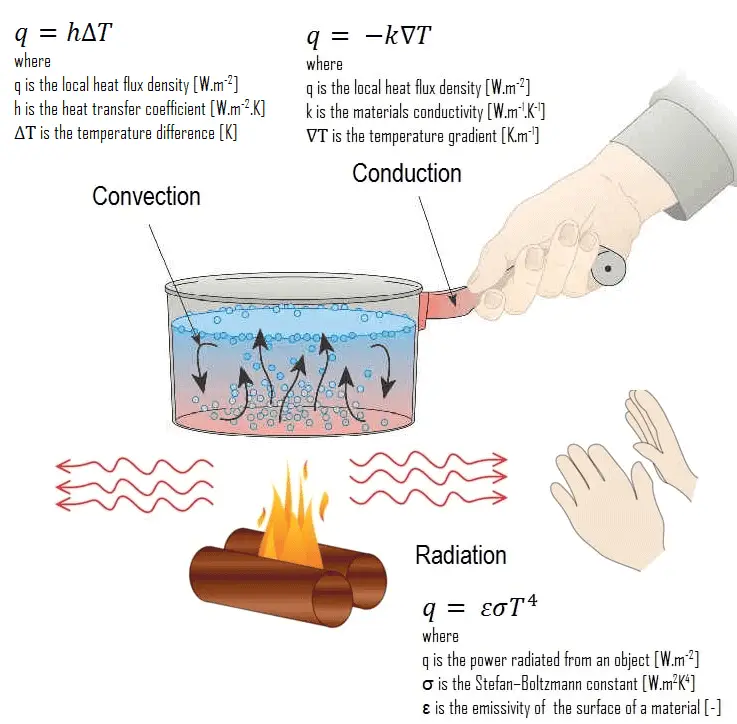
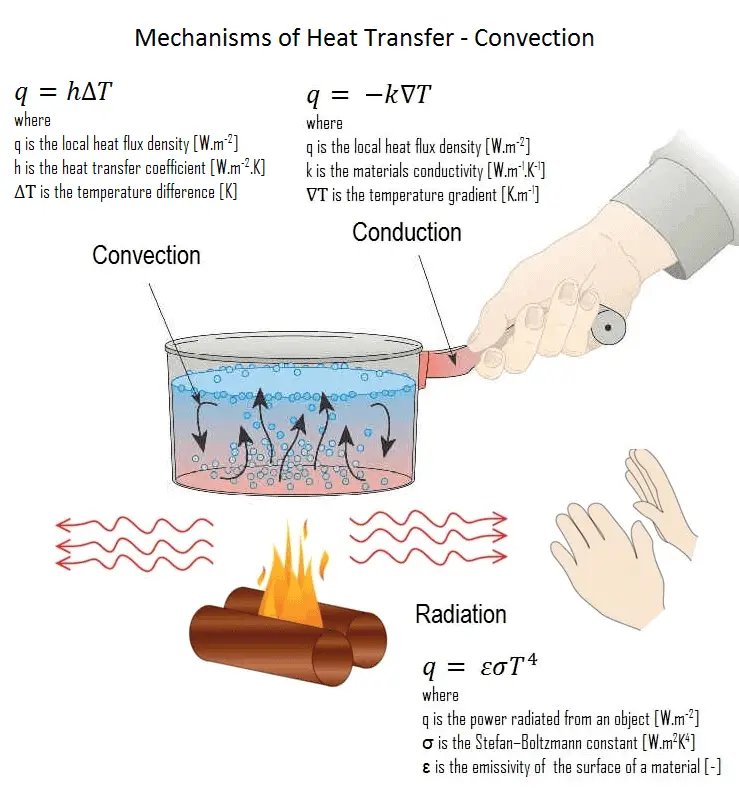
Conduction and convection are similar in that both mechanisms require the presence of a material medium (in comparison to thermal radiation). Convection vs Conduction

Convection vs Conduction

Heat Transfer - mechanisms

Convection vs Conduction

In thermal conduction, energy is transferred as heat either due to the migration of free electrons or lattice vibrational waves (phonons). There is no movement of mass in the direction of energy flow. Heat transfer by conduction is dependent upon the driving “force” of temperature difference.

In general, convection is either the mass transfer or the heat transfer due to bulk movement of molecules within fluids such as gases and liquids.

Conduction and convection are similar in that both mechanisms require the presence of a material medium (in comparison to thermal radiation). On the other hand they are different in that convection requires the presence of fluid motion.

It must be emphasized, at the surface, energy flow occurs purely by conduction, even in conduction. It is due to the fact, there is always a thin stagnant fluid film layer on the heat transfer surface. But in the next layers both conduction and diffusion-mass movement in the molecular level or macroscopic level occurs. Due to the mass movement the rate of energy transfer is higher. Higher the rate of mass movement, thinner the stagnant fluid film layer will be and higher will be the heat flow rate.

It must be noted, nucleate boiling at the surface effectively disrupts this stagnant layer and therefore nucleate boiling significantly increases the ability of a surface to transfer thermal energy to bulk fluid.

As was written, heat transfer through a fluid is by convection in the presence of mass movement and by conduction in the absence of it. Therefore, thermal conduction in a fluid can be viewed as the limiting case of convection, corresponding to the case of quiescent fluid.

Convection as a Conduction with Fluid Motion

Some experts do not consider convection to be a fundamental mechanism of heat transfer since it is essentially heat conduction in the presence of fluid motion. They consider it to be a special case of thermal conduction, known as “conduction with fluid motion”. On the other hand, it is practical to recognize convection as a separate heat transfer mechanism despite the valid arguments to the contrary.

What is Conduction

Thermal conduction, also called heat conduction, occurs within a body or between two bodies in contactwithout the involvement of mass flow and mixing. It is the direct microscopic exchange of kinetic energy of particles through the boundary between two systems. Heat transfer by conductionis dependent upon the driving “force” of temperature difference and the thermal conductivity (or the resistance to heat transfer). The thermal conductivity is dependent upon the nature and dimensions of the heat transfer medium. All heat transfer problems involve the temperature difference, the geometry, and the physical propertiesof the object being studied. In conduction heat transfer problems, the object being studied is usually a solid.

Microscopically this mode of energy transfer is attributed to free electron flow from higher to lower energy levels, lattice vibration and molecular collision. Consider a block of stone at high temperature, that consists of atoms that are oscillating intensely around their average positions. At low temperatures, the atoms continue to oscillate, but with less intensity. If a hotter block of stone is put in contact with a cooler block, the intensely oscillating atoms at the edge of the hotter block gives off its kinetic energy to the less oscillating atoms at the edge of the cool block. In this case there is energy transfer between these two blocks and heat flows from the hotter to the cooler block by this random vibrations. The modern view is to ascribe the energy transfer to lattice waves induced by atomic motion. In an electrical insulators, the energy transfer is exclusively via these lattice waves. In a conductor, it is also due to the translational motion of the free electrons.

Fourier’s law of Thermal Conduction

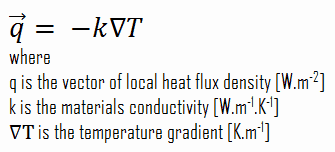
Heat transfer processes can be quantified in terms of appropriate rate equations. The rate equation in this heat transfer mode is based on Fourier’s law of thermal conduction. This law states that the time rate of heat transfer through a material is proportional to the negative gradient in the temperature and to the area, at right angles to that gradient, through which the heat flows. Its differential form is:

Fourier’s law of Thermal Conduction

What is Convection

In general, convection is either the mass transfer or the heat transfer due to bulk movement of molecules within fluids such as gases and liquids. Although liquids and gases are generally not very good conductors of heat, they can transfer heat quite rapidly by convection.

Convection takes place through advection, diffusion or both. Convection cannot take place in most solids because neither significant diffusion of matter nor bulk current flows can take place. Diffusion of heat takes place in rigid solids, but that is called thermal conduction.

The process of heat transfer between a surface and a fluid flowing in contact with it is called convective heat transfer. In engineering, convective heat transfer is one of the major mechanisms of heat transfer. When heat is to be transferred from one fluid to another through a barrier, convection is involved on both sides of the barrier. In most cases the main resistance to heat flow is by convection. Convective heat transfer take place both by thermal diffusion (the random motion of fluid molecules) and by advection, in which matter or heat is transported by the larger-scale motion of currents in the fluid.

Heat transfer by convection is more difficult to analyze than heat transfer by conduction because no single property of the heat transfer medium, such as thermal conductivity, can be defined to describe the mechanism. Convective heat transfer is complicated by the fact that it involves fluid motion as well as heat conduction. Heat transfer by convection varies from situation to situation (upon the fluid flow conditions), and it is frequently coupled with the mode of fluid flow. In forced convection, the rate of heat transfer through a fluid is much higher by convection than it is by conduction.

Newton’s Law of Cooling

Despite the complexity of convection, the rate of convection heat transfer is observed to be proportional to the temperature difference and is conveniently expressed by Newton’s law of cooling, which states that:

The rate of heat loss of a body is directly proportional to the difference in the temperatures between the body and its surroundings provided the temperature difference is small and the nature of radiating surface remains same.

newton's law of cooling - convection equation

Note that, ΔT is given by the surface or wall temperature, Twall and the bulk temperature, T∞, which is the temperature of the fluid sufficiently far from the surface.

Example – Convection vs Conduction

Convection - Convective Heat Transfer

 
References:
Heat Transfer:
  1. Fundamentals of Heat and Mass Transfer, 7th Edition. Theodore L. Bergman, Adrienne S. Lavine, Frank P. Incropera. John Wiley & Sons, Incorporated, 2011. ISBN: 9781118137253.
  2. Heat and Mass Transfer. Yunus A. Cengel. McGraw-Hill Education, 2011. ISBN: 9780071077866.
  3. Fundamentals of Heat and Mass Transfer. C. P. Kothandaraman. New Age International, 2006, ISBN: 9788122417722.
  4. U.S. Department of Energy, Thermodynamics, Heat Transfer and Fluid Flow. DOE Fundamentals Handbook, Volume 2 of 3. May 2016.

Nuclear and Reactor Physics:

  1. J. R. Lamarsh, Introduction to Nuclear Reactor Theory, 2nd ed., Addison-Wesley, Reading, MA (1983).
  2. J. R. Lamarsh, A. J. Baratta, Introduction to Nuclear Engineering, 3d ed., Prentice-Hall, 2001, ISBN: 0-201-82498-1.
  3. W. M. Stacey, Nuclear Reactor Physics, John Wiley & Sons, 2001, ISBN: 0- 471-39127-1.
  4. Glasstone, Sesonske. Nuclear Reactor Engineering: Reactor Systems Engineering, Springer; 4th edition, 1994, ISBN: 978-0412985317
  5. W.S.C. Williams. Nuclear and Particle Physics. Clarendon Press; 1 edition, 1991, ISBN: 978-0198520467
  6. G.R.Keepin. Physics of Nuclear Kinetics. Addison-Wesley Pub. Co; 1st edition, 1965
  7. Robert Reed Burn, Introduction to Nuclear Reactor Operation, 1988.
  8. U.S. Department of Energy, Nuclear Physics and Reactor Theory. DOE Fundamentals Handbook, Volume 1 and 2. January 1993.
  9. Paul Reuss, Neutron Physics. EDP Sciences, 2008. ISBN: 978-2759800414.

Advanced Reactor Physics:

  1. K. O. Ott, W. A. Bezella, Introductory Nuclear Reactor Statics, American Nuclear Society, Revised edition (1989), 1989, ISBN: 0-894-48033-2.
  2. K. O. Ott, R. J. Neuhold, Introductory Nuclear Reactor Dynamics, American Nuclear Society, 1985, ISBN: 0-894-48029-4.
  3. D. L. Hetrick, Dynamics of Nuclear Reactors, American Nuclear Society, 1993, ISBN: 0-894-48453-2.
  4. E. E. Lewis, W. F. Miller, Computational Methods of Neutron Transport, American Nuclear Society, 1993, ISBN: 0-894-48452-4.

See also:

Convection

We hope, this article, Convection vs Conduction, helps you. If so, give us a like in the sidebar. Main purpose of this website is to help the public to learn some interesting and important information about thermal engineering.
What is Newton’s Law of Cooling – Definition

Newton’s Law of Cooling – Heat Transfer Equation for Convection. Despite the complexity of convection, the rate of convective heat transfer is described by the Newton’s Law. Thermal Engineering

Newton’s Law of Cooling

Despite the complexity of convection, the rate of convection heat transfer is observed to be proportional to the temperature difference and is conveniently expressed by Newton’s law of cooling, which states that:

The rate of heat loss of a body is directly proportional to the difference in the temperatures between the body and its surroundings provided the temperature difference is small and the nature of radiating surface remains same.

newton's law of cooling - convection equation

Note that, ΔT is given by the surface or wall temperature, Twall and the bulk temperature, T∞, which is the temperature of the fluid sufficiently far from the surface.

Convective Heat Transfer Coefficient

As can be seen, the constant of proportionality will be crucial in calculations and it is known as the convective heat transfer coefficient, h. The convective heat transfer coefficient, h, can be defined as:

The rate of heat transfer between a solid surface and a fluid per unit surface area per unit temperature difference.

convective heat transfer coefficient - equation

convective heat transfer coefficient - examplesThe convective heat transfer coefficient is dependent upon the physical properties of the fluid and the physical situation. The convective heat transfer coefficient is not a property of the fluid. It is an experimentally determined parameter whose value depends on all the variables influencing convection such as the surface geometry, the nature of fluid motion, the properties of the fluid, and the bulk fluid velocity.

Typically, the convective heat transfer coefficient for laminar flow is relatively low compared to the convective heat transfer coefficient for turbulent flow. This is due to turbulent flow having a thinner stagnant fluid film layer on the heat transfer surface.

It must be noted, this stagnant fluid film layer plays crucial role for the convective heat transfer coefficient. It is observed, that the fluid comes to a complete stop at the surface and assumes a zero velocity relative to the surface. This phenomenon is known as the no-slip condition and therefore, at the surface, energy flow occurs purely by conduction. But in the next layers both conduction and diffusion-mass movement in the molecular level or macroscopic level occurs. Due to the mass movement the rate of energy transfer is higher. As was written, nucleate boiling at the surface effectively disrupts this stagnant layer and therefore nucleate boiling significantly increases the ability of a surface to transfer thermal energy to bulk fluid.

A similar phenomenon occurs for the temperature. It is observed, that the fluid’s temperature at the surface and the surface will have the same temperature at the point of contact. This phenomenon is known as the no-temperature-jump condition and it is very important for theory of nucleate boiling.

Values of the heat transfer coefficient, h, have been measured and tabulated for the commonly encountered fluids and flow situations occurring during heat transfer by convection.

 
Thermal Resistance - Analogy to Electric Resistance
See also: Thermal Resistance

Thermal resistance is a heat property and a measurement of a temperature difference by which an object or material resists a heat flow. The thermal resistance for conduction in a plane wall is defined as:

thermal resistance - definition

The equation above can be derived also for convective heat trasfer. For heat flow is analogous to the relation for electric current flow I, expressed as:

analogy to electric resistance

where Re = L/σeA is the electric resistance and V1 – V2 is the voltage difference across the resistance (σe is the electrical conductivity). The analogy between both equations is obvious. The rate of heat transfer through a layer corresponds to the electric current, the thermal resistance corresponds to electrical resistance, and the temperature difference corresponds to voltage difference across the layer. The temperature difference is the potential or driving function for the heat flow, resulting in the Fourier equation being written in a form similar to Ohm’s Law of Electrical Circuit Theory.

thermal resistance - composite wallsCircuit representations provide a useful tool for both conceptualizing and quantifying heat transfer problems. This analogy can be used also for the thermal resistance of the surface against heat convection. Note that when the convection heat transfer coefficient is very large (h → infinity), the convection resistance becomes zero and the surface temperature approaches the bulk temperature. This situation is approached in practice at surfaces where intensive boiling and condensation occur.

The heat transfer through the composite wall can be calculated from these resistances. The rate of steady heat transfer between two surfaces is equal to the temperature difference divided by the total thermal resistance between those two surfaces.

thermal resistance - equation

The equivalent thermal circuit for the plane wall with convection surface conditions is shown in the figure.

See also: Wiedemann–Franz Law

U-factor - Overall Heat Transfer Coefficient
Many of the heat transfer processes encountered in industry involve composite systems and even involve a combination of both conduction and convection. With these composite systems, it is often convenient to work with an overall heat transfer coefficient, known as a U-factor. The U-factor is defined by an expression analogous to Newton’s law of cooling:

u-factor - overall heat transfer coefficient

The overall heat transfer coefficient is related to the total thermal resistance and depends on the geometry of the problem. For example, heat transfer in a steam generator involves convection from the bulk of the reactor coolant to the steam generator inner tube surface, conduction through the tube wall, and convection (boiling) from the outer tube surface to the secondary side fluid.

In cases of combined heat transfer for a heat exchanger, there are two values for h. There is the convective heat transfer coefficient (h) for the fluid film inside the tubes and a convective heat transfer coefficient for the fluid film outside the tubes. The thermal conductivity (k) and thickness (Δx) of the tube wall must also be accounted for.

Overall Heat Transfer Coefficient – Plane Wall

U-factor - Overall Heat Transfer Coefficient

Overall Heat Transfer Coefficient – Cylindrical Tubes

Steady heat transfer through multilayered cylindrical or spherical shells can be handled just like multilayered plane walls.

Overall Heat Transfer Coefficient - Cylindrical Tubes

Example: Newton’s Law of Cooling

Convection - Convective Heat TransferFrom: Example – Convective Heat Transfer

Detailed knowledge of geometry, fluid parameters, outer radius of cladding, linear heat rate, convective heat transfer coefficient allows us to calculate the temperature difference ∆T between the coolant (Tbulk) and the cladding surface (TZr,1).

To calculate the the cladding surface temperature, we have to know:

  • the outer diameter of the cladding is: d = 2 x rZr,1 = 9,3 mm
  • the Nusselt number, which is NuDh = 890
  • the hydraulic diameter of the fuel channel is: Dh = 13,85 mm
  • the thermal conductivity of reactor coolant (300°C) is: kH2O = 0.545 W/m.K
  • the bulk temperature of reactor coolant at this axial coordinate is: Tbulk = 296°C
  • the linear heat rate of the fuel is: qL = 300 W/cm (FQ ≈ 2.0)

The convective heat transfer coefficient, h, is given directly by the definition of Nusselt number:

convective heat transfer coefficient - example

Finally, we can calculate the cladding surface temperature (TZr,1) simply using the Newton’s Law of Cooling:

Newton law of cooling - example

For PWRs at normal operation, there is a compressed liquid water inside the reactor core, loops and steam generators.  The pressure is maintained at approximately 16MPa. At this pressure water boils at approximately 350°C(662°F). As can be seen, the surface temperature TZr,1 = 325°C ensures, that even subcooled boiling does not occur. Note that, subcooled boiling requires TZr,1 = Tsat. Since the inlet temperatures of the water are usually about 290°C (554°F), it is obvious this example corresponds to the lower part of the core. At higher elevations of the core the bulk temperature may reach up to 330°C. The temperature difference of 29°C causes the subcooled boiling may occur (330°C + 29°C > 350°C). On the other hand, nucleate boiling at the surface effectively disrupts the stagnant layer and therefore nucleate boiling significantly increases the ability of a surface to transfer thermal energy to bulk fluid. As a result, the convective heat transfer coefficient significantly increases and therefore at higher elevations, the temperature difference (TZr,1 – Tbulk) significantly decreases.

 
References:
Heat Transfer:
  1. Fundamentals of Heat and Mass Transfer, 7th Edition. Theodore L. Bergman, Adrienne S. Lavine, Frank P. Incropera. John Wiley & Sons, Incorporated, 2011. ISBN: 9781118137253.
  2. Heat and Mass Transfer. Yunus A. Cengel. McGraw-Hill Education, 2011. ISBN: 9780071077866.
  3. Fundamentals of Heat and Mass Transfer. C. P. Kothandaraman. New Age International, 2006, ISBN: 9788122417722.
  4. U.S. Department of Energy, Thermodynamics, Heat Transfer and Fluid Flow. DOE Fundamentals Handbook, Volume 2 of 3. May 2016.

Nuclear and Reactor Physics:

  1. J. R. Lamarsh, Introduction to Nuclear Reactor Theory, 2nd ed., Addison-Wesley, Reading, MA (1983).
  2. J. R. Lamarsh, A. J. Baratta, Introduction to Nuclear Engineering, 3d ed., Prentice-Hall, 2001, ISBN: 0-201-82498-1.
  3. W. M. Stacey, Nuclear Reactor Physics, John Wiley & Sons, 2001, ISBN: 0- 471-39127-1.
  4. Glasstone, Sesonske. Nuclear Reactor Engineering: Reactor Systems Engineering, Springer; 4th edition, 1994, ISBN: 978-0412985317
  5. W.S.C. Williams. Nuclear and Particle Physics. Clarendon Press; 1 edition, 1991, ISBN: 978-0198520467
  6. G.R.Keepin. Physics of Nuclear Kinetics. Addison-Wesley Pub. Co; 1st edition, 1965
  7. Robert Reed Burn, Introduction to Nuclear Reactor Operation, 1988.
  8. U.S. Department of Energy, Nuclear Physics and Reactor Theory. DOE Fundamentals Handbook, Volume 1 and 2. January 1993.
  9. Paul Reuss, Neutron Physics. EDP Sciences, 2008. ISBN: 978-2759800414.

Advanced Reactor Physics:

  1. K. O. Ott, W. A. Bezella, Introductory Nuclear Reactor Statics, American Nuclear Society, Revised edition (1989), 1989, ISBN: 0-894-48033-2.
  2. K. O. Ott, R. J. Neuhold, Introductory Nuclear Reactor Dynamics, American Nuclear Society, 1985, ISBN: 0-894-48029-4.
  3. D. L. Hetrick, Dynamics of Nuclear Reactors, American Nuclear Society, 1993, ISBN: 0-894-48453-2.
  4. E. E. Lewis, W. F. Miller, Computational Methods of Neutron Transport, American Nuclear Society, 1993, ISBN: 0-894-48452-4.

See also:

Convection

We hope, this article, Newton’s Law of Cooling, helps you. If so, give us a like in the sidebar. Main purpose of this website is to help the public to learn some interesting and important information about thermal engineering.
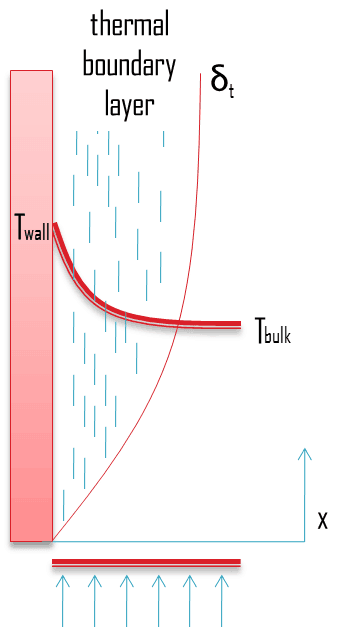
What is Convective Heat Transfer Coefficient – Definition

The convective heat transfer coefficient, h, can be defined as: The rate of heat transfer between a solid surface and a fluid per unit surface area per unit temperature difference. Thermal Engineering

Newton’s Law of Cooling

Despite the complexity of convection, the rate of convection heat transfer is observed to be proportional to the temperature difference and is conveniently expressed by Newton’s law of cooling, which states that:

The rate of heat loss of a body is directly proportional to the difference in the temperatures between the body and its surroundings provided the temperature difference is small and the nature of radiating surface remains same.

newton's law of cooling - convection equation

Note that, ΔT is given by the surface or wall temperature, Twall and the bulk temperature, T∞, which is the temperature of the fluid sufficiently far from the surface.

Convective Heat Transfer Coefficient

As can be seen, the constant of proportionality will be crucial in calculations and it is known as the convective heat transfer coefficient, h. The convective heat transfer coefficient, h, can be defined as:

The rate of heat transfer between a solid surface and a fluid per unit surface area per unit temperature difference.

convective heat transfer coefficient - equation

convective heat transfer coefficient - examplesThe convective heat transfer coefficient is dependent upon the physical properties of the fluid and the physical situation. The convective heat transfer coefficient is not a property of the fluid. It is an experimentally determined parameter whose value depends on all the variables influencing convection such as the surface geometry, the nature of fluid motion, the properties of the fluid, and the bulk fluid velocity.

Typically, the convective heat transfer coefficient for laminar flow is relatively low compared to the convective heat transfer coefficient for turbulent flow. This is due to turbulent flow having a thinner stagnant fluid film layer on the heat transfer surface.

It must be noted, this stagnant fluid film layer plays crucial role for the convective heat transfer coefficient. It is observed, that the fluid comes to a complete stop at the surface and assumes a zero velocity relative to the surface. This phenomenon is known as the no-slip condition and therefore, at the surface, energy flow occurs purely by conduction. But in the next layers both conduction and diffusion-mass movement in the molecular level or macroscopic level occurs. Due to the mass movement the rate of energy transfer is higher. As was written, nucleate boiling at the surface effectively disrupts this stagnant layer and therefore nucleate boiling significantly increases the ability of a surface to transfer thermal energy to bulk fluid.

A similar phenomenon occurs for the temperature. It is observed, that the fluid’s temperature at the surface and the surface will have the same temperature at the point of contact. This phenomenon is known as the no-temperature-jump condition and it is very important for theory of nucleate boiling.

Values of the heat transfer coefficient, h, have been measured and tabulated for the commonly encountered fluids and flow situations occurring during heat transfer by convection.

 
Thermal Resistance - Analogy to Electric Resistance
See also: Thermal Resistance

Thermal resistance is a heat property and a measurement of a temperature difference by which an object or material resists a heat flow. The thermal resistance for conduction in a plane wall is defined as:

thermal resistance - definition

The equation above can be derived also for convective heat trasfer. For heat flow is analogous to the relation for electric current flow I, expressed as:

analogy to electric resistance

where Re = L/σeA is the electric resistance and V1 – V2 is the voltage difference across the resistance (σe is the electrical conductivity). The analogy between both equations is obvious. The rate of heat transfer through a layer corresponds to the electric current, the thermal resistance corresponds to electrical resistance, and the temperature difference corresponds to voltage difference across the layer. The temperature difference is the potential or driving function for the heat flow, resulting in the Fourier equation being written in a form similar to Ohm’s Law of Electrical Circuit Theory.

thermal resistance - composite wallsCircuit representations provide a useful tool for both conceptualizing and quantifying heat transfer problems. This analogy can be used also for the thermal resistance of the surface against heat convection. Note that when the convection heat transfer coefficient is very large (h → infinity), the convection resistance becomes zero and the surface temperature approaches the bulk temperature. This situation is approached in practice at surfaces where intensive boiling and condensation occur.

The heat transfer through the composite wall can be calculated from these resistances. The rate of steady heat transfer between two surfaces is equal to the temperature difference divided by the total thermal resistance between those two surfaces.

thermal resistance - equation

The equivalent thermal circuit for the plane wall with convection surface conditions is shown in the figure.

See also: Wiedemann–Franz Law

U-factor - Overall Heat Transfer Coefficient
Many of the heat transfer processes encountered in industry involve composite systems and even involve a combination of both conduction and convection. With these composite systems, it is often convenient to work with an overall heat transfer coefficient, known as a U-factor. The U-factor is defined by an expression analogous to Newton’s law of cooling:

u-factor - overall heat transfer coefficient

The overall heat transfer coefficient is related to the total thermal resistance and depends on the geometry of the problem. For example, heat transfer in a steam generator involves convection from the bulk of the reactor coolant to the steam generator inner tube surface, conduction through the tube wall, and convection (boiling) from the outer tube surface to the secondary side fluid.

In cases of combined heat transfer for a heat exchanger, there are two values for h. There is the convective heat transfer coefficient (h) for the fluid film inside the tubes and a convective heat transfer coefficient for the fluid film outside the tubes. The thermal conductivity (k) and thickness (Δx) of the tube wall must also be accounted for.

Overall Heat Transfer Coefficient – Plane Wall

U-factor - Overall Heat Transfer Coefficient

Overall Heat Transfer Coefficient – Cylindrical Tubes

Steady heat transfer through multilayered cylindrical or spherical shells can be handled just like multilayered plane walls.

Overall Heat Transfer Coefficient - Cylindrical Tubes

Example: Convective Heat Transfer Coefficient

Convection - Convective Heat TransferFrom: Example – Convective Heat Transfer

Detailed knowledge of geometry, fluid parameters, outer radius of cladding, linear heat rate, convective heat transfer coefficient allows us to calculate the temperature difference ∆T between the coolant (Tbulk) and the cladding surface (TZr,1).

To calculate the the cladding surface temperature, we have to know:

  • the outer diameter of the cladding is: d = 2 x rZr,1 = 9,3 mm
  • the Nusselt number, which is NuDh = 890
  • the hydraulic diameter of the fuel channel is: Dh = 13,85 mm
  • the thermal conductivity of reactor coolant (300°C) is: kH2O = 0.545 W/m.K
  • the bulk temperature of reactor coolant at this axial coordinate is: Tbulk = 296°C
  • the linear heat rate of the fuel is: qL = 300 W/cm (FQ ≈ 2.0)

The convective heat transfer coefficient, h, is given directly by the definition of Nusselt number:

convective heat transfer coefficient - example

Finally, we can calculate the cladding surface temperature (TZr,1) simply using the Newton’s Law of Cooling:

Newton law of cooling - example

For PWRs at normal operation, there is a compressed liquid water inside the reactor core, loops and steam generators.  The pressure is maintained at approximately 16MPa. At this pressure water boils at approximately 350°C(662°F). As can be seen, the surface temperature TZr,1 = 325°C ensures, that even subcooled boiling does not occur. Note that, subcooled boiling requires TZr,1 = Tsat. Since the inlet temperatures of the water are usually about 290°C (554°F), it is obvious this example corresponds to the lower part of the core. At higher elevations of the core the bulk temperature may reach up to 330°C. The temperature difference of 29°C causes the subcooled boiling may occur (330°C + 29°C > 350°C). On the other hand, nucleate boiling at the surface effectively disrupts the stagnant layer and therefore nucleate boiling significantly increases the ability of a surface to transfer thermal energy to bulk fluid. As a result, the convective heat transfer coefficient significantly increases and therefore at higher elevations, the temperature difference (TZr,1 – Tbulk) significantly decreases.

 
References:
Heat Transfer:
  1. Fundamentals of Heat and Mass Transfer, 7th Edition. Theodore L. Bergman, Adrienne S. Lavine, Frank P. Incropera. John Wiley & Sons, Incorporated, 2011. ISBN: 9781118137253.
  2. Heat and Mass Transfer. Yunus A. Cengel. McGraw-Hill Education, 2011. ISBN: 9780071077866.
  3. Fundamentals of Heat and Mass Transfer. C. P. Kothandaraman. New Age International, 2006, ISBN: 9788122417722.
  4. U.S. Department of Energy, Thermodynamics, Heat Transfer and Fluid Flow. DOE Fundamentals Handbook, Volume 2 of 3. May 2016.

Nuclear and Reactor Physics:

  1. J. R. Lamarsh, Introduction to Nuclear Reactor Theory, 2nd ed., Addison-Wesley, Reading, MA (1983).
  2. J. R. Lamarsh, A. J. Baratta, Introduction to Nuclear Engineering, 3d ed., Prentice-Hall, 2001, ISBN: 0-201-82498-1.
  3. W. M. Stacey, Nuclear Reactor Physics, John Wiley & Sons, 2001, ISBN: 0- 471-39127-1.
  4. Glasstone, Sesonske. Nuclear Reactor Engineering: Reactor Systems Engineering, Springer; 4th edition, 1994, ISBN: 978-0412985317
  5. W.S.C. Williams. Nuclear and Particle Physics. Clarendon Press; 1 edition, 1991, ISBN: 978-0198520467
  6. G.R.Keepin. Physics of Nuclear Kinetics. Addison-Wesley Pub. Co; 1st edition, 1965
  7. Robert Reed Burn, Introduction to Nuclear Reactor Operation, 1988.
  8. U.S. Department of Energy, Nuclear Physics and Reactor Theory. DOE Fundamentals Handbook, Volume 1 and 2. January 1993.
  9. Paul Reuss, Neutron Physics. EDP Sciences, 2008. ISBN: 978-2759800414.

Advanced Reactor Physics:

  1. K. O. Ott, W. A. Bezella, Introductory Nuclear Reactor Statics, American Nuclear Society, Revised edition (1989), 1989, ISBN: 0-894-48033-2.
  2. K. O. Ott, R. J. Neuhold, Introductory Nuclear Reactor Dynamics, American Nuclear Society, 1985, ISBN: 0-894-48029-4.
  3. D. L. Hetrick, Dynamics of Nuclear Reactors, American Nuclear Society, 1993, ISBN: 0-894-48453-2.
  4. E. E. Lewis, W. F. Miller, Computational Methods of Neutron Transport, American Nuclear Society, 1993, ISBN: 0-894-48452-4.

See also:

Convection

We hope, this article, Convective Heat Transfer Coefficient, helps you. If so, give us a like in the sidebar. Main purpose of this website is to help the public to learn some interesting and important information about thermal engineering.