Facebook Instagram Youtube Twitter

What is Natural Convection – Free Convection – Definition

Natural convection, known also as free convection is a mechanism, or type of mass and heat transport, in which the fluid motion is generated only by density differences in the fluid. Thermal Engineering

Natural Convection – Free Convection

Natural Convection - boundary layerIn general, convection is either the mass transfer or the heat transfer due to bulk movement of molecules within fluids such as gases and liquids. Although liquids and gases are generally not very good conductors of heat, they can transfer heat quite rapidly by convection. Convection takes place through advection, diffusion or both. In preceding chapters we considered convection transfer in fluid flows that originate from an external forcing condition – forced convection. In this chapter, we consider natural convection, where any fluid motion occurs by natural means such as buoyancy.

Definition of Natural Convection

Natural convection, known also as free convection is a mechanism, or type of mass and heat transport, in which the fluid motion is generated only by density differences in the fluid occurring due to temperature gradients, not by any external source (like a pump, fan, suction device, etc.).

In natural convection, fluid surrounding a heat source receives heat and by thermal expansion becomes less dense and rises. Thermal expansion of the fluid plays a crucial role. In other words, heavier (more dense) components will fall, while lighter (less dense) components rise, leading to bulk fluid movement. Natural convection can only occur in a gravitational field or in the presence of another proper acceleration, such as:

  • acceleration
  • centrifugal force
  • Coriolis force

Natural convection essentially does not operate in the orbit of Earth. For example, in the orbiting International Space Station, other heat transfer mechanisms are required to prevent electronic components from overheating.

 
Convection Currents
The motion that results from the continual replacement of the heated fluid in the vicinity of the heat source by the cooler fluid nearby is called a natural convection current, and the mass and heat transfer that is enhanced as a result of this natural convection current is called natural convection mass and heat transfer.

Convection currents are generated by density differences in the fluid occurring due to temperature gradients. Convection currents are associated with natural convection, in which any fluid motion occurs by natural means such as buoyancy. In natural convection, matter and heat are moved from one location to another. Convection currents has attracted a great deal of attention from researchers because of its presence both in nature and engineering applications.

In nature, convection currents formed from air raising above sunlight-warmed land or water are a major feature of all weather systems. Convection currents also seen in the rising plume of hot air from fire, plate tectonics and oceanic circulation.


Creation of Convection Currents
Creation of convection currents is based on three physical assumptions:
  • Presence of heat source. Heat source is required, because convection currents are generated by density differences in the fluid occurring due to temperature gradients. In natural convection, fluid surrounding a heat source receives heat and by thermal expansion becomes less dense and rises. Thermal expansion of the fluid plays a crucial role. In other words, heavier (more dense) components will fall, while lighter (less dense) components rise, leading to bulk fluid movement.
  • Presence of proper acceleration. Natural convection can only occur in a gravitational field or in the presence of another proper acceleration, such as acceleration, centrifugal force and Coriolis force. Natural convection essentially does not operate in the orbit of Earth. For example, in the orbiting International Space Station, other heat transfer mechanisms are required to prevent electronic components from overheating.
  • Proper geometry. The presence and magnitude of natural convection also depend on the geometry of the problem. The presence of a fluid density gradient in a gravitational field does not ensure the existence of natural convection currents. This problem is illustrated in the following figure, where a fluid is enclosed by two large, horizontal plates of different temperature (Tupper ≠ Tlower).
    • In case A the temperature of the lower plate is higher than the temperature of the upper plate. In this case, the density decreases in the direction of the gravitational force. This geometry induces fluid circulation and heat transfer occurs via natural circulation. The heavier fluid will descend, being warmed in the process, while the lighter fluid will rise, cooling as it moves.
    • In case B the temperature of the lower plate is lower than the temperature of the upper plate. In this case, the density increases in the direction of the gravitational force. This geometry leads to stable conditions, stable temperature gradient and does not induce fluid circulation. Heat transfer occurs solely via thermal conduction.
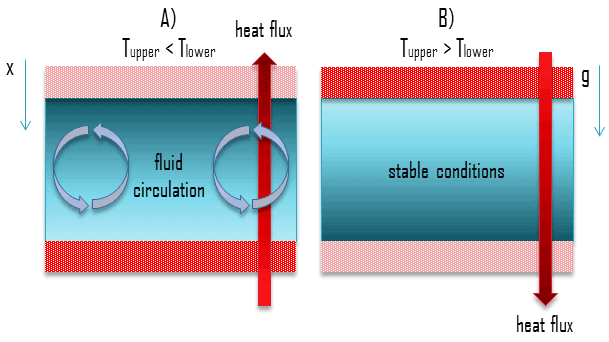
natural circulation - geometry

Natural Convection – Heat Transfer

Similarly as for forced convection, also natural convection heat transfer take place both by thermal diffusion (the random motion of fluid molecules) and by advection, in which matter or heat is transported by the larger-scale motion of currents in the fluid.  At the surface, energy flow occurs purely by conduction, even in convection. It is due to the fact, there is always a thin stagnant fluid film layer on the heat transfer surface. But in the next layers both conduction and diffusion-mass movement in the molecular level or macroscopic level occurs. Due to the mass movement the rate of energy transfer is higher. Higher the rate of mass movement, thinner the stagnant fluid film layer will be and higher will be the heat flow rate.

 
Thermal Expansion
In general, density can be changed by changing either the pressure or the temperature. Increasing the pressure always increases the density of a material. The effect of pressure on the densities of liquids and solids is very very small. On the other hand, the density of gases is strongly affected by pressure. This is expressed by compressibility. Compressibility is a measure of the relative volume change of a fluid or solid as a response to a pressure change.

The effect of temperature on the densities of liquids and solids is also very important. Most substances expand when heated and contract when cooled. However, the amount of expansion or contraction varies, depending on the material. This phenomenon is known as thermal expansion. The change in volume of a material which undergoes a temperature change is given by following relation:

thermal-expansion

where ∆T is the change in temperature, V is the original volume, ∆V is the change in volume, and αV is the coefficient of volume expansion.

It must be noted, there are exceptions from this rule. For example, water differs from most liquids in that it becomes less dense as it freezes. It has a maximum of density at 3.98 °C (1000 kg/m3), whereas the density of ice is 917 kg/m3. It differs by about 9% and therefore ice floats on liquid water

Density of water as a function of temperature
Chart - density - water - temperature

Density of water as a function of temperature

Natural Convection - boundary layerWe know that the density of gases and liquids depends on temperature, generally decreasing (due to fluid expansion) with increasing temperature.

The magnitude of the natural convection heat transfer between a surface and a fluid is directly related to the flow rate of the fluid induced by natural convection. The higher the flow rate, the higher the heat transfer rate. The flow rate in case of natural convection is established by the dynamic balance of buoyancy and friction.

Assume a plate at the temperature Twall, which is immersed in a quiescent fluid at the temperature Tbulk, where (Twall > Tbulk). The fluid close to the plate is less dense than fluid that is further removed. Buoyancy forces therefore induce a natural convection boundary layer in which the heated and lighter fluid rises vertically, entraining heavier fluid from the quiescent region. The resulting velocity distribution is unlike that associated with forced convection boundary layers and depends also on the fluid viscosity. In particular, the velocity is zero at the surface as well as at the boundary due to viscous forces. It must be noted, a natural convection also develops if (Twall < Tbulk), but, in this case, fluid motion will be downward.

The presence and magnitude of natural convection also depend on the geometry of the problem. The presence of a fluid density gradient in a gravitational field does not ensure the existence of natural convection currents. This problem is illustrated in the following figure, where a fluid is enclosed by two large, horizontal plates of different temperature (Tupper ≠ Tlower).

  1. In case A the temperature of the lower plate is higher than the temperature of the upper plate. In this case, the density decreases in the direction of the gravitational force. This geometry induces fluid circulation and heat transfer occurs via natural circulation. The heavier fluid will descend, being warmed in the process, while the lighter fluid will rise, cooling as it moves.
  2. In case B the temperature of the lower plate is lower than the temperature of the upper plate. In this case, the density increases in the direction of the gravitational force. This geometry leads to stable conditions, stable temperature gradient and does not induce fluid circulation. Heat transfer occurs solely via thermal conduction.

natural circulation - geometry

Since the natural convection is strongly dependent on the geometry, most heat transfer correlations in natural convection are based on experimental measurements and engineers often use proper characteristic numbers to describe natural convection heat transfer.
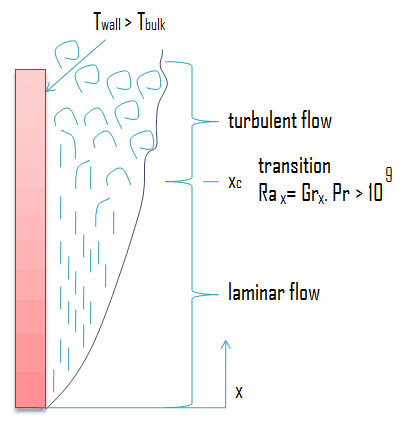
 
Natural Convection - Laminar and Turbulent
Rayleigh Number and Grashof NumberIt is important to note that natural convection boundary layers are not restricted to laminar flow. As with forced convection, hydrodynamic instabilities may arise. That is, disturbances in the flow may be amplified, leading to transition from laminar to turbulent flow. For a vertical flat plate, the flow turns turbulent for value of:

Rax = Grx . Pr > 109

As in forced convection the microscopic nature of flow and convection correlations are distinctly different in the laminar and turbulent regions.

Natural Convection – Correlations

As was written, most heat transfer correlations in natural convection are based on experimental measurements and engineers often use proper characteristic numbers to describe natural convection heat transfer. The characteristic number that describes convective heat transfer (i.e. the heat transfer coefficient) is the Nusselt number, which is defined as the ratio of the thermal energy convected to the fluid to the thermal energy conducted within the fluid. The Nusselt number represents the enhancement of heat transfer through a fluid layer as a result of convection relative to conduction across the same fluid layer. But in case of free convection, heat transfer correlations (for the Nusselt number) are usually expressed in terms of the Rayleigh number.

The Rayleigh number is used to express heat transfer in natural convection. The magnitude of the Rayleigh number is a good indication as to whether the natural convection boundary layer is laminar or turbulent. The simple empirical correlations for the average Nusselt number, Nu, in natural convection are of the form:

Nux = C. Raxn

The values of the constants C and n depend on the geometry of the surface and the flow regime, which is characterized by the range of the Rayleigh number. The value of n is usually n = 1/4 for laminar flow and n = 1/3 for turbulent flow.

For example:

natural convection - heat transfer correlations

See also: Nusselt Number
See also: Rayleigh Number

Example: Natural Convection – Flat Plate

A 10cm high vertical plate is maintained at 261°C in 260°C compressed water (16MPa). Determine the Nusselt number using the simple correlation for a vertical flat plate.

example - free convection - equation

To calculate the Rayleigh number, we have to know:

  • the coefficient of thermal expansion, which is: β = 0.0022
  • the Prandtl number (for 260°C), which is: Pr = 0.87
  • the kinematic viscosity (for 260°C), which is ν = 0.13 x 10⁻⁶ (note that, this value is significantly lower than that for 20°C)

The resulting Rayleigh number is:

example - natural convection - flow regime

The resulting Nusselt number, which represents the enhancement of heat transfer through a fluid layer as a result of convection relative to conduction across the same fluid layer is:

example - natural convection - solution

Combined Forced and Natural Convection

natural convection vs forced convectionAs was written, convection takes place through advection, diffusion or both. In preceding chapters we considered convection transfer in fluid flows that originate from an external forcing condition – forced convection. In this chapter, we consider natural convection, where any fluid motion occurs by natural means such as buoyancy. In fact, there are flow regimes, in which we have to consider both forcing mechanisms. When flow velocities are low, natural convection will also contribute in addition to forced convection. Whether or not free convection is significant for heat transfer, it can be checked using the following criteria:

  • If Gr/Re2 >> 1 free convection prevails
  • If Gr/Re2 << 1 forced convection prevails
  • If Gr/Re2 ≈ 1 both should be considered

The effect of buoyancy on heat transfer in a forced flow is strongly influenced by the direction of the buoyancy force relative to that of the flow. Natural convection may help or hurt forced convection heat transfer, depending on the relative directions of buoyancy-induced and the forced convection motions. Three special cases that have been studied extensively correspond to buoyancy-induced and forced motions:

  • Assisting flow. The buoyant motion is in the same direction as the forced motion.
  • Opposing flow. The buoyant motion is in the opposite direction to the forced motion.
  • Transverse flow. The buoyant motion is perpendicular to the forced motion.

It is obvious, in assisting and transverse flows, buoyancy enhances the rate of heat transfer associated with pure forced convection. On the other hand, in opposing flows, it decreases the rate of heat transfer. When determining the Nusselt number under combined natural and forced convection conditions, it is tempting to add the contributions of natural and forced convection in assisting flows and to subtract them in opposing flows:

combined forced and natural convection - correlation

For the specific geometry of interest, the Nusselt numbers Nuforced and Nunatural are determined from existing correlations for pure forced and natural (free) convection, respectively. The best correlation of data to experiments is often obtained for exponent n = 3, but it may vary between 3 and 4, depending on the geometry of the problem.

Natural Circulation

Natural Circulation - schema
Natural circulation in a closed loop

Natural circulation is the circulation of fluid within piping systems or open pools that is due to the density changes caused by temperature differences. Natural circulation does not require any mechanical devices to maintain flow.

This phenomenon have similar nature as natural convection, but in this case the heat transfer coefficient is not an object of study. In this case, the bulk flow through the loop is the object of study. This phenomenon is rather a hydraulic problem than a heat transfer problem, although in result natural circulation removes heat from source and transports it to the heat sink and is of the highest importance in reactor safety.

See also: Natural Circulation

 
References:
Heat Transfer:
  1. Fundamentals of Heat and Mass Transfer, 7th Edition. Theodore L. Bergman, Adrienne S. Lavine, Frank P. Incropera. John Wiley & Sons, Incorporated, 2011. ISBN: 9781118137253.
  2. Heat and Mass Transfer. Yunus A. Cengel. McGraw-Hill Education, 2011. ISBN: 9780071077866.
  3. U.S. Department of Energy, Thermodynamics, Heat Transfer and Fluid Flow. DOE Fundamentals Handbook, Volume 2 of 3. May 2016.

Nuclear and Reactor Physics:

  1. J. R. Lamarsh, Introduction to Nuclear Reactor Theory, 2nd ed., Addison-Wesley, Reading, MA (1983).
  2. J. R. Lamarsh, A. J. Baratta, Introduction to Nuclear Engineering, 3d ed., Prentice-Hall, 2001, ISBN: 0-201-82498-1.
  3. W. M. Stacey, Nuclear Reactor Physics, John Wiley & Sons, 2001, ISBN: 0- 471-39127-1.
  4. Glasstone, Sesonske. Nuclear Reactor Engineering: Reactor Systems Engineering, Springer; 4th edition, 1994, ISBN: 978-0412985317
  5. W.S.C. Williams. Nuclear and Particle Physics. Clarendon Press; 1 edition, 1991, ISBN: 978-0198520467
  6. G.R.Keepin. Physics of Nuclear Kinetics. Addison-Wesley Pub. Co; 1st edition, 1965
  7. Robert Reed Burn, Introduction to Nuclear Reactor Operation, 1988.
  8. U.S. Department of Energy, Nuclear Physics and Reactor Theory. DOE Fundamentals Handbook, Volume 1 and 2. January 1993.
  9. Paul Reuss, Neutron Physics. EDP Sciences, 2008. ISBN: 978-2759800414.

Advanced Reactor Physics:

  1. K. O. Ott, W. A. Bezella, Introductory Nuclear Reactor Statics, American Nuclear Society, Revised edition (1989), 1989, ISBN: 0-894-48033-2.
  2. K. O. Ott, R. J. Neuhold, Introductory Nuclear Reactor Dynamics, American Nuclear Society, 1985, ISBN: 0-894-48029-4.
  3. D. L. Hetrick, Dynamics of Nuclear Reactors, American Nuclear Society, 1993, ISBN: 0-894-48453-2.
  4. E. E. Lewis, W. F. Miller, Computational Methods of Neutron Transport, American Nuclear Society, 1993, ISBN: 0-894-48452-4.

See also:

Convection

We hope, this article, Natural Convection – Free Convection, helps you. If so, give us a like in the sidebar. Main purpose of this website is to help the public to learn some interesting and important information about thermal engineering.

What is Natural Circulation – Definition

Natural circulation is the circulation of fluid within piping systems or open pools that is due to the density changes caused by temperature differences. Thermal Engineering

Natural Circulation

Natural Circulation - schema
Natural circulation in a closed loop

Natural circulation is the circulation of fluid within piping systems or open pools that is due to the density changes caused by temperature differences. Natural circulation does not require any mechanical devices to maintain flow.

This phenomenon have similar nature as natural convection, but in this case the heat transfer coefficient is not an object of study. In this case, the bulk flow through the loop is the object of study. This phenomenon is rather a hydraulic problem than a heat transfer problem, although in result natural circulation removes heat from source and transports it to the heat sink and is of the highest importance in reactor safety.

 
What is Natural Convection
Natural convection, known also as free convection is a mechanism, or type of mass and heat transport, in which the fluid motion is generated only by density differences in the fluid occurring due to temperature gradients, not by any external source (like a pump, fan, suction device, etc.).

In natural convection, fluid surrounding a heat source receives heat and by thermal expansion becomes less dense and rises. Thermal expansion of the fluid plays a crucial role. In other words, heavier (more dense) components will fall, while lighter (less dense) components rise, leading to bulk fluid movement. Natural convection can only occur in a gravitational field or in the presence of another proper acceleration, such as:

  • acceleration
  • centrifugal force
  • Coriolis force

Natural convection essentially does not operate in the orbit of Earth. For example, in the orbiting International Space Station, other heat transfer mechanisms are required to prevent electronic components from overheating.

Conditions Required for Natural Circulation

Similarly as for natural convection, natural circulation essentially does not operate in the orbit of Earth. Natural circulation occurs in a loop only under specific conditions. Even after natural circulation has begun, removal of any one of these conditions will cause the natural circulation to stop. The conditions for natural circulation are as follows:

  • Presence of proper acceleration. Natural circulation can only occur in a gravitational field or in the presence of another proper acceleration, such as acceleration, centrifugal force.
  • Presence of heat source and heat sink. Heat source and heat sink are required, because natural circulation is generated by density difference in the fluid occurring due to temperature difference. Fluid entering a heat source receives heat and by thermal expansion becomes less dense and rises. Thermal expansion of the fluid plays a crucial role. Process in a heat sing is opposite, the heat sing receives heat and the fluid becomes denser. The density difference is the driving force for natural circulation flow. The difference in temperature must be maintained for the natural circulation to continue. Addition of heat by a heat source must exist at the high temperature area. Continuous removal of heat by a heat sink must exist at the low temperature area. Otherwise the temperatures would eventually equalize, and no further circulation would occur.
  • Proper geometry. The presence and magnitude of natural circulation also depend on the geometry of the problem. The presence of a fluid density gradient in a gravitational field does not ensure the existence of natural convection currents. Natural circulation in a fluid filled closed loop is established by locating a heat sink in the loop at an elevation that is higher than the heat source. The circulating fluid removes heat from source and transports it to the sink. The flow can be single phase or two phase wherein vapor flows alongside the liquid. The difference in temperature must be maintained for the natural circulation to continue. Addition of heat by a heat source must exist at the high temperature area. Continuous removal of heat by a heat sink must exist at the low temperature area. Otherwise the temperatures would eventually equalize, and no further circulation would occur. It is possible to have natural circulation take place in two-phase flow, but it is usually more difficult to maintain flow.
  • Fluids in contact. The two areas must be in contact so that flow between the areas is possible. If the flow path is obstructed or blocked, then natural circulation cannot occur.

Natural Circulation – Flow Rate

Natural circulation flow rate in the loop, under steady state condition is determined from the balance between the driving and the resisting forces. Driving force results from density difference between hot leg and cold leg of the loop. The head required to compensate for the head losses is created by density gradients and elevation changes.

Thermal Driving Head

Thermal driving head is the force that causes natural circulation to take place. It is caused by the difference in density between two bodies or areas of fluid. Consider two equal volumes of the same type of fluid. If the two volumes are not at the same temperature, then the volume with the higher temperature will also have a lower density and, therefore, less mass. It is known that the density of gases and liquids depends on temperature, generally decreasing (due to fluid expansion) with increasing temperature. Since the volume at the higher temperature will have a lower mass, it will also have less force exerted on it by gravity. This difference in the force of gravity exerted on the fluid will tend to cause the hotter fluid to rise and the colder fluid to sink. Thermal driving head can be simply calculated using the difference in hydrostatic pressures:

thermal driving head - equation

As can be seen, the greater the temperature difference between the hot and cold areas of fluid, the greater the thermal driving head and the resulting flow rate.

 
Density of water as a function of temperature
Chart - density - water - temperature

Density of water as a function of temperature

Hydraulic Resisting Force

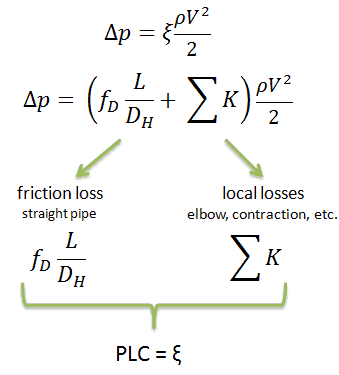
PLC - Pressure loss coefficient - equationsAs was written, natural circulation flow rate, V, in the loop, under steady state condition is determined from the balance between the driving head and the resisting forces. Like pipe friction, the overall pressure losses are proportional to the square of the flow rate and therefore they can be easily integrated into the Darcy-Weisbach equation. Engineers often use the pressure loss coefficient, PLC. It is noted K or ξ (pronounced “xi”). This coefficient characterizes pressure loss of a certain hydraulic system or of a part of a hydraulic system. It can be easily measured in hydraulic loops. The pressure loss coefficient can be defined or measured for both straight pipes and especially for local (minor) losses. Since the Darcy friction factor is a function of velocity (in Reynolds number), then the calculation of the pressure loss coefficient is an iterative process.

Natural Circulation in Reactor Engineering

Natural Circulation - schema
Natural circulation in a closed loop

In reactor engineering, natural circulation is very desired phenomenon, since it is capable to provide reactor core cooling after the loss of RCPs (e.g. after loss of offsite power – LOOP). In PWRs, plant design provides an elevation difference, h, of approximately 12 meters between the centerline of the steam generator and the centerline of the reactor core. The layout of the system must ensure natural circulation capability following a loss of flow to permit cooldown without overheating the core. Moreover, the interconnecting piping from the reactor pressure vessel to the steam generators must be intact, free from obstructions such as non-condensable gasses (e.g. steam pockets). In this way, natural circulation will ensure that the fluid will continue to flow as long as the reactor is hotter than the heat sink, even when power cannot be supplied to the pumps.

RCPs are not usually “safety system”, as defined. After the loss of RCPs (e.g. after loss of offsite power – LOOP) the reactor must be shutdown immediately, since RCPs slowly coast down to zero flow rate. Sufficient and safe residual heat removal is then ensured by a natural circulation flow through the reactor. With no forced flow, the coolant in the core begins to heat up. The increase in coolant temperature causes a reduction in coolant density, which in turn moves the coolant into the steam generator. It must be noted, natural circulation is not sufficient to remove the heat being generated when the reactor is at power.

Modern reactor designs use natural circulation a very important safety feature. Many passive safety systems in modern reactor designs operate without using any pumps, which creates increased design safety, integrity, and reliability, while simultaneously reducing overall reactor cost.

Indicators of Natural Circulation

In PWRs, various parameters can be used to indicate or verify natural circulation is occurring. This is dependent on plant type and plant systems. For instance for a PWR selected parameters that can be used are as follows:

  • Ideally, the flow rate can be measured in each of loops.
  • ΔT (THot – TCold). The temperature difference between hot legs and cold legs should be 25-80% of the full power value and either steady or slowly decreasing. This indicates that the decay heat is being removed from the system at an adequate rate to maintain or reduce core temperatures.
  • Hot and cold leg temperatures should be steady or slowly decreasing. Again, this indicates that heat is being removed and the decay heat load is decreasing as expected.
  • Steam generator steam pressure (secondary side pressure) should be following reactor coolant system temperature. This verifies that the steam generator is removing heat from the RCS coolant.

Special Reference: Natural circulation in water cooled nuclear power plants, IAEA-TECDOC-1474. IAEA, 2005. ISBN 92–0–110605–X.

 
References:
Heat Transfer:
  1. Fundamentals of Heat and Mass Transfer, 7th Edition. Theodore L. Bergman, Adrienne S. Lavine, Frank P. Incropera. John Wiley & Sons, Incorporated, 2011. ISBN: 9781118137253.
  2. Heat and Mass Transfer. Yunus A. Cengel. McGraw-Hill Education, 2011. ISBN: 9780071077866.
  3. U.S. Department of Energy, Thermodynamics, Heat Transfer and Fluid Flow. DOE Fundamentals Handbook, Volume 2 of 3. May 2016.

Nuclear and Reactor Physics:

  1. J. R. Lamarsh, Introduction to Nuclear Reactor Theory, 2nd ed., Addison-Wesley, Reading, MA (1983).
  2. J. R. Lamarsh, A. J. Baratta, Introduction to Nuclear Engineering, 3d ed., Prentice-Hall, 2001, ISBN: 0-201-82498-1.
  3. W. M. Stacey, Nuclear Reactor Physics, John Wiley & Sons, 2001, ISBN: 0- 471-39127-1.
  4. Glasstone, Sesonske. Nuclear Reactor Engineering: Reactor Systems Engineering, Springer; 4th edition, 1994, ISBN: 978-0412985317
  5. W.S.C. Williams. Nuclear and Particle Physics. Clarendon Press; 1 edition, 1991, ISBN: 978-0198520467
  6. G.R.Keepin. Physics of Nuclear Kinetics. Addison-Wesley Pub. Co; 1st edition, 1965
  7. Robert Reed Burn, Introduction to Nuclear Reactor Operation, 1988.
  8. U.S. Department of Energy, Nuclear Physics and Reactor Theory. DOE Fundamentals Handbook, Volume 1 and 2. January 1993.
  9. Paul Reuss, Neutron Physics. EDP Sciences, 2008. ISBN: 978-2759800414.

Advanced Reactor Physics:

  1. K. O. Ott, W. A. Bezella, Introductory Nuclear Reactor Statics, American Nuclear Society, Revised edition (1989), 1989, ISBN: 0-894-48033-2.
  2. K. O. Ott, R. J. Neuhold, Introductory Nuclear Reactor Dynamics, American Nuclear Society, 1985, ISBN: 0-894-48029-4.
  3. D. L. Hetrick, Dynamics of Nuclear Reactors, American Nuclear Society, 1993, ISBN: 0-894-48453-2.
  4. E. E. Lewis, W. F. Miller, Computational Methods of Neutron Transport, American Nuclear Society, 1993, ISBN: 0-894-48452-4.

See also:

Natural Convection

We hope, this article, Natural Circulation, helps you. If so, give us a like in the sidebar. Main purpose of this website is to help the public to learn some interesting and important information about thermal engineering.
What is Natural Convection – Definition

In natural convection, fluid surrounding a heat source receives heat and by thermal expansion becomes less dense and rises. Definition of Natural Convection

Natural Convection – Free Convection

Natural Convection - boundary layer

Definition of Natural Convection

Natural convection, known also as free convection is a mechanism, or type of mass and heat transport, in which the fluid motion is generated only by density differences in the fluid occurring due to temperature gradients, not by any external source (like a pump, fan, suction device, etc.).

In natural convection, fluid surrounding a heat source receives heat and by thermal expansion becomes less dense and rises. Thermal expansion of the fluid plays a crucial role. In other words, heavier (more dense) components will fall, while lighter (less dense) components rise, leading to bulk fluid movement. Natural convection can only occur in a gravitational field or in the presence of another proper acceleration, such as:

  • acceleration
  • centrifugal force
  • Coriolis force

Natural convection essentially does not operate in the orbit of Earth. For example, in the orbiting International Space Station, other heat transfer mechanisms are required to prevent electronic components from overheating.

 
Convection Currents
The motion that results from the continual replacement of the heated fluid in the vicinity of the heat source by the cooler fluid nearby is called a natural convection current, and the mass and heat transfer that is enhanced as a result of this natural convection current is called natural convection mass and heat transfer.

Convection currents are generated by density differences in the fluid occurring due to temperature gradients. Convection currents are associated with natural convection, in which any fluid motion occurs by natural means such as buoyancy. In natural convection, matter and heat are moved from one location to another. Convection currents has attracted a great deal of attention from researchers because of its presence both in nature and engineering applications.

In nature, convection currents formed from air raising above sunlight-warmed land or water are a major feature of all weather systems. Convection currents also seen in the rising plume of hot air from fire, plate tectonics and oceanic circulation.

&nbsp;

Creation of Convection Currents

Creation of convection currents is based on three physical assumptions:

  • Presence of heat source. Heat source is required, because convection currents are generated by density differences in the fluid occurring due to temperature gradients. In natural convection, fluid surrounding a heat source receives heat and by thermal expansion becomes less dense and rises. Thermal expansion of the fluid plays a crucial role. In other words, heavier (more dense) components will fall, while lighter (less dense) components rise, leading to bulk fluid movement.
  • Presence of proper acceleration. Natural convection can only occur in a gravitational field or in the presence of another proper acceleration, such as acceleration, centrifugal force and Coriolis force. Natural convection essentially does not operate in the orbit of Earth. For example, in the orbiting International Space Station, other heat transfer mechanisms are required to prevent electronic components from overheating.
  • Proper geometry. The presence and magnitude of natural convection also depend on the geometry of the problem. The presence of a fluid density gradient in a gravitational field does not ensure the existence of natural convection currents. This problem is illustrated in the following figure, where a fluid is enclosed by two large, horizontal plates of different temperature (Tupper ≠ Tlower).
    • In case A the temperature of the lower plate is higher than the temperature of the upper plate. In this case, the density decreases in the direction of the gravitational force. This geometry induces fluid circulation and heat transfer occurs via natural circulation. The heavier fluid will descend, being warmed in the process, while the lighter fluid will rise, cooling as it moves.
    • In case B the temperature of the lower plate is lower than the temperature of the upper plate. In this case, the density increases in the direction of the gravitational force. This geometry leads to stable conditions, stable temperature gradient and does not induce fluid circulation. Heat transfer occurs solely via thermal conduction.

natural circulation - geometry

 
References:
Heat Transfer:
  1. Fundamentals of Heat and Mass Transfer, 7th Edition. Theodore L. Bergman, Adrienne S. Lavine, Frank P. Incropera. John Wiley & Sons, Incorporated, 2011. ISBN: 9781118137253.
  2. Heat and Mass Transfer. Yunus A. Cengel. McGraw-Hill Education, 2011. ISBN: 9780071077866.
  3. U.S. Department of Energy, Thermodynamics, Heat Transfer and Fluid Flow. DOE Fundamentals Handbook, Volume 2 of 3. May 2016.

Nuclear and Reactor Physics:

  1. J. R. Lamarsh, Introduction to Nuclear Reactor Theory, 2nd ed., Addison-Wesley, Reading, MA (1983).
  2. J. R. Lamarsh, A. J. Baratta, Introduction to Nuclear Engineering, 3d ed., Prentice-Hall, 2001, ISBN: 0-201-82498-1.
  3. W. M. Stacey, Nuclear Reactor Physics, John Wiley & Sons, 2001, ISBN: 0- 471-39127-1.
  4. Glasstone, Sesonske. Nuclear Reactor Engineering: Reactor Systems Engineering, Springer; 4th edition, 1994, ISBN: 978-0412985317
  5. W.S.C. Williams. Nuclear and Particle Physics. Clarendon Press; 1 edition, 1991, ISBN: 978-0198520467
  6. G.R.Keepin. Physics of Nuclear Kinetics. Addison-Wesley Pub. Co; 1st edition, 1965
  7. Robert Reed Burn, Introduction to Nuclear Reactor Operation, 1988.
  8. U.S. Department of Energy, Nuclear Physics and Reactor Theory. DOE Fundamentals Handbook, Volume 1 and 2. January 1993.
  9. Paul Reuss, Neutron Physics. EDP Sciences, 2008. ISBN: 978-2759800414.

Advanced Reactor Physics:

  1. K. O. Ott, W. A. Bezella, Introductory Nuclear Reactor Statics, American Nuclear Society, Revised edition (1989), 1989, ISBN: 0-894-48033-2.
  2. K. O. Ott, R. J. Neuhold, Introductory Nuclear Reactor Dynamics, American Nuclear Society, 1985, ISBN: 0-894-48029-4.
  3. D. L. Hetrick, Dynamics of Nuclear Reactors, American Nuclear Society, 1993, ISBN: 0-894-48453-2.
  4. E. E. Lewis, W. F. Miller, Computational Methods of Neutron Transport, American Nuclear Society, 1993, ISBN: 0-894-48452-4.

See also:

Natural Convection

We hope, this article, Natural Convection, helps you. If so, give us a like in the sidebar. Main purpose of this website is to help the public to learn some interesting and important information about thermal engineering.

What is Natural Convection – Heat Transfer – Correlations – Definition

Natural Convection – Heat Transfer – Correlations. Natural convection heat transfer take place both by thermal diffusion and by advection. Thermal Engineering

Natural Convection – Heat Transfer

Similarly as for forced convection, also natural convection heat transfer take place both by thermal diffusion (the random motion of fluid molecules) and by advection, in which matter or heat is transported by the larger-scale motion of currents in the fluid.  At the surface, energy flow occurs purely by conduction, even in convection. It is due to the fact, there is always a thin stagnant fluid film layer on the heat transfer surface. But in the next layers both conduction and diffusion-mass movement in the molecular level or macroscopic level occurs. Due to the mass movement the rate of energy transfer is higher. Higher the rate of mass movement, thinner the stagnant fluid film layer will be and higher will be the heat flow rate.

 
Thermal Expansion
In general, density can be changed by changing either the pressure or the temperature. Increasing the pressure always increases the density of a material. The effect of pressure on the densities of liquids and solids is very very small. On the other hand, the density of gases is strongly affected by pressure. This is expressed by compressibility. Compressibility is a measure of the relative volume change of a fluid or solid as a response to a pressure change.

The effect of temperature on the densities of liquids and solids is also very important. Most substances expand when heated and contract when cooled. However, the amount of expansion or contraction varies, depending on the material. This phenomenon is known as thermal expansion. The change in volume of a material which undergoes a temperature change is given by following relation:

thermal-expansion

where ∆T is the change in temperature, V is the original volume, ∆V is the change in volume, and αV is the coefficient of volume expansion.

It must be noted, there are exceptions from this rule. For example, water differs from most liquids in that it becomes less dense as it freezes. It has a maximum of density at 3.98 °C (1000 kg/m3), whereas the density of ice is 917 kg/m3. It differs by about 9% and therefore ice floats on liquid water

Density of water as a function of temperature
Chart - density - water - temperature

Density of water as a function of temperature

Natural Convection - boundary layerWe know that the density of gases and liquids depends on temperature, generally decreasing (due to fluid expansion) with increasing temperature.

The magnitude of the natural convection heat transfer between a surface and a fluid is directly related to the flow rate of the fluid induced by natural convection. The higher the flow rate, the higher the heat transfer rate. The flow rate in case of natural convection is established by the dynamic balance of buoyancy and friction.

Assume a plate at the temperature Twall, which is immersed in a quiescent fluid at the temperature Tbulk, where (Twall > Tbulk). The fluid close to the plate is less dense than fluid that is further removed. Buoyancy forces therefore induce a natural convection boundary layer in which the heated and lighter fluid rises vertically, entraining heavier fluid from the quiescent region. The resulting velocity distribution is unlike that associated with forced convection boundary layers and depends also on the fluid viscosity. In particular, the velocity is zero at the surface as well as at the boundary due to viscous forces. It must be noted, a natural convection also develops if (Twall < Tbulk), but, in this case, fluid motion will be downward.

The presence and magnitude of natural convection also depend on the geometry of the problem. The presence of a fluid density gradient in a gravitational field does not ensure the existence of natural convection currents. This problem is illustrated in the following figure, where a fluid is enclosed by two large, horizontal plates of different temperature (Tupper ≠ Tlower).

  1. In case A the temperature of the lower plate is higher than the temperature of the upper plate. In this case, the density decreases in the direction of the gravitational force. This geometry induces fluid circulation and heat transfer occurs via natural circulation. The heavier fluid will descend, being warmed in the process, while the lighter fluid will rise, cooling as it moves.
  2. In case B the temperature of the lower plate is lower than the temperature of the upper plate. In this case, the density increases in the direction of the gravitational force. This geometry leads to stable conditions, stable temperature gradient and does not induce fluid circulation. Heat transfer occurs solely via thermal conduction.

natural circulation - geometry

Since the natural convection is strongly dependent on the geometry, most heat transfer correlations in natural convection are based on experimental measurements and engineers often use proper characteristic numbers to describe natural convection heat transfer.

 
Natural Convection - Laminar and Turbulent
Rayleigh Number and Grashof NumberIt is important to note that natural convection boundary layers are not restricted to laminar flow. As with forced convection, hydrodynamic instabilities may arise. That is, disturbances in the flow may be amplified, leading to transition from laminar to turbulent flow. For a vertical flat plate, the flow turns turbulent for value of:

Rax = Grx . Pr > 109

As in forced convection the microscopic nature of flow and convection correlations are distinctly different in the laminar and turbulent regions.

Natural Convection – Correlations

As was written, most heat transfer correlations in natural convection are based on experimental measurements and engineers often use proper characteristic numbers to describe natural convection heat transfer. The characteristic number that describes convective heat transfer (i.e. the heat transfer coefficient) is the Nusselt number, which is defined as the ratio of the thermal energy convected to the fluid to the thermal energy conducted within the fluid. The Nusselt number represents the enhancement of heat transfer through a fluid layer as a result of convection relative to conduction across the same fluid layer. But in case of free convection, heat transfer correlations (for the Nusselt number) are usually expressed in terms of the Rayleigh number.

The Rayleigh number is used to express heat transfer in natural convection. The magnitude of the Rayleigh number is a good indication as to whether the natural convection boundary layer is laminar or turbulent. The simple empirical correlations for the average Nusselt number, Nu, in natural convection are of the form:

Nux = C. Raxn

The values of the constants C and n depend on the geometry of the surface and the flow regime, which is characterized by the range of the Rayleigh number. The value of n is usually n = 1/4 for laminar flow and n = 1/3 for turbulent flow.

For example:

natural convection - heat transfer correlations

See also: Nusselt Number
See also: Rayleigh Number

Example: Natural Convection – Flat Plate

A 10cm high vertical plate is maintained at 261°C in 260°C compressed water (16MPa). Determine the Nusselt number using the simple correlation for a vertical flat plate.

example - free convection - equation

To calculate the Rayleigh number, we have to know:

  • the coefficient of thermal expansion, which is: β = 0.0022
  • the Prandtl number (for 260°C), which is: Pr = 0.87
  • the kinematic viscosity (for 260°C), which is ν = 0.13 x 10⁻⁶ (note that, this value is significantly lower than that for 20°C)

The resulting Rayleigh number is:

example - natural convection - flow regime

The resulting Nusselt number, which represents the enhancement of heat transfer through a fluid layer as a result of convection relative to conduction across the same fluid layer is:

example - natural convection - solution

Combined Forced and Natural Convection

natural convection vs forced convectionAs was written, convection takes place through advection, diffusion or both. In preceding chapters we considered convection transfer in fluid flows that originate from an external forcing condition – forced convection. In this chapter, we consider natural convection, where any fluid motion occurs by natural means such as buoyancy. In fact, there are flow regimes, in which we have to consider both forcing mechanisms. When flow velocities are low, natural convection will also contribute in addition to forced convection. Whether or not free convection is significant for heat transfer, it can be checked using the following criteria:

  • If Gr/Re2 >> 1 free convection prevails
  • If Gr/Re2 << 1 forced convection prevails
  • If Gr/Re2 ≈ 1 both should be considered

The effect of buoyancy on heat transfer in a forced flow is strongly influenced by the direction of the buoyancy force relative to that of the flow. Natural convection may help or hurt forced convection heat transfer, depending on the relative directions of buoyancy-induced and the forced convection motions. Three special cases that have been studied extensively correspond to buoyancy-induced and forced motions:

  • Assisting flow. The buoyant motion is in the same direction as the forced motion.
  • Opposing flow. The buoyant motion is in the opposite direction to the forced motion.
  • Transverse flow. The buoyant motion is perpendicular to the forced motion.

It is obvious, in assisting and transverse flows, buoyancy enhances the rate of heat transfer associated with pure forced convection. On the other hand, in opposing flows, it decreases the rate of heat transfer. When determining the Nusselt number under combined natural and forced convection conditions, it is tempting to add the contributions of natural and forced convection in assisting flows and to subtract them in opposing flows:

combined forced and natural convection - correlation

For the specific geometry of interest, the Nusselt numbers Nuforced and Nunatural are determined from existing correlations for pure forced and natural (free) convection, respectively. The best correlation of data to experiments is often obtained for exponent n = 3, but it may vary between 3 and 4, depending on the geometry of the problem.

 
References:
Heat Transfer:
  1. Fundamentals of Heat and Mass Transfer, 7th Edition. Theodore L. Bergman, Adrienne S. Lavine, Frank P. Incropera. John Wiley & Sons, Incorporated, 2011. ISBN: 9781118137253.
  2. Heat and Mass Transfer. Yunus A. Cengel. McGraw-Hill Education, 2011. ISBN: 9780071077866.
  3. U.S. Department of Energy, Thermodynamics, Heat Transfer and Fluid Flow. DOE Fundamentals Handbook, Volume 2 of 3. May 2016.

Nuclear and Reactor Physics:

  1. J. R. Lamarsh, Introduction to Nuclear Reactor Theory, 2nd ed., Addison-Wesley, Reading, MA (1983).
  2. J. R. Lamarsh, A. J. Baratta, Introduction to Nuclear Engineering, 3d ed., Prentice-Hall, 2001, ISBN: 0-201-82498-1.
  3. W. M. Stacey, Nuclear Reactor Physics, John Wiley & Sons, 2001, ISBN: 0- 471-39127-1.
  4. Glasstone, Sesonske. Nuclear Reactor Engineering: Reactor Systems Engineering, Springer; 4th edition, 1994, ISBN: 978-0412985317
  5. W.S.C. Williams. Nuclear and Particle Physics. Clarendon Press; 1 edition, 1991, ISBN: 978-0198520467
  6. G.R.Keepin. Physics of Nuclear Kinetics. Addison-Wesley Pub. Co; 1st edition, 1965
  7. Robert Reed Burn, Introduction to Nuclear Reactor Operation, 1988.
  8. U.S. Department of Energy, Nuclear Physics and Reactor Theory. DOE Fundamentals Handbook, Volume 1 and 2. January 1993.
  9. Paul Reuss, Neutron Physics. EDP Sciences, 2008. ISBN: 978-2759800414.

Advanced Reactor Physics:

  1. K. O. Ott, W. A. Bezella, Introductory Nuclear Reactor Statics, American Nuclear Society, Revised edition (1989), 1989, ISBN: 0-894-48033-2.
  2. K. O. Ott, R. J. Neuhold, Introductory Nuclear Reactor Dynamics, American Nuclear Society, 1985, ISBN: 0-894-48029-4.
  3. D. L. Hetrick, Dynamics of Nuclear Reactors, American Nuclear Society, 1993, ISBN: 0-894-48453-2.
  4. E. E. Lewis, W. F. Miller, Computational Methods of Neutron Transport, American Nuclear Society, 1993, ISBN: 0-894-48452-4.

See also:

Natural Convection

We hope, this article, Natural Convection – Heat Transfer – Correlations, helps you. If so, give us a like in the sidebar. Main purpose of this website is to help the public to learn some interesting and important information about thermal engineering.

What is Laminar and Turbulent Natural Convection – Definition

Laminar and Turbulent Natural Convection. The microscopic nature of flow and natural convection correlations are distinctly different in the laminar and turbulent regions. Thermal Engineering

Laminar and Turbulent Natural Convection

Rayleigh Number and Grashof NumberIt is important to note that natural convection boundary layers are not restricted to laminar flow. As with forced convection, hydrodynamic instabilities may arise. That is, disturbances in the flow may be amplified, leading to transition from laminar to turbulent flow. For a vertical flat plate, the flow turns turbulent for value of:

Rax = Grx . Pr > 109

As in forced convection the microscopic nature of flow and convection correlations are distinctly different in the laminar and turbulent regions.

Natural Convection – Correlations

As was written, most heat transfer correlations in natural convection are based on experimental measurements and engineers often use proper characteristic numbers to describe natural convection heat transfer. The characteristic number that describes convective heat transfer (i.e. the heat transfer coefficient) is the Nusselt number, which is defined as the ratio of the thermal energy convected to the fluid to the thermal energy conducted within the fluid. The Nusselt number represents the enhancement of heat transfer through a fluid layer as a result of convection relative to conduction across the same fluid layer. But in case of free convection, heat transfer correlations (for the Nusselt number) are usually expressed in terms of the Rayleigh number.

The Rayleigh number is used to express heat transfer in natural convection. The magnitude of the Rayleigh number is a good indication as to whether the natural convection boundary layer is laminar or turbulent. The simple empirical correlations for the average Nusselt number, Nu, in natural convection are of the form:

Nux = C. Raxn

The values of the constants C and n depend on the geometry of the surface and the flow regime, which is characterized by the range of the Rayleigh number. The value of n is usually n = 1/4 for laminar flow and n = 1/3 for turbulent flow.

For example:

natural convection - heat transfer correlations

See also: Nusselt Number
See also: Rayleigh Number

Example: Natural Convection – Flat Plate

A 10cm high vertical plate is maintained at 261°C in 260°C compressed water (16MPa). Determine the Nusselt number using the simple correlation for a vertical flat plate.

example - free convection - equation

To calculate the Rayleigh number, we have to know:

  • the coefficient of thermal expansion, which is: β = 0.0022
  • the Prandtl number (for 260°C), which is: Pr = 0.87
  • the kinematic viscosity (for 260°C), which is ν = 0.13 x 10⁻⁶ (note that, this value is significantly lower than that for 20°C)

The resulting Rayleigh number is:

example - natural convection - flow regime

The resulting Nusselt number, which represents the enhancement of heat transfer through a fluid layer as a result of convection relative to conduction across the same fluid layer is:

example - natural convection - solution

 
References:
Heat Transfer:
  1. Fundamentals of Heat and Mass Transfer, 7th Edition. Theodore L. Bergman, Adrienne S. Lavine, Frank P. Incropera. John Wiley & Sons, Incorporated, 2011. ISBN: 9781118137253.
  2. Heat and Mass Transfer. Yunus A. Cengel. McGraw-Hill Education, 2011. ISBN: 9780071077866.
  3. U.S. Department of Energy, Thermodynamics, Heat Transfer and Fluid Flow. DOE Fundamentals Handbook, Volume 2 of 3. May 2016.

Nuclear and Reactor Physics:

  1. J. R. Lamarsh, Introduction to Nuclear Reactor Theory, 2nd ed., Addison-Wesley, Reading, MA (1983).
  2. J. R. Lamarsh, A. J. Baratta, Introduction to Nuclear Engineering, 3d ed., Prentice-Hall, 2001, ISBN: 0-201-82498-1.
  3. W. M. Stacey, Nuclear Reactor Physics, John Wiley & Sons, 2001, ISBN: 0- 471-39127-1.
  4. Glasstone, Sesonske. Nuclear Reactor Engineering: Reactor Systems Engineering, Springer; 4th edition, 1994, ISBN: 978-0412985317
  5. W.S.C. Williams. Nuclear and Particle Physics. Clarendon Press; 1 edition, 1991, ISBN: 978-0198520467
  6. G.R.Keepin. Physics of Nuclear Kinetics. Addison-Wesley Pub. Co; 1st edition, 1965
  7. Robert Reed Burn, Introduction to Nuclear Reactor Operation, 1988.
  8. U.S. Department of Energy, Nuclear Physics and Reactor Theory. DOE Fundamentals Handbook, Volume 1 and 2. January 1993.
  9. Paul Reuss, Neutron Physics. EDP Sciences, 2008. ISBN: 978-2759800414.

Advanced Reactor Physics:

  1. K. O. Ott, W. A. Bezella, Introductory Nuclear Reactor Statics, American Nuclear Society, Revised edition (1989), 1989, ISBN: 0-894-48033-2.
  2. K. O. Ott, R. J. Neuhold, Introductory Nuclear Reactor Dynamics, American Nuclear Society, 1985, ISBN: 0-894-48029-4.
  3. D. L. Hetrick, Dynamics of Nuclear Reactors, American Nuclear Society, 1993, ISBN: 0-894-48453-2.
  4. E. E. Lewis, W. F. Miller, Computational Methods of Neutron Transport, American Nuclear Society, 1993, ISBN: 0-894-48452-4.

See also:

Natural Convection

We hope, this article, Laminar and Turbulent Natural Convection, helps you. If so, give us a like in the sidebar. Main purpose of this website is to help the public to learn some interesting and important information about thermal engineering.

What is Natural Convection – Example – Problem with Solution – Definition

Natural Convection – Example – Problem with Solution. Determine the Nusselt number for natural convection using the simple correlation for a vertical flat plate. Thermal Engineering

Example: Natural Convection – Flat Plate

A 10cm high vertical plate is maintained at 261°C in 260°C compressed water (16MPa). Determine the Nusselt number using the simple correlation for a vertical flat plate.

example - free convection - equation

To calculate the Rayleigh number, we have to know:

  • the coefficient of thermal expansion, which is: β = 0.0022
  • the Prandtl number (for 260°C), which is: Pr = 0.87
  • the kinematic viscosity (for 260°C), which is ν = 0.13 x 10⁻⁶ (note that, this value is significantly lower than that for 20°C)

The resulting Rayleigh number is:

example - natural convection - flow regime

The resulting Nusselt number, which represents the enhancement of heat transfer through a fluid layer as a result of convection relative to conduction across the same fluid layer is:

example - natural convection - solution

 
References:
Heat Transfer:
  1. Fundamentals of Heat and Mass Transfer, 7th Edition. Theodore L. Bergman, Adrienne S. Lavine, Frank P. Incropera. John Wiley & Sons, Incorporated, 2011. ISBN: 9781118137253.
  2. Heat and Mass Transfer. Yunus A. Cengel. McGraw-Hill Education, 2011. ISBN: 9780071077866.
  3. U.S. Department of Energy, Thermodynamics, Heat Transfer and Fluid Flow. DOE Fundamentals Handbook, Volume 2 of 3. May 2016.

Nuclear and Reactor Physics:

  1. J. R. Lamarsh, Introduction to Nuclear Reactor Theory, 2nd ed., Addison-Wesley, Reading, MA (1983).
  2. J. R. Lamarsh, A. J. Baratta, Introduction to Nuclear Engineering, 3d ed., Prentice-Hall, 2001, ISBN: 0-201-82498-1.
  3. W. M. Stacey, Nuclear Reactor Physics, John Wiley & Sons, 2001, ISBN: 0- 471-39127-1.
  4. Glasstone, Sesonske. Nuclear Reactor Engineering: Reactor Systems Engineering, Springer; 4th edition, 1994, ISBN: 978-0412985317
  5. W.S.C. Williams. Nuclear and Particle Physics. Clarendon Press; 1 edition, 1991, ISBN: 978-0198520467
  6. G.R.Keepin. Physics of Nuclear Kinetics. Addison-Wesley Pub. Co; 1st edition, 1965
  7. Robert Reed Burn, Introduction to Nuclear Reactor Operation, 1988.
  8. U.S. Department of Energy, Nuclear Physics and Reactor Theory. DOE Fundamentals Handbook, Volume 1 and 2. January 1993.
  9. Paul Reuss, Neutron Physics. EDP Sciences, 2008. ISBN: 978-2759800414.

Advanced Reactor Physics:

  1. K. O. Ott, W. A. Bezella, Introductory Nuclear Reactor Statics, American Nuclear Society, Revised edition (1989), 1989, ISBN: 0-894-48033-2.
  2. K. O. Ott, R. J. Neuhold, Introductory Nuclear Reactor Dynamics, American Nuclear Society, 1985, ISBN: 0-894-48029-4.
  3. D. L. Hetrick, Dynamics of Nuclear Reactors, American Nuclear Society, 1993, ISBN: 0-894-48453-2.
  4. E. E. Lewis, W. F. Miller, Computational Methods of Neutron Transport, American Nuclear Society, 1993, ISBN: 0-894-48452-4.

See also:

Natural Convection

We hope, this article, Natural Convection – Example – Problem with Solution, helps you. If so, give us a like in the sidebar. Main purpose of this website is to help the public to learn some interesting and important information about thermal engineering.

What is Combined Forced and Natural Convection – Definition

Combined Forced and Natural Convection, Under combined natural and forced convection conditions, it is tempting to add the contributions of natural and forced convection in assisting flows and to subtract them in opposing flows:

Combined Forced and Natural Convection

natural convection vs forced convectionAs was written, convection takes place through advection, diffusion or both. In preceding chapters we considered convection transfer in fluid flows that originate from an external forcing condition – forced convection. In this chapter, we consider natural convection, where any fluid motion occurs by natural means such as buoyancy. In fact, there are flow regimes, in which we have to consider both forcing mechanisms. When flow velocities are low, natural convection will also contribute in addition to forced convection. Whether or not free convection is significant for heat transfer, it can be checked using the following criteria:

  • If Gr/Re2 >> 1 free convection prevails
  • If Gr/Re2 << 1 forced convection prevails
  • If Gr/Re2 ≈ 1 both should be considered

The effect of buoyancy on heat transfer in a forced flow is strongly influenced by the direction of the buoyancy force relative to that of the flow. Natural convection may help or hurt forced convection heat transfer, depending on the relative directions of buoyancy-induced and the forced convection motions. Three special cases that have been studied extensively correspond to buoyancy-induced and forced motions:

  • Assisting flow. The buoyant motion is in the same direction as the forced motion.
  • Opposing flow. The buoyant motion is in the opposite direction to the forced motion.
  • Transverse flow. The buoyant motion is perpendicular to the forced motion.

It is obvious, in assisting and transverse flows, buoyancy enhances the rate of heat transfer associated with pure forced convection. On the other hand, in opposing flows, it decreases the rate of heat transfer. When determining the Nusselt number under combined natural and forced convection conditions, it is tempting to add the contributions of natural and forced convection in assisting flows and to subtract them in opposing flows:

Combined Forced and Natural Convection

combined forced and natural convection - correlation

For the specific geometry of interest, the Nusselt numbers Nuforced and Nunatural are determined from existing correlations for pure forced and natural (free) convection, respectively. The best correlation of data to experiments is often obtained for exponent n = 3, but it may vary between 3 and 4, depending on the geometry of the problem.

Natural Convection – Correlations

As was written, most heat transfer correlations in natural convection are based on experimental measurements and engineers often use proper characteristic numbers to describe natural convection heat transfer. The characteristic number that describes convective heat transfer (i.e. the heat transfer coefficient) is the Nusselt number, which is defined as the ratio of the thermal energy convected to the fluid to the thermal energy conducted within the fluid. The Nusselt number represents the enhancement of heat transfer through a fluid layer as a result of convection relative to conduction across the same fluid layer. But in case of free convection, heat transfer correlations (for the Nusselt number) are usually expressed in terms of the Rayleigh number.

The Rayleigh number is used to express heat transfer in natural convection. The magnitude of the Rayleigh number is a good indication as to whether the natural convection boundary layer is laminar or turbulent. The simple empirical correlations for the average Nusselt number, Nu, in natural convection are of the form:

Nux = C. Raxn

The values of the constants C and n depend on the geometry of the surface and the flow regime, which is characterized by the range of the Rayleigh number. The value of n is usually n = 1/4 for laminar flow and n = 1/3 for turbulent flow.

For example:

natural convection - heat transfer correlations

See also: Nusselt Number
See also: Rayleigh Number

 
References:
Heat Transfer:
  1. Fundamentals of Heat and Mass Transfer, 7th Edition. Theodore L. Bergman, Adrienne S. Lavine, Frank P. Incropera. John Wiley & Sons, Incorporated, 2011. ISBN: 9781118137253.
  2. Heat and Mass Transfer. Yunus A. Cengel. McGraw-Hill Education, 2011. ISBN: 9780071077866.
  3. U.S. Department of Energy, Thermodynamics, Heat Transfer and Fluid Flow. DOE Fundamentals Handbook, Volume 2 of 3. May 2016.

Nuclear and Reactor Physics:

  1. J. R. Lamarsh, Introduction to Nuclear Reactor Theory, 2nd ed., Addison-Wesley, Reading, MA (1983).
  2. J. R. Lamarsh, A. J. Baratta, Introduction to Nuclear Engineering, 3d ed., Prentice-Hall, 2001, ISBN: 0-201-82498-1.
  3. W. M. Stacey, Nuclear Reactor Physics, John Wiley & Sons, 2001, ISBN: 0- 471-39127-1.
  4. Glasstone, Sesonske. Nuclear Reactor Engineering: Reactor Systems Engineering, Springer; 4th edition, 1994, ISBN: 978-0412985317
  5. W.S.C. Williams. Nuclear and Particle Physics. Clarendon Press; 1 edition, 1991, ISBN: 978-0198520467
  6. G.R.Keepin. Physics of Nuclear Kinetics. Addison-Wesley Pub. Co; 1st edition, 1965
  7. Robert Reed Burn, Introduction to Nuclear Reactor Operation, 1988.
  8. U.S. Department of Energy, Nuclear Physics and Reactor Theory. DOE Fundamentals Handbook, Volume 1 and 2. January 1993.
  9. Paul Reuss, Neutron Physics. EDP Sciences, 2008. ISBN: 978-2759800414.

Advanced Reactor Physics:

  1. K. O. Ott, W. A. Bezella, Introductory Nuclear Reactor Statics, American Nuclear Society, Revised edition (1989), 1989, ISBN: 0-894-48033-2.
  2. K. O. Ott, R. J. Neuhold, Introductory Nuclear Reactor Dynamics, American Nuclear Society, 1985, ISBN: 0-894-48029-4.
  3. D. L. Hetrick, Dynamics of Nuclear Reactors, American Nuclear Society, 1993, ISBN: 0-894-48453-2.
  4. E. E. Lewis, W. F. Miller, Computational Methods of Neutron Transport, American Nuclear Society, 1993, ISBN: 0-894-48452-4.

See also:

Natural Convection

We hope, this article, Combined Forced and Natural Convection, helps you. If so, give us a like in the sidebar. Main purpose of this website is to help the public to learn some interesting and important information about thermal engineering.

What is Convection Current – Definition

Convection currents are generated by density differences in the fluid occurring due to temperature gradients. Convection currents are associated with natural convection. Thermal Engineering

Convection Currents

The motion that results from the continual replacement of the heated fluid in the vicinity of the heat source by the cooler fluid nearby is called a natural convection current, and the mass and heat transfer that is enhanced as a result of this natural convection current is called natural convection mass and heat transfer.

Convection currents are generated by density differences in the fluid occurring due to temperature gradients. Convection currents are associated with natural convection, in which any fluid motion occurs by natural means such as buoyancy. In natural convection, matter and heat are moved from one location to another. Convection currents has attracted a great deal of attention from researchers because of its presence both in nature and engineering applications.

In nature, convection currents formed from air raising above sunlight-warmed land or water are a major feature of all weather systems. Convection currents also seen in the rising plume of hot air from fire, plate tectonics and oceanic circulation.

Creation of Convection Currents

Creation of convection currents is based on three physical assumptions:

  • Presence of heat source. Heat source is required, because convection currents are generated by density differences in the fluid occurring due to temperature gradients. In natural convection, fluid surrounding a heat source receives heat and by thermal expansion becomes less dense and rises. Thermal expansion of the fluid plays a crucial role. In other words, heavier (more dense) components will fall, while lighter (less dense) components rise, leading to bulk fluid movement.
  • Presence of proper acceleration. Natural convection can only occur in a gravitational field or in the presence of another proper acceleration, such as acceleration, centrifugal force and Coriolis force. Natural convection essentially does not operate in the orbit of Earth. For example, in the orbiting International Space Station, other heat transfer mechanisms are required to prevent electronic components from overheating.
  • Proper geometry. The presence and magnitude of natural convection also depend on the geometry of the problem. The presence of a fluid density gradient in a gravitational field does not ensure the existence of natural convection currents. This problem is illustrated in the following figure, where a fluid is enclosed by two large, horizontal plates of different temperature (Tupper ≠ Tlower).
    • In case A the temperature of the lower plate is higher than the temperature of the upper plate. In this case, the density decreases in the direction of the gravitational force. This geometry induces fluid circulation and heat transfer occurs via natural circulation. The heavier fluid will descend, being warmed in the process, while the lighter fluid will rise, cooling as it moves.
    • In case B the temperature of the lower plate is lower than the temperature of the upper plate. In this case, the density increases in the direction of the gravitational force. This geometry leads to stable conditions, stable temperature gradient and does not induce fluid circulation. Heat transfer occurs solely via thermal conduction.

natural circulation - geometry

Convection Currents – Atmospheric Circulation

Earth_Global_Circulation - Convection Currents
Source: nasa.gov License: Public Domain

One of phenomena, that are of the highest importance for Earth climate is the atmospheric circulation, which is the large-scale movement of air, and is a means by which thermal energy (together with ocean circulation) is distributed on the surface of the Earth. The Earth’s atmospheric circulation varies from year to year, but the large scale structure of its circulation remains fairly constant.

The atmospheric circulation is a consequence of illumination of Earth by the Sun, and the laws of thermodynamics. The atmospheric circulation can be viewed as a heat engine driven by the Sun’s energy, and whose energy sink, ultimately, is the blackness of space. From this point of view, also wind turbines are powered by the Sun.

&nbsp;

Convection Currents – Thermal Column

thermal column - convection currents
Source: wikipedia.org License: CC BY 2.5

Another important convection current, which is formed in the atmosphere is a thermal column. Thermal column is a column of rising air in the lower altitudes of Earth’s atmosphere, a form of atmospheric updraft. Thermal columns are created by the uneven heating of the Earth’s surface from solar radiation, and are an example of atmospheric natural convection.

The Sun warms the ground, which in turn warms the air directly above it. The warmer air nearer to the surface expands, becoming less dense than the surrounding air. The lighter air rises and cools due to its expansion in the lower pressure at higher altitudes. It stops rising when it has cooled to the same temperature as the surrounding air. Dark earth, urban areas, and roadways are good sources of thermal columns.

&nbsp;

 
References:
Heat Transfer:
  1. Fundamentals of Heat and Mass Transfer, 7th Edition. Theodore L. Bergman, Adrienne S. Lavine, Frank P. Incropera. John Wiley & Sons, Incorporated, 2011. ISBN: 9781118137253.
  2. Heat and Mass Transfer. Yunus A. Cengel. McGraw-Hill Education, 2011. ISBN: 9780071077866.
  3. U.S. Department of Energy, Thermodynamics, Heat Transfer and Fluid Flow. DOE Fundamentals Handbook, Volume 2 of 3. May 2016.

Nuclear and Reactor Physics:

  1. J. R. Lamarsh, Introduction to Nuclear Reactor Theory, 2nd ed., Addison-Wesley, Reading, MA (1983).
  2. J. R. Lamarsh, A. J. Baratta, Introduction to Nuclear Engineering, 3d ed., Prentice-Hall, 2001, ISBN: 0-201-82498-1.
  3. W. M. Stacey, Nuclear Reactor Physics, John Wiley & Sons, 2001, ISBN: 0- 471-39127-1.
  4. Glasstone, Sesonske. Nuclear Reactor Engineering: Reactor Systems Engineering, Springer; 4th edition, 1994, ISBN: 978-0412985317
  5. W.S.C. Williams. Nuclear and Particle Physics. Clarendon Press; 1 edition, 1991, ISBN: 978-0198520467
  6. G.R.Keepin. Physics of Nuclear Kinetics. Addison-Wesley Pub. Co; 1st edition, 1965
  7. Robert Reed Burn, Introduction to Nuclear Reactor Operation, 1988.
  8. U.S. Department of Energy, Nuclear Physics and Reactor Theory. DOE Fundamentals Handbook, Volume 1 and 2. January 1993.
  9. Paul Reuss, Neutron Physics. EDP Sciences, 2008. ISBN: 978-2759800414.

Advanced Reactor Physics:

  1. K. O. Ott, W. A. Bezella, Introductory Nuclear Reactor Statics, American Nuclear Society, Revised edition (1989), 1989, ISBN: 0-894-48033-2.
  2. K. O. Ott, R. J. Neuhold, Introductory Nuclear Reactor Dynamics, American Nuclear Society, 1985, ISBN: 0-894-48029-4.
  3. D. L. Hetrick, Dynamics of Nuclear Reactors, American Nuclear Society, 1993, ISBN: 0-894-48453-2.
  4. E. E. Lewis, W. F. Miller, Computational Methods of Neutron Transport, American Nuclear Society, 1993, ISBN: 0-894-48452-4.

See also:

Convection

We hope, this article, Convection Current, helps you. If so, give us a like in the sidebar. Main purpose of this website is to help the public to learn some interesting and important information about thermal engineering.

What is Creation of Convection Current – Definition

Creation of convection currents is based on three physical assumptions: Presence of heat source, Presence of proper acceleration and Proper geometry. Thermal Engineering

Creation of Convection Currents

Creation of convection currents is based on three physical assumptions:

  • Presence of heat source. Heat source is required, because convection currents are generated by density differences in the fluid occurring due to temperature gradients. In natural convection, fluid surrounding a heat source receives heat and by thermal expansion becomes less dense and rises. Thermal expansion of the fluid plays a crucial role. In other words, heavier (more dense) components will fall, while lighter (less dense) components rise, leading to bulk fluid movement.
  • Presence of proper acceleration. Natural convection can only occur in a gravitational field or in the presence of another proper acceleration, such as acceleration, centrifugal force and Coriolis force. Natural convection essentially does not operate in the orbit of Earth. For example, in the orbiting International Space Station, other heat transfer mechanisms are required to prevent electronic components from overheating.
  • Proper geometry. The presence and magnitude of natural convection also depend on the geometry of the problem. The presence of a fluid density gradient in a gravitational field does not ensure the existence of natural convection currents. This problem is illustrated in the following figure, where a fluid is enclosed by two large, horizontal plates of different temperature (Tupper ≠ Tlower).
    • In case A the temperature of the lower plate is higher than the temperature of the upper plate. In this case, the density decreases in the direction of the gravitational force. This geometry induces fluid circulation and heat transfer occurs via natural circulation. The heavier fluid will descend, being warmed in the process, while the lighter fluid will rise, cooling as it moves.
    • In case B the temperature of the lower plate is lower than the temperature of the upper plate. In this case, the density increases in the direction of the gravitational force. This geometry leads to stable conditions, stable temperature gradient and does not induce fluid circulation. Heat transfer occurs solely via thermal conduction.

natural circulation - geometry

 
References:
Heat Transfer:
  1. Fundamentals of Heat and Mass Transfer, 7th Edition. Theodore L. Bergman, Adrienne S. Lavine, Frank P. Incropera. John Wiley & Sons, Incorporated, 2011. ISBN: 9781118137253.
  2. Heat and Mass Transfer. Yunus A. Cengel. McGraw-Hill Education, 2011. ISBN: 9780071077866.
  3. U.S. Department of Energy, Thermodynamics, Heat Transfer and Fluid Flow. DOE Fundamentals Handbook, Volume 2 of 3. May 2016.

Nuclear and Reactor Physics:

  1. J. R. Lamarsh, Introduction to Nuclear Reactor Theory, 2nd ed., Addison-Wesley, Reading, MA (1983).
  2. J. R. Lamarsh, A. J. Baratta, Introduction to Nuclear Engineering, 3d ed., Prentice-Hall, 2001, ISBN: 0-201-82498-1.
  3. W. M. Stacey, Nuclear Reactor Physics, John Wiley & Sons, 2001, ISBN: 0- 471-39127-1.
  4. Glasstone, Sesonske. Nuclear Reactor Engineering: Reactor Systems Engineering, Springer; 4th edition, 1994, ISBN: 978-0412985317
  5. W.S.C. Williams. Nuclear and Particle Physics. Clarendon Press; 1 edition, 1991, ISBN: 978-0198520467
  6. G.R.Keepin. Physics of Nuclear Kinetics. Addison-Wesley Pub. Co; 1st edition, 1965
  7. Robert Reed Burn, Introduction to Nuclear Reactor Operation, 1988.
  8. U.S. Department of Energy, Nuclear Physics and Reactor Theory. DOE Fundamentals Handbook, Volume 1 and 2. January 1993.
  9. Paul Reuss, Neutron Physics. EDP Sciences, 2008. ISBN: 978-2759800414.

Advanced Reactor Physics:

  1. K. O. Ott, W. A. Bezella, Introductory Nuclear Reactor Statics, American Nuclear Society, Revised edition (1989), 1989, ISBN: 0-894-48033-2.
  2. K. O. Ott, R. J. Neuhold, Introductory Nuclear Reactor Dynamics, American Nuclear Society, 1985, ISBN: 0-894-48029-4.
  3. D. L. Hetrick, Dynamics of Nuclear Reactors, American Nuclear Society, 1993, ISBN: 0-894-48453-2.
  4. E. E. Lewis, W. F. Miller, Computational Methods of Neutron Transport, American Nuclear Society, 1993, ISBN: 0-894-48452-4.

See also:

Convection Currents

We hope, this article, Creation of Convection Current, helps you. If so, give us a like in the sidebar. Main purpose of this website is to help the public to learn some interesting and important information about thermal engineering.

What is Atmospheric Circulation – Convection Currents – Definition

One of phenomena, that are of the highest importance for Earth climate is the atmospheric circulation, which is the large-scale movement of air. Thermal Engineering

Convection Currents – Atmospheric Circulation

Earth_Global_Circulation - Convection Currents
Source: nasa.gov License: Public Domain

One of phenomena, that are of the highest importance for Earth climate is the atmospheric circulation, which is the large-scale movement of air, and is a means by which thermal energy (together with ocean circulation) is distributed on the surface of the Earth. The Earth’s atmospheric circulation varies from year to year, but the large scale structure of its circulation remains fairly constant.

The atmospheric circulation is a consequence of illumination of Earth by the Sun, and the laws of thermodynamics. The atmospheric circulation can be viewed as a heat engine driven by the Sun’s energy, and whose energy sink, ultimately, is the blackness of space. From this point of view, also wind turbines are powered by the Sun.

Creation of Convection Currents

Creation of convection currents is based on three physical assumptions:

  • Presence of heat source. Heat source is required, because convection currents are generated by density differences in the fluid occurring due to temperature gradients. In natural convection, fluid surrounding a heat source receives heat and by thermal expansion becomes less dense and rises. Thermal expansion of the fluid plays a crucial role. In other words, heavier (more dense) components will fall, while lighter (less dense) components rise, leading to bulk fluid movement.
  • Presence of proper acceleration. Natural convection can only occur in a gravitational field or in the presence of another proper acceleration, such as acceleration, centrifugal force and Coriolis force. Natural convection essentially does not operate in the orbit of Earth. For example, in the orbiting International Space Station, other heat transfer mechanisms are required to prevent electronic components from overheating.
  • Proper geometry. The presence and magnitude of natural convection also depend on the geometry of the problem. The presence of a fluid density gradient in a gravitational field does not ensure the existence of natural convection currents. This problem is illustrated in the following figure, where a fluid is enclosed by two large, horizontal plates of different temperature (Tupper ≠ Tlower).
    • In case A the temperature of the lower plate is higher than the temperature of the upper plate. In this case, the density decreases in the direction of the gravitational force. This geometry induces fluid circulation and heat transfer occurs via natural circulation. The heavier fluid will descend, being warmed in the process, while the lighter fluid will rise, cooling as it moves.
    • In case B the temperature of the lower plate is lower than the temperature of the upper plate. In this case, the density increases in the direction of the gravitational force. This geometry leads to stable conditions, stable temperature gradient and does not induce fluid circulation. Heat transfer occurs solely via thermal conduction.

natural circulation - geometry

 
References:
Heat Transfer:
  1. Fundamentals of Heat and Mass Transfer, 7th Edition. Theodore L. Bergman, Adrienne S. Lavine, Frank P. Incropera. John Wiley & Sons, Incorporated, 2011. ISBN: 9781118137253.
  2. Heat and Mass Transfer. Yunus A. Cengel. McGraw-Hill Education, 2011. ISBN: 9780071077866.
  3. U.S. Department of Energy, Thermodynamics, Heat Transfer and Fluid Flow. DOE Fundamentals Handbook, Volume 2 of 3. May 2016.

Nuclear and Reactor Physics:

  1. J. R. Lamarsh, Introduction to Nuclear Reactor Theory, 2nd ed., Addison-Wesley, Reading, MA (1983).
  2. J. R. Lamarsh, A. J. Baratta, Introduction to Nuclear Engineering, 3d ed., Prentice-Hall, 2001, ISBN: 0-201-82498-1.
  3. W. M. Stacey, Nuclear Reactor Physics, John Wiley & Sons, 2001, ISBN: 0- 471-39127-1.
  4. Glasstone, Sesonske. Nuclear Reactor Engineering: Reactor Systems Engineering, Springer; 4th edition, 1994, ISBN: 978-0412985317
  5. W.S.C. Williams. Nuclear and Particle Physics. Clarendon Press; 1 edition, 1991, ISBN: 978-0198520467
  6. G.R.Keepin. Physics of Nuclear Kinetics. Addison-Wesley Pub. Co; 1st edition, 1965
  7. Robert Reed Burn, Introduction to Nuclear Reactor Operation, 1988.
  8. U.S. Department of Energy, Nuclear Physics and Reactor Theory. DOE Fundamentals Handbook, Volume 1 and 2. January 1993.
  9. Paul Reuss, Neutron Physics. EDP Sciences, 2008. ISBN: 978-2759800414.

Advanced Reactor Physics:

  1. K. O. Ott, W. A. Bezella, Introductory Nuclear Reactor Statics, American Nuclear Society, Revised edition (1989), 1989, ISBN: 0-894-48033-2.
  2. K. O. Ott, R. J. Neuhold, Introductory Nuclear Reactor Dynamics, American Nuclear Society, 1985, ISBN: 0-894-48029-4.
  3. D. L. Hetrick, Dynamics of Nuclear Reactors, American Nuclear Society, 1993, ISBN: 0-894-48453-2.
  4. E. E. Lewis, W. F. Miller, Computational Methods of Neutron Transport, American Nuclear Society, 1993, ISBN: 0-894-48452-4.

See also:

Convection Currents

We hope, this article, Atmospheric Circulation – Convection Currents, helps you. If so, give us a like in the sidebar. Main purpose of this website is to help the public to learn some interesting and important information about thermal engineering.